Posts

Here are all published articles, sorted by date in descending order.

301 posts total
7 pages total
Semi-Automated Data Annotation in Multisensor Datasets for Autonomous Vehicle Testing

Semi-Automated Data Annotation in Multisensor Datasets for Autonomous Vehicle Testing

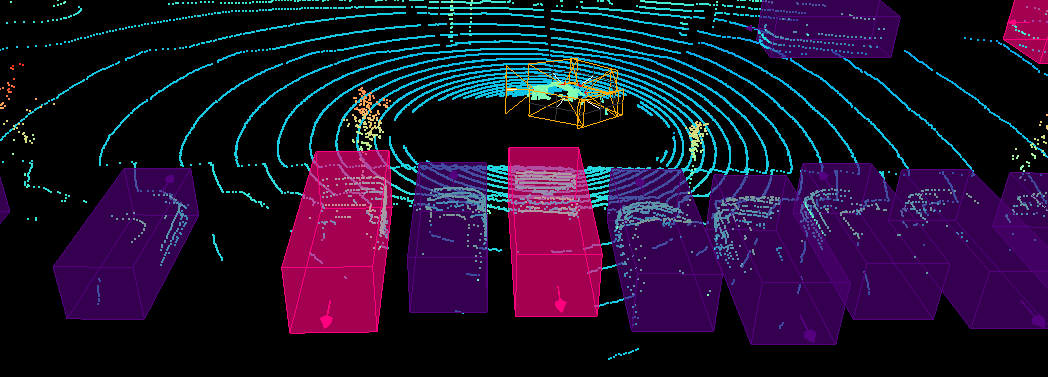
This report presents the design and implementation of a semi-automated data annotation pipeline developed within the DARTS project, whose goal is to create a large-scale, multimodal dataset of driving scenarios recorded in Polish conditions. Manual annotation of such heterogeneous data is both costly and time-consuming. To address this challenge, the proposed solution adopts a human-in-the-loop approach that combines artificial intelligence with human expertise to reduce annotation cost and duration. The system automatically generates initial annotations, enables iterative model retraining, and incorporates data anonymization and domain adaptation techniques. At its core, the tool relies on 3D object detection algorithms to produce preliminary annotations. Overall, the developed tools and methodology result in substantial time savings while ensuring consistent, high-quality annotations across different sensor modalities. The solution directly supports the DARTS project by accelerating the preparation of large annotated dataset in the project s standardized format, strengthening the technological base for autonomous vehicle research in Poland.
paper research
Semi-overlapping Multi-bandit Best Arm Identification for Sequential Support Network Learning

Semi-overlapping Multi-bandit Best Arm Identification for Sequential Support Network Learning

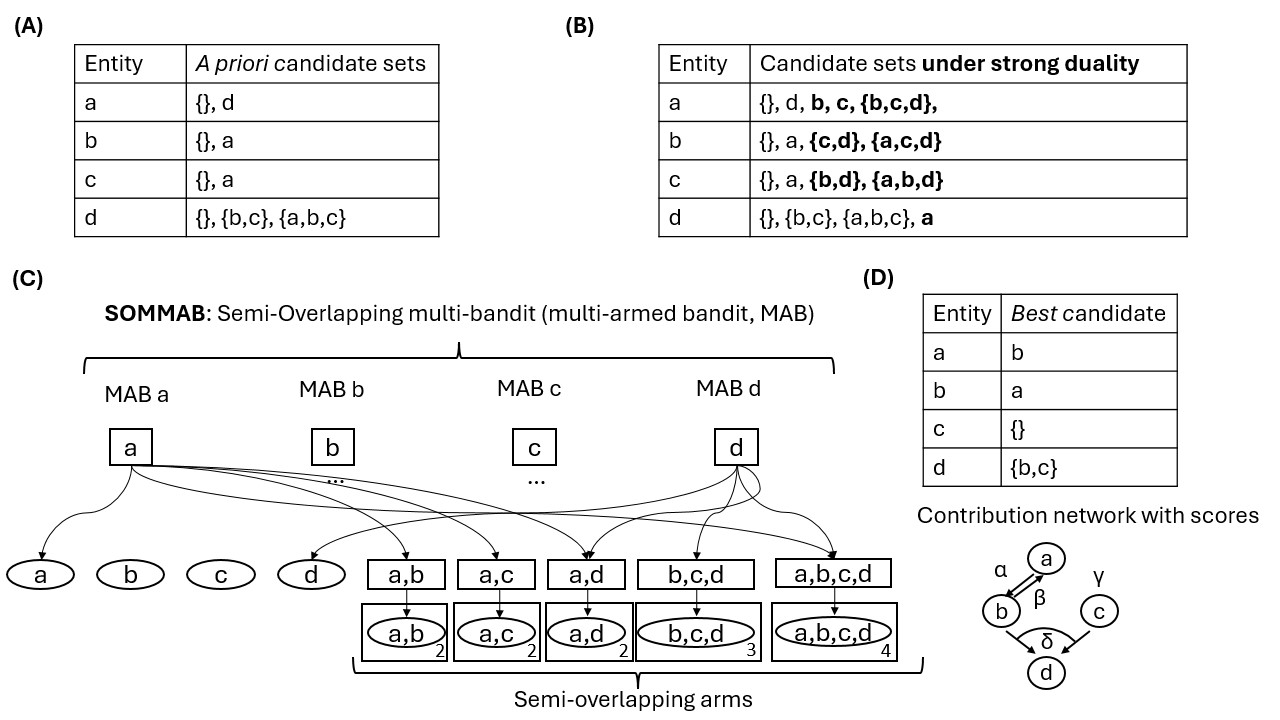
Many modern AI and ML problems require evaluating partners contributions through shared yet asymmetric, computationally intensive processes and the simultaneous selection of the most beneficial candidates. Sequential approaches to these problems can be unified under a new framework, Sequential Support Network Learning (SSNL), in which the goal is to select the most beneficial candidate set of partners for all participants using trials; that is, to learn a directed graph that represents the highest-performing contributions. We demonstrate that a new pure-exploration model, the semi-overlapping multi-(multi-armed) bandit (SOMMAB), in which a single evaluation provides distinct feedback to multiple bandits due to structural overlap among their arms, can be used to learn a support network from sparse candidate lists efficiently. We develop a generalized GapE algorithm for SOMMABs and derive new exponential error bounds that improve the best known constant in the exponent for multi-bandit best-arm identification. The bounds scale linearly with the degree of overlap, revealing significant sample-complexity gains arising from shared evaluations. From an application point of view, this work provides a theoretical foundation and improved performance guarantees for sequential learning tools for identifying support networks from sparse candidates in multiple learning problems, such as in multi-task learning (MTL), auxiliary task learning (ATL), federated learning (FL), and in multi-agent systems (MAS).

paper research
SingingBot  An Avatar-Driven System for Robotic Face Singing Performance

SingingBot An Avatar-Driven System for Robotic Face Singing Performance

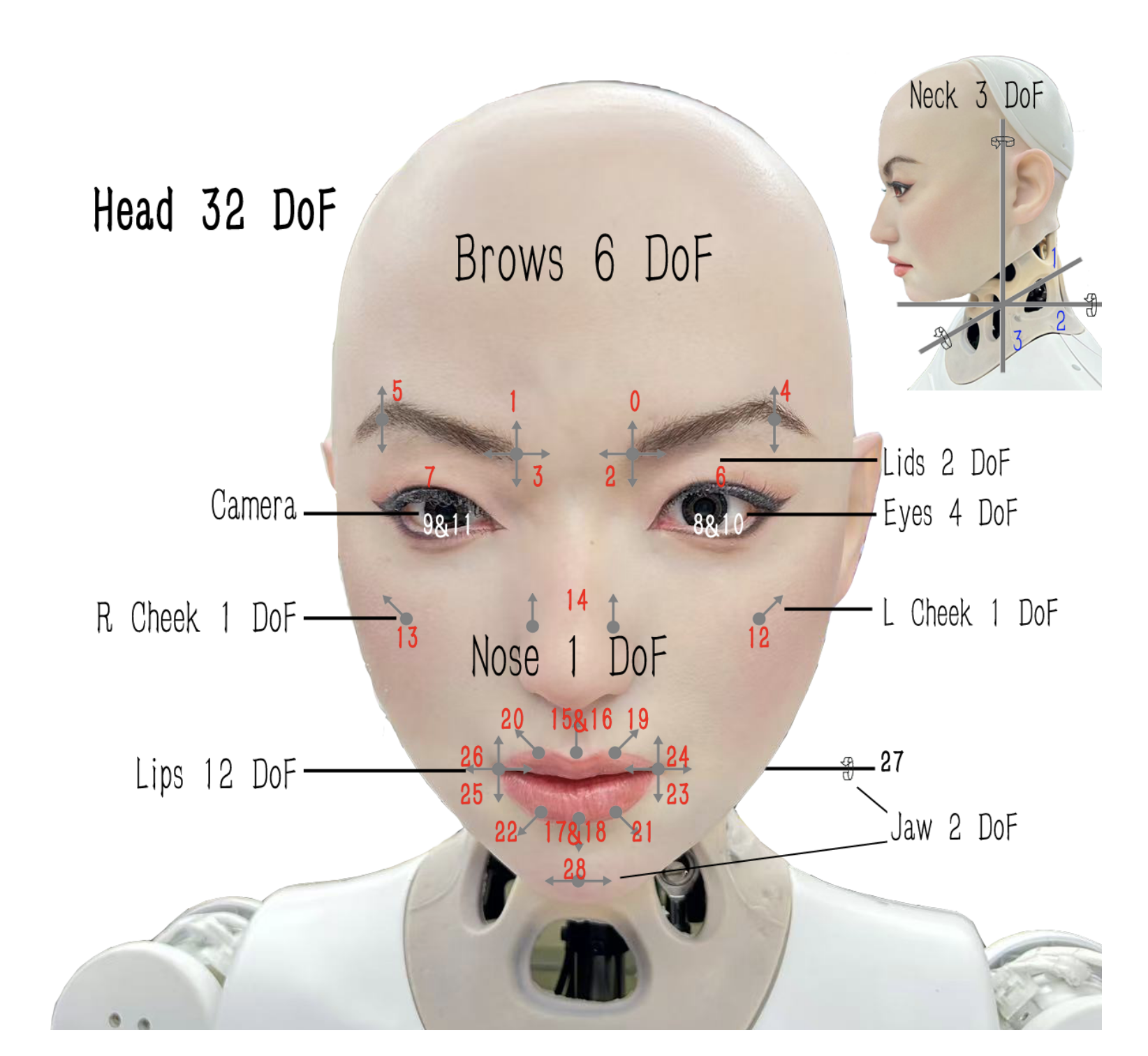
Equipping robotic faces with singing capabilities is crucial for empathetic Human-Robot Interaction. However, existing robotic face driving research primarily focuses on conversations or mimicking static expressions, struggling to meet the high demands for continuous emotional expression and coherence in singing. To address this, we propose a novel avatar-driven framework for appealing robotic singing. We first leverage portrait video generation models embedded with extensive human priors to synthesize vivid singing avatars, providing reliable expression and emotion guidance. Subsequently, these facial features are transferred to the robot via semantic-oriented mapping functions that span a wide expression space. Furthermore, to quantitatively evaluate the emotional richness of robotic singing, we propose the Emotion Dynamic Range metric to measure the emotional breadth within the Valence-Arousal space, revealing that a broad emotional spectrum is crucial for appealing performances. Comprehensive experiments prove that our method achieves rich emotional expressions while maintaining lip-audio synchronization, significantly outperforming existing approaches.

paper research
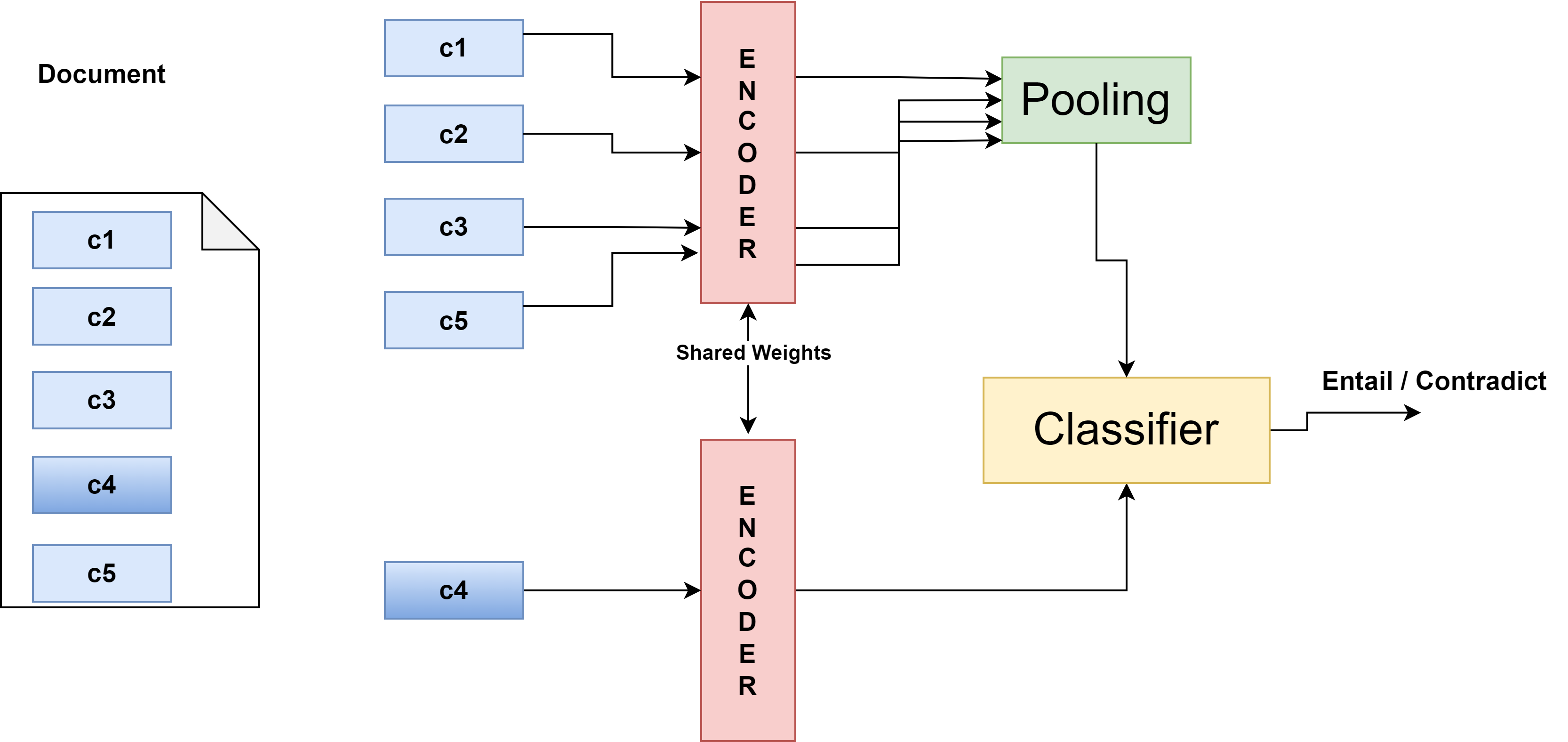
Skim-Aware Contrastive Learning for Efficient Document Representation

Skim-Aware Contrastive Learning for Efficient Document Representation

Although transformer-based models have shown strong performance in word- and sentence-level tasks, effectively representing long documents, especially in fields like law and medicine, remains difficult. Sparse attention mechanisms can handle longer inputs, but are resource-intensive and often fail to capture full-document context. Hierarchical transformer models offer better efficiency but do not clearly explain how they relate different sections of a document. In contrast, humans often skim texts, focusing on important sections to understand the overall message. Drawing from this human strategy, we introduce a new self-supervised contrastive learning framework that enhances long document representation. Our method randomly masks a section of the document and uses a natural language inference (NLI)-based contrastive objective to align it with relevant parts while distancing it from unrelated ones. This mimics how humans synthesize information, resulting in representations that are both richer and more computationally efficient. Experiments on legal and biomedical texts confirm significant gains in both accuracy and efficiency.

paper research
Slot-ID  Identity-Preserving Video Generation from Reference Videos via Slot-Based Temporal Identity Encoding

Slot-ID Identity-Preserving Video Generation from Reference Videos via Slot-Based Temporal Identity Encoding

Producing prompt-faithful videos that preserve a user-specified identity remains challenging models need to extrapolate facial dynamics from sparse reference while balancing the tension between identity preservation and motion naturalness. Conditioning on a single image completely ignores the temporal signature, which leads to pose-locked motions, unnatural warping, and average faces when viewpoints and expressions change. To this end, we introduce an identity-conditioned variant of a diffusion-transformer video generator which uses a short reference video rather than a single portrait. Our key idea is to incorporate the dynamics in the reference. A short clip reveals subject-specific patterns, e.g., how smiles form, across poses and lighting. From this clip, a Sinkhorn-routed encoder learns compact identity tokens that capture characteristic dynamics while remaining pretrained backbone-compatible. Despite adding only lightweight conditioning, the approach consistently improves identity retention under large pose changes and expressive facial behavior, while maintaining prompt faithfulness and visual realism across diverse subjects and prompts.

paper research
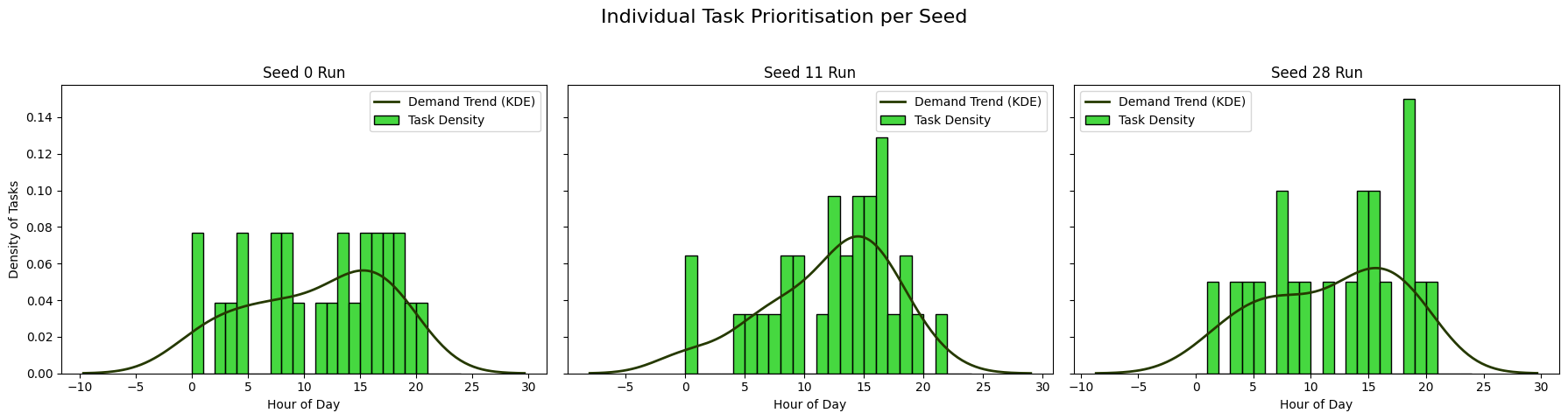
SmartFlow Reinforcement Learning and Agentic AI for Bike-Sharing Optimisation

SmartFlow Reinforcement Learning and Agentic AI for Bike-Sharing Optimisation

SmartFlow is a multi-layered framework that integrates Reinforcement Learning and Agentic AI to address the dynamic rebalancing problem in urban bike-sharing services. Its architecture separates strategic, tactical, and communication functions for clarity and scalability. At the strategic level, a Deep Q-Network (DQN) agent, trained in a high-fidelity simulation of New Yorks Citi Bike network, learns robust rebalancing policies by modelling the challenge as a Markov Decision Process. These high-level strategies feed into a deterministic tactical module that optimises multi-leg journeys and schedules just-in-time dispatches to minimise fleet travel. Evaluation across multiple seeded runs demonstrates SmartFlows high efficacy, reducing network imbalance by over 95% while requiring minimal travel distance and achieving strong truck utilisation. A communication layer, powered by a grounded Agentic AI with a Large Language Model (LLM), translates logistical plans into clear, actionable instructions for operational staff, ensuring interpretability and execution readiness. This integration bridges machine intelligence with human operations, offering a scalable solution that reduces idle time, improves bike availability, and lowers operational costs. SmartFlow provides a blueprint for interpretable, AI-driven logistics in complex urban mobility networks.

paper research
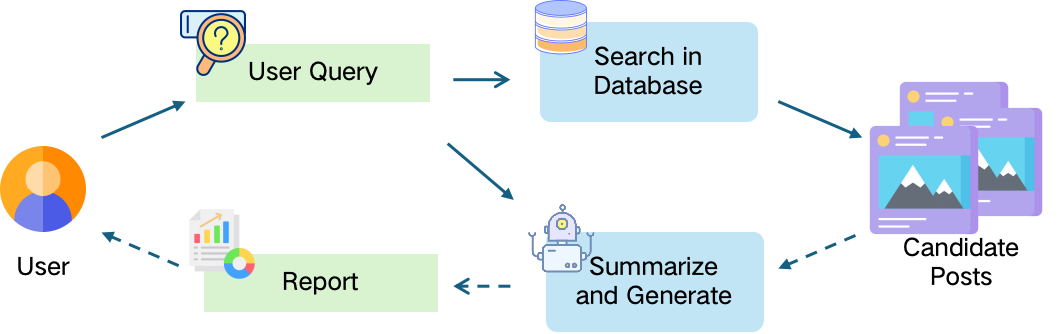
SoulSeek  Exploring the Use of Social Cues in LLM-based Information Seeking

SoulSeek Exploring the Use of Social Cues in LLM-based Information Seeking

Social cues, which convey others presence, behaviors, or identities, play a crucial role in human information seeking by helping individuals judge relevance and trustworthiness. However, existing LLM-based search systems primarily rely on semantic features, creating a misalignment with the socialized cognition underlying natural information seeking. To address this gap, we explore how the integration of social cues into LLM-based search influences users perceptions, experiences, and behaviors. Focusing on social media platforms that are beginning to adopt LLM-based search, we integrate design workshops, the implementation of the prototype system (SoulSeek), a between-subjects study, and mixed-method analyses to examine both outcome- and process-level findings. The workshop informs the prototype s cue-integrated design. The study shows that social cues improve perceived outcomes and experiences, promote reflective information behaviors, and reveal limits of current LLM-based search. We propose design implications emphasizing better social-knowledge understanding, personalized cue settings, and controllable interactions.

paper research
SpaceTimePilot  Generative Rendering of Dynamic Scenes Across Space and Time

SpaceTimePilot Generative Rendering of Dynamic Scenes Across Space and Time

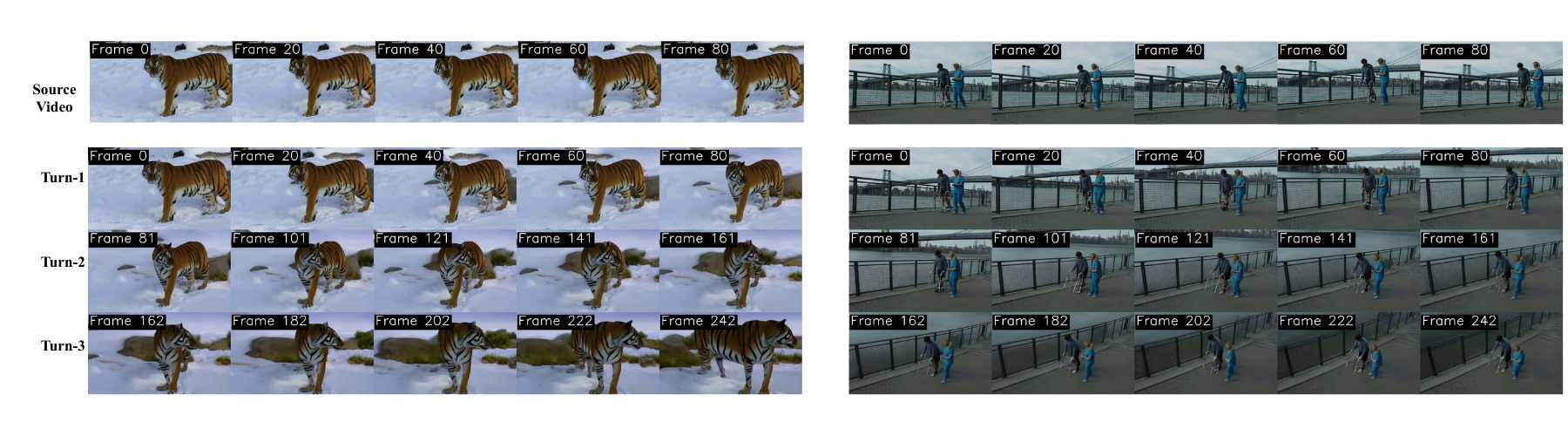
We present SpaceTimePilot, a video diffusion model that disentangles space and time for controllable generative rendering. Given a monocular video, SpaceTimePilot can independently alter the camera viewpoint and the motion sequence within the generative process, re-rendering the scene for continuous and arbitrary exploration across space and time. To achieve this, we introduce an effective animation time-embedding mechanism in the diffusion process, allowing explicit control of the output video s motion sequence with respect to that of the source video. As no datasets provide paired videos of the same dynamic scene with continuous temporal variations, we propose a simple yet effective temporal-warping training scheme that repurposes existing multi-view datasets to mimic temporal differences. This strategy effectively supervises the model to learn temporal control and achieve robust space-time disentanglement. To further enhance the precision of dual control, we introduce two additional components an improved camera-conditioning mechanism that allows altering the camera from the first frame, and CamxTime, the first synthetic space-and-time full-coverage rendering dataset that provides fully free space-time video trajectories within a scene. Joint training on the temporal-warping scheme and the CamxTime dataset yields more precise temporal control. We evaluate SpaceTimePilot on both real-world and synthetic data, demonstrating clear space-time disentanglement and strong results compared to prior work. Project page https //zheninghuang.github.io/Space-Time-Pilot/ Code https //github.com/ZheningHuang/spacetimepilot

paper research
Sparse Threats, Focused Defense  Criticality-Aware Robust Reinforcement Learning for Safe Autonomous Driving

Sparse Threats, Focused Defense Criticality-Aware Robust Reinforcement Learning for Safe Autonomous Driving

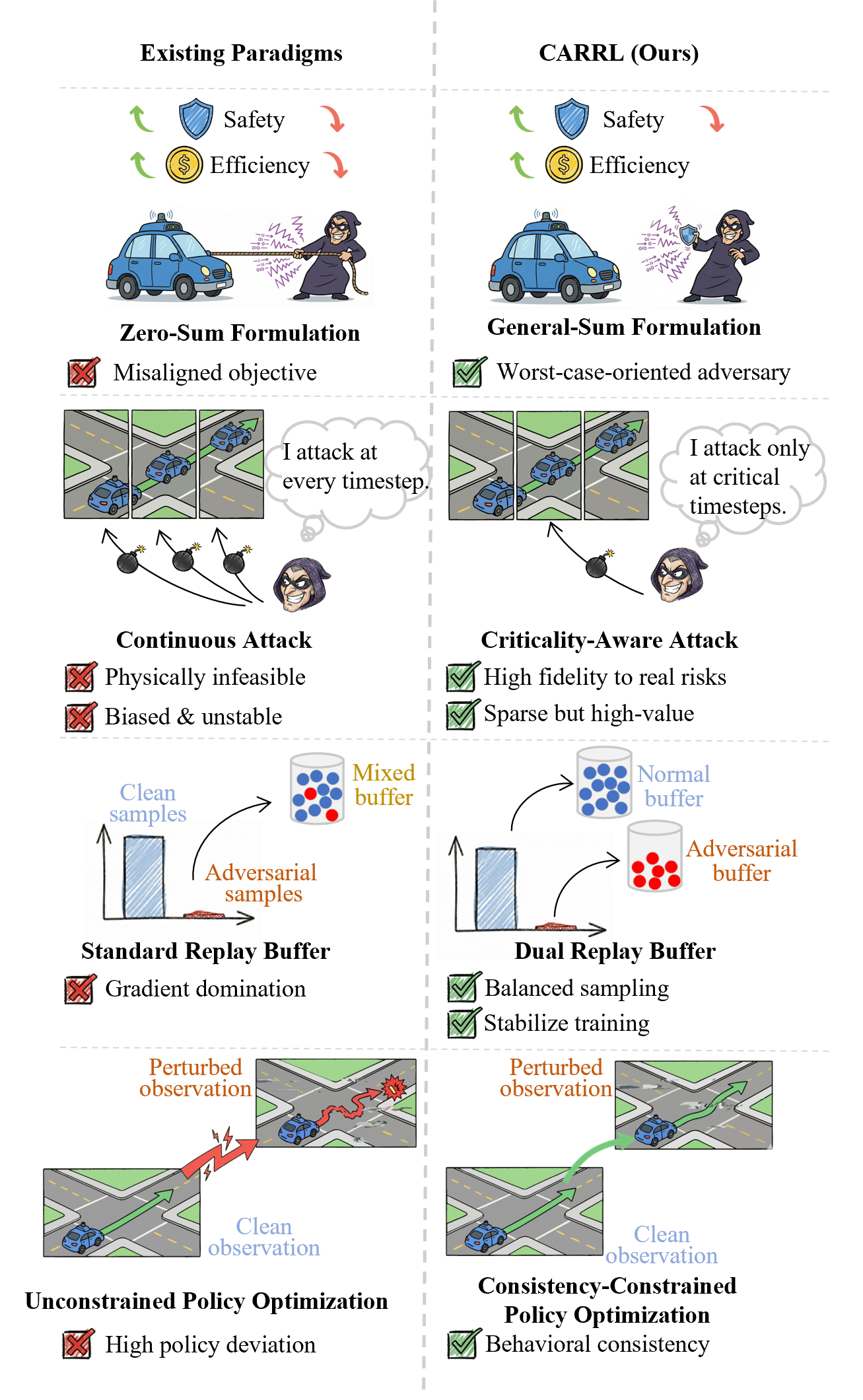
Reinforcement learning (RL) has shown considerable potential in autonomous driving (AD), yet its vulnerability to perturbations remains a critical barrier to real-world deployment. As a primary countermeasure, adversarial training improves policy robustness by training the AD agent in the presence of an adversary that deliberately introduces perturbations. Existing approaches typically model the interaction as a zero-sum game with continuous attacks. However, such designs overlook the inherent asymmetry between the agent and the adversary and then fail to reflect the sparsity of safety-critical risks, rendering the achieved robustness inadequate for practical AD scenarios. To address these limitations, we introduce criticality-aware robust RL (CARRL), a novel adversarial training approach for handling sparse, safety-critical risks in autonomous driving. CARRL consists of two interacting components a risk exposure adversary (REA) and a risk-targeted robust agent (RTRA). We model the interaction between the REA and RTRA as a general-sum game, allowing the REA to focus on exposing safety-critical failures (e.g., collisions) while the RTRA learns to balance safety with driving efficiency. The REA employs a decoupled optimization mechanism to better identify and exploit sparse safety-critical moments under a constrained budget. However, such focused attacks inevitably result in a scarcity of adversarial data. The RTRA copes with this scarcity by jointly leveraging benign and adversarial experiences via a dual replay buffer and enforces policy consistency under perturbations to stabilize behavior. Experimental results demonstrate that our approach reduces the collision rate by at least 22.66 % across all cases compared to state-of-the-art baseline methods.

paper research
SPoRC-VIST  A Benchmark for Evaluating Generative Natural Narrative in Vision-Language Models

SPoRC-VIST A Benchmark for Evaluating Generative Natural Narrative in Vision-Language Models

Vision-Language Models (VLMs) have achieved remarkable success in descriptive tasks such as image captioning and visual question answering (VQA). However, their ability to generate engaging, long-form narratives -- specifically multi-speaker podcast dialogues -- remains under-explored and difficult to evaluate. Standard metrics like BLEU and ROUGE fail to capture the nuances of conversational naturalness, personality, and narrative flow, often rewarding safe, repetitive outputs over engaging storytelling. In this work, we present a novel pipeline for end-to-end visual podcast generation, and fine-tune a Qwen3-VL-32B model on a curated dataset of 4,000 image-dialogue pairs. Crucially, we use a synthetic-to-real training strategy we train on high-quality podcast dialogues from the Structured Podcast Research Corpus (SPoRC) paired with synthetically generated imagery, and evaluate on real-world photo sequences from the Visual Storytelling Dataset (VIST). This rigorous setup tests the model s ability to generalize from synthetic training data to real-world visual domains. We propose a comprehensive evaluation framework that moves beyond textual overlap, and use AI-as-a-judge (Gemini 3 Pro, Claude Opus 4.5, GPT 5.2) and novel style metrics (average turn length, speaker switch rate) to assess quality. Our experiments demonstrate that our fine-tuned 32B model significantly outperforms a 235B base model in conversational naturalness ($>$80 % win rate) and narrative depth (+50 % turn length), while maintaining identical visual grounding capabilities (CLIPScore 20.39).

paper research
No Image

Stronger Approximation Guarantees for Non-Monotone γ-Weakly DR-Submodular Maximization

Maximizing submodular objectives under constraints is a fundamental problem in machine learning and optimization. We study the maximization of a nonnegative, non-monotone $γ$-weakly DR-submodular function over a down-closed convex body. Our main result is an approximation algorithm whose guarantee depends smoothly on $γ$; in particular, when $γ=1$ (the DR-submodular case) our bound recovers the $0.401$ approximation factor, while for $γ<1$ the guarantee degrades gracefully and, it improves upon previously reported bounds for $γ$-weakly DR-submodular maximization under the same constraints. Our approach combines a Frank-Wolfe-guided continuous-greedy framework with a $γ$-aware double-greedy step, yielding a simple yet effective procedure for handling non-monotonicity. This results in state-of-the-art guarantees for non-monotone $γ$-weakly DR-submodular maximization over down-closed convex bodies.

paper research
Stylometry Analysis of Human and Machine Text for Academic Integrity

Stylometry Analysis of Human and Machine Text for Academic Integrity

This work addresses critical challenges to academic integrity, including plagiarism, fabrication, and verification of authorship of educational content, by proposing a Natural Language Processing (NLP)-based framework for authenticating students content through author attribution and style change detection. Despite some initial efforts, several aspects of the topic are yet to be explored. In contrast to existing solutions, the paper provides a comprehensive analysis of the topic by targeting four relevant tasks, including (i) classification of human and machine text, (ii) differentiating in single and multi-authored documents, (iii) author change detection within multi-authored documents, and (iv) author recognition in collaboratively produced documents. The solutions proposed for the tasks are evaluated on two datasets generated with Gemini using two different prompts, including a normal and a strict set of instructions. During experiments, some reduction in the performance of the proposed solutions is observed on the dataset generated through the strict prompt, demonstrating the complexities involved in detecting machine-generated text with cleverly crafted prompts. The generated datasets, code, and other relevant materials are made publicly available on GitHub, which are expected to provide a baseline for future research in the domain.
paper research
Surprisal and Metaphor Novelty Judgments  Moderate Correlations and Divergent Scaling Effects Revealed by Corpus-Based and Synthetic Datasets

Surprisal and Metaphor Novelty Judgments Moderate Correlations and Divergent Scaling Effects Revealed by Corpus-Based and Synthetic Datasets

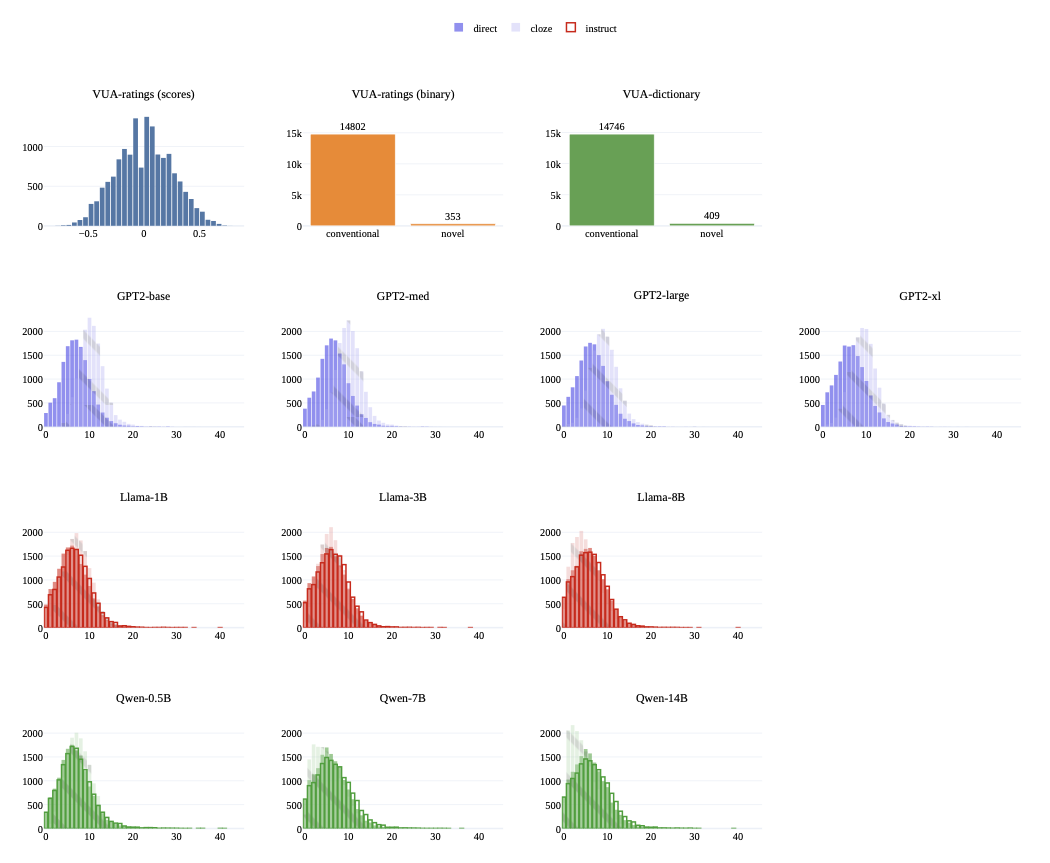
Novel metaphor comprehension involves complex semantic processes and linguistic creativity, making it an interesting task for studying language models (LMs). This study investigates whether surprisal, a probabilistic measure of predictability in LMs, correlates with annotations of metaphor novelty in different datasets. We analyse the surprisal of metaphoric words in corpus-based and synthetic metaphor datasets using 16 causal LM variants. We propose a cloze-style surprisal method that conditions on full-sentence context. Results show that LM surprisal yields significant moderate correlations with scores/labels of metaphor novelty. We further identify divergent scaling patterns on corpus-based data, correlation strength decreases with model size (inverse scaling effect), whereas on synthetic data it increases (quality-power hypothesis). We conclude that while surprisal can partially account for annotations of metaphor novelty, it remains limited as a metric of linguistic creativity. Code and data are publicly available https //github.com/OmarMomen14/surprisal-metaphor-novelty

paper research
SwinIFS  Landmark Guided Swin Transformer For Identity Preserving Face Super Resolution

SwinIFS Landmark Guided Swin Transformer For Identity Preserving Face Super Resolution

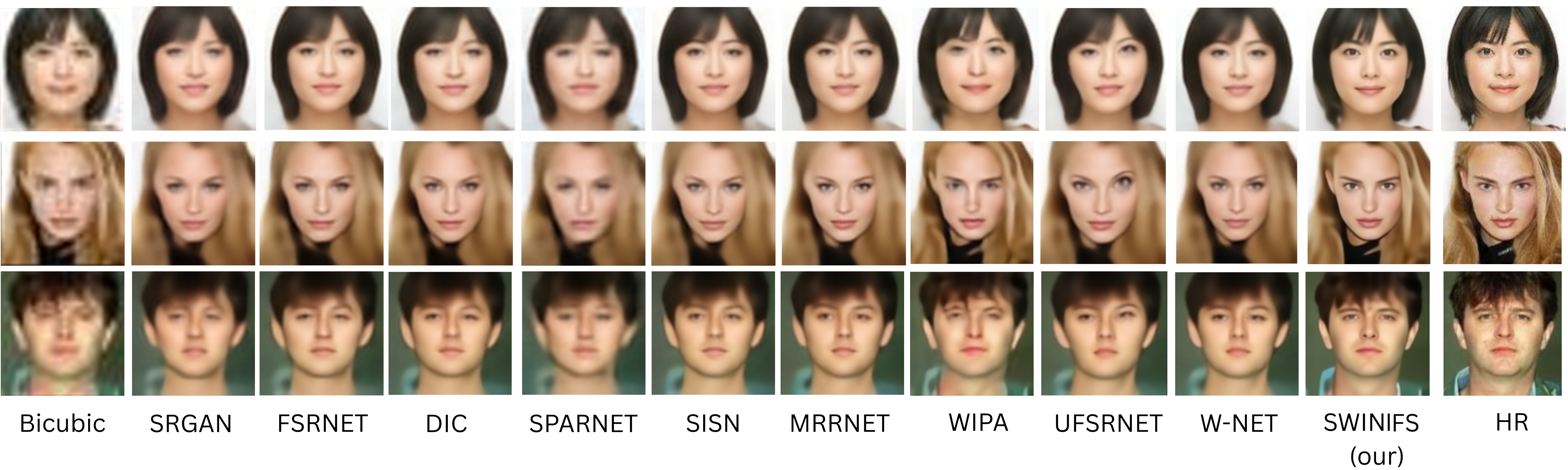
Face super-resolution aims to recover high-quality facial images from severely degraded low-resolution inputs, but remains challenging due to the loss of fine structural details and identity-specific features. This work introduces SwinIFS, a landmark-guided super-resolution framework that integrates structural priors with hierarchical attention mechanisms to achieve identity-preserving reconstruction at both moderate and extreme upscaling factors. The method incorporates dense Gaussian heatmaps of key facial landmarks into the input representation, enabling the network to focus on semantically important facial regions from the earliest stages of processing. A compact Swin Transformer backbone is employed to capture long-range contextual information while preserving local geometry, allowing the model to restore subtle facial textures and maintain global structural consistency. Extensive experiments on the CelebA benchmark demonstrate that SwinIFS achieves superior perceptual quality, sharper reconstructions, and improved identity retention; it consistently produces more photorealistic results and exhibits strong performance even under 8x magnification, where most methods fail to recover meaningful structure. SwinIFS also provides an advantageous balance between reconstruction accuracy and computational efficiency, making it suitable for real-world applications in facial enhancement, surveillance, and digital restoration. Our code, model weights, and results are available at https //github.com/Habiba123-stack/SwinIFS.

paper research
SymSeqBench  a unified framework for the generation and analysis of rule-based symbolic sequences and datasets

SymSeqBench a unified framework for the generation and analysis of rule-based symbolic sequences and datasets

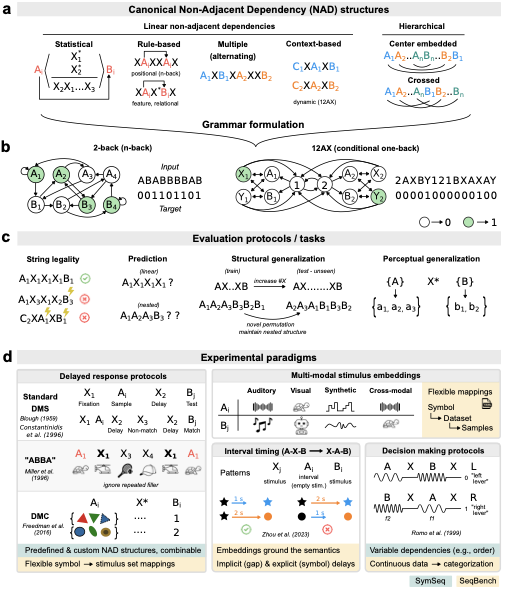
Sequential structure is a key feature of multiple domains of natural cognition and behavior, such as language, movement and decision-making. Likewise, it is also a central property of tasks to which we would like to apply artificial intelligence. It is therefore of great importance to develop frameworks that allow us to evaluate sequence learning and processing in a domain agnostic fashion, whilst simultaneously providing a link to formal theories of computation and computability. To address this need, we introduce two complementary software tools SymSeq, designed to rigorously generate and analyze structured symbolic sequences, and SeqBench, a comprehensive benchmark suite of rule-based sequence processing tasks to evaluate the performance of artificial learning systems in cognitively relevant domains. In combination, SymSeqBench offers versatility in investigating sequential structure across diverse knowledge domains, including experimental psycholinguistics, cognitive psychology, behavioral analysis, neuromorphic computing and artificial intelligence. Due to its basis in Formal Language Theory (FLT), SymSeqBench provides researchers in multiple domains with a convenient and practical way to apply the concepts of FLT to conceptualize and standardize their experiments, thus advancing our understanding of cognition and behavior through shared computational frameworks and formalisms. The tool is modular, openly available and accessible to the research community.

paper research
SynRAG  A Large Language Model Framework for Executable Query Generation in Heterogeneous SIEM Systems

SynRAG A Large Language Model Framework for Executable Query Generation in Heterogeneous SIEM Systems

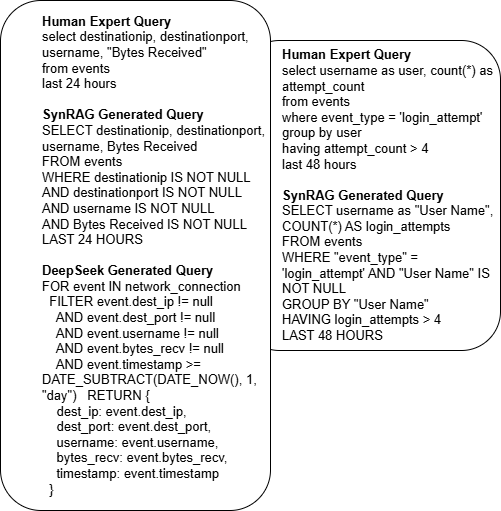
Security Information and Event Management (SIEM) systems are essential for large enterprises to monitor their IT infrastructure by ingesting and analyzing millions of logs and events daily. Security Operations Center (SOC) analysts are tasked with monitoring and analyzing this vast data to identify potential threats and take preventive actions to protect enterprise assets. However, the diversity among SIEM platforms, such as Palo Alto Networks Qradar, Google SecOps, Splunk, Microsoft Sentinel and the Elastic Stack, poses significant challenges. As these systems differ in attributes, architecture, and query languages, making it difficult for analysts to effectively monitor multiple platforms without undergoing extensive training or forcing enterprises to expand their workforce. To address this issue, we introduce SynRAG, a unified framework that automatically generates threat detection or incident investigation queries for multiple SIEM platforms from a platform-agnostic specification. SynRAG can generate platformspecific queries from a single high-level specification written by analysts. Without SynRAG, analysts would need to manually write separate queries for each SIEM platform, since query languages vary significantly across systems. This framework enables seamless threat detection and incident investigation across heterogeneous SIEM environments, reducing the need for specialized training and manual query translation. We evaluate SynRAG against state-of-the-art language models, including GPT, Llama, DeepSeek, Gemma, and Claude, using Qradar and SecOps as representative SIEM systems. Our results demonstrate that SynRAG generates significantly better queries for crossSIEM threat detection and incident investigation compared to the state-of-the-art base models.

paper research
T3C  Test-Time Tensor Compression with Consistency Guarantees

T3C Test-Time Tensor Compression with Consistency Guarantees

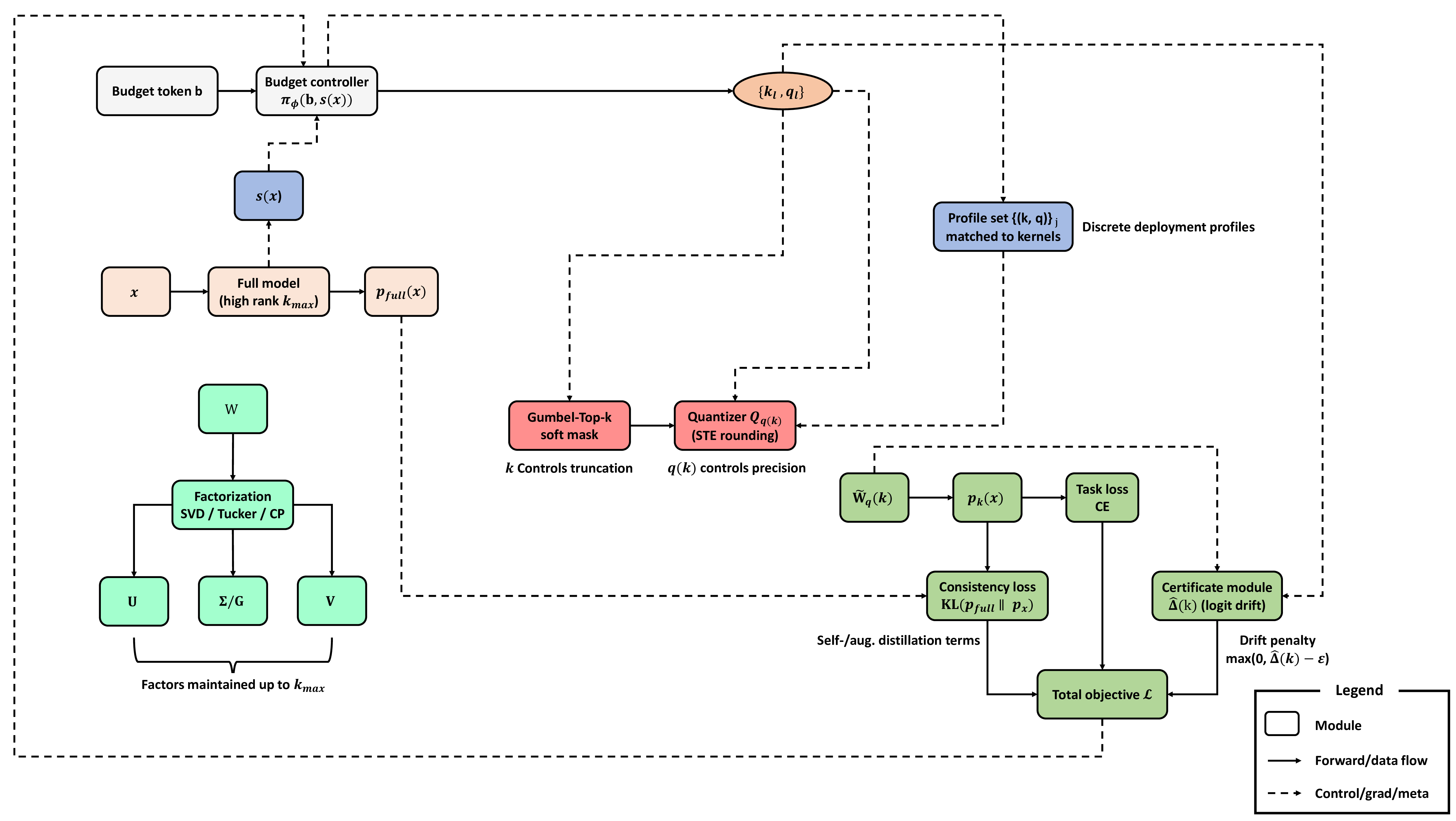
We present T3C, a train-once, test-time budget-conditioned compression framework that exposes rank and precision as a controllable deployment knob. T3C combines elastic tensor factorization (maintained up to a maximal rank) with rank-tied mixed-precision quantization and a lightweight controller that maps a latency/energy/size budget token to per-layer rank/bit assignments; the policy snaps to hardware-aligned profiles and is monotone in the budget. A fast, layerwise consistency certificate, computed from spectral proxies and activation statistics, upper-bounds logit drift and regularizes training, yielding a practical reliability signal with negligible overhead. On ImageNet-1k, T3C shifts the vision Pareto frontier for ResNet-50 at matched accuracy ( leq 0.5% drop), p50 latency is 1.18ms with a 38MB model, outperforming PTQ-8b (1.44ms, 88MB); for ViT-B/16, T3C reaches 2.30ms p50 with 59MB, improving over strong PTQ/QAT baselines. A single T3C checkpoint therefore provides predictable, certificate-backed accuracy-latency-size trade-offs on demand across devices.

paper research
Tackling the Inherent Difficulty of Noise Filtering in RAG

Tackling the Inherent Difficulty of Noise Filtering in RAG

Retrieval-Augmented Generation (RAG) has become a widely adopted approach to enhance Large Language Models (LLMs) by incorporating external knowledge and reducing hallucinations. However, noisy or irrelevant documents are often introduced during RAG, potentially degrading performance and even causing hallucinated outputs. While various methods have been proposed to filter out such noise, we argue that identifying irrelevant information from retrieved content is inherently difficult and limited number of transformer layers can hardly solve this. Consequently, retrievers fail to filter out irrelevant documents entirely. Therefore, LLMs must be robust against such noise, but we demonstrate that standard fine-tuning approaches are often ineffective in enabling the model to selectively utilize relevant information while ignoring irrelevant content due to the structural constraints of attention patterns. To address this, we propose a novel fine-tuning method designed to enhance the model s ability to distinguish between relevant and irrelevant information within retrieved documents. Extensive experiments across multiple benchmarks show that our approach significantly improves the robustness and performance of LLMs.

paper research
Temporal Attack Pattern Detection in Multi-Agent AI Workflows  An Open Framework for Training Trace-Based Security Models

Temporal Attack Pattern Detection in Multi-Agent AI Workflows An Open Framework for Training Trace-Based Security Models

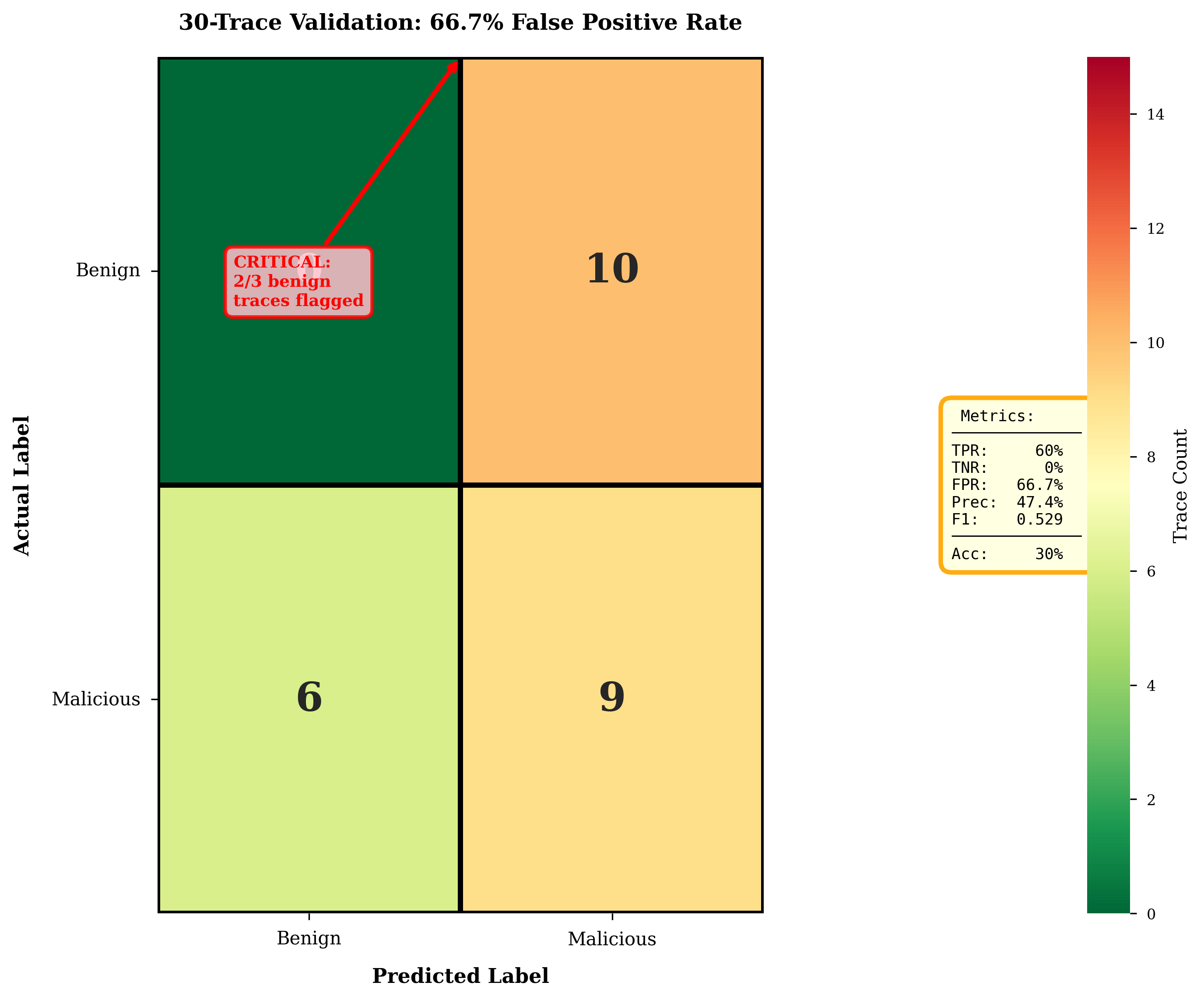
We present an openly documented methodology for fine-tuning language models to detect temporal attack patterns in multi-agent AI workflows using OpenTelemetry trace analysis. We curate a dataset of 80,851 examples from 18 public cybersecurity sources and 35,026 synthetic OpenTelemetry traces. We apply iterative QLoRA fine-tuning on resource-constrained ARM64 hardware (NVIDIA DGX Spark) through three training iterations with strategic augmentation. Our custom benchmark accuracy improves from 42.86% to 74.29%, a statistically significant 31.4-point gain. Targeted examples addressing specific knowledge gaps outperform indiscriminate scaling. Key contributions include (1) synthetic trace generation methodology for multi-agent coordination attacks and regulatory violations, (2) empirical evidence that training data composition fundamentally determines behavior, and (3) complete open release of datasets, training scripts, and evaluation benchmarks on HuggingFace. While practical deployment requires human oversight due to false positive rates, this work establishes the first reproducible framework enabling practitioners to build custom agentic security models adapted to their threat landscapes.

paper research
The Agentic Leash  Extracting Causal Feedback Fuzzy Cognitive Maps with LLMs

The Agentic Leash Extracting Causal Feedback Fuzzy Cognitive Maps with LLMs

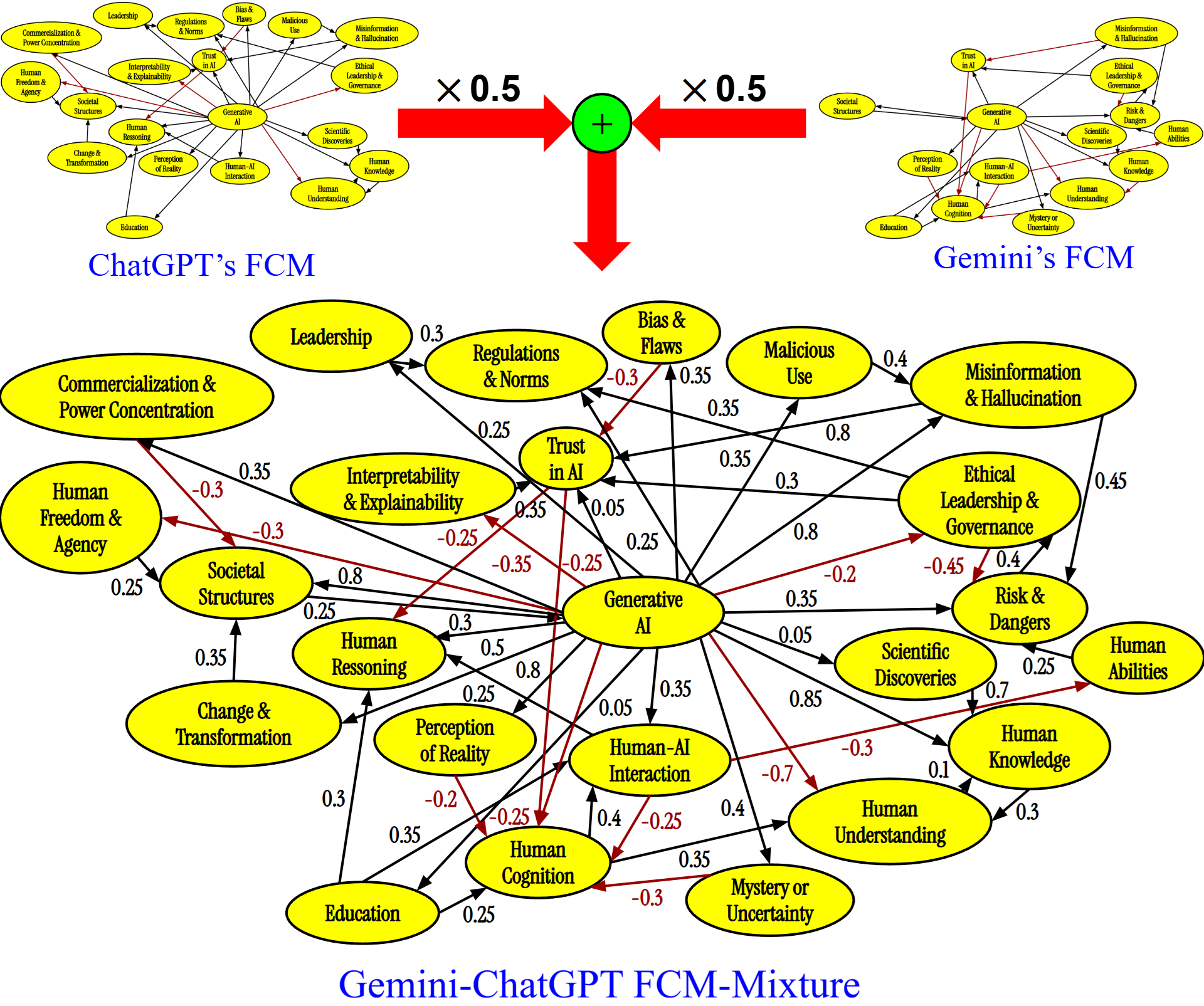
We design a large-language-model (LLM) agent that extracts causal feedback fuzzy cognitive maps (FCMs) from raw text. The causal learning or extraction process is agentic both because of the LLM s semi-autonomy and because ultimately the FCM dynamical system s equilibria drive the LLM agents to fetch and process causal text. The fetched text can in principle modify the adaptive FCM causal structure and so modify the source of its quasi-autonomy--its equilibrium limit cycles and fixed-point attractors. This bidirectional process endows the evolving FCM dynamical system with a degree of autonomy while still staying on its agentic leash. We show in particular that a sequence of three finely tuned system instructions guide an LLM agent as it systematically extracts key nouns and noun phrases from text, as it extracts FCM concept nodes from among those nouns and noun phrases, and then as it extracts or infers partial or fuzzy causal edges between those FCM nodes. We test this FCM generation on a recent essay about the promise of AI from the late diplomat and political theorist Henry Kissinger and his colleagues. This three-step process produced FCM dynamical systems that converged to the same equilibrium limit cycles as did the human-generated FCMs even though the human-generated FCM differed in the number of nodes and edges. A final FCM mixed generated FCMs from separate Gemini and ChatGPT LLM agents. The mixed FCM absorbed the equilibria of its dominant mixture component but also created new equilibria of its own to better approximate the underlying causal dynamical system.

paper research
The Generative AI Paradox  Erosion of Truth and Corrosion of Information Verification

The Generative AI Paradox Erosion of Truth and Corrosion of Information Verification

Generative AI (GenAI) now produces text, images, audio, and video that can be perceptually convincing at scale and at negligible marginal cost. While public debate often frames the associated harms as deepfakes or incremental extensions of misinformation and fraud, this view misses a broader socio-technical shift GenAI enables synthetic realities; coherent, interactive, and potentially personalized information environments in which content, identity, and social interaction are jointly manufactured and mutually reinforcing. We argue that the most consequential risk is not merely the production of isolated synthetic artifacts, but the progressive erosion of shared epistemic ground and institutional verification practices as synthetic content, synthetic identity, and synthetic interaction become easy to generate and hard to audit. This paper (i) formalizes synthetic reality as a layered stack (content, identity, interaction, institutions), (ii) expands a taxonomy of GenAI harms spanning personal, economic, informational, and socio-technical risks, (iii) articulates the qualitative shifts introduced by GenAI (cost collapse, throughput, customization, micro-segmentation, provenance gaps, and trust erosion), and (iv) synthesizes recent risk realizations (2023-2025) into a compact case bank illustrating how these mechanisms manifest in fraud, elections, harassment, documentation, and supply-chain compromise. We then propose a mitigation stack that treats provenance infrastructure, platform governance, institutional workflow redesign, and public resilience as complementary rather than substitutable, and outline a research agenda focused on measuring epistemic security. We conclude with the Generative AI Paradox as synthetic media becomes ubiquitous, societies may rationally discount digital evidence altogether.

paper research
The Illusion of Insight in Reasoning Models

The Illusion of Insight in Reasoning Models

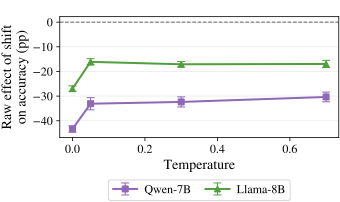
Do reasoning models have Aha! moments? Prior work suggests that models like DeepSeek-R1-Zero undergo sudden mid-trace realizations that lead to accurate outputs, implying an intrinsic capacity for self-correction. Yet, it remains unclear whether such intrinsic shifts in reasoning strategy actually improve performance. Here, we study mid-reasoning shifts and instrument training runs to detect them. Our analysis spans 1M+ reasoning traces, hundreds of training checkpoints, three reasoning domains, and multiple decoding temperatures and model architectures. We find that reasoning shifts are rare, do not become more frequent with training, and seldom improve accuracy, indicating that they do not correspond to prior perceptions of model insight. However, their effect varies with model uncertainty. Building on this finding, we show that artificially triggering extrinsic shifts under high entropy reliably improves accuracy. Our results show that mid-reasoning shifts are symptoms of unstable inference behavior rather than an intrinsic mechanism for self-correction.

paper research
The Impact of LLMs on Online News Consumption and Production

The Impact of LLMs on Online News Consumption and Production

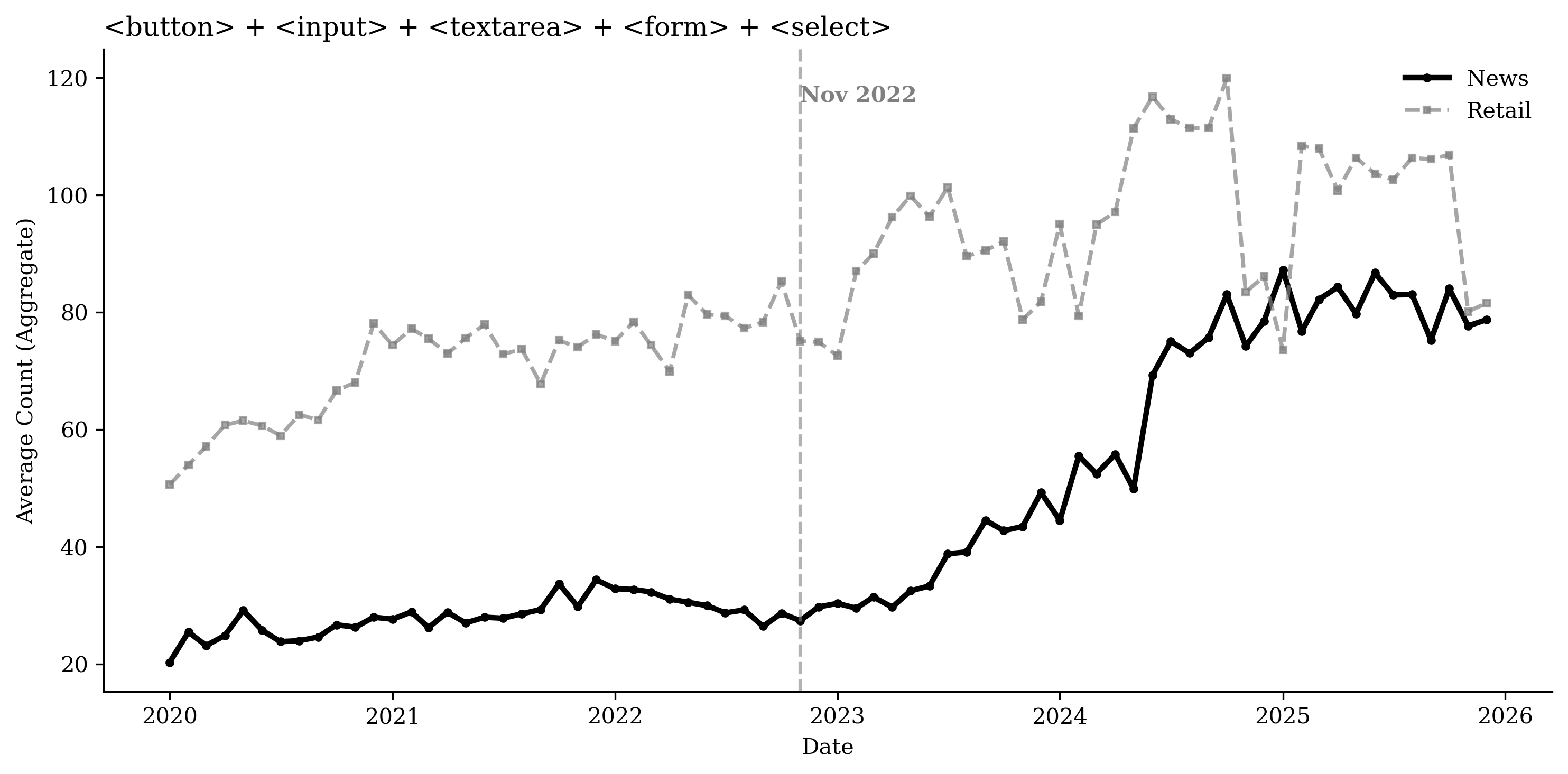
Large language models (LLMs) change how consumers acquire information online; their bots also crawl news publishers websites for training data and to answer consumer queries; and they provide tools that can lower the cost of content creation. These changes lead to predictions of adverse impact on news publishers in the form of lowered consumer demand, reduced demand for newsroom employees, and an increase in news slop. Consequently, some publishers strategically responded by blocking LLM access to their websites using the robots.txt file standard. Using high-frequency granular data, we document four effects related to the predicted shifts in news publishing following the introduction of generative AI (GenAI). First, we find a moderate decline in traffic to news publishers occurring after August 2024. Second, using a difference-in-differences approach, we find that blocking GenAI bots can be associated with a reduction of total website traffic to large publishers compared to not blocking. Third, on the hiring side, we do not find evidence that LLMs are replacing editorial or content-production jobs yet. The share of new editorial and content-production job listings increases over time. Fourth, regarding content production, we find no evidence that large publishers increased text volume; instead, they significantly increased rich content and use more advertising and targeting technologies. Together, these findings provide early evidence of some unforeseen impacts of the introduction of LLMs on news production and consumption.

paper research
The Invisible Hand of AI Libraries Shaping Open Source Projects and Communities

The Invisible Hand of AI Libraries Shaping Open Source Projects and Communities

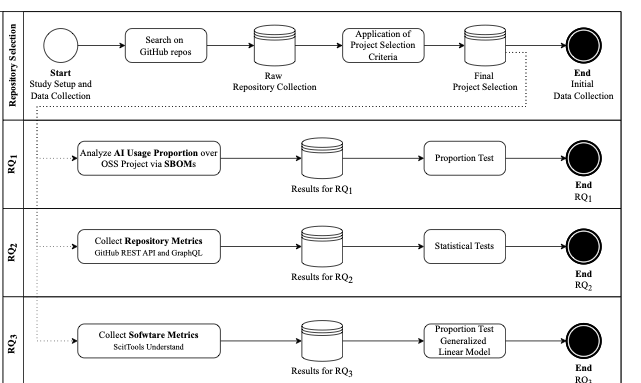
In the early 1980s, Open Source Software emerged as a revolutionary concept amidst the dominance of proprietary software. What began as a revolutionary idea has now become the cornerstone of computer science. Amidst OSS projects, AI is increasing its presence and relevance. However, despite the growing popularity of AI, its adoption and impacts on OSS projects remain underexplored. We aim to assess the adoption of AI libraries in Python and Java OSS projects and examine how they shape development, including the technical ecosystem and community engagement. To this end, we will perform a large-scale analysis on 157.7k potential OSS repositories, employing repository metrics and software metrics to compare projects adopting AI libraries against those that do not. We expect to identify measurable differences in development activity, community engagement, and code complexity between OSS projects that adopt AI libraries and those that do not, offering evidence-based insights into how AI integration reshapes software development practices.

paper research
No Image

The Logical Structure of Physical Laws A Fixed Point Reconstruction

We formalise the self referential definition of physical laws using monotone operators on a lattice of theories, resolving the pathologies of naive set theoretic formulations. By invoking Tarski fixed point theorem, we identify physical theories as least fixed points of admissibility constraints derived from Galois connections. We demonstrate that QED and General Relativity can be represented in such a logical structure with respect to their symmetry and locality principles.

paper research
The New Compiler Stack  A Survey on the Synergy of LLMs and Compilers

The New Compiler Stack A Survey on the Synergy of LLMs and Compilers

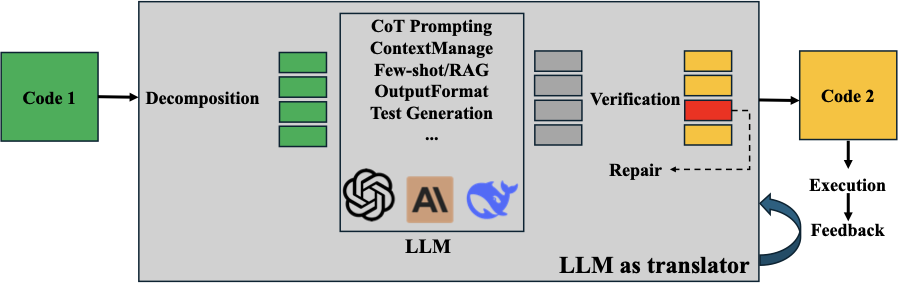
This survey has provided a systematic overview of the emerging field of LLM-enabled compilation by addressing several key research questions. We first answered how LLMs are being integrated by proposing a comprehensive, multi-dimensional taxonomy that categorizes works based on their Design Philosophy (Selector, Translator, Generator), LLM Methodology, their operational Level of Code Abstraction, and the specific Task Type they address. In answering what advancements these approaches offer, we identified three primary benefits the democratization of compiler development, the discovery of novel optimization strategies, and the broadening of the compiler s traditional scope. Finally, in addressing the field s challenges and opportunities, we highlighted the critical hurdles of ensuring correctness and achieving scalability, while identifying the development of hybrid systems as the most promising path forward. By providing these answers, this survey serves as a foundational roadmap for researchers and practitioners, charting the course for a new generation of LLM-powered, intelligent, adaptive and synergistic compilation tools.

paper research
No Image

The Optimal Sample Complexity of Linear Contracts

In this paper, we settle the problem of learning optimal linear contracts from data in the offline setting, where agent types are drawn from an unknown distribution and the principal s goal is to design a contract that maximizes her expected utility. Specifically, our analysis shows that the simple Empirical Utility Maximization (EUM) algorithm yields an $ varepsilon$-approximation of the optimal linear contract with probability at least $1-δ$, using just $O( ln(1/δ) / varepsilon^2)$ samples. This result improves upon previously known bounds and matches a lower bound from Duetting et al. [2025] up to constant factors, thereby proving its optimality. Our analysis uses a chaining argument, where the key insight is to leverage a simple structural property of linear contracts their expected reward is non-decreasing. This property, which holds even though the utility function itself is non-monotone and discontinuous, enables the construction of fine-grained nets required for the chaining argument, which in turn yields the optimal sample complexity. Furthermore, our proof establishes the stronger guarantee of uniform convergence the empirical utility of every linear contract is a $ varepsilon$-approximation of its true expectation with probability at least $1-δ$, using the same optimal $O( ln(1/δ) / varepsilon^2)$ sample complexity.

paper research
No Image

The Silicon Psyche Anthropomorphic Vulnerabilities in Large Language Models

Large Language Models (LLMs) are rapidly transitioning from conversational assistants to autonomous agents embedded in critical organizational functions, including Security Operations Centers (SOCs), financial systems, and infrastructure management. Current adversarial testing paradigms focus predominantly on technical attack vectors prompt injection, jailbreaking, and data exfiltration. We argue this focus is catastrophically incomplete. LLMs, trained on vast corpora of human-generated text, have inherited not merely human knowledge but human textit{psychological architecture} -- including the pre-cognitive vulnerabilities that render humans susceptible to social engineering, authority manipulation, and affective exploitation. This paper presents the first systematic application of the Cybersecurity Psychology Framework ( cpf{}), a 100-indicator taxonomy of human psychological vulnerabilities, to non-human cognitive agents. We introduce the textbf{Synthetic Psychometric Assessment Protocol} ( sysname{}), a methodology for converting cpf{} indicators into adversarial scenarios targeting LLM decision-making. Our preliminary hypothesis testing across seven major LLM families reveals a disturbing pattern while models demonstrate robust defenses against traditional jailbreaks, they exhibit critical susceptibility to authority-gradient manipulation, temporal pressure exploitation, and convergent-state attacks that mirror human cognitive failure modes. We term this phenomenon textbf{Anthropomorphic Vulnerability Inheritance} (AVI) and propose that the security community must urgently develop ``psychological firewalls -- intervention mechanisms adapted from the Cybersecurity Psychology Intervention Framework ( cpif{}) -- to protect AI agents operating in adversarial environments.

paper research
The Two-Stage Decision-Sampling Hypothesis  Understanding the Emergence of Self-Reflection in RL-Trained LLMs

The Two-Stage Decision-Sampling Hypothesis Understanding the Emergence of Self-Reflection in RL-Trained LLMs

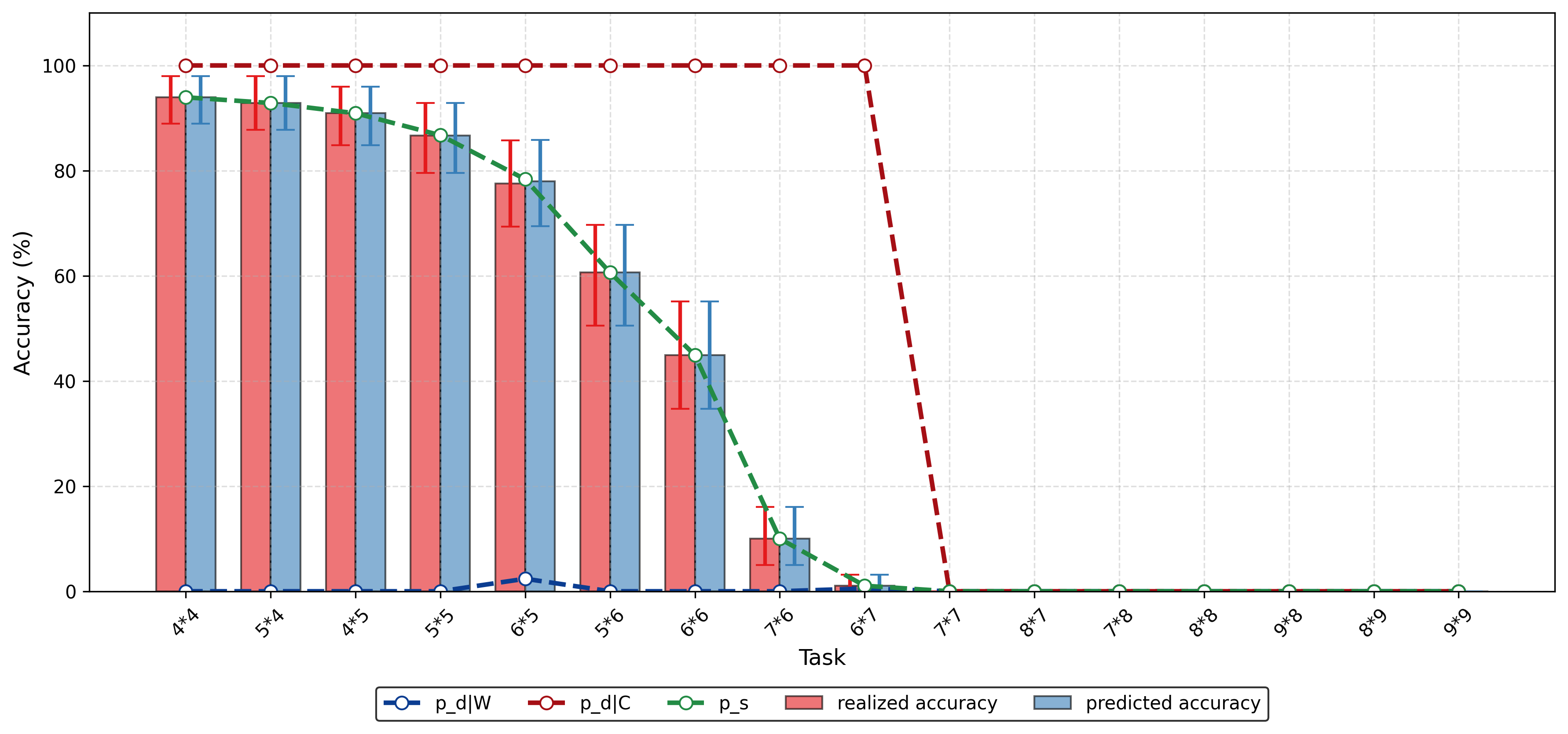
Self-reflection capabilities emerge in Large Language Models after RL post-training, with multi-turn RL achieving substantial gains over SFT counterparts. Yet the mechanism of how a unified optimization objective gives rise to functionally distinct capabilities of generating solutions and evaluating when to revise them remains opaque. To address this question, we introduce the Gradient Attribution Property to characterize how reward gradients distribute across policy components, formalized through the Two-Stage Decision-Sampling (DS) Hypothesis, which decomposes the policy into sampling ($Ï€_{sample}$) for generation and decision ($Ï€_{d}$) for verification. We prove that surrogate rewards exhibit Balanced Gradient Attribution, while SFT and KL penalties exhibit Unbalanced Gradient Attribution, with length-weighting creating asymmetric regularization that constrains $Ï€_{sample}$ while leaving $Ï€_{d}$ under-optimized, providing an theoretical explanation of why RL succeeds where SFT fails. We also empirically validate our theoretical predictions on arithmetic reasoning demonstrates that RL s superior generalization stems primarily from improved decision-making ($Ï€_{d}$) rather than sampling capabilities, providing a first-principles mechanistic explanation for self-correction in thinking models.

paper research
Theoretical Convergence of SMOTE-Generated Samples

Theoretical Convergence of SMOTE-Generated Samples

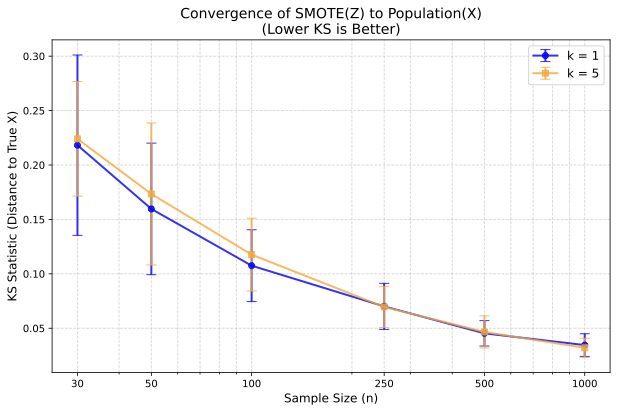
Imbalanced data affects a wide range of machine learning applications, from healthcare to network security. As SMOTE is one of the most popular approaches to addressing this issue, it is imperative to validate it not only empirically but also theoretically. In this paper, we provide a rigorous theoretical analysis of SMOTE s convergence properties. Concretely, we prove that the synthetic random variable Z converges in probability to the underlying random variable X. We further prove a stronger convergence in mean when X is compact. Finally, we show that lower values of the nearest neighbor rank lead to faster convergence offering actionable guidance to practitioners. The theoretical results are supported by numerical experiments using both real-life and synthetic data. Our work provides a foundational understanding that enhances data augmentation techniques beyond imbalanced data scenarios.

paper research
Tubular Riemannian Laplace Approximations for Bayesian Neural Networks

Tubular Riemannian Laplace Approximations for Bayesian Neural Networks

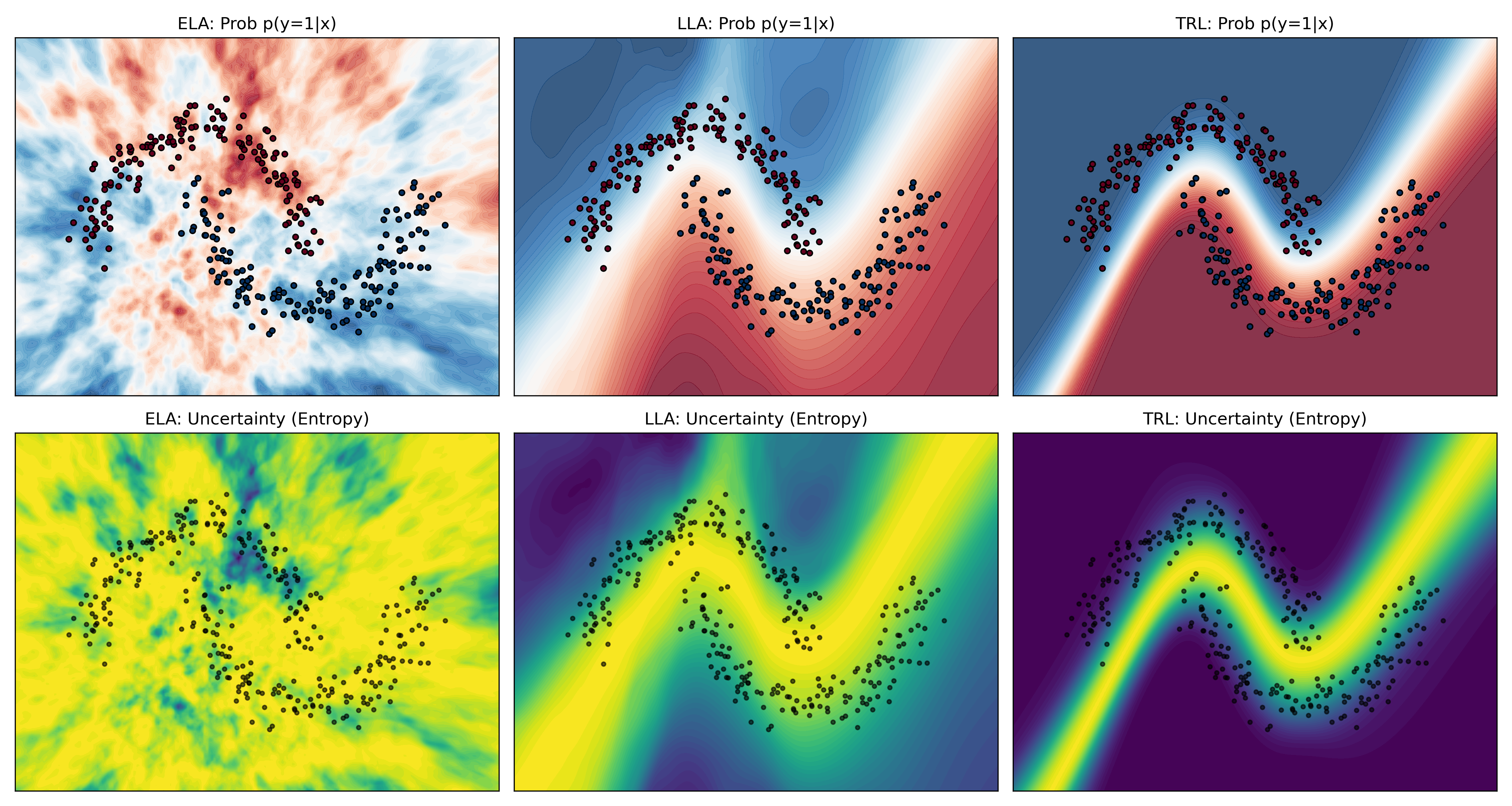
Laplace approximations are among the simplest and most practical methods for approximate Bayesian inference in neural networks, yet their Euclidean formulation struggles with the highly anisotropic, curved loss surfaces and large symmetry groups that characterize modern deep models. Recent work has proposed Riemannian and geometric Gaussian approximations to adapt to this structure. Building on these ideas, we introduce the Tubular Riemannian Laplace (TRL) approximation. TRL explicitly models the posterior as a probabilistic tube that follows a low-loss valley induced by functional symmetries, using a Fisher/Gauss-Newton metric to separate prior-dominated tangential uncertainty from data-dominated transverse uncertainty. We interpret TRL as a scalable reparametrised Gaussian approximation that utilizes implicit curvature estimates to operate in high-dimensional parameter spaces. Our empirical evaluation on ResNet-18 (CIFAR-10 and CIFAR-100) demonstrates that TRL achieves excellent calibration, matching or exceeding the reliability of Deep Ensembles (in terms of ECE) while requiring only a fraction (1/5) of the training cost. TRL effectively bridges the gap between single-model efficiency and ensemble-grade reliability.

paper research
UltraEval-Audio  A Unified Framework for Comprehensive Evaluation of Audio Foundation Models

UltraEval-Audio A Unified Framework for Comprehensive Evaluation of Audio Foundation Models

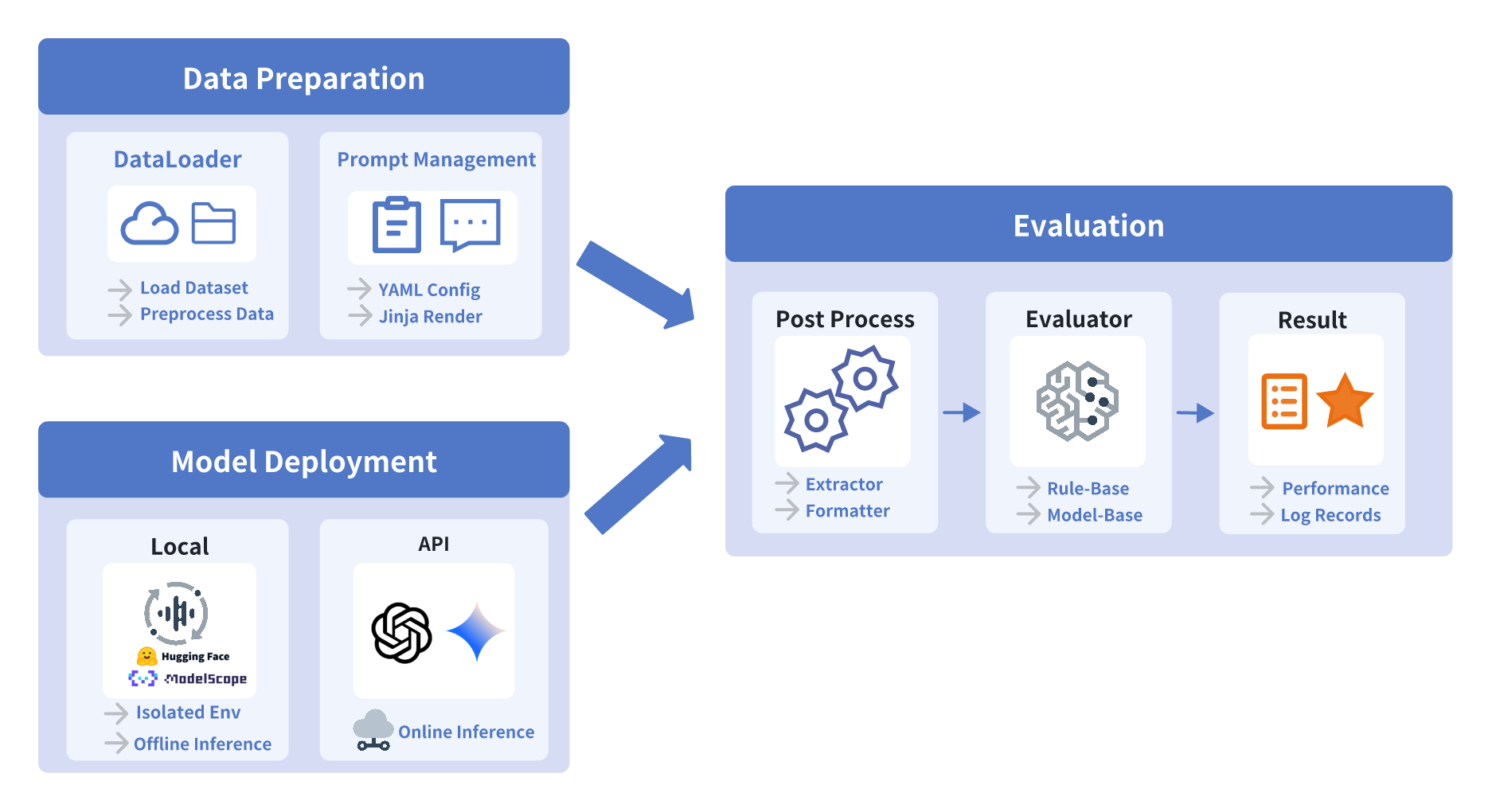
The development of audio foundation models has accelerated rapidly since the emergence of GPT-4o. However, the lack of comprehensive evaluation has become a critical bottleneck for further progress in the field, particularly in audio generation. Current audio evaluation faces three major challenges (1) audio evaluation lacks a unified framework, with datasets and code scattered across various sources, hindering fair and efficient cross-model comparison;(2) audio codecs, as a key component of audio foundation models, lack a widely accepted and holistic evaluation methodology; (3) existing speech benchmarks are heavily reliant on English, making it challenging to objectively assess models performance on Chinese. To address the first issue, we introduce UltraEval-Audio, a unified evaluation framework for audio foundation models, specifically designed for both audio understanding and generation tasks. UltraEval-Audio features a modular architecture, supporting 10 languages and 14 core task categories, while seamlessly integrating 24 mainstream models and 36 authoritative benchmarks. To enhance research efficiency, the framework provides a one-command evaluation feature, accompanied by real-time public leaderboards. For the second challenge, UltraEval-Audio adopts a novel comprehensive evaluation scheme for audio codecs, evaluating performance across three key dimensions semantic accuracy, timbre fidelity, and acoustic quality. To address the third issue, we propose two new Chinese benchmarks, SpeechCMMLU and SpeechHSK, designed to assess Chinese knowledge proficiency and language fluency. We wish that UltraEval-Audio will provide both academia and industry with a transparent, efficient, and fair platform for comparison of audio models. Our code, benchmarks, and leaderboards are available at https //github.com/OpenBMB/UltraEval-Audio.

paper research
Understanding and Steering the Cognitive Behaviors of Reasoning Models at Test-Time

Understanding and Steering the Cognitive Behaviors of Reasoning Models at Test-Time

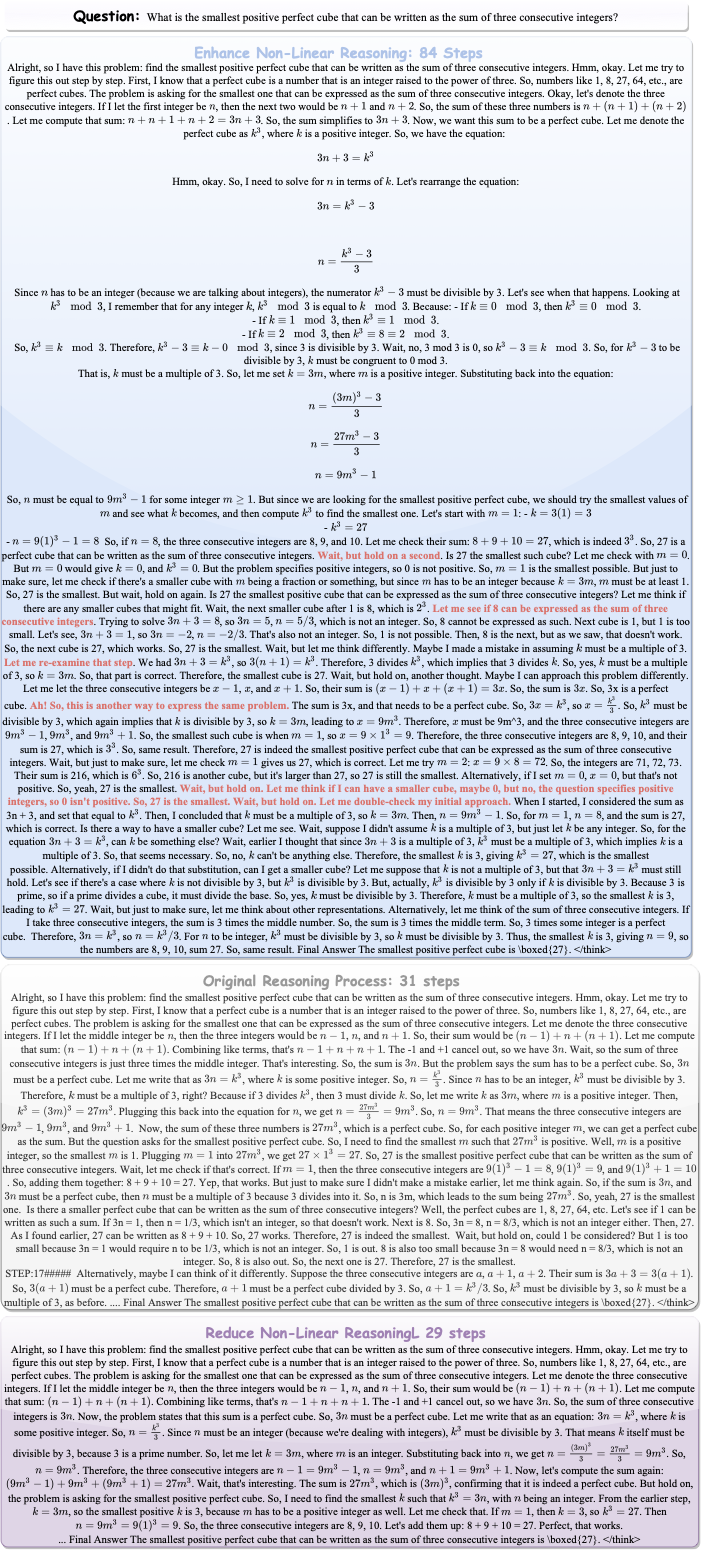
Large Language Models (LLMs) often rely on long chain-of-thought (CoT) reasoning to solve complex tasks. While effective, these trajectories are frequently inefficient, leading to high latency from excessive token generation, or unstable reasoning that alternates between underthinking (shallow, inconsistent steps) and overthinking (repetitive, verbose reasoning). In this work, we study the structure of reasoning trajectories and uncover specialized attention heads that correlate with distinct cognitive behaviors such as verification and backtracking. By lightly intervening on these heads at inference time, we can steer the model away from inefficient modes. Building on this insight, we propose CREST, a training-free method for Cognitive REasoning Steering at Test-time. CREST has two components (1) an offline calibration step that identifies cognitive heads and derives head-specific steering vectors, and (2) an inference-time procedure that rotates hidden representations to suppress components along those vectors. CREST adaptively suppresses unproductive reasoning behaviors, yielding both higher accuracy and lower computational cost. Across diverse reasoning benchmarks and models, CREST improves accuracy by up to 17.5% while reducing token usage by 37.6%, offering a simple and effective pathway to faster, more reliable LLM reasoning.

paper research
UniCrop  A Universal, Multi-Source Data Engineering Pipeline for Scalable Crop Yield Prediction

UniCrop A Universal, Multi-Source Data Engineering Pipeline for Scalable Crop Yield Prediction

Accurate crop yield prediction relies on diverse data streams, including satellite, meteorological, soil, and topographic information. However, despite rapid advances in machine learning, existing approaches remain crop- or region-specific and require data engineering efforts. This limits scalability, reproducibility, and operational deployment. This study introduces UniCrop, a universal and reusable data pipeline designed to automate the acquisition, cleaning, harmonisation, and engineering of multi-source environmental data for crop yield prediction. For any given location, crop type, and temporal window, UniCrop automatically retrieves, harmonises, and engineers over 200 environmental variables (Sentinel-1/2, MODIS, ERA5-Land, NASA POWER, SoilGrids, and SRTM), reducing them to a compact, analysis-ready feature set utilising a structured feature reduction workflow with minimum redundancy maximum relevance (mRMR). To validate, UniCrop was applied to a rice yield dataset comprising 557 field observations. Using only the selected 15 features, four baseline machine learning models (LightGBM, Random Forest, Support Vector Regression, and Elastic Net) were trained. LightGBM achieved the best single-model performance (RMSE = 465.1 kg/ha, $R^2 = 0.6576$), while a constrained ensemble of all baselines further improved accuracy (RMSE = 463.2 kg/ha, $R^2 = 0.6604$). UniCrop contributes a scalable and transparent data-engineering framework that addresses the primary bottleneck in operational crop yield modelling the preparation of consistent and harmonised multi-source data. By decoupling data specification from implementation and supporting any crop, region, and time frame through simple configuration updates, UniCrop provides a practical foundation for scalable agricultural analytics. The code and implementation documentation are shared in https //github.com/CoDIS-Lab/UniCrop.

paper research
Universal Conditional Logic  A Formal Language for Prompt Engineering

Universal Conditional Logic A Formal Language for Prompt Engineering

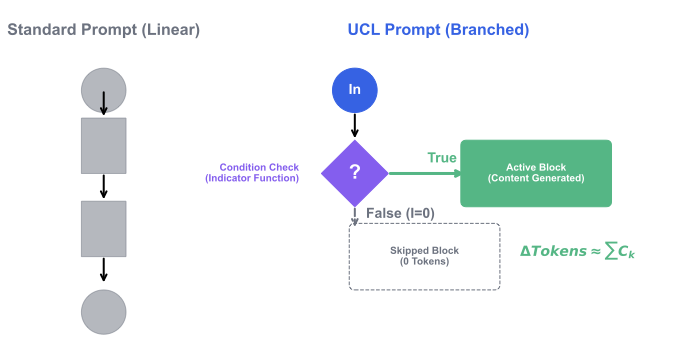
We present Universal Conditional Logic (UCL), a mathematical framework for prompt optimization that transforms prompt engineering from heuristic practice into systematic optimization. Through systematic evaluation (N=305, 11 models, 4 iterations), we demonstrate significant token reduction (29.8%, t(10)=6.36, p < 0.001, Cohen s d = 2.01) with corresponding cost savings. UCL s structural overhead function O_s(A) explains version-specific performance differences through the Over-Specification Paradox beyond threshold S* = 0.509, additional specification degrades performance quadratically. Core mechanisms -- indicator functions (I_i in {0,1}), structural overhead (O_s = gamma * sum(ln C_k)), early binding -- are validated. Notably, optimal UCL configuration varies by model architecture -- certain models (e.g., Llama 4 Scout) require version-specific adaptations (V4.1). This work establishes UCL as a calibratable framework for efficient LLM interaction, with model-family-specific optimization as a key research direction.

paper research
Value Vision-Language-Action Planning & Search

Value Vision-Language-Action Planning & Search

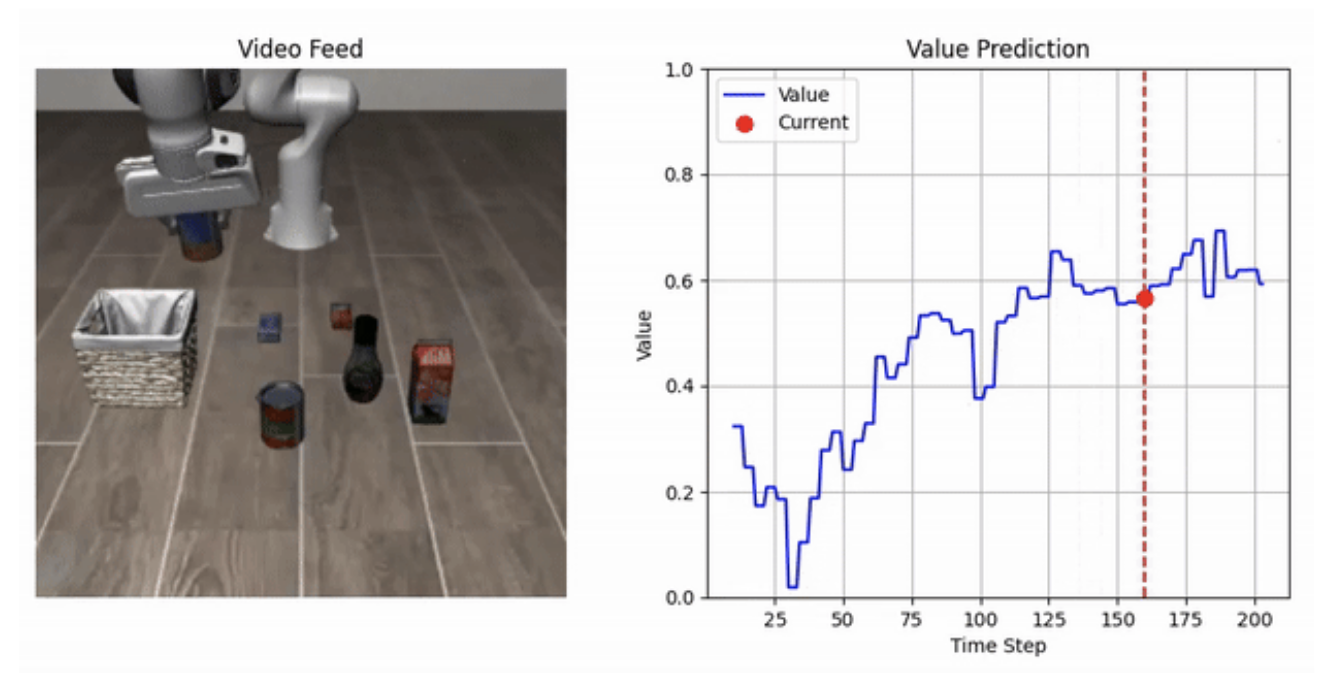
Vision-Language-Action (VLA) models have emerged as powerful generalist policies for robotic manipulation, yet they remain fundamentally limited by their reliance on behavior cloning, leading to brittleness under distribution shift. While augmenting pretrained models with test-time search algorithms like Monte Carlo Tree Search (MCTS) can mitigate these failures, existing formulations rely solely on the VLA prior for guidance, lacking a grounded estimate of expected future return. Consequently, when the prior is inaccurate, the planner can only correct action selection via the exploration term, which requires extensive simulation to become effective. To address this limitation, we introduce Value Vision-Language-Action Planning and Search (V-VLAPS), a framework that augments MCTS with a lightweight, learnable value function. By training a simple multilayer perceptron (MLP) on the latent representations of a fixed VLA backbone (Octo), we provide the search with an explicit success signal that biases action selection toward high-value regions. We evaluate V-VLAPS on the LIBERO robotic manipulation suite, demonstrating that our value-guided search improves success rates by over 5 percentage points while reducing the average number of MCTS simulations by 5-15 percent compared to baselines that rely only on the VLA prior.

paper research
Value-guided action planning with JEPA world models

Value-guided action planning with JEPA world models

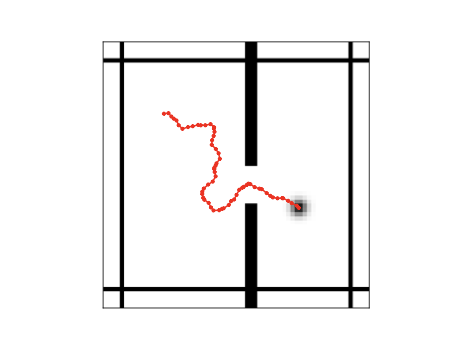
Building deep learning models that can reason about their environment requires capturing its underlying dynamics. Joint-Embedded Predictive Architectures (JEPA) provide a promising framework to model such dynamics by learning representations and predictors through a self-supervised prediction objective. However, their ability to support effective action planning remains limited. We propose an approach to enhance planning with JEPA world models by shaping their representation space so that the negative goal-conditioned value function for a reaching cost in a given environment is approximated by a distance (or quasi-distance) between state embeddings. We introduce a practical method to enforce this constraint during training and show that it leads to significantly improved planning performance compared to standard JEPA models on simple control tasks.

paper research
VEAT Measures Implicit Associations in Text-to-Video Generator Sora and Reveals Bias Mitigation Challenges

VEAT Measures Implicit Associations in Text-to-Video Generator Sora and Reveals Bias Mitigation Challenges

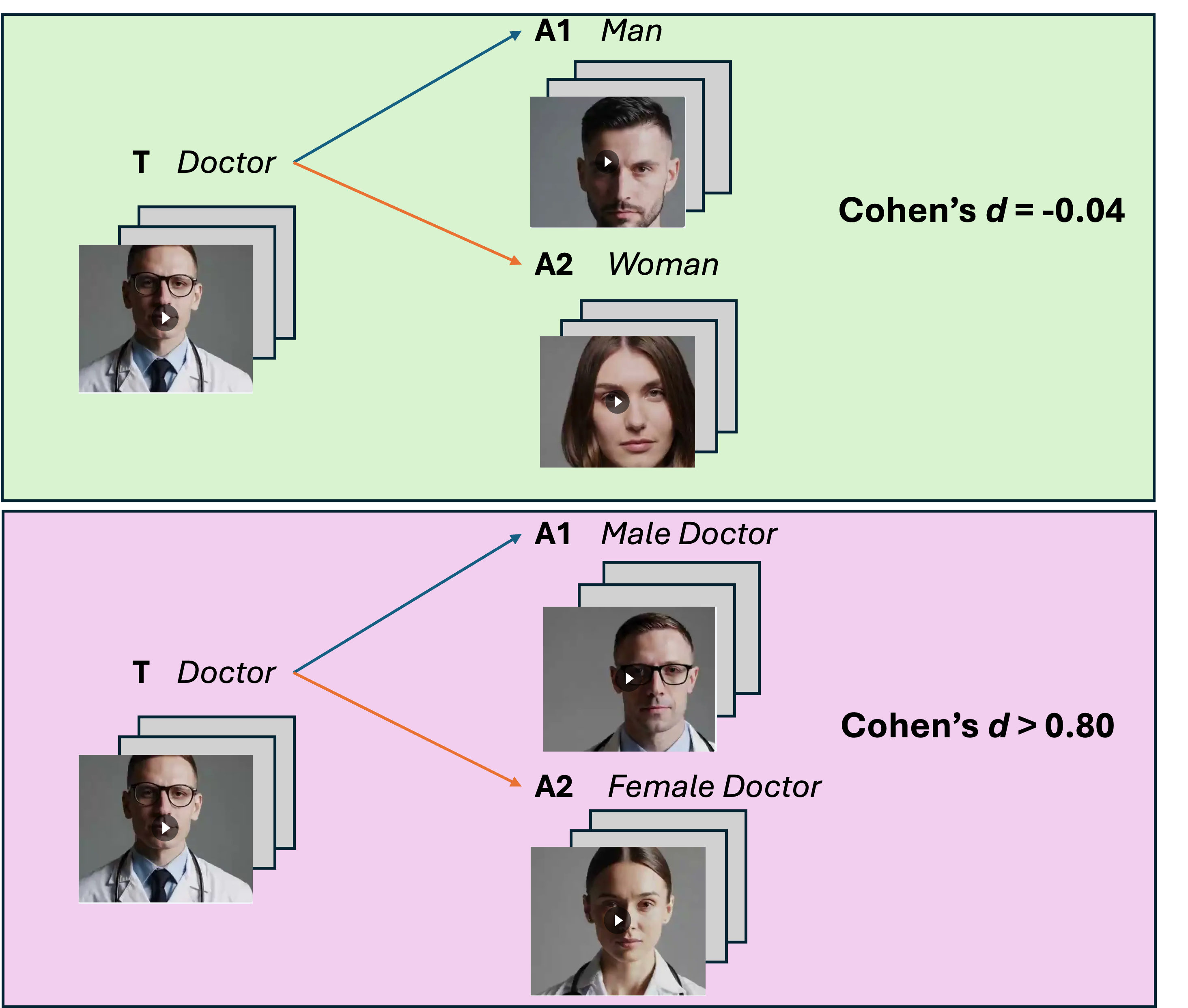
Text-to-Video (T2V) generators such as Sora raise concerns about whether generated content reflects societal bias. We extend embedding-association tests from words and images to video by introducing the Video Embedding Association Test (VEAT) and Single-Category VEAT (SC-VEAT). We validate these methods by reproducing the direction and magnitude of associations from widely used baselines, including Implicit Association Test (IAT) scenarios and OASIS image categories. We then quantify race (African American vs. European American) and gender (women vs. men) associations with valence (pleasant vs. unpleasant) across 17 occupations and 7 awards. Sora videos associate European Americans and women more with pleasantness (both d>0.8). Effect sizes correlate with real-world demographic distributions percent men and White in occupations (r=0.93, r=0.83) and percent male and non-Black among award recipients (r=0.88, r=0.99). Applying explicit debiasing prompts generally reduces effect-size magnitudes, but can backfire two Black-associated occupations (janitor, postal service) become more Black-associated after debiasing. Together, these results reveal that easily accessible T2V generators can actually amplify representational harms if not rigorously evaluated and responsibly deployed.

paper research
VerLM  Explaining Face Verification Using Natural Language

VerLM Explaining Face Verification Using Natural Language

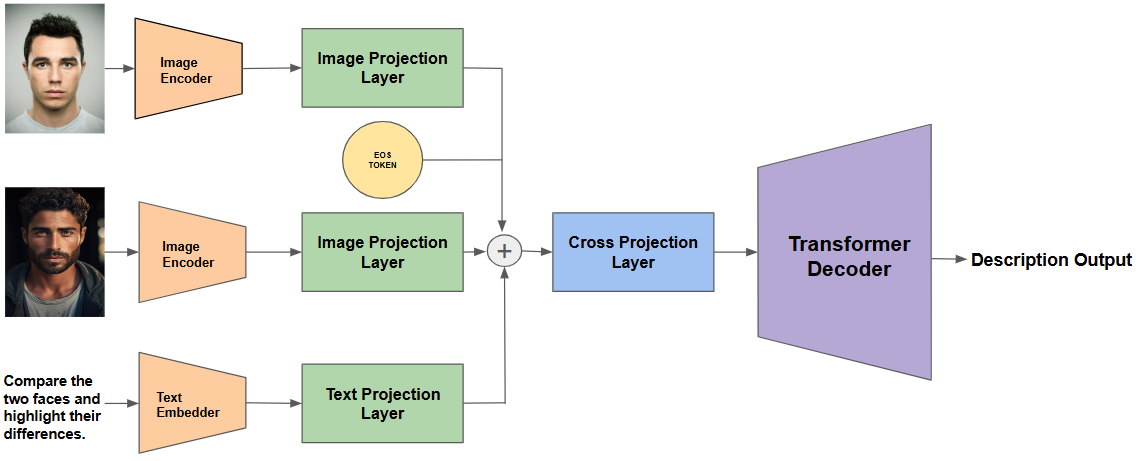
Face verification systems have seen substantial advancements; however, they often lack transparency in their decision-making processes. In this paper, we introduce an innovative Vision-Language Model (VLM) for Face Verification, which not only accurately determines if two face images depict the same individual but also explicitly explains the rationale behind its decisions. Our model is uniquely trained using two complementary explanation styles (1) concise explanations that summarize the key factors influencing its decision, and (2) comprehensive explanations detailing the specific differences observed between the images. We adapt and enhance a state-of-the-art modeling approach originally designed for audio-based differentiation to suit visual inputs effectively. This cross-modal transfer significantly improves our model s accuracy and interpretability. The proposed VLM integrates sophisticated feature extraction techniques with advanced reasoning capabilities, enabling clear articulation of its verification process. Our approach demonstrates superior performance, surpassing baseline methods and existing models. These findings highlight the immense potential of vision language models in face verification set up, contributing to more transparent, reliable, and explainable face verification systems.

paper research
Viability and Performance of a Private LLM Server for SMBs  A Benchmark Analysis of Qwen3-30B

Viability and Performance of a Private LLM Server for SMBs A Benchmark Analysis of Qwen3-30B

The proliferation of Large Language Models (LLMs) has been accompanied by a reliance on cloud-based, proprietary systems, raising significant concerns regarding data privacy, operational sovereignty, and escalating costs. This paper investigates the feasibility of deploying a high-performance, private LLM inference server at a cost accessible to Small and Medium Businesses (SMBs). We present a comprehensive benchmarking analysis of a locally hosted, quantized 30-billion parameter Mixture-of-Experts (MoE) model based on Qwen3, running on a consumer-grade server equipped with a next-generation NVIDIA GPU. Unlike cloud-based offerings, which are expensive and complex to integrate, our approach provides an affordable and private solution for SMBs. We evaluate two dimensions the model s intrinsic capabilities and the server s performance under load. Model performance is benchmarked against academic and industry standards to quantify reasoning and knowledge relative to cloud services. Concurrently, we measure server efficiency through latency, tokens per second, and time to first token, analyzing scalability under increasing concurrent users. Our findings demonstrate that a carefully configured on-premises setup with emerging consumer hardware and a quantized open-source model can achieve performance comparable to cloud-based services, offering SMBs a viable pathway to deploy powerful LLMs without prohibitive costs or privacy compromises.

paper research
VIBE  Visual Instruction Based Editor

VIBE Visual Instruction Based Editor

Instruction-based image editing is among the fastest developing areas in generative AI. Over the past year, the field has reached a new level, with dozens of open-source models released alongside highly capable commercial systems. However, only a limited number of open-source approaches currently achieve real-world quality. In addition, diffusion backbones, the dominant choice for these pipelines, are often large and computationally expensive for many deployments and research settings, with widely used variants typically containing 6B to 20B parameters. This paper presents a compact, high-throughput instruction-based image editing pipeline that uses a modern 2B-parameter Qwen3-VL model to guide the editing process and the 1.6B-parameter diffusion model Sana1.5 for image generation. Our design decisions across architecture, data processing, training configuration, and evaluation target low-cost inference and strict source consistency while maintaining high quality across the major edit categories feasible at this scale. Evaluated on the ImgEdit and GEdit benchmarks, the proposed method matches or exceeds the performance of substantially heavier baselines, including models with several times as many parameters and higher inference cost, and is particularly strong on edits that require preserving the input image, such as an attribute adjustment, object removal, background edits, and targeted replacement. The model fits within 24 GB of GPU memory and generates edited images at up to 2K resolution in approximately 4 seconds on an NVIDIA H100 in BF16, without additional inference optimizations or distillation.

paper research
Video and Language Alignment in 2D Systems for 3D Multi-object Scenes with Multi-Information Derivative-Free Control

Video and Language Alignment in 2D Systems for 3D Multi-object Scenes with Multi-Information Derivative-Free Control

Cross-modal systems trained on 2D visual inputs are presented with a dimensional shift when processing 3D scenes. An in-scene camera bridges the dimensionality gap but requires learning a control module. We introduce a new method that improves multivariate mutual information estimates by regret minimisation with derivative-free optimisation. Our algorithm enables off-the-shelf cross-modal systems trained on 2D visual inputs to adapt online to object occlusions and differentiate features. The pairing of expressive measures and value-based optimisation assists control of an in-scene camera to learn directly from the noisy outputs of vision-language models. The resulting pipeline improves performance in cross-modal tasks on multi-object 3D scenes without resorting to pretraining or finetuning.

paper research
Vision-Based Early Fault Diagnosis and Self-Recovery for Strawberry Harvesting Robots

Vision-Based Early Fault Diagnosis and Self-Recovery for Strawberry Harvesting Robots

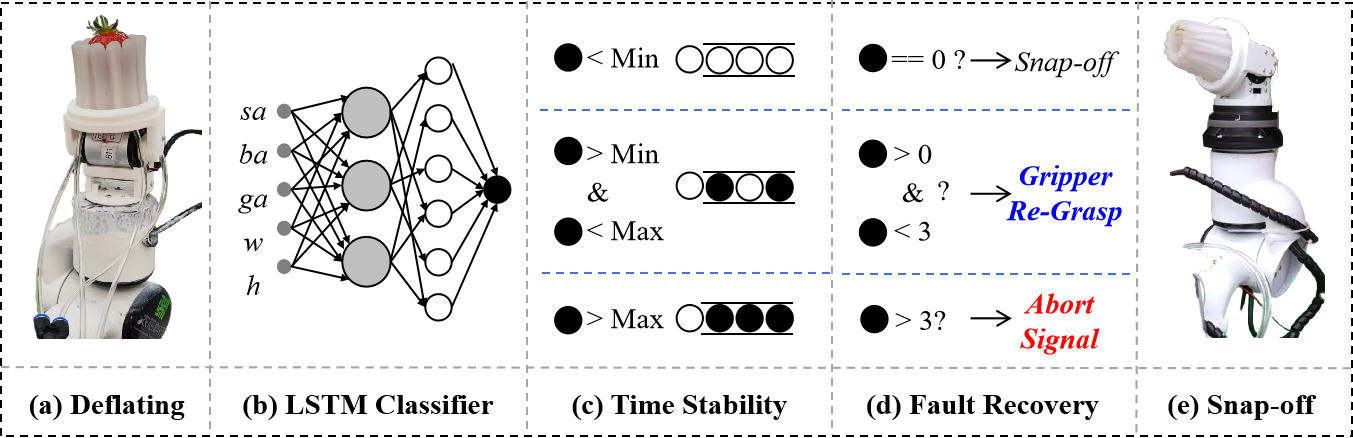
Strawberry harvesting robots faced persistent challenges such as low integration of visual perception, fruit-gripper misalignment, empty grasping, and strawberry slippage from the gripper due to insufficient gripping force, all of which compromised harvesting stability and efficiency in orchard environments. To overcome these issues, this paper proposed a visual fault diagnosis and self-recovery framework that integrated multi-task perception with corrective control strategies. At the core of this framework was SRR-Net, an end-to-end multi-task perception model that simultaneously performed strawberry detection, segmentation, and ripeness estimation, thereby unifying visual perception with fault diagnosis. Based on this integrated perception, a relative error compensation method based on the simultaneous target-gripper detection was designed to address positional misalignment, correcting deviations when error exceeded the tolerance threshold. To mitigate empty grasping and fruit-slippage faults, an early abort strategy was implemented. A micro-optical camera embedded in the end-effector provided real-time visual feedback, enabling grasp detection during the deflating stage and strawberry slip prediction during snap-off through MobileNet V3-Small classifier and a time-series LSTM classifier. Experiments demonstrated that SRR-Net maintained high perception accuracy. For detection, it achieved a precision of 0.895 and recall of 0.813 on strawberries, and 0.972/0.958 on hands. In segmentation, it yielded a precision of 0.887 and recall of 0.747 for strawberries, and 0.974/0.947 for hands. For ripeness estimation, SRR-Net attained a mean absolute error of 0.035, while simultaneously supporting multi-task perception and sustaining a competitive inference speed of 163.35 FPS.

paper research
VIT-Ped  Visionary Intention Transformer for Pedestrian Behavior Analysis

VIT-Ped Visionary Intention Transformer for Pedestrian Behavior Analysis

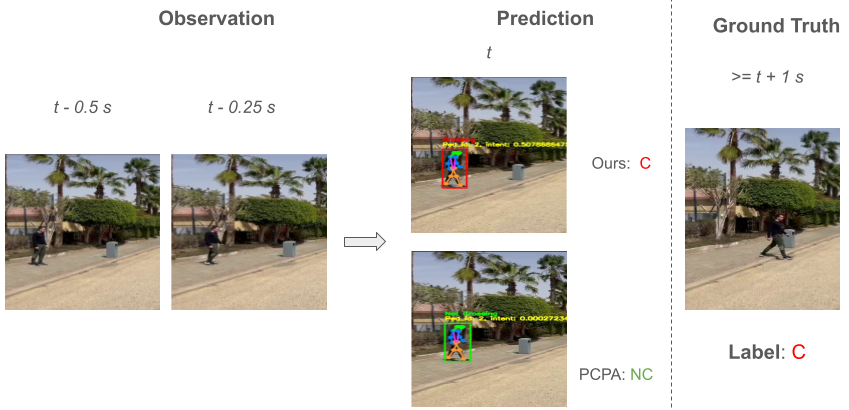
Pedestrian Intention prediction is one of the key technologies in the transition from level 3 to level 4 autonomous driving. To understand pedestrian crossing behaviour, several elements and features should be taken into consideration to make the roads of tomorrow safer for everybody. We introduce a transformer / video vision transformer based algorithm of different sizes which uses different data modalities .We evaluated our algorithms on popular pedestrian behaviour dataset, JAAD, and have reached SOTA performance and passed the SOTA in metrics like Accuracy, AUC and F1-score. The advantages brought by different model design choices are investigated via extensive ablation studies.

paper research
VLA-RAIL  A Real-Time Asynchronous Inference Linker for VLA Models and Robots

VLA-RAIL A Real-Time Asynchronous Inference Linker for VLA Models and Robots

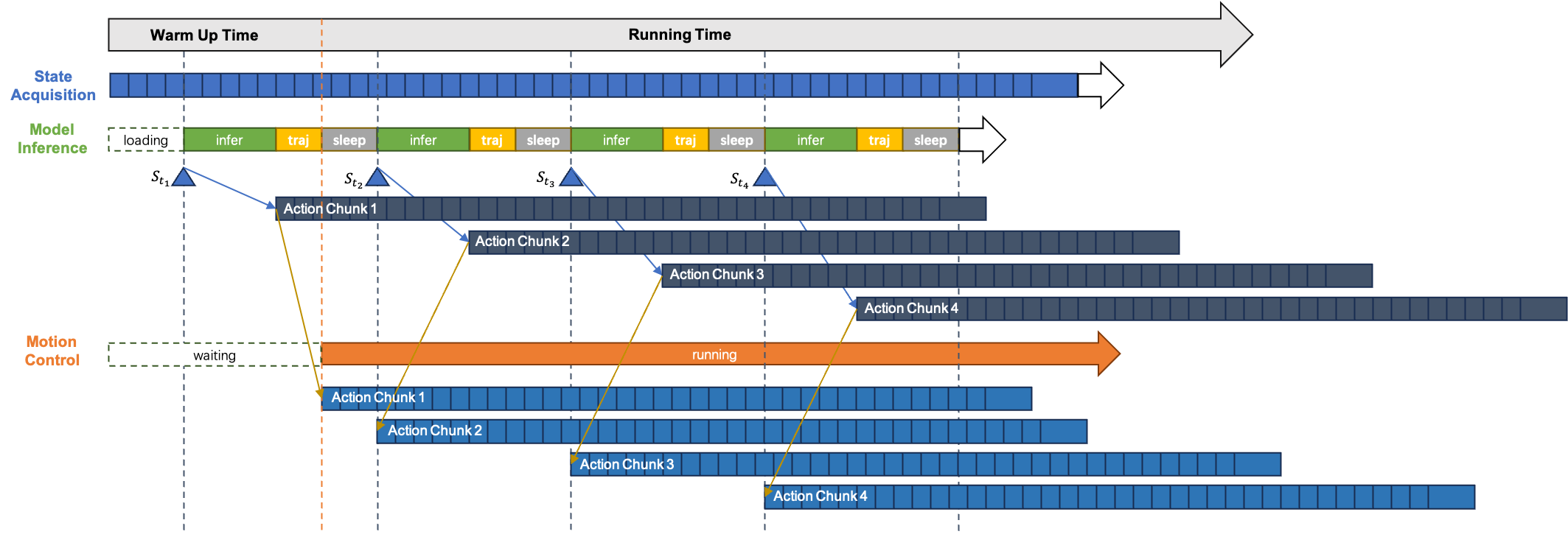
Vision-Language-Action (VLA) models have achieved remarkable breakthroughs in robotics, with the action chunk playing a dominant role in these advances. Given the real-time and continuous nature of robotic motion control, the strategies for fusing a queue of successive action chunks have a profound impact on the overall performance of VLA models. Existing methods suffer from jitter, stalling, or even pauses in robotic action execution, which not only limits the achievable execution speed but also reduces the overall success rate of task completion. This paper introduces VLA-RAIL (A Real-Time Asynchronous Inference Linker), a novel framework designed to address these issues by conducting model inference and robot motion control asynchronously and guaranteeing smooth, continuous, and high-speed action execution. The core contributions of the paper are two fold a Trajectory Smoother that effectively filters out the noise and jitter in the trajectory of one action chunk using polynomial fitting and a Chunk Fuser that seamlessly align the current executing trajectory and the newly arrived chunk, ensuring position, velocity, and acceleration continuity between two successive action chunks. We validate the effectiveness of VLA-RAIL on a benchmark of dynamic simulation tasks and several real-world manipulation tasks. Experimental results demonstrate that VLA-RAIL significantly reduces motion jitter, enhances execution speed, and improves task success rates, which will become a key infrastructure for the large-scale deployment of VLA models.

paper research
Vulcan  Instance-Optimal Systems Heuristics Through LLM-Driven Search

Vulcan Instance-Optimal Systems Heuristics Through LLM-Driven Search

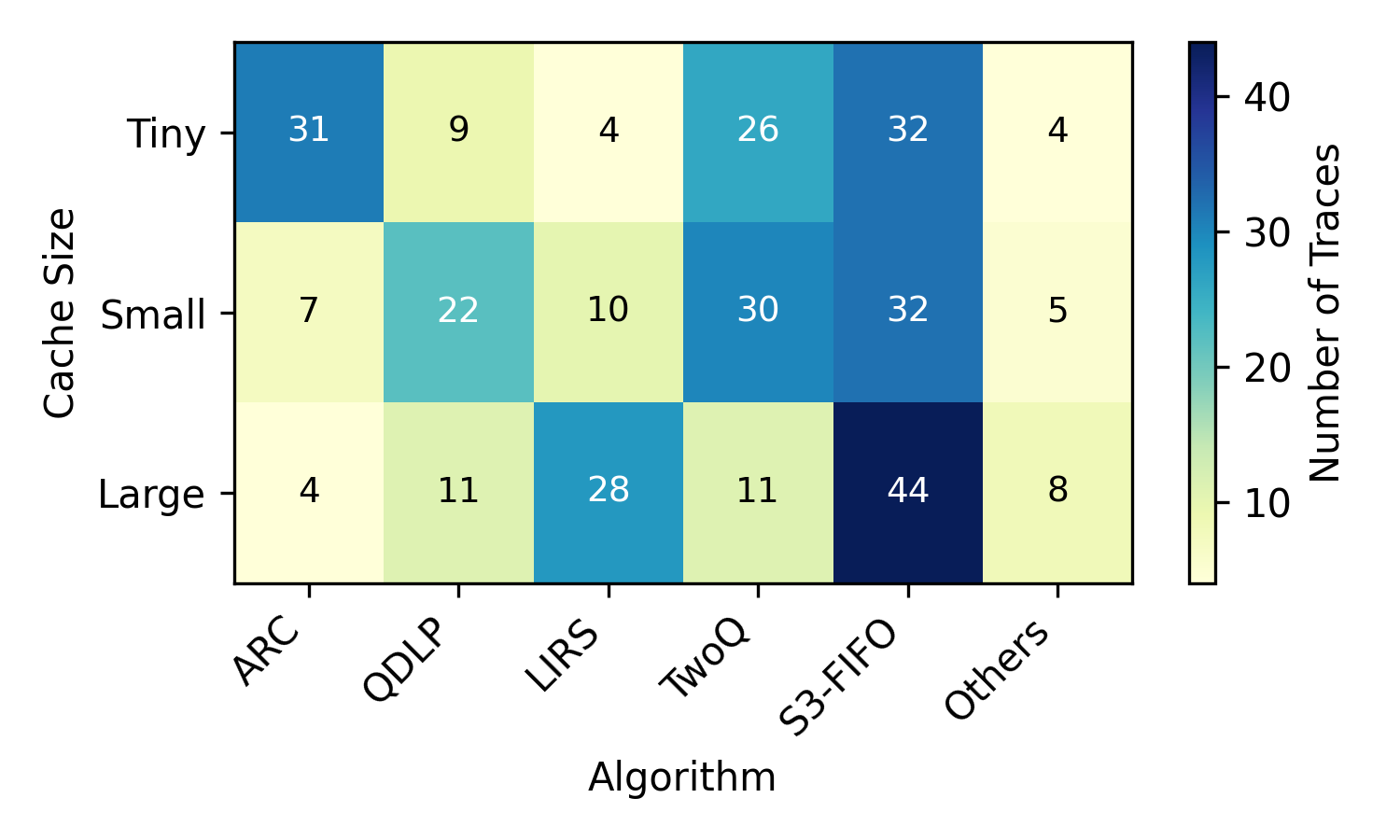
Resource-management tasks in modern operating and distributed systems continue to rely primarily on hand-designed heuristics for tasks such as scheduling, caching, or active queue management. Designing performant heuristics is an expensive, time-consuming process that we are forced to continuously go through due to the constant flux of hardware, workloads and environments. We propose a new alternative synthesizing instance-optimal heuristics -- specialized for the exact workloads and hardware where they will be deployed -- using code-generating large language models (LLMs). To make this synthesis tractable, Vulcan separates policy and mechanism through LLM-friendly, task-agnostic interfaces. With these interfaces, users specify the inputs and objectives of their desired policy, while Vulcan searches for performant policies via evolutionary search over LLM-generated code. This interface is expressive enough to capture a wide range of system policies, yet sufficiently constrained to allow even small, inexpensive LLMs to generate correct and executable code. We use Vulcan to synthesize performant heuristics for cache eviction and memory tiering, and find that these heuristics outperform all human-designed state-of-the-art algorithms by upto 69% and 7.9% in performance for each of these tasks respectively.

paper research
No Image

Warp-Cortex An Asynchronous, Memory-Efficient Architecture for Million-Agent Cognitive Scaling on Consumer Hardware

Current multi-agent Large Language Model (LLM) frameworks suffer from linear memory scaling, rendering System 2 parallel reasoning impractical on consumer hardware. We present Warp Cortex, an asynchronous architecture that theoretically enables million-agent cognitive scaling by decoupling agent logic from physical memory. Through Singleton Weight Sharing and a novel Topological Synapse--inspired by hybrid landmarking techniques from Topological Data Analysis (TDA)--we reduce memory complexity from O(N * L) to O(1) for weights and O(N * k) for context, where k << L. By treating the KV-cache as a point cloud in latent space, we apply witness-complex-inspired sparsification to preserve persistent homological features of the context manifold. On a single NVIDIA RTX 4090, we empirically demonstrate 100 concurrent agents at 2.2 GB total VRAM, with theoretical capacity exceeding 1,000 agents before compute latency becomes the bottleneck. We further introduce Referential Injection, a non-intrusive KV-cache update mechanism that allows asynchronous sub-agents to influence primary generation without stream disruption.

paper research
What Drives Success in Physical Planning with Joint-Embedding Predictive World Models?

What Drives Success in Physical Planning with Joint-Embedding Predictive World Models?

A long-standing challenge in AI is to develop agents capable of solving a wide range of physical tasks and generalizing to new, unseen tasks and environments. A popular recent approach involves training a world model from state-action trajectories and subsequently use it with a planning algorithm to solve new tasks. Planning is commonly performed in the input space, but a recent family of methods has introduced planning algorithms that optimize in the learned representation space of the world model, with the promise that abstracting irrelevant details yields more efficient planning. In this work, we characterize models from this family as JEPA-WMs and investigate the technical choices that make algorithms from this class work. We propose a comprehensive study of several key components with the objective of finding the optimal approach within the family. We conducted experiments using both simulated environments and real-world robotic data, and studied how the model architecture, the training objective, and the planning algorithm affect planning success. We combine our findings to propose a model that outperforms two established baselines, DINO-WM and V-JEPA-2-AC, in both navigation and manipulation tasks. Code, data and checkpoints are available at https //github.com/facebookresearch/jepa-wms.

paper research
WildIng  A Wildlife Image Invariant Representation Model for Geographical Domain Shift

WildIng A Wildlife Image Invariant Representation Model for Geographical Domain Shift

Wildlife monitoring is crucial for studying biodiversity loss and climate change. Camera trap images provide a non-intrusive method for analyzing animal populations and identifying ecological patterns over time. However, manual analysis is time-consuming and resource-intensive. Deep learning, particularly foundation models, has been applied to automate wildlife identification, achieving strong performance when tested on data from the same geographical locations as their training sets. Yet, despite their promise, these models struggle to generalize to new geographical areas, leading to significant performance drops. For example, training an advanced vision-language model, such as CLIP with an adapter, on an African dataset achieves an accuracy of 84.77%. However, this performance drops significantly to 16.17% when the model is tested on an American dataset. This limitation partly arises because existing models rely predominantly on image-based representations, making them sensitive to geographical data distribution shifts, such as variation in background, lighting, and environmental conditions. To address this, we introduce WildIng, a Wildlife image Invariant representation model for geographical domain shift. WildIng integrates text descriptions with image features, creating a more robust representation to geographical domain shifts. By leveraging textual descriptions, our approach captures consistent semantic information, such as detailed descriptions of the appearance of the species, improving generalization across different geographical locations. Experiments show that WildIng enhances the accuracy of foundation models such as BioCLIP by 30% under geographical domain shift conditions. We evaluate WildIng on two datasets collected from different regions, namely America and Africa. The code and models are publicly available at https //github.com/Julian075/CATALOG/tree/WildIng.

paper research
Wittgenstein s Family Resemblance Clustering Algorithm

Wittgenstein s Family Resemblance Clustering Algorithm

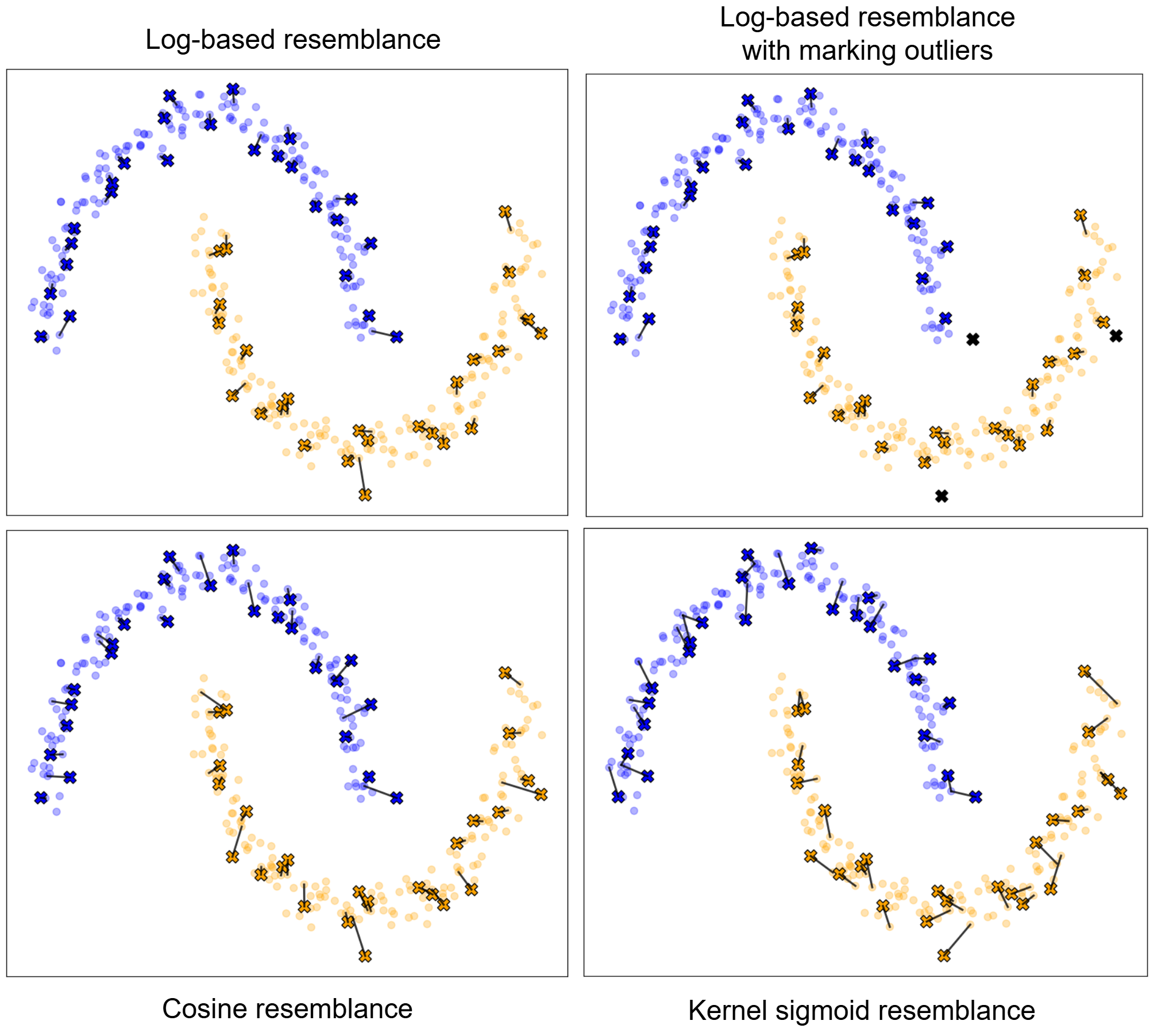
This paper, introducing a novel method in philomatics, draws on Wittgenstein s concept of family resemblance from analytic philosophy to develop a clustering algorithm for machine learning. According to Wittgenstein s Philosophical Investigations (1953), family resemblance holds that members of a concept or category are connected by overlapping similarities rather than a single defining property. Consequently, a family of entities forms a chain of items sharing overlapping traits. This philosophical idea naturally lends itself to a graph-based approach in machine learning. Accordingly, we propose the Wittgenstein s Family Resemblance (WFR) clustering algorithm and its kernel variant, kernel WFR. This algorithm computes resemblance scores between neighboring data instances, and after thresholding these scores, a resemblance graph is constructed. The connected components of this graph define the resulting clusters. Simulations on benchmark datasets demonstrate that WFR is an effective nonlinear clustering algorithm that does not require prior knowledge of the number of clusters or assumptions about their shapes.

paper research

Start searching

Enter keywords to search articles

↑↓
↵
ESC
⌘K Shortcut