SQL-Driven Transparency in Pathology Image Analysis
📝 Original Paper Info
- Title: Toward Auditable Neuro-Symbolic Reasoning in Pathology SQL as an Explicit Trace of Evidence- ArXiv ID: 2601.01875
- Date: 2026-01-05
- Authors: Kewen Cao, Jianxu Chen, Yongbing Zhang, Ye Zhang, Hongxiao Wang
📝 Abstract
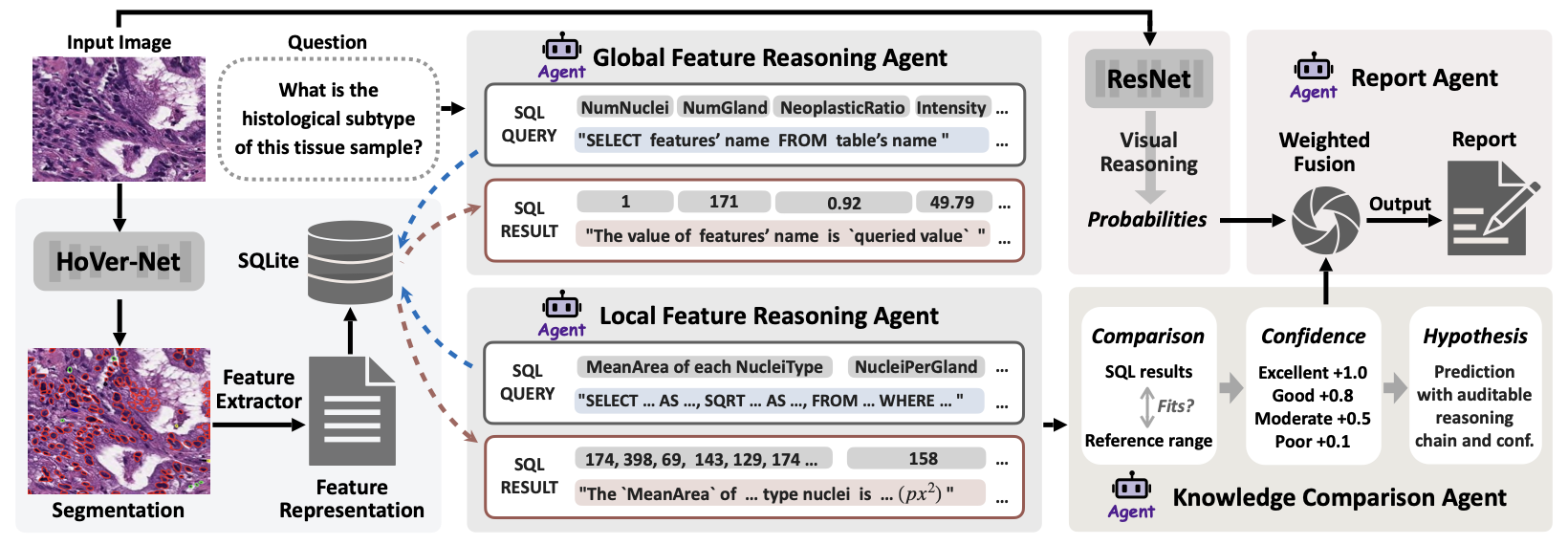
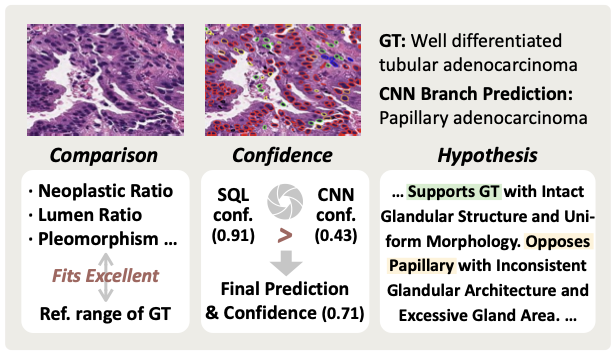
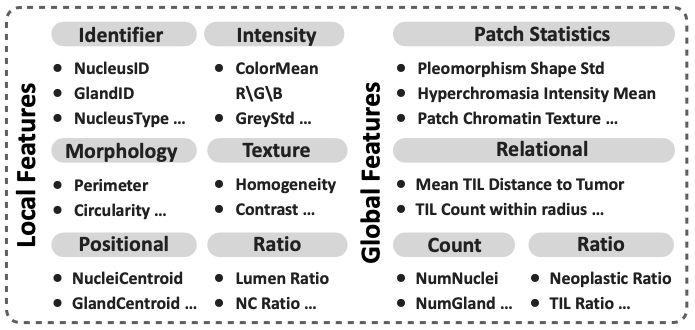
Automated pathology image analysis is central to clinical diagnosis, but clinicians still ask which slide features drive a model's decision and why. Vision-language models can produce natural language explanations, but these are often correlational and lack verifiable evidence. In this paper, we introduce an SQL-centered agentic framework that enables both feature measurement and reasoning to be auditable. Specifically, after extracting human-interpretable cellular features, Feature Reasoning Agents compose and execute SQL queries over feature tables to aggregate visual evidence into quantitative findings. A Knowledge Comparison Agent then evaluates these findings against established pathological knowledge, mirroring how pathologists justify diagnoses from measurable observations. Extensive experiments evaluated on two pathology visual question answering datasets demonstrate our method improves interpretability and decision traceability while producing executable SQL traces that link cellular measurements to diagnostic conclusions.💡 Summary & Analysis
1. **Impact of Deep Learning Models**: This study highlights the transformative role deep learning plays in NLP, focusing on how CNNs contribute. 2. **New Insights into Sentiment Analysis**: The research compares various CNN architectures to understand their performance in sentiment analysis and identifies the most effective model. 3. **Future Directions for Model Optimization**: By proving that certain CNN architectures outperform others, this study opens doors to further optimization efforts.📄 Full Paper Content (ArXiv Source)
📊 논문 시각자료 (Figures)