Perish or Flourish? A Holistic Evaluation of Large Language Models for Code Generation in Functional Programming
📝 Original Paper Info
- Title: Perish or Flourish? A Holistic Evaluation of Large Language Models for Code Generation in Functional Programming- ArXiv ID: 2601.02060
- Date: 2026-01-05
- Authors: Nguyet-Anh H. Lang, Eric Lang, Thanh Le-Cong, Bach Le, Quyet-Thang Huynh
📝 Abstract
Functional programming provides strong foundations for developing reliable and secure software systems, yet its adoption remains not widespread due to the steep learning curve. Recent advances in Large Language Models (LLMs) for code generation present new opportunities to lower these barriers. However, extensive evaluations of LLMs largely focus on imperative programming languages, and their capabilities in functional programming languages (FP) remain underexplored. To address this gap, we introduce FPEval, a holistic evaluation framework built on FPBench, a new benchmark of 721 programming tasks across three difficulty levels on three mainstream FP languages: Haskell, Ocaml and Scala. FPEval provides compehensive evaluation infrastructures with both test validations with comprehensive test suites and static analysis tools to assess both functional correctness and code style and maintainability. Using this framework, we evaluate state-of-the-art LLMs, including GPT-3.5, GPT-4o, and GPT-5, for code generation in functional programming languages and Java as an imperative baseline. Our results demonstrate that LLM performance in functional programming improves substantially with model advancement; however, error rates remain significantly higher in purely functional languages (Haskell and OCaml) than in hybrid (Scala) or imperative (Java) languages. Moreover, LLMs frequently generate non-idiomatic functional code that follows imperative patterns, raising concerns about code style and long-term maintainability. Finally, we show that LLMs can partially self-repair both correctness and quality issues when provided with static analysis feedback and hand-crafted instructions for common types of issues.💡 Summary & Analysis
1. **FPEval Introduction**: FPEval is a comprehensive framework for evaluating LLMs' code generation capabilities in functional programming, including tasks of various difficulties across multiple languages. It allows systematic evaluation of how models solve problems and identify issues related to coding style and maintainability. 2. **LLMs Functional Programming Performance**: This study provides the first empirical evaluation of LLMs on functional programming code generation, revealing that while advanced models like GPT-5 significantly outperform earlier versions, there remains a notable performance gap compared to imperative programming languages. 3. **Self-Repair Capabilities**: It's shown that LLMs can partially self-repair both correctness and quality issues when provided with static analysis feedback, indicating potential for better code generation in the future.📄 Full Paper Content (ArXiv Source)
Functional programming is an emerging declarative programming paradigm that conceptualizes computation as the evaluation of mathematical functions rather than a sequence of state-mutating commands in widely-used imperative programming. This model of computation offers distinct advantages over imperative programming, resulting in software systems that are modular, deterministic, and susceptible to formal reasoning. For example, functional programming offers immutability, which ensures that a variable’s value cannot be changed during its existence. Immutability enables functional programming to mitigate common sources of software bugs in imperative programming such as side effects and race conditions. Consequently, functional programming is increasingly recognized as a future paradigm for reliable and secure software development . Despite these benefits, functional programming poses a steep learning curve. The paradigm requires a fundamental shift from imperative commands with mutable state to high-level abstractions of program behaviors such as recursion, higher-order functions, and monads, which many developers find difficult. Consequently, functional programming remains unduly less popular in practice than imperative programming.
The recent rise of coding assistants powered by Large Language Models (LLMs), such as GitHub Copilot , Cursor , and Claude Code , presents new opportunities for functional programming. By supporting software developers in tasks such as code generation , bug fixing , and technical question answering , these tools offer particular benefits to novice programmers and have the potential to reduce the learning curve associated with programming in general . If similar benefits extend to functional programming, these LLM-based coding assistants could contribute to increasing the adoption of the programming paradigm in practice. Unfortuntately, existing studies on LLM-based coding mainly focus on imperative programming languages, such as Python and Java. In contrast, the applicability of LLMs to functional programming languages, such as Haskell, OCaml, and Scala, remains significantly under-explored.
In this work, we conduct the first comprehensive empirical study to evaluate the capabilities of LLMs for code generation in functional programming. Our objective is three-fold: (1) to assess the ability of LLMs for generating correct and high-quality code in functional programming; (2) to evaluate the quality of LLM-generated code beyond functional correctness, with particular attention to coding style and maintainability; and (3) to evaluate the effectiveness of LLMs on self-repairing their mistakes. To this end, we structure our study using the following research questions:
-
RQ1: How effective are LLMs for code generation in functional programming languages?
-
RQ2: What are common coding style and maintainability issues in code generated by LLMs in functional programming languages?
-
RQ3: How effective are self-repair mechanisms in improving the correctness and code style and maintainability of LLM-generated functional code?
To answer these questions, we introduce FPEval, a holistic evaluation framework designed for code generation in functional programming. FPEval is powered by FPBench, a new multi-language benchmark consisting of 721 programming tasks distributed across three difficulty levels (184 easy, 346 medium, and 191 hard) and three languages: Scala, Haskell, and OCaml. To ensure a rigorous assessment on LLM-generated code, we construct a comprehensive test suite for each task, augmenting public test cases from LeetCode with private test cases, which target specific boundary conditions and edge cases for each programmming task. Furthermore, FPEval also integrates well-known static analysis tools, including HLint , OCamlFormat , and Scalastyle , enabling a dual assessment of both the functional correctness and code style and maintainability of the generated code.
Using FPEval, we evaluate state-of-the-art LLMs (GPT-3.5, GPT-4o, and GPT-5) on functional programming tasks, with Java included as an imperative baseline. Our evaluations show that LLM performance on functional programming improves substantially with model advancement, with GPT-5 achieving an approximately 3x increase in the number of functionally-correct code over GPT-3.5. However, a consistent performance gap persists between purely functional languages (Haskell and OCaml) and hybrid or imperative languages (Scala and Java). Beyond correctness, we find that a significant portion of LLM-generated code has poor style and maintainability. In particular, LLMs frequently produce non-idiomatic functional code that follows imperative patterns rather than best practices in functional programming. Notably, the prevalence of such low-quality code increases alongside gains in functional correctness, indicating a form of reward hacking in which models optimize for correctness while neglecting non-functional properties. These findings highlight the need for future LLM training and evaluation to explicitly incorporate functional programming best practices. Finally, we show that LLMs can partially self-repair both correctness and quality issues when provided with static analysis feedback and hand-crafted instructions for common types of issues.
In summary, our main contributions include:
-
We introduce FPEval, a holistic framework for evaluating LLM code generation in the functional programming paradigm. FPEval integrates FPBench, a curated dataset of 721 programming tasks with executable test suites in Scala, Haskell, and OCaml, and an automated evaluation pipeline that leverages software testing and static analysis tools to rigorously assess both the correctness and the code style and maintainability of generated code.
-
We present the first empirical evaluation of LLMs for functional programming code generation, systematically assessing the functional correctness and code style and maintainability of generated code, and the LLMs’ capacity for self-repair.
-
We provide a detailed analysis of code style and maintainability issues in LLM-generated functional code and demonstrate the potential LLM’s self-repair for improving the code style and maintainability issues with static analysis feedbacks and detailed instructions for common issues.
-
We advance research in code generation for functional programming by releasing FPEval under Apache 2.0 License, lowering barriers for academic research and establishing foundational benchmarks and metrics for future work. An early access version of FPEval can be found at https://github.com/thanhlecongg/FPEval .
Benchmark Construction and Evaluation Pipeline
Benchmark Construction
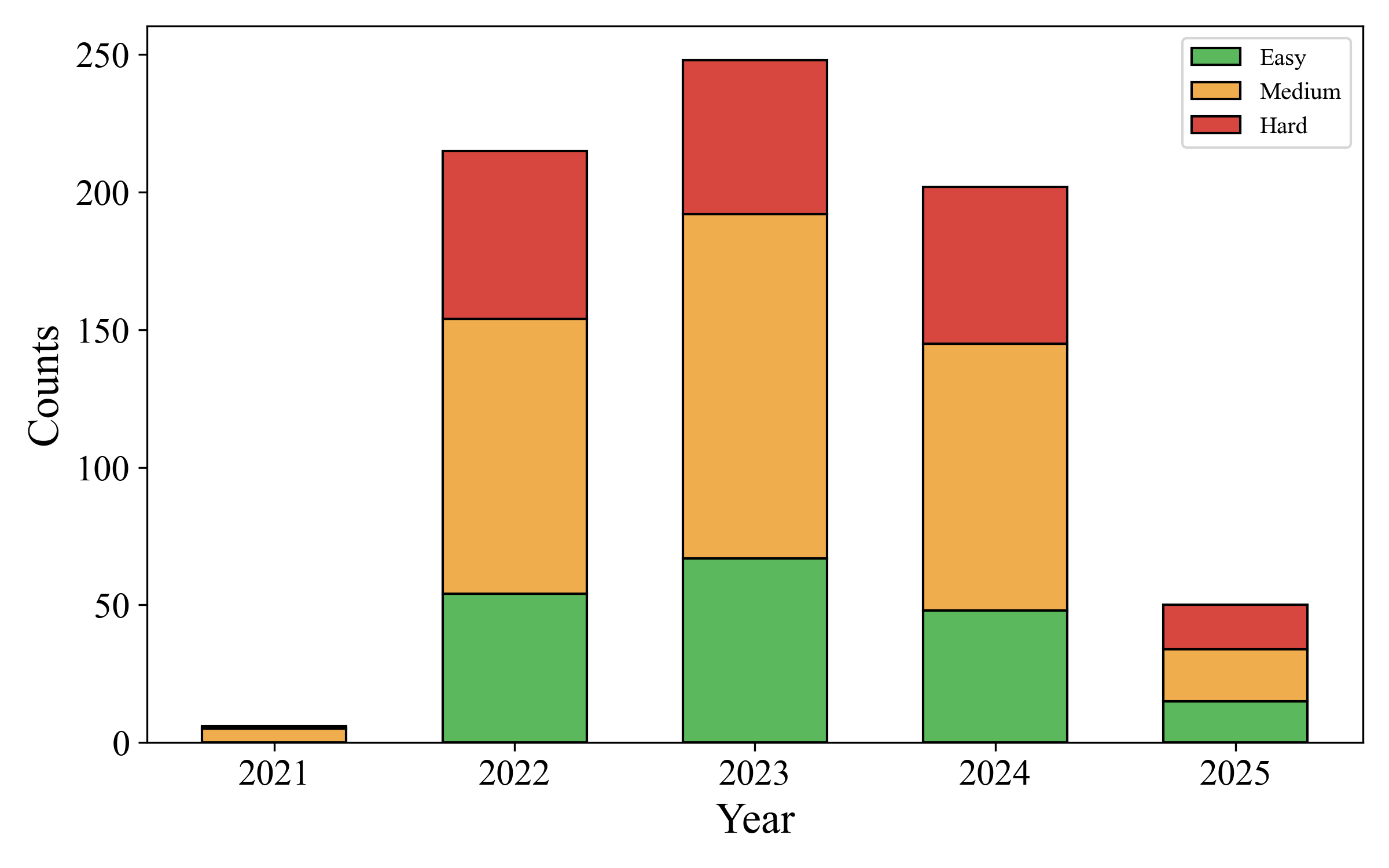
Data Collection. To support a rigorous empirical study in the code generation of LLMs in functional programming, we curated a comprehensive benchmark dataset from LeetCode , a widely-used platform for competitive programming and technical interviews. From the full collection, we filtered out premium-only content to select 721 publicly available algorithmic tasks. These tasks span three distinct difficulty levels consisting of 184 easy, 346 medium, and 191 hard programming tasks. For each task, we extracted the problem description, I/O constraints, and public test cases via LeetCode’s public API and custom HTML parsers. Collected public test cases were incorporated into prompt construction and later reused for initial correctness checks. Figures 1 illustrate the diversity of the dataset, i.e., FPBench. Our data collection period from 2021 to 2025 enables the capture of evolving trends in algorithm design and problem types. FPBench also include programming tasks with diverse difficulty levels, enabling us to systematically evaluate model performance under diverse problem complexity.
Language Template Generation.
A critical challenge to evaluating functional programming on LeetCode
tasks is the lack of support for widely-used functional programming
languages such as Haskell and OCaml. Specifically, LeetCode do not
provide any templates for these functional programming, yielding
difficulties for LLMs to understand I/O and typing requirements. To
bridge this gap, we implemented a transpiler that constructs
syntactically and semantically valid starter templates for Haskell and
OCaml from Python templates provided by LeetCode. This translastion was
challenging due to fundamental differences in programming paradigms and
type system, e.g., dynamic versus static typing, imperative versus
functional control flows, and the lack of one-to-one mappings for many
language constructs. Our transpiler addresses these discrepancies by (1)
performing structural translation of Python function definitions to
typed signatures in Haskell and OCaml, including parameter binding and
return types; (2) inferring types for nested and compound data
structures (e.g., mapping List[List[int]] to [[Int]]); (3)
normalizing I/O semantics to conform to functional patterns while
preserving the semantics of the original task specification.
Evaluation Pipeline
Test validation.
The FPEval pipeline begins by assessing the functional correctness of the generated code. While prior works typically utilize public test cases from LeetCode, this test suite is often limited in coverage and may fail to detect subtle logical errors. To mitigate this, we augment each task with a suite of private test cases. Following Huang et al. , we employ GPT-4o to synthesize these rigorous test cases directly from task descriptions to target boundary conditions, corner cases, and degenerate inputs (see Appendix [appendix:prompt_testcases] for the specific prompts). Note that, executing these tests within the functional paradigm also presents a critical challenge. Unlike Python, which supports flexible and dynamic execution, statically typed languages like Haskell and OCaml require rigorous type scaffolding, strict compilation, and runtime isolation. To address this, we developed a specialized test infrastructure for functional programming languages using test templates with the standard library and a Docker-based isolated runtime environment, as detailed in Appendix [appendix:test_execution].
Code Style and Maintainability Evaluation.
Beyond functional correctness, the code style and maintainability of the
generated code is a critical dimension of our evaluation. A solution may
satisfy all test cases while still being low quality with respects to
best practices in functional programming. Such code accumulates
technical debt, rendering systems difficult to maintain and even
potentially introducing latent safety issues . To systematically
quantify this dimension, FPEval integrates widely-used static analysis
tools that check weather a code snippet strictly adhere functional
programming best practices. Specifically, we ultilize HLint and GHC
for Haskell, Dune and OCamlFormat for Ocaml, and Scalastyle for
Scala. A example categorization of the rules applied by these tools is
provided in
Appendix 10.
LLM Selection and Configurations
To ensure a comprehensive evaluation across varying levels of capability
and cost, we evaluate three Large Language Models of OpenAI GPT series
including GPT-3.5-turbo , GPT-4o and GPT5 . We adopt a zero-shot
prompting strategy, in which the model is provided solely with the
natural language task description and the language-specific starter
template(see Listing [code:prompt] for an illustration). We
configure the generation parameters for GPT-3.5-turbo and GPT-4o with
temperature = 0.7. For GPT5, we utilize its default
temperature = 1.0, as this model architecture fixes the temperature to
optimize its underlying sampling logic. To ensure a fair comparison with
earlier models, we explicitly disable the reasoning capabilities of GPT5
by setting reasoning_effort = none. All models are restricted to a
max_tokens = 2048. For each task, we generate a single candidate
solution and post-process LLMs’ responses to extract code blocks by
discarding conversational text.
Experiments
RQ1: How effective are LLMs for code generation in functional programming languages?
To address this research question, following , we evaluate performance
via pass@1, i.e., the proportion of tasks where the model’s first
generated solution satisfies all test cases, and classify unsuccessful
generations into: (1) Compilation Errors (syntax/type mismatches); (2)
Test Failures (logic errors); and (3) Timeouts (execution limits).
Main Results. Table [tab:pass_rate] presents the performance of the studied LLMs across four languages: Haskell, OCaml, Scala, and Java. Overall, we observe that LLM performance on functional programming improves substantially with model advancement, with GPT-5 achieving an approximately 3x increase in the number of functionally-correct code over GPT-3.5. However, a consistent performance gap persists between purely functional languages (Haskell and OCaml) and hybrid or imperative languages (Scala and Java).
Specifically, GPT-3.5 shows limited capability in functional languages, achieving pass rates of only 14.5% in Haskell and 9.43% in OCaml. In contrast, the model performs better in Scala (19.28%) and Java (22.19%). While GPT-4o and GPT5 substantially improves upon pass rate in Haskell (27.18%/42.34%) and Scala (36.2%/52.16%), it continues to exhibit a notable performance gap between the languages to Java. Specifically, GPT-4o’s pass rates in Haskell and OCaml lag those of Java by approximately 16.5 and 7.5 percentage points, respectively. This divergence even intensifies in GPT-5, where the performance gap widens to nearly 18 and 9 percentage points. These results suggest that despite the scaling and continuous improvement of Large Language Models, the performance gap between functional and imperative code generation remains significant.
Compilation Errors. Interestingly, we found that, different from imperative code generation, LLMs frequently generate uncompliable code with syntax or type errors in functional programming language. For instance, GPT-3.5 encounters high compilation error rates of 43.14% and 25.5% in OCaml and Haskell. Although GPT-4o manages to reduce these rates to approximately 21%, it does not match the stability it demonstrates in Java (6.24%). Notably, while GPT-5 successfully lowers the compilation error rate in OCaml to 13.73% and achieves a remarkably low 4.62% in Java, it fails to show similar improvement in Haskell, where the error rate remains high at 24.28%. These findings indicate that even the most advanced models struggle to follow the strict syntactic rules of certain functional languages, likely due to the limited amount of such code in their training data compared to Java and other imperative languages.
| Model | Metric | Haskell | OCaml | Scala | Java |
|---|---|---|---|---|---|
| GPT-3.5 | Pass | 14.15% | 9.43% | 19.28% | 22.19% |
| Test Failures | 50.21% | 43.13% | 65.46% | 57.28% | |
| Compilation Errors | 25.52% | 43.14% | 14.01% | 10.40% | |
| Timeout | 10.12% | 4.30% | 1.25% | 10.12% | |
| GPT-4o | Pass | 27.18% | 36.20% | 38.83% | 43.69% |
| Test Failures | 45.08% | 39.11% | 51.60% | 43.00% | |
| Compilation Errors | 21.36% | 21.08% | 9.57% | 6.24% | |
| Timeout | 6.38% | 3.61% | 0% | 7.07% | |
| GPT-5 | Pass | 42.34% | 52.16% | 58.36% | 61.14% |
| Test Failures | 32.63% | 33.38% | 32.37% | 27.48% | |
| Compilation Errors | 24.28% | 13.73% | 9.27% | 4.62% | |
| Timeout | 0.76% | 0.72% | 0% | 6.76% |
RQ2: What are common code style and maintainability issues in code generated by LLMs in functional programming languages?
To address this research question, we utilized a suite of language-specific static analysis tools to evaluate the adherence of LLM-generated code to best practices for code style and maintainability in functional programming. Specifically, we used HLint and GHC warnings for Haskell, dune and ocamlformat for Ocaml, Checkstyle and PMD for Java, and Scalastyle for Scala. We define a code snippet as “clean” only if it satisfies all applicable checks without any violations.
Main Results. Table 1 illustrates the proportion of “clean” code samples across both functionally-correct code generated by studied LLMs, i.e., those that passed all functional test cases in the first RQ.
For OCaml, while GPT-3.5 and GPT-4o maintain relatively high clean code ratios in these correct solutions (63% and 61%, respectively), GPT-5 shows a marked decline to 44%. This suggests that while the older models fail more often, they tend to adhere to functional programming idioms and best practices in maintainability when they do succeed. In contrast, GPT-5, which achieves significantly higher correctness rates (as shown in Table [tab:pass_rate]), appears to prioritize functional correctness over these essential non-functional properties, potentially resorting to more imperative or complex structures to satisfy the test cases.
For Haskell, all studied LLMs consistently struggle to produce clean code. Specifically, GPT-5 and GPT-4o only achieve a clean code ratio of approximately 45-46% of their functionally-correct solutions. Togeother with high compilation rates in RQ1, this consistently poor quality of LLM-generated code indicates that the strict constraints of Haskell remain a persistent challenge for current LLMs. Even the latest LLM, i.e., GPT-5, fails to improve code style and maintainability in Haskell. While this results are understandable given the complexity and strictliness of Haskell, it also highlight the limitations of LLMs in functional programming
Interestingly, our broader analysis reveals an unexpected trade-off in GPT-5 between code correctness and code qualiy, which happens not only in Ocalm and Haskell but also Scala and Java. Specifically, in RQ1, we can see that GPT-5 consistently improve the pass@1 accross four studied programming languages. However, in this experiment, we found that GPT-5 consistently witness lower code style and maintainability in all these languages compared to GPT-4o. Specifically, the clean code rate drop from 77% $`\to`$ 57% in Scala, 63% $`\to`$ 51% in Java, 46% $`\to`$ 45% in Haskell, 61% $`\to`$ 44% in Ocaml. This trend implies that as models optimize for higher pass rates, they may sacrifice code style and maintainability. This behaviors are consistent to “reward hacking”, which are typically observed in LLMs. In practice, these behaviors can potentially harms software systems by introducing unoticed technical debt, which can pass functional test validations but increase the cost of maintainability.
| Model | Language | |||
|---|---|---|---|---|
| 2-5 | Haskell | OCaml | Scala | Java |
| GPT-3.5 | 22% | 63% | 61% | 58% |
| GPT-4o | 46% | 61% | 77% | 63% |
| GPT-5 | 45% | 44% | 57% | 51% |
Common Issues. To shed the light to future improvements, we conducted a semi-automated analysis on the low quality code with respects to best practices in functional programming detected by static analysis tools. We first manually identified recurring code style and maintainability issues and mapped them to specific diagnostics from our static analysis tools; subsequently, we developed a script to automatically parse the tool logs across the entire dataset to quantify the prevalence of these issues.
In Haskell, the most common issues were non-idiomatic patterns such as unnecessary lambdas (37×), missed eta reductions (36×), and redundant brackets. GHC further warned about unused variables and non-exhaustive pattern matches. In OCaml, most issues were code readability, raised by ocamlformat, e.g. redundant semicolons and parentheses. We also observed several critical issues, including type errors and unintended mutation of immutable data structures, although these occurred less frequently. Overall, while these issues do not compromise the functional correctness of LLM-generated code, they violate established best practices in functional programming and may increase the risk of future maintenance issues.
The most interesting issues are observed in Scala. Specifically, we
found that the most frequent issue was the use of return (236x), which
is discouraged in idiomatic Scala, as it indicate the use of imperative
paradigm. Other violations included magic numbers, long methods, and
inconsistent procedure definitions. The consistent presence of
imperative constructs suggests that LLMs may not fully leverage Scala’s
functional features, instead generating code that resembles Java-style
imperative logic, which is allowed but not encouraged in Scala. These
observations lead us to a broader question: Do LLMs truly generate
functional code, or they just “hack” reward by embedding imperative code
to achieve higher functional correctness?
Imperative Bias in LLMs-Generated Functional Code. Although LLMs are
explicitly queried to generate code in functional programming languages,
we observed that their outputs often reflect an imperative programming
bias. This phenomenon is observed across all three languages, but is
especially noticeable in Scala, with the use of constructs like
return, mutable variables, and other Java-like patterns. In Haskell
and OCaml, we observe similar biases, such as the use of mutable
references, in-place updates, or IO effects in pure function features
that conflict with the declarative and immutable nature of these
languages. These observations suggest that LLMs do not fully adhere to
expectations of functional programming. Rather, they tend to generalize
from the dominant imperative structures in their training corpus,
resulting in outputs that, while syntactically correct, often betray the
core principles of FP: purity, immutability, and declarative control
flow (see
Appendix 11 for representative
examples).
To validate the generality of these observations, we identified common
imperative coding patterns, which are discouraged in functional
programming principles. Particularly, we identified imperative and
mutable constructs using keyword-based pattern matching (e.g., mutable
collections, var, explicit loops in Scala; manual let-bindings,
excessive if-then-else in Haskell; mutable references and assignments
in OCaml). Then, we conducted a comprehensive analysis on LLM-generated
code in Scala, Haskell, and OCaml across GPT-3.5, GPT-4o and GPT-5 to
identify code with these imperative patterns.
Table 2 presents the results of
our analysis. We can see that all studied LLMs show a significant
imperative bias in their generated code across all studied functional
programming languages. Notably, GPT-5 demonstrates the highest
prevalence of imperative patterns, with 94%, 88%, and 80% of the
generated code in Scala, Haskell, and OCaml, respectively, containing
such constructs. These proportions represent a substantial increase
relative to predecessors, i.e., GPT-3.5 and GPT-4o. These results
suggest a “reward hacking” situation: while GPT-5 seem to become more
capable of solving complex problems (as evidenced by the higher pass
rates discussed previously), they increasingly rely on imperative
shortcuts to ensure functional correctness rather than writing pure
functional programming code.
| Language | GPT-3.5 | GPT-4o | GPT-5 |
|---|---|---|---|
| Scala | 94% | 88% | 94% |
| Haskell | 53% | 63% | 88% |
| OCaml | 57% | 42% | 80% |
Percentage of LLM-generated code with imperative patterns
RQ3: How effective are self-repair mechanisms in improving the correctness and code style and maintainability of LLM-generated functional code?
Prior work suggests that LLMs can self-repair their mistakes with a feedback loop, this research question investigates whether LLM’s self-repair ability can improve the functional correctness and code style and maintainability of LLM outputs in functional programming languages. To this end, we examine the ability of ChatGPT to refine its own code given explicit repair prompts.
Following , we consider two following repair approaches:
(1)Simple Repair. In this approach, we provide LLMs with a high-level
system instruction to correct its previously generated solution. The
instruction is formulated as in Appendix
[code:prompt_self_repair].
This baseline captures a minimal repair setting, where the model is
asked to regenerate a better solution without any structured guidance
beyond the task and functional programming reminder.
(2)Instruction-guided Repair. In this apporach, we adopt a more
structured approach with feedbacks from static analysis and hand-crafted
instructions for common issues. Particularly, we ultised static analysis
and test validations to identify potential function correctness and code
style and maintainability issues. Then we break down the common quality
issues observed in the generated code, such as compilation errors, type
errors, imperative coding style, and provide the model with explicit
instructions on how to fix them for each type of common issues. These
instructions are tailored to each functional programming language
(Haskell, OCaml, and Scala) and directly map common error categories to
actionable repair instruction. These instructions are provided in
[tab:haskell_fix],
[tab:ocaml_fix],
[tab:scala_fix] in Appendix
13.
Results. Table [tab:self_repair] details the
number of functionally-correct solutions across three settings: initial
generation, simple repair, and instruction-guided repair. Overall, we
can see that LLMs consistently improve the functional correctness of
their across all models and languages with self-repair capabilities
using both studied repair approaches. A closer examination reveals a
nuanced interaction between repair approaches and solution quality.
While Instruction-guided Repair significantly boosts performance in
certain contexts (e.g., GPT-3.5 in Scala: 118 $`\to`$ 139), it does not
always strictly outperform Simple Repair in terms of raw pass rates.
For instance, in Haskell and OCaml with GPT-5, Simple Repair achieves
slightly higher correctness (e.g., Haskell: 301 vs. 295). This
phenomenon is explained by analyzing code style and maintainability of
the generated code. As in
Table [tab:self_repair_clean], in
most of the cases, Instruction-guided Repair yields the highest rate
of clean code, i.e., those follows best functional programming
practices, substantially outperforming Simple Repair. This suggests
that LLMs face a trade-off between code style and maintainability and
functional correctness. Simple Repair allows the models to prioritize
passing test cases by any necessary approaches, even retaining or
introducing imperative shortcuts to fix errors. Meanwhile,
Instruction-guided Repair, by enforcing strict FP constraints,
increases the difficulty of the generation task. The models attempt to
find a solution that is both correct and high quality with respects to
code style and maintainability. In cases where the model cannot
synthesize a high quality solution, it may fail to generate valid code,
resulting in a slight drop in pass rates despite the better code style
and maintainability of the successful solutions.
Fortunately the performance gap between Instruction-guided Repair and
Simple Repair are minimal. For example, Simple Repair with GPT-5
only generate more 6 correct solutions than Instruction-guided Repair
for Haskell. These results suggest that Instruction-guided Repair
provides higher quality code with minimal trade-offs in pass@1 rate.
They also indicate that LLMs are increasingly capable of achieving
functional correctness while simultaneously adhering to code style and
maintainability considerations if best practices in functional
programming are explicitly provided to these models. These findings
suggest that practices should be more explicitly incorporated into LLM
training and inference to enable the generation of code that is both
functionally correct and of high quality in terms of code style and
maintainability.
Related Works.
Code Generation Benchmarks. Numerous datasets have been proposed to evaluate the code generation capabilities of Large Language Models (LLMs). Early benchmarks primarily focused on Python code generation, such as HumanEval and MBPP . More recently, the research community has pivoted toward multilingual evaluation through datasets such as MultiPL-E and HumanEval-XL , though these still largely prioritize imperative programming paradigms (e.g., C++, Java, and Go). Other lines of work have examined specification-oriented languages, such as F* , Dafny and JML . Different from these existing efforts, FPEval specifically targets functional programming languages, a paradigm that remains significantly under-represented in current benchmarking literature. Furthermore, we go beyond traditional functional correctness evaluation by conducting a holistic assessment of code style and maintainability. This holistic approach allows us to unveil deeper insights into the overall quality and technical debt of LLM-generated code in functional programming.
Automation in Functional Programming. Several works in the literature have also investigated the automation of functional programming. Notably, Gissurarson et al. proposed PropR , a property-based automated program repair (APR) framework designed to fix Haskell bugs by leveraging property-based testing and type-driven synthesis. Recently, Van Dam et al. fine-tuned UniXCoder and CodeGPT specifically for Haskell code completion, demonstrating that language-specific models can significantly outperform general-purpose LLMs in this domain. Different from these studies, which are primarily restricted to the Haskell ecosystem, our work expands the scope to a diverse set of functional programming languages, including Haskell, Scala, and OCaml. Furthermore, rather than focusing on fine-tuning smaller architectures, we conduct a comprehensive evaluation of the latest frontier LLMs, including GPT-3.5, GPT-4o, and GPT-5. This allow us to assess the capabilities of these state-of-the-art models across multiple functional languages, providing a broader perspective on the current boundaries of AI-driven software engineering in functional programming.
Conclusion
In this paper, we presented FPEval, the first comprehensive evaluation framework and empirical study for assessing the code generation abilities of Large Language Models within the functional programming paradigm. FPEval contains an dual-assessment approach, containing both rigorous test suites and static analysis tools, allowed us to not only evaluate functional correctness but also code style and maintainability of LLM-generated code.
Our findings reveal a significant “paradigm gap” in current LLM performance: these models demonstrate substantially higher error rates in pure functional programming languages, such as Haskell and OCaml, compared to hybrid or imperative baselines. Furthermore, our analysis indicates that even when LLMs achieve functional correctness, they frequently generate low quality code that violate best practice in functional programming, thereby undermining the safety and maintainability benefits inherent to functional programming.
Despite these limitations, we also found that the code generation capabilities of LLMs in functional programming improves with model advancement. Additionally, our results demonstrated that LLMs hold potential on self-repairing their mistakes with guided by detailed feedbacks from static analysis and customized instructions. Overall, we hope that FPEval can serve as robust benchmark for the community and offer empirical insights to guide the development of LLMs in functional programming.
Limitations
The limitations of this work are as follows:
First, our evaluation is constrained the limited scope of the subject models. Due to computational and financial constraints, our evaluation focuses exclusively on three Large Language Models (LLMs): GPT-3.5, GPT-4o, and GPT-5. This narrow selection may impact the generalizability of our findings across the broader landscape of open-source or alternative proprietary models. To minimize this risk, we have taken specific steps: (1) we selected models from OpenAI, the current industry leader, to ensure our results reflect the state-of-the-art capabilities in the field. (2) we selected models across three distinct generations of OpenAI GPT series to facilitate a longitudinal analysis of LLM evolution and performance trajectories. (3) we included GPT-5, the most advanced model available at the time of experimentation, to ensure that our benchmarks capture the upper bound of current LLMs abilities.
Second, this study mainly focuses on the code generation capabilities of LLMs in functional programming. While the generation of functionally-correct and high-quality code is a fundamental requirement for practical software engineering, it represents only a subset of the developer’s workflow. Our evaluation does not account for other essential software development tasks, such as bug repair or code optimization. Consequently, our findings reflect the models’ effectiveness in initial synthesis but may not generalize to their performance in iterative software evolution or debugging. However, we hope that our work can serve as a foundational benchmark for functional programming in the LLM era, providing a necessary baseline upon which future studies into broader software engineering automation can be built.
Finally, our benchmark primarily comprises problems sourced from educational and competitive programming platforms. While these tasks provide rigorous constraints for evaluating algorithmic correctness, they may not be fully representative of industrial-scale functional programming. Real-world software involves complex inter-module dependencies, legacy architectural constraints, and specific domain-driven design patterns that are often absent in isolated programming challenges. In the future work, we will consider the expansion of our dataset to include large-scale, open-source functional programming repositories.
Prompt for Synthesizing Test-Case Generators
To automatically construct high-quality and diverse test cases for each programming task, we employ GPT-4o to synthesize Python input-generation code directly from the natural-language task description. The model is prompted to behave as an expert competitive programmer and to strictly follow all problem constraints when constructing test data. Below is the exact prompt template used for generating test-case synthesis code. The assistant receives (i) the task description and (ii) a Python template scaffold, and is instructed to output a single Python function named construct_inputs() that returns 10 diverse inputs without printing them.
("system",
     "You are an expert Python competitive programmer and your goal is to construct input generators for testing programming contest problems. You will write relevant generators and finally construct `construct_inputs` function that returns a list of diverse inputs sampled from the generator. Remember to strictly follow the instructions and constraints present in the problem statement.\n"
    ),
    ("human",
     "### INSTRUCTIONS:\n"
     "- Identify the constraints from the problem statement.\n"
     "- Construct a Python function `construct_inputs()` that generates diverse test cases.\n"
     "- Ensure all generated values strictly follow the constraints.\n\n"
     "### EXAMPLE REFERENCE:\n"
     "import numpy as np\n"
     "def random_input_generator(weight_min, weight_max, size_min, size_max):\n"
     "    weights_size = np.random.randint(size_min, size_max+1)\n"
     "    weights = np.random.randint(weight_min, weight_max, size=weights_size).tolist()\n"
     "    k = np.random.randint(1, len(weights)+1)\n"
     "    return weights, k\n\n"
     "def construct_inputs():\n"
     "    inputs_list = []\n"
     "    ## random inputs\n"
     "    for i in range(8):\n"
     "        inputs_list.append(random_input_generator(1, 50, 1, 10))  # Adjust according to constraints\n"
     "    return inputs_list\n\n"
     "### TASK:\n"
     "{task_description}\n"
     "{python_template}\n"
"Construct a random input generator. Use the format used in the above example by returning a single function that builds diverse inputs named `construct_inputs`. Do not print the inputs_list.\n"),Test Execution.
To ensure the execution of public and private test cases, we developed a
specialized test infrastructure for functional languages that operates
in four stages. First, FPEval generates per-problem unit tests using
standard libraries (e.g., OUnit2 for OCaml, HUnit for Haskell).
Second, it constructs compilation-ready test templates, into which the
LLM-generated solutions are injected. Third, the infrastructure
validates both public and private test cases by compiling and executing
the resulting files in an isolated environment using Docker. Finally, it
captures execution logs to rigorously distinguish between syntax errors,
static type mismatches, runtime failures and functional errors. The
infrastructure also automatically handles differences in data formats
(e.g., booleans, lists, strings), supports docstring-based type
extraction, and performs type-aware formatting of test inputs and
expected outputs. This automation was essential for scaling evaluation
across hundreds of problems and ensuring a high-quality assessment of
LLM effectiveness in functional programming languages.
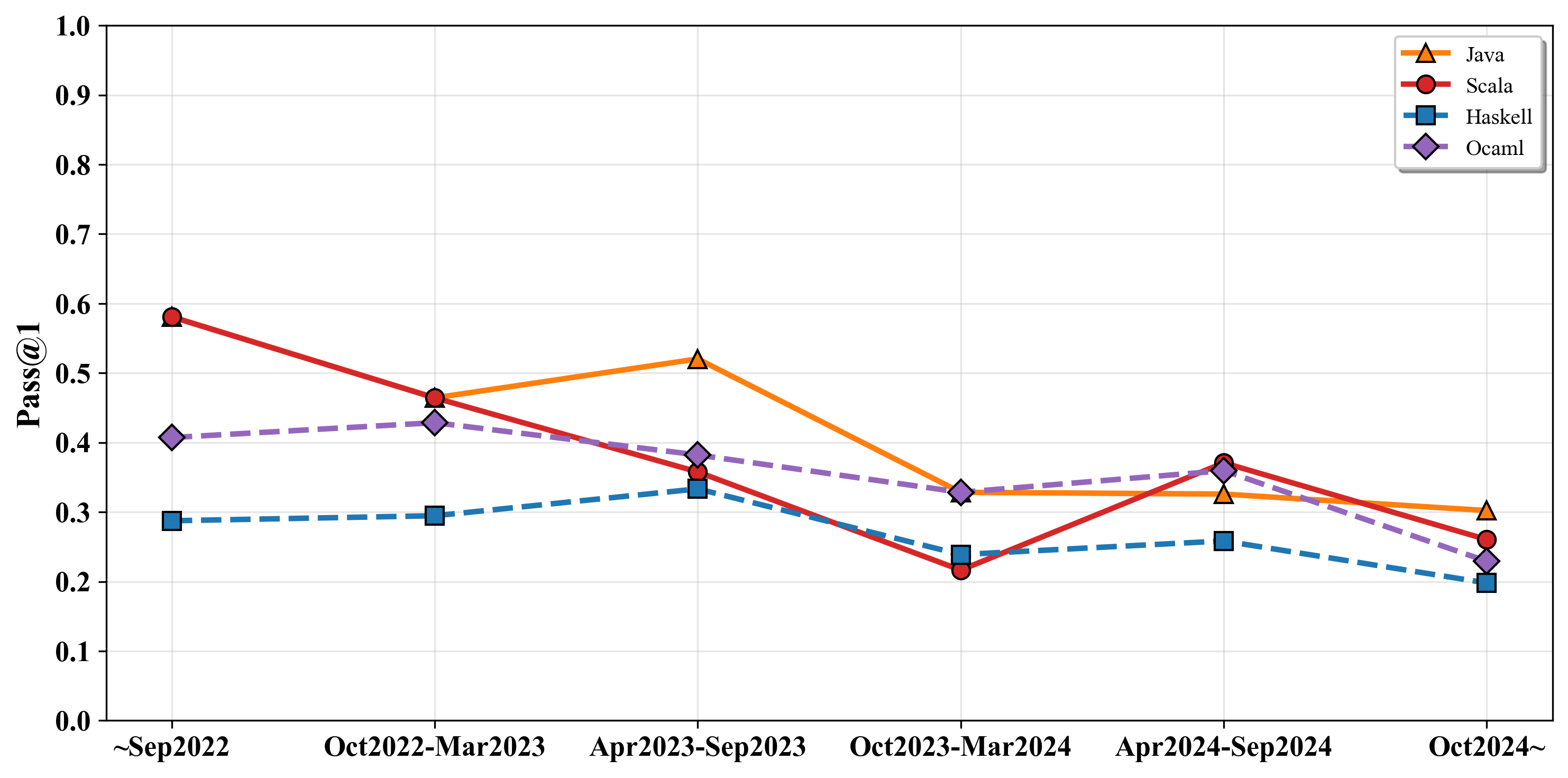
Data Contamination.
We also investigate the potential impact of data contamination of studied LLMs. We specifically select GPT-4o for this analysis due to its knowledge cutoff, which provides a balanced distribution of tasks between the pre-cutoff and post-cutoff periods in our evaluation date. To quantify the impact of data contamination, we partition the programming tasks into six distinct chronological periods based on their release dates:(1) before September 2022, (2) October 2022–March 2023, (3) April–September 2023, (4) October 2023–March 2024, (5) April–September 2024, and (6) after October 2024. Figure 2 illustrates the pass rates of GPT-4o in four studied programming languages. We can see that GPT-4o show show a substantial post-cutoff performance drop in Java and Scala, i.e., from 52.0% to 32.8% in Java and from 35.8% to 21.6% in Scala. This results suggest possible data contamination in pre-training data. In contrast, the model maintains a low and stable accuracy in Ocaml and Haskell throughout, consistent with their limited presence in pre-training corpora.
Static Analysis Rule Categorization
To ensure the reproducibility of our code cleanliness metrics, we
provide a categorization of the static analysis rules employed by
FPEval.
Table [tab:static_analysis_rules]
details the specific configurations used for each language. These rules
are selected to detect two primary types of violations:
-
Imperative Bias: Constructs that are syntactically valid but violate functional programming principles (e.g., use of mutable variables, explicit loops, or procedural control flow).
-
Non-Idiomatic Usage: Code that fails to leverage the expressive power of the language.
For Haskell, we rely on HLint to detect redundant constructs and
suggest higher-order replacements. For OCaml, we invoke the compiler
directly using the -warn-error +a flag to enforce strict static
semantics. For Scala, we employ the default Scalastyle
configuration, which reflects the community’s standard for idiomatic
code. However, to prioritize semantic correctness over formatting
minutiae, we explicitly disabled all whitespace-related rules (e.g., tab
checking, spacing alignment), focusing strictly on logic and paradigm
violations.
Representative Examples of Imperative Code Patterns
1. Mutable Variables
-
Imperative-style (incorrect):
SCALAvar count = 0 count = count + 1 // Functional-style (preferred) val count = 0 val newCount = count + 1Click to expand and view moreIn FP, variables are ideally immutable (
valin Scala,letwithout reassignment in OCaml). However, GPT often generates code using mutable bindings (var) or reassignment operators.
2. Imperative Loops
-
Imperative-style (incorrect):
SCALAfor (i <- 0 until n) { println(i) }Click to expand and view more -
Functional-style (preferred):
SCALA(0 until n).foreach(println)Click to expand and view more -
Or recursion (in OCaml):
OCAMLlet rec print_numbers i n = if i < n then ( print_int i; print_newline (); print_numbers (i + 1) n )Click to expand and view moreGPT frequently defaults to
for,while, ordo whileloops common in imperative languages but less idiomatic in FP. A functional solution would use higher-order functions or recursion.
3. In-place Mutation of Data Structures
-
Imperative-style (incorrect):
SCALAval arr = Array(1, 2, 3) arr(0) = 42Click to expand and view more -
Functional-style (preferred):
SCALAval arr = Vector(1, 2, 3) val newArr = arr.updated(0, 42)Click to expand and view moreInstead of treating data structures as immutable, GPT often produces code that mutates arrays or lists directly, especially in performance-related contexts. This contradicts the functional principle of constructing new values rather than mutating existing ones.
4. Use of null Instead of Option Types
-
Imperative-style (incorrect):
SCALAdef findUser(name: String): User = { if (db.contains(name)) db(name) else null }Click to expand and view more -
Functional-style (preferred):
SCALAdef findUser(name: String): Option[User] = db.get(name)Click to expand and view moreFP discourages the use of
null, favoring safer alternatives likeOption,Maybe, or pattern matching.
Imperative Bias in LLM-Generated Functional Code
Although LLMs are prompted to generate code in functional programming languages such as Haskell, OCaml, and Scala, their outputs often reflect an imperative programming bias. This section provides representative examples and quantitative evidence of this phenomenon.
Example 1: Scala
-
Imperative-style (incorrect):
SCALAimport scala.collection.mutable def countAlternatingSubarrays(nums: List[Int]): Int = { val n = nums.length // Mutable variable 'n' var count = 0 //Mutable variable (var) var left = 0 //Mutable variable (var) var right = 0 // Mutable variable (var) val set = mutable.HashSet[Int]() // Uses mutable collection (HashSet) while (right < n) { //Imperative loop set.add(nums(right)) // Side-effect: mutating set while (set.size > 2) { set.remove(nums(left)) //Side-effect: mutating set left += 1 //Mutation } count += right - left + 1 //Mutation right += 1 //Mutation } count }Click to expand and view more -
Functional-style (preferred):
SCALAdef countAlternatingSubarrays(nums: List[Int]): Int = { nums.indices.foldLeft((0, 0, Map.empty[Int, Int], 0)) { case ((left, right, freqMap, count), r) => val num = nums(r) val updatedFreq = freqMap.updated(num, freqMap.getOrElse(num, 0) + 1) // Slide left pointer while more than 2 distinct elements val (newLeft, newFreq) = Iterator.iterate((left, updatedFreq)) { case (l, fmap) => val leftNum = nums(l) val newCount = fmap(leftNum) - 1 val newFmap = if (newCount == 0) fmap - leftNum else fmap.updated(leftNum, newCount) (l + 1, newFmap) }.dropWhile { case (_, fmap) => fmap.size > 2 }.next() val newCount = count + (r - newLeft + 1) (newLeft, r + 1, newFreq, newCount) }._4 }Click to expand and view moreThe functional version uses an immutable ‘Map‘ instead of a mutable ‘HashSet‘, eliminates all ‘var‘ declarations, and replaces reassignment with state threading via ‘foldLeft‘. It also employs ‘Iterator.iterate‘ to express the sliding window logic in a recursion-inspired style.
Example 2: OCaml
-
Imperative-style (incorrect):
OCAMLlet minTime (skill: int list) (mana: int list) : int = let n = List.length skill in let m = List.length mana in let dp = Array.make_matrix n m 0 in (*uses mutable array*) dp.(0).(0) <- skill.(0) * mana.(0); (*mutation using "<-"*) for j = 1 to m - 1 do (*Imperative loop *) dp.(0).(j) <- max dp.(0).(j-1) (skill.(0) * mana.(j)); (*Mutation inside loop*) done; for i = 1 to n - 1 do (*Imperative loop*) dp.(i).(0) <- dp.(i-1).(0) + skill.(i) * mana.(0); (*Mutation*) for j = 1 to m - 1 do (*Nested loop*) dp.(i).(j) <- max dp.(i).(j-1) dp.(i-1).(j) + skill.(i) * mana.(j); (*Mutation*) done; done; dp.(n-1).(m-1)Click to expand and view more -
Functional-style (preferred):
OCAMLlet minTime (skill: int list) (mana: int list) : int = let rec build_dp prev_row i = match List.nth_opt skill i with | None -> prev_row | Some s -> let row = List.mapi (fun j m -> let from_left = if j = 0 then None else Some (List.nth row (j - 1)) in let from_top = List.nth prev_row j in let cell_value = match from_left with | None -> from_top + s * m | Some l -> max l from_top + s * m in cell_value ) mana in build_dp row (i + 1) in match skill with | [] -> 0 | s0 :: rest -> let first_row = snd (List.fold_left (fun (max_val, acc) m -> let curr = max max_val (s0 * m) in (curr, acc @ [curr]) ) (min_int, []) mana) in let final_dp = build_dp first_row 1 in List.hd (List.rev final_dp)Click to expand and view more
In this version:
-
The dp matrix is reconstructed immutably using List.fold_left and pure functions.
-
There are no imperative loops or mutation (<- is gone).
-
Recursion and list transformations maintain purity and immutability.
Example 3: Haskell
-
Imperative-style (incorrect):
HASKELLimport Data.List maxOperations :: [Int] -> Int maxOperations nums = helper nums 0 where helper nums count | length nums < 2 = count | otherwise = let score = sum $ take 2 nums in helper (delete (head nums) $ delete (head $ reverse nums) nums) (count + 1)Click to expand and view more -
Functional-style (preferred):
HASKELLmaxOperations = go 0 where go count (x:xs@(_:_)) = let mid = init xs in go (count + 1) mid go count _ = countClick to expand and view more
Prompt Design and Language-specific Self-repair Instructions
This appendix details the prompting strategies and language-specific repair mappings used in our experiments. It consists of two parts: (1) the prompt templates for code generation and self-repair, and (2) the mapping between common compiler warnings or errors and the corresponding self-repair instructions for each functional language (Haskell, OCaml, and Scala).
Prompt Templates
The first part presents the exact prompts used for the baseline code generation and self-repair settings.
("system",
     "You are an expert {lang} programmer. You will be given a question (problem specification) and will generate a correct {lang} program that matches the specification and passes all tests. You will NOT return anything except for the program AND necessary imports.\n",
    ),
    ("human",
     "### QUESTION:\n{description}\n"
     "### FORMAT: You will use the following starter code to write the solution to the problem and enclose your code within delimiters.\n{template}\n"
     "### ANSWER: (use the provided format with backticks)\n"
)("system",
"You are a helpful programming assistant and an expert {lang} programmer. The previously generated code has quality issues, does not pass the tests, and is not idiomatic functional programming. Please provide a better code implementation as expected by the task description and the function using idiomatic functional programming style. You must put the entire fixed program within code delimiters only once.",
),
("human",
"### CODE: \n{pre_code}\n"
)Language-specific Self-repair Mappings
The second part summarizes detailed mappings between compiler feedback and the corresponding self-repair instructions. These mappings serve as structured guidance for the model to correct errors and improve code style and maintainability during the self-repair process.
| Warning / Error | Instruction for Self-repair |
|---|---|
| Avoid lambda | Avoid using lambda expressions when a function or operator already exists. |
| Eta reduce | Remove unnecessary parameters by applying eta-reduction. |
| Redundant bracket | Eliminate redundant brackets to simplify the expression. |
| Avoid lambda using infix | Replace lambda expressions with infix operators when possible. |
| Use zipWith | Use zipWith for parallel list operations instead of combining map and zip. |
| Avoid reverse | Avoid using reverse before head, last, or indexing, as it is inefficient. |
| Move brackets to avoid $ | Prefer parentheses over excessive use of the $ operator for readability. |
| Move filter | Apply filter closer to the data source to reduce unnecessary computation. |
| Use uncurry | Use uncurry when applying a function to a tuple. |
| Use infix | Use infix notation for better readability when working with operators. |
| Warning / Error | Instruction for Self-repair |
|---|---|
| Type error | Check type annotations and ensure expressions match expected types. For example, if a function expects an int but receives a string, convert or adjust the type. |
| Unbound identifier | Declare the identifier before using it, or fix the spelling. Make sure the correct module is opened/imported. |
| Parse error | Fix OCaml syntax: check missing in, ->, ;;, or misplaced parentheses/brackets. |
| Unused | Remove unused variables, or prefix them with _ if they are intentionally unused. |
| Exhaustiveness error | Add missing cases in pattern matching to cover all constructors, or use _ as a catch-all case. |
| Incorrect arity | Check the number of arguments when calling a function. Supply missing arguments or remove extra ones. |
| Missing labeled argument | Add the required labeled argument when calling the function (e.g., f ~x:value if the function expects ~x). |
| Mutation of immutable | OCaml values are immutable by default. Rewrite code to avoid mutation, and use new bindings (let x = ...) instead of trying to update old ones. |
| Warning / Error | Instruction for Self-repair |
|---|---|
| If block needs braces | Always wrap if blocks with braces {} for clarity and to avoid ambiguity. |
| Avoid using return | Do not use return; rely on expression values instead. |
| Magic Number | Replace magic numbers with named constants or enums for readability. |
| Cyclomatic complexity of | Refactor the function into smaller ones or use functional constructs (map, fold, recursion) to reduce complexity. |
| There should be a space before the plus (+) sign | Add proper spacing around operators (e.g., a + b not a+b). |
| File line length exceeds | Split long lines into multiple shorter lines for readability. |
| File must end with newline character | Ensure the file ends with a newline character. |
📊 논문 시각자료 (Figures)