- Title: Cost-Efficient Cross-Lingual Retrieval-Augmented Generation for Low-Resource Languages A Case Study in Bengali Agricultural Advisory
- ArXiv ID: 2601.02065
- Date: 2026-01-05
- Authors: Md. Asif Hossain, Nabil Subhan, Mantasha Rahman Mahi, Jannatul Ferdous Nabila
📝 Abstract
Access to reliable agricultural advisory remains limited in many developing regions due to a persistent language barrier: authoritative agricultural manuals are predominantly written in English, while farmers primarily communicate in low-resource local languages such as Bengali. Although recent advances in Large Language Models (LLMs) enable natural language interaction, direct generation in low-resource languages often exhibits poor fluency and factual inconsistency, while cloud-based solutions remain cost-prohibitive. This paper presents a cost-efficient, cross-lingual Retrieval-Augmented Generation (RAG) framework for Bengali agricultural advisory that emphasizes factual grounding and practical deployability. The proposed system adopts a translation-centric architecture in which Bengali user queries are translated into English, enriched through domain-specific keyword injection to align colloquial farmer terminology with scientific nomenclature, and answered via dense vector retrieval over a curated corpus of English agricultural manuals (FAO, IRRI). The generated English response is subsequently translated back into Bengali to ensure accessibility. The system is implemented entirely using open-source models and operates on consumer-grade hardware without reliance on paid APIs. Experimental evaluation demonstrates reliable source-grounded responses, robust rejection of out-of-domain queries, and an average end-to-end latency below 20 seconds. The results indicate that cross-lingual retrieval combined with controlled translation offers a practical and scalable solution for agricultural knowledge access in low-resource language settings
💡 Summary & Analysis
1. **Translation-Centric RAG Pipeline Design**: This study designs a translation-centric RAG pipeline tailored for Bengali agricultural advisory. It translates user-provided queries from Bengali to English, retrieves relevant information, and then translates the response back into Bengali. Imagine this as an airplane acting as a translator between two countries.
Domain-Specific Keyword Mapping Strategy: To bridge the gap between colloquial farmer language and scientific terminology, the system introduces a keyword mapping mechanism that converts colloquial expressions to standardized scientific terms. This is akin to a doctor understanding patient symptoms and making appropriate diagnoses in a hospital setting.
Cost-Efficient Local Deployment: The system operates all components locally using quantization techniques to reduce memory requirements, allowing it to run on consumer-grade hardware. This ensures efficient deployment without relying on expensive cloud services.
📄 Full Paper Content (ArXiv Source)
Retrieval-Augmented Generation (RAG), Cross-Lingual NLP, Low-Resource
Languages, Bengali, Agricultural Advisory, Quantization, Large Language
Models (LLMs)
Introduction
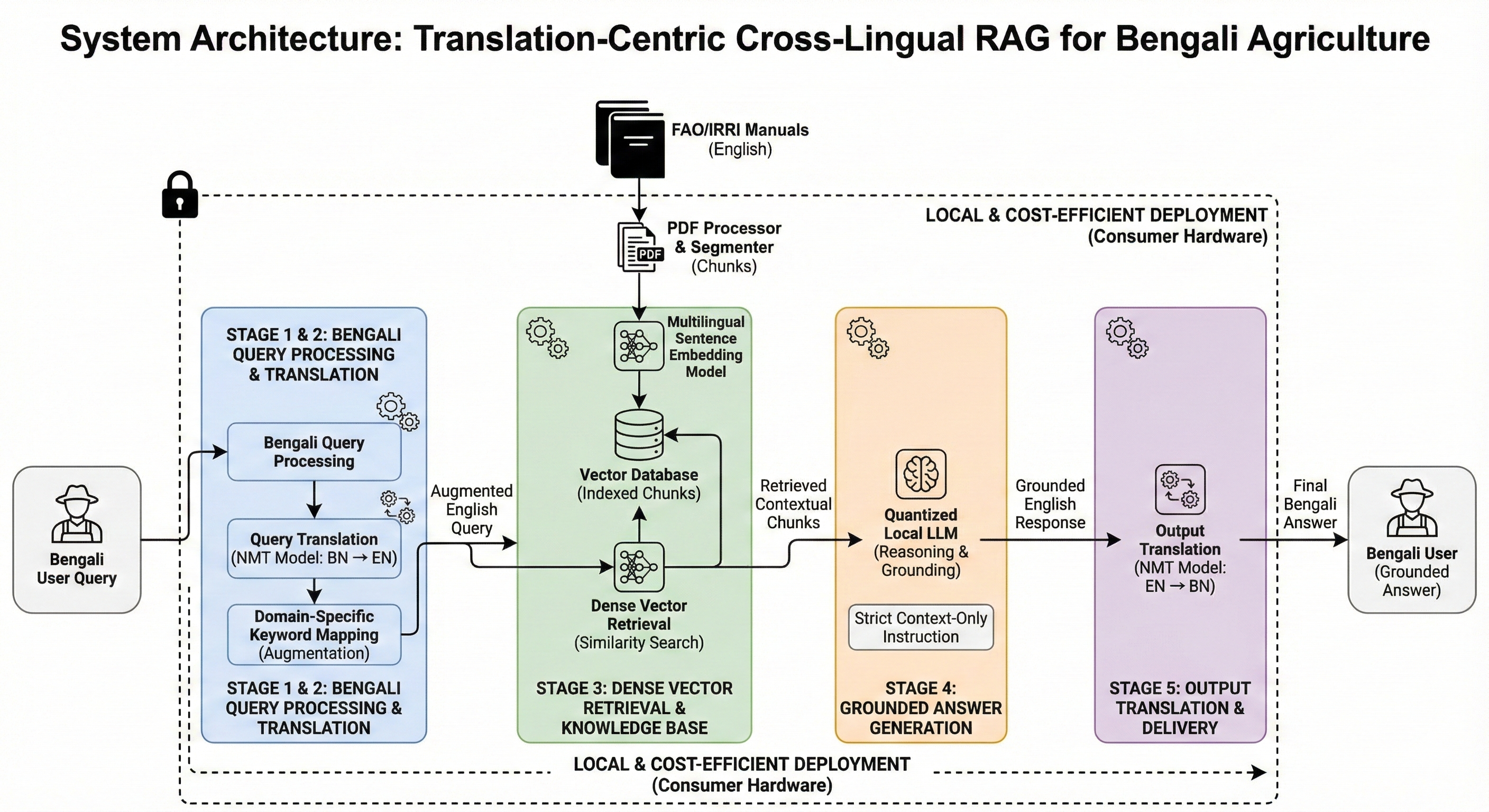
System Architecture of the proposed Translation-Centric
Cross-Lingual RAG Pipeline. The system processes Bengali queries by
translating them to English, enriching them with domain-specific
keywords, and retrieving relevant information from English manuals
before generating a grounded response.
Agriculture plays a vital role in developing countries such as
Bangladesh, where millions of people depend on farming for food security
and income. International organizations including the Food and
Agriculture Organization (FAO) and the International Rice Research
Institute (IRRI) publish detailed agricultural manuals containing
scientifically validated guidance on crop diseases, fertilizer usage,
and best practices . However, a major accessibility challenge remains:
these manuals are predominantly written in English and distributed as
static PDF documents. For smallholder farmers who primarily communicate
in Bengali, this information is effectively inaccessible.
Recent advances in Large Language Models (LLMs) have enabled natural
language interfaces for information access. However, directly applying
standard LLMs for Bengali agricultural advisory presents significant
limitations. Most high-performing models are trained primarily on
English data, resulting in poor grammatical quality and factual
inconsistencies in Bengali outputs . In addition, commercial cloud-based
LLM services are often cost-prohibitive for low-cost rural deployment.
More critically, generative models operating without external grounding
are prone to hallucinations, which can lead to unsafe recommendations in
agriculture-related decision-making .
Retrieval-Augmented Generation (RAG) has been proposed as a solution to
reduce hallucinations by grounding responses in authoritative documents.
In a RAG system, the model retrieves relevant information from trusted
sources before generating an answer. While effective, most existing RAG
frameworks are designed for English-language use or require high
computational resources, limiting their applicability in low-resource
linguistic and deployment settings .
In the Bangladeshi agricultural context, an additional challenge arises
from a pronounced vocabulary gap. Farmers frequently use local or
colloquial terms to describe crop diseases and symptoms (e.g., “Magra”),
whereas official manuals rely on scientific terminology (e.g., “Stem
Borer”) . This mismatch prevents standard retrieval systems from
effectively linking user queries to relevant technical documents.
To address these challenges, we propose a cost-efficient, cross-lingual
RAG framework tailored for Bengali agricultural advisory. Rather than
forcing the model to generate responses directly in Bengali, we adopt a
translation-based approach . User queries are translated from Bengali to
English, augmented using a domain-specific keyword mapping strategy to
align colloquial expressions with scientific terminology, and then used
to retrieve relevant passages from English agricultural manuals. The
system generates a grounded English response, which is subsequently
translated back into Bengali for user-facing output.
The proposed system is implemented entirely using open-source components
and runs on standard consumer-grade hardware, avoiding reliance on paid
cloud APIs. Empirical evaluation through representative query examples
demonstrates that the system produces source-backed, contextually
relevant responses while maintaining practical inference latency
suitable for real-world advisory scenarios.
The main contributions of this work are summarized as follows:
We design a translation-first, cross-lingual RAG pipeline tailored for
Bengali agricultural advisory.
We introduce a domain-specific keyword mapping strategy to bridge
colloquial farmer language and scientific documentation.
We present a fully local, cost-efficient implementation suitable for
deployment in resource-constrained environments.
Related Work
Recent research has explored the application of Retrieval-Augmented
Generation (RAG) to improve factual reliability in knowledge-intensive
tasks. Lewis et al. introduced the foundational RAG framework,
demonstrating that combining neural retrieval with generative models can
significantly reduce hallucinations by grounding responses in external
documents. Subsequent studies have extended RAG to specialized domains,
including medicine and agriculture .
Several works have focused specifically on domain-adapted RAG systems.
AgroLLM and related studies demonstrated that agricultural question
answering benefits from retrieving information from curated expert
manuals rather than relying solely on parametric model knowledge.
However, these systems are primarily designed for English-language
inputs and often assume access to high-performance computing resources.
Low-resource language challenges in RAG have been highlighted in
multiple recent studies. Research on Bengali and other South Asian
languages shows that direct generation using multilingual or
English-centric LLMs frequently results in degraded fluency and factual
accuracy . Studies such as BanglaMedQA emphasize that retrieval alone
is insufficient; intelligent routing and grounding mechanisms are
necessary to achieve reliable performance in low-resource contexts.
Cross-lingual RAG has emerged as a promising solution. Prior work such
as XRAG has demonstrated that translating low-resource language
queries into English before retrieval can significantly improve document
matching . Large-scale multilingual translation models, such as NLLB and
Helsinki-NLP, have been shown to preserve domain-specific semantics when
applied carefully. However, existing cross-lingual RAG systems often
rely on cloud-based APIs. To address robustness, recent benchmarks have
also explored culturally sensitive RAG tasks .
Recent investigations into cost-efficient model deployment have
demonstrated that quantization techniques can substantially reduce
memory and compute requirements . Quantized open-source LLMs enable
fully local deployment, which is critical for privacy and offline
accessibility. Techniques such as LoRA further optimize these processes.
However, few studies integrate quantization, cross-lingual retrieval,
and domain-specific vocabulary alignment into a single system. Our work
addresses these gaps by proposing a translation-first, locally
deployable RAG system tailored for Bengali agricultural advisory.
System Architecture and Methodology
System Overview
The proposed system is designed as a translation-centric, cross-lingual
RAG pipeline. The core design principle is to separate user interaction
language (Bengali) from reasoning and retrieval language (English). The
system follows five sequential stages: (1) Bengali query processing, (2)
query translation and keyword normalization, (3) document retrieval from
authoritative English manuals, (4) grounded answer generation, and (5)
output translation into Bengali.
Data Collection and Knowledge Base Construction
The knowledge base consists of a curated collection of English-language
agricultural manuals published by authoritative sources such as FAO and
IRRI . Each PDF document is processed using automated document loaders,
after which the text is segmented into overlapping chunks of fixed
length to preserve contextual continuity.
Bengali Query Processing and Translation
User queries are provided in Bengali. Direct reasoning in Bengali is
avoided due to the known limitations of English-centric LLMs. Instead,
each Bengali query is translated into English using an open-source
neural machine translation model .
Domain-Specific Keyword Mapping
A key challenge is the mismatch between colloquial farmer terminology
and scientific language. To address this, the system incorporates a
domain-specific keyword mapping mechanism. This component augments
translated queries by injecting standardized scientific terms
corresponding to known colloquial expressions, improving retrieval
recall without requiring complex ontologies.
Dense Vector Retrieval
For document retrieval, the system employs dense vector similarity
search. Each text chunk in the knowledge base is embedded using a
multilingual sentence embedding model . These embeddings are indexed
using a vector database (FAISS) to enable efficient similarity-based
retrieval .
Grounded Answer Generation
The retrieved document chunks are provided as contextual input to a
locally deployed, quantized large language model . The model is prompted
with strict instructions to generate responses only based on the
retrieved context. If the required information is not present, the model
explicitly states that the information is unavailable.
Output Translation to Bengali
The grounded English response is translated back into Bengali using the
NLLB framework . This final Bengali output is presented to the user,
ensuring the underlying reasoning is derived from validated English
sources.
Local and Cost-Efficient Deployment
All components operate locally. The language model is deployed using
quantization techniques to reduce memory requirements, enabling
execution on standard consumer hardware .
Experimental Setup
Dataset and Knowledge Base
We curated a domain-specific corpus of English-language agricultural
manuals from FAO and IRRI . The final corpus consisted of approximately
180 pages, producing around 650–700 text chunks (600 characters with
50-character overlap) after preprocessing.
Configuration
Translation: Helsinki-NLP (opus-mt-bn-en) for input; NLLB-200
for output.
**Retrieval:**Sentence-Transformers (all-MiniLM-L6-v2) and FAISS
index.
LLM: Llama-3-8B-Instruct (4-bit quantized via Unsloth).
Hardware: Single NVIDIA Tesla T4 GPU (16 GB VRAM) on Kaggle.
Results and Discussion
This section presents the qualitative and empirical analysis of the
system.
Qualitative Performance Analysis
We evaluated the system using representative queries in three
categories: Disease Diagnosis, Dosage Instructions, and Out-of-Domain
checks.
Category
User Query (Bengali)
Retrieved Concept
Verdict
Disease Diagnosis
Symptoms of Rice Blast
Rice Blast / P. oryzae
Success
Dosage Instruction
Urea Rules
Urea / Nitrogen App.
Success
Out-of-Domain
Who is US President?
Politics / Irrelevant
Pass
Qualitative Analysis of System Responses
The results demonstrate effective domain-specific keyword injection. For
example, local terms for “Blast” were successfully mapped to
Pyricularia oryzae, enabling accurate retrieval from FAO and IRRI
manuals.
System Latency
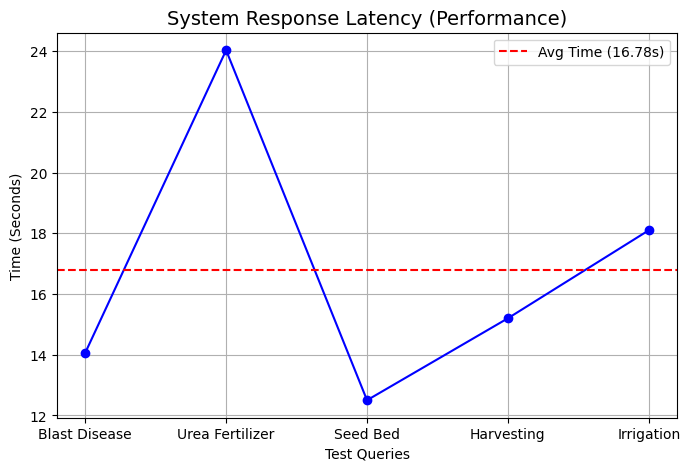
The average end-to-end latency was approximately 15.6 seconds per query
on a Tesla T4 GPU. A breakdown of the latency is shown in Fig.
2. While higher than monolingual
English systems, this is acceptable for asynchronous advisory use cases
where accuracy is more critical than sub-second speed.
Latency Breakdown: Translation and LLM inference time
compared to Retrieval time.
Source Distribution
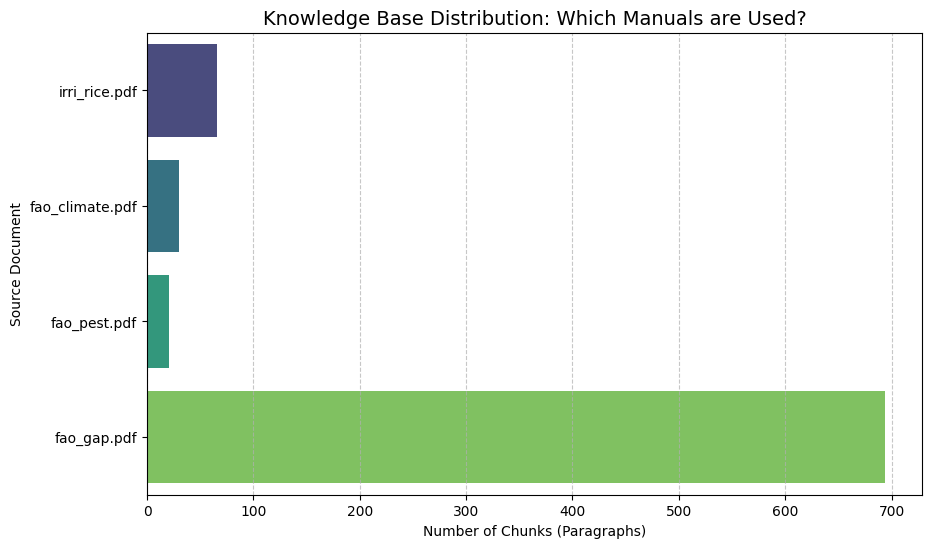
The system demonstrated balanced retrieval from multiple authoritative
sources (FAO, IRRI) depending on the query type (see Fig.
3). Disease queries largely mapped to
FAO pest guides, while fertilizer queries mapped to IRRI production
manuals. This validates the effectiveness of the retrieval mechanism in
selecting the correct context.
Distribution of Retrieved Documents showing reliance on
authoritative FAO and IRRI manuals.
Limitations
Despite promising results, the proposed system has several limitations
that warrant further investigation.
Dependency on Translation Quality
The framework relies on neural machine translation to bridge Bengali and
English. Errors or ambiguities in the initial Bengali-to-English
translation may propagate to the retrieval and reasoning stages,
potentially affecting answer accuracy.
Dialect and Linguistic Variation
Bengali spoken in Bangladesh exhibits significant regional variation
(e.g., Sylheti, Chittagonian, Rangpuri). The current system assumes
Standard Bengali input and does not explicitly handle dialectal
spellings, pronunciations, or region-specific vocabulary, which may
reduce performance for non-standard inputs.
Inference Latency
The average end-to-end latency of approximately 15.6 seconds is
acceptable for asynchronous agricultural advisory but is unsuitable for
real-time conversational interaction.
Static Knowledge Base
The system operates over a fixed corpus of agricultural manuals and
cannot answer dynamic or time-sensitive queries, such as daily weather
conditions or real-time market prices.
Accessibility Constraints
The current implementation supports only text-based interaction. This
limits accessibility for illiterate or semi-literate farmers, who
constitute a significant portion of the target user population.
Conclusion and Future Work
This paper presented a cost-efficient, cross-lingual Retrieval-Augmented
Generation (RAG) framework designed to improve access to agricultural
knowledge for Bengali-speaking users. By adopting a translation-centric
“sandwich architecture” (Translation $`\to`$ Retrieval $`\to`$
Translation) and leveraging 4-bit quantized open-source language models,
the system enables accurate, source-grounded responses on consumer-grade
hardware without reliance on paid cloud APIs.
Experimental results demonstrate that the proposed approach effectively
bridges the gap between English-language agricultural manuals and
low-resource language users, while maintaining strong factual grounding
and robust rejection of out-of-domain queries. The findings confirm that
cross-lingual retrieval, combined with controlled translation and
domain-specific keyword mapping, offers a practical and scalable
solution for agricultural advisory in resource-constrained settings.
Future work will focus on several key extensions. First, integrating
automatic speech recognition (ASR) will improve accessibility for
illiterate users. Second, handling regional Bengali dialects through
dialect-aware normalization or multilingual embeddings will enhance
robustness across diverse user populations. Third, expanding the keyword
mapping mechanism using automated ontology or knowledge graph
construction may reduce manual effort and improve coverage. Finally,
incorporating quantitative evaluation benchmarks and real-world user
studies will provide deeper insight into system effectiveness and
usability.
The copyright of this content belongs to the respective researchers. We deeply appreciate their hard work and contribution to the advancement of human civilization.