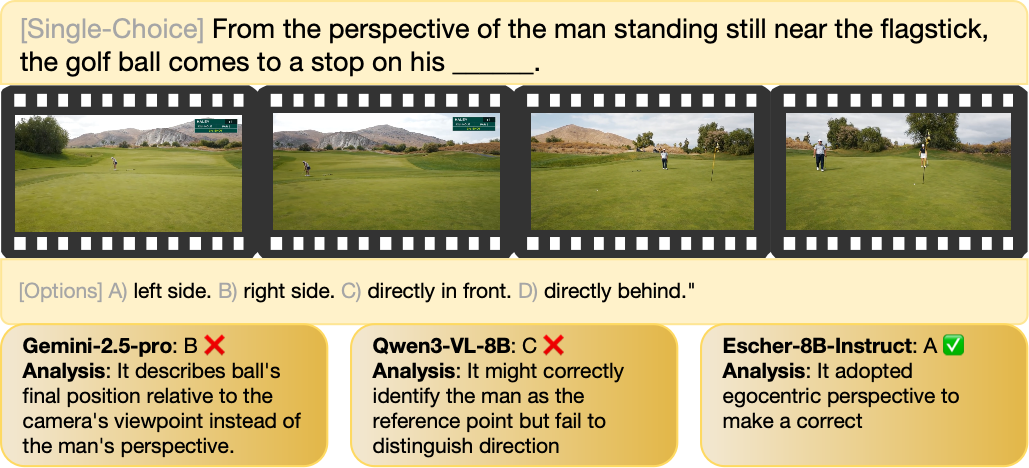
- Title: EscherVerse An Open World Benchmark and Dataset for Teleo-Spatial Intelligence with Physical-Dynamic and Intent-Driven Understanding
- ArXiv ID: 2601.01547
- Date: 2026-01-04
- Authors: Tianjun Gu, Chenghua Gong, Jingyu Gong, Zhizhong Zhang, Yuan Xie, Lizhuang Ma, Xin Tan
📝 Abstract
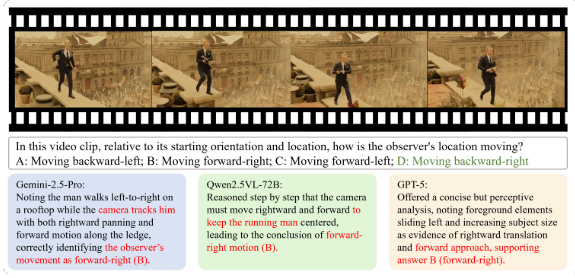
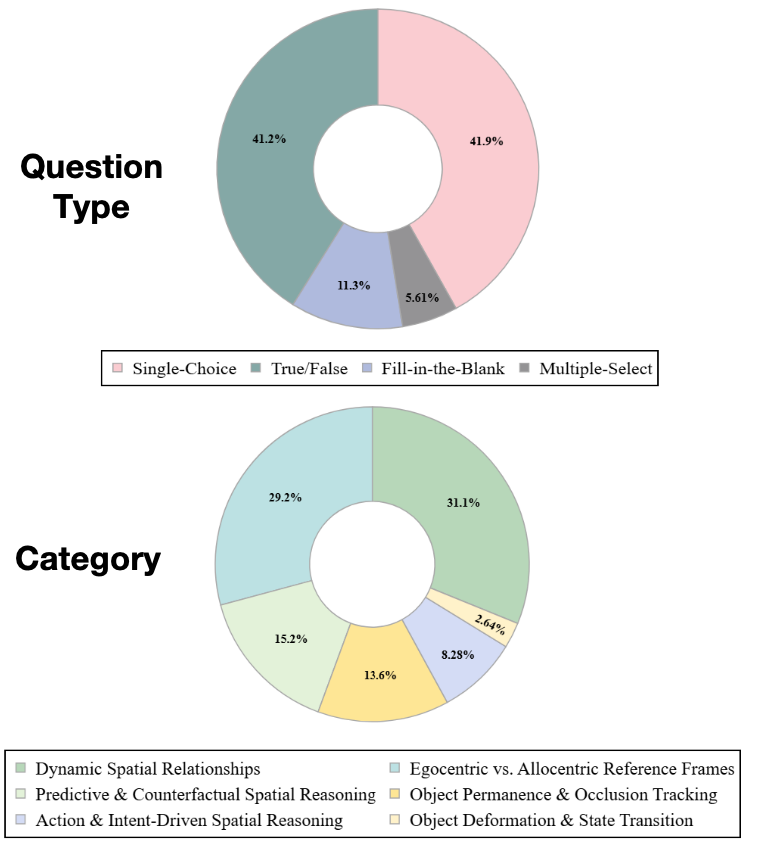
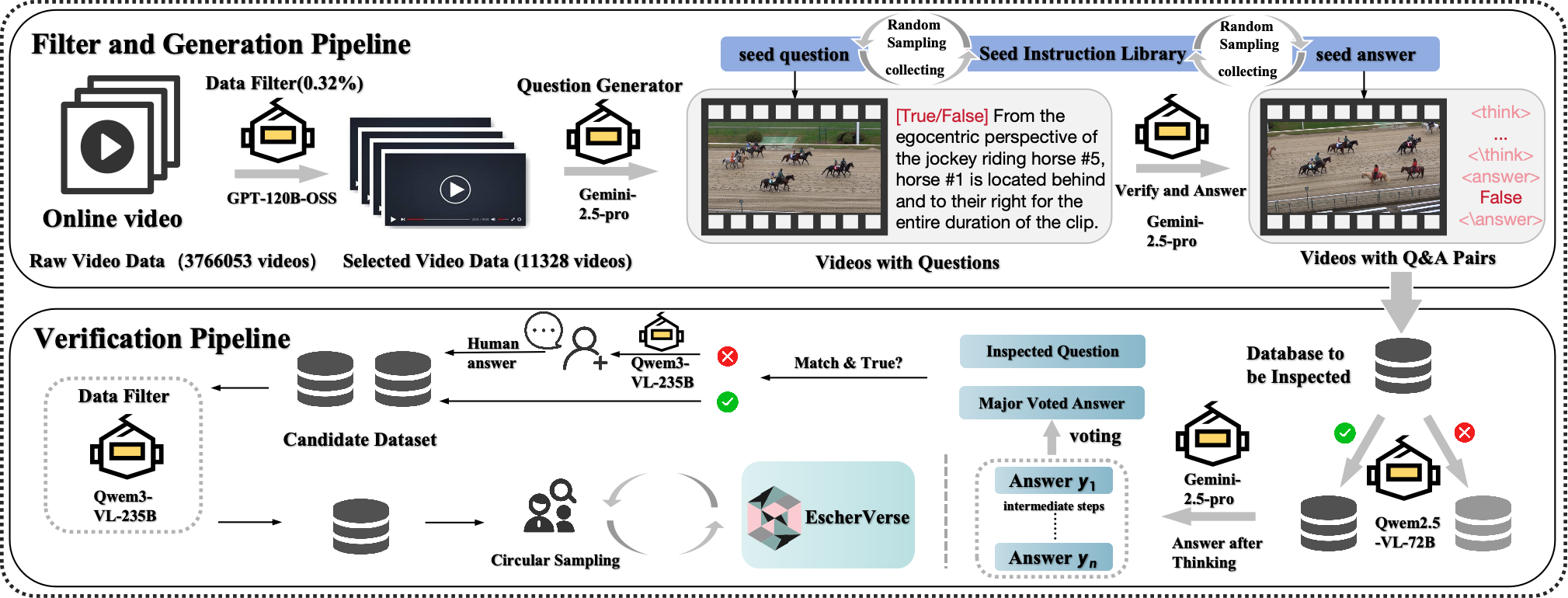
The ability to reason about spatial dynamics is a cornerstone of intelligence, yet current research overlooks the human intent behind spatial changes. To address these limitations, we introduce Teleo-Spatial Intelligence (TSI), a new paradigm that unifies two critical pillars: Physical-Dynamic Reasoning--understanding the physical principles of object interactions--and Intent-Driven Reasoning--inferring the human goals behind these actions. To catalyze research in TSI, we present EscherVerse, consisting of a large-scale, open-world benchmark (Escher-Bench), a dataset (Escher-35k), and models (Escher series). Derived from real-world videos, EscherVerse moves beyond constrained settings to explicitly evaluate an agent's ability to reason about object permanence, state transitions, and trajectory prediction in dynamic, human-centric scenarios. Crucially, it is the first benchmark to systematically assess Intent-Driven Reasoning, challenging models to connect physical events to their underlying human purposes. Our work, including a novel data curation pipeline, provides a foundational resource to advance spatial intelligence from passive scene description toward a holistic, purpose-driven understanding of the world.
💡 Summary & Analysis
1. **Contribution 1: Opportunity to Address Reviewer Comments**
Providing authors with the chance to address reviewers’ comments is crucial for academic integrity and improving paper quality. This is akin to a doctor asking further questions to better understand a patient's symptoms, ensuring comprehensive treatment.
Contribution 2: Guidelines for Rebuttal Submission
Authors should not introduce new research findings or experiments in their rebuttals. This maintains the fairness of academic review processes. It’s like not allowing unfair shortcuts during a race; all participants must adhere to the same rules.
Contribution 3: Adherence to Formatting Guidelines
Following specific formatting guidelines for submitting rebuttals ensures consistency and fairness across all submissions. This is similar to all racers following the same set of racing rules, ensuring a fair competition.
📄 Full Paper Content (ArXiv Source)
# Introduction
After receiving paper reviews, authors may optionally submit a rebuttal
to address the reviewers’ comments, which will be limited to a one
page PDF file. Please follow the steps and style guidelines outlined
below for submitting your author response.
The author rebuttal is optional and, following similar guidelines to
previous conferences, is meant to provide you with an opportunity to
rebut factual errors or to supply additional information requested by
the reviewers. It is NOT intended to add new contributions (theorems,
algorithms, experiments) that were absent in the original submission and
NOT specifically requested by the reviewers. You may optionally add a
figure, graph, or proof to your rebuttal to better illustrate your
answer to the reviewers’ comments.
Per a passed 2018 PAMI-TC motion, reviewers should refrain from
requesting significant additional experiments for the rebuttal or
penalize for lack of additional experiments. Authors should refrain from
including new experimental results in the rebuttal, especially when not
specifically requested to do so by the reviewers. Authors may include
figures with illustrations or comparison tables of results reported in
the submission/supplemental material or in other papers.
Just like the original submission, the rebuttal must maintain anonymity
and cannot include external links that reveal the author identity or
circumvent the length restriction. The rebuttal must comply with this
template (the use of sections is not required, though it is recommended
to structure the rebuttal for ease of reading).
Response length
Author responses must be no longer than 1 page in length including any
references and figures. Overlength responses will simply not be
reviewed. This includes responses where the margins and formatting are
deemed to have been significantly altered from those laid down by this
style guide. Note that this LaTeX guide already sets figure captions and
references in a smaller font.
Formatting your Response
Make sure to update the paper title and paper ID in the appropriate
place in the tex file.
All text must be in a two-column format. The total allowable size of the
text area is $`6\frac78`$ inches (17.46 cm) wide by $`8\frac78`$ inches
(22.54 cm) high. Columns are to be $`3\frac14`$ inches (8.25 cm) wide,
with a $`\frac{5}{16}`$ inch (0.8 cm) space between them. The top margin
should begin 1 inch (2.54 cm) from the top edge of the page. The bottom
margin should be $`1\frac{1}{8}`$ inches (2.86 cm) from the bottom edge
of the page for $`8.5 \times 11`$-inch paper; for A4 paper,
approximately $`1\frac{5}{8}`$ inches (4.13 cm) from the bottom edge of
the page.
Please number any displayed equations. It is important for readers to be
able to refer to any particular equation.
Wherever Times is specified, Times Roman may also be used. Main text
should be in 10-point Times, single-spaced. Section headings should be
in 10 or 12 point Times. All paragraphs should be indented 1 pica
(approx. $`\frac{1}{6}`$ inch or 0.422 cm). Figure and table captions
should be 9-point Roman type as in
1.
List and number all bibliographical references in 9-point Times,
single-spaced, at the end of your response. When referenced in the text,
enclose the citation number in square brackets, for example . Where
appropriate, include the name(s) of editors of referenced books.
Example of caption. It is set in Roman so that mathematics
(always set in Roman: Bsin A = Asin B)
may be included without an ugly clash.
To avoid ambiguities, it is best if the numbering for equations,
figures, tables, and references in the author response does not overlap
with that in the main paper (the reviewer may wonder if you talk about
1 in the author response or in the
paper). See LaTeX template for a workaround.
Illustrations, graphs, and photographs
All graphics should be centered. Please ensure that any point you wish
to make is resolvable in a printed copy of the response. Resize fonts in
figures to match the font in the body text, and choose line widths which
render effectively in print. Readers (and reviewers), even of an
electronic copy, may choose to print your response in order to read it.
You cannot insist that they do otherwise, and therefore must not assume
that they can zoom in to see tiny details on a graphic.
When placing figures in LaTeX, it is almost always best to use
\includegraphics, and to specify the figure width as a multiple of the
line width as in the example below
The copyright of this content belongs to the respective researchers. We deeply appreciate their hard work and contribution to the advancement of human civilization.