- Title: LOFA Online Influence Maximization under Full-Bandit Feedback using Lazy Forward Selection
- ArXiv ID: 2601.00933
- Date: 2026-01-02
- Authors: Jinyu Xu, Abhishek K. Umrawal
📝 Abstract
We study the problem of influence maximization (IM) in an online setting, where the goal is to select a subset of nodes$\unicode{x2014}$called the seed set$\unicode{x2014}$at each time step over a fixed time horizon, subject to a cardinality budget constraint, to maximize the expected cumulative influence. We operate under a full-bandit feedback model, where only the influence of the chosen seed set at each time step is observed, with no additional structural information about the network or diffusion process. It is well-established that the influence function is submodular, and existing algorithms exploit this property to achieve low regret. In this work, we leverage this property further and propose the Lazy Online Forward Algorithm (LOFA), which achieves a lower empirical regret. We conduct experiments on a real-world social network to demonstrate that LOFA achieves superior performance compared to existing bandit algorithms in terms of cumulative regret and instantaneous reward.
💡 Summary & Analysis
1. **Key Contribution of LOFA**: The Lazy Online Forward Algorithm (LOFA) is designed to optimize influence spread in online settings, similar to choosing the right influencers on social media to promote a product effectively.
Balancing Efficiency and Adaptability: LOFA gradually adds nodes over time while optimizing influence diffusion, much like how players adjust their strategies during a game based on evolving circumstances.
Experimental Results: Tested with real-world social network data, LOFA outperformed existing methods, akin to a new app capturing market attention by delivering superior performance compared to its predecessors.
📄 Full Paper Content (ArXiv Source)
# Introduction
The Influence Maximization (IM) problem is a fundamental challenge in
social network analysis that aims to identify a small set of influential
nodes (seed users) in a network such that their activation leads to the
maximum spread of influence . This problem has significant applications
in various domains, such as viral marketing, social network analysis,
rumor control, and public health campaigns, where understanding and
leveraging network dynamics are crucial. Companies seek to leverage
network effects to promote products through word-of-mouth marketing,
while policymakers aim to maximize the reach of awareness campaigns with
minimal resources. Influence Maximization helps optimize these processes
by selecting the most effective set of influencers.
The IM problem can be categorized into offline and online settings based
on network knowledge and the decision-making process. Some IM research
primarily focuses on an offline setting, where the entire network
structure and influence probabilities are known in advance, allowing for
precomputation of optimal seed sets. However, in real-world scenarios,
networks often evolve dynamically, and influence propagation occurs in
real-time, necessitating the study of IM in an online setting. Our
research focuses on the online IM problem, where decisions must be made
adaptively as the network changes or new information becomes available.
Literature Review
IM has been extensively studied in different settings. We briefly survey
some representative work as follows. introduced the foundational IM
framework under the Independent Cascade (IC) and Linear Threshold (LT)
models, proving submodularity of the influence function and enabling a
greedy algorithm with $`(1-1/e)`$ approximation. proposed the
Cost-Effective Lazy Forward (CELF) algorithm, enhancing greedy
efficiency via submodularity, which is further improved by as CELF++.
improved the offline scalability using Reverse Influence Sampling (RIS),
now central to many offline IM algorithms, although it is limited for
online settings. Recently, community-based methods have also been
explored to improve the runtime further.
Next, the Combinatorial Multi-Armed Bandit (CMAB) approaches adapt Upper
Confidence Bound (UCB) , Thompson Sampling , and related strategies to
submodular rewards, with regret bounds established under semi- and
full-bandit feedback . proposed Explore-Then-Commit Greedy for
stochastic submodular rewards with full-bandit feedback, while
introduced ClusterGreedy under LT by partitioning nodes. applied the
Moth-Flame Optimization Algorithm for influencer identification, and
developed Combinatorial UCB (CUCB) for probabilistically triggered arms.
Furthermore, Online IM research addresses dynamic networks and partial
feedback. proposed adaptive seed selection with heuristic methods, while
used a CMAB framework to balance exploration and exploitation under
limited feedback, though computationally intensive. In addition, we
survey methods for general non-linear reward functions beyond
submodularity, such as CMAB-SM , a divide-and-conquer strategy to
efficiently handle large action spaces, and DART , a successive
accept-reject algorithm.
All these studies illustrate the evolution of IM from static offline
methods like RIS to online adaptive approaches. Our work focuses on
bridging efficiency and adaptability in online IM while maintaining a
competitive regret.
Contribution
We propose the Lazy Online Forward Algorithm (LOFA) for the Influence
Maximization (IM) problem in an online setting under full-bandit
feedback. Using experiments on a real-world social network, we show that
LOFA outperforms other methods in terms of empirical reward and regret.
Organization
The rest of the paper is structured as follows.
2 provides preliminaries and
formulates the problem of interest.
3 discusses the proposed Online
Lazy Forward Algorithm (LOFA).
4 demonstrates the implementation
of LOFA on a real-world social network against competing baselines and
shows its superior performance.
5 concludes the paper and provides
some future directions.
Preliminaries and Problem Formulation
The Online Influence Maximization (IM) Problem is an extension of the
classical IM problem, where the goal is to sequentially select a set of
seed nodes in a social network to maximize the expected spread of
influence over time. In this section, we discuss some preliminaries and
formulate the problem of interest in this paper. Let $`\Omega`$ denote
the ground set of $`n`$ elements. A function:
$`\sigma:2^V \rightarrow \mathbb{R}`$ is submodular if
$`\forall A\subseteq B\subseteq V \subseteq \Omega`$ and any node
$`v \in V - B`$,
$`\sigma\left(A \cup \{v\}\right) - \sigma(A) \ge \sigma(B \cup \{v\}) - \sigma(B)`$,
and is monotone if
$`\forall A\subseteq B\subseteq V \subseteq \Omega`$,
$`\sigma(A) \le\sigma(B)`$.
Diffusion Models and Social Influence
Diffusion models describe the process by which influence propagates
through a network. Among them, one of the most extensively studied is
the Independent Cascade (IC) model . Other classical models include the
linear threshold model and the more recent pressure threshold model .
In this work, we focus on the IC model. The IC model is a probabilistic
diffusion framework in which influence spreads across the network in
discrete time steps. Consider a directed graph $`G = (V,E)`$, where
$`V`$ is the set of nodes and $`E`$ is the set of edges. Each edge
$`(u,v) \in E`$ is associated with an influence probability
$`p_{u,v} \in [0,1]`$, which specifies the likelihood that node $`u`$
successfully activates node $`v`$. At time $`t'=0`$, a seed set
$`S \subseteq V`$ is initially activated. For each subsequent step
$`t' \geq 1`$, every node $`u`$ that became active at time $`t'-1`$ has
a single opportunity to activate each of its currently inactive
neighbors $`v`$ with probability $`p_{u,v}`$. If activation succeeds,
node $`v`$ becomes active at time $`t'`$ and will attempt to activate
its neighbors in the following round. The diffusion process continues
until a time step passes in which no further activations occur.
Importantly, the process is progressive: once a node becomes active, it
remains active for the remainder of the diffusion.
The influence of the seed set $`S`$ is defined as the number of active
nodes at the end of the diffusion.
Problem Statement
We formalize the online influence maximization (IM) problem as a
sequential process of selecting seed nodes over discrete time steps
under the independent cascade model: each edge $`(u,v)`$ has an
activation probability $`p_{u,v} \in [0,1]`$ that is fixed but unknown
to the learner. These probabilities do not change over rounds, although
the diffusion outcomes are stochastic. In this setting, the activation
probabilities on edges are initially unknown and must be learned through
bandit feedback. Importantly, while the learner receives only
full-bandit feedback—i.e., the total influence spread after selecting
$`S_t`$, we assume no prior knowledge of the network structure beyond
the ability to choose nodes. Our setting, therefore, excludes
non-stationary or adversarially changing diffusion processes. Thus, the
main sources of uncertainty arise from: (i) the unknown propagation
probabilities associated with edges, and (ii) the inherent stochasticity
of the diffusion cascades.
Formally, consider a sequential decision-making problem with horizon
$`T`$. At each round $`t \in \{1, \dots, T\}`$, the learner selects a
subset $`S^t \subseteq \Omega`$ of base nodes, subject to a cardinality
constraint $`|S^t| \leq k`$, where $`\Omega`$ denotes the ground set.
At round $`t`$, after playing subset $`S^t`$, the learner observes
influence $`f_t(S^t)`$, with expectation $`\mathbb{E}[f_t(S^t)]`$, where
social influence is measured as the expected spread of activations in
the network. A play of an action $`S \subseteq V`$ refers to one
execution of the independent cascade diffusion process initiated from
the seed set $`S`$. Let $`f(S) \in [0,1]`$, denote the influence of
activated nodes in that diffusion. We assume that $`f(S)`$ is monotone
and submodular. The objective is to maximize the cumulative influence
$`\sum_{t=1}^T f_t(S^t)`$. Let $`S^*`$ denote the optimal seed set of
size at most $`k`$. Since maximizing a monotone submodular function
under a cardinality constraint is NP-hard, we benchmark against the
$`(1 - 1/e)`$-approximation, yielding the comparison value
$`(1 - 1/e)T f(S^*)`$.
In this section, we present our proposed algorithm, the Lazy Online
Forward Algorithm (LOFA). The pseudo code for LOFA is presented in
[alg:lofa]. Our algorithm adds one node to
the selected set of nodes over time greedily until the cardinality
constraint is satisfied, and then exploits that set of nodes.
Let $`S^{(i)}`$ denote the set when we have selected $`i`$ nodes. Our
procedure begins with the empty set, $`S^{(0)} = \phi`$. After fixing a
subset $`S^{(i-1)}`$ with $`i-1`$ nodes, our procedure explores the rest
nodes to add to $`S^{(i-1)}`$ for an interval of time referred to as
phase $`i`$. The procedure repeats this process until the cardinality
constraint $`k`$ is satisfied. During the procedure, we maintain a max
heap $`Q`$ with nodes corresponding to the nodes in the graph $`G`$. The
element in $`Q`$ is in the form of
$`\{u.\texttt{mg1},u.\texttt{prev}_\texttt{best},u.\texttt{mg2},u.\texttt{flag}\}`$.
$`u.\texttt{mg1}`$ stands for the marginal gain of $`u`$ with respect to
the current node set. $`u.\texttt{prev}_\texttt{best}`$ is the node that
has the maximum marginal gain in the current iteration, before node
$`u`$. $`u.\texttt{mg2}`$ is the marginal gain of $`u`$ with respect to
the union of the current node set and $`u.\texttt{prev}_\texttt{best}`$.
And $`u.\texttt{flag}`$ marks the iteration number when
$`u.\texttt{mg1}`$ was last updated.
In each iteration, the algorithm selects the node with the highest
marginal gain from the priority queue. Instead of recomputing the
marginal gain for every node in every iteration, LOFA exploits the
submodularity property to avoid unnecessary computations: 1) If a node
$`u`$ was not the best candidate in the previous iteration, its marginal
gain in the current iteration cannot exceed its previous marginal gain
(due to submodularity). 2) If a node $`u`$, on the other hand, is the
best candidate in the previous iteration, then we will recompute its
marginal gain with respect to the current set. If the recomputed
marginal gain is still the highest among all nodes, add $`u`$ to the
seed set. Otherwise, reinsert $`u`$ into the priority queue with its
updated marginal gain, as some other nodes may have higher marginal gain
with respect to the current set. 3) Thus, the algorithm lazily
re-evaluates the marginal gain of $`u`$ only when it is the top
candidate in the priority queue.
During exploration, each selected arm is played $`m`$ times, where $`m`$
is calculated as described in the
[alg:lofa]. We choose $`m`$ to be this
number as this is the number that minimizes the regret as shown by .
LOFA also has a low storage complexity and per-round time complexity.
During exploration, LOFA only needs to maintain a priority queue with
size $`|V|`$. And the only computation needed is to update the marginal
gain for the current node and possibly re-push the node back into the
heap. During the exploitation, LOFA only needs to store the indices of
those $`k`$ nodes and doesn’t need any extra computation. Thus, LOFA has
$`O(|V|)`$ storage complexity and $`O(\log|V|)`$ per-round time
complexity.
Input: set of base arms $`\Omega`$, horizon $`T`$, cardinality
constraint $`k`$ Initialize
$`S^{(0)} \leftarrow \emptyset; n \leftarrow |\Omega|`$;
$`m \leftarrow \left\lceil \left(\frac{T\sqrt{2\log(T)}}{n+2nk\sqrt{2\log(T)}}\right)^{2/3} \right\rceil`$
$`Q \gets \emptyset`$; $`\texttt{last}_\texttt{seed} = \texttt{NULL}`$;
$`\texttt{curr}_\texttt{best} = \texttt{NULL}`$
$`u.\texttt{mg1} = \text{Average result by playing \{u\} $m$ times}`$1
$`u.\texttt{prev}_\texttt{best} = \texttt{curr}_\texttt{best}`$
$`u.\texttt{mg2} = \text{Average result by playing }`$
$`\{u \cup \texttt{curr}_\texttt{best}\}`$ $`m`$ ;
$`\texttt{u.flag} = 0`$; Add $`u`$ to $`Q`$; Update
$`\texttt{curr}_\texttt{best}`$ based on mg1 $`u`$ = top(root)
element in $`Q`$ $`S \gets S \cup \{u\}`$; $`Q \gets Q - \{u\}`$;
$`\texttt{last}_\texttt{seed} = u`$ continue $`u`$.mg1 = $`u`$.mg2
Play $`S\cup \{u\}`$ $`m`$ times $`u`$.mg1 = $`\Delta _u`$ (the
empirical mean $`\bar f (S \cup \{u\})`$) Play
$`S\cup \{\texttt{curr}_\texttt{best}\} \cup \{u\}`$ $`m`$ times
$`u.\texttt{mg2} =`$ $`\Delta _u`$ (the empirical mean
$`\bar f (S \cup \{\texttt{curr}_\texttt{best}\}\cup \{u\})`$)
$`u.\texttt{prev}_\texttt{best} = \texttt{curr}_\texttt{best}`$
$`u`$.flag = $`\left|S\right|`$; Update
$`\texttt{curr}_\texttt{best}`$; Reinsert $`u`$ into $`Q`$ and heapify
Play action $`S`$
Experiments
In this section, we present experiments evaluating the performance of
the proposed algorithm against several baseline methods using a
real-world Facebook network . Instead of comparing the results to the
$`(1 - 1/e)`$ regret, which requires knowledge of the true $`S^*`$
value, we compare the cumulative rewards achieved by LOFA and the
baselines against $`T f(S^\texttt{grd})`$, where $`S^\texttt{grd}`$
denotes the offline $`(1 - 1/e)`$ approximation solution provided by .
Baseline Methods
DART is a successive accept-reject algorithm designed for Lipschitz
reward functions that satisfy an additional condition on the
marginal gains of the base arms.
ETCG is an algorithm designed for the combinatorial multi-armed
bandit problem with stochastic submodular rewards (in expectation)
under full-bandit feedback, where only the reward of the selected
action is observed at each time step $`t`$.
Experimental Details
We conduct experiments using a subset of the Facebook network graph. We
used the community detection method proposed by to detect a community
with 534 nodes and 8158 edges. The diffusion process is simulated using
the independent cascade model . For each horizon
$`T \in \{ 2\times10^4,4\times10^4,...,10\times10^5\}`$, we tested each
method $`10`$ times.
Results and Discussion
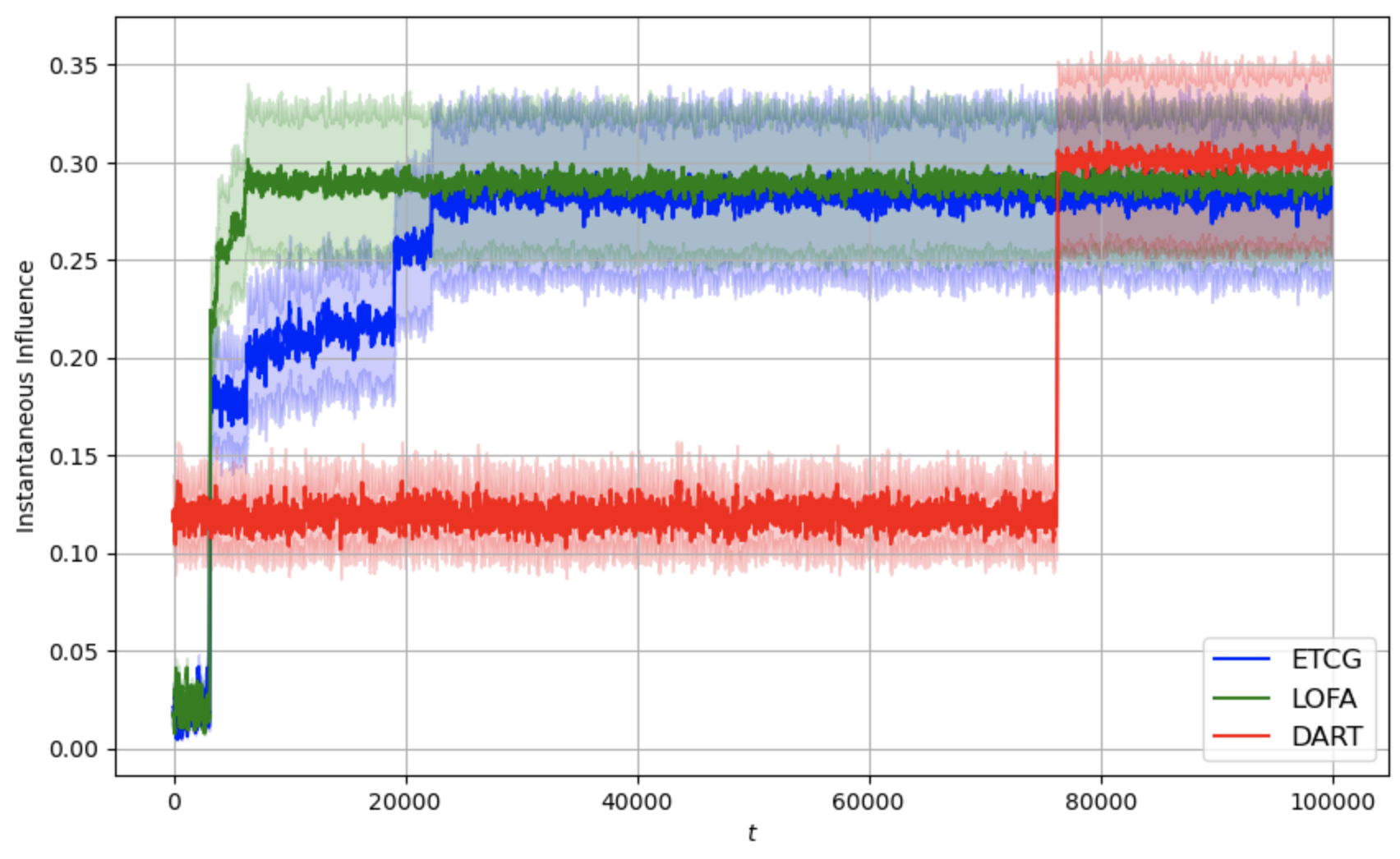
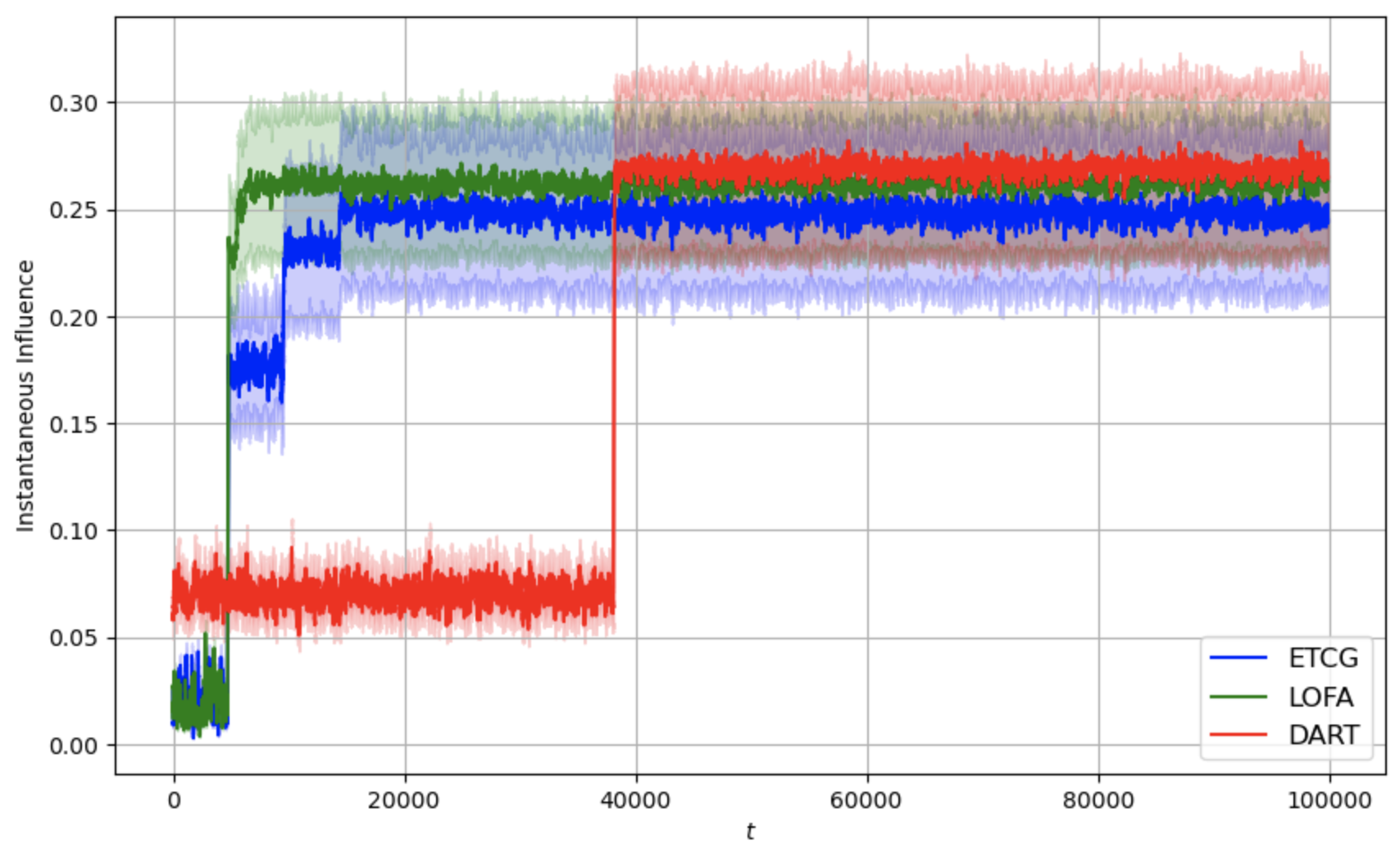
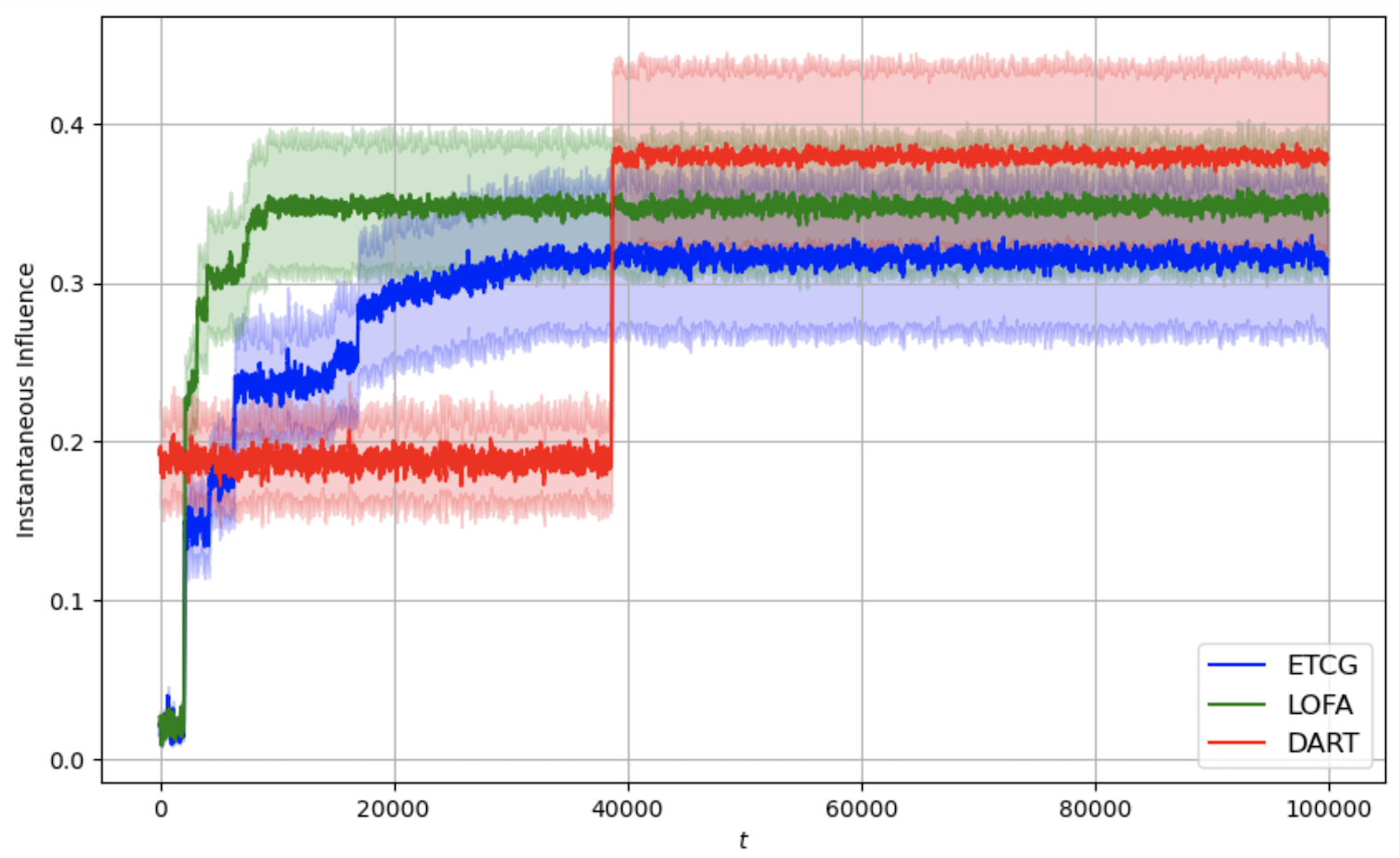
[fig:fb-4,fig:fb-8,fig:fb-16]
present the average cumulative instantaneous influence curves for
different methods, evaluated under varying time horizons $`T`$ and
cardinality constraints $`k \in \{4, 8, 16\}`$ over a horizon
$`T = 10^5`$. The shaded regions indicate standard deviations across
runs. The plot is smoothed with a moving average of window size
$`= 100`$. In the graph, LOFA is in green, ETCG is in blue, and DART is
in red. We can see that both ETCG and LOFA reach the exploitation state
much faster than DART. For ETCG, we can see an obvious step increase for
each of the plots from
1 to
3. This is due to the fact that ETCG will
play each node that has not yet been chosen in each phase an equal
number of times. However, LOFA uses lazy forward selection, meaning that
it might not always play all the possible nodes during each phase in the
exploration state. This causes the step increase to be steeper than the
ETCG curve as LOFA spends less time in the exploration by reducing
redundant calculation.
Moving average (window size 100) of instantaneous influence
as a function of t for budget
k = 4.Moving average (window size 100) of instantaneous influence
as a function of t for budget
k = 8.Moving average (window size 100) of instantaneous influence
as a function of t for budget
k = 16.
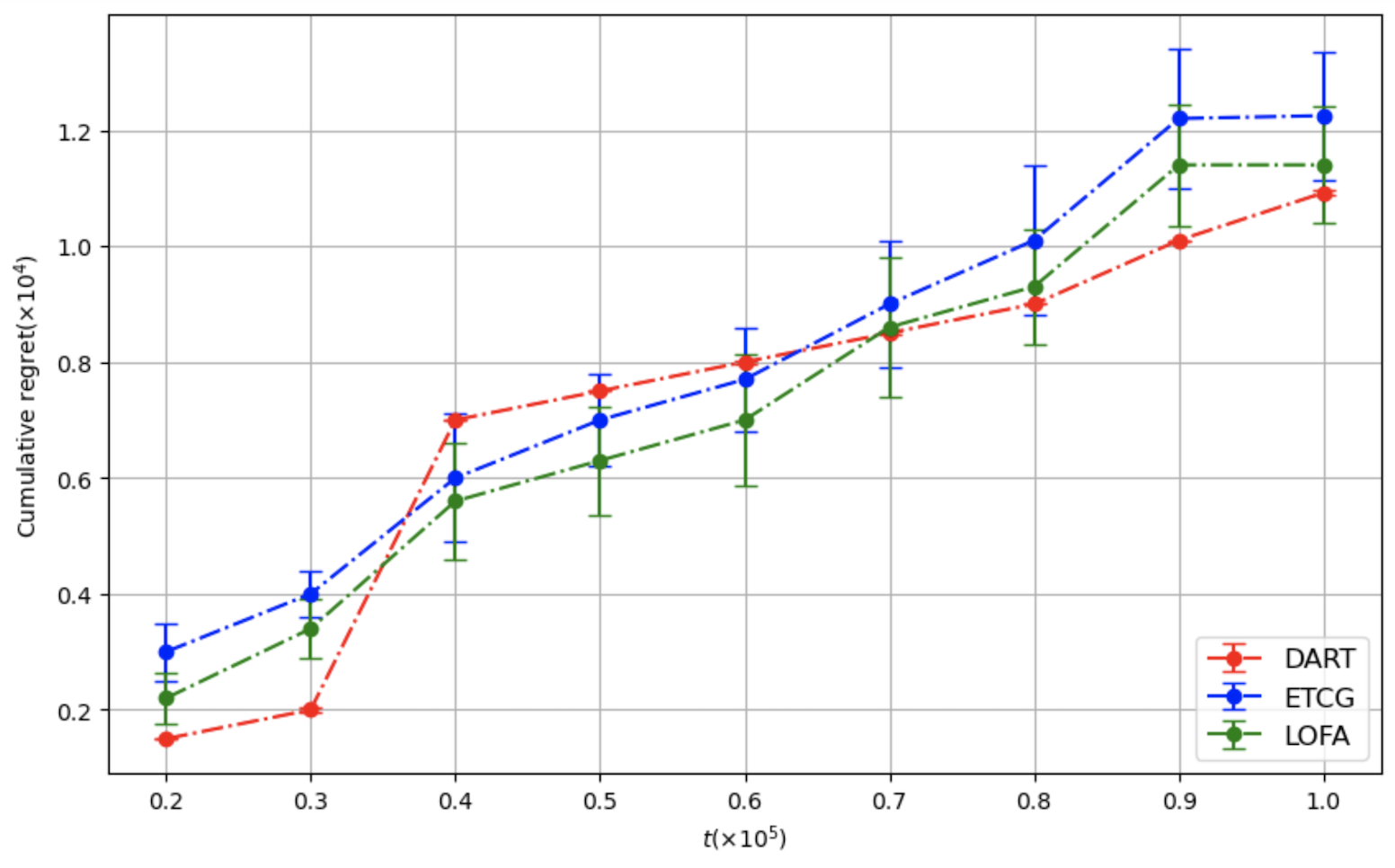
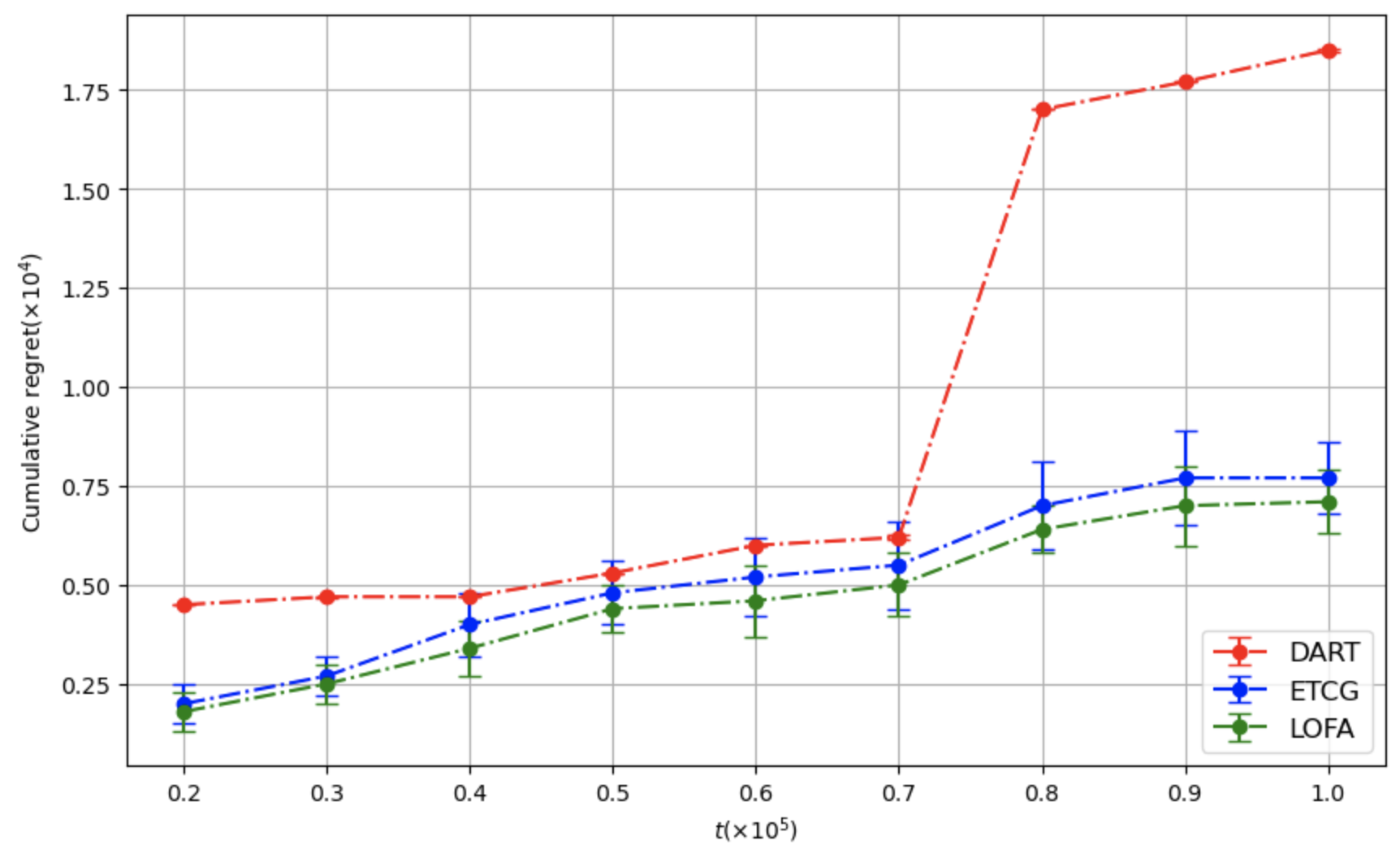
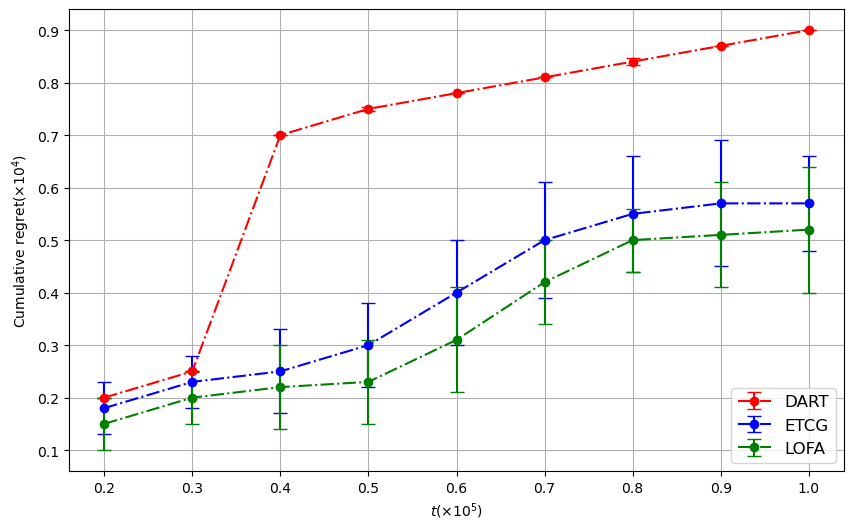
[fig:fb-regret-4,fig:fb-regret-8,fig:fb-regret-16]
present the average cumulative regret curves for different methods,
evaluated under varying time horizons $`T`$ and cardinality constraints
$`k \in \{4, 8, 16\}`$. The error bar regions indicate standard
deviations across runs.
Cumulative regret as a function of time horizon T for budget k = 4.Cumulative regret as a function of time horizon T for budget k = 8.Cumulative regret as a function of time horizon T for budget k = 16.
LOFA (in green), ETCG (in blue) have similar performance for small time
horizons. However, DART (in red) has a huge jump, which makes the
performance significantly worse than LOFA and ETCG. This is because of
the exponential epoch lengths considered in DART with the number of
epochs. This creates a non-smooth behavior in the regret growth of DART.
LOFA and ETCG have similar performance patterns for all time horizons.
This is because both LOFA and ETCG are selecting one node at a time, but
LOFA utilizes the property of sub-modularity by using lazy-forward so
that it spends less time in the explore stage, leading the total regret
to be smaller than ETCG.
We also observe that DART achieves slightly lower cumulative regret than
LOFA when the budget is large. This behavior differs from the $`k=4`$
and $`k=8`$ settings. The key reason is that DART’s exploration phases
scale with the size of the chosen set: as $`k`$ increases, DART
allocates substantially more rounds to exploration before committing.
Conclusion and Future Work
We studied the problem of Influence Maximization under an online
setting, where at each time step, the user can choose up to $`k`$ out of
$`n`$ seeds and only observes their influence. We proposed a simple
algorithm, LOFA, and showed that it outperforms the baselines in terms
of empirical reward and regret.
In the future, we want to understand the theoretical regret bound of
LOFA and test its scalability to larger networks for different budgets.
We are also interested in extending our work to continuous settings .
Remark
Although LOFA was developed in the context of the influence maximization
(IM) problem, it can also be applied to other domains where submodular
reward structures naturally arise, including:
Adaptive Sensor Placement: When deploying a limited number of
sensors to monitor an environment, selecting only the highest-ranked
locations based on estimated utility may be suboptimal. Instead, an
adaptive approach should be used to maximize information coverage
across diverse regions. This is motivated by the fact that placing
sensors too close to each other may lead to redundant data
collection, diminishing the overall information gain .
Online Advertising Campaigns: In online advertising, selecting only
the ads with the highest estimated click-through rates (CTR) may not
lead to optimal revenue. A diverse selection of ads should be
presented to users to ensure broad audience engagement and avoid
overexposure to the same type of content. This is motivated by the
fact that repeatedly showing similar ads may lead to user fatigue
and decreased engagement over time .
Drug Discovery and Clinical Trials: In drug discovery, testing only
the compounds with the highest predicted efficacy may not yield the
best results due to unknown interactions and dependencies. A
well-balanced selection strategy is required to explore diverse
compounds while focusing on promising candidates. This is motivated
by the necessity to efficiently allocate resources while maximizing
the likelihood of discovering effective treatments .
The copyright of this content belongs to the respective researchers. We deeply appreciate their hard work and contribution to the advancement of human civilization.
When an action is ’played $`m`$ times,’ the algorithm
independently simulates $`m`$ cascades, obtaining samples
$`\{f^1(S),f^2(S),...,f^m(S) \}`$. The ’average result’ corresponds
to the empirical mean:
MATH
\bar f(S) = \frac{1}{m}\Sigma_{i=1}^m f^{(i)}(S)
Click to expand and view more
, which serves as an unbiased estimator of its expected spread. ↩︎