FlashInfer-Bench Closing the Loop on AI Kernels
📝 Original Paper Info
- Title: FlashInfer-Bench Building the Virtuous Cycle for AI-driven LLM Systems- ArXiv ID: 2601.00227
- Date: 2026-01-01
- Authors: Shanli Xing, Yiyan Zhai, Alexander Jiang, Yixin Dong, Yong Wu, Zihao Ye, Charlie Ruan, Yingyi Huang, Yineng Zhang, Liangsheng Yin, Aksara Bayyapu, Luis Ceze, Tianqi Chen
📝 Abstract
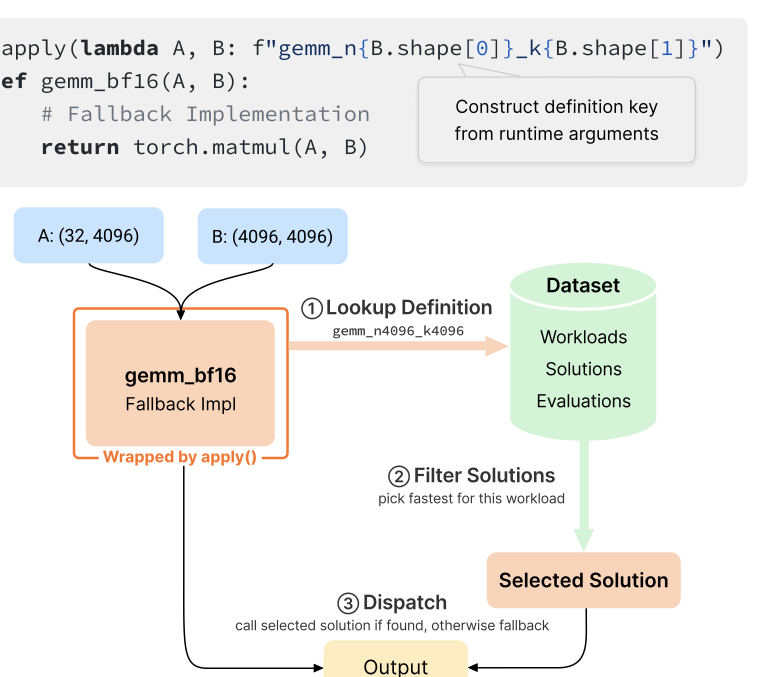
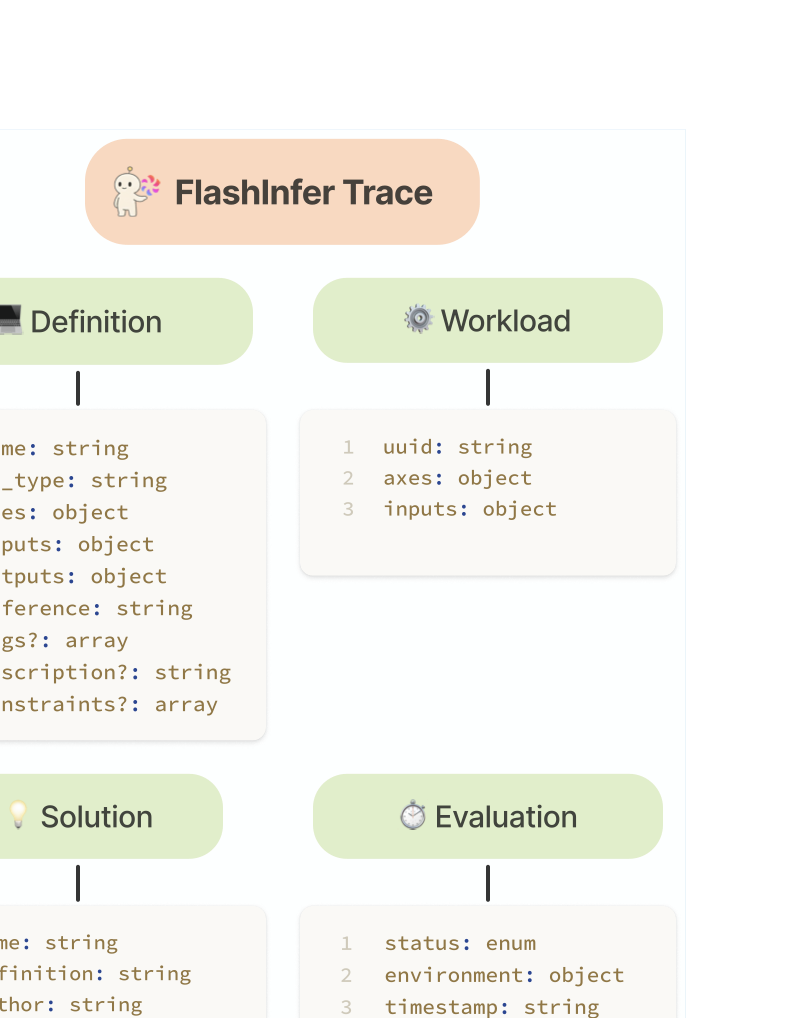
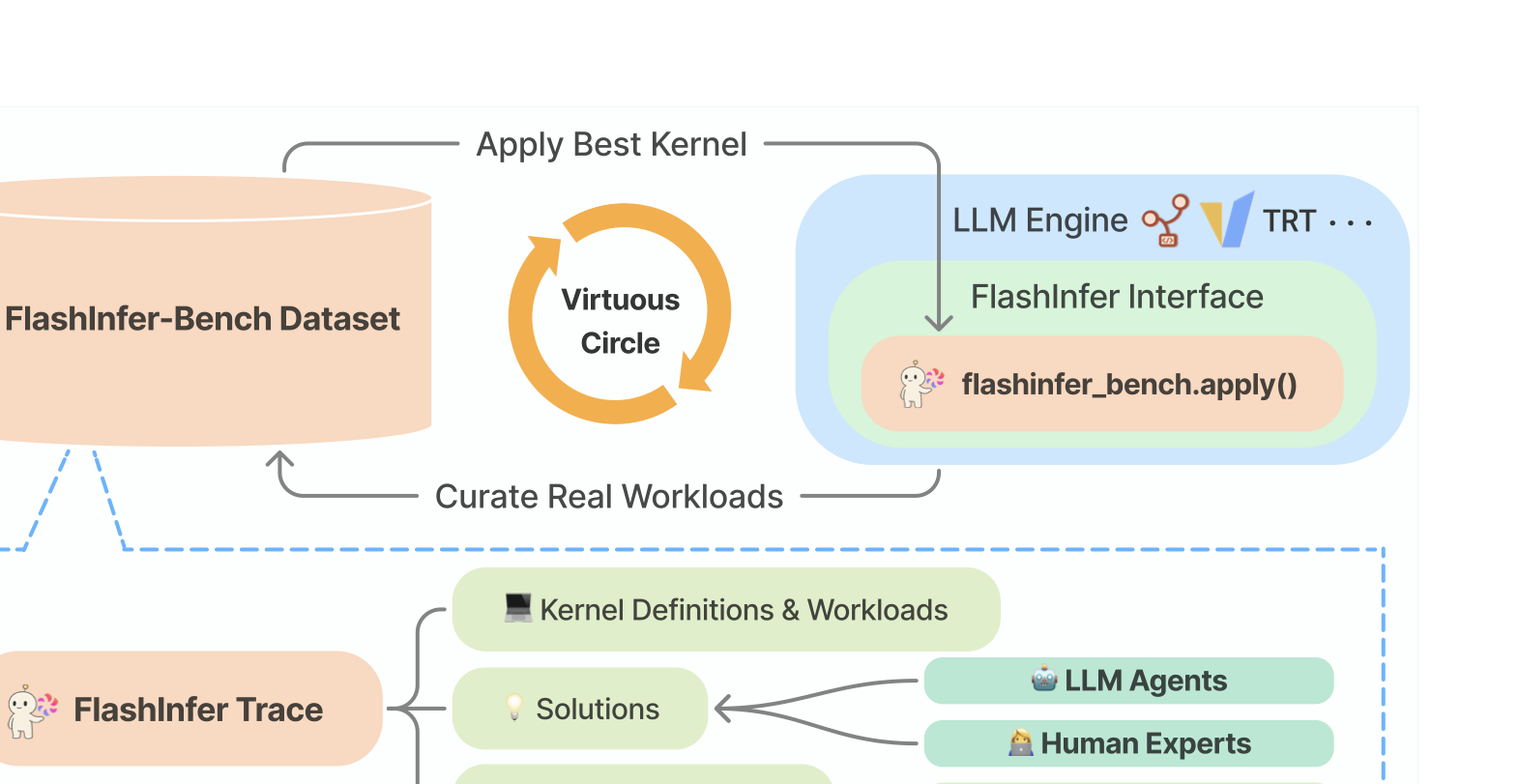
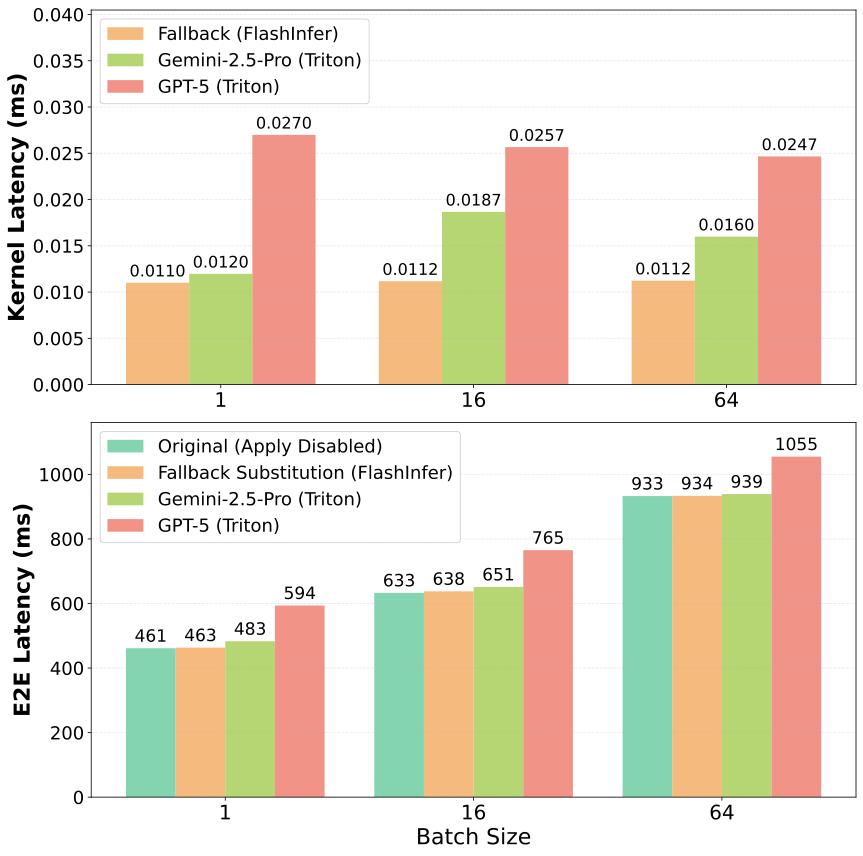
Recent advances show that large language models (LLMs) can act as autonomous agents capable of generating GPU kernels, but integrating these AI-generated kernels into real-world inference systems remains challenging. FlashInfer-Bench addresses this gap by establishing a standardized, closed-loop framework that connects kernel generation, benchmarking, and deployment. At its core, FlashInfer Trace provides a unified schema describing kernel definitions, workloads, implementations, and evaluations, enabling consistent communication between agents and systems. Built on real serving traces, FlashInfer-Bench includes a curated dataset, a robust correctness- and performance-aware benchmarking framework, a public leaderboard to track LLM agents' GPU programming capabilities, and a dynamic substitution mechanism (apply()) that seamlessly injects the best-performing kernels into production LLM engines such as SGLang and vLLM. Using FlashInfer-Bench, we further evaluate the performance and limitations of LLM agents, compare the trade-offs among different GPU programming languages, and provide insights for future agent design. FlashInfer-Bench thus establishes a practical, reproducible pathway for continuously improving AI-generated kernels and deploying them into large-scale LLM inference.💡 Summary & Analysis
1. **Quantum Computing Challenges**: Quantum computers can easily decrypt current encryption algorithms, posing a significant threat to our personal and financial data. 2. **QKD: A New Frontier in Secure Communication**: Quantum Key Distribution leverages quantum mechanics principles for perfectly secure communication, much like an 'impenetrable file cabinet'. 3. **Future Security Strategies**: To prepare for the quantum computing era, we need to develop new encryption technologies and security policies.📄 Full Paper Content (ArXiv Source)
📊 논문 시각자료 (Figures)