Deep Learning Aids in Skin Disease Diagnosis
📝 Original Paper Info
- Title: Towards Automated Differential Diagnosis of Skin Diseases Using Deep Learning and Imbalance-Aware Strategies- ArXiv ID: 2601.00286
- Date: 2026-01-01
- Authors: Ali Anaissi, Ali Braytee, Weidong Huang, Junaid Akram, Alaa Farhat, Jie Hua
📝 Abstract
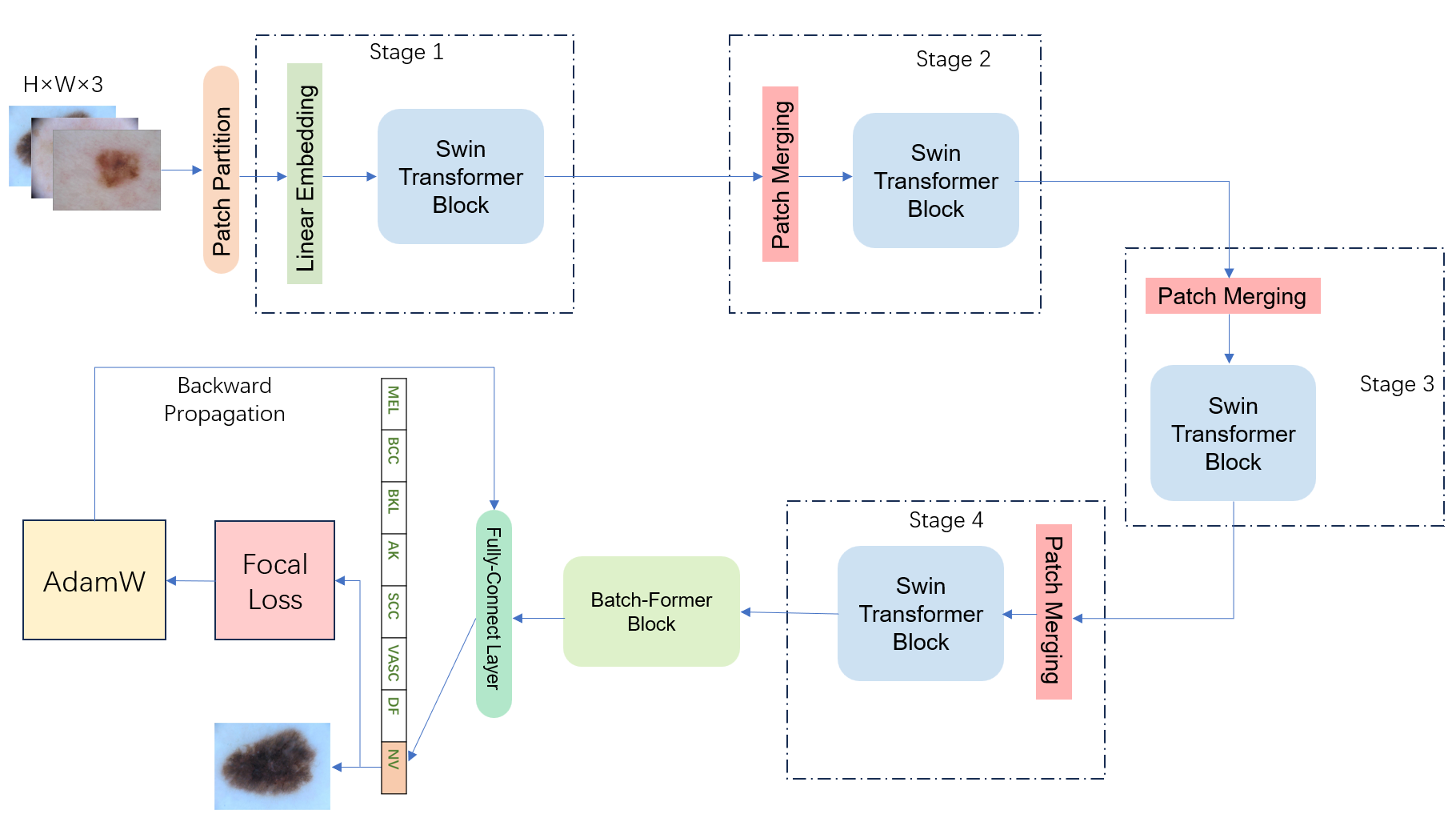
As dermatological conditions become increasingly common and the availability of dermatologists remains limited, there is a growing need for intelligent tools to support both patients and clinicians in the timely and accurate diagnosis of skin diseases. In this project, we developed a deep learning based model for the classification and diagnosis of skin conditions. By leveraging pretraining on publicly available skin disease image datasets, our model effectively extracted visual features and accurately classified various dermatological cases. Throughout the project, we refined the model architecture, optimized data preprocessing workflows, and applied targeted data augmentation techniques to improve overall performance. The final model, based on the Swin Transformer, achieved a prediction accuracy of 87.71 percent across eight skin lesion classes on the ISIC2019 dataset. These results demonstrate the model's potential as a diagnostic support tool for clinicians and a self assessment aid for patients.💡 Summary & Analysis
1. **Model Pruning**: This is akin to pruning a tree to make it more efficient by removing unnecessary branches. The goal is to reduce the model's size while maintaining its performance. 2. **Knowledge Distillation**: It’s like a seasoned expert passing on their accumulated knowledge to a less experienced colleague, thereby shortening the learning curve and improving efficiency. 3. **Low-Precision Training**: This method resembles converting high-definition images into low-definition ones for storage savings. By reducing the precision of computations, we can significantly cut down on computing resources.📄 Full Paper Content (ArXiv Source)
📊 논문 시각자료 (Figures)