ClinicalReTrial Evolving AI for Smarter Clinical Protocols
📝 Original Paper Info
- Title: ClinicalReTrial A Self-Evolving AI Agent for Clinical Trial Protocol Optimization- ArXiv ID: 2601.00290
- Date: 2026-01-01
- Authors: Sixue Xing, Xuanye Xia, Kerui Wu, Meng Jiang, Jintai Chen, Tianfan Fu
📝 Abstract
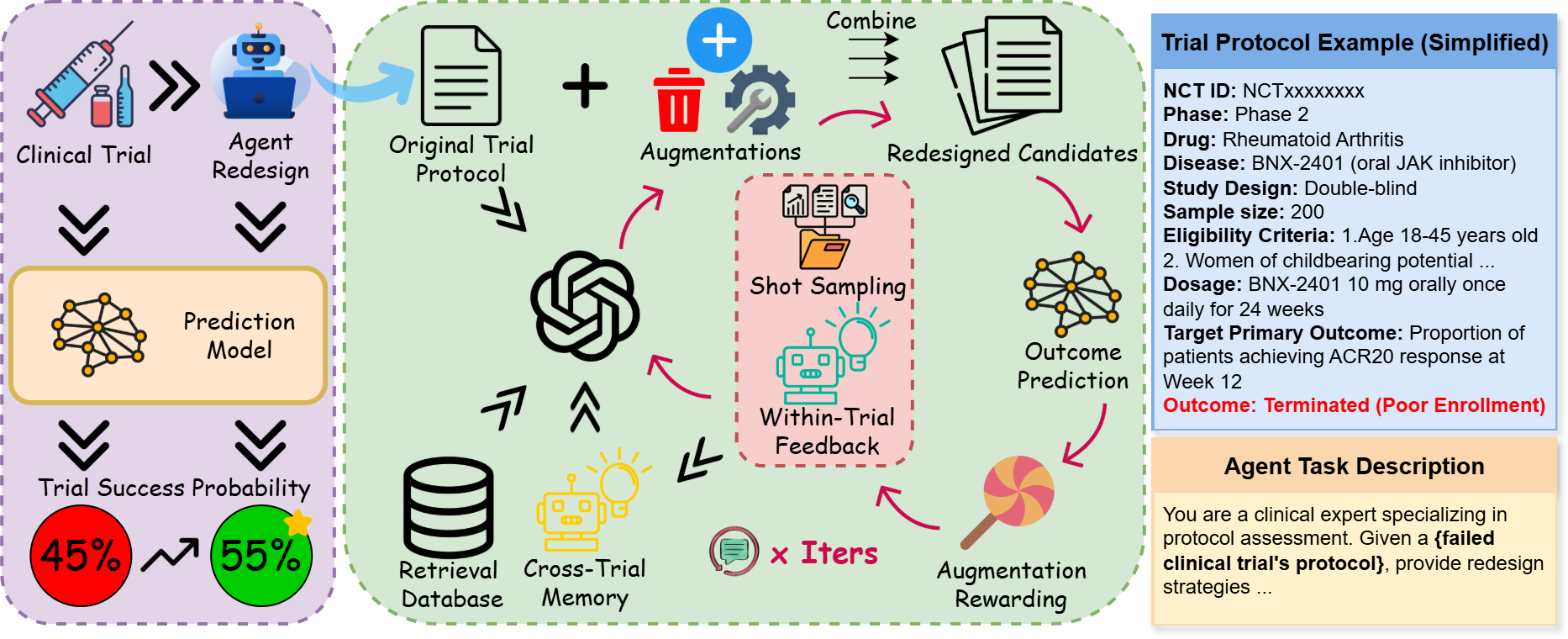
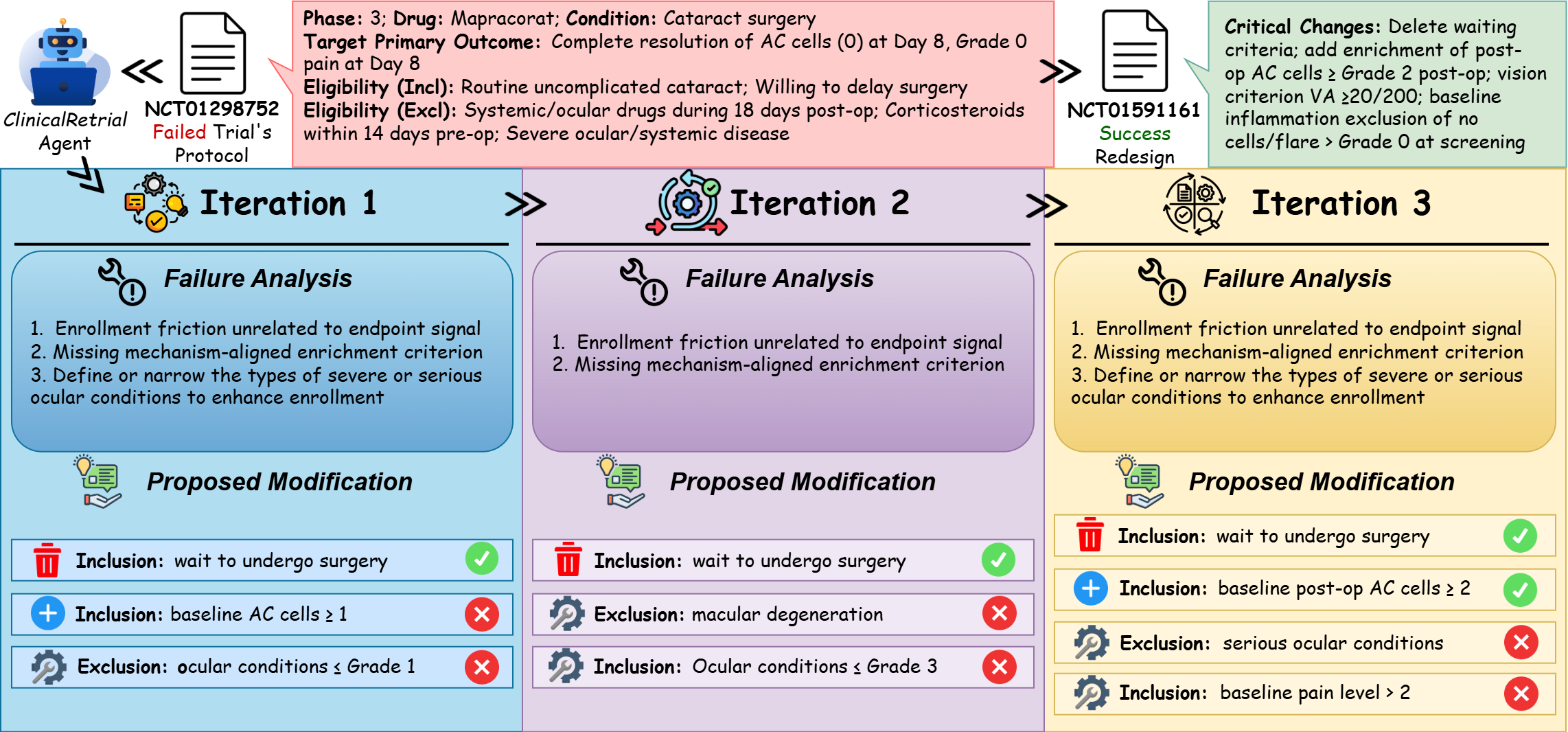
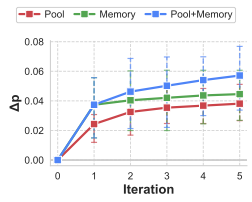
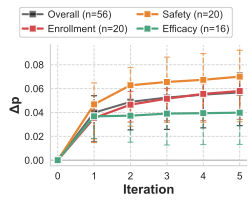
Clinical trial failure remains a central bottleneck in drug development, where minor protocol design flaws can irreversibly compromise outcomes despite promising therapeutics. Although cutting-edge AI methods achieve strong performance in predicting trial success, they are inherently reactive for merely diagnosing risk without offering actionable remedies once failure is anticipated. To fill this gap, this paper proposes ClinicalReTrial, a self-evolving AI agent framework that addresses this gap by casting clinical trial reasoning as an iterative protocol redesign problem. Our method integrates failure diagnosis, safety-aware modification, and candidate evaluation in a closed-loop, reward-driven optimization framework. Serving the outcome prediction model as a simulation environment, ClinicalReTrial enables low-cost evaluation of protocol modifications and provides dense reward signals for continuous self-improvement. To support efficient exploration, the framework maintains hierarchical memory that captures iteration-level feedback within trials and distills transferable redesign patterns across trials. Empirically, ClinicalReTrial improves 83.3% of trial protocols with a mean success probability gain of 5.7%, and retrospective case studies demonstrate strong alignment between the discovered redesign strategies and real-world clinical trial modifications.💡 Summary & Analysis
1. **Utilizing Pre-trained Models**: This is like getting a good recommendation from an experienced friend when you're reading a new book. Just as their advice can be very useful based on their extensive experience, pre-trained models leverage vast amounts of learned information to provide more accurate results. 2. **Custom Network Design**: It's akin to an architect designing a custom house according to the client’s requirements. Rather than using an existing model, designing networks specifically optimized for certain problems leads to more effective outcomes. 3. **Combining Pre-training with Customization**: This is like mixing recipes with local ingredients to create delicious dishes. By maintaining the strengths of pre-trained models while adjusting them to specific issues, optimal performance can be achieved.📄 Full Paper Content (ArXiv Source)
📊 논문 시각자료 (Figures)