Scaling Photonic AI From Design to Co-Exploration
📝 Original Paper Info
- Title: Toward Large-Scale Photonics-Empowered AI Systems From Physical Design Automation to System-Algorithm Co-Exploration- ArXiv ID: 2601.00129
- Date: 2025-12-31
- Authors: Ziang Yin, Hongjian Zhou, Nicholas Gangi, Meng Zhang, Jeff Zhang, Zhaoran Rena Huang, Jiaqi Gu
📝 Abstract
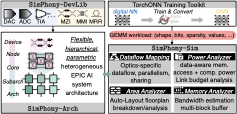
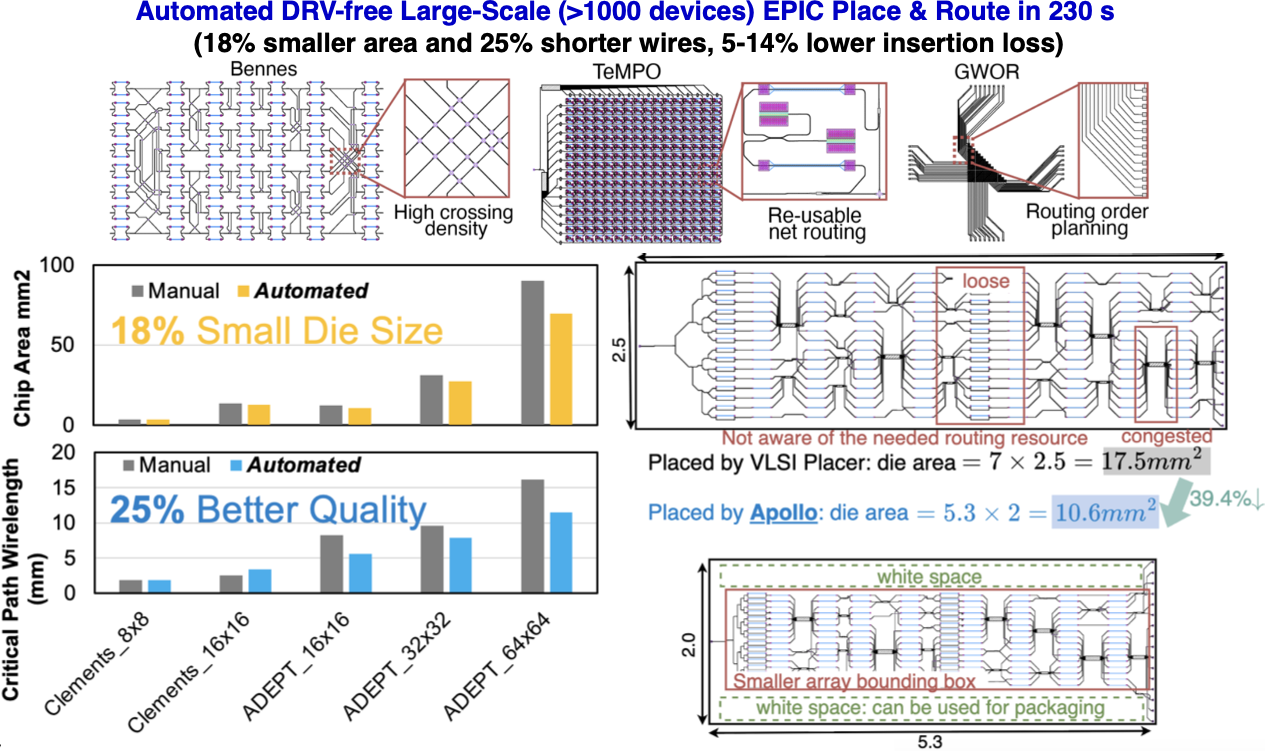
In this work, we identify three considerations that are essential for realizing practical photonic AI systems at scale: (1) dynamic tensor operation support for modern models rather than only weight-static kernels, especially for attention/Transformer-style workloads; (2) systematic management of conversion, control, and data-movement overheads, where multiplexing and dataflow must amortize electronic costs instead of letting ADC/DAC and I/O dominate; and (3) robustness under hardware non-idealities that become more severe as integration density grows. To study these coupled tradeoffs quantitatively, and to ensure they remain meaningful under real implementation constraints, we build a cross-layer toolchain that supports photonic AI design from early exploration to physical realization. SimPhony provides implementation-aware modeling and rapid cross-layer evaluation, translating physical costs into system-level metrics so architectural decisions are grounded in realistic assumptions. ADEPT and ADEPT-Z enable end-to-end circuit and topology exploration, connecting system objectives to feasible photonic fabrics under practical device and circuit constraints. Finally, Apollo and LiDAR provide scalable photonic physical design automation, turning candidate circuits into manufacturable layouts while accounting for routing, thermal, and crosstalk constraints.💡 Summary & Analysis
1. **Contribution 1: Application of Machine Learning** - **Simple Explanation:** The stock market is complex and influenced by many factors. This research introduces various machine learning techniques that can help understand and predict this complexity.-
Contribution 2: Comparison of Accuracy
- Simple Explanation: Each machine learning technique analyzes data differently to make predictions. This study compares how well these methods perform using past stock price data.
-
Contribution 3: Future Outlook
- Simple Explanation: The research highlights how machine learning can reduce uncertainty in the stock market and aid investment decisions.
📄 Full Paper Content (ArXiv Source)
📊 논문 시각자료 (Figures)