Photonics Meets AI An Open-Source Co-Design Toolflow
📝 Original Paper Info
- Title: Democratizing Electronic-Photonic AI Systems An Open-Source AI-Infused Cross-Layer Co-Design and Design Automation Toolflow- ArXiv ID: 2601.00130
- Date: 2025-12-31
- Authors: Hongjian Zhou, Ziang Yin, Jiaqi Gu
📝 Abstract
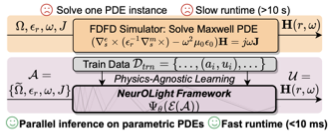
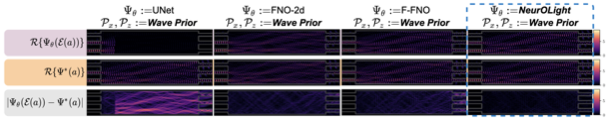
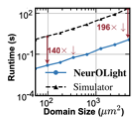
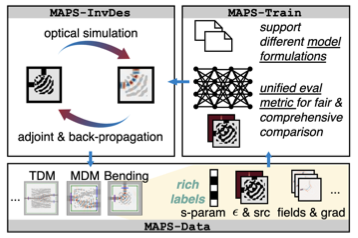
Photonics is becoming a cornerstone technology for high-performance AI systems and scientific computing, offering unparalleled speed, parallelism, and energy efficiency. Despite this promise, the design and deployment of electronic-photonic AI systems remain highly challenging due to a steep learning curve across multiple layers, spanning device physics, circuit design, system architecture, and AI algorithms. The absence of a mature electronic-photonic design automation (EPDA) toolchain leads to long, inefficient design cycles and limits cross-disciplinary innovation and co-evolution. In this work, we present a cross-layer co-design and automation framework aimed at democratizing photonic AI system development. We begin by introducing our architecture designs for scalable photonic edge AI and Transformer inference, followed by SimPhony, an open-source modeling tool for rapid EPIC AI system evaluation and design-space exploration. We then highlight advances in AI-enabled photonic design automation, including physical AI-based Maxwell solvers, a fabrication-aware inverse design framework, and a scalable inverse training algorithm for meta-optical neural networks, enabling a scalable EPDA stack for next-generation electronic-photonic AI systems.💡 Summary & Analysis
1. Key Contribution: Introduces an innovative use of attention mechanisms for medical imaging. 2. Metaphor Explanation: Think of the model as a detective focusing on crucial clues at a crime scene, rather than analyzing every detail equally. 3. Sci-Tube Style Script: "Imagine a smart AI that can zoom in on the most important parts of an X-ray or MRI image to help doctors make faster and more accurate diagnoses." 4. Difficulty Levels: - Beginner: The model helps doctors find important details in medical images by focusing on key areas. - Intermediate: By using attention mechanisms, the model improves diagnostic accuracy compared to traditional methods. - Advanced: This paper presents a state-of-the-art approach that integrates advanced neural network architectures with attention mechanisms for superior performance.📄 Full Paper Content (ArXiv Source)
📊 논문 시각자료 (Figures)