R-Debater Retrieval-Augmented Debate Generation through Argumentative Memory
📝 Original Paper Info
- Title: R-Debater Retrieval-Augmented Debate Generation through Argumentative Memory- ArXiv ID: 2512.24684
- Date: 2025-12-31
- Authors: Maoyuan Li, Zhongsheng Wang, Haoyuan Li, Jiamou Liu
📝 Abstract
We present R-Debater, an agentic framework for generating multi-turn debates built on argumentative memory. Grounded in rhetoric and memory studies, the system views debate as a process of recalling and adapting prior arguments to maintain stance consistency, respond to opponents, and support claims with evidence. Specifically, R-Debater integrates a debate knowledge base for retrieving case-like evidence and prior debate moves with a role-based agent that composes coherent utterances across turns. We evaluate on standardized ORCHID debates, constructing a 1,000-item retrieval corpus and a held-out set of 32 debates across seven domains. Two tasks are evaluated: next-utterance generation, assessed by InspireScore (subjective, logical, and factual), and adversarial multi-turn simulations, judged by Debatrix (argument, source, language, and overall). Compared with strong LLM baselines, R-Debater achieves higher single-turn and multi-turn scores. Human evaluation with 20 experienced debaters further confirms its consistency and evidence use, showing that combining retrieval grounding with structured planning yields more faithful, stance-aligned, and coherent debates across turns.💡 Summary & Analysis
1. **Argumentative Memory System Development**: The paper proposes an 'argumentative memory' system that records and reuses past debate patterns, much like how students study past exam papers to prepare for future tests. 2. **R-Debater Framework**: R-Debater integrates argumentation structures and strategies, maintains stance consistency, and improves the ability to rebut opponents’ claims. This system operates similarly to a soccer player executing various plays instantly during a game. 3. **Performance Improvement**: R-Debater significantly enhances logical coherence compared to existing models and is preferred by actual experts in over 75% of cases, much like how an advanced cooktop cooks food faster and more accurately.📄 Full Paper Content (ArXiv Source)
Competitive debate distills public reasoning into a structured, adversarial setting where speakers must plan multi-turn rhetoric, maintain stance, and ground claims in verifiable evidence. Prior work, from end-to-end debating systems (e.g., Project Debater ) to a mature literature on argument mining , has advanced pipelines for discovering and organizing arguments. Meanwhile, Large Language Models (LLMs) have markedly improved open‐ended dialogue and text generation , but when faced with competitive debate, their outputs often remain fluent yet shallow: They are insufficiently grounded, weak on stance fidelity, and brittle over many turns. Therefore, one should pivot to the capacities that make argumentation stance-faithful and durable across turns.
Building on this insight, we treat argumentation not only as a computational task but as a cognitive and rhetorical process grounded in human memory and discourse. As Vitale notes, public argumentation operates through a rhetorical-argumentative memory that recycles and reformulates prior persuasive strategies in new situations . Likewise, Aleida Assmann in her acclaimed theory of cultural memory conceptualizes collective memory as a dialogic, dynamic reconstruction of past discourses rather than a static archive . These perspectives motivate our central premise: effective debate generation should retrieve and recontextualize argumentative memory, producing statements that are grounded in prior reasoning and robust rhetorical patterns.
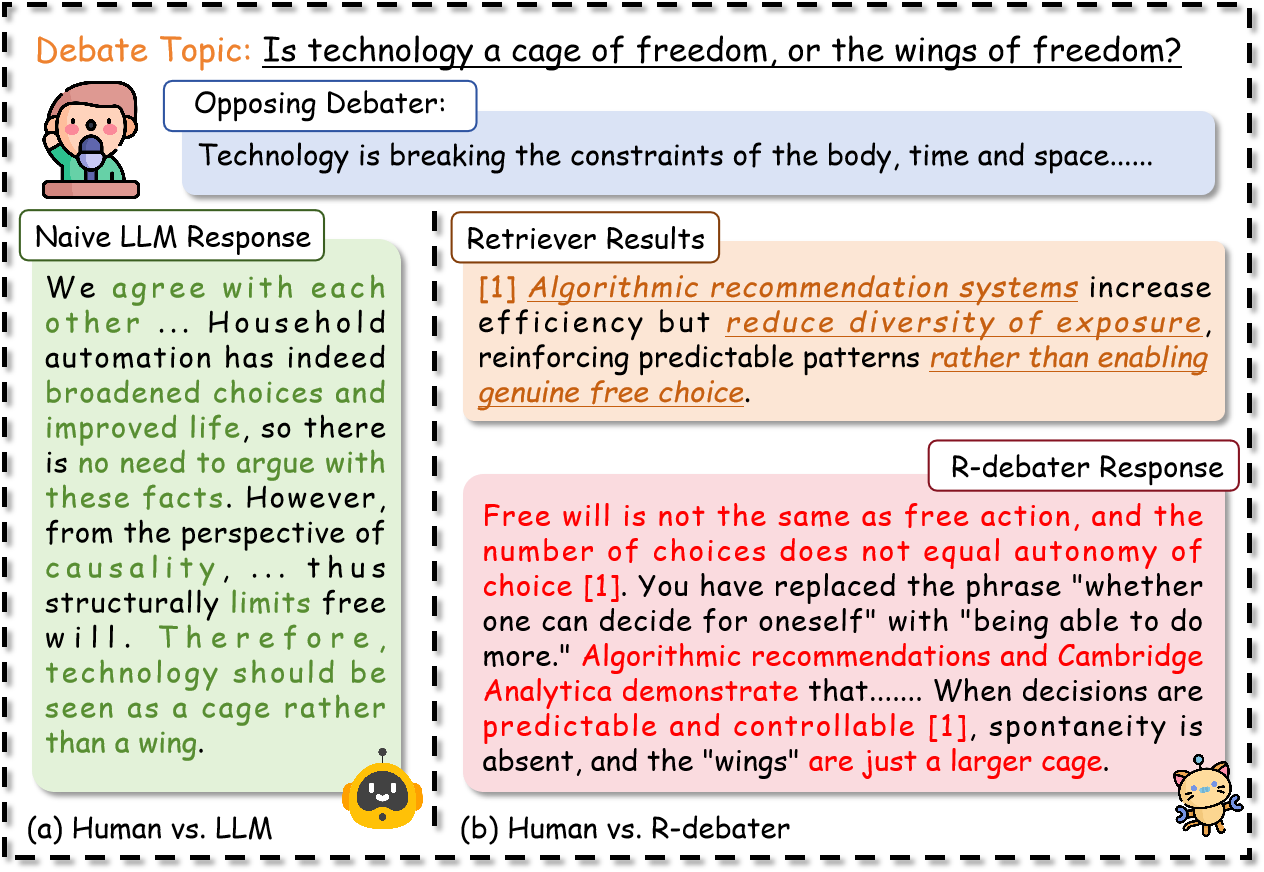
Retrieval‐augmented generation (RAG) is a natural mechanism for recalling prior cases and evidence , and has proved useful in QA and open‐domain assistants . However, mainstream RAG stacks optimize for short factual responses and struggle with debate’s structured, adversarial recontextualization, where models must reconcile retrieved material with evolving discourse and opponent claims. Recent analyses also show a persistent “tug-of-war” between a model’s internal priors and retrieved evidence, yielding faithfulness and coverage errors without explicit control . Concurrently, agentic AI frameworks provide machinery for planning and tool use , yet they rarely encode argumentative schemes or dialogic memory needed to preserve stance and reasoning coherence across turns .
This paper addresses this gap by conceptualizing argumentative memory in computational terms. Specifically, we treat retrieval as the mechanism for recalling prior discourse and role-based planning as the mechanism for reframing it into new argumentative settings. Tackling this question raises three central challenges: First, generated statements must incorporate appropriate argumentative schemes and logical structures to be persuasive and coherent. Second, the system must maintain stance fidelity throughout the debate, ensuring that rebuttals are grounded in opponents’ claims while avoiding hallucinations or sycophantic tendencies. Finally, the model must retrieve high-quality, context-relevant debate materials and integrate them strategically into statement generation rather than reproducing retrieved content verbatim.
To address these challenges, we propose R-Debater, a framework that integrates retrieval-augmented reasoning with role-based planning for debate statement generation. Unlike prior systems, R-Debater leverages the entire debate history to generate stance-specific and rhetorically coherent utterances, bridging the gap between rhetorical theory and generative modeling.
We conduct extensive experiments on the ORCHID dataset, which comprises over 1,000 formal debates across multiple domains. Evaluation demonstrates that R-Debater achieves substantial gains in both logical fidelity and rhetorical persuasiveness over strong LLM and RAG baselines. In particular, it delivers near-perfect logical coherence and markedly higher factual grounding, while human experts prefer its generated debates in over 75% of pairwise comparisons. These results confirm that R-Debater not only improves measurable debate quality but also aligns closely with expert judgements, validating its reliability and interpretability.
Overall, our main contributions are as follows:
-
We present, to the best of our knowledge, the first systematic investigation of debate statement generation with LLMs under realistic multi-turn settings.
-
We propose R-Debater, a novel framework that integrates argumentation structures, debate strategies, stance fidelity mechanisms, and retrieval-based case reasoning to address the core challenges of debate generation.
-
Extensive empirical validation on debate datasets demonstrates that R-Debater significantly outperforms strong LLM and RAG baselines in terms of factual accuracy, stance consistency, and cross-turn coherence.
Related Work
Computational Argumentation
Argumentation research has long-standing roots in symbolic reasoning and formal logic , with early computational approaches offering transparency and rigor but relying on brittle, rule-based knowledge bases that limit scalability to open-domain debates . These symbolic methods also often lack expressiveness in realistic discourse.
To address these limitations, subsequent work in computational argumentation has leveraged advances in natural language processing (NLP) . Retrieval-based pipelines such as CANDELA adopt a retrieval-planning-realization process, aggregating evidence from multiple sources to improve the factual grounding and specificity. Other studies enhance neural models with argumentation knowledge graphs , which encode structured relationships between claims, premises, and stances, thereby improving both credibility and topical relevance. Beyond single-turn generation, hierarchical dialogue frameworks integrate topic analysis, stance retrieval, and user feedback to produce more adaptive multi-turn interactions. These advances substantially enhance fluency, evidence utilization, and contextual relevance. However, most existing approaches still treat each debate as an isolated reasoning task rather than a reactivation of prior argumentative patterns. They focus on structural modeling but lack cross-turn continuity, making it difficult to capture genuine debate dynamics.
Recent studies highlight that LLMs possess strong capabilities in long-context understanding and coherent discourse generation . These advances open the door to debate systems that move beyond turn-local reasoning and model the holistic argumentative flow. Building on this line, R-Debater aims to integrate external knowledge with full-dialogue modeling to produce strategically grounded and rhetorically coherent argumentative responses.
Retrieval-Augmented and Agentic AI
LLMs have demonstrated strong long-text generation capabilities across diverse NLP tasks , yet they remain prone to hallucination and lack the factual grounding required for credible debate-oriented applications . Retrieval-augmented generation (RAG) mitigates these issues by grounding outputs in external knowledge sources , and RAG-based dialogue systems have shown improved factuality and coherence. However, these systems primarily target informational QA or open-domain chit-chat , failing to address the complex requirements of stance construction and rebuttal across multiple debate turns. In this sense, RAG can be regarded as an early computational analogue of rhetorical memory, capable of retrieving and reorganizing prior discourses to support new argumentative goals, yet still lacking the dynamic recontextualization central to real debates.
Parallel to RAG, research on agentic AI explores decomposing complex tasks into interacting role-based agents. Frameworks such as AutoGen and Agent4Debate demonstrate that specialized agents can coordinate, critique, or compete to achieve more robust and strategically informed outputs , but the absence of explicit evidence grounding often limits their argumentative credibility. Viewed through the lens of dialogic memory, such systems simulate interactional structure yet fail to capture the cumulative recall of argumentation history.
In contrast, R-Debater builds on both paradigms by explicitly operationalizing argumentative memory through retrieval-augmented and role-based mechanisms. It dynamically retrieves debate-specific evidence, assigns strategic roles, and recontextualizes past argumentative moves to generate text that is both stance-specific and globally coherent in rhetorical and strategic senses, thereby achieving a deeper integration of evidence retrieval and rhetorical reasoning within complex multi-turn debates.
Task Formulation
A debate is a structured, adversarial dialogue in which two parties alternate turns to advance their own stance while challenging the opponent. Unlike open-domain dialogues, a debate imposes strict constraints: utterances must be stance-consistent and argumentatively relevant, either reinforcing one’s position or rebutting opposing claims.
Formally, we represent a (dialogue-based) argumentation $`A`$ as a pair $`A=(T,H)`$, where $`T=\{t_1,t_2\}`$ denotes the two opposing stances (pro and con) on a given topic, and the ordered sequence
H=(u_1,u_2,\dots,u_n)represents an $`n`$-turn argument history (where $`n \in \mathbb{N}`$ is even). Here, $`u_j`$ denotes the utterance at turn $`j`$, which is a natural-language text. We assume the pro side speaks first, so the set $`P_n=(u_j)_{j\equiv1\pmod{2}}=(u_1,u_3,\ldots,u_{n-1})`$ contains all utterances produced by the pro side, while $`C_n=(u_j)_{j\equiv0\pmod{2}}=(u_2,u_4,\ldots,u_n)`$ contains utterances produced by the con side.
We introduce a single-utterance predicate $`\phi(u,s)`$ that returns
True if utterance $`u`$ either explicitly supports stance $`s`$ or
rebuts the opposing stance. We require that in the argument history
$`H`$, every utterance $`u_i`$ either satisfies $`\phi(u_i,t_1)`$ if
$`i`$ is odd, or satisfies $`\phi(u_i,t_2)`$ if $`i`$ is even, but not
both.
Debate and argumentative memory. From the perspective of rhetorical and dialogic memory , each utterance not only presents a local claim but also reconstructs argumentative contexts to sustain stance coherence across turns. We thus view a debate as an iterative reconstruction of prior reasoning contexts rather than a sequence of isolated utterances: At each turn, a speaker retrieves and adapts fragments of earlier arguments, evidence, or rhetorical strategies to sustain coherence and respond to the opponent’s reasoning. We refer to this process as argumentative memory. We now formulate a process in which argumentative memory is instrumental the construction of utterane in a debate.
We assume to have a pre-curated set $`\mathcal{D}`$ of latent memory of
previously-encountered argumentative patterns. Given an ongoing
(partial) dialogue history $`H_j=(u_1,\ldots,u_j)`$, where $`j where $`\mathcal{R}`$ denotes the retrieval function that recalls an
early memory $`\mathcal{E}_j`$, and $`\mathcal{M}`$ denotes the
reasoning function that adapts $`\mathcal{E}_j`$ to the current debate
context to produce the next utterance $`u_{j+1}`$. R-Debater Task Definition. We define debate utterance generation as
a next-utterance prediction problem that requires stance fidelity and
argumentative relevance while leveraging argumentative memory and
rhetorical strategies. Suppose that we have an argumentative memory set
$`\mathcal{D}`$. Given stances $`T`$, partial history $`H_j`$ with even
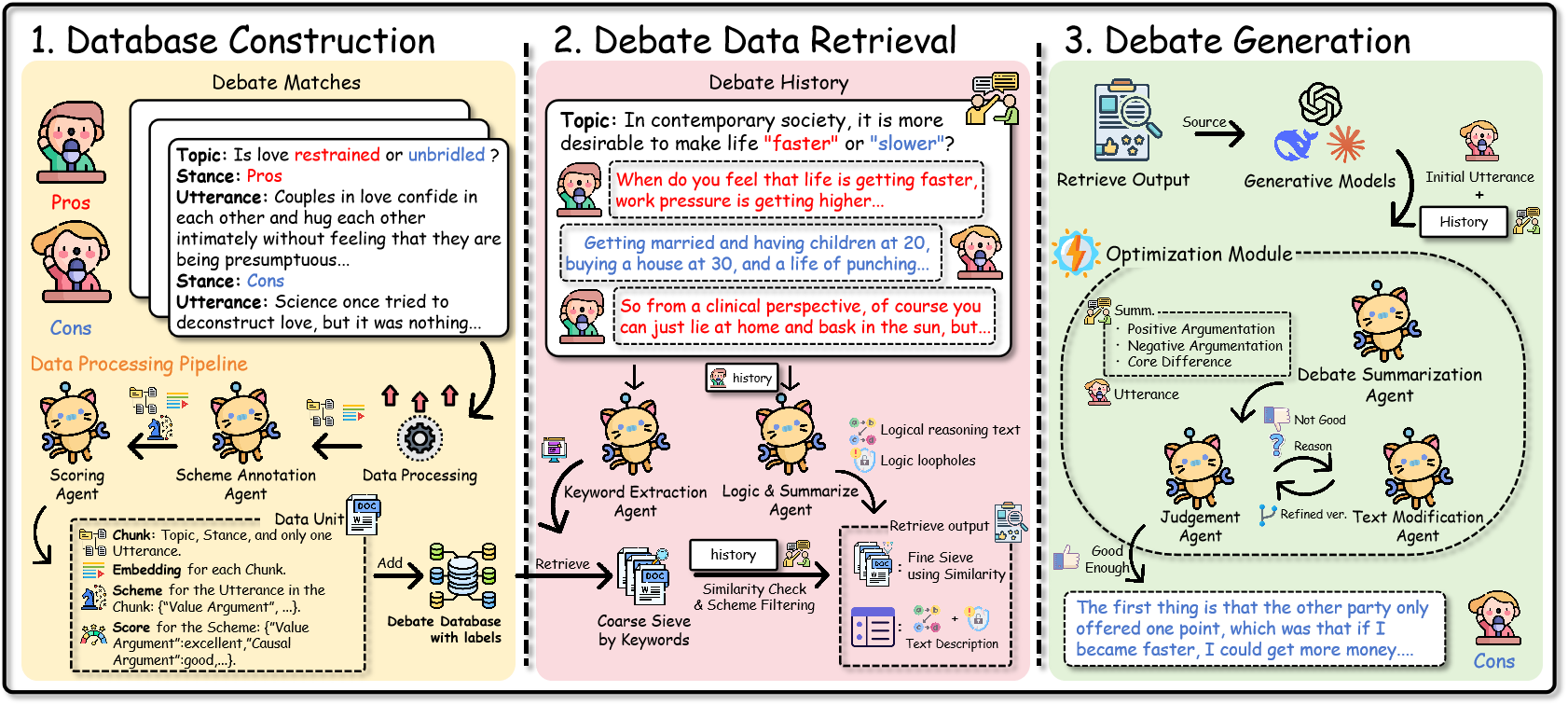
$`j We propose
R-Debater, as illustrated in
Figure 2, a retrieval- augmented and
role-based framework that models debate as the dynamic reconstruction of
argumentative memory. It consists of three pipelines: (1) Database
Construction, which segments debate transcripts into utterance-level
units and annotates argumentative information, (2) Debate Data
Retrieval, which leverages this database to obtain stance-relevant
evidence while also summarizing the logical gaps and weaknesses in the
opponent’s reasoning, and (3) Debate Generation, which produces
stance-consistent, rhetorically coherent utterances through iterative
verification. We construct a large-scale debate knowledge base from authentic
transcripts collected across diverse public sources. Each transcript is
processed by a rule-based parser that segments dialogue into
utterance-level units $`U=\{u_1,\dots,u_n\}`$, removing moderator turns
and meta-commentary to retain only argumentative content. Each $`u_i`$
corresponds to a single debater’s statement at a particular debate
stage. A pre-trained encoder $`f_{\text{emb}}`$ then maps every
utterance into a dense representation
$`\mathbf{e}_i=f_{\text{emb}}(u_i)`$, yielding pairs
$`(u_i,\mathbf{e}_i)`$ that capture semantic meaning and stylistic
features for subsequent retrieval and reasoning. Argumentation Schemes. Following Walton et al. , an argumentation
scheme is a stereotypical reasoning pattern that shows how premises
support a conclusion and poses critical questions for evaluating
validity. These schemes are widely used in computational argumentation
to represent and assess the plausibility of natural arguments. As Walton
et al. stress in their seminal monograph Argumentation Schemes ,
schemes serve as dialogical templates that capture recurring structures
of everyday reasoning and provide systematic criteria for evaluating
strength. In this work, we employ seven commonly adopted schemes from :
example-based argumentation, expert opinion, positive consequence,
negative consequence, causal argumentation, analogical
argumentation, and value-based argumentation, which together provide
the reasoning foundation for our framework. Scheme Annotation and Scoring. The Scheme Annotation Agent uses
prompt-based LLM reasoning to assign an argumentation-scheme set
$`\mathcal{S}_i`$ to each utterance. Then, the Scoring Agent
performs few-shot evaluation with exemplars
$`\mathcal{X}_{\text{few}}=\{e_{\text{poor}},e_{\text{general}},e_{\text{good}}
,e_{\text{excellent}}\}`$ and outputs per-scheme qualitative labels: and $`\text{Score}_i(S)=\text{none}`$ if $`S\notin\mathcal{S}_i`$. The
scoring criteria follow Walton et al.’s guidelines for evaluating
argumentation schemes, emphasizing whether the premises are acceptable,
the scheme is applied appropriately, and the critical questions are
adequately addressed. Thus, each label reflects the appropriateness and
rhetorical effectiveness of the scheme usage in context. Finally, each database record is represented as
$`r_i = (u_i, \mathbf{e}_i, \mathcal{S}_i, \text{Score}_i)`$,
constituting the enriched knowledge base $`\mathcal{D}=\{r_i\}_{i=1}^N`$
that supports retrieval and generation. In subsequent stages,
$`\mathcal{D}`$ provides the foundation for stance-aware evidence
selection and supports generation modules in reconstructing contextually
coherent and strategically grounded arguments. Given an ongoing debate and a target stance $`t_{i} \in T`$, the
retrieval module extracts stance-relevant argumentative context to
support the generation of the next utterance. It operates through two
complementary components: a Logic & Summarization Agent, which
identifies logic loopholes in the opponent’s arguments, and a Keyword
Extraction Agent, which derives salient keywords from the current
debate history. The extracted keywords are then passed to a basic
retriever for coarse-grained evidence retrieval from the knowledge base
$`\mathcal{D}`$, constructed in
Section 4.1. A fine-grained
filtering stage then computes semantic similarity between the retrieved
candidates and the current debate history to retain the most
contextually relevant exemplars. Logic & Summarization Agent. This component analyzes the accumulated
utterances from the opposing side to detect logic loopholes,
contradictions, and unsupported assumptions across the entire debate
history, rather than at the single-utterance level. Inspired by the
SymbCoT paradigm, we design a prompt-based logical decomposition
process that guides LLMs to transform the opponent’s collective
statements into pseudo-first-order predicates and simulate lightweight
symbolic reasoning over them. Formally, given the opponent’s utterance sequence defined as
$`H^{\text{opp}}_{n}=\{u_1^{\text{opp}},\dots,u_t^{\text{opp}}\}`$, the
agent constructs a set of pseudo–first-order predicates and derives
natural-language reasoning chains: which summarize the inferred argumentative logic throughout the
opponent’s discourse. The first step, predicate extraction, converts each utterance into a
symbolic form that captures its structure and causal relations. Once the individual predicates are extracted, the next step reconstructs
them into a coherent reasoning chain that represents the opponent’s
overall argumentative flow. Prompt for $`f_{\text{pred}}`$: You are a Symbolic Translator. Prompt for $`f_{\text{infer}}`$: You are a Symbolic Chain-of-Thought
Generator. Logical inconsistencies or invalid reasoning patterns in
$`\tau_{\text{opp}}`$ are then identified as
$`\mathcal{L} = f_{\text{logic}}(\tau_{\text{opp}}).`$ where
$`\mathcal{L}`$ denotes a collection of natural-language control signals
that provide interpretable guidance for generating targeted rebuttals
and reinforcing stance fidelity. In this design, only
$`\mathcal{P}_{\text{opp}}`$ corresponds to a pseudo–first-order logical
representation, while $`\tau_{\text{opp}}`$ and $`\mathcal{L}`$ remain
natural-language constructs, enabling symbolic-style interpretability
without explicit theorem proving. To operationalize the three core functions: $`f_{\text{pred}}`$,
$`f_{\text{infer}}`$, and $`f_{\text{logic}}`$, we design prompt
templates that guide the LLM through predicate extraction,
reasoning-chain construction, and logic flaw detection. The final stage
$`f_{\text{logic}}`$ verifies the inferred reasoning chain to pinpoint
contradictions and unsupported assumptions, producing the interpretable
control signal set $`\mathcal{L}`$ as follows: Prompt for $`f_{\text{logic}}`$: You are a Logic Critic /
Verifier. More detailed prompt versions for all three modules
($`f_{\text{pred}}`$, $`f_{\text{infer}}`$, and $`f_{\text{logic}}`$)
and an end-to-end example of the three-step process are provided in
Appendix 9 and
Appendix 12 respectively. Keyword Extraction Agent. This component operates in parallel with
the Logic & Summarization Agent and focuses on retrieving strategically
relevant exemplars from the debate knowledge base $`\mathcal{D}`$. A
prompt-based LLM first extracts salient keywords
$`\mathcal{K}=\{k_1,\dots,k_m\}`$ from the partial debate history
$`H_j=\{u_1,\dots,u_j\}`$. These keywords are used in a rule-based
coarse retrieval stage to filter database records with explicit keyword
matches: Subsequently, a fine-grained re-ranking is performed by encoding the
current debate history into a single representation
$`\mathbf{v}_{H}=f_{\text{emb}}(H_j)`$ and computing cosine similarity
against the embeddings of the coarse candidates
$`\mathbf{e}_j=f_{\text{emb}}(r_j)`$: Each retrieved chunk $`r_i \in \mathcal{R}`$ is annotated with a set of
argumentation schemes $`\mathcal{S}_i`$ and corresponding quality labels
$`\text{Score}_i`$ inherited from database construction. For
aggregation, each label is assigned a numeric value (poor=1,
general=2, good=3, excellent=4), while schemes absent in a chunk
receive $`0`$. For each scheme type $`S \in \mathcal{S}`$, we then
compute its average score across the top-$`k`$ retrieved candidates:
$`\bar{s}(S) = \frac{1}{k}\sum_{r_i \in \mathcal{E}} \text{Score}_i(S).`$
Schemes with $`\bar{s}(S) > 2`$ (above the general threshold) are
retained as high-quality argumentative priors, and the corresponding
chunks containing these schemes are selected as exemplars. The resulting
prior sets $`(\mathcal{E}^{\text{prior}}, \mathcal{S}^{\text{prior}})`$
jointly form the output of the Keyword Extraction Agent and provide
strategy-oriented evidence for subsequent generation. Given the retrieved strategic evidence and logical signals from the
previous stage, the model first generates an initial utterance
$`\tilde{u}^{(0)}`$ conditioned on the debate history $`H_n`$ and the
designated stance $`s`$: The Debate Summarization Agent then analyzes both the accumulated
debate history and the newly generated utterance to produce a structured
summary covering the overall debate overview, supporting and opposing
arguments, and the core points of divergence. These structured
summaries, together with the candidate utterance, are passed to the
judgement Agent. The Judgement Agent evaluates the candidate utterance under three
criteria: stance faithfulness, argumentative relevance, and scheme
compliance, and then outputs a binary judgement signal
$`J^{(t)}\!\in\!\{0,1\}`$ along with textual feedback $`\rho^{(t)}`$
explaining any detected violation. If the judgement is positive
($`J^{(t)}=1`$), the utterance is accepted as the final output.
Otherwise, the Text Modification Agent receives both the utterance and
the feedback and produces a revised version:
$`\tilde{u}^{(t+1)} = f_{\text{modify}}\big(\tilde{u}^{(t)}, \rho^{(t)}\big).`$
This process repeats until all evaluation criteria are satisfied, and
the utterance $`u^{*}`$ is adopted as the debate output for the turn. Dataset. We conduct all experiments on the ORCHID debate dataset,
which contains high-quality transcripts collected from formal debate
tournaments. Each record contains the debate topic, participating
institutions (e.g., Tongji University), speaker identifiers (e.g.,
Pro-1, Con-2), explicit stance tags (pro/con), and detailed
utterance texts. To ensure data consistency, we exclude free-debate or
informal discussion sessions during preprocessing. On average, each
debate contains about ten rounds, with each utterance consisting of
1,000–1,500 Chinese characters. Since the transcripts originate from
standardized competitions with explicit stance and role annotations,
ORCHID provides consistent quality and minimizes potential bias across
topics and domains. From the most recent five years of ORCHID, we
extract a total of 1,134 debates, of which 1,000 are used to construct
the retrieval corpus. For evaluation, we adopt a curated set of 32
debates covering seven representative domains: Society & Livelihood,
Politics & Governance, Economy & Development, Technology & Future,
Morality & Values, Education & Youth, and International Relations,
ensuring topical diversity and no overlap with the retrieval corpus. Compared Methods. We compare R-Debater against three baselines. (i)
LLM: a direct prompting approach that generates debate utterances
without any external retrieval materials or structured planning. (ii)
Naive RAG: a retrieval-augmented baseline that simply concatenates
retrieved knowledge to the prompt, without filtering or explicit
reasoning control. (iii) Agent4Debate: a multi-agent coordination
framework that assigns distinct roles for analysis, evidence gathering,
and rebuttal generation. All baselines are instantiated with
GPT-4o , DeepSeek-V3 , and Claude-3.7-sonnet under a
zero-shot setting, setting the temperature to 0.2 and without
fine-tuning, to ensure fairness and reproducibility. Evaluation. We adopt two methods: InspireScore for
utterance-level assessment and Debatrix for debate-level
evaluation. InspireScore measures utterance quality along three
dimensions: Subjective, Logic, and Fact. The Subjective dimension
captures persuasiveness and rhetorical appeal, including emotional
appeal, clarity of the argument, argument arrangement, and topic
elevation. Logic assesses reasoning validity and stance consistency,
ensuring arguments maintain coherent reasoning chains, avoid
contradictions, and align with both the assigned position and debate
motion. Fact evaluates factual grounding and evidence usage,
considering correctness, credibility, and contextual relevance of cited
information. We report per-dimension results and the aggregated
InspireScore averaged across runs. To complement utterance-level
analysis, Debatrix evaluates performance by scoring each utterance
across three criteria: Argument (A), Source (S), and Language
(L), then aggregates them into an Overall (O) score. The final
outcome reflects which side achieves superior argument quality, evidence
integration, and linguistic fluency, providing a measure of overall
debate effectiveness. Experimental Design. We design three complementary experiments to
evaluate R-Debater from different perspectives: micro-level
next-utterance generation, macro-level adversarial debate simulation,
and internal agent–expert alignment. They assess both external
performance and internal reliability of the framework. Experiment 1: Next-Utterance Generation. We assesses the model’s
ability to generate the next debate utterance, given a truncated
dialogue history and stance. Each model produces one continuation, which
is evaluated using InspireScore in terms of linguistic fluency,
argumentative soundness, and stance consistency. Experiment 2: Adversarial Debate Simulation. To assess global debate
competence, we conduct simulations in which R-Debater and Agent4Debate
engage in multi-turn debates under opposing stances. We initialize each
simulation from a balanced stage and allow the debate to proceed until
both sides reach a conclusion. The resulting trajectories are evaluated
with the Debatrix metric, which measures argument quality, evidence
integration, and rhetorical coherence across the debate flow. Experiment 3: Expert Alignment Evaluation. To validate
interpretability and trustworthiness of the framework, we evaluate
alignment between internal agents and human experts. Two components are
assessed: Scheme Annotation Agent, which labels argumentation
schemes, and Scoring Agent, which rates argumentative quality. For
Scheme Annotation Agent, we compute Jaccard Index, Precision, Hamming
Loss, Cohen’s $`\kappa`$, and Krippendorff’s $`\alpha`$ to capture
surface-level and inter-rater consistency. For Scoring Agent, we examine
Pearson, Spearman, and Kendall correlations between automatic and expert
scores, reflecting absolute, relative alignment. As shown in Table [tab:single-turn], R-Debater
consistently surpasses all baselines in single-turn debate performance
across different foundation models. It achieves the highest scores in
all InspireScore dimensions: Subjective, Logic, and Fact, as well
as in the overall composite score. The most notable gains appear in the
logical dimension, where R-Debater approaches a near-perfect score
($`\approx`$1) across all models, indicating a strong ability to
maintain reasoning coherence and stance fidelity. Improvements in both
the factual and subjective dimensions further demonstrate that
integrating retrieval-augmented argumentative memory and multi-agent
collaboration enhances both factual grounding and rhetorical
persuasiveness, resulting in more convincing and well-structured
single-turn arguments. We further assess R-Debater in full multi-turn debate scenarios using
the Debatrix evaluation framework. As shown in
Table 1, R-Debater consistently surpasses
the Agent4Debate baseline across all evaluation dimensions and
foundation models. On GPT-4o, it achieves substantial gains in Source
Credibility, Language quality, Argument soundness, and Overall
performance, while comparable or even greater improvements are observed
on DeepSeek-V3. These results demonstrate that R-Debater not only
sustains its superiority in single-turn reasoning but also exhibits
stronger strategic consistency and cross-turn coherence, highlighting
the effectiveness of retrieval-augmented argumentative memory and
structured multi-agent reasoning in extended debate settings. Beyond baseline comparisons, we assess the alignment of R-Debater’s
internal agents with expert judgements. To measure how faithfully the internal modules of R-Debater approximate
expert reasoning, we evaluate both the Scheme Annotation Agent and
the Scoring Agent against gold-standard expert annotations.
Table [tab:agent_eval] presents the
agreement metrics for the annotation task and the correlation results
for scoring alignment. 0.48 Scoring Agent: correlation with expert scores. 0.48 Scoring Agent: correlation with expert scores. Annotation Agreement with Experts. As shown in
Table [tab:agent_eval] (a), the Scheme
Annotation Agent achieves strong agreement with expert annotations
across multiple metrics. The Jaccard Index and Precision demonstrate
that the agent captures the majority of expert-labeled schemes, while
low Hamming Loss indicates that misclassifications are rare.
Furthermore, Cohen’s $`\kappa`$ (both micro and macro) and
Krippendorff’s $`\alpha`$ reveal substantial inter-rater reliability,
confirming that the automated annotation process can approximate
expert-level scheme identification with high fidelity. These results
validate that the retrieval-augmented annotation mechanism produces
stable and interpretable scheme assignments. Scoring Alignment with Experts. As shown in
Table [tab:agent_eval] (b), the Scoring
Agent exhibits high correlation with expert scores (Pearson, Spearman,
Kendall), preserving both absolute values and relative rankings. This
suggests it can serve as a credible proxy for expert evaluation,
reducing the reliance on costly human annotation. Such alignment also
indicates that the scoring module provides a consistent and scalable way
to benchmark debate quality, ensuring that R-Debater’s evaluations
remain interpretable and trustworthy across large-scale experiments. Together, these findings indicate that R-Debater’s internal modules
align closely with expert reasoning, enhancing the framework’s
interpretability and trustworthiness. To illustrate the qualitative advantages of R-Debater, we conducted a
case study using data recorded from a real debate experiment in
Experiment 2, with the topic “Should society encourage Generation Z to
‘rectify’ workplace culture?” R-Debater and Naive RAG were assigned
opposite stances under the same historical debate context and tasked
with generating the next utterance for their respective sides. Below is
an excerpt for context: Opponent (Con): “Corporate culture is the foundation of
organizational stability, and Gen-Z’s questioning of existing systems
will only cause internal disorder. Authority and discipline are
guarantees of efficiency; we should not overturn the entire system
because of a few isolated incidents.” Given this context, the Logic & Summarization Agent identifies a false
dichotomy in the opponent’s reasoning. Let $`\tau_{\text{opp}}`$ denote
the set of natural-language reasoning chains extracted from the
opponent, the logical control signals are then computed as This logical signal $`\mathcal{L}`$ guides generation of a rebuttal
emphasizing the necessity of constructive criticism in organizational
evolution. Qualitative comparison between R-Debater and Naive RAG on logical
reasoning and stance consistency.
Analysis. The case highlights R-Debater’s ability to reconstruct
argumentative memory across turns. By identifying the false dichotomy
between questioning and disorder, R-Debater effectively integrates
logical consistency with persuasive coherence. It retrieves historically
similar cases from $`\mathcal{D}`$ that show how constructive criticism
can foster positive organizational change, thereby directly countering
the opponent’s premise. The generated rebuttal remains focused on the
topic while providing factual grounding through concrete examples. In contrast, Naive RAG fails to engage with the opponent’s core
reasoning chain, producing surface-level counterpoints that do not
address the logical flaw in the original argument. Human evaluation
further confirms that R-Debater’s outputs exhibit stronger reasoning
quality by addressing the opponent’s argumentative structure rather than
responding to superficial content. We conduct a series of ablation studies under the same setting as
Experiment 1, using
In all settings, the overall R-Debater framework is preserved, and only
one specific component is removed to isolate its contribution. Removing
the Optimization Module leads to a notable drop in overall
InspireScore (0.831$`\rightarrow`$0.776), primarily driven by
declines in the subjective dimension. This indicates that the
Optimization Module primarily enhances Subjective performance by
improving rhetorical appeal, including clarity, fluency, and emotional
resonance, as well as reinforcing the firmness of stance. When the
Logic & Summarization Agent is excluded, the decrease
(0.831$`\rightarrow`$0.761) is most pronounced in the logic
dimension, confirming that this agent plays a central role in
maintaining coherent reasoning chains and reducing logical
inconsistencies. The absence of the Argumentation Scheme causes the
sharpest degradation (0.831$`\rightarrow`$0.528), even
approaching the naive LLM baseline. Without this mechanism, the model
struggles to organize or leverage retrieved argumentative memory, even
with the support of the Logic & Summarization Agent, resulting in
fragmented reasoning and factual drift. Overall, the ablation pattern reveals a clear division of labor within
R-Debater: the Optimization Module enhances rhetorical persuasion, the
Logic & Summarization Agent secures reasoning coherence, and the
Argumentation Scheme ensures evidence integration. Their synergy
underpins the framework’s superior performance in debate generation. Given that the evaluation of debate quality is inherently subjective ,
we complement automatic metrics with a dedicated human assessment phase.
To ensure fairness and reproducibility, all evaluations were conducted
under strict randomization and anonymization, eliminating bias from
model identity or order effects. This evaluation used the same input set
as Experiment 1, and annotators assessed the debate statements generated
by the four compared models. Our annotator pool consisted of 20 members
from the university debate association, each with demonstrated debating
experience and critical reasoning skills. Following the InspireScore framework, the evaluation covered two
categories of dimensions. The subjective dimensions included emotional
appeal, argument clarity, argument arrangement, and topic relevance,
while the objective dimensions assessed fact authenticity and logical
validity. Each dimension was rated on a 1–10 Likert Scale to capture
fine-grained differences in argumentative quality. After completing the
dimension-level scoring, annotators selected their overall preferred
debate statement among the four candidates, providing an additional
holistic measure of preference. Table 6 summarizes the human preference
rates. Results indicate that R-Debater achieved the highest selection
rate (76.32%), substantially outperforming the Agent4Debate (15.79%),LLM
(7.89%), and NaiveRAG (0%). This result underscores both the factual
grounding and rhetorical persuasiveness of debates generated by
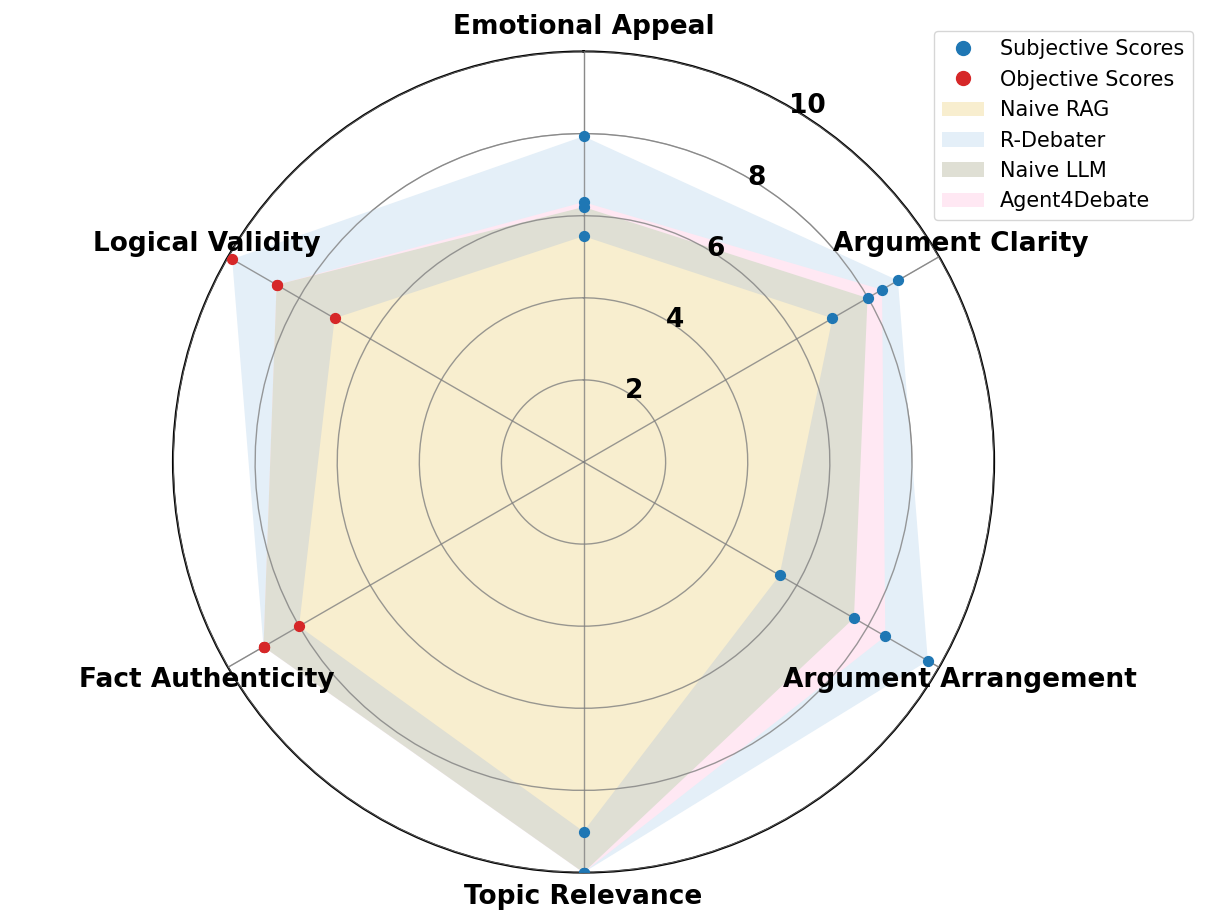
R-Debater. Human preference for debate generation models Figure 3 further reports the
macro-averaged Likert ratings across the six InspireScore dimensions,
providing a complementary perspective to the overall preference rates. Although R-Debater shows strong performance, several limitations remain.
First, the framework inherently depends on pretrained LLMs, which may
suffer from outdated knowledge and hallucination issues. While retrieval
mitigates these problems to some extent, inconsistencies between
retrieved evidence and model priors can still compromise factual
reliability. Second, the retrieval process itself introduces additional
latency and potential noise, and the multi-agent architecture further
increases token usage and computational overhead, limiting the system’s
scalability for real-time or large-scale applications. Third, the
timeliness and coverage of the debate database play a critical role in
overall performance. If the repository is not regularly updated or lacks
domain diversity, R-Debater may generate arguments that are outdated or
topically misaligned. Fourth, the current implementation is primarily
trained and evaluated on the ORCHID dataset. Future work includes
extending the framework to cross-lingual and cross-domain settings to
assess its generalization capacity, particularly in informal or
multilingual debate contexts. Finally, metrics such as InspireScore and
Debatrix still involve subjective components. Although human evaluation
improves reliability, it remains small-scale and subjective,
underscoring the need for broader and more systematic studies in future
assessments. We present R-Debater, a retrieval-augmented framework that integrates
argumentative memory with structured multi-agent planning to generate
coherent, stance-consistent, and evidence-grounded debate arguments
across multiple turns. Empirical results on the ORCHID dataset
demonstrate that R-Debater outperforms strong LLM-based baselines in
factual accuracy, logical coherence, and persuasive quality, validating
the effectiveness of reconstructing argumentative memory through
retrieval grounding and coordinated agent reasoning. Moving forward, the
framework will be extended to broader debate domains and multilingual
contexts, with efforts to enhance interpretability and efficiency for
real-time interactive use. Together, these advances highlight the
potential of retrieval-augmented multi-agent systems to support more
transparent, adaptive, and trustworthy debate generation. This appendix presents a concrete, end-to-end example of our three-step
pipeline. Given an opponent’s debate statement, we first extract
pseudo-first-order predicates $`\mathcal{P}_{\text{opp}}`$, then derive
a natural-language reasoning chain $`\tau_{\text{opp}}`$, and finally
identify logical flaws $`\mathcal{L}`$. Debate Topic: Has globalization accelerated or slowed in the
post-pandemic era? Con. However, the pandemic has not accelerated globalization; rather, it
has disrupted it. The outbreak of COVID-19 nearly halted global economic
interactions. Variants spread rapidly in the UK and Germany, while
Australia and Malaysia returned to lockdowns. Such disruptions affected
people’s lives and forced governments to reassess the impact of
globalization. Data prove this trend: since 2019, global trade
dependence has decreased by seven percentage points, whereas it had only
decreased by four points over the entire twelve years preceding the
pandemic. Foreign direct investment dropped by 38% due to COVID-19 and
remains 25% below previous levels. Even in 2021, supposedly the
“post-pandemic era,” indicators continue to decline. Nations are also
adjusting their strategies. President Biden’s American Jobs Plan
emphasizes rebuilding domestic supply chains and ensuring Americans “buy
American.” China’s 14th Five-Year Plan stresses domestic circulation as
the core. The pandemic exposed the fragility of over-reliance on global
supply chains, prompting governments to turn inward. Moreover, public
distrust has grown—polls show that 73% of respondents believe China
should be held responsible for the pandemic, which reduces willingness
for international cooperation. Thus, globalization is slowing, not
accelerating. Con. Yet your example of China actually supports our view. China
controlled the pandemic well, so its trade grew. But in countries like
the UK, Europe, and India—where control failed—borders closed and trade
declined. Overall, global trade is still down. The WTO predicts that
even by 2022, trade volumes will remain below 2019 levels. You stress
cross-border e-commerce, but this existed before COVID; the pandemic
only temporarily amplified it. As for digital supply chains, they are
still in their infancy, and there is no long-term evidence they can
reverse the slowdown of globalization. More importantly, the pandemic
revealed the necessity of reshoring critical industries. When masks were
seized and vaccine production stalled, nations realized that so-called
“risk diversification” meant leaving eggs in someone else’s basket. In
contrast, reshoring ensures essential goods stay secure. That is why
industrial reshoring policies—whether in healthcare, steel, or other
strategic sectors—are rising worldwide. Globalization, therefore, is not
accelerating but rather facing a cautious retreat. PredicateSet = { Disrupts(Pandemic, Globalization),
NearlyHalts(Pandemic, GlobalEconomicInteractions), SpreadVariants({UK,
Germany}), Lockdowns({Australia, Malaysia}), Decrease(TradeDependence,
since2019, 7pp), Decrease(TradeDependence, pre2019_12y, 4pp),
Decrease(FDI, Pandemic, 38%), BelowBaseline(FDI, Current, 25%),
ContinuesDecline(Indicators, 2021), Emphasizes(AmericanJobsPlan,
DomesticSupplyChains & BuyAmerican), Emphasizes(China14FYP,
DomesticCirculation), Reveals(Pandemic, Fragility(GlobalSupplyChains)),
Increases(PublicDistrust, Pandemic), Blames(Public, China, 73%),
Concludes(Overall, GlobalizationSlowing), Notes(ChinaTrade,
GrewUnderGoodControl), Notes({UK, Europe, India}, BordersClosed &
TradeDeclined), Predicts(WTO, TradeVolumeBelow(2022, 2019)),
Claims(CrossBorderEcommerce, PreExisted & TemporarilyAmplified),
Claims(DigitalSupplyChains, EarlyStage &
InsufficientEvidenceLongTermReversal), Advocates(Reshoring,
CriticalIndustries), MotivatedBy(Reshoring, SecurityOfEssentialGoods),
Observes(ReshoringPoliciesRising, {Healthcare, Steel, StrategicSectors})
} ReasoningChain = """ The opponent argues that the pandemic disrupted
globalization, as evidenced by halted interactions, renewed lockdowns,
and the spread of variants across multiple countries. They further claim
that quantitative indicators confirm a slowdown: global trade dependence
fell by 7 percentage points since 2019 (compared with only 4 points in
the prior twelve years), FDI dropped by 38% and remains 25% below
previous levels, and key indicators continued to decline in 2021. Policy
responses are presented as consistent with de-globalization: the
American Jobs Plan promotes domestic supply chains and Buy American,
while China’s 14th Five-Year Plan stresses domestic circulation. The
pandemic is said to reveal global supply-chain fragility, increasing
public distrust (73% blaming China), which purportedly reduces
willingness for international cooperation. Even if some economies (e.g.,
China) sustained or grew trade under effective control, the opponent
maintains that overall global trade remains below 2019 levels, citing a
WTO prediction that 2022 trade volume would still be lower than in 2019.
They contend that cross-border e-commerce predated COVID and was only
temporarily amplified, and that digital supply chains are nascent
without long-term evidence of reversing the slowdown. From the security
perspective, they argue that shortages and seizures during the pandemic
justify reshoring in critical sectors; the observed rise of reshoring
policies is then taken as a sign of a broader, cautious retreat from
globalization. Hence, the conclusion is that globalization is slowing
rather than accelerating. """ LogicalFlaws = { “Temporal Scope Ambiguity: The argument mixes
short-term shock (lockdowns, 2020–2021 contractions) with a long-term
trend claim (’globalization is slowing’) without clearly separating
transient effects from persistent structural change.”, “Selective
Quantification: Declines in FDI and trade dependence are emphasized, but
the chain does not examine heterogeneity across regions/sectors (e.g.,
China trade growth) and whether rebounds or offsetting channels
(services, digital trade) exist.”, “Causal Leap: Public distrust (73%
blaming China) is treated as directly reducing international
cooperation, but the mechanism is not specified (policy channels,
durations, or countervailing incentives).”, “Equivocation Between
Reshoring and Deglobalization: Reshoring in critical sectors is taken as
general evidence of global retreat, yet partial risk rebalancing can
co-exist with continued cross-border integration elsewhere.”,
“Status-Quo Comparison: The claim that 2022 trade volumes remain below
2019 is used to infer a slowdown, but no baseline for expected recovery,
cyclical adjustment, or substitution effects is provided.”, “Persistence
Assumption: The narrative assumes that amplified cross-border e-commerce
and digital supply-chain adoption are temporary, without engaging with
data that could indicate durable post-shock adoption.” } The following prompts describe various argumentative schemes that the
Scheme Annotation Agent utilizes during debate annotation and analysis.
Each scheme is defined with its method, definition, scenario, example,
analytical process, and sample output. You are the Scheme Annotation Agent. Your task is to read a single
debate utterance and, using the scheme definitions below, label all
argumentation schemes that appear in the utterance (multi-label is
allowed). Argumentation Scheme Details: The following argumentation schemes were selected and used in our
experiments. 1. Example-Based Argumentation Definition: This scheme supports a general conclusion through
specific cases. It assumes that the attributes of an individual or event
are representative and can be generalized to similar situations. Its
validity depends on whether the case truly reflects the broader
situation. It also allows questioning the representativeness of the
opponent’s case. 2. Value-Based Argumentation Definition: This scheme relies on ethical or moral core values to
assess whether a policy, behavior, or opinion conforms to a particular
value system. Its logic centers on identifying value standards and
evaluating legitimacy accordingly. 3. Expert Opinion Argumentation Definition: This scheme uses expert statements, professional
knowledge, and recognized authority to validate premises or conclusions,
often by clarifying key concepts to strengthen credibility. 4. Positive Consequence Argumentation Definition: This scheme justifies an action or policy by emphasizing
its beneficial outcomes, making the argument intuitive and persuasive
via demonstrated gains. 5. Causal Argumentation Definition: Establishes a clear causal relation, arguing that a
premise inevitably or with high likelihood leads to a result; focuses on
the coherence and plausibility of the causal chain. 6. Negative Consequence Argumentation Definition: Refutes an opponent’s standpoint by deriving
unacceptable or extreme negative consequences from it, thereby
challenging its plausibility or desirability. 7. Analogical Argumentation Definition: Supports a conclusion by appealing to similarity between
two situations with comparable logical structure, contingent on verified
shared properties. The following prompts describe how the Scoring Agent evaluates the
quality of scheme usage in debate utterances. Each dimension of
evaluation is defined with its criteria, scenario, example, analytical
process, and sample output. You are the Scoring Agent. Your task is to read a single debate
utterance and, for each annotated scheme, assign a quality label from
the set: {poor, general, good, excellent}. If the scheme is not used,
output What to output: The following are the definitions of dimensions: 1. Acceptability Definition: Judges whether the premises and assumptions are credible
and contextually defensible. 2. Inference & Defeasibility Definition: Evaluates whether the reasoning follows the canonical
pattern of the scheme and respects its defeasible nature. 3. Relevance Definition: Assesses whether the chosen scheme truly fits the
reasoning pattern and conclusion. 4. Robustness & Rhetorical Clarity Definition: Measures resilience to objections and clarity of
delivery. Good Example 1: To ensure interpretability and reproducibility, we provide the prompt
templates used for the three core reasoning components in the Logic &
Summarization Agent. Each method plays a distinct role in transforming
an opponent’s argument into structured, symbolic, and interpretable
reasoning signals. While the detailed prompts are listed below, the same
logic pipeline is consistently applied across all debate scenarios. Role: You are a Symbolic Translator. Please output a set of pseudo-first-order predicates capturing the core
argumentative logic. Role: You are the Symbolic Chain-of-Thought Generator. Please produce a step-by-step reasoning narrative
($`\tau_{\mathrm{opp}}`$) in natural language that links these
predicates, indicating support, causation, and possible contradictions. Role: You are the Logic Critic / Verifier. Please identify all logical flaws or inconsistencies in the chain, and
for each, output a natural-language description referencing the relevant
claims. Debate Topic: Has globalization accelerated or slowed in the
post-pandemic era? First, economic demand. The economic pressures amplified by the pandemic
have forced companies to rely even more on the global division of labor
and supply chains. For example, labor costs in the U.S. pharmaceutical
industry are five times higher than in India, and American manufacturing
costs are more than 30% higher than in China. Withdrawing from
globalization would dramatically increase costs. According to the
Institute of International Finance, global corporate debt rose by $5.4
trillion in 2020, and default rates reached their highest since the
financial crisis. Under such debt pressure, rejoining global supply
chains is inevitable. CPB monitoring data show that by November 2020,
global trade had already returned to pre-pandemic levels, and in March
2021, international trade grew by 2.3%. This rapid recovery is solid
evidence that globalization has accelerated. Data prove this trend: since 2019, global trade dependence has decreased
by seven percentage points, whereas it had only decreased by four points
over the entire twelve years preceding the pandemic. Foreign direct
investment dropped by 38% due to COVID-19 and remains 25% below previous
levels. Even in 2021, supposedly the “post-pandemic era,” indicators
continue to decline. Nations are also adjusting their strategies. President Biden’s American
Jobs Plan emphasizes rebuilding domestic supply chains and ensuring
Americans “buy American.” China’s 14th Five-Year Plan stresses domestic
circulation as the core. The pandemic exposed the fragility of
over-reliance on global supply chains, prompting governments to turn
inward. Moreover, public distrust has grown—polls show that 73% of
respondents believe China should be held responsible for the pandemic,
which reduces willingness for international cooperation. Thus,
globalization is slowing, not accelerating. Cross-border e-commerce has also surged, deepening global ties.
Meanwhile, reshoring imposes massive costs: rebuilding domestic
factories and hiring domestic workers makes products more expensive,
reducing competitiveness at a time when both companies and consumers are
financially strained. Evidence supports this: once China controlled the
pandemic in 2021, outbound investment rose 27.1% compared to 2019. This
proves that once risks are managed, firms quickly return to global
markets. Thus, in terms of risk, cost, and post-pandemic data,
globalization is accelerating. You stress cross-border e-commerce, but this existed before COVID; the
pandemic only temporarily amplified it. As for digital supply chains,
they are still in their infancy, and there is no long-term evidence they
can reverse the slowdown of globalization. More importantly, the pandemic revealed the necessity of reshoring
critical industries. When masks were seized and vaccine production
stalled, nations realized that so-called “risk diversification” meant
leaving eggs in someone else’s basket. In contrast, reshoring ensures
essential goods stay secure. That is why industrial reshoring
policies—whether in healthcare, steel, or other strategic sectors—are
rising worldwide. Globalization, therefore, is not accelerating but
rather facing a cautious retreat. Scoring Table: Candidate 2 Scoring Table: Candidate 3 Scoring Table: Candidate 4 Final Choice (pick one):\begin{equation}
\label{eqn:problem}
\mathcal{E}_j = \mathcal{R}(H_j, \mathcal{D}), \,
u_{j+1} = \mathcal{M}(T, H_j, \mathcal{E}_j).
\end{equation}Methodology
Database Construction
\text{Score}_i(S)\in\{\text{poor},\text{general},\text{good},\text{excellent}\}\, \text{for } S\in\mathcal{S}_i.Debate Data Retrieval
\mathcal{P}_{\text{opp}}=\bigcup_{i=1}^{t} f_{\text{pred}}(u_i^{\text{opp}}), \,
\tau_{\text{opp}} = f_{\text{infer}}(\mathcal{P}_{\text{opp}}),
Task: Read an opponent’s debate statement and convert its major
argumentative claims into pseudo–first-order predicates.
Guidelines: Identify central claims, causal/temporal relations, and
quantitative assertions. Use concise predicate forms such as:
Cause(A,B), Supports(A,B), Contrast(A,B), Negate(P). Exclude
rhetorical or filler content, and output one predicate per line.
Input: {[OPPONENT’S UTTERANCE]}
Task: Take the predicate set extracted by $`f_{pred}`$ and generate
a coherent natural-language reasoning chain representing the opponent’s
logic.
Guidelines: Interpret causal and contrastive relations among
predicates, order them into a logical narrative, and mark where claims
support or conflict. Maintain neutrality and reconstruct the opponent’s
logic, rather than providing a rebuttal.
Input: {[PSEUDO-FIRST-ORDER LOGICAL REPRESENTATION]}
Task: Read the reasoning chain and identify logical flaws or
inconsistencies, producing a set of natural-language control signals.
Guidelines: Detect contradictions, unsupported assumptions, circular
reasoning, or overgeneralization. Each flaw should be concise (1–3
sentences) and reference relevant claims. Do not add new evidence, and
only report logical flaws.
Input: {[REASONING CHAIN SET]}\mathcal{E}_{\text{coarse}}=\bigl\{\, r_j \in \mathcal{D}\; \big|\; \texttt{rule\_match}(r_j,\mathcal{K}) \bigr\}.\text{sim}(\mathbf{v}_{H},\mathbf{e}_j)=\frac{\mathbf{v}_{H}\cdot \mathbf{e}_j}{\|\mathbf{v}_{H}\|\,\|\mathbf{e}_j\|},
\,
\mathcal{E}=\texttt{Top-}k\bigl(\{(r_j,\text{sim}(\mathbf{v}_{H},\mathbf{e}_j)) \mid r_j\in \mathcal{E}_{\text{coarse}}\}\bigr).Debate Generation
\tilde{u}^{(0)} = M(H_n,\,\mathcal{L},\,\mathcal{E}^{\text{prior}},\,\mathcal{S}^{\text{prior}},\,s).Experiments
Experimental Setup
Results and Analysis
Single-turn Debate Evaluation
Multi-turn Competitive Debate Evaluation
Model
Framework
Debatrix
3-6
S
L
A
O
GPT-4o
R-Debater (ours)
1.13
1.16
1.26
1.23
Agent4Debate
0.87
0.84
0.74
0.77
Deepseek-V3
R-Debater (ours)
1.25
1.11
1.19
1.25
Agent4Debate
0.75
0.89
0.81
0.75
Expert Alignment Evaluation.
Metric
Value
Jaccard Index (avg)
0.7366
Precision (avg)
0.8225
Hamming Loss (avg)
0.1291
Cohen’s $`\kappa`$ (micro)
0.7229
Cohen’s $`\kappa`$ (macro)
0.6964
Krippendorff’s $`\alpha`$ (nominal)
0.7230
Metric
Value
Pearson
0.6356
Spearman
0.6533
Kendall
0.5880
Case Study
\begin{aligned}
\mathcal{L} &= f_{\text{logic}}(\tau_{\text{opp}}) \\[2pt]
            &= \bigl\{\text{``False dichotomy: }
               (\text{Questioning} \!\rightarrow\! \text{Disorder})
               \text{ is invalid.''}\bigr\}.
\end{aligned}
Module
R-Debater (Pro)
Naive RAG (Con)
Detected Logical Issue ($`\mathcal{L}`$)
“Conflates constructive questioning with destructive disorder; assumes all systemic challenges stem from isolated incidents.”
NA.
Retrieved Evidence ($`\mathcal{E}`$)
Case: “Tech company (Meituan) innovation spurred by employee feedback programs that improved both culture and productivity.” (Argumentation scheme: causal argumentation, score: good; exemplification, score: excellent)
Generic examples of “corporate hierarchy and discipline” unrelated to the core argument.
Generated Rebuttal ($`u_{m+1}`$)
“Constructive questioning drives organizational adaptation, not disorder. Many successful companies have integrated employee feedback to improve both culture and efficiency, demonstrating that systemic evolution differs from complete overthrow.”
“Encouraging confrontation may undermine teamwork and trust. Rather than opposing authority, fostering open communication would yield more sustainable improvement.”
Ablation Study
gpt-4o-mini as the base model and InspireScore for
evaluation. The results in
Table 5 demonstrate the
complementary roles of all major components in R-Debater.
Method
InspireScore
2-5
Subjective
Logic
Fact
InspireScore
R-debater
0.841
0.954
0.700
0.831
w/o Opt. Module
0.773
0.917
0.640
0.776
w/o L. & S. Agent
0.735
0.875
0.672
0.761
w/o Argu. Schem.
0.371
0.683
0.531
0.528
Human Evaluation
Model
LLM
NaiveRAG
Agent4Debate
R-Debater
Choose Rate (%)
7.89
0.00
15.79
76.32
Limitations
Conclusion
Appendix
Case Demonstration of the Logic & Summarization Agent
Prompts for Scheme Annotation Agent
Allowed scheme names (use exactly these as JSON keys) and their
descriptions:
{[SCHEME LIST]}
{[SCHEME DESCRIPTIONS]}
What to output:
Return a single JSON object where each present scheme is a key and the
value is an object with a concise English explanation under the field
"reason" that cites the evidence from the utterance (no more than 40
words per reason). Do not invent new scheme names.
Formatting rules:
{}.
Expected JSON format:
{
“Example-Based Argumentation”: {“reason”: “Points to a specific case
to generalize the conclusion.”},
“Causal Argumentation”: {“reason”: “Claims X leads to Y via an
explicit cause-effect link.”}
}
Utterance to annotate:
{[USER INPUT]}
Scenario: Common in policy evaluation or ethical debates, where a
debater cites specific instances to support claims. The opponent may
challenge the applicability in different contexts.
Example: “Although your city-level data shows the policy is
effective, it does not cover rural areas, hence it cannot prove
nationwide applicability.”
Analytical Process: Based on inductive reasoning, assuming case
universality, followed by examining case limitations to challenge the
logical rigor of the argument.
Sample Output: Argumentative Technique: Example-Based Argumentation.
Logical Basis: Reveals that case representativeness does not hold,
invalidating generalization.
Scenario: In debates involving value conflicts, debaters argue from
differing moral standards and value orientations, weighing priorities to
build reasoning.
Example: “Although economic growth is important, environmental
protection must take precedence as the foundation of sustainable
development for long-term welfare.”
Analytical Process: First, clarify the core value(s); then link
competing values with clear priority ordering to argue for or against
compliance.
Sample Output: Argumentative Technique: Value-Based Argumentation.
Logical Basis: Constructs legitimacy reasoning from core values and
their priority.
Scenario: In academic, technical, or professional debates, expert
viewpoints bolster trust and reliability.
Example: “As a renowned psychologist noted, anger can trigger a
sense of justice and thus should not be dismissed as merely negative.”
Analytical Process: Introduce a qualified expert, establish domain
relevance and independence, clarify key terms, and connect the expert
claim to the conclusion with warranted backing.
Sample Output: Argumentative Technique: Expert Opinion
Argumentation. Logical Basis: Strengthens reasoning through
authoritative, domain-relevant support.
Scenario: In law reform or policy evaluation, debaters highlight
historical progress or present benefits to justify adoption or
continuation.
Example: “The modern legal system ensures power supervision and
promotes fairness and justice.”
Analytical Process: Marshal empirical evidence and historical
comparisons to show a credible pathway from action to desirable effects;
address feasibility and scope.
Sample Output: Argumentative Technique: Positive Consequence
Argumentation. Logical Basis: Demonstrates rationality through a
credible positive causal chain.
Scenario: In technology, policy, or ethics debates, causal links are
frequently contested.
Example: “Without regulation, technological advances will inevitably
cause privacy violations, harming society.”
Analytical Process: Specify mechanisms, conditions, and
intermediaries; test for alternative causes and hidden assumptions;
evaluate necessity/sufficiency.
Sample Output: Argumentative Technique: Causal Argumentation.
Logical Basis: Validates rigor through explicitly articulated and tested
causal links.
Scenario: Used in risk management or ethical debates to highlight
dangers of adopting the opponent’s premise or policy.
Example: “If we accept the idea that ‘the harder, the better’, then
even dangerous activities like rooftop jumps would be justified, which
is absurd.”
Analytical Process: Assume the opponent’s premise, project it along
a plausible path to extreme or harmful outcomes, and expose
contradictions or rule violations.
Sample Output: Argumentative Technique: Negative Consequence
Argumentation. Logical Basis: Reveals absurd or harmful outcomes
entailed by the opponent’s logic.
Scenario: In public policy or social reform debates, speakers cite
cross-domain or cross-country cases to suggest transferable solutions.
Example: “Just as country X achieved progress after adopting this
policy, it can also promote development here with appropriate
adjustments.”
Analytical Process: Identify the base and target cases, establish
relevant commonalities, check disanalogies, and infer a parallel
conclusion with stated limits.
Sample Output: Argumentative Technique: Analogical Argumentation.
Logical Basis: Validates universality and rationality via warranted
analogy.Prompts for Scoring Agent
none.
Evaluation focuses on four key dimensions:
Return a single JSON object where each scheme is a key and the value is
an object with dimension-level scores. Scores must be one of {poor,
general, good, excellent, none}.
Formatting rules:
Expected JSON format:
{
“Causal Argumentation”: {“Acceptability”: “good”, “Inference”:
“excellent”, “Relevance”: “good”, “Defeasibility”: “general”},
“Expert Opinion Argumentation”: {“Acceptability”: “excellent”,
“Inference”: “good”, “Relevance”: “good”, “Defeasibility”: “good”}
}
Utterance to evaluate:
{[SCHEME ANNOTATION AGENT OUTPUT]}
Scenario: Used when a debater relies on explicit or implicit
premises to support reasoning.
Example: “Government data shows rising pollution levels, so
regulation is urgent.”
Analytical Process: Examine the trustworthiness of data and
assumptions; weak or anecdotal evidence reduces acceptability.
Sample Output: Acceptability: good. Premises are factual, plausible,
and contextually relevant.
Scenario: In causal or expert opinion schemes, check if the
reasoning anticipates critical questions.
Example: “Without regulation, new technology will inevitably cause
privacy risks.”
Analytical Process: Test whether reasoning is overly deductive,
ignores exceptions, or misuses the scheme.
Sample Output: Inference: good. Reasoning is consistent with the
scheme and addresses counterpoints.
Scenario: In analogical or value-based schemes, check if the cited
case or value is truly pertinent.
Example: “Like country X, we should adopt universal healthcare
policies.”
Analytical Process: Identify if reasoning aligns with the intended
scheme or introduces irrelevant elements.
Sample Output: Relevance: excellent. The argument closely aligns
with the scheme’s purpose.
Scenario: When arguments risk collapse under counterexamples or
unclear phrasing.
Example: “If we follow your logic, absurd actions like reckless
stunts would be justified.”
Analytical Process: Evaluate ability to anticipate counterarguments
and maintain persuasive coherence.
Sample Output: Robustness: general. Argument is somewhat clear but
vulnerable to objections.
Utterance: “Because decades of industrial pollution have led to elevated
disease rates in neighboring towns, we must adopt stricter environmental
regulations now.”
Evaluation: Acceptability: good; Inference: good; Relevance: excellent;
Robustness: good.
Good Example 2:
Utterance: “Many nations with universal healthcare report better
outcomes; adopting a similar system is likely beneficial here.”
Evaluation: Acceptability: good; Inference: good; Relevance: excellent;
Robustness: good.
Bad Example 1:
Utterance: “I saw two sick people near the factory yesterday, so the
factory must be causing all illnesses in this region.”
Evaluation: Acceptability: general; Inference: poor; Relevance: general;
Robustness: poor.
Bad Example 2:
Utterance: “Because a famous scientist once said this chemical is
dangerous, we must ban it immediately.”
Evaluation: Acceptability: general; Inference: poor; Relevance: general;
Robustness: poor.Prompts for Methods in Logic & Summarization Agent
Task: Read an opponent’s debate statement and convert its major
argumentative claims into pseudo-first-order logical predicates.
Guidelines: - Identify central claims, causal/temporal relations, and
quantitative assertions. - Use compact predicate forms (Cause(A,B),
Necessary(A,B), Supports(A,B), Increase(X,Value), Decrease(X,Value),
Contrast(A,B), Negate(P)). - If numbers, percentages, or time periods
appear, include them. - Use consistent entity names - Avoid
rhetorical/filler content; only capture logical claims. - Output only
predicates (one per line), not natural sentences.
Prompt format: Here is the opponent’s statement: {[STATEMENT TEXT]}
Task: Take the predicate set extracted by $`f_{pred}`$ and generate a
natural-language reasoning chain ($`\tau_{\mathrm{opp}}`$).
Guidelines: - Read the predicate list and interpret relations (cause,
support, contrast, contradiction). - Order them into a coherent
reasoning narrative. - Explicitly mark where claims support or
conflict. - Maintain neutrality (reconstruct opponent’s logic, not
rebuttal). - Do not add new evidence; only use given predicates.
Prompt format: Here is the predicate set from the opponent: p1, p2, p3,
…
Task: Read the reasoning chain ($`\tau_{\mathrm{opp}}`$) generated by
$`f_{infer}`$ and identify logical flaws or inconsistencies in nature
language($`\mathcal{L}`$).
Guidelines: - Detect contradictions, unsupported assumptions, circular
reasoning, overgeneralization, temporal mismatches, or missing links. -
Each flaw is concise (1–3 sentences), in natural language. - Reference
relevant predicates or claims explicitly. - Do not counterargue with new
evidence; only report logical flaws. - Output a list of flaw
descriptions.
Prompt format: Here is the reasoning chain from the opponent
($`\tau_{\mathrm{opp}}`$): <($`\tau_{\mathrm{opp}}`$) text>Example of Human Evaluation Form
Background. You are invited to participate in a study on automatic
debate generation. Each task provides (i) an incomplete debate context
and (ii) four candidate debate statements generated by different
systems. Your role is to evaluate these candidate statements according
to the given criteria. All responses are anonymous and will only be used
for research purposes.
Debate Context
Pro. The post-pandemic era refers to the period when the pandemic
has largely subsided, with only occasional small outbreaks.
Globalization refers to the strengthening of cross-border flows and the
deepening of interdependence among nations. We argue that the
post-pandemic era has accelerated globalization for three reasons.
Con. However, the pandemic has not propelled globalization forward;
rather, it has disrupted it. The outbreak of COVID-19 nearly halted
global economic interactions. Variants spread rapidly in the UK and
Germany, while Australia and Malaysia returned to lockdowns. Such
disruptions affected people’s lives and forced governments to reassess
the impact of globalization.
Pro. The opposition emphasizes reshoring, but this cannot truly
mitigate risk. If a domestic outbreak shuts down production, a purely
national supply chain still collapses. Real “not putting all eggs in one
basket” means having multiple global suppliers, enabled by digitalized
supply chains. The pandemic accelerated digital globalization: big data
and IoT allow firms to monitor supply and demand shifts, reduce costs,
and optimize distribution. A U.S. Congressional report estimates
digitalized supply chains can cut unit costs by 30–40%.
Con. Yet your example of China actually supports our view. China
controlled the pandemic well, so its trade grew. But in countries like
the UK, Europe, and India—where control failed—borders closed and trade
declined. Overall, global trade is still down. The WTO predicts that
even by 2022, trade volumes will remain below 2019 levels.
Candidate 1
In the post-pandemic era, globalization has not slowed but accelerated
due to multiple factors. First, the core driver of economic
globalization—global division of labor and supply chain optimization—has
become even more important after the pandemic. Companies face enormous
cost pressures, and data show that in 2020 global corporate debt
increased by $5.4 trillion, with default rates at their highest since
the financial crisis. This forces firms to rejoin global supply chains
in the post-pandemic era to reduce costs. International trade recovered
in 2021 and continues to grow. Second, the pandemic accelerated the
digital economy, with digitalized supply chains tightening global
networks. Cross-border e-commerce grew 53% in Q2 2020, and in the first
half of 2021, China’s cross-border e-commerce imports and exports rose
28.6%. Digital globalization significantly reduced supply chain costs.
Third, global risks such as pandemics and climate change demand closer
cooperation among nations. The COVAX program’s successful implementation
shows countries increasingly rely on globalization to address shared
risks. Thus, economic, technological, and governance needs in the
post-pandemic era jointly drive globalization forward.
Candidate 2
The post-pandemic era refers to the period when the pandemic has largely
subsided. Globalization means the strengthening of cross-border flows
and deepening interdependence among nations. We argue that the
post-pandemic era accelerates globalization for three reasons. First,
economic demand: pandemic-driven pressures force firms to remain
globalized to reduce costs. Second, the digital economy has been
accelerated, with digitalized supply chains tightening global networks
and fostering cross-border e-commerce. Third, the need to cope with
global risks makes countries part of a shared risk community, where
global governance systems become key. Thus, globalization accelerates in
the post-pandemic era.
Candidate 3
The post-pandemic era refers to the period when the pandemic has largely
subsided with occasional outbreaks. Globalization means strengthening
cross-border flows and interdependence. We argue that globalization has
accelerated for three reasons. First, the core driver of globalization
is cost reduction through global division of labor. Pandemic-driven cost
pressures push firms to stay global. For example, U.S. pharmaceutical
labor costs are five times those in India; withdrawing would sharply
increase costs. By November 2020, global trade had recovered to
pre-pandemic levels, and in March 2021, international trade grew 2.3%,
showing acceleration. Second, the pandemic accelerated the digital
economy: digital globalization fosters efficient global data flows, with
big data reducing production costs. Studies show digital supply chains
can lower unit costs by 30–40%. Cross-border e-commerce grew 53% in
2020, and in 2021, China’s cross-border e-commerce trade rose 28.6%,
showing digital economy support for globalization. Third, shared risk
management increases interdependence, as seen in WHO’s COVAX program,
which highlights global cooperation. Thus, globalization is accelerating
in the post-pandemic era.
Candidate 4
Thank you, Chair. The opposition tried to argue that pandemic-era trade
declines and reshoring prove globalization slowed. But this reasoning is
logically flawed. First, their evidence cherry-picks short-term pandemic
data, ignoring long-term recovery. By March 2021, global trade grew
2.3%, showing resilience. Second, the digital economy is not a temporary
trend: the pandemic catalyzed its adoption, with cross-border e-commerce
and IoT integration driving deeper globalization. Third, reshoring
examples are isolated and economically unsustainable. Japan’s few
reshored firms pale in comparison to the inflows of new foreign
investment in China. Ultimately, globalization is driven by efficiency
and cost optimization, which reshoring cannot overturn. Ultimately,
global risks foster international cooperation, as evident in the sharing
of vaccines through COVAX. Thus, globalization in the post-pandemic era
is accelerating, not retreating.
Evaluation Criteria (1–10 each): Emotional Appeal, Argument
Clarity, Argument Arrangement, Topic Relevance, Fact Authenticity,
Logical Validity.
Scoring Table: Candidate 1
Dimension
1
2
3
4
5
6
7
8
9
10
Emotional Appeal
$`\square`$
$`\square`$
$`\square`$
$`\square`$
$`\square`$
$`\square`$
$`\square`$
$`\square`$
$`\square`$
$`\square`$
Argument Clarity
$`\square`$
$`\square`$
$`\square`$
$`\square`$
$`\square`$
$`\square`$
$`\square`$
$`\square`$
$`\square`$
$`\square`$
Argument Arrangement
$`\square`$
$`\square`$
$`\square`$
$`\square`$
$`\square`$
$`\square`$
$`\square`$
$`\square`$
$`\square`$
$`\square`$
Topic Relevance
$`\square`$
$`\square`$
$`\square`$
$`\square`$
$`\square`$
$`\square`$
$`\square`$
$`\square`$
$`\square`$
$`\square`$
Fact Authenticity
$`\square`$
$`\square`$
$`\square`$
$`\square`$
$`\square`$
$`\square`$
$`\square`$
$`\square`$
$`\square`$
$`\square`$
Logical Validity
$`\square`$
$`\square`$
$`\square`$
$`\square`$
$`\square`$
$`\square`$
$`\square`$
$`\square`$
$`\square`$
$`\square`$
Dimension
1
2
3
4
5
6
7
8
9
10
Emotional Appeal
$`\square`$
$`\square`$
$`\square`$
$`\square`$
$`\square`$
$`\square`$
$`\square`$
$`\square`$
$`\square`$
$`\square`$
Argument Clarity
$`\square`$
$`\square`$
$`\square`$
$`\square`$
$`\square`$
$`\square`$
$`\square`$
$`\square`$
$`\square`$
$`\square`$
Argument Arrangement
$`\square`$
$`\square`$
$`\square`$
$`\square`$
$`\square`$
$`\square`$
$`\square`$
$`\square`$
$`\square`$
$`\square`$
Topic Relevance
$`\square`$
$`\square`$
$`\square`$
$`\square`$
$`\square`$
$`\square`$
$`\square`$
$`\square`$
$`\square`$
$`\square`$
Fact Authenticity
$`\square`$
$`\square`$
$`\square`$
$`\square`$
$`\square`$
$`\square`$
$`\square`$
$`\square`$
$`\square`$
$`\square`$
Logical Validity
$`\square`$
$`\square`$
$`\square`$
$`\square`$
$`\square`$
$`\square`$
$`\square`$
$`\square`$
$`\square`$
$`\square`$
Dimension
1
2
3
4
5
6
7
8
9
10
Emotional Appeal
$`\square`$
$`\square`$
$`\square`$
$`\square`$
$`\square`$
$`\square`$
$`\square`$
$`\square`$
$`\square`$
$`\square`$
Argument Clarity
$`\square`$
$`\square`$
$`\square`$
$`\square`$
$`\square`$
$`\square`$
$`\square`$
$`\square`$
$`\square`$
$`\square`$
Argument Arrangement
$`\square`$
$`\square`$
$`\square`$
$`\square`$
$`\square`$
$`\square`$
$`\square`$
$`\square`$
$`\square`$
$`\square`$
Topic Relevance
$`\square`$
$`\square`$
$`\square`$
$`\square`$
$`\square`$
$`\square`$
$`\square`$
$`\square`$
$`\square`$
$`\square`$
Fact Authenticity
$`\square`$
$`\square`$
$`\square`$
$`\square`$
$`\square`$
$`\square`$
$`\square`$
$`\square`$
$`\square`$
$`\square`$
Logical Validity
$`\square`$
$`\square`$
$`\square`$
$`\square`$
$`\square`$
$`\square`$
$`\square`$
$`\square`$
$`\square`$
$`\square`$
Dimension
1
2
3
4
5
6
7
8
9
10
Emotional Appeal
$`\square`$
$`\square`$
$`\square`$
$`\square`$
$`\square`$
$`\square`$
$`\square`$
$`\square`$
$`\square`$
$`\square`$
Argument Clarity
$`\square`$
$`\square`$
$`\square`$
$`\square`$
$`\square`$
$`\square`$
$`\square`$
$`\square`$
$`\square`$
$`\square`$
Argument Arrangement
$`\square`$
$`\square`$
$`\square`$
$`\square`$
$`\square`$
$`\square`$
$`\square`$
$`\square`$
$`\square`$
$`\square`$
Topic Relevance
$`\square`$
$`\square`$
$`\square`$
$`\square`$
$`\square`$
$`\square`$
$`\square`$
$`\square`$
$`\square`$
$`\square`$
Fact Authenticity
$`\square`$
$`\square`$
$`\square`$
$`\square`$
$`\square`$
$`\square`$
$`\square`$
$`\square`$
$`\square`$
$`\square`$
Logical Validity
$`\square`$
$`\square`$
$`\square`$
$`\square`$
$`\square`$
$`\square`$
$`\square`$
$`\square`$
$`\square`$
$`\square`$
Candidate 1 $`\square`$ Candidate 2 $`\square`$ Candidate 3 $`\square`$
Candidate 4 $`\square`$
📊 논문 시각자료 (Figures)