- Title: Evaluating Contextual Intelligence in Recyclability A Comprehensive Study of Image-Based Reasoning Systems
- ArXiv ID: 2601.00905
- Date: 2025-12-31
- Authors: Eliot Park, Abhi Kumar, Pranav Rajpurkar
📝 Abstract
While the importance of efficient recycling is widely acknowledged, accurately determining the recyclability of items and their proper disposal remains a complex task for the general public. In this study, we explore the application of cutting-edge vision-language models (GPT-4o, GPT-4o-mini, and Claude 3.5) for predicting the recyclability of commonly disposed items. Utilizing a curated dataset of images, we evaluated the models' ability to match objects to appropriate recycling bins, including assessing whether the items could physically fit into the available bins. Additionally, we investigated the models' performance across several challenging scenarios: (i) adjusting predictions based on location-specific recycling guidelines; (ii) accounting for contamination or structural damage; and (iii) handling objects composed of multiple materials. Our findings highlight the significant advancements in contextual understanding offered by these models compared to previous iterations, while also identifying areas where they still fall short. The continued refinement of context-aware models is crucial for enhancing public recycling practices and advancing environmental sustainability.
💡 Summary & Analysis
1. **Swift Classification:** The study explores how different models can quickly classify waste to improve recycling rates and reduce environmental impact. This involves determining the compatibility of various types of waste with different disposal bins.
2. **Location-Specific Guidelines Implementation:** The models were tested under varying location-specific recycling guidelines, reflecting the unique systems and distributors in each city.
3. **Classification Based on Changes in Condition:** The ability of the model to determine recyclability based on changes such as contamination or structural damage was also assessed.
Simple Explanation with Metaphors:
This study aims to find ways to accurately classify waste for recycling using AI models, thereby protecting the environment. Each model must decide which type of disposal bin a given item should be placed in. It’s like sorting clothes into different baskets based on their color.
The research also considers that recycling guidelines can vary by location, meaning each city has its own unique system and buyers for recycled goods. This is akin to wearing different outfits depending on the city you’re in.
Lastly, it evaluates how well models can determine recyclability when waste items are contaminated or damaged. It’s similar to deciding whether a torn book should be repaired and reused or discarded.
Sci-Tube Style Script:
Beginner: “Making recycling easier! Let’s look at how AI models classify waste. We’ll also see how they adapt to different city guidelines!”
Intermediate: “Protecting the environment with AI in waste classification! Find out about our tests considering various conditions and location-specific rules.”
Advanced: “Addressing complex recycling systems with cutting-edge technology. Learn more about the latest advancements in waste classification models and their performance.”
📄 Full Paper Content (ArXiv Source)
# Introduction
Effective waste management, particularly through recycling, is essential
in promoting environmental sustainability. In 2018, the United States
generated approximately 292.4 million tons of municipal solid waste,
equating to 4.9 pounds per person per day . Of this, 32.1 percent was
either recycled or composted, a notable achievement but one that
highlights the significant proportion of waste still destined for
landfills. Within this waste stream, certain materials, such as paper
and paperboard, achieved recycling rates as high as 68.2 percent, while
others, such as plastics, lagged far behind at just 8.7 percent . These
disparities underscore the need for innovative approaches to improve
recycling rates across all categories, including a better understanding
by the general public in distinguishing which items should be recycled.
Related Works
In a recent work [2], the potential of general vision-language models,
specifically Contrastive Language-Image Pretraining (CLIP) , for
automating the classification of waste materials for recycling was
explored. The results were substantially better compared to previous
approaches using simple convolution neural networks with the model
achieving an accuracy of 89% in zero-shot classification into a dozen
different disposal methods. However, the approach had notable
limitations. CLIP’s reliance on a predefined list of potential items
meant it struggled with items outside of this list, reducing its
effectiveness in real-world applications where waste items are highly
varied. In particular, the model was not designed to handle common but
challenging cases such as greasy, dirty, or broken items, which often
complicate the recycling process. The current study seeks to address
these shortcomings by utilizing state-of-the-art models GPT-4o ,
GPT-4o-mini, and Claude 3.5 , which are all equipped with advanced
vision capabilities. These models enhance the system’s ability to
classify a broader range of waste items, including those with unique
characteristics that significantly impact their recyclability, such as
contamination and structural damage. By integrating more diverse and
representative data, and leveraging these cutting-edge models, we aim to
develop a more accurate and robust tool for waste classification,
ultimately contributing to more efficient recycling practices.
style="width:5.5in" />
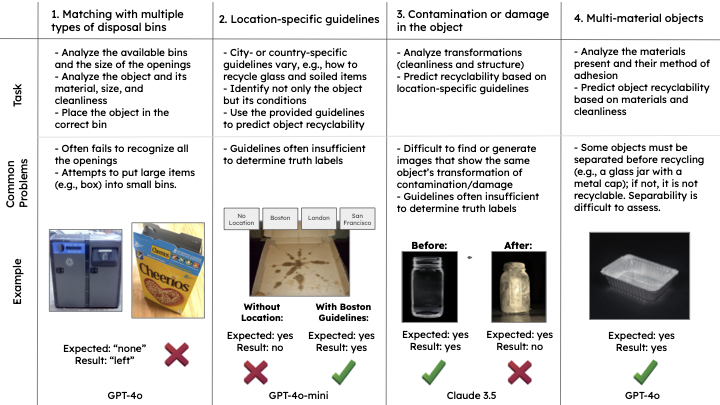
Overview of our study. Four contextual predictions are
tested for three models.
Methodology
The overview of the experiments are shown in Figure 1. We collected
images through a combination of three methods: Google Images, DALL·E
image generation, and personal photography. The goal was to compile a
diverse and representative database of commonly disposed items, ensuring
that the images were clear, realistic, and contextually appropriate. We
generated an initial list of 100 commonly disposed items using ChatGPT,
which provided a broad array of materials across various categories.
After refining this list, we manually gathered images for each item,
focusing on capturing realistic depictions rather than stock photos with
blank backgrounds.
The materials included in the database covered a wide spectrum, with a
focus on frequently encountered waste types: Cardboard, Electronics,
Glass, Plastic, Metal, Organics, Paper, Styrofoam, Textiles, and Wood.
Each category was represented by 10 images, yielding a total of 100
images.
Three models were used: (i) GPT-4o (released May 2024): a multimodal
(text, images, audio) generative pre-trained transformer from OpenAI .
(ii) GPT-4o-mini (July 2024): a small and less expensive version of
GPT-4o. (iii) Claude 3.5 Sonnet (Jun 2024): a generative pre-trained
transformer from Anthropic.
Experiment 1: Predicting recyclability based on recognizing different types of waste bin
One challenge in a real-life situation is the different types of
recycling options that are available at the time of disposal. In this
experiment, we aimed to evaluate the model’s ability to classify waste
items based on their compatibility with different types of disposal
bins. Each API call involved two images: one of a bin and one of an item
from the previously curated database. The models were prompted to
consider both the size of the bin opening and the physical
characteristics of the item, such as shape, size, and material, to
determine the correct disposal method.
The experiment utilized three distinct bin images to represent common
disposal scenarios: (i) BigBelly Bins: These are urban bins found in
many cities, featuring two categories (trash and recycling) with small
openings designed to limit contamination. A major challenge for the
models was to infer the size of the opening compared to the size of the
item. (ii) Residential Bins: Standard 96-gallon residential bins
typically used for household waste collection. (iii) Three-Category
Urban Bins: These include categories for trash, recycling, and compost,
commonly found in urban settings. Each of the 100 images was tested
against all three bin images, resulting in a comprehensive evaluation of
the model’s ability to accurately classify items across varying disposal
contexts.
Experiment 2: Predicting recyclability using location-specific guidelines
Another complication is the differing recyclability guidelines depending
on the city and country. This is a complex issue driven by the specific
machines used at each recycling collection center and which distributor
purchases the recycled items for a city. Thus, this experiment was
designed to assess the model’s ability to adapt its waste classification
based on location-specific recycling guidelines. We used the same
database of 100 items across four tests, each incorporating varying
levels of guideline specificity to evaluate how well the model could
adjust to different local recycling practices.
The tests included: No Guidelines (165 word prompt) as the baseline and
(i) Boston Guidelines (377 word prompt); (ii) London Guidelines (499
word prompt); (iii) San Francisco Guidelines (557 word prompt). Across
these tests, five items displayed a change in recyclability status when
transitioning from Boston’s guidelines to those of London and San
Francisco. This variation underscores the importance of local context in
determining the correct disposal method, as items deemed recyclable in
one city may not be accepted in another.
Experiment 3: Predicting Recyclability Based on Phase Changes
Here, we aimed to evaluate the model’s ability to classify waste items
based on transformations that may affect their recyclability. The
experiment utilized a set of 40 images, each labeled as either “before”
or “after” to depict the same object in two different states:
pre-transformation (clean) and post-transformation. The transformations
were divided into two categories: (i) Contamination, with 20 images
displayed objects before and after contamination, such as food residue
or liquid spills; (ii) Structural change, with 20 images captured
objects before and after structural changes, including damage like
tearing, breaking, or crumpling.
For each pair, the model was presented with both images simultaneously
and tasked with assessing the transformation that occurred to determine
the correct recyclability status. This experiment’s design provided a
comprehensive evaluation of the model’s ability to consider physical
changes that can affect whether an item should be recycled or discarded.
The focus on 40 image pairs allowed for a detailed analysis of the
model’s performance across both contamination and structural changes,
providing insights into its ability to adapt to real-world scenarios
where the condition of an item plays a crucial role in determining its
recyclability.
Experiment 4: Predicting Recyclability of Multi-Material Objects
This experiment assessed the model’s ability to classify items made of
multiple materials. A set of 50 images was used, each representing an
object composed of more than one material, such as an aluminum takeout
tray with a detachable plastic top or a glass jar with a metal lid.
These images were passed through the model individually to evaluate its
effectiveness in determining the recyclability of complex,
multi-material objects.
Results and Analysis
style="width:5.5in" />
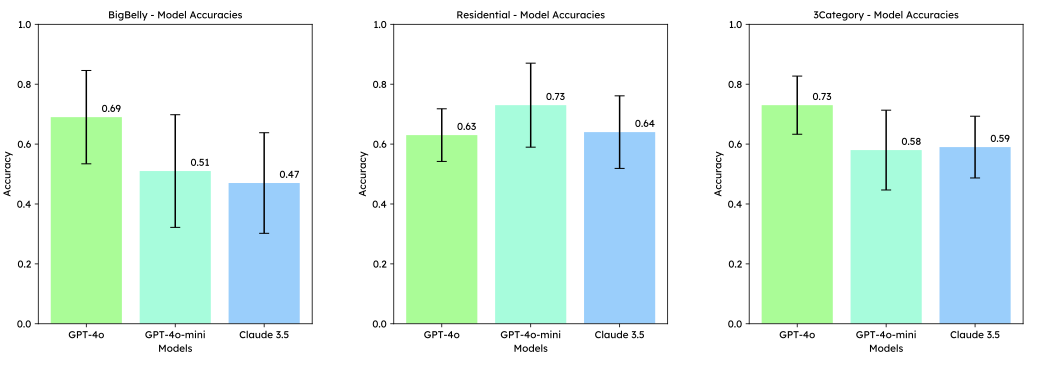
Performance on Bin Testing (Experiment 1). Recyclability
prediction was made in the context of the available bin type, requiring
accurate assessment of size of the item and the opening.
Experiment 1: Bin Testing (Figure 2)
BigBelly Urban Bins
In these experiments, GPT-4o demonstrated the highest performance among
the models with an average accuracy of 0.69 across all types. It
excelled in classifying electronics (0.9) and glass (0.9), reflecting
the model’s capability to manage the more distinct visual features of
these materials. However, it encountered significant challenges with
cardboard (0.2), largely due to the inability to correctly assess the
size of the BigBelly bin openings relative to the size of the items.
This limitation led to misclassifications where larger items like
cardboard were incorrectly identified as fitting into the bin.
GPT-4o-mini, with an accuracy of 0.51, faced even greater difficulties,
particularly with cardboard and wood, where it failed to classify any
images correctly (0.0 accuracy for cardboard and 0.3 for wood). This
model struggled because it hallucinated the existence of a third bin,
often outputting “middle” when only left and right options were
available.
Claude was the weakest performer, achieving an accuracy of 0.47. Similar
to GPT-4o-mini, Claude also struggled with larger items like cardboard
and wood, failing to recognize that these items were too large for the
bin openings. This misjudgment led to frequent misclassifications,
further highlighting the model’s limitations in scenarios where precise
spatial reasoning and contextual understanding of bin dimensions are
critical.
Residential Bins
The performance dynamics shifted slightly. GPT-4o-mini achieved the
highest accuracy at 0.73, particularly excelling in the classification
of wood (1.0) and maintaining solid performance across other categories
like cardboard (0.8) and paper (0.8). However, despite its overall
strong performance, GPT-4o-mini also exhibited a surprising issue: it
again hallucinated the existence of a third bin on four occasions. This
is notable given that, unlike the BigBelly bins where the two bins had
three openings that might have caused confusion, the residential bins
are clearly separated into only two large and distinct containers. This
unexpected behavior suggests that the model may have underlying
difficulties in accurately interpreting the physical layout of the bins,
even in seemingly straightforward scenarios.
GPT-4o followed closely with an accuracy of 0.63, showing consistent
strength in electronics (0.8) and paper (0.8), though its performance in
wood (0.7) and cardboard (0.8) was slightly lower than GPT-4o-mini.
Claude, on the other hand, showed improvement compared to its
performance in the BigBelly bins, achieving an accuracy of 0.64. While
GPT-4o-mini’s weakest material in this experiment was electronics (0.2),
electronics was one of GPT-4o’s strongest categories.
The higher accuracies across all models in this experiment may not fully
reflect the models’ strengths but rather the increased capacity of the
96-gallon residential bins, which can accommodate a broader range of
item sizes. This larger bin size likely simplified the classification
task, as more items, including larger ones like cardboard and wood,
could easily fit into the bins. This suggests that the observed
improvement in performance might be partially due to the bin’s capacity
rather than solely the models’ predictive capabilities.
Three-Category Bins
GPT-4o led with an accuracy of 0.73, demonstrating its ability to
effectively manage the complexity of multiple disposal categories. The
model excelled in classifying electronics (0.9) and organics (0.9),
maintaining high accuracy in textiles (0.9) and glass (0.6).
GPT-4o-mini, with an accuracy of 0.58, showed similar strengths as
GPT-4o but struggled significantly more with wood (0.4) and organic
matter (0.1). The low accuracy in organic matter classification was
particularly concerning, as it stemmed from the model repeatedly
outputting “compost” seven times, despite explicit instructions in the
prompt to use only “left”, “right”, “middle”, or “none”. This issue
highlights a critical weakness in GPT-4o-mini’s ability to follow
prompts accurately, especially in complex scenarios involving multiple
disposal categories.
Claude, achieving an accuracy of 0.59, showed improvement in this setup
compared to simpler bin configurations. However, it continued to face
challenges, particularly with wood (0.7) and cardboard (0.3). While
Claude’s performance was slightly better here, its ongoing struggles
with these materials indicate persistent issues with accurately
classifying items, particularly in scenarios where size and material
characteristics are critical. Across the different models, GPT-4o
consistently delivered the best results. However, all models faced
challenges, particularly with accurately classifying items based on
their size, which was a recurring issue across different materials like
cardboard and wood. This underscores the need for further refinement,
especially in handling larger or less distinct items and ensuring that
models adhere strictly to the provided prompts.
style="width:5.5in" />
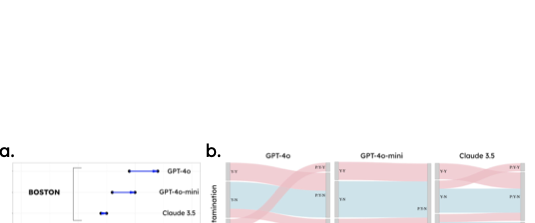
Three additional tests for contextual predictions. (a)
City-specific guidelines were added to the prompt. The direction of the
arrows indicates that the classification improved (or remained the same)
as a result. (b) Pairs of images were tested for contamination (e.g.,
soiled item) and structural changes (e.g., broken glass). The changes in
the pair predictions are illustrated with the blue and pink bands
corresponding to correct and incorrect items, respectively. For
instance, for GPT-4o, four pairs were Y-N pairs (recyclable prior to
contamination / not recyclable after contamination); three items were
predicted correctly (blue) but one item was predicted to be N-N. In
general, contaminated items that are still recyclable were incorrectly
predicted as no longer being recyclable.
Here, we tested the models’ performance under different
location-specific guidelines: Boston, London, and San Francisco. Each
model was evaluated using the same set of 100 images across all
locations to assess how well they could adapt to varying recycling
guidelines.
When comparing the “No Location” scenario (which used Boston labels) to
the Boston-specific prompt, there was a noticeable improvement in
accuracy for all models. GPT-4o’s accuracy increased from 0.89 in the
“No Location” scenario to 0.94 with the Boston guidelines. GPT-4o-mini
also saw a jump from 0.86 to 0.90, while Claude’s accuracy slightly
increased from 0.84 to 0.85. These improvements suggest that the models
benefitted from the more explicit instructions provided by the
Boston-specific guidelines, even though the prompt specified Boston as
the city of the “No Location” scenario. Across all locations, only five
items changed their recyclability status when switching from Boston
Regulations to London or San Francisco’s Regulations. This limited
variation implies that the increase in accuracy seen in
location-specific scenarios may not be entirely due to the models
adapting to new guidelines, but rather to the added support of a
detailed prompt. The consistency in the incorrect images also supports
this, as many images were incorrect regardless of the location-specific
prompt.
Overall, the results indicate that while the models are capable of
adjusting to different location-specific guidelines, the relatively
minor changes in recyclability in this dataset across locations suggest
that the observed improvements in accuracy may be attributable to the
clarity and specificity of the guidelines rather than the models’
ability to handle different regional recycling practices.
Experiment 3: Structural Changes
The models were evaluated for their ability to classify items before and
after undergoing physical transformations due to contamination or
structural changes. GPT-4o achieved an overall combined image-pair
accuracy of 0.75, and a slightly higher individual image accuracy of
0.875.
For contamination, GPT-4o led with a combined accuracy of 0.6 and an
individual accuracy of 0.8, demonstrating a solid performance in
recognizing and adapting to soiled items. GPT-4o-mini followed with a
combined accuracy of 0.4, showing some limitations in handling subtle
contamination, while Claude achieved a combined accuracy of 0.7.
In the structural changes scenario, GPT-4o again excelled with a
combined accuracy of 0.9 and an individual accuracy of 0.95, showing
strong adaptability to physical alterations. GPT-4o-mini achieved a
combined accuracy of 0.8, and Claude lagged behind with 0.5, indicating
difficulties in accurately reclassifying structurally altered items.
These results highlight GPT-4o’s robustness in managing complex
real-world scenarios, though further refinement is needed across all
models to enhance their practical applicability in diverse recycling
contexts.
Experiment 4: Multi-Material Objects
This experiment tested the models’ ability to classify items composed of
multiple materials, such as plastic combined with metal or glass. GPT-4o
led with an impressive overall accuracy of 0.98, misclassifying only 1
out of 50 images. This high accuracy indicates GPT-4o’s strong
capability in managing the complexity of multi-material objects,
effectively identifying and categorizing them with minimal errors.
GPT-4o-mini also performed well, achieving an overall accuracy of 0.92,
although it misclassified 4 out of 50 images. This slightly lower
accuracy compared to GPT-4o suggests that while GPT-4o-mini is
competent, it still has room for improvement in handling the intricacies
of multi-material items. Claude, however, demonstrated significant
challenges in this experiment, with an overall accuracy of 0.78 and 11
misclassified images out of 50. The lower accuracy indicates that Claude
struggled with the complexities of multi-material objects, particularly
when compared to the more robust performance of GPT-4o.
In summary, GPT-4o was the most reliable model for classifying
multi-material objects, showing a clear advantage over GPT-4o-mini and
especially Claude. The consistent performance of GPT-4o across these
complex scenarios highlights its effectiveness, while the noticeable gap
in accuracy for Claude underscores the need for further refinement in
handling multi-material classifications.
Discussion
Standard guidelines for recycling are often inadequate for the public in
determining the recyclability of an item due the myriad of its possible
conditions. As we have shown here, the rapid advances in vision-language
models now offer contextual intelligence that leads to exceptional
performance in many complex situations. GPT-4o, for instance, excels in
many of the tests carried out in this work.
A continuing challenging in evaluating the prediction models is the
difficulty of ascertaining the true label, especially given the more
than dozen disposal methods specified in most city guidelines and their
variations. We have called, emailed, and visited city recycling managers
to obtain the true labels for many contexts. In some cases, the answers
were clear (e.g., a greasy pizza box is recyclable in Boston but not in
some other cities); but in other cases, there were no definitive
answers, in part because the different companies who buy the recycled
items at a given time have different requirements. Nevertheless, the
models we tested here are ideal for their easy-to-modify prompts in
addition to their contextual intelligence.
In our evaluation, no distinction was between a false positive and a
false negative prediction. In reality, a false positive (an item
predicted to be recyclable but is not) is more costly, as it
contaminates the batch to which it was assigned. A weight function could
be incorporated into the model to improve its practicality.
The copyright of this content belongs to the respective researchers. We deeply appreciate their hard work and contribution to the advancement of human civilization.