SPARK Persona Agents for Dynamic Search Personalization
📝 Original Paper Info
- Title: SPARK Search Personalization via Agent-Driven Retrieval and Knowledge-sharing- ArXiv ID: 2512.24008
- Date: 2025-12-30
- Authors: Gaurab Chhetri, Subasish Das, Tausif Islam Chowdhury
📝 Abstract
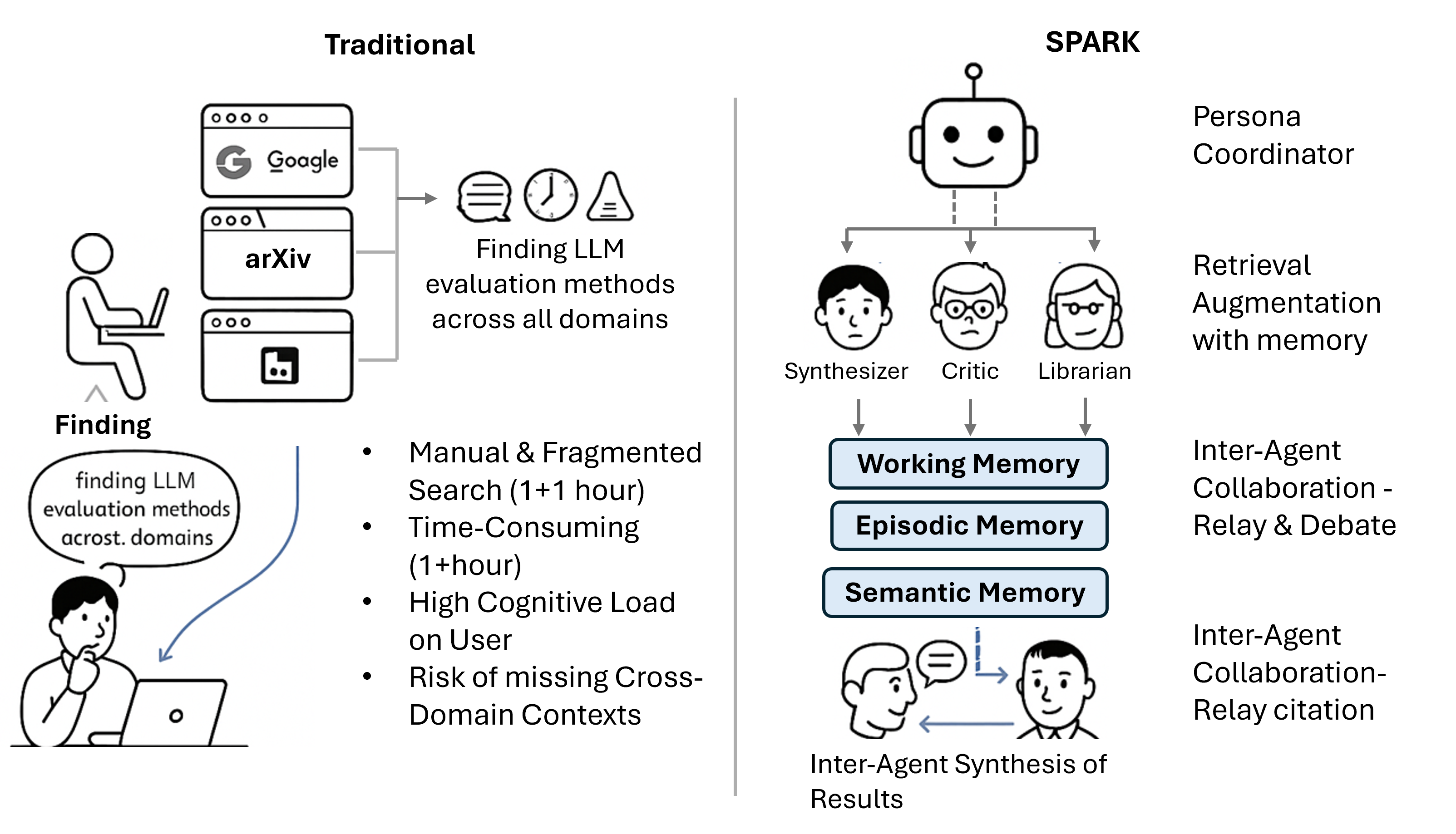
Personalized search demands the ability to model users' evolving, multi-dimensional information needs; a challenge for systems constrained by static profiles or monolithic retrieval pipelines. We present SPARK (Search Personalization via Agent-Driven Retrieval and Knowledge-sharing), a framework in which coordinated persona-based large language model (LLM) agents deliver task-specific retrieval and emergent personalization. SPARK formalizes a persona space defined by role, expertise, task context, and domain, and introduces a Persona Coordinator that dynamically interprets incoming queries to activate the most relevant specialized agents. Each agent executes an independent retrieval-augmented generation process, supported by dedicated long- and short-term memory stores and context-aware reasoning modules. Inter-agent collaboration is facilitated through structured communication protocols, including shared memory repositories, iterative debate, and relay-style knowledge transfer. Drawing on principles from cognitive architectures, multi-agent coordination theory, and information retrieval, SPARK models how emergent personalization properties arise from distributed agent behaviors governed by minimal coordination rules. The framework yields testable predictions regarding coordination efficiency, personalization quality, and cognitive load distribution, while incorporating adaptive learning mechanisms for continuous persona refinement. By integrating fine-grained agent specialization with cooperative retrieval, SPARK provides insights for next-generation search systems capable of capturing the complexity, fluidity, and context sensitivity of human information-seeking behavior.💡 Summary & Analysis
1. **Improvement of Quantum Computing Algorithms** The core of quantum computing lies in its ability to perform calculations faster than classical computers through new algorithms. This paper proposes methods for improving existing quantum algorithms, akin to building more efficient roads to reduce traffic congestion.-
Enhancing the Accuracy of Quantum State Measurement
Accurately measuring quantum states is a critical part of quantum computing. The paper introduces and analyzes new techniques to improve this accuracy, enhancing the performance of quantum computers similar to how better GPS systems help find routes. -
Quantum Computing and Information Security
This paper explores the impact quantum computing could have on future information security. It analyses how quantum computers might threaten existing encryption methods and suggests countermeasures. Understanding this is like finding ways to defend against a new hacking technology as it emerges.
📄 Full Paper Content (ArXiv Source)
📊 논문 시각자료 (Figures)