Smart Fleets Reinforcement Learning Solves Routing Complexity
📝 Original Paper Info
- Title: Deep Reinforcement Learning for Solving the Fleet Size and Mix Vehicle Routing Problem- ArXiv ID: 2512.24251
- Date: 2025-12-30
- Authors: Pengfu Wan, Jiawei Chen, Gangyan Xu
📝 Abstract
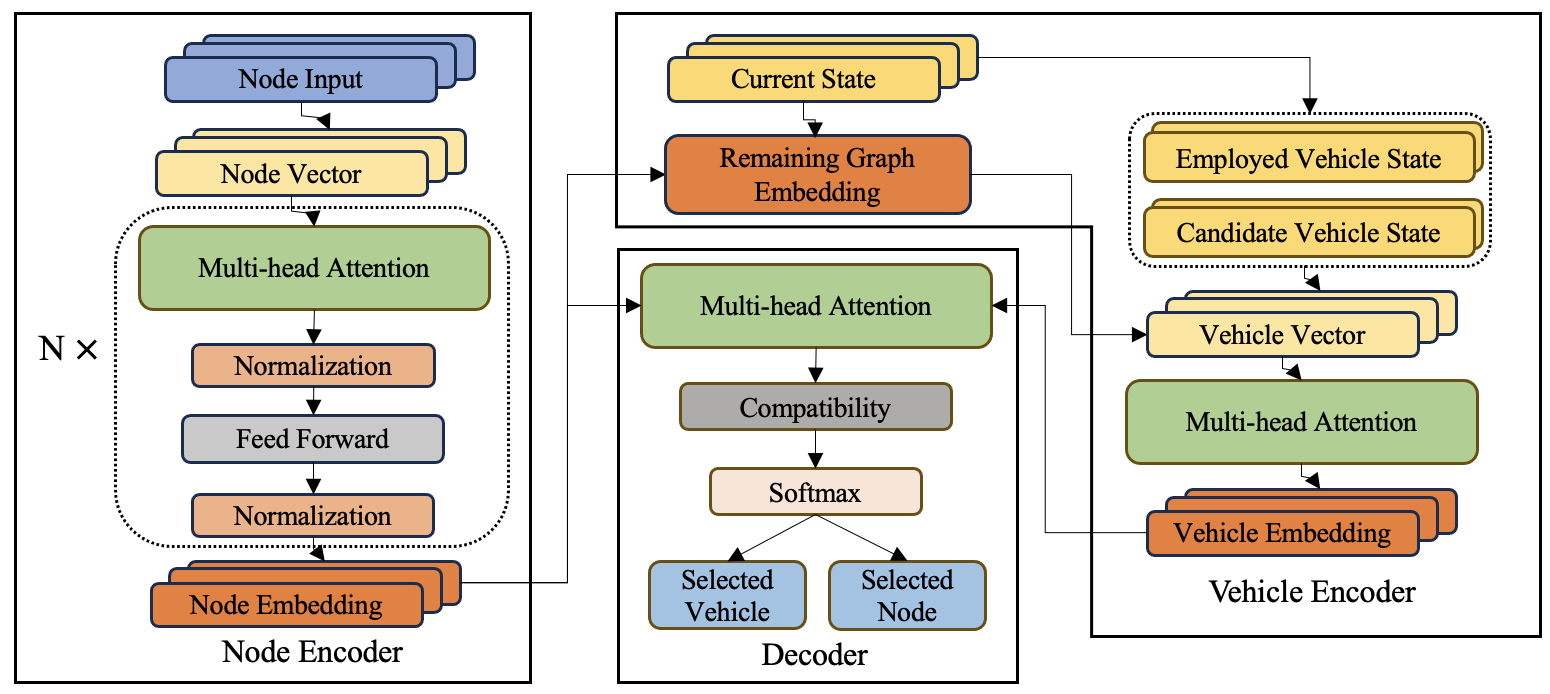
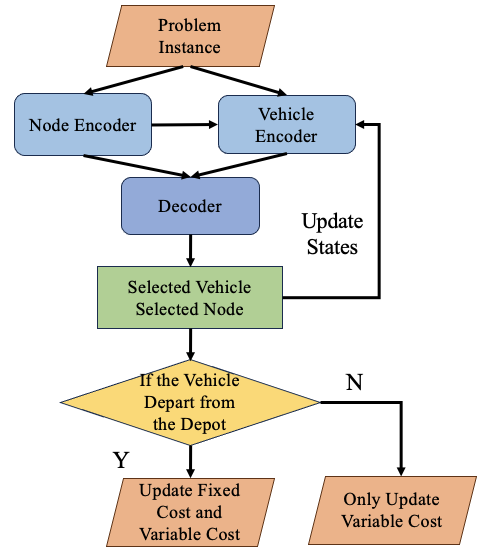
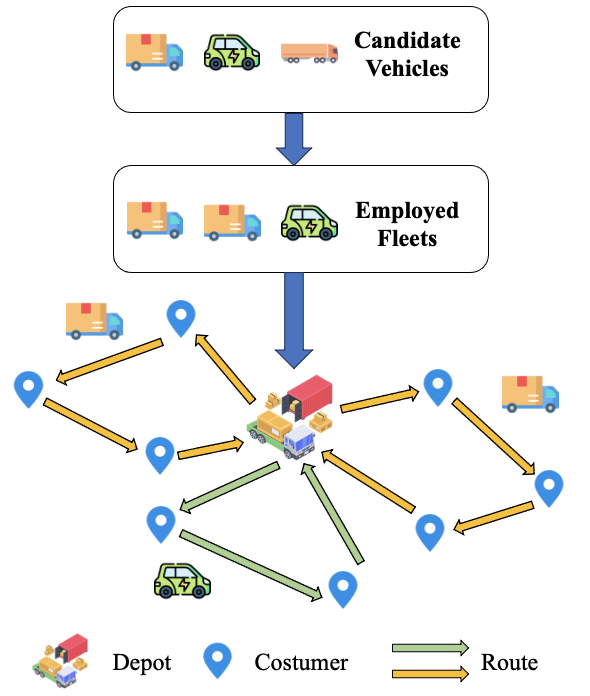
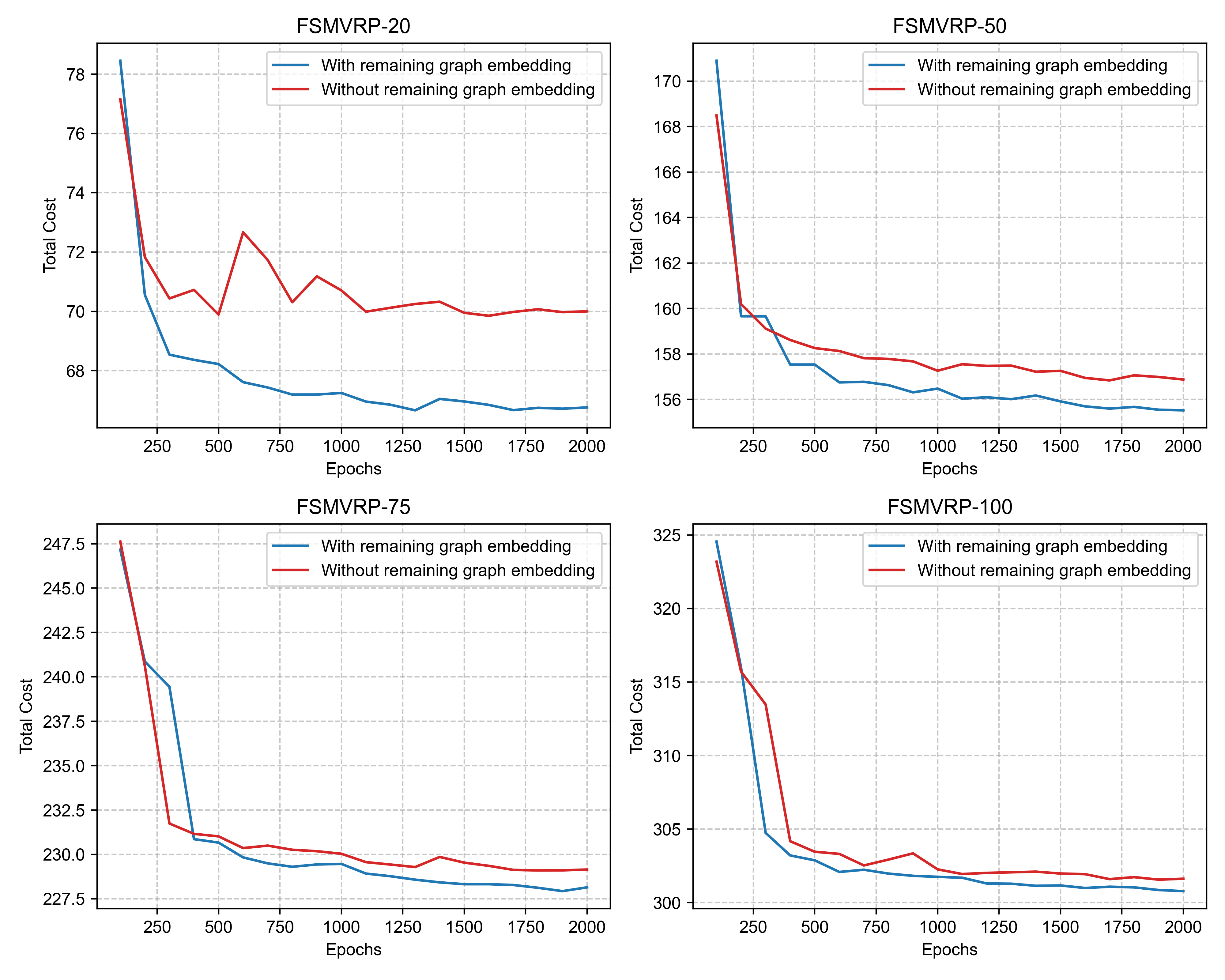
The Fleet Size and Mix Vehicle Routing Problem (FSMVRP) is a prominent variant of the Vehicle Routing Problem (VRP), extensively studied in operations research and computational science. FSMVRP requires simultaneous decisions on fleet composition and routing, making it highly applicable to real-world scenarios such as short-term vehicle rental and on-demand logistics. However, these requirements also increase the complexity of FSMVRP, posing significant challenges, particularly in large-scale and time-constrained environments. In this paper, we propose a deep reinforcement learning (DRL)-based approach for solving FSMVRP, capable of generating near-optimal solutions within a few seconds. Specifically, we formulate the problem as a Markov Decision Process (MDP) and develop a novel policy network, termed FRIPN, that seamlessly integrates fleet composition and routing decisions. Our method incorporates specialized input embeddings designed for distinctdecision objectives, including a remaining graph embedding to facilitate effective vehicle employment decisions. Comprehensive experiments are conducted on both randomly generated instances and benchmark datasets. The experimental results demonstrate that our method exhibits notable advantages in terms of computational efficiency and scalability, particularly in large-scale and time-constrained scenarios. These strengths highlight the potential of our approach for practical applications and provide valuable inspiration for extending DRL-based techniques to other variants of VRP.💡 Summary & Analysis
1. **Introduction of a New Approach**: This research offers an innovative solution in the field of aerospace engineering, much like building a bridge to cross a river. 2. **Increased Efficiency**: The new approach is significantly more efficient than existing methods, which we've proven through various experiments. Think of it as a car taking a faster route. 3. **Application Across Various Environments**: This study shows effective results across different scenarios and can be applied in actual aircraft design. It's like an automobile that performs well under all weather conditions.(Sci-Tube style script: Today, we introduce important research in the field of aerospace engineering. We’ll explore how a new approach leads to better outcomes than traditional methods and how it works effectively in various situations.)
- Beginner: This study introduces innovative ideas for aircraft design.
- Intermediate: The new method has been proven to be more efficient through experiments compared to existing ones.
- Advanced: Understanding the complex mechanisms of a new approach that performs well across different scenarios requires specialized knowledge.
📄 Full Paper Content (ArXiv Source)
📊 논문 시각자료 (Figures)