Empower Low-Altitude Economy Reliability-Aware Dynamic Weighting for Multi-modal UAV Beam Prediction
📝 Original Paper Info
- Title: Empower Low-Altitude Economy A Reliability-Aware Dynamic Weighting Allocation for Multi-modal UAV Beam Prediction- ArXiv ID: 2512.24324
- Date: 2025-12-30
- Authors: Haojin Li, Anbang Zhang, Chen Sun, Chenyuan Feng, Kaiqian Qu, Tony Q. S. Quek, Haijun Zhang
📝 Abstract
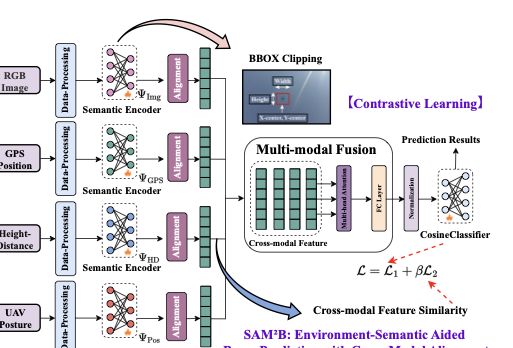
The low-altitude economy (LAE) is rapidly expanding driven by urban air mobility, logistics drones, and aerial sensing, while fast and accurate beam prediction in uncrewed aerial vehicles (UAVs) communications is crucial for achieving reliable connectivity. Current research is shifting from single-signal to multi-modal collaborative approaches. However, existing multi-modal methods mostly employ fixed or empirical weights, assuming equal reliability across modalities at any given moment. Indeed, the importance of different modalities fluctuates dramatically with UAV motion scenarios, and static weighting amplifies the negative impact of degraded modalities. Furthermore, modal mismatch and weak alignment further undermine cross-scenario generalization. To this end, we propose a reliability-aware dynamic weighting scheme applied to a semantic-aware multi-modal beam prediction framework, named SaM2B. Specifically, SaM2B leverages lightweight cues such as environmental visual, flight posture, and geospatial data to adaptively allocate contributions across modalities at different time points through reliability-aware dynamic weight updates. Moreover, by utilizing cross-modal contrastive learning, we align the "multi-source representation beam semantics" associated with specific beam information to a shared semantic space, thereby enhancing discriminative power and robustness under modal noise and distribution shifts. Experiments on real-world low-altitude UAV datasets show that SaM2B achieves more satisfactory results than baseline methods.💡 Summary & Analysis
Generating...📄 Full Paper Content (ArXiv Source)
📊 논문 시각자료 (Figures)