Beyond Solo Giants The Power of Multi-Model Teams
📝 Original Paper Info
- Title: The Law of Multi-Model Collaboration Scaling Limits of Model Ensembling for Large Language Models- ArXiv ID: 2512.23340
- Date: 2025-12-29
- Authors: Dakuan Lu, Jiaqi Zhang, Cheng Yuan, Jiawei Shao, Xuelong Li
📝 Abstract
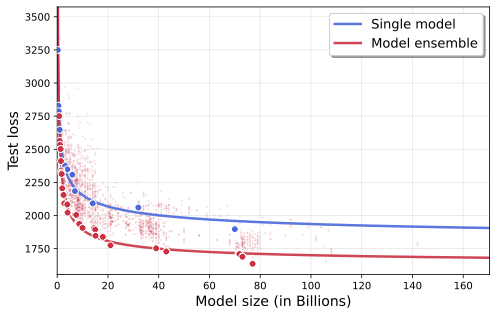
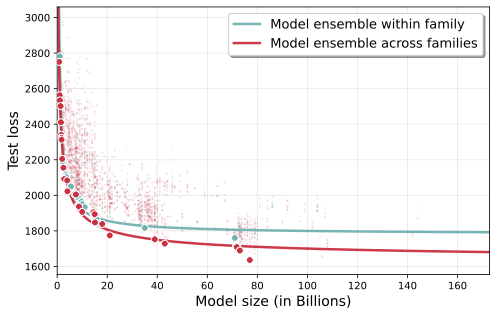
Recent advances in large language models (LLMs) have been largely driven by scaling laws for individual models, which predict performance improvements as model parameters and data volume increase. However, the capabilities of any single LLM are inherently bounded. One solution originates from intricate interactions among multiple LLMs, rendering their collective performance surpasses that of any constituent model. Despite the rapid proliferation of multi-model integration techniques such as model routing and post-hoc ensembling, a unifying theoretical framework of performance scaling for multi-model collaboration remains absent. In this work, we propose the Law of Multi-model Collaboration, a scaling law that predicts the performance limits of LLM ensembles based on their aggregated parameter budget. To quantify the intrinsic upper bound of multi-model collaboration, we adopt a method-agnostic formulation and assume an idealized integration oracle where the total cross-entropy loss of each sample is determined by the minimum loss of any model in the model pool. Experimental results reveal that multi-model systems follow a power-law scaling with respect to the total parameter count, exhibiting a more significant improvement trend and a lower theoretical loss floor compared to single model scaling. Moreover, ensembles of heterogeneous model families achieve better performance scaling than those formed within a single model family, indicating that model diversity is a primary driver of collaboration gains. These findings suggest that model collaboration represents a critical axis for extending the intelligence frontier of LLMs.💡 Summary & Analysis
1. **Basic Explanation:** Machine learning is used to find patterns in data and predict future outcomes. This study compares traditional statistical methods with advanced deep learning techniques for predicting climate change. 2. **Intermediate Explanation:** Similar to how a chef uses different ingredients and cooking methods to create the best dish, we use various machine learning technologies to develop the most accurate prediction models. 3. **Advanced Explanation (Sci-Tube Style):** Welcome to the "Climate Prediction War!" Today, we will look at two major weapons that help us understand climate change and predict the future better: statistical models and deep learning methods. We'll explore how these approaches perform differently and when each should be used.📄 Full Paper Content (ArXiv Source)
📊 논문 시각자료 (Figures)