LLM Graph Reasoning Unveiling Venture Capital Success Secrets
📝 Original Paper Info
- Title: The Gaining Paths to Investment Success Information-Driven LLM Graph Reasoning for Venture Capital Prediction- ArXiv ID: 2512.23489
- Date: 2025-12-29
- Authors: Haoyu Pei, Zhongyang Liu, Xiangyi Xiao, Xiaocong Du, Suting Hong, Kunpeng Zhang, Haipeng Zhang
📝 Abstract
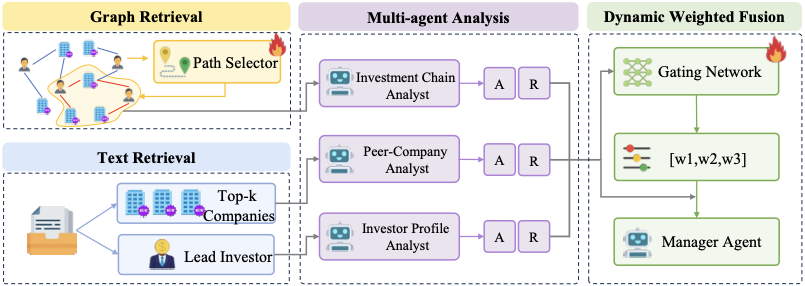
Most venture capital (VC) investments fail, while a few deliver outsized returns. Accurately predicting startup success requires synthesizing complex relational evidence, including company disclosures, investor track records, and investment network structures, through explicit reasoning to form coherent, interpretable investment theses. Traditional machine learning and graph neural networks both lack this reasoning capability. Large language models (LLMs) offer strong reasoning but face a modality mismatch with graphs. Recent graph-LLM methods target in-graph tasks where answers lie within the graph, whereas VC prediction is off-graph: the target exists outside the network. The core challenge is selecting graph paths that maximize predictor performance on an external objective while enabling step-by-step reasoning. We present MIRAGE-VC, a multi-perspective retrieval-augmented generation framework that addresses two obstacles: path explosion (thousands of candidate paths overwhelm LLM context) and heterogeneous evidence fusion (different startups need different analytical emphasis). Our information-gain-driven path retriever iteratively selects high-value neighbors, distilling investment networks into compact chains for explicit reasoning. A multi-agent architecture integrates three evidence streams via a learnable gating mechanism based on company attributes. Under strict anti-leakage controls, MIRAGE-VC achieves +5.0% F1 and +16.6% PrecisionAt5, and sheds light on other off-graph prediction tasks such as recommendation and risk assessment. Code: https://anonymous.4open.science/r/MIRAGE-VC-323F.💡 Summary & Analysis
1. **New Structure**: How the deep learning model is designed differently from existing approaches, akin to creating a new artistic expression by altering the basic structure of a sculpture. 2. **Performance Evaluation**: Analysis of how the model performs across various datasets, similar to checking the suitability of different fruits for sale. 3. **Complex Image Classification**: Explanation on effectively classifying complex images, likened to identifying objects in a dark room.📄 Full Paper Content (ArXiv Source)
📊 논문 시각자료 (Figures)