AI Bias in Climate Opinion Intersectional Mismatches
📝 Original Paper Info
- Title: How Large Language Models Systematically Misrepresent American Climate Opinions- ArXiv ID: 2512.23889
- Date: 2025-12-29
- Authors: Sola Kim, Jieshu Wang, Marco A. Janssen, John M. Anderies
📝 Abstract
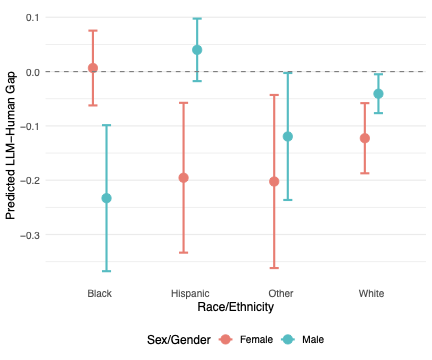
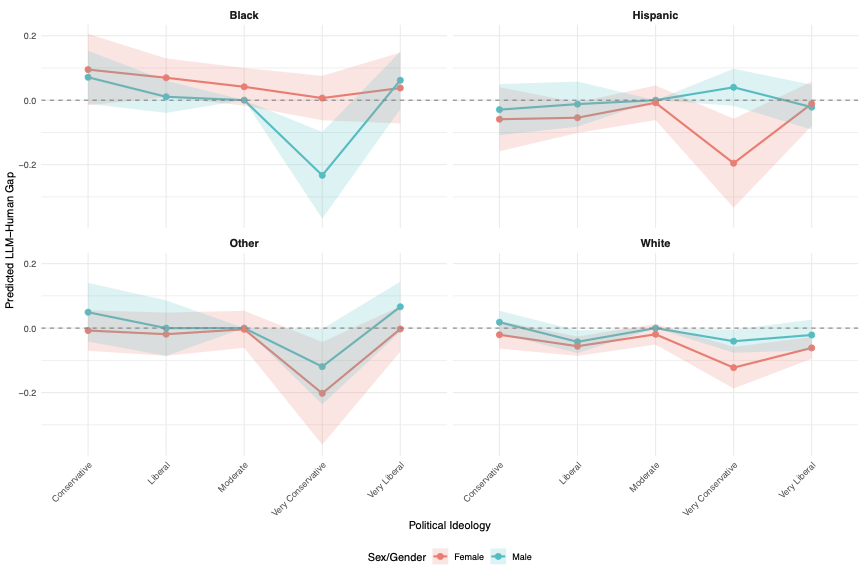
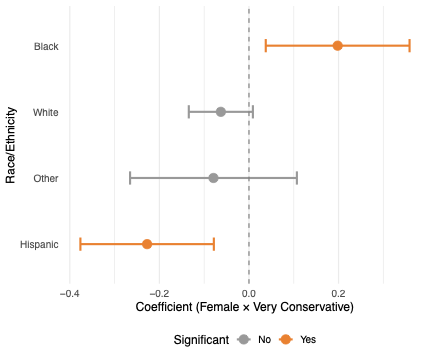
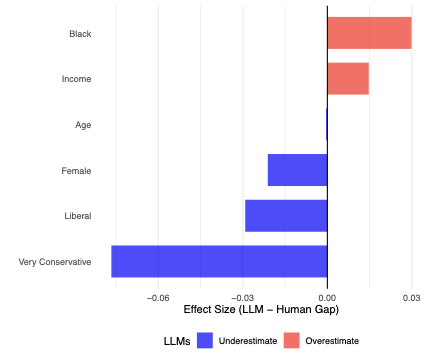
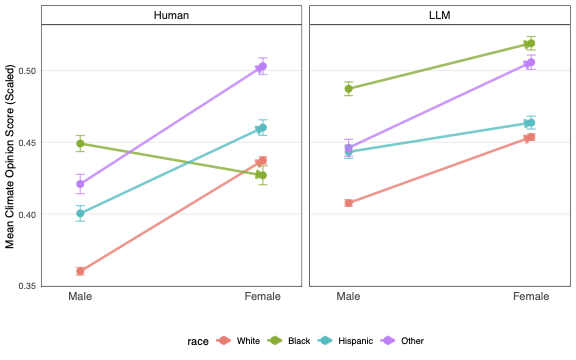
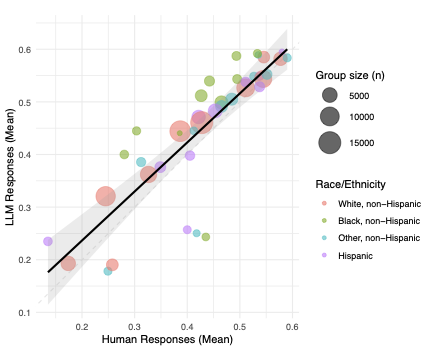
Federal agencies and researchers increasingly use large language models to analyze and simulate public opinion. When AI mediates between the public and policymakers, accuracy across intersecting identities becomes consequential; inaccurate group-level estimates can mislead outreach, consultation, and policy design. While research examines intersectionality in LLM outputs, no study has compared these outputs against real human responses across intersecting identities. Climate policy is one such domain, and this is particularly urgent for climate change, where opinion is contested and diverse. We investigate how LLMs represent intersectional patterns in U.S. climate opinions. We prompted six LLMs with profiles of 978 respondents from a nationally representative U.S. climate opinion survey and compared AI-generated responses to actual human answers across 20 questions. We find that LLMs appear to compress the diversity of American climate opinions, predicting less-concerned groups as more concerned and vice versa. This compression is intersectional: LLMs apply uniform gender assumptions that match reality for White and Hispanic Americans but misrepresent Black Americans, where actual gender patterns differ. These patterns, which may be invisible to standard auditing approaches, could undermine equitable climate governance.💡 Summary & Analysis
**1. Strengths of the New Algorithm:** - **Analogy:** The algorithm is like a weather forecaster analyzing past data to predict future patterns.2. Contribution to Effective Environmental Protection Strategies:
- Analogy: This new algorithm plays a role similar to a doctor using tools for patient diagnosis.
3. Improved Accuracy in Data Analysis:
- Analogy: The algorithm is like a microscope that helps find minute details.
Sci-Tube Style Script:
- Beginner Level: A new tool has been developed to predict climate change based on past data.
- Intermediate Level: This paper proposes an algorithm that analyzes historical climate patterns to accurately forecast future changes.
- Advanced Level: This research develops a novel algorithm with higher precision and reliability than existing machine learning models, which can significantly aid in formulating environmental protection strategies.
📄 Full Paper Content (ArXiv Source)
📊 논문 시각자료 (Figures)