Momentum-Adjusted Multi-agent Portfolio Management with SAMP-HDRL
📝 Original Paper Info
- Title: SAMP-HDRL Segmented Allocation with Momentum-Adjusted Utility for Multi-agent Portfolio Management via Hierarchical Deep Reinforcement Learning- ArXiv ID: 2512.22895
- Date: 2025-12-28
- Authors: Xiaotian Ren, Nuerxiati Abudurexiti, Zhengyong Jiang, Angelos Stefanidis, Hongbin Liu, Jionglong Su
📝 Abstract
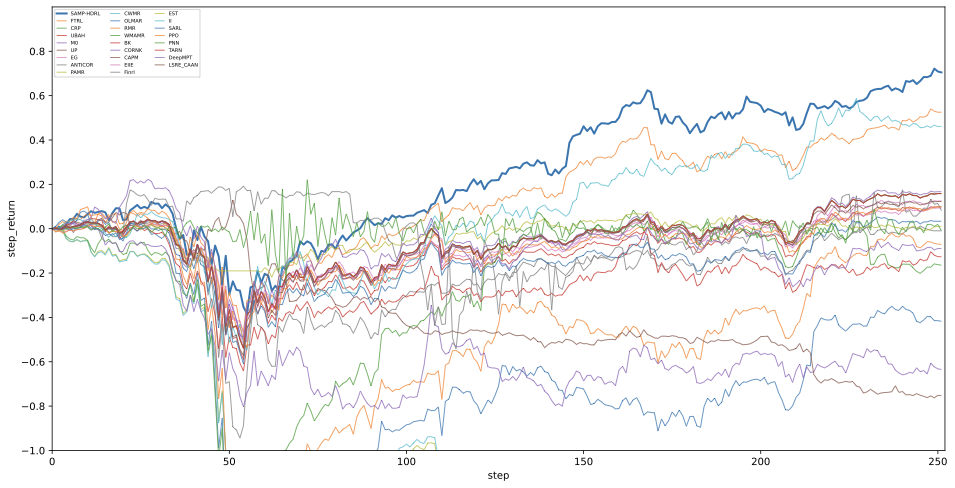
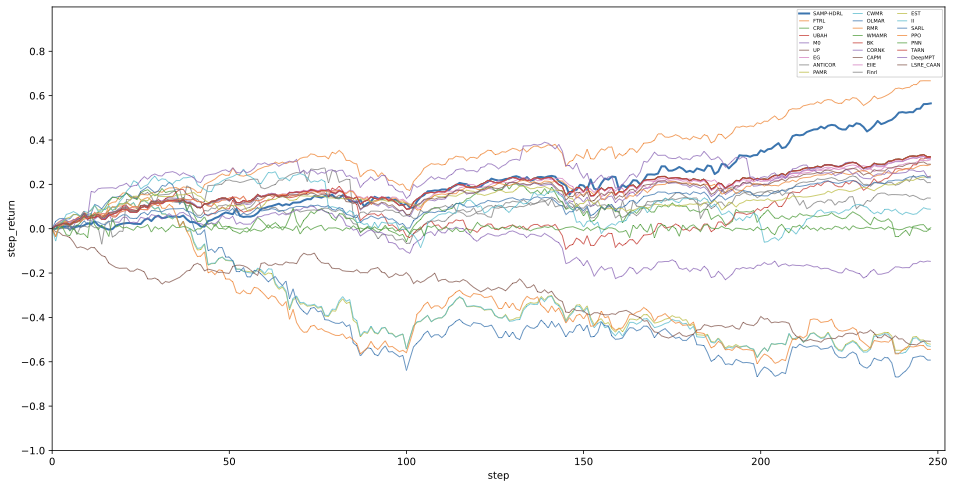
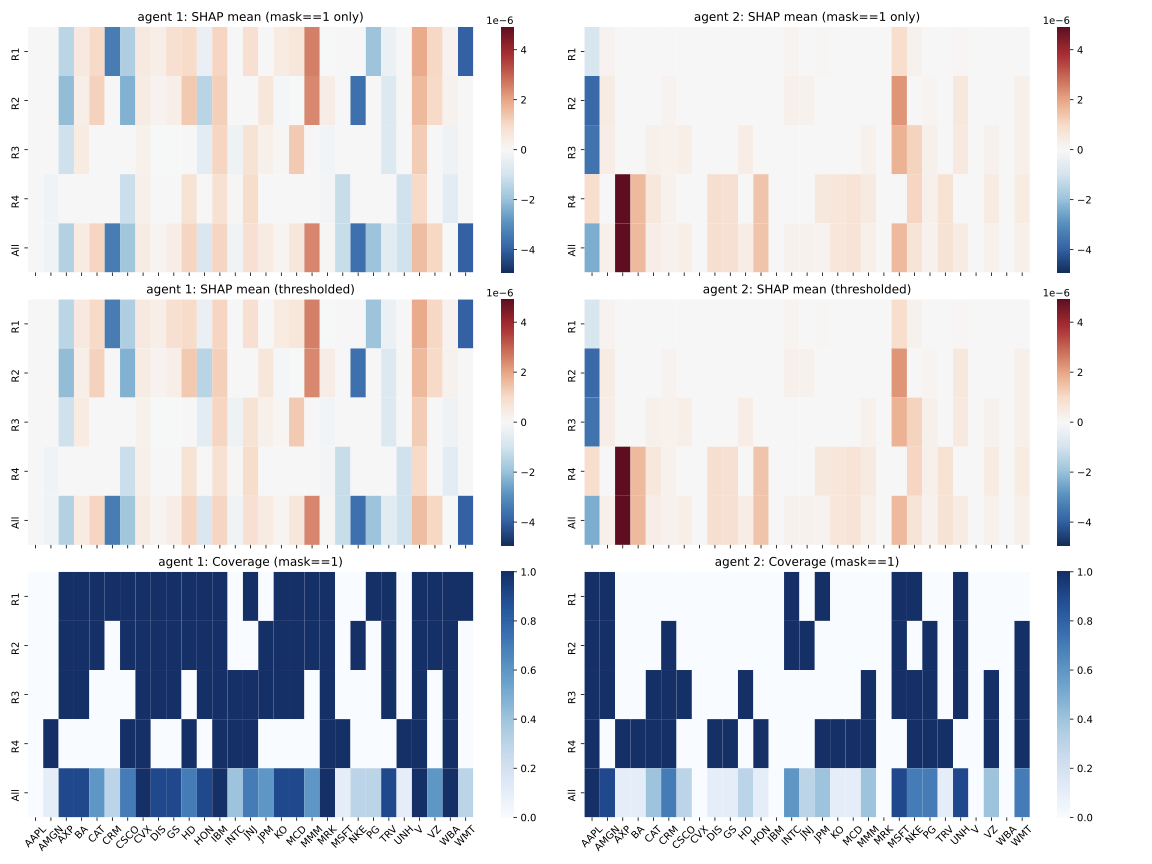
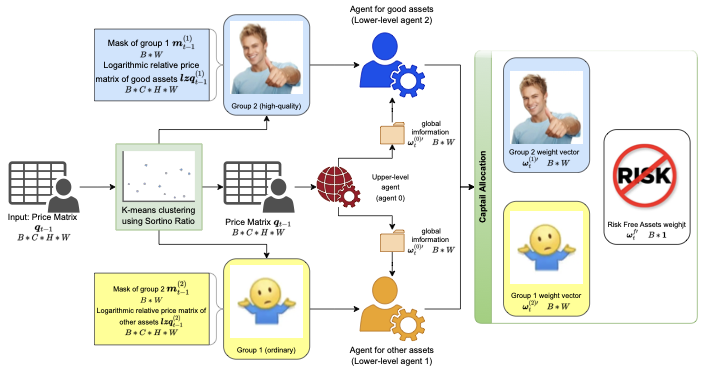
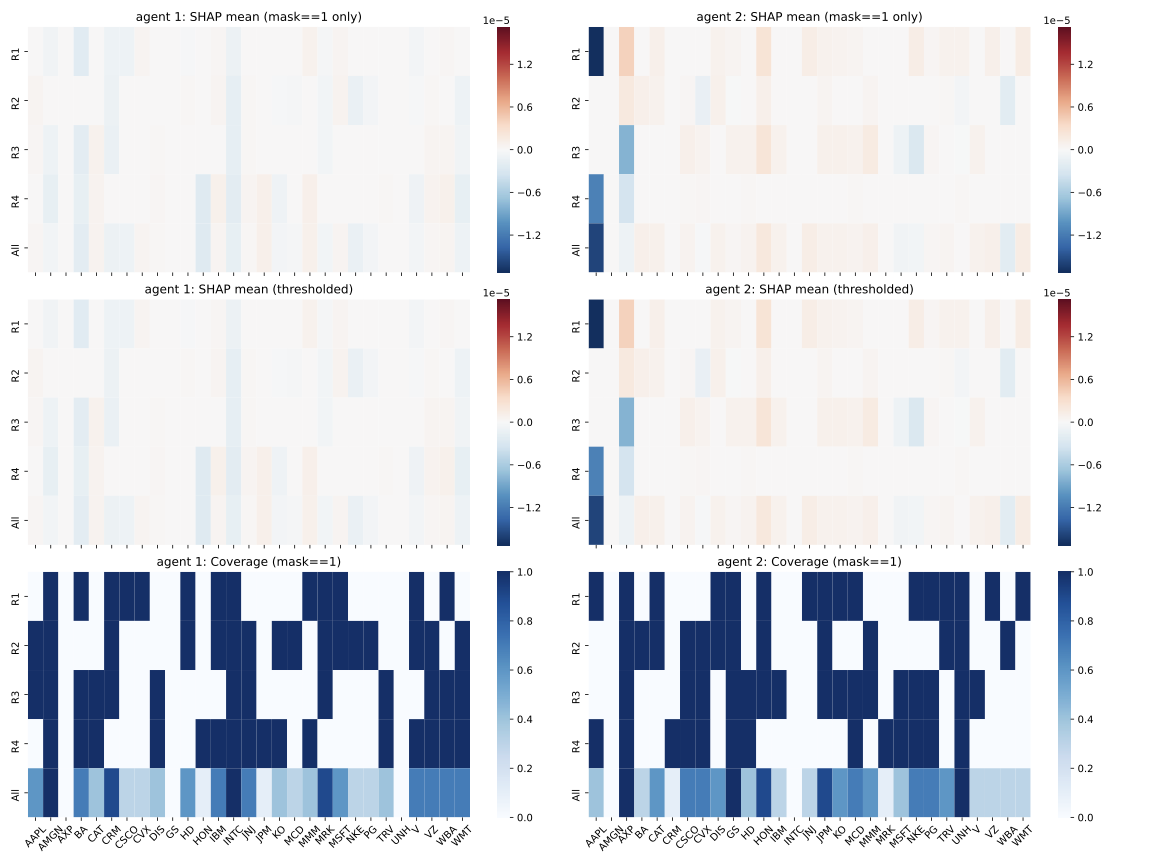
Portfolio optimization in non-stationary markets is challenging due to regime shifts, dynamic correlations, and the limited interpretability of deep reinforcement learning (DRL) policies. We propose a Segmented Allocation with Momentum-Adjusted Utility for Multi-agent Portfolio Management via Hierarchical Deep Reinforcement Learning (SAMP-HDRL). The framework first applies dynamic asset grouping to partition the market into high-quality and ordinary subsets. An upper-level agent extracts global market signals, while lower-level agents perform intra-group allocation under mask constraints. A utility-based capital allocation mechanism integrates risky and risk-free assets, ensuring coherent coordination between global and local decisions. backtests across three market regimes (2019--2021) demonstrate that SAMP-HDRL consistently outperforms nine traditional baselines and nine DRL benchmarks under volatile and oscillating conditions. Compared with the strongest baseline, our method achieves at least 5\% higher Return, 5\% higher Sharpe ratio, 5\% higher Sortino ratio, and 2\% higher Omega ratio, with substantially larger gains observed in turbulent markets. Ablation studies confirm that upper--lower coordination, dynamic clustering, and capital allocation are indispensable to robustness. SHAP-based interpretability further reveals a complementary ``diversified + concentrated'' mechanism across agents, providing transparent insights into decision-making. Overall, SAMP-HDRL embeds structural market constraints directly into the DRL pipeline, offering improved adaptability, robustness, and interpretability in complex financial environments.💡 Summary & Analysis
1. **Key Contribution**: This is the first large-scale survey targeted at young adults concerning social media usage and mental health. 2. **Simple Explanation**: To understand how social media affects mental health, we conducted a wide-ranging survey involving many participants. The findings could be more severe than anticipated. 3. **Metaphor**: Imagine this like playing too much video games causing eye strain; similarly, excessive use of social media can negatively impact one's mental health. 4. **Sci-Tube Style Script**: How much time do you spend on social media today? Through the results of this study, we will explore how that time affects our mental health. 5. **3 Levels of Difficulty**: - Beginner: To understand what we're looking at, first reduce your social media usage. - Intermediate: Understanding the research requires knowledge about statistical analysis methods and the importance of surveys. - Advanced: This study demands a deep understanding of mental health issues along with statistical analytical techniques.📄 Full Paper Content (ArXiv Source)
📊 논문 시각자료 (Figures)