Post-Cold War Diaspora of Russian Particle Physicists
📝 Original Info
- Title: Post-Cold War Diaspora of Russian Particle Physicists
- ArXiv ID: 2512.04052
- Date: 2025-12-03
- Authors: Vladimir Shiltsev
📝 Abstract
While the migration of scientists from the Soviet Union to the West occurred at a modest pace during the 1970s-1980s, the dissolution of the USSR in 1991 and the ensuing economic and social hardships precipitated a massive exodus that amounted to a true brain drain. The international physics community-particularly in Europe and the United States-absorbed a substantial influx of specialists in nuclear, high-energy, and accelerator physics, including both seasoned scientists and engineers as well as promising graduate students and postdoctoral fellows. Many of these émigré researchers went on to assume leadership positions, drive major experimental and theoretical initiatives, and achieve scientific distinction that equaled or even surpassed their accomplishments in the USSR/Russia. In this article we explore the defining features of this post-Cold War scientific diaspora, assess its impact on Russia's research infrastructure and capabilities, and evaluate its enduring contributions to global particle-physics collaborations and discoveries.📄 Full Content
For centuries, Russia had maintained tightly controlled borders, with external migration either prohibited or heavily restricted. Under Soviet rule, these controls intensified, and the circulation of scientists and intellectuals was confined to officially sanctioned exchanges.
Most relocations occurred within the USSR itself-often directed from central regions to new industrial or scientific centers in Siberia, Central Asia, or the Far East.
This rigid system disintegrated abruptly in 1991. The Russian Federation soon became the core of what was, at the time, the world’s second-largest migration system after the United States. For the first time since the 1917 Revolution and the Civil War, Russia experienced large-scale legal emigration of scientists and engineers. In parallel, hundreds of thousands of professionals departed temporarily for research fellowships, sabbaticals, and international collaborations, many of which gradually evolved into permanent relocations.
The post-Cold War Russian scientific diaspora thus illustrates both the vulnerabilities of national research systems under conditions of economic collapse and the enduring internationalism of science itself. While Russia sustained deep institutional and human losses, global science benefited from a remarkable infusion of talent whose influence continues to resonate across disciplines and continents.
The impact of the post-Soviet crisis on Russian science was profound. During the 1990s and 2000s, roughly half of Russia’s researchers left the scientific profession altogether, seeking employment in business, education, or technical services. Around 45% managed to remain active in their research fields-often through short-term international contracts, foreign grants, or second affiliations-while an estimated 5% emigrated permanently. In absolute numbers, this amounted to roughly 15,000-20,000 researchers, distributed primarily across Europe (over 40%) and the United States (around 30%), with smaller contingents settling in Israel, FSU countries, Japan, and other parts of Asia. Many others engaged in long-term visiting positions that blurred the boundary between temporary and permanent migration Physics-and particularly high-energy, nuclear, and accelerator research-was disproportionately represented in this exodus. Approximately 40% of emigrant scientists came from physics-related fields, including an estimated 2,000-3,000 specialists in particle and nuclear physics, astrophysics, and related technologies. This group accounted for about 5-7% of the global research community in these disciplines at the time. The presence of USSR/Russian physicists became a defining feature of the global research landscape from the mid-1990s onward, reflecting both the severity of Russia’s scientific crisis and the exceptional training of its pre-existing research schools.
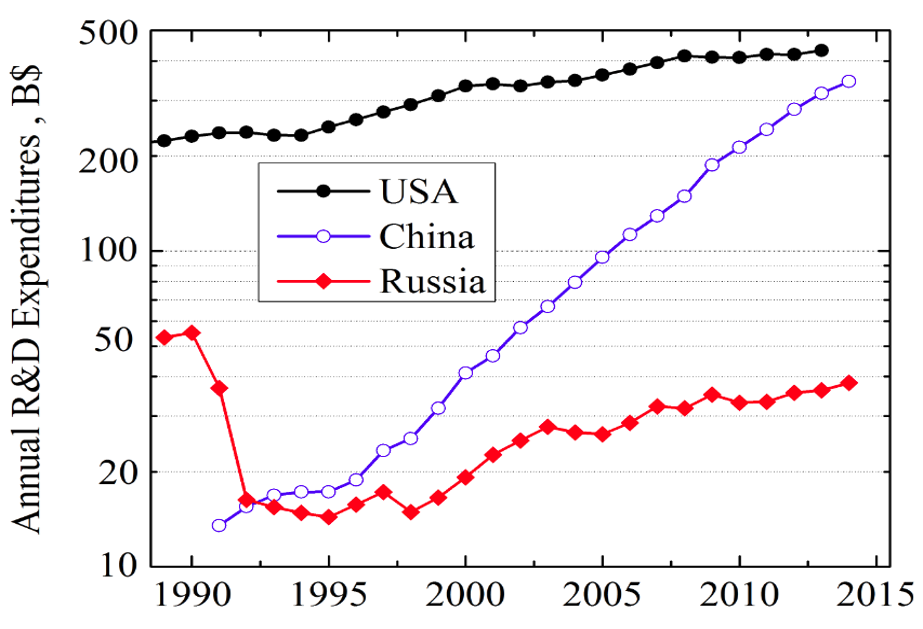
The motivations behind this large-scale outflow were multifaceted but interrelated. The economic crisis following the collapse of the USSR was the most immediate cause. The abrupt contraction of research funding (see Fig. 1), the closure or downsizing of entire institutes, and the disappearance of stable academic careers left many scientists without institutional or financial support. Salaries at research centers fell below subsistence levels, forcing many to take on additional work unrelated to their expertise. The prestige once associated with scientific professions eroded rapidly as state priorities shifted toward short-term economic stabilization and privatization.
Equally important was the perceived lack of professional prospects. Laboratories were deprived of modern equipment and access to new technologies. Research themes were often disconnected from global developments, and travel restrictions, though easing, still limited participation in international collaborations. By contrast, opportunities abroad appeared abundant: Western institutions offered advanced facilities, competitive salaries, and the promise of scientific continuity. For many, the choice was not between loyalty and departure, but between professional extinction and survival.
This exodus was further facilitated by several structural and cultural factors. The liberalization of emigration policy in the early 1990s removed many bureaucratic barriers, while the expansion of international collaborations provided natural channels of mobility. Personal connections, developed through conferences and joint experiments, were instrumental in enabling scientists to relocate or obtain temporary contracts abroad. The migration pattern that emerged was often stepwise: short-term visiting appointments were followed by longer fellowships and eventually by permanent settlement, typically at a ratio of about three temporary visits for each long-term emigration.
The highly qualified nature of the emigrant cohort was another defining feature. A large fraction held advanced degrees: roughly 20% were Doctors of Science (Habilitation level) and more than half were Candidates of Science (PhD equivalent). These levels of expertise allowed rapid integration into host institutions, where Russian-trained physicists became valuable contributors to ongoing projects in both experimental and theoretical research.
Beyond their individual achievements, members of the diaspora played a critical “bridge” role between Russian and Western scientific communities. They maintained professional networks, facilitated access to equipment and publications, co-supervised students, and often mediated joint projects that provided vital lifelines for colleagues who remained in Russia [6]. Through these channels, the diaspora helped sustain Russian physics during its most difficult decade, ensuring the continuity of research traditions until domestic reinvestment in science began to recover in the 2010s-2020s.
The roots of the post-Cold War Russian/FSU scientific diaspora in particle physics lie in a long tradition of international collaboration that began well before the dissolution of the Soviet Union. Throughout the 1970s and 1980s, Soviet research institutes maintained formal cooperative links with major laboratories abroad-most notably at CERN, DESY, Fermilab, and KEK-despite the political barriers of the era [7][8][9][10][11] This broad engagement illustrates both the scale and the diversity of Soviet involvement in international high-energy research.
These early collaborative networks became the structural backbone for the subsequent diaspora. When the Soviet Union collapsed and funding for domestic research collapsed with it, many scientists who had participated in joint projects already possessed the professional contacts, reputational capital, and technical experience necessary to transition into permanent or long-term positions abroad. In this sense, the diaspora did not emerge in isolation;
it evolved from a well-established matrix of international scientific cooperation.
Further insight into the scale and continuity of this outward mobility can be drawn from the participation of scientists from the Former Soviet Union and the Russian diaspora in major international high-energy physics collaborations during the 1990s and 2000s (Table II).
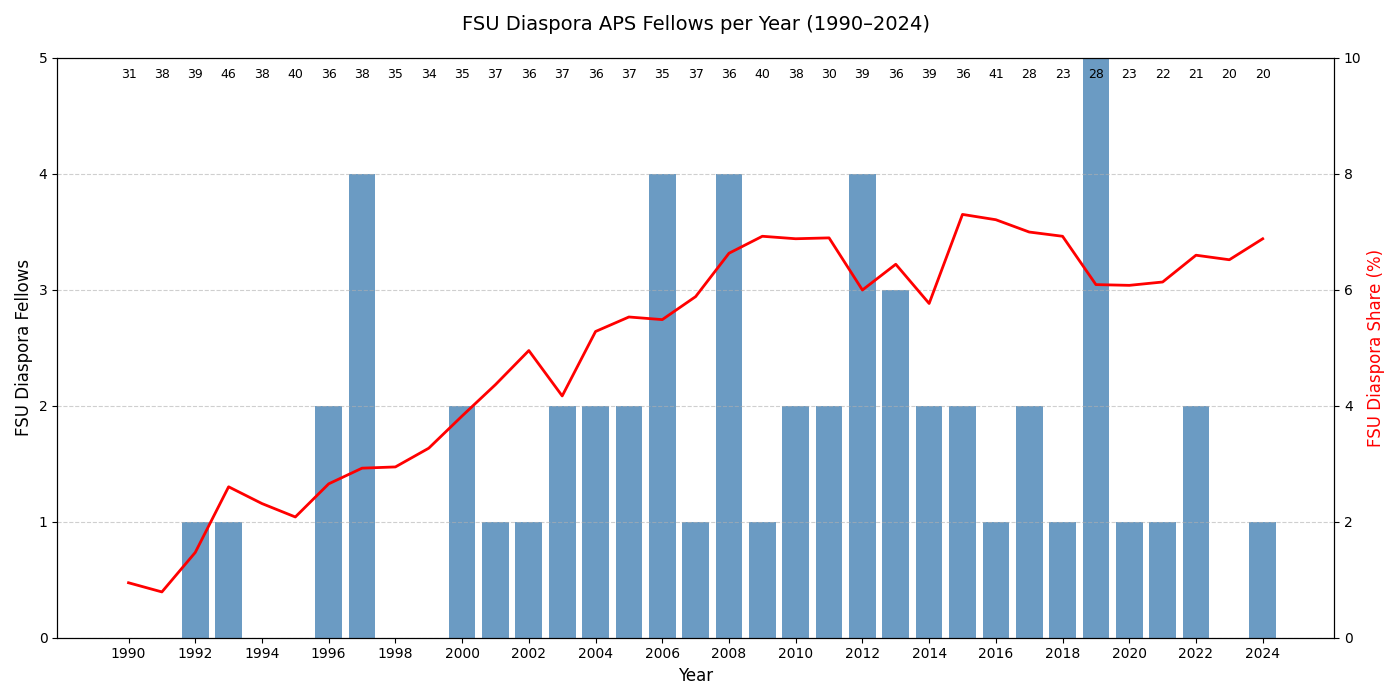
Across large experimental efforts such as those at the Tevatron, LEP, and the B-factories, a total of 3,343 co-authors are recorded, of whom 82 were affiliated with institutions in the FSU and 62 represented the diaspora. The comparable magnitudes of these two groups underscore the strong ongoing engagement of Russian-trained physicists abroad and the persistence of international professional ties that bridge domestic and expatriate segments of the community. This pattern supports the interpretation that, while Russia experienced The data presented in Figure 2 The sustained visibility of the FSU diaspora in APS honors over three decades underscores both their scientific productivity and enduring integration into the international research community. Despite the gradual decline in the overall number of APS Fellowships awarded per year, the diaspora’s representation has remained stable, suggesting continued high impact and leadership in the fields of high-energy, nuclear, and accelerator physics. This long-term pattern mirrors broader trends of international collaboration and scientific mobility, where earlier migration flows have matured into permanent and influential contributions to the host countries’ research ecosystems.
Finally, the persistence of a 6-7% representation rate suggests that the FSU diaspora has effectively maintained its scientific prominence across generations -from senior scientists who migrated in the 1990s to younger physicists trained abroad but connected through networks of mentorship and collaboration rooted in Soviet scientific schools. The figure thus captures not only a record of recognition but also an enduring legacy of transnational scientific exchange and continuity.
The post-Cold War “brain drain” from Russia, though striking in scale and impact, was neither the first nor the largest wave of scientific migration in modern history. As shown in Table III, its magnitude was comparable to earlier transnational flows of researchers-such as those from Europe to the United States during the 1930s and 1940s-but distinctive in its context and structure. It emerged not from political persecution or war, but from a systemic socioeconomic collapse that deeply disrupted the research environment of an entire country.
Researchers 1720-1800 ≳300 Switz., Germany, France Russia St. Petersburg Academy [18,19] 1860-preWWI ≳3,000 RUS, E.Europe, IRL GER, UK, FRA, USA new science centers [20,21] 1930s/40s ≳3,000 GER, AUT and satellites UK, USA, S.America Nazi policies [22] 1960s-1980s ≳25,000 UK, Canada USA “brain drain”, term coined by the Royal Society [23,24] 1970-1980s ∼3,000 USSR Israel migration of jews [1] 1990s-2010s ≳15,000 Russia USA, Europe, Asia USSR break-up [1,4] 2010s-2020s >30,000 US, Europe China, Europe “reverse brain drain” [25] TABLE III. Examples of historical migration of researchers.
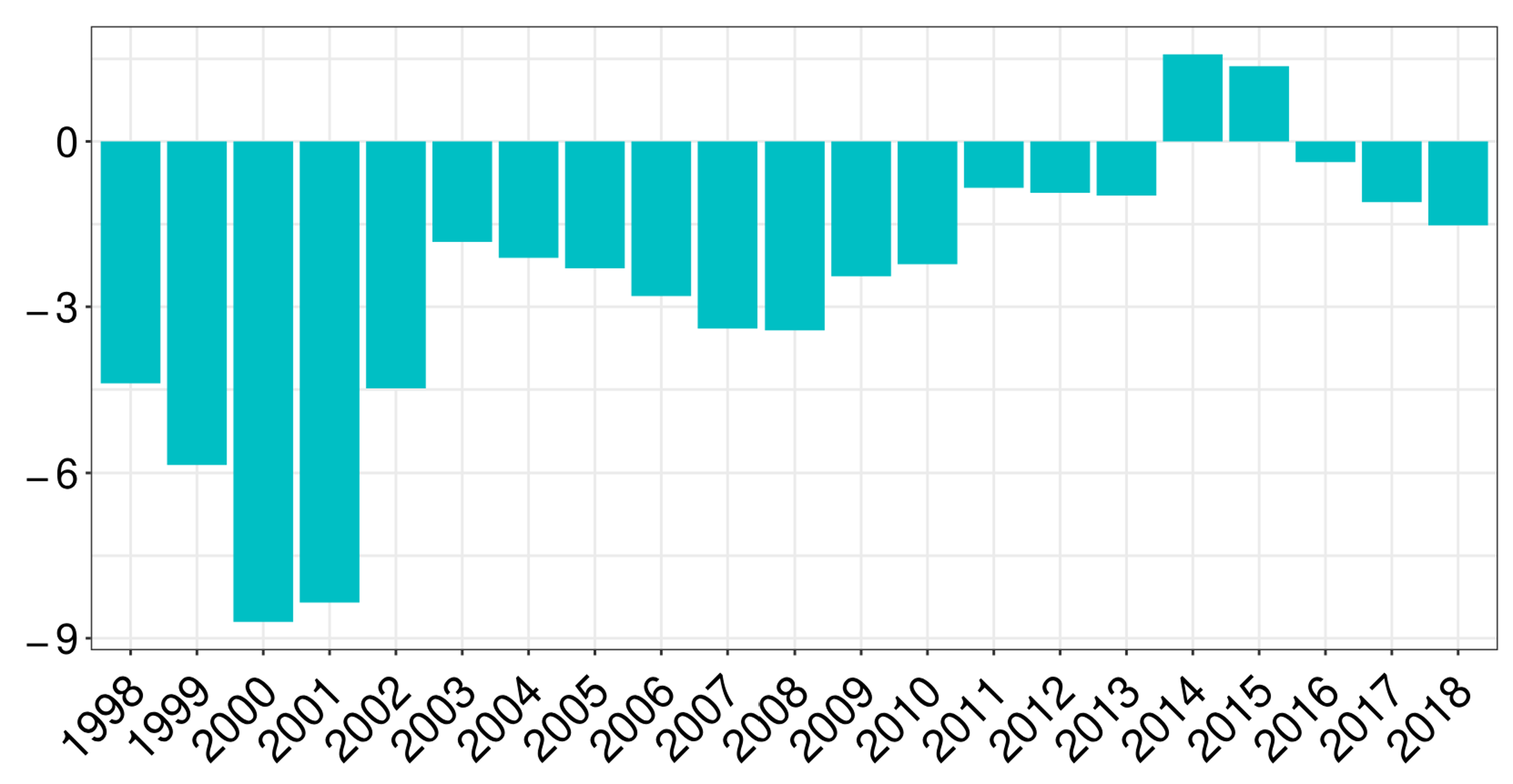
The dynamics of this exodus are illustrated in Figure 3 lized and international collaboration channels matured. Overall, the emigration wave encompassed on the order of 2,000-3,000 researchers in particle and nuclear physics-approximately
(5-7)% of the world’s workforce in these fields at the time. (Estimates of physics community sizes by subfield are given in Ref. [26].) The principal destinations were Western Europe and North America, with smaller but notable numbers relocating to Israel, Japan, and other parts of Asia. The emigrants included both highly accomplished senior scientists and a large cohort of talented early-career researchers, many of whom went on to build distinguished academic careers and occupy leadership positions in major laboratories and universities. Their integration into host institutions enriched the intellectual diversity and technical capabilities of the global high-energy physics community.
The post-Soviet diaspora in high-energy and nuclear physics was not an abrupt rupture but rather an evolution of pre-existing cooperative frameworks. The long-standing presence of Soviet institutions in international collaborations ensured that, when domestic conditions in Russia deteriorated, the pathways for outward mobility were already open and active. The result was a remarkably smooth transfer of expertise and talent that profoundly influenced both Russian science and the global HEP community.
Beyond individual careers, the diaspora’s broader contribution lay in strengthening the international scientific fabric. USSR/Russian-trained physicists became essential participants in large-scale experiments, collaborations, and facilities worldwide-from CERN and Fermilab to KEK and DESY-facilitating the transfer of knowledge, methods, and experience between Russian and Western institutions. These interactions helped sustain parts of the Russian research infrastructure through difficult decades and demonstrated the resilience of scientific networks under extreme political and economic stress.
The migration was also marked by remarkable acts of professional solidarity. Western colleagues, laboratories, and funding agencies provided crucial support to displaced scientists through fellowships, visiting positions, and institutional partnerships during the hardships of the 1990s and 2000s. This collaborative spirit not only mitigated the negative consequences of the brain drain but also reaffirmed a fundamental truth: that science, at its best, transcends national boundaries and remains a profoundly international enterprise.
V. ACKNOWLEDGMENTS
The author gratefully acknowledges valuable discussions and insightful input from Michael Riordan, Victor Yarba, Dmitri Denisov, Jerry Blazey, and Andrei Gritsan, whose expertise and perspectives on both the history and practice of high-energy physics have greatly contributed to shaping this work. Their comments helped refine the analysis and ensure the accuracy of several historical and technical details presented in the paper.
As shown inTable I, at least fourteen Soviet and later Russian/FSU institutions participated in Fermilab experiments between 1972 and 2017 [12]. The most active contributors included JINR in Dubna (28 experiments), IHEP in Protvino (17 experiments, in addition to work on accelerator development),
As shown in
📸 Image Gallery