Electrical Engineering and Systems Science / Image and Video Processing
Computer Science / Multimedia
CALPA-NET A Channel Pruning Assisted Deep Residual Network for Digital Image Steganalysis
📝 Original Paper Info
- Title: CALPA-NET Channel-pruning-assisted Deep Residual Network for Steganalysis of Digital Images- ArXiv ID: 1911.04657
- Date: 2020-06-25
- Authors: Shunquan Tan, Weilong Wu, Zilong Shao, Qiushi Li, Bin Li, Jiwu Huang
📝 Abstract
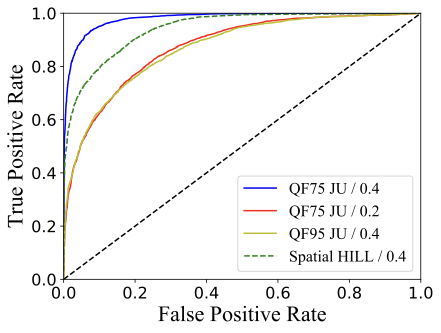
Over the past few years, detection performance improvements of deep-learning based steganalyzers have been usually achieved through structure expansion. However, excessive expanded structure results in huge computational cost, storage overheads, and consequently difficulty in training and deployment. In this paper we propose CALPA-NET, a ChAnneL-Pruning-Assisted deep residual network architecture search approach to shrink the network structure of existing vast, over-parameterized deep-learning based steganalyzers. We observe that the broad inverted-pyramid structure of existing deep-learning based steganalyzers might contradict the well-established model diversity oriented philosophy, and therefore is not suitable for steganalysis. Then a hybrid criterion combined with two network pruning schemes is introduced to adaptively shrink every involved convolutional layer in a data-driven manner. The resulting network architecture presents a slender bottleneck-like structure. We have conducted extensive experiments on BOSSBase+BOWS2 dataset, more diverse ALASKA dataset and even a large-scale subset extracted from ImageNet CLS-LOC dataset. The experimental results show that the model structure generated by our proposed CALPA-NET can achieve comparative performance with less than two percent of parameters and about one third FLOPs compared to the original steganalytic model. The new model possesses even better adaptivity, transferability, and scalability.💡 Summary & Analysis
This paper introduces CALPA-NET, a novel approach that aims to reduce the network structure of existing deep learning-based steganalyzers through selective channel pruning. The core issue addressed is the excessive resource consumption and computational cost associated with expanding neural networks to improve detection performance in steganography tasks. By shrinking the model without sacrificing accuracy, CALPA-NET offers a more efficient alternative that reduces both the parameter count (down to less than 2% of the original) and FLOPs (to about one-third). This makes it easier to deploy and train these models while maintaining high performance levels. The significance of this work lies in its potential to streamline steganalysis processes, enabling faster analysis with reduced computational resources.📄 Full Paper Content (ArXiv Source)
📊 논문 시각자료 (Figures)