When to Restrict Provider Entry in Regulated Markets with Mandatory Purchase Requirements
📝 Original Paper Info
- Title: When to Limit Market Entry under Mandatory Purchase- ArXiv ID: 2002.06326
- Date: 2020-02-18
- Authors: Meryem Essaidi, Kira Goldner, S. Matthew Weinberg
📝 Abstract
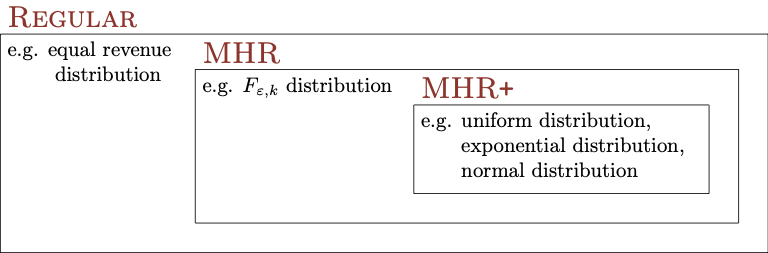
We study a problem inspired by regulated health insurance markets, such as those created by the government in the Affordable Care Act Exchanges or by employers when they contract with private insurers to provide plans for their employees. The market regulator can choose to do nothing, running a Free Market, or can exercise her regulatory power by limiting the entry of providers (decreasing consumer welfare by limiting options, but also decreasing revenue via enhanced competition). We investigate whether limiting entry increases or decreases the utility (welfare minus revenue) of the consumers who purchase from the providers, specifically in settings where the outside option of "purchasing nothing" is prohibitively undesirable. We focus primarily on the case where providers are symmetric. We propose a sufficient condition on the distribution of consumer values for (a) a unique symmetric equilibrium to exist in both markets and (b) utility to be higher with limited entry. (We also establish that these conclusions do not necessarily hold for all distributions, and therefore some condition is necessary.) Our techniques are primarily based on tools from revenue maximization, and in particular Myerson's virtual value theory. We also consider extensions to settings where providers have identical costs for providing plans, and to two providers with an asymmetric distribution.💡 Summary & Analysis
This paper focuses on the regulatory role in health insurance markets where government or employers can limit provider entry to balance consumer welfare and revenue. By using Myerson's virtual value theory, researchers showed that under certain conditions, limiting entry can lead to higher utility for consumers, especially when not purchasing anything is an undesirable option. The study provides policymakers with insights on how to effectively regulate market entry in health insurance markets, potentially leading to better choices and welfare for consumers.📄 Full Paper Content (ArXiv Source)
📊 논문 시각자료 (Figures)