A Comprehensive Study on Temporal Modeling for Online Action Detection
📝 Original Paper Info
- Title: A Comprehensive Study on Temporal Modeling for Online Action Detection- ArXiv ID: 2001.07501
- Date: 2020-01-22
- Authors: Wen Wang, Xiaojiang Peng, Yu Qiao, Jian Cheng
📝 Abstract
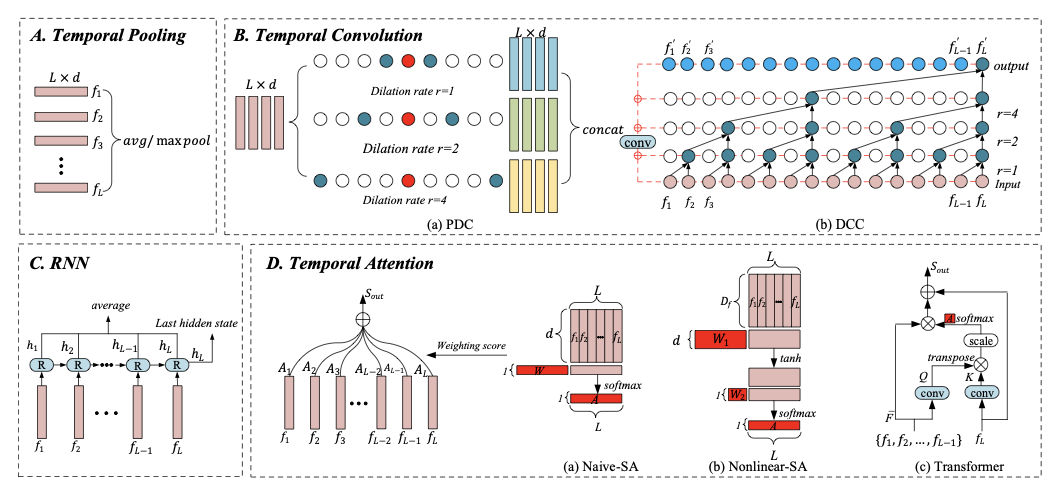
Online action detection (OAD) is a practical yet challenging task, which has attracted increasing attention in recent years. A typical OAD system mainly consists of three modules: a frame-level feature extractor which is usually based on pre-trained deep Convolutional Neural Networks (CNNs), a temporal modeling module, and an action classifier. Among them, the temporal modeling module is crucial which aggregates discriminative information from historical and current features. Though many temporal modeling methods have been developed for OAD and other topics, their effects are lack of investigation on OAD fairly. This paper aims to provide a comprehensive study on temporal modeling for OAD including four meta types of temporal modeling methods, \ie temporal pooling, temporal convolution, recurrent neural networks, and temporal attention, and uncover some good practices to produce a state-of-the-art OAD system. Many of them are explored in OAD for the first time, and extensively evaluated with various hyper parameters. Furthermore, based on our comprehensive study, we present several hybrid temporal modeling methods, which outperform the recent state-of-the-art methods with sizable margins on THUMOS-14 and TVSeries.💡 Summary & Analysis
This paper focuses on a comprehensive study of temporal modeling techniques for online action detection (OAD), aiming to provide best practices for developing state-of-the-art OAD systems. The authors explore four meta types of temporal modeling methods: temporal pooling, temporal convolution, recurrent neural networks, and temporal attention. These are critical components in an OAD system that process video frames effectively by integrating past and current information.The paper addresses the challenge of accurately predicting actions based on real-time video data. By analyzing different temporal models, the researchers aim to enhance the performance of OAD systems. The study reveals that while many temporal modeling methods have been developed, their effectiveness in OAD has not been thoroughly investigated until now.
Key results include significant improvements over previous state-of-the-art techniques on datasets like THUMOS-14 and TVSeries. By combining various temporal modeling approaches, the authors achieved remarkable performance gains. This research is crucial for advancing real-time action recognition systems used in diverse applications such as smart cities, security, and healthcare.
📄 Full Paper Content (ArXiv Source)
📊 논문 시각자료 (Figures)