QoE-Driven Coupled Uplink and Downlink Rate Adaptation for 360-Degree Video Live Streaming
📝 Original Paper Info
- Title: QoE-driven Coupled Uplink and Downlink Rate Adaptation for 360-degree Video Live Streaming- ArXiv ID: 2001.03536
- Date: 2020-01-13
- Authors: Jie Li, Ransheng Feng, Zhi Liu, Wei Sun, Qiyue Li
📝 Abstract
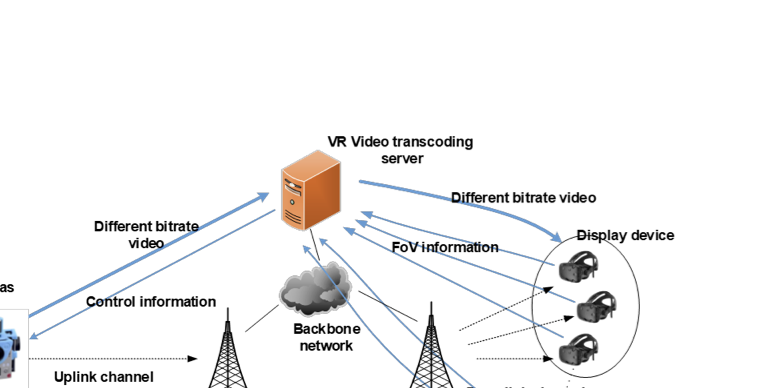
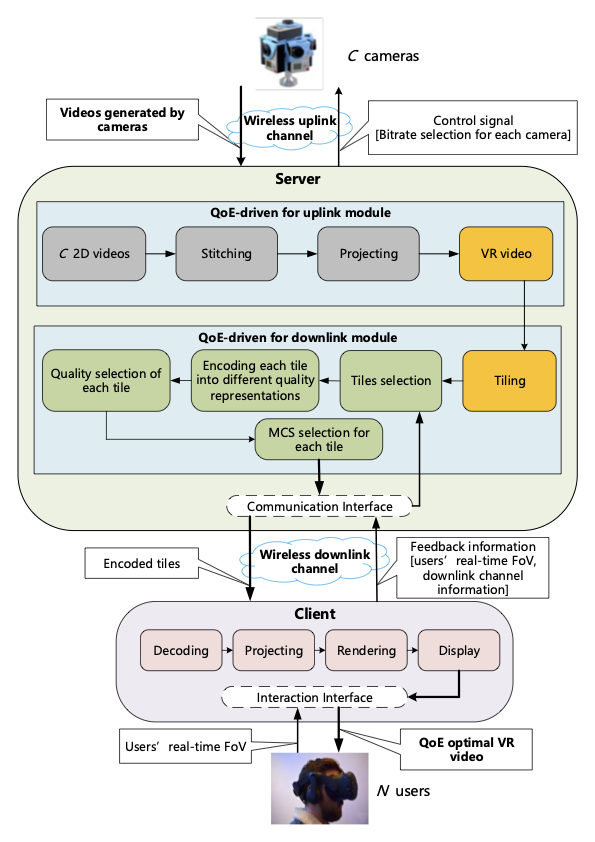
360-degree video provides an immersive 360-degree viewing experience and has been widely used in many areas. The 360-degree video live streaming systems involve capturing, compression, uplink (camera to video server) and downlink (video server to user) transmissions. However, few studies have jointly investigated such complex systems, especially the rate adaptation for the coupled uplink and downlink in the 360-degree video streaming under limited bandwidth constraints. In this letter, we propose a quality of experience (QoE)-driven 360-degree video live streaming system, in which a video server performs rate adaptation based on the uplink and downlink bandwidths and information concerning each user's real-time field-of-view (FOV). We formulate it as a nonlinear integer programming problem and propose an algorithm, which combines the Karush-Kuhn-Tucker (KKT) condition and branch and bound method, to solve it. The numerical results show that the proposed optimization model can improve users' QoE significantly in comparison with other baseline schemes.💡 Summary & Analysis
This paper proposes a method for optimizing the quality of experience (QoE) in 360-degree video live streaming by dynamically adapting both uplink and downlink rates based on real-time user field-of-view (FOV) information. The authors address a significant gap in current research, which has not adequately explored rate adaptation under limited bandwidth constraints for such complex systems.Problem Statement: 360-degree video live streaming involves multiple stages including capture, compression, uplink transmission from the camera to the server, and downlink transmission from the server to users. If any of these stages are poorly managed, it can degrade user experience (QoE). However, there is a lack of comprehensive studies that tackle both uplink and downlink rate adaptation simultaneously.
Solution: The proposed solution involves an algorithm that dynamically adjusts video streaming rates based on the real-time FOV information from each user. This approach considers both uplink and downlink bandwidth constraints to determine optimal streaming speeds. The problem is formulated as a nonlinear integer programming issue, and the authors use a combination of Karush-Kuhn-Tucker (KKT) conditions and branch-and-bound methods to solve it.
Key Results: Numerical results demonstrate that this optimization model significantly improves user QoE compared to baseline schemes. This improvement indicates better system performance and higher user satisfaction under limited bandwidth conditions.
Significance & Applications: The findings have significant implications for enhancing the quality of 360-degree video streaming in environments with restricted bandwidths, such as virtual reality (VR) and augmented reality (AR). It can greatly benefit real-time live event broadcasts, remote education, and teleconferencing by maximizing user experience.
📄 Full Paper Content (ArXiv Source)
📊 논문 시각자료 (Figures)