- Authors: Cameron Ruggles and Nate Veldt and David F. Gleich
Many clustering applications in machine learning and data mining rely on solving metric-constrained optimization problems. These problems are characterized by $O(n^3)$ constraints that enforce triangle inequalities on distance variables associated with $n$ objects in a large dataset. Despite its usefulness, metric-constrained optimization is challenging in practice due to the cubic number of constraints and the high-memory requirements of standard optimization software. Recent work has shown that iterative projection methods are able to solve metric-constrained optimization problems on a much larger scale than was previously possible, thanks to their comparatively low memory requirement. However, the major limitation of projection methods is their slow convergence rate. In this paper we present a parallel projection method for metric-constrained optimization which allows us to speed up the convergence rate in practice. The key to our approach is a new parallel execution schedule that allows us to perform projections at multiple metric constraints simultaneously without any conflicts or locking of variables. We illustrate the effectiveness of this execution schedule by implementing and testing a parallel projection method for solving the metric-constrained linear programming relaxation of correlation clustering. We show numerous experimental results on problems involving up to 2.9 trillion constraints.
This paper introduces a parallel projection method for solving metric-constrained optimization problems encountered in clustering algorithms within machine learning and data mining. The challenge lies in the cubic number of constraints (O(n^3)) that enforce triangle inequalities on distance variables associated with n objects, which is computationally demanding even with standard optimization software. To address this issue, the paper proposes a parallel projection approach that allows for multiple simultaneous projections without conflicts or variable locking. This method significantly improves convergence rates and memory efficiency, enabling the solution of problems involving up to nearly 3 trillion constraints more quickly than before. The authors demonstrate their approach by solving the linear programming relaxation of correlation clustering and show consistent speedups over serial methods.
# Introduction
Many tasks in machine learning and data mining, in particular problems
related to clustering, rely on learning pairwise distance scores between
objects in a dataset of $`n`$ objects. One particular paradigm for
learning distances, that arises in a number of different contexts, is to
set up a convex optimization problem involving $`O(n^2)`$ distance
variables and $`O(n^3)`$ metric constraints which enforce triangle
inequalities on the variables. This approach has been applied to
problems in sensor location , metric learning , metric nearness , and
joint clustering of image segmentations . Metric-constrained
optimization problems also frequently arise as convex relaxations of
NP-hard graph clustering objectives. A common approach to developing
approximation algorithms for these clustering objectives is to first
solve a convex relaxation and then round the solution to produce a
provably good output clustering .
The constraint set of metric-constrained optimization problems may
differ slightly depending on the application. However, the common factor
among all of these problems is that they involve a cubic number of
constraints of the form $`x_{ij} \leq x_{ik} + x_{jk}`$ where
$`(i,j,k)`$ is a triplet of points in some dataset and $`x_{ij}`$ is a
distance score between two objects $`i`$ and $`j`$. This leads to an
extremely large, yet very sparse and carefully structured constraint
matrix. Given the size of this constraint matrix and the corresponding
memory requirement, it is often not possible to solve these problems on
anything but very small datasets when using standard optimization
software. In recent work we showed how to overcome the memory
bottleneck by applying memory-efficient iterative projection methods,
which provide a way to solve these problems on a much larger scale than
was previously possible. Unfortunately, although projection methods come
with a significantly decreased memory footprint, they are also known to
exhibit very slow convergence rates. In particular, the best known
results are obtained by specifically applying Dykstra’s projection
method , which is known to have a only a linear convergence rate .
Given the slow convergence rate of Dykstra’s method, a natural question
to ask is whether one can improve its performance using parallelism.
There does in fact already exist a parallel version of Dykstra’s
method , which performs independent projections at all constraints of a
problem simultaneously, and then averages the results to obtain the next
iterate. However, this procedure is ineffective for metric-constrained
optimization, since averaging over the extremely large constraint set
leads to changes that are so small no meaningful progress is made from
one iteration to the next. As another challenge, we note that many of
the most commonly studied metric-constrained optimization problems are
linear programs . Because linear programming is P-complete,
parallelizing LP solvers is in general very hard. Thus, finding
meaningful ways to solve metric-constrained optimization problems in a
way that is both fast and memory efficient possess several significant
challenges.
In this work we take a first step in parallelizing projection methods
for metric-constrained optimization. This leads to a modest but
consistent reduction in running time for solving these challenging
problems on a large scale. Our approach relies on the observation that
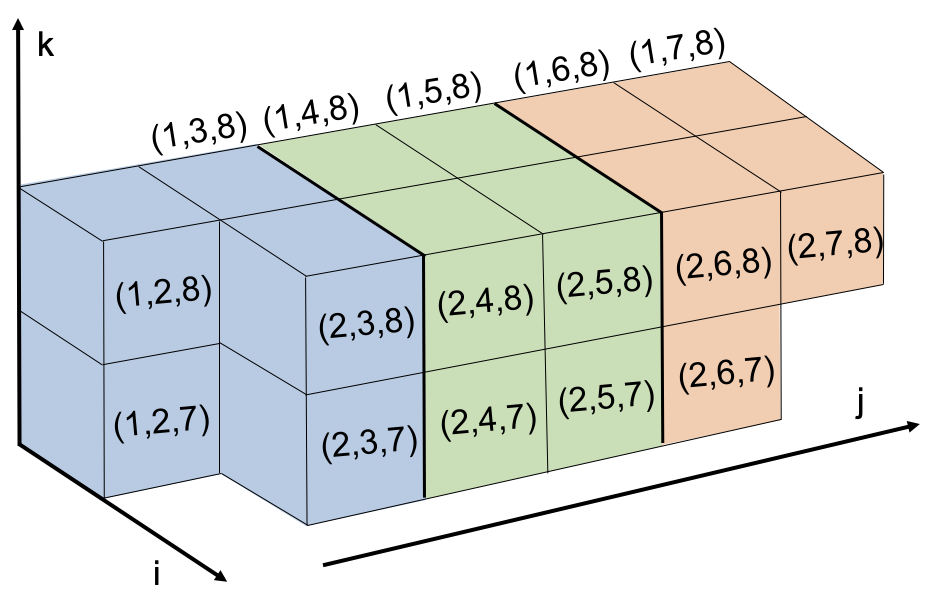
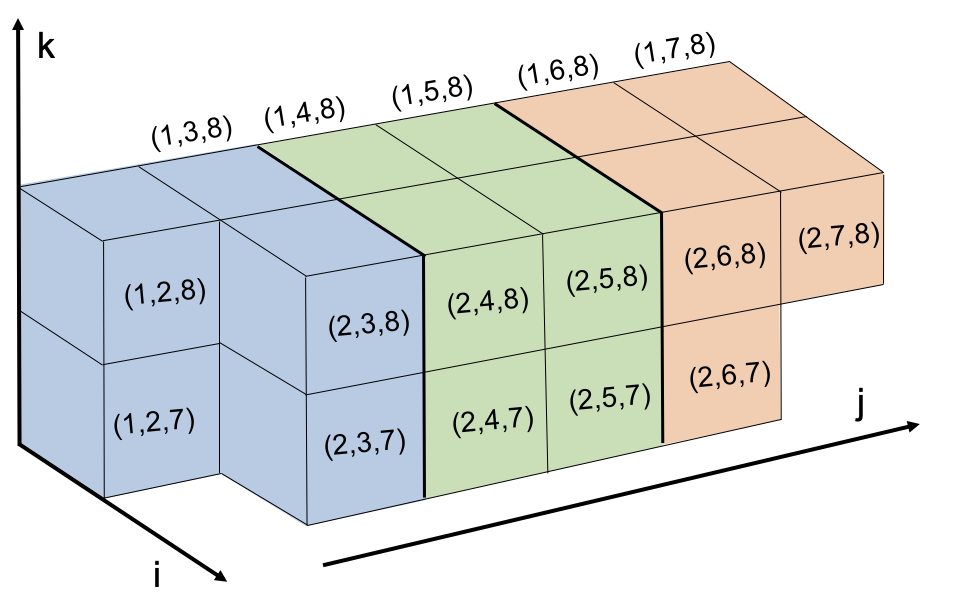
when applying projection methods to metric-constrained optimization, two
projection steps can be performed simultaneously and without conflict as
long as the $`(i,j,k)`$ triplets associated with different metric
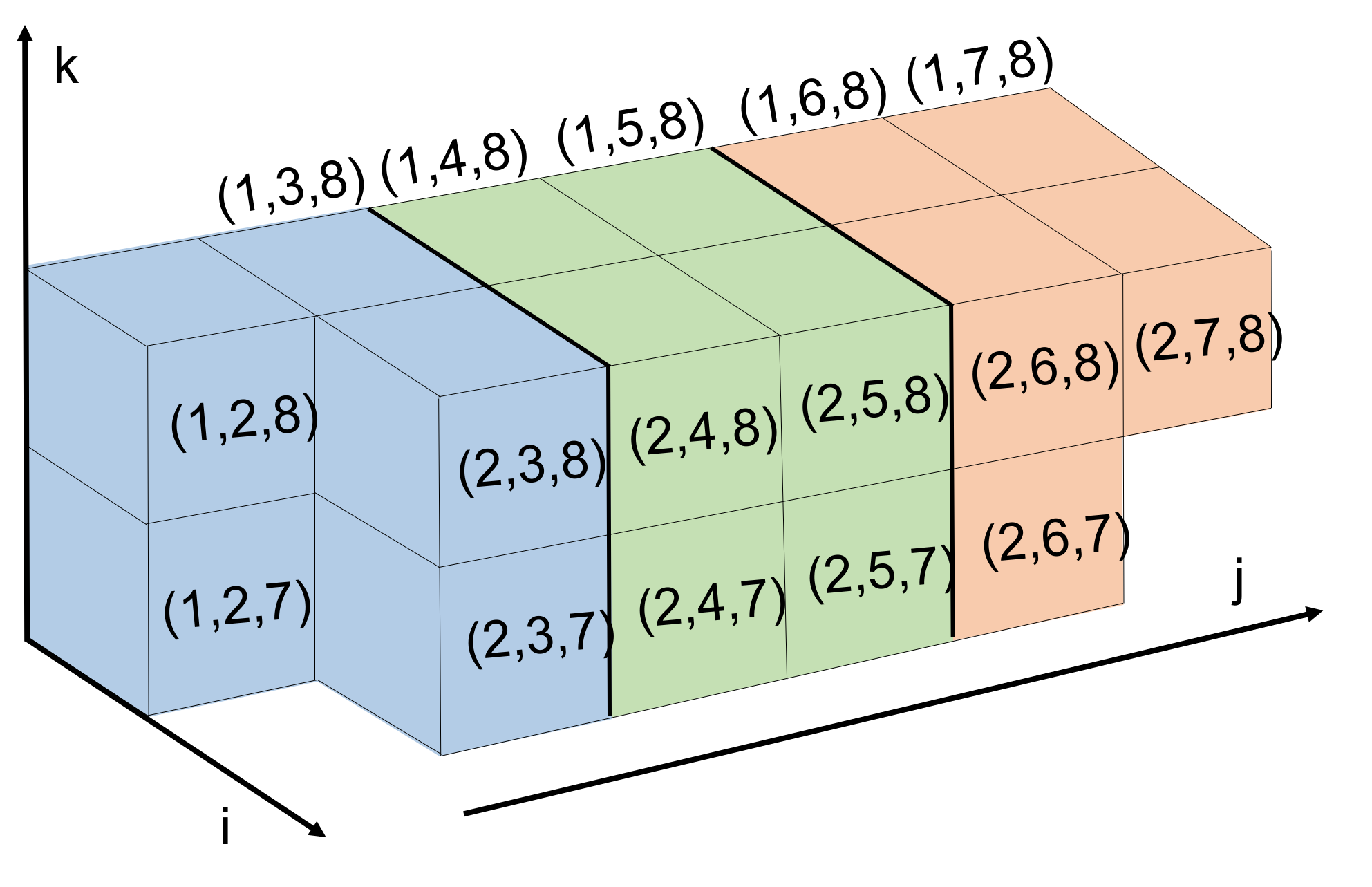
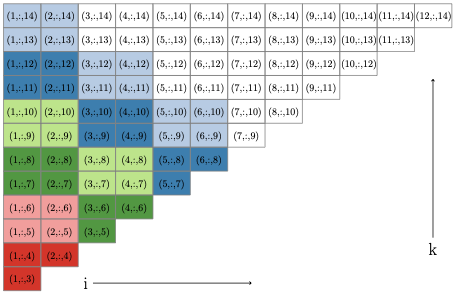
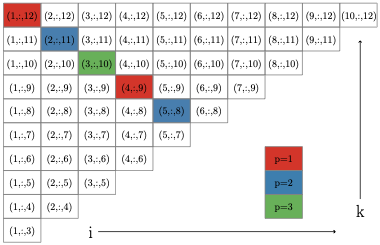
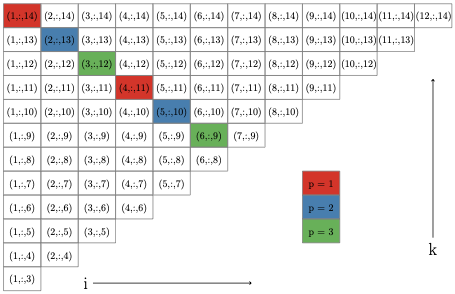
constraints share at most one index in common. Based on this, we develop
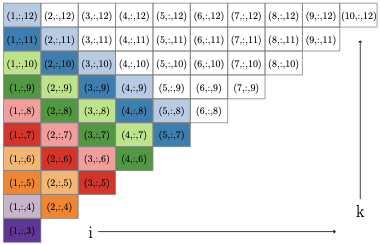
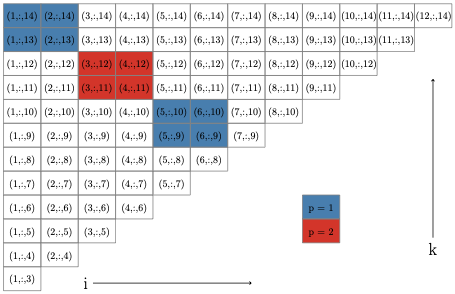
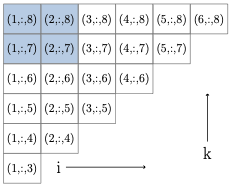
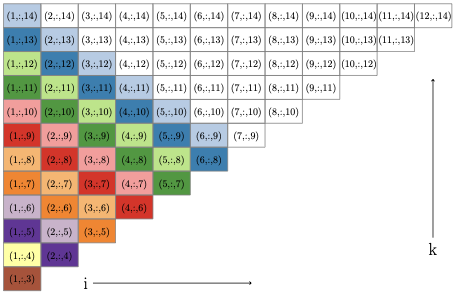
a new parallel execution schedule which identifies large blocks of
metric constraints that can be visited in parallel without locking
variables or performing conflicting projection steps. Because Dykstra’s
projection methods also relies on carefully updating dual variables
after each projection, we also show how to keep track of dual variables
in parallel and update them at each pass through the constraint set. We
demonstrate the performance of our new approach by using it to solve the
linear programming relaxation of correlation clustering . Solving this
LP is an important first step in many theoretical approximation
algorithms for correlation clustering . In our experiments we
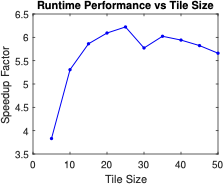
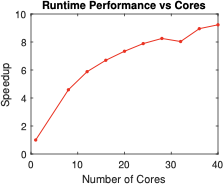
consistently obtain a speedup of roughly a factor 5 over the serial
method using even a small number cores, and achieve a speedup of over a
factor of 11 for our largest problem. Our new approach allows us to
handle problems containing up to nearly 3 trillion constraints in a
fraction of the time it takes the serial method.
The copyright of this content belongs to the respective researchers. We deeply appreciate their hard work and contribution to the advancement of human civilization.