Unitary, Inner product, and Dagger categories
This article provides an alternate characterization of dagger categories, which are central to the study of categorical quantum mechanics, in terms of inner product categories. An inner product category is an "achiral involutive" category with an inn…
Authors: Robin Cockett, Durgesh Kumar, Priyaa Varshinee Srinivasan
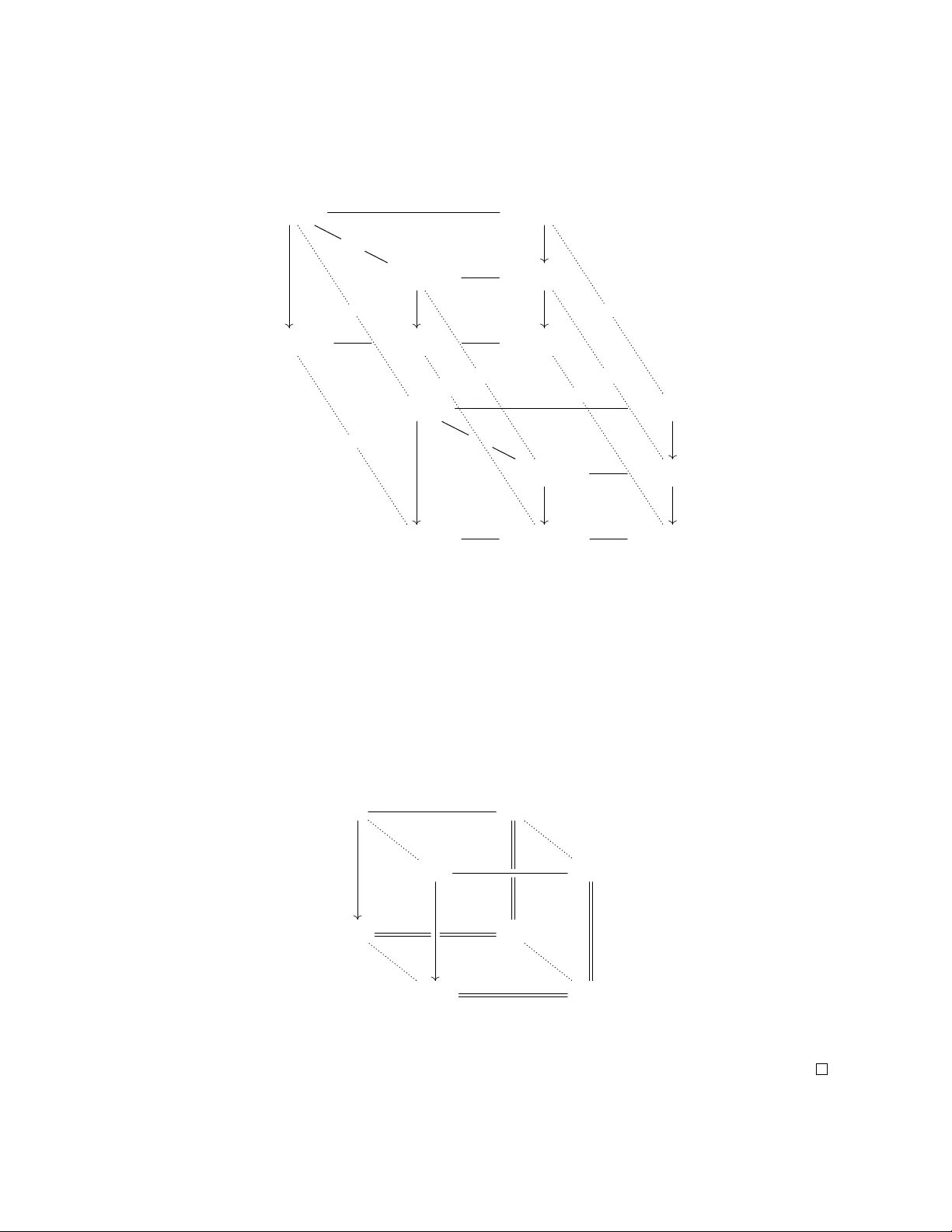
Submitted to A CT 2026. © R. Cockett, D. Kumar , & P V . Sriniv asan This work is licensed under the Creativ e Commons Attribution License. Unitary , Inner Pr oduct, and Dagger Categories Robin Cockett Univ ersity of Calgary Calgary , Canada robin@ucalgary.ca Durgesh K umar Univ ersity of Calgary Calgary , Canada durgesh.kumar@ucalgary.ca Priyaa V arshinee Sriniv asan T allinn University of T echnology T allinn, Estonia priyaavarshinee@gmail.com * This article provides an alternate characterization of dagger cate gories, which are central to the study of categorical quantum mechanics, in terms of inner product categories. An inner product category is an “achiral in volutiv e” category with an inner product combinator . Inner product categories are, in turn, precisely the same as unitary categories, which are a weaker form of dagger categories. In unitary categories, there is an isomorphism between an object and its dagger, instead of the identity function as in the case of dagger categories. Ev ery unitary cate gory is equipped with a global inner product structure, which allows one to strictify the in voluti ve structure on the unitary category to obtain a dagger category , making unitary categories 2-categorically equi valent to dagger categories. By regarding the inner product as an abstract metric on an (achiral) in voluti ve category , one can define metric-preserving maps (isometries) in inner product categories, and also dev elop other notions of special maps — unitary , Hermitian, positi ve, and normal maps — in this setting. 1 Intr oduction A †-cate gory (pronounced “dagger cate gory”) [7] is a category equipped with a contra variant in v olution: it is a foundational construct in the study of categorical quantum mechanics [3, 4]. †-categories are defined to hav e a dagger functor which is strict, in the sense of being the identity on objects. Howe ver , this le vel of strictness is quite restricti ve when relating quantum structures to broader categorical framew orks. For example, ∗ -autonomous categories [1, 2] and compact closed categories can have necessarily non- strict inv olutions [8, Sections 3.1 and 3.2]. In this paper, in order to capture these examples, we follow [6] and reformulate †-categories as e xamples of achiral in voluti ve categories. The term in volutive has been used in v arious ways in the cate gorical literature. For e xample, Donald Y au, in his book “In voluti ve Category Theory” [10], studies co variant in volutions. In this regard, he fol- lo ws a precedent set by Bart Jacobs [5]. In this paper , ho wev er , when we talk about in voluti ve categories, we are considering exclusi vely contrav ariant in volutions — also called “re verse” in volutions by Y au. A general theory of contra variant inv olutions was initiated by Paul-Andr ´ e Mellie ` s in his in vestigation of “chirality” [6]. The term “chiral” comes from chemistry 1 in the context of breaking the behavioural symmetry between the mirror images of a molecule – here – between a category and its dual. In a sequel paper , we shall use the more general chiral setting adv ocated by Mellie ` s to talk about chiral in volutions. In this paper , ho wev er , we consider the achir al system of 0-cells, 1-cells, and 2-cells which do not break symmetry . In light of this, we will refer to these categories as achiral in voluti ve cate gories. Every achiral in voluti ve category has an associated unitary category . A unitary category is a weak version of a †-category [7] in which ev ery object has an isomorphism to its †-dual. This associated * This work was co-funded by the European Union and Estonian Research Council through the Mobilitas 3.0 (MOB3JD1227). 1 In chemistry , a chiral molecule is a molecule with two distinct enantiomers. Even though such enantiomers are mirror images of each other , they have distinct chemical and physical properties (e.g. famously , enantiomers rotate polarized light in opposite directions). 2 Unitary , inner product, and dagger categories unitary category is constructed from a general achiral in voluti ve category by collecting its pre-unitary objects. The construction is 2-functorial, and the (2-)category of unitary categories sits as a coreflectiv e subcategory in the 2-cate gory of achiral categories. Next, we axiomatize what it means for an achiral inv olutiv e category to be equipped with a (global) inner pr oduct structure. Any unitary category can be equiv alently viewed as an achiral in voluti ve cate- gory with an inner product. This inner product structure can be used to strictify the in voluti ve structure to obtain a †-category (in the sense of [7]), providing a three-way equiv alence between the 2-categories of unitary categories, inner product categories, and †-categories. Moreover , by regarding the inner product as providing an abstract metric on the category , one can define isometries to be metric-preserving maps. Unitary maps are then isometries which are in vertible. Similarly , Hermitian maps, positive maps, and normal maps can all be naturally described in terms of the inner product structure. Chiral in voluti ve categories are not unitary , hence they do not have an inner product. Ho wever , this setting naturally leads to †-linearly distributi ve categories [8] where the par is gi ven by the chiral dual. Notably , models of †-linearly distributi ve categories (†-LDCs) are used to study infinite-dimensional quantum processes. W e plan to explain this in detail in a sequel. 2 Achiral in volutions A category has an (achiral) inv olution if it has a contrav ariant endofunctor ( ) † ∶ X op / / X called the dagger and a natural isomorphism ι ∶ X / / X †† called the inv olutor such that the following diagram commutes:- X † X ††† X † ι X † ( ι X ) † W e call a category with an (achiral) in volution an in volutive category and write it as a triple X = ( X , ( − ) † , ι ) . W e shall call an in voluti ve category whose in volution is strict (so that X † = X and ι is the identity map) a strict in volutive category and use this term interchangeably with †-cate gory . Example 2.1. (1) All †-categories as defined in [7] are strict in voluti ve categories and there are many examples of these: (a) Every groupoid (and, indeed, more generally , e very inv erse category 2 ) is a †-category with x † = x − 1 (respecti vely x † = x ( − 1 ) ). (b) The category of relations with R † = R ○ = {( b , a )( a , b ) ∈ R } being the transpose relation. (c) The category of matrices ov er any rig (or ring), R , which has an in volution is a †-cate gory with respect to the conjugate transpose. A rig has a conjugation, ( ) , when 1 = 1, ab = b a , 0 = 0, and a + b = a + b . When the rig is commutati ve, there is a trivial conjugation gi ven by the identity . One then obtains a strict in volution by modifying the transpose: ( r i , j ) i < n , j < m ∶ n / / m ( r i , j ) j < m , i < n ∶ m / / n ( ) † This gives the usual dagger (conjugate transpose) when R = C (where C is the complex numbers with the usual conjugation). 2 A category in which for e very morphism f , there exists a unique map g such that f g f = f and g f g = g . R. Cock ett, D. K umar , & P V . Sriniv asan 3 (2) Every ∗ -autonomous category and compact closed category is an in voluti ve category with the in vo- lution being the dual functor . (3) An elementary example of an in voluti ve category is the category of symmetric reflexi ve graphs, SRGraph . An object is a set X equipped with a symmetric reflexi ve relation, ⌣ (with x ⌣ x and, if x ⌣ y , then y ⌣ x ). A morphism is an isomorphism/bijection between the underlying sets which preserves the relation (that is α ∶ X / / Y , which has an in verse, α − 1 as a set map, and is such that x ⌣ x ′ implies α ( x ) ⌣ α ( x ′ ) ). The in volution ( ) † ∶ SRGraph op / / SRGraph sends α ∶ ( X , ⌣ X ) / / ( Y , ⌣ Y ) to α † = α − 1 ∶ ( Y , ⌣ † Y ) / / ( X , ⌣ † X ) , where x ⌣ † X x ′ if f x ⌣ x ′ or x = x ′ . Notice that this is not a †-category (as ( X , ⌣ X ) = ( X , ⌣ X ) † - except for the empty and one element objects) b ut ι ∶ X / / X †† is the identity . (4) The integers with respect to the usual ordering is an in voluti ve category with respect to negation – notice this is not a dagger category as n † ∶ = − n = n , unless n = 0. More generally , any finite ordinal is an in voluti ve cate gory by rev ersing the order . Remark 2.2. The axiom ι X † ( ι X ) † = 1 X † for achiral in volution gi ves an adjoint equi v alence: X ( ) † ( ( X op ( ) † f f with the unit and the counit being ι ∶ X / / X †† . It should be noted that most of the theory we dev elop does not require this identity . As shall be seen, the identity is needed to make ι an achiral (natural) transformation. Definition 2.3. If ( X , ( ) † , ι ) and ( Y , ( ) ‡ , ι ′ ) are cate gories with in volution then an (achiral) in volutive functor written as, ( F , γ ) ∶ ( X , ( ) † , ι ) / / ( Y , ( ) ‡ , ι ′ ) , consists of a functor F ∶ X / / Y and a natural isomorphism γ X ∶ F ( X † ) / / F ( X ) ‡ (of the contravariant functors) called the preser vator making the following diagr am commute: F ( X ) ι ′ F ( ι ) / / F ( X †† ) γ X F ( X ) ‡‡ γ ‡ X / / F ( X † ) ‡ In volutive functors compose with the composition defined as ( F , γ )( G , γ ′ ) ∶ = ( F G , G ( γ ) γ ′ ) . Remark 2.4. (1) Here we are asking more coherence for functors than is usual. Often one asks just for the existence of γ X ∶ F ( X † ) / / F ( X ) † with no coherence requirement gov erning the interaction with ι . (2) For †-categories one asks that F “preserves” the dagger , that is F ( X † ) and F ( X ) † are literally the same object. This, and the fact that the in volutor is the identity , collapses the coherence square abo ve to the identity . This ensures that this coherence requirement is automatically satisfied in †-cate gories. (3) For co v ariant in volutions one can prove that the preservator must be an isomorphism from the coher - ence requirement [5, 10]. Ho wev er this does not appear to be true for the contrav ariant in volution: so we hav e requir ed that the preservator be an isomorphism. 4 Unitary , inner product, and dagger categories Definition 2.5. If ( F , γ ) , ( G , γ ′ ) ∶ X / / Y ar e in volutive functors then an (achiral) transf ormation α ∶ ( F , γ ) / / ( G , γ ′ ) is a natural transformation α ∶ F / / G which in addition satisfies: F ( X ) F ( ι ) ι ′ F ( X ) / / α X $ $ F ( X ) ‡‡ ( α X ) ‡‡ % % γ ‡ X G ( X ) ι ′ G ( X ) / / G ( ι ) G ( X ) ‡‡ γ X † F ( X †† ) α X †† $ $ γ X † / / F ( X † ) ‡ G ( X †† ) γ ′ X † / / G ( X † ) ‡ α ‡ X † e e Notice that the bottom right morphism is going in the “wrong direction”: we call this map the tether . The requirement that the squares in which the tether occurs must commute (the tethering requirement) has a significant consequence: Lemma 2.6. The tethering r equir ement for ces α to be a natural isomorphism. Pr oof. T o see this, first note that a morphism f is a retraction (respectiv ely a section) if and only if any conjugate, β f γ − 1 – with β and γ in vertible – is a retraction (respecti vely a section). Notice that the bottom square of the cube above forces α X †† to be a section: whence, as α X = F ( ι ) α X †† G ( ι ) − 1 , α X is a section. No w notice that the right-hand square forces α ‡ X † to be a retraction, whence, as α X is a conjugate of this, we also hav e that α X is a retraction and hence an isomorphism. More generally , as we shall see when we discuss chiral transformations in a sequel paper, there is another less drastic w ay to explain “tethering” without requiring all transformations to be isomorphisms. Furthermore, as we shall see, this has interesting structural ramifications. Remark 2.7. (1) In the case of †-categories both ι and γ are identities and this forces α − 1 = α † . Thus, α , in this case, is a unitary isomorphism [7, Definition 2.3]. (2) As the tether is an isomorphism, its direction can be corrected. Indeed, for a chiral transformation [6], there are actually two natural transformations going in opposite directions: in the achiral situation this pair becomes ( α , α − 1 ) . It is clear that these transformations compose by just stacking these squares. It is also clear that whiskering on the left gi ves a transformation: X V / / Y F & & G 8 8 ⇓ α Z W / / W Whiskering on the right is more complicated (see commuting diagram in Figure 1 in Appendix A). This leads to the claim that: R. Cockett, D. Kumar , & P V . Sriniv asan 5 Proposition 2.8. In volutive cate gories, their functors, and their achiral transformations or ganize them- selves into a 2-cate gory , aChiral (in which all 2-cells ar e isomorphisms). There is a ready-to-hand example of such a transformation of in voluti ve functors: Lemma 2.9. F or any achir al involutive cate gory the in volutor itself is an (achiral) tr ansformation. The proof is gi ven in Appendix A. 3 Unitary categories The notion of a unitary category was introduced in [8] in the context of dagger isomix categories. Here, we extract the essence of the notion to in voluti ve categories. An in voluti ve category , X is a unitary category [8, Definition 4.1] in case for ev ery object X ∈ X there is an isomorphism ϕ X ∶ X / / X † , called the unitary structure map of X (not assumed to be natural) such that: [U .1] ϕ X † = ( ϕ − 1 X ) † where ϕ X † ∶ X † / / X †† ; [U .2] ϕ X ϕ X † = ι X where ι X ∶ X / / X †† . A unitary category is thus a quadruple consisting of the in voluti ve category and a unitary structure — X = ( X , ( − ) † , ι , ϕ ) . Unitary structure maps satisfy a number of identities: Lemma 3.1. The unitary structur e maps satisfy: ( i ) ϕ † X = ϕ − 1 X † ; ( ii ) ϕ X = ι ( ϕ † X ) ; ( iii ) ϕ − 1 X ι = ( ϕ − 1 X ) † ; ( iv ) ι ( ϕ X † ) † ι − 1 = ϕ − 1 X . Example 3.2. (1) Any †-category has a unitary structure gi ven by the identity map. (2) The standard example of a unitary †-category is the category of finite dimensional vector spaces: e very finite dimensional space is isomorphic to its dual, albeit in an unnatural way (depends on the choice of a basis): these isomorphisms give a unitary structure [8, Section 4.4.1]. (3) The integers under the usual ordering with the negation as in volution is a simple example of a non- unitary category . Definition 3.3. An in volutive functor ( F , γ ) ∶ ( X , ( ) † , ι ) / / ( Y , ( ) ‡ , ι ′ ) , between unitary categories is a unitary functor if for every X ∈ X , the following diagr am commutes: F ( X ) F ( ϕ X ) ϕ F ( X ) ( ( F ( X † ) γ X / / F ( X ) † Remark 3.4. (1) For a unitary functor ( F , γ ) , the unitary structure determines the preservator as γ X = F ( ϕ − 1 X ) ϕ F ( X ) and this forces the preserv ator to be an isomorphism (recall that, in general, we had to require this). (2) A unitary functor between †-categories necessarily preserves the in volution on the nose as the preser- v ator γ ∶ F ( X † ) / / F ( X ) † is the identity as F ( ϕ X ) γ = ϕ F ( X ) and the unitary structure maps are all identities forcing γ to be the identity . 6 Unitary , inner product, and dagger categories Lemma 3.5. (i) Unitary functors between †-cate gories ar e necessarily strict in volutive functors which pr eserve the dagg er on the nose, F ( X † ) = F ( X ) † ; (ii) F or unitary functors, the underlying functor determines the pr eservator . Pr oof. It remains to prov e the latter statement. Suppose ( F , γ ) and ( F , γ ′ ) are unitary functors with the same underlying functor , F , then, as ϕ F ( X ) = F ( ϕ X ) γ , we have γ = F ( ϕ − 1 X ) ϕ F ( X ) . Lemma 3.6. Unitary cate gories with unitary functors and achiral transformations form a 2-cate gory , UNIT ARY . Pr oof. It is clear that the identity functor (with the identity natural transformation) is a unitary functor . W e now sho w that the composition of two unitary functors is unitary: G ( F ( ϕ X )) G ( γ X ) γ ′ X = G ( φ F ( X ) ) γ ′ F ( X ) = ψ G ( F ( X )) Unitality and associati vity of composition follow from that of in voluti ve functors. W e no w construct a 2-coreflection between unitary categories and in voluti ve categories. It is clear that the unitary categories form a sub-2-category of in voluti ve categories, I ∶ UNIT ARY / / aChiral . W e extract a unitary category from an arbitrary in voluti ve category adapting the unitary construction [8, Definition 4.12]. Gi ven an in voluti ve cate gory X we form Unitary ( X ) as follows: Objects: Pairs ( X , h ∶ X / / X † ) , where X is an object of X and h is an isomorphism such that h ( h − 1 ) † = ι . Each such pair is called a pre-unitary object of X . Maps: A map f ∶ ( X , h ∶ X / / X † ) / / ( Y , h ′ ∶ Y / / Y † ) is any map f ∶ X / / Y of X . In volution: On objects is ( X , h ) † ∶ = ( X , h − 1 ) † and, on maps and for ι , as in X . W e revisit some of the examples of in voluti ve categories (from Example 2.1) to illustrate the pre- unitary objects in these categories: Example 3.7. (1) Let X be any †-category . The pre-unitary objects of X are ( X , h ) where h is a Hermitian isomorphism, ( f = f † ) and X embeds as a full subcategory into Unitary ( X ) by sending an object X to ( X , id X ) . (2) For the category SRGraph , recall that the dagger of a map is just its in verse function. For a pre- unitary object we need to hav e an isomorphism between h ∶ X / / X † which must preserves the relation and, furthermore, is such that h ( h − 1 ) † = 1. In SRGraph the latter identity means that the underlying set function has hh = 1. Suppose h ( a ) = b with a = b then if a ∼ b then h ( a ) ∼ h ( b ) and con versely if a ∼ b then h ( a ) ∼ h ( b ) so that there cannot be any distinct points which are swapped. This forces h to be the identity map; howe ver , a similar argument sho ws that h cannot fix two distinct points in this case either . Thus, the cardinality of the underlying set must be at most 1. So the pre- unitary objects of SRGraph are precisely the empty relation on the null set and the unique reflexi ve relation on a singleton set. (3) In the posetal category of integers, the Unitary construction produces the one-object discrete category 0. Note that for the subcategory of non-zero integers there are no pre-unitary objects. R. Cockett, D. Kumar , & P V . Sriniv asan 7 Gi ven F ∶ X / / Y an achiral functor , then we may transfer it onto the unitary objects by taking h ∶ X / / X † to F ( h ) γ ∶ F ( X ) / / F ( X ) † . W e must check that F ( h ) γ ∶ F ( X ) / / F ( X ) † is a pre-unitary object: F ( h ) γ (( F ( h ) γ ) − 1 ) † = F ( h ) γ ( γ − 1 F ( h ) − 1 ) † = F ( h ) γ ( F ( h ) − 1 ) † ( γ − 1 ) † = F ( hh − 1† ) γ ( γ − 1 ) † = F ( ι ) γ ( γ − 1 ) † = ι . That F on pre-unitary objects is a unitary functor follows from the definition of F on objects. Thus, Unita ry ∶ aChiral / / UNIT ARY is a 2-functor: Proposition 3.8. Ther e is a 2-adjunction: UNIT ARY ( U , Unita ry ( X )) ≃ aChiral ( I ( U ) , X ) wher e U is a unitary cate gory and X is an involutive cate gory with Unitary ( I ( U )) ≃ U making this a 2-cor eflection. 4 Inner pr oduct categories Our ne xt aim is to show that e very unitary category comes equipped with an inner product structure and, indeed, to sho w that this structure actually characterizes unitary categories. T o this end, we start with: Definition 4.1. An inner pr oduct category is an in volutive cate gory which has an inner product com- binator : f ∶ A / / X g ∶ B / / X f g ∶ A / / B † satisfying axioms [IP .1] – [IP .4] listed below . [IP.1] Pre-composition: h f k g = h f g k † . [IP.2] Dagger and duals: (a) ι f † g † ι = f g and (b) ι f g † = f g . [IP.3] Given hg = 1 , f g h k ι = f k [IP.4] Given gh = 1 , f g ι h k = ( k f ) † , wher e the map h k ι ∶ A † / / B is the dual inner product of h ∶ X / / A and k ∶ X / / B defined as follows: [dual-IP] A † A ††† B B †† ι A † ⟨ h ∣ k ⟩ ι ∶ = ⟨ k † ∣ h † ⟩ † ι − 1 B For the types of maps in [IP.1] - [IP.4] , see, Definition B.1 in Appendix B. Lemma 4.2. In an inner pr oduct cate gory , the following are equivalent: (a) Either [IP .2](a) or [IP .2](b) holds, and [IP .2](c) f †† g †† = ι − 1 A f g ι B † holds; (b) Both [IP .2](a) and [IP .2](b) hold. For proof of the abo ve Lemma and subsequent results in this section, see Appendix B. 8 Unitary , inner product, and dagger categories Lemma 4.3. The following equations hold in an inner pr oduct cate gory: (i) If h , k ∶ B / / A and f , g ∶ A / / X then h f kg ι = f † h k ι g (ii) g † f † = ( f g ι ) † (iii) f g † = g † f † ι Definition 4.4. An in volutive functor ( F , γ ) ∶ X / / Y between inner pr oduct cate gories preserv es the inner pr oduct if for any f , g ∶ A / / X ∈ X , F ( f ) F ( g ) = F ( f g ) γ A . Gi ven any unitary category , for any pair of maps f ∶ A / / X and g ∶ B / / X we may define an inner product f g ∶ = f ϕ X g † ∶ A / / B † . Lemma 4.5. Every unitary cate gory is an inner pr oduct cate gory with the inner pr oduct combinator defined as follows. Given f ∶ A / / X , g ∶ B / / X , their inner pr oduct is defined to be: f g X ∶ = f ϕ X g † Pr oof. W e begin computing the dual inner product. Gi ven h ∶ X / / A and k ∶ X / / B , h k ι ∶ = ι A † k † f † † ι − 1 B = ι A † ( k † ϕ X † h †† ) † ι − 1 B = ι X † h ††† ( ϕ X † ) † k †† ι − 1 B = f † ι X † ( ϕ X † ) † ι − 1 X k = h † ϕ − 1 X k where we use in the last line (see also Lemma 3.1): ι ( ϕ X † ) † ι − 1 = ι ( ϕ − 1 X ) †† ι − 1 = ϕ − 1 X . W e now pro ve the identities: Giv en f ∶ A / / X and B / / X , [IP.2] is immediate. For , [IP.2] (a) ι f † g † ι = ι f †† ϕ − 1 X † g † = f ι ϕ − 1 X † g † = f ϕ X g † = f g (b) ι f g † = ι ( f ϕ X g † ) † = ι g †† ϕ † X f † = g ι ϕ † X f † = g ϕ X f † = g f [IP.2] If hg = 1 then, f g h k ι = f ϕ X g † h † ϕ − 1 X k = f ι X ( hg ) † ι − 1 X k = f k [IP.2] If gh = 1 then, f g ι h k = f † ϕ − 1 X gh ϕ X k † = f † k † = ( k f ) † Proposition 4.6. An inner pr oduct category is a unitary cate gory where the unitary structur e is given by: ϕ A ∶ = 1 A 1 A ∶ A / / A † . Pr oof. W e sho w that ϕ A ∶ = 1 A 1 A ∶ A / / A † is the unitary structure map, that is [U .1] and [U .2] hold. First ϕ A ∶ A / / A † is an isomorphism: its in verse is ϕ − 1 A ∶ = 1 A 1 A ι . By [IP .3] we hav e that ϕ − 1 A ϕ = 1 A , and by [IP .4] we have that ϕ A ϕ − 1 A = 1 A † . [U .1] ϕ A † = ( ϕ − 1 A ) † ϕ A † ∶ = 1 A † 1 A † = 1 † A 1 † A Lem . 4 . 3 ( ii ) = 1 A 1 A ι † = ∶ ( ϕ − 1 A ) † [U .2] ϕ A ϕ A † = ι ϕ A ∶ = 1 A 1 A [IP .2] (a) = ι 1 † A 1 † A ι = ι 1 A † 1 A † ι = ∶ ι ϕ − 1 A † Finally , we note that, almost immediately , the unitary structure induced by an inner product struc- ture induces the original inner product structure and, conv ersely , the inner product structure of unitary structure induces the original unitary structure; thus, the structures are in bijecti ve correspondence. R. Cockett, D. Kumar , & P V . Sriniv asan 9 Notice Proposition 4.6 does not use [IP .2] (b). This means that demanding the identity is redundant. This means that one should be able to prov e [IP .2] (b) from [IP .2] (a) as sho wn in the below Lemma. The proof uses [IP .1] and [IP .4] to reduce the problem to an identity of unitary structure maps and then uses the fact that the unitary structure maps are isomorphisms. Theorem 4.7. A unitary cate gory is pr ecisely the same as an inner pr oduct category . Pr oof. F ollows immediately from Propositions 4.5 and 4.6. Thus, an inner product can be used to replace unitary structure and vice versa. Furthermore, as we no w note, the equiv alence of inner product and unitary structure also works at the lev el of functors: Lemma 4.8. Let X and Y be inner pr oduct cate gories. Then ( F , γ ) ∶ X / / Y , an in volutive functor is inner pr oduct pr eserving if and only if it is a unitary functor . Global inner products are not a new idea: V icary [9], for example, defines the inner product of two parallel maps f , g ∶ A / / X in a dagger category as f g = f g † . Note that our definition of inner product reduces to V icary’ s for †-categories and parallel maps. Ho wev er , our definition does encompass non- parallel maps as well. Thus, every dagger cate gory is certainly an example of an inner product category . V ie wing a groupoid as a †-category , the inner product of two morphisms x ∶ X / / Z , y ∶ Y / / Z will be xy − 1 . In the category of relations the inner product of R ∶ X / / Z , S ∶ Y / / Z will be RS † ∶ X / / Y , where S † is the transpose relation. 4.1 Inner adjoints At this stage, we know that a unitary category can equi valently be defined as a category with an inner product. Howe ver , a category with an inner product supports the notion of an “inner adjoint”. Definition 4.9. In an inner product cate gory , given f ∶ A / / B the (inner) adjoint of f is a map f ∗ ∶ B / / A such that x f y = x y f ∗ Inner adjoint provide the generalization of “adjoint” in the sense of Hilbert spaces. They also provide a clean way of sho wing that a unitary category is equiv alent to a †-category . Lemma 4.10. In an inner pr oduct cate gory , the adjoint of a map f ∶ A / / B exists, is unique, and is given by f ∗ ∶ = ϕ B f † ϕ − 1 A (1) which satisfies: ( i ) x f y = x y f ∗ ( ii ) x f ∗ y = x y f ( iii ) f = ( f ∗ ) ∗ ( iv ) 1 ∗ A = 1 A and ( f g ) ∗ = g ∗ f ∗ Pr oof. Let f ∶ A / / B , setting x = 1 A and y = 1 B gi ves: f 1 = 1 f ∗ f ϕ B = ϕ A ( f ∗ ) † ϕ − 1 A f ϕ B = ( f ∗ ) † ι ( ϕ − 1 A f ϕ B ) † ι − 1 = ι ( f ∗ ) †† ι − 1 ι ϕ † B f † ( ι ϕ † A ) − 1 = f ∗ f ∗ = ϕ B f † ϕ − 1 A 10 Unitary , inner product, and dagger categories This sho ws that f determines f ∗ uniquely . Similarly , f ∗ determines f as f = ϕ A ( f ∗ ) † ϕ − 1 B W e may now use these for establishing the Lemma: (i) This is by definition. (ii) This means, when f ∶ A / / B , that we have both x y f ‡ = x f y and x f ∗ y = x y f where we define f ∗ ∶ = ϕ B f † ϕ − 1 A ∶ B / / A . (iii) This, in particular, does means f ∗∗ = f . W e may also calculate this out directly: f ∗∗ ∶ = ϕ A ( f ∗ ) † ϕ − 1 B ∶ = ϕ A ( ϕ B f † ϕ − 1 A ) † ϕ − 1 B = ϕ A ( ϕ − 1 A ) † f †† ϕ † B ϕ − 1 B = ι f †† ι − 1 = f . (iv) Now this ( ) ∗ is clearly a contrav ariant functor as it is easily seen that it preserves identities and for composition we hav e: x y ( f g ) ∗ = x f g y = x f yg ∗ = x yg ∗ f ∗ and so ( f g ) ∗ = g ∗ f ∗ Thus, taking the adjoint of a map is a contrav ariant, stationary-on-objects functor with f ∗∗ = f ; with this structure, we have turned our inner product category ( X , ( ) † ) into a dagger category ( X , ( ) ∗ ) : we refer to this latter structure as the adjoint in volution. Proposition 4.11. F or every inner product category X , the adjoint-in volution ( X , ( ) ∗ ) gives a dagger cate gory . Pr oof. It follows from Lemma 4.10 ( iii ) that f ∗∗ = f , and from ( iv ) that 1 ∗ A = 1 A ∗ and ( f g ) ∗ = g ∗ f ∗ . Thus, ( ) ∗ is a contrav ariant in volution on X . Furthermore, the identity functor no w becomes a morphism of unitary categories: V X ∶∶ = ( Id , ϕ − 1 ) ∶ ( X , ( ) † ) / / ( X , ( ) ∗ ) with the preservator ϕ − 1 X ∶ X † / / X (recall that X ∗ = X ). This is clearly a natural transformation as for any f ∶ X / / Y ∈ X , ϕ − 1 Y f ∗ Eqn ( 1 ) ∶ = ϕ − 1 Y ϕ Y f † ϕ − 1 X = f † ϕ − 1 X And it satisfies the required coherence condition as: ι X ϕ − 1 X † = ϕ X = ϕ X ( ϕ − 1 X ) † ( ϕ X ) † = ϕ X ( ϕ − 1 X ) † (( ϕ X ) † ) − 1 = ϕ X ( ϕ − 1 X ) † ϕ − 1 X † = ( ϕ − 1 X ) ‡ No w note that as e very †-cate gory has an inner product structure we may define a new inner product based on the adjoint, f g ∗ ∶ = f g ∗ . The functor ( Id , ϕ − 1 ) then preserves the inner product structure as f g ϕ − 1 = f ϕ g † ϕ − 1 = ∶ f g ∗ = ∶ f g ∗ Thus by Lemma 4.8 it is a unitary functor . The functor is clearly a (unitary) equiv alence. W e also hav e an equiv alence between the category of inner product (or unitary) categories and unitary functors, and the category of dagger categories and unitary functors. W e define this functor by sending an inner product category to its induced dagger category and we send a unitary functor ( F , γ ) to ( F , id ) . This functor is clearly bijective on objects and is full. Faithfulness of this functor follows from equation (1) for conjugation. So we have the follo wing proposition: Proposition 4.12. Ther e is an equivalence between the cate gory Unita ry of inner pr oduct (or unitary) cate gories, unitary functors and transformations, and the full sub-2-cate gory † - Cat of dagg er cate gories. W e define the equiv alence by sending a unitary category to its †-category and transport the 1-cells and 2-cells by sandwiching α X ↦ V − 1 X α X V X . R. Cockett, D. Kumar , & P V . Sriniv asan 11 4.2 Isometries and special maps It is natural to use the inner product to provide insight into the various special classes of maps av ailable in in voluti ve categories. T o achiev e this, it is useful to regard the inner product structure as providing an abstract metric on an object. This then gives the notion of a metric-preserving map, also known as an isometry: Definition 4.13. In an inner pr oduct cate gory h ∶ X / / Y is an isometry in case for every f , g ∶ A / / X , f g = f h gh . It is immediate that isometries compose. Lemma 4.14. The following ar e equivalent in an inner pr oduct category: ( i ) h ∶ X / / Y is an isometry; ( ii ) h ϕ Y h † = ϕ X ( iii ) hh ∗ = 1 X Pr oof. ( i ) ⇒ ( ii ) : If the inner product is preserved by h then this preservation must hold for the identity maps on X that is 1 X 1 X = h h = h 1 Y 1 Y h † so that h ϕ Y h † = ϕ X as required. ( ii ) ⇒ ( iii ) : If h ϕ Y h † = ϕ X then hh ∗ ∶ = h ϕ Y h † ϕ − 1 X = ϕ X ϕ − 1 X = 1 X . ( iii ) ⇒ ( i ) : If hh ∗ = 1 X then f h gh = f ghh ∗ = f g . Clearly if an isomorphism is an isometry its in verse is automatically an isometry: Lemma 4.15. In an inner pr oduct cate gory , the following ar e equivalent for an isomorphism h ∶ X / / Y : (i) h and h ∗ ar e isometries; (ii) either h or h − 1 is an isometry; (iii) h † = ϕ − 1 Y h − 1 ϕ X or equivalently h = ϕ X ( h − 1 ) † ϕ − 1 Y ; (iv) h − 1 = h ∗ . Pr oof. ( i ) ⇒ ( ii ) Immediate. ( ii ) ⇒ ( iii ) Given that h an isometry . Then, from Lemma 4.14(ii), we hav e that: h ϕ Y h † = ϕ X . Using the fact that h is an isomorphism, we can deduce that h † = ϕ − 1 Y h − 1 ϕ X . ( iii ) ⇒ ( iv ) Given that h † = ϕ − 1 Y h − 1 ϕ X . Then, from Lemma 4.14(iii), we have that hh ∗ = 1 X . Since, h is an isomorphism, hh ∗ = hh − 1 which in turn implies that h ∗ = h − 1 . ( iv ) ⇒ ( i ) When h − 1 = h ∗ then f g = f hh ∗ g = f h gh and so h is an isometry . Similarly , h ∗ is an isometry as f h ∗ gh ∗ = f gh ∗ h ∗∗ = f gh ∗ h = f g . Definition 4.16. In an inner pr oduct category an isomorphism is said to be unitary if it satisfies any of the equivalent conditions of Lemma 4.15. Lemma 4.17. (i) f ∶ A / / X is a unitary map if and only if f † ∶ X † / / A † is unitary . (ii) The unitary structure map ϕ A is an isometry . 12 Unitary , inner product, and dagger categories (iii) The involutor map ι ∶ A / / A †† is an isometry . Pr oof. (i) First when f is unitary , then ϕ X = f − 1 ϕ A ( f † ) − 1 , so we hav e ϕ X † = (( f − 1 ϕ A ( f † ) − 1 ) − 1 ) † = ( f † ϕ − 1 A f ) † = f † ( ϕ − 1 A ) † f †† = f † ϕ A † f †† So f † is unitary . And when f † is unitary , we hav e ( ϕ − 1 A ) † = ( f † ) − 1 ϕ X † ( f †† ) − 1 = ( f † ) − 1 ( ϕ − 1 X ) † ( f †† ) − 1 = (( f † ) − 1 ϕ − 1 X f − 1 ) † So by faithfulness of † functor, we have ϕ − 1 A = ( f † ) − 1 ϕ − 1 X f − 1 , and hence ϕ A = f ϕ X f † , so f is unitary . (ii) For the unitary structure map, we hav e: ϕ A ϕ A † ϕ † A = ϕ A ( ϕ − 1 A ) † ϕ † A = ϕ A ( ϕ A ϕ − 1 A ) † = ϕ A So ϕ A ∶ A / / A † is an isometry . (iii) For the in volutor we ha ve, ι A ϕ A †† ι † A = ι A ( ϕ − 1 A † ) † ι † A = ι A ϕ † A = ϕ A where the last equality is by Lemma 3.1 (ii). Note that the unitary structure map and the in volutor are, of course, also unitary as they are isometries which are isomorphisms. Definition 4.18. A map a ∶ X / / X is Hermitian in case, for e very f , g ∶ A / / X , f a g = f ga . Lemma 4.19. In an inner pr oduct cate gory the following are equivalent: ( i ) a ∶ X / / X is Hermitian; ( ii ) a ϕ X = ϕ X a † ; ( iii ) a = a ∗ . Pr oof. ( i ) ⇒ ( ii ) : If a is Hermitian then 1 X a 1 X = 1 X 1 X a so that a ϕ X = ϕ X a † . ( ii ) ⇒ ( iii ) : By Lemma 4.14, a ∗ = ϕ X a † ϕ − 1 X so a = a ∗ when a ϕ X = ϕ X a † . ( iii ) ⇒ ( i ) : Immediate from the definition of the adjoint. Definition 4.20. In an inner pr oduct cate gory , • A map f ∶ X / / X † is positive if ther e is a map q ∶ X / / Y with f = q q . • A map f ∶ X / / X is normal if f f ϕ X † = ϕ X f † f † . Remark 4.21. How does this notion of positi ve maps relate to the usual notion of positi ve maps in a dagger category? Recall that, in a dagger category a map f ∶ X → X is called positiv e if there exists a map g ∶ X → Y such that f = gg † . When the in volution is identity-on-objects. Our definition, in a †-category , thus, reduces to this standard definition of positi ve maps. Lemma 4.22. Ther e ar e the following containment r elations: (i) Every Hermitian map is normal. (ii) Every unitary endomorphism is normal. For proof, see Appendix B.1. R. Cockett, D. Kumar , & P V . Sriniv asan 13 Refer ences [1] Michael Barr . *-Autonomous Cate gories , volume 752 of Lecture Notes in Mathematics . Springer , Berlin, Heidelberg, 1979. [2] J Robin B Cockett and Robert AG Seely . W eakly distributi ve categories. Journal of Pure and Applied Algebra , 114(2):133–173, 1997. [3] Bob Coecke and Aleks Kissinger . Picturing Quantum Pr ocesses: A F irst Course in Quantum Theory and Diagrammatic Reasoning . Cambridge University Press, 2017. [4] Chris Heunen and Jamie V icary . Cate gories for Quantum Theory: An Intr oduction . Oxford Uni versity Press, 11 2019. [5] Bart Jacobs. Inv olutive categories and monoids, with a gns-correspondence. F oundations of Physics , 42:874– 895, 2012. [6] Paul-Andr ´ e Melli ` es. Dialogue categories and chiralities. Publications of the Resear ch Institute for Mathe- matical Sciences , 52:359–412, 2016. [7] Peter Selinger . Dagger compact closed categories and completely positive maps. Electr onic Notes in Theo- r etical Computer Science , 170, 2007. [8] Priyaa V arshinee Sriniv asan. Dagger Linear Logic and Categorical Quantum Mechanics . PhD thesis, Uni- versity of Calgary , Canada, 2021. [9] Jamie V icary . Completeness of dagger-cate gories and the complex numbers. arXiv preprint , 2008. [10] Donald Y au. In volutive Cate gory Theory . Lecture Notes in Mathematics. Springer , 2020. 14 Unitary , inner product, and dagger categories A Achiral in volutions H ( F ( X )) ι / / H ( F ( ι )) H ( ι ) ' ' H ( α X ) H ( F ( X )) †† γ † H ( α X ) †† H ( F ( X ) †† ) γ / / H ( γ † ) H ( α †† X ) H ( F ( X ) † ) † H ( γ ) † H ( α † X ) † H ( F ( X †† )) H ( γ ) / / H ( α X †† ) H ( F ( X † ) † ) γ / / Y Y H ( α † X † ) H ( F ( X † )) † Y Y H ( α X † ) † H ( G ( X )) ι / / H ( G ( ι )) H ( ι ) ' ' H ( G ( X )) †† γ † H ( G ( X ) †† ) γ / / H ( γ † ) H ( G ( X ) † ) † H ( γ ) † H ( G ( X †† )) H ( γ ) / / H ( G ( X † ) † ) γ / / H ( G ( X † )) † Figure 1: Whiskering on the right Lemma A.1. F or any achir al involutive cate gory the in volutor itself is an (achiral) tr ansformation. Pr oof. Consider the following diagram: X ι X ι X / / ι X " " X †† ι †† X " " X †† ι X †† / / ι †† X X †††† X †† ι X †† " " X †† X †††† X †††† ι † X † b b All the squares commute: notice that ι †† X = ι X †† and the bottom and rightmost square commute using the adjoint duality . R. Cockett, D. Kumar , & P V . Sriniv asan 15 B Inner pr oduct categories Definition B.1. An inner product category is an in volutive cate gory which has an inner pr oduct com- binator : f ∶ A / / X g ∶ B / / X f g ∶ A / / B † satisfying axioms [IP .1] – [IP .4] listed below . [IP.1] Pre-composition: h f k g = h f g k † That is, given maps f ∶ A / / X , g ∶ B / / X , h ∶ Y / / A, and k ∶ Z / / B, the following diagram commutes: Y A Z † B † h ⟨ h f ∣ k g ⟩ = ⟨ f ∣ g ⟩ k † [IP.2] Dagger and duals: (a) ι f † g † ι = f g and (b) ι f g † = f g . That is, given f ∶ A / / X and g ∶ B / / X , the following diagr ams commute: ( a ) A A †† B † ι ⟨ f ∣ g ⟩ ⟨ f † ∣ g † ⟩ ι ( b ) B B †† A † ι ⟨ g ∣ f ⟩ ⟨ f ∣ g ⟩ † [IP.3] Given hg = 1 , f g h k ι = f k That is, given f ∶ A / / X and g ∶ B / / X , and parallel maps h , k ∶ X / / B, and that hg = 1 X , the following diagr am commutes: A B † B ⟨ f ∣ g ⟩ f k ⟨ h ∣ k ⟩ ι [IP.4] Given gh = 1 , f g ι h k = ( k f ) † . That is, given maps f ∶ A / / Z , g ∶ A / / X , and par allel maps h , k ∶ X / / A, and that gh = 1 B then the following diagr am commutes: Z † X X † ⟨ f ∣ g ⟩ ι ( k f ) † ⟨ h ∣ k ⟩ Wher e the dual inner product for maps h ∶ X / / A and k ∶ X / / B, is the map h k ι ∶ A † / / B defined as follows: [dual-IP] A † A ††† B B †† ι A † ⟨ h ∣ k ⟩ ι ∶ = ⟨ k † ∣ h † ⟩ † ι − 1 B 16 Unitary , inner product, and dagger categories Lemma B.2. The following hold in an inner pr oduct cate gory: (i) If h , k ∶ B / / A and f , g ∶ A / / X then h f kg ι = f † h k ι g (ii) g † f † = ( f g ι ) † (iii) f g † = g † f † ι Pr oof. (i) The definition of the dual inner product has to be carefully unwrapped while applying [IP .1] : h f kg ι ∶ = ι ( k g ) † ( h f ) † † ι − 1 = ι g † k † f † h † † ι − 1 = ι ( g † k † h † f †† ) † ι − 1 = ι f ††† k † h † † g †† ι − 1 = f † ι k † h † † ι − 1 g = ∶ f † h k ι g (ii) W e no w show this identity holds using only the f act that the category is in voluti ve: ι g † f † † = ι g † f † † ι − 1 ι = ∶ f g ι ι = ι ( f g ι †† g † f † † = ( f g ι ) †† g † f † = ( f g ι ) † In particular , we use that ι is in vertible and ( ) † is a faithful functor . (iii) The two identities of [IP .2] imply this identity ι f † g † ι = f g = ι g f † f † g † ι = g f † Lemma B.3. In an inner pr oduct cate gory , the following are equivalent: (a) Either [IP .2](a) or [IP .2](b) holds, and [IP .2](c) f †† g †† = ι − 1 A f g ι B † holds; (b) Both [IP .2](a) and [IP .2](b) hold. Pr oof. ( ⇒ ) Suppose [IP .2](a) holds, that is, ι A f † g † ι = f g , and that the following equation holds f †† g †† = ι − 1 A f g ι B † . ( ⋆ ) Then, we prov e that [IP .2](b) holds, that is, ι B f g † = g f : g f [IP .2](a) = ι B g † f † ι = ι B ι B †† f †† g †† † ι − 1 A † [IP .2](c) = ι B ι B †† ι − 1 A f g ι B † † ι − 1 A † = ι B ι B †† ι † B † f g † ( ι − 1 A ) † ι − 1 A † = ι B ι B †† ( ι B † ) † f g † ι A † ι − 1 A † = ι B f g † Similarly , if [IP .2](b) and ( ⋆ ) hold, then [IP .2](a) holds. R. Cockett, D. Kumar , & P V . Sriniv asan 17 ( ⇐ ) For the con verse, assume [IP .2] (a) and [IP .2] (b) hold. Then, ι − 1 A f g ι B † [IP .2] ( a ) = ι − 1 A ι A f † g † ι ι B † = f † g † ι ι B † [dual-IP] = ι A †† g †† f †† † ι − 1 B † ι B † [IP .2](b) = ι A †† ( ι A †† ) − 1 f †† g †† = f †† g †† Lemma B.4. Let X and Y be inner pr oduct categories. Then ( F , γ ) ∶ X / / Y , an involutive functor is inner pr oduct pr eserving if and only if it is a unitary functor . Pr oof. ( ⇒ ) Let ( F , γ ) ∶ X / / Y be a unitary functor , and f , g ∶ A / / X a pair of parallel maps in X , then: F ( f g ) γ A = F ( f 1 X 1 X g † ) γ A (by [IP .1] ) = F ( f ) F ( 1 X 1 X ) F ( g † ) γ A = F ( f ) F ( 1 X 1 X ) γ X ( F ( g )) ‡ = F ( f ) F ( ϕ X ) γ X ( F ( g )) ‡ = F ( f ) 1 F ( X ) 1 F ( X ) ( F ( g )) ‡ (as F is unitary) = F ( f ) F ( g ) Thus, F preserves the inner product. ( ⇐ ) Suppose F preserves inner product, then: F ( ϕ A ) γ A = F ( 1 A 1 A ) γ A = F ( 1 A ) F ( 1 A ) = 1 F ( A ) 1 F ( A ) = ϕ F ( A ) B.1 Isometries and special maps Lemma B.5. Ther e ar e the following containment r elations: (i) Every Hermitian map is normal. (ii) Every unitary endomorphism is normal. Pr oof. (i) For a ∶ X / / X which is Hermitian, we hav e, a ϕ X = ϕ X a † , so a a ϕ X † = a ϕ X a † ϕ X † = aa ϕ X ϕ X † = aa ι and ϕ X ϕ X a † = ϕ X a † ϕ X † a †† = a ϕ X ϕ X † a †† = a ι a †† = aa ι . (ii) Let a ∶ X / / X be a unitary map, then first note by Lemma 4.17 (i), a † ∶ X † / / X † is also unitary . Then we hav e, a a ϕ X † = a ϕ X a † ϕ X † = ϕ X ϕ X † = ι and ϕ X a † a † = ϕ X a † ϕ X † a †† = ϕ X ϕ X † = ι .
Original Paper
Loading high-quality paper...
Comments & Academic Discussion
Loading comments...
Leave a Comment