Collapse of Magnetized White Dwarfs as site of Heavy Element Formation and Kilonova Signal
We present the first end-to-end calculation connecting the accretion-induced collapse (AIC) of a magnetized, rapidly rotating white dwarf to observable kilonova signatures, combining 2D general-relati
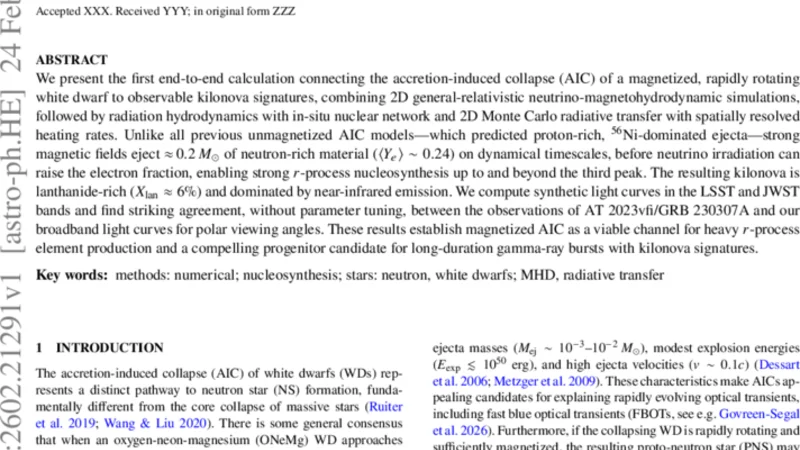
We present the first end-to-end calculation connecting the accretion-induced collapse (AIC) of a magnetized, rapidly rotating white dwarf to observable kilonova signatures, combining 2D general-relativistic neutrino-magnetohydrodynamic simulations, followed by radiation hydrodynamics with in-situ nuclear network and 2D Monte Carlo radiative transfer with spatially resolved heating rates. Unlike all previous unmagnetized AIC models - which predicted proton-rich, $^{56}$Ni-dominated ejecta - strong magnetic fields eject ${\sim 0.2 M_\odot}$ of neutron-rich material $(\langle Y_e \rangle \sim 0.24)$ on dynamical timescales, before neutrino irradiation can raise the electron fraction, enabling strong $r$-process nucleosynthesis up to and beyond the third peak. The resulting kilonova is lanthanide-rich $(X_{\rm lan} \approx 6%)$ and dominated by near-infrared emission. We compute synthetic light curves in the LSST and JWST bands and find striking agreement, without parameter tuning, between the observations of AT 2023vfi/GRB 230307A and our broadband light curves for polar viewing angles. These results establish magnetized AIC as a viable channel for heavy $r$-process element production and a compelling progenitor candidate for long-duration gamma-ray bursts with kilonova signatures.
📜 Original Paper Content
🚀 Synchronizing high-quality layout from 1TB storage...