Addressing leakage and mode suppression in angular power spectrum estimation for gravitational-wave backgrounds using pulsar timing arrays
Mapping gravitational-wave background (GWB) anisotropy with pulsar timing arrays (PTAs) is affected by harmonic-space mode suppression and mode coupling arising from an array's nonuniform sky response
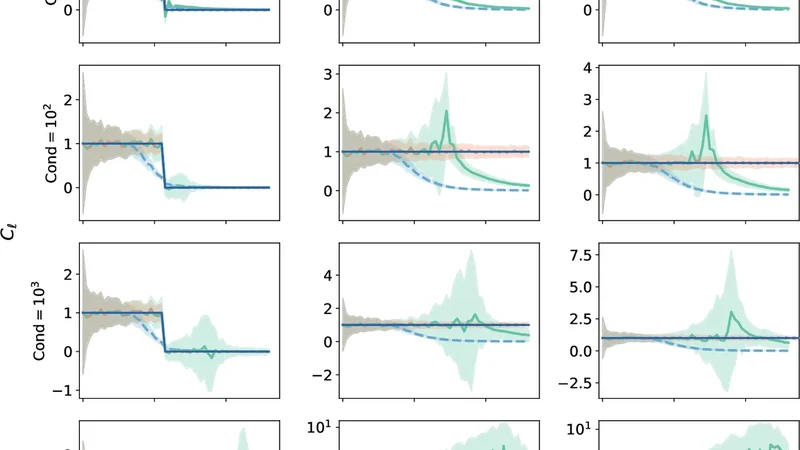
Mapping gravitational-wave background (GWB) anisotropy with pulsar timing arrays (PTAs) is affected by harmonic-space mode suppression and mode coupling arising from an array’s nonuniform sky response. Spherical harmonic expansions must be truncated at finite multipole l_max^rec, often set to l_max^N_pair$\equiv {\rm int}\left[\sqrt{\text{N_pair}}-1\right]$, where N_pair is the number of distinct pulsar pairs in an array. This choice is motivated by the counting argument that cross-correlations provide at most N_pair independent constraints. We obtain the multipole l_max^res corresponding to the maximum informative angular scale of a PTA. It is defined such that expansions to l_max^res (approximately) span the space of “observable skies” encoded in the N_pair eigenmaps of the Fisher information matrix, and therefore depends on the array configuration. We explicitly show that GWB power contained in multipoles l$\gtrsim$l_max^res do not significantly affect analyses that use expansions out to l_max^res, because the PTA response acts as a low-pass filter. In contrast, truncating at l_max^rec< l_max^res leads to leakage of small-scale angular power from l_max^rec<l$\leq$l_max^res. Even choosing l_max^rec=l_max^res, the standard frequentist estimator of the angular power spectrum C_l remains biased by the modes unobservable by the array. Although we can (partially) debias the standard estimator – improving its agreement with an injected spectrum – this reduction in bias comes at the expense of an increase in variance, particularly for poorly constrained modes with l$\gg$l_eff. We therefore recommend: (i) using l_max^res for PTA analyses involving spherical harmonic expansions, and (ii) using the debiased standard estimator for C_l recovery, but only out to multipoles l<l_eff ($\ll$l_max^res) corresponding to sufficiently constrained modes.
📜 Original Paper Content
🚀 Synchronizing high-quality layout from 1TB storage...