A Geometric Approach to Feedback Stabilization of Nonlinear Systems with Drift
The paper presents an approach to the construction of stabilizing feedback for strongly nonlinear systems. The class of systems of interest includes systems with drift which are affine in control and which cannot be stabilized by continuous state fee…
Authors: Hannah Michalska, Miguel Torres-Torriti
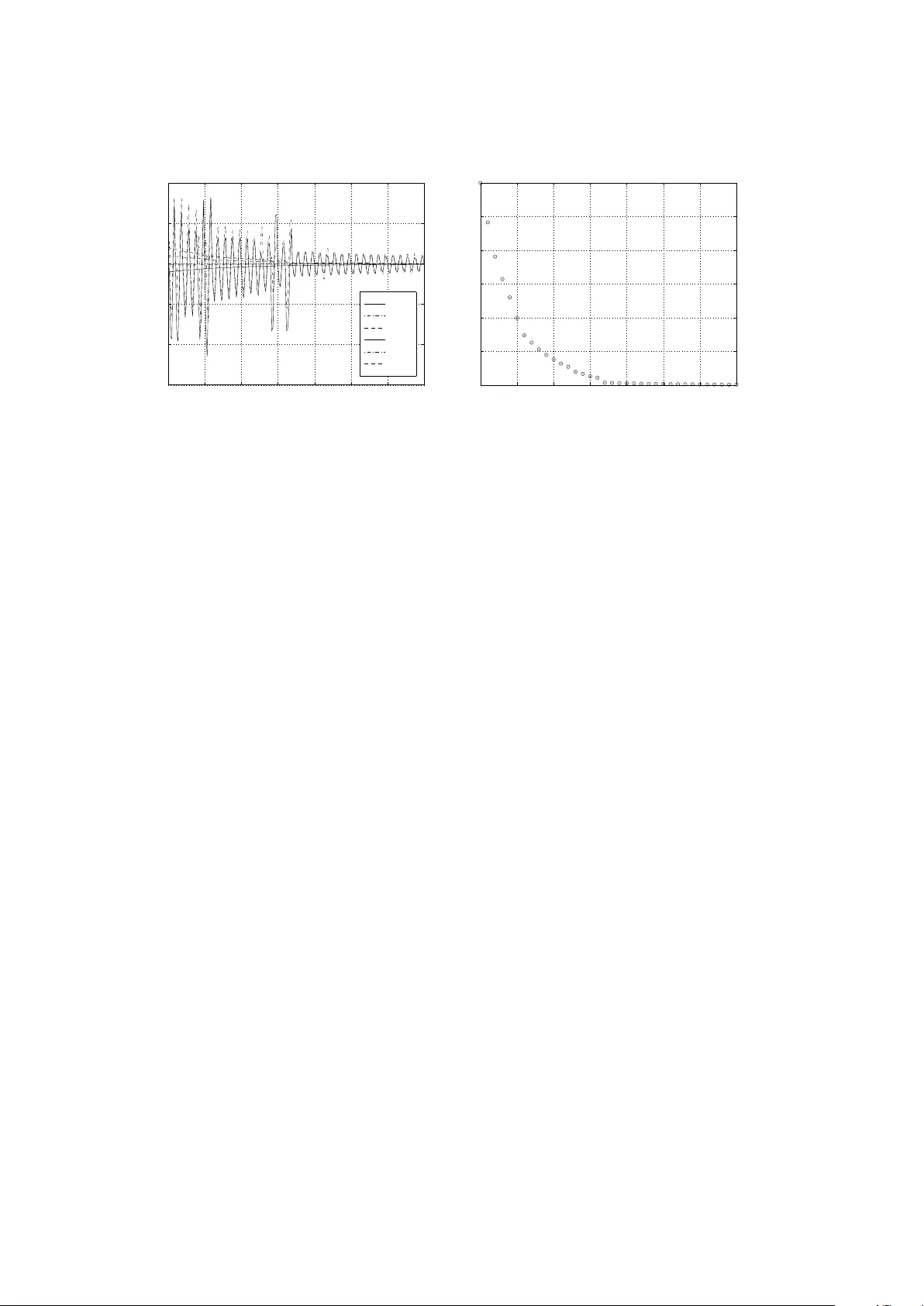
A Geometric Approac h to F eedbac k Stabilization of Nonlinear Systems with Drift ⋆ H. Mic halsk a , M. T orres-T orriti Dep artment of Ele ctric al & Computer Engine ering, McGil l University, 3480 University Str e et, Montr ´ eal, QC, Canada H3A 2A7 Abstract The pap er presen ts an approac h to the construction of stabilizing feedback for strongly nonlinear systems. The class of systems of in terest includes systems with drift whic h are affine in control and whic h cannot b e stabilized by con tinuous state feedbac k. The approac h is indep enden t of the selection of a Ly apunov t yp e func- tion, but requires the solution of a nonlinear programming satisficing pr oblem stated in terms of the logarithmic co ordinates of flows. As opp osed to other approac hes, p oin t-to-p oin t steering is not required to ac hieve asymptotic stability . Instead, the flo w of the con trolled system is required to intersect perio dically a certain reac hable set in the space of the logarithmic co ordinates. Key wor ds: Nonlinear systems with drift; Con trol syn thesis; Stabilization; Time-v arying state feedbac k; Systems on Lie groups. 1 In tro duction The paper presen ts an approac h to the design of feedbac k stabilizing controls for systems with drift whic h tak e the general form: Σ : ˙ x = f 0 ( x ) + m X i =1 f i ( x ) u i def = f u ( x ) (1) where, the state x ( t ) evolv es on R n , u def = [ u 1 , . . . , u m ], u i ∈ R are the control inputs, m < n , and f i , i = 0 , 1 , . . . , m , are real analytic v ector fields on R n . ⋆ This work was supp orted by NSERC of Canada under grant OGP-0138352. Email addr esses: michalsk@cim.mcgill.ca (H. Michalsk a), migueltt@cim.mcgill.ca (M. T orres-T orriti). Accepted in Systems & Con trol Letters (Apr. 2003), vol. 50, n. 4, pp. 303-318 © 2003 Elsevier Science. Cite DOI: https://doi.org/10.1016/S0167-6911(03)00169-5 F eedback stabilization of systems of this type can b e very c hallenging in the case when (1) fails to satisfy Bro ck ett’s necessary condition for the existence of con tinuous stabilizing state feedback laws, see [2]. Systems of this t yp e are encoun tered in a n umber of applications, for example, the con trol of rigid b o dies in space, con trol of systems with acceleration constrain ts, and control of a v ariet y of underactuated dynamical systems. Hence, the dev elopment of gener al stabilization approac hes for such systems deserv es further attention. As compared with driftless systems, relatively few approac hes ha ve so far b een prop osed for the stabilization of systems with drift. The difficulty of steering systems with drift arises from the fact that, in the most general case of non-recurrent or unstable drift, the system motion along the drift vector field needs to b e coun teracted b y enforcing system motions along adequately c hosen Lie brack et vector fields in the system’s underlying con trollabilit y Lie algebra. Such indirect system motions are complex to design for and can b e ac hieved only through either time-v arying op en-lo op controls or discontin uous state feedbac k. The ma jorit y of relev ant feedbac k stabilization metho ds for systems with drift found in the literature, contemplate systems of sp ecific structure and deliv er feedbac k laws whic h apply exclusiv ely to the particular mo dels considered, see for example [1,3,9,13,17,20,22,23]. More general feedbac k design metho dologies hav e b een prop osed in [10,7,15,18,19] and apply to systems in general form (1). The first systematic pro cedure for the construction of stabilizing piece-wise constant con trols w as presen ted in [10] and clearly demonstrates the difficulty of the problem. The metho d of [10] has b een applied in [7] to asymptotically steer the the attitude and angular v elo cit y of an underactuated spacecraft to the origin. General a veraging techniques on Lie groups ha ve b een successfully applied to attitude con trol in [15]. The Lie algebraic approac h outlined in [18] requires an analytic solution of a tra jectory intercep tion problem for the flo ws of the original system and its Lie algebraic extension in terms of the logarithmic co ordinates on the asso ciated Lie group. Suc h analytic solutions are generally difficult to deriv e. The approach in [19] draws on the ideas of [5,6], whic h apply to systems without drift. The metho d of [19] combines the construction of a p erio dic time-v arying critically stabilizing con trol with the on-line calculation of an additional correctiv e term to provide for asymptotic con vergence to the origin. In the ab ov e context, the con tributions of this pap er can b e described as follo ws. • An approach to stabilization of general systems of the form (1) is presented whic h is based on the explicit calculation of a reac hable set of desirable states for the controlled system. Suc h reac hable set is determined when the 2 system Σ is reformulated as a right-in v ariant system on an analytic, simply connected, nilp oten t Lie group and once the stabilization problem is re- stated accordingly . The reformulation allows for the time-v arying part of the stabilizing feedbac k con trol to b e deriv ed as the solution of a nonlinear programming problem for steering the open-lo op system Σ to the giv en reac hable set of states. The construction of the feedback law do es not require n umerical in tegration of the mo del differen tial equation and is indep enden t of the c hoice of a Ly apunov t yp e function. • Unlik e other approaches, [10,7,14,18,19], p oint-to-point steering is not re- quired to ac hieve asymptotic stabilit y . Instead, the flow of the con trolled system is required to in tersect p erio dically a certain reachable set in the space of the logarithmic coordinates. In con trast to [10,7,14], the approach presen ted here offers a proof for Ly apuno v asymptotic stabilit y of the con- trolled system to the equilibrium and applies to systems whose linearization ma y b e uncon trollable. • The approach presen ted might pro ve useful for the construction of feedback la ws with a reduced n umber of control discon tinuities and for the devel- opmen t of computationally feasible methods tow ard the design of smo oth time-v arying stabilizing feedback. This is b ecause the system is sho wn to remain asymptotically stable provided that the state of the system tra- v erses the sets of desirable states p erio dically in time. Since the sets of desirable states are t ypically large, the latter condition leav es m uch free- dom for impro ved design, whic h is not the case for previous metho ds based on p oint-to-point steering. • A fairly complex example is presen ted which clearly demonstrates the com- putational feasibility of the approach and its p otential for extension to non- nilp oten t systems. The example employs a specialized Maple softw are pac k- age recen tly dev elop ed by the authors to facilitate symbolic Lie algebraic calculations 1 . The proposed approac h is based on a differen t concept than those used in [10,7,15] and compares fa vourably with the previous methods prop osed in [18,19]. One adv an tage of the presen t approac h is that it do es not require the exact analytic solution of the tra jectory interception problem for the flo ws for the original and extended system, as in [18]. It also a voids the exp ensiv e on-line computation of the v alue and the gradien t of the Lyapuno v type func- tion whose level sets are the tra jectories of the critically stabilized system, as required in [19]. F urthermore, it should b e easier to apply to systems with larger dimension of the state or controllabilit y Lie algebra than the metho ds in [10,7]. 1 The Lie T o ols Package (L TP) is freely a v ailable at: http://www.cim.mcgill.ca/ ∼ migueltt/ltp/ltp.html 3 2 Problem Definition and Assumptions Problem Definition. Construct a time-varying c ontr ol law which glob al ly stabilizes system Σ to the origin. The sets of p ositiv e integers and non-negative reals are denoted by N and R + , resp ectiv ely . If F def = { f 0 , . . . , f m } is a family of v ector fields defined on R n then L ( F ) is used to denote the Lie algebra of vector fields generated by F , and L x ( F ) def = { f ( x ) | f ∈ L ( F ) } ⊂ R n . All v ector fields considered here are assumed to b e real, analytic, and complete, i.e. an y v ector field f is assumed to generate a globally defined one-parameter group of transformations acting on R n and denoted b y exp( tf ). This implies that for all t 1 , t 2 ∈ R , exp( t 1 f ) ◦ exp( t 2 f ) = exp(( t 1 + t 2 ) f ), and for all x ∈ R n , x ( t ) = exp( tf ) x satisfies the differen tial equation ˙ x = f with initial condition x (0) = x . It is a well kno wn fact, see [21, p. 95], that if all generators in F are analytic and complete then all v ector fields in L ( F ) are analytic and complete. Solutions to system Σ, starting from x (0) = x and resulting from the applica- tion of a con trol u , are denoted by x o ( t, x, u ), t ≥ 0. The follo wing h yp otheses are assumed to hold with resp ect to system Σ where P m denotes the family of piece-wise constan t functions, contin uous from the righ t, and defined on R m . H1. The v ector fields f 0 , . . . , f m : R n → R n are real, analytic, complete, and linearly indep endent, with f 0 (0) = 0, and generate a nilpotent Lie algebra of v ector fields L ( F ), such that its dimension is dim L ( F ) = r ≥ n + 1. H2. The system Σ is strongly con trollable, i.e. for any T > 0 and any t wo p oin ts x 0 , x f ∈ R n , x f is reachable from x 0 b y some con trol u ∈ P m of Σ in time not exceeding T ; i.e. there exists a control u ∈ P m and a time t ≤ T suc h that x o ( t, x 0 , u ) = x f . The method presen ted here emplo ys an arbitrary Lyapuno v t yp e function V : R n → R + whic h is only required to satisfy the follo wing conditions: H3.a. V is t wice con tin uously differen tiable with V (0) = 0. Additionally , there exists a constan t ζ > 0, such that for all x ∈ R n , ∥∇ V ( x ) ∥ ≥ ζ ∥ x ∥ . H3.b. V is positive definite and decrescent, i.e. there exist con tinuous, strictly increasing functions α ( · ) : R + → R + and β ( · ) : R + → R + , with α (0) = β (0) = 0, such that for all x ∈ R n , α ( ∥ x ∥ ) ≤ V ( x ) ≤ β ( ∥ x ∥ ). The function V is not a Ly apunov function in the usual sense in that it will b e allow ed to increase instantaneously along the tra jectories of the stabilized system. How ev er, in the sequel, the function V will still b e referred to as a Ly apunov function. 4 3 Basic F acts and Preliminary Results Let R F ( T , x ) denote the reachable set of Σ at time T from x by piece-wise constan t controls. A well known consequence of strong con trollability is that the condition for accessibilit y is satisfied, namely: span L x ( F ) = R n for all x ∈ R n . It is helpful to introduce the following subsets of diff ( R n ), the group (under comp osition) of diffeomorphisms on R n : G def = { exp( t 1 f u (1) ) ◦ · · · ◦ exp( t k f u ( k ) ) | u ( i ) ∈ R m ; t i ∈ R ; k ∈ N } G T def = { exp( t 1 f u (1) ) ◦ · · · ◦ exp( t k f u ( k ) ) | u ( i ) ∈ R m ; t i ≥ 0; k X i =1 t i = T ; k ∈ N } where f u ( i ) def = f 0 + P m j =1 f j u j ( i ) , and u j ( i ) are components of u ( i ) . By the strong con trollability h yp othesis, if G x and G T x denote the orbits through x of G and G T , respectively , i.e. G x = { g x | g ∈ G } and G T x = { g x | g ∈ G T } , then R F ( T , x ) = G T x = G x = R n , for any T > 0. The group G ⊂ diff ( R n ) is a subgroup of diff ( R n ), [12]. Moreo ver, by virtue of the results by R. Palais, [21], G can b e giv en a structure of a Lie group with Lie algebra isomorphic to L ( F ). The result of Palais [21], interpreted so as to apply to system Σ, is worth citing: Theorem 1 (P alais, [21], p. 95) L et L ( F ) b e a finite dimensional Lie al- gebr a of ve ctor fields define d on R n . Assume that al l the gener ators in F ar e analytic and c omplete. Then ther e exists a unique analytic, simply c on- ne cte d Lie gr oup H , whose underlying gr oup is a sub gr oup of diff ( R n ) , and a unique glob al action of this gr oup on R n define d as an analytic mapping ϕ : H × R n ∋ ( h, p ) → h ( p ) ∈ R n which induc es an isomorphism b etwe en the Lie algebr a, L ( H ) , of right invariant ve ctor fields on H , and L ( F ) . Pr e cisely, the isomorphism ϕ + L : L ( H ) → L ( F ) is c onstructe d by setting: ϕ + L ( λ )( p ) = ( dϕ p ) e ( λ ( e )) for al l λ ∈ L ( H ) , p ∈ R n wher e e ∈ H is the identity element, and ( dϕ p ) e is the differ ential of a mapping ϕ p : H → R n at identity. F or any p ∈ R n , the mapping ϕ p is define d by: ϕ p ( h ) = h ( p ) . This result has strong implications. It can be shown, see [12, Thm. 3.2.], that the isomorphism ϕ + L induces an isomorphism, denoted b y ϕ + G , b et ween the groups H and G . If for a constan t control u ∈ R m , λ ∈ L ( H ) and f u are related b y ϕ + L ( λ ) = f u , where f u is the righ t-hand side of (1), then the one-parameter group exp( tλ ) maps in to the one-parameter group exp( tf u ) as 5 follo ws, see [29, Thm. 2.10.3, p. 91]: ϕ + G (exp( tλ )) = exp( tϕ + L ( λ )) = exp( tf u ) for all t ≥ 0 Eac h element exp( t 1 f u (1) ) ◦ · · · ◦ exp( t k f u ( k ) ) ∈ G can th us b e expressed as ϕ + G { exp( t 1 λ 1 ) ◦ · · · ◦ exp( t k λ k ) } where: ϕ + L ( λ i ) = f u ( i ) for all i = 1 , . . . , k . It follo ws that H is given by: H = ( ϕ + G ) − 1 ( G ) = { exp( t 1 λ 1 ) ◦ · · · ◦ exp( t k λ k ) | λ i ∈ L ( H ) , ϕ + L ( λ i ) ∈ L ( F ); t i ∈ R ; k ∈ N } The ab ov e facts allow to reformulate the system Σ as a righ t inv arian t system Σ H ev olving on the Lie group H as follo ws. If the right inv arian t v ector fields η i ∈ L ( H ) are such that ϕ + L ( η i ) = f i for all i = 0 , . . . , m , then Σ H : ˙ S ( t ) = { η 0 + m X i =1 u i η i } S ( t ) with S (0) = e ; t ≥ 0 (2) The simplified notation used in the ab o ve expression for Σ H deserv es explana- tion. If T H h denotes the tangen t space to H at h ∈ H , then for any η ∈ T H e , the expression η S ( t ) denotes the image of η under the map dR S ( t ) : T H e → T H S ( t ) induced b y the map of righ t translation by S ( t ) ∈ H : h → hS ( t ), for all h ∈ H . In this notation, if η is represented by the curv e h ( τ ) ∈ H , τ ≥ 0, then η S ( t ) is represented by the curv e h ( τ ) S ( t ) ∈ H , τ ≥ 0. Under the assumptions made: Prop osition 2 The system Σ H is str ongly c ontr ol lable on H fr om the iden- tity e , i.e. given any T > 0 , any h ∈ H is r e achable fr om e ∈ H by a tr aje ctory of Σ H using a c ontr ol u ∈ P m , in time not exc e e ding T . Ther e exists a dif- fe omorphism b etwe en tr aje ctories of systems Σ and Σ H in the sense that: if S ( t ) , t ∈ [0 , T ] , is a tr aje ctory of Σ H thr ough e , c orr esp onding to a c onc atena- tion u ∈ P m of c onstant c ontr ols u ( i ) ∈ R m define d on intervals of lengths t i , i = 1 , . . . , j , r esp e ctively, then x o ( t, x, u ) = ϕ + G ( S ( t )) x , t ∈ [0 , T ] , is a tr aje c- tory of Σ thr ough the p oint x c orr esp onding to the same pie c e-wise c onstant c ontr ol u . PR OOF. The image of H T def = { exp( t 1 λ 1 ) ◦ · · · ◦ exp( t k λ k ) | λ i ∈ L ( H ) , ϕ + L ( λ i ) ∈ L ( F ); t i ∈ R ; P k i =1 t i = T , k ∈ N } under the group isomorphism ϕ + G is G T . Hence H = ( ϕ + G ) − 1 ( G ) = ( ϕ + G ) − 1 ( G T ) = H T , b y strong con trollability of Σ. It follo ws that system Σ H is strongly con trollable from the iden tity b ecause, for an y T > 0, R H ( T , e ) = H T e = H e = H where R H ( T , e ) is the reachable set from iden tity for system Σ H at time T , and H def = { η 0 , . . . , η m } . T o show that x o ( t, x, u ), t ∈ [0 , T ], is a tra jectory of Σ it suffices to notice that, since ϕ + G is a group isomorphism corresp onding to a Lie algebra isomorphism ϕ + L , 6 ϕ + G (exp( t 1 λ 1 ) ◦ · · · ◦ exp( t j λ j )) x = exp( t 1 ϕ + L ( λ 1 )) ◦ · · · ◦ exp( t j ϕ + L ( λ j )) x = exp( t 1 f u (1) ) ◦ · · · ◦ exp( t j f u ( j ) ) x 2 F or steering purp oses, it is useful to consider the Lie algebraic extension of Σ, Σ e , defined as Σ e : ˙ x = g 0 ( x ) + r − 1 X i =1 g i ( x ) v i def = g v ( x ) (3) where, for simplicit y of exp osition, the set g i , i = 1 , . . . , r − 1, is assumed to con tain a basis for L x ( F ) for an y x in a sufficien tly large neighbourho o d of the origin B (0 , R ), and where G def = { g 0 , . . . , g r − 1 } is a basis for L ( F ), and v def = [ v 1 , . . . , v r − 1 ]. Additionally , it is assumed that g i = f i for 0 ≤ i ≤ m , and the remaining v ector fields g i , m + 1 ≤ i ≤ r − 1, are some Lie brac kets of the system v ector fields f i . Let the solution of Σ e through a p oint x , and under the action of a con trol v , b e denoted by x e ( t, x, v ), t ≥ 0. By construction, b oth systems Σ and Σ e ha ve the same underlying algebra of v ector fields L ( F ). Additionally , system Σ e not only inherits the strong con trollability prop ert y of Σ, but is in fact instantaneously con trollable in any direction of the state space. It is hence muc h easier to steer than Σ whose motion along some directions has to b e generated by time-v arying controls, or else piece-wise constant switching controls. Similarly to Σ, the system Σ e can b e reformulated on the Lie group H as Σ e H : ˙ S e ( t ) = { µ 0 + r − 1 X i =1 v i µ i } S e ( t ) with S e (0) = e ; t ≥ 0 (4) with ϕ + L ( µ i ) = g i for all i = 0 , . . . , r − 1. Clearly , Proposition 2 also holds for Σ e H ; i.e. system Σ e H is strongly con trollable from identit y , and tra jectories of Σ e H map in to tra jectories of Σ e according to: x e ( t, x, v ) = ϕ + G ( S e ( t )) x , t ∈ [0 , T ]. Since H is analytic, simply connected, and nilpotent ( L ( H ) is nilpotent), it follo ws that the exp onential map on L ( H ) is a global diffeomorphism on to H , see [29, Thm. 3.6.2., p. 196]. Let { ψ 0 , . . . , ψ r − 1 } b e a basis of L ( H ) whic h, without the loss of generalit y , is ordered in such a wa y that ψ i = η i = µ i , i = 0 , . . . , m , and is such that the mapping R r ∋ ( t 0 , . . . , t r − 1 ) → exp( t 0 ψ 0 ) ◦ · · · ◦ exp( t r − 1 ψ r − 1 ) ∈ H (5) 7 is a global co ordinate c hart on H ; see Remark 3 on ho w to construct one suc h basis. This implies that the solutions to Σ H and Σ e H , whose common underlying Lie algebra is L ( H ), can b e expressed as products of exp onen tials: S ( t ) = r − 1 Y i =0 exp( γ i ( t ) ψ i ) and S e ( t ) = r − 1 Y i =0 exp( γ e i ( t ) ψ i ) (6) where the functions γ i , γ e i : R → R , are referred to as the γ -co ordinates of the flo ws S ( t ), S e ( t ), resp ectively , and can b e sho wn to satisfy a set of differential equations of the form, see [30]: Γ( γ ) ˙ γ = u d Γ( γ e ) ˙ γ e = v d γ (0) = γ e (0) = 0 (7) Here Γ( · ) : R r → R r × r is a real analytic, matrix v alued function of γ def = [ γ 0 , . . . , γ r − 1 ] T , the zero initial conditions corresp ond to S (0) = S e (0) = I , and u d def = [1 u 1 . . . u m 0 . . . 0] ∈ R r , and v d def = [1 v 1 . . . v r − 1 ] ∈ R r , (where the first comp onent of u d and v d corresp onds to the drift vector field). The solution to equation (7) is generally only local unless Γ( γ ) is in vertible for all γ . The inv ertibilit y of Γ( γ ) is ensured if a basis for L ( H ) is constructed as indicated in Remark 3; see also [30]. Remark 3 Sinc e L ( H ) is the Lie algebr a of the analytic, simply c onne cte d, nilp otent Lie gr oup H , then L ( H ) is solvable and thus ther e exists a chain of ide als 0 ⊂ I r − 1 ⊂ I r − 2 ⊂ · · · ⊂ I 0 = L ( H ) wher e e ach I i is exactly of dimension r − i . Without the loss of gener ality a b asis { ψ 0 , . . . , ψ r − 1 } for L ( H ) c an e asily b e c onstructe d so that e ach I i is gener ate d by { ψ i , . . . , ψ r − 1 } . As the exp onential map exp : L ( H ) → H is a glob al analytic diffe omorphism onto analytic, simply c onne cte d, nilp otent Lie gr oups, then any element h ∈ H has a unique r epr esentation as a single exp onential: h = exp r − 1 X i =0 θ i ψ i ! wher e θ i , i = 0 , 1 , . . . , r − 1 , ar e known as Lie-Cartan c o or dinates of the first kind. This exp onential c an further b e written as a pr o duct of exp onentials by showing that the mapping (5) is onto and one-to-one, thus making it a glob al chart for H . The fact that, in the b asis chosen ab ove, (5) is a bije ction would r e quir e pr o of. This pr o of is omitte d her e for r e asons of br evity (se e L emma on p age 326 of [26], for a similar ar gument). An algorithmic way to obtain a b asis for L ( H ) which satisfies the ab ove mentione d c onditions is to employ the c onstruction pr o c e dur e given by P. Hal l [24]. Remark 4 The r epr esentation (6) of the solution to e quation (2) is not unique. The r epr esentation in the form of the pr o duct of exp onentials (6) r esults fr om 8 the intr o duction of the Lie-Cartan c o or dinates of the se c ond kind (5) on the gr oup H ; se e [30]. A lternatively, as p ointe d out in R emark 3, the solution to (2) c an b e r epr esente d using the Lie-Cartan c o or dinates of the first kind, i.e. it is p ossible to write S ( t ) = exp r − 1 X i =0 θ i ( t ) ψ i ! wher e θ i : R → R , i = 0 , 1 , . . . , r − 1 , ar e the “c o or dinates” of such a solution; se e [16]. It is also known that the solution of (2) c an b e written in terms of a formal series of C ∞ functions on H . The last arises when (2) is solve d by Pic ar d iter ation giving rise to the Pe ano-Baker formula which exhibits the solution in terms of iter ate d inte gr als. Sp e cific al ly, S ( T ) defines the Chen-Fliess series of the input u ; se e [8, The or em III.2, p. 22] and [25, p. 695]. The e quivalenc e of the Chen-Fliess series r epr esentation and the r epr esentation thr ough the pr o duct of exp onentials of the solutions to (2) has b e en shown in [26] (se e The or em on p. 328). The pr o duct exp ansion in [26] uses P. Hal l b ases. 4 Stabilizing F eedbac k Con trol Design Generally , a control Lyapuno v function whic h leads to a smo oth feedback con trol law for system Σ is not guaranteed to exist. An alternative idea for the construction of a stabilizing feedback relies on achieving a perio dic decrease in an arbitrarily imp osed Lyapuno v type function V , through the action of a time-v arying con trol. P erio dic decrease is defined in terms of the condition V ( x ( t 0 + nT )) − V ( x ( t 0 + ( n − 1) T )) < 0, which is required to hold for all n ∈ N and where x ( t ), t ≥ t 0 , is the tra jectory of the closed-lo op system and T > 0 is the “p erio d” of decrease. T o construct a feedback control which guarantees a p erio dic decrease in V , it is conv enient to re-state the stabilization problem on the Lie group H . Since Σ e is instan taneously controllable in any direction of the state space, it is helpful to emplo y the extended system as the first instrumen t to achiev e suc h a decrease. T o this end, for any x ∈ B (0 , R ) let a set U e ( x ) of admissible extended con trols b e in tro duced as follo ws: U e ( x ) def = n v ∈ R r − 1 | ∇ V g v ( x ) < − η ∥ x ∥ 2 , ∥ v ∥ ≤ M ∥ x ∥ o where the constant R > 0 is sufficiently large to accommo date for all ini- tial conditions of in terest, and M > 0 is to b e chosen later. The set U e ( x ) translates in to a reachable set of states of the extended system Σ e at time T , 9 R G ( T , x, U e ( x )): R G ( T , x, U e ( x )) def = { z ∈ R n | z = x e ( T , x, v ) , v ∈ U e ( x ) } where x e ( T , x, v ) denotes the tra jectory of Σ e emanating from x at time t = 0 and resulting from the application of the control v ov er the time in terv al [0 , T ]. The reason for introducing U e ( x ) is explained in terms of the following result. Prop osition 5 Under hyp otheses H1–H3 ther e exists a time horizon T max > 0 such that for al l t > 0 and T ∈ [0 , T max ]: V ( z ) − V ( x ) ≤ − η 2 ∥ x ∥ 2 T (8) for al l z ∈ R G ( T , x, U e ( x )) . PR OOF. See App endix A. In this con text it is desirable to construct an op en lo op control for system Σ whic h guaran tees an equiv alent decrease in the Lyapuno v function as stated b y (8). This can b e ac hieved by the construction of an y ¯ u ∈ P m whic h ensures: x o ( T , x, ¯ u ) ∈ R G ( T , x, U e ( x )) (9) The ab ov e is a con trol problem for whic h the terminal constrain t set has no direct c haracterization. How ever, when (9) is re-stated on the Lie group H it translates in to a computationally feasible nonlinear programming problem whic h can b e form ulated in terms of the γ -co ordinates. This is done as follows. By virtue of the definitions in Section 2 the reac hable set R G ( T , x, U e ( x )) is the orbit G ( T , U e ( x )) x = R G ( T , x, U e ( x )) where G ( T , U e ( x )) def = { exp( T g v ) | v ∈ U e ( x ) } ⊂ G Also H ( T , U e ( x )) def = { S e ( T , v ) | v ∈ U e ( x ) } = ( ϕ + G ) − 1 G ( T , U e ( x )) ⊂ H where S e ( T , v ) denotes the v alue of the solution to equation (4) at time T and due to extended control v . When expressed in the global co ordinate sys- tem, (5), eac h elemen t of H ( T , U e ( x )) has the represen tation: S e ( T , v ) = r − 1 Y i =0 exp( γ e i ( T , v d ) ψ i ) (10) 10 where γ e ( T , v d ) def = [ γ e 0 , . . . , γ e r − 1 ]( T , v d ), is the v alue of the solution to equa- tion (7) at time T and due to control v d = [1 v ] T with v ∈ U e ( x ). Since x o ( T , x, ¯ u ) = ϕ + G r − 1 Y i =0 exp( γ i ( T , ¯ u d ) ψ i ) ! x where γ ( T , ¯ u d ) def = [ γ 0 , . . . , γ r − 1 ]( T , ¯ u d ) is the v alue of the solution to equa- tion (7) at time T and due to con trol ¯ u d = [1 ¯ u 0 . . . 0] T ∈ P r with ¯ u ∈ P m , then (9) holds if r − 1 Y i =0 exp( γ i ( T , ¯ u d ) ψ i ) ∈ H ( T , U e ( x )) Due to the represen tation (10), it hence follows that (9) holds if γ ( T , ¯ u d ) ∈ R γ ( T , U e ( x )) where R γ ( T , U e ( x )) def = { γ e ( T , v d ) | v ∈ U e ( x ) } F or an y c onstant con trol v d = [1 , v ] ∈ R r equation (7) can b e in tegrated sym b olically to yield γ e ( T , v d ) = R T 0 Γ − 1 ( γ e ( τ , v d )) d τ v d def = M ( T ) v d . Since Γ is nonsingular and triangular for any of its argumen ts γ e , then M ( T ) is also nonsingular and triangular for an y integrated tra jectory γ e ( τ , v d ), τ ∈ [0 , T ], with a constan t v d . Since one of the components of v d is equal to one (due to the presence of the drift v ector field), an analytic expr ession can b e deriv ed for the in verse mapping F : R r × R → R r − 1 suc h that v = F ( γ e ( T , v d ) , T ). It follo ws that R γ ( T , U e ( x )) = { γ ∈ R r | F ( γ , T ) ∈ U e ( x ) } (11) whic h is giv en explicitly and p ermits to express (9) as a nonlinear programming problem with respect to the v ariables parametrizing the piece-wise constan t con trol ¯ u . Assuming that such a parametrization is giv en by u ( k ) , k = 1 , . . . , s , s ∈ N , so that ¯ u ( τ ) def = u ( k ) , τ ∈ [ t k , t k + ε ) , εs = T and t 1 = 0 , t k = t k − 1 + ε, k = 1 , 2 , . . . , s the solution of (7), γ ( T , ¯ u d ), is also parametrized b y u ( k ) , k = 1 , . . . , s . The nonlinear programming problem equiv alent to (9) is hence stated as the follo wing satisficing pr oblem (SP): 11 SP: F or given constants η > 0, T > 0 and M > 0, and for x ∈ B (0 , R ), find feasible parameter vectors u ( k ) , k = 1 , . . . , s , suc h that: γ ( T , ¯ u d ) ∈ R γ ( T , U e ( x )) (12) Concerning the selection of the constan t M and the existence of solutions to SP , it is p ossible to sho w the follo wing. Prop osition 6 Under assumptions H1–H3, for any neighb ourho o d of the origin B (0 , R ) and any η > 0 , ther e exists a c onstant M ( R, η ) > 0 , such that a solution to SP exists for any x ∈ B (0 , R ) , and any c ontr ol horizon T > 0 , pr ovide d that s ∈ N , the numb er of switches in the c ontr ol se quenc e ¯ u , is al lowe d to b e lar ge enough. PR OOF. See App endix B. Prop osition 7 L et ¯ u ( x, τ ) , τ ∈ [0 , T ] , b e a c ontr ol gener ate d by the solution ¯ u to SP. Ther e exists a T max > 0 such that for al l T ∈ [0 , T max ]: V ( x o ( T , x, ¯ u )) − V ( x ) < − η 2 ∥ x ∥ 2 T (13) PR OOF. If ¯ u solves SP then γ ( T , ¯ u d ) ∈ R γ ( T , U e ( x )). Hence, there exists a con trol v ∈ U e ( x ) such that x o ( T , x, ¯ u ) = x e ( T , x, v ) ∈ R G ( T , x, U e ( x )) which pro ves (13) b y virtue of Prop osition 5. 2 The results presen ted ab ov e no w serve for the construction of the stabilizing feedbac k. 5 The Stabilizing F eedbac k and its Analysis The stabilizing feedbac k con trol, u c ( x, τ ), τ ≥ 0, x ∈ B (0 , R ) for system Σ is defined as a concatenation of solutions to SP , ¯ u ( x ( nT ) , τ ), τ ∈ [ nT , ( n + 1) T ], computed at discrete instan ts of time nT , n ∈ N ∪ { 0 } : u c ( x, τ ) def = ¯ u ( x ( n T ) , τ ) for all τ ∈ [ nT , ( n + 1) T ] , n ∈ N ∪ { 0 } (14) where x ( nT ) is the state of the closed-lo op system Σ at time nT . 12 Remark 8 • The c onc atenate d c ontr ol u c ( x, t ) is a fe e db ack c ontr ol in the sense that a solution to SP is c ompute d at e ach t = nT , n ∈ N ∪ { 0 } and thus dep ends on x ( nT ) . • An off-line c onstruction of the fe e db ack law c ould p ossibly b e envisage d in that the satisficing pr oblem c ould b e solve d on a finite c ol le ction of c omp act non-overlapping subsets C s c overing B (0 , R ) . The obje ctive function for the SP should for this purp ose b e mo difie d as fol lows: γ ( T , ¯ u d ) ∈ [ x ∈ C s R γ ( T , U e ( x )) • The c omputation of the analytic expr ession for the mapping F defining the r e achable set R γ ( T , U e ( x )) in (11) c an b e facilitate d by ade quate supp orting softwar e for symb olic manipulation of Lie algebr aic expr essions. Such soft- war e has b e en develop e d by the authors (se e [28]) in the form of a softwar e p ackage for Lie algebr aic c omputations in Maple which c an b e use d her e for the c onstruction of a b asis for the c ontr ol lability Lie algebr a, simplific ation of arbitr ary Lie br acket expr essions, and the derivation of the e quation for the evolution of the γ -c o or dinates. Theorem 9 L et T ∈ [0 , T max ] , wher e T max is sp e cifie d in Pr op osition 5 and let the c onstant M b e sele cte d as in Pr op osition 6. Supp ose ther e exists a c onstant C > 0 such that the solutions to SP ar e b ounde d as fol lows ∥ ¯ u ( x ( nT ) , τ ) ∥ ≤ C ∥ x ( nT ) ∥ for al l τ ∈ [0 , T ] , n ∈ N ∪ { 0 } (15) Under these c onditions, the c onc atenate d c ontr ol u c ( x, τ ) given by (14) r enders the close d-lo op system Σ uniformly asymptotic al ly stable. PR OOF. Let t k = t 0 + k T , k ∈ N , and let x ( t ) denote the state of the closed- lo op system at time t due to con trol (14). By Prop osition 7 the state of system Σ with con trol input (14) satisfies V ( x ( t k +1 )) − V ( x ( t k )) ≤ − φ ( ∥ x ( t k ) ∥ ) ∀ k ∈ N ∪ { 0 } (16) where φ ( ∥ x ( t k ) ∥ ) = η 2 ∥ x ( t k ) ∥ 2 T . By inv oking the Gron wall-Bellman lemma with ¯ u satisfying (15) it is easy to sho w that (see the pro of of Prop osition 5 in whic h the state of Σ e should b e replaced b y the state of Σ) for any constants R > 0 and T > 0, there exist constan ts r ∈ [0 , R ] and K > 0 such that ∥ x ( t k + τ ) ∥ ≤ ∥ x ( t k ) ∥ exp( K τ ) < R (17) 13 for all x ( t k ) ∈ B (0 , r ), and for all τ ∈ [0 , T ]. T o pro ve global uniform asymptotic stabilit y , it is necessary to sho w that: (1) the equilibrium p oint of (1) is uniformly stable, and (2) that the tra jectories x ( t ), t ≥ 0, con v erge to the origin uniformly with resp ect to time. (1) Uniform stabilit y: Uniform stabilit y is pro v ed b y sho wing that for all R > 0 there exists δ ( R ) > 0 suc h that for ∥ x ( t 0 ) ∥ < δ ( R ), the state remains in B (0 , R ), i.e. ∥ x ( t ) ∥ < R for all ∀ t, t 0 , with t ≥ t 0 . T o this end, define δ ( R ) def = β − 1 ( α ( r )). By assumption H3.b, α ( δ ) ≤ β ( δ ) = α ( r ), so δ ≤ r . F or all x ( t 0 ) ∈ B (0 , δ ) ⊂ B (0 , r ), we further hav e that β ( ∥ x ( t 0 ) ∥ ) < β ( δ ) = α ( r ) b ecause β ( · ) is strictly increasing. Therefore, by assumption H3.b: V ( x ( t 0 )) ≤ β ( ∥ x ( t 0 ) ∥ ) < α ( r ), and due to (16), V ( x ( t 1 )) < V ( x ( t 0 )) < α ( r ), whenev er x ( t 0 ) = 0. Again, b y assumption H3.b, α ( ∥ x ( t 1 ) ∥ ) ≤ V ( x ( t 1 )), which implies that α ( ∥ x ( t 1 ) ∥ ) < α ( r ), so ∥ x ( t 1 ) ∥ < r . No w, supp ose that V ( x ( t n )) < α ( r ), for some integer n . If x ( t n ) = 0 then, b y virtue of the same argumen t as the one presented ab ov e, V ( x ( t n +1 )) < V ( x ( t n )) < α ( r ), and α ( ∥ x ( t n +1 ) ∥ ) ≤ V ( x ( t n +1 )) < α ( r ), so, again ∥ x ( t n +1 ) ∥ < r . By induction, then ∥ x ( t k ) ∥ < r for all k ∈ N ∪ { 0 } , and b y direct application of (17), ∥ x ( t k + τ ) ∥ ≤ ∥ x ( t k ) ∥ exp( K τ ) < r exp( K τ ) ≤ R for all τ ∈ [0 , T ], k ∈ N ∪ { 0 } . It hence follo ws that system Σ with feedbac k la w (14) is uniformly stable. (2) Global uniform con v ergence: Global uniform conv ergence, requires the existence of a function ξ : R n × R + → R + suc h that, for all x ∈ R n , l im t →∞ ξ ( x, t ) = 0 and such that ∥ x ( t ) ∥ ≤ ξ ( x ( t 0 ) , t − t 0 ) for all t 0 , t ≥ t 0 . The last inequality translates into the require- men t that for all R > 0 there exists ¯ T ( R, x 0 ) ≥ 0 suc h that ∥ x ( t ) ∥ < R , for all t 0 > 0 and for all t ≥ t 0 + ¯ T . Let R > 0 b e an y giv en constan t and let δ ( R ) > 0 be suc h that ∥ x ( t 0 ) ∥ < δ ( R ) implies that ∥ x ( t ) ∥ < R for all t 0 ≥ 0 and for all t ≥ t 0 . Suc h a δ exists b y virtue of uniform stability of the closed-lo op system. It remains to show that there exists an index k ∗ ( x ( t 0 ) , δ ) ∈ N ∪ { 0 } suc h that ∥ x ( t k ∗ ) ∥ < δ (18) By contradiction, supp ose that ∥ x ( t k ) ∥ ≥ δ , for all k ∈ N ∪ { 0 } . By virtue of (16), for an y k ∈ N : V ( x ( t 1 )) − V ( x ( t 0 )) ≤ − φ ( ∥ x ( t 0 ) ∥ ) ≤ − φ ( δ ) . . . V ( x ( t k )) − V ( x ( t k − 1 )) ≤ − φ ( ∥ x ( t k − 1 ) ∥ ) ≤ − φ ( δ ) V ( x ( t k +1 )) − V ( x ( t k )) ≤ − φ ( ∥ x ( t k ) ∥ ) ≤ − φ ( δ ) 14 Adding the ab ov e ( k + 1) inequalities, yields V ( x ( t k +1 )) − V ( x ( t 0 )) ≤ − ( k + 1) φ ( δ ) whic h implies that V ( x ( t k +1 )) ≤ V ( x ( t 0 )) − ( k + 1) φ ( δ ) ≤ β ( ∥ x ( t 0 ) ∥ ) − ( k + 1) φ ( δ ) ∀ k ∈ N ∪ { 0 } The abov e inequalit y directly indicates the existence of a finite index ¯ k ≥ 0 suc h that V ( x ( t ¯ k )) < 0 whic h con tradicts the fact that V is p ositiv e definite. Hence, there exists a finite index k ∗ ∈ N such that (18) is v alid. Clearly , the index k ∗ dep ends only on the v alue of x ( t 0 ) and R , but is independent of the particular v alue of t 0 . By virtue of uniform stability , w e now conclude that for all t 0 ≥ 0 and for all t > t 0 + k ∗ T , ∥ x ( t ) ∥ < R , which prov es global uniform conv ergence with ¯ T ( x 0 , R ) def = k ∗ T . This completes the proof of global uniform asymptotic sta- bilit y of the closed-loop system Σ with con trol (14). 2 Remark 10 The assumption (15) is not r estrictive as it c an always b e sat- isfie d if the system is uniformly c ontr ol lable in the fol lowing sense: for every c onstant extende d c ontr ol v ther e exists a ¯ u ∈ P m such that x e ( T , x, v ) = x o ( T , x, ¯ u ) and ∥ ¯ u ( τ ) ∥ ≤ M 1 ∥ v ∥ , for al l τ ∈ [0 , T ] and some M 1 > 0 . The last r e quir ement is not include d as a design c ondition in SP for br evity of exp osition and b e c ause it is e asy to satisfy. 6 Stabilization of an Underactuated Rigid Body in Space The ab o ve stabilization approac h is applied to the follo wing example in R 6 with t wo inputs whic h mo dels an underactuated rigid-bo dy in space: ˙ x = f 0 ( x ) + f 1 ( x ) u 1 + f 2 ( x ) u 2 (19) where, f 0 ( x ) = (sin( x 3 ) sec( x 2 ) x 5 + cos( x 3 ) sec( x 2 ) x 6 ) ∂ ∂ x 1 + (cos( x 3 ) x 5 − sin( x 3 ) x 6 ) ∂ ∂ x 2 + ( x 4 + sin( x 3 ) tan( x 2 ) x 5 + cos( x 3 ) tan( x 2 ) x 6 ) ∂ ∂ x 3 + a x 4 x 5 ∂ ∂ x 6 , f 1 ( x ) = ∂ ∂ x 4 , f 2 ( x ) = ∂ ∂ x 5 , and x = [ x 1 , x 2 , x 3 , x 4 , x 5 , x 6 ] T with a = − 0 . 5; see [4] for details on the mo del deriv ation. Although more ef- fectiv e stabilization metho ds for this particular system hav e b een constructed 15 in the literature, these explicitly exploit the structure and the form of the sys- tem equations. The purp ose of this example is merely to explain the approach presen ted which applies to systems with drift, in their full generalit y . The mo del used here is non-nilp oten t, thus it do es not lend itself directly to the application of the metho d presen ted. It was how ev er selected to indicate to the reader that the approac h can b e extended to non-nilp otent systems, pro- vided that the last are suitably “appro ximated” by nilp oten t systems. At this stage, it is not our aim to in tro duce rigorous criteria for obtaining such appro x- imations (see [11]), but rather to demonstrate that ev en a t yp e of nilp otent truncation of the controllabilit y Lie algebra of the original system can pro ve sufficien t to implemen t the metho d. Ob viously , an y suc h approximation or truncation should necessarily preserve con trollability of the system. It is fur- ther kno wn, (see Theorem 2 in [14]), that the steering error in tro duced while emplo ying a truncated v ersion of the con trollabilit y Lie algebra is a decreasing function of the distance b etw een the initial and target p oin ts. It follows that the steering error can b e controlled by selecting an adequately small time hori- zon T . Both the degree of nilpotency and the horizon T can b e selected on a trial and error basis by requesting p erio dic decrease in the Lyapuno v function whic h is a directly v erifiable criterion for the adequacy of the truncation. In the ab o v e context, system (19) is assumed to be approximated b y another system of a similar structure ˜ Σ : ˙ x = g 0 ( x ) + g 1 ( x ) u 1 + g 2 ( x ) u 2 whose controllabilit y Lie algebra, L ( g 0 , g 1 , g 2 ), corresp onds to a nilp otent trun- cation of order four of L ( f 0 , f 1 , f 2 ). This is to say that L ( g 0 , g 1 , g 2 ) is nilp oten t of order four and has { g 0 , g 1 , g 2 , [ g 0 , g 1 ] , [ g 0 , g 2 ] , [ g 1 , [ g 0 , g 2 ]] , [[ g 0 , g 1 ] , [ g 0 , g 2 ]] } as its basis. Such truncation preserves the STLC prop ert y of the system, as is easily v erified using Theorem 7.3 in [27]. The differen tial equations (7) for the evolution of the γ -co ordinates for the appro ximating system are: 16 ˙ γ 0 ˙ γ 1 ˙ γ 2 ˙ γ 3 ˙ γ 4 ˙ γ 5 ˙ γ 6 = 1 0 0 0 0 0 0 0 1 0 0 0 0 0 0 0 1 0 0 0 0 0 − γ 0 0 1 0 0 0 0 0 − γ 0 0 1 0 0 0 γ 0 γ 2 γ 0 γ 1 − γ 2 − γ 1 1 0 0 − aγ 2 0 γ 2 γ 0 γ 3 − aγ 2 0 γ 1 aγ 0 γ 2 aγ 0 γ 1 − γ 3 − aγ 0 1 u 0 u 1 u 2 u 3 u 4 u 5 u 6 (20) with γ i (0) = 0, i = 0 , 1 , . . . , 6. A detailed deriv ation of these equations is presen ted in [28] and makes extensiv e use of the pac k age for Lie algebraic computations also describ ed in [28]. A quadratic function V ( x ) = 1 2 ∥ x ∥ 2 is c hosen to define U e ( x ). In tegrating (20) with constant controls v i o ver the interv al [0 , T ] yields the required map F : R 7 × R → R 6 : v 1 = F 1 ( γ e , T ) = γ e 1 ( T ) T v 2 = F 2 ( γ e , T ) = γ e 2 ( T ) T v 3 = F 3 ( γ e , T ) = 1 T γ e 3 ( T ) + γ e 0 ( T ) γ e 1 ( T ) 2 v 4 = F 4 ( γ e , T ) = 1 T γ e 4 ( T ) + γ e 0 ( T ) γ e 2 ( T ) 2 v 5 = F 5 ( γ e , T ) = 1 T γ e 5 ( T ) + γ e 1 ( T ) γ e 4 ( T ) 2 + γ e 2 ( T ) γ e 3 ( T ) 2 − γ e 0 ( T ) γ e 1 ( T ) γ e 2 ( T ) 6 v 6 = F 6 ( γ e , T ) = 1 T γ e 6 ( T ) + a γ e 0 ( T ) γ e 5 ( T ) 2 + γ e 3 ( T ) γ e 4 ( T ) 2 + a γ e 0 2 ( T ) γ e 1 ( T ) γ e 2 ( T ) 12 − γ e 0 ( T ) γ e 2 ( T ) γ e 3 ( T ) 12 (1 + a ) + γ e 0 ( T ) γ e 1 ( T ) γ e 4 ( T ) 12 (1 − a ) The abov e results in the follo wing expression for the reachable set in the γ -co ordinates: R γ ( T , U e ( x )) = ( γ | 6 X i =0 ∇ V g i ( x ) F i ( γ , T ) < − η ∥ x ∥ 2 , ∥ F ( γ , T ) ∥ ≤ M ∥ x ∥ ) The expressions for γ ( T , ¯ u d ) in terms of the constant parameters defining ¯ u d ∈ P r are easily obtained b y sym b olic integration and are subsequently emplo yed to solv e SP . The v alues s = 6, T = 0 . 1, η = 1, M = 10, R = 2 and C = 50, w ere assumed in the solution of SP . The sim ulation results are 17 obtained using an initial condition x 0 = [ − 0 . 1 0 0 . 2 0 0 0 . 1] T and are sho wn in Figure 1. 0 0.5 1 1.5 2 2.5 3 3.5 −1.5 −1 −0.5 0 0.5 1 Time x(t) x 1 (t) x 2 (t) x 3 (t) x 4 (t) x 5 (t) x 6 (t) 0 0.5 1 1.5 2 2.5 3 3.5 0 0.005 0.01 0.015 0.02 0.025 0.03 Time V(kT) a b (a) State tra jectory x ( t ). (b) F unction V ( x ( t )) for t = k T , k = 0 , 1 , . . . , 35. Fig. 1. Results for the stabilization of the rigid bo dy obtained with the concatenated con trol u c ( x, τ ). 7 Conclusions The presen ted stabilizing feedback design approac h applies to general systems with drift for whic h con trollable linearizations, as w ell as contin uous stabilizing state feedbac k laws, ma y not exist. The approac h is computationally exp ensiv e, but less so as compared with [19]. As compared with the control pro cedure of [10], it provides a more systematic to ol for generation of complicated Lie brac ket motions of the system whic h migh t b e necessary in the pro cess of stabilization. The approac h do es not deliv er the feedbac k uniquely as it employs arbitrary solutions to a satisficing nonlinear programming problem. This can b e view ed as the strength of the metho d, as it leav es the designer muc h freedom to accommo date for other goals. F or example, it may be desired to solv e SP while sim ultaneously minimizing the num b er of discontin uities in the op en lo op control or else to construct a time-v arying contin uous con trol. F uture researc h is aimed at exploring p ossible simplifications which migh t originate from a particular structure of the W ei-Norman equations describing the ev olution of the flo w of the system on the Lie group. 18 A Pro of of Prop osition 5 Since V is twice contin uously differentiable, g v is analytic and linear in v , and g 0 (0) = 0, then ∇ V and g v are Lipschitz contin uous on B (0 , 2 R ), uniformly with resp ect to v = [ v 1 , . . . , v r − 1 ] T satisfying ∥ v ∥ ≤ M ∥ x ∥ . Hence, there exists a K > 0 such that: ∥ g w ( y ) − g v ( x ) ∥ ≤ K ∥ y − x ∥ and ∥∇ V ( y ) − ∇ V ( x ) ∥ ≤ K ∥ y − x ∥ for all x ∈ B (0 , R ), y ∈ B (0 , 2 R ), and for any constan t v and w suc h that ∥ v ∥ ≤ M ∥ x ∥ and ∥ w ∥ ≤ M ∥ x ∥ . Let x e ( t ) def = x e ( t, x, v ), t ≥ 0. First, it is shown that there exists a T 1 > 0 and a constan t K 1 > 0 such that ∥ x e ( s ) − x ∥ ≤ ∥ x ∥ (exp( K s ) − 1) (A.1) and ∥ x e ( s ) ∥ ≤ K 1 ∥ x ∥ (A.2) for all s ∈ [0 , T 1 ] suc h that x e ( s ) ∈ B (0 , 2 R ). T o this end it suffices to notice that ∥ x e ( s ) − x ∥ ≤ Z s 0 ∥ g v ( x ) ∥ d τ + Z s 0 ∥ g v ( x e ( τ )) − g v ( x ) ∥ d τ ≤ K ∥ x ∥ s + Z s 0 K ∥ x e ( τ ) − x ∥ d τ whic h, b y the application of the Gronw all-Bellman lemma, yields inequal- it y (A.1). It can b e sho wn that if T 1 is chosen so that (exp( K T 1 ) − 1) ≤ 1 2 then (A.1) holds for s ∈ [0 , T 1 ]. By contradiction, supp ose that there exists an s 1 < T 1 suc h that ∥ x e ( s 1 ) ∥ = 2 R . It follows that 2 R ≤ ∥ x ∥ + ∥ x e ( s 1 ) − x ∥ ≤ R + ∥ x ∥ (exp( K s 1 ) − 1) ≤ 3 2 R whic h is false, and hence (A.1) is v alid for s ∈ [0 , T 1 ]. Inequalit y (A.2) follows from (A.1) since ∥ x e ( s ) ∥ ≤ ∥ x e ( s ) − x ∥ + ∥ x ∥ ≤ ∥ x ∥ exp( K s ) ≤ K 1 ∥ x ∥ with K 1 = exp( K T 1 ). 19 No w, V ( x e ( T )) − V ( x ) ≤ ∇ V ( x ) g v ( x ) T + Z T 0 ∥∇ V ( x e ( s )) g v ( x e ( s )) − ∇ V ( x ) g v ( x ) ∥ d s (A.3) ≤ − η ∥ x ∥ 2 T + ¯ K ∥ x ∥ Z T 0 ∥ x e ( s ) − x ∥ d s b ecause ∥∇ V ( x e ( s )) g v ( x e ( s )) − ∇ V ( x ) g v ( x ) ∥ ≤ ∥∇ V ( x e ( s )) g v ( x e ( s )) − ∇ V ( x e ( s )) g v ( x ) ∥ + ∥∇ V ( x e ( s )) g v ( x ) − ∇ V ( x ) g v ( x ) ∥ ≤ ¯ K ∥ x ∥ ∥ x e ( s ) − x ∥ with ¯ K = K 2 ( K 1 + 1). Hence, if T < T 1 then x e ( s ) ∈ B (0 , 2 R ) for all s ∈ [0 , T ] and, using (A.1) in (A.3), yields V ( x e ( T )) − V ( x ) ≤ − η ∥ x ∥ 2 T + ¯ K ∥ x ∥ 2 Z T 0 (exp( K s ) − 1) d s ≤ − η 2 ∥ x ∥ 2 q ( T ) where q ( T ) def = 2 + 2 ¯ K η T − 2 ¯ K η K (exp( K T ) − 1). If r ( T ) def = q ( T ) − T , then r (0) = 0 and r ′ (0) = 1, so there exists a T max ≤ T 1 suc h that r ( T ) ≥ 0 for all T ∈ [0 , T max ]. Hence q ( T ) ≥ T for all T ∈ [0 , T max ] whic h prov es (8). □ B Pro of of Prop osition 6 F or any ϵ ∈ (0 , η ζ 2 ] and an y giv en x ∈ B (0 , R ) let z ( x ) def = − ϵ ∇ V T ( x ) Then, b y virtue of h yp othesis H3.b, z ( x ) satisfies ∇ V z ( x ) = − ϵ ∥∇ V ( x ) ∥ 2 ≤ − ϵζ 2 ∥ x ∥ 2 ≤ − η ∥ x ∥ 2 and is realizable as the righ t-hand side of the extended system (3), i.e. there exists an extended con trol v such that g 0 ( x ) + r − 1 X i =1 g i ( x ) v i = z ( x ) Clearly , v ( x ) = Q † ( x ) ( z ( x ) − g 0 ( x )) , v = [ v 1 v 2 . . . v r − 1 ] T 20 where Q † = Q T Q Q T − 1 is the pseudo-in v erse of the n × ( r − 1) matrix Q ( x ) = [ g 1 ( x ) g 2 ( x ) . . . g r − 1 ( x )], which is guaranteed to exist for all x ∈ R n b ecause rank Q ( x ) = n by construction of the extended system (3). Moreov er, Q † is a smo oth matrix function of x , th us there exists a constant c ( R ) > 0 such that ∥ Q † ( x ) ∥ ≤ c, ∀ x ∈ B (0 , R ) By Lipsc hitz contin uity of g 0 and ∇ V , there exist constants d ( R ) > 0 and K ( R ) > 0 suc h that: ∥ v ∥ ≤ ∥ Q † ( x ) ∥ ∥ z ( x ) − g 0 ( x ) ∥ ≤ ∥ Q † ( x ) ∥ ( ∥ z ( x ) ∥ + ∥ g 0 ( x ) ∥ ) ≤ c η K ζ 2 ∥ x ∥ + d ∥ x ∥ ! and hence with M = c η K ζ 2 + d , the extended control v is in the set U e ( x ); it is only one of many con trols which satisfy v ∈ U e ( x ). Let γ e ( T ) be the γ -co ordinates of the flo w at time T of the extended system (3) with control v . Then γ e ( T ) ∈ R γ ( T , U e ( x )). By virtue of the controllabilit y assumption H2, there exists an op en lo op control ¯ u ∈ P m suc h that γ e ( T , v d ) = γ ( T , ¯ u d ). Hence, γ ( T , ¯ u d ) ∈ R γ ( T , U e ( x )) thus pro ving the existence of solutions to SP at an y x ∈ B (0 , R ). □ References [1] A.M. Blo ch, M. Reyhanoglu and N.H. McClamroch, Con trol and stabilization of nonholonomic dynamic systems, IEEE T r ans. A utomat. Contr ol 37 (1992) 1746–1757. [2] R.W. Brock ett, Asymptotic stabilit y and feedback stabilization, in: R.W. Bro c k ett, R.S. Millman, and H.J. Sussmann, eds., Differ ential Ge ometric Contr ol The ory (Birkh¨ auser, 1983) 181–191. [3] F. Bullo, N. E. Leonard and A. D. Lewis, Con trollability and motion algorithms for underactuated Lagrangian systems on Lie groups, IEEE T r ans. Automat. Contr ol 45 (2000) 1437–1454. [4] V.T. Copp ola and N.H. McClamro c h, Spacecraft attitude control, in: W. S. Levine, ed., Contr ol System Applic ations (CR C Press, 2000) 1303–1315. [5] J.-M. Coron and J.-B. Pomet, A remark on the design of time-v arying stabilizing feedbac k laws for controllable systems without drift, Nonline ar Contr ol Systems Design Symp osium ’92 (NOLCOS92) (Bordeaux, F rance, June 1992) 413–417. 21 [6] J.-M. Coron, Global asymptotic stabilization for con trollable systems without drift, Math. Contr ol Signals Systems , 5 (1992) 295–312. [7] P .E. Crouch, Spacecraft attitude control and stabilization: Applications of geometric control theory to rigid bo dy models, IEEE T r ans. Automat. Contr ol 29 (1984) 321–331. [8] M. Fliess, R ´ ealisation locale des syst` emes non lin ´ eaires, alg` ebres de Lie filtr´ ees transitiv es et s´ eries g ´ en ´ eratrices non comm utatives, Inventiones Mathenatic ae 71 (1983) 521–537. [9] J.-M. Go dha vn, A. Balluchi, L.S. Cra wford and S.S. Sastry , Steering of a class of nonholonomic systems with drift terms, Automatic a J. IF AC 35 (1999) 837– 847. [10] H. Hermes, On the synthesis of a stabilizing feedbac k con trol via Lie algebraic metho ds, SIAM J. Contr ol Optim. 18 (1980) 353–361. [11] H. Hermes, Nilpotent and high-order approximations of vector field systems, SIAM J. Contr ol Optim. 33 (1991) 238–264. [12] R. M. Hirschorn, Con trollability in nonlinear systems, J. Differ ential Equations 19 (1975) 46–61. [13] I.V. Kolmanovsky , N.H. McClamro c h and V.T. Copp ola, Con trollability of a class of nonlinear systems with drift, Pr o c. 33 rd Confer enc e on De cision & Contr ol , Lak e Buena Vista, Florida, U.S.A., (1994), 1254–1255. [14] G. Lafferriere and H. J. Sussmann, A differential geometric approach to motion planning, in: Z. Li, and J. F. Canny , eds., Nonholonomic Motion Planning (Klu wer Academic Publishers, 1993) 235–270. [15] N.E. Leonard and P .S. Krishnaprasad, Averaging on Lie groups, attitude, con trol and drift, Pr o c. 27 th A nnual Confer enc e on Information Scienc es and Systems , The Johns Hopkins Univ ersity (Marc h 1993) 369–374. [16] W. Magnus, On the exp onen tial solution of differen tial equations for a linear op erator, Commun. Pur e Appl. Math. VI I (1954) 649–673. [17] R. M’Closk ey and P . Morin, Time-v arying homogeneous feedbac k: design to ols for the exp onen tial stabilization of systems with drift, Internat. J. Contr ol 71 (1998) 837–869. [18] H. Michalsk a and F. U. Rehman, Time-v arying feedback syn thesis for a class of nonhomogeneous systems, Pr o c. 36 th Confer enc e on De cision & Contr ol , San Diego, California, U.S.A., (1997), 4018–4021. [19] H. Mic halsk a and M. T orres-T orriti, Time-v arying stabilizing feedback con trol for nonlinear systems with drift, Pr o c. 40 th Confer enc e on De cision and Contr ol , Orlando, Florida, U.S.A., (2001), 1767–1768. [20] P . Morin and C. Samson, Time-v arying exp onential stabilization of a rigid spacecraft with t wo control torques, IEEE T r ans. Automat. Contr ol 42 (1997) 528–534. 22 [21] R. S. Palais, Glob al F ormulation of the Lie The ory of T r ansformation Gr oups , V ol. 22, Mem. A mer. Math. So c. (AMS, 1957). [22] K. Y. P ettersen and O. Egeland, Time-v arying exp onential stabilization of the p osition and attitude of an underactuated autonomous underw ater vehicle, IEEE T r ans. A utomat. Contr ol 44 (1999) 112–115. [23] M. Reyhanoglu, A. v an der Schaft, N.H. McClamro c h and I.V. Kolmanovsky , Dynamics and con trol of a class of underactuated mechanical systems, IEEE T r ans. A utomat. Contr ol 44 (1999) 1663–1671. [24] J.-P . Serre, Lie Algebr as and Lie gr oups (W. A. Benjamin, New Y ork, 1965). [25] H. J. Sussmann, Lie brack ets and lo cal controllabilit y: a sufficient condition for scalar-input systems, SIAM J. Contr ol Optim. 21 (1983) 686–713. [26] H. J. Sussmann, A pro duct expansion for the Chen series, in: C. I. Byrnes and A. Lindquist, eds., The ory and Applic ations of Nonline ar Contr ol Systems (Elsevier Science Publishers B. V., North-Holland, 1986) 323-335. [27] H. J. Sussmann, A general theorem on lo cal con trollabilit y , SIAM J. Contr ol Optim. 25 (1987) 158–194. [28] M. T orres-T orriti and H. Mic halsk a, A softw are pack age for Lie algebraic computations, submitted to SIAM R ev. (2002). [29] V. S. V aradara jan, Lie Gr oups, Lie A lgebr as, and their R epr esentations (Springer-V e rlag, 1984). [30] J. W ei and E. Norman, On global represen tations of the solutions of linear differen tial equations as pro ducts of exp onentials, Pr o c. Amer. Math. So c. 15 (1964) 327–334. 23
Original Paper
Loading high-quality paper...
Comments & Academic Discussion
Loading comments...
Leave a Comment