Arxiv 2512.23731
A new modelling approach shows how the Earth's hidden vibrations may drive global weather dynamics and atmospheric pressure variations, hinting that the planet's own beat could be imprinted on our cli
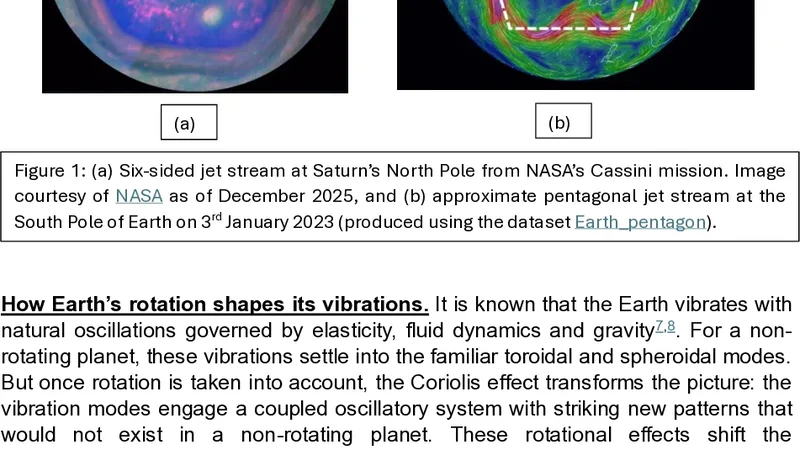
A new modelling approach shows how the Earth’s hidden vibrations may drive global weather dynamics and atmospheric pressure variations, hinting that the planet’s own beat could be imprinted on our climate. The atmospheric rotational patterns of the mean sea level pressure, in connection to the development of powerful storms, are shown to be caused by Earth’s rotational elastic dynamics and earthquake-induced oscillations. These seismic excitations are discussed in relation to storm formation and the global atmospheric patterns of high-pressure regions. Introduction. The years 2024-2025 were marked by a series of extreme seismic events and unusually high variations of mean sea pressure level -from as low as 921 hPa to as high as 1060 hPa, which was similar to the years 1883-1884, with one of the largest eruptions of Krakatoa in 1883, and the lowest ever recorded mean sea level pressure in the British Isles of 926 hPa in January of 1884, as described in the 1884 and 1930 Nature articles 1,2 . Recent research 3,4,5 reveals that our planet undergoes elastic oscillations 3 , resonating like an immense gyroscope. The natural vibrations of the Earth ripple through the tectonic plate boundaries and echo in the atmosphere 6 , revealing hidden connections between the Earth’s elastic dynamics and changing weather patterns. By analysing the natural resonances, scientists can uncover how the planet’s movement may align with atmospheric pressure variations, providing a new perspective on the interconnected rhythms of the Earth and sky. Numerical models tie the Earth’s vibrations to real-world atmospheric variability, suggesting that the planet’s ‘heartbeat’ may be felt both beneath our feet and above our heads.
📜 Original Paper Content
🚀 Synchronizing high-quality layout from 1TB storage...