Extensions of Formal Hodge Structures
We define and study the properties of the category ${\sf FHS}_n$ of formal Hodge structure of level $\le n$ following the ideas of L. Barbieri-Viale who discussed the case of level $\le 1$. As an application we describe the generalized Albanese varie…
Authors: Nicola Mazzari
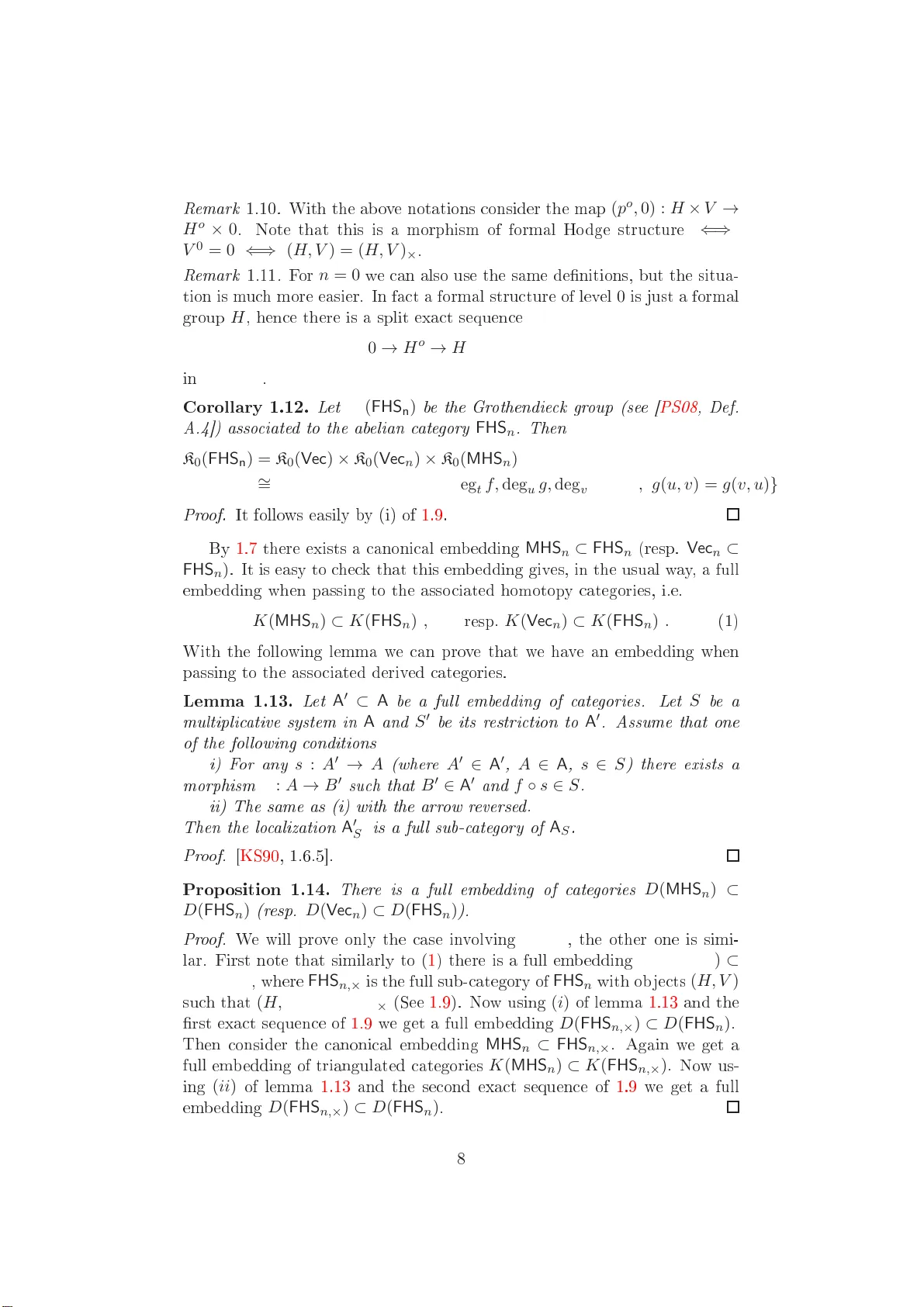
Extensions of F ormal Ho dge Strutures Niola Mazzari No v em b er 11, 2018 Abstrat W e dene and study the prop erties of the ategory FHS n of formal Ho dge struture of lev el ≤ n follo wing the ideas of L. Barbieri-Viale who disussed the ase of lev el ≤ 1 . As an appliation w e desrib e the generalized Albanese v ariet y of Esnault, Sriniv as and Vieh w eg via the group Ext 1 in FHS n . This form ula generalizes the lassial one to the ase of prop er but non neessarily smo oth omplex v arieties. In tro dution The aim of this w ork is to dev elop the program prop osed b y S. Blo h, L. Barbieri-Viale and V. Sriniv as ([ BS02 ℄,[ BV07 ℄) of generalizing Deligne mixed Ho dge strutures pro viding a new ohomology theory for omplex algebrai v arieties. In other w ords to onstrut and study ohomologial in v arian ts of (prop er) algebrai s hemes o v er C whi h are ner than the asso iated mixed Ho dge strutures in the ase of singular spaes. F or an y natural n um b er n > 0 (the lev el) w e onstrut an ab elian ategory , FHS n , and a family of funtors H n,k ♯ : ( Sch / C ) ◦ → FHS n 1 ≤ k ≤ n su h that 1. The ategory MHS n of mixed Ho dge struture of lev el ≤ n is a full sub-ategory of FHS n . 2. There is a forgetful funtor f : F HS n → MHS n s.t. f (H n,k ♯ ( X )) = H n ( X ) (funtorially in X ) is the usual mixed Ho dge struture on the Betti ohomology of X , i.e. H n ( X ) := H n ( X an , Z ) . Roughly sp eaking the sharp ohomology ob jets H n,k ♯ ( X ) onsist of the singular ohomology groups H n ( X an , Z ) , with their mixed Ho dge struture, plus some extra struture. W e remark that H n,k ♯ ( X ) is ompletely determined b y the mixed Ho dge struture on H n ( X ) when X is prop er and smo oth; the extra struture sho ws up only when X is not prop er or singular. 1 The motiv ating example is the follo wing. Let X b e a prop er algebrai s heme o v er C . Denote H i ( X ) := H i ( X an , Z ) , H i ( X ) C := H i ( X ) ⊗ C and let H i,j dR ( X ) := H i ( X an , Ω 0 b e an in teger. W e dene the ategory V ec n , as follo ws. The ob jets are diagrams of n − 1 omp osable arro ws of V ec denoted b y V : V n v n − → V n − 1 v n − 1 − → V n − 2 → · · · → V 1 . Let V , V ′ ∈ V ec n , a morphism f : V → V ′ is a family f i : V i → V ′ i of C -linear maps su h that 3 V i +1 f i +1 / / V i f i V ′ i +1 / / V ′ i is omm utativ e for all 1 ≤ i ≤ n . Denition 1.1 (lev el = 0 ) . W e dene the ategory of formal Ho dge stru- tur es of level 0 (t wisted b y k ), FHS 0 ( k ) as follo ws: the ob jets are formal groups H su h that H et is a pure Ho dge struture of t yp e ( − k , − k ) ; mor- phism are maps of formal groups. Equiv alen tly FHS 0 ( k ) is the pro dut ategory MHS 0 ( k ) × V ec . Denition 1.2 (lev el ≤ n ) . Fix n > 0 an in teger. W e dene a formal Ho dge strutur e of level ≤ n (or a n -formal Ho dge strutur e ) to b e the data of i) A formal group H (o v er C ) arrying a mixed Ho dge struture on the étale omp onen t, ( H et , F , W ) , of lev el ≤ n . Hene w e get F n +1 H C = 0 and F 0 H C = H C , where H C := H et ⊗ C . ii) A family of n. gen. C -v etor spaes V i , for 1 ≤ i ≤ n . iii) A omm utativ e diagram of ab elian groups H et h et # # H H H H H H H H H c / / H C /F n / / H C /F n − 1 / / · · · / / H C /F 1 H o h o / / V n π n O O v n / / V n − 1 π n − 1 O O v n − 1 / / · · · / / V 1 π 1 O O su h that π i , h o are C -linear maps. W e denote this ob jet b y ( H , V ) or ( H , V , h, π ) . Note that V = { V n → · · · → V 1 } an b e view ed as an ob jet of V ec n . The map h = ( h et , h o ) : H → V n is alled augmentation of the giv en formal Ho dge struture. A morphism of n -formal Ho dge strutures is a pair ( f , φ ) su h that: f : H → H ′ is a morphism of formal groups; f indues a morphism of mixed Ho dge strutures f et ; φ i : V i → V ′ i is a family of C -linear maps; φ : V → V ′ is a morphism in V ec n ; ( f , φ ) are ompatible with the ab o v e struture, i.e. su h that the follo wing diagram omm utes H ′ et h ′ et # # H H H H H H H H H H / / H ′ C /F H et h et # # G G G G G G G G G / / f et 5 5 k k k k k k k k k k k k k k k k k k k H ′ C /F ¯ f C 5 5 k k k k k k k k k k k k k k k k k k ( H ′ ) o ( h ′ ) o / / V ′ π ′ O O H o h o / / f o 5 5 j j j j j j j j j j j j j j j j j j V π O O φ 5 5 j j j j j j j j j j j j j j j j j j j j j W e denote this ategory b y FHS n = FHS n (0) . 4 R emark 1.3 . Note that the omm utativit y of the diagram (iii) of the ab o v e denitions implies that the maps π i are surjetiv e. In fat after tensor b y C w e get that the omp osition π n ◦ h C is the anonial pro jetion H C → H C /F n : hene π n is surjetiv e. Similarly w e obtain the surjetivit y of π i for all i . Example 1.4 (Sharp ohomology of a urv e) . Let U = X \ D b e a omplex pro jetiv e urv e min us a nite n um b er of p oin ts. Then w e get the follo wing omm utativ e diagram H 1 ( U ) ) ) S S S S S S S S S S S S S S S S S / / H 1 ( U ) C /F 1 Ker(H 1 , 1 dR ( X ) → H 1 , 1 dR ( U )) / / H 1 , 1 dR ( X ) π 1 O O represen ting a formal Ho dge struture of lev el ≤ 1 . R emark 1.5 (T wisted fhs) . In a similar w a y one an dene the ategory FHS n ( k ) whose ob jet are represen ted b y diagrams H et h Z $ $ J J J J J J J J J J / / H C /F n − k / / H C /F n − 1 − k / / · · · / / H C /F 1 − k H o h o / / V n − k π n − k O O v n − k / / V n − k − 1 π n − k − 1 O O v n − k − 1 / / · · · / / V 1 − k π 1 − k O O where H et is an ob jet of MHS n ( k ) . Hene the T ate t wist H et 7→ H et ⊗ Z ( k ) indues an equiv alene of ate- gories FHS n (0) → FHS n ( k ) ( H , V ) 7→ ( H ( k ) , V ( k )) where H ( k ) = H et ⊗ Z ( k ) × H o and V ( k ) is obtained b y V shifting the degrees, i.e. V ( k ) i = V i + k , for 1 − k ≤ i ≤ n − k . Example 1.6 (Lev el ≤ 1 ) . A ording to the ab o v e denition a 1 -formal Ho dge struture t wisted b y 1 is represen ted b y a diagram H et h et # # H H H H H H H H H / / H C /F 0 H o h o / / V 0 π 0 O O where is ( H et , F , W ) b e a mixed Ho dge struture of lev el ≤ 1 (t wisted b y Z (1) ), i.e. of t yp e [ − 1 , 0] × [ − 1 , 0] ⊂ Z 2 (reall that this implies F 1 H C = 0 and F − 1 H C = H C ). If w e further assume that H et arries a mixed Ho dge struture su h that gr W − 1 H et is p olarized w e get the ategory studied in [ BV07 ℄. 5 Prop osition 1.7 (Prop erties of FHS) . i) The ate gory FHS n is an ab elian ate gory. ii) The for getful funtor ( H , V ) 7→ H (r esp. ( H , V ) 7→ V ) is an exat funtor with values in the ate gory of formal gr oups (r esp. the ate gory V ec n ). iii) Ther e exists a ful l and thik emb e dding MHS l (0) → FHS l (0) indu e d by ( H et , F , W ) 7→ ( H et , V i = H C /F i ) . iv) Ther e exists a ful l and thik emb e dding V ec l (0) → FHS l (0) indu e d by V 7→ (0 , V ) . Pr o of. i) It follo ws from the fat that w e an ompute k ernels, o-k ernels and diret sum omp onen t-wise. ii) It follo ws b y (i). iii) Let ( f , φ ) : ( H et , H C /F ) → ( H ′ et , H ′ C /F ) b e a morphism in FHS n . Then b y denition for an y 1 ≤ i ≤ n there is a omm utativ e diagram H C /F i id φ i / / H ′ C /F i id H C /F i ¯ f i / / H ′ C /F i where ¯ f i ( x + F i H C ) = f ( x ) + F i H ′ C is the map indue b y f : it is w ell dened b eause the morphisms of mixed Ho dge strutures are stritly ompatible w.r.t. the Ho dge ltration. Hene φ is ompletely determined b y f . iv) It is a diret onsequene of the denition of FHS n . Lemma 1.8. Fix n ∈ Z . The fol lowing funtor MHS → V ec , ( H et , W , F ) 7→ H C /F n is an exat funtor. Pr o of. This follo ws from [ Del71 , 1.2.10℄. 1.1 Sub-ategories of FHS n Let ( H , V ) b e a formal Ho dge struture of lev el ≤ n . It an b e visualized as a diagram H et h et # # H H H H H H H H H / / H C /F n / / H C /F n − 1 / / · · · / / H C /F 1 H o h o / / V n π n O O v n / / V n − 1 π n − 1 O O v n − 1 / / · · · / / V 1 π 1 O O V o n O O / / V o n − 1 O O / / · · · / / V o 1 O O 6 where V o i := Ker( π i : V i → H C /F i ) . W e an onsider the follo wing n -formal Ho dge strutures 1. ( H , V ) et := ( H et , V /V o ) , alled the étale p art of ( H , V ) . 2. ( H , V ) × := ( H , V /V o ) , where the augmen tation H → H C /F n = V n /V o n is the omp osite π n ◦ h . W e sa y that ( H , V ) is étale (resp. onne te d ) if ( H , V ) = ( H, V ) et (resp. ( H , V ) et = 0 ). Also w e sa y that ( H , V ) is sp e ial if h o : H o → V n fators through V o n . W e will denote b y FHS n, et (resp. FHS o n , FHS s n ) the full sub- ategory of FHS n whose ob jets are étale (resp. onneted, sp eial). Note that b y onstrution the ategory of étale formal Ho dge struture FHS n, et is equiv alen t to MHS n , b y abuse of notation w e will iden tify these t w o ate- gories. Prop osition 1.9 (Canonial Deomp osition) . i) L et ( H , V ) ∈ FHS n ( n > 0 ), then ther e ar e two anoni al exat se quen es 0 → (0 , V o ) → ( H, V ) → ( H , V ) × → 0 ; 0 → ( H , V ) et → ( H, V ) × → ( H o , 0) → 0 ii) The augmentation h o : H o → V n fators tr ough V o n ⇐ ⇒ ther e is a anoni al exat se quen e 0 → ( H, V ) o → ( H, V ) → ( H , V ) et → 0 wher e ( H , V ) o := ( H o , V o ) . Pr o of. i) Let (0 , θ ) : (0 , V o ) → ( H, V ) b e the anonial inlusion. By 1.7 Cok er(0 , θ ) an b e alulated in the pro dut ategory F rmGrp × V ec n , i.e. Cok er(0 , θ ) = Cok er 0 × Cok er θ = H × V /V o and the augmen tation H → H C /F n is the omp osition H h → V n π n → H C /F n . F or the seond exat sequene onsider the natural pro jetion p o : H → H o . It indues a morphism ( p o , 0) : ( H, V ) × → ( H o , 0) . Using the same argumen t as ab o v e w e get Ker( p o , 0) = Ker p o × Ker 0 = H et × V /V 0 as an ob jet of F rmGrp × Vec n . F rom this follo ws the seond exat sequene. ii) By the denition of a morphism of formal Ho dge strutures (of lev el ≤ n ) w e get that the anonial map, in the ategory F rmGrp × Vec n , ( p Z , π ) : H × V → H et × V /V o indues a morphism of formal Ho dge strutures ⇐ ⇒ the follo wing diagram omm utes H h p Z / / H Z V n π n / / H C /F n i.e. π n h ( x, y ) = y mo d F n H C for all x ∈ H o , y ∈ H et ⇐ ⇒ h o ( x ) = 0 . 7 R emark 1.10 . With the ab o v e notations onsider the map ( p o , 0) : H × V → H o × 0 . Note that this is a morphism of formal Ho dge struture ⇐ ⇒ V 0 = 0 ⇐ ⇒ ( H , V ) = ( H, V ) × . R emark 1.11 . F or n = 0 w e an also use the same denitions, but the situa- tion is m u h more easier. In fat a formal struture of lev el 0 is just a formal group H , hene there is a split exat sequene 0 → H o → H → H et → 0 in FHS 0 (0) . Corollary 1.12. L et K 0 ( FHS n ) b e the Gr othendie k gr oup (se e [ PS08 , Def. A.4℄) asso iate d to the ab elian ate gory FHS n . Then K 0 ( FHS n ) = K 0 ( V ec ) × K 0 ( V ec n ) × K 0 ( MHS n ) ∼ = { ( f , g ) ∈ Z [ t ] × Z [ u, v ] | deg t f , deg u g , deg v g ≤ n , g ( u, v ) = g ( v , u ) } Pr o of. It follo ws easily b y (i) of 1.9 . By 1.7 there exists a anonial em b edding MHS n ⊂ FHS n (resp. V ec n ⊂ FHS n ). It is easy to he k that this em b edding giv es, in the usual w a y , a full em b edding when passing to the asso iated homotop y ategories, i.e. K ( MHS n ) ⊂ K ( FHS n ) , resp. K ( Vec n ) ⊂ K ( FHS n ) . (1) With the follo wing lemma w e an pro v e that w e ha v e an em b edding when passing to the asso iated deriv ed ategories. Lemma 1.13. L et A ′ ⊂ A b e a ful l emb e dding of ate gories. L et S b e a multipli ative system in A and S ′ b e its r estrition to A ′ . Assume that one of the fol lowing onditions i) F or any s : A ′ → A (wher e A ′ ∈ A ′ , A ∈ A , s ∈ S ) ther e exists a morphism f : A → B ′ suh that B ′ ∈ A ′ and f ◦ s ∈ S . ii) The same as (i) with the arr ow r everse d. Then the lo alization A ′ S ′ is a ful l sub- ate gory of A S . Pr o of. [ KS90 , 1.6.5℄. Prop osition 1.14. Ther e is a ful l emb e dding of ate gories D ( MHS n ) ⊂ D ( FHS n ) (r esp. D ( V ec n ) ⊂ D ( FHS n ) ). Pr o of. W e will pro v e only the ase in v olving MHS n , the other one is simi- lar. First note that similarly to ( 1 ) there is a full em b edding K ( FHS n, × ) ⊂ K ( FHS n ) , where FHS n, × is the full sub-ategory of FHS n with ob jets ( H , V ) su h that ( H , V ) = ( H , V ) × (See 1.9 ). No w using ( i ) of lemma 1.13 and the rst exat sequene of 1.9 w e get a full em b edding D ( FHS n, × ) ⊂ D ( FHS n ) . Then onsider the anonial em b edding MHS n ⊂ FHS n, × . Again w e get a full em b edding of triangulated ategories K ( MHS n ) ⊂ K ( FHS n, × ) . No w us- ing ( ii ) of lemma 1.13 and the seond exat sequene of 1.9 w e get a full em b edding D ( FHS n, × ) ⊂ D ( FHS n ) . 8 1.2 A djuntions Prop osition 1.15. The fol lowing adjuntion formulas hold i) Hom MHS ( H et , H ′ et ) ∼ = Hom FHS n (( H, V ) , ( H ′ et , H ′ C /F )) for al l ( H , V ) ∈ FHS s n (i.e. sp e ial), H ′ et ∈ MHS n . ii) Hom FHS n (( H o , V ) , ( H ′ , V ′ )) ∼ = Hom FHS n (( H o , V ) , (( H ′ ) o , ( V ′ ) o )) for al l ( H o , V ) ∈ FHS o n (i.e. onne te d), ( H ′ , V ′ ) ∈ FHS s n . Pr o of. The pro of is straigh tforw ard. Expliitly: i) Let ( H , V ) ∈ FHS s n , H ′ et ∈ MHS n . By denition a morphism ( f , φ ) ∈ Hom FHS n (( H, V ) , ( H ′ et , H ′ C /F )) is a morphism of formal groups f : H → H ′ su h that f et is a morphism of mixed Ho dge strutures, hene f = f et , and φ : V → H ′ C /F is sub- jet to the ondition f /F ◦ π = φ . Then the asso iation ( f , φ ) 7→ f et ∈ Hom MHS ( H et , H ′ et ) is an isomorphism. ii) Let ( H o , V ) ∈ FHS o n , ( H ′ , V ′ ) ∈ FHS s n . A morphism ( f , φ ) in Hom FHS n (( H o , V ) , ( H ′ , V ′ )) is of the form f = f o : H o → ( H ′ ) o , φ : V → V ′ m ust fator through ( V ′ ) o b eause π ′ ◦ φ = π ◦ f /F = 0 . 1.3 Dieren t lev els An y mixed Ho dge struture of lev el ≤ n (sa y in MHS n (0) ) an also b e view ed as an ob jet of MHS m (0) for an y m > n . This giv e a sequene of full em b eddings MHS 0 ⊂ MHS 1 ⊂ · · · ⊂ MHS In this setion w e w an t to in v estigate the analogous situation in the ase of formal Ho dge strutures. Consider the t w o funtors ι, η : Ve c n → V ec n +1 dened as follo ws ι ( V ) : ι ( V ) n +1 = V n id → ι ( V ) n = V n v n → · · · → V 1 η ( V ) : η ( V ) n +1 = 0 0 → ι ( V ) n = V n v n → · · · → V 1 Prop osition 1.16. The funtors ι, η ar e ful l and faithful. Mor e over the essential image of ι (r esp. η ) is a thik sub- ate gory 1 . Pr o of. T o he k that ι, η are em b eddings it is straigh tforw ard. W e pro v e that the essen tial image of ι (resp. η ) is losed under extensions only in ase n = 2 just to simplify the notations. 1 By thi k w e mean a sub-ategory losed under k ernels, o-k ernels and extensions 9 First onsider an extension of η V b y η V ′ in V ec 3 0 / / 0 / / V ′′ 3 / / 0 / / 0 0 / / V ′ 2 / / V ′′ 2 / / V 2 / / 0 0 / / V ′ 1 / / V ′′ 1 / / V 1 / / 0 then it follo ws that V ′′ 3 = 0 . No w onsider an extension of ιV b y ιV ′ in V ec 3 0 / / V ′ 2 id / / V ′′ 3 v / / V 2 id / / 0 0 / / V ′ 2 / / V ′′ 2 / / V 2 / / 0 0 / / V ′ 1 / / V ′′ 1 / / V 1 / / 0 Then v is an isomorphism (b y the snak e lemma). It follo ws that V ′′ is isomorphi, in V ec 3 , to an ob jet of ι V ec 2 . T o he k that the essen tial image of ι (resp. η ) is losed under k ernels and ok ernels is straigh tforw ard. R emark 1.17 . The ategory of omplexes of ob jets of V ec onen trated in degrees 1 , ..., n is a full sub-ategory of V ec n . Moreo v er the em b edding indues an equiv alene of ategories for n = 1 and 2 , but for n > 2 the em b edding is not thi k. Example 1.18 ( FHS 1 ⊂ FHS 2 ) . The basi onstrution is the follo wing: let ( H , V ) b e a 1 -fhs, w e an asso iate a 2 -fhs ( H ′ , V ′ ) represen ted b y a diagram of the follo wing t yp e H ′ et h ′ Z $ $ I I I I I I I I I I / / H ′ C /F 2 / / H ′ C /F 1 ( H ′ ) o ( h ′ ) o / / V ′ 2 π ′ 2 O O v ′ 2 / / V ′ 1 π ′ 1 O O T ak e H ′ et := H et , then H ′ C /F 2 = H C , H ′ C /F 1 = H C /F 1 and the augmen- tation h ′ et is the anonial inlusion; let V ′ 1 := V 1 , π ′ 1 := π 1 and dene V ′ 2 , π ′ 2 , v ′ 2 via b er pro dut V ′ 2 v ′ 2 π ′ 2 / / H C V 1 π 1 / / H C /F 1 10 Hene V ′ 2 ts in the follo wing exat sequenes 0 → F 1 H C → V ′ 2 → V 1 → 0 ; 0 → V 0 1 → V ′ 2 → H C → 0 . Finally w e dene ( h ′ ) o : ( H ′ ) o → V ′ 2 again via b er pro dut ( H ′ ) o ( h ′ ) o / / V ′ 2 v ′ 2 H o h o / / V 1 hene w e get the follo wing exat sequene 0 → F 1 H C → ( H ′ ) o → H o → 0 . By indution is easy to extend this onstrution. W e ha v e the follo wing result. Prop osition 1.19. L et n, k > 0 . Then ther e exists a faithful funtor ι = ι k : FHS n → FHS n + k Mor e over ι indu es an e quivalen e b etwe en FHS n and the sub- ate gory of FHS n + k whose obje ts ar e ( H , V ) suh that a) H et is of level ≤ n . Hen e F n +1 H C = 0 and F 0 H C = H C . b) V n + i = V n +1 for 1 ≤ i ≤ k . ) Ther e exists a ommutative diagr am with exat r ows F n / / H C / / H C /F n F n α " " F F F F F F F F F id O O / / V n +1 π n +1 O O v n +1 / / V n π n O O H o h o O O wher e α is a C -line ar map. A nd morphisms ar e those in FHS n + k omp atible w.r.t. the diagr am in ( c ) . Pr o of. The onstrution of ι k is a generalization of that in 1.18 . W e ha v e ι k = ι 1 ◦ ι k − 1 , hene it is enough to dene ι 1 whi h is the same as in 1.18 up to a hange of subsripts: n = 1 , n + 1 = 2 . T o pro v e the equiv alene w e dene a quasi-in v erse: Let ( H ′ , V ′ ) ∈ FHS n +1 and satisfying a, b, c and α : F n H ′ C → ( H ′ ) o as in the prop osition. Dene ( H , V ) ∈ FHS n in the follo wing w a y: H = H ′ /α ( F n H ′ C ) ; V i = V ′ i for all 1 ≤ i ≤ n ; h : H ′ /α ( F n H ′ C ) ¯ h ′ − → V ′ n +1 v ′ n +1 − → V ′ n = V n , where ¯ h ′ = ( h ′ et , ( h ′ ) o mo d F n ) . 11 Prop osition 1.20. L et n, k > 0 and denote by ι k FHS n ⊂ FHS n + k the essen- tial image of FHS n (Se e the pr evious pr op osition). Then ι k FHS n ⊂ FHS n + k is an ab elian (not ful l) sub- ate gory lose d under kernels, okernels and ex- tensions. Pr o of. Straigh tforw ard. R emark 1.21 . Note that ι k FHS n ⊂ FHS n + k it is not losed under sub-ob jets. R emark 1.22 . Let FHS pr p n b e the full sub-ategory of FHS n whose ob jets are formal Ho dge strutures ( H , V ) with H o = 0 2 . Then ι k indues a full and faithful funtor ι = ι k : FHS pr p n → FHS pr p n + k Moreo v er ι k FHS pr p n ⊂ F HS pr p n + k is an ab elian thi k sub-ategory . Example 1.23 (Sp eial strutures) . F or sp eial strutures it is natural to onsider the follo wing onstrution, similar to ι k (Compare with 1.18 ). Let ( H , V ) b e a formal Ho dge strutures of lev el ≤ 1 . Dene τ ( H, V ) = ( H , V ′ ) to b e the formal Ho dge struture of lev el ≤ 2 represen ted b y the follo wing diagram H et ! ! B B B B B B B B / / H C h C / / H C /F 1 H o ( h ′ ) o / / V ′ 2 π ′ 2 O O v ′ 2 / / V 1 π 1 O O where V ′ 2 , v ′ 2 , ( h ′ ) o are dened via b er pro dut as follo ws H o h o 0 % % ( h ′ ) o V ′ 2 v ′ 2 π ′ 2 / / H C V 1 π 1 / / H C /F 1 Note that the omm utativit y of the external square is equiv alen t to sa y that ( H , V ) is sp eial. Hene this onstrution annot b e used for general formal Ho dge strutures. Prop osition 1.24. L et n, k > 0 inte gers. Then ther e exists a ful l and faithful funtor τ = τ k : FHS s n → FHS s n + k 2 The sup ersript pr p stands for prop er. In fat the sharp ohomology ob jets ( 3.1 ) of a prop er v ariet y ha v e this prop ert y . 12 Mor e over the essential image of τ k , τ k FHS spc n , is the ful l and thik ab elian sub- ate gory of FHS spc n + k with obje ts ( H , V ) suh that a) H et is of level ≤ n . Hen e F n +1 H C = 0 and F 0 H C = H C . b) V n + i = V n +1 for 1 ≤ i ≤ k . ) V n +1 = H C × H C /F n V n . Pr o of. Note that τ k = τ 1 ◦ τ k − 1 , hene is enough to onstrut τ 1 . Let ( H , V ) b e a sp eial formal Ho dge struture of lev el ≤ n , then τ 1 ( H , V ) is dened as in 1.23 up to hange the sub-sripts n = 1 , n + 1 = 2 . T o pro v e the equiv alene it is enough to onstrut a quasi-in v erse of τ 1 . Let ( H ′ , V ′ ) b e a sp eial formal Ho dge struture of lev el ≤ n satisfying the onditions a, b, c of the prop osition, then dene ( H , V ) ∈ FHS n as follo ws: H := H ′ ; V i := V ′ i for all 1 ≤ i ≤ n ; h = v ′ n +1 ◦ h ′ . Thi kness follo ws diretly from the exatness of the funtors ( H , V ) 7→ H et , ( H , V ) 7→ V o . R emark 1.25 . The funtors τ k , ι k agree on the full sub-ategory of FHS n formed b y ( H , V ) with H o = 0 . 2 Extensions in FHS n 2.1 Basi fats Example 2.1 . W e desrib e the ext-groups for V ec 2 . W e ha v e the follo wing isomorphism φ : Ext 1 Ve c 2 ( V , V ′ ) ∼ → Hom Ve c (Ker v , Coke r v ′ ) Expliitly φ asso iates to an y extension lass the Ker - Cok er b oundary map of the snak e lemma. T o pro v e it is an isomorphism w e argue as follo ws. The ab elian ategory V ec 2 is equiv alen t to the full sub-ategory C ′ of C b ( V ec ) of omplexes onen trated in degree 0 , 1 . Hene the group of lasses of extensions is isomorphi. No w let a : A 0 → A 1 , b : B 0 → B 1 b e t w o omplexes of ob jets of V ec . Then w e ha v e Ext 1 C ′ ( A • , B • ) = Ext 1 C b ( V ec ) ( A • , B • ) = Hom D b ( V ec ) ( A • , B • [1]) b eause C ′ is a thi k sub-ategory of C b ( V ec ) . The ategory V ec is of ohomologial dimension 0 , then a : A 0 → A 1 is quasi-isomorphi to Ker a 0 → Cok er a , similarly for B • . It follo ws that Hom D b ( V ec ) ( A • , B • [1]) = Hom D b ( V ec ) (Ker a [0] ⊕ C ok er a [ − 1] , Ker b [1] ⊕ Coker b [0]) = Hom Ve c (Ker a, Cok er b ) . 13 As a orollary w e obtain that Ext 1 Ve c 2 ( V , − ) is a righ t exat funtor and this is a suien t ondition for the v anishing of Ext i Ve c 2 ( , − ) for i ≤ 2 (i.e. V ec 2 is a ategory of ohomologial dimension 1 .). Example 2.2 . The ategory V ec 3 is of ohomologial dimension 1 . W e argue as in [ Maz ℄. Let V b e an ob jet of V ec 3 , w e dene the follo wing inreasing ltration W − 2 = { 0 → 0 → V 1 } ; W − 1 = { 0 → V 2 → V 1 } ; W 0 = V Note that morphisms in V ec 3 are ompatible w.r.t. this ltration. T o pro v e that Ext 2 Ve c 3 ( V , V ′ ) = 0 it is suien t to sho w that Ext 2 Ve c 3 (gr W i V , gr W j V ′ ) = 0 for i, j = − 2 , − 1 , 0 (just use the short exat sequenes indued b y W , f. [ Maz , Pro of of 2.5℄). W e pro v e the ase i = 0 , j = − 2 lea ving to the reader the other ases (whi h are easier, f. [ Maz , 2.2-2.4℄). Let γ ∈ Ext 2 Ve c 3 (gr W 0 V , gr W − 2 V ′ ) = 0 , w e an represen t γ b y an exat sequene in V ec 3 of the follo wing t yp e 0 → gr W − 2 V ′ → A → B → gr W 0 V → 0 Let C = Cok er(gr W − 2 V ′ → A ) = Ker( B → gr W 0 V ) , then γ = γ 1 · γ 2 where γ 1 ∈ Ext 1 Ve c 3 ( C, gr W − 2 V ′ ) , γ 2 ∈ Ext 1 Ve c 3 (gr W 0 V , C ) . Arguing as in [ Maz , 2.4℄ w e an supp ose that C = gr W − 1 C , hene γ 1 = [0 → gr W − 2 V ′ → A → gr W − 1 C → 0] , γ 2 = [0 → gr W − 1 C → B → gr W 0 V → 0] It follo ws that A = { 0 → C 2 f 1 − → V ′ 1 } , B = { V 3 f 2 − → C 2 → 0 } for some f 1 , f 2 . No w onsider D = { V 3 f 2 − → C 2 f 1 − → V ′ 1 } ∈ V ec 3 , then it is easy to he k that γ 1 = [0 → W − 2 D → W − 1 D → gr W − 1 D → 0] , γ 2 = [0 → gr − 1 D → W 0 D /W − 2 D → gr W 0 D → 0] By [ Maz , Lemma 2.1℄ γ = 0 . Prop osition 2.3. L et H et b e a mixe d Ho dge strutur e of level ≤ n : we onsider it as an étale formal Ho dge strutur e. L et ( H ′ , V ′ ) b e b e a formal Ho dge strutur e of level ≤ n (for n > 0 ). Then i) Ther e is a anoni al isomorphism of ab elian gr oups Ext 1 MHS ( H et , H ′ et ) ∼ = Ext 1 FHS n ( H et , ( H ′ , V ′ /V ′ o )) . ii) F or any i ≥ 2 ther e is a anoni al isomorphism Ext i FHS n ( H et , ( H ′ , V ′ /V ′ o )) ∼ = Ext i FHS n ( H et , ( H ′ o , 0)) . Pr o of. This follo ws easily b y the omputation of the long exat sequene obtained applying Hom FHS n ( H Z , − ) to the short exat sequene 0 → ( H ′ , V ′ ) et → ( H ′ , V ′ ) × → ( H ′ o , 0) → 0 . 14 Prop osition 2.4. The for getful funtor ( H , V ) 7→ H et indu es a surje tive morphism of ab elian gr oups γ : Ext 1 FHS n (( H, V ) , ( H ′ , V ′ )) → E xt 1 MHS ( H et , H ′ et ) for any ( H , V ) , ( H ′ , V ′ ) with H et , H ′ et fr e e. Pr o of. Reall the extension form ula for mixed Ho dge strutures is (see [ PS08 , I 3.5℄) Ext 1 MHS ( H et , H ′ et ) ∼ = W 0 H om ( H et , H ′ et ) C F 0 ∩ W 0 ( H om ( H et , H ′ et ) C ) + W 0 H om ( H et , H ′ et ) Z (2) more preisely w e get that an y extension lass an b e represen ted b y ˜ H et = ( H ′ et ⊕ H et , W , F θ ) where the w eigh t ltration is the diret sum W i H ′ et ⊕ W i H et and F i θ := F i H ′ et + θ ( F i H et ) ⊕ F i H et , for some θ ∈ W 0 H om ( H et , H ′ et ) C . It fol- lo ws that ˜ H C /F i θ = H ′ C /F i ⊕ H C /F i . Then w e an onsider the formal Ho dge struture of lev el ≤ n ( ˜ H , ˜ V ) dened as follo ws: ˜ H et = ( H ′ et ⊕ H et , W , F θ ) as ab o v e; ˜ H o := ( H ′ ) o ⊕ H o ; ˜ V i := V ′ i ⊕ V i , ˜ v i := ( v ′ i , v i ) ; ˜ h = ( h ′ , h ) . Then it easy to he k that ( ˜ H , ˜ V ) ∈ Ext 1 FHS n (( H ′ , V ′ ) , ( H , V )) and γ ( ˜ H , ˜ V ) = ( H ′ et ⊕ H et , W , F θ ) . Example 2.5 (Innitesimal deformation) . Let f : b X → Sp ec C [ ǫ ] / ( ǫ 2 ) a smo oth and pro jetiv e morphism. W rite X/ C for the smo oth and pro jetiv e v ariet y orresp onding to the sp eial b er, i.e. the b er pro dut X / / b X f Sp ec C / / Sp ec C [ ǫ ] / ( ǫ 2 ) then (see [ BS02 , 2.4℄) for an y i, n there is a omm utativ e diagram with exat ro ws 0 / / H n − i +1 ( X an , Ω i − 1 ) 0 / / H n ( b X an , Ω 1 . It is natural to ask if the groups Ext i FHS n (( H, V ) , ( H ′ , V ′ )) v anish for i > n (up to torsion). In parti- ular Blo h and Sriniv as raised a similar question for sp eial formal Ho dge strutures (f. [ BS02 ℄). The author answ ered p ositiv ely this question for n = 1 in [ Maz ℄. 15 2.2 F ormal Carlson theory Prop osition 2.7. L et A, B torsion-fr e e mixe d Ho dge strutur es. Supp ose B pur e of weight 2 p and A of weights ≤ 2 p − 1 . Ther e is a ommutative diagr am of omplex Lie gr oup Ext 1 MHS ( B , A ) i ∗ ) ) R R R R R R R R R R R R R R γ / / Hom Z ( B p,p Z , J p ( A )) Ext 1 MHS ( B p,p Z , A ) ¯ γ O O wher e ¯ γ is an isomorphism; i ∗ is the surje tion indu e d by the inlusion i : B p,p Z → B . Pr o of. This follo ws easily from the expliit form ula 2 . The onstrution of γ , ¯ γ is giv en in the follo wing remark. Then ho osing a basis of B p,p Z it is easy to he k that ¯ γ is an isomorphism. R emark 2.8 . i) Let { b 1 , ..., b n } a Z -basis of B p,p Z , then Hom Z ( B p,p Z , J p ( A )) ∼ = ⊕ n i =1 J p ( A ) whi h is a omplex Lie group. ii) Expliitly γ an b e onstruted as follo ws. Let x ∈ Ext 1 MHS ( B , A ) represen ted b y the extension 0 → A → H → B → 0 then apply Hom MHS ( Z ( − p ) , − ) to the ab o v e exat sequene and onsider the b oundary of the asso iated long exat sequene · · · → Hom MHS ( Z ( − p ) , B ) ∂ x − → Ext 1 MHS ( Z ( − p ) , A ) → · · · Note that ∂ x do es not dep end on the hoie of the represen tativ e of x ; Hom MHS ( Z ( − p ) , B ) = B p,p Z ; J p ( A ) = Ext 1 MHS ( Z ( − p ) , A ) . Hene w e an dene γ ( x ) := ∂ x ∈ Hom Z ( B p,p Z , J p ( A )) . iii) If the omplex Lie group J p ( A ) is algebrai then Hom Z ( B p,p Z , J p ( A )) an b e iden tied with set of one motiv es of t yp e u : B p,p Z → J p ( A ) Denition 2.9 (formal-p-Jaobian) . Let ( H , V ) b e a formal Ho dge struture of lev el ≤ n . Assume H et is a torsion free mixed Ho dge struture. F or 1 ≤ p ≤ n the p -th formal Ja obian of ( H , V ) is dened as J p ♯ ( H , V ) := V p /H et . where H et ats on V p via the augmen tation h . By onstrution there is an extension of ab elian groups 0 → V 0 p → J p ♯ ( H , V ) → J p ( H , V ) → 0 where w e dene J p ( H , V ) := J p ( H et ) = H C / ( F p + H et ) . 16 Note that that J p ♯ ( H , V ) is a omplex Lie group if the w eigh ts of H et are ≤ 2 p − 1 . Prop osition 2.10. Ther e is an extension of ab elian gr oups 0 → V o p → Ext 1 FHS p ( Z ( − p ) , ( H , V )) → E x t 1 MHS ( Z ( − p ) , H et ) → 0 for any ( H , V ) formal Ho dge strutur e of level ≤ p + 1 . In p artiular if H et has weights ≤ 2 p − 1 ther e is an extension 0 → V o p → Ext 1 FHS p ( Z ( − p ) , ( H , V )) → J p ( H et ) → 0 . (3) Pr o of. By 2.4 there is a surjetiv e map γ : Ext 1 FHS p ( Z ( − p ) , ( H , V )) → Ext 1 MHS ( Z ( − p ) , H et ) . Reall that Z ( − p ) is a mixed Ho dge struture and here is onsidered as a formal Ho dge struture of lev el ≤ p represen ted b y the follo wing diagram Z > > > > > > > / / 0 / / · · · 0 h o / / 0 O O / / · · · It follo ws diretly from the denition of a morphism of formal Ho dge stru- tures that an elemen t of Ker γ is a formal Ho dge struture of the form ( H × Z ( − p ) , H /F ) represen ted b y H et × Z h ′ et % % K K K K K K K K K K K / / H C /F n / / H C /F n − 1 / / · · · / / H C /F 1 H o h o / / V n π n O O v n / / V n − 1 π n − 1 O O v n − 1 / / · · · / / V 1 π 1 O O where the augmen tation h ′ et ( x, z ) = h et ( x ) + θ ( z ) for some θ : Z → V o p . The map θ do es not dep end on the represen tativ e of the lass of the extension b eause V p and Z ( − p ) are xed. Example 2.11 . By the previous prop osition for p = 1 w e get 0 → V o 1 → Ext 1 FHS 1 ( Z ( − 1) , ( H , V )) → Ext 1 MHS ( Z ( − 1) , H et ) → 0 . 3 Sharp Cohomology Denition 3.1. Let X b e a prop er s heme o v er C , n > 0 and 1 ≤ k ≤ n . W e dene the sharp ohomolo gy obje t H n,k ♯ ( X ) to b e the n -formal Ho dge 17 struture represen ted b y the follo wing diagram H n ( X ) & & M M M M M M M M M M / / H n ( X ) C /F n / / · · · / / H n ( X ) C /F 1 V n,k n ( X ) O O / / · · · / / V n,k 1 ( X ) O O where V n,k i ( X ) := ( H n,i dR ( X ) if 1 ≤ i ≤ k H n ( X ) C /F i × H n ( X ) C /F k H n,k dR ( X ) if k < i ≤ n In the ase n = k w e will simply write H n ♯ ( X ) = H n,n ♯ ( X ) . This ob jet is represen ted expliitly b y H n ( X an , Z ) ( ( Q Q Q Q Q Q Q Q Q Q Q Q Q / / H n ( X an , C ) /F n / / H n ( X an , C ) /F n − 1 / / · · · / / H n ( X an , C ) /F 1 H n ( X an , Ω
Original Paper
Loading high-quality paper...
Comments & Academic Discussion
Loading comments...
Leave a Comment