Fibonacci Index and Stability Number of Graphs: a Polyhedral Study
The Fibonacci index of a graph is the number of its stable sets. This parameter is widely studied and has applications in chemical graph theory. In this paper, we establish tight upper bounds for the Fibonacci index in terms of the stability number a…
Authors: Veronique Bruy`ere, Hadrien Melot
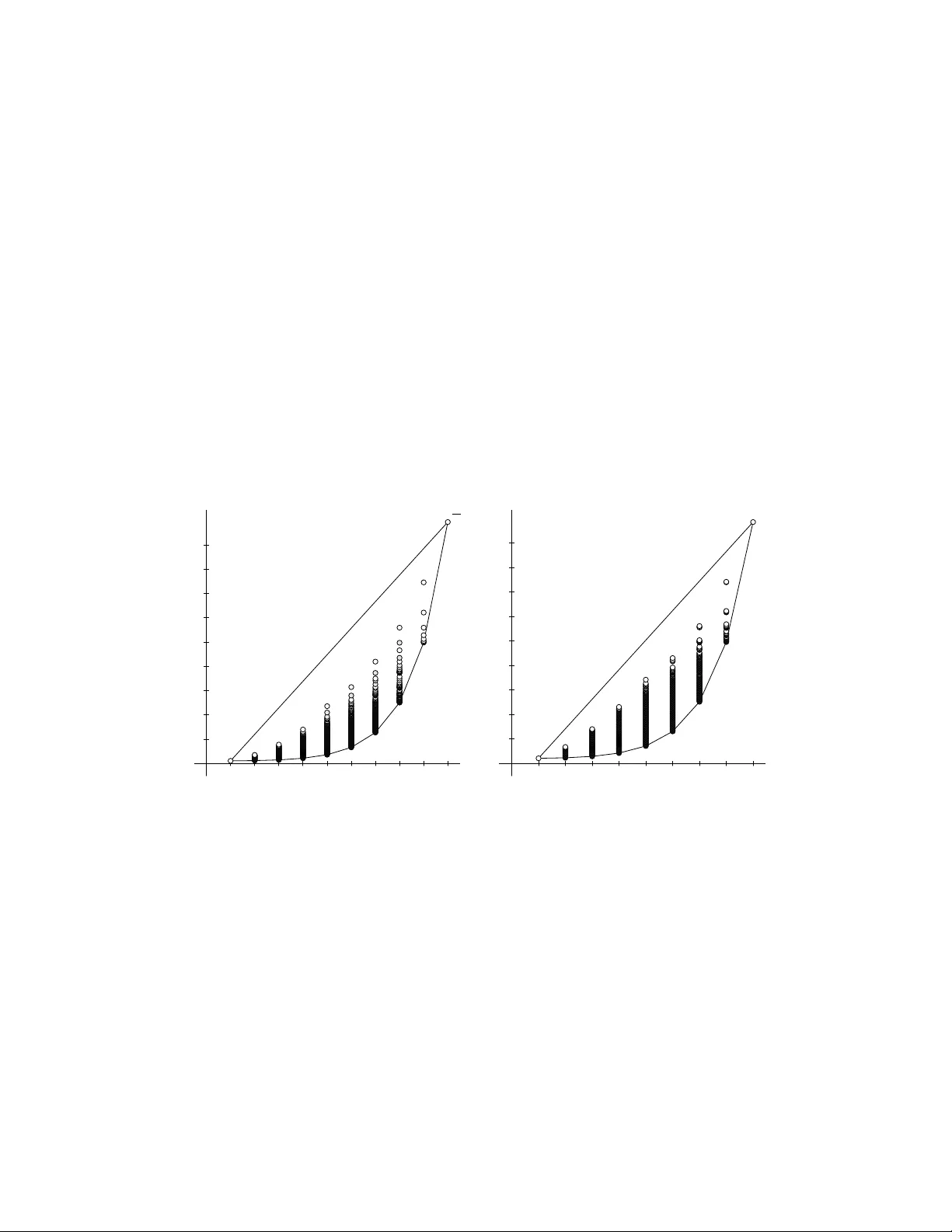
Fib onacci Index and Stabilit y Num b er of Graphs: a P olyhedral Study V ´ eronique Bruy ` ere ∗ Hadrien M ´ elot ∗ , † No vem ber 10, 2018 Abstract. The Fib onacci index of a graph is the num b er of its stable sets. This parameter is widely studied and has applications in c hemical graph theory . In this paper, we establish tight upp er b ounds for the Fib onacci index in terms of the stability num ber and the order of general graphs and connected graphs. T ur´ an graphs frequen tly app ear in extremal graph theory . W e show that T ur´ an graphs and a connected v ariant of them are also extremal for these particular problems. W e also make a p olyhedral study by establishing all the optimal linear inequalities for the stabilit y n umber and the Fibonacci index, inside the classes of general and connected graphs of order n . Keywor ds: Stable se t; Fibonacci index; Merrifield-Simmons index; T ur´ an graph; α -critical graph; GraPHedron. 1 In tro duction The Fib onacci index F ( G ) of a graph G w as in troduced in 1982 b y Pro dinger and Tic h y [21] as the num b er of stable sets in G . In 1989, Merrifield and Simmons [17] in tro duced inde- p enden tly this parameter in the c hemistry literature 1 . They show ed that there exist cor- relations b et ween the boiling point and the Fib onacci index of a molecular graph. Since, the Fib onacci index has b een widely studied, esp ecially during the last few years. The ma jority of these recent results app eared in chemical graph theory [13, 14, 22, 24–26] and in extremal graph theory [10, 12, 18–20]. In this literature, sev eral results are b ounds for F ( G ) among graphs in particular classes. Lo wer and upp er b ounds inside the classes of general graphs, connected graphs, and trees are well kno wn (see Section 2). Sev eral authors giv e a c haracterization of trees with max- im um Fib onacci index inside the class T ( n, k ) of trees with order n and a fixed parameter k . F or example, Li et al. [14] determine such trees when k is the diameter; Heuberger and ∗ Departmen t of Theoretical Computer Science, Univ ersit ´ e de Mons-Hainaut, Av en ue du Champ de Mars 6, B-7000 Mons, Belgium. † Charg ´ e de Rec herc hes F.R.S.-FNRS. Corresponding author. E-mail: hadrien.melot@umh.ac.be . 1 The Fib onacci index is called the Fibonacci num b er by Prodinger and Tic hy [21]. Merrifield and Simmons in tro duced it as the σ -index [17], also kno wn as the Merrifield-Simmons index. 1 W agner [10] when k is the maximum degree; and W ang et al. [26] when k is the n umber of p ending v ertices. Unicyclic graphs are also in vestigated in similar wa ys [18, 19, 25]. The Fib onacci index and the stability n umber of a graph are b oth related to stable sets. Hence, it is natural to use the stabilit y num b er as a parameter to determine bounds for F ( G ). Let G ( n, α ) and C ( n, α ) b e the classes of – resp ectiv ely general and connected – graphs with order n and stabilit y n umber α . The lo wer b ound for the Fib onacci index is kno wn for graphs in these classes. Indeed, Pedersen and V estergaard [19] giv e a simple pro of to show that if G ∈ G ( n, α ) or G ∈ C ( n, α ), then F ( G ) ≥ 2 α + n − α . Equalit y o ccurs if and only if G is a complete split graph (see Section 2). In this article, w e determine upp er bounds for F ( G ) in the classes G ( n, α ) and C ( n, α ). In b oth cases, the b ound is tigh t for every p ossible v alue of α and n and the extremal graphs are characterized. A T ur´ an graph is the union of disjoin t balanced cliques. T ur´ an graphs frequen tly app ear in extremal graph theory . F or example, the well-kno wn Theorem of T ur´ an [23] states that these graphs ha ve minimum size inside G ( n, α ). W e show in Section 3 that T ur´ an graphs ha ve also maxim um Fib onacci index inside G ( n, α ). Observe that remo ving an edge in a graph strictly increases its Fibonacci index. Indeed, all existing stable sets remain and there is at least one more new stable set: the t w o v ertices inciden t to the deleted edge. Therefore, w e might hav e the intuition that the upp er b ound for F ( G ) is a simple consequence of the Theorem of T ur´ an. How ev er, we show that it is not true (see Sections 2 and 6). The pro of uses structural properties of α -critical graphs. Graphs in C ( n, α ) which maximize F ( G ) are c haracterized in Section 4. W e call them T ur´ an-connected graphs since they are a connected v arian t of T ur´ an graphs. It is interesting to note that these graphs again minimize the size inside C ( n, α ). Hence, our results lead to questions ab out the relations betw een the Fib onacci index, the stabilit y num ber, the size and the order of graphs. These questions are summarized in Section 6. In Section 5, w e further extend our results b y a p olyhedral study of the relations among the stability num b er and the Fib onacci index. Indeed, w e state all the optimal linear inequalities for the stability num b er and the Fib onacci index, inside the classes of general and connected graphs of order n . The ma jor part of the results of this article has b een published in Ref. [4]. 2 Basic prop erties In this section, we supp ose that the reader is familiar with usual notions of graph theory (w e refer to Berge [1] for more details). First, we fix our terminology and notation. W e then recall the notion of α -critical graphs and giv e prop erties of suc h graphs, used in the next sections. W e end with some basic prop erties of the Fibonacci index of a graph. 2 2.1 Notations Let G = ( V , E ) b e a simple and undirected graph order n ( G ) = | V | and size m ( G ) = | E | . F or a v ertex v ∈ V ( G ), we denote b y N ( v ) the neighborho o d of v ; its closed neighborho o d is defined as N ( v ) = N ( v ) ∪ { v } . The degree of a vertex v is denoted by d ( v ) and the maxim um degree of G b y ∆( G ). W e use notation G ' H when G and H are isomorphic graphs. The complement of G is denoted by G . The stability numb er α ( G ) of a graph G is the num b er of v ertices of a maximum stable set of G . Clearly , 1 ≤ α ( G ) ≤ n ( G ), and 1 ≤ α ( G ) ≤ n ( G ) − 1 when G is connected. Definition 1. W e denote by G v the induced subgraph obtained b y remo ving a v ertex v from a graph G . Similarly , the graph G N [ v ] is the induced subgraph obtained by removing the closed neigh b orhoo d of v . Finally , the graph obtained b y remo ving an edge e from G is denoted b y G e . Classical graphs of order n are used in this article: the complete graph K n , the path P n , the cycle C n , the star S n (comp osed by one vertex adjacent to n − 1 vertices of degree 1) and the complete split graph CS n,α (comp osed of a s table set of α vertices, a clique of n − α vertices and each v ertex of the stable set is adjacent to each vertex of the clique). The complete split graph CS 7 , 3 is depicted in Figure 1. W e also deeply study the t w o classes of T ur´ an graphs and T ur´ an-connected graphs. A T ur´ an gr aph T n,α is a graph of order n and a stabilit y num b er α such that 1 ≤ α ≤ n , that is defined as follows. It is the union of α disjoint balanced cliques (that is, such that their orders differ from at most one) [23]. These cliques hav e thus d n α e or b n α c vertices. W e no w define a T ur´ an-c onne cte d gr aph TC n,α with n vertices and a stability num ber α where 1 ≤ α ≤ n − 1. It is constructed from the T ur´ an graph T n,α with α − 1 additional edges. Let v b e a v ertex of one clique of size d n α e , the additional edges link v and one vertex of eac h remaining cliques. Note that, for eac h of the t wo classes of graphs defined ab o v e, there is only one graph with giv en v alues of n and α , up to isomorphism. Example 1. Figure 1 shows the T ur´ an graph T 7 , 3 and the T ur´ an-connected graph TC 7 , 3 . When α = 1, we observe that T n, 1 ' TC n, 1 ' CS n, 1 ' K n . When α = n , we hav e T n,n ' CS n,n ' K n , and when α = n − 1, w e hav e TC n,n − 1 ' CS n,n − 1 ' S n . Figure 1: The graphs CS 7 , 3 , T 7 , 3 and TC 7 , 3 3 2.2 α -critical graphs W e recall the notion of α -critical graphs [7, 11, 15]. An edge e of a graph G is α -critic al if α ( G e ) > α ( G ), otherwise it is called α -safe . A graph is said to b e α -critic al if all its edges are α -critical. By con ven tion, a graph with no edge is also α -critical. These graphs pla y an imp ortan t role in extremal graph theory [11], and also in our pro ofs. Example 2. Simple examples of α -critical graphs are complete graphs and o dd cycles. T ur´ an graphs are also α -critical. On the contrary , T ur´ an-connected graph are not α - critical, except when α = 1. W e state some in teresting properties of α -critical graphs. Lemma 1. L et G b e an α -critic al gr aph. If G is c onne cte d, then the gr aph G v is c onne cte d for al l vertic es v of G . Pr o of. W e use t wo known results on α -critical graphs (see, e.g., [15, Chapter 12]). If a v ertex v of an α -critical graph has degree 1, then v and its neighbor w form a connected comp onen t of the graph. Every v ertex of degree at least 2 in an α -critical graph is con tained in a cycle. Hence, by the first result, the minimum degree of G equals 2, except if G ' K 2 . Clearly G v is connected b y the second result or when G ' K 2 . Lemma 2. L et G b e an α -critic al gr aph. L et v b e any vertex of G which is not isolate d. Then, α ( G ) = α ( G v ) = α ( G N [ v ] ) + 1 . Pr o of. Let e = v w b e an edge of G containing v . Then, there exist in G tw o maxim um stable sets S and S 0 , suc h that S con tains v , but not w , and S 0 con tains w , but not v (see, e.g., [15, Chapter 12]). Thus, α ( G ) = α ( G v ) due to the existence of S 0 . The set S av oids eac h v ertex of N ( v ). Hence, S \ { v } is a stable set of the graph G N [ v ] of size α ( G ) − 1. It is easy to c heck that this stable set is maxim um. 2.3 Fib onacci index Let us no w recall the Fib onacci index of a graph [17, 21]. The Fib onac ci index F ( G ) of a graph G is the n umber of all the stable sets in G , including the empty set. The follo wing lemma ab out F ( G ) is w ell-known (see [9, 14, 21]). It is used intensiv ely through the article. Lemma 3. L et G b e a gr aph. • L et e b e an e dge of G , then F ( G ) < F ( G e ) . • L et v b e a vertex of G , then F ( G ) = F ( G v ) + F ( G N [ v ] ) . • If G is the union of k disjoint gr aphs G i , 1 ≤ i ≤ k , then F ( G ) = Q k i =1 F ( G i ) . 4 Example 3. W e ha v e F ( K n ) = n + 1, F ( K n ) = 2 n , F ( S n ) = 2 n − 1 + 1 and F ( P n ) = f n +2 (recall that the sequence of Fib onacci n umbers f n is f 0 = 0 , f 1 = 1 and f n = f n − 1 + f n − 2 for n > 1). Pro dinger and Tic h y [21] give simple lo wer and upper b ounds for the Fib onacci index. W e recall these b ounds in the next lemma. Lemma 4. L et G b e a gr aph of or der n . • Then n + 1 ≤ F ( G ) ≤ 2 n with e quality if and only if G ' K n (lower b ound) and G ' K n (upp er b ound). • If G is c onne cte d, then n + 1 ≤ F ( G ) ≤ 2 n − 1 + 1 with e quality if and only if G ' K n (lower b ound) and G ' S n (upp er b ound). • If G is a tr e e, then f n +2 ≤ F ( G ) ≤ 2 n − 1 + 1 with e quality if and only if G ' P n (lower b ound) and G ' S n (upp er b ound). W e denote b y G ( n, α ) the class of general graphs with order n and stability num b er α ; and b y C ( n, α ) the class of connected graphs with order n and stabilit y n um b er α . Pedersen and V estergaard [19] characterize graphs with minimum Fib onacci index as indicated in the following theorem. Theorem 5. L et G b e a gr aph inside G ( n, α ) or C ( n, α ) , then F ( G ) ≥ 2 α + n − α, with e quality if and only if G ' CS n,α . The aim of this article is the study of graphs with maximum Fibonacci index inside the t wo classes G ( n, α ) and C ( n, α ). The system GraPHedron [16] allo ws a formal framework to conjecture optimal relations among a set of graph in v arian ts. Thanks to this system, graphs with maxim um Fib onacci index inside each of the t wo previous classes ha ve been computed for small v alues of n [8]. W e observ e that these graphs are isomorphic to T ur´ an graphs for the class G ( n, α ), and to T ur´ an-connected graphs for the class C ( n, α ). F or the class C ( n, α ), there is one exception when n = 5 and α = 2: b oth the cycle C 5 and the graph TC 5 , 2 ha ve maxim um Fibonacci index. Recall that the classical Theorem of T ur´ an [23] states that T ur´ an graphs T n,α ha ve minim um size inside G ( n, α ). W e migh t think that T ur´ an graphs hav e maximum Fibonacci index inside G ( n, α ) as a direct corollary of the Theorem of T ur´ an and Lemma 3. This argumen t is not correct since removing an α -critical edge increases the stability num ber. Therefore, Lemma 3 only implies that graphs with maxim um Fibonacci index inside G ( n, α ) are α -critical graphs. In Section 6, we mak e further observ ations on the relations b et ween the size and the Fib onacci index inside the classes G ( n, α ) and C ( n, α ). 5 There is another interesting prop ert y of T ur´ an graphs related to stable sets. Bysko v [5] establish that T ur´ an graphs ha v e maximum num b er of maximal stable sets inside G ( n, α ). The Fibonacci index coun ts not only the maximal stable sets but all the stable sets. Hence, the fact that T ur´ an graphs maximize F ( G ) cannot b e simply derived from the result of Bysk ov. 3 General graphs In this section, we study graphs with maxim um Fib onacci index inside the class G ( n, α ). These graphs are said to b e extr emal . F or fixed v alues of n and α , w e show that there is one extremal graph up to isomorphism, the T ur´ an graph T n,α (see Theorem 8). Before establishing this result, w e need some auxiliary results. W e denote b y f T ( n, α ) the Fib onacci index of the T ur´ an graph T n,α . By Lemma 3, its v alue is equal to f T ( n, α ) = l n α m + 1 p j n α k + 1 α − p , where p = ( n mo d α ). W e ha v e also the following inductive formula. Lemma 6. L et n and α b e inte gers such that 1 ≤ α ≤ n . Then f T ( n, α ) = n + 1 if α = 1 , 2 n if α = n, f T ( n − 1 , α ) + f T ( n − n α , α − 1) if 2 ≤ α ≤ n − 1 . Pr o of. The cases α = 1 and α = n are trivial (see Example 3). Supp ose 2 ≤ α ≤ n − 1. Let v b e a vertex of T n,α with maximum degree. Thus v is in a n α -clique. As α < n , the v ertex v is not isolated. Therefore T v n,α ' T n − 1 ,α . As α ≥ 2, the graph T N [ v ] n,α has at least one vertex, and T N [ v ] n,α ' T n − d n α e ,α − 1 . By Lemma 3, we obtain f T ( n, α ) = f T ( n − 1 , α ) + f T ( n − l n α m , α − 1) . A consequence of Lemma 6 is that f T ( n − 1 , α ) < f T ( n, α ). Indeed, the cases α = 1 and α = n are trivial, and the term f T ( n − n α , α − 1) is alwa ys strictly p ositiv e when 2 ≤ α ≤ n − 1. Corollary 7. The function f T ( n, α ) is strictly incr e asing in n when α is fixe d. W e no w state the upp er b ound on the Fib onacci index of graphs in the class G ( n, α ). Theorem 8. L et G b e a gr aph of or der n with a stability numb er α , then F ( G ) ≤ f T ( n, α ) , with e quality if and only if G ' T n,α . 6 Pr o of. The cases α = 1 and α = n are straigh tforward. Indeed G ' T n, 1 when α = 1, and G ' T n,n when α = n . W e can assume that 2 ≤ α ≤ n − 1, and thus n ≥ 3. W e now prov e b y induction on n that if G is extremal, then it is isomorphic to T n,α . The graph G is α -critical. Otherwise, there exists an edge e ∈ E ( G ) suc h that α ( G ) = α ( G e ), and b y Lemma 3, F ( G ) < F ( G e ). This is a contradiction with G b eing extremal. Let us compute F ( G ) thanks to Lemma 3. Let v ∈ V ( G ) of maxim um degree ∆. The v ertex v is not isolated since α < n . Thus by Lemma 2, α ( G v ) = α and α ( G N [ v ] ) = α − 1. On the other hand, If χ is the chromatic n umber of G , it is well-kno wn that n ≤ χ . α (see, e.g., Berge [1]), and that χ ≤ ∆ + 1 (see Brooks [3]). It follo ws that n ( G N [ v ] ) = n − ∆ − 1 ≤ n − l n α m . (1) Note that n ( G N [ v ] ) ≥ 1 since α ≥ 2. W e can apply the induction hypothesis on the graphs G v and G N [ v ] . W e obtain f T ( n, α ) ≤ F ( G ) as G is extremal, = F ( G v ) + F ( G N [ v ] ) b y Lemma 3, ≤ f T ( n ( G v ) , α ( G v )) + f T ( n ( G N [ v ] ) , α ( G N [ v ] )) b y induction, = f T ( n − 1 , α ) + f T ( n − ∆ − 1 , α − 1) ≤ f T ( n − 1 , α ) + f T ( n − n α , α − 1) b y Eq. (1) and Corollary 7, = f T ( n, α ) b y Lemma 6. Hence equalit y holds everywhere. In particular, by induction, the graphs G v , G N [ v ] are extremal, and G v ' T n − 1 ,α , G N [ v ] ' T n − d n α e ,α − 1 . Coming bac k to G from G v and G N [ v ] and recalling that v has maxim um degree, it follo ws that G ' T n,α . Corollary 7 states that f T ( n, α ) is increasing in n . It w as an easy consequence of Lemma 6. The function f T ( n, α ) is also increasing in α . Theorem 8 can b e used to pro ve this fact easily as shown no w. Corollary 9. The function f T ( n, α ) is strictly incr e asing in α when n is fixe d. Pr o of. Supp ose 2 ≤ α ≤ n − 1. By Lemma 4 it is clear that f T ( n, 1) < f T ( n, α ) < f T ( n, n ). No w, let e b e an edge of T n,α . Clearly α ( T e n,α ) = α + 1. Moreov er, by Lemma 3 and Theorem 8, F ( T n,α ) < F ( T e n,α ) < F ( T n,α +1 ) . Therefore, f T ( n, α ) < f T ( n, α + 1). 7 4 Connected graphs W e now consider graphs with maximum Fib onacci index inside the class C ( n, α ). Such graphs are called extr emal . If G is connected, the b ound of Theorem 8 is clearly not tigh t, except when α = 1, that is, when G is a complete graph. W e are going to prov e that there is one extremal graph up to isomorphism, the T ur´ an-connected graph TC n,α , with the exception of the cycle C 5 (see Theorem 12). First, we need preliminary results and definitions to pro v e this theorem. W e denote b y f TC ( n, α ) the Fibonacci index of the T ur´ an-connected graph TC n,α . An inductiv e form ula for its v alue is given in the next lemma. Lemma 10. L et n and α b e inte gers such that 1 ≤ α ≤ n − 1 . Then f TC ( n, α ) = n + 1 if α = 1 , 2 n − 1 + 1 if α = n − 1 , f T ( n − 1 , α ) + f T ( n 0 , α 0 ) if 2 ≤ α ≤ n − 2 , wher e n 0 = n − n α − α + 1 and α 0 = min( n 0 , α − 1) . Pr o of. The cases α = 1 and α = n − 1 are trivial by Lemma 4. Supp ose now that 2 ≤ α ≤ n − 2. Let v b e a v ertex of maxim um degree in TC n,α . W e apply Lemma 3 to compute F ( TC n,α ). Observe that the graphs TC v n,α and TC N [ v ] n,α are both T ur´ an graphs when 2 ≤ α ≤ n − 2. The graph TC v n,α is isomorphic to T n − 1 ,α . Let us sho w that TC N [ v ] n,α is isomorphic to T n 0 ,α 0 . By definition of a T ur´ an-connected graph, d ( v ) is equal to n α + α − 2. Th us n ( TC N [ v ] n,α ) = n − d ( v ) − 1 = n 0 . If α < n 2 , then TC n,α has a clique of order at least 3 and α ( TC N [ v ] n,α ) = α − 1 ≤ n 0 . Otherwise, TC N [ v ] n,α ' K n 0 and α ( TC N [ v ] n,α ) = n 0 ≤ α − 1. Therefore α ( TC N [ v ] n,α ) = min( n 0 , α − 1) in b oth cases. By Lemma 3, these observ ations leads to f TC ( n, α ) = f T ( n − 1 , α ) + f T ( n 0 , α 0 ) . Definition 2. A bridge in a connected graph G is an edge e ∈ E ( G ) such that the graph G e is no more connected. T o a bridge e = v 1 v 2 of G which is α -safe, we asso ciate a de c omp osition D ( G 1 , v 1 , G 2 , v 2 ) such that v 1 ∈ V ( G 1 ), v 2 ∈ V ( G 2 ), and G 1 , G 2 are the tw o connected comp onen ts of G e . A decomp osition is said to b e α - critic al if G 1 is α -critical. Lemma 11. L et G b e a c onne cte d gr aph. If G is extr emal, then either G is α -critic al or G has an α -critic al de c omp osition. 8 Pr o of. W e supp ose that G is not α -critical and we sho w that it must contain an α -critical decomp osition. Let e b e an α -safe edge of G . Then e must b e a bridge. Otherwise, the graph G e is connected, has the same order and stability num b er as G and satisfies F ( G e ) > F ( G ) by Lemma 3. This is a con tradiction with G b eing extremal. Therefore G contains at least one α -safe bridge defining a decomposition of G . Let us choose a decomposition D ( G 1 , v 1 , G 2 , v 2 ) such that G 1 is of minimum order. Then, G 1 is α -critical. Otherwise, G 1 con tains an α -safe bridge e 0 = w 1 w 2 , since the edges of G are α -critical or α -safe bridges b y the first part of the pro of. Let D ( H 1 , w 1 , H 2 , w 2 ) b e the decomp osition of G defined b y e 0 , such that v 1 ∈ V ( H 2 ). Then n ( H 1 ) < n ( G 1 ), which is a con tradiction. Hence the decomposition D ( G 1 , v 1 , G 2 , v 2 ) is α -critical. Theorem 12. L et G b e a c onne cte d gr aph of or der n with a stability numb er α , then F ( G ) ≤ f TC ( n, α ) , with e quality if and only if G ' TC n,α when ( n, α ) 6 = (5 , 2) , and G ' TC 5 , 2 or G ' C 5 when ( n, α ) = (5 , 2) . Pr o of. W e pro ve by induction on n that if G is extremal, then it is isomorphic to TC n,α or C 5 . T o handle more easily the general case of the induction (in a wa y to av oid the extremal graph C 5 ), we consider all connected graphs with up to 6 v ertices as the basis of the induction. F or these basic cases, w e refer to the rep ort of an exhaustive automated v erification [8]. W e th us supp ose that n ≥ 7. W e know b y Lemma 11 that either G has an α -critical decomp osition or G is α -critical. W e consider now these t wo situations. 1) G has an α -critical decomp osition. W e prov e in three steps that G ' TC n,α : ( i ) W e establish that for every decomp osition D ( G 1 , v 1 , G 2 , v 2 ), the graph G i is extremal and is isomorphic to a T ur´ an-connected graph such that d ( v i ) = ∆( G i ), for i = 1 , 2. ( ii ) W e sho w that if such a decomp osition is α -critical, then G 1 is a clique. ( iii ) W e pro v e that G is itself isomorphic to a T ur´ an-connected graph. ( i ) F or the first step, let D ( G 1 , v 1 , G 2 , v 2 ) b e a decomp osition of G , n 1 b e the order of G 1 , and α 1 its stability num ber. W e pro ve that G 1 ' TC n 1 ,α 1 suc h that d ( v 1 ) = ∆( G 1 ). The argument is identical for G 2 . By Lemma 3, we hav e F ( G ) = F ( G 1 ) F ( G v 2 2 ) + F ( G v 1 1 ) F ( G N [ v 2 ] 2 ) . By the induction hypothesis, F ( G 1 ) ≤ f TC ( n 1 , α 1 ). The graph G v 1 1 has an order n 1 − 1 and a stabilit y n um b er ≤ α 1 . Hence b y Theorem 8 and Corollary 9, F ( G v 1 1 ) ≤ f T ( n 1 − 1 , α 1 ). It follows that F ( G ) ≤ f TC ( n 1 , α 1 ) F ( G v 2 2 ) + f T ( n 1 − 1 , α 1 ) F ( G N [ v 2 ] 2 ) . (2) 9 As G is supp osed to b e extremal, equality o ccurs. It means that G v 1 1 ' T n 1 − 1 ,α 1 and G 1 is extremal. If G 1 is isomorphic to C 5 , then n 1 = 5, α 1 = 2 and F ( G 1 ) = f TC (5 , 2). How ev er, F ( G v 1 1 ) = F ( P 4 ) < f T (4 , 2). By (2), this leads to a con tradiction with G b eing extremal. Th us, G 1 m ust b e isomorphic to TC n 1 ,α 1 . Moreov er, v 1 is a vertex of maxim um degree of G 1 . Otherwise, G v 1 1 cannot b e isomorphic to the graph T n 1 − 1 ,α 1 . ( ii ) The second step is easy . Let D ( G 1 , v 1 , G 2 , v 2 ) b e an α -critical decomp osition of G , that is, G 1 is α -critical. By ( i ), G 1 is isomorphic to a T ur´ an-connected graph. The complete graph is the only T ur´ an-connected graph which is α -critical. Therefore, G 1 is a clique. ( iii ) W e no w supp ose that G has an α -critical decomp osition D ( G 1 , v 1 , G 2 , v 2 ) and w e sho w that G ' TC n,α . Let n 1 b e the order of G 1 and α 1 its stabilit y num b er. As v 1 v 2 is an α -safe bridge, it is clear that n ( G 2 ) = n − n 1 and α ( G 2 ) = α − α 1 . By ( i ) and ( ii ), G 1 is a clique (and th us α 1 = 1), G 2 ' TC n − n 1 ,α − 1 , and v 2 is a v ertex of maximum degree in G 2 . If α = 2, then G 2 is also a clique in G . By Lemma 3 and the fact that F ( K n ) = n + 1 w e ha v e, F ( G ) = F ( G v 1 ) + F ( G N [ v 1 ] ) = n 1 ( n − n 1 + 1) + ( n − n 1 ) = n + n n 1 − n 2 1 . When n is fixed, this function is maximized when n 1 = n 2 . That is, when G 1 and G 2 are balanced cliques. This appears if and only if G ' TC n, 2 . Th us w e supp ose that α ≥ 3. In other w ords, G con tains at least three cliques: the clique G 1 of order n 1 ; the clique H con taining v 2 and a clique H 0 in G 2 link ed to H by an α -safe bridge v 2 v 3 . Let k = n − n 1 α − 1 , then the order of H is d k e and the order of H 0 is d k e or b k c (recall that G 2 ' TC n − n 1 ,α − 1 ). These cliques are represented in Figure 2. v 1 G 1 v 2 H v 3 H ′ Figure 2: Cliques in the graph G T o prov e that G is isomorphic to a T ur´ an-connected graph, it remains to show that the clique G 1 is balanced with the cliques H and H 0 . W e consider the decomp osition defined b y the α -safe bridge v 2 v 3 . By ( i ), G 1 and H are cliques of a T ur´ an-connected graph, and H is a clique with maximum order in this graph (recall that v 2 is a vertex of maximum degree in G 2 ). Therefore d k e − 1 ≤ n 1 ≤ d k e , showing that G 1 is balanced with H and H 0 . 2) G is α -critical. Under this h yp othesis, w e pro ve that G is a complete graph, and th us is isomorphic to a T ur´ an-connected graph. 10 Supp ose that G is not complete. Let v b e a vertex of G with a maximum degree d ( v ) = ∆. As G is connected and α -critical, the graph G v is connected b y Lemma 1. By Lemma 2, α ( G v ) = α and α ( G N [ v ] ) = α − 1. Moreo ver, n ( G v ) = n − 1 and n ( G N [ v ] ) = n − ∆ − 1. By the induction h yp othesis and Theorem 8, w e get F ( G ) = F ( G v ) + F ( G N [ v ] ) ≤ f TC ( n − 1 , α ) + f T ( n − ∆ − 1 , α − 1) . Therefore, G is extremal if and only if G N [ v ] ' T n − ∆ − 1 ,α − 1 and G v is extremal. How ever, G v is not isomorphic to C 5 as n ≥ 7. Thus G v ' TC n − 1 ,α . So, the graph G is comp osed b y the graph G v ' TC n − 1 ,α and an additional v ertex v connected to TC n − 1 ,α b y ∆ edges. There must b e an edge b etw een v and a vertex v 0 of maximum degree in G v , otherwise G N [ v ] is not isomorphic to a T ur´ an graph. The vertex v 0 is adjacent to n − 1 α + α − 2 v ertices in G v and it is adjacen t to v , that is, d ( v 0 ) = n − 1 α + α − 1 . It follows that ∆ ≥ d ( v 0 ) > n − 1 α (3) as G is not a complete graph. On the other hand, v is adjacent to each vertex of some clique H of G v since G N [ v ] has a stabilit y num b er α − 1. As this clique has order at most n − 1 α , v must b e adjacen t to a v ertex w / ∈ H by (3). W e observ e that the edge v w is α -safe. This is impossible as G is α -critical. It follows that G is a complete graph and the proof is completed. The study of the maxim um Fib onacci index inside the class T ( n, α ) of trees with order n and stability num b er α is strongly related to the study done in this section for the c lass C ( n, α ). Indeed, due to the fact that trees are bipartite, a tree in T ( n, α ) has alwa ys a stabilit y n umber α ≥ n 2 . Moreov er, the T ur´ an-connected graph TC n,α is a tree when α ≥ n 2 . Therefore, the upp er bound on the Fib onacci index for connected graphs is also v alid for trees. W e th us get the next corollary with in addition the exact v alue of f TC ( n, α ). Corollary 13. L et G b e a tr e e of or der n with a stability numb er α , then F ( G ) ≤ 3 n − α − 1 2 2 α − n +1 + 2 n − α − 1 , with e quality if and only if G ' TC n,α . Pr o of. It remains to compute the exact v alue of f TC ( n, α ). When α ≥ n 2 , the graph TC n,α is comp osed by one cen tral v ertex v of degree α and α p ending paths of length 1 or 2 attached 11 to v . An extremity of a pending path of length 2 is a v ertex w such that w / ∈ N ( v ). Th us there are x = n − α − 1 p ending paths of length 2 since N ( v ) has size α + 1, and there are y = α − x = 2 α − n + 1 p ending paths of length 1. W e apply Lemma 3 on v to get f TC ( n, α ) = F ( K 2 ) x F ( K 1 ) y + F ( K 1 ) x = 3 x 2 y + 2 x . W e conclude this section by sho wing that the function f TC ( n, α ) is strictly increasing in n and α , as already stated for the function f T ( n, α ) (see Corollaries 7 and 9). Prop osition 14. The function f TC ( n, α ) is strictly incr e asing in n and α . Pr o of. W e first pro ve that f TC ( n, α ) is strictly increasing in n when α is fixed. The cases α = 1 and α = n − 1 are obvious by Lemma 10 and we supp ose that 2 ≤ α ≤ n − 2. Let n 0 = n − n α − α + 1 and α 0 = min( n 0 , α − 1). Also, w e note n 00 = n + 1 − n +1 α − α + 1 and α 00 = min( n 00 , α − 1). Observe that n 0 ≤ n 00 and α 0 ≤ α 00 . W e ha ve f TC ( n, α ) = f T ( n − 1 , α ) + f T ( n 0 , α 0 ) b y Lemma 10, < f T ( n, α ) + f T ( n 00 , α 00 ) b y Corollaries 7 and 9, = f TC ( n + 1 , α ) b y Lemma 10. Therefore, f TC ( n, α ) < f TC ( n + 1 , α ). W e no w prov e that f TC ( n, α ) is strictly increasing in α when n is fixed. Let 2 ≤ α ≤ n − 2. Ob viously , f TC ( n, 1) < f TC ( n, α ) < f TC ( n, n − 1) by Lemma 4. W e consider tw o cases. a) If α < n 2 , then TC n,α con tains at least one clique H of size at least 3 and the remaining cliques are of size at least 2. Supp ose that G is the graph obtained from TC n,α b y remo ving an edge inside H . Then, G is connected and α ( G ) = α + 1. Moreo v er, Lemma 3 and Theorem 12 ensure that f TC ( n, α ) < F ( G ) < f TC ( n, α + 1) and the result follows. b) Supp ose no w that α ≥ n 2 . In this case, TC n,α and TC n,α +1 are trees. Let x = n − α − 1, x 0 = n − α − 2, y = 2 α − n + 1, and y 0 = 2 α − n + 3. Then, f TC ( n, α + 1) − f TC ( n, α ) = 3 x 0 2 y 0 + 2 x 0 − 3 x 2 y − 2 x b y Corollary 13, = 3 x − 1 2 y − 2 x − 1 . As α ≤ n − 2, w e ha ve that x − 1 ≥ 0. Thus, 2 x − 1 ≤ 3 x − 1 . Morev ov er, as α ≥ n 2 , w e ha ve that y ≥ 0 and thus 2 y ≥ 1. It follows that 3 x − 1 2 y − 2 x − 1 ≥ 0. The case of equalit y with 0 happ ens when b oth x − 1 = 0 and y = 0, that is, when α = 1. This nev er holds since α ≥ 2. Therefore f TC ( n, α ) is strictly increasing in α . 12 5 P olyhedral study In the previous sections, we ha ve stated that the graphs with maximum Fib onacci index inside the classes G ( n, α ) and C ( n, α ) are isomorphic to T ur´ an graphs and T ur´ an-connected graphs resp ectiv ely (see Theorems 8 and 12). These results ha ve b een suggested thanks to the system GraPHedron [8]. In this section, we further push the use of the system GraPHedron as outlined in [16]. Indeed, this framework allo ws to suggest the set of all optimal linear inequalities among the stabilit y num b er and the Fib onacci index for graphs inside the class G ( n ) of general graphs of order n and the class C ( n ) of connected graphs of order n . That is, it allows to determine for small v alues of n the complete description of the p olytop es P G ( n ) = con v { ( x, y ) | ∃ G ∈ G ( n ) , α ( G ) = x, F ( G ) = y } , (4) P C ( n ) = con v { ( x, y ) | ∃ G ∈ C ( n ) , α ( G ) = x, F ( G ) = y } , (5) where c onv denotes the con v ex h ull. K 10 S 10 K 10 Stability Number Fibonacci index 0 1 2 3 4 5 6 7 8 9 10 0 103 206 309 412 515 618 721 824 927 K 10 S 10 Stability Number Fibonacci index 0 1 2 3 4 5 6 7 8 9 0 52 104 156 208 260 312 364 416 468 Figure 3: The polytop es P G (10) (left) and P C (10) (righ t) F or example, Figure 3 sho ws the p olytopes P G ( n ) and P C ( n ) when n = 10, as given in the rep orts created by GraPHedron [8]. In these represen tations, w e associate to a p oint ( x, y ) the set of all graphs with a stability num ber x and a Fib onacci index y , and we sa y that the p oin t ( x, y ) c orr esp onds to these graphs. F or instance, in Figure 3, the point (1 , 11) corresp onds to the graph K 10 , whereas the p oin t (9 , 2 9 + 1) corresponds to the graph S 10 . 13 In this section, w e mak e a polyhedral study in a w ay to giv e a complete description of the p olytop es P G ( n ) and P C ( n ) for all (sufficiently large) v alues of n . More precisely , we are going to describ e the fac et defining ine qualities of b oth p olytop es P G ( n ) and P C ( n ) , that is, their minimal system of linear inequalities. Let us fix some notation: L n ( x ) = 2 n − n − 1 n − 1 ( x − 1) + n + 1 , L 0 n ( x ) = 2 n − 1 − n n − 2 ( x − 1) + n + 1 . The following Theorems 15 and 16 give the complete description of P G ( n ) and P C ( n ) . These theorems will be pro v ed at the end of this section, after some preliminary results. Theorem 15. L et n ≥ 5 . Then the p olytop e P G ( n ) has n fac ets define d by the ine qualities y ≥ 2 k − 1 x + 2 k (1 − k ) + n, for k = 1 , 2 , . . . , n − 1 , (6) y ≤ L n ( x ) . (7) Theorem 16. L et n ≥ 8 . Then the p olytop e P C ( n ) has n − 1 fac ets define d by the ine qualities y ≥ 2 k − 1 x + 2 k (1 − k ) + n, for k = 1 , 2 , . . . , n − 2 , (8) y ≤ L 0 n ( x ) . (9) W e first make some comments. In Figure 4, the t wo p olytopes P G ( n ) and P C ( n ) are dra wn together. This gives a graphical summary of the main res ults stated in Theorems 5, 8, 12, 15 and 16: • blac k p oints corresp ond to T ur´ an graphs and ha v e maxim um y -v alue among general graphs by Theorem 8; • grey p oin ts corresp ond to T ur´ an-connected graphs and ha v e maximum y -v alue among connected graphs b y Theorem 12; • white p oin ts correspond to complete split graphs and hav e minimum y -v alue among general and connected graphs by Theorem 5; • the n facets of P G ( n ) are the n − 1 lines joining t wo consecutive p oints corresp onding to complete split graphs, and the line y = L n ( x ) joining the tw o p oin ts corresp onding to K n and K n (see Theorem 15); • the n − 1 facets of P C ( n ) are the n − 2 lines joining t wo consecutiv e p oin ts corresp onding to (connected) complete split graphs, and the line y = L 0 n ( x ) joining the t wo points corresp onding to K n and S n (see Theorem 16). 14 x y Stability Number Fibonacci index y = L (x) n y = L (x) ’ n 1 n/2 n-1 n n+1 2 n 2 n-1 +1 K n S n K n Figure 4: Representation of P G ( n ) and P C ( n ) together In the next lemma, we establish the inequalities (7) and (9). Lemma 17. The ine quality y ≥ 2 k − 1 x + 2 k (1 − k ) + n, (10) defines a fac et of P G ( n ) for k = 1 , 2 , . . . , n − 1 , and a fac et of P C ( n ) for k = 1 , 2 , . . . , n − 2 . Pr o of. W e know b y Theorem 5 that the p oin ts which ha ve minimum y -v alues are those corresp onding to complete split graphs. These p oints are ( x, 2 x + n − x ) , whic h are conv exly independent as the function 2 x + n − x is strictly con vex in x . Therefore these p oints are vertices of P G ( n ) and P C ( n ) , for x = 1 , 2 , . . . , n − 1, and x = 1 , 2 , . . . , n − 2, 15 resp ectiv ely . Moreo v er, there can b e no other p olytope vertices b et w een tw o consecutive p oin ts b ecause x is increasing b y step of 1, and there exists a complete split graph for eac h p ossible v alue of x . Ineq. (10) can then be derived by computing the equation of the line passing by tw o con- secutiv e points k , 2 k + n − k and k + 1 , 2 k +1 + n − k − 1 . It is obvious that Ineq. (10) is facet defining since these points are tw o indep enden t polytop e vertices. W e no w consider the class G ( n ) and study in more details ho w p oints ( x, y ) corre- sp onding to graphs G with α ( G ) = x and F ( G ) = y are situated with resp ect to the line y = L n ( x ). Lemma 18. L et n and α b e inte gers such that n ≥ 7 and 2 ≤ α ≤ n , then f T ( n, α ) α − 1 ≤ 2 n n − 1 · (11) Pr o of. W e consider three cases α = n , α = 2 and 3 ≤ α ≤ n − 1. Let q = n − n α b e the order of the graph obtained b y removing a clique of maximal size in T n,α . ( i ) Supp ose that α = n . In this case, both sides of Ineq. (11) are equal and the result trivially holds. ( ii ) Supp ose that α = 2. If n is ev en, f T ( n, 2) = n 2 4 + n + 1 and if n is o dd, f T ( n, 2) = n 2 4 + n + 3 4 . Hence f T ( n, 2)( n − 1) ≤ n 2 4 + n + 1 ( n − 1) . The latter function is cubic, and thus strictly less than 2 n when n ≥ 7. The result holds in case α = 2. ( iii ) Supp ose no w that 3 ≤ α ≤ n − 1. The proof will use an induction on n . If 7 ≤ n ≤ 10, Ineq. (11) can b e chec k ed b y easy computation and we assume that n ≥ 11. By Lemma 6, w e hav e f T ( n, α ) α − 1 = f T ( n − 1 , α ) α − 1 + f T ( q , α − 1) α − 1 ≤ f T ( n − 1 , α ) α − 1 + f T ( q , α − 1) α − 2 · W e can use induction for f T ( n − 1 , α ) / ( α − 1) b ecause either we fall in case ( i ) when α = n − 1, or we sta y in cas e ( iii ). W e can also use induction for f T ( q , α − 1) / ( α − 2). Indeed, if α − 1 = 2 or α − 1 = q , we fall in cases ( ii ) and ( i ), resp ectiv ely . Otherwise, notice that q = n − l n α m > n − l n 3 m ≥ n − n + 2 3 · (12) 16 Hence, q ≥ 7 when n ≥ 11, and w e fall in case ( iii ). It follo ws that f T ( n, α ) α − 1 ≤ 2 n − 1 n − 2 + 2 q q − 1 · As 2 q / ( q − 1) is an increasing function, it is maximum when q = n − 2. This leads to f T ( n, α ) α − 1 ≤ 2 n − 1 n − 2 + 2 n − 2 n − 3 ≤ 2 n − 1 n − 3 + 2 n − 2 n − 3 = 3 · 2 n 4( n − 3) · T o finish the pro of, one has to c hec k if 3 4( n − 3) ≤ 1 n − 1 · This is the case when n ≥ 9. Lemma 19. L et G b e a gr aph of or der n ≥ 5 with a stability numb er α and a Fib onac ci index F , then F ≤ 2 n − n − 1 n − 1 ( α − 1) + n + 1 , with e quality if and only if G ' K n or G ' K n . Pr o of. Notice that the righ t hand side of the inequality in this lemma is equal to L n ( α ) (see Figures 3 and 4). The cases α = 1 and α = n are trivial and corresp ond to b oth cases of equalit y with G ' K n and G ' K n , resp ectiv ely . W e now assume that 2 ≤ α ≤ n − 1 and w e prov e the strict inequality F < L n ( α ). By Theorem 8, it suffices to show that f T ( n, α ) < L n ( α ). The cases n = 5 and n = 6 can b e easily c hec ked b y computation and we supp ose that n ≥ 7. T o achiev e this aim, w e use the following geometrical argumen t. F or a fixed v alue of n , we consider tw o lines. The first one is y = L n ( x ) and the second one is the line passing b y the p oin ts (1 , n + 1), ( α , f T ( n, α )) corresp onding to K n and T n,α , resp ectiv ely . The first line has slope 2 n − n − 1 n − 1 , and the second line has slope f T ( n, α ) − ( n + 1) α − 1 · W e no w pro ve that the slop e of the second line is strictly less than the slop e if the first line. As α < n and b y Lemma 18, f T ( n, α ) − ( n + 1) α − 1 < f T ( n, α ) α − 1 − n + 1 n − 1 ≤ 2 n − 1 n − 1 − n + 1 n − 1 , and the result holds. 17 W e now consider the class C ( n ), and we mak e the same kind of computations of done in the t w o previous lemmas, but with resp ect to the line y = L 0 n ( x ). Lemma 20. L et n and α b e inte gers such that n ≥ 11 and 2 ≤ α ≤ n − 4 , then f T ( n, α ) α − 1 ≤ 2 n − 1 n − 2 · (13) Pr o of. The pro of is similar to the pro of of Lemma 18. W e consider three cases α = 2, α = n − 4 and 3 ≤ α ≤ n − 5. Let q = n − n α . ( i ) Supp ose that α = 2. Similarly to case ( ii ) in the pro of of Lemma 18, w e hav e that f T ( n, 2) ≤ n 2 4 + n + 1. Hence f T ( n, 2)( n − 2) ≤ n 2 4 + n + 1 ( n − 2) . The latter function is cubic, and th us strictly less than 2 n − 1 when n ≥ 9. ( ii ) Supp ose that α = n − 4. In this case, and as n ≥ 11, the T ur´ an graph T n,n − 4 is isomorphic to the disjoin t union of four graphs K 2 and n − 8 graphs K 1 . Hence, 2 n − 1 n − 2 − f T ( n, n − 4) n − 5 = 2 7 · 2 n − 8 n − 2 − 3 4 · 2 n − 8 n − 5 , = 2 n − 8 (2 7 − 3 4 ) n − (5 · 2 7 − 2 · 3 4 ) ( n − 2)( n − 5) , = 2 n − 8 [47 n − 478] ( n − 2)( n − 5) , whic h is p ositiv e when n ≥ 11. Ineq. (13) holds in this case. ( iii ) Supp ose now that 3 ≤ α ≤ n − 5. W e use an induction on n . If 11 ≤ n ≤ 16, Ineq. (13) can b e chec ked b y computation and we assume that n ≥ 17. Similarly to case ( iii ) in the pro of of Lemma 18, we hav e f T ( n, α ) α − 1 ≤ f T ( n − 1 , α ) α − 1 + f T ( q , α − 1) α − 2 , and w e can use induction for b oth terms. Indeed for f T ( n − 1 , α ) / ( α − 1) w e fall in case ( ii ) when α = n − 5, or w e sta y in case ( iii ). F or f T ( q , α − 1) / ( α − 2), since 3 ≤ α ≤ n − 5, we can chec k that either α − 1 = 2 or α − 1 = q − 4 tw o cases already treated in ( i ) and ( ii ), or 3 ≤ α − 1 ≤ q − 5. In the latter case, we hav e q ≥ 11 when n ≥ 17 b y Ineq. (12). It follows that f T ( n, α ) α − 1 ≤ 2 n − 2 n − 3 + 2 q − 1 q − 2 . 18 As 2 q / ( q − 2) is increasing, it is maximum when q = n − 2. This leads to f T ( n, α ) α − 1 ≤ 2 n − 2 n − 3 + 2 n − 3 n − 4 ≤ 3 · 2 n − 1 4( n − 4) · The pro of is completed b ecause 3 4( n − 4) ≤ 1 n − 2 when n ≥ 10. Lemma 21. L et G b e a c onne cte d gr aph of or der n ≥ 8 with a stability numb er α and a Fib onac ci index F , then F ≤ 2 n − 1 − n n − 2 ( α − 1) + n + 1 , with e quality if and only if G ' K n or G ' S n . Pr o of. Observe that the right hand side of the inequality stated in the lemma is equal to L 0 n ( α ) (see Figure 4). The cases α = 1 and α = n − 1 are trivial and corresp ond to the t w o cases of equalit y . When 2 ≤ α ≤ n − 2, we pro ve the strict inequality F < L 0 n ( α ). The cases n = 8, n = 9 and n = 10 can b e chec k ed b y computation and we therefore supp ose that n ≥ 11. W e consider separately the t wo cases 2 ≤ α ≤ n − 4 and n − 3 ≤ α ≤ n − 2. ( i ) Let 2 ≤ α ≤ n − 4. By Theorem 12, it is enough to show that f TC ( n, α ) < L 0 n ( α ). W e prov e a stronger result, that is, f T ( n, α ) < L 0 n ( α ). The result follows since f TC ( n, α ) ≤ f T ( n, α ). This situation is w ell illustrated in Figure 4 whic h also indicates that the case n − 3 ≤ α ≤ n − 2 has to b e treated separately . The argumen t to prov e that f T ( n, α ) < L 0 n ( α ) is the same as in the pro of of Lemma 19. W e sho w that the slop e of the line y = L 0 n ( x ) is strictly greater than the slop e of the line passing b y the t w o points corresp onding to K n and T n,α . As α ≤ n − 4, we ha ve n + 1 α − 1 ≥ n + 1 n − 5 > n n − 2 . This observ ation and Lemma 20 lead to f T ( n, α ) α − 1 − n + 1 α − 1 < f T ( n, α ) α − 1 − n n − 2 ≤ 2 n − 1 n − 2 − n n − 2 , and the announced prop ert y on the slop es is prov ed. 19 ( ii ) Let n − 3 ≤ α ≤ n − 2. By Theorem 12, one has to sho w that f TC ( n, n − 2) < L 0 n ( n − 2) and f TC ( n, n − 3) < L 0 n ( n − 3). It suffices to pro v e that f TC ( n, n − 2) < L 0 n ( n − 3) . Indeed, f TC ( n, n − 3) < f TC ( n, n − 2) b y Corollary 14 and L 0 n ( n − 3) < L 0 n ( n − 2) b ecause the slop e of y = L 0 n ( x ) is strictly p ositiv e. As n ≥ 11, w e ha ve α ≥ n 2 and we use Corollary 13 to compute f TC ( n, n − 2). This leads to L 0 n ( n − 3) − f TC ( n, n − 2) = 2 n − 1 − n n − 2 ( n − 4) + n + 1 − 3 · 2 n − 3 − 2 , = ( n − 10) · 2 n − 3 + n + 2 n − 2 , whic h is strictly p ositiv e when n ≥ 10. W e can now give the pro of of Theorems 15 and 16. Pr o of of The or ems 15 and 16. W e b egin with the pro of for the p olytope P G ( n ) . Looking at Lemma 17, it remains to pro v e that ( i ) Ineq. (7) is facet defining; ( ii ) there are exactly n facet defining inequalities of P G ( n ) . The pro of ( i ) is straightforw ard. Indeed, Lemma 19 ensures that Ineq. (7) is v alid. Moreo ver, the p oin ts (1 , n + 1) and ( n, 2 n ) corresp ond to the graphs K n and K n , respectively . These p oin ts are affinely independent and satisfy Ineq. (7) with equality . Therefore Ineq. (7) is facet defining. F or ( ii ), it suffices to observ e that for any v alue of x = 1 , 2 , . . . , n , there is exactly one v ertex in the p olytop e: the p oint which correspond to the complete split graph CS n,x . It follo ws that P G ( n ) has exactly n v ertices and n facets. The pro of is similar for the p olytope P C ( n ) except that x < n . Indeed, Ineq. (9) is v alid b y Lemma 21, and the p oints satisfying Ineq. (9) with equality correspond to the graphs K n and S n . 6 Observ ations T ur´ an graphs T n,α ha ve minimum size inside G ( n, α ) by the Theorem of T ur´ an [23]. Christophe et al. [6] giv e a tigh t low er b ound for the connected case of this theorem, and Bougard and Joret [2] characterized the extremal graphs, which happ en to con tain the TC n,α graphs as a sub class. By these results and Theorems 8 and 12, we can observ e the following relations betw een graphs with minim um size and maximum Fib onacci index. The graphs inside G ( n, α ) minimizing m ( G ) are exactly those which maximize F ( G ). This is also true for the graphs 20 inside C ( n, α ), except that there exist other graphs with minimum size than the T ur´ an- connected graphs. Ho wev er, these observ ations are not a trivial consequence of the fact that F ( G ) < F ( G e ) where e is an y edge of a graph G . As indicated in our pro ofs, the latter prop ert y only implies that a graph maximizing F ( G ) contains only α -critical edges (and α -safe bridges for the connected case). Our pro ofs use a deep study of the structure of the extremal graphs to obtain Theorems 8 and 12. W e now give additional examples showing that the intuition that more edges imply few er stable sets is wrong. P edersen and V estergaard [19] giv e the following example. Let r b e an in teger such that r ≥ 3, G 1 b e the T ur´ an graph T 2 r,r and G 2 b e the star S 2 r . The graphs G 1 and G 2 ha ve the same order but G 1 has less edges ( r ) than G 2 (2 r − 1). Nev ertheless, observ e that F ( G 1 ) = 3 r < F ( G 2 ) = 2 2 r − 1 + 1. This example do es not take in to accoun t the stabilit y num b er since α ( G 1 ) = r and α ( G 2 ) = 2 r − 1. W e prop ose a similar example of pairs of graphs with the same order and the same stabilit y num b er (see the graphs G 3 and G 4 on Figure 5). These t wo graphs are inside the class G (6 , 4), how ev er m ( G 3 ) < m ( G 4 ) and F ( G 3 ) < F ( G 4 ). Notice that w e can get suc h examples inside G ( n, α ) with n arbitrarily large, b y considering the union of sev eral disjoin t copies of G 3 and G 4 . G 3 : G 4 : Figure 5: Graphs with same order and stability num b er These remarks and our results suggest some questions ab out the relations b et w een the size, the stability num b er and the Fib onacci index of graphs. What are the low er and upp er bounds for the Fib onacci index inside the class G ( n, m ) of graphs order n and size m ; or inside the class G ( n, m, α ) of graphs order n , size m and stability n umber α ? Are there classes of graphs for which more edges alwa ys imply fewer stable sets? W e think that these questions deserv e to be studied. Ac kno wledgmen ts The authors thank Gw ena¨ el Joret for helpful suggestions. References [1] Ber ge, C. The The ory of Gr aphs . Do v er Publications, New Y ork, 2001. 21 [2] Bougard, N., and Joret, G. T ur´ an Theorem and k -connected graphs. J. Gr aph The ory 58 (2008), 1 – 13. [3] Br ooks, R.-L. On colouring the no des of a net work. Pr o c. Cambridge Philos. So c. 37 (1941), 194 – 197. [4] Br uy ` ere, V., and M ´ elot, H. T ur` an Graphs, Stability Number, and Fibonacci In- dex. In Combinatorial Optimization and Applic ations, COCOA 2008 (St. John’s, New- foundland, Canada, 2008), v ol. 5165 of L e ctur e Notes in Computer Scienc e , Springer– V erlag, pp. 127 – 138. [5] Bysk ov, J.M. Enumerating maximal indep enden t sets with applications to graph colouring. Op er. R es. L ett. 32 (2004), 547 – 556. [6] Christophe, J., Dewez, S., Doignon, J.-P., Elloumi, S., F asbender, G., Gr ´ egoire, P., Huygens, D., Labb ´ e, M., M ´ elot, H., and Y aman, H. Linear inequalities among graph inv ariants: using GraPHedron to unco v er optimal relation- ships. Accepted for publication in Networks (2008), 24 pages. [7] Erd ¨ os, P., and Gallai, T. On the minimal num b er of v ertices represen ting the edges of a graph. Magyar T ud. Akad. Mat. Kutat´ o Int. K¨ ozl. 6 (1961), 181–203. [8] GraPHedr on . Rep orts on the study of the Fib onacci index and the stabilit y num b er of graphs and connected graphs. URL: www.graphedron.net/index.php?page=viewBib&bib=10 . [9] Gutman, I., and Polansky, O.E. Mathematic al Conc epts in Or ganic Chemistry . Springer-V erlag, Berlin, 1986. [10] Heuber ger, C., and W agner, S. Maximizing the n um b er of indep endent subsets o ver trees with bounded degree. J. Gr aph The ory 58 (2008), 49 – 68. [11] Joret, G. Entr opy and Stability in Gr aphs . PhD thesis, Univ ersit ´ e Libre de Bruxelles, Belgium, 2007. [12] Knopfma cher, A., Tichy, R.F.., W agner, S., and Ziegler, V. Graphs, parti- tions and Fibonacci n um b ers. Discr ete Appl. Math. 155 (2007), 1175 – 1187. [13] Li, X., Li, Z., and W ang, L. The Inv erse Problems for Some T op ological Indices in Combinatorial Chemistry. J. Comput. Biol. 10 , 1 (2003), 47 – 55. [14] Li, X., Zhao, H., and Gutman, I. On the Merrifield-Simmons Index of T rees. MA TCH Comm. Math. Comp. Chem. 54 (2005), 389 – 402. [15] Lo v ´ asz, L., and Plummer, M.D. Matching The ory . Ak ad ´ emiai Kiad´ o - North- Holland, Budap est, 1986. 22 [16] M ´ elot, H. F acet Defining Inequalities among Graph Inv ariants: the system GraPHe- dron. Discr ete Applie d Mathematics 156 (2008), 1875–1891. [17] Merrifield, R.E.., and Simmons, H.E.. T op olo gic al Metho ds in Chemistry . Wiley , New Y ork, 1989. [18] Pedersen, A.S., and Vester gaard, P.D. The num b er of indep enden t sets in unicyclic graphs. Discr ete Appl. Math. 152 (2005), 246 – 256. [19] Pedersen, A.S., and Vestergaard, P.D. Bounds on the Num b er of V ertex Inde- p enden t Sets in a Graph. T aiwanese J. Math. 10 , 6 (2006), 1575 – 1587. [20] Pedersen, A.S., and Vester gaard, P.D. An Upp er Bound on the Num b er of Indep enden t Sets in a T ree. Ars Combin. 84 (2007), 85 – 96. [21] Pr odinger, H., and Tichy, R.F.. Fib onacci num b ers of graphs. Fib onac ci Quart. 20 , 1 (1982), 16 – 21. [22] Tichy, R.F., and W agner, S. Extremal Problems for T op ological Indices in Com- binatorial Chemistry . J. Comput. Biol. 12 , 7 (2005), 1004 – 1013. [23] Tur ´ an, P. Eine Extremalaufgabe aus der Graphen theorie. Mat. Fiz. L ap ok 48 (1941), 436–452. [24] W agner, S. Extremal trees with resp ect to Hoso ya Index and Merrifield-Simmons Index. MA TCH Comm. Math. Comp. Chem. 57 (2007), 221 – 233. [25] W ang, H., and Hua, H. Unicycle graphs with extremal Merrifield-Simmons Index. J. Math. Chem. 43 , 1 (2008), 202 – 209. [26] W ang, M., Hua, H., and W ang, D. The first and second largest Merrifield- Simmons indices of trees with prescrib ed pendent vertices. J. Math. Chem. 43 , 2 (2008), 727 – 736. 23
Original Paper
Loading high-quality paper...
Comments & Academic Discussion
Loading comments...
Leave a Comment