Formal Specification of Continuum Deformation Coordination
Continuum deformation is a leader-follower multiagent cooperative control approach. Previous work showed a desired continuum deformation can be uniquely defined based on trajectories of d +1 leaders in a d-dimensional motion space and acquired by fol…
Authors: Hossein Rastgoftar, Jean-Baptiste Jeannin, Ella Atkins
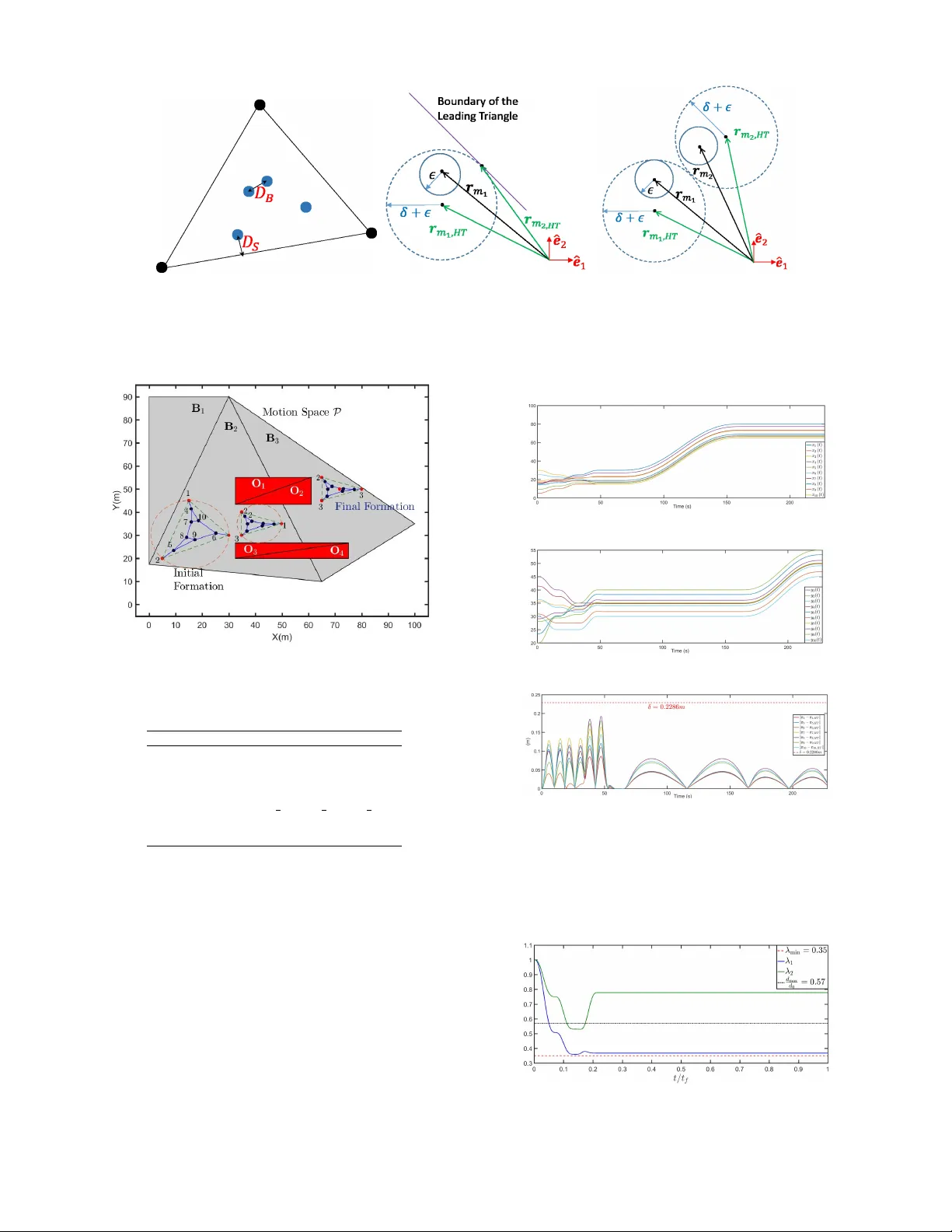
F ormal Specification of Continuum Def ormation Coordination Hossein Rastgoftar , Jean-Baptiste Jeannin, and Ella Atkins Abstract — Continuum def ormation is a leader -follower multi- agent cooperative control approach. Previous work showed a desired continuum deformation can be uniquely defined based on trajectories of d + 1 leaders in a d -dimensional motion space and acquired by followers through local inter-agent commu- nication. This paper formally specifies continuum deformation coordination in an obstacle-laden en vironment. Using linear temporal logic (L TL), continuum deformation liveness and safety requir ements are defined. Safety is prescribed by pro- viding conditions on (i) agent de viation bound, (ii) inter -agent collision avoidance, (iii) agent containment, (iv) motion space containment, and (v) obstacle collision avoidance. Liveness specifies a reachability condition on the desired final formation. I . I N T RO D U C T I O N From package deliv ery and autonomous taxis to military applications, Unmanned Aerial V ehicles (UA V) are chang- ing our daily li ves. Some applications ho we ver cannot be achiev ed by a single UA V , but need a swarm of cooperating U A Vs forming a Multi-Agent System (MAS). Examples of such applications are surveillance, formation flight, and traffic control. MAS perform critical tasks, and it is becom- ing increasingly important to formally specify and v erify the correctness of their behavior , in terms of both safety and liveness requirements. In this paper we are primarily interested in formation flying. W e treat MAS e volution as a continuum deformation [1], and formally specify its safety and liv eness requirements. Multi-agent system coordination applies methods such as consensus [2], [3] with application to distributed motion control [4], [5], sensing [6], [7], medical systems [8], and smart grids [9], [10]. For containment control [11], [12] multiple leaders guide the MAS toward a target shape using consensus to update positions [11], [13] under fixed and switching communication topologies [14], [15]. Directed communication topologies [16], [17], ev ent-based contain- ment control [14], [18], and finite-time containment control [19] hav e been formulated. Formal specification and veri- fication of multi-agent systems have receiv ed considerable attention [20]–[23], and our aim is to extend that work to the context of continuum deformation. Containment control assures asymptotic con ver gence to a desired configuration inside the con vex region prescribed by leaders but has two limitations: (i) followers are not assured to remain inside the moving con vex region defined by leader positions during transition; and (ii) inter -agent collision a voidance cannot be guaranteed for an arbitrary initial agent distribution. Continuum deformation extends containment control theory Authors are with the Aerospace Engineering Department, Univer - sity of Michigan, Ann Arbor , MI, 48109 USA e-mails: { hosseinr, jean- nin,ematkins } @umich.edu Fig. 1: Elements of the formal specification. by prescribing a homogeneous mapping that guarantees inter- agent collision av oidance and that followers remain within the leader-defined boundary [1], [24]. In a continuum defor- mation coordination, inter-agent distances can aggressiv ely change while no two particles collide. This property can advance swarm coordination maneuverability and agility , and allows a large-scale MAS to safely negotiate narro w channels in obstacle-laden environments. As its main contribution, this paper formally specifies safety and liveness for the coordination of continuum defor- mation of an MAS with a lar ge number of agents (Fig. 1). Using triangulation and tetrahedralization, safety conditions are defined to assure obstacle collision av oidance, inter- agent collision a voidance, and motion space containment in 2-dimensional and 3-dimensional continuum deformations. This paper also formally specifies a liveness condition that assures continuum deformation is possible giv en an initial MAS configuration and a motion space obstacle geometry . This paper is organized as follows: In Section II, prelimi- naries in triangulation and tetrahedralization, continuum de- formation coordination, graph theory , linear temporal logic, and MAS collecti ve dynamics are re viewed. Continuum deformation formal specification in Section III is followed by suf ficient safety conditions in Section IV. Simulation results and conclusions are presented in Sections V and VI, respectiv ely . Fig. 2: 2-dimension motion space democratization from α parameters. I I . P R E L I M I NA RY N OT I O N S A. T riangulation and T etrahedr alization T o determine whether an agent stays in its designated motion space and does not collide with any obstacle, we need to compute whether this agent is inside or outside a giv en d -dimensional polytope. Our approach creates a partition of the polytope into a number of d -simplexes (i.e., a triangle for d = 2 or a tetrahedron for d = 3 ), thereby reducing the problem to checking whether our agent stays in one of the simplexes. A d -simplex T is defined as the non- zero volume specified by points a 1 , . . . , a d + 1 ∈ R d . Note that a 1 , . . . , a d + 1 ∈ R d form a valid d -simplex if and only if the following rank condition is satisfied: Λ ( a 1 , · · · , a d + 1 ) = rank a 2 − a 1 · · · a d + 1 − a 1 = d , (1) If (1) is satisfied, we can define v ector operator Ω gi ven an arbitrary vector c and a 1 , . . . , a d + 1 : Ω ( a 1 , · · · , a d + 1 , c ) = a 1 · · · a d + 1 1 · · · 1 − 1 c 1 . (2) Note that Ω ( a 1 , · · · , a d + 1 , c ) ∈ R d + 1 , let α 1 . . . α d + 1 = Ω ( a 1 , · · · , a d + 1 , c ) . As sho wn in Fig. 2, a 2-dimension motion space ( d = 2 ) can be divided into 10 regions based on the signs of α 1 , α 2 , and α 3 . Similarly , a 3-dimension motion space can be di vided into 55 regions based on the signs of α 1 , α 2 , α 3 and α 4 . In general, we can decide whether c is inside or outside a simplex based on the signs of α 1 , . . . , α d + 1 : Pr oposition 1: The point c is positioned inside the (open) simplex defined by a 1 , · · · , a d + 1 if and only if Ω ( a 1 , · · · , a d + 1 , c ) > 0 . W e use the term “containment” when a point c is inside a d -polytope, which typically represents a simple x of leaders, the motion space or an obstacle. B. Continuum Deformation Definition Consider an MAS consisting of N agents identified by unique inde x numbers V = { 1 , · · · , N } . Agents 1 through d + 1 are leaders and the remaining agents are followers acquiring the desired coordination through local communication, e.g. V L = { 1 , · · · , d + 1 } is the set of leaders and V F = { d + 2 , · · · , N } is the set of followers. W e denote by r i ( t ) the actual position of agent i at time t , and by r HT i ( t ) its desired position at time t . The j -th coordinate of r i is denoted as r i , j , and the j -th coordinate of r HT i is denoted as r HT i , j . Let r 0 i and r f i denote initial and final positions of agent i ∈ V , respectively . The desired position of agent i is defined by: r HT i ( t ) = Q ( t , t 0 ) r 0 i + d ( t , t 0 ) , (3) where r 0 i = r HT i ( t 0 ) , r HT i f = r HT i t f ( i ∈ V ), t 0 and t f denote initial and final time, Q ( t , t 0 ) ∈ R d × d is the Jacobian matrix, Q ( t 0 , t 0 ) = I d ∈ R d × d is the identity matrix, d ( t , t 0 ) ∈ R d × 1 is the rigid-body displacement vector , and d ( t 0 , t 0 ) = 0 ∈ R d × 1 . The affine transformation (3) is called homogeneous transformation in continuum mechanics [25]. In a homogeneous transformation coordination, leaders form a d -dimensional leading polytope at any time t , there- fore ∀ t , Λ r HT 1 , · · · , r HT d + 1 = d . (4) Because homogeneous transformation is a linear mapping, Q and D elements are uniquely related to leader position components by ∀ t , v ec Q T d = I d ⊗ P ( t 0 ) I d ⊗ 1 d × 1 v ec ( P ( t ) ) , (5) where ” ⊗ ” is the Kronecker product, 1 d ∈ R ( d + 1 ) × 1 is the one-entry matrix, and P ( t ) = r HT 1 , 1 · · · r HT 1 , d . . . . . . . . . r HT d + 1 , d · · · r HT d + 1 , d ∈ R ( d + 1 ) × d . Ω r HT 1 ( t ) , · · · , r HT d + 1 ( t ) , r HT i ( t ) ∈ R ( d + 1 ) × 1 remains time- in variant at any time t ∈ [ t 0 , t f ] : ∀ t ∈ [ t 0 , t f ] , ∀ i ∈ V , Ω r HT 1 , · · · , r HT d + 1 , r HT i = Ω i , 0 , (6) is time-in variant, where ∀ i ∈ V , Ω i , 0 = Ω r 0 1 , · · · , r 0 d + 1 , r 0 i ∈ R d + 1 . Assumption: This paper assumes follower agents are posi- tioned inside the leading simplex at initial time t 0 : ∀ i ∈ V F , Ω i , 0 > 0 . C. Continuum Deformation Acquisition Assume directed graph G = G ( V , E ) defines a fixed inter- agent communication topology, V is the node set and E ⊂ V × V is the edge set. Follower i ∈ V F communicates with d + 1 in-neighbor agents defined by set N i = { i 1 , · · · , i d + 1 } ⊂ V . It is assumed that Λ r i 1 , 0 , · · · , r i d + 1 , 0 = d ( ∀ i ∈ V F ), so in- neighbor agents of follower i form an d -dimensional simplex at initial time t 0 . Follo wer inter-agent communications are weighted and obtained from w i , i 1 · · · w i , i d + 1 T = Ω r 0 i 1 , · · · , r 0 i d + 1 , r 0 i . (7) Note that w i , i k is the communication weight between fol- lower i ∈ V F and in-neghbpor agent i k ∈ N i ( k = 1 , · · · , d + 1 ). D. MAS Collective Dynamics Model Let r i ∈ R d × 1 denote actual position of agent i ∈ V . d 2 r i d t 2 = u i , (8) where u i = ( Ü r HT i ( giv en ) i ∈ V L β v Í j ∈ N i w i , j Û r j − Û r i + β r Í j ∈ N i w i , j r j − r i i ∈ V F . (9) For continuum deformation communication weights are con- sistent with agents’ positions at t 0 and assigned by Eq. (7). E. T emporal Logic T emporal Logic (TL) can capture temporal behavior of a dynamical system. In this paper we use a logic based on L TL − X [26]. The logic L TL − X is a flav our of Linear T emporal Logic without the Next operator X (sometimes written ◦ ), which makes it more adapted to reasoning about continuous-time systems. Since we are reasoning about an explicit system, we make our atomic formulas concrete, as comparisons of expressions. Our logic uses two syntactic categories: expressions e and propositions φ . An expression e can be a constant c , a state v ariable representing the j -th coordinate of the actual position of agent j , r i , j , a state variable representing the j -th coordinate of the desired position of agent j , r HT i , j , as well as a multiplication e 1 × e 2 , addition e 1 + e 2 , subtraction e 1 − e 2 , or division e 1 / e 2 of two expressions. A formula can be True > , a comparison of two expressions e 1 ≤ e 2 , or a disjunction φ 1 ∨ φ 2 , negation ¬ φ or until φ 1 U φ 2 of two formulas. e :: = c | r i , j | r HT i , j | e × e | e + e | e − e | e / e φ :: = > | e ≤ e | φ ∨ φ | ¬ φ | φ U φ W e call atomic formulas the formulas of the form e ≤ e . As is usual in L TL, we define the operators False ⊥ , conjunction ∧ , always and eventually ^ as: ⊥ = ¬> ^ φ = >U φ φ 1 ∧ φ 2 = ¬(¬ φ 1 ∨ ¬ φ 2 ) φ = ¬ ^ ¬ φ For any time t ≥ 0 , the state S ( t ) of our system is a function giving the valuation of ev ery state variable: S ( t ) : { r 1 , 1 , . . . , r N , d , r HT 1 , 1 , . . . , r HT N , d } → R Given such a state S ( t ) for the valuation of state variables, an expression e can be ev aluated in the usual way to a real number that we write S ( t )( e ) . The satisfaction of formula φ in state S ( t ) (i.e., at time t ) is then gi ven by: S ( t ) > is always satisfied; S ( t ) e 1 ≤ e 2 if and only if S ( t )( e 1 ) ≤ S ( t )( e 2 ) ; S ( t ) ¬ φ if and only if S ( t ) 2 φ ; S ( t ) φ 1 ∨ φ 2 if and only if S ( t ) φ 1 or S ( t ) φ 2 ; S ( t ) φ 1 U φ 2 if and only if there e xists t 0 ≥ t such that S ( t 0 ) φ 2 and for all t ≤ t 00 < t 0 we hav e S ( t 00 ) φ 1 . For conv enience, we write e 2 for the expression e × e ; k r i − r HT i k 2 2 for the expression ( r i , 1 − r i , 1 ) 2 + · · · + ( r i , d − r HT i , d ) 2 ; and Ω r HT 1 , · · · , r HT d + 1 , r i as in Equation 2 (Section II-A). I I I . F O R M A L S P E C I FI C A T I O N This paper’ s first objectiv e is to formally specify safety requirements for continuum deformation. MAS continuum deformation is considered safe if the following require- ments are satisfied: (1) Bounded deviation, (2) Follo wer containment guarantee, (3) Inter-agent collision av oidance, (4) Motion-space containment, and (5) Obstacle collision av oidance. The paper’ s second objectiv e is to formally specify a liv eness condition: agent desired final position reachability . Definition 1 (Motion Space): The motion space, denoted by B ⊂ R d , is finite and conv ex. Let B enclose m B simplex es B 1 , · · · , B m B , e.g. Ð m B i = 1 B i ⊂ B . B i is a d -dimensional simplex with vertices at b i , 1 ∈ R d × 1 , · · · b i , d + 1 ∈ R d × 1 . Definition 2 (Obstacle): Let O ⊂ R d be a finite set defin- ing motion space obstacles. Let O encompass m O simplex es O 1 , · · · , O m O , e.g. O ⊂ Ð m O i = 1 O i . O i is an d -dimensional simplex with v ertices o i , 1 ∈ R d × 1 , · · · o i , d + 1 ∈ R d × 1 . 1) Safety Condition 1: Bounded V ehicle Deviation: Deviation of ev ery agent from continuum deformation must not exceed δ , i.e., the actual position r i ( i ∈ V ) of e very agent must stay within δ of its desired position r H T i . This requirement can be e xpressed as: Û i ∈ V k r i − r HT i k 2 2 ≤ δ 2 , ( ψ 1 ) where δ is constant and k · k 2 is the 2-norm symbol. 2) Safety Condition 2: F ollower Containment Condi- tion: Follo wer i ∈ V F must be inside the leading simplex at any time t . This condition can be e xpressed as: ∀ i ∈ V F , ∀ t ≥ t 0 r i ∈ T ( r HT 1 , · · · , r HT d + 1 ) which can be expressed in our logic using the function Ω as: Û i ∈ V F Ω r HT 1 , · · · , r HT d + 1 , r i ≥ 0 . ( ψ 2 ) 3) Safety Condition 3: Inter -Agent Collision A voidance: Assume e very agent is enclosed by a ball of radius . Collision a voidance between an y two different agents i and j is satisfied, if and only if: Û i , j ∈ V , i , j k r i − r j k 2 2 ≥ ( 2 ) 2 . ( ψ 3 ) 4) Safety Condition 4: Motion Space Containment: Motion space containment is satisfied, if ∀ i ∈ V , ∀ t ≥ t 0 r i ∈ B which can be expressed in our logic using the function Ω as: Û i ∈ V m B Ü k = 1 Ω b k , 1 , · · · , b k , d + 1 , r i ≥ 0 . ( ψ 4 ) Eq. ( ψ 4 ) ensures existence of a simplex B i ⊂ B enclosing leader i ∈ V L at any time t . 5) Safety Condition 5: Obstacle Collision A voidance: Obstacle collision avoidance is satisfied if ∀ i ∈ V , ∀ t ≥ t 0 , ( r i < O ) . which can be expressed in our logic using the function Ω as: Û i ∈ V m O Û k = 1 ¬ Ω o k , 1 , · · · , o k , m B , r i ≥ 0 ! . ( ψ 5 ) Eq. ( ψ 5 ) ensures every agent i ∈ V is outside the obstacle zone defined by simple xes O 1 , · · · , O m O . 6) Liveness Condition 6: F inal F ormation Rec hability: Giv en agent desired final positions r f 1 , · · · , r f N , the liv eness condition is defined by: ^ Û i ∈ V k r i − r f i k 2 2 ≤ ε 2 . ( ψ 6 ) I V . S U FFI C I E N T C O N D I T I O N S A. Inter-Agent Collision A voidance and Ag ent Containment It is computationally expensi ve to ensure inter-agent colli- sion av oidance and follower containment using Eqs. ( ψ 3 ) and ( ψ 2 ). W e can instead use the sufficient conditions provided in Theorem 1 to guarantee these two MAS safety constraints at less computational cost. Theor em 1: [1] Let D B denote minimum separation distance between two agents at initial time t 0 , and let D S denote the minimum boundary distance at initial time t 0 . Define δ max = min 1 2 ( D B − 2 ) , ( D S − ) and λ min = δ + δ max + . (11) Inter-agent collision av oidance and agent containment are guaranteed, if the eigen values of pure deformation matrix U D = Q T Q 1 2 , denoted λ 1 , λ 2 , and λ 3 , satisfy ∀ t ≥ 0 , 3 Û i = 1 λ min ≤ λ i ( t ) , (12) and no agent de viation exceeds δ at any time t . Pr oof: [1] Let m 1 and m 2 denote two points of the leading simplex that has the minimum separation distance at t 0 . If δ max = 1 2 ( D B − ) then m 1 , m 2 ∈ V are two agents (Fig. 3(c)). Otherwise, m 1 ∈ V F is the index number of a follower and m 2 denotes a point on the boundary of the leading simplex having minimum distance from m 1 (Fig. 3(b)): k r 0 m 1 − r 0 m 2 k 2 = µ ( δ max + ) , where µ = ( 2 m 1 , m 2 ∈ V 1 m 1 ∈ V F , m 2 is at the leading polytope boundar y . Considering Eq. (3), r m 2 − r m 1 T r m 2 − r m 1 = r 0 m 2 − r 0 m 1 T U 2 D r 0 m 2 − r 0 m 1 . Assume ∀ i , j ∈ V , i , j , ( δ + ) ≤ min k r i − r j k 2 , then, inter-agent collision a voidance is ensured if inequality ( ψ 1 ) is satisfied. This implies that µ 2 ( δ + ) 2 ≤ min λ 2 1 , λ 2 2 , λ 2 3 µ 2 ( δ max + ) 2 ≤ r m 2 , 0 − r m 1 , 0 T U 2 D r m 2 , 0 − r m 1 , 0 . In other words, inter-agent collision avoidance is a voided if ∀ t , i = 1 , 2 , 3 , δ + δ max + 2 ≤ λ 2 i ( t ) ! . Consequently , inter-agent collision is av oided if inequality (12) is satisfied. Because Q is nonsingular at any time t and Q ( t 0 , t 0 ) = I d , U D eigen values are always positive. Therefore, Eq. (12) is satisfied. B. Motion Space Containment If safety condition ψ 2 is satisfied, then motion space containment is guaranteed by ensuring leaders remain inside the motion space B . Formally , gi ven the formula: Û i ∈ V L m B Ü k = 1 Ω b k , 1 , · · · , b k , d + 1 , r i ≥ 0 , ( ψ 7 ) we hav e: Theor em 2: If ψ 2 ∧ ψ 7 is satisfied, then ψ 4 is satisfied. C. Obstacle Collision A voidance If safety condition ψ 2 is satisfied, then obstacle collision av oidance is guaranteed by ensuring leaders do not collide with obstacles. Formally , gi ven the formula: Û i ∈ V L m O Û k = 1 ¬ Ω o k , 1 , · · · , o k , m B , r i ≥ 0 ! , ( ψ 8 ) we hav e: Theor em 3: If ψ 2 ∧ ψ 8 is satisfied, then ψ 5 is satisfied. Proofs of Theorems 2 and 3 are adapted from [1]. V . S I M U L A T I O N R E S U LT S Consider an MAS with N = 10 agents ev olving in 2 dimen- sions ( d = 2 ). Agents 1 , 2 , and 3 are leaders; the remaining agents are followers. Inter-agent communication is defined by the Fig. 4 graph, and follower communication weights are listed in T able I. Follo wer communication weights are consistent with the initial formation and assigned by Eq. (7). Fig. 4 also shows MAS initial and final formations. B = B 1 Ð B 2 Ð B 3 defines the motion space, and O = Ð 4 k = 1 O 4 defines obstacles in B . The paper assumes all agents are identical with β r = 2 and β v = 4 . Agent positions are plotted versus time in Figs. 5 (a) and 5 (b) with t ∈ [ 0 , 227 . 5 ] , t 0 = 0 s , t f = 227 . 5 s . (a) (b) µ = 1 (c) µ = 2 Fig. 3: (a) Minimum distances D B and D S at t 0 . (b) D S − < 0 . 5 ( D B − 2 ) ( µ = 1 ), δ max is assigned based on the closest distance from the boundary . (c) 0 . 5 ( D B − 2 ) ≤ D S − ( µ = 2 ), δ max is assigned based on agents m 1 and m 2 having the closest separation distance at t 0 . r m 1 and r m 2 are the actual positions of points m 1 and m 2 . Fig. 4: Schematic of motion space B . T ABLE I: Communication weights w i , i 1 , w i , i 2 , and w i , i 3 i i 1 i 2 i 3 w i , i 1 w i , i 2 w i , i 3 4 1 7 10 0 . 60 0 . 20 0 . 20 5 2 8 9 0 . 60 0 . 20 0 . 20 6 3 9 10 0 . 60 0 . 20 0 . 20 7 4 8 10 0 . 40 0 . 36 0 . 24 8 5 7 9 1 3 1 3 1 3 9 5 6 8 0 . 31 0 . 42 0 . 27 10 4 6 7 0 . 35 0 . 29 0 . 36 Satisfaction of Safety Condition 1: Fig. 5(c) plots de- viation of ev ery follower versus time confirming that no follower exceeds δ = 0 . 2286 m at any time t ∈ [ t 0 , t f ] s . Satisfaction of Safety Conditions 2 and 3: Giv en MAS initial formation, D B = 2 . 7348 m and D S = 1 . 5996 m are the minimum separation and boundary distances. The paper assumes that each agent is enclosed by a ball with radius = 0 . 25 m , thus, δ max δ ma = 1 . 1174 m . Giv en δ = 0 . 2286 , = 0 . 25 m , and δ ma = 1 . 1174 m , λ min = 0 . 35 is computed by Eq. (11). As sho wn in Fig. 6, U D eigen values are greater than λ min at any time t , hence, safety condition 2 is satisfied. Satisfaction of Safety Conditions 4 and 5: Leader paths are plotted in Figs. 7 (a-c). As sho wn, motion containment (a) (b) (c) Fig. 5: (a,b) x and y components of agents’ actual positions versus time; (c) Deviation of follower agents versus time. Fig. 6: Eigenv alues of the matrix U D versus time and obstacle collision a voidance conditions are satisfied. Satisfaction of Necessary Condition 6: As shown in Fig. 6, k r i − r HT i k tends to zero at final time t f , therefore, the liv eness condition 6 is satisfied. A C K N OW L E D G E M E N T S This work was supported in part by National Science Foundation Grant CNS 1739525. V I . C O N C L U S I O N In this paper we formally specified continuum deformation coordination in a d -dimensional motion space. Using trian- gulation and tetrahedralization, we de veloped safety and li ve- ness conditions for continuum deformation. W e constructed Linear T emporal Logic (L TL) formulae to check the valid- ity of inter-agent and obstacle collision avoidance as well as agent and motion-space containment. W e demonstrated validity of the method with simulation results. The paper shows how a large-scale continuum deformation satisfies the liv eness and safety conditions we developed. This formal definition supports efficient specification and computational ov erhead when designing and deploying a large-scale MAS. R E F E R E N C E S [1] H. Rastgoftar , Continuum deformation of multi-agent systems . Springer , 2016. [2] C.-L. Liu and F . Liu, “ Asynchronously compensated consensus al- gorithm for discrete-time second-order multi-agent systems under communication delay , ” Control Theory Applications, IET , vol. 8, no. 17, pp. 2004–2012, 2014. [3] A. Bidram, A. Davoudi, F . L. Lewis, and Z. Qu, “Secondary control of microgrids based on distributed cooperativ e control of multi-agent systems, ” Generation, T r ansmission & Distribution, IET , vol. 7, no. 8, pp. 822–831, 2013. [4] W . Ren et al. , “Information consensus in multivehicle cooperative control, ” 2007. [5] W . Y u and P . W ang, “Distributed node-to-node consensus of linear multi-agent systems with directed switching topologies, ” in Contr ol, Automation, Robotics and V ision (ICARCV), 2016 14th International Confer ence on . IEEE, 2016, pp. 1–6. [6] C. Li, X. Y u, W . Y u, T . Huang, and Z.-w . Liu, “Distributed event- triggered scheme for economic dispatch in smart grids, ” IEEE T rans. Ind. Informat. , 2015. [7] L. Zhang, C. Hua, and X. Guan, “Distributed output feedback consen- sus tracking prescribed performance control for a class of non-linear multi-agent systems with unkno wn disturbances, ” IET Control Theory & Applications , vol. 10, no. 8, pp. 877–883, 2016. [8] L. B. Seef f and J. H. Hoofnagle, “National institutes of health consensus development conference: management of hepatitis c: 2002, ” Hepatology , vol. 36, no. 5B, 2002. [9] W . Zhao, M. Liu, J. Zhu, and L. Li, “Fully decentralised multi-area dynamic economic dispatch for large-scale po wer systems via cut- ting plane consensus, ” IET Generation, T ransmission & Distribution , vol. 10, no. 10, pp. 2486–2495, 2016. [10] H. Xing, Y . Mou, M. Fu, and Z. Lin, “Distributed bisection method for economic po wer dispatch in smart grid, ” IEEE Tr ansactions on power systems , vol. 30, no. 6, pp. 3024–3035, 2015. [11] Y . Cao, D. Stuart, W . Ren, and Z. Meng, “Distrib uted containment control for multiple autonomous vehicles with double-integrator dy- namics: algorithms and experiments, ” Control Systems T ec hnology , IEEE T ransactions on , vol. 19, no. 4, pp. 929–938, 2011. [12] S. J. Y oo, “Distributed containment control with predefined perfor- mance of high-order multi-agent systems with unkno wn heterogeneous non-linearities, ” Contr ol Theory Applications, IET , vol. 9, no. 10, pp. 1571–1578, 2015. [13] Y . Cao and W . Ren, “Containment control with multiple stationary or dynamic leaders under a directed interaction graph, ” in Decision and Contr ol, 2009 held jointly with the 2009 28th Chinese Contr ol Con- fer ence. CDC/CCC 2009. Pr oceedings of the 48th IEEE Conference on . IEEE, 2009, pp. 3014–3019. [14] W . Zhang, Y . T ang, Y . Liu, and J. Kurths, “Event-triggering con- tainment control for a class of multi-agent networks with fixed and switching topologies, ” IEEE T ransactions on Cir cuits and Systems I: Re gular P apers , vol. 64, no. 3, pp. 619–629, 2017. [15] W . Li, L. Xie, and J.-F . Zhang, “Containment control of leader- following multi-agent systems with markovian switching network topologies and measurement noises, ” Automatica , vol. 51, pp. 263– 267, 2015. [16] M. Oussalah, D. Professor Ali Hessami, B. Qi, X. Lou, and B. Cui, “Containment control of second-order multi-agent systems with di- rected topology and time-delays, ” Kybernetes , v ol. 43, no. 8, pp. 1248– 1261, 2014. [17] C. Xu, Y . Zheng, H. Su, and H. O. W ang, “Containment control for coupled harmonic oscillators with multiple leaders under directed topology , ” Intl. J. of Contr ol , vol. 88, no. 2, pp. 248–255, 2015. [18] K. Liu, Z. Ji, G. Xie, and R. Xu, “Event-based broadcasting con- tainment control for multi-agent systems under directed topology , ” International Journal of Control , v ol. 89, no. 11, pp. 2360–2370, 2016. [19] Y . Zhao and Z. Duan, “Finite-time containment control without ve- locity and acceleration measurements, ” Nonlinear Dynamics , vol. 82, no. 1-2, pp. 259–268, 2015. [20] C. T omlin, G. J. Pappas, and S. Sastry , “Conflict resolution for air traffic management: A study in multiagent hybrid systems, ” IEEE T ransactions on automatic contr ol , vol. 43, no. 4, pp. 509–521, 1998. [21] F . Brazier , B. M. Dunin-Keplicz, N. R. Jennings, J. T reur et al. , “Formal specification of multi-agent systems: a real world case, ” 1995. [22] C. M. Jonker and J. Treur , “Compositional verification of multi- agent systems: a formal analysis of pro-activeness and reactiv eness, ” International Journal of Cooperative Information Systems , vol. 11, no. 01n02, pp. 51–91, 2002. [23] F . Raimondi and A. Lomuscio, “ Automatic verification of multi-agent systems by model checking via ordered binary decision diagrams, ” Journal of Applied Logic , vol. 5, no. 2, pp. 235–251, 2007. [24] H. Rastgoftar and E. M. Atkins, “Continuum deformation of a multiple quadcopter payload deli very team without inter-agent communication, ” in 2018 International Conference on Unmanned Aircr aft Systems (ICU AS) . IEEE, 2018, pp. 539–548. [25] W . M. Lai, D. H. Rubin, E. Krempl, and D. Rubin, Introduction to continuum mechanics . Butterworth-Heinemann, 2009. [26] M. Kloetzer and C. Belta, “ A fully automated framework for control of linear systems from temporal logic specifications, ” IEEE T rans. Automat. Contr . , vol. 53, no. 1, pp. 287–297, 2008. [Online]. A vailable: https://doi.org/10.1109/T A C.2007.914952 (a) (b) (c) Fig. 7: Paths of the continuum deformation leaders: (a) Leader 1 , (b) Leader 2 , (c) Leader 3 .
Original Paper
Loading high-quality paper...
Comments & Academic Discussion
Loading comments...
Leave a Comment