Realtime Profiling of Fine-Grained Air Quality Index Distribution using UAV Sensing
Given significant air pollution problems, air quality index (AQI) monitoring has recently received increasing attention. In this paper, we design a mobile AQI monitoring system boarded on unmanned-aerial-vehicles (UAVs), called ARMS, to efficiently b…
Authors: Yuzhe Yang, Zijie Zheng, Kaigui Bian
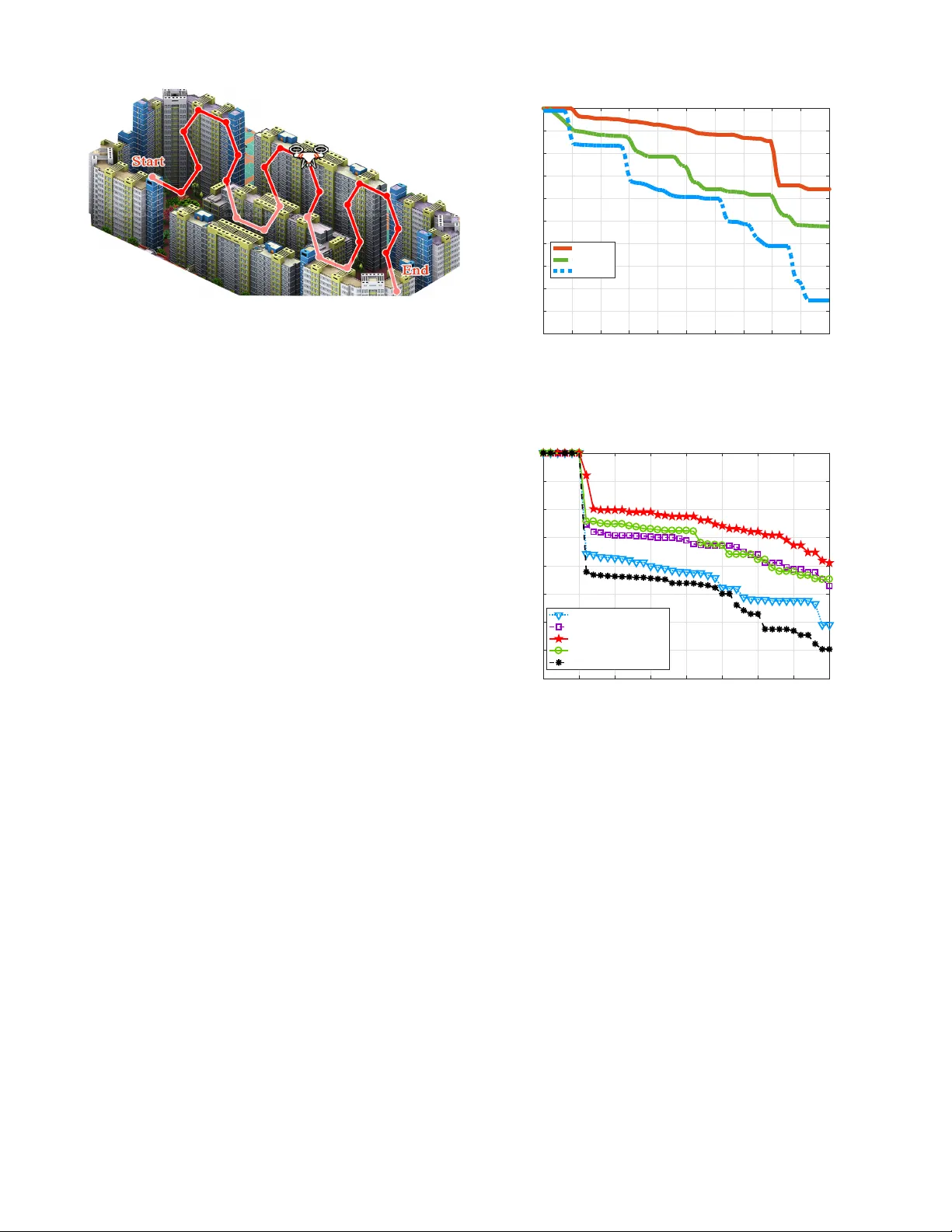
1 Realtime Profiling of Fine-Grained Air Quality Inde x Distrib ution using U A V Sensing Y uzhe Y ang, Zijie Zheng, Student Member , IEEE, Kaigui Bian, Member , IEEE, Lingyang Song, Senior Member , IEEE , and Zhu Han, F ellow , IEEE Abstract —Given significant air pollution problems, air quality index (A QI) monitoring has recently receiv ed increasing atten- tion. In this paper , we design a mobile A QI monitoring system boarded on unmanned-aerial-vehicles (U A Vs), called ARMS , to efficiently b uild fine-grained A QI maps in realtime. Specifically , we first propose the Gaussian plume model on basis of the neural network (GPM-NN), to ph ysically characterize the particle dispersion in the air . Based on GPM-NN, we propose a battery efficient and adaptive monitoring algorithm to monitor A QI at the selected locations and construct an accurate AQI map with the sensed data. The proposed adaptive monitoring algorithm is evaluated in two typical scenarios, a two-dimensional open space like a roadside park, and a three-dimensional space like a courtyard inside a building. Experimental results demonstrate that our system can pro vide higher prediction accuracy of A QI with GPM-NN than other existing models, while greatly reducing the power consumption with the adaptive monitoring algorithm. Index T erms —Mobile sensing, air quality , fine-grained moni- toring, unmanned aerial vehicle (U A V). I . I N T R O D U C T I O N I N a recent report from the W orld Health Organiza- tion (WHO) [1], air pollution has become the world’ s largest environmental health risk, as one in eight of global deaths are caused by air pollution exposure each year . Air pollution is caused by gaseous pollutants that are harmful to humans and ecosystem, especially concentrated in the urban areas of developing countries. Thus, reducing air pollution would sav e millions of lives, and many countries ha ve in vested significant efforts on monitoring and reducing the emission of air pollutants. Gov ernment agencies hav e defined air quality index (A QI) to quantify the degree of air pollution. A QI is calculated based on the concentration of a number of air pol- lutants (e.g., the concentration of PM 2 . 5 , PM 10 particles and so on in dev eloping countries). A higher value of A QI indicates that air quality is “heavily” or “seriously” polluted, resulting in a greater proportion of the population may experience harmful health effects [2]. T o intuitiv ely reflect A QI value of locations in either tw o-dimensional (2D) or three-dimensional (3D) area, A QI map is defined to offer such con venience [3]. A. Mobile A QI Monitoring A QI monitoring can be completed by sensors at gov ern- mental static observation stations, generating a A QI map in Y . Y ang, Z. Zheng, K. Bian and L. Song are with School of Electrical Engineering and Computer Science, Peking Univ ersity , Beijing, China (email: { yuzhe.yang, zijie.zheng, bkg, lingyang.song } @pku.edu.cn). Z. Han is with Electrical and Computer Engineering Department, Uni versity of Houston, Houston, TX, USA (email: zhan2@uh.edu). a local area (e.g., a city [4]). Howe ver , these static sensors can only obtain a limited number of measurement samples in the observation area and may often induce high costs. For example, there are only 28 monitoring stations in Beijing. The distance between two nearby stations is typically sev eral ten- thousand meters, and the A QI is monitored ev ery 2 hours [5]. T o provide more flexible and accurate monitoring as well as reduce the cost, mobile devices, such as cell phones, cars and balloons are used to carry sensors and process real time measuring. Crowd-sourced photos contributed by mass of cell phones can help depict the 2D A QI map in a large geographical region in Beijing [6], with a range of 4 km × 4 km. Mobile nodes equipped with sensors can provide 100 m × 100 m 2D on- ground concentration maps with relatively high resolution [7]– [9]. Sensors carried by tethered balloons can build the height profile of A QI at a fixed observation height within 1000 m [10]. A mobile system with sensors equipped in cars and drones can help monitor PM 2 . 5 in open 3D space [11], with 200m per measurement. B. Motivations for Realtime F ine-Gr ained Monitoring Even though current mobile sensing approaches can provide relativ ely accurate and real-time A QI monitoring data, they are spatially coarse-grained, since tw o measurements are separated by few hundreds of meters in horizontal or vertical directions in the 3D space. Howev er , A QI has intrinsic changes from meters to meters, and it is preferred to perform A QI monitoring in the 3D space surrounding an office building or throughout a univ ersity campus, rather than city-wide [12], [13]. The A QI distrib ution in meter-sliced areas, called as fine-grained areas would be desirable for people, particularly those living in urban areas. The fine-grained A QI map can help design the ventilation system for buildings, which for example guide teachers and students to stay away from the pollution sources on campus [14]. Due to the high power consumption of mobile devices, one can only measure a limited number of locations of the entire space. T o av oid an exhausti ve measurement, using an estimation model to approximate the value of unmeasured area has been wildly adopted. In [15], the prediction model is based on a few public air quality stations and meteorological data, taxi trajectories, road networks, and Point of Interests (POIs). Howe v er , because they estimate A QI using a feature set based on historical data, their model cannot respond in realtime to the change in pollution concentration at an hourly granularity , leading to large errors at times. In [11], the random walk model is used for prediction by dividing the whole space into 2 Fig. 1. An illustration of A QI measurement using mobile sensing over UA V . different shapes of cubes. Howe ver , the model may not reflect physical dispersion of particles [16], [17], and all locations are measured without considering the battery life constraint when mobile devices are used. Mobile sensor nodes used in [7] employ the regression model as well as graph theory to estimate the A QI value at unmeasured locations. Howe v er , they mainly focus on 2D area, and can hardly produce a 3D fine-grained map. Neural networks (NN) are also used for forecasting on the A QI distribution [18]–[21]. Howe ver , its performance in fine-gained area is not satisfied without considering the physical characteristic of real A QI distribution. C. Contributions T o this end, in this paper we design a mobile sensing system based on unmanned-aerial-vehicles (UA Vs), called ARMS , that can effecti vely catch A QI variance at meter-le vel and profile the corresponding fine-grained distribution. ARMS is a realtime monitoring system that can generate current A QI map within a few minutes, compared to the previous methods with an interval of a few hours. With ARMS, the fine-grained A QI map construction can be decomposed into two parts. First, we propose a novel A QI distribution model, named Gaussian Plume model embedding Neural Networks (GPM- NN), that combines physical dispersion and non-linear NN structure, to do predictions of unmeasured area. Second, we detail the adaptiv e monitoring algorithm as well as addressing its applications in a few typical scenarios. By measuring only selected locations in dif ferent scenarios, GPM-NN is used to estimate A QI value at unmeasured locations and generate realtime A QI maps, which can save the battery life of mobile devices while maintaining high accuracy in A QI estimation. The contributions of our work are summarized as follows: • The GPM-NN is highly adaptiv e in dif ferent fine-grained measurement scenarios, and it can provide higher accu- racy in creating A QI maps than other existing models. • The adaptive monitoring algorithm can guide U A V to choose optimized trajectory in different scenarios based on GPM-NN. It can greatly reduce the battery consump- tion of ARMS, while achieving high accuracy when constructing realtime A QI maps. • The ARMS is the first U A V sensing system for fine- grained A QI monitoring. The rest of this paper is organized as follo ws. In Section II, we briefly introduce our U A V sensing system. In Section III, we present our fine-grained A QI distribution model. The adaptiv e monitoring algorithm is addressed in Section IV . In Section V and Section VI, we present two typical application scenarios and performance analysis of ARMS, respectively . Finally , conclusions are drawn in Section VII. I I . P R E L I M I NA R I E S O F UA V S E N S I N G S Y S T E M In this section, first we provide a brief introduction of ARMS, and then we show how to construct a dataset using ARMS. T o confirm the reliability of the collected dataset, we compare the collected data and the official A QI measured by the nearest Beijing go vernment’ s monitoring station, i.e., the Haidian station [22]. T o determine the parameters of our model, we test possible factors that may influence A QI, such as wind, locations, etc., and remove those factors that have small correlations with A QI in the fine-grained scenarios from our model. A. System Overview The architecture of ARMS includes an U A V and an air quality sensor boarded on the U A V , as shown in Fig. 2. The sensor is fixed in a plastic box with vent holes, bundled on the bottom of U A V . The sensor uses a laser-based A QI detec- tor [23], which can provide the concentration within ≤ ± 3% monitor error for common pollutants in A QI calculation, such as PM 2 . 5 , PM 10 , CO, NO, SO 2 and O 3 . The values of these pollutants are realtime recorded, with which we calculate the corresponding A QI value at measuring locations. For the U A V , we select DJI Phantom 3 Quadcopter [24] as the mobile sensing device. The U A V can keep hosting for at most 15 minutes due to the battery constraint, which restricts the longest continuous duration within one measurement. The GPS sensor on the UA V can provide the real-time 3D position. During one measurement, the U A V is programmed with a trajectory , including all locations that need to be measured. Follo wing this trajectory , U A V hovers for 10 seconds to collect 3 Fig. 2. The ARMS system, and the front and the back of the sensor board. sufficient data to derive the A QI value at each stop, before moving to the next one. During one monitoring process, ARMS measures all target locations and records the corresponding A QI values. After the measuring process is completed, the data is then sent to the offline PC and put into the GPM-NN model to construct the realtime A QI map. Thus, the map construction process is offline. B. Dataset Description Data collected by ARMS are then arranged as a dataset 1 . As shown in Fig. 1, we have conducted a measurement study in both typical 2D and 3D scenarios (i.e., a roadside park and the courtyard of an office building in Peking Univ ersity), respectiv ely , from Feb . 11 to Jul. 1, 2017, for more than 100 days to collect suf ficient data. In the dataset, each .txt file includes one complete mea- surement over a day in one typical scenario. In each .txt file, each sample has four parameters, 3D coordinates ( x, y, z ) and an A QI value. Each value represents the measured A QI, while its coordinates in the matrix reflect the position in dif ferent scenarios. In the 2D scenario, we assume z = 0 , while measuring at an interv al of 5m in x and y directions. In the 3D scenario, ev ery ro w presents fixed position in xy plane, while ev ery column represents the height at an interval of 5m in z direction. C. Data Reliability T o verify that there is no measurement error, we sho w the results of the relationship between our collected data and the official data (i.e., Haidian station [22]), in Fig. 3. Note that the official data is limited and only for the 2D space, while our system is mobile and suitable for the 3D space profiling. W e select 14 consecutive days for about 60 instances of monitoring from Mar . 14 to Mar . 27, 2017, to verify the reliability of our measurement. W e use the two-tailed hypothesis test [25]: H 0 : µ 1 = µ 2 v s. H 1 : µ 1 6 = µ 2 , where µ 1 denotes our av erage measured data for all days and µ 2 is the average for the of ficial ones. The test result, P = 0 . 9999 0 . 05 , indicates that there is no significant difference between the two values, which confirms the reliability of our measurements. 1 Dataset can be found at https://github.com/YyzHarry/A QI Dataset. 3 . 1 4 3 . 1 5 3 . 1 6 3 . 1 7 3 . 1 8 3 . 1 9 3 . 2 0 3 . 2 1 3 . 2 2 3 . 2 3 3 . 2 4 3 . 2 5 3 . 2 6 3 . 2 7 Da t e 0 5 0 1 0 0 1 5 0 2 0 0 2 5 0 A Q I V a l u e O f f i c i a l M e a su r e d Fig. 3. A QI value comparison between official data and data we collected, for 14 days in March, 2017. D. Selection of Model P arameter s According to the pre vious A QI monitoring results for coarse-grained scenarios [17], A QI is related to wind (in- cluding speed and direction), temperature, humidity , altitude and spatial locations. But for fine-grained scenarios, corre- lations between A QI and these spatial parameters need to be reconsidered, due to the heterogenous diffusion in both vertical and horizontal directions in a small-scale area. In this test, all these potential parameters are measured by our ARMS with different sensors. T o ev aluate the real correlation between these parameters, we adopt the spatial regression according to [26], and test the coefficient for each parameter . Mathematically , the spatio-temporal model is gi ven below: C ( s i ) = z ( s i ) β T + ε ( s i ) , (1) where C ( s i ) is the particle concentration at position s i , z ( s i ) = ( z 1 ( s i ) , ..., z n ( s i )) denotes the vector of n param- eters at s i , and β = ( β 1 , ..., β n ) is the coefficient vector . ε ( s i ) ∼ N (0 , σ 2 ) is the Gaussian white-noise process. Based on our data, we use the least square regression and implement a hypothesis test for each coefficient β j , as H 0 : β j = 0 . The results in T able I indicate that wind and location are highly related to A QI distribution, whereas temperature and humidity are not. 4 T ABLE I R E S U L T O F T H E H Y P O T H E S IS T E S T T ested Parameter P value W ind 7 . 5693 × 10 − 5 ( 0 . 05) Location 2 . 0981 × 10 − 5 ( 0 . 05) T emperature 0 . 9070 ( 0 . 05) Humidity 0 . 6996 ( 0 . 05) I I I . F I N E - G R A I N E D AQ I D I S T R I B U T I O N M O D E L In this section, we provide a prediction model considering both physical particle dispersion and NN structure. W e first introduce the physical dispersion model for the fine-grained scenario. Then, we provide a brief introduction of NN we adopt in modeling, which can adapt to complicated cases, such as the non-linearity introduced by extreme weather . Finally , we embed the dispersion model in NN to design our distribution model. A. Physical P article Dispersion Model W e first address the physical particle dispersion model for fine-grained scenarios. Specifically , we ignore the influence of temperature and humidity according to discussions in Section 2.D, and select the Gaussian Plume Model (GPM) in the particle mov ement theory [27], to describe the particle’ s dispersion. GPM is widely used to describe particles’ physical motion [16], [28], and its rob ustness has been proved in a small scale system [29]. GPM is expressed as C ( x, y , z ) = Q 2 π σ y σ z u exp − ( z − H ) 2 2 σ 2 z exp − y 2 2 σ 2 y , (2) where Q is the point source strength, u is the average wind speed, and H denotes the height of source. T o adopt GPM into the fine-grained scenario, the GPM is revised as below C ( ~ x, u ) = Z L 2 − L 2 λ 2 π σ y σ z u exp − ( z − H ) 2 2 σ 2 z − y 2 2 σ 2 y d y = λ exp − ( z − H ) 2 2 σ 2 z 2 π σ z u Z L 2 σ y − L 2 σ y exp − γ 2 2 d γ = λ √ 2 π σ z u exp − ( z − H ) 2 2 σ 2 z 1 − 2 Q L 2 σ y , (3) where C ( ~ x, u ) is the A QI v alue at location ~ x , u is the real wind speed at dif ferent locations in the entire space, H denotes a variable that reflects the influence of wind direction, which presents severely polluted areas along z -axis. Pollution mainly deriv es as a line source aligned the y -axis, and L denotes the length of polluted source, λ denotes the particle density at the source. σ y and σ z are diffusion parameters in y and z directions, and are both empirically gi ven. The dispersion model in (3) can reflect physical characteristics, but can hardly deal with unpredictable complicated changes, such as the non- linearity introduced by extreme weather . 𝒙 𝟏 𝒙 𝟐 𝒙 𝒎 1 Σ Σ Σ Σ g(.) g(.) g(.) g(.) ε(𝒙) 𝑪(𝒙, 𝒖) 1 t 𝜷 𝟏 𝜷 𝟐 𝜷 𝑲−𝟏 𝜷 𝑲 𝜷 𝑲+𝟏 𝜷 𝑲+𝟐 𝟏 𝝎 𝟏𝟏 𝝎 𝟏𝟐 𝝎 𝟏𝑲 𝒃 𝑲 𝒃 𝑲−𝟏 𝒃 𝟏 𝝎 𝟐𝑲 𝝎 𝒎𝟏 Non-linear part Linear part 𝑪 𝒔𝒕𝒂𝒕𝒊𝒄 𝑪 𝒇 input layer hidden layer output layer Fig. 4. The model structure of GPM-NN. B. Neural Network Model The neural network model, especially multilayer percep- tron (MLP), has been wildly adopted to do estimation for air quality [18]–[21]. They usually train models by using a huge amount of data to achieve decent performance. All possible influential factors are inv olved as the neural network input variables for network training. Other types of NN [30], [31] are proposed for better classification with more complex struc- tures. As it has been proved that a three-layer neural network can compute any arbitrary function [32]–[34], NN is able to present the complicated changes in fine-grained scenario. Howe v er , without considering the physical characteristics of A QI, the NN model may ov erfit and perform worse on the test data than on the training data [18]. C. GPM-NN Model In order to utilize the advantages of both GPM and NN, we embed the revised GPM in NN, and put forward GPM embedding NN (GPM-NN) model. 1) Model Description: As shown in Fig. 4, the model structure contains a linear part (the physical dispersion model) and a non-linear part (the NN structure) for fine-grained A QI distribution, respectiv ely . Let N be the total number of data collected by ARMS, which is represented by a pair ( X j , t j ) , where X j = [ x 1 x 2 . . . x m ] T is the j th sample with a dimensionality of m variables and t j is the measured A QI value. (a) In the non-linear NN part, let K denote the total number of neurons in the hidden layer . The weights for these neurons are denoted by W = [ W 1 W 2 . . . W K ] , where W i = [ ω i 1 ω i 2 . . . ω im ] is the m -dimensional weight vector containing the weights between the com- ponents of input vectors and the i th neuron in the hidden layer . b = [ b 1 b 2 . . . b K ] is the bias term of the i th neuron. The non-linear part with K neurons in the hidden layer will hav e β = [ β 1 β 2 . . . β K ] as weights for output layer and g ( · ) is the acti vation function. (b) In the linear part, we use C ( ~ x, u ) , a constant value and a Gaussian process as inputs, to reflect the influence 5 of the physical model. The regression weights are correspondingly determined as β K +1 , β K +2 and 1. Thus, the mathematical expression of the proposed model can be written as t ( ~ x, u ) = K X i =1 β i g ( W i X j + b i ) + β K +1 C ( ~ x, u )+ β K +2 + ε ( ~ x ) , j = 1 , 2 , . . . , N , (4) where t ( ~ x, u ) is the estimated value of t j and it represents the model’ s output. C ( ~ x, u ) is the output of the dispersion model in (3) and β i are regression coefficients. ε ( ~ x ) ∼ N (0 , σ 2 ) is the measurement error defined by a Gaussian white-noise process. Since there is a risk that the NN part will overfit and perform worse on the test data than training data, the estimated A QI value is expressed as C f ( ~ x, u ) = C static + t ( ~ x, u ) , (5) where C static is the av erage value of our measured A QI in a day , which is an in v ariant to quantify basic distribution characteristics. 2) P arameter Estimation: As shown in (4), GPM-NN has ( K + 3) parameters, H , β 1 , β 2 , . . . , β K +2 , which need to be estimated based on data collected by ARMS. 50 days’ data are used for training the non-linear part of GPM-NN. W e use the least square regression to estimate the parameters. Let S denote the residual error as S = N X i =1 ˆ C f ( ~ x i , u i ) − β K +2 − β K +1 C ( ~ x, u ) − K X j =1 β j g j 2 (6) where i denotes the measuring sample of the i th observation point, and g j = g ( W j X i + b j ) . Proposition 1. Equation (6) has a unique minimum point for estimated parameters β 1 , β 2 , . . . , β K +2 and H , when σ 2 z > max { 2 z 2 i , 2 H 2 0 } . Pr oof: See Appendix A. T o find the minimum point of the residual error function S ( H , β 1 , . . . , β K +2 ) , we use the Ne wton method [35] to solve the following equations whose analytical solution does not exist, as ∂ S ∂ H = 0 , ∂ S ∂ β j = 0 , j = 1 , 2 , . . . , K + 2 . (7) When the estimation value of H (denoted as H ∗ ) is deter- mined, C ( ~ x, u ) is correspondingly determined. Denote J = g ( W 1 X 1 + b 1 ) ··· g ( W K X 1 + b K ) C ( ~ x 1 ,u 1 ) 1 g ( W 1 X 2 + b 1 ) ··· g ( W K X 2 + b K ) C ( ~ x 2 ,u 2 ) 1 . . . . . . . . . . . . . . . g ( W 1 X N + b 1 ) ··· g ( W K X N + b K ) C ( ~ x N ,u N ) 1 N × ( K +2) as the model output matrix, and similarly β = β 1 β 2 . . . β K β K +1 β K +2 ( K +2) × 1 is the vector that needs to be estimated. Hence, the estimated value of N samples can be written as T = J β . (8) Note that J is both row-column full rank matrix, which has a corresponding generalized inv erse matrix [36]. As we hav e prov ed (6) has a unique minimum point, we then hav e β = ( J T J ) − 1 J T J β = ( J T J ) − 1 J T T = J † T , (9) where J † = ( J T J ) − 1 J T is known as the Moore-Penrose pseudo in verse of J . This equation is the least squares solution for an over -determined linear system and is prov ed to have the unique minimum solution [37]. Thus, this equation is equal to the multiv ariate equation in (7), by which we can find the minimum value point of S . 3) P erformance Evaluation: T o determine the initial value of the weights W and biases b for the hidden layer , we use the training data to do preprocessing and acquire the optimal values. Hence, the model can be completely determined for describing the A QI distribution in fine-grained scenarios. For ev aluating the performance of GPM-NN, we use av- erage estimation accuracy (AEA) as the merit, e xpressed as AE A = 1 n n X i =1 1 − | ˆ C f ( i ) − C f ( i ) | C f ( i ) ! , (10) where n denotes the total locations in the scenario, ˆ C f ( i ) denotes the estimation A QI value in the i th location and C f ( i ) denotes the real measured v alue. In Section V and Section VI, we compare the accuracy of A QI map constructed by our GPM-NN and other existing models. I V . A D A P T I V E AQ I M O N I T O R I N G A L G O R I T H M In this section, we provide the adaptive monitoring algo- rithm of ARMS. Intuitiv ely , a larger number of measure- ment locations introduce a higher accuracy of the A QI map. Howe v er , based on the physical characteristic of particle dispersion in GPM-NN, we can b uild a suf ficiently accurate A QI map by regularly measuring only a few locations. This process can ef fectiv ely save the energy , and thus improv e the efficiency of the system. Specifically , an A QI monitor- ing is decomposed into two steps— complete monitor ing and sel ective monitor ing —for ef ficiency and accuracy . W e 6 Algorithm 1: Operation of monitoring algorithm /* Complete Monitoring: triggered between days */ for i = 1 to sum ( C ube ) do measure the A QI value of C ube i and record; mov e to the next cube; end generate baseline 3D A QI map B ; /* Selective Monitoring: triggered between hours */ for i = 1 to sum ( C ube ) do calculate PDT cubei ; if PDT cubei ≥ PDT | | PDT cubei ≤ δ then add C ube i to M ; end end generate min trajectory D of M ; forall p i ∈ D do measure the A QI value of C ube i and record; end update the realtime A QI map M based on previous B and D ; if M deviates B by a lar ge σ then enter the complete monitoring period; end first trigger compl ete monitor ing ev eryday for one time, to establish a baseline distribution. Then ARMS periodi- cally (e.g., every one hour) measures only a small set of observation points, which are acquired by analysing the char- acteristic of the established A QI map. This process, named as selectiv e monitor ing , is based on GPM-NN to update the re- altime A QI map. By accumulating current measurements with the previous map, a new A QI map is generated timely . Every time when selective monitoring is done, ARMS compares the newly-measured results and the most recent measurement. If there is a large discrepancy between them, which indicates that the A QI experiences sev ere environmental changes, we would again trigger the complete monitoring to rebuild the baseline distribution. Thus, ARMS can effecti vely reduce the measurement effort as well as cope with the unpredictable spatio-temporal variations in the A QI values. A. Complete Monitoring The compl ete monitor ing is designed to obtain a baseline characteristic of the A QI distrib ution in a fine-grained area and is triggered at a day interval. The entire space can be divided into a set of 5 m × 5 m × 5 m cubes. In the complete monitoring process, ARMS measures all cubes continuously and builds a baseline A QI map using GPM-NN. The process is of high dissipation, and thus is triggered over a long observation period. B. Selective Monitoring T o reflect changes of the A QI distribution in a small-scale space ov er time (e.g., between each hour in a day) [11], ARMS uses the selectiv e monitor ing to capture such dynamics. The selective monitoring makes use of previous A QI map, by analyzing the physical characteristics of it, to reduce the monitoring overhead in the next survey and maintain the realtime A QI map accordingly . In the selectiv e monitoring process, ARMS measures A QI value of only a small set of selected cubes and generates A QI map ov er the entire fine-grained area. T o deal with the inherent tradeoff between measurement consumption and accuracy , we put forward an important index called the partial deriv ativ e threshold ( PDT ), to guide system selecting specific cubes. PDT is defined as P D T i = ∂ C f ∂ x i − ∂ C f ∂ x i min ∂ C f ∂ x i max − ∂ C f ∂ x i min , (11) where x i denotes the i th variable in GPM-NN ( i = 1 , 2 , . . . , m ), and C f = C f ( ~ x, u ) denotes the entire distribu- tion in a small-scale area. | ∂ C f /∂ x i | min and | ∂ C f /∂ x i | max denote the minimum and the maximum v alue of the partial deriv ati ve for parameter x i , respectively . Note that ∂ C f /∂ x i describes the upper bound of dynamic change degrees we can tolerate, expressed as ∂ C f ∂ x i = P D T i · ∂ C f ∂ x i max − ∂ C f ∂ x i min + ∂ C f ∂ x i min , 0 ≤ P DT i ≤ 1 . (12) For each parameter , there is one corresponding PDT . In general, PDT reflects the threshold for dynamic change de- grees in a fine-grained area. Area that has large change rate of model’ s parameters would have a larger PDT value, indicating more drastic changes. When giv en a specific PDT , any cube whose ∂ C f /∂ x i is abov e threshold of (12) will be mov ed into a set M . Moreov er , when PDT i is too small (less than a small const δ ), the corresponding i th cube will also be added into M . Mathematically , set M is gi ven as M = { i | P D T i ≥ P D T } ∪ { i | P DT i ≤ δ } . (13) Remark 1. Elements in M can be the sever e changing ar eas in a small-scale space (e.g., a tuyer e or abnormal building ar chitectur e), or typically the lowest or the highest value that can r eflect basic featur es of the distrib ution. These elements ar e sufficient to depict the entir e A QI map, and hence ar e needed to be measured between two measurements. Thus, by only measuring cubes in M , ARMS can generate a realtime A QI map implemented by GPM-NN, while greatly reducing the measur ement overhead. In general, PDT is adjusted manually for dif ferent scenarios. When PDT is low , the threshold for abnormal cubes declines, indicating the measuring cubes will increase and the estima- tion accuracy is relati vely high. Howe ver , it can cause great battery consumption. On the other hand, as PDT is high, the measuring cubes will decrease. This can cause a decline in accuracy , b ut can highly reduce consumption. In summary , the tradeoff between accuracy and consumption should be studied to acquire a better performance of whole system. 7 Complete Monitoring Selective Monitoring Target Cube Fig. 5. An example of the adaptiv e monitoring algorithm, i.e, complete and selectiv e monitoring. C. T rajectory Optimization When target cubes in set M are determined, the total network can be modelled as a 3D graph G = ( V , E ) with a number of | V | target cubes. Hence, finding the minimum trajectory ov er these cubes is equal to find the shortest hamil- tonian cycle in a 3D graph. This problem is known as the trav eling salesman problem (TSP), which is NP-hard [38]. T o solve TSP in this case, we propose a greedy algo- rithm to find the sub-optimal trajectory . In the fine-grained scenario, ARMS has power consumption and can monitor no more than n cubes over one measurement. T o find the corresponding trajectory , we focus on ho w to determine the next measuring cube based on current location of ARMS. Let Z = { O 0 , O 1 , ..., O | V |− 1 } be the set of coverage cubes, with O i denotes every observation cube. The aim is to acquire as many target cubes as possible over the trajectory for higher A QI estimation accuracy . Considering the significant physical characteristic of PDT above, our greedy solution can be formulated as: maximize the next cube’ s PDT , as well as minimize the trav eling cost from current location to next cube. Hence, finding the optimal trajectory in this case is equal to an iteration of solving the following optimization problem, expressed as i ∗ = arg max i P D T i cost ( i ) s.t. O i ∈ M , O i ∩ [ { O 0 , O 1 , . . . , O i − 1 } = ∅ , (14) where cost ( i ) is the consumption for the U A V to traverse from the ( i − 1) th cube to the i th cube, and P DT i is acquired by analysing the characteristic of latest A QI map. For ev ery current location i , the selection of next target cube follows (14). Note that there are limited target cubes in M , which are also determined by (12), hence the objectiv e function aims to generate trajectory point-by-point. Thus, using the solution of (14), the greedy algorithm can effecti vely select ke y cubes and generate the suboptimal trajectory for ARMS in different scenarios, respectiv ely . For analyzing the complexity of our algorithm, there are V target cubes in total that need to be added from M . When current location of ARMS is at the i th cube, it needs to compare another | V − i | edges in G to determine the next measuring cube. Note that ev ery target cube contains m parameters ( m = 4 in our model), and O ( V ) = O ( n ) . Thus, the total operation time is O m P V − 1 i =1 | V − i | = O ( n 2 ) . Algorithm 1 describes the whole process of the monitoring algorithm. Complete monitoring is triggered between days and selectiv e monitoring is triggered between hours. When the monitoring area experiences sev ere en vironmental changes such as the gale, ARMS compares the result of map built by selectiv e monitoring and the map built last time. If there is a large deviation σ between them, ARMS would again trigger the complete monitoring to rebuild the baseline distribution. V . A P P L I C A T I O N S C E NA R I O I : P E R F O R M A N C E A NA LY S I S I N H O R I Z O N TA L O P E N S P AC E In this section, we implement the adaptiv e monitoring algorithm in a typical 2D scenario, namely the horizontal open space. W e present performance analysis of GPM-NN and adaptiv e monitoring algorithm in this typical scenario, respectiv ely . A. Scenario Description When the 3D space has a limited range in height, ARMS needs to cover target cubes nearly in the same horizontal plane. T wo distant cubes at the same height may have a low correlation, as the wind may create different concentration of pollutants in a horizontal plane. This scenario is com- monly considered as a typical 2D scenario and often with a horizontal-open space (e.g., a roadside park), as shown in Fig. 6. 8 Fig. 6. The typical application scenarios of ARMS in 2D space (a roadside park). B. P erformance Analysis In this section, we first compare the accuracy of GPM-NN with other existing models by the experimental result in Fig. 7. Then, Fig. 8 illustrates the influence by different numbers of neurons in the hidden layer . T o study GPM-NN’ s performance when A QI varies, in Fig. 9, we show the relationship between different A QI values and corresponding estimation accuracy . In Fig. 10, we present the performance of our monitoring algorithm versus other selection algorithms. Finally , Fig. 11 shows the tradeof f between system battery consumptions and estimation accuracy via different PDT s. 1) Model Accuracy: In Fig. 7, we compare three pre- diction models, our regression model GPM-NN, linear in- terpolation (LI) [39] and classical multi-variable linear re- gression (MLR) [26], respectively , v ersus different values of PDT . LI uses interpolation to estimate the A QI v alue of undetected cubes by other measured cubes, while MLR uses multiple parameters (e.g., wind, humidity , temperature, etc.) of measured cubes to do regression and estimation. In the horizontal open space scenario, we can find that GPM-NN achie ves the highest accuracy . In each curve, we can see that the av erage estimation accuracy decreases as the PDT value increases. As discussed in Section IV -B, when PDT has a higher threshold, target cubes in set M decline, i.e., the total cubes measured by ARMS become fewer . Thus, the estimation accuracy correspondingly drops. When PDT = 0 . 1 , GPM-NN performs the best among three models, which pro ves the robust and precision of our model. Moreov er , as PDT increases (e.g., PDT = 0 . 75 ), GPM-NN still maintains a high accuracy (almost 80% ), while others experience a rapid decrease. This implies that our model is suitable for adaptiv e energy saving monitoring in a fine-grained area. 2) Effects of Neuron Numbers: As we adopt the NN struc- ture to introduce the non-linear part for our GPM-NN model, the number of neurons in the hidden layer can hav e great impacts on estimation results. In Fig. 8, we plot the estimation accuracy of dif ferent number of neurons in GPM-NN via PDT , to study their influence. From Fig. 8, when PDT < 0 . 1 , the monitoring contains all cubes. When the number of neurons is 0, our model is equal to the physical model in (3) with regression, which only contains the linear part. By comparing this curve with others, we can 0 0.1 0.2 0.3 0.4 0.5 0.6 0.7 0.8 0.9 1 PDT 0 10 20 30 40 50 60 70 80 90 100 Average Estimation Accuracy (%) GPM-NN MLR LI Fig. 7. The comparison of estimation accuracy between GPM-NN, MLR and LI, in 2D scenario. 0 0.1 0.2 0.3 0.4 0.5 0.6 PDT 80 82 84 86 88 90 92 94 96 98 100 Average Estimation Accuracy (%) Neuron number = 10 Neuron number = 100 Neuron number = 500 Neuron number = 1000 Neuron number = 0 Fig. 8. The impact of the number of neurons in the non-linear part, in 2D scenario. find out that the number of neurons = 0 is worse than the number of neurons 6 = 0. By adding the non-linear part (NN structure), GPM-NN performs better with higher accuracy . Moreov er , the curve with fewer number of neurons (e.g., the number of neurons = 10) performs worse than with more neurons (e.g., the number of neurons = 500). In this scenario, we can find that the number of neurons = 1000 can achiev e the highest estimation accuracy . W e ignore the situation where the number of neurons > 1000, as too many neurons in the hidden layer can cause overfitting. 3) Effects of V arious A QI: In Fig. 9, we plot the estimation accuracy of GPM-NN with different A QI values (i.e., A QI ≤ 50, 50 ≤ A QI ≤ 200 and A QI ≥ 200 [22]), via different PDT s. From the curves, we can find that in 2D scenario, GPM- NN performs the best when A QI ≥ 200 . As 50 ≤ A QI ≤ 200 , GPM-NN also maintains high accuracy , while relativ ely worse when A QI is lo w . This indicates that our model is better predicting in moderately and highly polluted days, which has great instructing significance in forecasting sev ere pollution as well as prevention. This characteristic is also suitable for the 9 0 0.1 0.2 0.3 0.4 0.5 0.6 0.7 0.8 PDT 75 80 85 90 95 100 Average Estimation Accuracy (%) Slightly polluted (AQI<50) Moderately polluted (50200) Fig. 9. The performance of GPM-NN with different AQI value, in 2D scenario. 0 0.1 0.2 0.3 0.4 0.5 0.6 PDT 0 10 20 30 40 50 60 70 80 90 100 Normalized Battery Consumptions (%) Sequential Selection Greedy Algorithm Proposed Monitoring Algorithm Fig. 10. Comparison of the Adaptive Monitoring Algorithm, Greedy Algo- rithm and Sequential Selection. adaptiv e monitoring algorithm when A QI is high. Note that ev en GPM-NN performs not so good when A QI is low , it still outperforms other models. 4) P erformance of Adaptive Monitoring Algorithm: In this part, we compare the results of the proposed monitoring algorithm for trajectory planning, versus other algorithms such as greedy algorithm and sequential selection, by plotting their battery consumptions ov er one measurement in Fig. 10. The greedy algorithm aims to select the nearest tar get cube in M to generate the trajectory [9], while sequential selection is done by selecting cubes from the bottom (or left) to the top (or right) in order [11]. In the typical horizontal open space, we plot the normalized battery consumption achiev ed by three algorithms in Fig. 10, via different PDT s. The normalized consumption is the cost percentage achiev ed by each monitoring method of one total battery charge (i.e., 15 minutes). As PDT increases, the con- sumption would correspondingly decrease, as the target cubes in M would be fewer . By comparing three curves, we can see that sequential selection is the most consuming method. 0 0.1 0.2 0.3 0.4 0.5 0.6 0.7 0.8 0.9 1 PDT 0 0.1 0.2 0.3 0.4 0.5 0.6 0.7 0.8 0.9 1 Consumption (%) 0 0.1 0.2 0.3 0.4 0.5 0.6 0.7 0.8 0.9 1 0 0.01 0.02 0.03 0.04 0.05 0.06 0.07 0.08 0.09 0.1 Average Error Normalized Consumptions Average Error Fig. 11. The tradeoff between system battery consumption and estimation accuracy , in 2D scenario. Our monitoring algorithm performs the best and is better than the normal greedy algorithm, while 0 . 1 ≤ P D T ≤ 0 . 4 . After PDT reaches 0.4, the consumption of three methods becomes equal, since the target cubes in M now is so fe w that there is no difference in using these algorithm. Hence, the adapti ve monitoring algorithm can relati vely reduce the power consumption for monitoring A QI in the 2D scenario. 5) T radeoff between Consumption and Accuracy: In Fig. 11, we illustrate the tradeoff between the battery con- sumption and estimation accuracy . T o better illustrate the tradeoff, we use av erag e er r or as a merit, expressed as E RR = 1 n n X i =1 ˆ C f ( i ) − C f ( i ) C f ( i ) 2 , (15) where n , ˆ C f ( i ) and C f ( i ) are the same in (10). W e plot the curves of system’ s power consumption and average estimation error versus PDT . Fig. 11 illustrates the relationship between the accuracy and the battery consumption. Intuitiv ely , a larger PDT introduces less po wer consumption, which prov es that with a higher PDT , consumption declines as the number of measured cubes decreases. Moreov er , when PDT ≥ 0 . 4 , the total consumption of the whole system can be reduced by 90% . The rapid decline of consumption is also related to the high redundancy of data in the typical 2D space as the roadside park. On the other hand, the av erage error of ARMS increases as PDT becomes larger , which confirms the existence of the tradeoff between power consumption and estimation accuracy . Under this circumstance, choose PDT = 0 . 41 can achie ve a relati vely high predicting accuracy (over 80% ) while greatly reduce the battery consumption of the system. V I . A P P L I C AT I O N S C E N A R I O I I : P E R F O R M A N C E A N A L Y S I S I N V E RT I C A L E N C L O S E D S PAC E In this section, we implement the adaptiv e monitoring algorithm in a typical 3D scenario, vertical enclosed space. 10 Fig. 12. The typical application scenarios of ARMS in 3D space (courtyard inside a high-rise building). W e then present performance analysis of the GPM-NN and the adaptiv e monitoring algorithm in this typical scenario, respectiv ely . A. Scenario Description In the typical 3D scenario, the 3D space has target cubes in various heights. In this type of scenario, the planar area is relativ ely limited (e.g., the courtyard inside a high-rise building). As shown in Fig. 12, in such a vertical enclosed space, there is no significant difference on A QI v alues between two horizontally neighboring cubes, but the wind may create a discrepancy of the pollutant concentration on two cubes at different heights. Hence, the benefit of selecting more cubes vertically outweigh the cost of traversing between distant cubes at the same heights. B. P erformance Analysis In this section, we present performance analysis of ARMS in dif ferent aspects, as in Section V .B, for typical 3D scenario. 1) Model Accuracy: In Fig. 13, we compare three predic- tion models. In the vertical enclosed space scenario, GPM- NN still maintains the highest accuracy among three models via different PDT s. Compared to 2D scenario, LI decreases rapidly as PDT increases, which indicates the heterogenous in 3D A QI distrib ution. Moreover , when PDT = 0 . 8 , GPM- NN would experience a violent decline. This phenomenon is caused by the inherent characteristic of PDT . When PDT is high, the corresponding number of target cubes in M becomes so few that the predicting accurac y can significantly drop, ev en if only one point unmeasured (e.g., 10 cubes with PDT = 0 . 75 and 9 cubes with PDT = 0 . 8 ). This result can provide the basis for choosing the suitable PDT value. In conclusion, GPM-NN performs better in both 2D and 3D fine-grained scenarios, with high estimation accuracy ev en if measuring cubes are fe w . 2) Effects of Neur on Numbers: In Fig. 14, we study the effects of the number of neurons in a typical 3D scenario. When PDT < 0 . 1 , the result is the same as in the 2D scenario, that each curve performs the best. As PDT increases, the curve with the number of neurons = 0 declines most rapidly like that in Fig. 8. Also, the curve with fewer number of neurons (e.g., 0 0.1 0.2 0.3 0.4 0.5 0.6 0.7 0.8 0.9 1 PDT 0 10 20 30 40 50 60 70 80 90 100 Average Estimation Accuracy (%) GPM-NN MLR LI Fig. 13. The comparison of estimation accuracy between GPM-NN, MLR and LI, in 3D scenario. 0 0.1 0.2 0.3 0.4 0.5 0.6 0.7 0.8 PDT 60 65 70 75 80 85 90 95 100 Average Estimatoin Accuracy (%) Neuron number = 10 Neuron number = 100 Neuron number = 500 Neuron number = 1000 Neuron number = 0 Fig. 14. The impact of the number of neurons in the non-linear part, in 3D scenario. the number of neurons = 10) performs worse than with more neurons (e.g., the number of neurons = 100/1000) as well. In this scenario, we can find that the number of neurons = 500 can achie ve the highest estimation accuracy , which is different from the result in the 2D scenario. In conclusion, our GPM-NN model (with combination of linear and non-linear part) is robust and better than that with only linear part. Moreov er , the number of neurons in the hid- den layer can effecti vely influence the model’ s performance, and the optimal v alue is dif ferent in v arious scenarios. 3) Effects of V arious A QI: In Fig. 15, we again plot the estimation accuracy of GPM-NN with dif ferent A QI values in the 3D sceanrio. From the curves, we can find that GPM-NN also performs the best when moderately and highly polluted, while relativ ely worse when A QI is low . In conclusion, GPM-NN can maintain better estimation accuracy when the A QI value is moderate and high, which is suitable for the operation of our ARMS. 4) P erformance of Adaptive Monitoring Algorithm: In the 3D scenario as vertical enclosed space, Fig. 16 shows the 11 0 0.1 0.2 0.3 0.4 0.5 0.6 0.7 0.8 PDT 75 80 85 90 95 100 Average Estimation Accuracy (%) Slightly polluted (AQI<50) Moderately polluted (50200) Fig. 15. The performance of GPM-NN with different A QI value, in 3D scenario. 0 0.1 0.2 0.3 0.4 0.5 0.6 0.7 0.8 0.9 1 PDT 0 10 20 30 40 50 60 70 80 90 100 Normalized Battery Consumptions (%) Sequential Selection Greedy Algorithm Proposed Monitoring Algorithm Fig. 16. Comparison of the Adaptive Monitoring Algorithm, Greedy Algo- rithm and Sequential Selection. consumption of three algorithms, our monitoring algorithm, greedy algorithm and sequential selection, via different PDT s. From the figure, we can see when PDT is lo w , sequential selection consumes much more than those of our method and greedy algorithm. This indicates that when scenario becomes 3D, the cube selection can be more complicated and a suitable selection method can highly reduce the battery consumption. Moreov er , adaptive monitoring algorithm also performs the best among three methods, and it is better than the greedy algorithm when P DT ≤ 0 . 8 . As PDT becomes high, the normalized consumption of three algorithms is closer , and be- comes equal when P D T ≥ 0 . 8 . Thus, the adaptiv e monitoring algorithm can effecti vely save the battery life for monitoring A QI in 3D scenario. 5) T radeoff between Consumption and Accuracy: In Fig. 17, we plot the tradeoff in the 3D scenario as horizontal enclosed space. This typical 3D scenario is more common in real measurement, and hence the result is more instructi ve. As PDT becomes higher, the av erage error grows rapidly as consumption can drop fairly . Gi ven the average error, for 0 0.1 0.2 0.3 0.4 0.5 0.6 0.7 0.8 0.9 1 PDT 0 0.1 0.2 0.3 0.4 0.5 0.6 0.7 0.8 0.9 1 Consumption (%) 0 0.1 0.2 0.3 0.4 0.5 0.6 0.7 0.8 0.9 1 0 0.05 0.1 0.15 0.2 0.25 Average Error Normalized Consumptions Average Error Fig. 17. The tradeoff between system battery consumption and estimation accuracy , in 3D scenario. example, when E RR = 0 . 04 (average estimation accuracy is about 80% ), the corresponding PDT = 0 . 51 , and thus the power consumption can be reduced to as little as 37% . Hence, by choosing suitable PDT v alue for monitoring, the measuring efforts can greatly scale down. V I I . C O N C L U S I O N In this paper, we hav e designed a UA V sensing system, ARMS, to construct fine-grained A QI maps. A novel fine- grained A QI distribution model GPM-NN has been proposed based on NN and physical model, to help generate a re- altime A QI map with data collected by ARMS. T o reduce the battery consumptions of ARMS, we have proposed the adaptiv e monitoring algorithm to efficiently update realtime A QI maps. For the 2D and 3D scenarios, we have applied the adapti ve monitoring algorithm, respectively . By using the proposed index PDT , the system can well balance the intrinsic tradeoff between the estimation accuracy and po wer consumption. Experimental results have sho wed that GPM- NN can achieve a higher accuracy in A QI map construction than other existing models, and the number of neurons in the hidden layer of GPM-NN should also be adjusted in various scenarios to acquire better performance. Moreover , the adaptiv e monitoring algorithm can generate trajectory while greatly saving the battery life of the U A V , and ARMS can well balance the tradeoff between accuracy of A QI map and battery consumptions. A P P E N D I X A P R O O F O F P R O P O S I T I O N 1 For β j where j ∈ [1 , K + 2] , we have ∂ 2 S ∂ β 2 j = 2 P N i =1 g 2 j > 0 , 1 ≤ j ≤ K, 2 P N i =1 C 2 ( ~ x i , u i ) > 0 , j = K +1 , 2 P N i =1 1 = 2 N > 0 , j = K +2 . (16) Hence, ∂ S /∂ β j are all conv ex functions, with j ∈ [1 , K + 2] . 12 As for variable H , the second order partial deriv ativ e can be calculated as ∂ 2 S ∂ H 2 = − 2 N X i =1 β 0 " − β 0 σ 6 z u 2 i ( z i − H ) 2 exp − ( z i − H ) 2 σ 2 z − C − β 0 exp − ( z i − H ) 2 2 σ 2 z u i σ z 1 u i σ 3 z exp − ( z i − H ) 2 2 σ 2 z + C − β 0 exp − ( z i − H ) 2 2 σ 2 z u i σ z ( z i − H ) 2 exp − ( z i − H ) 2 2 σ 2 z u i σ 5 z # , where C = ˆ C f ( ~ x i , u i ) − C static − β K +2 − P K j =1 β j g j , and β 0 = λ √ 2 π β K +1 1 − 2 Q L 2 σ y . Then we hav e ∂ 2 S ∂ H 2 = 2 N X i =1 " 2 β 0 2 ( z i − H ) 2 σ 6 z u 2 i − β 0 2 σ 4 z u 2 i ! exp − ( z i − H ) 2 σ 2 z + C β 0 σ 3 z u i − β 0 ( z i − H ) 2 u i σ 5 z ! exp − ( z i − H ) 2 2 σ 2 z # . Let t i = exp − ( z i − H ) 2 2 σ 2 z , each item of the summation is equiv alent to a quadratic function Q i ( t i ) = a i t 2 i + b i t i . Note that t i ∈ (0 , 1] , and t i = 0 is one zero point of Q i ( t i ) . T o satisfy the proposition that ∂ 2 S /∂ H 2 always has positive value, the problem becomes a i = 2 β 0 2 ( z i − H ) 2 u 2 i σ 6 z − β 0 2 u 2 i σ 4 z < 0 , b i = C β 0 u i σ 3 z − β 0 ( z i − H ) 2 u i σ 5 z ! > 0 , ∀ i ∈ [1 , N ] , which can be simplified as: σ 2 z > max i 2( z i − H ) 2 , σ 2 z > max i ( z i − H ) 2 . (17) W e define H ∈ [0 , H 0 ] , where H 0 is the upper bound for a fine-grained measurement. Hence, by choosing appropriate diffusion parameter σ z as σ 2 z > max { 2 z 2 i , 2 H 2 0 } , we have ∂ 2 S ∂ H 2 = 2 N X i =1 Q i ( t i ) = 2 N X i =1 ( a i t 2 i + b i t i ) = 2 N X i =1 b 2 i 4 | a i | − | a i | t i + b i 2 a i 2 ! > 0 , ∀ t i ∈ (0 , 1] . Therefore, ∂ S /∂ H is also a con ve x function, which indi- cates that equation (6) has a minimum as well as a unique value, correspondingly . R E F E R E N C E S [1] W . H. Organization, “7 million premature deaths annually linked to air pollution, ” Air Quality & Climate Change , vol. 22, no. 1, pp. 53-59, Mar. 2014. [2] Q. Di, Y . W ang, A. Zanobetti, et al, “ Air pollution and mortality in the medicare population, ” New England J . of Medicine , vol. 376, no. 26, pp. 2513-2522. Jul. 2017. [3] Y . Li, Y . Zhu, W . Y in, Y . Liu, G. Shi and Z. Han, “Prediction of High Resolution Spatial-T emporal Air Pollutant Map from Big Data Sources, ” Int. Confer ence on Big Data Computing and Commun. , T aiyuan, China, pp. 273-282. Jul. 2015. [4] B. Zou, J. G. Wilson, F . B. Zhan, and Y . N. Zeng, “ Air pollution exposure assessment methods utilized in epidemiological studies, ” J. of En vir onmental Monitoring , vol. 11, no. 3, pp. 475-490, Feb. 2009. [5] Beijing MEMC, “Beijing municipal environmental monitoring center, ” http://www .bjmemc.com.cn/. Mar . 2017. [6] Y . Cheng, X. Li, Z. Li, S. Jiang, Y . Li, J. Jia, and X. Jiang, “ Aircloud: a cloud-based air-quality monitoring system for everyone, ” Pr oc. of the 12th ACM Conference on Embedded Network Sensor Syst. , New Y ork, NY , Nov . 2014. [7] D. Hasenfratz, O. Saukh, C. W alser , C. Hueglin, M. Fierz, T . Arn, J. Beutel, and L. Thiele, “Deriving high-resolution urban air pollution maps using mobile sensor nodes, ” P ervasive and Mobile Compting , vol. 16, no. 2, pp. 268-285, Jan. 2015. [8] N. Nikzad, N. V erma, C. Ziftci, E. Bales, N. Quick, P . Zappi, K. Patrick, S. Dasgupta, I. Krueger, T . Rosing, and W . Griswold, “CitiSense: improving geospatial en vironmental assessment of air quality using a wireless personal exposure monitoring system, ” Proc. of ACM W ireless Health , San Diego, CA, Oct. 2010. [9] Y . Gao, W . Dong, K. Guo, X. Liu, Y . Chen, X. Liu, J. Bu and C. Chen, “Mosaic: a low-cost mobile sensing system for urban air quality monitor- ing, ” IEEE Int. Conference on Comput. Commun. (INFOCOM’16) , San Francisco, CA, Jul. 2016. [10] D. Bisht, S. Tiwari, U. Dumka, A. Sriv astav a, P . Safai, S. Ghude, D. Chate, P . Rao, K. Ali, T . Prabhakaran, et al, “T ethered balloon-born and ground-based measurements of black carbon and particulate profiles within the lower troposphere during the foggy period in delhi, India, ” Sci. of The T otal Envir onment , vol. 573, no. 1, pp. 894-905. Dec. 2016. [11] Y . Hu, G. Dai, J. Fan, Y . W u and H. Zhang, “BlueAer: A fine-grained urban PM2.5 3D monitoring system using mobile sensing, ” IEEE Int. Confer ence on Comput. Commun. (INFOCOM’16) , San Francisco, CA, Jul. 2016. [12] T . N. Quang, C. He, L. Morawska, L. D. Knibbs, and M. Falk, “V ertical particle concentration profiles around urban office buildings, ” Atmospheric Chemistry and Physics , vol. 12, no. 11, pp. 5017-5030. May 2012. [13] F . M. Rubinoa, L. Floridiaa, M. T avazzania, S. Fustinonia, R. Giampic- coloa, A. Colombia, “Height profile of some air quality markers in the urban atmosphere surrounding 100m tower building, ” Atmospheric En vir onment , vol. 32, no. 20, pp. 3569-3580. Sep. 1998. [14] C. Borrego, H. Martins, O. Tchepel, L. Salmim, A. Monteiro, and A. I. Miranda, “How urban structure can af fect city sustainability from an air quality perspective, ” En vir onmental modelling & software , vol. 21, no. 4, pp. 461-467, Apr. 2006. [15] Y . Zheng and F . Liu and H. Hsieh, “U-Air: when urban air quality inference meets big data, ” Proc. of the 19th A CM SIGKDD int. conference on Knowledge discovery and data mining (KDD ’13) , Chicago, IL, pp. 1436-1444, Aug. 2013. [16] H. X. Xu, G. Li, S. L. Y ang and X. Xu, “Modeling and simulation of haze process based on Gaussian model, ” 2014 11th Int. Comput. Confer ence on W avelet Actiev Media T echnology and Inform. Pr o- cess.(ICCW AMTIP) , Chengdu, China, pp. 68-74, Apr . 2014. [17] Michela Cameletti, Rosaria Ignaccolo and Stefano Bande, “Comparing spatio-temporal models for particulate matter in Piemonte, ” En vir on- metrics , vol. 22, no. 8, pp. 985-996. Dec. 2011. [18] C. Zhao, M. Heeswijk and J. Karhunen, “ Air quality forecasting using neural networks, ” IEEE Symp. Series on Computational Intell. (SSCI) , Athens, Greece, Dec. 2016. [19] M. Cai, Y . Y in and M. Xie, “Prediction of hourly air pollutant con- centrations near urban arterials using artificial neural network approach, ” T ransportation Researc h P art D: Tr ansport and Envir onment , vol. 14, no. 1, pp. 32-41, Jan. 2009. [20] M. W . Gardner, S. R. Dorling, “Neural network modelling and predic- tion of hourly NOx and NO2 concentrations in urban air in London, ” Atmospheric En vir onment , vol. 33, no. 5, pp. 709-719, Feb. 1999. 13 [21] M. Dedovic, S. A vdakovic, I. T urkovic, N. Dautbasic, and T . Konjic, “Forecasting PM10 concentrations using neural networks and system for improving air quality , ” 2016 XI Int. Symp. on T elecommun. (BIHTEL) , Sarajev o, Bosnia-Herzego vina, Oct. 2016. [22] Beijing EPB, “Beijing municipal environmental protection bureau, ” http://www .bjepb.gov .cn/. Mar . 2017. [23] Plantower , “T echnology laser PM2.5 sensor, air quality sensor , ” http://www .plantower .com/en/. [24] Da-Jiang Innovations Science and T echnology Co., Ltd. (DJI), Phantom 3 Professional. https://www .dji.com/cn/phantom-3-pr o. [25] R. V . Hogg and A. T . Craig, Intr oduction to mathematical statistics , 5th ed. Upper Saddle River , New Jersey: Prentice Hall. 1995. [26] M. Cameletti, F . Lindgren, D. Simpson, and H. Rue, “Spatio-temporal modeling of particulate matter concentration through the SPDE ap- proach, ” Advances in Statistical Anal. , vol. 97, no. 2, pp. 109-131. Apr . 2013. [27] D. R. Middleton, “Modelling air pollution transport and deposition, ” IEE Colloquium on P ollution of Land, Sea and Air: An Overview for Engineers , London, UK, Oct. 1995. [28] J. M. Stockie, “The mathematics of atmospheric dispersion modeling, ” Siam Revie w , vol. 53, no. 2, pp. 349-372. May 2011. [29] S. Brusca, F . Famoso, R. Lanzafame, S. Mauro, A. Marino Cugno Gar- rano, and P . Monforte, “Theoretical and experimental study of Gaussian plume model in small scale system, ” Ener gy Procedia , vol. 101, no. 1, pp. 58-65. Nov . 2016. [30] F . T ang, B. Mao, Z. Fadlullah, N. Kato, O. Akashi, T . Inoue, and K. Mizutani, “On Removing Routing Protocol from Future W ireless Networks: A Real-time Deep Learning Approach for Intelligent Traffic Control, ” IEEE W ir elesss Mag. (WCM) , In press. 2017. [31] A. Al-Molegi, M. Jabreel, and B. Ghaleb, “STF-RNN: Space T ime Features-based Recurrent Neural Network for predicting people next location, ” 2016 IEEE Symp. Series on Computational Intell. (SSCI) , Athens, Greece, Dec. 2016. [32] S. M. Carroll and B. W . Dickinson, “Construction of neural nets using the Radon transform, ” Pr oc. IEEE 1989 Int. Joint Conf. on Neural Networks , Ne w Y ork, Feb. 1989. [33] G. Cybenko, “ Approximation by superpositions of a sigmoidal function, ” Math. Contr ol, Signals, and Syst. , vol. 2, no. 4, pp. 303-314. Feb. 1989. [34] K. Funahashi, “On the approximate realization of continuous mapping by neural networks, ” Neural Networks , vol. 2, no. 3, pp. 183-192, Feb. 1989. [35] D. P . Bertsekas, Nonlinear pr ogramming , Belmont: Athena scientific. 1999. pp. 1-60. [36] R. Penrose, “ A generalized inv erse for matrices, ” Math. pr oc. of the Cambridge philosophical soc. , vol. 51, no. 3, pp. 406-413. Jul. 1955. [37] R. MacAusland, “The moore-penrose in verse and least squares, ” Math 420: Advanced T opics in Linear Algebra . 2014. [38] D. Goldberg, R. Lingle, “ Alleles, loci, and the trav eling salesman problem, ” Pr oc. of an Int. Conf. on Genetic Algorithms and Their Applicat. , vol. 154, pp. 154-159. Hillsdale, NJ, Jul. 1985. [39] C. De Boor , A practical guide to splines . New Y ork: Springer-V erlag. 1978.
Original Paper
Loading high-quality paper...
Comments & Academic Discussion
Loading comments...
Leave a Comment