On $(le k)$-edges, crossings, and halving lines of geometric drawings of $K_n$
Let $P$ be a set of points in general position in the plane. Join all pairs of points in $P$ with straight line segments. The number of segment-crossings in such a drawing, denoted by $\crg(P)$, is the \emph{rectilinear crossing number} of $P$. A \em…
Authors: Bernardo M. Abrego, Mario Cetina, Silvia Fern
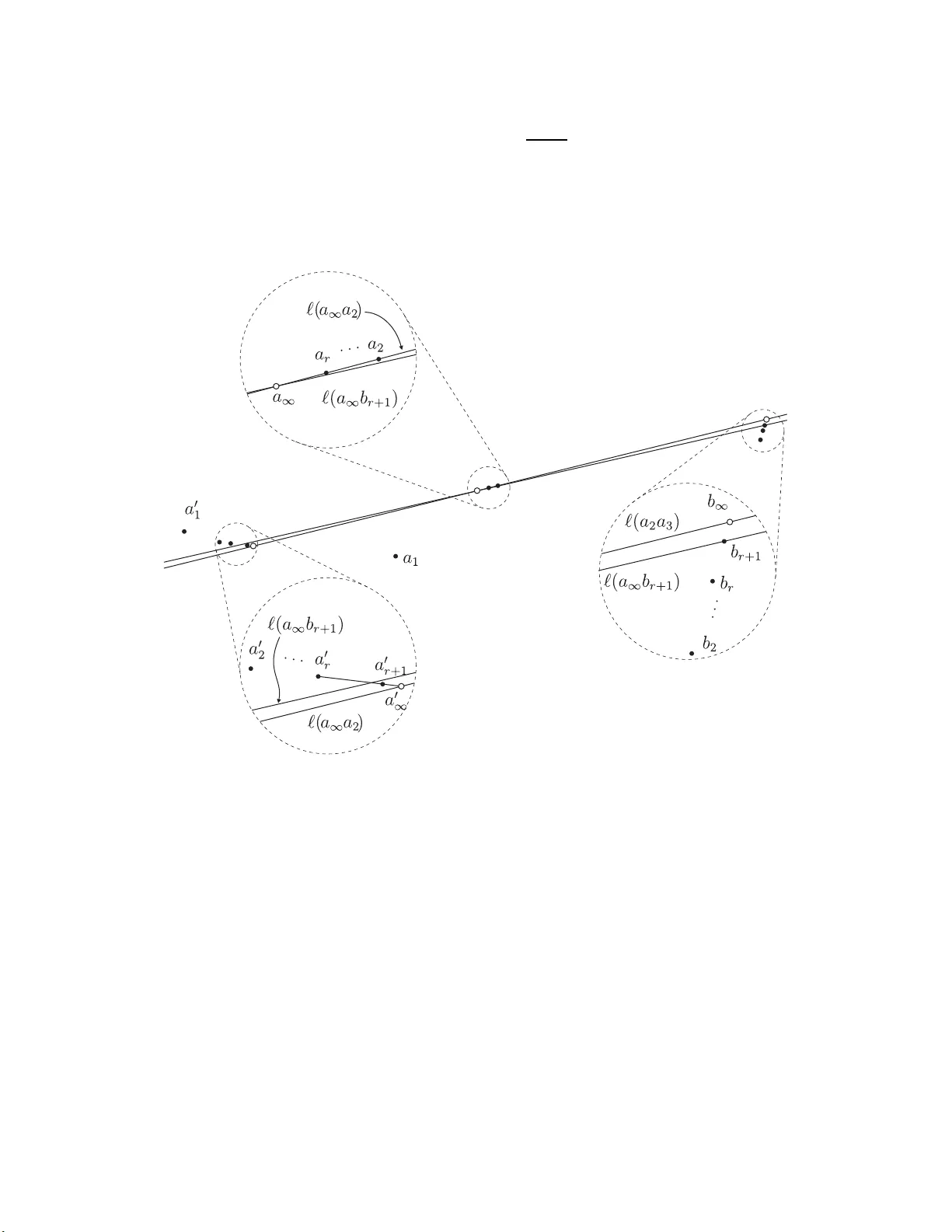
On ≤ k -edges, crossings, and halving lines of geometric dra wings of K n Bernardo M. Ábrego 1 , Mario Cetina 2 , Silvia F ernández-Merc han t 1 , Jesús Leaños 3 , Gelasio Salazar 4 ∗ 1 Departmen t of Mathema tics, California State Univ ersit y , N orthridg e. {bern ardo.abre go,silvia.fernandez}@csun.edu 2 Instituto T ecnológico de San Luis P otosí. mar io.cetin a@itslp.edu.mx 3 Unidad Acad émica de Matemáticas, Univ ersidad Autónoma de Zacatecas. jlean os@mate.r eduaz.mx 4 Instituto de Fís ica, Univ ersidad Autónoma de San Luis P otosí. gsala zar@ifisi ca.uaslp.mx Abstract Let P be a set of p oin ts in general p osition in the plane. Join all pa irs of p oin ts in P with straigh t line segmen ts. The nu m b er of segmen t-crossings in such a draw ing, denoted b y cr( P ) , is the r e ctiline ar cr ossing numb er of P . A halving lin e of P is a line passing though tw o p oin ts of P that divides the rest o f the p oin ts of P in (almost) half. The n um b er of halving lines of P is denoted b y h ( P ) . Similarly , a k - e dge , 0 ≤ k ≤ n/ 2 − 1 , is a line passing through tw o p oin ts of P and lea ving exactly k p oin ts of P on one side. The n um b er of ( ≤ k ) -edges of P is denoted b y E ≤ k ( P ) . Let cr ( n ) , h ( n ) , and E ≤ k ( n ) denot e the minim um of cr( P ) , the maxim um of h ( P ) , and the minim um of E ≤ k ( P ) , resp ectiv ely , ov er all sets P of n poin ts in general p osition in the plane. W e s ho w that the previously b est kno wn lo w er bound on E ≤ k ( n ) is tight for k < ⌈ (4 n − 2) / 9 ⌉ and impro v e it for all k ≥ ⌈ (4 n − 2) / 9 ⌉ . This in turn impro v es the lo w er b ound on cr ( n ) from 0 . 3 7968 n 4 + Θ( n 3 ) to 277 729 n 4 + Θ( n 3 ) ≥ 0 . 379 97 n 4 + Θ( n 3 ) . W e also giv e the exact v alues of cr ( n ) and h ( n ) for all n ≤ 27 . Exact v alues w ere kno wn only for n ≤ 18 and odd n ≤ 21 for the crossing nu m b er, and for n ≤ 14 and o dd n ≤ 21 for halving lines. 2010 AMS Sub ject Classification : Primary 5 2C30, Secondary 52C10, 52C45, 05C62, 68R10, 60D05, and 52A22. Keyw ords : k -edges, k -sets, Halving lines, Rectilinear crossing n um bers, Allow able sequences, Geometric dra wings. 1 In tro duction W e consider three imp ortan t w ell-kno wn pro blems in Com binatorial G eometry: the rectilin- ear crossing n um b er, the maxim um n um b er of halving lines, and the minim um n um b er of ∗ Suppor ted b y CONA CYT Grant 106432 1 ( ≤ k ) -edges of complete geometric graphs on n v ertices. All p oin t sets in this pap er are in the plane, finite, and in general p osition. Let P b e a finite set of p oin ts in general p osition in the plane. Th e r e ctiline ar cr os s ing numb er of P , denoted by cr( P ) , is the nu m b er of crossings obtained when all straigh t line segmen ts joining pairs of p oin ts in P are dra wn. (A c r ossing is the inte rsection of tw o segmen ts in their in terior.) The r e ctiline ar cr ossing numb er of n is the minim um nu m b er of crossings determined b y an y set of n p oin ts, i.e., cr ( n ) = min { cr( P ) : | P | = n } . The problem of determining cr ( n ) for eac h n w as p osed by Erdős and Guy in the early sev en ties [EG73],[Guy71]. This is equiv alen t to finding the minim um n um ber of con v ex quadrilaterals determined b y n p oin ts, as ev ery pair of crossing segmen ts bijectiv ely corresp onds to the diagonals of a conv ex quadrilateral. A halving line of P is a line passing through t w o p oin ts of P and dividing the rest in almost half. So wh en P has n p oin ts and n is ev en, a ha lving line o f P leav es n/ 2 − 1 points of P o n each side; whereas when n is o dd, a halv ing line leav es ( n − 3) / 2 p oin ts on one side and ( n − 1) / 2 on the other. The n um b er o f halving lines of P is denoted b y h ( P ) . Generalizing a halving line, a k -e d g e of P , with 0 ≤ k ≤ n/ 2 − 1 , is a line through t w o p oin ts of P lea ving exactly k p oin ts on one side. The n um b er o f k -edges of P is denoted by E k ( P ) . Since a halving line is a ( ⌊ n/ 2 ⌋ − 1) -edge, then E ⌊ n/ 2 ⌋− 1 ( P ) = h ( P ) . Similarly , for 0 ≤ k ≤ n/ 2 − 1 , E ≤ k ( P ) and E ≥ k ( P ) denote the num b er of ( ≤ k ) -edges and ( ≥ k ) -edges of P , resp ectiv ely . That is, E ≤ k ( P ) = P k j =0 E j ( P ) a nd E ≥ k ( P ) = P ⌊ n/ 2 ⌋− 1 j = k E j ( P ) = n 2 − P k − 1 j =0 E j ( P ) . Let h ( n ) and E ≤ k ( n ) b e the maxim um of h ( P ) a nd the minim um of E ≤ k ( P ) , resp ectiv ely , ov er all sets P o f n p oin ts. A concept closely related to k -edges is that of k -sets ; a k -set of P is a set Q that can b e separated from P \ Q with a straigh t line. R otating this separating line clo c kwise un til it hits a p oin t on eac h side yields a ( k − 1) -edge, and it turns out that this asso ciation is bijectiv e. Th us the n um b er o f k -sets o f P is equal to t he n um ber of ( k − 1) -edges of P . As a consequence, an y o f the results obtained here for k -edges can b e directly translated in to equiv a lent results for ( k + 1) - sets . Erdős, Lo v ász, S immons, and Straus [EL*73], [Lo v71] first in tro duced the concepts of halving lines, k -sets, and k -edges. Since the in tro duction of these parameters bac k in the early 1970s, the determination (or estimation) of cr ( n ) , h ( n ) , and E ≤ k ( n ) hav e b ecome classical problems in comb inatorial geometry . General b ounds are kno wn but exact v alues ha v e only b een found fo r small n . The b est kno wn general b ounds for the halving lines are Ω( ne c √ log n ) ≤ h ( n ) ≤ O ( n 4 / 3 ) , due to Tóth [Tó01] and Dey [Dey98], resp ectiv ely . The previously b est asymptotic b ounds f or the crossing n um ber ar e 0 . 3792 n 4 + Θ( n 3 ) ≤ cr ( n ) ≤ 0 . 38048 8 n 4 + Θ( n 3 ) . (1) The low er b ound is due to Aic hholzer et a l. [A G*07B] and it follow s from Inequalit y (2) as we indicate b elo w. The upp er b ound follows from a recursiv e construction devised by Ábrego and F ernández-Merc han t [AF07] using the a suitable initial construction found b y the authors in [A C*10]. The b est low er b ound for the minim um n um b er of ( ≤ k ) -edges is E ≤ k ( n ) ≥ 3 k + 2 2 + 3 k + 2 − ⌊ n/ 3 ⌋ 2 − max { 0 , ( k + 1 − ⌊ n/ 3 ⌋ )( n − 3 ⌊ n/ 3 ⌋ ) } , (2) 2 due to Aic hholzer et al. [A G*07B]. F urther references and related pro blems can b e found in [BMP06]. The last tw o problems are naturally r elated, and their connection to the first problem is sho wn by t he follow ing iden tit y , indep enden tly prov ed b y Ló v asz et al. [L V*04] and Ábrego and F ernández-Merc han t [AF0 5] . F or any set P of n p oin ts, cr( P ) = 3 n 4 − ⌊ n/ 2 ⌋− 1 X k =0 k ( n − k − 2) E k ( P ) , or equiv a lently cr( P ) = ⌊ n/ 2 ⌋− 2 X k =0 ( n − 2 k − 3) E ≤ k ( P ) − 3 4 n 3 + 1 + ( − 1) n +1 1 8 n 2 . (3) Hence, low er b ounds on E ≤ k ( n ) g ive low er b ounds on cr ( n ) . The ma jorit y of our results (all non-constructiv e parts) are prov ed in the more general con text of generalized configurations of p oin ts, where the p oints in P are joined b y pseu- dosegmen ts r a ther than straight line segmen ts. Go o dman and P ollac k [GP80] establishe d a correspo nden ce b etw een the set of generalized configurations of p oin ts a nd what they called al lo w able se quenc es. In Sec tion 2, w e defin e allo w able sequenc es, in tro duce the necessary no- tation to state the three problems ab o v e in the con text of allow able sequen ces, and include a summary of results for these problems in b oth, the geometric and the allow able sequence con text. n 14 16 18 20 22 23 24 25 26 27 h ( n ) = e h ( n ) 22 ∗ 27 33 38 44 75 51 85 57 96 cr ( n ) = e cr ( n ) 324 ∗ 603 ∗ 1029 ∗ 1657 2528 3077 3 699 4430 5250 6180 T able 1: New exact v alues. The ∗ v alues w ere only kno wn in the rectilinear case. The main result in this pap er is Theorem 1 in Section 3, whic h b ounds E ≥ k ( P ) b y a function of E k − 1 ( P ) . This result has the fo llo wing imp ortan t consequenc es. 1. In Section 4, w e find exact v alues of cr ( n ) and h ( n ) for n ≤ 27 . Exact v alues w ere only kno wn f o r n ≤ 18 and o dd n ≤ 21 in the case of cr ( n ) , and for n ≤ 1 4 and o dd n ≤ 21 in the case of h ( n ) . (See T a ble 1.) W e also sho w that the same v alues are ac hiev ed for the more general case of the pseudolinear crossing nu m b er e cr ( n ) and the maxim um n um b er of halving pseudolines e h ( n ) . (See Section 2 for the definitions.) 2. Theorem 2 in Section 5 improv es the low er b ound in Inequalit y (2) for k ≥ ⌈ (4 n − 11) / 9 ⌉ . It giv es a recursiv e low er b ound whose asymptotic v alue is give n b y E ≤ k ( n ) ≥ n 2 − 1 9 r 1 − 2 k + 2 n (5 n 2 + 19 n − 31) , as show n in Corollary 3. 3 3. Theorem 3 in Section 6 impro v es the low er b ound in Inequalit y (1) to cr ( n ) ≥ 277 729 n 4 + Θ n 3 ≥ 0 . 37997 n 4 + Θ n 3 . In Section 7, and to complemen t item 2 a bov e, w e sho w that Inequalit y (2) is tight for k < ⌈ (4 n − 1 1) / 9 ⌉ . More precisely , w e construct sets of p oints sim ultaneously ac hieving equalit y in Inequalit y (2) for all k < ⌈ (4 n − 11) / 9 ⌉ . Sev eral results of this pap er app eared (without pro ofs) in the conference pro ceedings of LA GOS’07 [AF*0 8A , AF*08B]. 2 Allo w able sequ ences and generalized configurations of p oin ts An y set P of n p oin ts in the plane can b e enco ded b y a sequence o f p erm utations of the set [ n ] = { 1 , 2 , ..., n } a s follo ws. Consider a directed line l . Orthogonally pro ject P onto l and la b el the p oin ts of P fro m 1 to n according to their order in l . In this order, the iden tit y p erm utation (1 , 2 , ..., n ) , is the first p erm utation of our sequence . Note tha t l can b e ch osen so that none of the pro jections ov erlap. Con tin uous ly rotate l counterc lo c kwise. The o rder of the pro j ections of P onto l c hanges ev ery time tw o pro jections o v erlap, that is, ev ery time a line through t w o p oin ts of P b ecomes p erp endicular to l . Eac h time this happ ens, a new p erm utation is recorded as part of our sequenc e. After a 180 ◦ -rotation o f l w e obtain a sequence of n 2 + 1 p erm utations such t hat the first p erm utation (1 , 2 , ..., n ) is the iden tit y , the la st p erm utation ( n, n − 1 , ..., 2 , 1) is the rev erse of the iden tit y , any t w o consecutiv e p erm utations differ b y a trans p osition of adjacen t elemen ts, and an y pair of p oin ts (lab els 1 , ..., n ) transp ose exactly once. This sequence is know n as a halfp erio d o f the cir cular se quenc e asso ciated to P . The cir cular se quenc e of P is then a doubly infinite sequenc e of p erm utations obtained b y rota ting l indefinitely in b oth directions. As an abstract generalization of a circular sequence, a sim p le al low able se quenc e on [ n ] is a doubly infinite seque nce Π = ( ..., π − 1 , π 0 , π 1 , ... ) of p erm utations of [ n ] , suc h t ha t any t w o consecutiv e p erm utations π i and π i +1 differ b y a t r a nsposition τ ( π i ) of neigh b oring el- emen ts, a nd suc h that for ev ery j , π j is the rev erse p erm utation of π j + ( n 2 ) . A halfp erio d of Π is a sequence of n 2 + 1 consecutiv e permu tations of [ n ] . As b efore, an y halfp erio d of Π uniquely determines Π and all prop erties for halfp erio ds men tioned ab o v e still hold. Moreo v er, the halfp erio d π = ( π i , π i +1 , ..., π i + ( n 2 ) ) is completely determined b y the transp osi- tions τ ( π i ) , τ ( π i +1 ) , . . . , τ ( π i + ( n 2 ) − 1 ) . No te that the sequence ( . . . , τ ( π − 1 ) , τ ( π 0 ) , τ ( π 1 ) . . . ) is n 2 -p erio dic. Th us we indistinctly refer to π as a sequence of p erm utations or as a sequence of (suitable) transpositions. Allow able sequences that are the circular sequence o f a set o f p oin ts are called str etchable . A pseudoline is a curv e in P 2 , the pro jectiv e plane, whose remo v al do es not disconnect P 2 . Alternativ ely , a pseudoline is a simple curv e in the plane that extends infinitely in b oth directions. A simple ge n er alize d c onfigur ation of p oi n ts consists of a set of n 2 pseudolines and n p oin ts in the plane suc h that eac h pseudoline passes through exactly tw o p oin ts, and an y tw o pseudolines in tersect exactly once. 4 Circular and a llo w able seq uences w ere first introduced b y G oo dman and P ollac k [G P80]. They prov ed that not ev ery allo w able sequence is stretc hable and established a correspon- dence b et w een a llow able sequences and generalized configurations of p oin ts. The three proble ms at hand can be e xtended to generalized configurations of points , or equiv alen tly , to simple allo w able sequenc es. In this new setting, a transp osition of t w o p oin ts in p ositions k and k + 1 , or n − k and n − k + 1 in a simple allow able sequence Π corresp onds to a ( k − 1) -edge. W e sa y that suc h t r a nsposition is a k -transp osition, or respectiv ely , a ( n − k ) - t ra nsposition, and if 1 ≤ k ≤ n/ 2 all these transp ositions are called k -critic a l . Therefore E k (Π) , E ≤ k (Π) , and E ≥ k (Π) corresp ond to the n umber of ( k + 1 ) - critical, ( ≤ k + 1) -critical, a nd ( ≥ k + 1) -critical transp ositions in an y halfp erio d o f Π . A halving line of Π is a ⌊ n/ 2 ⌋ - transposition, and th us h (Π) = E ⌊ n/ 2 ⌋− 1 (Π) . Iden tit y (3), whic h relates the num b er of k -edges to the crossing n um b er, was o riginally pro v ed for allow able sequenc es. In this setting, a pseudose gment is the segmen t of a pseudoline joining tw o p oin ts in a generalized configuration of p oin ts, and c r(Π) is the n um ber o f pseudosegme n t-crossings in the generalized configuration o f p oin ts that corresp onds to the allow able sequence Π . All these definitions and functions coincide with their o rig inal coun terparts for P wh en Π is the circular sequ ence of P . Ho w ev er, when cr ( n ) , h ( n ) , and E ≤ k ( n ) are minimiz ed or maximized o v er all allo w able sequences on [ n ] ra ther than o v er a ll sets of n p o in ts, the corresponding quan tities may c hange and therefore we use the notation e cr ( n ) , e h ( n ) , and e E ≤ k ( n ) . Because n -p oin t sets corresp ond to the stretc hable simple allow able sequences on [ n ] , it follo ws that e cr ( n ) ≤ cr ( n ) , e h ( n ) ≥ h ( n ) , and e E ≤ k ( n ) ≤ E ≤ k ( n ) . T amaki and T okuy ama [TT02] extended Dey’s upp er b ound f o r allo w able seq uences to e h ( n ) = O ( n 4 / 3 ) . Ábrego et al. [AB*06] pro v ed that the lo w er b ound for E ≤ k ( n ) in Inequalit y (2) is also a low er b ound on e E ≤ k ( n ) . They used this b ound to extend (and eve n sligh tly impro v e) the corresponding low er b ound on cr ( n ) to e cr ( n ) . Our main result, The orem 1 in Section 3, concen tra t es on the cen tra l b eha vior of a llo w able sequenc es. W e b ound E ≥ k (Π) b y a function of E k − 1 (Π) . As a conseque nce, w e impro v e (or matc h) the upp er b ounds on e h ( n ) for n ≤ 27 , and th us the lo w er b ounds on e cr ( n ) in the same range. This is enough to matc h the corresp onding b est k no wn geometric constructions [A] for h ( n ) a nd cr ( n ) . This show s t hat for all n ≤ 27 , e h ( n ) = h ( n ) a nd e cr ( n ) = cr ( n ) whose exact v alues are summarized in T able 1. 3 The Cen tral Theorem In this section, we presen t our main theorem. Giv en a halfp eriod π = ( π 0 , π 1 , π 2 , ..., π ( n 2 ) ) of an allow able sequence and an in teger 1 ≤ k < n/ 2 , the k -c enter of the p erm utation π j , denoted by C ( k , π j ) , is the set of elemen ts in the middle n − 2 k p ositions of π j . Let L 0 , C 0 , and R 0 b e the se t of elemen ts in the first k , middle n − 2 k , and last k p ositions, resp ectiv ely , of the p erm utation π 0 . Define s ( k , π ) = min | C 0 ∩ C ( k , π i ) | : 0 ≤ i ≤ n 2 . Note that s ( k , π ) ≤ n − 2 k − 1 b ecause at least one of the n − 2 k elemen ts of C 0 m ust lea v e the k -cen ter. 5 Theorem 1. L e t Π b e an a l lowable se quenc e on [ n ] a nd π any halfp erio d of Π . If s = s ( k , π ) , then E ≥ k (Π) ≤ ( n − 2 k − 1) E k − 1 (Π) − s 2 ( E k − 1 (Π) − n + 1) . Pr o of. F or presen tation purp oses, w e divide this pro of in to subsec tions. Let Π b e an allow a ble sequence on [ n ] and π = ( π 0 , π 1 , π 2 , ..., π ( n 2 ) ) an y halfp erio d of Π , s = s ( k , π ) , and K = E k − 1 ( π ) . Supp ose tha t π i 1 , π i 2 , ..., π i K is the subseque nce of p erm utations in π obta ined when the k -critical transp ositions τ ( π i 1 ) , τ ( π i 2 ) , ..., τ ( π i K ) o f π o ccur (in this order). F or simplicit y w e write τ j instead of τ ( π i j ) . These p erm utations partition π into K + 1 parts B 0 ( π ) , B 1 ( π ) , B 2 ( π ) , ..., B K ( π ) called b l o cks , where B j ( π ) = { π l : i j ≤ l < i j +1 } for 1 ≤ j ≤ K − 1 , B 0 ( π ) = { π l : 0 ≤ l < i 1 } , and B K ( π ) = { π l : i K ≤ l ≤ n 2 } . Denote b y p j the p oin t that en ters the k -cen ter of π i j with τ j . W e say that a ( ≥ k + 1) -critical tra nsposition in B j ( π ) , 1 ≤ j ≤ K, is an essential transp osition if it in v olv es p j or if it o ccurs b efore τ 1 , and a noness ential tra nsposition otherwise. Figure 1: Classification of essen tial k -critical transp ositions. Rearrangemen t of π W e claim that, to b ound E ≥ k (Π) , we can assume that all ( ≥ k + 1) -critical tra nsp ositions of π are essen tial transp ositions. T o show this, in case π has nonessen tial transp ositions, w e mo dify π so that the obtained halfp erio d λ satisfies E j ( π ) = E j ( λ ) for all j < k , and th us E ≥ k ( π ) = E ≥ k ( λ ) ; and either λ has only essen tial transp ositions or the last nonessen tial transp osition of λ o ccurs in an earlier perm utation than the last nonesse n tial transposition of π . Applying this pro cedure enough times, w e end with a halfp erio d λ all of whose ( ≥ k + 1) - critical transp ositions are essen tial and such that E j ( π ) = E j ( λ ) for all j ≤ k , and thus E ≥ k ( π ) = E ≥ k ( λ ) . 6 This is ho w λ is construc ted. Supp ose B j ( π ) is the last blo c k of π that contains nonessen- tial transp ositions. Defi ne λ as the halfp erio d that coincides with π ev erywhere except f o r the ( ≥ k + 1) - t ra nspositions in B j ( π ) . All nonessen tial transp ositions in B j ( π ) tak e place righ t b efore τ j in λ , and right after τ j o ccurs, all essen tial transp ositions in B j ( π ) o ccur con- secutiv ely in B j ( λ ) but probably in a different order than in B j ( π ) , so that the final p o sition of p j is the same in B j ( π ) and B j ( λ ) . Note that in fact the last p erm utations of the blo ck s B j ( π ) and B j ( λ ) are equal. Classification of k -critical transp ositions F rom no w on, w e assume that π only has essen tial transp ositions. W e classify the k -critical transp ositions as follo ws (see F igure 1): τ j is an arrivi ng t r a nsposition if p j ∈ C 0 . An arriving transp osition is m -augmenting if it incremen ts the num b er of elemen ts in C 0 in the k -cen ter from m − 1 to m , and it is neutr al otherwise. W e sa y that τ j is a r eturning transp osition if it is a k -transp osition and p j ∈ R 0 , or if it is an ( n − k ) -transp osition and p j ∈ L 0 . That is, p i is “getting back ” to its starting region. Similarly , τ j is a dep arting transp osition if it is a k -transp osition and p j ∈ L 0 , or if it is an ( n − k ) -transp osition and p j ∈ R 0 . That is, p j is “getting aw ay” from its original region. W e sa y tha t a departing transp osition τ j is a cutting transp osition, if τ j is a k -transp osition and the next k -critical tra nsp osition that in v olv es p j is an ( n − k ) -transp osition; or if τ i is an ( n − k ) -transp osition and the next k -critical transp osition that in v olv es p j is a k -transp osition. All other departing transp ositions ar e called stal ling . Finally , w e define the we i g ht of a k -critical transp osition τ j , denoted by w ( τ j ) , as t he n um b er of ( ≥ k + 1) -critical transp ositions in B j ( π ) that are not b et w een t w o elemen ts of C 0 . T ransp ositions with w eigh t at most n − 2 k − 1 − s are called light . All other transp ositions are he avy . Let A, N , R, C , S light , and S hea vy b e the n um b er of augmenting, neutral, returning, cutting, ligh t stalling, a nd heav y stalling transp ositions, resp ectiv ely . Then K = A + N + R + C + S light + S hea vy . Bounding E ≥ k (Π) Observ e that the k -cen ter of all p erm utations in B 0 ( π ) remains unc hanged. It follo ws t hat all ( ≥ k + 1) -critical transp ositions o f B 0 ( π ) ar e b etw een elemen ts of C 0 . Th us P K j =1 w ( τ j ) coun ts a ll ( ≥ k + 1) -critical transp ositions except those b et w een tw o elemen ts of C 0 . There are n − 2 k 2 transp ositions b et w een elemen ts of C 0 , but eac h neutral transposition corresponds to a k -critical (not ( ≥ k + 1) -critical) transp osition b et w een t w o elemen ts of C 0 . Th us E ≥ k (Π) ≤ n − 2 k 2 − N + K X j =1 w ( τ j ) . (4) Bounds for t he w eigh t of a k -critical t r ans p osition W e b ound the w eigh t of a tra nsposition dep ending on its class (departing, returning, etc.), as we ll as the nu m b er of transp ositions within a class, if necessary . F or j ≥ 1 all ( ≥ k + 1) - critical transp ositions in B j ( π ) in v olv e p j and thu s w ( τ j ) ≤ n − 2 k − 1 . How ev er, since the 7 w eigh t of τ j do es not coun t transp ositions b et w een t w o elemen ts of C 0 , and there are alw a ys at least s elemen ts of C 0 in the k -cen ter, then w ( τ j ) ≤ n − 2 k − s whene v er τ j is arriving (b ecause p j ∈ C 0 ). Moreo v er, if τ j is m -augmen ting, then w ( τ j ) ≤ n − 2 k − m . If τ j is a returning transp osition, then p j has already b een transp osed with all the elemen ts of C 0 that are in the k -cen ter of π i j . Since there are at least s suc h e lemen ts, then w ( τ j ) ≤ n − 2 k − 1 − s . Summarizing, w ( τ j ) ≤ n − 2 k − 1 for all τ j , n − 2 k − s, if τ j is neutral, n − 2 k − m, if τ j is m -augmenti ng, n − 2 k − 1 − s , if τ j is light stalling or returning. (5) Bounding C W e b ound the num ber of cutting transp ositions. Since the first (la st) k elemen ts of π 0 are the last (first) elemen ts of π ( n 2 ) , then the 2 k elemen ts not in C 0 m ust part icipate in at least one cutting transp osition. That is, C ≥ 2 k . Note that, if p / ∈ C 0 participates in c ≥ 2 cutting transpo sitions , then there m ust b e at least c − 1 returning transp ositions of p . In other words, there m ust b e at least C − 2 k ≥ 0 returni ng transpositions. There are C cutting transp ositions and a t least n − 2 k − s arriving transp ositions (at least one m -augmen ting arriving transp osition for eac h s + 1 ≤ m ≤ n − 2 k ). Then K − C − ( n − 2 k − s ) coun ts all other k - critical transp ositions, including in particular all returning transp ositions. Th us K − C − ( n − 2 k − s ) ≥ C − 2 k , that is, 2 C ≤ 4 k + K − n + s. (6) Augmen ting and heavy stalling tr ans p ositions W e k eep trac k of the augmen ting and heavy stalling transp ositions together. T o do this, w e consider the bipartite graph G whose vertic es are the augmen ting and the hea vy stalling transp ositions. The augmen ting transposition τ l is adjacen t in G to the hea vy stalling trans- p osition τ j if j < l , p j is in the k -cen ter of all p erm utations in blo c ks B j to B l , one trans- p osition from τ j and τ l is a k -tra nsp osition and the other is an ( n − k ) -transp osition, and p l do es not sw ap with p j in B l ( π ) . W e b ound the degree of a v ertex in G . Let τ j b e a hea vy stalling transp osition. If p j ∈ L 0 (the case p j ∈ R 0 is equiv alen t), then τ j is a k -transp osition. Because p j mo v es to the rig ht exactly w ( τ j ) > n − 2 k − 1 − s p ositions with in B j ( π ) , it follo ws that the k -cen ter righ t b efore τ j +1 o ccurs (i.e., the k - cen ter of π i j +1 − 1 ) has at most n − 2 k − 1 − w ( τ j ) < s p oin ts of C 0 to the righ t of p j . Also, since τ j is stalling, the next time that p j lea v es the k -cen ter is by a k - transposition τ j + a . This means that t he k -cen ter right b efore τ j + a o ccurs (i.e., the k -cen ter of π i j + a − 1 ) has at least s p oin ts of C 0 to the right of p j . Thus , b et w een τ j and τ j + a there m ust be at least s − ( n − 2 k − 1 − w ( τ j )) arriving ( n − k ) -transp ositions τ l suc h that p l remains to the righ t of p j in B l ( π ) , i.e., p l do es not sw ap with p j in B l ( π ) . These transp ositions are adjacen t to τ j and thus the degree of τ j in G is at least w ( τ j ) − ( n − 2 k − 1 − s ) . Hence, | E ( G ) | ≥ X τ j hea vy stalling ( w ( τ j ) − ( n − 2 k − 1 − s )) , 8 where E ( G ) is the set of edges of G . Let τ l b e an m -augmen ting trans p osition. Since p l ∈ C 0 , and w eigh ts do not coun t transp ositions b et w een t w o ele men ts of C 0 , then a t most n − 2 k − m − w ( τ l ) p oints in L 0 ∪ R 0 do not sw ap with p l in B l ( π ) . Only these p oin ts are p ossible p j s suc h that τ j is adjacen t to τ l . Th us the degree of τ l in G is at most n − 2 k − m − w ( τ l ) ≤ n − 2 k − 1 − s − w ( τ l ) . Note that there is at least one m -augmentin g transp osition for each s + 1 ≤ m ≤ n − 2 k . This is b ecause the k -cen ter of at least one p erm utation of π con tains exactly s elemen ts of C 0 (b y definition of s ), and the k -cen ter of π ( n 2 ) con tains exactly n − 2 k elemen ts of C 0 (since it coincides with C 0 ). Then the num ber of el emen ts in the k - cen ter m ust be ev en tually incremen ted from s to n − 2 k . F or each s + 1 ≤ m ≤ n − 2 k , w e use n − 2 k − m − w ( τ l ) to b ound the degree of one m - augmen t ing transp osition. F or a ll other augmentin g transp ositions we use the b ound n − 2 k − 1 − s − w ( τ l ) . Hence | E ( G ) | ≤ X τ j augmen ting (( n − 2 k − 1 − s ) − w ( τ j )) − n − 2 k X m = s +1 ( m − s − 1) = X τ j augmen ting (( n − 2 k − 1 − s ) − w ( τ j )) − n − 2 k − s 2 . The previous t w o inequalities imply that X τ j augmen ting w ( τ j ) + X τ j hea vy stalling w ( τ j ) ≤ ( n − 2 k − 1 − s ) ( A + S hea vy ) − n − 2 k − s 2 . (7) Final calculations W e use inequalities (5) and (7) to b ound P K i =1 w ( τ i ) − N . K X j =1 w ( τ j ) − N = X τ j cutting w ( τ j ) + X τ j augmen ting w ( τ j ) + X τ j hea vy stalling w ( τ j ) + X τ j light stalli ng w ( τ j ) + X τ j return ing w ( τ j ) + X τ j neutral w ( τ j ) − N ≤ ( n − 2 k − 1) C + ( n − 2 k − 1 − s ) ( A + S hea vy ) − n − 2 k − s 2 + ( n − 2 k − 1 − s ) ( S light + R ) + ( n − 2 k − s ) N − N ≤ sC + ( n − 2 k − 1 − s ) K − n − 2 k − s 2 . By Inequalit y (4), E ≥ k (Π) ≤ n − 2 k 2 − n − 2 k − s 2 + sC + ( n − 2 k − 1 − s ) K = ( n − 2 k − 1) K − s 2 (2 K − 2 n + 4 k + 1 + s − 2 C ) . 9 Finally , b y Inequalit y (6), E ≥ k (Π) ≤ ( n − 2 k − 1) K − s 2 ( K − n + 1) . 4 New exact v alues for n ≤ 27 In this section, w e giv e exact v a lues of h ( n ) and e h ( n ) for n ≤ 2 7 . W e start b y stating a relaxed ve rsion of Theorem 1, whic h w e use in the sp ecial case when k = ⌊ n/ 2 ⌋ − 1 . Corollary 1. L et Π b e a simple al lowable se quenc e on [ n ] and π any h alfp erio d of Π . If s = s ( k , π ) , then E ≥ k (Π) ≤ ( n − 2 k − 1) E k − 1 (Π) + s 2 ≤ ( n − 2 k − 1) E k − 1 (Π) + n − 2 k − 1 2 . Pr o of. There are at least n − 2 k − s elemen ts of C 0 that lea v e the k -center, so there are at least n − 2 k − s arriving transp ositions. In a ddition, there are at least 2 k departing transpositions, one p er elemen t not in C 0 . It follo ws that E k − 1 (Π) ≥ 2 k + ( n − 2 k − s ) = n − s . The first inequalit y no w follo ws directly from Theorem 1. F inally , s ≤ n − 2 k − 1 for all halfp eriods of Π whic h yi elds the second inequalit y . Another conseq uence is that E k − 1 (Π) ≥ n − s ≥ 2 k + 1 , whic h is in fa ct the minim um p ossible v alue of E k − 1 (cf. [L V*04]). The previous corollary implies the following result f or halving lines. Corollary 2. If Π is a si m ple al lowa b le se quenc e on [ n ] and n ≥ 8 , then h (Π) ≤ ( 1 24 n ( n + 30 ) − 3 if n is even, 1 18 ( n − 3)( n + 45) + 1 9 if n is o dd. Pr o of. If k = ⌊ n/ 2 ⌋ − 1 on Corollary 1, then E ≥⌊ n/ 2 ⌋− 1 (Π) = h (Π) and th us h (Π) ≤ ( n − 2 ⌊ n/ 2 ⌋ + 1) E ≥⌊ n/ 2 ⌋− 2 (Π) + n − 2 ⌊ n/ 2 ⌋ +1 2 , that is, h (Π) ≤ ( E n/ 2 − 2 (Π) if n is ev en, 2 E ( n − 1) / 2 − 2 (Π) + 1 if n is o dd. Moreo v er, b ecause E ≤⌊ n/ 2 ⌋− 3 (Π) + E ⌊ n/ 2 ⌋− 2 (Π) + h (Π) = n 2 , it follo ws that h (Π) ≤ ( 1 2 n 2 − 1 2 E ≤ n/ 2 − 3 (Π) if n is ev en, 2 3 n 2 − 2 3 E ≤ ( n − 1) / 2 − 3 (Π) + 1 3 if n is o dd. The b ound in Inequalit y (2) is also v alid in the more general con text of allow able sequences [AB*06]. Using this b ound for E ≤ k (Π) when k = ⌊ n/ 2 ⌋ − 3 , and consi dering all residue classes of n mo dulo 18 with n ≥ 8 , it follo ws that ⌊ 1 2 n 2 − 1 2 E ≤ n/ 2 − 3 (Π) ⌋ ≤ ⌊ n ( n + 30) / 24 − 3 ⌋ when n is ev en , and ⌊ 2 3 n 2 − 2 3 E ≤ ( n − 1) / 2 − 3 (Π) + 1 3 ⌋ ≤ ⌊ ( n − 3)( n + 45) / 18 + 1 / 9 ⌋ when n is o dd. 10 Because h ( n ) ≤ c n 4 / 3 , the inequalit y in Corollary 2 is only useful for small v alue s of n . Ho w ev er, ev en with the curren t b est constan t c = (31287 / 8192) 1 / 3 < 1 . 5721 [AA*98, PR*06], our b ound is b etter when n is eve n in the range 8 ≤ n ≤ 184 . The exact v a lues of h ( n ) w ere previously kno wn only f or ev en n ≤ 14 or o dd n ≤ 21 [AA*98, BR02]. The exact v alues of cr ( n ) we re previously kno wn only for ev en n ≤ 18 or o dd n ≤ 2 1 [A G*07B]. The v a lues in T able 1 corresp ond to the upp er b ounds obtained by Corollary 2 when n is ev en, 14 ≤ n ≤ 26 or n is o dd, 23 ≤ n ≤ 27 . W e also obtained new lo w er b ounds for e cr ( n ) in this range of v alues o f n . The iden tit y E ≤⌊ n/ 2 ⌋− 2 (Π) = n 2 − h (Π) together with Corollar y 2 giv e a new low er b ound for E ≤⌊ n/ 2 ⌋− 2 (Π) . Using this b ound for k = ⌊ n/ 2 ⌋ − 2 and the b ound in Inequalit y (2) fo r k ≤ ⌊ n/ 2 ⌋ − 3 in Iden tit y (3 ) yields the v alues in T able 1 for e cr ( n ) . F or example, if n = 24 then E ≤ 10 (Π) = 24 2 − h (24) ≥ 276 − 51 = 225 and b y Inequalit y (2), the ve ctor ( E ≤ 0 (Π) , E ≤ 1 (Π) , E ≤ 2 (Π) , . . . , E ≤ 9 (Π)) is b ounded b elo w entry-wis e by (3 , 9 , 18 , 30 , 45 , 63 , 84 , 108 , 13 8 , 174) , so Iden tit y ( 3 ) implies that e cr (24) = P 10 k =0 (21 − 2 k ) E ≤ k (Π) − 3 4 24 3 ≥ 3699 . All the b ounds show n in T able 1 are attained by Aic hholzer’s et al. constructions [A], and thus T able 1 actually show s the exact v alues of e h ( n ) , h ( n ) , e cr ( n ) , and cr ( n ) fo r n in the sp ecifi ed range. F or 28 ≤ n ≤ 33 , T able 2 shows the new reduced ga p b et w een the low er and upp er b ounds of h ( n ) and e h ( n ) . n 28 29 30 31 32 33 h ( n ) ≥ 63 105 69 11 5 73 126 e h ( n ) ≤ 64 107 72 11 8 79 130 T able 2: Up dated b ounds for 28 ≤ n ≤ 33 5 New lo w er b ound for the n um b er of ( ≤ k ) -edges In this section, w e obtain a new lo w er b ound for the n um b er of ≤ k -edges. Our emphasis is on finding t he b est p ossible asymptotic result as we ll as the b est b ounds that apply to the small v alues of n for whic h the exact v alue is unkno wn. Theorem 2 provide s the exact result that can b e applied to small v alues of n , whereas Corollary 3 is suitable enough to giv e the b est asymptotic b ehav ior. Let m = ⌈ (4 n − 11) / 9 ⌉ . F or eac h n , define the follow ing recursiv e sequence. u m − 1 = 3 m + 1 2 + 3 m + 1 − ⌊ n/ 3 ⌋ 2 − 3 m − j n 3 k n 3 − j n 3 k and u k = 1 n − 2 k − 2 n 2 + ( n − 2 k − 3) u k − 1 for k ≥ m . The follow ing is the new low er b ound on E ≤ k ( n ) . It follows from Theorem 1. 11 Theorem 2. F or any n and k such that m − 1 ≤ k ≤ ( n − 3) / 2 , E ≤ k ( n ) ≥ u k . Pr o of. W e need the following t w o lemmas to estimate the g r owth of the sequence u k with respect to n and k . F or presen tation purposes, w e defer their proo fs to the end o f the section. Lemma 1. F o r any k such that m − 1 ≤ k ≤ ( n − 5) / 2 , 3 r 1 − 2 k + 9 / 2 n < n 2 − u k n 2 − u m − 1 ≤ 3 r 1 − 2 k + 2 n . (8) Lemma 2. F o r any k such that m ≤ k ≤ ( n − 5) / 2 , 3 r 1 − 2 k + 9 / 2 n n 2 − u m − 1 ≥ ( n − 1) ( n − 2 k − 3) . W e pro v e the stronger statemen t e E ≤ k ( n ) ≥ u k . Let Π b e an allo w able sequence on [ n ] and π an y of its halfp eriods. W e pro ceed b y induc tion on k . If k = m − 1 the result holds b y Inequalit y ( 2 ), prov e d in the more general con text of allo w able sequences [AB*06]. Assume that k ≥ m and E ≤ k − 1 (Π) ≥ u k − 1 . Let s = s ( k + 1 , π ) ; b y Theorem 1, E ≥ k +1 (Π) ≤ ( n − 2 k − 3) E k (Π) − s 2 ( E k (Π) − ( n − 1)) . If s = 0 or E k (Π) ≥ n − 1 , then E ≥ k +1 (Π) ≤ ( n − 2 k − 3) E k (Π) . Th us n 2 − E ≤ k (Π) ≤ ( n − 2 k − 3) ( E ≤ k (Π) − E ≤ k − 1 (Π)) , and by induction E ≤ k (Π) ≥ 1 n − 2 k − 2 n 2 + ( n − 2 k − 3) E ≤ k − 1 (Π) ≥ 1 n − 2 k − 2 n 2 + ( n − 2 k − 3) u k − 1 , whic h implies that E ≤ k (Π) ≥ u k b y definition o f u k . Now assume s > 0 and E k (Π) < n − 1 . Because E k (Π) ≥ 2 k + 3 (see the pro of of Corollary 1), it follo ws that k ≤ ( n − 5) / 2 . By Theorem 1, E ≥ k +1 (Π) ≤ ( n − 2 k − 3) E k (Π) − s 2 ( E k (Π) − ( n − 1) ) = ( n − 2 k − 3 − s 2 ) E k (Π) + s 2 ( n − 1) . Recall that s = s ( k + 1 , π ) ≤ n − 2 k − 3 . Because E k (Π) < n − 1 , it f o llo ws that E ≥ k +1 (Π) ≤ ( n − 2 k − 3 − s 2 )( n − 1) + s 2 ( n − 1) = ( n − 1) ( n − 2 k − 3) . 12 Therefore E ≤ k (Π) = n 2 − E ≥ k +1 (Π) ≥ n 2 − ( n − 1) ( n − 2 k − 3) . By Lemma 2, E ≤ k (Π) ≥ n 2 − 3 r 1 − 2 k + 9 / 2 n n 2 − u m − 1 , and by Lemma 1, E ≤ k (Π) ≥ u k for all allow a ble sequences Π on [ n ] . Therefore E ≤ k ( n ) ≥ e E ≤ k ( n ) ≥ u k . Corollary 3. F or any n and k such that m − 1 ≤ k ≤ ( n − 2) / 2 , E ≤ k ( n ) ≥ n 2 − 1 9 r 1 − 2 k + 2 n 5 n 2 + 19 n − 31 . Pr o of. Let Π b e an allow able sequen ce on [ n ] . If k = ⌊ n/ 2 ⌋ − 1 , then E ≤⌊ n/ 2 ⌋− 1 (Π) = n 2 . F or k < ⌊ n/ 2 ⌋ − 1 , it f o llo ws that n ≥ 3 and from Theorem 2 a nd Lemma 1, E ≤ k (Π) ≥ u k ≥ n 2 − 3 r 1 − 2 k + 2 n n 2 − u m − 1 . Considering the p ossible residues of n mo dulo 9 , it can b e v erified that for n ≥ 3 , u m − 1 ≥ 17 54 n 2 − 65 54 n + 31 27 (equalit y if n ≡ 3 (mo d 9)) . Therefore E ≤ k ( n ) ≥ e E ≤ k ( n ) ≥ n 2 − 1 9 q 1 − 2 k + 2 n (5 n 2 + 19 n − 31) . Pro ofs of the Lemma s Pr o of of L emm a 1. The in teger ra ng e [ m − 1 , ( n − 5) / 2] is empt y fo r n ≤ 5 . Assum e n ≥ 6 and pro ceed b y induction on k . If k = m − 1 , then 3 p 1 − (2 m + 5 / 2) /n ≤ 1 ≤ 3 p 1 − 2 m/n is equiv a lent to ⌈ (4 n − 11) / 9 ⌉ ≤ 4 n/ 9 ≤ ⌈ (4 n − 11) / 9 ⌉ + 5 / 4 whic h holds in general. Assume that k ≥ m and that (8 ) holds for k − 1 . F rom the definition of u k and the ind uction h yp o thes is, n 2 − u k ≤ n 2 − 1 n − 2 k − 2 n 2 + ( n − 2 k − 3) u k − 1 = n − 2 k − 3 n − 2 k − 2 n 2 − u k − 1 ≤ 3 n 2 − u m − 1 n − 2 k − 3 n − 2 k − 2 r 1 − 2 k n , and ( n − 2 k − 3) p 1 − 2 k /n / ( n − 2 k − 2 ) ≤ p 1 − (2 k + 2) / n b ecaus e k ≤ ( n − 5) / 2 , whic h pro v es the second inequalit y in (8). Similarly , from the definition of u k and the induction h yp o thes is, n 2 − u k ≥ n 2 − 1 n − 2 k − 2 n 2 + ( n − 2 k − 3) u k − 1 − 1 = n − 2 k − 3 n − 2 k − 2 n 2 − u k − 1 − 1 ≥ 3 n 2 − u m − 1 n − 2 k − 3 n − 2 k − 2 r 1 − 2 k + 5 / 2 n − 1 . 13 Hence, to prov e the second ineq ualit y in (8), it is enough to show that 3( n 2 − u m − 1 ) d > 1 , where d = n − 2 k − 3 n − 2 k − 2 r 1 − 2 k + 5 / 2 n − r 1 − 2 k + 9 / 2 n (9) is alwa ys p ositiv e b ecause k ≤ ( n − 5) / 2 . First note that u m − 1 ≤ 3 m + 1 2 + 3 m + 1 − ⌊ n/ 3 ⌋ 2 ≤ 3 (4 n + 6) / 9 2 + 3 ( n + 1 0 ) / 9 2 , whic h implies that 3 n 2 − u m − 1 ≥ 1 9 5 n 2 − 25 n + 4 . (10) Multiplying the easily-v erified inequalit y 1 > ( n − 2 k − 3) p n − 2 k − 5 / 2 + ( n − 2 k − 2) p n − 2 k − 9 / 2 (2 n − 4 k − 5) p n − 2 k − 5 / 2 b y Iden tit y (9), yields d > n − 2 k − 9 / 4 ( n − 2 k − 2) 2 p n ( n − 2 k − 5 / 2 ) · 2 n − 4 k − 4 2 n − 4 k − 5 > n − 2 k − 9 / 4 ( n − 2 k − 2) 2 p n ( n − 2 k − 5 / 2 ) = 1 − 1 4 ( n − 2 k − 2) 1 ( n − 2 k − 2) p n ( n − 2 k − 2 − 1 / 2) . Since (4 n − 11) / 9 ≤ k ≤ ( n − 5) / 2 , then 3 ≤ n − 2 k − 2 ≤ ( n + 4) / 9 . Th us d > 1 − 1 12 27 ( n + 4 ) p n ( n − 1 / 2) = 99 4 ( n + 4) p n ( n − 1 / 2) . This inequalit y , together with Inequalit y (10), imply that for all n ≥ 6 , 3 n 2 − u m − 1 d > 11 4 5 n 2 − 25 n + 4 ( n + 4) p n ( n − 1 / 2) ! > 1 . Pr o of of L emm a 2. F or eac h n ≤ 40 the in teger range [ m, ( n − 5 ) / 2] is either empt y or con tains only k = ⌊ ( n − 5) / 2 ⌋ . F or these cases, the inequalit y can easily b e v erified. Assume n ≥ 41 , it fo llows from Inequalit y (10) tha t 9 1 − 2 k + 9 / 2 n n 2 − u m − 1 2 ≥ ( n − 2 k − 9 / 2) (5 n 2 − 25 n + 4) 2 81 n . Since k ≤ ( n − 5) / 2 , then n − 2 k − 9 / 2 ≥ ( n − 2 k − 3) 2 n − 2 k + 3 . 14 Also k ≥ m ≥ (4 n − 11) / 9 implies n − 2 k + 3 ≤ ( n + 49) / 9 a nd thus ( n − 2 k − 9 / 2) (5 n 2 − 25 n + 4) 2 81 n ≥ ( n − 2 k − 3) 2 (5 n 2 − 25 n + 4) 2 9 n ( n + 49 ) . Finally , for n ≥ 41 , (5 n 2 − 25 n + 4) 2 9 n ( n + 49 ) ≥ ( n − 1) 2 , and consequen tly 9 1 − 2 k + 9 / 2 n n 2 − u m − 1 2 ≥ ( n − 1) 2 ( n − 2 k − 3) 2 . 6 New lo w er b ound on cr ( n ) In this section, we use Corollary 3 to get the follo wing new lo w er b ound on cr ( n ) . Theorem 3. cr ( n ) ≥ 277 729 n 4 + Θ( n 3 ) > 0 . 379972 n 4 + Θ( n 3 ) . Pr o of. W e actually prov e that the right hand side is a low er b ound on e cr ( n ) . A ccording to (3), if Π is an aw ollable sequence on [ n ] , then cr (Π) = n 4 24 ⌊ n/ 2 ⌋− 1 X k =0 1 n 1 − 2 k n E ≤ k (Π) n 2 + Θ n 3 . Using Inequalit y (2) f o r 0 ≤ k ≤ m − 1 giv es E ≤ k (Π) n 2 ≥ 3 2 k n 2 + 3 2 max 0 , k n − 1 3 2 − Θ 1 n . Similarly , if m ≤ k ≤ ⌊ n/ 2 ⌋ − 1 , then b y Corollary 3, E ≤ k (Π) n 2 ≥ 1 2 − 5 9 r 1 − 2 k n + Θ 1 n . Therefore, cr (Π) ≥ n 4 24 Z 4 / 9 0 3 2 (1 − 2 x ) x 2 + max 0 , x − 1 3 2 ! dx ! + n 4 24 Z 1 / 2 4 / 9 (1 − 2 x ) 1 2 − 5 9 √ 1 − 2 x dx ! + Θ( n 3 ) ≥ n 4 86 243 + 19 729 + Θ( n 3 ) = 277 729 n 4 + Θ( n 3 ) . 15 The fo llo wing is the list of b est low er b ounds for e cr ( n ) in the range 2 8 ≤ n ≤ 99 that follo w from using Iden tit y (3) w ith the b ound in eithe r Inequalit y (2) or the new bound from Theorem 2. n e cr ( n ) ≥ n e cr ( n ) ≥ n e cr ( n ) ≥ n e cr ( n ) ≥ n e cr ( n ) ≥ n e cr ( n ) ≥ 28 723 3 40 33048 52 990 7 3 64 234223 76 475305 88 866947 29 8421 41 36674 53 107251 65 249732 77 501531 89 907990 30 972 3 42 40561 54 115 8 78 66 265888 78 528738 90 950372 31 11207 43 44796 55 12508 7 67 282974 79 557191 91 994394 32 128 3 0 44 49324 56 134 7 98 68 300767 80 586684 92 1039840 33 146 2 6 45 54181 57 145 0 30 69 319389 81 617310 93 1086725 34 16613 46 59410 58 15590 0 70 338913 82 649190 94 1135377 35 187 9 6 47 65015 59 167 3 44 71 359311 83 682308 95 1185551 36 211 6 4 48 70948 60 179 3 54 72 380531 84 716507 96 1237263 37 23785 49 77362 61 19209 5 73 402798 85 752217 97 1290844 38 266 2 1 50 84146 62 205 4 37 74 425980 86 789077 98 1346029 39 29691 51 91374 63 21945 7 75 450078 87 827289 99 1402932 7 A p oin t- set with few ( ≤ k ) -edges for ev er y k ≤ 4 n/ 9 − 1 Com bining Inequalit y ( 2 ) and Theorem 2, w e obtain the b est kno wn lo w er b ound for E ≤ k ( n ) . If n is a m ultiple of 9 a nd k ≤ (4 n/ 9) − 1 , then this b ound reads E ≤ k ( n ) ≥ 3 k +2 2 if 0 ≤ k ≤ n/ 3 − 1 , 3 k +2 2 + 3 k − n/ 3+2 2 if n/ 3 ≤ k ≤ 4 n/ 9 − 2 , 3 (4 n/ 9 − 1)+2 2 + 3 (4 n/ 9 − 1) − n/ 3+2 2 + 3 if k = 4 n/ 9 − 1 . (11) Our aim in this section is to show that this b ound is tight for n ≥ 2 7 . This impro v es on the construction in [A G*07A], where tightne ss fo r Inequalit y (11) is prov ed for k ≤ (5 n/ 12) . W e recursiv ely construct, for eac h in teger r ≥ 3 , a 9 r -p oin t set S r suc h that for ev ery k ≤ (4 n/ 9) − 1 , E ≤ k ( S r ) equals the right hand side of (1 1). Constructing the sets S r If a and b a r e distinct p oin ts, then ℓ ( ab ) denotes the line spanned b y a and b , and ab denotes the closed line segmen t with endp oin ts a and b , directed from a to w ards b . Let θ denote the clo c kwis e rotation b y an angle of 2 π / 3 around the origin. A t this p oin t the reader ma y w an t to take a sneak preview at Figure 2, where S 3 is sk etc hed. F or eac h r ≥ 3 the set S r is naturally partitioned in to nine sets o f size r : A r = { a 1 , . . . , a r } , A ′ r = { a ′ 1 , . . . , a ′ r } , A ′′ r , and their resp ectiv e 2 π / 3 and 4 π / 3 rotations around the origin. The elemen ts of A ′′ r are not lab eled b ecause they c hange in each iterat io n. F or i = 1 , . . . , r , we let b i = θ ( a i ) , b ′ i = θ ( a ′ i ) , c i = θ 2 ( a i ) , and c ′ i = θ 2 ( a i ) . Th us if w e let B r = { b 1 , . . . , b r } , B ′ r = { b ′ 1 , . . . , b ′ r } , B ′′ r = θ ( A ′′ r ) , C r = { c 1 , . . . , c r } , C ′ r = { c ′ 1 , . . . , c ′ r } , and C ′′ r = θ 2 ( A ′′ r ) , 16 then w e obtain B r ∪ B ′ r ∪ B ′′ r (resp ectiv ely , C r ∪ C ′ r ∪ C ′′ r ) by applying θ (respectiv ely , θ 2 ) to A r ∪ A ′ r ∪ A ′′ r . W e refer to this prop ert y a s the 3 - s ymm etry of S r . As w e men tioned before, the construc tion of the sets S r is rec ursiv e. F or r ≥ 3 , we obtain A r +1 and A ′ r +1 b y adding suitable p oin ts a r +1 to A r and a ′ r +1 to A ′ r . Keeping 3 - symmetry , this determines B r +1 , B ′ r +1 , C r +1 , and C ′ r +1 . Ho w ev er, the set A ′′ r +1 is not obtained b y adding a p oint to A ′′ r , but instead is defined in terms of B r +1 , B ′ r +1 , C r +1 , and C ′ r +1 ; this explains wh y we hav e not listed the elemen t s in A ′′ r , B ′′ r , and C ′′ r . Before mo ving o n with the construction, we remark that t he sets S r con tain subsets of more than t w o collinear p oin ts. As it will b ecome clear from the construction, the p oin ts can b e sligh tly p erturbed to general p osition, so that the n um b er o f ( ≤ k ) -edges remains unc hanged fo r ev ery k ≤ 4 n/ 9 − 1 . Figure 2: The 27 -p oin t set S 3 . The p oin ts a ∞ , a ′ ∞ , b ∞ , b ′ ∞ , c ∞ , and c ′ ∞ do not b elong to S 3 . W e start by describing S 3 , see Figure 2. First w e explicitly fix A 3 and A ′ 3 : a 1 = ( − 700 , − 50) , a 2 = ( − 410 , 15 0 ) , a 3 = ( − 436 , 14 4 ) , a ′ 1 = ( − 130 0 , 2 0 ) , a ′ 2 = ( − 120 0 , − 10) , 17 and a ′ 3 = ( − 1170 , − 14) . Th us B 3 , B ′ 3 , C 3 , and C ′ 3 also get determined. F o r the p oin ts in A ′′ 3 w e do not giv e their exact co ordinates, instead w e sim ply ask that they s atisfy the follow ing: all the p oints in A ′′ 3 lie on the x -a xis , and are sufficien tly far to the left of A 3 ∪ A ′ 3 so t ha t if a line ℓ 1 passes through a p oint in A ′′ 3 and a p oin t in S 3 \ ( B ′′ 3 ∪ C ′′ 3 ) , and a line ℓ 2 passes through t w o p oin ts in S 3 \ A ′′ 3 , then the slope of ℓ 1 is smaller in a bsolute v alue t han the slop e of ℓ 2 , i.e., ℓ 1 is closer (in slop e) to a horizon tal line, than ℓ 2 . Figure 3: b r +1 is placed in b et w een b r and b ∞ , ab ov e the line ℓ ( a ′ r a 2 ) . W e need to define six auxiliary p oints not in S r : a ∞ = ℓ ( a 2 a 3 ) ∩ ℓ ( c 2 c 3 ) and a ′ ∞ = ℓ ( a ′ 2 a ′ 3 ) ∩ ℓ ( a 2 a 3 ) . As exp ected, let b ∞ = θ ( a ∞ ) , c ∞ = θ 2 ( a ∞ ) , b ′ ∞ = θ ( a ′ ∞ ) , and c ′ ∞ = θ 2 ( a ′ ∞ ) . W e no w describe ho w to get S r +1 from S r . The crucial step is to define the p oin ts b r +1 and a ′ r +1 to b e added to B r and A ′ r to obtain B r +1 and A ′ r +1 , respectiv ely . Then we construct A ′′ r +1 and applying θ and θ 2 to B r +1 , A ′ r +1 , and A ′′ r +1 , w e obtain the rest o f S r +1 . Supp ose that for some r ≥ 3 , the set S r has b een constructed so that the follo wing prop erties hold fo r t = r (this is clearly true fo r the base case r = 3 ): (I) The p oin ts a 2 , . . . , a t app ear in this order a lo ng a 2 a ∞ . (I I) The p oints a ′ 2 , . . . , a ′ t app ear in this order a lo ng a ′ 2 a ′ ∞ . (I I I) F or a ll i = 2 , . . . , t − 1 a nd j = 2 , . . . , t , ℓ ( a ′ i a j ) interse cts the interior of b i b i +1 . (IV) F or all j = 2 , . . . , t , ℓ ( a ′ t a j ) interse cts the in terior of b t b ∞ . No w w e add b r +1 and a ′ r +1 . Place b r +1 an ywhere on the open line segmen t determined by b ∞ and the in terse ction point of ℓ ( a ′ r a 2 ) with b r b ∞ . (The existence of this in tersection p oin t is 18 guaran teed by (IV), see Figure 3 ) . Place a ′ r +1 an ywhere on the op en line segmen t determined b y a ′ ∞ and the in tersection p oint of ℓ ( b r +1 a ∞ ) with a ′ r a ′ ∞ . (This inters ection exists b ecause a ′ ∞ , a ∞ , a 2 , and b ∞ are collinear and app ear in this order along ℓ ( a ′ ∞ b ∞ ) , the line ℓ ( a ′ ∞ b ∞ ) separates b r +1 from a ′ r , and the line ℓ ( a ′ r a 2 ) separates b r +1 from a ∞ , see Figure 4 ). Th us B r +1 and A ′ r +1 and consequen tly A r +1 , C r +1 , B ′ r +1 , and C ′ r +1 , are defined. It is straigh tforw ard to c hec k that (I)–(IV) hold for t = r + 1 . Figure 4: a ′ r +1 is placed in b et w een a ′ r and a ′ ∞ , b elo w the line ℓ ( a ∞ b r +1 ) . It only re mains to describe ho w to construct A ′′ r +1 . As w e men tioned ab ov e, this set is not a sup erset of A ′′ r , instead it gets defined analogously to A ′′ 3 : we let the p oin ts in A ′′ r +1 lie on the x -axis, and sufficien tly far t o the left of A r +1 ∪ A ′ r +1 , so that if ℓ 1 passes through a p oin t in A ′′ r +1 and through a p oint in S r +1 \ ( B ′′ r +1 ∪ C ′′ r +1 ) , and ℓ 2 spans tw o p oin ts in S r +1 \ A ′′ r +1 , then the slop e of ℓ 1 is smaller in absolute v a lue t ha n the slop e o f ℓ 2 . Calculating E ≤ k ( S r ) W e fix r ≥ 3 , and pro ceed to determine E ≤ k ( S r ) f or eac h k , 0 ≤ k ≤ 4 r − 1 . It is now con v enien t to lab el the elemen ts of A ′′ r , B ′′ r , and C ′′ r . Let a ′′ 1 , a ′′ 2 , . . . , a ′′ r b e the elemen ts o f A ′′ r , ordered as they app ear from left to right along the negative x -axis. As expected, let b ′′ i = θ ( a ′′ i ) and c ′′ i = θ 2 ( a ′′ i ) , for i = 1 , . . . , r . 19 W e call a k - edge bichr omatic if it jo ins t w o p oints with differen t lab el letters (i.e., if it is of the fo rm ab , bc , o r ac ); otherwise, a k -edge is mono chr omatic . A mono c hromatic edge is of typ e aa if it is o f the form ℓ ( a i a j ) for some intege rs i, j ; edges of t yp es aa ′ , aa ′′ , a ′ a ′ , a ′ a ′′ , a ′′ a ′′ (and their coun terparts for b and c ) are sim ilarly defined. Finally , w e sa y that an edge of an y of the t yp es aa, aa ′ , aa ′′ , a ′ a ′ , a ′ a ′′ , or a ′′ a ′′ is of typ e A ; edges of t yp es B and C are similarly defined. W e let E bic ≤ k (resp ectiv ely , E mono ≤ k ) stand for the num b er of bic hromatic (resp ectiv el y , mono c hromatic) ( ≤ k ) -edges, so t hat E ≤ k ( S r ) = E bic ≤ k ( S r ) + E mono ≤ k ( S r ) . W e sa y tha t a finite p oin t set P is 3 -de c om p osable if it can b e partitioned in to three equal-size sets A , B , and C satisfying the following: there is a triangle T enclosing P suc h that the orthogo nal pro jections of P on to the three sides of T s ho w A b et w een B and C on one side, B b et w een A and C on another side, and C b et w een A and B on the third side (see [AC*10]). W e sa y that { A, B , C } is a 3 - de c omp osition of P . It is easy to see that if w e let A := A r ∪ A ′ r ∪ A ′′ r , B := B r ∪ B ′ r ∪ B ′′ r , and C := C r ∪ C ′ r ∪ C ′′ r , then { A, B , C } is a 3 -decomp osition of S r : indeed, it suffices to take an enclosing triangle of S r with one side orthogonal to the line spanned b y the p oin ts in A ′′ , one side orthogonal to the line spanned b y the p oin ts in B ′′ , and one side or t hog onal to the line spanned b y the p oints in C ′′ . Th us, it follow s from Claim 1 in [A C*10 ] (where it is pro v ed in the more general setting of allo w able sequenc es) that E bic ≤ k ( S r ) = 3 k +2 2 , if 0 ≤ k ≤ 3 r − 1 ; 3 3 r +1 2 + ( k − 3 r + 1)9 r , if 3 r ≤ k ≤ 4 r − 1 . (12) W e no w count the mono c hromatic ( ≤ k ) -edges. By 3 -symmetry , it suffices to fo cus on those of t yp e A . It is readily c hec k ed that for a ll i and j distinct integers , ℓ ( a i a j ) , ℓ ( a ′ i a ′ j ) , a nd ℓ ( a ′′ i a ′′ j ) a re k -critical edges for some k > 4 r − 1 . T he same is true for ℓ ( a i a ′ j ) whenev er i and j are not b oth equal to 1 (when i 6 = 1 and j 6 = 1 this follo ws from (I I I) and (IV) ), while ℓ ( a 1 a ′ 1 ) is a (4 r − 1 ) -edge. Now , for eac h i, j , 1 ≤ i ≤ r , 2 ≤ j ≤ r , ℓ ( a ′′ i a ′ j ) is a (4 r + i − j ) -edge, while a ′′ i a ′ 1 is a (4 r + i − 2) -edge. Finally , if 1 ≤ i ≤ r and 2 ≤ j ≤ r , then ℓ ( a ′′ i a j ) is a (3 r + i + j − 3) -edge, and ℓ ( a ′′ i a 1 ) is a (3 r + i − 1) -edge. In conclusion (to obtain (i), w e recall that a k -edge is also a (9 r − 2 − k ) - edge): (i) for 1 ≤ s ≤ r , the num b er of ( 3 r − 1 + s ) -edges of types a ′ a ′′ or aa ′′ is 2 s ; (ii) there is exactly one (4 r − 1) -edge of type aa ′ ; and (iii) all other edges of ty p e A are k - critical edges for some k > 4 r − 1 . It fo llows that the n um ber o f ( ≤ k ) -edges of type A is (a) 0 , for k ≤ 3 r − 1 ; (b) 2 P k − (3 r − 1) s =1 s = 2 k − 3 r +2 2 , fo r 3 r ≤ k ≤ 4 r − 2 ; (c) 1 + 2 P (4 r − 1) − (3 r − 1) s =1 s = 2 r +1 2 + 1 , for k = 4 r − 1 . 20 By 3 -symmetry , for eac h in teger k there are exactly as man y ( ≤ k ) - edges of t yp e A as there are of type B , a nd of ty p e C . Therefore E mono ≤ k ( S r ) = 0 if 0 ≤ k ≤ 3 r − 1 , 6 k − (3 r − 2) 2 if 3 r ≤ k ≤ 4 r − 2 , 6 r +1 2 + 3 if k = 4 r − 1 . (13) Because E ≤ k ( S r ) = E bic ≤ k ( S r ) + E mono ≤ k ( S r ) , it follows by iden tities (12) and (13) that E ≤ k ( S r ) equals the right hand side of (11). 8 Concluding remarks The Ineq ualit y in Theorem 1 is b est p ossible. That is, there are n -p oint sets P whose simple allo w able sequen ce Π giv es equalit y in the Inequalit y of Corollary 1: E ≥ k (Π) = ( n − 2 k − 1) E k − 1 (Π) + s 2 . W e presen t tw o constructions. The first has s = n − 2 k − 1 and consists o f 2 k + 1 p oin ts whic h are the vertice s of a regular p olygon and n − 2 k − 1 cen tral p oin ts v ery close to the cen ter of the p olygon. This construction was give n in [L V*04] to show that E k − 1 ≥ 2 k + 1 is b est p ossible. Indeed, note that the ( k − 1) -edges of P corresp ond to the larger diago na ls of the p olygon, and so E k − 1 (Π) = 2 k + 1 ; moreo v er, any edge formed by t w o p oin ts in the cen tral part or one p oin t in the cen tral part and a v ertex of the p olygon determine a ( ≥ k ) -edge. Th us E ≥ k (Π) = n − 2 k − 1 2 + (2 k + 1) ( n − 2 k − 1) , whic h achi ev es the desired equalit y . The second construction has s = 0 and thus it can only b e ac hiev ed when k ≥ n/ 3 . Consider a (2 t + 1) -regular p olygon where eac h v ertex is replaced b y a set of m points on a small segmen t p ointin g in t he direction of the cen ter of the p olygon. Let Π b e the allo w able sequen ce corresponding to this p oin t-set, n = (2 t + 1) m , and k = tm . It is straigh tforw ard to v erify that E k − 1 (Π) = (2 t + 1) m and E ≥ k (Π) = 2(2 t + 1) m 2 . Th us E ≥ k (Π) = ( m − 1) E k − 1 (Π) = ( n − 2 k − 1) E k − 1 (Π) . Prior to this w ork, there we re tw o results that pro vided a low er b ound for E ≤ k ( P ) based on the b eha vior of v alues of k close to n/ 2 . First, W elzl [W e96] as a particular case of a more general result pro v ed that E ≤ k ( P ) ≥ F 1 ( k , n ) , where F 1 ( k , n ) = n 2 − 2 n n/ 2 X j = k +1 k 1 / 2 < n 2 − √ 2 2 n 3 / 2 √ n − 2 k . Second, Balogh and Salazar [BS06 ] pro v ed that E ≤ k ( P ) ≥ F 2 ( k , n ) , where F 2 ( k , n ) is a function that, for n/ 3 ≤ k ≤ n/ 2 , satisfies that F 2 ( k , n ) < n 2 − 13 √ 3 36 n 3 / 2 √ n − 2 k + o ( n 2 ) . 21 By direct comparison, it f ollo ws that b oth F 1 ( k , n ) and F 2 ( k , n ) are smaller than the b ound in Corollary 3. Th us our b ound is b etter than these t w o previous b ounds. A nice feature o f Theorem 1 is that it can g iv e b etter b ounds for E ≤ k ( n ) and k large enough, and for cr ( n ) , pro vided someone finds a b etter b ound than Inequalit y (2) for E ≤ k ( n ) when 4 n/ 9 < k < n/ 2 . F or example, Ábrego et al. [AF*07] considered 3 -regular p oin t sets P . These are point-sets with the property that for 1 ≤ j ≤ n/ 3 , the j th depth lay er of P has exactly 3 p oin ts of P . A p oin t p ∈ P is in the j th depth lay er if p b elongs to a ( j − 1) -edge but not to a ( ≤ j − 2) -edge of P . If n is a m ultiple of 18, they prov ed the f o llo wing lo w er b ound: E ≤ k ( P ) ≥ 3 k + 2 2 + 3 k + 2 − n/ 3 2 + 18 k + 2 − 4 n/ 9 2 . (14) This is b etter than the b ound in Theorem 2 for k > 4 n/ 9 , how ev er using Theorem 1 it is p ossible to find an ev en b etter lo w er bound when k ≥ 17 n/ 36 . W e construct a new recursiv e sequenc e u ′ starting at m = 17 n/ 36 giv en b y u ′ m − 1 = 3 m + 1 2 + 3 m + 1 − ⌊ n/ 3 ⌋ 2 + 18 m + 1 − ⌊ 4 n/ 9 ⌋ 2 and u ′ k = 1 n − 2 k − 2 n 2 + ( n − 2 k − 3) u ′ k − 1 for k ≥ m . The v alue of m = 17 n/ 36 is the smallest p ossible for whic h u ′ m is greater than t he right-side of Ine qualit y (14). F ollo wing the proof of Theorem 2 it is p ossible to sho w that E ≤ k ( P ) ≥ u ′ k for 17 n/ 3 6 ≤ k < n/ 2 . Thu s, if w e could show that Inequalit y (14) holds for arbitrary p oint sets P , then w e kno w that b ound will no longer b e tight for k ≥ 17 n/ 3 6 . F ro m equiv alen t statemen ts to lemmas 1 a nd 2, it follo ws that u ′ k ∼ n 2 − (7 √ 2 n 2 / 18) p 1 − 2 k /n . This in turn improv es the cros sing n um ber of 3 - regular point-sets P to cr ( P ) ≥ 0 . 380024 n 4 + Θ( n 3 ) . In [A C*10] w e considered other class of p oint-sets called 3 -decomposable. These are p oin t-sets P f or whic h there is a triangle T enclosing P and a balanced partition A , B , a nd C of P , suc h that the o rthogonal pro jections of P on to the sides of T sho w A b etw een B and C on one side, B b et w een A and C on another side, and C b et w een A and B on the third side. F or 3 -decomp osable sets P w e w ere able to prov e a low er b ound consisting of an infinite series of binomial co efficien ts: E ≤ k ( P ) ≥ 3 k + 2 2 + 3 k + 2 − n/ 3 2 + 3 ∞ X j =2 j ( j + 1) k + 2 − c j n 2 , (15) where c j = 1 / 2 − 1 / (3 j ( j + 1 )) . Our main result do es not impro v e this low er b ound, how eve r it giv es an in teresting heuris- tic that pro vides some evidence ab out the p oten tial truth of this inequalit y for unrestricted p oin t-sets P . If w e ass ume that t he sum of the first t + 1 terms in the righ t-side of Inequalit y (15) is a lo w er bo und for E ≤ k ( P ) , then, just as w e outlined in the previous para graph for t = 2 , Theorem 1 giv es a b etter b ound when k is big enough. This happ ens to b e precisely when k ≥ c t +1 n , whic h is also the v alue of k for whic h the nex t term in the sum of Inequalit y (15) give s a nonzero con tribution. 22 It was also show n in [AC *10] that Ine qualit y (15 ) implies the follo wing b ound for 3 - decompo sable sets P : cr ( P ) ≥ 2 27 (15 − π 2 ) n 4 + Θ( n 3 ) > 0 . 380029 n 4 + Θ( n 3 ) . (16) Theorem 1 do es not impro v e the n 4 co efficien t, but it impro v es the sp eed of con v ergence. F or instance, using Theorem 1 together with the first 30 terms of Inequalit y (15) giv es a b etter b ound than the one obtained solely from the first 101 terms of Inequalit y (15). Finally , w e reiterate our conjectures from [A C*10] that inequalities (15) and (16 ) are true for unrestricted p oin t-sets P . W e in fact conjecture that for ev ery k and n , the class of 3 -decomp osable sets contains optimal sets for b oth E ≤ k ( n ) and cr ( n ) . References [AB*06] B. M. Ábrego, J. Balogh, S. F ernández-Merc hant, J. Leaños, and G. Salazar. An extended lo w er b ound on the n um b er of ( ≤ k ) -edges to generalized configurations of p oin ts and the pseudolinea r crossing num b er of K n . Journal of Combinatorial The ory , Series A. 115 (2008), 1257–1264. [A C*10] B. M. Ábrego, M. Ceti na, S. F ernández-Merc hant, J. L eaños, and G. Salazar. 3- symmetric and 3-decomposable dra wings of K n . Discr ete and Applie d Mathematics 158 (2010), 1240–1258. [AF*08A] B. M. Ábrego, S. F ernández-Merc han t, J. Leaños, and G. Salazar. The maximu m n um ber of halving lines and the rectilinear crossing n um ber K n for n ≤ 27 , Ele ctr onic Notes in Discr ete Mathematics 30 (2008), 261–266. [AF*08B] B. M. Ábrego, S. F ernández-Merc han t, J. Leañ os, and G. Salazar. A cen tral approac h to b ound the n um b er of crossings in a generalized configuration, Ele ctr onic Notes in Discr ete Mathematics 30 (2008), 273–278. [AF*07] B. M. Ábrego, S. F ernández-Merc hant, J. Leaños, and G. Salazar. Recen t develop - men ts on the n um ber of ( ≤ k ) -sets, halving lines, and the rectilin ear crossing n um b er of K n . Pro ceedings of XI I Encuen tros de Geometría Computacional, Univ ersidad de V alladolid, Spain, June 25–27 (2007), ISBN 978-84-690-6900-4. [AF07] B. M. Ábrego and S. F ernández-Merc han t. G eometric dra wings of K n with few cross- ings. J. Com bin. The ory Ser. A 114 (2007), 373–379. [AF05] B. M. Ábrego and S. F ernández-Merc han t, A lo w er b ound for the rectilinear crossing n um ber, Gr aphs and Comb. 21 (2005), 293–300. [AA*98] A. Andrzejac, B. Arono v, S. Har-P eled, R. Seidel, an d E. W elzl. Results on k -sets and j-facets via con tin uous motions. I n Pr o c e e din gs of the 14th Annual ACM Symp osium on Computational Ge ometry (1998), 192–199. [A] O. Aic hholzer. On the rectilinear crossing n um b er. A v ailable online at h ttp://www. ist.tugraz.at/staff/aic hho lzer/crossings.html . 23 [A G*07A] O. Aic hholzer, J. García, D. Orden, and P .A. Ramos, New results on lo w er b ounds for the n um b er of ( ≤ k ) –facets. Ele ctr onic Notes in Dis cr ete Mathematics , V ol 29C, 189–193 (2007). [A G*07B] O. Aic hholzer, J. García, D. Orden, and P . Ramos, New lo w er b ounds for the n um b er of ( ≤ k ) -edges and the rectilinear crossing nu m b er of K n . Discr ete Comput. Ge om. 38 (2007), 1–14. [BS06] J. Balogh and G. Salazar, k -sets, con v ex quadrilaterals, and the rectilinear cross ing n um ber of K n , Discr ete Comput. Ge om. 35 (2006), 671–690. [BR02] A. Bey gelzimer and S. Radziszowski, On halving line arrangemen ts. Di scr ete M athe- matics 257 (2002), 267–283. [BMP06] P . Brass, W. Moser, J. Pa c h, R e se ar ch Pr oblems in Discr e te Ge ometry , Springer- V erlag, New Y ork, 2005. [Dey98] T. K. Dey , Impro v ed b ounds for planar k -sets and related problems. Discr ete Com- put. Ge om. 19 (1998), 373–382. [EL*73] P . Erdős, L. Lóv asz, A. Simmons, E. G. Straus, Dissection gr aphs of planar p oin t sets. In: A surve y of Combin atorial Theory , J. N. Sriv asta v a et al., eds., North-Holland 1973, 139–149. [EG73] P . Erdős and R. K. Guy , Crossing n um b er problems, Amer. Math. Monthly 80 (1973), 52–58. [GP80] J . E. Go o dman, R. P ollack, O n the com binatorial classification of nondeg enerate con- figurations in the plane, J. Combin. The ory Ser. A 29 (1980), 220–235. [Guy71] R. K. Guy , Latest results on crossing num b ers, In: Recen t T rends in Graph Theory , Springer, N.Y., (1971), 143–156. [Lo v71] L. Ló v asz, On the n um b er of halving lines, Ann. Univ. Sci. Budap est Eötv ös Sect. Math. 14 (1971) 107–108. [L V*04] L. Lo v ász, K. V esztergom bi, U . W agner, E. W elzl, Conv ex quadrilaterals and k -sets. In: P ac h, J. editor: T owar ds a the ory of ge ometric gr aphs , Con temporary Mathematic s Series, 342 , AMS 2004, 139–148. [PR*06] J. P ac h, R. Radoičić, G. T ardos, G. Tóth, Impro ving the Crossing Lemma b y finding more crossings in sparse graphs, Dis cr ete Comput. Ge om. 36 (2006), 527–552. [TT02] H. T amaki, T. T okuyam a, A cha racterization o f planar graphs by pseudo-line ar- rangemen ts. Eigh th Ann ual I nternat ional Symp osium on A lgorithms and Computa- tion (Singap ore, 1997), Algorithmic a 35 (2003), 269–285. [Tó01] G. Tóth, Poin t Sets with man y k -sets, Discr ete Comput. Ge om. 26 (2001), 187–194. [W e96] E. W elzl, More on k -sets of finite sets in the plane, Discr ete Comput. Ge om. 1 (198 6), 95–100. 24
Original Paper
Loading high-quality paper...
Comments & Academic Discussion
Loading comments...
Leave a Comment