A Discrete Tchebichef Transform Approximation for Image and Video Coding
In this paper, we introduce a low-complexity approximation for the discrete Tchebichef transform (DTT). The proposed forward and inverse transforms are multiplication-free and require a reduced number of additions and bit-shifting operations. Numeric…
Authors: P. A. M. Oliveira, R. J. Cintra, F. M. Bayer
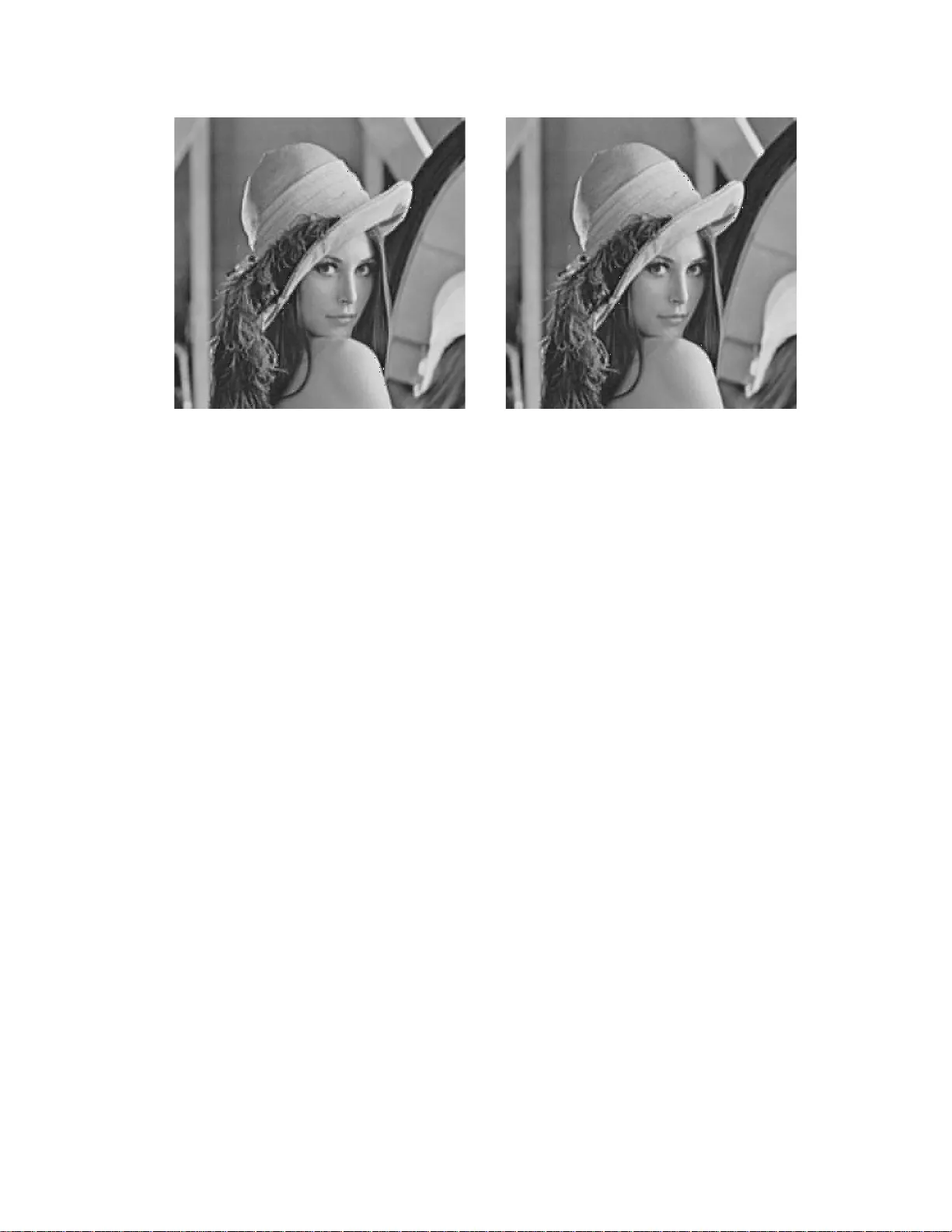
A Discrete Tchebiche f T ransform Approxim ation for Imag e and V ideo Coding Paulo A. M. Oli veira ∗ Renato J. Cintra ∗ F ´ abio M. Bayer † Sunera Kulaseke ra ‡ Arjuna Madanayake ‡ Abstract In this paper, we introdu ce a low-complexity approx imation for th e discrete Tchebich ef transfor m (DTT). The propo sed forward and in verse transforms are multiplication- free and require a reduc ed num- ber of additions and bit-shif ting op erations. Numerical comp ression simulations demo nstrate the effi- ciency of the proposed transform for image and video coding . Furthermore, Xilinx V irtex-6 FP GA based hardware realization shows 44.9% reduction in dynam ic power con sumption and 6 4.7% lo wer area when compare d to the literatur e. Keywords Approx imate DTT , fast algorithms, image and video coding. 1 Introd uction The discrete Tchebich ef transform (DTT) is a useful tool for signal cod ing and data decorr elation [1]. In recent y ears, signal p rocessi ng literature has empl oye d the DTT in sev eral image p rocess ing problems, such as artifa ct measurement [2], blind integr ity verifica tion [3 ], and image compression [4 – 7]. In particul ar , the 8-poin t DTT has been considered in blind forensics for integr ity check of medical images [3]. For image compress ion, the 8-po int DTT is also capable of outpe rforming the 8-po int discrete cos ine tran sform (DCT) in terms of av erage bit-length in bitstream codification [4 ]. Moreo ver , in [7] an 8-point DTT -b ased encod er capabl e of improv ed image quality and reduced encoding/ decodi ng time was proposed ; being a competitor to state-of -the-ar t D CT -based methods. Howe ver , to the best of our kno w ledge, literature archi ves only one fast algorithm for the 8-point DTT , which require s a significant number of arithmetic operation s [6 ]. Such ∗ Paulo A. M. O liv eira and Renato J. Cintra are with t he Signal Processing Group, Departamen to de Estat´ ıstica, Uni versidade Federal de P ernambu co, Recife, PE, Brazil . R. J. Cintra is also wi th the LIRIS , Institut National des Sciences Appliqu ´ ees (I NSA), L yon, France (e-mail: rjdsc@ieee.org). † F ´ abio M. Bayer is with the Departamento de Estat´ ıstica and LA CESM, Uni versidade Federa l de Santa Maria, San ta Ma ria, RS, Brazil (e-mail: bay er@ufsm.br). ‡ Sunera Kulaseke ra and Arjuna Madanayake are with the Department of Electrical and Computer Engineering, The Univ ersity of Akron, Akron, OH, USA (e-mail: arjuna@uak ron.edu). 1 high arithmetic complexi ty may be a hindrance for the adopt ion of the DTT in contempo rary dev ices that demand lo w-comple xity circuitry and low po wer consumption [8–10]. An alternat i ve to the exact transform computation is the employment of approxi mate transforms. Such approa ch has been successful ly appl ied to the exac t DCT , resulting in sev eral appr oximatio ns [11, 12]. In genera l, an approximate transfo rm consists of a lo w-comple xity matr ix with elements defined o ver a set of small integers , such as { 0 , ± 1 , ± 2 , ± 3 } . The resu lting matrix posses ses null multiplica ti ve complexi ty , becaus e the in volv ed arith metic opera tions can be implement ed exclusi vely by means of a reduced number of additi ons and bit-shifts. Prominent example s of approximate transforms includ e: the signed DCT [13 ], the series of D CT approx imations by Bougue zel-Ahmed- Swamy [14–16], the approximatio n by Lengwehasatit- Ortega [17], and the integ er based approximation s descri bed in [11 , 12, 18, 19 ]. In this work, we introduce a lo w -comple xity DTT ap proxi mation that require s 54.5% less additio ns than the exact DTT fast algor ithm. The prop osed method is suitable for image and video coding, capa ble of proces sing data coded accordin g to popula r standards —such as JPEG [20], H.264 [21], and HEVC [22]— at a low computa tional cost. Moreove r , the FP GA hardware realization of the proposed transfo rm is also sough t. This paper unfold s as follo ws. Section 2 describes the DTT and introd uces the approximate DTT with its associate fast algorithm. A computation al comple xity a nalysis is offer ed. In S ection 3, we perform numerica l e xperiments; applying of the pr oposed transform as a to ol for image and video co mpressio n. In Section 4, we pro vide very lar ge scale inte gration (VLSI) realizati ons of the ex act DTT and proposed approx imation. Conclusio ns and final remarks are in Section 5. 2 Discr ete Tchebichef T ransform A pproximation 2.1 Exact Discrete T chebichef T ransform The DTT is an orthogonal transf ormation deri ved from the discrete Tche bichef polyn omials [23]. The entries of the N -point DTT matrix are furnish ed by [1]: t k , n = s ( 2 k + 1 )( N − k − 1 ) ! ( N + k ) ! · ( 1 − N ) k · 3 F 2 ( − k , − n , 1 + k ; 1 , 1 − N ; 1 ) , k , n = 0 , 1 , . . . , N − 1 , (1) where 3 F 2 ( a 1 , a 2 , a 3 ; b 1 , b 2 ; z ) = ∑ ∞ n = 0 ( a 1 ) k ( a 2 ) k ( a 3 ) k ( b 1 ) k ( b 2 ) k · z k k ! is the hyper geometric function and ( a ) k = a ( a + 1 ) · · · ( a + k − 1 ) is the ascending factor ial. Therefore, the analysi s and synth esis equations for the DTT are giv en b y X = T · x an d x = T − 1 · X = T ⊤ · X , where x = h x 0 x 1 · · · x N − 1 i ⊤ is the input signal, X = h X 0 X 1 · · · X N − 1 i ⊤ is the transformed signal, and T is the N -point DTT m atrix with elements t k , n , k , n = 0 , 1 , . . . , N − 1, In particular , the 8-point DT T matrix T can be described by the product of a diagonal matrix F and an 2 inte ger -entry m atrix T 0 [6], resul ting in: T = F · T 0 , where T 0 = 1 1 1 1 1 1 1 1 − 7 − 5 − 3 − 1 1 3 5 7 7 1 − 3 − 5 − 5 − 3 1 7 − 7 5 7 3 − 3 − 7 − 5 7 7 − 13 − 3 9 9 − 3 − 13 7 − 7 23 − 17 − 15 15 17 − 23 7 1 − 5 9 − 5 − 5 9 − 5 1 − 1 7 − 21 35 − 35 21 − 7 1 , (2) and F = 1 2 · diag 1 √ 2 , 1 √ 42 , 1 √ 42 , 1 √ 66 , 1 √ 154 , 1 √ 546 , 1 √ 66 , 1 √ 858 . A fast algorithm for the abov e integ er matrix T 0 = F − 1 · T was deriv ed in [6] requiring 44 additions and 2 9 bi t-shift ing operations. Such arithmetic comple xity is conside red exc essi ve, when compared to state-o f-the-a rt di screte transform approxi mations which genera lly require less than 24 addition s [12, 13, 16, 17]. 2.2 DTT App r oximation and Fast Algorithm In [12], a class of DCT ap proximat ions was introdu ced based o n the follo wing relation : roun d ( α · C ) , where round ( · ) is the rou nd func tion as defined in C and Matla b langua ges [12], α is a real par ameter , and C is the exa ct D CT matrix. W e aim at proposing a similar approach to obtain an 8-poi nt DT T approximatio n. T he scale-a nd-rou nd approach is particula rly ef fectiv e when discre te trigonometri c transfor ms are considered. This is beca use the entrie s of such transfo rmation matrices ha ve smaller dynamic ranges when compared to the DTT . In contrast, the DTT entrie s hav e va lues with a dyna mic range roughly sev en times larg er than the DCT , fo r example. Thus the approximat ion error implied by the round function is less ev enly distrib uted in non-tr igonome tric transfo rm matrices , su ch as the DT T . T o mitigate this ef fect, we propose a compading-lik e operat ion [24], consisti ng of a rescaling matrix D that normalizes the DT T matrix entries. T hus, accordin g the f ormalism d etailed in [12], we introdu ce a p arametric f amily o f app roximate DTT matrices T ( α ) , whi ch are gi ven by: T ( α ) = r ound ( α · T · D 0 ) , (3) where D 0 = diag ( q 6 7 , √ 154 13 , √ 66 9 , √ 858 35 , √ 858 35 , √ 66 9 , √ 154 13 , q 6 7 ) . W e aim at identifying a particula r optimal parameter α ∗ such that T ∗ = T ( α ∗ ) resu lts in a matrix satis- fying the following constraints : (i) th e entries of T ∗ must be defined o ver {− 1 , 0 , 1 } an d (ii) T ∗ must possess lo w arithmetic complexity . Constraint (i) implies the search space ( 0 , 3 / 2 ) . Although the above problem is not analy tically trac table, its solution ca n be found by ex hausti ve search [12]. By t aking the values of α ov er the considered interv al in steps of 10 − 3 , above conditions are satisfied for 0 . 931 ≤ α ∗ ≤ 0 . 957. All value s of α ∗ in this latter interv al imply the same approx imate matrix. Thus, the obta ined low-c omple xity forward 3 DTT appro ximation is giv en by: T ∗ = 1 1 1 1 1 1 1 1 − 1 − 1 0 0 0 0 1 1 1 0 0 − 1 − 1 0 0 1 − 1 1 1 0 0 − 1 − 1 1 0 − 1 0 1 1 0 − 1 0 0 1 − 1 − 1 1 1 − 1 0 0 − 1 1 0 0 1 − 1 0 0 0 − 1 1 − 1 1 0 0 (4) and its in vers e T ∗ is gi ven by: ( T ∗ ) − 1 = T 1 · D 1 where T 1 = 1 − 3 3 − 2 1 − 1 − 1 − 1 1 − 2 − 1 2 − 1 1 − 1 1 1 − 1 − 1 1 − 1 − 2 3 − 2 1 − 1 − 1 1 1 − 2 − 1 3 1 1 − 1 − 1 1 2 − 1 − 3 1 1 − 1 − 1 − 1 2 3 2 1 2 − 1 − 2 − 1 − 1 − 1 − 1 1 3 3 2 1 1 − 1 1 , (5) and D 1 = diag 1 8 , 1 10 , 1 8 , 1 10 , 1 4 , 1 10 , 1 8 , 1 10 . Consid ering the total ene r gy erro r [13 , 18] between the e xact and approx imate matrices, we obtained 3 . 32 and 4 . 86 as the error va lues for the direct and in verse transf orma- tions, respe cti vely . Such errors are considere d very small [19]. Thus, employi ng the orthogo naliza tion proced ure describe d in [12 ], we obt ain the follo w- ing e xpression for the DTT approximati on: ˆ T = D ∗ · T ∗ , where D ∗ = p ediag ( T ∗ · ( T ∗ ) ⊤ ) = h d ∗ 0 d ∗ 1 d ∗ 2 d ∗ 3 d ∗ 4 d ∗ 5 d ∗ 6 d ∗ 7 i ⊤ is a diagonal matrix and ed iag ( · ) returns a diagonal matrix with the diagonal elements of its matrix argu ment [12 ]. The in verse transfor mation is ( ˆ T ) − 1 = ( D ∗ · T ∗ ) − 1 = ( T ∗ ) − 1 · ( D ∗ ) − 1 = T 1 · D 1 · ( D ∗ ) − 1 . Theref ore, the analysis and synthesis equatio ns for the proposed trans- form ar e gi ven by ˆ X = ˆ T · x and x = T 1 · D 1 · ( D ∗ ) − 1 · ˆ X , where ˆ X = h ˆ X 0 ˆ X 1 · · · ˆ X 7 i ⊤ is th e approx imate transfo rmed vecto r . Ho wev er , in se veral conte xts, diago nal matrice s—such as D 1 and D ∗ —represe nt only scal ing fac tors and may not contrib ute to the computa tional cost of transfo rmations . For instanc e, in JPEG-base d im- age compressio n applicat ions, diagonal matrices can be embedde d into quanti zation block [6, 11, 12] and, when the explic it tran sform coefficien ts are needle ss, a scaled version of the transform-domai n spectrum is suf fi cient [25]. Therefore, hereafter , we disregard the diagonal matric es and focus our analysis on the lo w -comple xity matrices T ∗ and T 1 . A fast algorithm based on sparse m atrix factoriza tion [11, 12, 14] was deri ved for the proposed forwa rd and in verse approximation s. In F igure 1, the signal flow graph (SF G) for the direct transformati on is depic ted. The SFG for the in verse transformation can be obtaine d accordin g to the methods describ ed in [26]. Moreo ver , T able 1 summarizes the arithmetic complex ity assessment for the propo sed transformatio ns. The fa st algorithms for T ∗ and T 1 demand 54.5% and 34.1% less additions than the DTT fas t algorithm (ITT ) pro posed in [6], respecti vely . 4 x 7 x 6 x 5 x 4 x 1 x 0 x 2 x 3 ˆ X 1 /d ∗ 1 ˆ X 3 /d ∗ 3 ˆ X 7 /d ∗ 7 ˆ X 5 /d ∗ 5 ˆ X 4 /d ∗ 4 ˆ X 6 /d ∗ 6 ˆ X 2 /d ∗ 2 ˆ X 0 /d ∗ 0 Figure 1: Signal flo w graph for T ∗ . Input data x n , n = 0 , 1 , . . . , 7, relates to the output ˆ X k , k = 0 , 1 , . . . , 7. Dashed arro w s represent multiplicati ons by − 1. S caling by d ∗ k , k = 0 , 1 , . . . , 7, can be ignored and absorbed into the quanti zation step. T able 1: Arithmetic comple xity of the prop osed 1-D transforms Method Mult. Additions Shifts T otal Exact DTT [6] 0 44 29 73 Proposed ˆ T ∗ 0 20 0 20 Proposed T 1 0 29 8 37 3 Experimental Results 3.1 Image Compre ssion In order to assess the pro posed transform in image compress ion appli cations , we perfor med a JPEG-like simulatio n based o n [6, 11, 12]. A set of 45 512 × 512 8-bit grayscale image s obt ained from a stan dard publ ic image bank [27] was consider ed. E ach image was subdi vided into 8 × 8 size blocks A i , j , i , j = 1 , 2 , . . . , 64 . Each block is submitted to two-dimens ional (2-D) versions of the discussed tran sformatio ns accord ing to: B i , j = M · A i , j · M ⊤ , where B i , j is the tran sform-do main block and M ∈ { T , T ∗ } T he resulting 64 spectral co- ef fi cients of each b lock were ordered in the s tandard zigzag seq uence. Subsequently , the r initial coef ficients in each block were reta ined and the remaining coef fi cients were disc arded [12]. W e adopted 1 ≤ r ≤ 45. Finally , each transform-do main sub image was submitted to in verse 2-D transformation s and the full image was reconstructe d. Image quality measures w ere employe d to assess the degra dation between original and recons tructed images . The considered measures were the structural similarity index (SSIM) [28] and the spectr al resid ual base similarit y (SR-SIM) [29]. These measures hav e the distinctio n of bein g consistent with subj ecti ve ratings [29, 30]. The peak signal-t o-nois e ratio (PSNR ) was not con sidered as a figure of merit because of its limited capability of capturing the human perceptio n of image fidelity and qualit y [31]. For each val ue of r , we consider ed a verage measures a cross all considered ima ges. Such m ethodo logy is less prone to varian ce ef fects and fortuito us da ta. F igure 2 shows the resulting SSIM and SR-SIM measurements. The proposed transform performed very closely to the exact DTT . For q ualitat i ve purposes , F igure 3 shows compress ed images acco rding to the DTT and the proposed approx imation for r = 6; images are visua lly 5 0 10 20 30 40 r 0 . 5 0 . 6 0 . 7 0 . 8 0 . 9 1 . 0 A verage SSIM DTT ˆ T ∗ (a) SSIM 0 10 20 30 40 r 0 . 90 0 . 92 0 . 94 0 . 96 0 . 98 1 . 00 A verage SR-SIM DTT ˆ T ∗ (b) SR-SIM Figure 2: Quality metrics con siderin g (a) SS IM and (b) SR-SIM for the exa ct DTT and the proposed ap- proximat ion in terms of r . 6 (a) DTT , r = 6 (b) ˆ T ∗ , r = 6 Figure 3: Compressed ‘Lena’ image for r = 6 b y me ans of the (a ) DTT and (b) the p ropose d appro ximation . indist inguis hable. 3.2 V ideo Compression W ith the objecti ve of assessing the propose d trans form performance in video coding, we hav e embed ded the proposed DT T approxi mation in the widely emplo yed software library x26 4 [32] for encodin g video streams into the H.264/A VC standard [21]. The 8-po int transform emplo yed in H.264/A VC is an intege r approx imation of the DCT that demands 32 additions and 14 bit-sh ifting opera tions [33]. In comparison, the proposed 8-point direct transfor m requ ires 38% less addition s and no bit-sh ifting operation s, while the propo sed in verse transform requires 9% less additions and 43% less bit-shifting operations. W e encode d ele ven CIF video s with 300 frames at 25 frames per seco nd from a public video database [34] with the standa rd and the modified librari es. In our simulat ion, we employed defaul t set tings and controlled the video qua lity by two dif ferent approaches: (i) tar get bitrate, varyi ng from 100 to 500 kbps with a step of 50 kbps and (ii) quantizati on parameter (QP), v arying from 5 to 50 with steps of 5 units. For video quality assess ment, we submitted the luma component of the vi deo frames to av erage SSIM ev aluation rel ati ve to the Y componen t (luminance). Results are shown in Figure 4. E ven in scenari os of high compres sion (lo w bitrate/hig h QP), the degrad ation related to the proposed approximat ion is in the order of 0.01 units of SSIM; therefore , ver y low . Figure 5 displ ays the first encoded frame of a standa rd video sequence at lo w tar get bitrate (200 kbps). The resu lting compressed frames are visually indistinguis hable. 7 100 200 300 400 500 T arget bitrate (kbps) 0 . 88 0 . 90 0 . 92 0 . 94 0 . 96 0 . 98 1 . 00 A verage Y -SSIM H.264 proposed (a) 10 2 0 3 0 4 0 50 QP 0 . 70 0 . 75 0 . 80 0 . 85 0 . 90 0 . 95 1 . 00 A verage Y -SSIM H.264 proposed (b) Figure 4: V ideo quality assessment in terms of (a) fixed tar get bitrate and (b) quantiza tion parameter . 8 (a) H.264/A VC (b) Modified H.264/A VC Figure 5: First frame of the compressed sequence ‘Foreman ’ accor ding to (a) the original H. 264/A VC and (b) modified H.264/A VC with the propo sed approximation . 4 VLSI Ar chitectur es T o compare hardware resource consumption of the proposed approximate DT T against the exact DTT pro- posed in [6], the 1-D version of both algorith ms w ere initially modeled and tested in Matlab Simulink and then were physic ally realize d on a Xilinx V irtex-6 X C6VLX240T -1FFG1156 field programmab le gate array (FPGA) de vice and v alidat ed using hardware -in-the -loop testing thro ugh the JT A G interf ace. B oth appr oxi- mations were verified using more than 10000 test vectors with complete agreement with theoreti cal value s. Results are sho w n in T able 2. Metr ics, including configur able logic blocks (CLB) and flip-flop (FF ) count, critica l path delay (CPD, in ns), and maximum operating frequenc y ( F max , in MHz) are prov ided. In addi- tion, static ( Q p , in mW) and frequenc y normal ized dynamic po wer ( D p , in mW/MHz) consump tions were estimated using the Xilinx XPower Analyzer . The final throughpu t of the 1-D DTT was 438 . 68 × 10 6 8- point transfo rmations /second, with a pix el rate of 3 . 509 × 10 9 pix els/sec ond. The percentag e reducti on in the number of CL Bs and FFs was 64.7% and 71%, resp ecti vely . The dyna mic po wer consumptio n D p of the proposed architec ture was 44.9% lower . The fi gures of merit area-time ( AT ) and area-t ime 2 ( A T 2 ) had percen tage reductions of 66.1% and 67.5% when compared with the exac t D TT [6]. 5 Conclusion In this paper , a low-compl exit y approximatio n for the 8-point DTT was proposed. The arit hmetic cost of the proposed appro ximation are signi ficantly lo w , when compared w ith the exac t DTT . At the same time, the proposed tool is very close to the DT T in terms of image coding for a wide range of compressio n rates. In video compression, the introduce d approxi mation was adapted into the popul ar codec H. 264 furnishing virtua lly identical results at a much le ss comput ational cost. Our go al with the code c experi mentatio n is not 9 T able 2: Resou rce consumption on Xilinx XC6VLX240T -1FFG 1156 de vice Resource Method Exact DTT [6] Propos ed CLB ( A ) 408 144 FF 1370 396 CPD ( T ) (ns) 2.390 2.290 F max (MHz) 418.41 438.68 A T 975.1 329.7 A T 2 2330.5 755.1 D p (mW/MHz) 5.10 2.81 Q p (W) 3.44 3.44 to suggest the modification of an existin g stand ard. Our objecti ve is to demonstrate the capabilities of the propo sed low-co mplex ity transf orm in asymmetri c codec s [35]. Such codecs are emplo yed when a video is encoded once but decoded sev eral times in low po wer device s [35, 36]. Additionally , the proposed trans- form can be consider ed in distrib uted video coding (D VC ) [36, 37], w here the computational complexit y is concen trated in the decoder . A rele vant context for D V C is in remote senso rs an d video systems that are con- straine d in terms of po wer , bandwidth, and computati onal capabiliti es [36]. T he prop osed approximati on is a viable alternati ve to the DTT ; possess ing low-comp lexi ty and good performanc e according to meaningful image qualit y m easure s. Moreov er , the associated hardware realiza tion consumed roughly 1 / 3 of the area requir ed by the exact D TT ; also the dynamic power consumptio n was decreased by 44.9%. Future work in this field may consid er the ev aluation of DTT approxi mations in quantizati on schemes [4, 5]. Ackno wledgments This work was supported by the C NPq, F A CEP E, and F APERGS, Brazil; and the U ni versity of Akro n, O hio, USA. Refer ences [1] R. Mukundan, S. Ong, and P . A. Lee, “Image analysi s by Tchebichef moments , ” IEE E T ransa ctions on Imag e Pr ocessing , vol . 10, no. 9, pp. 1357–1364 , 2001. [2] L. Leida, Z. Hancheng, Y . Gaobo, and Q . Jianshen g, “Refe rencele ss measu re of blockin g artifacts by Tchebich ef kernel analys is, ” IEEE Signal Pr ocessing Letters , v ol. 21, pp. 122–125 , Jan 2014. [3] H. Huang, G. Coatri eux, H. Shu, L. Luo, and C. Roux, “Blind inte grity ve rification of medical images, ” IEEE T rans action s on Informatio n T ec hnolog y in Biomedicine , vol . 16, pp. 1122–1126 , N ov 20 12. 10 [4] F . Ernawa n, N. Abu , and N. S uryana , “TMT quan tizatio n table gen eration base d on psyc hov isual thresh old for image compressi on, ” in 2013 Internat ional C onfer ence of Information and Comm unica- tion T echno log y (ICoICT) , pp. 202–207, Mar 2013. [5] S. Prattipati , M. Swamy , and P . Meher , “ A v ariable quant ization technique for image compressio n using inte ger tchebiche f transform, ” in 2013 9th Internation al Confer ence on Informatio n, Communicati ons and Signa l Pr ocessing (ICICS) , pp. 1–5, Dec 2013. [6] S. Pratti pati, S. Ishwar , P . Meh er , and M. Swamy , “ A fast 8 × 8 inte ger T chebic hef transform and comparis on with inte ger cosine transfo rm for image compressio n, ” in 2013 IEE E 56th Intern ationa l Midwest Symposiu m on Cir cuits and Systems (MWSCAS) , pp. 1294– 1297, 2013. [7] R. Senapat i, U. Pati, and K . Mahap atra, “Reduced memory , low comple xity embedde d image com- pressi on algorit hm using hierar chical listless disc rete Tchebich ef transfo rm, ” IET Ima ge Pr ocessing , v ol. 8, pp. 213–23 8, Apr 2014. [8] L. W . Chew , L .-M. Ang, and K . P . Seng, “Surve y of image compression algorith ms in w ireless sensor netwo rks, ” in 200 8 Internati onal Symposium on Information T ec hnology (ITSim) , v ol. 4, pp. 1–9, Aug 2008. [9] F . Ernaw an, E. Noersasongk o, and N. Abu , “ An efficien t 2 × 2 Tchebic hef moments for mobile image compress ion, ” in 2 011 Internation al Symposium on I ntellig ent Signal Pr ocessi ng a nd Communicatio ns Systems (ISP A CS) , pp. 1–5, Dec 2011. [10] N. Koua dria, N. Doghmane, D. Messade g, and S . Harize, “Low complex ity DCT for image compres- sion in wireless visua l sensor networks, ” E lectr onic s Letters , v ol. 49, pp. 1531– 1532, Nov 2013. [11] R. J. Cin tra an d F . M. Bayer , “ A DCT appro ximation for i mage co mpressio n, ” IEEE Signal Pr oce ssing Letter s , vol. 18, pp. 579–5 82, Oct 2011. [12] R. J. Cintra, F . M. Bayer , and C . J. T ab lada, “Low-comple xity 8-point DCT approximatio ns based on inte ger functions , ” Signal P r ocessin g , vol. 99, pp. 201–214 , 2014. [13] T . I. Haweel, “ A ne w squa re wav e transfor m based on the DC T, ” Signal Pr ocessin g , vo l. 81, no. 11, pp. 2309 –2319 , 2001. [14] S. B ouguez el, M. Ahmad, and M. Swamy , “ A multipli cation -free transfor m for image compression, ” in 2008 2nd Intern ationa l Confer ence on Signals, C ir cuits and Systems (SCS) , pp. 1–4, Nov 200 8. [15] S. Bouguezel, M. Ahmad, and M. Swamy , “ A lo w-complexi ty parametri c transform for image com- pressi on, ” in 201 1 IEE E Internati onal Symposiu m on Cir cuits and Sys tems (ISCAS) , pp. 2145–2148 , May 2011 . 11 [16] S. Bougueze l, M. Ahmad, and M. S wamy , “Binary discrete cos ine and Hart ley transfor ms, ” IEEE T ran saction s on Circ uits and Systems I: Re gular P ape rs , v ol. 60, pp. 989–1 002, A pr 2013. [17] K. Lengwehasa tit and A. Ortega , “Scalable va riable complex ity approximate forward D CT, ” IEE E T ran saction s on Circ uits and Systems for V id eo T echnolo gy , vol. 14, pp. 123 6–124 8, Nov 20 04. [18] F . M. Bayer and R. J. Cin tra, “DCT-like tran sform for image compressio n requires 14 additi ons only , ” Electr onics Letters , v ol. 48, pp. 919–92 1, Jul 2012. [19] U. S. Potlu ri, A. Madanayak e, R. J. Cintra, F . M. Bayer , S. Kulase ker a, and A. Edirisuriya , “Improv ed 8-poin t approximat e DCT for image a nd video compress ion requiri ng only 14 additi ons, ” IE EE T r ans- action s on Cir cuits and Systems I: R e gular P ap ers , vol. 61, pp. 1727–1 740, Jun 2014. [20] G. W allace, “T he JPEG still picture compressio n standard, ” IEEE T ransa ctions on Consumer Elec- tr onics , vo l. 38, pp. xviii–xx xi v , Feb 1992. [21] I. Richards on, T he H.264 Advanced V ideo Compre ssion Standa r d . John W iley and Sons, 2 ed., 201 0. [22] G. Sulli van , J. Ohm, W . -J. Han, and T . W ieg and, “Overvie w of the high ef fi cienc y video coding (HEVC) standard, ” IEEE T ransact ions on Cir cuits and Systems for V id eo T ec hnology , vol. 22, no. 12, pp. 1649 –1668 , 2012. [23] H. Bateman, A. Erd ´ elyi, W . Magnus, F . Oberhettinger , and F . Tricomi, Higher tra nscend ental func- tions , v ol. 2. McGraw-Hill, 1953 . [24] R. Gray and D. Neuhof f, “Qua ntizati on, ” IEE E T ran saction s on Informat ion The ory , v ol. 44, p p. 2325 – 2383, Oct 1998 . [25] Y . Arai, T . Agui, and M. Nakajima, “ A fast DCT -SQ sche me for images, ” IEICE T ransacti ons , v ol. E71, pp. 1095 –1097 , Nov 198 8. [26] R. Blahut, F ast Algorithms for Signal Pr ocessing . C ambridge Uni versity Press, 2010. [27] Uni versity of S outher n C aliforn ia, Signal and Image Processing Ins titute, “The USC-SIPI image databa se. ” http:// sipi.usc .edu/database/ , 2014 . [28] Z. W ang, A. Bovik, H. Sheikh, and E. Simoncelli, “Image quality assessment: from error visibility to structu ral similarity , ” IEEE T ransacti ons on Image Pr ocess ing , vol. 13, pp. 600–6 12, Apr 2004. [29] L. Zhang and H. Li, “SR-SIM: A fast and high performance IQA inde x based on spectral residual, ” in 19th IEEE Intern ationa l Confer ence on Imag e Pr ocessing (ICIP) , pp. 1473–1 476, S ep 2012 . [30] Z. W ang and A. Bovik, “Red uced- and no-refer ence image quality assessment , ” IE EE Sign al Pr ocess - ing Magaz ine , vol. 28, pp. 29– 40, Nov 2011. 12 [31] Z. W an g and A. Bovik , “Mean squared erro r: Lov e it or lea ve it? a ne w look at signal fidelity mea- sures, ” IE EE Signal Pr ocessing Magazin e , vo l. 26, pp. 98–117 , Jan 2009. [32] x264 team, “x264 . ” http:/ /www .video lan.or g/dev elopers/x264.htm l , 2014 . [33] S. Gordon, D. Marpe, and T . W ieg and, “Simplied use of 8 × 8 trans form – updated proposal and results . ” Joint V ideo T eam (JVT) of ISO/IEC MPE G and ITU-T VCEG, doc. JVT–K028, Munich, Germany , Mar 2004. [34] “Xiph.or g V ideo T est Me dia. ” https://med ia.xiph.or g/video/derf/ , 2014. [35] U. Mitra, Intr od uction to Multimedia Systems . Academic Press, 2004. 207 p. [36] K. R. V ijayanagar , J. Kim, Y . Lee, and J. bok K im, “Low comple xity distrib uted video coding, ” J ournal of V isual C ommunicatio n and Image Repr esentati on , vol. 25, no. 2, pp. 361–37 2, 2014. [37] A. W yner a nd J. Z i v , “The rate-d istorti on function for source co ding with side information at the decod er , ” IEEE T ransact ions on Informatio n Theory , vol . 22, pp. 1–10, Jan 1976. 13
Original Paper
Loading high-quality paper...
Comments & Academic Discussion
Loading comments...
Leave a Comment