Integration of H"older forms and currents in snowflake spaces
For an oriented $n$-dimensional Lipschitz manifold $M$ we give meaning to the integral $\int_M f dg_1 \wedge ... \wedge dg_n$ in case the functions $f, g_1, >..., g_n$ are merely H\"older continuous of a certain order by extending the construction of…
Authors: Roger Z"ust
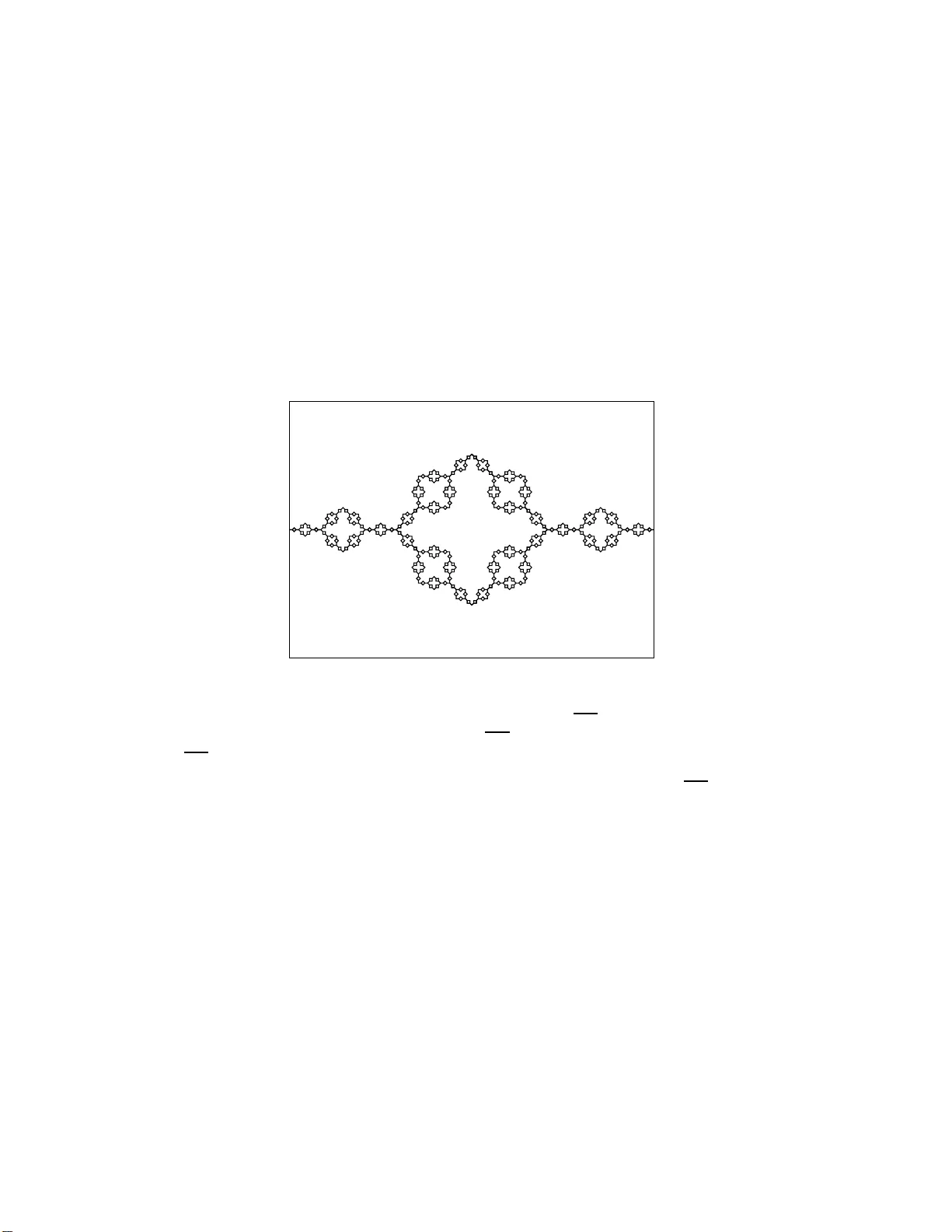
INTEGRA TION OF H ¨ OLDER F ORMS AND CURRENTS IN SNO WFLAKE SP A CES ROGER Z ¨ UST Abstract. F or an oriente d n -dimensional Lipsc hitz manifold M we give meaning to the inte- gral R M f dg 1 ∧ · · · ∧ dg n in case the functions f , g 1 , . . . , g n are merely H ¨ older cont inuous of a certain order by extending the construction of the Ri emann-Stieltjes integral to higher dimen- sions. Mor e generally , we sho w that for α ∈ ( n n +1 , 1] the n -dimensional locall y normal curren ts in a lo cally compact metric space ( X, d ) represen t a subspace of the n -dimensional current s in ( X, d α ). On the other hand, for n ≥ 1 a nd α ≤ n n +1 the vect or space of n -dimensional current s in ( X , d α ) is zero. 1. I ntr oduction If f , g 1 , . . . , g n are smo oth functions o n [0 , 1 ] n , the differen tial form f dg 1 ∧ · · · ∧ dg n is defined and w e can calculate the int egr al Z [0 , 1] n f dg 1 ∧ · · · ∧ dg n . In genera l, this differential form makes no sense if f , g 1 , . . . , g n are not smo oth but merely H¨ older contin uous. Nevertheless, we w ant to show that in ca s e the s um of the H¨ older exp onents of these n + 1 functions is bigger than n , the in tegr al ab ov e ca n b e giv en a rea sonable v alue b y generalizing the construction o f the clas sical Riemann-Stieltjes integral to higher dimensions. More precisely , this integral, we call it R [0 , 1] n f d ( g 1 , . . . , g n ), is co nstructed re cursively on the dimension of the cube by approximating it with Riemannian sums of the form 2 kn X i =1 f ( µ B i ) Z ∂ B i g 1 d ( g 2 , . . . , g n ) , where B 1 , . . . , B 2 kn is the par tition of [0 , 1] n int o 2 kn cube s of equal size and µ B i is the barycenter of B i . Our result fo r n = 1 is cov ered in [12] where L.C. Y oung show ed that the Riemann-Stieltjes int egr al exis ts even under weaker assumptions. With the usual partition of unity constructio n this integral extends to oriented Lips c hitz manifolds and a v aria nt o f Stokes’ theorem for H¨ older contin uous functions is presented. In the last s e ction we discuss the co nnection to the theory of curr e n ts in metric spaces. Metric currents hav e been introduced by Ambrosio and Kirchheim in [1], extending the classica l F ederer- Fleming theo ry o f [4] to co mplete metric spaces. W e will mainly work with the lo cal currents int ro duced b y Lang in [6] not relying on a finite mass as sumption. F or a locally compact metric space ( X, d ) the n -dimensional currents D n ( X ) are functions T : Lip c ( X ) × n Y i =1 Lip lo c ( X ) → R that are ( n + 1)-linear, contin uous in a suitable sense and satisfy T ( f , π 1 , . . . , π n ) = 0 whenever some π i is constant on a neighborho o d of the supp ort o f f . F or α ∈ (0 , 1) we ar e interested Pa rtiall y supp orted by the Swis s National Science F ou ndation. 1 2 R OGER Z ¨ UST in the vector space D n ( X, d α ) of n -dimensional curr en ts in the snowflak e spa ce ( X , d α ). By approximating H¨ older with Lipschitz functions we genera lize the result obtained fo r the Riema nn- Stieltjes integral ab ov e and show that any lo cally norma l cur ren t T ∈ N n, lo c ( X ), a s defined in Chapter 5 of [6], has a natur al extension to a functional ¯ T : H α c ( X ) × H β 1 lo c ( X ) × · · · × H β n lo c ( X ) → R on a tuple o f H¨ older functions if the exp onents satisfy α + β 1 + · · · + β n > n . In particular , if α = β 1 = · · · = β n > n n +1 , this extension is a current in D n ( X, d α ) and hence N n, lo c ( X ) can b e ident ified with a subspace of D n ( X, d α ). On the o ther hand, we show that D n ( X, d α ) = { 0 } if n ≥ 1 and α ≤ n n +1 . Ac kno wledgem en ts: I would like to thank Ur s L ang for many inspiring discus s ions and for carefully r eading earlie r v ersions of this pap er. I a m also g rateful to Christian Riedweg for some helpful commen ts. 2. A ppr oxima tion of H ¨ older continuous functions A map f fr o m ( X , d X ) to ( Y , d Y ) is said to be H¨ older co n tinuous of o rder α ∈ (0 , 1 ] if there exists a C ∈ [0 , ∞ ) such that d Y ( f ( x ) , f ( x ′ )) ≤ C d X ( x, x ′ ) α holds for a ll x, x ′ ∈ X . The smalles t C with this prop erty is denoted by H α ( f ). The s et of all such maps is H α ( X, Y ) or H α ( X ) in case ( Y , d Y ) = ( R , | . | ). If α = 1, we sp eak o f Lipschitz contin uous maps and write Lip instead of H 1 . If X is b ounded, a basic prop erty o f these sets is that H β ( X, Y ) ⊂ H α ( X, Y ) for 0 < α ≤ β ≤ 1. With resp ect to the usual a dditio n and m ultiplication of functions H α ( X ) is a vector space, and an alg ebra if X is b ounded. The H¨ older exp onen ts are multiplicative with resp ect to comp ositions, i.e. g ◦ f ∈ H αβ ( X, Z ) if f ∈ H α ( X, Y ) and g ∈ H β ( Y , Z ). The next results show how H¨ older functions can be approximated by Lipschitz functions. Up to minor mo difications of the second lemma they are contained in the app endix of [5] written b y Stephen Semmes. F or A ⊂ X we de no te by A ǫ the clo s ed ǫ -neighbor ho o d { x ∈ X : d ( x, A ) ≤ ǫ } of A . Lemma 2. 1. [5 , Theo rem B.6.3] L et k > 0 and 0 < α < 1 b e c onstants. If ( f j ) j ∈ Z is a family of functions fr om X to R such that (1) k f j k ∞ ≤ k 2 j α , (2) f j is k 2 j ( α − 1) -Lipschitz, (3) P j ∈ Z f j ( x 0 ) c onver ges for some x 0 ∈ X , then P j ∈ Z f j c onver ge s uniformly on b ounde d subset s of X to a function which is H¨ older c on- tinuous of or der α and t he p artial sums have b ounde d α -H¨ older c onstants . Conversely, every H¨ olde r c ontinuous function of or der α admits such a r epr esentation. Lemma 2.2. L et C > 0 and F ⊂ H α ( X ) b e such that H α ( f ) ≤ C holds for al l f ∈ F . Then for every ǫ > 0 and f ∈ F we c an assign a function f ǫ such t hat (1) Lip( f ǫ ) ≤ C ǫ α − 1 , (2) k f − f ǫ k ∞ ≤ C ǫ α , (3) spt( f ǫ ) ⊂ s pt( f ) ǫ , (4) H α ( f ǫ ) ≤ 3 C , (5) k g ǫ − h ǫ k ∞ ≤ k g − h k ∞ for al l g , h ∈ F . The follo wing pro of is for the most part co n tained in the pro of of [5, Theo rem B.6.1 6]. INTEGRA T ION OF H ¨ OLDER FORMS AND CURRENTS IN SNOWFLAKE SP A CES 3 Pr o o f. W e define f ǫ by f ǫ ( x ) : = inf { f ( y ) + C ǫ α − 1 d ( x, y ) : y ∈ X } . f ǫ is the infimum o f C ǫ α − 1 -Lipschitz functions a nd if finite it is C ǫ α − 1 -Lipschitz to o. Clearly f ǫ ( x ) ≤ f ( x ). If d ( x, y ) ≥ ǫ , then f ( y ) + C ǫ α − 1 d ( x, y ) ≥ f ( y ) + H α ( f ) d ( x, y ) α ≥ f ( x ) and therefore f ǫ ( x ) = inf { f ( y ) + C ǫ α − 1 d ( x, y ) : y ∈ X , d ( x, y ) ≤ ǫ } . By this c hara cterization (3) is obvious. In addition f ǫ ( x ) ≤ f ( x ) ≤ inf { f ( y ) + C ǫ α : y ∈ X , d ( x , y ) ≤ ǫ } ≤ f ǫ ( x ) + C ǫ α for all x ∈ X which shows (2). Hence f ǫ ( x ) is finite and as a consequence (1) holds. If d ( x, y ) ≤ ǫ , then | f ǫ ( x ) − f ǫ ( y ) | ≤ C ǫ α − 1 d ( x, y ) ≤ C d ( x, y ) α . On the other hand if d ( x, y ) ≥ ǫ we com bine (1) and (2) to conclude (4): | f ǫ ( x ) − f ǫ ( y ) | ≤ 2 k f − f ǫ k ∞ + | f ( x ) − f ( y ) | ≤ 2 C ǫ α + C d ( x, y ) α ≤ 2 C d ( x, y ) α + C d ( x, y ) α . T o verify (5) let g , h ∈ F . By a straightforward ev aluation g ǫ ( x ) = inf { g ( y ) + C ǫ α − 1 d ( x, y ) : y ∈ X } ≤ k g − h k ∞ + inf { h ( y ) + C ǫ α − 1 d ( x, y ) : y ∈ X } = k g − h k ∞ + h ǫ ( x ) and hence (5) holds. 3. A generalized Riemann-Stiel tjes integral 3.1. Cons truction. Let f ∈ H α ( A ), g 1 ∈ H β 1 ( A ) , . . . , g n ∈ H β n ( A ) b e H¨ older contin uous functions on a b ox A = [ u 1 , v 1 ] × · · · × [ u n , v n ] ⊂ R n . In this section we define a v alue for R A f d ( g 1 , . . . , g n ), or shorter R A f dg , where g : = ( g 1 , . . . , g n ). The constr uction o f the in tegra l is done recursively . In dimension 0 the integral is defined to be the ev aluation functional. Assuming that the integral in dimensions 0 , . . . , n − 1 is already constructed we use the b oundary in tegrals Z ∂ B g 1 d ( g 2 , . . . , g n ) of boxes B = [ s 1 , t 1 ] × · · · × [ s n , t n ] ⊂ A to build up the Riemannian sums. They are defined by n X i =1 1 X j =0 ( − 1) i + j Z B ( i,j ) g 1 d ( g 2 , . . . , g n ) , where B ( i,j ) : = [ s 1 , t 1 ] × · · · × [ s i − 1 , t i − 1 ] × { s i + j ( t i − s i ) } × [ s i +1 , t i +1 ] × · · · × [ s n , t n ] and the functions are res tricted to these co dimension one b oxes (to b e precise, B ( i,j ) is ident ified with a b ox in R n − 1 by omitting the i -th co ordinate and e a c h function is re arranged accor dingly). This is the standard orientation co n ven tion for the bo undary as used for example in [9]. If B is 4 R OGER Z ¨ UST the in terv al [ s, t ], the b oundary integral is just R ∂ [ s,t ] g = g ( t ) − g ( s ). W e define the Riemannian sums I n ( f , g , P , ξ ) : = X B ∈P f ( ξ B ) Z ∂ B g 1 d ( g 2 , . . . , g n ) , where P is a pa rtition of A into finitely many boxes with disjoint in teriors and ξ = { ξ B } B ∈P is a collection of p oin ts s uc h that ξ B ∈ B . I n ( f , g , P ) is the sum ab ov e where ea ch ξ B is ass umed to b e µ B , the barycenter of B . The mes h, k P k , of a par tition P of is the maximal diameter of a box in P . In dimensio n 1 this is the usual constr uction of the Riemann-Stieltjes integral R t s f dg . It is defined to be the limit, as the mesh of the par tition P of the interv al [ s, t ] approaches zer o, of the approximating sum I 1 ( f , g , P , ξ ). T o ca lculate the integral ov er A we will use only very sp ecial partitions , namely P 0 ( A ) , P 1 ( A ) , P 2 ( A ) , . . . , where P 0 ( A ) consists of the box A a lone and P k +1 ( A ) is constructed from P k ( A ) by div iding each b o x into 2 n similar b oxes half the size. If it is clear whic h b o x is par titioned, we s imply write P k instead of P k ( A ). The definitio n of I n ( f , g , P , ξ ) is motiv ated b y Stokes’ Theorem. W e will make use o f it in the fo llo wing form: Lemma 3.1 . L et g 1 , . . . , g n b e Lipschitz funct ions define d on a b ox A ⊂ R n . Then Z A det D ( g 1 , . . . , g n ) d L n = n X i =1 1 X j =0 ( − 1) i + j Z A ( i,j ) g 1 det D ( g 2 , . . . , g n ) d L n − 1 . F or smo oth functions the pro of is sta ndard and will be omitted. F or m ulated with differen tial forms it ca n b e found for example in [9]. A Lipschitz function on R n can b e a ppro ximated uniformly by a s e quence of smo oth functions with bo unded Lipschitz constants, see e.g. [3, 4.1.2], and the integrals in the lemma a gree b y a contin uity argument, se e e.g. [1, E xample 3.2] or [6, Prop osition 2.6] and the refer ences there fo r mor e de ta ils. Theorem 3.2. F or al l n ∈ N , al l b o xes A ⊂ R n and all numb ers α, β 1 , . . . , β n c ontaine d in (0 , 1] such t hat α + β 1 + · · · + β n > n the function Z A : H α ( A ) × H β 1 ( A ) × · · · × H β n ( A ) → R ( f , g 1 , . . . , g n ) 7→ Z A f dg : = lim k →∞ I n ( f , g , P k , ξ k ) is wel l define d and indep endent of the choic e of ( ξ k ) k ∈ N . R A satisfies t he fol lowing pr op erties: (1) R A is ( n + 1) -line ar. (2) In c ase β 1 = · · · = β n = 1 , the identity Z A f dg = Z A f det D g d L n holds (for smo oth f and g this agr e e s with R A f dg 1 ∧ · · · ∧ dg n ). (3) R A is c ontinuous in the sense that Z A f m dg m → Z A f dg , for m → ∞ whenever ( f m ) m ∈ N and ( g m,i ) m ∈ N ar e se quenc es c onver ging uniformly to f r esp. g i on A and H α ( f m ) r esp. H β i ( g m,i ) ar e b oun de d in m for al l i = 1 , . . . , n . Mor e over R A is u n iquely define d by (2) and (3) . Pr o of. Uniqueness of the integral is a direct co nsequence of Lemma 2.2 (or Lemma 2.1). E very H¨ older contin uous function can b e approximated by Lipschitz functions in such a wa y tha t (3) applies and b y (2) the integral for L ips c hitz functions is given. INTEGRA TION OF H ¨ OLDER FORMS AND CURRENTS IN SNOWFLAKE SP ACES 5 F or n = 0 the theo r em is clear. Let A ⊂ R n , f and g b e as in the theor em a nd a ssume that in dimensions 0 , . . . , n − 1 the integral is already constructed. It should be no ticed that β 1 + · · · + β n > n − 1 since α ≤ 1. So R ∂ B g 1 d ( g 2 , . . . , g n ) do es indeed exist for a n y n -dimensiona l b ox B ⊂ A and hence the Riemannian sums I n ( f , g , P k , ξ k ) are well defined. In dimensions 1 ≤ m ≤ n − 1 we additionally assume the existence of constan ts C ′ m ( ˆ β 1 , . . . , ˆ β m ) and C m ( ˆ α, ˆ β 1 , . . . , ˆ β m ) suc h that for any b o x ˆ B ⊂ R m and functions ˆ f ∈ H ˆ α ( ˆ B ), ˆ g 1 ∈ H ˆ β 1 ( ˆ B ) , . . . , H ˆ β m ( ˆ B ) of or ders satisfying ˆ α + ˆ β 1 + · · · + ˆ β m > m the following estimates ho ld: Z ∂ ˆ B ˆ g 1 d ( ˆ g 2 , . . . , ˆ g m ) ≤ C ′ m diam( ˆ B ) P m i =1 ˆ β i m Y i =1 H ˆ β i ( ˆ g i ) , (3.1) Z ˆ B ˆ f d ˆ g − I m ( ˆ f , ˆ g , P k ( ˆ B ) , ˆ ξ k ) ≤ C m diam( ˆ B ) ˆ α + P m i =1 ˆ β i (3.2) · 2 k ( m − ˆ α − P m i =1 ˆ β i ) H ˆ α ( ˆ f ) m Y i =1 H ˆ β i ( ˆ g i ) . W e will show the existence of C ′ n and C n and these tw o estimates for the b ox A . Let B ⊂ A be a n y n -dimensional box. Firstly , an estimate for the bo undary in tegral J ( B , g ) : = Z ∂ B g 1 d ( g 2 , . . . , g n ) is established. F or n = 1, (3.1) holds with C ′ 1 ( β ) : = 1 b ecause Z ∂ [ s,t ] g = | g ( t ) − g ( s ) | ≤ H β ( g )( t − s ) β . Now let n > 1. T o shorten no tation we define ¯ β : = P n i =1 β i , γ : = α + ¯ β , H β : = Q n i =1 H β i ( g i ) and H α,β : = H α ( f ) H β . Setting k = 0 and m = n − 1 in (3.2) leads to J ( B , g ) − n X i =1 1 X j =0 ( − 1) i + j g 1 ( ξ B ( i,j ) ) Z ∂ B ( i,j ) g 2 d ( g 3 , . . . , g n ) ≤ 2 nC n − 1 ( β ) dia m( B ) ¯ β H β . The iden tity n X i =1 1 X j =0 ( − 1) i + j Z ∂ B ( i,j ) g 2 d ( g 3 , . . . , g n ) = 0 is true b ecause of the orie ntation conv ent ion and a pplying (3.1) with m = n − 1 to the faces B ( i,j ) results in | J ( B , g ) | ≤ n X i =1 1 X j =0 | g 1 ( ξ B ( i,j ) ) − g 1 ( ξ B ) | Z ∂ B ( i,j ) g 2 d ( g 3 , . . . , g n ) + 2 nC n − 1 ( β ) dia m( B ) ¯ β H β ≤ 2 n H β 1 ( g 1 ) diam( B ) β 1 C ′ n − 1 ( β 2 , . . . , β n ) diam( B ) P m i =2 β i m Y i =2 H β i ( g i ) + 2 nC n − 1 ( β ) dia m( B ) ¯ β H β = C ′ n ( β ) dia m( B ) ¯ β H β , (3.3) where C ′ n ( β ) : = 2 n C ′ n − 1 ( β 2 , . . . , β n ) + C n − 1 ( β ) . 6 R OGER Z ¨ UST Next w e show that the limit R A f dg exists. T o do this w e will make use of the identit y (3.4) J ( B , g ) = n X i =1 1 X j =0 ( − 1) i + j X F ∈P 1 ( B ( i,j ) ) Z F g 1 d ( g 2 , . . . , g n ) = X ˜ B ∈P 1 ( B ) J ( ˜ B , g ) . This is true beca use the in tegra ls ov er faces of some ˜ B which are not contained in ∂ B cancel in pairs. Now w e determine an upp er b ound for | I n ( f , g , P k +1 ) − I n ( f , g , P k ) | . If B ∈ P k for some k ≥ 1 , denote b y B ′ the box in P k − 1 with B ⊂ B ′ . By (3.4) | I n ( f , g , P k ) − I n ( f , g , P k − 1 ) | = X B ∈P k f ( µ B ) J ( B , g ) − f ( µ B ′ ) X B ∈P k J ( B , g ) ≤ X B ∈P k | f ( µ B ) − f ( µ B ′ ) | | J ( B , g ) | ≤ H α ( f ) diam( A ) α 2 kα X B ∈P k | J ( B , g ) | ≤ 2 kn H α ( f ) diam( A ) α 2 kα C ′ n ( β ) diam( A ) ¯ β 2 k ¯ β H β = C ′ n ( β ) dia m( A ) γ 2 k ( n − γ ) H α,β . (3.5) The last inequality holds by (3.3) and the fa c t that the cardinality of P k is exa c tly 2 kn . Hence ( I n ( f , g , P k )) k ∈ N is a Cauc hy seq uence b ecause γ > n and the limit Z A f dg = lim k →∞ I n ( f , g , P k ) exists as stated in the theorem. T o additionally handle the in termediate p oints we no te that | I n ( f , g , P k , ξ k ) − I n ( f , g , P k ) | ≤ X B ∈P k | f ( ξ B ) − f ( µ B ) | | J ( B , g ) | ≤ C ′ n ( β ) dia m( A ) γ 2 k ( n − γ ) H α,β analogo usly to the estimate ab ove. T o show (3.2) in case m = n we calculate Z A f dg − I n ( f , g , P k , ξ k ) ≤ | I n ( f , g , P k ) − I n ( f , g , P k , ξ k ) | + ∞ X j = k +1 | I n ( f , g , P j ) − I n ( f , g , P j − 1 ) | ≤ C ′ n ( β ) dia m( A ) γ H α,β ∞ X j = k 2 j ( n − γ ) = C n ( α, β ) diam ( A ) γ 2 k ( n − γ ) H α,β , (3.6) where C n ( α, β ) : = C ′ n ( β ) 1 − 2 n − γ . W e now prove the rema ining parts of the theorem. In dimension 0 the integral is linear and by induction it is multilin ear in a ll dimensions b ecause the appr o ximating sums are. The pr oof of (2) is by induction on the dimension n . Let f ∈ H α ( A ) have α -H¨ older constant H and the INTEGRA TION OF H ¨ OLDER FORMS AND CURRENTS IN SNOWFLAKE SP ACES 7 g i ∈ Lip( A ), i = 1 , . . . , n , hav e L a s a common Lipschitz consta nt. If P is a partition of A , then I n ( f , g , P ) − Z A f ( x ) det D g ( x ) d L n ( x ) = X B ∈P Z B ( f ( µ B ) − f ( x )) det D g ( x ) d L n ( x ) ≤ X B ∈P Z B | f ( µ B ) − f ( x ) || det D g ( x ) | d L n ( x ) ≤ H L n X B ∈P Z B k µ B − x k α d L n ( x ) ≤ H L n kP k α L n ( A ) which is small if kP k is small. The first equation needs justification. If n = 1, it holds beca use Z t s g ′ d L = g ( t ) − g ( s ) = Z ∂ [ s,t ] g by basic analysis or by Lemma 3.1 applied to an interv a l [ s, t ] ⊂ A . If n > 1 , Z B det D g d L n = n X i =1 1 X j =0 ( − 1) i + j Z B ( i,j ) g 1 det D ( g 2 , . . . , g n ) d L n − 1 = n X i =1 1 X j =0 ( − 1) i + j Z B ( i,j ) g 1 d ( g 2 , . . . , g n ) = Z ∂ B g 1 d ( g 2 , . . . , g n ) and thes e equations are true on any n -dimensional box B ⊂ A successively by Lemma 3.1 on B , the induction h yp othesis and the definition of R ∂ B . The r emaining pa rt is the pro of of (3), the contin uity o f R A . Let f m and g m be t wo se q uences with the describ ed prop erties and let H b e a common upp er bo und for the H¨ older constants of all functions inv olved. By the multiliearity of R A it suffices to co ns ider bo unded seq ue nc e s f m , g m, 1 , . . . , g m,n one of which converges to zero a nd to conclude that the integral R A f m dg m conv erges to zer o as w ell. Combining (3.6) and (3.3) Z A f m dg m ≤ | I n ( f m , g m , P k , ξ k ) | + C n ( α, β ) diam ( A ) γ 2 k ( n − γ ) H n +1 ≤ k f m k ∞ X B ∈P k Z ∂ B g m + C n ( α, β ) diam ( A ) γ 2 k ( n − γ ) H n +1 ≤ C ′ n ( β ) k f m k ∞ diam( A ) ¯ β 2 k ( n − ¯ β ) H n + C n ( α, β ) diam ( A ) γ 2 k ( n − γ ) H n +1 . (3.7) Using either the third estimate if f m tends to zero o r the s econd and the induction hyp o thesis if g m,i tends to zero for some i leads to lim sup m →∞ Z A f m dg m ≤ C n ( α, β ) diam ( A ) γ 2 k ( n − γ ) H n +1 . By v arying k this expressio n is ar bitr ary small. This completes the pro of of the theorem. F or n = 1 the theorem r e s tates so me res ults o f [12] by L.C. Y oung . It is shown there that in the setting o f the theore m, the Riema nn-Stieltjes integral R t s f dg exists (thereby allowing all partitions, not only the sp ecial ones we used) a nd has all the prop erties desc r ibed. Mor e generally , the Riemann-Stieltjes in tegra l over [ s, t ] is defined for functions f ∈ W p ([ s, t ]) and 8 R OGER Z ¨ UST g ∈ W q ([ s, t ]) if they have no common discontin uities and 1 /p + 1 /q > 1. W p ([ s, t ]) denotes the space of functions f : [ s, t ] → R with b ounded mean v ariation of order p , i.e. sup m X i =1 | f ( x i ) − f ( x i − 1 ) | p < ∞ , where the supremum ra nges ov er all pa rtitions s = x 0 ≤ x 1 ≤ · · · ≤ x m = t and all m ∈ N . If p ≥ 1, the class W p ([ s, t ]) contains the H¨ o lder functions H 1 /p ([ s, t ]). It is ra ther easy to compute R A f dg numerically . If we know only the v alues o f f a nd g o n the corners of the boxes in P k ( A ) for so me k , we can r ecursively co mpute appr o ximations for the int egr al on lower-dimensional sub-b o xes to get an appro ximatio n of R A f dg in the end. In case g is L ips c hitz, this enables us to numerically ca lculate R A f det D g d L n without tak ing det D g into account, which, b y the w ay , migh t not be defined on a set of measure zero. 3.2. Neces sit y of the ass umption on the H¨ old e r exp onen ts. The next example demon- strates that the b ound o n the H¨ older exp onents is sharp if we wan t a function R A as in the theorem s atisfying (2) a nd (3). Let α, β 1 , . . . , β n be real num b ers in the int erv al (0 , 1] such that γ = α + β 1 + · · · + β n ≤ n . W e co nsider the box A = [0 , 2 π ] n and smo oth functions f m , g m, 1 , . . . , g m,n defined b y f m ( x ) : = m X i =1 1 2 iα sin(2 i x 1 ) . . . sin(2 i x n ) , g m,k ( x ) : = m X i k =1 1 2 i k β k cos(2 i k x k ) , for k = 1 , . . . , n. By Lemma 2.1 these functions conv erge to H¨ older co n tinuous functions f , g 1 , . . . , g n in a way (3) of Theorem 3.2 is applica ble and by (2) we can calcula te R A f m dg m . Because D g m is diago nal as a matrix with respect to the standard basis of R n , the in tegra nd is given b y f m det D g m = X i,i 1 ,...,i n 2 − iα + P n k =1 i k (1 − β k ) n Y k =1 sin(2 i x k ) sin(2 i k x k ) ! . F or l , l ′ ∈ N it holds that R 2 π 0 sin( l x ) sin( l ′ x ) dx is π if l = l ′ and 0 otherwise. This identit y together with F ubini’s theore m implies that only the summands with i = i 1 = · · · = i n need to be c o nsidered. Hence Z A f m det D g m d L n = m X i =1 2 − iα + P n k =1 i (1 − β k ) n Y k =1 Z 2 π 0 sin 2 (2 i x k ) dx k = π n m X i =1 2 i ( n − γ ) . This sum is unbounded in m . Consequently , R A can’t be extended to include the functions f , g 1 , . . . , g n . 3.3. Som e Prop erties. W e now lis t s o me pr oper ties o f the in tegral defined above. T he pr oo fs will be ra ther short and rely on a pproximation by Lipschitz functions, L e mma 2.2, and the prop erties of the in teg ral in Theo rem 3.2. Prop osition 3.3 . L et A , f and g b e given as in The or em 3.2. (1) (additivity) If P is a p artition of A , then R A f dg = P A i ∈P R A i f dg . (2) f is ext ende d to b e zero outside of A . If this ext ension is c ontinuous on a b ox B ⊃ A and e ach g i is ex tende d arbitr arily t o a H¨ older c ontinu ous function of the same or der, then R A f dg = R B f dg . INTEGRA TION OF H ¨ OLDER FORMS AND CURRENTS IN SNOWFLAKE SP ACES 9 (3) (lo c ality) If some function g i is c onstant on a neighb orho o d of the supp ort of f , then R A f dg = 0 . (4) (alternating pr op erty) If g i = g j for some differ ent i and j , then R A f dg = 0 . (5) (pr o duct ru le) If α ≤ β 1 and h, h ′ ∈ H β 1 ( A ) , t hen Z A f d ( hh ′ , g 2 , . . . , g n ) = Z A f h d ( h ′ , g 2 , . . . , g n ) + Z A f h ′ d ( h, g 2 , . . . , g n ) . (6) (p ar ametrization pr op erty) L et U b e a neighb orho o d of spt( f ) in A , ϕ : U → ϕ ( U ) ⊂ R n a bi-Lipschitz map with det D ϕ ≥ 0 L n -almost everywher e and B ⊃ ϕ ( U ) a b ox su ch t hat ϕ ( U ∩ ∂ A ) = ϕ ( U ) ∩ ∂ B . If f ◦ ϕ − 1 is extende d to b e zer o on B \ ϕ ( U ) and e ach function g i ◦ ϕ − 1 is ext ende d arbitr arily to a H¨ older c ontinu ous function of the same or der, then Z A f d ( g 1 , . . . , g n ) = Z B f ◦ ϕ − 1 d ( g 1 ◦ ϕ − 1 , . . . , g n ◦ ϕ − 1 ) . Pr o of. By a pproximation (1),(3) and (4) ar e direct conseq uences o f the res p ective results for Lipschitz functions. The sa me is true for (5) obs erving tha t for ψ ∈ H α ( A ), ψ ′ ∈ H β ( A ) and α ≤ β , the pro duct ψ ψ ′ satisfies H α ( ψ ψ ′ ) ≤ k ψ k ∞ H β ( ψ ′ ) diam( A ) β − α + k ψ ′ k ∞ H α ( ψ ). If the extension of f in (2) is contin uous, it is clearly H¨ olde r co ntin uous of the same order as f . Therefo re (2 ) is a consequence of (1). The integral on the rig h t-hand side of (6) is well defined b ecause the extens ion of f ◦ ϕ − 1 is H¨ older contin uous of the same or der a s f and the same holds for ea c h g i ◦ ϕ − 1 . F o r Lipschitz functions the iden tity is a special ca se of the a rea form ula, see e.g. [3, 3.2.3]. The gener al result follows by approximating f , g 1 , . . . , g n by Lipschitz functions as b efore, with the addition that every approximation of f has suppor t in U . Next we give an upp er b ound for | R A f dg | similar to (3.7) which takes the s ha pe of A a bit better int o account. Corollary 3. 4. L et A , f and g b e as in The or em 3.2 and let ǫ > 0 b e the length of the shortest e dge of A . Then Z A f dg ≤ K n k f k ∞ ǫ ¯ β − n + H α ( f ) ǫ γ − n L n ( A ) n Y i =1 H β i ( g i ) ≤ K ′ n k f k ∞ ǫ ¯ β − ( n − 1) H n − 1 ( ∂ A ) + H α ( f ) ǫ γ − n L n ( A ) n Y i =1 H β i ( g i ) for ¯ β = P n i =1 β i , γ = α + ¯ β as b efor e and some c onstant s K n and K ′ n dep ending only on n , α and β = ( β 1 , . . . , β n ) . Pr o of. Let n ≥ 2. The edge of A parallel to the i -th co ordina te axis ha s length x i and w.l.o.g. ǫ = x 1 . F or j = 2 , . . . , n we write x j = ( N j + δ j ) ǫ where N j ∈ N and δ j ∈ [0 , 1). W e partition A int o N 2 · N 3 · · · N n cube s w ith edge leng th ǫ and some smaller b o xes. Applying (3.3) and (3.6) with k = 0 to these cub es gives in combination with (1) o f Prop o sition 3.3 Z A f dg ≤ C ′ n ( β ) k f k ∞ ( √ nǫ ) ¯ β + C n ( α, β ) H α ( f )( √ nǫ ) γ n Y i =1 H β i ( g i ) n Y j =2 ( N j + 1) ≤ K ′′ n k f k ∞ ǫ ¯ β + H α ( f ) ǫ γ n Y i =1 H β i ( g i ) n Y j =2 2 x j ǫ where K ′′ n = K n 2 n − 1 and the fir st inequality of the corolla ry is immediate. The second is a dire c t consequence of the first by noting that 2 n L n ( A ) ≤ ǫ H n − 1 ( ∂ A ). The cas e n = 1 is clear since ǫ = diam( A ) = L ( A ). 10 R OGER Z ¨ UST 3.4. Stokes’ theorem for H¨ older con tinuous functions. The in tegr al of Theo rem 3.2 sat- isfies (3.8) Z A 1 d ( g 1 , . . . , g n ) = Z ∂ A g 1 d ( g 2 , . . . , g n ) by definition. The go al here is to extend this integral to oriented Lipschitz manifolds a nd to show that a similar v aria n t of Stok es’ theorem holds in this setting. A metric s pa ce ( M , d ) is said to b e an n -dimensio nal Lipschitz manifold if it can b e cov ered by charts ( U, ϕ ), w he r e U is an op en b o unded subset of M a nd ϕ is a bi-Lipschitz map o f U onto an op en bo unded s ubset of { x ∈ R n : x 1 ≤ 0 } . The b oundary ∂ M of M is the set of those p oints that a re mapp ed into { x ∈ R n : x 1 = 0 } by some (and hence all) charts. ∂ M is either empty or an ( n − 1)-dimens io nal Lipschit z manifold (with the induced metric). If X is a par acompact Hausdorff spa ce with a n atla s of charts whose tra nsition functions are bi-L ips c hitz, a metr ic d can b e co nstructed such that ( X, d ) is a Lipsc hitz manifold compatible with this atlas. This and related results can be found in [8]. In the comments b elow we a ssume that n ≥ 2 . Th e 1-dimensio nal manifolds (with their 0- dimensional b oundaries) need sp e cial considera tions and are left to the re a der. M is sa id to b e orientable if ther e exists a n atlas { ( U i , ϕ i ) } i ∈ I such that every transitio n function ϕ i ◦ ϕ k − 1 is orientation pres e rving in the sense that det D ( ϕ i ◦ ϕ k − 1 ) is p ositive L n -almost everywhere on ϕ k ( U i ∩ U k ). An orientation on M induces an o rient ation on ∂ M with the defining prop erty that for every p ositively o rien ted chart ϕ : U → { x 1 ≤ 0 } of M , the re striction ϕ | ∂ M is a p o sitiv ely oriented chart of ∂ M (given the obvious identification of R n − 1 with { x ∈ R n : x 1 = 0 } b y deleting the first co ordinate). The next r esult extends the integral o f the last sec tio n to or ien ted Lipschitz ma nifolds and states a v ariant o f Stokes’ theorem. Theorem 3.5. L et M b e an oriente d n -dimensional Lipschitz m anifo ld and let α , β 1 , . . . , β n b e c onstant s c ontaine d in the interval (0 , 1] such that α + β 1 + · · · + β n > n. Then t her e is a unique multiline ar function Z M : H α c ( M ) × H β 1 lo c ( M ) × · · · × H β n lo c ( M ) → R , ( f , g 1 , . . . , g n ) 7→ Z M f d ( g 1 , . . . , dg n ) such t hat Z M f d ( g 1 , . . . , g n ) = Z B f ◦ ϕ − 1 d ( g 1 ◦ ϕ − 1 , . . . , g n ◦ ϕ − 1 ) whenever ( U , ϕ ) is a p ositvely oriente d chart which c ontains spt( f ) and B is a b ox with ϕ ( U ) ⊂ B ⊂ { x 1 ≤ 0 } . F urthermor e, if f = 1 on a neighb orho o d of spt( g 1 ) (which has to b e c omp act for this r e ason), t hen (3.9) Z M f d ( g 1 , . . . , g n ) = Z ∂ M g 1 d ( g 2 , . . . , g n ) . Pr o of. Let { ( U i , ϕ i ) } 1 ≤ i ≤ N be finitely many p o sitiv ely o rien ted charts such that the U i cov er spt( f ). W e cho ose a Lipsc hitz partition of unity { θ i } 1 ≤ i ≤ N for spt( f ) subo rdinate to this co vering. Assuming the m ultilinearity a nd parametrization proper ty the in tegral has to be defined by Z M f d ( g 1 , . . . , g n ) : = N X i =1 Z ϕ i ( U i ) ( θ i f ) ◦ ϕ i − 1 d g 1 ◦ ϕ i − 1 , . . . , g n ◦ ϕ i − 1 . R ϕ i ( U i ) means an integral as defined in Theorem 3.2 ov er a b ox in { x 1 ≤ 0 } that c o n tains ϕ i ( U i ) and each g j ◦ ϕ − 1 i is extended arbitr a rily to a H¨ older c o n tinuous function of the s a me or der. The right-hand side is well defined b y (2) and (3) of Prop osition 3.3. It is indep enden t of the charts and the partition of unit y by (6) of Pr opos ition 3.3. R M is m ultilinear b ecause the R ϕ i ( U i ) are. INTEGRA TION OF H ¨ OLDER FORMS AND CURRENTS IN SNOWFLAKE SP ACES 11 T o show Stokes’ theorem fo r this integral we cons ider this time a cov er { ( U i , ϕ i ) } 1 ≤ i ≤ N of spt( g 1 ) and a sub ordinate Lipschitz pa rtition of unity { θ i } 1 ≤ i ≤ N for spt( g 1 ). By (3) o f Pro po- sition 3.3 we can r eplace f by a function whic h is 1 on every U i without changing the left-ha nd side of (3.9) . W.l.o.g. U 1 , . . . , U N ′ are those se ts that meet the bo undary ∂ M . By the linearity of R M in the second argument and (3.8) Z M f d ( g 1 , . . . , g n ) = N X i =1 Z M f d ( θ i g 1 , g 2 , . . . , g n ) = N X i =1 Z ϕ i ( U i ) d ( θ i g 1 ) ◦ ϕ i − 1 , g 2 ◦ ϕ i − 1 , . . . , g n ◦ ϕ i − 1 = N ′ X i =1 Z ϕ i ( U i ) ∩{ x 1 =0 } ( θ i g 1 ) ◦ ϕ i − 1 d g 2 ◦ ϕ i − 1 , . . . , g n ◦ ϕ i − 1 = Z ∂ M g 1 d ( g 2 , . . . , g n ) . 4. Currents in snowflake sp aces and applica tions 4.1. Preli minaries. F ollowing [6 ] the vector space D n ( X ) o f n -dimensional currents in a lo cally compact metric space ( X, d ) are those functions T : D n ( X ) → R , where D n ( X ) = Lip c ( X ) × n Y i =1 Lip lo c ( X ) , such that: (1) (m ultilinearity) T is ( n + 1)-linear . (2) (lo calit y) If n ≥ 1, T ( f , π 1 , . . . , π n ) = 0 whenever some π i is constant on a neighbor hoo d of spt( f ). (3) (contin uity) T is contin uous in the sense that T ( f j , π j ) → T ( f , π ) , for j → ∞ , whenever ( f j ) j ∈ N and ( π i j ) j ∈ N , i = 1 , . . . n , are sequence s which satisfy the following conv ergence criteria: (a) f j conv erges uniformly to f , the Lipschitz constants Lip( f j ) a re b ounded in j and there is a compact set whic h cont ains spt( f j ) for all j . (b) F or every compact set K ⊂ X the L ipsc hitz constants Lip( π i j | K ) are b ounded in j and π i j | K conv erges uniformly to π i | K . Here are some definitions related to a c ur ren t T ∈ D n ( X ) we will need: • If n ≥ 1, the b oundary o f T is the current ∂ T ∈ D n − 1 ( X ) given by ∂ T ( f , π 1 , . . . , π n − 1 ) : = T ( σ , f , π 1 , . . . , π n − 1 ) , where σ ∈ Lip c ( X ) is any function such that σ = 1 on a neig hbo rho o d of spt( f ), see [6, Definition 3.4]. • The supp ort of T is the s mallest closed set spt( T ) ⊂ X such that T ( f , π ) = 0 whenever spt( f ) ∩ spt( T ) = ∅ , see [6, Definition 3.1]. 12 R OGER Z ¨ UST • Let Y be a lo cally compact s pa ce, A a lo cally co mpact subset of X containing spt( T ) and F ∈ Lip lo c ( A, Y ) a pro p er map, i.e. F − 1 ( K ) is compact if K ⊂ Y is compact. T he n the pushforw ard of T via F is the curr en t F # T ∈ D n ( Y ) defined b y F # T ( f , π 1 , . . . , π n ) : = T A ( f ◦ F, π 1 ◦ F, . . . , π n ◦ F ) for ( f , π 1 , . . . , π n ) ∈ D n ( Y ), see [6 , Definition 3 .6]. T A denotes the restriction of T to D n ( A ). • The mass of T on a n op en set V ⊂ X , M V ( T ), is the least num b er M ∈ [0 , ∞ ] such that X λ ∈ Λ T ( f λ , π λ ) ≤ M whenever Λ is a finite set, spt( f λ ) ⊂ V , P λ ∈ Λ | f λ | ≤ 1 and π i λ is 1-Lipschitz for all i a nd λ , see [6 , Definition 4 .2]. W e set N V ( T ) : = M V ( T ) + M V ( ∂ T ) if n ≥ 1 and N V ( T ) : = M V ( T ) if n = 0. If V = X , the index in M V and N V is omitted. In D n ( X ) the following subspa ces ar e of special interest: currents with finite mass M n ( X ) : = { T ∈ D n ( X ) : M ( T ) < ∞} currents with lo cally finite mass M n, lo c ( X ) : = { T ∈ D n ( X ) : M V ( T ) < ∞ for all op en V ⋐ X } normal currents N n ( X ) : = { T ∈ D n ( X ) : N ( T ) < ∞} lo cally normal curren ts N n, lo c ( X ) : = { T ∈ D n ( X ) : N V ( T ) < ∞ for all op en V ⋐ X } F or any α ∈ (0 , 1) a snowflake s pace ( X , d α ) is o btained. By abus e of notation we write X α if it is clear which metric is meant . Obviously H α ( X ) = Lip( X α ), H α c ( X ) = Lip c ( X α ) a nd H α lo c ( X ) = Lip lo c ( X α ). The next result p oint s out some basic facts ab out curr en ts in snowflake spaces. Lemma 4.1. L et X b e a lo c al ly c omp act metr ic sp ac e. Every curr ent in D n ( X α ) is the un ique extension of a curr ent in D n ( X ) and M n, lo c ( X α ) = { 0 } for α ∈ (0 , 1) and n ≥ 1 . Pr o of. If g ∈ Lip( B ), wher e B is a b ounded metric space, then (4.1) H α ( g ) ≤ Lip( g ) diam( B ) 1 − α . F rom this es timate we infer that Lip c ( X ) ⊂ H α c ( X ) and Lip lo c ( X ) ⊂ H α lo c ( X ) and a curr en t T ∈ D n ( X α ) can b e restr ic ted to D n ( X ). This r estriction defines a cur ren t in D n ( X ). The m ultilinear ity and lo cality axioms ar e immediate and the contin uity a xiom holds by (4.1). O n the other hand, T is de fined by its v alues on H α c ( X ) n +1 by the lo cality prop erty , and these functions can b e appr o ximated by Lipschitz function as given in Lemma 2.2. The c on tinuit y prop erty then implies that the restriction o f T to Lip c ( X ) n +1 is enough to r econstruct its v alues on D n ( X α ). In the definition of the mass ab o ve it would b e equa lly v alid to a ssume that ea c h π i λ is only lo cally 1-L ipsc hitz. L et n ≥ 1 and T ∈ D n ( X α ) w ith T 6 = 0 . By definition there is a ( f , π ) ∈ Lip c ( X ) n +1 with k f k ∞ ≤ 1 and T ( f , π ) > 0. It follows from (4.1) that rπ 1 has lo cally an arbitrary small α -H¨ older constant for every r ∈ R and as a result M V ( T ) ≥ T ( f , r π 1 , π 2 , . . . , π n ) = r T ( f , π ) → ∞ for r → ∞ , wher e V is a n y open neighbo r hoo d of spt( f ) with c ompact closure. INTEGRA TION OF H ¨ OLDER FORMS AND CURRENTS IN SNOWFLAKE SP ACES 13 4.2. Extensi on of lo cally normal curren ts. In what follows w e discuss the question whether a current in D n ( X ) can b e extended to a current in D n ( X α ). F rom Theore m 3.5 it follows that every oriented n -dimensiona l Lipschitz manifold M defines a curr en t in D n ( M α ) for α > n n +1 . F urther extensions are no t p ossible in general a s indica ted by the counterexample in subsectio n 3.2. There are how ever cur r en ts not extendable this far. Let a = ( a m ) m ∈ N be a sequence of po sitiv e nu mbers such that P ∞ m =1 a m < ∞ . Let s m : = P m k =1 a k be the partial sums and set s 0 : = 0. F or such a sequence we denote by [ a ] the curr e nt in M 1 ( R ) induced by S ∞ m =0 [2 s m , 2 s m + a m +1 ]. W e cla im that [ a ] is a curr en t in D 1 ( R α ) if and only if P ∞ m =1 a α m is finite a nd α > 1 2 . If [ a ] is a current in D 1 ( R α ), then α > 1 2 by the counterexample in subsection 3 .2. W e cho ose a function g ∈ H α c ( R ) such that g ( x ) = ( x − 2 s m ) α on each interv al [2 s m , 2 s m + a m +1 ] for all m ≥ 0. Becaus e ∂ [ a ] ∈ D 0 ( R α ) w e hav e ∂ [ a ]( g ) = ∞ X m =1 a α m < ∞ . On the other hand if α > 1 2 and this sum is finite, then by Corollar y 3.4 (4.2) ∞ X m =1 Z 2 s m − 1 + a m 2 s m − 1 f dg ≤ C ∞ X m =1 H α ( f ) H α ( g ) a 2 α m + k f k ∞ H α ( g ) a α m < ∞ , for a constant C dep ending only on α . Consequently [ a ] ∈ D 1 ( R α ). F or example if the sequence is a m = m − β − 1 , then [ a ] ∈ D 1 ( R α ) exactly if α ∈ ( β , 1] ∩ ( 1 2 , 1 ], or if a m = m − (1+(log 2 log 2 m ) − 1 ) β − 1 for m ≥ 4, then [ a ] ∈ D 1 ( R α ) exactly if α ∈ [ β , 1] ∩ ( 1 2 , 1 ]. Similar examples in higher dimensions exist to o. These [ a ] ∈ D 1 ( R ) a re flat c hains with finite mass but infinite b oundary mass. They are in particular not lo cally normal and therefor e it ma y still be po ssible that N n, lo c ( X ) ⊂ D n ( X α ) for α > n n +1 . This turns out to be true and is implied by the next theor em. Theorem 4.2. L et X b e a lo c al ly c omp act metric sp ac e and let α, β 1 , . . . , β n b e c onst ants c on- taine d in the interval (0 , 1] such that α + β 1 + · · · + β n > n . Then for every T ∈ N n, lo c ( X ) , ther e is a unique extension ¯ T : H α c ( X ) × H β 1 lo c ( X ) × · · · × H β n lo c ( X ) → R such t hat: (1) ¯ T is ( n + 1) -line ar, (2) ¯ T ( f , π 1 , . . . , π n ) = 0 if some π i is c onstant on a neighb orho o d of spt( f ) , (3) ¯ T is c ont inuous in the s en se that ¯ T ( f j , π j ) → ¯ T ( f , π ) , for j → ∞ , whenever ( f j ) j ∈ N and ( π i j ) j ∈ N , i = 1 , . . . n , ar e se quenc es which satisfy the fol lowing c onver genc e criteria: (a) f j c onver ges uniformly t o f , t he H¨ older c onstants H α ( f j ) ar e b ou n de d in j and ther e is a c omp act set which c ontains spt( f j ) for al l j . (b) F or every c omp act set K ⊂ X the H¨ older c onstants H β i ( π i j | K ) ar e b ounde d in j and π i j | K c onver ges uniformly to π i | K . Pr o of. Uniqueness is a co nsequence of Lemma 2.2. By (1) and (2) of the theorem we can assume that π 1 , . . . , π n hav e suppor t con tained in a compact neighborho o d of spt( f ). With (3) and (4) of Le mma 2.2 this tuple o f functions with co mpa ct s upport can be approximated by Lipschitz functions in such a way that the contin uity prop erty of ¯ T applies. But the v alue of ¯ T for Lipschitz-tuples with compac t supp ort is given. So , if there is s uc h an extension, it is unique. W e first consider the case where ( f , π 1 , . . . , π n ) ∈ H α c ( X ) × H β 1 c ( X ) × · · · × H β n c ( X ) 14 R OGER Z ¨ UST and all these functions hav e supp ort contained in the compact se t K ⊂ X . Let V b e a n y op en set containing K with finite N V ( T ). The latter conditio n certainly holds if V has compact closure. Let C α ≥ H α ( f ) , C β 1 ≥ H β 1 ( π 1 ) , . . . , C β n ≥ H β n ( π n ) b e co nstan ts. If δ ≥ ǫ > 0 are small enoug h such tha t K δ is contained in V , we cho ose approximations f ǫ , π 1 ǫ , . . . , π n ǫ and f ′ δ , π ′ 1 δ , . . . , π ′ n δ satisfying (1) and (2) of Lemma 2.2 with respect to the constants ab ov e in place of C such that all the a pproximating functions have compact supp ort contained in V . W e are int eres ted in a b ound on the difference | T ( f ′ δ , π ′ δ ) − T ( f ǫ , π ǫ ) | . This term is dominated b y the sum | T ( f ′ δ − f ǫ , π ′ δ ) | + n X i =1 T ( f ǫ , π 1 ǫ , . . . , π i − 1 ǫ , π ′ i δ − π i ǫ , π ′ i +1 δ , . . . , π ′ n δ ) . T o s horten notation we wr ite ¯ β : = P n i =1 β i , γ : = α + ¯ β , C β : = Q n i =1 C β i and C α,β : = C α C β . Using [6, Theorem 4.3(4)] | T ( f ′ δ − f ǫ , π ′ δ ) | ≤ M V ( T ) k f ′ δ − f ǫ k ∞ n Y i =1 Lip( π ′ i δ ) ≤ M V ( T )( k f ′ δ − f k ∞ + k f − f ǫ k ∞ ) n Y i =1 Lip( π ′ i δ ) ≤ M V ( T )( δ α + ǫ α ) C α n Y i =1 C β i δ β i − 1 ≤ M V ( T )( δ α ǫ α + 1) C α,β ǫ γ − n . (4.3) Assuming that ǫ is small enough s uc h that C α ǫ α ≤ k f k ∞ equation (5.1) in [6] gives M V ( ∂ ( T ⌊ f ǫ )) ≤ k f ǫ k ∞ M V ( ∂ T ) + Lip( f ǫ ) M V ( T ) ≤ ( k f k ∞ + C α ǫ α ) M V ( ∂ T ) + C α ǫ α − 1 M V ( T ) ≤ 2 k f k ∞ M V ( ∂ T ) + C α ǫ α − 1 M V ( T ) . An estimate for the terms S i : = T ( f ǫ , π 1 ǫ , . . . , π i − 1 ǫ , π ′ i δ − π i ǫ , π ′ i +1 δ , . . . , π ′ n δ ) = ∂ ( T ⌊ f ǫ )( π ′ i δ − π i ǫ , π 1 ǫ , . . . , π i − 1 ǫ , π ′ i +1 δ , . . . , π ′ n δ ) is given by S i ≤ M V ( ∂ ( T ⌊ f ǫ )) k π ′ i δ − π i ǫ k ∞ i − 1 Y j =1 Lip( π j ǫ ) n Y j = i +1 Lip( π ′ j δ ) ≤ M V ( ∂ ( T ⌊ f ǫ ))( δ β i ǫ β i + 1) C β ǫ ¯ β − ( n − 1) n Y j = i +1 δ β j − 1 ǫ β j − 1 ≤ 2 k f k ∞ M V ( ∂ T ) C β ǫ ¯ β − ( n − 1) + M V ( T ) C α,β ǫ γ − n ( δ β i ǫ β i + 1) . (4.4) If in addition δ ≤ 2 ǫ , then comb ining (4.3) and (4.4) leads to (4.5) | T ( f ′ δ , π ′ δ ) − T ( f ǫ , π ǫ ) | ≤ 6 n M V ( ∂ T ) k f k ∞ C β ǫ ¯ β − ( n − 1) + 3( n + 1) M V ( T ) C α,β ǫ γ − n . By ass umption ¯ β − ( n − 1) ≥ γ − n > 0 and M V ( T ) + M V ( ∂ T ) = N V ( T ) < ∞ a nd the estimate ab o ve implies that ( T ( f 2 − m , π 2 − m )) m ∈ N is a Cauchy sequence in R . ¯ T ( f , π ) is defined to be its INTEGRA TION OF H ¨ OLDER FORMS AND CURRENTS IN SNOWFLAKE SP ACES 15 limit and w e show now tha t it do es not depe nd o n the choice of the a pproximating sequence. If m is big enough suc h that K 2 − m ⊂ V and C α 2 − mα ≤ k f k ∞ , w e hav e | ¯ T ( f , π ) − T ( f 2 − m , π 2 − m ) | ≤ ∞ X j = m +1 h 6 n M V ( ∂ T ) k f k ∞ C β 2 j (( n − 1) − ¯ β ) + 3( n + 1 ) M V ( T ) C α,β 2 j ( n − γ ) i . (4.6) Let 2 − m ≤ δ ≤ 2 − ( m − 1) be s uc h that K δ ⊂ V . Combining (4.5) and (4.6) g iv es | ¯ T ( f , π ) − T ( f ′ δ , π ′ δ ) | ≤ | T ( f 2 − m , π 2 − m ) − T ( f ′ δ , π ′ δ ) | + ∞ X j = m +1 h 6 n M V ( ∂ T ) k f k ∞ C β 2 j (( n − 1) − ¯ β ) + 3( n + 1 ) M V ( T ) C α,β 2 j ( n − γ ) i ≤ 6 n + 3 1 − 2 n − γ h M V ( ∂ T ) k f k ∞ C β 2 m (( n − 1) − ¯ β ) + M V ( T ) C α,β 2 m ( n − γ ) i . (4.7) This shows that T ( f ǫ , π ǫ ) → ¯ T ( f , π ) for ǫ → 0 whenever the approximating functions f ǫ , π 1 ǫ , . . . , π n ǫ satisfy (1) and (2) of Lemma 2.2 with an uppe r b ound on the constants use d in place of C and the suppor ts o f these functions are compact and co n tained in a fixed op en set V with N V ( T ) < ∞ . Next we show that ¯ T is linear in the first a rgument . The o ther cases are do ne similarly . Let g b e another function in H α c ( X ) and assume that the supp ort of g is also contained in K . T o handle the sum f + g we set the appro ximation ( f + g ) ′ ǫ to b e f ǫ + g ǫ . This is an approximation for f + g such that (1) a nd (2) of Lemma 2.2 holds with C = H α ( f ) + H α ( g ) and the suppo r t of ( f + g ) ′ ǫ is contained in K ǫ . Since T (( f + g ) ′ ǫ , π ǫ ) = T ( f ǫ , π ǫ ) + T ( g ǫ , π ǫ ) w e get | ¯ T ( f + g , π ) − ¯ T ( f , π ) − ¯ T ( g , π ) | ≤ | ¯ T ( f + g , π ) − T (( f + g ) ′ ǫ , π ǫ ) | + | ¯ T ( f , π ) − T ( f ǫ , π ǫ ) | + | ¯ T ( g , π ) − T ( g ǫ , π ǫ ) | , where the la tter sums tend to z e ro by (4.7) if ǫ tends to zero. Multiplication by a constant is done lik ewise. Assume now that π i is co nstan t o n a neighborho o d of spt( f ), w.l.o .g. i = 1 . Let c b e the v alue of π 1 on spt( f ). The appr oximation π 1 ǫ as constructed in the pro of o f Lemma 2.2 satisfies spt( π 1 ǫ ) ⊂ spt( π 1 ) ǫ and similarly spt( π 1 ǫ − c ) ⊂ spt( π 1 − c ) ǫ . If ǫ is small enoug h such that spt( f ) ǫ ∩ spt( π 1 − c ) ǫ = ∅ , then T ( f ǫ , π ǫ ) = 0 and consequently ¯ T ( f , π ) = 0. If ( f , π ) is an elemen t of H α c ( X ) × H β 1 lo c ( X ) × · · · × H β n lo c ( X ), we choos e ϕ ∈ L ip c ( X ) such that ϕ = 1 on a neighborho o d of s pt ( f ). An easy calculation shows that (4.8) H β i ( ϕπ i ) ≤ k ϕ k ∞ H β i ( π i | spt( ϕ ) ) + k π i | spt( ϕ ) k ∞ H β i ( ϕ ) and w e can define (4.9) ¯ T ( f , π ) : = ¯ T ( f , ϕπ 1 , . . . , ϕπ n ) . By the lo cality a nd multilinearity prop erty just prov en, this definition do es not depend on ϕ . It is clear that these t wo prop erties also ho ld on H α c ( X ) × H β 1 lo c ( X ) × · · · × H β n lo c ( X ). If f j , π 1 j , . . . , π n j are sequences as given in the theor em, ther e is a compact s e t K ⊂ X such that spt f j ⊂ K , H α ( f j ) ≤ H a nd k f j k ∞ ≤ B for all j . With (4.8) and the definition in (4.9) we ca n a s sume (by maybe enla rging K and H ) that spt( π i j ) ⊂ K and H β i ( π i j ) ≤ H for a ll i and j . T o apply Lemma 2.2 let F b e the collection o f all these functions and set C = H . By 16 R OGER Z ¨ UST the m ultilinearity o f ¯ T , in order to show the conv erg ence of | ¯ T ( f , π ) − ¯ T ( f j , π j ) | to zer o, we can assume that one of the sequence s f j , π 1 j , . . . , π n j conv erges uniformly to zero. If m is big enough such that H 2 − mα ≤ B and K 2 − m ⊂ V for some op en set V with M V ( T ) < ∞ , we can apply (4.7) to conclude that ¯ T ( f j , π j ) ≤ | T (( f j ) 2 − m , ( π j ) 2 − m ) | + 6 n + 3 1 − 2 n − γ h M V ( ∂ T ) B H n 2 m (( n − 1) − ¯ β ) + M V ( T ) H n +1 2 m ( n − γ ) i . T (( f j ) 2 − m , ( π j ) 2 − m ) → 0 for j → ∞ by (1), (3) and (5) of Lemma 2.2 a nd the co n tinuit y of T . So, there is an N ∈ N such tha t lim sup j →∞ ¯ T ( f j , π j ) ≤ 6 n + 3 1 − 2 n − γ h M V ( ∂ T ) B H n 2 m (( n − 1) − ¯ β ) + M V ( T ) H n +1 2 m ( n − γ ) i for all m ≥ N . Therefore lim j →∞ | ¯ T ( f j , π j ) | = 0 and this concludes the proo f of the theorem. Let U be an op en subset of R n . By [6, Theorem 7.2] the lo cally norma l c ur ren ts N n, lo c ( U ) can be identified with the space of functions of lo cally bounded v ar ia tion BV lo c ( U ). This is the space of all u ∈ L 1 lo c ( U ) with sup Z V u div( ψ ) d L n : ψ ∈ C 1 c ( V , R n ) , k ψ k ∞ ≤ 1 < ∞ for all open sets V ⋐ U . This identification assigns to u ∈ BV lo c ( U ) the current [ u ] given by [ u ]( f , π ) = Z U uf det( D π ) d L n for all ( f , π ) ∈ D n ( U ). The theorem abov e gives a meaning to this in tegra l in case the functions f , π 1 , . . . , π n are o nly H¨ older contin uous and ther e by ex tends the scop e of Theorem 3.2, where u is the characteristic function of a b ox. But compared to the construction in the pro of ab ov e the generalized Riemann-Stieltjes in tegral seems to have some adv antages. Firstly , it is r ather direct to compute numerically and seco ndly , for thin boxes the upp er bounds calculated in Corollar y 3.4 are stronger and allow for example the estimate (4.2). 4.3. Appli cations. Theo r em 4.2 ex tends several co nstructions that are known to w o rk fo r Lip- schitz maps to some classes of H¨ o lder maps. F o r example if A is a lo cally compact subset of X , Y is another lo cally compact metric space and ϕ is a pr oper map contained in H α lo c ( A, Y ) for some α > n n +1 , then for every T ∈ N n, lo c ( X ) with spt( T ) ⊂ A the pus hfo r w ard ϕ # T ∈ D n ( Y ) exists. Or if ( u, v 1 , . . . , v k ) ∈ H α lo c ( X ) × H β 1 lo c ( X ) × · · · × H β k lo c ( X ), where n ≥ k ≥ 0, the cur ren t T ⌊ ( u, v 1 , . . . , v k ) ∈ D n − k ( X ) exists if α + β 1 + · · · + β k > k , see [6, Definition 2.3] for the definition of this construction. T o illustrate this, let [Ω] = [ R 2 ] ⌊ Ω ∈ D 2 ( R 2 ) b e the cur r en t representing the von Ko ch snowflak e domain Ω. W e wan t to find a clo sed expression for ∂ [Ω ] not r elying on [Ω]. In the usual w ay Ω is constructed as the union of closed sets Ω 1 ⊂ Ω 2 ⊂ · · · ⊂ Ω . Each Ω i is bi-Lipschitz equiv alent to the clos e d unit ball in R 2 . So, there ar e bi-Lipschitz functions ϕ i : S 1 → R 2 such that ϕ i # [ S 1 ] = ∂ [Ω i ] by Stokes’ theor em. The ϕ i ’s can b e chosen in such a wa y that they conv erge uniformly to a function ϕ a nd H α ( ϕ i ) is bo unded in i for α = log 3 log 4 , the recipr oca l of the Haus dorff dimensio n of ∂ Ω, see e .g . [10, p.1 51]. This in particular implies that ϕ is H¨ older contin uo us of order α and ϕ i # [ S 1 ] con verges weakly to ϕ # [ S 1 ] as curr en ts in D 1 ( R 2 ) due to the fact that α > 1 2 . Because M ([Ω] − [Ω i ]) → 0 the b oundaries ∂ [Ω i ] conv erg e weakly to ∂ [Ω] a nd hence ∂ [Ω] = ϕ # [ S 1 ]. This leads to the expression ∂ [Ω]( f , g ) = Z S 1 f ◦ ϕ d ( g ◦ ϕ ) INTEGRA TION OF H ¨ OLDER FORMS AND CURRENTS IN SNOWFLAKE SP ACES 17 for all ( f , g ) ∈ D 1 ( R 2 ). In this ca se the pushfor ward ϕ # [ S 1 ] is an in tegra l flat chain. F or the definition of flat c hains, F n ( V ), and in teg ral flat chains, F n ( V ), in a n o pen s e t V ⊂ R m we refer to [3, 4.1 .12] a nd [3 , 4.1 .24]. The next prop osition g eneralizes this obs erv ation ab out the von Ko ch curve. Prop osition 4.3 . L et T ∈ N n ( X ) with c omp act s u pp ort and ϕ ∈ H α ( X, R m ) for some α > n n +1 . Then ϕ # T ∈ D n ( R m ) is a flat chain r esp e ct ively an inte gr al flat chain if T ∈ I n ( X ) . Pr o of. Because T has c o mpact supp ort we can ass ume that X = spt( T ) is compact. Let 0 ≤ a < b ≤ 1 . As in Theorem 3.2 of [11] the functional T b a on D n +1 ([0 , 1 ] × X ) defined b y T b a ( f , π 1 , . . . , π n +1 ) : = n +1 X i =1 ( − 1) i +1 Z b a T ( f t ∂ t π i t , π 1 t , . . . , π i − 1 t , π i +1 t , . . . , π n +1 t ) dt is a curren t in N n +1 ([0 , 1 ] × X ) resp. I n +1 ([0 , 1 ] × X ) if T ∈ I n ( X ). It satisfies (4.10) ∂ ( T b a ) = T b − T a − ( ∂ T ) b a , where for an y s ∈ [0 , 1] the current T s in N n ([0 , 1 ] × X ) resp. I n ([0 , 1 ] × X ) is defined b y T s ( f , π 1 , . . . , π n ) : = T ( f s , π 1 s , . . . , π n s ) . Clearly (4.11) M ( T b a ) ≤ ( b − a ) M ( T ) . Motiv ated by Lemma 2.2 we define ˜ ϕ : [0 , 1] × X → R m co ordinate-wise b y ˜ ϕ k ( t, x ) : = inf { ϕ k ( y ) + C t α − 1 d ( x, y ) : y ∈ X , d ( x, y ) ≤ t } , k = 1 , . . . , m, where C : = max 1 ≤ k ≤ m H α ( ϕ k ). A simple calculation shows that each ˜ ϕ k ( ., x ) is C ts α − 2 -Lipschitz on [ s, t ] fo r all 0 < s < t ≤ 1 . T ogether with (1) o f Lemma 2.2 the map ˜ ϕ is Lipschitz on [ s, 1] × X for all s ∈ (0 , 1] a nd ther e is a constant C ′ > 0 suc h that ˜ ϕ is C ′ s α − 1 -Lipschitz on [ s, 2 s ] × X for all s ∈ (0 , 1 2 ]. Hence, with (4.11) M ( ˜ ϕ # T 2 s s ) ≤ ( C ′ s α − 1 ) n +1 s M ( T ) = C ′ n +1 s α ( n +1) − n M ( T ) . This s ho ws tha t ( ˜ ϕ # T 1 2 − i ) i ∈ N is a Cauch y sequence in N n +1 ( R m ) re s p. I n +1 ( R m ) equipp ed with the M -norm. This sequence conv erges to a current ˜ ϕ # T 1 0 ∈ M n +1 ( R m ) b ecause M n +1 ( R m ) equipp e d with the M -no r m is a Ba nac h s pace by [6, Pro positio n 4.2]. B y [6, Theor em 5.5] the metric mass a nd the E uclidean mass ar e compar able, thus ˜ ϕ # T 1 0 is in F n +1 ( R m ) ∩ M n +1 ( R m ) resp. R n +1 ( R m ) b y [3, 4.1.17] and [3, 4.1.24]. With (4 .1 0 ) this shows that ϕ # T = lim i →∞ ˜ ϕ # ( T 2 − i ) = lim i →∞ ˜ ϕ # T 1 − ( ∂ T ) 1 2 − i − ∂ ( T 1 2 − i ) = ˜ ϕ # T 1 − lim i →∞ ˜ ϕ # ( ∂ T ) 1 2 − i − lim i →∞ ∂ ( ˜ ϕ # T 1 2 − i ) = ˜ ϕ # T 1 − ˜ ϕ # ( ∂ T ) 1 0 − ∂ ( ˜ ϕ # T 1 0 ) , and this is a current in F n ( R m ) resp. F n ( R m ). The following result shows that ma ny lo cally norma l currents can b e realized as pushforwards of Euclidean currents. It is a direct consequence of the Assouad embedding theorem. Corollary 4 .4. L et T b e in N n, lo c ( X ) r esp. I n, lo c ( X ) for a lo c al ly c omp act doubling metric sp ac e X . Then, for any α ∈ ( n n +1 , 1 ) t her e is an m ∈ N , an op en subset U of R m , a curre nt S in F lo c n ( U ) r esp. F lo c n ( U ) and a bi-Lipschitz map ϕ : spt( S ) → spt( T ) α such that T = ϕ # S . Note that in p articular ϕ ∈ Lip lo c (spt( S ) , X ) . 18 R OGER Z ¨ UST Pr o of. By the Assouad embedding theo rem (see e.g. [2]) there is a bi-Lipschitz embedding ψ : spt( T ) α → R m for so me m ∈ N . The image ψ (spt ( T )) is a lo cally co mpact subset of R m . By a characterization o f such sets ψ (spt ( T )) = U ∩ A , where U is o pen a nd A is closed in R m . By the prop osition ab ov e and the definitions in [3] the cur r en t S : = ψ # T is an e le men t of F lo c n ( U ) resp. F lo c n ( U ). Clea rly , spt( S ) = ψ (spt( T )) and the result follows with ϕ : = ψ − 1 . In g e neral, it is not p ossible to ta k e α = 1 in the cor ollary ab o ve. T o see this, co nsider the geo desic metric space G which is the Gr omo v-Ha usdorff limit of the so c a lled Laaks o graphs, see e.g. [7, p.29 0]. G is doubling and there is no bi-Lipschitz em b edding into a Hilb ert spa c e as shown in [7, Theo r em 2.3]. It is p ossible to co nstruct a c urrent in N 1 ( G ) with supp ort G . Similarly ther e is a compact geo desic metric space X which is doubling, homeomor phic to [0 , 1] 2 , contains an isometric copy of G and is the supp ort o f a curr en t in I 2 ( X ). The following figure indicates how a homeomorphic image of X in R 2 may lo ok like: 4.4. None xistence o f curr ents in certain sno wfl ake s paces. As seen a bove, a lo cally nor mal current in N n, lo c ( X ) can b e e x tended for cer tain v alues, α > n n +1 , to get a curr en t in D n ( X α ). The next theorem demonstrates tha t the b ound n n +1 is bes t po ssible and similar ex tensions for α ≤ n n +1 are impossible fo r all nontrivial currents in D n ( X ). Theorem 4.5. L et X b e a lo c al ly c omp act metric sp ac e and let n ≥ 1 and α ≤ n n +1 b e c onstants. Then D n ( X α ) = { 0 } . Mor e gener al ly, for T ∈ D n ( X ) \ { 0 } ther e is no extension as describ e d in The or em 4.2 if α + β 1 + · · · + β n ≤ n . Pr o of. W e will give a pro of of the first statement b ecause up to some notational changes the second is proved alike. W e assume that there is a cur ren t T ∈ D n ( X α ) \ { 0 } and derive a contradiction. Succ e s siv ely , w e show that: (1) There is a curren t T 1 ∈ D n (( R n ) α ) \ { 0 } with compact support. (2) There is a curren t T 2 ∈ D n (( R n ) α ) ∩ M n ( R n ) \ { 0 } with compact supp ort. (3) There is a tr anslation inv ariant c urrent T 3 ∈ D n (( R n ) α ) ∩ M n, lo c ( R n ) \ { 0 } . T ransla tion inv aria n t means that τ s # T 3 = T 3 for a ll s ∈ R n , where τ s ( x ) = x + s is the translation by s . (4) T 3 = c [ R n ] for some c 6 = 0 . The las t p oint contradicts the fact that [ R n ] / ∈ D n (( R n ) α ) by the counterexample in subsec- tion 3.2. (1) Because T res tricts to a non-zero current in D n ( X ) there is a ( f , π ) ∈ D n ( X ) with T ( f , π ) 6 = 0. The cur ren t T 1 : = π # ( T ⌊ f ) ∈ D n ( R n ) ca n be extended to a current in D n (( R n ) α ) INTEGRA TION OF H ¨ OLDER FORMS AND CURRENTS IN SNOWFLAKE SP ACES 19 bec ause π | spt( f ) is prop er and an element o f Lip(spt ( f ) α , ( R n ) α ). F or a function σ ∈ Lip c ( R n ) with σ = 1 on a neigh b orho o d of π (spt( f )) we g et T 1 ( σ , id ) = T 1 ( f σ ◦ π, id ◦ π ) = T ( f , π ) 6 = 0 . Hence T 1 6 = 0. (2) Let ǫ > 0 . S ǫ ∈ D n (( R n ) α ) is defined b y S ǫ : = 1 ǫ n Z [0 ,ǫ ] n τ s # T 1 d L n ( s ) . The map s 7→ τ s # T 1 ( f , π ) is contin uous for a fixed tuple ( f , π ) ∈ D n (( R n ) α ) by the contin uity prop erty o f T 1 . Hence S ǫ is a function on D n (( R n ) α ) which is mult ilinear a nd satisfie s the lo calit y condition b y definition. T o see that S ǫ is c o n tinuous, Leb esgue’s do minated c on vergence theorem can be used. This is p ossible bec a use for fixed C, L ≥ 0 the Arzel` a-Asco li theorem and the contin uity of T 1 imply that the supremum (4.12) sup {| T 1 ( f , π ) | : ( f , π ) ∈ H α c,L ( R n ) n +1 , k f k ∞ ≤ C } , where H α c,L ( R n ) : = { g ∈ H α c ( R n ) : H α ( g ) ≤ L } , is a ttained and is thus finite. Note that b ecause spt( T 1 ) is compa ct we can as s ume that each π i in (4.12) satis fies π i ( x 0 ) = 0 for some fixed x 0 ∈ spt( T 1 ) a nd the supp ort of all functions f , π 1 , . . . , π n is contained in so me co mpact set depe nding on C, L and spt( T 1 ). So S ǫ is indeed a current and lim ǫ → 0 S ǫ ( f , π ) → T 1 ( f , π ) for every ( f , π ) ∈ D n (( R n ) α ). Hence S ǫ 6 = 0 for ǫ small enough a nd w e set T 2 : = S ǫ for such an ǫ . Clea rly , T 2 has compact suppor t. T o c heck that the mass of T 2 , seen as a curren t in D n ( R n ), is finite, note that M ( T 2 ) = s up { T 2 ( f , id ) : f ∈ C ∞ c ( R n ) , k f k ∞ ≤ 1 } . This follows fr o m the chain rule for currents, [6, Theorem 2.5], and the fact tha t C ∞ c ( R n ) is dense in D ( R n ). T hus, it is enough to consider T 2 ( f , id ) for f ∈ Lip c ( R n ) to ca lculate the mass: T 2 ( f , id ) = 1 ǫ n Z [0 ,ǫ ] n τ s # T 1 ( f , id ) d L n ( s ) = 1 ǫ n Z [0 ,ǫ ] n T 1 ( f ◦ τ s , id + s ) d L n ( s ) = 1 ǫ n Z [0 ,ǫ ] n T 1 ( f ◦ τ s , id ) d L n ( s ) = T 1 ( f ǫ , id ) , where f ǫ ( x ) : = 1 ǫ n R [0 ,ǫ ] n f ( x + s ) d L n ( s ). In the third line lo cality a nd multilinearit y of T 1 is used. The last equalit y can b e seen by approximating the integral by Riema nnian sums a nd using linearity in the first a rgument of T 1 . Cho ose a sequence ( f i ) i ∈ N ⊂ Lip c ( R n ) with k f i k ∞ ≤ 1 and lim i →∞ T 2 ( f i , id ) = M ( T 2 ). Becaus e spt( T 2 ) is compact we can ass ume that for all i the supp ort spt( f i ) is con tained in some fixed compact set K ⊂ R n . Clearly k ( f i ) ǫ k ∞ ≤ 1 for all i and if we can show that Lip(( f i ) ǫ ) is b ounded in i , then the Arzel` a-Asco li theorem a nd the co n tinuit y of T 1 imply that M ( T 2 ) = T 1 ( g , i d ) < ∞ 20 R OGER Z ¨ UST for some g ∈ Lip c ( R n ). If ψ is any measurable function on R n with | ψ | ≤ 1 almost everywhere, then | ψ ǫ ( x ) − ψ ǫ ( y ) | = 1 ǫ n Z [0 ,ǫ ] n ψ ( x + s ) − ψ ( y + s ) d L n ( s ) ≤ 1 ǫ n Z τ x ([0 ,ǫ ] n )∆ τ y ([0 ,ǫ ] n ) | ψ ( s ) | d L n ( s ) ≤ 1 ǫ n L n ( τ x ([0 , ǫ ] n )∆ τ y ([0 , ǫ ] n )) , where A ∆ B = ( A \ B ) ∪ ( B \ A ) is the symmetric difference of t wo sets A and B . It is a straight forward calc ulation to verify that 1 ǫ n L n ( τ x ([0 , ǫ ] n )∆ τ y ([0 , ǫ ] n )) ≤ L n ǫ k x − y k for some constant L n depe nding only on n . Therefore Lip( ψ ǫ ) ≤ L n ǫ and the same holds for the functions f i , which is the remaining part of (2). (3) F or a current Z ∈ D n (( R n ) α ) with compact suppor t and finite mas s we define ¯ Z : = Z R n τ s # Z d L n ( s ) . Because Z has co mpact supp ort this defines a curr en t in D n (( R n ) α ) by the same r easoning as for T 2 ab o ve. The curre nt ¯ Z is a pparently transla tion in v aria nt and ha s lo cally finite mass beca use Z has finite ma ss and compact s upport. The crucial par t is to find such a Z with ¯ Z 6 = 0. If f ∈ Lip c ( R n ) and s ∈ R n , | τ s # Z ( f , id ) − Z ( f , id ) | = | Z ( f ◦ τ s − f , id ) | ≤ k f ◦ τ s − f k ∞ M ( Z ) ≤ Lip( f ) k s k M ( Z ) . (4.13) Let Z and f b e suc h that spt( Z ) ⊂ B ǫ ( x 0 ), spt( f ) ⊂ B ǫ + δ ( x 0 ) and Z ( f , id ) > Lip( f )(2 ǫ + δ ) n n + 1 M ( Z ) . Here B r ( x ) denotes the closed ball in R n with radius r and center x . Then (4.13) implies ¯ Z ( f , id ) = Z B 2 ǫ + δ (0) τ s # Z ( f , id ) d L n ( s ) ≥ Z B 2 ǫ + δ (0) Z ( f , id ) − Lip( f ) k s k M ( Z ) d L n ( s ) = H n − 1 ( S n − 1 ) Z ( f , id ) (2 ǫ + δ ) n n − Lip( f ) (2 ǫ + δ ) n +1 n + 1 M ( Z ) > 0 , which sho ws that ¯ Z 6 = 0 . If k f k ∞ ≤ 1, by altering f outside the ball B ǫ ( x 0 ) if necessary , δ can b e assumed to b e equal Lip( f ) − 1 . If there is a Z ∈ D n (( R n ) α ) with finite ma ss and spt( Z ) ⊂ B ǫ ( x 0 ) and an f ∈ Lip c ( R n ) with k f k ∞ ≤ 1 such that (4.14) Z ( f , id ) > (2 ǫ Lip( f ) + 1) n n + 1 M ( Z ) , the T 3 we lo ok for can b e c o nstructed. T o find such a Z fix ρ ∈ ( n n +1 , 1 ) and let f b e an element o f Lip c ( R n ) w ith k f k ∞ ≤ 1 and T 2 ( f , id ) > ρ M ( T 2 ). Cho ose ǫ > 0 suc h that ρ ≥ (2 ǫ Lip( f ) + 1) n n +1 INTEGRA TION OF H ¨ OLDER FORMS AND CURRENTS IN SNOWFLAKE SP ACES 21 and a Lipschitz par tition of unity f 1 , . . . , f N in R n for spt( T 2 ) such that spt( f i ) ⊂ B ǫ ( x i ) for some x i ∈ R n , i = 1 , . . . , N . Now, N X i =1 ( T 2 ⌊ f i )( f , id ) = T 2 ( f , id ) > ρ M ( T 2 ) = N X i =1 ρ M ( T 2 ⌊ f i ) . Hence there is at least one i such that ( T 2 ⌊ f i )( f , id ) > ρ M ( T 2 ⌊ f i ) ≥ (2 ǫ Lip( f ) + 1) n n + 1 M ( T 2 ⌊ f i ) . Clearly T 2 ⌊ f i is a current in D n (( R n ) α ) with spt( T 2 ⌊ f i ) ⊂ B ǫ ( x i ) and finite mas s for which (4.14) holds. (4) By cons truction k T 3 k is a nontrivial, translation inv aria n t Radon measure on R n . See [6, Chapter 4] for the definition and prop erties of this measure. Thus k T 3 k = C L n for a co nstan t C > 0. W e set T 3 ( χ [0 , 1] n , id ) = : c . By the linear it y of T 3 in the first a rgument, the inequality | T 3 ( f , id ) | ≤ C R | f | d L n and Lebesg ue’s dominated con vergence theor em we conclude that T 3 ( f , id ) = c Z R n f ( x ) d L n ( x ) for all f ∈ B ∞ c ( R n ). This also implies that C = | c | . If π ∈ C 1 , 1 ( R n , R n ), the identit y T 3 ( f , π ) = c [ R n ]( f , π ) holds by the chain rule, [6, Theor em 2.5]. And finally T 3 = c [ R n ] by approximating the Lipschitz functions with smo oth ones. An immedia te conse q uence of this res ult is that D n ( X ) = { 0 } for so me n ≥ 1 if X is bi- Lipschitz equiv alent to a lo cally compact metric space Y for whic h d ( x, z ) n +1 n ≤ d ( x, y ) n +1 n + d ( y , z ) n +1 n holds for all x, y , z ∈ Y . F or instance, this is true for all n ≥ 1 if Y is an ultrametric space, i.e. d ( x, z ) ≤ ma x { d ( x, y ) , d ( y , z ) } holds for all x, y , z ∈ Y . References [1] L. Am brosio and B. Kirchheim , Curr ents in metric sp ac es , Acta Math., 185 (2000), 1–80. [2] P. Assouad , Plongements lipschitziens dans R n , Bull. Soc. Math. F rance, 111 (1983), 429–448. [3] H. Federer , Ge ometric m e asur e the ory , Die Grundlehren der mathematisch en Wissenschaften, Band 153, Springer-V erlag New Y or k Inc., New Y ork, 1969. [4] H. Federer and W. H. Fleming , Normal and inte gr al curr ents , Ann. of Math. (2), 72 (1960), 458–520. [5] M. G romo v , Metric structur es for Riemannia n and non-Rie mannian sp ac es , vol. 152 of Progress in Mathe- matics, Birkh¨ auser Boston Inc., Boston, MA, 1999. With app endices by M. Katz, P . Pansu and S. Semmes. [6] U. Lang , L o cal curr e nts in met ric sp ac es . prepri n t 2008, http://www.m ath.ethz.ch/ ~ lang/loc .pdf . [7] U. Lang a nd C. Plaut , Bilipschitz emb e ddings of metric sp ac e s int o sp ac e forms , Geom. Dedicata, 87 (2001), 285–307. [8] J. Luu kkainen and J. V ¨ ais ¨ al ¨ a , Elements of L ipschitz top olo g y , Ann. Acad. Sci. F enn. Ser. A I Math., 3 (1977), 85–122. [9] M. S piv ak , Calculus on manifolds. A mo dern appr o ach to classic al the or ems of advanc ed ca lculus , W. A. Benjamin, Inc., New Y ork- Amsterdam, 1965. [10] P. Tukia , A quasic onformal gr oup not isomorphic to a M¨ obius gr oup , Ann. A cad. Sci. F enn. Ser. A I Math., 6 (1981), 149–160. [11] S. Wenger , Fla t c onver ge nc e for i nte gr al curr ents in metric sp ac es , Calc. V ar. Partial Di fferen tial Equations, 28 (2007), 139–160. [12] L. C. Youn g , An ine quality of the H¨ ol der typ e , con ne cte d with Stieltjes inte gr ation , A cta M ath., 67 (1936), 251–282. Dep ar tment of Ma thema tics, ETH Z ¨ urich, S witz erland E-mail ad dr ess : roger.zuest @math.ethz.ch
Original Paper
Loading high-quality paper...
Comments & Academic Discussion
Loading comments...
Leave a Comment