Identifying codes in line graphs
An identifying code of a graph is a subset of its vertices such that every vertex of the graph is uniquely identified by the set of its neighbours within the code. We study the edge-identifying code problem, i.e. the identifying code problem in line …
Authors: Florent Foucaud (LaBRI), Sylvain Gravier (IF), Reza Naserasr (LaBRI)
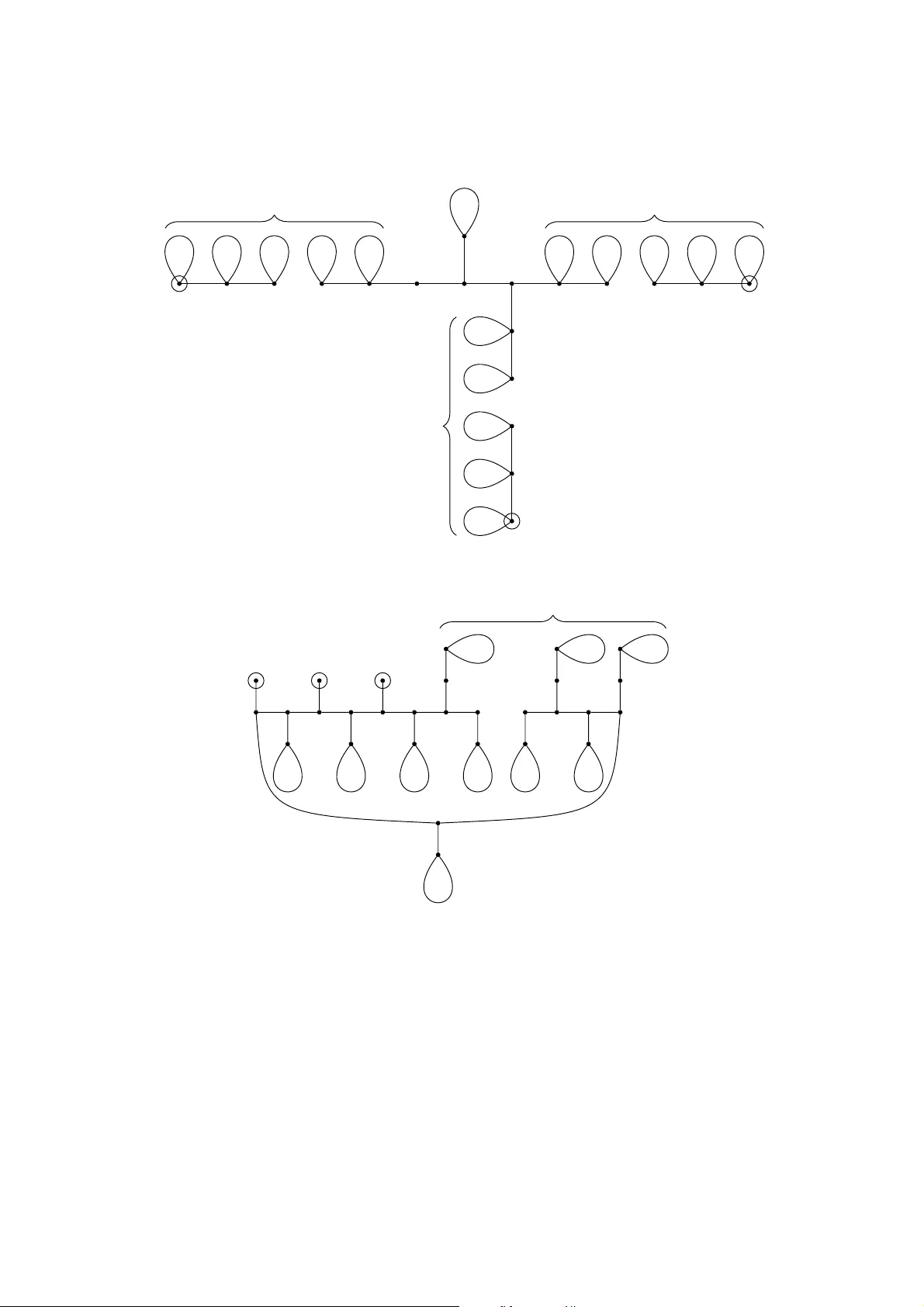
Iden tifying co des in line graphs ✩ Florent F oucaud a , Sylv ain Gravier b , Reza Naserasr a,b , Aline P arrea u b , P etru V alicov a a L aBRI - Université de Bor de aux - CNRS, 351 c ours de la Lib ér ation, 33 405 T alenc e c e dex, F r anc e. b Institut F ourier 100, rue des Maths, BP 74, 38402 St Martin d’Hèr es c e dex, F r anc e. Abstract An iden tifying co de of a graph is a subset of its vertices such that every vertex of the g raph is uniquely iden tified by the set of its neighbour s within the co de. W e study the edg e-iden tifying co de problem, i.e. the identifying co de problem in line gra p hs. If γ ID ( G ) deno t es the size of a minim um identifying co de of a n iden tifiable graph G , w e show that the usual b ound γ ID ( G ) ≥ ⌈ log 2 ( n + 1) ⌉ , wher e n denotes the order o f G , can b e improv ed to Θ( √ n ) in the class o f line graphs. Moreov er, this b ound is tight. W e also prove that the upper b ound γ ID ( L ( G )) ≤ 2 | V ( G ) | − 5 , where L ( G ) is the line gra ph of G , holds (with tw o exceptions). This implies that a conjecture o f R. Kla sing, A. Kosowski, A. Raspa ud and the fir st author holds for a sub class of line graphs. Finally , w e show that the edge- identifying co de problem is NP-complete, ev en for the clas s of plana r bipartite gr aphs of max imum degre e 3 and arbitrar ily large girth. Keywor d s: Iden tifying co des, Dominating sets, Line g raphs, NP-completeness . 1. In tro duction An identifying c o de of a gr aph G is a subset C of vertices of G such that fo r each v ertex x , the set of vertices in C at distance at mos t 1 fro m x , is nonempty and uniquely identifies x . Mor e for mally: Definition 1. Gi ven a gr aph G , a su bset C of V ( G ) is an identifyi ng c o de of G if C is b o th: • a dominating set of G , i. e. for e ach vertex v ∈ V ( G ) , N [ v ] ∩ C 6 = ∅ , and • a separ ating set of G , i.e. for e a ch p ai r u, v ∈ V ( G ) ( u 6 = v ), N [ u ] ∩ C 6 = N [ v ] ∩ C . Here N [ v ] is the closed neighbour ho o d of v in G . This concept was introduced in 1998 in [13] and is a well-studied o ne (see e.g . [1, 4, 5, 8, 9, 12, 16]). A vertex x is a twin o f another vertex y if N [ x ] = N [ y ] . A gra ph G is called twin-fr e e if no vertex has a twin. The first obser v ation r egarding the co ncept of iden tifying co des is that a graph is identifiable if a nd only if it is twin-free. As usual for many other graph theor y co ncepts, a natural problem in the s tudy of iden tifying co des is to find one of a minimum size. Given a gra ph G , the smallest size of an iden tifying co de of G is called identifying c o de nu mb er of G a nd denoted by γ ID ( G ) . The main lines of research here are to find the exact v alue of γ ID ( G ) for in teresting graph cla sses, to approximate it and to g ive lower o r upp er bo unds in terms of simpler gra ph parameters . Examples o f class ic results are as follows: Theorem 2. [1 2] If G is a twin-fr e e gr ap h with at le ast two e d ges, then γ ID ( G ) ≤ | V ( G ) | − 1 . The collection of a ll twin-free g raphs r e aching this b ound is classified in [8]. A b etter upper bo und in terms of both n umber of v ertices and maximum degree ∆( G ) of a gr aph G is also co njectured: ✩ This researc h is supp orted by the ANR Pro ject IDEA • ANR-08-EMER- 007, 2009-2011. Pr eprint submitted to J. of Gr aph The ory Novemb er 6, 2018 Conjecture 3. [ 9] Ther e exists a c onstant c such t hat for every twin-fr e e gr aph G , γ ID ( G ) ≤ | V ( G ) | − | V ( G ) | ∆( G ) + c. Some s upp or t for this conjecture is provided in [8, 9, 10]. The parameter γ ID ( G ) is also bo unded below by a function o f | V ( G ) | where equality holds for infinitely many graphs. Theorem 4. [1 3] F or any twin-fr e e gr aph G , γ ID ( G ) ≥ ⌈ lo g 2 ( | V ( G ) | + 1) ⌉ . The collection of a ll gra phs a ttaining this lower b ound is classified in [16]. F rom a computationa l p oint of view , it is s hown that given a g raph G , finding the exact v alue of γ ID ( G ) is in the class of NP-hard problems. It in fa c t remains NP-har d for many sub classes of graphs [1, 4 ]. F urthermore, approximating γ ID ( G ) is not ea sy either as shown in [14, 11, 1 7]: it is NP-hard to approximate γ ID ( G ) within a o (log ( | V ( G ) | )) -factor. The problem of finding ident ifying codes in g raphs can be viewed as a specia l case of the more general combinatorial pro blem o f finding tr a nsversals in hyper graphs (a transv ersa l is a set of v ertices intersecting each hyper edge). More precisely , to ea ch g raph G o ne can ass o ciate the hyperg raph H ( G ) who se vertices ar e vertices of G and whose hyperedg es are a ll the sets of the form N [ v ] and N [ u ] ⊖ N [ v ] (symmetric difference of N [ u ] and N [ v ] ). Finding a n identifying co de for G is then equiv alent to finding a transversal for H ( G ) . Though the identifying co de pr oblem is captured by this mor e genera l pro blem, the str uctur a l prop erties of the g r aph from which the h yp ergra ph is built allow o ne to obtain strong e r r esults which are not tr ue for general hyperg raphs. In this work, we show that even stro nger results can be obtained if we consider h yp ergr aphs co ming fro m line gra phs. These stronger r e s ults follow from the new p ersp ective of iden tifying edges by e dg es. Given a graph G and an e dg e e o f G , w e define N [ e ] to be the set o f edges adjacent to e together with e itself. An e dge-identifying c o de of a gr aph G is a subset C E of edges s uch that for each edge e the set N [ e ] ∩ C E is no nempty and uniquely determines e . More for mally: Definition 5. Given a gr aph G , a subset C E of E ( G ) is an e dge-identif ying c o de of G if C E is b oth: • an edge-dominating set of G , i. e. for e ac h e dge e ∈ E ( G ) , N [ e ] ∩ C E 6 = ∅ , and • an edge-separ ating set of G , i.e. for e ach p air e, f ∈ E ( G ) ( e 6 = f ), N [ e ] ∩ C E 6 = N [ f ] ∩ C E . W e will say that an edg e e separa tes edges f and g if either e b elo ngs to N [ f ] but not to N [ g ] , o r vice- versa. When considering edge-identifying co des we will ass ume the edge set o f the graph is nonempty . The line gr aph L ( G ) o f a graph G is the graph with vertex s e t E ( G ) , where tw o vertices of L ( G ) are a djacent if the corresp onding edges are adjacen t in G . It is ea sily observed that the notion o f edge-identifying co de o f G is e q uiv alen t to the notion of (vertex-)identif ying co de o f the line gr aph o f G . Thus a gr a ph G admits an edge-identifying co de if a nd only if L ( G ) is twin-free. A pair o f twins in L ( G ) ca n co rresp ond in G to a pair of: 1. par a llel edges; 2. adjacent edges whos e non-common ends are o f degree 1 ; 3. a djacent edges whose no n common ends are of degree 2 but they ar e connected to eac h o ther. H ence w e will cons ider simple gra phs only . A pair of edg e s o f type 2 or t yp e 3 is called p endant (see Figure 1) and thus a g raph is e dge-identifiable if a nd only if it is p enda nt-fr e e . The smallest size of an edge-identifying co de of an edge-identifiable gr a ph G is denoted by γ EID ( G ) and is called e dg e-identifying c o de numb er of G . As we will use it often throughout the paper, given a g raph G and a set S E of its edges, w e define the graph induced by S E to b e the g raph with the set of all endpoints o f the edg es of S E as its vertex set and S E as its edge set. T o warm up, we notice that five edges of a per fect matching of the Petersen g raph P , for m an edge- iden tifying co de of this g raph (see Figure 2). The low er b ound of Theorem 4 pr ov es that γ EID ( P ) ≥ 4 . Later, b y impro ving this b o und for line graphs, w e will s e e that in fact γ EID ( P ) = 5 (see Theorem 12 and Theorem 16). 2 G G Figure 1: T wo p ossibil ities for a pair of p endan t edges (thic k edges) i n G Figure 2: An edge-iden tifying co de of the Petersen graph The o utline of the pap er is as follows: in Section 2, we intro duce some useful lemmas and give the edge-identifying co de num ber of some basic families of graphs. In Section 3, we impr ov e the g eneral lo wer bo und for the clas s of line gra phs, then in Section 4 we improve the upp er b ound. Finally , in Section 5 we show that determining γ EID ( G ) is also in the class of NP-hard problems even when restricted to pla na r subc ubic bipa rtite gr aphs of a r bitrarily larg e girth, but the problem is 4-approximable in p oly no mial time. 2. Preliminaries In this s e c tio n we first give some easy to ols which help for finding minimum-size edge-identifying co des of gra phs. W e then apply these to ols to determine the exact v alues of γ EID for some basic families of gr aphs. W e recall that C n is the cycle on n vertices, P n is the path on n vertices, K n is the complete graph on n vertices a nd K n,m is the co mplete bipartite gra ph with parts o f size n and m . W e reca ll that the girth of a graph is the length of o ne of its shortest cycles. An e dge c over o f a g raph G is a subset S E of its edges such that the union of the endp oints of S E equals V ( G ) . A matching is a set of pairwise non-adjacent edges, and a p erfe ct matching is a matching which is also an edge cov er. Lemma 6. L et G b e a simple gr aph with girth at le ast 5 . L et C E b e an e dge c over of G such that the gr aph ( V ( G ) , C E ) is p endant-fr e e. Then C E is an e dge-identify ing c o de of G . In p articular, if G has a p erfe ct matching M , M is an e dge-identifying c o de of G . Pr o of. The co de C E is a n edge - dominating set o f G b ecause it cov ers all the vertices of G . T o complete the pro of, we need to pr ov e that C E is a lso an edge-sepa rating s et. Let e 1 , e 2 be tw o edg es of G . If e 1 , e 2 ∈ C E , then C E ∩ N [ e 1 ] 6 = C E ∩ N [ e 2 ] bec ause ( V ( G ) , C E ) is p endant-free. Otherwise, we can a ssume that e 2 / ∈ C E . If e 1 ∈ C E and C E ∩ N [ e 1 ] = C E ∩ N [ e 2 ] , then e 2 m ust b e a dja c e nt to e 1 . Let u be their common vertex and e 2 = uv . Since C E is an edge cov er, there is a n edg e e 3 ∈ C E which is inciden t to v . Howev er, e 3 cannot b e adjacent to e 1 bec a use G is triangle-free . Therefore e 3 separates e 1 and e 2 . Finally , we assume neither of e 1 and e 2 is in C E . Then there a re tw o edge s of C E , say e 3 and e 4 , adjac e nt to the tw o ends o f e 1 . But since G has neither C 3 nor C 4 as a subgra ph, e 3 and e 4 cannot b oth be a djacent to e 2 and, therefo re, e 1 and e 2 are separated. 3 W e note that in the pr evious pro of the absence of C 4 is o nly used when the endp oints of e 1 , e 2 , e 3 , e 4 could induce a C 4 which would not b e a djacent to any other edge of C E . Thus, we hav e the following stronge r statement : Lemma 7. L et G b e a t riangle-fr e e gr aph. L et C E b e a subset of e dges of G that c overs vertic es of G , such that C E is p endant-fr e e. If for no p air xy , uv of iso late d e dges in C E , the set { x, y , u, v } induc es a C 4 in G , then C E is an e dge-id entifying c o de of G . W e will also need the following lemma ab out p endant-free trees. Lemma 8. If T is a p enda nt-fr e e tr e e on mor e than two vertic es, then T has two vertic es of de gr e e 1, e ach adjac ent to a vertex of de gr e e 2. Pr o of. T ake a long est path in T , then it is easy to verify that both ends of this path sa tisfy the condition of the lemma. W e are now ready to determine the v alue of γ EID of so me families o f gr aphs. Prop ositio n 9. W e have γ EID ( K n ) = ( 5 , if n = 4 or 5 n − 1 , if n ≥ 6 . F urthermor e, let C E b e an e d ge-identifying c o de of K n of size n − 1 ( n ≥ 6 ) and let G 1 , G 2 , . . . , G k b e the c onne cte d c o mp onents of ( V ( K n ) , C E ) . Then exactly one c omp onent, say G i , is isomorphic to K 1 and every other c omp onen t G j ( j 6 = i ) is isomorphic to a cycle of length at le ast 5. Pr o of. W e note that L ( K 4 ) is iso morphic to K 6 \ M , where M is a p erfect matching of K 6 . One can c heck that this g raph has identifying co de num ber 5 . B y a case analysis, we can show that K 5 do es not a dmit an edge-identifying co de o f size 4. Indeed, since a n edge-identifying c o de m ust b e p endant-free, there ar e only t wo g raphs possible for an edge-identif ying co de of this size: a path P 5 or a cycle C 4 . In bo th cases, there a re edges which are not sepa rated. Edges of a C 5 form an edge-identifying co de of size 5 of K 5 , hence γ EID ( K 5 ) = 5 . F urther mo re, it is not difficult to chec k that the set o f edges o f a cy c le of length n − 1 ( n ≥ 6 ) iden tifies all edges of K n . Th us we hav e γ EID ( K n ) ≤ n − 1 . The fact that γ EID ( K n ) ≥ n − 1 follows from the second part o f the theorem which is prov ed as follows. Let C E be an edge - ident ifying co de of K n of size n − 1 or less ( n ≥ 6 ). Let G ′ = ( V ( K n ) , C E ) . Let G 1 , G 2 , . . . , G k be the co nnected comp onents of G ′ . Since G ′ has n vertices but at most n − 1 edg es, at least one comp onent of G ′ is a tree. On the o ther hand we claim that a t most one of these comp onents can be a tree and that such tree w ould be isomorphic to K 1 . Let G i be a tree. First we show that | V ( G i ) | ≤ 2 . If not, b y Le mma 8 there is a vertex x of deg ree 1 in G i with a neighbour u of degree 2 . Let v be the other neighbour o f u . Then the edges xv and u v are not identified. If V ( G i ) = { x, y } then for a ny other vertex u , the edges ux and uy are not se pa rated. Finally , if there are G i and G j with V ( G i ) = { x } and V ( G j ) = { y } , then the edge xy is not do minated by C E . Thus exactly one comp onent of G ′ , say G 1 , is a tree and G 1 ∼ = K 1 . This implies that γ EID ( K n ) ≥ n − 1 . Therefore, γ EID ( K n ) = n − 1 and, furthermor e, each G i , ( i ≥ 2) , is a graph with a unique cycle. It remains to pro ve that each G i , i ≥ 2 is isomorphic to a cycle of length at least 5 . By con tradiction suppo se one of these gra phs, say G 2 , is no t isomorphic to a cycle. Since G 2 has a unique cycle, it must contain a v ertex v of degr ee 1. L e t t b e the neig hbo ur of v in G 2 and let u b e the vertex o f G 1 . Then the edges tv a nd tu ar e no t separa ted by C E . Finally we no te that such cycle cannot b e of length 3 o r 4, be c ause C 3 is no t p endant-free a nd in C 4 , the tw o c hords (whic h are edges of K n ) w ould not b e se pa rated. Prop ositio n 10. γ EID ( K n,n ) = 3 n − 1 2 for n ≥ 3 . Pr o of. Let X and Y be the t wo parts of K n,n . If n is even, then let { A i } n 2 i =1 be a par tition of vertices such that each A i has exactly t wo vertices in X a nd tw o in Y . Let G i be a subgraph of K n,n isomorphic to P 4 and with A i as its vertices. If n is o dd, let A 1 be o f size 2 a nd having exactly one elemen t fr o m X and one element from Y and let also G 1 be the subgra ph (iso morphic to K 2 ) induced by A 1 . Then we define A i ’s 4 and G i ’s ( i ≥ 2 ) as in the previo us case (for K n − 1 ,n − 1 ). By Lemma 7, the set of edges in the G i ’s induces an edge- ident ifying c o de of K n,n of size 3 n − 1 2 . T o complete the pro of w e show that there ca nno t b e an y smaller edg e - ident ifying co de. Let C E be an e dg e-identif ying co de o f G . Let G 1 , G 2 , . . . , G k be the connected comp onents of ( X ∪ Y , C E ) . The pro of will b e completed if we show tha t except po ssibly one, every G i m ust hav e at lea st four vertices. T o prov e this claim we first note that there is no connected pendant-free gra ph on three v ertices. W e now suppo se G 1 and G 2 are both of order 2. Then the t wo edges connecting G 1 and G 2 are not separated. If G 1 is of or der 1 and G 2 is of or der 2, then the edge connecting G 1 to G 2 is not identified from the edge o f G 2 . If G 1 and G 2 are bo th of order 1, then bo th of their vertices must b e in the same par t of the gr aph as otherwise the edge connecting them is not dominated by C E . But now for any vertex x whic h is not in the same part a s G 1 and G 2 , the edges connecting x to G 1 and G 2 are not separated. The following examples show that if true, the upp er b o und of Conjecture 3 is tight even in the class of line gr aphs. These exa mples were first intro duced in [9] but witho ut using the notion o f edge - ident ifying co des. Prop ositio n 11. L et G b e a k - r e gula r multigr ap h ( k ≥ 3 ). L et G 1 b e obtaine d fr om G by sub divid ing e ach e dge exactly onc e. Then γ EID ( G 1 ) = ( k − 1) | V ( G ) | = | E ( G 1 ) | − | E ( G 1 ) | 2 k − 2 = | V ( L ( G 1 )) | − | V ( L ( G 1 )) | ∆( L ( G 1 )) . Pr o of. Let x b e a vertex of G 1 of deg ree at leas t 3 (an orig inal vertex from G ). F o r each edg e e x i inciden t to x , let e ′ i x be the edg e adjacent to e x i but not incident to x and let A x = { e ′ x i } k i =1 . Then { A x | x ∈ V ( G ) } is a partition of E ( G 1 ) . F or any edge-identifying co de C E of G 1 , if tw o elements of A x , say e ′ x 1 and e ′ x 2 , are b oth not in C E , then e x 1 and e x 2 are not separa ted. Th us |C E ∩ A x | ≥ k − 1 . This proves that |C E | ≥ ( k − 1) | V ( G ) | . W e now build an edg e -ident ifying code of this size by cho o sing one edge of each set A x , in suc h a wa y that for each v ertex x orig inally from G , exactly o ne edge incident to x is chosen. Then the s et of non-chosen edges will be an edge-identifying co de. T o s e le c t this set of edges, o ne can consider the inciden t bipartite m ultigraph H of G : the vertex s et o f H is V ∪ V ′ where V and V ′ are copies of V ( G ) and ther e is an edge xx ′ in H if x ∈ V , x ′ ∈ V ′ and xx ′ ∈ E ( G ) . The multigraph H is k -r egular and bipar tite, th us it has a p erfect matchin g M . F or each vertex x ∈ V , let ρ ( x ) be the vertex in V ′ such that xρ ( x ) ∈ M . Let now e ′ x M be the edge of G 1 that b elongs to the set A x and is incident to ρ ( x ) (in G 1 ). Fina lly , let C E = E ( G 1 ) \ { e ′ x M } x ∈ V ( G ) . Exactly one element o f each A x is no t in C E , and for ea ch vertex x , exactly one edge incident to x is not in C E . This implies that C E is a n edge-identifying co de. F or a simple example of the previous construction, let G b e the multigraph o n t wo vertices with k pa rallel edges. Then G 1 ∼ = K 2 ,n and there fo re γ EID ( K 2 ,n ) = 2 n − 2 . Hyper cub e s, b eing the natura l gr ound of co de-like structur e s , have b een a cent er of fo cus for determining the smallest size of their iden tifying co des. The hypercub e of dimension d , denoted H d , is a gr aph whose vertices ar e elements of Z d 2 with tw o vertices b eing a djac ent if their difference is in the standa rd basis: { (1 , 0 , 0 , . . . , 0) , (0 , 1 , 0 , . . . , 0) , . . . , (0 , 0 , . . . , 0 , 1) } . The hypercub e of dimension d ca n als o b e viewed as the cartesian product of the h yp ercub e of dimension d − 1 and K 2 . In this wa y of building H d we add a new co ordinate to the left of the vectors representing the vertices o f H d − 1 . The problem of determining the identifying co de n um b er of h yp ercub es has proved to be a challenging one fr om b oth theo r etical and computational p oints o f v iew. T o day the pr ecise ident ifying co de num b er is known for only seven hypercub es [3]. In contrast, we show here that finding the edge- ident ifying co de n umber of a h ype r cub e is not so difficult. W e first introduce the following genera l theorem. Theorem 12. L et G b e a c onne cte d p endant-fr e e gr aph. W e have: γ EID ( G ) ≥ | V ( G ) | 2 . Pr o of. Let C E be an edge - ident ifying co de of G . Let G ′ be the s ubg raph induced b y C E and let G 1 , . . . , G s be the connected co mpo nent s o f G ′ . Let n i be the order o f G i and k i be its size (thus P s i =1 k i = |C E | ). Let X = V ( G ) \ V ( G ′ ) and n ′ i be the num b er of vertices in X that are joined to a vertex of G i in G . W e show 5 that n ′ i + n i ≤ 2 k i . If k i = 1 , then clea rly n ′ i = 0 and n ′ i + n i = 2 = 2 k i . If G i is a tree, then n i = k i + 1 and, b y Lemma 8, G i m ust ha ve t wo vertices o f degree 2 eac h having a vertex of deg ree 1 as a neighbour . Then no v ertex of X can b e adjacent to one of these t wo vertices in G . Moreov er, each other v ertex of G i can b e adjacent to at mo st one vertex in X . So n ′ i ≤ k i − 1 , and finally n i + n ′ i ≤ 2 k i . If G i is not at tree , we hav e n i ≤ k i and n ′ i ≤ n i and, therefor e, n ′ i + n i ≤ 2 k i . Finally , since G is connected, ea ch vertex in X is co nnected to a t leas t one G i . Hence b y countin g the num ber vertices of G we hav e: | V ( G ) | ≤ s X i =1 ( n i + n ′ i ) ≤ 2 s X i =1 k i ≤ 2 |C E | . Theorem 12 tog ether with Lemma 7 lea ds to the following result: Corollary 13. L et G b e a triangle-fr e e p endant-fr e e gr aph . Supp ose G has a p erfe ct matching M with t he pr op erty that for any p air xy , uv of e dges in M , the set { x, y , u, v } do es not induc e a C 4 . Then M is an optimal e dge-identifying c o de and γ EID ( G ) = | V ( G ) | 2 . W e no te that in par ticular, if the girth of a gr aph G is at least 5 and G a dmits a perfect matc hing M , then M is a minim um-size identif ying co de of G . F or example, the edg e-identif ying co de o f the Pet ersen graph g iven in Fig ur e 2 is optimal. As another applicatio n of Coro lla ry 13, w e give the edge-identif ying co de o f all hypercub es of dimension d ≥ 4 . Prop ositio n 14. F o r d ≥ 4 , we have γ EID ( H d ) = 2 d − 1 . Pr o of. By Theorem 1 2, w e hav e γ EID ( H d ) ≥ 2 d − 1 . W e will construct b y induction a perfect matching M d of H d such that no pair of edg e s induces a C 4 , for d ≥ 4 . By Lemma 7, M d will b e a n edge-identifying co de of H d , proving the r e s ult. T wo suc h matchin gs of H 4 , which are also dis jo in t, a re pres ent ed in Figur e 3. The matc hing M 5 can now b e built using each o f these tw o matc hings of H 4 — o ne matc hing p er copy of H 4 in H 5 . It is ea sily verified that M 5 has the required pro p erty . F urthermore, M 5 has the extra pro p e rty that for each edge uv of M 5 , u and v do not differ on the first co o rdinate (reca ll that we build H 5 from H 4 b y adding a new co o rdinate on the left, hence the fir st co ordinate is a the new one). W e now build the matchin g M d of H d ( d ≥ 6 ) from M d − 1 in suc h a way that no t w o edges o f M d belo ng to a 4 - cycle in H d and that for each edge uv of M d , u and v do not differ on the first co o r dinate. T o do this, let H ′ 1 be the copy of H d − 1 in H d induced b y the set of vertices whose first co ordinate is 0 . Similarly , let H ′ 2 be the copy of H d − 1 in H d induced by the other vertices. Let M ′ 1 be a cop y of M d − 1 in H ′ 1 and let M ′ 2 be a matc hing in H ′ 2 obtained from M ′ 1 b y the fo llowing transformation: for e = uv ∈ M ′ 1 , define ψ ( e ) = σ ( u ) σ ( v ) where σ ( x ) = x + (1 , 0 , 0 , . . . , 0) . It is now easy to chec k that the new matching M d = M ′ 1 ∪ M ′ 2 has b oth pro pe r ties we need. W e note that the formula of Prop ositio n 14 do es not hold for d = 2 and d = 3 . F o r d = 2 the hyper cub e H 2 is iso morphic to C 4 and thus γ EID ( H 2 ) = 3 . F or d = 3 , we note that an ident ifying co de of size 4, if it exists, must b e a matching with no pair of edge s b elong ing to a 4 -cycle. But this is not p ossible. An iden tifying co de of s ize 5 is shown in Figure 4, therefore γ EID ( H 3 ) = 5 . 3. Lo w er Bounds Recall from Theorem 4 that γ ID ( G ) is b ounded b elow by a function of the order of G . As mentioned befo r e, this b ound is tight. Let C b e a set of c is o lated v ertices. W e ca n build a gra ph G of order 2 c − 1 such that C is an identifying code of G . T o this end, for every subset X of C with | X | ≥ 2 , we asso ciate a new vertex w hich is joined to all v ertices in X and only to those vertices. Then, it is easily seen that C is an identifying co de o f this g raph. How ev er, the gra ph built in this wa y is far fro m b e ing a line graph a s it contains K 1 ,t , even for lar ge v alues of t . In fact this low er b ound turns o ut to be far from b eing tight 6 Figure 3: T wo disjoint edge-iden tifying codes of H 4 Figure 4: An optimal edge-iden tifying code of H 3 for the family of line graphs. In this section we give a tight lower b ound on the size of an edg e-identif ying co de of a gr aph in terms of the n umber of its edges. Equiv alen tly w e hav e a lower b ound for the size of an iden tifying co de in a line g r aph in terms o f its or der. This low er b ound is of the order Θ( √ n ) and thus is a m uch improv ed low er b ound with resp ect to the genera l b ound of Theorem 4. Let G be a p endant-free g raph and let C E be an edge-identifying c o de of G . T o av oid trivialities such as having isola ted vertices we may ass ume G is connected. W e note that this do es not mean that the subgraph induced by C E is a lso connected, in fact we observe almost the contrary , i.e. in most cases, an edge-identifying co de of a minim um size will induce a disconnected subgraph of G . W e first pro ve a low er bo und for the ca se when an edge-identifying co de induces a connected subgraph. Theorem 15. If an e dge-identifying c o de C E of a nontrivial gr aph G induc es a c onne cte d su b gr a ph of G which is not isomorphic to K 2 , then G ha s at most |C E | +2 2 − 4 e dges. F urthermor e, e quality c an only hold if C E induc es a p ath. Pr o of. Let G ′ be the subgraph induced by C E . Since w e assumed G ′ is co nnected, and since G ′ is p endant- free, it canno t hav e three vertices. Since we assumed G ′ ≇ K 2 , we conclude that G ′ has at leas t four vertices. F o r each vertex x o f G ′ , let C x E be the set of a ll edges incident to x in G ′ . Let e = uv b e a n edge of G , then one o r bo th of u a nd v m ust b e in V ( G ′ ) . Therefore, dep ending o n which of these vertices belo ng to C E , e is uniquely determined by either C u E (if u ∈ V ( G ′ ) and v / ∈ V ( G ′ ) ), or C v E (if u / ∈ V ( G ′ ) and v ∈ V ( G ′ ) ), or C u E ∪ C v E (if bo th u, v ∈ V ( G ′ ) ). The total num b er of sets of this form can be a t most | V ( G ′ ) | + | V ( G ′ ) | 2 = | V ( G ′ ) | +1 2 , thus if | V ( G ′ ) | ≤ |C E | w e are done. Otherwise, s ince G ′ is connected, | V ( G ′ ) | = |C E | + 1 and G ′ is a p endant-free tree on a t least 4 v ertices. If v is a vertex of degree 1 adjacent to u , then we hav e C v E = { uv } but uv ∈ C u E and, therefo re, C u E = C u E ∪ C v E . On the o ther hand, by Lemma 8, there a re tw o vertices of degr e e 2 that have neighbours o f degree 1. L e t u b e such a vertex, let v b e its neighbour of degr ee 1 and x b e its other neighbour . Then C v E = { uv } a nd C u E = { uv , ux } and, therefo r e, C u E ∪ C x E = C v E ∪ C x E . Th us the total num b er of distinct sets of the form C y E or C y E ∪ C z E is at mo s t |C E | +2 2 − 4 . But if e q uality holds there can only be tw o vertices o f degree 1 in G ′ and hence C E is a path. 7 W e note that if this bound is tigh t, then G ′ is a path. F urthermor e, for each pa th P k +1 one can build many graphs which ha ve P k +1 as an edge-identifying co de and hav e k +2 2 − 4 edges. The set of all these graphs will be denoted by J k . An example of suc h a graph is obtained from K k +2 b y removing a certain set of four edg es as sho wn in Figur e 5. Note that every other mem b e r of J k is obtained fro m the pr evious example b y splitting the vertex that do es not b elong to P k +1 (but without adding any new edge). a ( k + 1) -c lique with t wo e dg es remov ed · · · Figure 5: An extremal graph of J k with its connecte d edge-ident ifying co de Next w e consider the case when the subgr aph induced by C E is not nece s sarily c o nnected. Theorem 16. L et G b e a p endant-fr e e gr aph and let C E b e an e dge-id entifying c o de of G with |C E | = k . Then we have: | E ( G ) | ≤ 4 3 k 2 , if k ≡ 0 mo d 3 4 3 ( k − 1)+1 2 + 1 , if k ≡ 1 mo d 3 4 3 ( k − 2)+2 2 + 2 , if k ≡ 2 mo d 3 . Pr o of. Let G b e a graph with maximum num ber of edges amo ng all g raphs with γ EID ( G ) = k . It can b e easily chec ked that for k = 1 , 2 or 3 , the max im um num ber o f edg es of G is 1, 3 or 6 r esp ectively . F or k ≥ 4 , we prove a slightly str onger statement: given a n edg e-identif ying co de C E of G of size k , all but at most tw o of the connected comp onents o f the subgraph induced by C E m ust b e iso morphic to P 4 . When there is only one comp onent not isomorphic to P 4 , it must be iso mo rphic to a P 2 , a P 5 or a P 6 . If there are tw o suc h comp onents, then they can b e tw o copies o f P 2 , a P 2 with a P 5 , o r just tw o copies o f P 5 . This depe nds on the v alue of k mod 3 . T o prove our claim let G b e a gr aph as defined ab ove, let C E be an edge-identifying code of s ize k of G and let G ′ be the subgraph induced by C E . F o r each vertex u ∈ V ( G ) \ V ( G ′ ) , we can assume that u has degree 1 : if u has degree d > 1 , with neighbo ur s v 1 , . . . , v d necessarily in V ( G ′ ) , then repla ce u by d vertices of deg ree 1: u 1 , . . . , u d , co nnecting u i to v i . Then the num b er o f edges do es not change, and the co de C E remains an edge-identif ying co de of size k , thus it suffices to prov e our claim for this new graph. Let G ′ 1 , G ′ 2 , . . . , G ′ r be the connected comp onents of G ′ with | V ( G ′ i ) | = n ′ i . F or each i ∈ { 1 , . . . , r } , let G i be the g raph induced by the vertices of G ′ i and the vertices co nnected to G ′ i only . T o each vertex x of G ′ we assign the set C x E of edg e s in G ′ inciden t to x . W e first no te that no G ′ i can be of order 3, b eca use there is no connected pendant-free graph on three vertices. If u a nd v ar e vertices from t wo disjoint comp onents of G ′ with each comp onent b eing of order at least 4 , then the pair u, v is uniquely deter mined by C u E ∪ C v E , thus by maxima lity of G , uv is an edge of G . If a comp onent of G ′ is isomorphic to K 2 , a ssuming u and u ′ are v ertices o f this comp onent, then for an y other vertex v of G ′ exactly one o f uv or u ′ v is an edge of G . W e now claim that each G ′ i with n ′ i ≥ 4 is a path. B y contradiction, if a G ′ i is not a pa th, we r e pla ce G i b y a mem be r J n ′ i − 1 of J n ′ i − 1 with P n ′ i being its edge-identifying c o de. Then we join each vertex of P n ′ i to eac h vertex of each G ′ j (with j 6 = i and n ′ j ≥ 4 ) and to exactly one vertex of each G j with n ′ j = 2 . W e note that the new g r aph still admits an e dge-identifying co de of size k . How ever, it has mor e edg es than G . 8 Indeed, while the num ber o f edg e s co nnecting G ′ i and the G ′ j ’s ( j 6 = i ) is not decreas ed, the num ber o f edges in G i is incr e ased when w e replace G i b y J n ′ i − 1 . This can b e s e e n by a pplying Theor em 15 on G i . W e now s how that none of the G ′ i ’s can hav e more than six vertices. By con tradiction, suppo se G ′ 1 is a comp onent with n ′ 1 ≥ 7 v ertices (th us n ′ 1 − 1 edg es). W e build a new gra ph G ∗ 1 from G a s follows. W e tak e disjoint copies of J 3 ∈ J 3 and J n ′ 1 − 4 ∈ J n ′ 1 − 4 with P 4 and P n ′ 1 − 3 being , respectively , their edge- identifying co des. W e now let V ( G ∗ 1 ) = V ( J 3 ) ∪ V ( J n ′ 1 − 4 ) ∪ ( V ( G ) \ V ( G 1 )) . The edges of J 3 , J n ′ 1 − 4 and G − G 1 are also edges of G ∗ 1 . W e then a dd edges be tw een these three parts as follows. W e join every v ertex of P 4 to each vertex of P n ′ 1 − 3 . F or i = 2 , 3 , . . . , r if n ′ i ≥ 4 , join every vertex of G ′ i to each vertex of P 4 ∪ P n ′ 1 − 3 . If n ′ i = 2 , we c ho ose exactly one vertex of G ′ i and join it to each v ertex of P 4 ∪ P n ′ 1 − 3 . The construction of G ∗ 1 ensures that it s till admits a n edg e-identif ying co de of size k , but it has more edges than G . In fact, the n umber of edges is increa sed in t wo wa ys. First, b ecause P 4 ∪ P n ′ 1 − 3 has one more vertex than G ′ 1 , the n umber of edges co nnecting P 4 ∪ P n ′ 1 − 3 to G − G 1 has increas ed (unless r = 1 ). Mo re imp ortantly , the n umber of edges induced by J 3 ∪ J n ′ 1 − 4 is 6 + n ′ 1 − 2 2 − 4 + 4 × ( n ′ 1 − 3 ) = n ′ 1 2 2 + 3 n ′ 1 2 − 7 which is strictly more than | E ( G ′ 1 ) | = n ′ 1 2 2 + n ′ 1 2 − 4 for n ′ 1 ≥ 3 . Since n ′ 1 ≥ 7 , this c o ntradicts the maxima lity of G . With a similar metho d, the following trans fo rmations str ictly increase the n umber of edge s while the new gr aph still admits an edge-identifying co de of size k : 1. T wo comp onents of G ′ each on six vertices transfor m into tw o gr aphs of J 3 and a gr aph o f J 4 . 2. One comp onent of G ′ on six vertices and another co mpo nent on five vertices transfo rm into three graphs o f J 3 . 3. One comp onent of G ′ on six vertices and o ne o n tw o vertices tra nsform in to t wo gra phs of J 3 . 4. Three comp onents of G ′ each on five vertices transform into four gra phs of J 3 . 5. T wo comp onents of G ′ on five vertices and one on tw o vertices tra nsform into three g r aphs of J 3 . 6. A comp onent of G ′ on five vertices a nd tw o on tw o vertices transfor m in to t wo gra phs of J 4 . 7. Three comp onents of G ′ each isomorphic to P 2 transform into a gra ph o f J 3 . F or the pro o f o f case 7, w e observe that the num ber of edges identified b y the three P 2 ’s would b e the same as the num ber of edges identified by the P 4 . How ever, since k ≥ 4 , there must b e s ome other comp onent in G ′ . Mo r eov er, the num ber of vertices of the three P 2 ’s, which are joined to the vertices of the other comp onents of G ′ , is three, whereas the num b er of these vertices of the P 4 , is four. Hence the maximality of G is contradicted. W e note that cases 1 , 2 and 3 imply that if a comp onent o f G ′ is isomo rphic to P 6 , every other comp onent is is o morphic to P 4 . Then case s 4 , 5 and 6 imply that if a co mp o nent is isomorphic to P 5 , then a t most one other comp onent is not isomorphic to P 4 and such c omp onent is necessarily either a P 2 or a P 5 . Finally , case 7 shows that there can b e at most t wo comp onents b oth isomo rphic to P 2 . W e conclude that each of the comp onents of G ′ is isomor phic to P 4 except for p oss ibly tw o of them. These ex ceptions are dep endent on the v alue of k mo d 3 as w e describ ed. The formulas of the theorem can be derived using these structural prop erties of G . F o r instance, in the case k ≡ 0 mo d 3 , each comp onent of G ′ is isomorphic to P 4 . T her e ar e k 3 such comp onents. F or ea ch comp onent G ′ i , there a re s ix edges in the gra ph G i . That gives 2 k e dg es. The other edges of G are edges b etw een t wo co mp o nents o f G ′ . By maximality o f G , b etw een t wo c o mpo nents of G ′ , there ar e exactly 16 edges. Ther e are k 3 2 pairs of comp onents of G ′ . Hence, the num b er of edges in G is: 2 k + 16 k 3 2 = 4 3 k 2 . The other cases ca n b e proved with the same metho d. 9 W e note that this bound is tight and the examples were in fact built inside the pro of. More precisely , for k ≡ 0 mo d 3 we take k 3 disjoint copies of elements of J 3 each having a P 4 as a n edge-identif ying code. W e then add an edge betw een eac h pair of v ertices coming from t wo dis tinct such P 4 ’s. W e note that the union o f these P 4 ’s is a minimum edge-identif ying co de of the graph. If k 6≡ 0 mo d 3 , then we build a similar construction. This time we use elements from J 3 with at most t wo exceptions that are elements of J 4 or J 5 . The ab ov e theorem can be r estated in the la nguage o f line gr aphs a s follows. Corollary 17 . L et G b e a twin-fr e e line gr aph on n ≥ 4 vertic es. Then we have γ ID ( G ) ≥ 3 √ 2 4 √ n . Pr o of. Suppos e G is the line gr aph of a p endant-free graph H ( L ( H ) = G ). Let k = γ ID ( G ) = γ EID ( H ) , and let n b e the nu mber o f vertices of G ( n = | E ( H ) | ). Then, a fter s o lving the qua dratic inequalities of Theorem 16 for k , we have: k ≥ 3 8 + 3 √ 8 n + 1 8 , for k ≡ 0 mo d 3 , k ≥ 5 8 + 3 √ 8 n − 7 8 , for k ≡ 1 mo d 3 , k ≥ 3 8 + 3 √ 8 n − 15 8 , for k ≡ 2 mo d 3 . It is then easy to chec k that the right-hand side of each of the three inequalities is at least as 3 √ 2 4 √ n for n ≥ 3 . Remark. Note that the low er b o und of γ ID ( G ) ≥ Θ( p | V ( G ) | ) , which holds for the class of line graphs, is also implied by Theorem 1 2. How ever, the bo und of 1 7 is more precis e . In [2], Beineke characterized line gr aphs by a list of nine forbidden induced subg raphs. Considering Beineke’s characteriza tion, the low er bo und of Corolla ry 17 ca n b e restated as follows: γ ID ( G ) ≥ Θ( p | V ( G ) | ) holds if G has no induced subgraph from Beineke’s list. I t is then natura l to a sk what is a minimal lis t of forbidden induced subg r aphs for which a similar claim would hold. Note that the claw g raph, K 1 , 3 , b elongs to Beineke’s list of forbidden subgraphs. How ev er, we remar k tha t the bound γ ID ( G ) ≥ Θ( p | V ( G ) | ) do es no t ho ld for the clas s of claw-free gr aphs. Examples can be built as follo ws: let A be a set of size k and let B b e the set of nonempt y subsets of A . Let G be the graph built on A ∪ B , where A and B ea ch induce a complete g raph and a vertex a of A is joined to a vertex b of B if a ∈ b . This graph is claw-free and it is easy to find an iden tifying co de of size at most 2 k = Θ (log | V ( G ) | ) in G . 4. Upp er b ounds The most na tural question in the study of iden tifying co des in graphs is to find an iden tifying co de as small a s p o ssible. A gener al b o und, only in terms of the num ber of vertices of a g raph, is provided by Theorem 2. F urthermo re, the class of all gr aphs with γ ID ( G ) = | V ( G ) | − 1 is classified in [8]. It is easy to chec k that none but s ix of these gr aphs are line gra phs . Th us we hav e the following corolla ry (wher e G ⊲ ⊳ H denotes the co mplete join of graphs G and H ): Corollary 1 8 . If G is a t win-fr e e line gr aph with G / ∈ { P 3 , P 4 , C 4 , P 4 ⊲ ⊳ K 1 , C 4 ⊲ ⊳ K 1 , L ( K 4 ) } , then we have γ ID ( G ) ≤ | V ( G ) | − 2 . Since γ EID ( K 2 ,n ) = 2 n − 2 , γ ID ( L ( K 2 ,n )) = | V ( L ( K 2 ,n )) | − 2 and the b o und of Co rollar y 1 8 is tight for an infinite family of gra phs . Conjecture 3 prop os e s a better bo und in terms of b o th the num be r o f vertices and the maximum degree of a gra ph. As p ointed o ut in Prop osition 11, mo st of the known extr emal graphs for Conjecture 3 are line g raphs. In this section, after proving so me general b ound for the e dg e-identif ying 10 co de num ber o f a p endant-free graph we will show that Conjecture 3 ho lds for the class of line g raphs of high eno ugh density . W e recall that a g raph on n vertices is 2-de gener ate d if its vertices can be ordered v 1 , v 2 , . . . , v n such that each vertex v i is joined to at most t wo vertices in { v 1 , v 2 , . . . , v i − 1 } . Our ma in idea for proving upper bo unds is to show that given a p endant-free g raph G , any (inclusionwise) minimal edge-identifying co de C E induces a 2-deg enerated subgra ph of G and hence |C E | ≤ 2 | V ( G ) | − 3 . O ur pr o ofs ar e constructive and one could build such small edge-identifying co des. Theorem 19 . L et G b e a p endant-fr e e gr aph and let C E b e a minimal e dge-identify ing c o de of G . Then G ′ , the sub gr aph induc e d by C E , is 2-de ge ner ate d. Pr o of. Let uv b e a n edge of G ′ with d G ′ ( u ) , d G ′ ( v ) ≥ 3 . By minimality of C E the subset C ′ = C E − u v of E ( G ) is not a n edge-identifying co de of G . By the choice of uv , C ′ is still an edge- dominating set, thus there m ust b e tw o edges, e 1 and e 2 , that are not separated by C ′ . Hence one of them, say e 1 , is inciden t either to u o r to v (p ossibly to b oth) and the o ther o ne ( e 2 ) is incident to neither one. W e consider tw o ca ses: either e 1 = uv or e 1 is incident to only one of u and v . In the first case, e 2 is adjacent to e very e dg e of C ′ which u v is adjacent to. Since for each vertex of uv there are a t lea st tw o edges in C ′ inciden t to this vertex, the subgr aph induced b y u , v and the vertices of e 2 m ust be is o morphic to K 4 and there should b e no other edge of C ′ inciden t to any vertex of this K 4 (see Figure 6(a)). In the o ther case, supp ose e 1 is adjacent to uv at u . Let x and y be tw o neighbours of u in G ′ other than v . Then it follows that e 2 = xy and, therefore, d G ′ ( u ) = 3 . Let z b e the o ther end o f e 1 . W e co nsider t wo sub cases: either z / ∈ { x, y } , or, without los s of ge ner ality , z = x . Suppo se z / ∈ { x, y } . Recall tha t uv is the o nly edge sepa r ating e 1 and e 2 , but e 1 m ust be separ ated from ux . Thus z y ∈ C E . Similar ly , e 1 m ust be separated from uy , s o z x ∈ C E . F urthermor e , d G ′ ( x ) = d G ′ ( y ) = d G ′ ( z ) = 2 and { x, y , z , u } induces a C 4 in G ′ (see Figur e 6(b)). Now supp ose e 1 = ux , since u v is the o nly edge separating e 1 and e 2 , then uy and po ssibly xy ar e the only edges in G ′ inciden t to y , so d G ′ ( y ) ≤ 2 a nd d G ′ ( u ) = 3 (see Figures 6(c) and 6 (d)). u v e 2 e 1 (a) u x y z v · · · e 2 e 1 (b) u y z = x v · · · e 2 e 1 (c) u y z = x v · · · e 2 e 1 (d) Figure 6: Case distinctions in the proof of Theorem 19. Bl ac k ve rtices ha ve fixed degree in G ′ . Thic k edges b elong to C E . T o summarize, w e prov ed that given an edge uv , in a minimal edge-identifying co de C E , we hav e one o f the following cas es. • One of u or v is of degr e e at most 2 in G ′ . • Edge uv is an edge o f a co nnected co mpo nent of G ′ isomorphic to K − 4 (that is K 4 with an edge remov ed), see Figure 6(a). • d G ′ ( u ) = 3 (considering the symmetry betw een u and v ) in whic h case either u is incident to a C 4 whose other vertices a re of degree 2 in G ′ (Figure 6 (b)), or to a vertex o f degr ee 1 in G ′ (Figure 6 (c)) or to a triang le with one vertex y of degree 2 in G ′ and y is no t adjac e nt to v (Figure 6(d)). In either case, there exists a vertex x o f degree at most 2 in G ′ such that when x is removed, at least one of the vertices u , v has degree at mos t 2 in the rema ining subgra ph o f G ′ . In this wa y we can define an order o f elimination o f the vertices of G ′ showing that G ′ is 2 -degenerated. 11 By further analysis of our pro of w e prov e the following: Corollary 20. If G is a p endant-fr e e gr aph on n vertic es not isomorphic to K 4 or K − 4 , then γ EID ( G ) ≤ 2 n − 5 . Pr o of. W e firs t prov e that if G is a p endant-free gra ph on n vertices no t isomo rphic to K 4 , then γ EID ( G ) ≤ 2 n − 4 . Let C E be a minimal edge-identifying co de a nd let G ′ be the subgra ph induced b y C E . Then, by Theorem 19, G ′ is 2 -degenerated. L e t v n , v n − 1 , . . . , v 1 be a sequence o f vertices of G ′ obtained by a pro cess of eliminating vertices of deg r ee at most 2. Since v 1 and v 2 can induce at most a K 2 , we notice that there could only b e at mos t 2 n − 3 edges in G ′ . F urthermo re, if there ar e exactly 2 n − 3 edg e s in G ′ , then v 1 v 2 ∈ C E and each vertex v i , 3 ≤ i ≤ n , has exactly tw o neighbour s in { v 1 , . . . , v i − 1 } . Hence, the subgra ph induced b y { v 1 , v 2 , v 3 , v 4 } is isomorphic to K − 4 . Considering symmetries, there are three possibilities for the subgr aph induced by { v 1 , . . . , v 5 } (recall that v 5 is o f degree 2 in this subgr aph): see Figure 7 . In each of these three cases, the edge uv has both ends o f degree at lea st 3. Thus, we can apply the argument used in the pro o f of Theo rem 1 9 on G ′ and u v , showing that we hav e one of the four co nfigurations of Figur e 6. But none of them ma tches with the config urations of Figure 7, a contradiction. u v u v u v Figure 7: The three maximal 2 -degenerated graphs on five ver tices Now we show that if γ EID ( G ) = 2 n − 4 , then G ∼ = K − 4 . This can b e ea sily c heck ed if G has at mo st four vertices, so we may as sume n ≥ 5 . Le t G ′′ be the subgraph of G ′ induced b y { v 1 , v 2 , v 3 , v 4 , v 5 } . If G ′′ has seven edges, then it is isomorphic to one of the gra phs of Figure 7, a nd we are done just like in the last case. Therefore, we can a ssume that G ′′ has exa c tly six edges a nd, since it is 2 - degenerated, by an ea sy ca se analysis, it must b e isomor phic to one of the graphs of Figure 8. u v (i) u v (ii) u v (iii) v ′ v u (iv) t u v (v) Figure 8: The five p ossibilities of 2 -degenerated graphs on fiv e vert ices with six edges If G ′′ is a gra ph in part (i), (ii) or (iii) of Figure 8, then again one could rep eat the arguments o f the pro of of Theo r em 1 9 with G ′ and the edge uv of the corres po nding figure, to obtain a co nt radiction. Suppos e G ′′ is isomorphic to the graph of Figure 8(iv). Since G ′′ is not pendant-free, there must b e at least one more vertex in G ′ . Let v 6 be as in the sequence obtained by the 2-deg e ner acy o f G ′ . Since G ′ has exactly 2 n − 4 edges, v 6 m ust hav e exactly tw o neighbours in G ′′ . By the symmetry of the fo ur vertices o f degree 2 in G ′′ , we may assume uv 6 ∈ C E . Then u and v are b oth of deg ree at least 3 in G ′ . Therefore , we could aga in re p ea t the arg umen t of Theorem 19 with G ′ and uv , where only one of the configura tions of this theo r em, namely 6(d), matches G ′′ . F ur thermore, if this happ ens then v ′ v 6 should also b e an edge of G ′ . Now u and v ′ are bo th of degree a t least 3 a nd we a pply the ar gument o f Theorem 19 with G ′ and u v ′ to o btain a contradiction. 12 Finally , let G ′′ be isomorphic to the g raph of Figure 8(v). W e claim that every other vertex v i ( i ≥ 6 ) is adjacent, in G ′ , only to u and v . By contradiction supp ose v 6 is a djacent to t . Then using the tech nique of Theorem 19 applied on G ′ and tu (respectively tv ), we conclude that v 6 is a djacent to u (res p ectively v ). Since | E ( G ′ ) | = |C E | = 2 n − 4 , G ′ is a spanning subg raph of G . But then it is ea sy to verify that C E \ { xu, xv } is an edge-identifying co de of G — a co ntradiction. W e note that γ EID ( K 2 ,n ) = 2 n − 2 = 2 | V ( K 2 ,n ) | − 6 thus this b ound cannot b e improv ed muc h. Corollar y 20 implies that Conjecture 3 holds for a large subcla ss of line gr aphs: Corollary 21. If G is a p e ndant-fr e e gr aph on n vertic es and with aver age de gr e e ¯ d ( G ) ≥ 5 , then we have γ ID ( L ( G )) ≤ n − n ∆( L ( G )) . Pr o of. Let u be a v ertex o f degree d ( u ) ≥ ¯ d ( G ) ≥ 5 . Since G is p endant-free there is at le a st one neig hbour v of u that is of degr ee at least 2. Th us there is an edge uv in G with d ( u ) + d ( v ) ≥ ¯ d ( G ) + 2 and, therefor e, ∆( L ( G )) ≥ ¯ d ( G ) . Hence, considering Corolla ry 20, it is e no ugh to s how that 2 | V ( G ) | − 5 ≤ | E ( G ) | − | E ( G ) | ¯ d ( G ) . T o this end, s ince ¯ d ( G ) ≥ 5 , we hav e 4 | V ( G ) | ≤ ( ¯ d ( G ) − 1) | V ( G ) | , therefore, 4 | V ( G ) | − 10 ≤ ( ¯ d ( G ) − 1) | V ( G ) | . Mutiplying b oth sides by ¯ d ( G ) 2 we have: (2 | V ( G ) | − 5) ¯ d ( G ) ≤ ( ¯ d ( G ) − 1) ¯ d ( G ) 2 | V ( G ) | = ( ¯ d ( G ) − 1) | E ( G ) | . 5. Complexity This section is devoted to the study of the dec is ion problem a sso ciated to the concept of edge-identifying co des. Let us first define the decision problems we use. The IDCO DE pr oblem is defined as follows: IDCODE INST ANCE: A graph G and a n integer k . QUESTION: Does G hav e an identifying co de of siz e at most k ? IDCODE was prov ed to b e NP-complete even when restricted to the class o f bipartite graphs of maximum degree 3 (see [4]) or to the clas s of planar graphs o f maximum degre e 4 and arbitrar ily large g irth (see [1]). The EDGE-IDCODE pro blem is defined as follows: EDGE-IDCODE INST ANCE: A graph G and a n integer k . QUESTION: Does G hav e an edg e-identif ying co de of size at most k ? W e will prove that EDGE-IDCODE is NP-hard in some restricted cla ss of graphs by reduction from PLANAR ( ≤ 3 , 3 )-SA T, which is a v ariant o f the SA T pr oblem a nd is defined as follows [7]: PLANAR ( ≤ 3 , 3 )-SA T INST ANCE: A collection Q of clauses ov er a set X o f b o olea n v ariables, where each clause contains at least t wo and a t most three distinct literals (a v ariable x o r its neg a tion x ). Moreover, each v ariable app ears in exactly three clauses : twice in its non-neg ated form, a nd once in its neg a ted for m. Finally , the bipartite incidence graph of Q , denoted B ( Q ) , is planar ( B ( Q ) ha s vertex set Q ∪ X and Q ∈ Q is adjacent to x ∈ X if x o r x appea rs in cla us e Q ). QUESTION: Can Q be satisfied, i.e. is there a truth assig nmen t of the v ariables o f X such that each c lause contains at least o ne true litera l? 13 PLANAR ( ≤ 3 , 3 )-SA T is known to b e NP-complete [7]. W e ar e no w ready to prov e the ma in result of this section. Theorem 22. ED GE-ID COD E is NP-c omplete even when r estricte d to bip artite planar gr aphs of m ax imu m de gr e e 3 and arbitr arily lar g e girth. Pr o of. The pro blem is clea rly in NP: given a subset C of edg e s of G , one c an chec k in p oly nomial time whether it is an edge-ident ifying co de of G b y co mputing the sets C ∩ N [ e ] for eac h edge e and comparing them pa irwise. W e now reduce PLANAR ( ≤ 3 , 3 )-SA T to EDGE-IDCODE. W e firs t give the pro of for the ca se of girth 8 a nd show that it ca n b e easily extended to an a rbitrarily large g irth. W e first nee d to define a generic sub-gadget (denoted P -gadge t) tha t will be needed for the r eduction. In order to hav e more compact figur e s, we will use the repre s entation of this gadg et as dr awn in Figure 9. W e will say that a P -gadget is attache d at some vertex x if x is inciden t to edg e a o f the gadget as depicted in the figure. When sp ea king of a P -gadget as a subgraph o f a graph G , we always mean that it for ms an induced subgraph of G , that is , there ar e no other edges within the gadget than { a, b , c, d, e } in Figure 9. Moreov er, vertex x is the only vertex of the P -gadg et which may be joined by an edge to other vertices outside the g a dget. x a b c d e G x G P Figure 9: The generic P - gadget W e make the following cla ims . Claim 1. In any gr aph c ontaining a P -gadget, at le ast thr e e e dges of this gadget must b elong to any e dge- identifying c o de. Claim 1 is true b ecause d is the only edg e sepa r ating b and c . Similar ly c is the only edge separating d and e . Finally , in order to separate d a nd c , o ne has to take at least one o f a , b or e . Claim 2. If G is a p endant-fr e e gr aph obtaine d fr om a gr a ph H with a P -gadget attache d at a vertex x of H , t hen any e d ge-identifying c o de of G must c ontain an e dge of H incident to x . Claim 2 follows from the fact that edge a must b e s e parated fro m edge b . W e are now ready to describ e the r e ductio n. Given an instance Q = { Q 1 , . . . , Q m } of PLANAR ( ≤ 3 , 3 )-SA T over the set of b o olea n v ariables X = { x 1 , . . . , x n } together with an embedding of its bipartite incidence graph B ( Q ) in the plane, we build the graph G Q as follows. 14 F or ea ch v ariable x j and c la use Q i we build the subgraphs G x j and G Q i resp ectively , as shown in Figure 1 0. W e reca ll that a g iven v ariable x j app ears in p ositive form in exactly tw o clauses, say Q p , Q q , and in negative for m in exactly one cla us e, say Q r . W e then unify ∗ vertex x 1 j of G x j with vertex l p k of G Q p which corr esp onds to x j . W e do a similar unification for vertices x 2 j and x j 1 with corresp onding v ertices from G Q q and G Q r . The intuition is that vertices of the form l i j in the cla use g adgets will represent literals of the clauses, and vertices of the form x j i , x i j of the vertex gadg ets represent p ositive and negative o ccurences of a v ariable, resp ectively . This can b e done while ensuring the plana r ity o f G Q , using the given planar embedding of B ( Q ) . Moreov er, G Q is bipartite b ecaus e B ( Q ) is bipartite, there a re no o dd cycles in the v ariable and clause gadgets and there is no path of o dd length betw een l i j ’s. Finally , it is easy to see that G Q has maxim um degree 3 and g ir th 8. Since a cla use ga dget has fo urty-fiv e vertices and a v ariable ga dget, fourty-tw o vertices, G Q has 45 m + 4 2 n v ertices and, therefore, the constr uction has p olyno mia l s ize in terms of the size of Q . l i 1 b i 1 a i 1 c 1 c 2 c 0 a i 2 b i 2 l i 2 a i 3 b i 3 l i 3 P P P P P P P (a) Clause gadget G Q i d 1 e 1 f 1 d 2 e 2 f 2 d 3 e 3 f 3 e 4 f 4 d 4 t 1 j x 1 j t j 1 x j 1 t 2 j x 2 j t j 2 f 5 P P P P P (b) V ariab le gadget G x j Figure 10: Reduction gadgets for clause Q i and v ariable x j W e will need t wo a dditional claims in o rder to co mplete the pro o f. Claim 3. In a variable gadget G x j , in or der t o sep ar ate the four p ai rs of e dges { d i , e i } for 1 ≤ i ≤ 4 , at le ast two e dges of A = { d i , e i | 1 ≤ i ≤ 4 } ∪ { t 1 j , t j 1 , t 2 j , t j 2 } b elong to any e dge-identifying c o de C . Mor e over, if | C ∩ A | = 2 , then either C ∩ A = { t 1 j , t 2 j } or C ∩ A = { t j 1 , t j 2 } . ∗ W e use the term “ uni f y” instead of the usual term “ident ify” i n order to av oid confusion with ident ifying co des. 15 The fir st part o f Cla im 3 follows from the fa ct that the tw o edge s of each o f the pairs { d 1 , e 1 } and { d 3 , e 3 } m ust be s e parated. The second follows from an ea sy c a se analysis. The following cla im follows directly from Claim 2. Claim 4. L et v 1 v 2 v 3 v 4 b e a p ath of four vertic es of G Q wher e e ach of the vertic es v 2 and v 3 has its own P -gadg et attache d and b oth v 2 and v 3 have de gr e e 3. Then, at le ast one of t he thr e e e dges of the p ath b elong to any identify ing c o de of the gr aph. If exactly one b elo ngs to a c o de, it must b e v 2 v 3 . W e now claim that Q is satisfiable if a nd o nly if G Q has an edge-identifying co de o f size a t mos t k = 2 5 m + 22 n . F or the sufficient side, given a truth ass ignment of the v ariables satisfying Q , we build an edge- identifying co de C as fo llows. F or e a ch P -ga dg et, edges a , c, d are in C . F or each cla use gadget G Q i , edge c 0 belo ngs to C . F or each litera l l i k of Q i , 1 ≤ k ≤ 3 , if l i k is true, edge a i k belo ngs to C ; otherwise, edge b i k belo ngs to C . If Q i has only tw o literals a nd vertex l i k is the vertex no t cor resp onding to a literal of Q i , then edge b i k belo ngs to C . Now, one ca n see that all edges o f G Q i are dominated. F urthermore , all pairs o f edges of G Q i are separa ted. This ca n b e easily seen for all pairs b e s ides { c 1 , c 2 } . F or this pa ir, since we are cons ider ing a satisfying assignment of Q , in every clause Q i of Q , there exists a true literal. Hence, for e ach clause Q i , at least o ne edg e a i j with 1 ≤ j ≤ 3 , must b e in the co de and, therefore, the pa ir { c 1 , c 2 } is separ ated. Next, in each v ariable ga dg et G x j , if x j is true, edges t 1 j and t 2 j belo ng to C . Otherwise, edges t j 1 and t j 2 belo ng to C . Edges f 1 , f 2 , f 3 , f 4 and f 5 also b elong to C . Because of this choice, all edges of G x j \ { t 1 j , t 2 j , t j 1 } ar e dominated. Since each of the three edg es t 1 j , t 2 j , t j 1 is incident to a vertex of a P -gadg e t of some cla use gadg et, they are also dominated. Mo reov er, a ll pairs of edges co nt aining at least one edge of G x j \ { t 1 j , t 2 j , t j 1 } ar e clearly separ a ted. Now, since for each P -gadg et of the clause g adgets, edge a is in C , t 1 j , t 2 j , t j 1 are sepa rated from a ll edg es in G Q . W e conclude tha t C is an edge-identifying co de of size k . F or the necess a ry side, let C ′ be an edge-identif ying code of G Q with |C ′ | ≤ k . It fo llows from Claim 1 that at least three edg e s o f each of the seven P -gadgets of a claus e gadget G Q i m ust b elong to C ′ . Moreov er, b y Cla im 2, edge c 0 is for ced to b e in a ny co de. Finally , by Claim 2, for ea ch vertex l i k ( 1 ≤ k ≤ 3 ) of G Q i , at lea st o ne of the edges a i k and b i k is in C ′ . Note that this is a total of at least t wen t y-five edg es p er clause gadget. Similarly , it follows fr om Claim 1 that in each v ariable g a dget G x j , a t least fifteen edges o f C ′ are contained in the P -gadgets of G x j . F o llowing Claim 2, all edg es f i ( 1 ≤ i ≤ 5 ) b elo ng to C ′ . Note that this is a to ta l of at least tw ent y edges in each v a r iable gadget. W e hav e consider ed 25 m + 20 n edges of C ′ so far. Hence 2 n edges r e ma in to b e co nsidered. It follows from Claim 3 that for each v ariable gadg et, at least t wo additiona l edges belong to C ′ (in order to separate the pairs { d i , e i } , for 1 ≤ i ≤ 4 ). Therefo re, since | C ′ | ≤ k , in each v ariable g adget, exactly tw o of these edges belo ng to C ′ . Hence, following the s econd pa rt of Cla im 3, either { t 1 j , t 2 j } o r { t j 1 , t j 2 } is a subset of C ′ . Remark that w e ha ve now consider ed all k = 25 m + 22 n edges of C ′ . There fo re, in e a ch clause gadget G Q i , exactly one of the edg es a i k and b i k of G Q i belo ngs to C ′ . W e c a n now build the following truth assignment: for each v ariable gadget, if { t 1 j , t 2 j } is a s ubs e t of C ′ , x j is set to TRUE. Otherwise, { t j 1 , t j 2 } is a subse t of C ′ and x j is set to F ALSE. Let us prove that this assignment sa tisfies Q . In each cla use g adget G Q i , note that edges c 1 and c 2 m ust b e separated by C ′ ; this mea ns that one edge a i k from { a i 1 , a i 2 , a i 3 } b elong s to C ′ . Hence, as noted in the previo us par agraph, b i k / ∈ C ′ and b y Claim 4, in the path formed by edges { a i k , b i k , t 1 j } , t 1 j belo ngs to the co de (without loss o f gener ality , we supp ose that l i k = x j and t 1 j is the edge of G x j inciden t to v ertex l i k of G Q i ). Therefore, in the cons tr ucted truth assignment, literal l i k has v alue TRUE , and the cla use is satisfied. Rep eating this arg ument for each clause shows that the formula is satisfied. 16 Now, it remains to show that similar ar g ument s can b e used to pr ov e the fina l statement of the theor em for larger g irth. Consider some integers λ ≥ 1 and µ ≥ 2 . W e build the graph G Q ( λ, µ ) using mo dified v a riable gadgets G x j ( µ ) a nd mo dified clause gadg e ts G Q i ( λ ) , whic h a re depicted in Fig ur e 11. The construction is the same as in the pr evious pro of and G Q ( λ, µ ) has (3 6 λ + 9) m + (3 0 µ − 18) n vertices. W e claim that the girth of G Q ( λ, µ ) is now at least min { 4 µ, 8 ( λ + 1) } . Indeed, G x j ( µ ) has a cy c le o f size exactly 4 µ and s ince the girth of B ( Q ) is at lea st 4 , it follows that the minim um leng th of a cycle betw een so me clause gadgets (at leas t tw o) and some v ariable gadgets (at lea st tw o) is at lea st 4(2 λ + 1) + 2 + 2 = 8( λ + 1) . Now, using a similar pro o f as the pro of for girth 8, it can be shown that Q is sa tisfia ble if and only if G Q ( λ, µ ) has an identif ying co de of size at most k = (21 λ + 4) m + (17 µ − 12) n . Recall that a g raph is p erfe ct if and only if for eac h of its induced subgraphs H , the c hromatic nu mber of H equals the clique num be r of H . It is k nown that a line gr aph L ( G ) is p erfect if a nd only if G has no odd cycles of length more than 3, see [18]. Moreov er, one can c heck that the line g raphs of the graphs constructed in the pr evious pro of are planar, hav e max imum d egree 4 and clique num ber 3. Therefor e, the following co rollary follows: Corollary 2 3. IDCODE is NP-c omplete even when r estricte d to p erfe ct 3-c olor able planar line gr aphs of maximum de gr e e 4. Note that by Theorem 1 2 and Coro llary 20, we have | V ( G ) | 2 ≤ γ EID ( G ) ≤ |C E | ≤ 2 | V ( G ) | − 3 for any penda nt -free graph G and any inclusionwise minimal edge -ident ifying c o de C E of G . Since one can construct such a co de in p olynomial time, this gives a p olynomial-time 4- a pproximation algorithm for the optimization problem asso ciated to EDGE-IDCODE: Theorem 2 4. The optimizatio n pr oblems asso cia te d to EDGE-IDCODE in gener al gr aphs and t o IDCODE when r estricte d to line gr aphs ar e 4-appr oximable in p olynomi al-time. W e remark that it is NP-hard to approximate the optimization version o f IDCODE within a factor of o (log( n )) in gener al gra phs on n vertices (see [1 4, 1 7]). In the following, by slightly restricting the class of gra phs considered in Theor em 22, we show that EDGE-IDCODE b ecomes linear - time so lv able in this r estricted clas s . Let us firs t in tro duce some necessary concepts. A graph prop er t y P is express able in c ounting monadic se c ond-or d er lo gic , CMSOL for short (see [6] for further r eference), if P can b e defined using: • vertices, edges, sets of vertices and sets of edges of a graph • the binary adjacency relation a d j where ad j ( u, v ) holds if and only if u , v are t wo adjacent vertices • the binary incidence relation i nc , w her e i nc ( v , e ) ho lds if and only if edg e e is incident to vertex v • the equality op erator = for vertices and edg es • the membership relation ∈ , to c heck whether an element b elongs to a set • the unary cardinality o p erator card for sets o f vertices • the logical op e rators OR, AND, NO T (denoted by ∨ , ∧ , ¬ ) • the logical quanti fiers ∃ and ∀ ov er vertices, edges, sets of vertices or sets of edges It has b een shown that CMSOL is par ticularly useful when combined with the c o ncept of the gra ph parameter tr e e-wid th (w e r efer the reader to [6 ] for a definition). Some imp ortant cla sses o f gr aphs hav e bo unded tree-width. F or example, trees hav e tree- width at most 1, series -parallel gr aphs have tree-width a t most 2 and o uterplanar gra phs hav e tree-width at mo s t 3. The following result shows that many gra ph pro p erties can be chec ked in linea r time for graphs of bo unded tree-width. 17 ... ... ... P P P P P P P P P P P P P P P P 2 λ times 2 λ times 2 λ times (a) Clause gadget G Q i ( λ ) ... P P P P P P P P P P 2 µ − 3 times (b) V ariab le gadget G x j ( µ ) Figure 11: Reduction gadgets for clause Q i and v ariable x j for arbitrarily large girth Theorem 25 ([6]) . L et P b e a gr aph pr op erty expr essable in CMSOL and let c b e a c onstant. Then, for any gr aph G of t r e e -width at most c , it c an b e che cke d in line ar time whether G has pr op erty P . W e now show that CMSOL c an b e used in the context of edge-identifying co des: Prop ositio n 26. Given a gr aph G and an inte ger k , let E I D ( G, k ) b e the pr op erty that γ EID ( G ) ≤ k . Pr op erty E I D ( G, k ) c an b e ex pr esse d in CMSOL. 18 Pr o of. Let V = V ( G ) and E = E ( G ) . W e define the CMSOL relation dom ( e, f ) which holds if and o nly if e, f are edges of E and e, f dominate eac h o ther, i.e. e and f are inciden t to the same vertex. W e ha ve dom ( e, f ) := ∃ x ∈ V , ( inc ( x, e ) ∧ in c ( x, f )) . Now we define E I D ( G, k ) as follows: E I D ( G, k ) := ∃ C , C ⊆ E , car d ( C ) ≤ k , ∀ e ∈ E , ∃ f ∈ C, dom ( e, f ) ∧ ∀ e ∈ E , ∀ f ∈ E , e 6 = f , ∃ g ∈ C , ( dom ( e, g ) ∧ ¬ dom ( f , g )) ∨ ( dom ( f , g ) ∧ ¬ dom ( e, g )) . This together with Theor em 2 5 implies the following cor ollary . Corollary 27. EDGE-ID CODE c an b e solve d in line ar time for al l classes of gr aphs having their tr e e-width b ounde d by a c onstant. This result implies, in particular, that one can find the edge- iden tifying co de num ber of a tree in linear time. Note that a similar approa ch has b e en used in [15] to show that this holds for IDCODE a s w ell. The pro o f of T heo rem 2 5 is c o nstructive and gives a linear-time algo rithm, but it is very tech nical and hides a large co nstant dep ending on the size of the CMSOL expressio n. Therefore, it would be interesting to give a simpler and mor e practical linear -time algor ithm for EDGE -IDCODE in trees. Observe that this has been do ne in [1] for the case of vertex-identif ying c o des. References [1] D. Auger. M inimal iden tifying codes in trees and pl anar graphs with l arge girth, Eur op e an Journal of Combinatorics 31(5):137 2–1384, 2010. [2] L. W. Beineke. Characterizations of derived graphs, Journal of Combinatorial The ory 9(2)2:129–13 5, 1970. [3] I. Charon, G. Cohen, O . Hudry and A. Lobstein. New identifying co des in the binary Hamming space, Eur op e an Journal of Combinatorics 31(2):491–5 01, 2010. [4] I. Charon, O. Hudry and A. Lobstein. M inimizing the s ize of an i den tifying or locating-dominating co de in a graph is NP-hard. The or etic al Computer Scienc e 290(3):2109– 2120, 2003. [5] I. Charo n, O. Hudry and A. Lobstein. Extremal car dinalities for iden tifying and lo cating-dominating codes in graphs. Discr ete M athematics 307( 3-5):356–366, 2007. [6] B. Courcelle. The m onadic second-order logic of graphs. I. Recognizable sets of finite graphs. Information and Computation 85(1):12– 75, 1990. [7] E. Dahlhaus, D . S. Johnson, C. H . Papa dimitriou, P . D. Seymour and M. Y an nak akis. The complexit y of multiterminal cuts. SIAM Journal of Computing 23(4):864–894, 1994. [8] F. F ouca ud, E. Guerrini, M. K ovše , R. Naserasr, A. Parrea u and P . V alico v. Extremal graphs for the iden tifying co de problem. Eur op e an Journal of Combinatorics 32(4):628– 638, 2011. [9] F. F ouc aud, R. Kl asing, A. Koso wski and A. Raspaud. On the s i ze of i den tifying co des in triangle-free graphs. Discr ete Applie d Mathematics 160( 10-11):1532–1546 , 2012. [10] F. F ou caud and G. Pera rnau. Bounds on identifying co des in terms of degree parameters. The Ele ctr onic Journal of Combinatorics 19:P32, 2012. [11] S. Gra vier, R. Klasing and J. Moncel. Hardness results and appro ximation algorithms for identifying co des and lo cating- dominating codes in graphs. Algo rithmic Op er ations R ese ar c h 3(1):43–50, 2008. [12] S. Gra vier and J. Moncel. On graphs having a V \ { x } set as an identifying co de. Discr ete Mathematics 307(3-5):432 –434, 2007. [13] M. G. Karpovsky , K. Chakrabart y and L. B. Levitin. On a new class of codes for identifying v ertices in graphs. IEEE T r ansactions on Information The ory 44:599–611, 1998. [14] M. Laifenfeld, A. T ra ch ten berg and T. Y. Berger-W olf. Iden tifying codes and the set co ve r problem. Pro ceedings of the 44th Annua l Allerton Conference on Communication, C ontrol and Computing, Monticello, U SA, Septem ber 2006. [15] J. Moncel. Co des Identifiants dans les Gr aphes . PhD Thesis, U ni v ersité Joseph-F ourier - Grenoble I, F rance, June 2005. A v a ilable onli ne at ht tp://tel.arc hive s-ouver tes.fr/tel-00010293 . [16] J. Moncel. On graphs on n v ertices ha ving an ident ifying code of cardinalit y ⌈ log 2 ( n + 1) ⌉ . Discr ete Applie d M athematics 154(14) :2032–2039, 2006. 19 [17] J. Suomela. Approx imabili ty of identifying co des and lo cating-dominating co des. Information Pr o c essing L etters 103(1):28 –33, 2007. [18] L. E. T rotter. Line p erfect graphs. Mathematic al Pr o gr amming 12(1):255–25 9, 1977. 20
Original Paper
Loading high-quality paper...
Comments & Academic Discussion
Loading comments...
Leave a Comment