Extended formulations for polygons
The extension complexity of a polytope $P$ is the smallest integer $k$ such that $P$ is the projection of a polytope $Q$ with $k$ facets. We study the extension complexity of $n$-gons in the plane. First, we give a new proof that the extension comple…
Authors: Samuel Fiorini, Thomas Rothvo{ss}, Hans Raj Tiwary
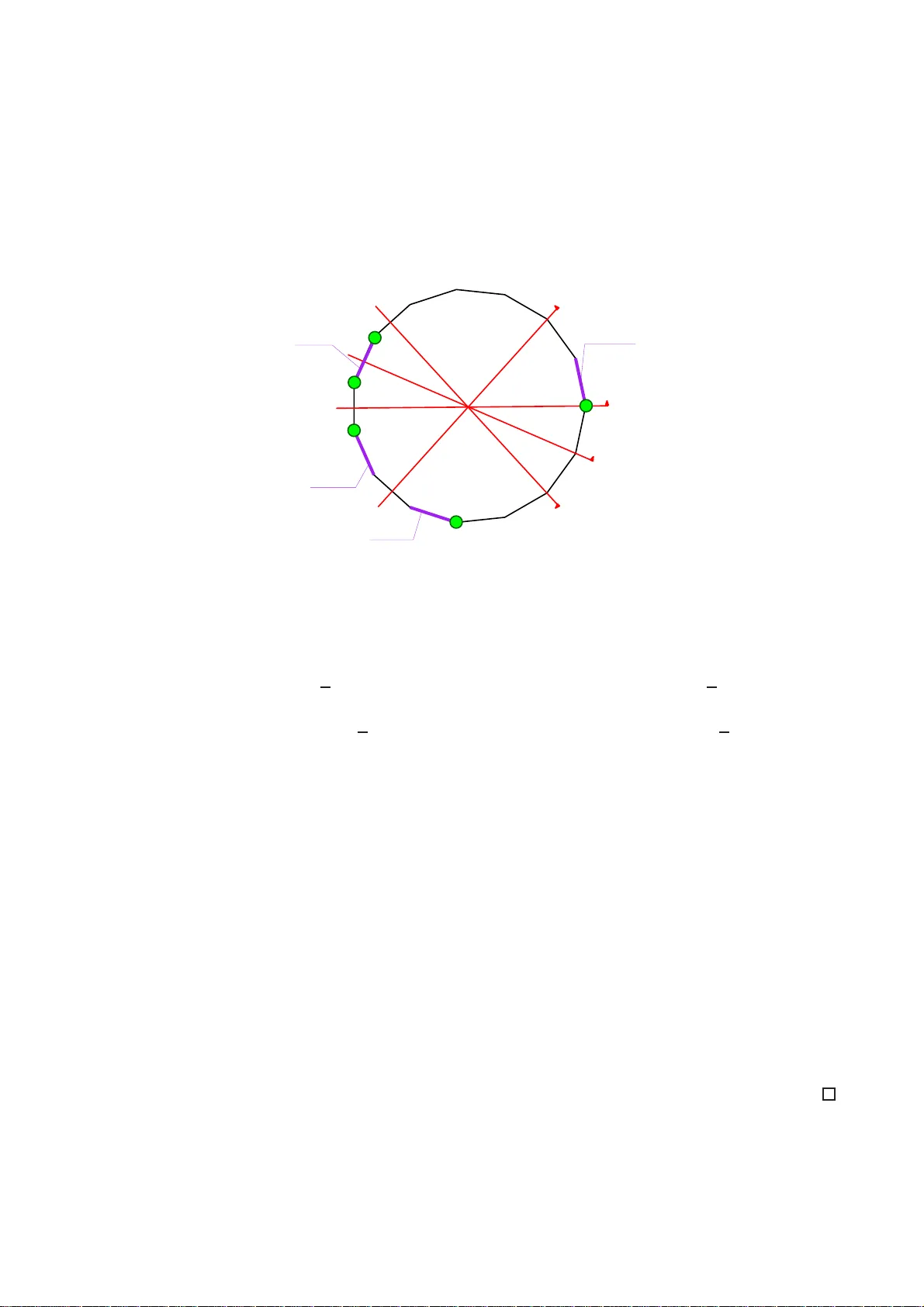
Extended form ulations for p olygons Samuel Fiorini ∗ Department of Mathemat ics, Universit ´ e Libre de Bruxel les, Belg ium. sfio rini@ ulb. ac.be Thoma s Roth voß † Department of Mathemat ics, MIT, USA. roth voss@ mit. edu Hans Ra j Ti w ar y ‡§ Department of Mat hemati cs, Universit ´ e Libre de Bruxell es, Belg ium. htiw ary@u lb.a c.be Octob er 24, 201 8 Abstract The extension complexit y of a p olytop e P is the sm allest integ er k suc h that P is the pro jection of a p olytop e Q with k facets. W e study the e xtens ion complexit y of n -gons in the p lane. First, w e giv e a new pro of that the extension complexit y o f regular n -gons is O (log n ), a result originating from wo r k by Ben-T al and Nemiro vski (2001 ). Our pro of easily generalizes to other p ermutahedra and simp lifies pro ofs of rece nt results b y Go emans (2009 ), and Kaib el and P ashko vic h (2011). Second, w e prov e a lo wer b oun d of √ 2 n on the extension complexit y of generic n -gons. Finally , w e p ro ve that there exist n -gons whose v ertices lie on a O ( n ) × O ( n 2 ) inte ger grid w ith extension complexit y Ω( √ n/ √ log n ). 1 In tro ductio n Consider a (con v ex) p olytop e P in R d . An extension (o r extended formulation ) of P is a p olytop e Q in R e suc h t ha t P is the image of Q under a linear pro jection from R e to R d . The main motiv ation for seeking exten sions Q of the po lytop e P is p erhaps that the n um b er of facets of Q can sometimes b e significantly smaller than that of P . This phenomenon has a lready found numerous a pplications in optimization, and in par t icular linear and integer progr a mming. T o our kno wledge, systematic inv estigations b egan at the end of the 1980’s with the w ork of Martin [13] and Y a nnak akis [17], among others. Recen tly , the sub ject is rec eiving a n increasing amoun t of attention. See, e.g., the surve ys by Conforti, Cornu ´ ejols and Za mbelli [4], V a nderb eck and W olsey [16 ], and Kaib el [10]. A striking example, whic h is relev an t t o this pap er, arises when P is a regular n -gon in R 2 . As fo llo ws from r esults of Ben-T al and Nemiro vski [2], for suc h a p olytop e P , one can construct an extension Q with as f ew as O (log n ) facets. It remained an o p en question to ∗ Suppo rted by the A ctions d e R e cher che Conc ert ´ ees (AR C) fund of the Communaut´ e fr an¸ caise de Belgique. † Suppo rted by F eo dor Lynen F ellowship of the Alexander von Humboldt F o undation, O NR grant N00 014- 11-1- 0053 and NSF contract CCF-082 9 878. ‡ Suppo rted b y F onds National de la Re c her che Scientifique (F.R.S.–FNRS). § Communicating Author. 1 determine to whic h exten t suc h a dramatic decrease in the n um b er of facets is p o ssible when P is a non-r e gular n -gon 1 . This is the main question w e addres s in this pap er. P π Q Figure 1: Pro of b y picture that the extension complexit y of a regular 8-gon is at most 6. Here P ⊆ R 2 is a re g ular 8-gon, Q ⊆ R 3 is a polytop e com binatoria lly equiv alen t to a 3-cub e, and π : R 3 → R 2 is a linear pro jection map suc h that π ( Q ) = P . Before giving an o utline of the pap er, w e state a f ew more definitions. The size of an extension Q is simply the num b er of facets of Q . The extension complexit y of P is the minim um size of an extension of P , denoted as xc( P ). See Fig ure 1 for an illustration. Notice that the extension complex ity of ev ery n -gon is Ω(log n ). This follows f r o m t he fa ct that an y extension Q with k facets has at most 2 k faces. Since eac h face of P is the pro jection of a face of the extension Q , it follo ws that Q mus t ha ve at least log 2 f facets if P has f f a ces [7]. Th us if P is an n -gon, we hav e xc( P ) > log 2 (2 n + 2) = Ω(log n ). When P is a regular n -gon, w e hav e xc( P ) = Θ(log n ). One of the fundame ntal results that can b e found in Y annak akis’ groundbreaking pa p er [17] is a c haracterization of the exte nsion complexit y of a po lytop e in terms of the non-negativ e rank o f its slack matrix. Although this is discusse d in detail in Section 2, w e include a brief description here. T o eac h p olytop e P one can asso ciate a matrix S ( P ) that records, in the en try that is in the i -th r ow and j -th column, the slack of the j th v ertex with resp ect to the i th facet. This matrix is the ‘slac k mat r ix’ of P . In turns out that computing xc( P ) amoun ts to determining the minimum num b er r suc h that there exists a f actorization of the slac k matrix of P a s S ( P ) = T U , where T is a non-negat ive matrix with r columns and U is a non-negative matrix with r rows. Suc h a factorization is called a ‘rank r non-negativ e factorization’ of the slac k matrix S ( P ). In Section 3 , w e giv e an explicit O (log n ) rank non-negative factorization of the slac k matrix of a regular n -gon. This pro vides a new pro of that the extens ion complexit y of ev ery regular n -gon is O (log n ). Our pro of tec hnique directly generalizes to other p olytop es, such as the p erm utahedron. In particular, w e obta in a new pro of of the fact that the extension complexit y of the n -p erm utahedron is O ( n log n ), a result due to Go emans [7]. Our approach builds on a new pro of of this result b y Kaib el and P ashk o vic h [11], but is differe nt because it w orks b y directly constructing a non-negative factorization of the slac k matrix. In Section 4, we pro v e that there exist n -gons whose ex tension comple xity is at least √ 2 n . Ho w eve r, the pro of uses p olygons whose co ordinates are transcenden tal num b ers, whic h is p erhaps not entirely satisfactor y . F or instance, one might ask whether a similar result holds when the enco ding length of eac h v ertex of the p olygon is O (log n ). In Section 5, w e settle this last q uestion b y pro ving the existe nce of n -gons whose v ertices b elong to a O ( n ) × O ( n 2 ) in t eger g rid a nd with extension complexit y Ω( √ n/ √ log n ). This is inspired b y recen t w o r k of o ne of the authors on the extension complexit y o f 0/1 - p olytop es [14]. 1 This was p ose d as an op en pr oblem during the First Carg ese W orksho p on Co m bina to rial Optimizatio n. 2 2 Slac k matrices and n on-negative factor izations Consider a po lytop e P in R d with m facets and n v ertices. Let A 1 x 6 b 1 , . . . , A m x 6 b m denote the facet-defining inequalities of P , where A 1 , . . . , A m are ro w v ectors. Let also v 1 , . . . , v n denote the v ertices of P . The slac k matrix of P is t he no n-negativ e m × n matrix S = S ( P ) with S ij = b i − A i v j . A rank r no n-negativ e factorization of a non-negativ e matrix S is an express io n of S as pro duct S = T U where T and U a r e non-negativ e matrices with r columns and r ro ws, resp ec- tiv ely . The non-negativ e ra nk of S , denoted b y rank + ( S ), is the minimum num b er r su ch t ha t S admits a rank r non- nega t iv e factorizat io n [3]. The follo wing theorem is (essen tially) due to Y annak a kis, see also [6]. Theorem 1 (Y annak akis [17]) . F or al l p olytop es P , xc( P ) = rank + ( S ( P )) . T o conclude this section, w e briefly indicate ho w to obtain extensions from no n-negativ e factorizations, and prov e half of Theorem 1. Assuming P = { x ∈ R d : Ax 6 b } , consider a rank r non-negativ e factorization S ( P ) = T U of the slack matrix of P . Then it can b e sho wn that the im a ge of the p olyhedron Q := { ( x, y ) ∈ R d + r | Ax + T y = b, y > 0 } under the pro jection R d + r → R d : ( x, y ) 7→ x is exactly P . Notice that Q has at most r facets. No w if w e tak e r = rank + ( S ( P )), then Q is a ctually a p olytop e [5]. Th us Q is an extension of P with at most rank + ( S ( P )) facets, and hence xc( P ) 6 rank + ( S ( P )). 3 Regular p olygons First, we giv e a new pro of of the tigh t logarithmic upper b ound on the extension complexit y of a regular n -gon. This result is implicit in w ork by Ben-T al and Nemiro vski [2 ] (although for n b eing a p o we r o f t w o). Another pro of can be found in Kaib el and P a shko vic h [1 1 ]. Then, w e discuss a generalization of the pro o f to related higher-dimensional p olytop es. Theorem 2. L et P b e a r e gular n -gon in R 2 . T hen xc( P ) = O (log n ) . Pr o of. Without loss of generalit y , w e ma y assume that the origin is the barycen ter o f P . After n um b ering the v ertices o f P coun ter-clo ckw ise as v 1 , . . . , v n , w e define a sequenc e ℓ 0 , . . . , ℓ q − 1 of axes of symmetry of P , as follow s. Initialize i to 0, and k to n . While k > 1, rep eat the follow ing s teps: • define ℓ i as the line through the origin and the midp oin t of vertic es v ⌈ k 2 ⌉ and v ⌈ k +1 2 ⌉ ; • replace k b y k +1 2 ; • incremen t i . Define q as the final v alue of i . Th us, q is the n umber of axes of symmetry ℓ i defined. Note that when k = k ( i ) is o dd, then ℓ i passes thro ugh one of the v ertices of P . No t e also that q = O (log n ). F or eac h i = 0 , . . . , q − 1 , one of the tw o closed halfplanes b ounded b y ℓ i con tains v 1 . W e denote it ℓ + i . W e denote the other by ℓ − i . No w, consider a v ertex v of P . W e define the folding seque nce v (0) , v (1) , . . . , v ( q ) of v as follo ws. W e let v (0) := v , and for i = 0 , . . . , q − 1, we let v ( i +1) denote the image of v ( i ) b y the reflection with respect to ℓ i if v ( i ) is not in the halfspace ℓ + i , otherwise w e let v ( i +1) := v ( i ) . In 3 other w ords, v ( i +1) is the ima g e o f v ( i ) under the conditio nal reflection with res p ect t o halfplane ℓ + i . By construction, we alwa ys hav e v ( q ) = v 1 . Next, conside r a facet F of P . The folding s equence F (0) , F (1) , . . . , F ( q ) of facet F is defined similarly as the fo lding sequence of v ertex v . Pic k an y ineq uality a T x 6 β defining F . W e let a (0) := a , and for i = 0 , . . . , q − 1, w e let a ( i +1) denote the image of a ( i ) under the conditional reflection with resp ect to ℓ + i . Then F ( i ) is the facet of P defined by ( a ( i ) ) T x 6 β . The last facet F ( q ) in the folding sequence is alw ays either the segmen t [ v 1 , v 2 ] or the segmen t [ v 1 , v n ]. See Figure 2 for an illustration with n = 15, and thus q = 4. v = v (0) v (1) v (3) v (4) v (2) l 3 l 1 l 2 l 0 F = F (0) F (1) F (2) F (3) = F (4) Figure 2: A 15-g on with four ax es of symmetry , a ve rt ex- and a f acet folding sequenc e. Finally , we defi ne a non-negativ e factorizatio n S ( P ) = T U of the slac k matrix of P , of rank 2 q = O (lo g n ). Belo w, let d ( x, ℓ i ) denote the distance of x ∈ R 2 to line ℓ i . In the left factor of the factorizatio n, t he row corresp onding to fa cet F is of the form ( t 0 , . . . , t q − 1 ), where t i := ( √ 2 d ( a ( i ) , ℓ i ) , 0) if a ( i ) is not in ℓ + i and t i := (0 , √ 2 d ( a ( i ) , ℓ i )) oth- erwise. Similarly , in the rig h t factor, the column corresp onding to ve rtex v is of the form ( u 0 , . . . , u q − 1 ) T , where u i := (0 , √ 2 d ( v ( i ) , ℓ i )) T if v ( i ) is not in ℓ + i and u i := ( √ 2 d ( v ( i ) , ℓ i ) , 0) T otherwise. The correctness of the factorization rests on the follow ing simple observ ation: for i = 0 , . . . , q − 1 the slac k o f v ( i +1) with resp ect to F ( i +1) equals the slac k of v ( i ) with resp ect to F ( i ) plus some correction term. If a ( i ) and v ( i ) are on opp osite side s of ℓ i , then the correction term is 2 d ( a ( i ) , ℓ i ) d ( v ( i ) , ℓ i ). Otherwise, it is zero (no correction is necessary). Indeed, letting n i denote a unit v ector norma l to ℓ i , and assuming that v ( i ) and a ( i ) are on opp osite sides of ℓ i , w e hav e β − ( a ( i ) ) T v ( i ) = β − ( a ( i ) ) T ( v ( i ) − 2( n T i v ( i ) ) n i + 2( n T i v ( i ) ) n i ) = β − ( a ( i +1) ) T v ( i +1) − 2(( a ( i ) ) T n i )( n T i v ( i ) ) = β − ( a ( i +1) ) T v ( i +1) + 2 d ( a ( i ) , ℓ i ) d ( v ( i ) , ℓ i ) . When v ( i ) and a ( i ) are on the same side of ℓ i , w e obv iously ha v e β − ( a ( i ) ) T v ( i ) = β − ( a ( i +1) ) T v ( i +1) . Observ e t hat the slac k of v ( q ) with resp ect to F ( q ) is alw ay s 0. The theorem f ollo ws. The n -p erm utahedron is the p olytop e of dimension n − 1 in R n whose n ! v ertices are the p oin ts obtained b y p erm uting the co o rdinates of (1 , 2 , . . . , n ) T . It has 2 n − 2 fa cets, defined b y the inequalities P j ∈ S x j 6 g ( | S | ) for all pro p er non-empt y subsets S o f [ n ] := { 1 , 2 , . . . , n } , where g ( S ) := n +1 2 − n −| S | +1 2 . 4 Let j and k denote t wo elemen ts of [ n ] suc h that j < k . W e denote H j,k the hyperplane defined by x j = x k , and H + j,k the closed halfspace defined by x j 6 x k . Applying the conditional reflection with resp ect to H + j,k to a v ector x ∈ R n amoun ts to sw a pping the co ordinates x j and x k if and only if x j > x k . In tuitively , the conditional reflection with resp ect to H + j,k sorts the co ordinates x j and x k . The pro of of Theorem 2 can b e mo dified to g ive a new pro of of the existence of O ( n log n ) size extension of the n -p erm uta hedron [7], as follows. Because there exists a sorting netw o rk of size O ( n log n ) f o r sorting n inputs, a celebrated result of Ajtai, Koml´ os a nd Szemer ´ edi [1 ], there exist q = O ( n log n ) halfspaces H + j 0 ,k 0 , H + j 1 ,k 1 , . . . , H + j q − 1 ,k q − 1 suc h that seque ntially applying the conditional reflection w ith respect to H + j i ,k i for i = 0 , . . . , q − 1 to any p o in t x ∈ R n , sorts this p oin t x . Therefore, the folding sequence of any vertex v of the n -p erm utahedron alw ays ends with the v ertex (1 , 2 , . . . , n ) T . Moreo v er, the folding seque nce of the fa cet defined b y P j ∈ S x j 6 g ( | S | ) alw ay s ends with the facet defined b y P n j = n −| S | +1 x j 6 g ( | S | ). Note that this last facet con tains the v ertex (1 , 2 , . . . , n ) T . Hence the pro of tec hnique u sed abov e for a regular n -go n e xtends to the n -p erm utahedron. In fact, it t ur ns out that the pro of tec hnique further extends to the permutahedron of an y finite reflec tio n g roup. O ne simply has to c ho ose the righ t sequenc e of conditional r eflections. Suc h seq uences w ere c o nstructed b y K aib el and Pashk ovic h [11], with the help of Ajtai-Koml´ os- Szemer ´ edi sorting netw or ks. Th us we can reprov e their main results ab out p erm utahedra of finite reflec tio n groups. Our proof is d ifferent in the sen se that w e explicitly c onstruct a non- negativ e f a ctorization of the slac k matr ix. 4 Generic p olygons W e b egin b y r ecalling some basic facts ab out field extensions, see, e.g., Hungerford [9], Lang [12], or Stew art [15]. Let L b e a field and K b e a subfield of L . Then L is a n extension field of K , and L/K is a field extension . W e sa y that the field extension L/K is algebraic if ev ery elemen t of L is algebraic o v er K , that is, f or eac h elemen t of L there exists a non-zero p olynomial with co efficien ts in K that has the elemen t as one of its ro ots. F or α 1 , . . . , α q ∈ L , t he inclusion-wise minimal subfield of L that con ta ins b oth K and { α 1 , . . . , α q } is denoted by K ( { α 1 , . . . , α q } ), or simply K ( α 1 , . . . , α q ). It is also t he subfield formed b y all fra ctio ns f ( α 1 ,...,α q ) g ( α 1 ,...,α q ) where f a nd g are p olynomials with co efficien ts in K and g ( α 1 , . . . , α q ) 6 = 0. A subset X of L is said to b e algebraically indep enden t ov er K if no non-trivial p o lynomial relation with co efficien ts in K holds among the elemen ts of X . The transcendence degree o f the field extension L/K is defined as the lar g est cardinality of an algebraically independen t subset of L o v er K . It is also the minim um cardinalit y of a subs et Y of L suc h that L/K ( Y ) is algebraic. W e sa y tha t a po lygo n in R 2 is g eneric if the co ordinates of its v ertices are distinct and form a set that is algebraically indep enden t o v er the rat io nals. Theorem 3. If P is a generic c onvex n -gon in R 2 then x c ( P ) > √ 2 n . Pr o of. Let α 1 , . . . , α 2 n denote the coo rdinates of the n vertice s of P , listed in any order. Th us X := { α 1 , . . . , α 2 n } is algebraically independent o ver Q . No w suppose that P is the pro jection of a d -dimensional p o lytop e Q with k facets. Without loss of generalit y , we ma y a ssume that Q lives in R d and that the pro jection is on to the t wo first co ordinat es. 5 Consider an y linear description of Q . This description is defined by k ( d + 1) re a l n um b ers: the k d entries of the constrain t matrix and t he k right-hand sides. W e denote these reals as β 1 , . . . , β k ( d +1) . By Cramer’s rule, eac h α i can b e written as α i = f i ( β 1 ,...,β k ( d +1) ) g i ( β 1 ,...,β k ( d +1) ) where f i and g i are p olynomials with rational coefficien ts and g i ( β 1 , . . . , β k ( d +1) ) 6 = 0. In particular, this means that eac h α i is in the extension field L := Q ( β 1 , . . . , β k ( d +1) ). Because X is algebraically indep enden t o ve r Q and X ⊆ L , the transcendence degree of L/ Q is at least 2 n . But on the other side, the transcende nce degree of L/ Q is a t most k ( d + 1 ). Indeed, letting Y := { β 1 , ..., β k ( d +1) } , w e hav e Q ( Y ) = L and th us L/ Q ( Y ) is algebraic. It follo ws that k ( d + 1) > 2 n . Because k > d + 1, w e see t hat k 2 > 2 n , hence k > √ 2 n . 5 P olygons with in te ger v er tices Since enco ding transcenden tal n umbers w ould require an infinite n umber of bits, an ob j ection migh t be raised that Theorem 3 is not very satisfying. In this section w e provide a slightly w eak er low er b ound w it h p olygons whos e v ertices can b e enco ded efficien t ly . In particular w e will now show that f o r ev ery n there exist p olygons with ve rtices on an O ( n ) × O ( n 2 ) grid and whose extension complexity is large. T o do this we will need a slightly mo dified v ersion of a rounding lemma prov ed b y Rothv oß [14], see Lemma 5 b elow . F or a matrix A let A ℓ (resp. A ℓ ) de no t e the ℓ -th ro w (resp. ℓ -th column) of A . Similarly , for a subset I of ro w indices of A , let A I denote the submatrix of A obtained by pic king the ro ws indexed by the elemen ts of I . Let T and U b e m × r and r × n nonnegative matrices. Since b elo w T and U will b e resp ectiv ely the left and r igh t facto r of a factorization o f some slac k matrix, w e can a ssume that no column of T is identically zero and, similarly , no ro w of U is iden tically ze ro . The pair T , U is said to b e normalized if k T ℓ k ∞ = k U ℓ k ∞ for ev ery ℓ ∈ [ r ] . Since mu lt iplying a column ℓ of T b y λ > 0 and sim ultaneously dividing row ℓ of U by λ leav es t he pro duct T U unc hanged, w e can a lw a ys scale the rows and columns of t wo matrices so that they are nor ma lized without c hanging T U . Lemma 4 (Roth v oß [14]) . If the p air T , U is normal i z e d, then max { k T k ∞ , k U k ∞ } 6 p k T U k ∞ . Pr o of. Let S := T U . Suppose, for the sak e of con tradiction, that the assertion do es not hold. Without loss o f generalit y , we may assume that k T k ∞ > p k T U k ∞ . Th us T iℓ > p k T U k ∞ for some indices i and ℓ . Because T , U is normalized, k U ℓ k ∞ = k T ℓ k ∞ > p k T U k ∞ and there m ust b e an index j suc h that U ℓj > p k T U k ∞ . Then S ij > T iℓ U ℓj > k T U k ∞ , which is a con tradiction. Consider a set of n con v ex indep enden t p oints V in the plane lying on an in teger g rid of size polynomial in n , its conv ex hu ll P := con v ( V ), and X := Z 2 ∩ P . The nex t crucial lemma (adapted fro m a similar result in [14]) implies that the description of an extension Q := { ( x, y ) | Ax + T y = b, y ≥ 0 } for P – p o ten tially con t a ining irrational n umbers – can b e rounded suc h that an in teger p oin t x is in X if and only if there is a y ≥ 0 suc h that ¯ Ax + ¯ T y ≈ ¯ b holds fo r the rounded system. Moreo ve r all co efficien ts in the rounded system come from a domain whic h is b ounded b y a p olynomial in n . Lemma 5. F or d, N ≥ 2 let V = { v 1 , . . . , v n } ⊆ Z d b e a c onvex indep enden t and non-empty set of p oints with k v i k ∞ 6 N for i ∈ [ n ] . L et P := con v ( V ) and let X := P ∩ Z d . Denote r := xc( P ) and ∆ := (( d + 1) N ) d . Then ther e ar e matric es ¯ A ∈ Z ( d + r ) × d , ¯ T ∈ ( 1 4 r ( d + r )∆ Z + ) ( d + r ) × r and a ve ctor ¯ b ∈ Z d + r with k ¯ A k ∞ , k ¯ b k ∞ , k ¯ T k ∞ 6 ∆ such t h a t X = x ∈ Z d | ∃ y ∈ [0 , ∆] r : k ¯ Ax + ¯ T y − ¯ b k ∞ 6 1 4( d + r ) . 6 Pr o of. Let Ax 6 b b e a non-redundan t desc ript io n of P with in tegral co efficien ts. W e ma y assume (see, e.g., [8, Lemma D.4.1]) that k A k ∞ , k b k ∞ 6 ∆ = (( d + 1) N ) d . Since xc( P ) = r , b y Y annak akis’ Theorem 1 there exist matrices T ∈ R m × r + and U ∈ R r × n + suc h that S := T U is the slac k-mat r ix of P , and P = { x ∈ R d | ∃ y ∈ R r : Ax + T y = b, y > 0 } . Without loss of generalit y a ssume that the pair T , U is normalized. Note that k S k ∞ = max i ∈ [ m ] j ∈ [ n ] ( b i − A i v j ) 6 ∆ + dN ∆ 6 ∆ 2 . Since T , U are normalized, using Lemma 4, w e ha v e that k T k ∞ 6 ∆ a nd k U k ∞ 6 ∆ . Let W := span( { ( A i , T i ) | i ∈ [ m ] } ) b e the row span of the constraint matrix of the system Ax + T y = b and let k := dim( W ) b e the dimension of W . Cho ose I ⊆ { 1 , . . . , m } of size | I | = k suc h that the v olume of t he parallelepip ed spanned b y the v ectors { ( A i , T i ) | i ∈ I } , denoted b y vol( { ( A i , T i ) | i ∈ I } ) , is maximized. Let T ′ I b e the matrix obtained from rounding the coefficien ts of T I to the nearest m ultiple of 1 4 r ( d + r )∆ . Our c ho ice will be ¯ A := A I , ¯ T := T ′ I and ¯ b := b I . Let Y := x ∈ Z d | ∃ y ∈ [0 , ∆] r : k A I x + T ′ I y − b I k ∞ 6 1 4( d + r ) . Then it is sufficien t to show that X = Y . Claim 6 . X ⊆ Y . Pr o of of claim. Consider an arbitrary v ertex v j ∈ V . Since, S = T U, w e can choo se y := U j > 0 suc h that Av j + T y = b . Since T , U are normalized, w e ha v e t hat k y k ∞ 6 k U k ∞ 6 ∆. Note that k T − T ′ k ∞ 6 1 4 r ( d + r )∆ . By the triangle inequalit y k A I v j + T ′ I y − b I k ∞ 6 k A I v j + T I y − b I | {z } =0 +( T ′ I − T I ) y k ∞ 6 r · k T ′ I − T I k ∞ | {z } 6 1 4 r ( d + r )∆ · k y k ∞ | {z } 6 ∆ 6 1 4( d + r ) Th us v j ∈ Y and hence V ⊆ Y . It follo ws that X ⊆ Y . ♦ Claim 7 . X ⊇ Y . Pr o of of claim. W e sho w that x ∈ Z d \ X implies x / ∈ Y . Since x / ∈ X and X ⊆ P , there m ust b e a row ℓ with A ℓ x > b ℓ . Since A, b and x ar e integral, one ev en has A ℓ x > b ℓ + 1. Note that in general ℓ is not among the selected c o nstrain ts with ro w indice s in I . But there are unique co efficien ts λ ∈ R k suc h that w e can express constrain t A ℓ x + T ℓ y = b ℓ as a linear com binat ion of those with indices in I , i.e. A ℓ , T ℓ = X i ∈ I λ i A i , T i . It is easy to see that P i ∈ I λ i b i = b ℓ , since otherwise the system Ax + T y = b could not hav e an y solutio n ( x, y ) at all and P = ∅ . The ne xt step is to b ound the co efficien ts λ i . Here w e recall that b y Cramer’s rule | λ i | = v ol ( A i ′ , T i ′ ) | i ′ ∈ I \{ i } ∪ { ℓ } v ol ( A i ′ , T i ′ ) | i ′ ∈ I 6 1 7 since w e pick ed I suc h that vol( { ( A i ′ , T i ′ ) | i ′ ∈ I } ) is maximize d. Fix an arbitrary y ∈ [0 , ∆] r , then 1 6 | A ℓ x − b ℓ | {z } > 1 + T ℓ y |{z} > 0 | = X i ∈ I λ i ( A i x − b i + T i y ) (1) 6 X i ∈ I | λ i | |{z} 6 1 ·| A i x − b i + T i y | 6 ( d + r ) · k A I x − b I + T I y k ∞ using the tria ng le inequalit y a nd t he fa ct that | I | 6 d + r . Again makin g use of the triangle inequalit y y ields k A I x − b I + T I y k ∞ = k A I x − b I + T ′ I y + ( T I − T ′ I ) y k ∞ (2) 6 k A I x − b I + T ′ I y k ∞ + r · k T I − T ′ I k ∞ | {z } 6 1 4 r ( d + r )∆ · k y k ∞ | {z } 6 ∆ 6 k A I x − b I + T ′ I y k ∞ + 1 4( d + r ) Com bining (1) and (2) g iv es k A I x − b I + T ′ I y k ∞ > 1 d + r − 1 4( d + r ) > 1 4( d + r ) for all y ∈ [0 , ∆] r and consequen tly x / ∈ Y . ♦ The theorem follows . Note that by padding zeros, we can ensure that ¯ A , ¯ T and ¯ b ha v e exactly d + r ro ws. No w w e are ready to prov e our lo we r b o und f or the extens io n complexity of p olygons. Theorem 8. F or every n ≥ 3 , ther e exists a c onvex n -gon P with vertic es in [2 n ] × [4 n 2 ] and xc( P ) = Ω( √ n/ √ log n ) . Pr o of. The 2 n p oin t s of the se t Z := { ( z , z 2 ) | z ∈ [2 n ] } are ob viously conv ex indep enden t. In other words , ev ery subset X ⊆ Z of size | X | = n yields a differen t conv ex n -gon. The num b er of suc h n -gons is 2 n n > 2 n . Let R := max { xc(conv( X )) | X ⊆ Z, | X | = n } . Lemma 5 pro vides a map Φ whic h takes X as input and pro vides the rounded sys tem ( ¯ A, ¯ T , ¯ b ). (If the c hoice of A , b and I is not unique, mak e an arbitrary canonical choice.) By pa dding z eros, we ma y assume that this system is of size (2 + R ) × (3 + R ). Also, Lemma 5 guaran tees that for each s ystem ( ¯ A, ¯ T , ¯ b ), the correspo nding set X can be reconstructed. In other w ords, the map Φ m ust b e injectiv e and the n um b er of suc h system m ust b e at least 2 n . Th us it suffic es t o determine the n um b er of suc h systems : the en tries in eac h system ( ¯ A, ¯ T , ¯ b ) are in teger m ultiples of 1 4 r ( d + r )∆ = 1 4 r (2+ r )144 n 4 for some r ∈ [ R ] using d = 2, N = 4 n 2 , ∆ = (12 n 2 ) 2 = 144 n 4 . Since no en try exceeds ∆, for eac h en try there are at most 1 + P R r =1 (165888 r (2 + r ) n 8 ) 6 cn 11 man y p ossible choices f or some fix ed constant c (note that R 6 n ). Thus the n um b er of such sys t ems is b ounded by ( cn 11 ) (3+ R ) · (2+ R ) 6 2 c ′ log n · R 2 for some constan t c ′ . W e conclude that 2 c ′ log 2 n · R 2 > 2 n and th us R = Ω( √ n/ √ log n ) . 6 Conclud ing Remarks Although the t wo low er b ounds presen ted here on the w orst case extension complexit y of a n -gon are ˜ Ω( √ n ), it is plausible that the true answ er is ˜ Ω( n ). W e leav e this as an open problem. 8 Ac kno wle dgemen ts W e thank Stefan Langerman for suggesting the pro of of Theorem 3. W e also thank V olk er Kaib el and Sebastian P okutta for stim ulating discus sions. Finally , w e thank t he anon ymous referee for his commen ts w hich helped impro ving the text. References [1] Miklos Ajtai, Janos Koml´ os, and Endre Szemer ´ edi. An O ( n log n ) sort ing net work. In Pr o c e e ding s of the fifte enth ann ual A CM Symp osium on The ory of Computing , STOC ’83, pages 1–9, New Y ork, NY, USA, 1983. AC M. [2] Aharon Ben-T al and Ark adi Nemiro vski. On p olyhedral approx imatio ns of the second- order cone. Math. Op er. R es. , 26(2):193– 2 05, 2 0 01. [3] Jo el E. Cohen and Uriel G. Rot h blum. Nonnegativ e ra nks, decomp ositions, and factoriza- tions of nonnegativ e mat r ices. Line ar Algebr a and Its Applic ations , 190:1 4 9–168, 19 93. [4] Mic hele Conforti, G´ erard Corn u ´ ejo ls, and G iacomo Zam b elli. Extended for mulations in com binatorial o ptimization. 4OR , 8(1):1–4 8, 201 0. [5] Mic hele Conforti, Y uri F a enza, Sam uel Fiorini, Roland Grapp e, and Hans Ra j Tiw ary . Extended for m ulations, non-negative factorizations and randomized comm unication pro- to cols. http://arxiv .org/abs/1105.4127 , 20 11. [6] Samuel Fiorini, V olke r Kaib el, Kanstantsin P ashk ovic h, and Dirk Olive r Theis. Com bina- torial b ounds on nonnegativ e rank a nd extended form ulations. w or king p a p er, 2011. [7] Mic hel Go emans. Smallest compact form ula t io n for the p ermutahed r o n. http://math .mit.edu/ ~ goemans/PAP ERS/permutahedron.pdf , 2009 . [8] Marc Hindry and Joseph H. Silv erman. Diop h antine Ge ometry: An Intr o duction . Springer, 1 edition, Marc h 20 00. [9] Thomas W. Hungerford. A lgeb r a . Gra dua t e T exts in Mathematics. Springer-V erlag, New Y ork, NY, USA, 197 4 . [10] V olk er Ka ib el. Extended formulations in com binato rial o ptimization. Optima , 85 :2–7, 2011. [11] V olk er Kaib el and Kanstantsin P ashk ovic h. Constructing extended form ulations fr om reflection relations. T o app ear in the pro o ceedings of the 15th conference on Inte g er Programming and Com binatorial Optimization, 2011. [12] Serge Lang . A lgebr a . Graduat e T exts in Mathematics. Springer, 2002 . [13] R. Kipp Martin. Using separation algorithms to generate mixed in teger mo del reform ula- tions. Op er ations R ese ar ch L etters , 10(3) :119 – 12 8 , 1991. [14] Thomas Ro th v oß . Some 0/1 p olytop es need exp onen tial size extended f orm ulations. http://arxi v.org/abs/1105.0036 , 201 1. [15] Ian St ewart. Galois The ory . Chapman & Ha ll/CR C Mathematics. Chapman & Hall/CRC , Bo ca Raton, FL, third edition, 200 4. 9 [16] F ran¸ cois V anderb ec k and Laurence A. W o lsey . Reformulation a nd decomp osition of integer programs. In M. et al. J ¨ unger, editor, 50 Y e ars of Inte ger Pr o gr a m ming 1958-20 0 8 , pages 431–502. Springer, 2010. [17] Mihalis Y annak akis. Expressing com binator ia l optimization pro blems b y linear programs. J. Comput. System Sci. , 43(3) :441–466, 1991. 10
Original Paper
Loading high-quality paper...
Comments & Academic Discussion
Loading comments...
Leave a Comment