MC Elements in Pronilpotent DG Lie Algebras
Consider a pronilpotent DG (differential graded) Lie algebra over a field of characteristic 0. In the first part of the paper we introduce the reduced Deligne groupoid associated to this DG Lie algebra. We prove that a DG Lie quasi-isomorphism betwee…
Authors: Amnon Yekutieli
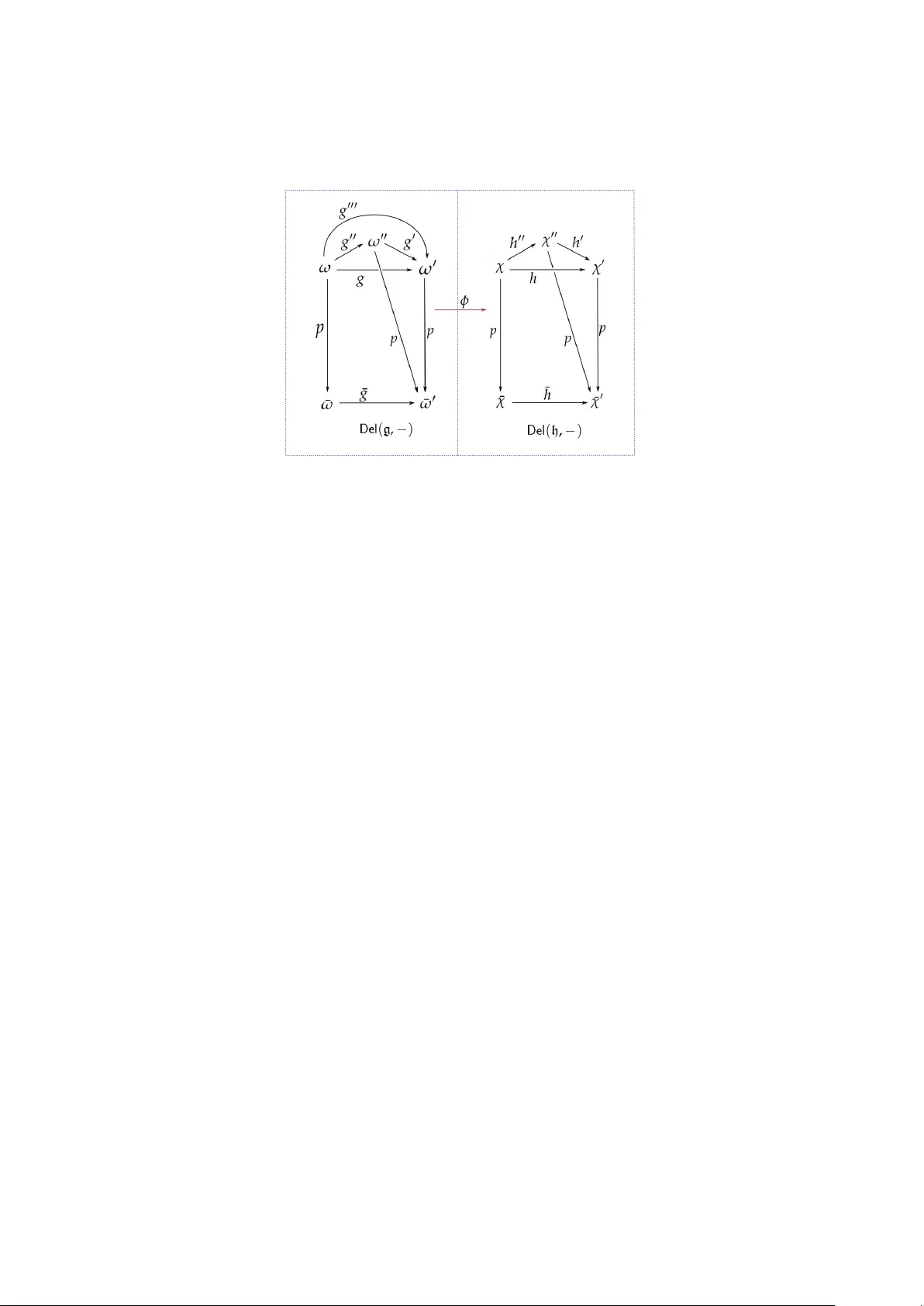
MC ELEMENTS IN PRONILPOTENT DG LIE ALGEBRAS AMNON YEKUTIELI A bstract . Consider a pronilpotent DG (differ ential graded) Lie algebra ov er a field of characteristic 0. In the first part of the paper we introduce the reduced Deligne groupoid associated to this DG Lie algebra. W e prov e that a DG Lie quasi- isomorphism betw een tw o such algebras induces an equiv alence between the corresponding reduced Deligne groupoids. This extends the famous result of Goldman-Millson (attributed to Deligne) to the unbounded pronilpotent case. In the second part of the paper w e consider the Deligne 2 -groupoid . W e show it exists under more relaxed assumptions than known before (the DG Lie algebra is either nilpotent or of quasi quantum type). W e pro v e that a DG Lie quasi- isomorphism between such DG Lie algebras induces a weak equiv alence betw een the corresponding Deligne 2-groupoids. In the third part of the paper we prov e that an L-infinity quasi-isomor phism betw een pronilpotent DG Lie algebras induces a bijection betw een the sets of gauge equivalence classes of Maurer -Cartan elements. This extends a result of Kontsevich and others to the pronilpotent case. C ontents 0. Introduction 1 1. Some Facts about DG Lie Algebras 4 2. The Reduced Deligne Groupoid 7 3. DG Lie Quasi-isomor phisms – Nilpotent Algebras 10 4. DG Lie Quasi-isomor phisms – Pronilpotent Algebras 14 5. Some Facts on 2-Groupoids 18 6. The Deligne 2-Groupoid 21 7. L ∞ Morphisms and Coalgebras 24 8. L ∞ Quasi-isomorphisms betw een Pronilpotent Algebras 26 References 31 0. I ntrod uction Let K be a field of characteristic 0. By parameter algebra ov er K w e mean a complete local noetherian commutative K -algebra R , with maximal ideal m , such that R / m = K . The important example is R = K [[ ¯ h ] ] , the ring of formal pow er series in the variable ¯ h . Date : 6 February 2012. Key words and phrases. DG Lie algebras, L-infinity mor phisms, Deligne groupoid, Deformation quantization. Mathematics Subject Classification 2000. Primary: 53D55; S econdary: 17B40, 14B10, 18D05. This research was supported b y the Israel Science Foundation. 1 2 AMNON YEKUTIELI Let ( R , m ) be a parameter algebra, and let g = L i ∈ Z g i be a DG (differential graded) Lie algebra ov er K . Ther e is an induced pronilpotent DG Lie algebra m b ⊗ g = M i ∈ Z m b ⊗ g i . A solution ω ∈ m b ⊗ g 1 of the Maurer-Cartan equation d ( ω ) + 1 2 [ ω , ω ] = 0 is called an MC element . The set of MC elements is denoted by MC ( g , R ) . Ther e is an action of the gauge group exp ( m b ⊗ g 0 ) on the set MC ( g , R ) , and we write (0.1) MC ( g , R ) : = MC ( g , R ) / exp ( m b ⊗ g 0 ) , the quotient set by this action. The Deligne groupoid De l ( g , R ) , introduced in [GM], is the transformation groupoid associated to the action of the group exp ( m b ⊗ g 0 ) on the set MC ( g , R ) . So the set π 0 ( D e l ( g , R ) ) of isomorphism classes of objects of this groupoid equals MC ( g , R ) . In [GM, Theorem 2.4] it w as pro v ed that if R is artinian, g and h are DG Lie algebras concentrated in the degree range [ 0, ∞ ) (we refer to this as the “non- negativ e nilpotent case”), and φ : g → h is a DG Lie algebra quasi-isomorphism, then the induced mor phism of groupoids De l ( φ , R ) : De l ( g , R ) → D el ( h , R ) is an equivalence. W e introduce the reduced Deligne groupoid D e l r ( g , R ) , which is a certain quo- tient of the Deligne groupoid De l ( g , R ) ; see Section 2 for details. If the Deligne 2-groupoid D e l 2 ( g , R ) is defined (see below), then (0.2) De l r ( g , R ) = π 1 ( D e l 2 ( g , R )) . Ho w ev er the groupoid D el r ( g , R ) alwa ys exists. This new groupoid also has the property that π 0 ( D e l r ( g , R )) = MC ( g , R ) . Here is the first main result of our paper . It is a generalization to the un- bounded pronilpotent case (i.e. the DG Lie algebras g and h can be unbounded, and the parameter algebra R doesn’t hav e to be artinian) of [GM, Theorem 2.4]. Our proof is similar to that of [GM, Theorem 2.4]: we also use obstruction classes. Theorem 0.3. Let R be a parameter algebra over K , and let φ : g → h be a DG Lie algebra quasi-isomorphism over K . Then the morphism of gr oupoids De l r ( φ , R ) : De l r ( g , R ) → D el r ( h , R ) is an equivalence. This is Theorem 4.2 in the body of the paper . A DG Lie algebra g = L i ∈ Z g i is said to be of quantum type if g i = 0 for all i < − 1. A DG Lie algebra ˜ g is said to be of quasi quantum type if there exists a DG Lie quasi-isomorphism ˜ g → g , for some quantum type DG Lie algebra g . Important examples of such DG Lie algebras are giv en in Example 6.2. In S ection 6 w e prov e that if R is artinian, or if g is of quasi quantum type, then the Deligne 2 -groupoid D e l 2 ( g , R ) exists. The original construction (see [Ge]) applied only to the case when R is artinian and g is of quantum type. Here is the second main result of this paper (repeated as Theorem 6.13): MC ELEMENTS 3 Theorem 0.4. Let R be a parameter algebra, let g and h be DG Lie algebras, and let φ : g → h be a DG Lie algebra quasi-isomorphism. Assume either of these two conditions holds : (i) R is artinian. (ii) g and h are of quasi quantum type. Then the morphism of 2 -groupoids De l 2 ( φ , R ) : D e l 2 ( g , R ) → D el 2 ( h , R ) is a weak equivalence. The proof of Theorem 0.4 relies on Theorem 0.3, via formula (0.2). Theorem 0.4 pla ys a crucial role in our new proof of twisted deformation quantization , in the revised version of [Y e4]. An L ∞ morphism Φ : g → h is a sequence Φ = { φ j } j ≥ 1 of K -linear functions φ j : V j g → h that generalizes the notion of DG Lie algebra homomorphism φ : g → h . Thus φ 1 : g → h is a DG Lie algebra homomor phism, up to a homotopy giv en by φ 2 ; and so on. S ee S ection 7 for details. The mor phism Φ is called an L ∞ quasi-isomorphism if φ 1 : g → h is a quasi-isomorphism. The concept of L ∞ morphism gained prominence after the Kontsevich For mality Theorem from 1997 (see [Ko2]). An L ∞ morphism Φ : g → h induces an R -multilinear L ∞ morphism Φ R = { φ R , j } j ≥ 1 : m b ⊗ g → m b ⊗ h . Giv en an element ω ∈ m b ⊗ g 1 w e write (0.5) MC ( Φ , R )( ω ) : = ∑ j ≥ 1 1 j ! φ R , j ( ω , . . . , ω | {z } j ) ∈ m b ⊗ h 1 . This sum conv erges in the m -adic topology of m b ⊗ h 1 . It is known that the function MC ( Φ , R ) sends MC elements to MC elements, and it respects gauge equivalence (see Propositions 8.2 and 8.7). So there is an induced function MC ( Φ , R ) from MC ( g , R ) to MC ( h , R ) . Here is the third main result of our paper . Theorem 0.6. Let g and h be DG Lie algebras, let R be a parameter algebra, and let Φ : g → h be an L ∞ quasi-isomorphism, all over the field K . Then the function MC ( Φ , R ) : MC ( g , R ) → MC ( h , R ) is bijective. This is Theorem 8.13 in the body of the paper . W e emphasize that this result is in the unbounded pronilpotent case. The proof of Theorem 0.6 goes like this: w e use the bar-cobar construction to reduce to the case of a DG Lie algebra quasi- isomorphism ˜ Φ : ˜ g → ˜ h ; and then w e use Theorem 0.3. Theorem 0.6 was kno wn in the nilpotent case; see [Ko2, Theorem 4.6], and [CKTB, Theorem 3.6.2]. The proof sketched in [Ko2, Section 4.5] relies on the structure of L ∞ algebras. The proof in [CKTB, S ection 3.7] relies on the w ork of Hinich on the Quillen model structure of coalgebras. It is not clear whether these methods w ork also in the pronilpotent case. In this paper w e only consider pronilpotent DG Lie algebras of the for m m b ⊗ g . Presumably Theorems 0.3, 0.4 and 0.6 can be extended to a more general setup – see Remark 4.4. 4 AMNON YEKUTIELI Acknowledgments. I wish to thank James Stashef f, Vladimir Hinich, Michel V an den Bergh, W illiam Goldman, Oren Ben Bassat, Marco Manetti and Ronald Bro wn for useful conversations. Thanks also to the referee for reading the paper carefully and providing sev eral constructive remarks. 1. S ome F acts about DG L ie A lgebras Let K be a field of characteristic 0. Given K -modules V , W we write V ⊗ W and Hom ( V , W ) instead of V ⊗ K W and Hom K ( V , W ) , respectiv ely . Definition 1.1. By parameter algebra o ver K w e mean a complete noetherian local commutativ e K -algebra R , with maximal ideal m , such that R / m = K . W e call m a parameter ideal . The most important example is of course R = K [[ ¯ h ] ] , where ¯ h is a v ariable, called the defor mation parameter . Note that R = K ⊕ m , so the ring R can be reco v ered fr om the nonunital algebra m . For any j ∈ N let R j : = R / m j + 1 and m j : = m / m j + 1 . S o R 0 = K , each R j is an artinian local ring with maximal ideal m j , R ∼ = lim ← j R j , and m ∼ = lim ← j m j . Let us fix a parameter algebra ( R , m ) . Giv en an R -module M , its m -adic comple- tion is b M : = lim ← j ( R j ⊗ R M ) . The module M is called m -adically complete if the canonical homomor phism M → b M is bijectiv e. (Some texts w ould sa y that M is complete and separated.) Since R is noetherian, the m -adic completion b M of any R -module M is m -adically com- plete; see [Y e5, Corollary 3.5]. Giv en an R -module M and a K -module V let us write (1.2) M b ⊗ V : = lim ← j ( R j ⊗ R ( M ⊗ V ) ) , namely M b ⊗ V is the m -adic completion of the R -module M ⊗ V . If W is another K -module, then there is a unique R -module isomorphism M b ⊗ ( V ⊗ W ) ∼ = ( M b ⊗ V ) b ⊗ W that commutes with the canonical homomorphisms from M ⊗ V ⊗ W ; hence we shall simply denote this complete R -module b y M b ⊗ V b ⊗ W . Let g = L i ∈ Z g i be a DG Lie algebra o ver K . (There is no finiteness assumption on g .) For any i let m b ⊗ g i be the complete tensor pr oduct as in (1.2). W e get a pronilpotent R -linear DG Lie algebra (1.3) m b ⊗ g : = M i ∈ Z m b ⊗ g i , with differ ential d and graded Lie bracket [ − , − ] induced from g . Recall that the Maurer-Cartan equation in m b ⊗ g is (1.4) d ( ω ) + 1 2 [ ω , ω ] = 0 for ω ∈ m b ⊗ g 1 . A solution of this equation is called an MC element of m b ⊗ g . The set of MC elements is denoted b y MC ( m b ⊗ g ) . In degree 0 w e ha ve a pronilpo- tent Lie algebra m b ⊗ g 0 , so there is an associated pronilpotent group exp ( m b ⊗ g 0 ) , called the gauge group , and a bijectiv e function exp : m b ⊗ g 0 → exp ( m b ⊗ g 0 ) called the exponential map. MC ELEMENTS 5 An element γ ∈ m b ⊗ g 0 acts on m b ⊗ g b y the derivation (1.5) ad ( γ ) ( α ) : = [ γ , α ] . W e view ad ( γ ) as an element of R b ⊗ End ( g ) 0 . Let g : = exp ( γ ) ∈ exp ( m b ⊗ g 0 ) , and define (1.6) Ad ( g ) : = exp ( ad ( γ ) ) = ∑ i ≥ 0 1 i ! ad ( γ ) i ∈ R b ⊗ End ( g ) 0 (this series conv erges in the m -adic topology). The element Ad ( g ) is an R -linear automorphism of the graded Lie algebra m b ⊗ g . There is an induced group auto- morphism Ad ( g ) of the group exp ( m b ⊗ g 0 ) , and this automorphism satisfies the equation (1.7) Ad ( g ) ( h ) = g ◦ h ◦ g − 1 for all h ∈ exp ( m b ⊗ g 0 ) . There is another action of γ ∈ m b ⊗ g 0 on ω ∈ m b ⊗ g 1 : (1.8) af ( γ ) ( ω ) : = [ γ , ω ] − d ( γ ) = ad ( γ ) ( ω ) − d ( γ ) . This is an affine action, namely af ( γ ) ∈ R b ⊗ End ( g 1 ) n g 1 . Consider the elements g : = exp ( γ ) ∈ exp ( m b ⊗ g 0 ) and (1.9) Af ( g ) : = exp ( af ( γ ) ) = ∑ i ≥ 0 1 i ! af ( γ ) i ∈ R b ⊗ End ( g 1 ) n g 1 . (The series abo v e conver ges in the m -adic topology .) W e get an affine action Af of the group exp ( m b ⊗ g 0 ) on the R -module m b ⊗ g 1 . For ω ∈ m b ⊗ g 1 this becomes Af ( g ) ( ω ) = exp ( ad ( γ ) )( ω ) + 1 − exp ( ad ( γ ) ) ad ( γ ) ( d ( γ ) ) . The arguments in [GM, S ection 1.3] (which refer to the case when g i are all finite dimensional ov er K , g i = 0 for i < 0, and R is artinian) are v alid also in our infinite case (cf. [Ge, Section 2.2]), and they show that Af ( g ) preserves the set MC ( m b ⊗ g ) . (This can be prov ed also using the method of Lemma 1.14.) W e write (1.10) MC ( m b ⊗ g ) : = MC ( m b ⊗ g ) exp ( m b ⊗ g 0 ) , the quotient set b y this action. Giv en a homomorphism of DG Lie algebras φ : g → h , and homomor phism of parameter algebras f : ( R , m ) → ( S , n ) , there is an induced function (1.11) MC ( φ ⊗ f ) : MC ( m b ⊗ g ) → MC ( n b ⊗ h ) . W e shall need the follo wing sort of algebraic differential calculus (which is used a lot implicitly in deformation theor y). Let K [ t ] be the polynomial algebra in a variable t , and let M be a K -module. A polynomial f ( t ) ∈ K [ t ] ⊗ M defines a function f : K → M , namely for any λ ∈ K the element f ( λ ) ∈ M is gotten b y substitution t 7 → λ . W e refer to f : K → M as a polynomial function, or as a polynomial path in M . Let K [ e ] : = K [ t ] / ( t 2 ) , where e is the class of t . Giv en f ( t ) ∈ K [ t ] ⊗ M and λ ∈ K w e denote by f ( λ + e ) ∈ K [ e ] ⊗ M the result of the substitution t 7→ λ + e . 6 AMNON YEKUTIELI Lemma 1.12. Let f ( t ) ∈ K [ t ] ⊗ M. If f ( λ + e ) = f ( λ ) in K [ e ] ⊗ M for all λ ∈ K , then f ( λ ) = f ( 0 ) for all λ ∈ K . Proof. This is an elementary calculation; note that K has characteristic 0. Giv en an element ω ∈ MC ( m b ⊗ g ) , consider the R -linear operator (of degree 1) (1.13) d ω : = d + ad ( ω ) on m b ⊗ g . Lemma 1.14. Let ω , ω 0 ∈ MC ( m b ⊗ g ) , and let g ∈ exp ( m ⊗ g 0 ) be such that ω 0 = Af ( g ) ( ω ) . Then for any i ∈ Z the diagram of R -modules m b ⊗ g i Ad ( g ) / / d ω m b ⊗ g i d ω 0 m b ⊗ g i + 1 Ad ( g ) / / m b ⊗ g i + 1 is commutative. Proof. Since m b ⊗ g i and m b ⊗ g i + 1 are m -adically complete R -modules, it suffices to v erify this after replacing R with R j . Therefor e w e can assume that R is artinian. Consider the DG Lie algebra K [ t ] ⊗ m ⊗ g . Let γ : = log ( g ) ∈ m ⊗ g 0 , and define g ( t ) : = exp ( t γ ) ∈ exp ( K [ t ] ⊗ m ⊗ g 0 ) ⊂ K [ t ] ⊗ R ⊗ End ( g 0 ) . So g ( 0 ) = 1 and g ( 1 ) = g . Next let ω ( t ) : = Af ( g ( t )) ( ω ) ∈ K [ t ] ⊗ m ⊗ g 1 , which is an MC element of K [ t ] ⊗ m ⊗ g , and it satisfies ω ( 0 ) = ω and ω ( 1 ) = ω 0 . Consider the polynomial f ( t ) : = Ad ( g ( 1 − t ) ) ◦ d ω ( t ) ◦ Ad ( g ( t )) ∈ K [ t ] ⊗ R ⊗ Hom ( g i , g i + 1 ) . It satisfies f ( 0 ) = Ad ( g ) ◦ d ω and f ( 1 ) = d ω 0 ◦ Ad ( g ) . W e will pro v e that f is constant. See diagram belo w depicting f ( λ ) , λ ∈ K . m ⊗ g i Ad ( g ( λ )) / / m ⊗ g i d ω ( λ ) / / m ⊗ g i m ⊗ g i + 1 / / m ⊗ g i + 1 Ad ( g ( 1 − λ ) ) / / m ⊗ g i + 1 T ake any λ ∈ K . Then f ( λ + e ) − f ( λ ) = Ad ( g ( 1 − e − λ ) ) ◦ d ω ( λ + e ) ◦ Ad ( g ( e ) ) − Ad ( g ( e )) ◦ d ω ( λ ) ◦ Ad ( g ( λ ) ) in K [ e ] ⊗ R ⊗ Hom ( g i , g i + 1 ) . A calculation shows that Ad ( g ( e )) = 1 + e · ad ( γ ) ∈ K [ e ] ⊗ R ⊗ End ( g ) MC ELEMENTS 7 and ω ( λ + e ) = ω ( λ ) + e · [ γ , ω ( λ ) ] − e · d ( γ ) ∈ K [ e ] ⊗ m ⊗ g 1 . Hence for any α ∈ R ⊗ g − 1 w e ha v e d ω ( λ + e ) ◦ Ad ( g ( e ) ) ( α ) = d ( α ) + e · d ([ γ , α ] ) + [ ω ( λ + e ) , α ] + e [ ω ( λ + e ) , [ γ , α ] ] and Ad ( g ( e )) ◦ d ω ( λ ( α ) = d ( α ) + [ ω ( λ ) , α ] + e [ γ , d ( α ) ] + e [ γ , [ ω ( λ ) , α ] ] . After expanding ter ms and using the graded Jacobi identity we see that d ω ( λ + e ) ◦ Ad ( g ( e ) ) ( α ) = Ad ( g ( e )) ◦ d ω ( λ ( α ) in K [ e ] ⊗ R ⊗ g 0 . Therefore f ( λ + e ) = f ( λ ) . By Lemma 1.12 w e conclude that f is constant. Proposition 1.15. (1) Let ω ∈ MC ( m b ⊗ g ) . Then d ω is a degree 1 derivation of the graded Lie algebra m b ⊗ g , and d ω ◦ d ω = 0 . W e obtain a new DG Lie algebra ( m b ⊗ g ) ω , with the same Lie bracket [ − , − ] , and a new differential d ω . (2) Let g ∈ exp ( m b ⊗ g 0 ) , and let ω 0 : = Af ( g )( ω ) ∈ MC ( m b ⊗ g ) . Then Ad ( g ) : ( m b ⊗ g ) ω → ( m b ⊗ g ) ω 0 is an isomorphism of DG Lie algebras. Proof. (1) This is w ell known (and v ery easy to check). (2) Let γ : = log ( g ) ∈ m b ⊗ g 0 . Since ad ( γ ) is a deriv ation of the graded Lie algebra m b ⊗ g , it follows that Ad ( g ) = exp ( ad ( γ ) ) is an automorphism of m b ⊗ g . By Lemma 1.14 this automorphism exchanges d ω and d ω 0 . 2. T he R educed D eligne G roupoid As before, K is a field of characteristic 0, ( R , m ) is a parameter algebra ov er K , and g = L i ∈ Z g i is a DG Lie algebra o v er K . Let us write (2.1) MC ( g , R ) : = MC ( R b ⊗ g ) and (2.2) G ( g , R ) : = exp ( m b ⊗ g 0 ) . Giv en ω , ω 0 ∈ MC ( g , R ) , let (2.3) G ( g , R ) ( ω , ω 0 ) : = { g ∈ G ( g , R ) | Af ( g ) ( ω ) = ω 0 } . As in [GM] w e define the Deligne groupoid De l ( g , R ) to be the transfor mation groupoid associated to the action of the gauge group G ( g , R ) on the set MC ( g , R ) . So the set of objects of De l ( g , R ) is MC ( g , R ) , and the set of morphisms ω → ω 0 in this groupoid is G ( g , R )( ω , ω 0 ) . Identity mor phisms and composition in the groupoid are those of the group G ( g , R ) . No w suppose ω , ω 0 ∈ MC ( g , R ) and g ∈ G ( g , R ) ( ω , ω 0 ) . Since Af ( g ◦ h ◦ g − 1 ) = Af ( g ) ◦ Af ( h ) ◦ Af ( g ) − 1 for any h , and in view of (1.7), there is a group isomorphism (2.4) Ad ( g ) : G ( g , R ) ( ω , ω ) → G ( g , R ) ( ω 0 , ω 0 ) . 8 AMNON YEKUTIELI Giv en ω ∈ MC ( g , R ) there is the derivation d ω of for mula (1.13). Let us define (2.5) a r ω : = Im d ω : m b ⊗ g − 1 → m b ⊗ g 0 and (2.6) ( m b ⊗ g 0 )( ω ) : = Ker d ω : m b ⊗ g 0 → m b ⊗ g 1 . These are R -submodules of m b ⊗ g 0 . Lemma 2.7. Let ω ∈ MC ( g , R ) . Consider the bijection of sets exp : m b ⊗ g 0 ' − → exp ( m b ⊗ g 0 ) = G ( g , R ) . (1) The module ( m b ⊗ g 0 )( ω ) is a Lie subalgebra of m b ⊗ g 0 , and exp ( m b ⊗ g 0 )( ω ) = G ( g , R ) ( ω , ω ) as subsets of G ( g , R ) . (2) The module a r ω is a Lie ideal of the Lie algebra ( m b ⊗ g 0 )( ω ) , and the subset N r ω = N r ( g , R ) ω : = exp ( a r ω ) is a normal subgroup of G ( g , R ) ( ω , ω ) . (3) Let g ∈ G ( g , R ) and ω 0 : = Af ( g )( ω ) . Then Ad ( g ) N r ω = N r ω 0 . Proof. (1) Since d ω is a graded derivation of the graded Lie algebra m b ⊗ g , its kernel is a graded Lie subalgebra, and its image is a graded Lie ideal in the kernel. In degree 0 w e get a Lie subalgebra ( m b ⊗ g 0 )( ω ) , and a Lie ideal a r ω in it. Because d ω is a continuous homomor phism betw een complete R -modules, its kernel ( m b ⊗ g 0 )( ω ) is closed; so this is a closed Lie subalgebra of m b ⊗ g 0 . This im- plies that the subset exp ( m b ⊗ g 0 )( ω ) is a closed subgroup of G ( g , R ) . Moreov er , let γ ∈ m b ⊗ g 0 and g : = exp ( γ ) . In the proof of [Ge, Theorem 2.2] it is shown that d ω ( γ ) = 0 iff Af ( g ) ( ω ) = ω . This shows that exp ( m b ⊗ g 0 )( ω ) = G ( g , R ) ( ω , ω ) . (2) W e already kno w that a r ω is a Lie ideal of ( m b ⊗ g 0 )( ω ) ; but since this is not a closed ideal in general, it is not immediate that the subset exp ( a r ω ) is a nor mal subgroup of exp ( m b ⊗ g 0 )( ω ) . Consider the CBH series F ( x 1 , x 2 ) = ∑ j ≥ 1 F j ( x 1 , x 2 ) , where F j ( x 1 , x 2 ) are homogeneous elements of degree i in the free Lie algebra in the v ariables x 1 , x 2 o v er Q . It is known (cf. [Bo]) that (2.8) exp ( γ 1 ) · exp ( γ 2 ) = exp ( F ( γ 1 , γ 2 )) for γ 1 , γ 2 ∈ m b ⊗ g 0 . Let us define a bracket [ − , − ] ω on m b ⊗ g − 1 as follo ws: [ α 1 , α 2 ] ω : = [ d ω ( α 1 ) , α 2 ] . In general this is not a Lie bracket (the Jacobi identity ma y fail). How ev er , since d ω is a square zero deriv ation of the graded Lie algebra m b ⊗ g , w e ha v e d ω ([ α 1 , α 2 ] ω ) = [ d ω ( α 1 ) , d ω ( α 2 )] . For any j ≥ 1 and α 1 , α 2 ∈ m b ⊗ g − 1 consider the element F j , ω ( α 1 , α 2 ) ∈ m b ⊗ g − 1 gotten by ev aluating the Lie polynomial F j ( x 1 , x 2 ) at x i 7→ α i , using the bracket MC ELEMENTS 9 [ − , − ] ω . No w take any γ 1 , γ 2 ∈ a r ω , and choose α 1 , α 2 ∈ m b ⊗ g − 1 such that γ i = d ω ( α i ) . Then d ω ( F j , ω ( α 1 , α 2 )) = F j ( γ 1 , γ 2 ) ∈ m b ⊗ g 0 . Let α : = ∑ j ≥ 1 F j , ω ( α 1 , α 2 ) ∈ m b ⊗ g − 1 and γ : = d ω ( α ) ∈ a r ω . By continuity w e get F ( γ 1 , γ 2 ) = γ . From this and for mula (2.8) w e see that N r ω = exp ( a r ω ) is a subgroup of G ( g , R ) = exp ( m b ⊗ g 0 ) . Similarly , Lemma 1.14(2) implies that the subset exp ( a r ω ) is inv ariant under the operations Ad ( g ) , g ∈ G ( g , R )( ω , ω ) . Therefor e N r ω is a normal subgroup of G ( g , R ) ( ω , ω ) . (3) According to Lemma 1.14(2) w e know that Ad ( g )( a r ω ) = a r ω 0 . Note that the set G ( g , R ) ( ω , ω 0 ) has a left action b y the group N r ω 0 , and a right action b y the group N r ω . Define (2.9) G r ( g , R )( ω , ω 0 ) : = G ( g , R )( ω , ω 0 ) / N r ω , the quotient set. So there is a surjectiv e function (2.10) η 1 : G ( g , R ) ( ω , ω 0 ) → G r ( g , R )( ω , ω 0 ) . By Lemma 2.7(3), the multiplication map of G ( g , R ) induces maps (2.11) G r ( g , R )( ω , ω 0 ) × G r ( g , R )( ω 0 , ω 00 ) → G r ( g , R )( ω , ω 00 ) for any ω , ω 0 , ω 00 ∈ MC ( g , R ) . If ω 0 = ω then G r ( g , R )( ω , ω ) is a group. Definition 2.12. The r educed Deligne groupoid associated to g and ( R , m ) is the groupoid D e l r ( g , R ) defined as follo ws. The set of objects of this groupoid is MC ( g , R ) . For any ω , ω 0 ∈ MC ( g , R ) , the set of mor phisms ω → ω 0 is the set G r ( g , R )( ω , ω 0 ) from for mula (2.9). The composition in D e l r ( g , R ) is giv en by for - mula (2.11), and the identity morphisms are those of the groups G r ( g , R )( ω , ω ) . There is a morphism of groupoids (i.e. a functor) (2.13) η = ( η 0 , η 1 ) : D el ( φ , R ) → D el r ( φ , R ) , where η 0 is the identity on the set of objects MC ( g , R ) , and η 1 is the surjective function in for mula (2.10). Hence (2.14) π 0 De l r ( g , R ) = π 0 De l ( g , R ) = MC ( m b ⊗ g ) , where π 0 ( − ) denotes the set of isomor phism classes of objects of a groupoid. Giv en a homomor phism f : ( R , m ) → ( S , n ) of parameter algebras, and a homomorphism φ : g → h of DG Lie algebras, there is an induced DG Lie algebra homomorphism f ⊗ φ : m b ⊗ g → n b ⊗ h . Hence there are induced mor phisms of groupoids De l ( φ , f ) and D el r ( φ , f ) such that the diagram De l ( g , R ) De l ( φ , f ) / / η De l ( h , S ) η De l r ( g , R ) De l r ( φ , f ) / / De l r ( h , S ) is commutativ e. And there is an induced function π 0 De l r ( φ , f ) : π 0 De l r ( g , R ) → π 0 De l r ( h , S ) . 10 AMNON YEKUTIELI Under the equality of sets (2.14), and the corresponding one for h and S , w e ha v e equality of functions (2.15) π 0 De l r ( φ , f ) = π 0 De l ( φ , f ) = MC ( f ⊗ φ ) . Proposition 2.16. Let ω ∈ MC ( g , R ) . The bijection exp : m b ⊗ g 0 → G ( g , R ) induces a bijection ( of sets ) exp : H 0 (( m b ⊗ g ) ω ) → G r ( g , R )( ω , ω ) . This bijection is functorial w .r .t. homomorphisms ( R , m ) → ( R , n ) of parameter algebras and homomorphisms g → h of DG Lie algebras. Proof. This is an immediate consequence of Lemma 2.7(1,2) and formula (2.9). Remark 2.17. After writing an earlier v ersion of this paper , w e wer e told by M. Manetti that M. Kontsevich had mentioned the idea of a reduced Deligne groupoid already in 1994. See [Ko1, page 19] and [Mt]. 3. DG L ie Q u asi - isomorphisms – N ilpotent A lgebras In this section w e prov e sev eral lemmas that will be used in S ection 4. W e assume that ( R , m ) is an artinian parameter algebra, but m 6 = 0. Also w e ha ve a DG Lie algebra quasi-isomor phism φ : g → h . Let l ( R ) : = min { l ∈ N | m l + 1 = 0 } , and define n : = m l ( R ) . Thus n is an ideal in R satisfying mn = 0. Let ¯ R : = R / n and ¯ m : = m / n . So ( ¯ R , ¯ m ) is a parameter algebra, and there is a canonical sur jection p : R → ¯ R . Our assumption that m 6 = 0 implies that l ( R ) ≥ 1, and that l ( ¯ R ) < l ( R ) . The homomor phism p : R → ¯ R induces a sur jectiv e homomorphism of DG Lie algebras p : m ⊗ g → ¯ m ⊗ g , and likewise for h . Thus w e get a commutativ e diagram of morphisms of groupoids De l r ( g , R ) φ / / p De l r ( h , R ) p De l r ( g , ¯ R ) φ / / De l r ( h , ¯ R ) , where, for the sake of brevity , w e write p instead of D e l r ( g , p ) , etc. Giv en elements ω , ω 0 ∈ MC ( g , R ) , let ¯ ω : = p ( ω ) and ¯ ω 0 : = p ( ω 0 ) in MC ( g , ¯ R ) . For any element ¯ g ∈ G ( g , ¯ R ) ( ¯ ω , ¯ ω 0 ) w e define (3.1) G ( g , R ) ( ω , ω 0 ) / ¯ g : = { g ∈ G ( g , R ) ( ω , ω 0 ) | p ( g ) = ¯ g } . Next, giv en an element ¯ ω ∈ MC ( g , ¯ R ) , let us denote by De l ( g , R ) / ¯ ω the fiber o v er ¯ ω of the mor phism of groupoids p : D e l ( g , R ) → D e l ( g , ¯ R ) . Thus the set of objects of D el ( g , R ) / ¯ ω is the set (3.2) MC ( g , R ) / ¯ ω : = { ω ∈ MC ( g , R ) | p ( ω ) = ¯ ω } . MC ELEMENTS 11 The set of mor phisms ω → ω 0 in D el ( g , R ) / ¯ ω is (3.3) G ( g , R ) ( ω , ω 0 ) / 1 : = { g ∈ G ( g , R ) ( ω , ω 0 ) | p ( g ) = 1 } . W e shall need some of this construction also for the groupoid De l r ( g , R ) . Giv en elements ω , ω 0 ∈ MC ( g ; R ) , let ¯ ω : = p ( ω ) and ¯ ω 0 : = p ( ω 0 ) in MC ( g , ¯ R ) . Suppose ¯ g ∈ G r ( g , ¯ R ) ( ¯ ω , ¯ ω 0 ) . W e define the subset (3.4) G r ( g , R )( ω , ω 0 ) / ¯ g : = { g ∈ G r ( g , R )( ω , ω 0 ) | p ( g ) = ¯ g } . W e now recall the obstruction functions o 2 and o 1 introduced in [GM, S ection 2.6]. Let us denote b y Z i ( g ) the K -module of i -cocy cles in g . For α ∈ m ⊗ Z i ( g ) w e shall denote its cohomology class by [ α ] ∈ m ⊗ H i ( g ) ∼ = H i ( m ⊗ g ) . Let cur : m ⊗ g 1 → m ⊗ g 2 be the function (3.5) cur ( ω ) : = d ( ω ) + 1 2 [ ω , ω ] . (“cur” stands for “curvature”.) Thus ω is an MC element iff cur ( ω ) = 0. Giv en ¯ ω ∈ MC ( g , ¯ R ) , choose any lift to an element ω ∈ m ⊗ g 1 . Then cur ( ω ) ∈ n ⊗ Z 2 ( g ) , and we define (3.6) o 2 ( ¯ ω ) : = [ cur ( ω )] ∈ n ⊗ H 2 ( g ) . It is shown in [GM] that o 2 ( ¯ ω ) is independent of the choice, and the resulting obstruction function o 2 : MC ( g , ¯ R ) → n ⊗ H 2 ( g ) has the property that an element ¯ ω ∈ MC ( g , ¯ R ) lifts to an element of MC ( g , R ) iff o 2 ( ¯ ω ) = 0. Consider an element ¯ ω ∈ MC ( g , ¯ R ) . The set MC ( g , R ) / ¯ ω , if it is nonempty , has a simply transitive action b y the additiv e group n ⊗ Z 1 ( g ) , namely ω 7 → ω + β for β ∈ n ⊗ Z 1 ( g ) . Giv en ω , ω 0 ∈ MC ( g , R ) / ¯ ω , define (3.7) o 1 ( ω , ω 0 ) : = [ ω − ω 0 ] ∈ n ⊗ H 1 ( g ) . The obstruction function o 1 : MC ( g , R ) / ¯ ω × MC ( g , R ) / ¯ ω → n ⊗ H 1 ( g ) has the property that the set G ( g , R )( ω , ω 0 ) / 1 is nonempty iff o 1 ( ω , ω 0 ) = 0. The obstruction functions o 2 and o 1 are functorial in g (in the obvious sense). Remark 3.8. It is possible to define the obstruction o 0 here too, but w e will not use it. Consider the exact sequence of complexes 0 → n ⊗ g → ( m ⊗ g ) ω p − → ( ¯ m ⊗ g ) ¯ ω → 0. From the cohomology exact sequence w e get a homomor phism H − 1 (( ¯ m ⊗ g ) ¯ ω ) → n ⊗ H 0 ( g ) . For g , g 0 ∈ G r ( g , R )( ω , ω 0 ) / ¯ g , the obstruction class o 0 ( g , g 0 ) liv es in the cokernel of this homomor phism. Lemma 3.9. Let ¯ χ ∈ MC ( h , ¯ R ) , ¯ ω ∈ MC ( g , ¯ R ) , χ ∈ MC ( h , R ) / ¯ χ and ¯ h ∈ G ( h , ¯ R ) ( φ ( ¯ ω ) , ¯ χ ) . Then there exist ω ∈ MC ( g , R ) / ¯ ω 12 AMNON YEKUTIELI F igure 1. Illustration for the proof of Lemma 3.9. The diagram is commutativ e. and h ∈ G ( h , R ) ( φ ( ω ) , χ ) / ¯ h . Proof. The proof is very similar to the proof of “Sur jectiv e on isomor phism classes” in [GM, Subsection 2.11]. It is illustrated in Figure 1. Let ¯ χ 0 : = Af ( ¯ h ) − 1 ( ¯ χ ) = φ ( ¯ ω ) ∈ MC ( h , ¯ R ) . Choose any h 0 ∈ G ( h , R ) lying abo v e ¯ h , and let χ 0 : = Af ( h 0 ) − 1 ( χ ) ∈ MC ( h , R ) / ¯ χ 0 . Since χ 0 exists, the obstruction class o 2 ( ¯ χ 0 ) is zero. No w φ ( ¯ ω ) = ¯ χ 0 , so by functo- riality of the obstruction classes w e get H 2 ( φ ) ( o 2 ( ¯ ω ) ) = o 2 ( ¯ χ 0 ) = 0. The assumption is that H 2 ( φ ) is injectiv e; hence o 2 ( ¯ ω ) = 0, and w e can find ω 00 ∈ MC ( g , R ) lying abo v e ¯ ω . Let χ 00 : = φ ( ω 00 ) ∈ MC ( h , R ) / ¯ χ 0 . Consider the pair of elements χ 00 , χ 0 ∈ MC ( h , R ) / ¯ χ 0 . There is an obstruction class o 1 ( χ 00 , χ 0 ) ∈ n ⊗ H 1 ( h ) . By assumption the homomorphism H 1 ( φ ) is surjective, so there is is a cohomol- ogy class c ∈ n ⊗ H 1 ( g ) such that H 1 ( φ ) ( c ) = o 1 ( χ 00 , χ 0 ) . Let γ ∈ n ⊗ Z 1 ( g ) be a cocy cle representing c , and define ω : = ω 00 − γ ∈ m ⊗ g 1 . Then ω ∈ MC ( g , R ) / ¯ ω (it is an easy calculation done in [GM]). Let χ 00 0 : = φ ( ω ) ∈ MC ( h , R ) / ¯ χ 0 . No w o 1 ( ω 00 , ω 0 ) = c , so o 1 ( χ 00 0 , χ 0 ) = o 1 ( χ 00 , χ 0 ) − o 1 ( χ 00 , χ 00 0 ) = o 1 ( χ 00 , χ 0 ) − H 1 ( φ ) ( o 1 ( ω 00 , ω 0 )) = 0. Therefore there exists h 00 0 ∈ G ( g , R )( χ 00 0 , χ 0 ) / 1. And w e hav e h : = h 0 · h 00 0 ∈ G ( g , R )( χ 00 0 , χ ) / ¯ h . MC ELEMENTS 13 Lemma 3.10. Let ω ∈ MC ( g , R ) and χ : = φ ( ω ) ∈ MC ( h , R ) . (1) The homomorphism of DG Lie algebras φ : ( m ⊗ g ) ω → ( m ⊗ h ) χ is a quasi-isomorphism. (2) The group homomorphism φ : G r ( g , R )( ω , ω ) → G r ( h , R )( χ , χ ) is an isomorphism. Proof. (1) This is done by induction on l ( R ) . If l ( R ) = 1 then m 2 = 0, so d ω = d and d χ = d. Since φ : g → h is a quasi-isomorphisms, and since m is flat ov er K , the assertion is true. No w assume that l ( R ) ≥ 2. Since mn = 0 it follows that d ω | n ⊗ g = d | n ⊗ g ; and likewise for n ⊗ h . Let ¯ ω : = p ( ω ) and ¯ χ : = p ( χ ) . W e get a commutativ e diagram of complexes of R -modules 0 / / n ⊗ g / / φ ( m ⊗ g ) ω p / / φ ( ¯ m ⊗ g ) ¯ ω / / φ 0 0 / / n ⊗ h / / ( m ⊗ h ) χ p / / ( ¯ m ⊗ h ) ¯ χ / / 0 with exact ro ws. By induction the right v ertical arrow is a quasi-isomor phism; and the left v ertical arrow is a quasi-isomor phism by the same argument giv en in the case l ( R ) = 1. Therefore the middle v ertical arrow is a quasi-isomorphism. (2) Combine item (1) abov e and Proposition 2.16. Lemma 3.11. Let ω , ω 0 ∈ MC ( g , R ) , and define ¯ ω : = p ( ω ) , ¯ ω 0 : = p ( ω 0 ) , χ : = φ ( ω ) , χ 0 : = φ ( ω 0 ) , ¯ χ : = φ ( ¯ ω ) and ¯ χ 0 : = φ ( ¯ ω 0 ) . Let ¯ g ∈ G r ( g , ¯ R ) ( ¯ ω , ¯ ω 0 ) , ¯ h : = φ ( ¯ g ) ∈ G r ( h , ¯ R ) ( ¯ χ , ¯ χ 0 ) , and h ∈ G r ( h , R )( χ , χ 0 ) / ¯ h . Then there exists a unique element g ∈ G r ( g , R )( ω , ω 0 ) / ¯ g such that φ ( g ) = h. Proof. The proof is v ery similar to the pr oof of “Full” in [GM, Subsection 2.11]. (Note ho we v er that there is a mistake in loc. cit. In our notation, what is done there is referring to the obstruction class o 1 ( ω , ω 0 ) , but this is not defined since p ( ω ) 6 = p ( ω 0 ) in general.) The proof is illustrated in Figure 2. Choose an arbitrar y lift g 00 ∈ G ( g , R ) of ¯ g , namely ¯ g = p ( η 1 ( g 00 )) . Define ω 00 : = Af ( g 00 )( ω ) ∈ MC ( g , R ) , h 00 : = φ ( g 00 ) ∈ G ( h , R ) , χ 00 : = φ ( ω 00 ) ∈ MC ( h , R ) and h 0 : = h · ( h 00 ) − 1 ∈ G ( h , R )( χ 00 , χ 0 ) / 1. 14 AMNON YEKUTIELI F igure 2. Illustration for the proof of Lemma 3.11. Some of the arro ws, like g and h , belong to the groupoid D el r ( − , − ) . Other arro ws, like g 00 and h 00 , belong to the groupoid D el ( − , − ) . The function φ sends ω 7 → χ , ¯ ω 7→ ¯ χ , g 7 → h , etc. The whole diagram is commutativ e. Since ω 00 , ω 0 ∈ MC ( g , R ) / ¯ ω 0 the obstruction class o 1 ( ω 00 , ω 0 ) is defined, and it satisfies H 1 ( φ ) ( o 1 ( ω 00 , ω 0 )) = o 1 ( χ 00 , χ 0 ) = 0 because h 0 exists. By assumption the homomorphism H 1 ( φ ) is injective, and w e conclude that o 1 ( ω 00 , ω 0 ) = 0. So there exists some g 0 ∈ G ( g , R )( ω 00 , ω 0 ) / 1. Let g 00 0 : = g 0 · g 00 ∈ G ( g , R )( ω , ω 0 ) . Then p ( η 1 ( g 00 0 )) = ¯ g , and hence η 1 ( g 00 0 ) ∈ G r ( g , R )( ω , ω 0 ) / ¯ g . By Lemma 3.10(2) w e ha v e a group isomorphism φ : G r ( g , R )( ω , ω ) /1 → G r ( h , R )( χ , χ ) /1. Since the set G r ( g , R )( ω , ω 0 ) / ¯ g is nonempty (it contains η 1 ( g 00 0 ) ), it admits a sim- ply transitiv e action b y the group G r ( g , R )( ω , ω ) /1. Therefore the function φ : G r ( g , R )( ω , ω 0 ) / ¯ g → G r ( h , R )( χ , χ 0 ) / ¯ h is bijectiv e. W e see that there is a unique element g ∈ G r ( g , R )( ω , ω 0 ) / ¯ g such that φ ( g ) = h . 4. DG L ie Q u asi - isomorphisms – P ronilpotent A lgebras In this section we extend [GM, Theorem 2.4] (attributed to Deligne) to the case of complete noetherian local rings and unbounded DG Lie algebras. This is Theorem 4.2. Let ( R , m ) be a complete parameter algebra, and let φ : g → h be a DG Lie algebra quasi-isomorphism. As in S ection 1, for any j ∈ N w e write R j : = R / m j + 1 and m j : = m / m j + 1 . W e denote b y p j : R → R j and p j , i : R j → R i the canonical MC ELEMENTS 15 projections (for j ≥ i ). Let n j : = m j / m j + 1 , which is an ideal in R j satisfying m j n j = 0 and n j = Ker ( p j , j − 1 : R j → R j − 1 ) . Thus R j − 1 ∼ = R j / n j . Lemma 4.1. (1) Let ω ∈ MC ( g , R ) and χ : = φ ( ω ) ∈ MC ( h , R ) . Then the homo- morphism of DG Lie algebras φ : ( m b ⊗ g ) ω → ( m b ⊗ h ) χ is a quasi-isomorphism. (2) The canonical function MC ( g , R ) → lim ← j MC ( g , R j ) is bijective. (3) For any ω , ω 0 ∈ MC ( g , R ) the canonical function G r ( g , R )( ω , ω 0 ) → lim ← j G r ( g , R j ) p j ( ω ) , p j ( ω 0 ) is surjective. Of course items (2-3) refer also to h . Proof. (1) W e forget the Lie brackets. Let M be the mapping cone of the homo- morphism of complexes of R -modules φ : ( m b ⊗ g ) ω → ( m b ⊗ h ) χ . So M = ( m b ⊗ g ) ω [ 1 ] ⊕ ( m b ⊗ h ) χ , with a suitable differential. For any j ≥ 0 let ω j : = p j ( ω ) and χ j : = p j ( χ ) . W e ha ve an inv erse system of homomor phisms of complexes φ j : ( m j b ⊗ g ) ω j → ( m j b ⊗ h ) χ j , and w e denote by M j the mapping cone of φ j . Then each p j : M → M j is surjective, and M ∼ = lim ← j M j . According to Lemma 3.10(1) the complexes M j are acyclic. Therefore, using the Mittag-Lef fler argument, the complex M is also acy clic. (2) This is because m b ⊗ g 1 is m -adically complete, and MC ( g , R ) is a closed subset in it (w .r .t. the m -adic metric). (3) W rite ω 0 j : = p j ( ω 0 ) . Suppose we are giv en a sequence { g j } j ∈ N of elements g j ∈ G r ( g , R j )( ω j , ω 0 j ) such that p j , j − 1 ( g j ) = g j − 1 . W e are going to find a sequence { ˜ g j } j ∈ N of elements ˜ g j ∈ G ( g , R j )( ω j , ω 0 j ) such that p j , j − 1 ( ˜ g j ) = ˜ g j − 1 and η 1 ( ˜ g j ) = g j for all j . Since the gr oup G ( g , R ) is complete w .r .t. its m -adic filtration, the limit ˜ g : = lim ← j ˜ g j ∈ G ( g , R ) exists; and by continuity ˜ g ∈ G ( g , R ) ( ω , ω 0 ) . Then the element g : = η 1 ( ˜ g ) ∈ G r ( g , R )( ω , ω 0 ) satisfies p j ( g ) = g j for all j . 16 AMNON YEKUTIELI Here is the recursiv e construction of the sequence { ˜ g j } j ∈ N . For j = 0 we take ˜ g 0 : = 1. No w assume that j ≥ 1 and w e ha v e a sequence ( ˜ g 0 , . . . , ˜ g j − 1 ) as required. Choose any element ˜ g 0 j ∈ G ( g , R j )( ω j , ω 0 j ) such that η 1 ( ˜ g 0 j ) = g j . Then η 1 ( p j , j − 1 ( ˜ g 0 j )) = p j , j − 1 ( η 1 ( ˜ g 0 j )) = p j , j − 1 ( g j ) = g j − 1 = η 1 ( ˜ g j − 1 ) . There is some ¯ a ∈ N r ( g , R j − 1 ) ω j − 1 such that ¯ a · p j , j − 1 ( ˜ g 0 j ) = ˜ g j − 1 . Choose any a ∈ N r ( g , R j ) ω j lifting ¯ a . Then ˜ g j : = a · ˜ g 0 j will satisfy p j , j − 1 ( ˜ g j ) = ˜ g j − 1 and η 1 ( ˜ g j ) = g j . Here is the main result of this section. W e denote the identity automorphism of R b y 1 R . Theorem 4.2. Let ( R , m ) be a parameter algebra over K , and let φ : g → h be a DG Lie algebra quasi-isomorphism over K . Then the function MC ( 1 R ⊗ φ ) : MC ( m b ⊗ g ) → MC ( m b ⊗ h ) is bijective. Mor eover , the morphism of groupoids De l r ( φ , R ) : De l r ( g , R ) → D el r ( h , R ) is an equivalence. Observe that there are no finiteness nor boundedness conditions on g and h . Proof. W e will pro v e these assertions: (a) The function MC ( 1 R ⊗ φ ) is sur jectiv e. (b) The function MC ( 1 R ⊗ φ ) is injectiv e. (c) For any ω ∈ MC ( g , R ) the group homomorphism G r ( φ , R ) : G r ( g , R )( ω , ω ) → G r ( h , R ) φ ( ω ) , φ ( ω ) is bijectiv e. Assertions (a-b) sa y that the function MC ( 1 R ⊗ φ ) is bijectiv e. Then assertion (c) implies that the function φ : G r ( g , R )( ω , ω 0 ) → G r ( h , R )( φ ( ω ) , φ ( ω 0 )) is bijectiv e for ev ery ω , ω 0 ∈ MC ( g , R ) . Hence D el r ( φ , R ) is an equiv alence. Proof of (a). Here it is more convenient to w ork with the groupoids De l ( − , − ) . Suppose we are giv en χ ∈ MC ( h , R ) . W e will find elements ω ∈ MC ( g , R ) and h ∈ G ( h , R ) ( φ ( ω ) , χ ) . Define χ j : = p j ( χ ) ∈ MC ( h , R j ) . W e are going to find a sequence { ω j } j ∈ N of elements ω j ∈ MC ( g , R j ) , and a sequence { h j } j ∈ N of elements h j ∈ G ( h , R j )( φ ( ω j ) , χ j ) , such that p j , j − 1 ( ω j ) = ω j − 1 and p j , j − 1 ( h j ) = h j − 1 for all j . This is done b y induction on j . For j = 0 w e take ω 0 : = 0 and h 0 : = 1 = exp ( 0 ) . No w consider j ≥ 1. Assume that w e hav e found sequences ( ω 0 , . . . , ω j − 1 ) and ( h 0 , . . . , h j − 1 ) satisfying the required conditions. By Lemma 3.9, applied to the artinian local ring R j , and the elements χ j , ω j − 1 and h j − 1 , there exist elements ω j and h j as required. No w the R -module m b ⊗ g 1 is m -adically complete, and the set MC ( g , R ) is closed inside m b ⊗ g 1 (with respect to the m -adic metric). Hence the limit ω : = MC ELEMENTS 17 lim ← j ω j belongs to MC ( g , R ) . The gauge group G ( h , R ) is complete, since it is pronilpotent (with respect to its m -adic filtration). W e get an element h : = lim ← j h j ∈ G ( h , R ) . By continuity we see that Af ( h ) ( φ ( ω ) ) = χ . Proof of (b). Here we prefer to w ork with the gr oupoids D el r ( − , − ) . T ake ω , ω 0 ∈ MC ( g , R ) , and define χ : = φ ( ω ) and χ 0 : = φ ( ω 0 ) . Suppose w e are giv en h ∈ G r ( h , R )( χ , χ 0 ) ; we will find g ∈ G r ( g , R )( ω , ω 0 ) . (W e do not care whether φ ( g ) = h or not.) Define ω j : = p j ( ω ) , ω 0 j : = p j ( ω 0 ) , χ j : = p j ( χ ) , χ 0 j : = p j ( χ 0 ) and h j : = p j ( h ) . W e will find a sequence { g j } j ∈ N of elements g j ∈ G r ( g , R j )( ω j , ω 0 j ) such that φ ( g j ) = h j and p j , j − 1 ( g j ) = g j − 1 . Then, by Lemma 4.1(3) there is an element g ∈ G r ( g , R )( ω , ω 0 ) such that p j ( g ) = g j for ev ery j . W e construct the sequence { g j } j ∈ N b y induction on j . For j = 0 w e take g 0 : = 1. No w let j ≥ 1, and suppose that we ha v e a sequence ( g 0 , . . . , g j − 1 ) as required. According to Lemma 3.11, applied to the artinian local ring R j , there exists an element g j ∈ G r ( g , R j )( ω j , ω 0 j ) such that p j , j − 1 ( g j ) = g j − 1 and φ ( g j ) = h j . Proof of (c). This is the complete v ersion of the proof of Lemma 3.10(2). By Lemma 4.1(1) the function H 0 ( φ R , ω ) is bijectiv e. The claim now follows from Proposition 2.16. Remark 4.3. Assume g is abelian (i.e. the Lie bracket is zero), so that m b ⊗ g is just a complex of R -modules, and MC ( g , R ) = H 1 ( m b ⊗ g ) . In this case the Deligne groupoid De l ( g , R ) is the truncation · · · → 0 → m b ⊗ g 0 → Ker d : m b ⊗ g 1 → m b ⊗ g 2 → 0 → · · · , whereas as the reduced Deligne groupoid D e l r ( g , R ) is the truncation · · · → 0 → Im d : m b ⊗ g − 1 → m b ⊗ g 0 → Ker d : m b ⊗ g 1 → m b ⊗ g 2 → 0 → · · · , both concentrated in the degree range [ 0, 1 ] . Let h be another abelian DG Lie algebra. It is clear that a quasi-isomorphism of complexes φ : g → h will induce a quasi-isomorphism De l r ( φ , R ) : D e l r ( g , R ) → D el r ( h , R ) . This is a special case of Theorem 4.2. Remark 4.4. Presumably Theorem 4.2 can be extended to the follo wing more general situation: g and h are R -linear DG Lie algebras, such that all the R - modules g i and h i are m -adically complete, and the graded Lie algebras gr m ( g ) and gr m ( h ) are abelian. W e are giv en an R -linear DG Lie algebra homomor phism φ : g → h such that gr m ( φ ) : gr m ( g ) → gr m ( h ) is a quasi-isomor phism. Then MC ( φ ) : MC ( g ) → MC ( h ) is bijectiv e. Cf. [Ge, Theorem 2.1] for the corresponding nilpotent case. 18 AMNON YEKUTIELI 5. S ome F acts on 2-G roupoids Let us recall that a (strict) 2 -groupoid G is a groupoid enriched in the monoidal category of groupoids. Another wa y of saying this is that a 2-groupoid G is a 2-category in which all 1-mor phisms and 2-morphisms are invertible. A com- prehensiv e revie w of 2-categories and related constructions is av ailable in [Y e3, Section 1]. S ee also [Ma, Bw, Ge]. W e wish to make things as explicit as possible, to make calculations (both in Section 6 of this paper , and in the new v ersion of [Y e4]) easier . A (small strict) 2- groupoid G is made up of the following ingredients: there is a set Ob ( G ) , whose elements are the objects of G . For any x , y ∈ Ob ( G ) there is a set G ( x , y ) , whose elements are called the 1 -morphisms from x to y . Giv en f ∈ G ( x , y ) , w e write f : x → y . For any f , g ∈ G ( x , y ) there is a set G ( x , y ) ( f , g ) , whose elements are called the 2 -morphisms from f to g . For a ∈ G ( x , y )( f , g ) w e write a : f ⇒ g . There are three types of composition operations in G . There is horizontal com- position of 1 -morphisms : giv en f 1 : x 0 → x 1 and f 2 : x 1 → x 2 , their composition is f 2 ◦ f 1 : x 0 → x 2 . Suppose w e are also given 1-mor phisms g i : x i − 1 → x i and 2-morphisms a i : f i ⇒ g i . Then there is a 2-morphism a 2 ◦ a 1 : f 2 ◦ f 1 ⇒ g 2 ◦ g 1 . This is horizontal composition of 2 -morphisms . If w e are also giv en 1-morphisms h i : x i − 1 → x i and 2-mor phisms b i : g i ⇒ h i , then there is the vertical composition (of 2-mor phisms) b i ∗ a i : f i ⇒ h i . There are pretty diagrams to displa y all of this (see [Y e3, S ection 1] or many other references). For ev er y x ∈ Ob ( G ) there is the identity 1-morphism 1 x : x → x , and for ev ery f ∈ G ( x , y ) there is the identity 2-mor phism 1 f : f ⇒ f . Here are the conditions required for the structure G to be a 2-groupoid: • The set Ob ( G ) , together with the 1-morphisms f : x → y , horizontal composition g ◦ f , and the identity mor phisms 1 x , is a groupoid. W e refer to this groupoid as the 1-truncation of G . • For ev ery x , y ∈ Ob ( G ) , the set G ( x , y ) , together with the 2-morphisms a : f ⇒ g , vertical composition b ∗ a , and the identity mor phisms 1 f , is a groupoid. W e refer to it as the v ertical groupoid abov e ( x , y ) . • Horizontal composition of 2-morphisms is associativ e, 1 g ◦ f = 1 g ◦ 1 f whenev er g and f are composable, and the 2-mor phisms 1 1 x are iden- tities for horizontal composition. • The exchange condition: giv en f i , g i , h i : x i − 1 → x i , a i : f i ⇒ g i and b i : g i ⇒ h i , one has ( b 2 ∗ a 2 ) ◦ ( b 1 ∗ a 1 ) = ( b 2 ◦ b 1 ) ∗ ( a 2 ◦ a 1 ) , as 2-morphisms f 2 ◦ f 1 ⇒ h 2 ◦ h 1 . A consequence of these four conditions is that 2-mor phisms are inv ertible for horizontal composition. Indeed, giv en a : f ⇒ g in G ( x , y ) , its horizontal inverse a −◦ : f − 1 ⇒ g − 1 is given by the for mula a −◦ = 1 g − 1 ◦ a −∗ ◦ 1 f − 1 , where a −∗ : g ⇒ f is the v ertical inv erse of a . Suppose H is another 2-groupoid. A (strict) 2 -functor F : G → H is a collection of functions MC ELEMENTS 19 F : Ob ( G ) → Ob ( H ) F : G ( x 0 , x 1 ) → H F ( x 0 ) , F ( x 1 ) F : G ( x 0 , x 1 )( g 0 , g 1 ) → H F ( x 0 ) , F ( x 1 ) F ( g 0 ) , F ( g 1 ) that respect the v arious compositions and identity morphisms. W e denote by 2 - Grp d the categor y consisting of 2-groupoids and 2-functors betw een them. Consider a 2-groupoid G . There is an equivalence relation on the set Ob ( G ) , giv en b y existence of 1-morphisms, i.e. x ∼ y if G ( x , y ) 6 = ∅ . W e let π 0 ( G ) : = Ob ( G ) / ∼ . For objects x , y ∈ Ob ( G ) there is an equiv alence relation on the set G ( x , y ) , giv en by existence of 2-morphisms: f ∼ g if G ( x , y ) ( f , g ) 6 = ∅ . W e let π 1 ( G , x , y ) : = G ( x , y ) / ∼ . W e define π 1 ( G ) to be the groupoid with object set Ob ( G ) , morphism sets π 1 ( G , x , y ) , and composition induced by horizontal composition in G . Thus π 1 ( G ) is a quotient groupoid of the 1-truncation of G , and π 0 ( π 1 ( G )) = π 0 ( G ) . W e write π 1 ( G , x ) : = π 1 ( G , x , x ) , which is a group. W e also define π 2 ( G , x ) : = G ( x , x ) ( 1 x , 1 x ) . This is an abelian group. The homotop y set π 0 ( G ) and groups π i ( G , x ) are functorial in an obvious w a y . A morphism F : G → H in 2 - Grpd is called a weak equivalence if the functions π 0 ( F ) : π 0 ( G ) → π 0 ( H ) π 1 ( F , x ) : π 1 ( G , x ) → π 1 ( H , F ( x ) ) π 2 ( F , x ) : π 2 ( G , x ) → π 2 ( H , F ( x ) ) are bijective for all x ∈ Ob ( G ) . It will be useful to relate the concept of 2-groupoid to the less familiar concept of crossed module over a groupoid , recalled below . For a groupoid G and an object x ∈ Ob ( G ) w e denote b y G ( x ) : = G ( x , x ) , the automorphism group of x . The composition in G is ◦ = ◦ G . Let G and N be groupoids, such that Ob ( G ) = Ob ( N ) . An action Ψ of G on N is a collection of group isomorphisms Ψ ( g ) : N ( x ) ' − → N ( y ) for all x , y ∈ Ob ( G ) and g ∈ G ( x , y ) , such that Ψ ( h ◦ g ) = Ψ ( h ) ◦ Ψ ( g ) whenev er g and h are composable, and Ψ ( 1 x ) = 1 N ( x ) . Example 5.1. Let G be any groupoid. The adjoint action Ad G of G on itself is defined b y Ad G ( g )( h ) : = g ◦ h ◦ g − 1 for g ∈ G ( x , y ) and h ∈ G ( x ) . A crossed module over a groupoid , or a crossed groupoid for short, is data ( G , N , Ψ , D ) consisting of: • Groupoids G and N , such that N is totally disconnected, and Ob ( N ) = Ob ( G ) . • An action Ψ of G on N , called the twisting . 20 AMNON YEKUTIELI • A morphism of groupoids (i.e. a functor) D : N → G , called the feedback , which is the identity on objects. These are the conditions: (i) The mor phism D is G -equivariant with respect to the actions Ψ and Ad G . Namely D ( Ψ ( g ) ( a ) ) = Ad G ( g )( D ( a ) ) in the group G ( y ) , for any x , y ∈ Ob ( G ) , g ∈ G ( x , y ) and a ∈ N ( x ) . (ii) For any x ∈ Ob ( G ) and a ∈ N ( x ) there is equality Ψ ( D ( a ) ) = Ad N ( x ) ( a ) , as automorphisms of the group N ( x ) . Example 5.2. If G and N are groups, namely Ob ( G ) = Ob ( N ) = { 0 } , then a crossed groupoid is just a crossed module. Example 5.3. Let G be a group acting on a set X . For x ∈ X let G ( x ) denote the stabilizer of x . Let { N x } x ∈ X be a collection of groups. Assume that for ev ery g ∈ G and x ∈ X ther e is giv en a group isomor phism Ψ ( g ) : N x ' − → N g ( x ) , and these satisfy the functoriality conditions of an action. Also assume there are group homomor phisms D x : N x → G ( x ) such that Ad G ( g ) ◦ D x = D g ( x ) ◦ Ψ ( g ) for any g ∈ G and x ∈ X . Define G to be the transfor mation gr oupoid associated to the action of G on X . And define N to be the totally disconnected gr oupoid with Ob ( N ) : = X and N ( x ) : = N x . Then ( G , N , Ψ , D ) is a crossed groupoid, which we call the transformation crossed groupoid associated to the action of G on { N x } x ∈ X . Example 5.4. Suppose G is any groupoid, and N is a normal subgroupoid of G , in the sense of [Bw, Y e4]. Let D : N → G be the inclusion, and let Ψ be the restriction of Ad G to N . Then ( G , N , Ψ , D ) is a crossed groupoid. It is kno wn that crossed groupoids are the same as 2-groupoids (cf. [Bw]). W e will no w give a precise statement of this fact. Proposition 5.5. Let ( H , N , Ψ , D ) be a crossed groupoid. Then there is a unique 2 - groupoid G with these properties: (i) The 1 -truncation of G is the same groupoid as H . Namely Ob ( G ) = Ob ( H ) , G ( x , y ) = H ( x , y ) , the identity morphisms 1 x are the same, and the horizontal composition is g ◦ G f = g ◦ H f for f : x → y and g : y → z . (ii) For any f , g : x → y in G we have G ( x , y ) ( f , g ) = { a ∈ N ( x ) | g = f ◦ H D ( a ) } . The identity morphism 1 f ∈ G ( x , y ) ( f , f ) is 1 x ∈ N ( x ) . Given h : x → y , a : f ⇒ g and b : g ⇒ h, the vertical composition is b ∗ G a = a ◦ N b. (iii) For any x 0 , x 1 , x 2 ∈ Ob ( G ) , any f i , g i : x i − 1 → x i and any a i : f i ⇒ g i in G , the horizontal composition a 2 ◦ G a 1 satisfies a 2 ◦ G a 1 = Ψ ( f − 1 1 )( a 2 ) ◦ N a 1 . Moreover , any 2 -groupoid G arises this way. MC ELEMENTS 21 Proof. It is easy to v erify that the conditions of a 2-groupoid hold. Conv ersely , suppose G is any 2-groupoid. Define the groupoid G 1 to be the 1-truncation of G . For any x ∈ Ob ( G ) consider the set of 2-mor phisms (5.6) G 2 ( x ) : = ä g ∈ G ( x , x ) G ( x , x ) ( 1 x , g ) . This is a group under horizontal composition ◦ G of 2-morphisms, with identity element 1 1 x . There is a group homomor phism D : G 2 ( x ) → G 1 ( x ) , defined b y (5.7) D ( a : 1 x ⇒ g ) : = g . Let G 2 be the totally disconnected groupoid with set of objects Ob ( G ) , and auto- morphism groups G 2 ( x ) as defined abov e. Then D : G 2 → G 1 is a morphism of groupoids. A 1-morphism f : x → y in G induces a group isomorphism Ad G 1 y G 2 ( f ) : G 2 ( x ) → G 2 ( y ) , with formula (5.8) Ad G 1 y G 2 ( f ) ( a ) : = 1 f ◦ a ◦ 1 f − 1 for a ∈ G 2 ( x ) . It is a simple verification that ( G 1 , G 2 , Ad G 1 y G 2 , D ) is a crossed groupoid. Remark 5.9. An amusing consequence of the proof abov e is that the v ertical composition in a 2-groupoid can be recov ered from the horizontal compositions. In view of Proposition 5.5, in a 2-groupoid G w e can talk about the group of 2-morphisms G 2 ( x ) for any object x . There is a feedback homomorphism D : G 2 ( x ) → G 1 ( x ) , and a twisting Ad ( g ) = Ad G 1 y G 2 ( g ) : G 2 ( x ) → G 2 ( y ) for any g : x → y . These satisfy the conditions of a crossed groupoid. 6. T he D eligne 2-G roupoid Definition 6.1. A DG Lie algebra g = L i ∈ Z g i is said to be of quantum type if g i = 0 for all i < − 1. A DG Lie algebra ˜ g = L i ∈ Z ˜ g i is said to be of quasi quantum type if there exists a quantum type DG Lie algebra g , and a DG Lie algebra quasi-isomor phism ˜ g → g . Example 6.2. Let C be a commutativ e K -algebra. The DG Lie algebras T poly ( C ) and D poly ( C ) that occur in deformation quantization are of quantum type (and hence the name). Let g be a quantum type DG Lie algebra. Consider the DG Lie algebra ˜ g : = ( L ◦ C )( g ) ; this is the bar-cobar construction discussed in S ection 7. There is a quasi-isomorphism ζ g : ˜ g → g , so ˜ g is of quasi quantum type (but is unbounded in the negative direction). Suppose g is a quantum type DG Lie algebra, and R is artinian. Then the Deligne 2 -gr oupoid of m ⊗ g is defined; see [Ge]. In this section w e show ho w this construction can be extended in tw o w ays: g can be of quasi quantum type, and R can be complete (i.e. not artinian). 22 AMNON YEKUTIELI No w let g be any DG Lie algebra, and ( R , m ) any parameter algebra. W e ha v e the set MC ( m b ⊗ g ) of MC elements, and the gauge group exp ( m b ⊗ g 0 ) . Giv en ω ∈ MC ( m b ⊗ g ) there is an R -bilinear function [ − , − ] ω on m b ⊗ g − 1 , whose formula is (6.3) [ α 1 , α 2 ] ω : = [ d ω ( α 1 ) , α 2 ] , where d ω = d + ad ( ω ) . Define (6.4) a ω : = Coker ( d ω : m b ⊗ g − 2 → m b ⊗ g − 1 ) , so there is an exact sequence of R -modules (6.5) m b ⊗ g − 2 d ω − → m b ⊗ g − 1 → a ω → 0. Proposition 6.6. T ake any ω ∈ MC ( m b ⊗ g ) . (1) Let α ∈ m b ⊗ g − 1 and β ∈ m b ⊗ g − 2 . Write α 0 : = d ω ( β ) ∈ m b ⊗ g − 1 . Then [ α , α 0 ] ω , [ α 0 , α ] ω ∈ d ω ( m ⊗ g − 2 ) . (2) The induced R-bilinear function [ − , − ] ω on a ω is a Lie bracket. Thus a ω is a Lie algebra. (3) Let g ∈ exp ( m b ⊗ g 0 ) , and let ω 0 : = Af ( g )( ω ) ∈ MC ( m b ⊗ g ) . Then Ad ( g ) : a ω → a ω 0 is an isomorphism of Lie algebras. Proof. (1) and (2) are easy direct calculations. (3) is a consequence of Proposition 1.15. Proposition 6.7. Assume either of these two conditions holds : (i) R is artinian. (ii) g is of quasi quantum type. Then for any ω ∈ MC ( m b ⊗ g ) the R-module a ω is m -adically complete. Hence a ω is a pronilpotent Lie algebra. Proof. If R is artinian then any R -module is m -adically complete. No w assume R is not artinian (namely it is a complete noetherian ring). If g is of quantum type then a ω = m b ⊗ g − 1 , which is m -adically complete (cf. [Y e5, Corollary 3.5]). For any DG Lie algebra g the canonical homomor phism (6.8) τ ω : a ω → c a ω = lim ← i ( R i ⊗ R a ω ) is sur jectiv e. Her e is the reason: the completion functor M 7 → b M is not exact (neither right nor left exact), but it does preserv e surjections (see [Y e5, Proposition 1.2]). Combining this with the exact sequence (6.5), and the fact that m b ⊗ g − 1 is complete, it follows that the homomorphism τ ω is surjectiv e. It remains to prov e that if there exists a DG Lie algebra quasi-isomor phism φ : g → h , for some quantum type DG Lie algebra h , then the homomor phism τ ω is injectiv e. Since d ω : a ω → m b ⊗ g 0 factors through c a ω , it follows that Ker ( τ ω ) ⊂ Ker ( d ω : a ω → m b ⊗ g 0 ) = H − 1 ( m b ⊗ g ) ω . MC ELEMENTS 23 Let χ : = φ ( ω ) . W e hav e a commutative diagram with exact ro ws 0 / / H − 1 ( m b ⊗ g ) ω / / H − 1 ( 1 b ⊗ φ ) a ω d ω / / ( m b ⊗ g 0 ) ω 0 / / H − 1 ( m b ⊗ h ) χ / / a χ d χ / / ( m b ⊗ h 0 ) χ . Because φ is a quasi-isomorphism, so is 1 b ⊗ φ : ( m b ⊗ g ) ω → ( m b ⊗ h ) χ (w e are using Lemma 4.1(1)). Hence the v ertical arro w H − 1 ( 1 b ⊗ φ ) in the diagram is an isomorphism of R -modules. It sends Ker ( τ ω ) bijectiv ely to Ker ( τ χ : a χ → c a χ ) . W e kno w that a χ is complete, so Ker ( τ χ ) = 0. Corollar y 6.9. In the situation of Proposition 6.7 , for every ω ∈ MC ( m b ⊗ g ) ther e is a pronilpotent group N ω : = exp ( a ω ) , and a group homomorphism D ω : = exp ( d ω ) : N ω → exp ( m b ⊗ g 0 )( ω ) . Given any g ∈ exp ( m b ⊗ g 0 ) and ω ∈ MC ( m b ⊗ g ) , let ω 0 : = Af ( g ) ( ω ) ∈ MC ( m b ⊗ g ) . Then there is a group isomorphism Ψ ( g ) : = exp ( Ad ( g ) ) : N ω ' − → N ω 0 , and the diagram N ω Ψ ( g ) D ω / / exp ( m b ⊗ g 0 )( ω ) Ad ( g ) N ω 0 D ω 0 / / exp ( m b ⊗ g 0 )( ω 0 ) is commutative. The isomorphisms Ψ ( g ) are an action of the group exp ( m b ⊗ g 0 ) on the collection of groups { N ω } ω ∈ MC ( m b ⊗ g ) . Moreover , for any a , a 0 ∈ N ω we have Ψ ( D ω ( a )) ( a 0 ) = Ad N ω ( a )( a 0 ) . Proof. Combine Propositions 1.15, 6.6 and 6.7. Remark 6.10. The Lie algebra a r ω and the group N r ω that occur in Section 2 are quotients, respectiv ely , of the Lie algebra a ω and the group N ω that occur here. Definition 6.11. Let g be a DG Lie algebra and R a parameter algebra. Assume either of these tw o conditions holds: (i) R is artinian. (ii) g is of quasi quantum type. The Deligne 2 -groupoid D e l 2 ( g , R ) is the transformation 2-groupoid (see Example 5.3 and Proposition 5.5) associated to the action of the group exp ( m b ⊗ g 0 ) on the collection of gr oups { N ω } ω ∈ MC ( m b ⊗ g ) . The feedback D ω and the twisting Ψ ( g ) are specified in Corollary 6.9. Proposition 6.12. Consider pairs ( g , R ) such that Deligne 2 -groupoid De l 2 ( g , R ) is defined, i.e. either of the two conditions in Definition 6.11 holds. (1) The Deligne 2 -groupoid D e l 2 ( g , R ) depends functorially on g and R . (2) The reduced Deligne groupoid satisfies De l r ( g , R ) = π 1 ( D e l 2 ( g , R )) . 24 AMNON YEKUTIELI Proof. This is immediate from the constructions. Theorem 6.13. Let R be a parameter algebra, let g and h be DG Lie algebras, and let φ : g → h be a DG Lie algebra quasi-isomorphism. Assume either of these two conditions holds: (i) R is artinian. (ii) g and h are of quasi quantum type. Then the morphism of 2 -groupoids De l 2 ( φ , R ) : D e l 2 ( g , R ) → D el 2 ( h , R ) is a weak equivalence. Proof. Since π 0 ( D e l 2 ( φ , R ) ) = π 0 ( D e l r ( φ , R ) ) and π 1 ( D e l 2 ( φ , R ) , ω ) = π 1 ( D e l r ( φ , R ) , ω ) for all ω ∈ MC ( m b ⊗ g ) , these are bijections b y Theorem 4.2. Next, there is a functorial bijection (6.14) exp : H − 1 ( m b ⊗ g ) ω ' − → Ker D ω : N ω → exp ( m b ⊗ g 0 ) = π 2 ( D e l 2 ( g , R ) , ω ) ; cf. the commutative diagram in the proof of Proposition 6.7. S o π 2 ( D e l 2 ( φ , R ) , ω ) = H − 1 ( 1 m b ⊗ φ ) is bijectiv e. Remark 6.15. It is possible to define a Deligne 2-groupoid D e l 2 ( g , R ) ev en when both conditions in Definition 6.11 fail, b y taking N ω : = exp ( c a ω ) . How ev er the function exp in (6.14) might fail to be bijectiv e. Hence, in the situation of Theorem 6.13, the homomor phism π 2 ( D e l 2 ( φ , R ) , ω ) might fail to be bijective. 7. L ∞ M orphisms and C o algebras W e shall use the coalgebra approach to L ∞ morphisms, following [Qu], [Ko2, Section 4], [Hi2], [CKTB, Section 3.7] and [Y e2, S ection 3]. Let us denote by DGLie ( K ) the categor y of DG Lie algebras ov er K , and by DGCog ( K ) the categor y of DG unital cocommutativ e coalgebras ov er K . Note that commutativity here is in the graded (or super) sense. Recall that a unital coalgebra C has a comultiplication ∆ : C → C ⊗ C , a counit e : C → K and a unit 1 ∈ C . The differential d has to be a coderiv ation of degree 1. The conditions on the unit are ∆ ( 1 ) = 1 ⊗ 1, d ( 1 ) = 0 and e ( 1 ) = 1 in K . Mor phisms in DGCog ( K ) are K -linear homomor phisms C → D respecting ∆ , e and 1. W e write C + : = Ker ( e ) . Let V = L i ∈ Z V i be a graded K -module. The symmetric algebra ov er K of the graded module V is Sym ( V ) = M i ∈ N Sym j ( V ) . Note that w e are in the super-commutativ e setting, so Sym j ( V ) = V j ( V [ 1 ]) [ − j ] . W e view Sym ( V ) as a Hopf algebra ov er K , which is commutativ e and co- commutativ e. The unit is 1 ∈ K = Sym 0 ( V ) , and the counit is the projection e : Sym ( V ) → K . MC ELEMENTS 25 The Hopf algebra Sym ( V ) is bigraded, with one grading coming from the grading of V , which w e call degree. The second grading is called order; by definition the j -th order component of Sym ( V ) is Sym j ( V ) . Let us write Sym + ( V ) : = M i ≥ 1 Sym j ( V ) = Ker ( e ) . The pr ojection Sym ( V ) → Sym 1 ( V ) is denoted by ln. S o for an element c ∈ Sym ( V ) , its first order term is ln ( c ) . Recall that giving a homomorphism of unital graded coalgebras Ψ : Sym ( V ) → Sym ( W ) is the same as giving its sequence of T a ylor coefficients { ∂ j Ψ } j ≥ 1 , where the j -th T a ylor coefficient of Ψ is the K -linear function ∂ j Ψ : = ( ln ◦ Ψ ) | Sym j ( V ) : Sym j ( V ) → W of degree 0. The free graded Lie algebra ov er the graded K -module V is denoted by FrLie ( V ) . There is a functor C : DGLie ( K ) → DGCog ( K ) called the bar construction . Giv en a DG Lie algebra g , the corresponding DG coal- gebra is C ( g ) : = Sym ( g [ 1 ] ) , with a coderiv ation that encodes both the differ ential of g and its Lie bracket. There is another functor L : DGCog ( K ) → DGLie ( K ) called the cobar construction . Given a DG coalgebra C , the corresponding DG Lie algebra is FrLie ( C + [ − 1 ] ) , with a derivation that encodes both the differential of C and its comultiplication. If g ∈ DGLie ( K ) and C ∈ DGCog ( K ) , then the set of graded K -linear homomorphisms Hom gr ( C , g ) is a DG Lie algebra, and there are functorial bijections (7.1) Hom DGLie ( K ) ( L ( C ) , g ) ∼ = Hom DGCog ( K ) ( C , C ( g )) ∼ = MC ( Hom gr ( C , g ) ) . Thus the functors C and L are adjoint. W e denote the adjunction mor phisms by ζ g : ( L ◦ C ) ( g ) → g and θ C : C → ( C ◦ L ) ( C ) . It is kno wn that the functor C is faithful. Let g and h be DG Lie algebras. By definition, an L ∞ morphism Φ : g → h is a mor phism C ( g ) → C ( h ) in DGCog ( K ) . Let us define DGLie ∞ ( K ) to be the categor y whose objects are the DG Lie algebras, and the morphisms are the L ∞ morphisms betw een them. Composition of L ∞ morphisms is that of DGCog ( K ) . Thus we get a full and faithful functor C ∞ : DGLie ∞ ( K ) → DGCog ( K ) whose restriction to DGLie ( K ) is C. T ake an L ∞ morphism Φ : g → h . Its i -th T a ylor coefficient ∂ i Φ : = ∂ i ( C ∞ ( Φ ) ) is a K -linear function ∂ i Φ : V i g → h 26 AMNON YEKUTIELI of degree 1 − i . W riting φ i : = ∂ i Φ , the sequence of functions { φ i } i ≥ 1 satisfies these equations: d φ i ( γ 1 ∧ · · · ∧ γ i ) − i ∑ k = 1 ± φ i γ 1 ∧ · · · ∧ d ( γ k ) ∧ · · · ∧ γ i = 1 2 ∑ k , l ≥ 1 k + l = i 1 k ! l ! ∑ σ ∈ S i ± φ k ( γ σ ( 1 ) ∧ · · · ∧ γ σ ( k ) ) , φ l ( γ σ ( k + 1 ) ∧ · · · ∧ γ σ ( i ) ) + ∑ k < l ± φ i − 1 [ γ k , γ l ] ∧ γ 1 ∧ · · · γ k · · · γ l · · · ∧ γ i . Here γ k ∈ g are homogeneous elements, S i is the per mutation gr oup of { 1, . . . , i } , and the signs depend only on the indices, the per mutations and the degrees of the elements γ k . The signs are written explicitly in [CKTB, Section 3.6]. Conv ersely , any sequence { φ i } i ≥ 1 of homomorphisms satisfying these equations deter mines an L ∞ morphism. Let Φ : g → h be an L ∞ morphism. The first T a ylor coefficient ∂ 1 Φ : g → h is a homomor phism of complexes of K -modules (forgetting the Lie brackets). If ∂ i Φ = 0 for all i ≥ 2, then ∂ 1 Φ is a DG Lie algebra homomorphism. If ∂ 1 Φ is a quasi-isomorphism, then Φ is called an L ∞ quasi-isomorphism . Lemma 7.2. Let g ∈ DGLie ( K ) , and define C : = C ( g ) , ˜ g : = L ( C ) and ˜ C : = C ( ˜ g ) . Consider the coalgebra homomorphisms θ C : C → ˜ C and C ( ζ g ) : ˜ C → C . Then C ( ζ g ) ◦ θ C = 1 C , the identity automorphism of C . Proof. This is true for any pair of adjoint functors; see [Ma, S ection IV .1 Theorem 1]. Lemma 7.3. Let Φ : g → h be an L ∞ quasi-isomorphism. Then ( L ◦ C ∞ )( Φ ) : ( L ◦ C ) ( g ) → ( L ◦ C )( h ) is a DG Lie algebra quasi-isomorphism. Proof. Let us write C : = C ( g ) , D : = C ( h ) and Ψ : = C ∞ ( Φ ) . Put on C the ascending filtration F j C : = L j k = 0 Sym k ( g [ 1 ] ) ; so that { F j C } j ≥ 0 is an admissible coalgebra filtration, in the sense of [Hi2, Definition 4.4.1]. Likewise there is an admissible coalgebra filtration { F j D } j ≥ 0 on D . According to step 2 of the pr oof of [Hi2, Proposition 4.4.3], the coalgebra homomorphism Ψ is a filtered quasi- isomorphism. Hence by [Hi2, Proposition 4.4.4] the DG Lie algebra homomor - phism ( L ◦ C ∞ )( Φ ) = L ( Ψ ) is a quasi-isomor phism. 8. L ∞ Q u asi - isomorphisms between P ronilpotent A lgebras Let ( R , m ) be a parameter K -algebra, and let Φ : g → h be an L ∞ morphism betw een DG Lie algebras. Then Φ extends uniquely to an R -multilinear L ∞ mor- phism Φ R : R b ⊗ g → R b ⊗ h , whose i -th T aylor coefficient ∂ i Φ R : ( R b ⊗ g ) × · · · × ( R b ⊗ g ) | {z } i → R b ⊗ h is the R -multilinear homogeneous extension of ∂ i Φ . See [Y e2, Section 3] for more details. MC ELEMENTS 27 Definition 8.1. Let Φ : g → h be an L ∞ morphism, and let ( R , m ) be a parameter algebra. For an element ω ∈ m b ⊗ g 1 w e define MC ( Φ , R )( ω ) : = ∑ i ≥ 1 1 i ! ( ∂ i Φ R )( ω , . . . , ω | {z } i ) ∈ m b ⊗ h 1 . Note that the sum abov e conver ges in the m -adic topology of m b ⊗ h 1 , since ( ∂ i Φ R )( ω , . . . , ω ) ∈ m i b ⊗ h 1 = m i − 1 · ( m b ⊗ h 1 ) . Proposition 8.2. Let ω ∈ MC ( g , R ) = MC ( m b ⊗ g ) . Then the element MC ( Φ , R ) ( ω ) belongs to MC ( h , R ) . Thus we get a function MC ( Φ , R ) : MC ( g , R ) → MC ( h , R ) . Proof. Let R j : = R / m j + 1 , and let p j : R → R j be the projection. Accor ding to [Y e2, Theorem 3.21], which refers to the artinian case, w e hav e MC ( Φ , R j )( p j ( ω )) ∈ MC ( h , R j ) for ev ery j . And by Lemma 4.1(2) w e know that MC ( h , R ) ∼ = lim ← j MC ( h , R j ) . Let Ω K [ t ] = K [ t ] ⊕ Ω 1 K [ t ] be the algebra of polynomial differential for ms in the v ariable t (relativ e to K ). This is a commutativ e DG algebra. For λ ∈ K there is a DG algebra homomor phism σ λ : Ω K [ t ] → K , namely t 7→ λ . There is an induced homomorphism of DG Lie algebras (8.3) σ λ : m b ⊗ Ω K [ t ] b ⊗ g → m b ⊗ g , and an induced function (8.4) MC ( σ λ ) : MC ( m b ⊗ Ω K [ t ] b ⊗ g ) → MC ( m b ⊗ g ) W e shall often think of elements of Ω K [ t ] as “functions of t ”, as in S ection 1. Giv en elements f ( t ) ∈ Ω K [ t ] and λ ∈ K , w e shall use the substitution notation f ( λ ) : = σ λ ( f ( t )) ∈ K . Lemma 8.5. Here λ = 0, 1 . (1) The homomorphisms σ 0 , σ 1 in formula (8.3) are quasi-isomorphisms. (2) The functions MC ( σ 0 ) and MC ( σ 1 ) in formula (8.4) are bijections. (3) The bijections MC ( σ 0 ) and MC ( σ 1 ) ar e equal. Proof. (1) This is because the homomor phisms σ i : Ω K [ t ] → K are homotopy equiv alences (of complexes of K -modules). (2) This is by item (1) and Theorem 4.2. (3) Note that the inclusion φ : m b ⊗ g → m b ⊗ Ω K [ t ] b ⊗ g is also a quasi-isomor phism, and that σ 0 ◦ φ = σ 1 ◦ φ is the identity automorphism of m b ⊗ g . Hence MC ( σ 0 ) ◦ MC ( φ ) = MC ( σ 1 ) ◦ MC ( φ ) , and canceling the bijection MC ( φ ) w e obtain our result. Lemma 8.6. Let ω 0 , ω 1 ∈ MC ( m b ⊗ g ) . The following two conditions are equivalent: 28 AMNON YEKUTIELI (i) There exists an element g ∈ exp ( m b ⊗ g 0 ) such that Af ( g ) ( ω 0 ) = ω 1 . (ii) There exists an element ω ( t ) ∈ MC ( m b ⊗ Ω K [ t ] b ⊗ g ) such that ω ( 0 ) = ω 0 and ω ( 1 ) = ω 1 . Proof. (i) ⇒ (ii): Consider the elements γ : = log ( g ) ∈ m b ⊗ g 0 , g ( t ) : = exp ( t γ ) ∈ exp ( m b ⊗ ( Ω K [ t ] ⊗ g ) 0 ) and ω ( t ) : = Af ( g ( t )) ( ω 0 ) ∈ MC ( m b ⊗ Ω K [ t ] b ⊗ g ) . Then ω ( 0 ) = Af ( g ( 0 )) ( ω 0 ) = Af ( 1 )( ω 0 ) = ω 0 and ω ( 1 ) = Af ( g ( 1 )) ( ω 0 ) = Af ( g ) ( ω 0 ) = ω 1 . (ii) ⇒ (i): Let us write [ ω i ] for the classes in MC ( m b ⊗ g ) . W e know that MC ( σ i )( [ ω ( t ) ] ) = [ ω i ] for i = 0, 1. By Lemma 8.5(3) w e know that MC ( σ 0 ) = MC ( σ 1 ) . Therefore [ ω 0 ] = [ ω 1 ] ; and b y definition this sa ys that Af ( g )( ω 0 ) = ω 1 for some g . Proposition 8.7. Let Φ : g → h be an L ∞ morphism. The function MC ( Φ , R ) : MC ( g , R ) → MC ( h , R ) respects gauge equivalences. Ther efore there is an induced function MC ( Φ , R ) : MC ( g , R ) → MC ( h , R ) . Proof. Let A : = R b ⊗ Ω K [ t ] , which is a commutativ e DG algebra. There are in- duced homomor phisms σ i : A → R . And there is an induced A -multilinear L ∞ morphism Φ A : m b ⊗ Ω K [ t ] b ⊗ g → m b ⊗ Ω K [ t ] b ⊗ h (cf. [Y e2, Section 3]). Let us write MC ( g , A ) : = MC ( m b ⊗ Ω K [ t ] b ⊗ g ) etc. There is a function MC ( Φ , A ) whose formula is like in Definition 8.1. Since the L ∞ morphisms Φ R and Φ A are induced from Φ , the diagram of functions MC ( g , A ) MC ( Φ , A ) / / MC ( σ i , R ) MC ( h , A ) MC ( σ i , R ) MC ( g , R ) MC ( Φ , R ) / / MC ( h , R ) is commutativ e, for i = 0, 1. Now suppose ω 0 , ω 1 ∈ MC ( g , R ) are gauge equiv- alent. By Lemma 8.6 there is an element ω ( t ) ∈ MC ( g , A ) such that ω ( i ) = ω i . Define χ i : = MC ( Φ , R )( ω i ) and χ ( t ) : = MC ( Φ , A ) ( ω ( t ) ) . Because the diagram abo v e is commutativ e, we hav e χ ( i ) = χ i . Using Lemma 8.6 again we conclude that χ 0 and χ 1 are gauge equivalent. MC ELEMENTS 29 Let Ψ : C → D be the morphism in DGCog ( K ) gotten b y applying the functor C ∞ to the L ∞ morphism Φ : g → h . And let ˜ Ψ : ˜ C → ˜ D be the morphism gotten b y applying the functor C ◦ L to Ψ : C → D . Since θ − is a natural transfor mation, w e get a commutativ e diagram (8.8) C Ψ / / θ C D θ D ˜ C ˜ Ψ / / ˜ D in DGCog ( K ) . There is a corresponding commutativ e diagram (8.9) g Φ / / θ g h θ h ˜ g ˜ Φ / / ˜ h in DGLie ∞ ( K ) . Namely ˜ g = ( L ◦ C ) ( g ) , ˜ h = ( L ◦ C ) ( h ) , and the full faithful functor C ∞ sends the diagram (8.9) to the diagram (8.8). Note that by the proof of Lemma 7.2, the T aylor coefficients ∂ j θ C are nonzero for all j ; so the corresponding morphism θ g : g → ˜ g in DGLie ∞ ( K ) is not a DG Lie algebra homomor phism. The same for θ h . Lemma 8.10. The diagram of functions (8.11) MC ( g , R ) MC ( Φ , R ) / / MC ( θ g , R ) MC ( h , R ) MC ( θ h , R ) MC ( ˜ g , R ) MC ( ˜ Φ , R ) / / MC ( ˜ h , R ) is commutative. Proof. Because of Lemma 4.1(2) w e can assume that R is artinian. Consider the commutativ e diagram of DG coalgebras ov er R (8.12) R ⊗ C Ψ R / / θ C , R R ⊗ D θ D , R R ⊗ ˜ C ˜ Ψ R / / R ⊗ ˜ D induced from (8.8) b y tensoring with R . T ake any ω ∈ m ⊗ g 1 ⊂ R ⊗ C , and define e : = exp ( ω ) = ∑ i ≥ 0 1 i ! ω i ∈ R ⊗ C . According to [Y e2, Lemma 3.18] w e ha ve MC ( θ h , R ) ◦ MC ( Φ , R ) ( ω ) = log ( θ D , R ◦ Ψ R )( e ) = log ( ˜ Ψ R ◦ θ C , R )( e ) = MC ( ˜ Φ , R ) ◦ MC ( θ g , R ) ( ω ) . This pro v es commutativity of the diagram. 30 AMNON YEKUTIELI Theorem 8.13. Let g and h be DG Lie algebras, let Φ : g → h be an L ∞ quasi- isomorphism, and let R be a parameter algebra, all over the field K . Then the function MC ( Φ , R ) : MC ( g , R ) → MC ( h , R ) ( see Proposition 8.7) is bijective. The idea for the proof w as suggested to us b y V an den Bergh. Proof. By Lemma 7.3 the DG Lie algebra homomorphism ˜ Ψ : ˜ g → ˜ h is a quasi- isomorphism. Therefore by Theorem 4.2 the function MC ( ˜ Φ , R ) : MC ( ˜ g , R ) → MC ( ˜ h , R ) is bijectiv e. Next, by [Hi2, Proposition 4.4.3(1)] the DG Lie algebra homomorphism ζ g : ˜ g → g is a quasi-isomorphism. Again using Theorem 4.2 w e conclude that the function MC ( ζ g , R ) : MC ( ˜ g , R ) → MC ( g , R ) is bijective. On the other hand, b y Lemma 7.2, with the arguments in the proof of Lemma 8.10, we see that MC ( ζ g , R ) ◦ MC ( θ g , R ) = 1 MC ( g , R ) . Therefore MC ( ζ g , R ) ◦ MC ( θ g , R ) = 1 MC ( g , R ) . Because MC ( ζ g , R ) is a bijection, the same is true for the function MC ( θ g , R ) . The same line of reasoning sa ys that MC ( θ h , R ) is bijectiv e. Finally consider the commutativ e diagram of functions MC ( g , R ) MC ( Φ , R ) / / MC ( θ g , R ) MC ( h , R ) MC ( θ h , R ) MC ( ˜ g , R ) MC ( ˜ Φ , R ) / / MC ( ˜ h , R ) induced from (8.11). W e know that three of the arrows are bijectiv e; so the fourth arro w , namely MC ( Φ , R ) , is also bijectiv e. Remark 8.14. Lemma 3.5 in our earlier paper [Y e1] says that the canonical func- tion MC ( g , R ) → lim ← j MC ( g , R / m j ) is bijective. The proof of this Lemma (which is actually omitted from the paper) is incorrect. Moreov er , we suspect that statement itself is false. The hidden as- sumption w as that the gauge group G ( g , R ) acts on the set MC ( g , R ) with closed orbits. This lemma is used to deduce [Y e1, Corollar y 3.10] (incorrectly) from the nilpo- tent case. The correction is to replace [Y e1, Corollar y 3.10] with Theorem 8.13 abo v e. The same correction pertains also to [Y e4, for mula (12.2)]. Remark 8.15. This is a good place to correct a typographical error (repeated sev eral times) in [Y e2, Section 3]. In Lemmas 3.14 and 3.18 of op. cit., instead of “ mg [ 1 ] ” the correct expression should be “ mg 1 ” or “ ( mg [ 1 ] ) 0 ”. Let us also mention that a “colocal coalgebra homomor phism”, in the sense of [Y e2, Definition 3.3], is the same as a “unital coalgebra homomorphism”. MC ELEMENTS 31 R eferences [Bo] N. Bourbaki, “Lie Groups and Lie Algebras”, Chapters 1-3, Springer , 1989. [Bw] R. Brown, Groupoids and crossed objects in algebraic topology , Homology , Homotop y and Applications 1 , No. 1 (1999), 1-78. [CKTB] A. Cattaneo, B. Keller , C. T orossian and A. Bruguières, “Défor mation, Quantification, Théorie de Lie”, Synthèses 20 , SMF . [GM] W .M. Goldman and J.J. Millson, The defor mation theory of representations of fundamental groups of compact Kähler manifolds, Publ. Math. IHES 67 (1988), 43-96. [Ge] E. Getzler , A Darboux theorem for Hamiltonian operators in the formal calculus of variations, Duke Math. J. 111 , Number 3 (2002), 535-560. [Hi1] V . Hinich, Descent of Deligne groupoids, Inter nat. Math. Res. Notices 5 (1997), 223-239. [Hi2] V . Hinich, DG coalgebras as formal stacks, J. Pure and Applied Algebra 162 (2001), 209-250. [Ko1] M. Kontsevich, T opics in algebra – defor mation theor y (Berkeley lecture notes by A. W ein- stein, 1994), a v ailable online. [Ko2] M. Kontsevich, Deformation Quantization of Poisson Manifolds, Lett. Math. Phys. 66 (2003), Number 3, 157-216. [Ma] S. Maclane, “Categories for the W orking Mathematician”, 2nd ed., Springer , 1998. [Mt] M. Manetti, Lectures on deformations of complex manifolds, Rend. Mat. Appl. (7) 24 (2004), 1-183. Eprint arXiv:math/0507286. [Qu] D. Quillen, Rational homotop y theor y , Ann. of Math. 90 (1969), 205-295. [Y e1] Deformation Quantization in Algebraic Geometr y , Adv . Math. 198 (2005), 383-432. Erratum: Adv . Math. 217 (2008), 2897-2906. [Y e2] A. Y ekutieli, Continuous and T wisted L-infinity Morphisms, J. Pure Appl. Algebra 207 (2006), 575-606. [Y e3] A. Y ekutieli, Central Extensions of Gerbes, Advances in Mathematics 225 (2010), 445-486. [Y e4] A. Y ekutieli, T wisted Deformation Quantization of Algebraic V arieties, Eprint [Y e5] A. Y ekutieli, On Flatness and Completion for Infinitely Generated Modules ov er Noetherian Rings, Comm. Algebra 39 (2011), 4221-4245. A. Y ekutieli : D ep artment of M athema tics B en G urion U niversity , B e ’ er S hev a 84105, I srael E-mail address : amyekut@math.bgu.ac.il
Original Paper
Loading high-quality paper...
Comments & Academic Discussion
Loading comments...
Leave a Comment