Bin Packing via Discrepancy of Permutations
A well studied special case of bin packing is the 3-partition problem, where n items of size > 1/4 have to be packed in a minimum number of bins of capacity one. The famous Karmarkar-Karp algorithm transforms a fractional solution of a suitable LP re…
Authors: Friedrich Eisenbr, D"om"ot"or Palv"olgyi, Thomas Rothvo{ss}
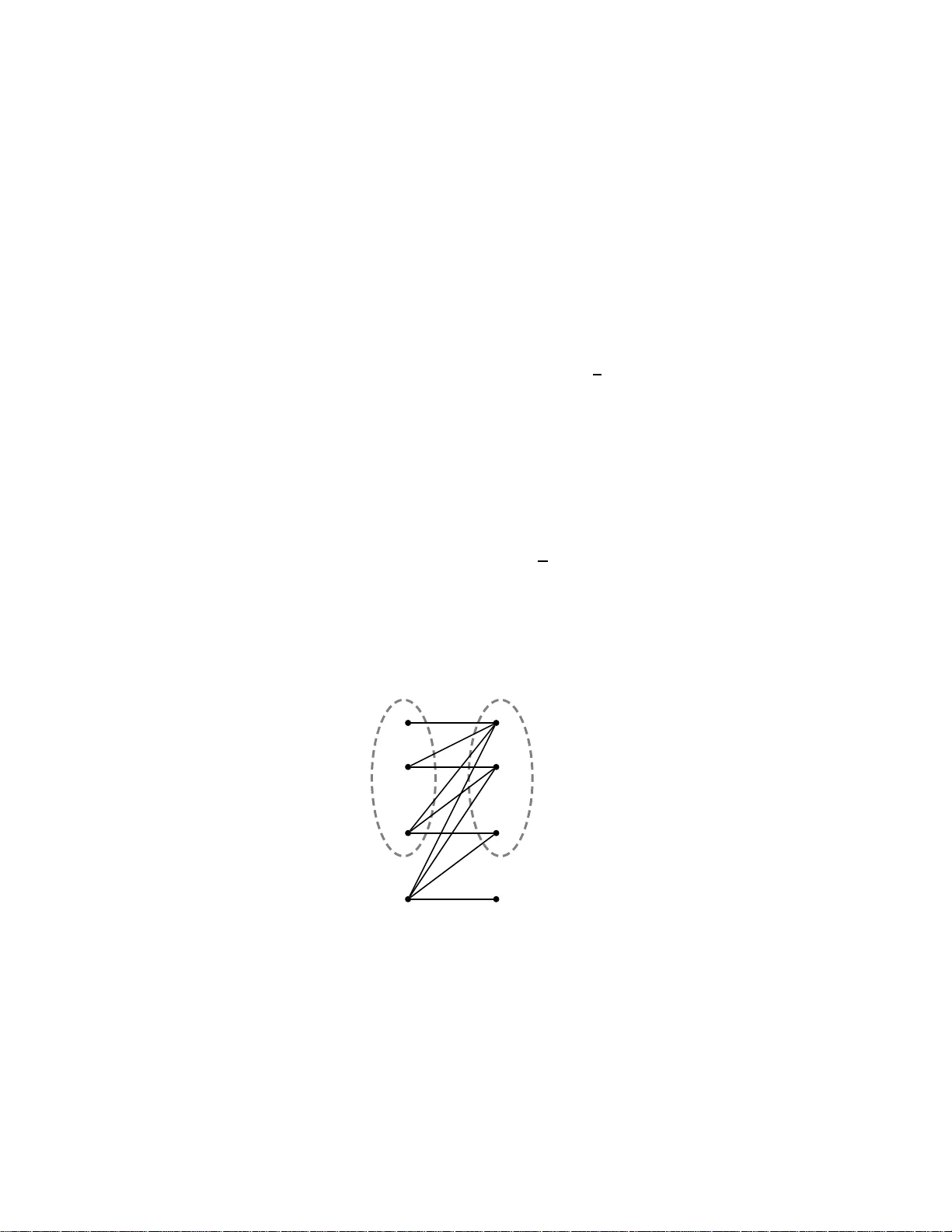
Bin P acking via Discrepancy of P e rmut ations ∗ F r iedr ich Eisenbrand † Dömötör Pálvölgyi ‡ Thomas Rothvoß § Abstract A well studied special case of bin packing is the 3-partition problem , where n items of size > 1 4 have to be packed in a minimu m num ber of bins of capacity one. The famous Karm arkar-Karp algorithm transforms a fractional solut ion of a suit ab le LP relaxatio n for this problem into an integral solution that requ ires at mos t O (log n ) additional bins. The thr ee -permutations-problem of Beck is the follo wing. Given any 3 permutations on n symbols, color the symbols red and blue, such that in any interval of any of those permutations, the number of red and blue symbols is roughly the same . The necessary difference is called the dis- crepancy . W e establish a surprising connection between bin packing and Beck ’ s problem: The additive integrality gap of the 3-partition linear program- ming relaxation can be bounded by the discrepancy of 3 permutations . This connection yields an alternative method to establish an O (log n ) bound on the add itive integrality gap of the 3-partition. Reve rsely , mak- ing use of a r ecent example of 3 permutations , for w hich a d iscrepancy of Ω (log n ) is necessary , we prove the followin g: The O (log 2 n ) upper bound on the additive gap for bin packing with arbitrary item sizes can not be im- pro ved by any technique that is based on rounding up items. This lower bound holds for a large class of algorithms including the K ar markar-Karp procedure . 1 I ntroduction The bin packing problem is the follo wing. G iven n items of size s 1 , . . . , s n ∈ [0, 1] respec tively , t he goal is to pack these items in as few bins of capacity one as ∗ A preliminary version of this paper appeared in SODA ’11 [10]. † EPFL, Lausanne, S wit zerlan d. Email: friedric h.eisenbrand@epfl .ch . Supported by th e S wiss N ation a l Science F ou ndation (SNF). ‡ Eötvös Loránd U niversity (EL TE), B udapest, Hungar y . Email: dom @cs.elte.hu § M.I.T ., Cambridge, USA. Email: rothvoss@math.mi t.edu . S u p port ed by the German R e- search Foundation (D FG) with in the Prio r ity Program 1307 “ Algorithm E ngineering” , by t he Alexander von Humboldt Foundation within the Fe odo r L ynen program, b y ONR grant N00014- 11-1-005 3 and by NSF contract CCF-08298 78. 1 possible . Bi n packing is a fundamental problem in Computer Science with nu- merous applications in theor y and practice . The development of heur istics for bin packing with better an d better per for- mance guarantee is an importan t success stor y in the field of Appro ximati on A l gorithms . J ohnson [16, 17] has sho wn tha t the First Fit algorithm requir es at most 1.7 · O P T + 1 bins and th a t First Fit Decreasing yields a solution with 11 9 O P T + 4 bins (see [ 8] for a tight bound of 11 9 O P T + 6 9 ). An impor tant step for ward was made by Fernandez de la V ega and Luecker [11] who pro vided an asymptotic polynomial time approximation scheme for bin packing. Th e round- ing tech n ique that is introduced in t heir paper ha s been very influential in the design of PT AS’ s for many other difficult combinatorial optimization problem s. I n 1982, Karma rkar and Karp [18] propos ed an appro ximation algorithm for bin packing that can be analyzed to yield a solution using at most O P T + O (log 2 n ) bins . This seminal procedur e is based on the Gilmore Gomor y LP r elaxat ion [13, 9]: min P p ∈ P x p P p ∈ P p · x p ≥ 1 x p ≥ 0 ∀ p ∈ P (LP) H ere 1 = (1, . . . , 1) T denotes t he all ones vector and P = { p ∈ {0, 1} n : s T p ≤ 1} is the set of all f easible patte r ns , i.e. ever y vector in P denotes a feasible way to pack one bin. Let O P T and O P T f be the value of the best integer and fractional solution respectively . The linear program (LP) has an exponen tial number of variables bu t still one can compute a ba sic solution x with 1 T x ≤ O P T f + δ in time polynomial in n an d 1/ δ [18] using the Grötschel-Lov á sz-Schr ijver variant of the Elli psoid method [14]. The procedure of K ar markar and Karp [18] yields an additi ve integrality gap of O (l og 2 n ), i.e. O P T ≤ O P T f + O (log 2 n ), see also [27]. This corres ponds to a n asymptotic FPT AS 1 for bin packing. The authors in [22] conj ecture that even O P T ≤ ⌈ O P T f ⌉ + 1 holds and t his even if one replaces the r ight-hand-side 1 by any other positive integral vector b . Th is Modified I nteg e r Round-up Conjecture was pro ven b y Seb ˝ o and Shmonin [23] if the number of different item sizes is at most 7. W e would like to mention that J ansen and Solis - O ba [15] rec ent ly pro vided an O P T + 1 approximation-algo r ithm for bin packing if the number of item siz es is fixed. M uch of the hardness of bin packing seems to appea r already in the special case of 3-par t ition , where 3 n items of siz e 1 4 < s i < 1 2 with P 3 n i = 1 s i = n have to 1 An asymptot ic fully polyno mial time approximation scheme (AFPT AS) is an approximation algorith m that produces solu tions of cost at most (1 + ε ) O P T + p (1/ ε ) in time polynomial in n and 1/ ε , where also p must be a polynomial. 2 be packed. It is strongly NP -hard to distinguish between O P T ≤ n and O P T ≥ n + 1 [12]. N o stronger hardness result is known for general bin packing. A closer look into [18] reveals that, with the r estr iction s i > 1 4 , the Karmarkar-K ar p algorithm uses O P T f + O (l og n ) bins 2 . Discr epancy theo ry Let [ n ] : = {1, . . . , n } and cons ider a set system S ⊆ 2 [ n ] o ver the ground set [ n ]. A coloring is a map ping χ : [ n ] → { ± 1}. In dis c repancy theor y , one aims at finding colorings for which the difference of “ red ” and “blue ” elements in a ll sets is as small as poss ible. Formally , the discrepancy of a set system S is defined as disc( S ) = m in χ :[ n ] → { ± 1} max S ∈ S | χ ( S ) | . where χ ( S ) = P i ∈ S χ ( i ). A random coloring pro vides an easy bound of dis c ( S ) ≤ O ( p n log | S | ) [20 ]. The famous “ Six S t andard Devi ations suffice ” result of S pencer [24 ] impro ves this to disc ( S ) ≤ O ( p n log(2 | S | / n )). If ever y element appears in at most t sets, then the Beck-Fial a The orem [3] yields disc( S ) < 2 t . The same a uthors conjecture that in fa ct disc( S ) = O ( p t ). S r inivasan [26] gave a O ( p t log n ) bound, which was impro ved b y Banaszczyk [ 1] to O ( p t log n ). Many such discrepancy proofs are purely existential, for instance due to the u se of the pigeonhole principle. In a ver y rec ent breakthrough Bansal [2] sho wed ho w to obtain the desired colorings for the Spencer [24 ] and Srinivasan [26] bounds by considering a random walk, guided by the solution of a semidefinite program. F or several decades, the follo wing three-permutations-con j e cture or simply Beck’ s conjecture (s ee Probl em 1.9 in [4]) was open: Given any 3 per mutations on n symbols, one can color the symbo ls with red and blue, such that in ever y inter val of ever y of those per- mutations, t h e n umber of r ed and blue symbo ls differ s b y O (1). F or mally , a set of permutations π 1 , . . . , π k : [ n ] → [ n ] induces a set-sys tem 3 S = {{ π i (1), . . . , π i ( j )} : j = 1, . . . , n ; i = 1, . . . , k }. W e denote the maximum discr epancy of such a set-sys tem induced by k p e r mu- tations over n symbols as D perm k ( n ), then Beck ’ s conjecture can be rephrased as 2 The geometric grouping procedure (Lemma 5 in [18]) discards items of size O (log 1 s min ), where s min denotes the size o f the smallest item. Th e geometric groupin g is a p plied O (log n ) times in the Karmarkar-K arp algorit h m. The claim follows by using that s min > 1 4 for 3-partit ion. 3 W e only consider intervals of permutatio ns that st a r t from the first eleme n t. Since any int erval is the difference of two such prefixes , this changes the discrepancy by a facto r o f at most 2. 3 D perm 3 ( n ) = O (1). One can pro vably upper bound D perm 3 ( n ) b y O (log n ) and mor e generally D perm k ( n ) can be bounded by O ( k log n ) [5] and by O ( p k log n ) [26, 25] using the so-c alled en tropy method . But ver y recently a counterexample to Beck ’ s conjectur e was f ou n d b y New- man and Nikolo v [21] (ear ning a pr ize of 100 USD offered by J oel Spencer) 4 . In fact, they f ully settle the question by p rovi ng t hat D perm 3 ( n ) = Θ (log n ). Our contribution The first r esult of this paper is the follo wing theorem. Theor em 1. The a ddi tive i ntegrality gap of t he l inear program (LP) restricted t o 3-partit ion instances is bounded by 6 · D perm 3 ( n ) . This r esult is constr uctive in the follo wing sense . If one can find a α discr ep- ancy coloring for an y th ree per mutations in polyno mial time, then there is an O P T + O ( α ) appro ximation algorithm for 3-part ition. The proof of Theorem 1 itself is via two steps . i) W e sho w tha t the additive integrality gap of (LP) is at most twice the maxi- mum linear discrepancy of a k -monotone matrix if all item sizes are larger than 1/( k + 1) (Section 3). This step is based on matching t echniques and Hall’ s th eorem . ii) W e then sho w that the linear discr epancy of a k -monotone matr ix is at most k times the discr epancy of k permutations (S ection 4 ). This resul t u ses a theorem of Lo vász, Spencer and V esztergo mbi. The theorem then follo ws by setting k equal to 3 in the abo ve steps . Further more , we sho w that t he discr epan cy of k permut ations is at most 4 times the linear discrepancy of a k -monotone matr ix. M oreo ver in Section 5, we p ro vide a 5 k · log 2 (2 min{ m , n }) upper bound on t h e linear discr epa n cy of a k -monotone n × m -matr ix. Rec all that most approximation algor ithms for bin packing or corresponding generalizations rely on “ rounding up items ” , i.e. they select some patter ns from the support of a fractional solution which form a valid solution to a dominating instance . Reversing the abo ve connection, we can show that no algorithm that is only based on this principle can obtain an additive integrality of o (log n ) for item 4 The count erexample was anno u nced few months after SODA ’11. A s a small an ecdote, both authors of [21] had a joint paper [6] on a related topic, which w a s presented in the same session of SODA ’11 as the conference v ersion o f this paper . 4 sizes > 1 4 and o (log 2 n ) for arbitrar y item sizes (see Section 6). This still holds if we allo w to discar d and greedi ly pa ck items. M ore precis ely: Theor em 2. F or infinitely many n , there is a bin packing instance s 1 ≥ . . . ≥ s n > 0 with a feasib l e fractional (LP) s olution y ∈ [0, 1] P such th a t the foll o win g holds: Let x ∈ Z P ≥ 0 be an integral solution and D ⊆ [ n ] be tho s e items t hat are not co ver ed by x wi th t he prop er ties : • Use only patter ns from fractional sol u t ion: s upp ( x ) ⊆ s u p p ( y ) . • Feasibility: ∃ σ : [ n ] \ D → [ n ] with σ ( i ) ≤ i an d P p : i ∈ p x p ≥ | σ − 1 ( i ) | for all i ∈ {1, . . . , n } . Then one has 1 T x + 2 P i ∈ D s i ≥ 1 T y + Ω (log 2 n ) . I mprov ing the Karmarkar-Karp a lgor ithm has been a longstanding open prob- lem for many decades no w . Our r esult sho ws that the r ecursive rounding proce- dure of the algorithm is optimal. In order t o break the O (log 2 n ) barr ier it does not suffice to consider only the patter ns that ar e contained in an initial fractional solution as it is the case for the Kar markar-Karp algorithm. 2 Pr eliminaries W e first review some fu rther necessary preliminaries on discrepancy theory . W e refer to [20] for further details . If A is a matrix, then we denote the i th row of A by A i and the j th entr y in the i t h ro w by A i j . The notation of discr epancy can be natu rally extended to real matrices A ∈ R m × n as disc( A ) : = min x ∈ {0,1} n k A ( x − 1/2 · 1 ) k ∞ , see , e.g. [20]. N ote that if A is t he incidence matr ix of a set system S (i. e. ea ch ro w of A corres ponds to the characteristic vector of a set S ∈ S ), t hen disc( A ) = 1 2 disc( S ), hence this notation is consistent — apar t from the 1 2 factor . The linear discrepancy of a mat rix A ∈ R m × n is defined a s lindisc( A ) : = max y ∈ [0,1] n min x ∈ {0,1} n k A x − A y k ∞ . This value can be a lso described by a two player game. The first player chooses a fractional vector y , then the seco nd player chooses a 0/1 vector x . The goal of the first player is to maximize , of the second to minimiz e k A x − A y k ∞ . The inequality disc( A ) ≤ lindisc( A ) holds b y choosing y : = (1/2, . . . , 1/2). One mor e notion of 5 defining the “ complexity” of a set system or a matrix is that of the h ereditary discrepancy : herdis c ( A ) : = max B submatr ix of A disc( B ). N otice that one can assume that B is for med b y choosing a subset of the columns of A . This parameter is ob viously a t least disc( A ) since w e can choose B : = A an d in [19] even an upper bound for lindisc( A ) is pro ved (see again [20] for a recent description). Theor em 3 ((Lovász, S pencer , V esztergombi )) . For A ∈ R m × n one has lindisc ( A ) ≤ 2 · herdisc ( A ). 3 Bounding the gap via the discrepancy of monotone ma- trices A ma t rix A is called k -monoton e if all its col umn vectors have non-decreasing entries from 0, . . . , k . In other wor ds A ∈ {0, . . . , k } m × n and A 1 j ≤ . . . ≤ A m j for any column j . W e denote t h e ma x imum linear discrepancy of such matr ices b y D mon k ( n ) : = max A ∈ Z m × n k -monotone lindisc( A ). The next theor em establishes step i) mentioned in the introduction. Theor em 4 . Consi der the lin e a r progr am (LP) and suppose tha t the item si zes satisfy s 1 , . . . , s n > 1 k + 1 . Then O P T ≤ O P T f + µ 1 + 1 k ¶ D mon k ( n ). Proof . Assume that the item siz es are sorted such that s 1 ≥ . . . ≥ s n . Let y be any optimum basic solution of (LP) and let p 1 , . . . , p m be the list of patter n s . Since y is a basic solution, its support satisfies | { i : y i > 0} | ≤ n . Henc e by deleting unused patter ns, we may assume 5 that m = n . W e define B = ( p 1 , . . . , p n ) ∈ {0, 1} n × n as the matrix composed of the p at- terns as column vectors . Clearly B y = 1 . Let A be the mat r ix t hat is defined by A i : = P i j = 1 B j , again A i denotes the i th ro w of A . In other wor ds, A i j de- notes the number of items of types 1, . . . , i in patter n p j . S ince B y = 1 we have A y = (1, 2, 3, . . . , n ) T . Each column of A is monotone . Fur t hermore , since no pat- tern contains mor e than k items one has A i j ∈ {0, . . . , k }, th us A is k - monotone. 5 In case that there are less than n p atterns, we add empty patt erns. 6 W e att ach a ro w A n + 1 : = ( k , . . . , k ) as the new last ro w of A . Clearly A remains k -monotone. There exists a vector x ∈ {0, 1} n with k A x − A y k ∞ ≤ lindisc( A ) ≤ D mon k ( n ). W e buy x i times patter n p i and D mon k ( n ) times the pattern that only contains the largest item of size s 1 . I t remains to sho w : (1) this yields a feasible solution; (2) the number of pat- terns does not exceed the claimed bound of O P T f + (1 + 1 k ) · D mon k ( n ). F or the latter claim, rec a ll that the constraint emergi ng from ro w A n + 1 = ( k , . . . , k ) together with P n i = 1 y i = O P T f pro vides k n X i = 1 x i ≤ k · n X i = 1 y i + D mon k ( n ) = k · O P T f + D mon k ( n ). W e use this to upper bound the number of opened bins by n X i = 1 x i + D mon k ( n ) ≤ O P T f + ³ 1 + 1 k ´ · D mon k ( n ). I t remains to pro ve that our integral solution is feasible. T o be more precise , we need to sho w that a n y item i can be a ssigned to a space reserved for an item of size s i or larger . N ( V ′ ) v 1 v 2 v i v n . . . . . . V ′ u 1 b 1 = B 1 x + D mon k ( n ) u 2 b 2 = B 2 x u i b i = B i x u n b n = B n x . . . . . . V U Figur e 1: The bipartite graph in the proof of Theorem 4 T o this end, consi der a bipartite gr ap h with nodes V = { v 1 , . . . , v n } on the left, repr esenting the items . The nodes on the r ight are the set U = { u 1 , . . . , u n }, where each u i is attr ibuted with a multipli city b i repr esenting the number of times that 7 we r eser ve space for items of size s i in our solution, see Figure 1. Recall t hat b i = ( B i x + D mon k ( n ) if i = 1 B i x other wise . W e insert an edge ( v i , u j ) for all i ≥ j . The meaning of this edge is the follo wing. One can assign item i into the space which is reser ved for item j since s i ≤ s j . W e claim that there ex ists a V -per fect matching, respec ting th e multiplici ties of U . By Hall’ s Theorem , see, e.g. [7], it suffices to sho w for any subset V ′ ⊆ V that the multiplicities of the nodes in N ( V ′ ) (the neighborhood of V ′ ) are a t least | V ′ | . Obser ve that N ( v i ) ⊆ N ( v i + 1 ), hence it suffices to pro ve the claim f or sets of the form V ′ = {1, . . . , i }. For such a V ′ one has X u j ∈ N ( V ′ ) b j = D mon k ( n ) + i X j = 1 B j x = D mon k ( n ) + A i x ≥ A i y = i and the claim f ollo ws . 4 Bounding the d i scr epancy of monotone mat r ices by the discre p a ncy of permutations I n this section, we sho w that the linear discrepancy of k -monotone matr ices is essentially bounded by the discr epa ncy of k permutations. This corresponds to step ii) in the proof of the main theorem. By Theorem 3 it suffices to boun d the discrepancy of k -monotone matr ices by the discrepancy of k per mutations times a suitable factor . W e first explain how one can associate a per mutation to a 1-monotone ma- trix. Suppose th at B ∈ {0, 1} m × n is a 1-monotone matr ix. If B j denotes the j -t h column of B , then the permutation π that we associate with B is t he (not neces- sarily unique) per mutation tha t satisfies B π (1) ≥ B π (2) ≥ · · · ≥ B π ( n ) where u ≥ v for vectors u , v ∈ R m if u i ≥ v i for all 1 ≤ i ≤ m . On the other hand the matr ix B (potentially plus some ext ra rows a nd after merging identical ro ws) gives the incidence matrix of the set-system induced by π . A k -monotone matr ix B can be decomposed into a sum of 1-monotone ma- trices B 1 , . . . , B k . Then any B ℓ naturally correspo n ds to a per mutation π ℓ of the columns as we explained abo ve. A lo w-discrepancy coloring of th ese p ermuta- tions yields a col or ing that has lo w discr epancy for any B ℓ and hence a lso for B , as we sho w no w in detail. Theor em 5. F or any k , n ∈ N , on e h as D mon k ( n ) ≤ k · D perm k ( n ) . 8 Proof . Consider any k -monotone matr ix A ∈ Z m × n . B y virtue of Theorem 3, there is a m × n ′ submatrix, B , of A such that lindisc( A ) ≤ 2 · disc( B ), thus it suf- fices to sho w that disc( B ) ≤ k 2 · D perm k ( n ). Of course, B itself is again k -monotone. Let B ℓ also be a m × n ′ matrix, defined b y B ℓ i j : = ( 1 if B i j ≥ ℓ 0, other wise. The matr ices B ℓ are 1-monotone , and t he matr ix B decomposes into B = B 1 + . . . + B k . As mentioned abo ve, for any ℓ , t here is a (not necessar ily unique) per- mutation π ℓ on [ n ′ ] such that B ℓ , π ℓ (1) ≥ B ℓ , π ℓ (2) ≥ . . . ≥ B ℓ , π ℓ ( n ′ ) , where B ℓ , j de- notes the j th column of B ℓ . O bserve that the ro w vector B ℓ i is the characteristic vector of the set { π ℓ (1), . . . , π ℓ ( j )}, where j denotes t he number of ones in B ℓ i . Let χ : [ n ′ ] → { ± 1} be the coloring that has discrepancy at most D perm k ( n ) with r espect to all permutations π 1 , . . . , π k . In particular | B ℓ i χ | ≤ D perm k ( n ), when interpreting χ as a ± 1 vector . T h en b y the triangle inequality disc( B ) ≤ 1 2 k B χ k ∞ ≤ 1 2 k X ℓ = 1 k B ℓ χ k ∞ ≤ k 2 D perm k ( n ). Combini n g Theorem 4 and Theorem 5, we conclude Corollary 6. G iven any bin packi ng instanc e wit h n items of size bigger th an 1 k + 1 one has O P T ≤ O P T f + 2 k · D perm k ( n ). I n par ticular , this pro ves Theor em 1, our main r esult. Bounding th e discrepancy of permutations in terms of the discr epancy of monotone matrices I n addition we would like to note that the discr epancy of per mutations can be also bounded by the disc repancy of k -monotone matrices as f ollo ws. Theor em 7. F or any k , n ∈ N , on e h as D perm k ( n ) ≤ 4 · D mon k ( n ). Proof . W e will sho w that for any permutations π 1 , . . . , π k on [ n ], there is a k n × n k -monotone matr ix C with disc( π 1 , . . . , π k ) ≤ 4 · disc( C ). Let Σ ∈ {1, . . . , n } k n be the string which we obtain by concatenating the k permuta t ions . That means Σ = ( π 1 (1), . . . , π 1 ( n ), . . . , π k (1), . . . , π k ( n )). Let C the mat rix where C i j is the number 9 of appearances of j ∈ {1, . . . , n } among the first i ∈ {1, . . . , k n } entries of Σ . By definition, C is k -monotone, in fact it is the “ same ” k -monotone matrix as in the previo u s proof. Choose y : = ( 1 2 , . . . , 1 2 ) to have C y = ( 1 2 , 1, . . . , k n 2 ). Let x ∈ {0, 1} n be a vector with k C x − C y k ∞ ≤ disc( C ). Consi der the coloring χ : [ n ] → { ± 1} with χ ( j ) : = 1 if x j = 1 and χ ( j ) : = − 1 if x j = 0. W e clai m tha t the disc repancy of this color- ing is bou n ded by 4 · disc( C ) for all k per mutations. Consider a n y prefix S : = { π i (1), . . . , π i ( ℓ )}. Let r = C ( i − 1 ) n + ℓ ∈ { i − 1, i } n be the ro w of C that corresponds to this pr efix . With these notations we have | χ ( S ) | ≤ | ( r − ( i − 1) 1 ) · (2 x − 2 y ) | ≤ 2 · ¡ | r ( x − y ) | | {z } ≤ disc( C ) + | k · 1 ( x − y ) | | {z } ≤ disc( C ) ¢ ≤ 4 · disc( C ). H ere the inequality | ( k · 1 ) · ( x − y ) | ≤ disc( C ) comes from the fa ct that k · 1 = ( k , . . . , k ) is the last ro w of C . 5 A bound on the di scr epancy of monotone matrices Finally , we want to pro vide a non-trivial upper bound on the linear discr epancy of k - monotone mat r ices . The result of S pencer , S r inivasan and T et a li [25, 26] together with Theorem 5 yields a bound of D mon k ( n ) = O ( k 3/2 log n ). This bound can be reduced by a direct proof th a t shares some similarities with that of Bo- hus [5]. N ote tha t D mon k ( n ) ≥ k /2, as the k -monotone 1 × 1 matr ix A = ( k ) to- gether with t arget vector y = (1/2) witnesses . Theor em 8. Consider any k - mon o t one matrix A ∈ Z n × m . Then lindisc ( A ) ≤ 5 k · log 2 (2 min{ n , m }). Proof . If n = m = 1, lindisc( A ) ≤ k 2 , hence the claim is true. Let y ∈ [ 0, 1] m by any vector . W e can remo ve all columns i with y i = 0 or y i = 1 a n d then a pply induction (on the size of the matrix). N ext , if m > n , i.e . the number of columns is bigger then the nu mber of cons traints, then y is not a basic solution of the system A y = b 0 ≤ y i ≤ 1 ∀ i = 1, . . . , m . W e replace y b y a basic solution y ′ and apply indu ction (since y ′ has some inte- ger entries and A y = A y ′ ). 10 Finally it remains to consider the case m ≤ n . Let a 1 , . . . , a n be the ro ws of A and let d ( j ) : = k a j + 1 − a j k 1 for j = 1, . . . , n − 1, i.e. d ( j ) gives the cumulated differ- ences between the j th and the ( j + 1)th ro w . Since the columns are k -monotone, each column contributes at most k to the sum P n − 1 j = 1 d ( j ). Thus n − 1 X j = 1 d ( j ) ≤ m k ≤ n k . By the pigeonhole pr inciple at least n /2 many ro ws j have d ( j ) ≤ 2 k . T ake any second of these row s and we obtain a set J ⊆ {1, . . . , n − 1} of size | J | ≥ n /4 such that for ever y j ∈ J one has d ( j ) ≤ 2 k and ( j + 1) ∉ J . Let A ′ y = b ′ be the subsys- tem of n ′ ≤ 3 4 n many equations, which we obta in by deleting the ro ws in J from A y = b . W e apply induction t o this system and obtain a n x ∈ {0, 1} m with k A ′ x − A ′ y k ∞ ≤ 5 k · log 2 (2 n ′ ) ≤ 5 k log 2 ³ 2 · 3 4 n ´ ≤ 5 k log 2 (2 n ) − 5 k log 2 ³ 4 3 ´ ≤ 5 k log 2 (2 n ) − 2 k . N o w consider any j ∈ {1, . . . , n }. If j ∉ J , then ro w j s t ill ap p eared in A ′ y = b ′ , hence | a T j x − a T j y | ≤ 5 k log 2 (2 n ) − 2 k . N ow supp ose j ∈ J . W e remember that j + 1 ∉ J , thus | a T j + 1 ( x − y ) | ≤ 5 k log 2 (2 n ) − 2 k . But then using the trian gle inequality | a T j x − a T j y | ≤ | ( a j + 1 − a j ) T ( x − y ) | | {z } ≤ d ( j ) ≤ 2 k + | a T j + 1 ( x − y ) | | {z } ≤ 5 k log 2 (2 n ) − 2 k ≤ 5 k · log(2 n ). 6 Lo wer bounds for algori thms ba sed on rounding up items Let us remind ourselves, ho w the classical approxim at ion algorithms for bin packing work. F or example in th e algorithm of de la V ega a n d Lueker [ 11] one first groups the items, i.e . the item sizes s i are rounded up to some s ′ i ≥ s i such that (1) t he nu mber of different item sizes in s ′ is a t most O (1/ ε 2 ) (for some proper choice of ε ) a n d (2) the optimum n umber of bins increases only by a (1 + ε ) f actor . N ote th a t any solution for the new instance with bigger item sizes induces a solution with the same v alue for the original instance. Then one computes a basic solution 6 y ∈ Q P ′ ≥ 0 to (LP) with | supp( y ) | ≤ O (1/ ε 2 ) and u ses 6 Alternat ively one can co mpute an optimum solution for the roun ded instan ce by dynamic programming in time n (1/ ε ) O (1/ ε ) , but using the LP reduces the r unnin g time to f ( ε ) · n . 11 ( ⌈ y p ⌉ ) p ∈ P ′ as a ppro ximate solution (her e P ′ are t he feasible patter ns induced by sizes s ′ ). I n contrast, th e algorith m of Karmarkar and Karp [18] uses an iterative pro- cedure , where in each of the O (log n ) iterations, the item sizes are suitably rounded and the integral part s ⌊ y p ⌋ from a basic solution y are bought. N evert h eless , both algorithms r ely only on the follo wing properties of bin-pa cking: • Replacement property: If p is a feasible patt ern (i.e . P i ∈ p s i ≤ 1) with j ∈ p and s i ≤ s j , then ( p \{ j }) ∪ { i } is also feasible . • D iscarding items: Any subset D ⊆ [ n ] of items can be greedil y assigned to at most 2 s ( D ) + 1 many bins ( s ( D ) : = P i ∈ D s i ). F or a vector x ∈ Z P ≥ 0 , we say th at x bu ys P p ∈ P : i ∈ p x p many slots for i t em i . The replacem en t property implies that e.g. for two items s 1 ≥ s 2 ; x induces a feasible solution already if it buys no slot for item 2, but 2 slots for the larg er item 1. I n the follo wing we always assume that s 1 ≥ . . . ≥ s n . W e say that an integral vector x c o vers the non-discarded items [ n ] \ D , if there is a map σ : [ n ]\ D → [ n ] with σ ( i ) ≤ i and P p ∈ P : i ∈ p x p ≥ | σ − 1 ( i ) | . H ere the map σ a ssigns items i to a slot that x reserves for an item of siz e s σ ( i ) ≥ s i . I n other wor ds, a tuple ( x , D ) corres ponds to a feasible solution if x co vers the items in [ n ] \ D and the cost of this solution can be bounded by 1 T x + 2 s ( D ) + 1. I t is not difficult to see 7 that for the existence of such a mapping σ it is nec- essary (though i.g. not sufficient) that X p ∈ P x p · | p ∩ {1, . . . , i } | ≥ i − | D | ∀ i ∈ [ n ]. (1) The algorithm of Kar markar and Karp starts from a fractional solution y and obtains a pair ( x , D ) with 1 T x ≤ 1 T y and P i ∈ D s i = O (log 2 n ) such that x co vers [ n ] \ D . Mor eo ver , it has t he proper ty 8 that supp( x ) ⊆ supp( y ), which means that it only uses patter ns tha t are already contained in the suppor t of t h e fractional solution y . Hence t his method falls into an abstract cl a ss of algorithms tha t can be characterized a s follo ws: Definition 1. W e call an approximation alg orithm for bin packing based on rounding up items , if for given item sizes s 1 , . . . , s n and a given fractional solut ion 7 Proof sketch: Assign input items i iteratively in increasing o rder (starting wit h the largest one) to the smallest available slot. If there is non e left for item i , then th ere are less then i slots for items 1, . . . , i . 8 The Karmarkar-Karp method solves th e (LP) O (log n ) many times for smaller and smaller in- stances. T his can either be done by reoptimizing the previous fractional solution or by start ing from scratch. We assume here th at t h e first o ption is cho sen. 12 y ∈ [0, 1] P to (LP) it performs as follo w s: The algor ithm produces a tuple ( x , D ) such that (1) x ∈ Z P ≥ 0 , (2) su pp ( x ) ⊆ supp ( y ) and (3) x covers [ n ] \ D . W e define the additive integrali ty gap for a tuple ( x , D ) as 1 T x + 2 X i ∈ D s i − 1 T y . W e can now argue that the method of Karmarkar an d Karp is optimal for all algorithms that are based on rounding up items. The crucial ingredient is the re- cent result of N ewman a n d N ikolo v [21] t h at t h ere are 3 per mutations of discrep- ancy Ω (log n ). F or a permutation π we let π ([ i ] ) = { π (1), . . . , π ( i )} be the pr efix consisting of the fir st i symbols . In t he follo wing, let O = {. . . , − 5, − 3, − 1, 1, 3, 5, . . . } be the set of odd integers . Theor em 9. [21] For ever y k ∈ N an d n = 3 k , t here are permutation s π 1 , π 2 , π 3 : [ n ] → [ n ] s uch that disc ( π 1 , . . . , π 3 ) ≥ k /3 . A dditiona l ly , for every colori ng χ : [ n ] → O one has: • If χ ([ n ]) ≥ 1 , then there are i , j such that χ ( π j ([ i ])) ≥ ( k + 2)/3 • If χ ([ n ]) ≤ − 1 , then there are i , j such that χ ( π j ([ i ])) ≤ − ( k + 2)/3 . N ote t hat the result of [21] was only stated for { ± 1} colorings. But t he proof uses only the fact th a t th e colors χ ( i ) are odd integers 9 . This theorem does not just yield a Ω (log n ) discr epancy , bu t also the stronger claim th at any coloring χ which is balanced (i.e. | χ ([ n ]) | is small) yields a prefix of one of the per mu ta- tions which has a “ surplus” of Ω (log n ) and an oth er prefix that ha s a “ deficit” of Ω (log n ). W e begin with slightly reformu lat ing the result. H ere we make no a t tempt to optimiz e any constant. A strin g Σ = ( Σ (1), . . . , Σ ( q )) is an order ed sequence; Σ ( ℓ ) denotes the sym bol at the ℓ th position and Σ [ ℓ ] = ( Σ (1), . . . , Σ ( ℓ )) denotes the prefix string cons isting of the first ℓ symbols . W e write χ ( Σ [ ℓ ]) = P ℓ i = 1 χ ( Σ ( i )) and O ≥− 1 = { − 1, 1, 3, 5, . . . }. Corollary 1 0 . F or in finitely man y even n , there is a stri n g Σ ∈ [ n ] 3 n , each of the n symbols appearing exactly 3 times, suc h t hat: for all χ : [ n ] → O ≥− 1 with χ ([ n ]) ≤ log n 40 , there is an even ℓ ∈ {1, . . . , 3 n } with χ ( Σ [ ℓ ]) ≤ − log n 20 . 9 The only point where [21] uses that χ ( i ) ∈ { ± 1} is the base case k = 1 of th e induction in t he proof of Lemma 2. In fact , the case χ ([3]) ≥ 1 with a single po sitive symbol i ∈ {1, 2, 3} becomes possible if one considers coloring s with odd numbers. Ho wever, also th is case can easily be seen to be true. Interestingly , color ing all multiples of 3 with + 2 an d all o ther numbers with − 1 would yield a constant discr epan cy . 13 N ote that this statement is in fact true for ever y large enough n u sing a simi- lar argument bu t we omit the proof as for us this weaker version suffices . Proof . Fo r some k ∈ N , let π 1 , π 2 , π 3 be the per mutations on [3 k ] accor ding to Theorem 9. W e append the p ermutat ions together to a str ing Σ of length 3 · 3 k . Additionally , for n : = 3 k + 1, we append 3 t imes t he symbol n to Σ . Thu s Σ = ( π 1 (1), . . . , π 1 (3 k ), π 2 (1), . . . , π 2 (3 k ), π 3 (1), . . . , π 3 (3 k ), n , n , n ) and Σ has even length. N ext, let χ : [ n ] → O ≥− 1 be any coloring with | χ ([ n ]) | ≤ log n 40 . Reducing the values of at most 1 2 ( log n 40 + 1) colors b y 2, we obtain a coloring χ ′ : [ n ] → O ≥− 1 with χ ′ ([3 k ]) ≤ − 1. Then by Theorem 9 th ere are j ∈ {1, . . . , 3} and i ∈ {1, . . . , 3 k } such that χ ′ ( π j ([ i ])) ≤ − ( k + 2)/3. For ℓ : = ( j − 1) · 3 k + i one has χ ( Σ [ ℓ ]) ≤ χ ′ ( Σ [ ℓ ]) + 3( log n 40 + 2) ≤ ( j − 1) · χ ′ ([3 k ]) | {z } < 0 + χ ′ ( π j [ i ] ) | {z } ≤− ( k + 2)/3 + 3( log n 20 + 2) ≤ − log n 20 for n large enough. If ℓ is not even, we can increment it by 1 — th e disc repancy is changed b y at most 2 (since we may assume that the last sym bol Σ ( ℓ ) is n egative, thus − 1), which can be absorbed into the slack that we stil l h a ve . 6.1 A Ω (log n ) lo wer bound for the case of item sizes > 1/4 I n th e follo wing, for an even n , let Σ be the str ing from Co r . 10. W e define a matrix A ∈ {0, 1} 3 n × n such that A i j : = ( 1 Σ ( i ) = j 0 other wise. N ote that A has a single one entr y per row a nd 3 one entr ies per column. N ext, we add up pa irs of consec ut ive ro ws t o obtain a matrix B ∈ {0, 1, 2} (3/2) n × n . F or mally B i : = A 2 i − 1 + A 2 i . W e define a bin packing instance by choosing item sizes s i : = 1 3 − ε i for items i = 1, . . . , 3 2 n with ε : = 1 20 n . Then 1 3 > s 1 > s 2 > . . . > s (3/2) n > 1 4 . Fur thermore w e consider B as our patt er n matr ix a nd y : = ( 1 2 , . . . , 1 2 ) a corres ponding fea sible f ractional solution. N ote that B y = 1 . I n the follo wing theor em we will a ssume for the sake of contradiction that this instance a dmits a solution ( x , D ) respecting Def. 1 with additive gap o (log n ). I t is not difficult t o see, that th en | D | = o (log n ) and | 1 T x − 1 T y | = o (log n ). T h e integral vector x defines a coloring χ : [ n ] → O ≥− 1 via the equat ion x i = y i + 1 2 χ ( i ). This coloring is balanced, i.e. | χ ([ n ]) | = o (lo g n ). Thus ther e is a prefix string Σ [ ℓ ] 14 with a deficit of χ ( Σ [ ℓ ]) ≤ − Ω (log n ). This corres ponds to x having ℓ /2 − Ω (lo g n ) slots for the largest ℓ /2 items, which implies that x cannot be feasible. N o w the proof in det a il: Theor em 11. The re i s no algorit h m for bin packing, based on rounding up items which achieves an additive integrality gap of o (log n ) for all instances with s 1 , . . . , s n > 1/4 . Proof . Let ( x , D ) be a solution to the cons tr ucted instance with supp ( x ) ⊆ supp( y ) such that x is integral and co vers t he non-disc arded items [ 3 2 n ] \ D . For the sake of contradictio n assume tha t 1 T x + 2 X i ∈ D s i ≤ 1 T y + o (log n ). Clearly we may assume tha t 1 T x ≤ 1 T y + 1 600 log n , otherwise there is nothing to sho w . N ote tha t 1 T x + 2 s ( D ) ≥ (3/2) n −| D | 3 + 2 · | D | 4 = 1 T y + | D | 6 (since 1 3 > s i > 1 4 ) and t hus | D | ≤ 1 100 log n . Fur ther more 1 T x ≥ (3/2) n −| D | 3 ≥ 1 T y − 1 300 log n . W e can summarize: | 1 T x − 1 T y | ≤ log n 300 and i X i ′ = 1 B i ′ x ≥ i − log n 100 ∀ i ∈ [ 3 2 n ] (2) W e will no w lead this to a contradictio n. R ecall that ever y symbol i ∈ {1, . . . , n } corres ponds t o a column of matrix B . Define a colo r ing χ : [ n ] → O ≥− 1 such that x i = 1 2 + 1 2 χ ( i ). N ote that indeed the integrality of x i implies that χ ( i ) is a n odd integer . Further more | χ ( [ n ]) | = 2 · | 1 T x − 1 T y | ≤ 1 150 log n . Us ing Cor . 10 there is a 2 q ∈ {1, . . . , 3 n } such that χ ( Σ [2 q ] ) ≤ − log n 20 . Th e cr ucial obser vation is that by construction χ ( Σ [2 q ] ) = P q i = 1 B i χ . Then the number of slots tha t x res er ves for the largest q items is q X i = 1 B i x = q X i = 1 B i y | {z } = q + 1 2 q X i = 1 B i χ = q + 1 2 χ ( Σ [2 q ]) | {z } ≤− log n 20 ≤ q − log n 40 . Thus x cannot co ver items [ 3 2 n ] \ D . 6.2 A Ω (log 2 n ) lo wer bou nd for the general case S ta rting from the pattern matr ix B defin ed abo ve, we will constr uct anoth er pat- tern matr ix C and a vector b of item multiplicities such that for the emerging 15 instance even a o (log 2 n ) additive integrality gap is not achievable by just round- ing up items . Let ℓ : = log n be a parameter . W e will define groups of items for every j = 1, . . . , ℓ , wher e group j ∈ {1, . . . , ℓ } contains 3 2 n many differ ent item types; each one with multiplic ity 2 j − 1 . Define C : = 2 0 · B 0 0 . . . 0 0 2 1 · B 0 . . . 0 0 0 2 2 · B . . . 0 . . . . . . . . . . . . . . . 0 0 0 . . . 2 ℓ − 1 · B and b = 2 0 · 1 2 1 · 1 2 2 · 1 . . . 2 ℓ − 1 · 1 , thus C is an 3 2 n ℓ × n ℓ matr ix and b is a 3 2 n ℓ -dimensional vector . In other words , each group is a sc a led clone of the instance in the previous section. Choosing again y : = (1/2, . . . , 1/2) ∈ R ℓ n as f ractional solution, we have C y = b . N ote that allo wing multiplicities is just for notational convenience and does not make the problem setting more general. Sinc e t h e total n u mber of items is still bounded by a polynomial in n (more pr ecisely 1 T b ≤ O ( n 2 )), ea ch item i c ould still be replaced b y b i items of multiplicity 1. Let s j i : = 1 3 · ( 1 2 ) j − 1 − i · ε the size of t h e i th item in group j for ε : = 1 12 n 3 . N ote that the siz e contribution of each item type is 2 j − 1 · s j i ∈ [ 1 3 , 1 3 − 1 n ]. Abbreviate the number of different item types by m : = ℓ · 3 2 n . Theor em 12. There is no algor ithm for bin packing which i s ba s ed on roundin g up items and achi eves an addit i ve i ntegrality gap of o (l og 2 n ) . Proof . Let ( x , D ) be arbitrar y with supp( x ) ⊆ supp( y ) such that x is integral and co vers [ m ] \ D (cons ider ing D no w as a multiset). Assume for the sake of contra- diction that 1 T x + 2 X i ∈ D s i ≥ 1 T y + o (log 2 n ). As in Theorem 11, we can assume that | 1 T x − 1 T y | ≤ 1 10000 log 2 n . First, observe that the bins in y are packed pretty tight, i.e. | 1 T y − s ([ m ] ) | ≤ 1. If an item i is co vered by a slot for a larger item i ′ , then this causes a waste of s i ′ − s i , which is not anymore a vailable for any oth er item. The additive gap is defined as 1 T x + 2 s ( D ) − 1 T y ≥ s ([ m ]/ D ) + waste + 2 s ( D ) − s ([ m ]) − 1 = waste + s ( D ) − 1. Thus both, th e waste and the siz e of the discarded items s ( D ) must be bounded b y 1 10000 log 2 n . Obser ve that the items in group j − 1 are at least a factor 3/2 larger tha n the items in group j . In oth er words , every item i from group j which is mapped to group 1, . . . , j − 1 generates a waste of at least 1 2 s j i . Thus th e total size of items 16 which are mapped to the slot of an item in a larger group is bounded by 1 5000 log 2 n . Thus th ere lies no har m in discarding t hese items as well — let D ′ be the union of such items a nd D . Then s ( D ′ ) ≤ s ( D ) + 1 5000 log 2 n ≤ 1 3000 log 2 n . F or group j , let D ′ j ⊆ D ′ be the discarded items in the j th group an d let x j ( y j , resp .) be the vector x ( y , resp .), restricted to the pat t erns corr espond- ing to group j . In other words , x = ( x 1 , . . . , x ℓ ) a nd y = ( y 1 , . . . , y ℓ ). By x j i ∈ Z ≥ 0 we denote the ent r y belonging to column ( 0 , . . . , 0 , 2 j − 1 B i , 0 , . . . , 0 ) in C . Pick j ∈ {1, . . . , ℓ } uniformly at random, then E [ | 1 T x j − 1 T y j | ] ≤ 1 10000 log n and E [ s ( D ′ j )] ≤ 1 3000 log n . B y Marko v’ s inequality , there must be an index j , such th a t | 1 T x j − 1 T y j | ≤ 1 1000 log n and s ( D ′ j ) ≤ log n 2000 . R ecall that | D ′ j | ≤ 4 · 2 j − 1 s ( D ′ j ) ≤ 2 j − 1 log n 500 . S ince x j co vers all items in group j (without D ′ j ), w e obtain i X i ′ = 1 2 j − 1 B i ′ x j ≥ i · 2 j − 1 − 2 j − 1 log n 500 ∀ i = 1, . . . , 3 2 n After division by 2 j − 1 , t h is implies Condition (2), which leads to a contradicti on. The claim follo ws since the number of items counted with multiplicity is bounded b y O ( n 2 ), thus log 2 ( 1 T b ) = Θ (log 2 n ). R emark 1. N ot e that th e additive integrality gap for the constru cted instance is sti l l small, on ce arbitrar y patterns may be used. F or example a First Fit D e- creasing assignment will produce a solu t ion of cost exactly O P T f . This can be partly fixed by slightl y increasing the item s izes. F or the s ake of si mplicity con- sider the constru ction i n Section 6.1 and obs erve that the used patterns are stil l feasible if the items corresponding to the fi rst permutation h ave si zes in the r ang e [ 1 3 + 10 δ , 1 3 + 11 δ ] and the it ems corresponding to the 2nd and 3r d permutation have item sizes in [ 1 3 − 7 δ , 1 3 − 6 δ ] (for a small constant δ > 0 ). Then a First Fit Decreasing approach will produce a Ω ( n ) additive gap. R eferences [1] W . Banasz czyk. Balancing vectors and Gaussian measures of n - dimensional convex bodies. Random S tructu res A lgori thms , 12(4):351–36 0, 1998. [2] N. Bansal. Constructive algorith ms for discr epancy minimization. CoRR , abs/1002. 2259, 2010. inf or mal publication. [3] J. Beck and T . Fiala. “Integer-making ” theorems . Dis crete Appl. Math. , 3(1):1–8, 1981. 17 [4] J. Beck and V . Sós . Disc repancy theor y . In Handbook of combin a t orics, Vol. 1, 2 , pages 1405–1446. Elsevier , Amsterdam, 1995. [5] G. Bohus. On the discr epancy of 3 per mutations. Random S tructu res A lgo- rithms , 1(2) :215–220, 1990. [6] Mos es Charikar , Alantha N ewman, and Aleksandar Nikolo v . T ight hardness results for minimizing discr epancy . In SODA , pages 1607–1614, 2011. [7] R. Diestel. Gr aph Theor y , volume 173 of G raduate T exts in Mathemati cs . S pr inger-V erlag, 1997. [8] G. Dósa. The tight bound of first fit decr ea sing bin-pa cking a lgorithm is FFD(I) < = 11/9OPT(I) + 6/9. I n Bo Chen, Mike P ater son, and Guochuan Zhang, editors, Combinatorics, A lgorit hms, P robabil istic and Experimental Methodologies, First Internation al S ymposiu m, ESCAP E 2007, Hangzhou, China, April 7-9, 2007, Revised Selected P apers , volume 4614 of Lecture Notes in Computer Science , pages 1–11. Springer , 2007. [9] K. Eisemann. The trim problem. Management S c ience , 3(3):279–284, 1957. [10] Friedr ich Eisenbrand, Dömötör Pálvölg yi, and Thomas Rothvoß. Bin pack- ing via discrepancy of permutations. In SODA , pages 476–481, 2011. [11] W . Fernandez de la V ega and G. S. Lueker . Bin packing can be solved within 1 + ε in li nea r time . Combinatorica , 1(4 ):349–355, 1981. [12] M. R. Gar ey and D . S. J ohnson. Computers and Intractability: A G uide t o the Theor y of NP-Completeness . W . H. Freem an and Company , N ew Y ork, N ew Y ork, 1979. [13] P . C. Gilmor e and R. E. Gomory . A linear progr a mming approach to the cutting-stock probl em. Oper ati o n s Research , 9:849–859 , 1961. [14] M. Grötschel, L. L o vász, a nd A. Sc hr ijver . Th e ellipsoi d method and its con- sequences in combinator ial optimization. Combinato r ica , 1(2):169–197, 1981. [15] K. J ansen and R. S olis-Oba. An opt + 1 algorithm for the cutting stock prob- lem with constant number of object lengths. I n Friedrich Eisenbrand and F . Bruce Shepherd, editors, Proceedings of t he 14th International Confer- ence on Integer Programm i ng and Combinat o r ial Optimizati on, IPCO 2010 , pages 438–4 49, 2010. 18 [16] D . S. J ohnson. Near -optimal bin packing algorithms . P hD th esis, MIT , Cam- bridge, MA, 1973. [17] D . S. J ohnson, A. Demers , J. D . Ullman, M. R. Gar ey , and R. L. Graham. W orst-case p erfor mance bounds f or simple one-dimensional packing al- gorithms. SIAM J ournal on Computi ng , 3(4 ):299–325, 1974. [18] N. Kar markar and R. M. Karp. An efficient approximation scheme for the one-dimensional bin-packing p roblem. I n 23rd annual symposium on foundations of comput e r s c ience (Chicag o, Ill., 1982) , pa ges 312–320. IEE E , N ew Y ork, 198 2. [19] L . Lovász , J. S pencer , and K. V esztergombi. Discr epan cy of set-systems an d matrices. E uropean J. Combin. , 7(2):151–160, 1986. [20] J. Matoušek. Geomet r ic discrepancy , volume 18 of A l gorithms and Combi - natorics . Springer-V e r lag, B er lin, 1999. An ill u strated guide. [21] A. Newman and A. N ikolo v . A counterexample to beck ’ s conjecture on the discr epancy of three permutations. CoRR , abs/1104.2 922, 2011. [22] G. Scheithauer and J. T er no . Theoretic al investigations on the modified integer round-up property for the one-dimensional cutting stock probl em. Oper ati ons Research Letters , 20(2) :93 – 100, 1997. [23] A. Seb ˝ o a nd G. Shmonin. Pr oof of the modified integer round-up conjec- ture for bin packing in dimension 7. P er sonal communication, 2009 . [24] J. Spencer . Six standar d deviations suffice. T ransactions of the Am er ican Mathematical Society , 289(2):679–70 6, 1985. [25] J. H . S pen cer , A. Srinivasan, and P . T etali. The discrepancy of per mutation families . U npublished manuscript. [26] A. Srinivasan. Impro ving the discr epancy boun d for sparse matrices: Better appro x imations for spar se lat tice appro ximation p roblems. I n Proceedings of the 8th Annual A CM-SIAM Sy mposi um on D iscrete Algorithms, S ODA ’97 (N ew Orleans, Louisi a n a, J anuar y 5-7, 1997) , pages 692–701, Philadelphia, P A, 1997. A CM SIGA CT , SIAM, Society for Industrial and A pplied Mathe- matics . [27] D . Williams on. Lecture notes on approximation al- gorithms, Fall 1998. IBM R esearch R epor t, 1998. http://l egacy.ori e.cornell.edu/~dpw/cornell.ps . 19
Original Paper
Loading high-quality paper...
Comments & Academic Discussion
Loading comments...
Leave a Comment