The maximum number of faces of the Minkowski sum of two convex polytopes
We derive tight expressions for the maximum number of $k$-faces, $0\le{}k\le{}d-1$, of the Minkowski sum, $P_1\oplus{}P_2$, of two $d$-dimensional convex polytopes $P_1$ and $P_2$, as a function of the number of vertices of the polytopes. For even …
Authors: Menelaos I. Karavelas, Eleni Tzanaki
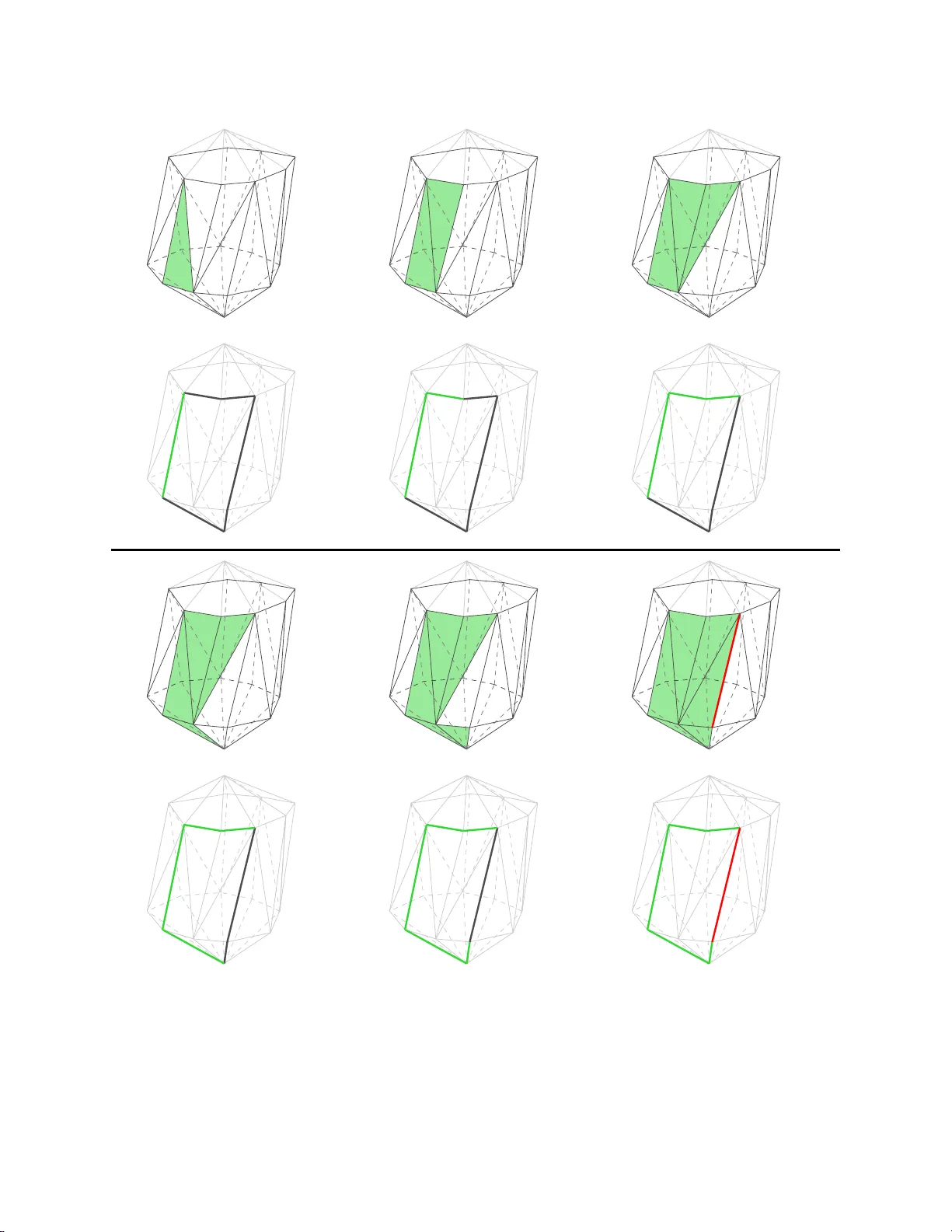
The maxim um num b er of faces of the Mink o wski sum of t w o con v ex p olytop es Menelaos I. Kara v elas † , ‡ Eleni T zanaki † , ‡ † Dep artment of Applie d Mathematics, University of Cr ete GR-714 09 Her aklion, Gr e e c e {mkar avel,etza naki}@tem.uoc.gr ‡ Institute of Applie d and Computational Mathematics, F oundation for R ese ar ch and T e chnolo gy - Hel las, P.O. Box 1385, GR-711 10 Her aklio n, G r e e c e No v em b er 2, 2018 Abstract W e derive tigh t expressio ns for the maximum num b er of k -faces, 0 ≤ k ≤ d − 1 , o f the Minko wski sum, P 1 ⊕ P 2 , of t wo d -dimensional con vex p olytop es P 1 and P 2 , as a f unction of the n umber o f v er tices of the po lytopes. F or even dimensions d ≥ 2 , the maximum v alues are attained when P 1 and P 2 are cyclic d - po lytopes with disjoin t vertex sets. F or o dd dimensions d ≥ 3 , the maximu m v alues are attained when P 1 and P 2 are ⌊ d 2 ⌋ -neighborly d -polytop es, whose v ertex sets are chosen appropriately from t wo distinct d -dimensional momen t-like curv es. Key wor ds: hig h-dimensional geometry , discrete geometry , combinatorial geometry , com binato- rial complexity , Mink owski sum, conv ex polytop es 2010 MSC: 52B05 , 52B11, 52C45, 68U05 1 In tro duction Giv en t w o d -dimensional p olytop es, or simply d -p olytopes , P and Q , their Mink o wski sum, P ⊕ Q , is defined as the set { p + q | p ∈ P , q ∈ Q } . Mink o wski sums are fundamen tal structures in b oth Mathematics and Computer Science. They app ear in a v ariety of differen t s ub jects, including Com- binatorial Geometry , Computational Geometry , Compu ter Algebra, Computer-Aided Design & Solid Mo deling, Motion Planning, Assem bly Planning, R obotics (s ee [18, 4] and the references therein), and, more recen tly , Game Theory [15], Computational Biology [14] and Op erations R esearc h [20]. Despite their apparen t imp ortance, little is k no wn about the worst-case complexit y of Minko wski sums in dimensions four and higher. In t w o dimensions, the w ors t-case complexit y of Mink o wski sums is w ell understo o d. Given tw o con v ex p olygons P and Q with n and m vertices, resp ectiv ely , the maxim um n umber of v ertices and edges of P ⊕ Q is n + m [2]. This result can b e immediately generalized (e.g., b y induction) to any n umber of summands. If P is con vex and Q is non-con v ex (or vice v ersa), the w orst-case complexit y of P ⊕ Q is Θ( nm ) , while if b oth P and Q are non-con v ex the 1 complexit y of their M inko wski sum can b e as high as Θ( n 2 m 2 ) [2]. When P and Q are 3-p olytopes (em b edded in the 3-dimensional Euclidean space), the w orst-case complexit y of P ⊕ Q is Θ( nm ) , if b oth P and Q are con vex, and Θ( n 3 m 3 ) , if both P and Q are non-con vex (e.g., see [3]). F or the in termediate cases, i.e., if only one of P and Q is con vex, s ee [17]. Giv en t w o con vex d -p olytop es P 1 and P 2 in E d , d ≥ 2 , with n 1 and n 2 v ertices, resp ectiv ely , w e can easily get a s traigh tforw ard upper b ound of O (( n 1 + n 2 ) ⌊ d +1 2 ⌋ ) on the complexit y of P 1 ⊕ P 2 b y means of the follo wing reduction: em b ed P 1 and P 2 in the hyperplanes { x d +1 = 0 } and { x d +1 = 1 } of E d +1 , resp ectiv ely; then the weigh ted Mink o wski sum (1 − λ ) P 1 ⊕ λP 2 = { (1 − λ ) p 1 + λp 2 | p 1 ∈ P 1 , p 2 ∈ P 2 } , λ ∈ (0 , 1) , of P 1 and P 2 is the intersect ion of the conv ex h ull, C H d +1 ( { P 1 , P 2 } ) , of P 1 and P 2 with the hyperplane { x d +1 = λ } . The em b edding and reduction describ ed ab o ve are essen tially what are kno wn as the Cayley emb e ddi ng and Cayley trick , resp ectiv ely [11]. F rom this reduction it is obvious that the w orst-case complexit y of (1 − λ ) P 1 ⊕ λP 2 is b ounded from ab o ve b y the complexit y of C H d +1 ( { P 1 , P 2 } ) , whic h is O (( n 1 + n 2 ) ⌊ d +1 2 ⌋ ) . F urthermore, the complexit y of the w eigh ted Mink o wski sum of P 1 and P 2 is indep enden t of λ , in the sense that for an y v alue of λ ∈ (0 , 1) the p olytopes w e get b y in tersecting C H d +1 ( { P 1 , P 2 } ) with { x d +1 = λ } are com binatorially equiv alen t. In fact, since P 1 ⊕ P 2 is nothing but 1 2 P 1 ⊕ 1 2 P 2 scaled b y a factor of 2, the complexit y of the w eigh ted Minko wski sum of t w o con v ex p olytop es is the same as the complexit y of their un w eigh ted Minko wski sum. V ery recen tly (cf. [12]), the authors of this pap er hav e considered the problem of computing the asymptotic worst-case complexit y of the con vex h ull of a fixed n um b er r of con v ex d -polytop es lying on r parallel h yp erplanes of E d +1 . A direct corollary of our results is a tigh t b ound on the worst-case complexit y of the Mink o wski sum of tw o con v ex d -p olytop es for all o dd dimensions d ≥ 3 , whic h refines the “ob vious” upp er b ound men tioned ab o ve. More precisely , w e hav e sho wn that f or d ≥ 3 o dd, the w orst-case complexit y of P 1 ⊕ P 2 is in Θ( n 1 n ⌊ d 2 ⌋ 2 + n 2 n ⌊ d 2 ⌋ 1 ) , whic h is a refinemen t of the ob v ious upp er b ound when n and m asy mpto tically differ. In terms of exact b ounds on the n um b er of faces of the Mink ow sk i sum of t wo p olytop es , results are k no wn only when the t w o summands are con vex. Besides the trivial b ound for con vex p olygons (2-p olytopes), men tioned in the previous paragraph , the first result of this nature w as sho wn by Gritzmann and Sturmfels [9]: given r p olytop es P 1 , P 2 , . . . , P r in E d , with a total of n non-parallel edges, the n um b er of l -faces, f l ( P 1 ⊕ P 2 ⊕ · · · ⊕ P r ) , of P 1 ⊕ P 2 ⊕ · · · ⊕ P r is b ounded from ab o v e b y 2 n l P d − 1 − l j =0 n − l − 1 j . This b ound is attained when the p olytopes P i are zonotop es , and their generating edges are in general p osition. Regarding b ounds as a function of the n um b er of v ertices or facets of the summands, F ukuda and W eib el [5] ha v e sho wn that, giv en tw o 3-p olytopes P 1 and P 2 in E 3 , the num b er of k -faces of P 1 ⊕ P 2 , 0 ≤ k ≤ 2 , is b ounded from ab o ve as follo ws: f 0 ( P 1 ⊕ P 2 ) ≤ n 1 n 2 , f 1 ( P 1 ⊕ P 2 ) ≤ 2 n 1 n 2 + n 1 + n 2 − 8 , f 2 ( P 1 ⊕ P 2 ) ≤ n 1 n 2 + n 1 + n 2 − 6 . (1) where n j is the n umber of v ertices of P j , j = 1 , 2 . W eib el [18] has also deriv ed similar express ions in terms of the n um b er of f acets m j of P j , j = 1 , 2 , namely: f 0 ( P 1 ⊕ P 2 ) ≤ 4 m 1 m 2 − 8 m 1 − 8 m 2 + 16 , f 1 ( P 1 ⊕ P 2 ) ≤ 8 m 1 m 2 − 17 m 1 − 17 m 2 + 40 , f 2 ( P 1 ⊕ P 2 ) ≤ 4 m 1 m 2 − 9 m 1 − 9 m 2 + 26 . All these b ounds are tight . F ogel, Halp erin and W eib el [3] hav e further generalized s ome of these b ounds in the case of r summands. More precisely , they ha ve sho wn that given r 3-p olytop es 2 P 1 , P 2 , . . . , P r in E 3 , where P j has m j ≥ d + 1 facets, the n um b er of facets of the Mink o wski sum P 1 ⊕ P 2 ⊕ · · · ⊕ P r is b ounded f rom ab o ve by X 1 ≤ i ⌊ d +1 2 ⌋ . W e then establish our upp er b ounds b y computing f ( F ) f rom h ( F ) . T o pro v e the lo w er b ounds w e distinguish b et ween ev en and o dd dimensions. In ev en dimensions d ≥ 2 , w e show that the k -faces of the Minko wski sum of any t w o cyclic d -p olytop es with n 1 and n 2 v ertices, resp ectively , whose v ertex sets are distinct, attain the upp er b ounds w e hav e pro ved. In o dd dimensions d ≥ 3 , the construction that establishes the tigh tness of our b ounds is more in tricate. W e consider the ( d − 1) -dimensional momen t curve γ ( t ) = ( t, t 2 , t 3 , . . . , t d − 1 ) , t > 0 , and define t w o v ertex sets V 1 and V 2 with n 1 and n 2 v ertices on γ ( t ) , resp ectiv ely . W e then embed V 1 (resp., V 2 ) on the hyperplane { x 2 = 0 } (resp., { x 1 = 0 } ) of E d and p erturb the x 2 -co ordina tes (resp., x 1 -co ordina tes) of the v ertices in V 1 (resp., V 2 ), so that the p olytope P 1 (resp., P 2 ) defined as the con vex h ull, in E d , of the vert ices in V 1 (resp., V 2 ) is full-dimensional. W e then argue that b y appr opriately cho osing the ver tex sets V 1 and V 2 , the num b er of k -faces of the Minko wski s um P 1 ⊕ P 2 attains its maxim um p ossible v alue. A t a ve ry high/qualitativ e lev el, the appropriate c hoice w e refer to ab o ve amoun ts to c ho osing V 1 and V 2 so that the parameter v alues on γ ( t ) of the v ertices in V 1 and V 2 , lie within t wo disjoin t inter v als of R that are far aw a y from eac h other. The structure of the rest of the pap er is as follow s. In Section 2 w e formally giv e v arious definitions, and recall a version of the U pper Bound Theorem fo r p olytopes that will b e useful later 1 In the rest of the pap er, all polytop es are considered to b e co nvex. 4 in the pap er. In Section 3 we define what w e call bineighb orly polytopal complexes and pro v e some prop ertie s asso ciated with them. The reason that w e in tro duce this new notion is the fact that the tigh tness of our upp er b ounds is sho wn to b e equiv alen t to requiring that the ( d + 1) -p olytop e P = C H d +1 ( { P 1 , P 2 } ) , defined abov e, is bineigh b orly . In Section 4 we pro ve our upp er b ounds on the num b er of f aces of the Minko wski s um of tw o p olytop es. In Section 5 w e describ e our lo wer b ound constructions and show that these construction s attain the upp er b ounds pro v ed in Section 4. W e conclude the pap er with Section 6, where w e s umma rize our results, and state op en problems and directions for future wor k. 2 Definitions and prelim inaries A c onvex p olytop e , or simply p olytop e , P in E d is the conv ex h ull of a finite set of p oin ts V in E d , called the vertex set of P . A p olytope P can equiv alentl y b e describ ed as the inter section of all the closed halfspaces con taining V . A fac e of P is the in tersection of P with a hyperplane for whic h the p olytop e is con tained in one of the tw o closed halfspaces delimited b y the h y perplane. The dimension of a face of P is the dimension of its affine hul l. A k -face of P is a k -dimensional face of P . W e consider the p olytop e itself as a trivial d -dimension al face; all the other faces are called pr op er faces. W e use the term d -p olytop e to refer to a p olytop e the trivial face of whic h is d -dimensional. F or a d -p olytope P , the 0 -faces of P are its vertic es , the 1 -faces of P are its e dges , the ( d − 2) -faces of P are called ri dge s , while the ( d − 1) -faces are called fac ets . F or 0 ≤ k ≤ d w e denote b y f k ( P ) the num b er of k -faces of P . Note that every k -face F of P is also a k -polytop e whose faces are all the faces of P con tained in F . A k -simplex in E d , k ≤ d , is the conv ex h ull of an y k + 1 affinely indep enden t p oin ts in E d . A p olytop e is called simplicial if all its prop er f aces are simplices. Equiv alen tly , P is simplicial if f or every ver tex v of P and ev ery face F ∈ P , v do es not b elong to the affine h ull of the v ertices in F \ { v } . A p olytop al c omplex C is a finite collection of p olytopes in E d suc h that (i) ∅ ∈ C , (ii) if P ∈ C then all the faces of P are also in C and (iii) the in tersection P ∩ Q for t wo p olytopes P and Q in C is a face of b oth P and Q . The dimension dim( C ) of C is the largest dimension of a p olytop e in C . A p olytopal complex is called pur e if all its maximal (with resp ect to inclusion) faces hav e the same dimension. In this case the maximal faces are called the fac ets of C . W e use the term d -c om plex to refer to a p olytopal complex whose maximal faces are d -dimensional (i.e., the dimension of C is d ). A p olytopal complex is s impli cial if all its faces are simp lices. Finally , a p olytopal complex C ′ is called a sub c omplex of a p olytopal complex C if all faces of C ′ are also faces of C . One imp ortan t class of p olytopal complexes arise from p olytop es. M ore precisely , a d -p olytope P , together with all its faces and the empt y set, form a d -complex, denoted b y C ( P ) . The only maximal face of C ( P ) , which is clearly the only facet of C ( P ) , is the p olytop e P itself. Moreo v er, all prop er faces of P f orm a pure ( d − 1) -complex, called the b oundary c omplex C ( ∂ P ) , or simply ∂ P of P . The facets of ∂ P ar e just the f acets of P , and its dimension is, clearly , dim( ∂ P ) = dim( P ) − 1 = d − 1 . Giv en a d -p olytop e P in E d , consider F a facet of P , and call H the supp orting hyperplane of F (with resp ect to P ). F or an arbitrary p oin t p in E d , w e sa y that p is b eyond (resp., b ene ath ) the facet F of P , if p lies in the op en halfs pace of H that do es not con tain P (resp., con tains the in terior of P ). F urthermore, we sa y that an arbitrary p oin t v ′ is b eyond the v ertex v of P if for ev ery f acet F of P con taining v , v ′ is b ey ond F , while for every facet F of P not con taining v , v ′ is b eneath F . F or a ver tex v of P , the star of v , denoted by star ( v , P ) , is the p olytopal complex of all faces of P that con tain v , and their faces. The link of v , denoted b y link ( v , P ) , is the sub complex of star ( v , P ) consisting of all the faces of star ( v, P ) that do not conta in v . 5 Definition 1 ([21, Remark 8.3]) . L et C b e a pur e simplicial p olytop al d -c omplex. A shel ling S ( C ) of C is a line ar or dering F 1 , F 2 , . . . , F s of the f ac ets of C such that for al l 1 < j ≤ s the interse ction, F j ∩ S j − 1 i =1 F i , of the fac et F j with the pr evious fac ets is n on-empty and pur e ( d − 1) -dimensional. In other wor ds, f or every i < j ther e exists some ℓ < j such that the interse ction F i ∩ F j is c ontaine d in F ℓ ∩ F j , and such that F ℓ ∩ F j is a fac et of F j . Ev ery p olytopal complex that has a shelling is called shel lable . In particular, the b oundary complex of a p olytop e of alw ays s hellab le. (cf. [1]). Consider a pure s hellable simplicial p olytopal complex C and let S ( C ) = { F 1 , . . . , F s } b e a shelling order of its facets. The r estriction R ( F j ) of a facet F j is the set of all vertice s v ∈ F j suc h that F j \ { v } is con tained in one of the earlier facets. 2 The main observ ation here is that when we construct C according to the shelling S ( C ) , the new faces at the j -th step of the shelling are exactly the ve rtex sets G with R ( F j ) ⊆ G ⊆ F j (cf. [21, Section 8.3]). Moreo ver, notice that R ( F 1 ) = ∅ and R ( F i ) 6 = R ( F j ) for all i 6 = j . The f -vector f ( P ) = ( f − 1 ( P ) , f 0 ( P ) , . . . , f d − 1 ( P )) of a d -p olytope P (or its b oundary complex ∂ P ) is defined as the ( d + 1) -dimensional v ector consisting of the nu mber f k ( P ) of k -faces of P , − 1 ≤ k ≤ d − 1 , where f − 1 ( P ) = 1 refers to the empt y set. The h -ve ctor h ( P ) = ( h 0 ( P ) , h 1 ( P ) , . . . , h d ( P )) of a d -p olytop e P (or its b oundary complex ∂ P ) is defined as the ( d + 1) -dimensional ve ctor, where h k ( P ) := P k i =0 ( − 1) k − i d − i d − k f i − 1 ( P ) , 0 ≤ k ≤ d . It is easy to v erify from the defining equations of the h k ( P ) ’s that the elemen ts of f ( P ) determine the elemen ts of h ( P ) and vice versa. F or simplicial p olytop es, the num b er h k ( P ) coun ts the num b er of facets of P in a shelling of ∂ P , whose restriction has size k ; this n um b er is indep endent of the particular shelling c hosen (cf. [21, Theorem 8.19]). Moreo ve r, the elemen ts of f ( P ) (or, equiv alentl y , h ( P ) ) are not linearly independent ; they satisfy the so called Dehn-Sommervil le e quations , which can b e written in a very concise form as: h k ( P ) = h d − k ( P ) , 0 ≤ k ≤ d . An imp ortan t implication of the existence of the Dehn-Sommer ville equations is that if we kno w the face num b ers f k ( P ) for all 0 ≤ k ≤ ⌊ d 2 ⌋ − 1 , w e can determine the remaining face num b ers f k ( P ) for all ⌊ d 2 ⌋ ≤ k ≤ d − 1 . Both the f -vector and h -v ector of a simplicial d -p olytop e are related to the s o called g -v ector. F or a s implicial d - p olytope P its g -vector is the ( ⌊ d 2 ⌋ + 1) -dimensional vector g ( P ) = ( g 0 ( P ) , g 1 ( P ) , . . . , g ⌊ d 2 ⌋ ( P )) , where g 0 ( P ) = 1 , and g k ( P ) = h k ( P ) − h k − 1 ( P ) , 1 ≤ k ≤ ⌊ d 2 ⌋ (see also [21, Section 8.6]). Using the con v en tion that h d +1 ( P ) = 0 , w e can actually extend the definiti on of g k ( P ) for all 0 ≤ k ≤ d + 1 , while using the Dehn-Sommerville equations f or P yields: g d +1 − k ( P ) = − g k ( P ) , 0 ≤ k ≤ d + 1 . W e can then express f ( P ) in terms of g ( P ) as f ollows: f k − 1 ( P ) = ⌊ d 2 ⌋ X j =0 g j ( P ) d + 1 − j d + 1 − k − j d + 1 − k , 0 ≤ k ≤ d + 1 . As a final note for this section, the Upp er Bound Theorem for p olytop es can b e express ed in terms of their g -v ector: Corollary 2 ([21, Corollary 8.38]) . W e c onsider simpli cial d -p olytop es P of fixe d dimensi on d and fixe d numb er of vertic es n = g 1 ( P ) + d + 1 . f ( P ) has its c omp onentwise m aximum if and only if al l the c omp onents of g ( P ) ar e maximal, with g k ( P ) = g 1 ( P ) + k − 1 k = n − d − 2 + k k . (4) Also, f k − 1 ( P ) i s maximal if an only if g i ( P ) i s maximal for al l i with i ≤ min { k, ⌊ d 2 ⌋} . 2 F or simplicial faces, w e identify the face with its defining v ertex set. 6 3 Bineigh b orly p olytopal com plexes Let C b e a d -complex, and let V b e the vertex s et of C . Let { V 1 , V 2 } b e a partition of V and define C 1 (resp., C 2 ) to b e the s ubcomplex of C consisting of all the f aces of C whose v ertices are vertices in V 1 (resp., V 2 ). W e start with a useful definition: Definition 3. L et C b e a d -c omplex. W e say that C i s ( k , V 1 ) -bineighb orly if we c an p artition the vertex set V of C into two non-empty subsets V 1 and V 2 = V \ V 1 such that for every ∅ ⊂ S j ⊆ V j , j = 1 , 2 , with | S 1 | + | S 2 | ≤ k , the vertic es of S 1 ∪ S 2 define a fac e of C (of di m ension | S 1 | + | S 2 | − 1 ). W e in tro duce the notion of bineigh b orly p olytopal complexes b ecause they pla y an imp ortant role when considering the maxim um complexit y of the Mink o wski sum of tw o d -polytop es P 1 and P 2 . As w e will see in the up coming s ection, the n umber of ( k − 1) -faces of P 1 ⊕ P 2 is maximal for all 1 ≤ k ≤ l , l ≤ ⌊ d − 1 2 ⌋ , if and only if the conv ex hul l P of P 1 and P 2 , when em b edded in the h yp erplanes { x d +1 = 0 } and { x d +1 = 1 } of E d +1 , resp ectiv ely , is ( l + 1 , V 1 ) -bineigh b orly, where V 1 stands for the vertex set of P 1 . Ev en more in terestingly , in any o dd dimension d ≥ 3 , the n um b er of k -faces of P 1 ⊕ P 2 is maximized for all 0 ≤ k ≤ d − 1 , if and only if P is ( ⌊ d +1 2 ⌋ , V 1 ) -bineigh b orly. In the rest of this section we highligh t some properties of bineigh b orly p olytopal complexes that will b e useful in the up coming sections. A direct consequence of our definition is the follo wing: supp ose that C is a ( l, V 1 ) -bineigh b orly p olytopal complex, and let F be a k -face F of C , 1 ≤ k < l , such that at least one vertex of F is in V 1 and at least one vertex of F is in V 2 ; then F is s impli cial (i.e., F is a k -simplex). Another immediate consequence of Definition 3 is that a k -neigh b orly d -complex is also ( k , V ′ ) -bineigh b orly for ev ery non-em pty subset V ′ of its ve rtex set: Corollary 4. L et C b e a k -neighb orly d -c omplex, with vertex set V . Then, for every V ′ , with ∅ ⊂ V ′ ⊂ V , C is ( k , V ′ ) -bineighb orly. It is easy to see that if a d -complex C is ( k , V 1 ) -bineigh b orly, then it is ( k − 1) -neigh b orly , as the follo wing s traight forwar d lemma suggests. Lemma 5. L et C b e a ( k , V 1 ) -bineighb orly d -c omplex, k ≥ 2 . Then C is ( k − 1) -neighb orly. Pr o of. Let S b e a non-empt y subset of V of size k − 1 . Consider the follo wing, m utually ex clusive cases: (i) S consists of vertice s of b oth V 1 and V 2 . In this case c ho ose a v ertex v ∈ V \ ( V 1 ∪ V 2 ) . (ii) S consists of vertice s of V 1 only . In this case ch o ose a vertex v ∈ V 2 . (iii) S consists of vertic es of V 2 only . In this case ch o ose a vertex v ∈ V 1 . Consider the v ertex set S ′ = S ∪ { v } , where v is defined as ab ov e. S ′ has size k , and has at least one v ertex from V 1 and at least one v ertex from V 2 . Sinc e C is ( k , V 1 ) -bineigh b orly, the vertex s et S ′ defines a ( k − 1) -face F S ′ of C , whic h is, in f act, a ( k − 1) -simplex. This implies that S is a ( k − 2) -face of F S ′ , and thus a ( k − 2) -face of C . In other words, for every vert ex s ubset S of C of size k − 1 , S defines a ( k − 2) -face of C , i.e., C is ( k − 1) -neigh b orly . The follo wing lemma is in s ome sense the rev erse of Lemma 5. Lemma 6. L et C b e a ( k, V 1 ) -bineighb orly d -c omplex, and let its two sub c omplexes C 1 and C 2 b e k -neighb orly. Then C is also k -neighb orly. 7 Pr o of. Let S b e a non-empt y subset of V of size k . Consider the followin g, mut ually exclusive cases: (i) S consists of vertic es of b oth V 1 and V 2 . Then, s ince C is ( k , V 1 ) -bineigh b orly, S defines a ( k − 1) -face of C . (ii) S consists of v ertices of V j only , j = 1 , 2 . Since C j is k -neigh b orly , S defines a ( k − 1) -face of C j . Ho wev er, C j is a sub complex of C , whic h further implies that S is also a f ace of C . Hence, for ev ery vertex subset S of V of size k , S defines a ( k − 1) -face of C , i.e., C is k -neigh b orly . Consider again a d -complex C with verte x set V . As ab o ve, partition V in to tw o subsets V 1 and V 2 , and let C 1 and C 2 b e the corresp onding sub complexes of C . Finally , let B b e the set of faces of C that are not f aces of either C 1 or C 2 . W e end this section with the follo wing lemma that giv es tight upp er b ounds f or the n um b er of faces in B . In what follows, we denote b y n j the cardinalit y of V j , j = 1 , 2 . Lemma 7. The numb er of ( k − 1) -fac es of B is b ounde d fr om ab ove as fol lows: f k − 1 ( B ) ≤ k − 1 X j =1 n 1 j n 2 k − j = n 1 + n 2 k − n 1 k − n 2 k , 1 ≤ k ≤ d, (5) wher e e quality holds if and only if C is ( k , V 1 ) -bineighb orly. Pr o of. The case k = 1 is trivial. W e ha ve f 0 ( B ) = 0 = n 1 + n 2 1 − n 1 1 − n 2 1 , since B do es not con tain any 0 -faces of C : the 0 -faces of C , i.e., the vertices of C , are either v ertices of C 1 or C 2 . Let k ≥ 2 , and denote b y V F the subset of V defining a face F ∈ B . Define ϕ k − 1 : B → 2 V to b e the mapping that maps a ( k − 1) -face F ∈ B to a s ubset V ′ F of V F , of size k , suc h that: (1) V ′ F is ( k − 1) -dimensional, and (2) V ′ F ∩ V j 6 = ∅ , j = 1 , 2 . The mapping ϕ k − 1 is w ell defined in the sense that suc h a subset V ′ F alw a ys exists. W e are going to sho w this b y induction on k . F or k = 2 , simply choose V ′ F = { v 1 , v 2 } , where v 1 ∈ V F ∩ V 1 and v 2 ∈ V F ∩ V 2 . Suppos e that our claim holds for k ≥ 2 , i.e., for an y ( k − 1) -face F of B , there exists a s ubset V ′ F of V F of size k , suc h that V ′ F is ( k − 1) -di mensional, and V ′ F ∩ V j 6 = ∅ , j = 1 , 2 . W e wish to sho w that this is also true for k + 1 . I ndee d, let F b e a k -face of B . I f F is defined by k + 1 v ertices (i.e., F is simplicial), V ′ F is simply V F . Clearly , V F is k -dimensional, and V F ∩ V j 6 = ∅ , j = 1 , 2 , since F is a k -face of B . Otherwise, supp ose F is defined b y more than k + 1 vertices, i.e., | V F | > k + 1 . Consider the ( k − 1) -faces of F : at least one of these faces has to b e a face in B (since, otherwise, F would not ha v e b een a face of B , but rather a face of either C 1 or C 2 ), and let F ′ b e such a ( k − 1) -face of F . By the induction hypothesis there exists a subset V ′ F ′ of V F ′ of size k , suc h that V ′ F ′ is ( k − 1) -dimension al and V ′ F ′ ∩ V j 6 = ∅ , j = 1 , 2 . But then there exists a v ertex v ∈ V F \ V ′ F ′ , suc h that the set V ′ F = V ′ F ′ ∪ { v } is k -dimension al (if this is not the case, then F w ould ha ve b een ( k − 1) -dimensional, whic h contra dicts the f act that F is a k -face of B ). The set V ′ F is the set we wer e lo oking for: V ′ F has size k + 1 (since | V ′ F ′ | = k ), V ′ F is k -dimensional (w e just argued that), and V ′ F ∩ V j 6 = ∅ , j = 1 , 2 (this holds for V ′ F ′ , and, th us, it holds for V ′ F as w ell). W e argue that the mapping ϕ k − 1 is an injection from the f aces of B to the subsets of size k of V whic h con tain elemen ts from b oth V 1 and V 2 . T o this end, consider tw o ( k − 1) -faces F 1 and F 2 of B , such that F 1 6 = F 2 , and assume that ϕ k − 1 ( F 1 ) = ϕ k − 1 ( F 2 ) . Since ϕ k − 1 ( F 1 ) = ϕ k − 1 ( F 2 ) , w e hav e that V ′ F 1 = V ′ F 2 and b oth V ′ F 1 and V ′ F 2 are ( k − 1) -dimensional. Therefore, the in tersection 8 F 1 ∩ F 2 is not only a face F of b oth F 1 and F 2 , but also con tains all v ertices in V ′ F 1 = V ′ F 2 . Since V ′ F 1 , or V ′ F 2 , is ( k − 1) -dimensional, F is a ( k − 1) -face of b oth F 1 and F 2 . On the other hand, the only ( k − 1) -face of either F 1 , or F 2 , is F 1 , or F 2 , respectively . Hence F = F 1 and F = F 2 , that is F 1 = F 2 , whic h con tradicts our assumption that F 1 6 = F 2 . Summarizi ng, w e hav e that if F 1 6 = F 2 , then ϕ k − 1 ( F 1 ) 6 = ϕ k − 1 ( F 2 ) , i.e., the mapping ϕ k − 1 is an injection. Ha ving established that ϕ k − 1 : B → 2 V is an injection, we proceed with the upp er b ound and equalit y claim of the lemma. The num b er of the subsets of V of size k , that ha ve at least one v ertex from b oth V 1 and V 2 is precisely P 1 ≤ j ≤ k − 1 n 1 j n 2 k − j , whic h is equal to n 1 + n 2 k − n 1 k − n 2 k , according to V andermonde’s con vo lution iden tit y . This giv es the upp er b ound. F urthermore, notice that the injection ϕ k − 1 b ecomes a bijection if and only if for ev ery non-empt y subset S 1 of V 1 and ev ery non-empt y subset S 2 of V 2 , where | S 1 | + | S 2 | = k , the v ertex set S 1 ∪ S 2 defines a ( k − 1) -face of C . In other word s, equalit y in (5) can only hold if and only if C is ( k , V 1 ) -bineigh b orly. Com bining Lemma 5 with Lemma 7 w e deduce that, if the inequalit y in Lemma 7 holds as equalit y for some l , then w e also hav e f k − 1 ( B ) = n 1 + n 2 k − n 1 k − n 2 k for all k with 1 ≤ k ≤ l − 1 . 4 Upp er b ounds Let P 1 and P 2 b e t w o d -p olytop es in E d , with n 1 and n 2 v ertices, resp ectiv ely . The Mink owski s um P 1 ⊕ P 2 of P 1 and P 2 is the d -polytop e P 1 ⊕ P 2 = { p + q | p ∈ P 1 , q ∈ P 2 } , whereas their w eigh ted Mink o wski s um is defined as (1 − λ ) P 1 ⊕ λP 2 = { (1 − λ ) p + λq | p ∈ P 1 , q ∈ P 2 } , where λ ∈ (0 , 1) . Let us em b ed P 1 (resp., P 2 ) in the h yp erplane Π 1 (resp., Π 2 ) of E d +1 with equation { x d +1 = 0 } (resp., { x d +1 = 1 } ). Then the w eighte d Mink ow ski s um (1 − λ ) P 1 ⊕ λP 2 is the d -p olytop e we get when in tersecting C H d +1 ( { P 1 , P 2 } ) with the h y p erplane { x d +1 = λ } (see Fig. 1). F rom this reduction P S f r a g r e p l a c e m e n t s P 1 P 2 Π 1 Π 2 ˜ P ˜ Π F Figure 1: The d -p olytopes P 1 and P 2 are em b edded in the h yp erplanes Π 1 = { x d +1 = 0 } and Π 2 = { x d +1 = 0 } of E d +1 . The polytop e ˜ P is th e in tersection of C H d +1 ( { P 1 , P 2 } ) with the h yp erplane ˜ Π = { x d +1 = λ } . 9 it is eviden t that the w eigh ted Minko wski sum (1 − λ ) P 1 ⊕ λP 2 , λ ∈ (0 , 1) , do es not really dep end on the sp ecific v alue of λ , in the s ense that the w eigh ted Mink o wski sums of P 1 and P 2 for t wo differen t λ v alues are comb inatorially equiv alen t. F urthermore, the w eigh ted Mink owski sum of P 1 and P 2 is also com binatorially equiv alent to the un w eigh ted Mink owski s um P 1 ⊕ P 2 , since P 1 ⊕ P 2 is nothing but 1 2 P 1 ⊕ 1 2 P 2 , scaled b y a factor of 2. In view of these observ ations, in the rest of the pap er w e fo cus on the s um P 1 ⊕ P 2 , with the understanding that our results carry o ver to the w eigh ted Mink o wski sum (1 − λ ) P 1 ⊕ λP 2 , for an y λ ∈ (0 , 1) . As in the previous paragraph, let Π 1 and Π 2 b e the h yp erplanes { x d +1 = 0 } and { x d +1 = 1 } , and let ˜ Π b e a h yp erplane in E d +1 parallel and in-b et w een Π 1 and Π 2 . Consider tw o d -p olytop es P 1 and P 2 em b edded in E d +1 , and in the h yp erplanes Π 1 and Π 2 , resp ectiv ely , and call P the con v ex h ull C H d +1 ( { P 1 , P 2 } ) . Kara velas and T zanaki [12, Lemma 2] ha ve show n that the v ertices of P 1 and P 2 can b e p erturb ed in suc h a wa y that: (i) the ver tices of P ′ 1 and P ′ 2 remain in Π 1 and Π 2 , resp ectively , and b oth P ′ 1 and P ′ 2 are simplicia l, (ii) P ′ = C H d +1 ( { P ′ 1 , P ′ 2 } ) is also simplicial, except p ossibly the facets P ′ 1 and P ′ 2 , and (iii) the num b er of ve rtices of P ′ 1 and P ′ 2 is the s ame as the n um b er of v ertices of P 1 and P 2 , resp ectiv ely , whereas f k ( P ) ≤ f k ( P ′ ) for all k ≥ 1 , where P ′ 1 and P ′ 2 are the p olytop es in Π 1 and Π 2 w e get af ter p erturbing the verti ces of P 1 and P 2 , respectively . In view of this result, it suffices to consider the case where b oth P 1 , P 2 and their con v ex h ull P = C H d +1 ( { P 1 , P 2 } ) are simplicial complexes (except p ossibly the facets P 1 and P 2 of P ). In the rest of this section, we consider that this is the case: P is considered simplicial, with the p ossible exception of its tw o facets P 1 and P 2 . Let F b e the set of prop er faces of P ha ving non-empt y intersect ion with ˜ Π . Note that ˜ P = P ∩ ˜ Π is a d -p olytop e, whic h is, in general, non-simplicial, and whose prop er non-trivial f aces are in tersections of the form F ∩ ˜ Π where F ∈ F . As we ha ve already observed ab o ve, ˜ P is com binatorially equiv alen t to the Mink owski sum P 1 ⊕ P 2 . F urthermore, f k − 1 ( P 1 ⊕ P 2 ) = f k − 1 ( ˜ P ) = f k ( F ) , 1 ≤ k ≤ d. (6) The rest of this section is devoted to deriving upp er b ounds f or f k ( F ) , whi ch, b y relation (6), b ecome upp er b ounds for f k − 1 ( P 1 ⊕ P 2 ) . Let K b e the p olytopal complex whose f aces are all the f aces of F , as w ell as the f aces of P that are subfaces of faces in F . It is easy to see that the d -faces of K are exactly the d -faces of F , and, th us, K is a pure simplicial d -complex, with the d -faces of F b eing the facets of K . Moreo ve r, the set of k -faces of K is the disjoin t union of the sets of k -faces of F , ∂ P 1 and ∂ P 2 . This implies: f k ( K ) = f k ( F ) + f k ( ∂ P 1 ) + f k ( ∂ P 2 ) , − 1 ≤ k ≤ d. (7) where f d ( ∂ P j ) = 0 , j = 1 , 2 , and conv en tionally w e s et f − 1 ( F ) = − 1 . Let y 1 (resp., y 2 ) b e a p oin t b elo w Π 1 (resp., ab o ve Π 2 ), s uc h that the v ertices of P 1 (resp., P 2 ) are the only vert ices of P visible from y 1 (resp., y 2 ) (s ee Fig. 2). T o ac hieve this, w e c ho ose y 1 (resp., y 2 ) to b e a p oin t b ey ond the facet P 1 (resp., P 2 ) of P , and b eneath every other f acet of P . Let Q b e the ( d + 1) -p olytop e that is the con vex h ull of the vert ices of P 1 , P 2 , y 1 and y 2 . Observ e that the faces of ∂ P (a nd th us all faces of F ), ex cept for the facets P 1 and P 2 of ∂ P , are all faces of the b oundary complex ∂ Q . T o see that, notice that a supp orting hyperplane H F for a facet F ∈ P , with F 6 = P 1 , P 2 , is also a supp orting h yp erplane f or Q . Indeed, the ve rtices of F are v ertices of Q differen t from y 1 and y 2 and th us, every vertex of P that is not a vertex of F strictly satisfies all h yp erplane inequalities for P . Also, by construction , the p oin ts y 1 and y 2 strictly satisfy 10 P S f r a g r e p l a c e m e n t s ∂ P 1 ∂ P 2 Π 1 Π 2 ˜ P ˜ Π F y 1 y 2 Figure 2: The p olytope Q is created b y adding t wo v ertices y 1 and y 2 . The v ertex y 1 (resp., y 2 ) is b elo w P 1 (resp., ab o v e P 2 ), and is visible b y the ver tices of P 1 (resp., P 2 ) only . all h yp erplane inequalities apart from those f or Π 1 and Π 2 , resp ectiv ely . Since H F is a h y perplane other than Π 1 and Π 2 w e dedu ce that all vertices of P , as w ell as y 1 and y 2 , lie on the same halfspace defined b y H F , and therefore H F supp orts Q . The faces of Q that are not f aces of F are the faces in the star S 1 of y 1 and the star S 2 of y 2 . T o verify this, consider a k -face F of P 1 , and let F ′ b e a f ace in F that con tains F . Let H ′ b e a supp orting h yp erplane of F ′ with resp ect to P . Tilt H ′ un til it hits the p oin t y 1 , while ke eping H ′ inciden t to F ′ , and call H ′′ this tilted hyperplane. H ′′ is a supp orting h yp erplane for y 1 and the v ertex set of P 1 , and thus is a s upporting h yp erplane for Q . The s ame argumen t can b e applied for star ( y 2 , Q ) . In fact, the b oundary complex ∂ P 1 of P 1 (resp., ∂ P 2 of P 2 ) is nothing but the link of y 1 (resp., y 2 ) in Q . It is easy to realize that the set of k -faces of ∂ Q is the disjoint union of the k -faces of F , S 1 and S 2 . This implies that: f k ( ∂ Q ) = f k ( F ) + f k ( S 1 ) + f k ( S 2 ) , 0 ≤ k ≤ d, (8) where f 0 ( F ) = 0 . The k -faces of ∂ Q in S j are either k -faces of ∂ P j or k -faces defined b y y j and a ( k − 1) -face of ∂ P j . In fact, there exists a bijection b et w een the ( k − 1) -faces of ∂ P j and the k -faces of S j con taining y j . Hence, we hav e, for j = 1 , 2 : f k ( S j ) = f k ( ∂ P j ) + f k − 1 ( ∂ P j ) , 0 ≤ k ≤ d, (9) where f − 1 ( ∂ P j ) = 1 and f d ( ∂ P j ) = 0 . Com bining relations (8) and (9), we get: f k ( ∂ Q ) = f k ( F ) + f k ( ∂ P 1 ) + f k − 1 ( ∂ P 1 ) + f k ( ∂ P 2 ) + f k − 1 ( ∂ P 2 ) , 0 ≤ k ≤ d. (10) 11 W e call K j , j = 1 , 2 , the sub complex of ∂ Q consisting of either faces of K or faces of S j . K j is a pure s impli cial d -complex the f acets of whic h are either facets in the star S j of y j or facets of K . F urthe rmore, K j is shellable. T o s ee this first notice that ∂ Q is shellable ( Q is a p olytope). Consider a line shelling F 1 , F 2 , . . . , F s of ∂ Q that s hells star ( y 2 , ∂ Q ) last, and let F λ +1 , F λ +2 , . . . , F s b e the facets of ∂ Q that corresp ond to S 2 . T rivially , the sub complex of ∂ Q , the f acets of whic h are F 1 , F 2 , . . . , F λ , is shellable; ho wev er, this s ubcomplex is nothing but K 1 . The argumen t for K 2 is analogous. Notice that Q is a simplicial ( d + 1) -p olytope, while K , K 1 and K 2 are simplicial d -complexes; hence their h -v ectors are w ell defined. More precisely: h k ( Y ) = k X i =0 ( − 1) k − i d + 1 − i d + 1 − k f i − 1 ( Y ) , 0 ≤ k ≤ d + 1 , (11) where Y stands for either ∂ Q , K , K 1 or K 2 . W e define the f -vector of F to b e the ( d + 2) -v ector f ( F ) = ( f − 1 ( F ) , f 0 ( F ) , . . . , f d ( F )) , where recall that f − 1 ( F ) = − 1 , and from this w e can also define the ( d + 2) -v ector h ( F ) = ( h 0 ( F ) , h 1 ( F ) , . . . , h d +1 ( F )) , where h k ( F ) = k X i =0 ( − 1) k − i d + 1 − i d + 1 − k f i − 1 ( F ) , 0 ≤ k ≤ d + 1 . (12) W e call this vect or the h -v ector of F . As for p olytopal complexes and p olytop es, the f -vector of F defines the h -ve ctor of F and vice versa. In particular, solving the defining equations (12) of the elemen ts of h ( F ) in terms of the elemen ts of f ( F ) w e get: f k − 1 ( F ) = d +1 X i =0 d + 1 − i k − i h i ( F ) , 0 ≤ k ≤ d + 1 . (13) The next lemma asso ciates the elemen ts of h ( ∂ Q ) , h ( K ) , h ( K 1 ) , h ( K 2 ) , h ( F ) , h ( ∂ P 1 ) and h ( ∂ P 2 ) . T he last among the relations in the lemma can b e though t of as the analogue of the Dehn-Sommer ville equations for F . Lemma 8. F or al l 0 ≤ k ≤ d + 1 we have: h k ( ∂ Q ) = h k ( F ) + h k ( ∂ P 1 ) + h k ( ∂ P 2 ) , (14) h k ( K ) = h k ( F ) + g k ( ∂ P 1 ) + g k ( ∂ P 2 ) , (15) h k ( K j ) = h k ( K ) + h k − 1 ( ∂ P j ) , j = 1 , 2 , (16) h d +1 − k ( F ) = h k ( F ) + g k ( ∂ P 1 ) + g k ( ∂ P 2 ) . (17) Pr o of. Let Y denote either F or a pure simplicial sub complex of ∂ Q . W e define the op erator S k ( · ; δ, ν ) whose action on Y is as follo ws: S k ( Y ; δ , ν ) = δ X i =1 ( − 1) k − i δ − i δ − k f i − ν ( Y ) . (18) It is easy to verify 3 that if Y is δ -dimensional (this includes the case Y ≡ F ), then S k ( Y ; δ , 1) = h k ( Y ) − ( − 1) k δ δ − k f − 1 ( Y ) . (19) 3 See Section A of the App endix for detailed deriv ations. 12 while if Y is ( δ − 1) -dimensional, then S k ( Y ; δ , 1) = h k ( Y ) − h k − 1 ( Y ) − ( − 1) k δ δ − k f − 1 ( Y ) , and (20) S k ( Y ; δ , 2) = h k − 1 ( Y ) . (21) Applying the op erator S k ( · ; d + 1 , 1) to ∂ Q and using relation (10) w e get: S k ( ∂ Q ; d + 1 , 1) = S k ( F ; d + 1 , 1) + S k ( ∂ P 1 ; d + 1 , 1) + S k ( ∂ P 1 ; d + 1 , 2) + S k ( ∂ P 2 ; d + 1 , 1) + S k ( ∂ P 2 ; d + 1 , 2) . (22) Substituting in (22), using relations (19 )-(21 ) , w e get: h k ( ∂ Q ) − ( − 1) k d + 1 d + 1 − k f − 1 ( ∂ Q ) = h k ( F ) − ( − 1) k d + 1 d + 1 − k f − 1 ( F ) + h k ( ∂ P 1 ) − h k − 1 ( ∂ P 1 ) − ( − 1) k d + 1 d + 1 − k f − 1 ( ∂ P 1 ) + h k − 1 ( ∂ P 1 ) + h k ( ∂ P 2 ) − h k − 1 ( ∂ P 2 ) − ( − 1) k d + 1 d + 1 − k f − 1 ( ∂ P 2 ) + h k − 1 ( ∂ P 2 ) . Giv en that f − 1 ( ∂ Q ) = f − 1 ( ∂ P 1 ) = f − 1 ( ∂ P 2 ) = 1 , and f − 1 ( F ) = − 1 , the ab o ve equality simplifies to relation (14). Recall that the s et of k -faces of K is the disjoint union of the k -faces of F , the k -faces of ∂ P 1 , and the k -faces of ∂ P 2 . Applying the operator S k ( · ; d + 1 , 1) to K , and using relation (7) we get: h k ( K ) = h k ( F ) + h k ( ∂ P 1 ) − h k − 1 ( ∂ P 1 ) + h k ( ∂ P 2 ) − h k − 1 ( ∂ P 2 ) , 0 ≤ k ≤ d + 1 , whic h reduces to relation (15) if w e replace the difference h k ( · ) − h k − 1 ( · ) b y the corresp onding elemen t of g ( P j ) . The k -faces of K j , j = 1 , 2 , are either k -faces of K or k -faces of the star S j of y j that con tain y j . The latter f aces are in one-to-one corresp ondence with the ( k − 1) -faces of ∂ P j , i.e., w e get: f k ( K j ) = f k ( K ) + f k − 1 ( ∂ P j ) , 0 ≤ k ≤ d. (23) Once again, applying the op erator S k ( · ; d + 1 , 1) to K j , and using relation (23 ) w e get relation (16). W e end the pro of of this lemma by pro ving relation s (17). Since Q is a simplicial ( d + 1) -polytop e, and P 1 , P 2 are simplicial d -p olytop es, the Dehn-Somm erville equations for these p olytop es hold. More precisely: h d +1 − k ( ∂ Q ) = h k ( ∂ Q ) , 0 ≤ k ≤ d + 1 , h d − k ( ∂ P j ) = h k ( ∂ P j ) , 0 ≤ k ≤ d, j = 1 , 2 . (24) Com bining the ab o v e relation s with (14) w e get, f or all 0 ≤ k ≤ d + 1 : h d +1 − k ( F ) + h d +1 − k ( ∂ P 1 ) + h d +1 − k ( ∂ P 2 ) = h k ( F ) + h k ( ∂ P 1 ) + h k ( ∂ P 2 ) , (25) or, equiv alen tly: h d +1 − k ( F ) + h k − 1 ( ∂ P 1 ) + h k − 1 ( ∂ P 2 ) = h k ( F ) + h k ( ∂ P 1 ) + h k ( ∂ P 2 ) , (26) whic h finally giv es: h d +1 − k ( F ) = h k ( F ) + g k ( ∂ P 1 ) + g k ( ∂ P 2 ) . In the equations ab o v e, g 0 ( ∂ P j ) = − g d +1 ( ∂ P j ) = 1 , j = 1 , 2 . 13 Recall that the main goal in this section is to deriv e upper b ounds for the elemen ts of h ( F ) . The most critical step to w ard this goal is the recurrence inequalit y for the elemen ts of h ( F ) describ ed in the follo wing lemma. Lemma 9. F or al l 0 ≤ k ≤ d , h k +1 ( F ) ≤ n 1 + n 2 − d − 1 + k k + 1 h k ( F ) + n 1 k + 1 g k ( ∂ P 2 ) + n 2 k + 1 g k ( ∂ P 1 ) . (27) Pr o of. Let us denote by V the v ertex set of ∂ Q , and by V j the vertex set of ∂ P j , j = 1 , 2 . Let Y /v b e a shorthand for link ( v , Y ) , where v is a vertex of Y , and Y stands for either K 1 or K 2 , or the b oundary complex of a simplicial p olytop e. McMullen [13] in his original proof of the Upp er Bound Theorem for p olytopes pro ved that for an y d -p olytop e P the followin g relation holds: ( k + 1) h k +1 ( ∂ P ) + ( d − k ) h k ( ∂ P ) = X v ∈ vert ( ∂ P ) h k ( ∂ P /v ) , 0 ≤ k ≤ d − 1 . (28) F urthermore, we ha ve h k ( ∂ P /v ) ≤ h k ( ∂ P ) . T o see this con sider a shelling of ∂ P that s hells star ( v , ∂ P ) first. The con tributions to h k ( ∂ P ) coincide with the contrib utions to h k ( ∂ P /v ) during the shelling of star ( v , ∂ P ) . After the shelling has left star ( v , ∂ P ) w e get no more con tributions to h k ( ∂ P /v ) , whereas we ma y get con tributions to h k ( ∂ P ) . Therefore: X v ∈ vert ( ∂ P ) h k ( ∂ P /v ) ≤ f 0 ( ∂ P ) h k ( ∂ P ) , 0 ≤ k ≤ d − 1 . (29) Applying relation (28) to Q , P 1 and P 2 w e get the f ollo wing relation s: ( k + 1) h k +1 ( ∂ Q ) + ( d + 1 − k ) h k ( ∂ Q ) = X v ∈ V h k ( ∂ Q /v ) , 0 ≤ k ≤ d. (30) ( k + 1) h k +1 ( ∂ P 1 ) + ( d − k ) h k ( ∂ P 1 ) = X v ∈ V 1 h k ( ∂ P 1 /v ) , 0 ≤ k ≤ d − 1 . (31) ( k + 1) h k +1 ( ∂ P 2 ) + ( d − k ) h k ( ∂ P 2 ) = X v ∈ V 2 h k ( ∂ P 2 /v ) , 0 ≤ k ≤ d − 1 . (32) Recall that the link of y j in ∂ Q is ∂ P j , j = 1 , 2 , and observe that the link of v ∈ V j in ∂ Q coincides with K j /v . Expanding relation (30) b y means of relation (14), w e deduce: ( k + 1)[ h k +1 ( F ) + h k +1 ( ∂ P 1 ) + h k +1 ( ∂ P 2 )] + ( d + 1 − k )[ h k ( F ) + h k ( ∂ P 1 ) + h k ( ∂ P 2 )] = = ( k + 1) h k +1 ( F ) + ( d + 1 − k ) h k ( F ) + ( k + 1) h k +1 ( ∂ P 1 ) + ( d − k ) h k ( ∂ P 1 ) + ( k + 1) h k +1 ( ∂ P 2 ) + ( d − k ) h k ( ∂ P 2 ) + h k ( ∂ P 1 ) + h k ( ∂ P 2 ) = X v ∈ V h k ( ∂ Q/v ) = h k ( ∂ Q/y 1 ) + h k ( ∂ Q /y 2 ) + X v ∈ V 1 ∪ V 2 h k ( ∂ Q/v ) = h k ( ∂ P 1 ) + h k ( ∂ P 2 ) + X v ∈ V 1 h k ( K 1 /v ) + X v ∈ V 2 h k ( K 2 /v ) . (33) Utilizing relations (31) and (32), the ab ov e equation is equiv alent to: ( k + 1) h k +1 ( F ) + ( d + 1 − k ) h k ( F ) = X v ∈ V 1 [ h k ( K 1 /v ) − h k ( ∂ P 1 /v )] + X v ∈ V 2 [ h k ( K 2 /v ) − h k ( ∂ P 2 /v )] . (3 4) 14 Let us no w consider a v ertex v ∈ V 1 , and a shelling S ( ∂ Q ) of ∂ Q that s hells star ( v , ∂ Q ) first and star ( y 2 , ∂ Q ) last. Suc h a shelling do es exit: consider a p oin t v ′ (resp., y ′ 2 ) b ey ond v (resp., y 2 ) suc h that the line ℓ defined by v ′ and y ′ 2 do es not pass through v and y 2 . Call v ′′ and y ′′ 2 the p oin ts of int ersection of ℓ with ∂ Q , and notice that, s ince v and y 2 are not visible to eac h other, the only p oin ts of in tersection of ℓ with ∂ Q are the p oin ts v ′′ and y ′′ 2 . The shelling S ( ∂ Q ) is the line shelling of ∂ Q induced b y ℓ when we mo ve f rom v ′′ a w a y f rom ∂ Q to ward s + ∞ , and then f rom −∞ to y ′′ 2 . Notice that S ( ∂ Q ) induces a shelling S ( K 1 ) f or K 1 that shells star ( v , K 1 ) first (an y shelling of ∂ Q , that shells star ( y 2 , ∂ Q ) last, induces a shelling for K 1 , where the order of the f acets of K 1 in this shelling is the same as their order in the shelling of ∂ Q ). On the other hand, S ( K 1 ) also induces (cf. [21, Lemma 8.7]): (i) a shelling S ( K 1 /v ) f or K 1 /v , and (ii) a shelling S ( ∂ P 1 ) for ∂ P 1 that shells star ( v , ∂ P 1 ) first (recall that ∂ P 1 ≡ ∂ Q/y 1 ≡ K 1 /y 1 ), while S ( ∂ P 1 ) induces a shelling S ( ∂ P 1 /v ) f or ∂ P 1 /v (again, cf. [21 , Lemma 8.7]). The in terested reader ma y refer to Figs. 3–8, where we sho w a shelling S ( K 1 ) of K 1 that shells star ( v , K 1 ) first, along with the induced shellings S ( K 1 /v ) and S ( ∂ P 1 ) . I n particular, Figs. 3 – 5 s how the step-b y- step construction of K 1 from S ( K 1 ) . Fig. 6 shows the step-b y-step construction of star ( v , K 1 ) from S ( K 1 ) , as w ell as the corresp onding induced constructio n of K 1 /v from the induced shelling S ( K 1 /v ) . Finally , Figs. 7 and 8 sho w the step-b y-step construction of ∂ P 1 from the shelling S ( ∂ P 1 ) induced b y S ( K 1 ) , along with the corresp onding steps of the construction of K 1 from S ( K 1 ) , i.e., we only depict the steps of S ( K 1 ) that induce facets of S ( ∂ P 1 ) . Let F be a f acet in S ( K 1 ) . I f F induces a face t for S ( K 1 /v ) , denote b y F /v this f acet of K 1 /v . Similarly , if F induces a facet for S ( ∂ P 1 ) , call F 1 this facet of ∂ P 1 . Finally , if F 1 induces a f acet for S ( ∂ P 1 /v ) , let F 1 /v b e this facet of ∂ P 1 /v . Let G ⊆ F , G/v ⊆ F /v , G 1 ⊆ F 1 and G 1 /v ⊆ F 1 /v b e the minimal new faces asso ciated with F , F /v , F 1 and F 1 /v in the corresp onding shellings, let λ be the cardinalit y of G , and observ e that F 1 = F ∩ ∂ P 1 , F 1 /v = ( F /v ) ∩ ∂ P 1 , G 1 = G ∩ ∂ P 1 and G 1 /v = ( G/ v ) ∩ ∂ P 1 . As long as w e shell star ( v , K 1 ) , G induces G/v , and, in f act, the faces G and G/v coincid e (s ee also Fig. 6): if F is the first facet in S ( K 1 ) , the n G ≡ G/v ≡ ∅ ; otherwise, v cannot b e a vertex in G or G/v (the minimal new faces are f aces of K 1 /v ). Similarly , as long as w e shell s tar ( v, ∂ P 1 ) , G 1 induces G 1 /v , and, in fact, the faces G 1 and G 1 /v coincide: if F 1 is the first facet in S ( ∂ P 1 ) , then G 1 ≡ G 1 /v ≡ ∅ ; otherw ise, v cannot be a vert ex in G 1 or G 1 /v (the minimal new faces are faces of ∂ P 1 /v ). Hence, as long as w e shell star ( v , K 1 ) (i.e., as long as v ∈ F ), we hav e h k ( K 1 /v ) = h k ( K 1 ) and h k ( ∂ P 1 /v ) = h k ( ∂ P 1 ) , for all k ≥ 0 , and, th us, h k ( K 1 /v ) − h k ( ∂ P 1 /v ) = h k ( K 1 ) − h k ( ∂ P 1 ) , for all k ≥ 0 . After the shelling S ( K 1 ) has left star ( v , K 1 ) , there are no more facets in S ( K 1 /v ) . This implies that, after S ( K 1 ) has left star ( v , K 1 ) (i.e., v is not a v ertex of F anymo re), the v alues of h k ( K 1 /v ) and h k ( ∂ P 1 /v ) remain unc hanged for all k ≥ 0 . How ever, the v alues of h k ( K 1 ) and h k ( ∂ P 1 ) ma y increase for some k . M ore precisely , if F do es not induce an y facet for S ( ∂ P 1 ) , then h λ ( K 1 ) is increased by one, h k ( K 1 ) do es not c hange for k 6 = λ , while h k ( ∂ P 1 ) remains unc hanged for all k ≥ 0 . Th us, h λ ( K 1 /v ) − h λ ( ∂ P 1 /v ) < h λ ( K 1 ) − h λ ( ∂ P 1 ) , while h k ( K 1 /v ) − h k ( ∂ P 1 /v ) ≤ h k ( K 1 ) − h k ( ∂ P 1 ) , f or all k 6 = λ . If, ho w ev er, F induces F 1 , then the minimal new face G 1 in S ( ∂ P 1 ) due to F 1 coincides with G (see also Figs. 7 and 8). T o vefiry this, s uppose G 1 ⊂ G ; since G is the minimal new face in S ( K 1 ) , G 1 w ould hav e b een a face already “discov ered” at a previous step of S ( K 1 ) , and thus also at a previous step of S ( ∂ P 1 ) , whic h contr adicts the fact that G 1 is the minimal new face for S ( ∂ P 1 ) . Therefore, in this case, b oth h λ ( K 1 ) and h λ ( ∂ P 1 ) are increased b y one, while h k ( K 1 ) and h k ( ∂ P 1 ) remain unc hanged f or all k 6 = λ . This implies h k ( K 1 /v ) − h k ( ∂ P 1 /v ) ≤ h k ( K 1 ) − h k ( ∂ P 1 ) , f or all k ≥ 0 . Summarizing the analysis ab o ve, w e deduce that for all v ∈ V 1 , and for all 0 ≤ k ≤ d , w e 15 • • • • • • • • • • • • • • • • • • • • v • • • • • • • • • • • • • • • • • • • • • • • • • • • • • • • • • • • • • • • • • • • • • • • • • • • • • • • • • • • • • • • • • • • • • • • • • • • • • • • • • • • • • • • • • • • • • • • • • • • • • • • • • • • • • • • • • • • • • • • • • • • • • • • • • • • • • • • • • • • • • • • • • • • • • • • • • • • • • • • • • • • • • • • • Figure 3: T op left: The complex K 1 (from Fig. 2) with the vert ex v sho wn in orange. Remaining subfigures (from left to righ t and top to b ottom): the first eight steps of the construction of K 1 from a s hellin g S ( K 1 ) = { F 1 , F 2 , . . . , F 26 } that shells star ( v , K 1 ) first. The facets in green are the facets of star ( v , K 1 ) . All other facets are sho wn in either blue or y ello w, dep ending on whether we see their exterior or interi or side (w.r.t. the interio r of the p olytop e Q ). The minimal new f aces at eac h s tep of the shelling are sho wn in red; recall that the minimal new face corresp onding to F 1 is ∅ . In all s ubfigu res, the faces of star ( y 2 , ∂ Q ) that do not b elong to ∂ Q/y 2 ≡ ∂ P 2 are s ho wn in gra y . 16 • • • • • • • • • • • • • • • • • • • • • • • • • • • • • • • • • • • • • • • • • • • • • • • • • • • • • • • • • • • • • • • • • • • • • • • • • • • • • • • • • • • • • • • • • • • • • • • • • • • • • • • • • • • • • • • • • • • • • • • • • • • • • • • • • • • • • • • • • • • • • • • • • • • • • • • • • • • • • • • • • • • • • • • • • • • • • • • • • • • • • • • • • • • • • • • • Figure 4: F rom left to right and top to b ottom: The next tw elv e steps of the construction of K 1 from S ( K 1 ) . Colors are as in Fig. 3. 17 • • • • • • • • • • • • • • • • • • • • • • • • • • • • • • • • • • • • • • • • • • • • • • • • • • • • • • • • • • • • • • • • • • • • • • • • • • • • • • • • • • • • • • • • • • • • • • • • • • • • • • • • • • • • • • • • • • • • • • • • • • • • • • • • • • • • • • • • • • • • • • • • • • • • • • • • • • • • • • • • • • • • • • • • • • • • • • • • • • • • • • • • • • • • • • • • • • • Figure 5: F rom left to righ t and top to b ottom: The final tw elv e steps of the construction of K 1 from S ( K 1 ) . Colors are, again, as in Fig. 3 . 18 • • • • • • • • • • • • • • • • • • • • • • • • • • • • • • • • • • • • • • • • • • • • • • • • • • • • • • • • • • • • • • • • • • • • • • • • • • • • • • • • • • • • • • • • • • • • • • • • • • • • • • • • • • • • • • • • • • • • • • • • • • • • • • • • • • • • • • • • • • • • • • • • • • • • • • • • • • • • • • • • • • • • • • • • • • • • • • • • • • • • • • • • • • • • • • • • • • • • • • • • • • • • • • • • • • • • • • • • • • • • • • • • • • • • • • • • • • • • • • • • • • • • • • • • • • • • Figure 6: The first six steps of S ( K 1 ) and the corresp onding s teps in the induced shelling S ( K 1 /v ) of K 1 /v (recall that S ( K 1 ) shells star ( v , K 1 ) first). Rows 1 & 3: The steps of S ( K 1 ) . Rows 2 & 4: The steps of S ( K 1 /v ) . K 1 /v is sho wn with green solid segmen ts (the f acets of K 1 /v , that ha ve not b een added y et, are highligh ted as blac k solid segmen ts). The minimal new faces at each step of the shellings S ( K 1 ) and S ( K 1 /v ) are shown in red. As exp ected, the minimal new faces, at corresponding steps, coincide. 19 • • • • • • • • • • • • • • • • • • • • • • • • • • • • • • • • • • • • • • • • • • • • • • • • • • • • • • • • • • • • • • • • • • • • • • • • • • • • • • • • • • • • • • • • • • • • • • • • • • • • • • • • • • • • • • • • • • • • • • • • • • • • • • • • • • • • • • • • • • • • • • • • • • • • • • • • • • • • • • • • • • • • • • • • • • • • • • • • • • • • • • • • • • • • • • • • • • • • • • • • • • • • • • • • • • • • • • • • • • • • • • • • • • • • • • • • • • • • • • • • • • • • • • • • • • Figure 7: The first six steps of the construction of ∂ P 1 from the shelling S ( ∂ P 1 ) induced by S ( K 1 ) , along with the corresp onding steps of the construction of K 1 from S ( K 1 ) . R o ws 1 & 3: the steps of S ( K 1 ) that induce facets for S ( ∂ P 1 ) . R o ws 2 & 4: The corresp onding steps of S ( ∂ P 1 ) . ∂ P 1 is shown with green s olid/d ashed segmen ts (the facets of ∂ P 1 , that hav e not b een added y et, are highligh ted as blac k solid/dashed segmen ts). The minimal new faces at eac h step of the shellings S ( K 1 ) and S ( ∂ P 1 ) are sho wn in red. As exp ected, the minimal new faces, at corresp onding steps, coincide. 20 • • • • • • • • • • • • • • • • • • • • • • • • • • • • • • • • • • • • • • • • • • • • • • • • • • • • • • • • • • • • • • • • • • • • • • • • • • • • • • • • • • • • • • • • • • • • • • • • • • • • • • • • • • • • • • • • • • • • • • • • • • • • • • • • Figure 8: The last three steps of the construct ion of ∂ P 1 from the shelling S ( ∂ P 1 ) induced b y S ( K 1 ) , along with the corresp onding s teps of the construction of K 1 from S ( K 1 ) . T op ro w: The steps of S ( K 1 ) . Bottom row: The s teps of S ( K 1 /v ) . Colors are as in Fig. 7. ha v e: h k ( K 1 /v ) − h k ( ∂ P 1 /v ) ≤ h k ( K 1 ) − h k ( ∂ P 1 ) . (35) Using the analogous argumen t for all vertices of V 2 , w e also get that, for all v ∈ V 2 , and for all 0 ≤ k ≤ d : h k ( K 2 /v ) − h k ( ∂ P 2 /v ) ≤ h k ( K 2 ) − h k ( ∂ P 2 ) . (36) No w, com bining relation (15) with relations (16), y ields h k ( K 1 ) − h k ( ∂ P 1 ) = h k ( F ) + g k ( ∂ P 2 ) , (37) h k ( K 2 ) − h k ( ∂ P 2 ) = h k ( F ) + g k ( ∂ P 1 ) , (38) Th us, by applying relation (35 ), and using relation (37), we get for ever y v ertex v ∈ V 1 : X v ∈ V 1 [ h k ( K 1 /v ) − h k ( ∂ P 1 /v )] ≤ X v ∈ V 1 [ h k ( K 1 ) − h k ( ∂ P 1 )] = n 1 [ h k ( F ) + g k ( ∂ P 2 )] , (39) Similarly , applying relation (36), and us ing relation (38 ), we get f or eve ry v ertex v ∈ V 2 : X v ∈ V 2 [ h k ( K 2 /v ) − h k ( ∂ P 2 /v )] ≤ X v ∈ V 2 [ h k ( K 2 ) − h k ( ∂ P 2 )] = n 2 [ h k ( F ) + g k ( ∂ P 1 )] . (40) W e th us arriv e at the followin g inequalit y , for 0 ≤ k ≤ d : ( k + 1) h k +1 ( F ) + ( d + 1 − k ) h k ( F ) ≤ ( n 1 + n 2 ) h k ( F ) + n 1 g k ( ∂ P 2 ) + n 2 g k ( ∂ P 1 ) , (41) whic h giv es the recurrence inequalit y in the statemen t of the lemma. 21 Using the recurrence relation from Lemma 9 w e get the following b ounds on the elemen ts of h ( F ) . Lemma 10. F or al l 0 ≤ k ≤ d + 1 , h k ( F ) ≤ n 1 + n 2 − d − 2 + k k − n 1 − d − 2 + k k − n 2 − d − 2 + k k . (42) Equality holds for al l k w i th 0 ≤ k ≤ l i f and only if l ≤ ⌊ d +1 2 ⌋ and P is ( l, V 1 ) -bineighb orly. Pr o of. W e show the desired b ound b y induction on k . Clearly , the b ound holds (as equality) for k = 0 , since h 0 ( F ) = − 1 = 1 − 1 − 1 = n 1 + n 2 − d − 2 + 0 0 − n 1 − d − 2 + 0 0 − n 2 − d − 2 + 0 0 . (43) Supp os e now that the b ound holds for h k ( F ) , where k ≥ 0 . Using the recurrence relation (27), in conjunction with the upp er b ounds for the elemen ts of the g -vec tor of a p olytop e from Corollary 2, and since for k ≥ 0 , n 1 + n 2 − d − 1 + k ≥ d + 1 > 0 , we hav e h k +1 ( F ) ≤ n 1 + n 2 − d − 1+ k k +1 h k ( F ) + n 1 k +1 g k ( ∂ P 2 ) + n 2 k +1 g k ( ∂ P 1 ) ≤ n 1 + n 2 − d − 1+ k k +1 h n 1 + n 2 − d − 2+ k k − n 1 − d − 2+ k k − n 2 − d − 2+ k k i + n 1 k +1 n 2 − d − 2+ k k + n 2 k +1 n 1 − d − 2+ k k = n 1 + n 2 − d − 1+ k k +1 n 1 + n 2 − d − 2+ k k − n 1 − d − 1+ k k +1 n 1 − d − 2+ k k − n 2 − d − 1+ k k +1 n 2 − d − 2+ k k = n 1 + n 2 − d − 1+ k k +1 − n 1 − d − 1+ k k +1 − n 2 − d − 1+ k k +1 . (44) Let us now turn to our equalit y claim. The claim for l = 0 is ob vious (cf. (43)), so w e assume b elo w that l ≥ 1 . Supp ose first that P is ( l, V 1 ) -bineigh b orly. Then, we ha v e: f i − 1 ( F ) = n 1 + n 2 i − n 1 i − n 2 i , 0 ≤ i ≤ l. (45) Substituting f i − 1 ( F ) from (45) in the defining eq uations (12) for h ( F ) , we get, for all 0 ≤ k ≤ l : h k ( F ) = k X i =0 ( − 1) k − i d +1 − i d +1 − k f i − 1 ( F ) = k X i =0 ( − 1) k − i d +1 − i d +1 − k n 1 + n 2 i − n 1 i − n 2 i = k X i =0 ( − 1) k − i d +1 − i d +1 − k n 1 + n 2 i − k X i =0 ( − 1) k − i d +1 − i d +1 − k n 1 i − k X i =0 ( − 1) k − i d +1 − i d +1 − k n 2 i = n 1 + n 2 − d − 2+ k k − n 2 − d − 2+ k k − n 2 − d − 2+ k k , where for the last equality w e used the fact that d +1 − i d +1 − k = 0 for i > k , in conjunction with the follo wing comb inatorial iden tit y (cf. [8, eq. (5.25)], [21 , Exercise 8.20]): X 0 ≤ k ≤ l l − k m s k − n ( − 1) k = ( − 1) l + m s − m − 1 l − m − n . 22 In the equation ab o ve w e set k ← i , l ← d + 1 , m ← d + 1 − k , n ← 0 , while s stands for either n 1 + n 2 , n 1 or n 2 . W e th us conclude that (42 ) holds as equalit y for all 0 ≤ k ≤ l . Supp os e no w that inequalit y (42) holds as equalit y for all 0 ≤ k ≤ l . Substituting h i ( F ) , 0 ≤ i ≤ l , from (42) in (13) we get: f l − 1 ( F ) = d +1 X i =0 d +1 − i l − i h i ( F ) = d +1 X i =0 d +1 − i l − i n 1 + n 2 − d − 2+ i i − n 1 − d − 2+ i i − n 2 − d − 2+ i i = d +1 X i =0 d +1 − i l − i n 1 + n 2 − d − 2+ i i − d +1 X i =0 d +1 − i l − i n 1 − d − 2+ i i − d +1 X i =0 d +1 − i l − i n 2 − d − 2+ i i = d +1 X i =0 d +1 − i d +1 − l n 1 + n 2 − d − 2+ i n 1 + n 2 − d − 2 − d +1 X i =0 d +1 − i d +1 − l n 1 − d − 2+ i n 1 − d − 2 − d +1 X i =0 d +1 − i d +1 − l n 2 − d − 2+ i n 2 − d − 2 (46) = ( d +1)+( n 1 + n 2 − d − 2)+1 ( d +1 − l )+( n 1 + n 2 − d − 2)+1 − ( d +1)+( n 1 − d − 2)+1 ( d +1 − l )+( n 1 − d − 2)+1 − ( d +1)+( n 2 − d − 2)+1 ( d +1 − l )+( n 2 − d − 2)+1 (47) = n 1 + n 2 n 1 + n 2 − l − n 1 n 1 − l − n 2 n 2 − l = n 1 + n 2 l − n 1 l − n 2 l , where, in order to get f rom (46) to (47), w e used the com binatorial iden tit y (cf. [8 , eq. (5.26)]): X 0 ≤ k ≤ l l − k m q + k n = l + q + 1 m + n + 1 , with k ← i , l ← d + 1 , m ← d + 1 − k , q ← s − d − 2 , n ← s − d − 2 , and s stands for either n 1 + n 2 , n 1 or n 2 . Hence, P is ( l , V 1 ) -bineigh b orly. Using the Dehn-Sommerville-lik e relations (17), in conjunction with the b ounds from the pre- vious lemma, we derive alternativ e bounds for h k ( F ) , whic h are of in terest since they refine the b ounds for h k ( F ) from Lemma 10 for large v alues of k , namely for k > ⌊ d +1 2 ⌋ . More precisely: Lemma 11. F or al l 0 ≤ k ≤ d + 1 , h d +1 − k ( F ) ≤ n 1 + n 2 − d − 2 + k k . (48) Equality holds for al l k w i th 0 ≤ k ≤ l i f and only if l ≤ ⌊ d 2 ⌋ and P is l -n eighb orly. Pr o of. The upp er b ound claim in (48) is a direct consequence of the De hn-Sommerville-lik e relations (17) for h ( F ) , the upp er b ounds from Lemma 10, and the Upp er Bound Theorem for p olytop es as stated in Corollary 2. The rest of the proof deals with the equalit y claim. Inequalit y (48) holds as equalit y for all 0 ≤ k ≤ l , where l ≤ ⌊ d 2 ⌋ , if and only if the follo wing t w o conditions hold: (i) Inequalit ies (42) hold as equalities for all 0 ≤ k ≤ l ≤ ⌊ d 2 ⌋ . (ii) F or j = 1 , 2 , and for all 0 ≤ k ≤ l ≤ ⌊ d 2 ⌋ , w e ha ve g k ( ∂ P j ) = n j − d − 2+ k k . 23 The first condition holds true if and only if P is ( l, V 1 ) -bineigh b orly, while the second condition holds true if and only if P j , j = 1 , 2 , is l -neigh b orly . Therefore, inequalit y (48) holds as equalit y for all 0 ≤ k ≤ l if and only if l ≤ ⌊ d 2 ⌋ , P is ( l, V 1 ) -bineigh b orly and b oth P 1 , P 2 are l -neigh b orly . In view of Lemma 6, we conclude that equalit y in (48) holds for all 0 ≤ k ≤ l if and only if l ≤ ⌊ d 2 ⌋ and P is l -neigh b orly . W e are now ready to compute upp er b ounds for the face n um b ers of F . Using relation (13), in conjunction with the b ounds on the elemen ts of h ( F ) from Lemma 10 and Lemma 11, w e get, for 0 ≤ k ≤ d + 1 : f k − 1 ( F ) = ⌊ d +1 2 ⌋ X i =0 d +1 − i k − i h i ( F ) + d +1 X i = ⌊ d +1 2 ⌋ +1 d +1 − i k − i h i ( F ) = ⌊ d +1 2 ⌋ X i =0 d +1 − i k − i h i ( F ) + ⌊ d 2 ⌋ X i =0 i k − d − 1+ i h d +1 − i ( F ) ≤ ⌊ d +1 2 ⌋ X i =0 d +1 − i k − i n 1 + n 2 − d − 2+ i i − 2 X j =1 n j − d − 2+ i i + ⌊ d 2 ⌋ X i =0 i k − d − 1+ i n 1 + n 2 − d − 2+ i i = ⌊ d +1 2 ⌋ X i =0 d +1 − i k − i n 1 + n 2 − d − 2+ i i + ⌊ d 2 ⌋ X i =0 i k − d − 1+ i n 1 + n 2 − d − 2+ i i − ⌊ d +1 2 ⌋ X i =0 d +1 − i k − i 2 X j =1 n j − d − 2+ i i (49) = d +1 2 X ∗ i =0 d +1 − i k − i + i k − d − 1+ i n 1 + n 2 − d − 2+ i i − ⌊ d +1 2 ⌋ X i =0 d +1 − i k − i 2 X j =1 n j − d − 2+ i i (50) = f k − 1 ( C d +1 ( n 1 + n 2 )) − ⌊ d +1 2 ⌋ X i =0 d +1 − i k − i 2 X j =1 n j − d − 2+ i i where C d ( n ) s tands for the cyclic d -polytop e with n v ertices, δ 2 P ∗ i =0 T i denotes the sum of the elemen ts T 0 , T 1 , . . . , T ⌊ δ 2 ⌋ where the last term is halve d if δ is ev en, while in order to get from (49) to (50 ) w e used an iden tity prov ed in Section B of the App endix. The fo llo wing lemma summarizes our results. Lemma 12. F or al l 0 ≤ k ≤ d + 1 : f k − 1 ( F ) ≤ f k − 1 ( C d +1 ( n 1 + n 2 )) − ⌊ d +1 2 ⌋ X i =0 d + 1 − i k − i n 1 − d − 2 + i i + n 2 − d − 2 + i i , wher e C d ( n ) stands for the cyclic d -p olytop e with n vertic es. F urthermor e: (i) Eq uality holds for al l 0 ≤ k ≤ l if and only if l ≤ ⌊ d +1 2 ⌋ and P is ( l, V 1 ) -bineighb orly. (ii) F or d ≥ 2 even, e quality holds for al l 0 ≤ k ≤ d + 1 if and only if P is ⌊ d 2 ⌋ -neighb orly. (iii) F or d ≥ 3 o dd, e quality holds for al l 0 ≤ k ≤ d + 1 if and only if P i s ( ⌊ d +1 2 ⌋ , V 1 ) -bineighb orly. 24 Since for all 1 ≤ k ≤ d , f k − 1 ( P 1 ⊕ P 2 ) = f k ( F ) , w e arriv e at the cen tral theorem of this section, stating upp er b ounds for the face nu mbers of the Mink o wski sum of t wo d -p olytopes. Theorem 13. L et P 1 and P 2 b e two d -p olytop es in E d , d ≥ 2 , with n 1 ≥ d + 1 and n 2 ≥ d + 1 vertic es, r esp e ctively. L et also P b e the c onvex hul l in E d +1 of P 1 and P 2 emb e dde d in the hyp erplanes { x d +1 = 0 } and { x d +1 = 1 } of E d +1 , r esp e ctively. T hen, for 1 ≤ k ≤ d , we have: f k − 1 ( P 1 ⊕ P 2 ) ≤ f k ( C d +1 ( n 1 + n 2 )) − ⌊ d +1 2 ⌋ X i =0 d + 1 − i k + 1 − i n 1 − d − 2 + i i + n 2 − d − 2 + i i , F urthermor e: (i) Eq uality holds for al l 1 ≤ k ≤ l if an only if l ≤ ⌊ d − 1 2 ⌋ and P is ( l + 1 , V 1 ) -bineighb orly. (ii) F or d ≥ 2 even, e quality holds for al l 1 ≤ k ≤ d if an only if P is ⌊ d 2 ⌋ -neighb orly. (iii) F or d ≥ 3 o dd, e quality holds for al l 1 ≤ k ≤ d if an only if P is ( ⌊ d +1 2 ⌋ , V 1 ) -bineighb orly. 5 Lo wer b ounds In the previous section w e prov ed upp er b ounds on the f ace n um b ers of the Minko wski sum P 1 ⊕ P 2 of t w o p olytop es P 1 and P 2 , and w e provided necessary and sufficien t conditions for these b ounds to hold. Ho wev er, there is one remaining imp ortan t question: A re these b ounds tigh t? In this section giv e a p ositiv e answ er to this question. W e recal l, from the in tro ductory section, the alrea dy kno wn results, and d iscuss ho w they are related to the results in this pap er. It is already kno wn (e.g., cf. [2]) that the maxim um n um b er of v ertices/edges of the M inko wski sum of t wo p olygons (i.e., 2-p olytopes ) is the sum of the v ertices/edges of the summands. These matc h our expressions for d = 2 in Theorem 13. F ukuda and W eib el [5] ha ve shown tigh t expressions for the nu mber of k -faces, 0 ≤ k ≤ 2 , of the Minko wski sum of t w o 3-p olytop es P 1 and P 2 , as a function of the n umber of v ertices of P 1 and P 2 . These maximal v alues are given in relations (1), and match our expres sions for d = 3 in Theorem 13. In the same pap er, F ukuda and W eib el ha ve sho wn that giv en r d -p olytop es P 1 , P 2 , . . . , P r , the num b er of k -faces of P 1 ⊕ P 2 ⊕ . . . ⊕ P r is b ounded from ab o v e as p er relation (2). These b ounds hav e b een sho wn to b e tigh t for d ≥ 4 , r ≤ ⌊ d 2 ⌋ , and for all k with 0 ≤ k ≤ ⌊ d 2 ⌋ − r . F or r = 2 , the upp er b ounds in (2) reduce to f k ( P 1 ⊕ P 2 ) ≤ k +1 X j =1 n 1 j n 2 k + 2 − j , 0 ≤ k ≤ d − 1 , (51) and are tigh t for all k , with 0 ≤ k ≤ ⌊ d 2 ⌋ − 2 . According to F ukuda and W eib el [5], these upp er b ounds are attained when considering tw o cyclic d -p olytopes P 1 and P 2 , with n 1 and n 2 v ertices, resp ectiv ely , wi th disjoin t v ertex sets. As w e sho w b elo w, this construction giv es, in fact, tigh t b ounds on the n umber of k -faces of the Mink ow ski sum for all 0 ≤ k ≤ d − 1 , when the dimension d is ev en. Theorem 14. L et d ≥ 2 and d is even. Consider two cyclic d -p olytop es P 1 and P 2 with disj oi nt vertex sets on the d -dimensional moment curve, and let n j b e the numb er of vertic es of P j , j = 1 , 2 . Then, for al l 1 ≤ k ≤ d : f k − 1 ( P 1 ⊕ P 2 ) = f k ( C d +1 ( n 1 + n 2 )) − ⌊ d +1 2 ⌋ X i =0 d + 1 − i k + 1 − i n 1 − d − 2 + i i + n 2 − d − 2 + i i , 25 wher e C d ( n ) stands for the cyclic d -p olytop e with n vertic es. Pr o of. Let V 1 and V 2 b e tw o disjoin t sets of p oin ts on the d -dimensional momen t curve of cardinalities n 1 and n 2 , respectively . L et P 1 and P 2 b e the corresp ondi ng cyclic d -p olytopes, and em b ed them, as in the previous section, in the h yp erplanes { x d +1 = 0 } and { x d +1 = 1 } of E d +1 . Let P = C H d +1 ( { P 1 , P 2 } ) and, again as in the previous section, define the set of f aces F as the set of prop er faces of P in tersected by the hyperplane ˜ Π with equation { x d +1 = λ } , λ ∈ (0 , 1) . W e then get: f ⌊ d 2 ⌋− 1 ( F ) = f ⌊ d 2 ⌋− 2 ( P 1 ⊕ P 2 ) = ⌊ d 2 ⌋− 1 X j =1 n 1 j n 2 ⌊ d 2 ⌋ − j = n 1 + n 2 ⌊ d 2 ⌋ − n 1 ⌊ d 2 ⌋ − n 2 ⌊ d 2 ⌋ , whic h, b y Lemma 7, implies that P is ( ⌊ d 2 ⌋ , V 1 ) -bineigh b orly. Using Lemma 6, in conjunction with the fact that b oth P 1 and P 2 are ⌊ d 2 ⌋ -neigh b orly , we further conclude that P is ⌊ d 2 ⌋ -neigh b orly . Hence, b y Theo rem 13, our upp er b ounds in Theorem 13 are attained f or all face nu mbers of P 1 ⊕ P 2 . If d ≥ 5 and d is o dd, how ever , the construction in [5 ] giv es tigh t b ounds f or f k ( P 1 ⊕ P 2 ) for all 0 ≤ k ≤ ⌊ d 2 ⌋ − 2 , whic h according to Theorem 13 are not sufficien t to establish that the b ounds are tigh t for the face n um b ers of all dimensions. T o establish the tigh tness of the b ounds in Theorem 13 f or all the f ace n um b ers of all dimensions, we need to construct t wo d -p olytop es P 1 and P 2 , with n 1 and n 2 v ertices, resp ectiv ely , s uc h that f ⌊ d 2 ⌋ ( F ) = f ⌊ d 2 ⌋− 1 ( P 1 ⊕ P 2 ) = n 1 + n 2 ⌊ d +1 2 ⌋ − n 1 ⌊ d +1 2 ⌋ − n 2 ⌊ d +1 2 ⌋ , or, equiv alen tly , construct t w o d -polytop es P 1 and P 2 , such that P is ( ⌊ d +1 2 ⌋ , V 1 ) -bineigh b orly. The rest of this section is dev oted to this construction. Before getting in to the tec hnical details w e first outline our approac h. In what follo ws d ≥ 3 and d is o dd. W e denote b y γ ( t ) , t > 0 , the ( d − 1) -di mensional momen t curv e, i.e., γ ( t ) = ( t, t 2 , . . . , t d − 1 ) , and w e define t w o additional curves γ 1 ( t ; ζ ) and γ 2 ( t ; ζ ) in E d +1 , as follow s: γ 1 ( t ; ζ ) = ( t, ζ t d , t 2 , t 3 , . . . , t d − 1 , 0) , γ 2 ( t ; ζ ) = ( ζ t d , t, t 2 , t 3 , . . . , t d − 1 , 1) , t > 0 , ζ ≥ 0 . (52) Notice that γ 1 ( t ; ζ ) and γ 2 ( t ; ζ ) , with ζ > 0 , are d -dimensional momen t-lik e curv es, em b edded in the h yp erplanes { x d +1 = 0 } and { x d +1 = 1 } , resp ectiv ely . Cho ose n 1 + n 2 real n um b ers α i , i = 1 , . . . , n 1 , and β i , i = 1 , . . . , n 2 , suc h that 0 < α 1 < α 2 < . . . < α n 1 and 0 < β 1 < β 2 < . . . < β n 2 . Let τ b e a strictly p ositiv e parameter determined b elo w, and let U 1 and U 2 b e the ( d − 1) -dimensional p oin t sets: U 1 = { γ 1 ( α 1 τ ) , γ 1 ( α 2 τ ) , . . . , γ 1 ( α n 1 τ ) } , U 2 = { γ 2 ( β 1 ) , γ 2 ( β 2 ) , . . . , γ 2 ( β n 2 ) } . (53) where γ j ( · ) is used to denote γ j ( · ; 0) , for simplicit y . Notice that U 1 and U 2 consist of p oin ts on the momen t curv e γ ( t ) , em b edded in the ( d − 1) -subspaces { x 1 = 0 , x d +1 = 0 } and { x 2 = 0 , x d +1 = 1 } of E d +1 , resp ectiv ely . Call Q j the cyclic ( d − 1) -polytop e defined as the con vex hull of the p oin ts in U j , j = 1 , 2 . W e first show that, for sufficien tly small τ , an y s ubset U of ⌊ d +1 2 ⌋ vertices of U 1 ∪ U 2 , suc h that U ∩ U j 6 = ∅ , j = 1 , 2 , defines a ⌊ d 2 ⌋ -face of Q = C H d +1 ( { Q 1 , Q 2 } ) ; in other wor ds, w e sho w that, for sufficien tly small τ , the ( d + 1) -polytop e Q is ( ⌊ d +1 2 ⌋ , U 1 ) -bineigh b orly. W e then 26 appropriatel y p erturb U 1 and U 2 (b y considering a p ositiv e v alue f or ζ ) so that they b ecome d - dimensional. Let V 1 , V 2 b e the p erturb ed v ertex sets, and P 1 , P 2 b e the resulting d -p olytop es ( V j is the v ertex s et of P j ). The final step of our construction amoun ts to considering the ( d + 1) -p olytop e P = C H d +1 ( { P 1 , P 2 } ) , and arguing that, if the p erturbation parameter ζ is s ufficie ntl y small, then P is ( ⌊ d +1 2 ⌋ , V 1 ) -bineigh b orly. In view of Theorem 13, this establishes the tigh tness of our b ounds for all face n um b ers of P 1 ⊕ P 2 . W e start off with a tec hnical lemma. Its pro of ma y b e found in Section C of the App endix. Lemma 15. Fix two inte gers k ≥ 2 and ℓ ≥ 2 , such that k + ℓ is o dd. L et D k ,ℓ ( τ ) b e the ( k + ℓ ) × ( k + ℓ ) determinant: D k ,ℓ ( τ ) = 1 1 · · · 1 0 0 · · · 0 x 1 τ x 2 τ · · · x k τ 0 0 · · · 0 0 0 · · · 0 1 1 · · · 1 0 0 · · · 0 y 1 y 2 · · · y ℓ x 2 1 τ 2 x 2 2 τ 2 · · · x 2 k τ 2 y 2 1 y 2 2 · · · y 2 ℓ x 3 1 τ 3 x 3 2 τ 3 · · · x 3 k τ 3 y 3 1 y 3 2 · · · y 3 ℓ . . . . . . . . . . . . . . . . . . x m 1 τ m x m 2 τ m · · · x m k τ m y m 1 y m 2 · · · y m ℓ , m = k + ℓ − 3 , wher e 0 < x 1 < x 2 < . . . < x k , 0 < y 1 < y 2 < . . . < y ℓ , and τ > 0 . Then, ther e exists some τ 0 > 0 (that dep ends on the x i ’s, the y i ’s, k , and ℓ ) such that for al l τ ∈ (0 , τ 0 ) , the determinant D k ,ℓ ( τ ) is strictly p ositive. W e no w f orma lly pro ceed with our construction. As described ab o v e, consider the v ertex sets U 1 and U 2 (cf. (53)), and call Q j the cyclic ( d − 1) -p olytope with vertex set U j , j = 1 , 2 . Notice that Q 1 (resp., Q 2 ) is em b edded in the ( d − 1) -subspace { x 2 = 0 , x d +1 = 0 } (resp., { x 1 = 0 , x d +1 = 1 } ) of E d +1 . As in the previous section, call ˜ Π the hyperplane of E d +1 with equation { x d +1 = λ } , λ ∈ (0 , 1) . Let Q = C H d +1 ( { Q 1 , Q 2 } ) , and let F Q b e the s et of prop er faces of Q with non-empt y in tersection with ˜ Π , i.e., F Q consists of all the prop er faces of Q , the vertex set of whic h has non- empt y int ersection with b oth U 1 and U 2 . The follo wing lemma establishes the first s tep tow ards our construction. Lemma 16. Ther e exists a sufficiently smal l p ositive value τ ⋆ for τ , such that the ( d + 1) -p olytop e Q is ( ⌊ d +1 2 ⌋ , U 1 ) -bineighb orly. Pr o of. Let t i = α i τ , t ǫ i = ( α i + ǫ ) τ , 1 ≤ i ≤ n 1 , and s i = β i , s ǫ i = β i + ǫ , 1 ≤ i ≤ n 2 , where ǫ > 0 is c hosen such that α i + ǫ < α i +1 , for all 1 ≤ i < n 1 , and β i + ǫ < β i +1 , for all 1 ≤ i < n 2 . Cho ose a subset U of U 1 ∪ U 2 of size ⌊ d +1 2 ⌋ , suc h that U ∩ U j 6 = ∅ , j = 1 , 2 . W e denote b y µ (resp., ν ) the cardinalit y of U ∩ U 1 (resp., U ∩ U 2 ), and, clearly , µ + ν = ⌊ d +1 2 ⌋ . Let γ 1 ( t i 1 ) , γ 1 ( t i 2 ) , . . . , γ 1 ( t i µ ) b e the v ertices in U ∩ U 1 , where i 1 < i 2 < . . . < i µ , and analo- gously , let γ 2 ( s j 1 ) , γ 2 ( s j 2 ) , . . . , γ 2 ( s j ν ) b e the vertices in U ∩ U 2 , where j 1 < j 2 < . . . < j ν . Let x = ( x 1 , x 2 , . . . , x d +1 ) and define the ( d + 2) × ( d + 2) determinan t H U ( x ) as follo ws: H U ( x ) = 1 1 1 · · · 1 1 1 1 · · · 1 1 x γ 1 ( t i 1 ) γ 1 ( t ǫ i 1 ) · · · γ 1 ( t i µ ) γ 1 ( t ǫ i µ ) γ 2 ( s j 1 ) γ 2 ( s ǫ j 1 ) · · · γ 2 ( s j ν ) γ 2 ( s ǫ j ν ) . (54) The equation H U ( x ) = 0 is the equation of a hyperplane in E d +1 that passes through the p oin ts in U . W e claim that, for an y choi ce of U , and for all vertic es u in ( U 1 ∪ U 2 ) \ U , w e ha ve H U ( u ) > 0 for sufficien tly small τ . 27 Consider first the case u ∈ U 1 \ U . Then, u = γ 1 ( t ) = ( t, 0 , t 2 , t 3 , . . . , t d − 1 , 0) , t = ατ , for some α 6∈ { α i 1 , α i 2 , . . . , α i µ } , in whic h case H U ( u ) b ecomes: H U ( u ) = 1 1 1 · · · 1 1 1 1 · · · 1 1 γ 1 ( t ) γ 1 ( t i 1 ) γ 1 ( t ǫ i 1 ) · · · γ 1 ( t i µ ) γ 1 ( t ǫ i µ ) γ 2 ( s j 1 ) γ 2 ( s ǫ j 1 ) · · · γ 2 ( s j ν ) γ 2 ( s ǫ j ν ) = 1 1 1 · · · 1 1 1 1 · · · 1 1 t t i 1 t ǫ i 1 · · · t i µ t ǫ i µ 0 0 · · · 0 0 0 0 0 · · · 0 0 s j 1 s ǫ j 1 · · · s j ν s ǫ j ν t 2 t 2 i 1 ( t ǫ i 1 ) 2 · · · t 2 i µ ( t ǫ i µ ) 2 s 2 j 1 ( s ǫ j 1 ) 2 · · · s 2 j ν ( s ǫ j ν ) 2 t 3 t 3 i 1 ( t ǫ i 1 ) 3 · · · t 3 i µ ( t ǫ i µ ) 3 s 3 j 1 ( s ǫ j 1 ) 3 · · · s 3 j ν ( s ǫ j ν ) 3 . . . . . . . . . . . . . . . . . . . . . . . . . . . t d − 1 t d − 1 i 1 ( t ǫ i 1 ) d − 1 · · · t d − 1 i µ ( t ǫ i µ ) d − 1 s d − 1 j 1 ( s ǫ j 1 ) d − 1 · · · s d − 1 j ν ( s ǫ j ν ) d − 1 0 0 0 · · · 0 0 1 1 · · · 1 1 . Observ e no w that w e can transform H U ( u ) in the form of the determinan t D k ,ℓ ( τ ) of Lemma 15, where k = 2 µ + 1 and ℓ = 2 ν , b y means of the follo wing determinan t transformations: (i) Su btract the last ro w of H U ( u ) f rom the first. (ii) Sh ift the first column of H U ( u ) to the righ t, so that the non-zero v alues of the second ro w of H U ( u ) o ccup y columns 1 through 2 µ + 1 and are in increasing order. This has to b e done by an even n um b er of column swaps, since t cannot b e b et w een some t i k and t ǫ i k (due to the wa y w e hav e c hosen ǫ ). (iii) Shift the last ro w of H U ( u ) up, s o as to b ecome the third ro w of H U ( u ) . This can b e done by d − 1 ro w sw aps, whic h implies that the s ign of the determinan t do es not ch ange (recall that d is o dd). Consider now the case u ∈ U 2 \ U . Then, u = γ 2 ( s ) = (0 , s, s 2 , s 3 , . . . , s d − 1 , 1) , for some s 6∈ { s j 1 , s j 2 , . . . , s j ν } , in whic h case H U ( u ) b ecomes: H U ( u ) = 1 1 1 · · · 1 1 1 1 · · · 1 1 γ 2 ( s ) γ 1 ( t i 1 ) γ 1 ( t ǫ i 1 ) · · · γ 1 ( t i µ ) γ 1 ( t ǫ i µ ) γ 2 ( s j 1 ) γ 2 ( s ǫ j 1 ) · · · γ 2 ( s j ν ) γ 2 ( s ǫ j ν ) = 1 1 1 · · · 1 1 1 1 · · · 1 1 0 t i 1 t ǫ i 1 · · · t i µ t ǫ i µ 0 0 · · · 0 0 s 0 0 · · · 0 0 s j 1 s ǫ j 1 · · · s j ν s ǫ j ν s 2 t 2 i 1 ( t ǫ i 1 ) 2 · · · t 2 i µ ( t ǫ i µ ) 2 s 2 j 1 ( s ǫ j 1 ) 2 · · · s 2 j ν ( s ǫ j ν ) 2 s 3 t 3 i 1 ( t ǫ i 1 ) 3 · · · t 3 i µ ( t ǫ i µ ) 3 s 3 j 1 ( s ǫ j 1 ) 3 · · · s 3 j ν ( s ǫ j ν ) 3 . . . . . . . . . . . . . . . . . . . . . . . . . . . s d − 1 t d − 1 i 1 ( t ǫ i 1 ) d − 1 · · · t d − 1 i µ ( t ǫ i µ ) d − 1 s d − 1 j 1 ( s ǫ j 1 ) d − 1 · · · s d − 1 j ν ( s ǫ j ν ) d − 1 1 0 0 · · · 0 0 1 1 · · · 1 1 . As for u ∈ U 1 \ U , observ e that w e can transform H U ( u ) in the form of the determinan t D k ,ℓ ( τ ) of Lemma 15, where now k = 2 µ and ℓ = 2 ν + 1 , b y means of the follo wing determinan t tran sf orma tions: (i) Su btract the last ro w of H U ( u ) f rom the first. 28 (ii) Sh ift the first column of H U ( u ) to the righ t, s o that the non-zero v alues of the third row of H U ( u ) o ccup y columns 2 µ + 1 through d + 2 and are in increasing order. This has to b e done b y an even num b er of column s w aps, since w e hav e to shift through the firs t 2 µ columns, and since s cannot b e b et w een some s j k and s ǫ j k (due to the w ay w e hav e c hosen ǫ ). (iii) Shift the last ro w of H U ( u ) up, s o as to b ecome the third ro w of H U ( u ) . This can b e done by d − 1 ro w sw aps, whic h implies that the s ign of the determinan t do es not ch ange (recall that d is o dd). W e th us conclude that, f or any sp ecific choice of U , and for an y sp ecific p oin t u ∈ ( U 1 ∪ U 2 ) \ U , there exists s ome τ 0 > 0 (cf. Lemma 15) that dep ends on u and U , suc h that for all τ ∈ (0 , τ 0 ) , H U ( u ) > 0 . Since the total n um b er of subsets U is n 1 + n 2 ⌊ d +1 2 ⌋ − n 1 ⌊ d +1 2 ⌋ − n 2 ⌊ d +1 2 ⌋ , while for eac h suc h subset U w e need to consider the ( n 1 + n 2 − ⌊ d +1 2 ⌋ ) v ertices in ( U 1 ∪ U 2 ) \ U , it suffices to consider a v alue τ ⋆ for τ th at is small enough, so that all ( n 1 + n 2 − ⌊ d +1 2 ⌋ ) h n 1 + n 2 ⌊ d +1 2 ⌋ − n 1 ⌊ d +1 2 ⌋ − n 2 ⌊ d +1 2 ⌋ i p ossible determinan ts H U ( u ) are strictly p ositiv e. Call U ⋆ j , j = 1 , 2 , the v ertex sets we get for τ = τ ⋆ , Q ⋆ j the corresp onding p olytopes, and Q ⋆ the resulting con vex h ull 4 . Our analysis immediately implies that for e ach U ⋆ ⊆ U ⋆ 1 ∪ U ⋆ 2 , where U ⋆ ∩ U ⋆ j 6 = ∅ , j = 1 , 2 , the equation H U ⋆ ( x ) = 0 , x ∈ E d +1 , is the equation of a supp orting h yp erplane for Q ⋆ passing through the v ertices of U ⋆ (and those only). In other w ords, ev ery subset of U ⋆ of U ⋆ 1 ∪ U ⋆ 2 , where | U ⋆ | = ⌊ d +1 2 ⌋ , U ⋆ ∩ U ⋆ j 6 = ∅ , j = 1 , 2 , defines a ⌊ d 2 ⌋ -face of Q ⋆ , whic h means that Q ⋆ is ( ⌊ d +1 2 ⌋ , U ⋆ 1 ) -bineigh b orly. W e are no w ready to p erform the last s tep of our construction. W e assume we hav e chosen τ to b e equal to τ ⋆ , and, as in the pro of of Lemma 16, call U ⋆ j , Q ⋆ j , j = 1 , 2 , the corresponding v ertex sets and ( d − 1) -polytop es. Finally , call Q ⋆ the conv ex h ull of Q ⋆ 1 and Q ⋆ 2 , i.e., Q ⋆ = C H d +1 ( { Q ⋆ 1 , Q ⋆ 2 } ) . W e p erturb the v ertex s ets U ⋆ 1 and U ⋆ 2 , to get the v ertex s ets V 1 and V 2 b y considering ve rtices on the curv es γ 1 ( t ; ζ ) and γ 2 ( t ; ζ ) , with ζ > 0 instead of the curv es γ 1 ( t ) and γ 2 ( t ) (cf. (52)). More precisely , define the sets V 1 and V 2 as: V 1 = { γ 1 ( α 1 τ ⋆ ; ζ ) , γ 1 ( α 2 τ ⋆ ; ζ ) , . . . , γ 1 ( α n 1 τ ⋆ ; ζ ) } , and V 2 = { γ 2 ( β 1 ; ζ ) , γ 2 ( β 2 ; ζ ) , . . . , γ 2 ( β n 2 ; ζ ) } , (55) where ζ > 0 . Let P j b e the con vex h ull of the vertices in V j , j = 1 , 2 , and notice that P j is a ⌊ d 2 ⌋ -neigh b orly d -p olytop e. Let P = C H d +1 ( { P 1 , P 2 } ) , and let F P b e the s et of prop er faces of P with non-empt y in tersection with ˜ Π , i.e., F P consists of all the prop er f aces of P , the v ertex set of whic h has non-empt y in tersection with b oth V 1 and V 2 . The follo wing lemma establishes the final step of our construction. In v iew of Theorem 13 , it also establishes the tigh tness of our b ounds f or all face n um b ers of P 1 ⊕ P 2 . Lemma 17. Ther e exists a sufficiently sm al l p ositive value ζ ⋆ for ζ , such that the ( d + 1) -p olytop e P is ( ⌊ d +1 2 ⌋ , V 1 ) -bineighb orly. Pr o of. Similarly to what w e ha ve done in the pro of of Lemma 16, let t i = α i τ ⋆ , t ǫ i = ( α i + ǫ ) τ ⋆ , 1 ≤ i ≤ n 1 , and s i = β i , s ǫ i = β i + ǫ , 1 ≤ i ≤ n 2 , where ǫ > 0 is c hosen suc h that α i + ǫ < α i +1 , for all 1 ≤ i < n 1 , and β i + ǫ < β i +1 , for all 1 ≤ i < n 2 . Cho ose V a subset of V 1 ∪ V 2 of size ⌊ d +1 2 ⌋ , such that V ∩ V j 6 = ∅ , j = 1 , 2 . Denote by µ (resp., ν ) the cardinali ty of V ∩ V 1 (resp., V ∩ V 2 ). Considering ζ as a small p ositive parameter, 4 In fact U 2 is indep enden t of τ , but we use a unified notatio n for simplicit y . 29 let γ 1 ( t i 1 ; ζ ) , γ 1 ( t i 2 ; ζ ) , . . . , γ 1 ( t i µ ; ζ ) b e the v ertices in V ∩ V 1 , where i 1 < i 2 < . . . < i µ , and analogously , let γ 2 ( s j 1 ; ζ ) , γ 2 ( s j 2 ; ζ ) , . . . , γ 2 ( s j ν ; ζ ) b e the v ertices in V ∩ V 2 , where j 1 < j 2 < . . . < j ν . Let x = ( x 1 , x 2 , . . . , x d +1 ) and define the ( d + 2) × ( d + 2) determinan t F V ( x ; ζ ) as: F V ( x ; ζ ) = 1 1 1 · · · 1 1 1 · · · 1 x γ 1 ( t i 1 ; ζ ) γ 1 ( t ǫ i 1 ; ζ ) · · · γ 1 ( t ǫ i µ ; ζ ) γ 2 ( s j 1 ; ζ ) γ 2 ( s ǫ j 1 ; ζ ) · · · γ 2 ( s ǫ j ν ; ζ ) . (56) The equation F V ( x ; ζ ) = 0 is the equation of a hyperplane in E d +1 that passes through the p oin ts in V . W e claim that for all vertices v ∈ ( V 1 ∪ V 2 ) \ V , w e hav e F V ( v ; ζ ) > 0 for sufficien tly small ζ . Indeed, let U ⋆ denote the s et of verti ces in U ⋆ 1 ∪ U ⋆ 2 that corresp ond to the v ertices in V , i.e., U ⋆ con tains the pro jections, on the h yp erplanes { x 2 = 0 } or { x 1 = 0 } of E d +1 , of the vertice s in V , dep endin g on whether these v ertices b elong to V 1 or V 2 , resp ectiv ely . Cho ose some v ∈ ( V 1 ∪ V 2 ) \ V . If v ∈ V 1 \ V , v is of the form v = γ 1 ( t i ; ζ ) , ζ > 0 , for some i 6∈ { i 1 , i 2 , . . . , i µ } , whereas if v ∈ V 2 \ V , v is of the form v = γ 2 ( s j ; ζ ) , ζ > 0 , for some j 6∈ { j 1 , j 2 , . . . , j ν } . In the former case, let u ⋆ = γ 1 ( t i ) = γ 1 ( t i ; 0) , whereas, in the latter case, let u ⋆ = γ 2 ( s j ) = γ 2 ( s j ; 0) . In more geometric terms, w e define u ⋆ to b e the pro jection of v on the h yp erplanes { x 2 = 0 } or { x 1 = 0 } of E d +1 , dep ending in whether v b elongs to V 1 \ V or V 2 \ V , resp ectiv ely , or, equiv alen tly , u ⋆ is the (unp ertur b ed) v ertex in ( U ⋆ 1 ∪ U ⋆ 2 ) \ U ⋆ that corre sp onds to v . Observ e that F V ( v ; ζ ) is a p olynomial function in ζ , and th us it is con tinu ous with resp ect to ζ for an y ζ ∈ R . This implies that lim ζ → 0 + F V ( v ; ζ ) = F U ⋆ ( u ; 0) = H U ⋆ ( u ⋆ ) , (57) where w e used the fact that lim ζ → 0 + v = u ⋆ , and observ ed that F U ⋆ ( u ⋆ ; 0) = H U ⋆ ( u ⋆ ) , where H U ⋆ ( u ⋆ ) is the determinan t in relation (54) in the pro of of Lemma 16. Since H U ⋆ ( u ⋆ ) > 0 (recall that w e ha ve ch osen τ to b e equal to τ ⋆ ), we conclude, f rom (57), that there exists some ζ 0 > 0 that dep ends on v and V , such that f or all ζ ∈ (0 , ζ 0 ) , F V ( v ; ζ ) > 0 . Since the total num b er of subsets V is n 1 + n 2 ⌊ d +1 2 ⌋ − n 1 ⌊ d +1 2 ⌋ − n 2 ⌊ d +1 2 ⌋ , while for each such s ubset V w e need to consider the ( n 1 + n 2 − ⌊ d +1 2 ⌋ ) v ertices in ( V 1 ∪ V 2 ) \ V , it suffices to consider a v alue ζ ⋆ for ζ that is small enough, so that all ( n 1 + n 2 − ⌊ d +1 2 ⌋ ) h n 1 + n 2 ⌊ d +1 2 ⌋ − n 1 ⌊ d +1 2 ⌋ − n 2 ⌊ d +1 2 ⌋ i p ossible determinan ts F V ( v ; ζ ) are strictly p ositiv e. Call V ⋆ j , j = 1 , 2 , the v ertex sets w e get for ζ = ζ ⋆ , P ⋆ j the corresponding p olytop es, and P ⋆ the resulting conv ex hull. Then, for e ach V ⋆ ⊆ V ⋆ 1 ∪ V ⋆ 2 , where V ⋆ ∩ V ⋆ j 6 = ∅ , j = 1 , 2 , the eq uation F V ⋆ ( x ; ζ ⋆ ) = 0 , x ∈ E d +1 , is the equation of a s upporting h yp erplane for P ⋆ passing through the verti ces of V ⋆ (and those only). In other word s, every subset of V ⋆ of V ⋆ 1 ∪ V ⋆ 2 , where | V ⋆ | = ⌊ d +1 2 ⌋ , V ⋆ ∩ V ⋆ j 6 = ∅ , j = 1 , 2 , defines a ⌊ d 2 ⌋ -face of P ⋆ , whic h means that P ⋆ is ( ⌊ d +1 2 ⌋ , V ⋆ 1 ) -bineigh b orly. W e are no w ready to s tate the second main theorem of this s ection, that concerns the tightn ess of our upp er b ounds on the n um b er of k -faces of the Mink owski sum of t wo d -p olytop es for all 0 ≤ k ≤ d − 1 and f or all o dd dimensions d ≥ 3 . Theorem 18. L et d ≥ 3 and d is o dd. Ther e exist two ⌊ d 2 ⌋ -neighb orly d -p oly top es P 1 and P 2 with n 1 and n 2 vertic es, r esp e ctively, such that, for al l 1 ≤ k ≤ d : f k − 1 ( P 1 ⊕ P 2 ) = f k ( C d +1 ( n 1 + n 2 )) − ⌊ d +1 2 ⌋ X i =0 d + 1 − i k + 1 − i n 1 − d − 2 + i i + n 2 − d − 2 + i i , wher e C d ( n ) stands for the cyclic d -p olytop e with n vertic es. 30 6 Summary and op en proble m s In this pap er w e ha v e computed the maxim um n um b er of k -faces, f k ( P 1 ⊕ P 2 ) , 0 ≤ k ≤ d − 1 of the M ink ow sk i sum of t wo d -p olytopes P 1 and P 2 as a function of the num b er of v ertices n 1 and n 2 of these tw o p olytop es. In ev en dimensions d ≥ 2 , these maximal v alues are attained if P 1 and P 2 are cyclic d -polytop es with disjoin t v ertex sets. In o dd dimensions d ≥ 3 , the lo w er b ound construction is more in tricate. Denoting by γ 1 ( t ; ζ ) and γ 2 ( t ; ζ ) the d -dimensional momen t- lik e cu rves ( t, ζ t d , t 2 , t 3 , . . . , t d − 1 ) and ( ζ t d , t, t 2 , t 3 , . . . , t d − 1 ) , where t > 0 and ζ > 0 , we ha v e sho wn that these maxim um v alues are attained if P 1 and P 2 are the d -p olytopes with vert ex sets V 1 = { γ 1 ( α i τ ⋆ ; ζ ⋆ ) | i = 1 , . . . , n 1 } and V 2 = { γ 2 ( β j ; ζ ⋆ ) | j = 1 , . . . , n 2 } , resp ectiv ely , where 0 < α 1 < α 2 < . . . < α n 1 , 0 < β 1 < β 2 < . . . < β n 2 , and τ ⋆ , ζ ⋆ are appropriately c hosen, sufficien tly small, p ositiv e parameters. The obviou s op en problem is to extend our results for the Minko wski sum of r d -p olytopes in E d , for r ≥ 3 and d ≥ 4 . A related problem is to express the n um b er of k -faces of the Minko wski sum of r d -p olytopes in terms of the num b er of facets of these p olytop es. Res ults in this direction are kno wn for d = 2 and d = 3 only (see the introductory section and [3] for the 3-dimensional case). W e would lik e to derive such expressions f or an y d ≥ 4 and any num b er, r , of s ummands. A c kno wledgemen ts The authors would like to thank Alain Lascoux for usef ul discussions related to the factorization of the determinan t in Lemma 15, and Efi F ogel for suggestions regarding the impro v emen t of the presen tation of the material. The work in this paper has b een partial ly supp orted by the FP7- REGPOT-2009-1 pro ject “Archime des Cen ter for Mo deling, Analysis and Computation”. References [1] H. Bruggesser and P . Mani. Shellab le decomp ositions of cells and spheres. Math. S c and. , 29:197–205, 1971. [2] Mark de Berg, M arc v an Kreve ld, Mark Ov ermars, and Otfried Sch w arzk opf. Computational Ge ometry: Algorithms and Applic ations . Springer-V erlag, Berlin, Germany , 2nd edition, 2000. [3] E fi F ogel, Dan Halp erin, and Christophe W eib el. On the exact maxim um complexit y of Mink o wski sums of p olytopes . Discr ete C omput. Ge om. , 42:654–6 69, 2009. [4] E fraim F ogel. Minkowski Sum Const ruction and other Applic ations of Ar r angements of Ge o desic Ar cs on the Spher e . PhD thesis, T el-A viv Univ ersity , Octob er 2008. [5] K omei F ukuda and Christophe W eib el. f -vectors of Mink o wski additions of conv ex p olytop es. Discr ete Comput. Ge om. , 37(4):503–516, 2007. [6] F. R. Gan tmac her. The The ory of Matri c es , vol ume I. Ch elsea Publishin g Co., New Y ork, 1960. [7] F. R. Gan tmac her. Applic ations of the The ory of Matric es . Do ver , Mineola, New Y ork, 2005. [8] R. L. Graham, D. E. Kn uth, and O. P atashnik. Concr ete Mathe matics . A ddison-W esley , Reading, MA, 1989. 31 [9] P eter Gritzmann and Bernd Sturmfels. Mink o wski addition of p olytop es: Computationa l com- plexit y and applicat ions to Gröbner bases. SIAM J. Disc. Math. , 6(2):246 –269, Ma y 1993. [10] K enneth Hoffman and R a y Kunze. Li n e ar Algeb r a . Pren tice Hall, 2nd edition, 1971. [11] Bir kett Hub er, Jörg Ram bau, and F rancisco San tos. The Cayla y Tric k, lifting s ub divisions and the Bohne-Dress theorem on zonotopal tilings. J. Eur. Math. So c. , 2(2):179–198, June 2000. [12] Men elaos I. Karav elas and Eleni T zanaki. Con vex hu lls o f spheres and con vex h ulls of con vex p olytopes lying on parallel hyperplanes. In Pr o c. 27th Annu. ACM Symp os. Comput. Ge om. (SCG’11) , pages 397–406, P aris, F rance, June 13–15, 2011. [13] P eter M cMullen . The maxim um n um b ers of faces of a conv ex p olytop e. Mathematika , 17:179– 184, 1970. [14] L . P ac h ter and B. Sturmfels, editors. Algeb r aic statistics f or c omputational biolo gy . Camb ridge Univ ersit y Press, New Y ork, 2005. [15] J . Rosenm üller. Game The ory: Sto chastics, inf ormation, str ate gies and Co op er ation , volum e 25 of The ory and De cision Li br ary, Series C . Klu wer A cademic Publishers, Dordrec ht, 2000. [16] Rama n San yal. T op ological obstructions for v ertex num b ers of Minko wski sums. J. Comb. The ory, Ser. A , 116(1):168–179, 2009. [17] Mic ha Sharir. Algorithmic motion planning. In J. E. Go o dman and J. O’Rourke, editors, Handb o ok of Discr ete and Computational Ge ometry , chap ter 47, pages 1037–1064. Chapman & Hall/CR C, London, 2nd edition, 2004. [18] C hristophe W eib el. Minkowski Sums of Polytop es: C ombinatorics and C omputation . PhD thesis, École P olytec hnique Fédérale de Lausanne, 2007. [19] C hristophe W eib el. Maximal f-vectors of Minko wski sums of large num b ers of p olytop es, 2010. arXiv:1002.0155v1 [cs.CG] . [20] H. Zhang. Observ able Marko v decision pro cesses: A geometric tec hnique and analysis. Op er a- tions R ese ar ch , 58(1):214–2 28, Jan uary-F ebruary 2010. [21] Gün ter M. Ziegler. L e ctur es on Polytop es , volu me 152 of Gr aduate T exts i n M athematics . Springer-V erlag , New Y ork, 1995. A The summa tion op erator Let Y be either F or a pure simplicial sub complex of ∂ Q . Belo w w e compute the action of the op erator S k ( · ; δ, ν ) on Y , for ν ∈ { 1 , 2 } and when Y is either δ - or ( δ − 1) -dimensional. Recall the action of the op erator S k ( · ; δ, ν ) on Y : S k ( Y ; δ , ν ) = δ X i =1 ( − 1) k − i δ − i δ − k f i − ν ( Y ) , 32 and consider first the case where Y is δ -dimensional and ν = 1 . In this case w e ha v e: S k ( Y ; δ , 1) = δ X i =1 ( − 1) k − i δ − i δ − k f i − 1 ( Y ) = δ X i =0 ( − 1) k − i δ − i δ − k f i − 1 ( Y ) − ( − 1) k δ δ − k f − 1 ( Y ) = h k ( Y ) − ( − 1) k δ δ − k f − 1 ( Y ) . (58) If Y is ( δ − 1) -dimensional and ν = 1 , w e hav e: S k ( Y ; δ , 1) = δ X i =1 ( − 1) k − i δ − i δ − k f i − 1 ( Y ) = δ X i =1 ( − 1) k − i δ − i − 1 δ − k + δ − i − 1 δ − k − 1 f i − 1 ( Y ) = − δ X i =1 ( − 1) ( k − 1) − i δ − 1 − i δ − 1 − ( k − 1) f i − 1 ( Y ) + δ X i =1 ( − 1) k − i δ − 1 − i δ − 1 − k f i − 1 ( Y ) = − h k − 1 ( Y ) − ( − 1) k δ − 1 δ − k f − 1 ( Y ) + h k ( Y ) − ( − 1) k δ − 1 δ − 1 − k f − 1 ( Y ) = h k ( Y ) − h k − 1 ( Y ) − ( − 1) k δ δ − k f − 1 ( Y ) . (59) Finally , if Y is ( δ − 1) -dimensional and ν = 2 , w e hav e: S k ( Y ; δ , 2) = δ X i =1 ( − 1) k − i δ − i δ − k f i − 2 ( Y ) = δ − 1 X i =0 ( − 1) ( k − 1) − i δ − 1 − i δ − 1 − ( k − 1) f i − 1 ( Y ) = h k − 1 ( Y ) (60) B Pro of of an iden tit y In this section w e pro ve the f ollo wing identit y used in Section 4 to pro ve the upp er b ound f or f k − 1 ( F ) (see relations (49) and (50)). Lemma 19. F or any d ≥ 2 , an d any se quenc e of numb ers α i , wher e 0 ≤ i ≤ ⌊ d +1 2 ⌋ , we have: ⌊ d +1 2 ⌋ X i =0 d + 1 − i k − i α i + ⌊ d 2 ⌋ X i =0 i k − d − 1 + i α i = d +1 2 X ∗ i =0 d + 1 − i k − i + i k − d − 1 + i α i . Pr o of. W e start b y recalling the definition of the sym b ol δ 2 X ∗ i =0 T i . This s ym b ol denotes the sum of 33 the elemen ts T 0 , T 1 , . . . , T ⌊ δ 2 ⌋ , where the last term is halved if δ is ev en. More precisely: δ 2 X ∗ i =0 T i = ( T 0 + T 1 + . . . + T ⌊ δ 2 ⌋− 1 + 1 2 T ⌊ δ 2 ⌋ if δ is even , T 0 + T 1 + . . . + T ⌊ δ 2 ⌋− 1 + T ⌊ δ 2 ⌋ if δ is o dd . Let us no w first consider the case d o dd. I n this case d + 1 is even , and w e hav e: ⌊ d +1 2 ⌋ X i =0 d +1 − i k − i α i + ⌊ d 2 ⌋ X i =0 i k − d − 1+ i α i = ⌊ d +1 2 ⌋ X i =0 d +1 − i k − i α i + ⌊ d +1 2 ⌋− 1 X i =0 i k − d − 1+ i α i = ⌊ d +1 2 ⌋− 1 X i =0 d +1 − i k − i + i k − d − 1+ i α i + d +1 −⌊ d +1 2 ⌋ k −⌊ d +1 2 ⌋ α ⌊ d +1 2 ⌋ = ⌊ d +1 2 ⌋− 1 X i =0 d +1 − i k − i + i k − d − 1+ i α i + 1 2 d +1 −⌊ d +1 2 ⌋ k −⌊ d +1 2 ⌋ + ⌊ d +1 2 ⌋ k − d − 1+ ⌊ d +1 2 ⌋ α ⌊ d +1 2 ⌋ = d +1 2 X ∗ i =0 d +1 − i k − i + i k − d − 1+ i α i The case d even is even simpler to pro ve. In this case d + 1 is o dd, hence: ⌊ d +1 2 ⌋ X i =0 d +1 − i k − i α i + ⌊ d 2 ⌋ X i =0 i k − d − 1+ i α i = ⌊ d +1 2 ⌋ X i =0 d +1 − i k − i α i + ⌊ d +1 2 ⌋ X i =0 i k − d − 1+ i α i = ⌊ d +1 2 ⌋ X i =0 d +1 − i k − i + i k − d − 1+ i α i = d +1 2 X ∗ i =0 d +1 − i k − i + i k − d − 1+ i α i This completes the pro of. C Pro of of Lemm a 1 5 W e s tart by in tro ducing what is kno wn as L aplac e’s Exp ansion The or em for determinan ts (see [6, 10] for details and pro ofs). Consider a n × n matrix A . Let r = ( r 1 , r 2 , . . . , r k ) , b e a v ector of k ro w indices for A , where 1 ≤ k < n and 1 ≤ r 1 < r 2 < . . . < r k ≤ n . Let c = ( c 1 , c 2 , . . . , c k ) b e a v ector of k column indices for A , where 1 ≤ k < n and 1 ≤ c 1 < c 2 < . . . < c k ≤ n . W e denote b y S ( A ; r , c ) the k × k submatrix of A constructed b y keepin g the entries of A that b elong to a row in r and a column in c . The c om pleme ntary submatrix for S ( A ; r , c ) , denoted by ¯ S ( A ; r , c ) , is the ( n − k ) × ( n − k ) s ubmatrix of A constructed by remo ving the ro ws and columns of A in r and c , resp ectiv ely . Then, the determinan t of A can b e computed b y expanding in terms of the k columns of A in c according to the follo wing theorem. 34 Theorem 20 ( Laplace’s Expansion Theorem ) . L et A b e a n × n matrix. L et c = ( c 1 , c 2 , . . . , c k ) b e a ve ctor of k c olumn indi c es for A , wher e 1 ≤ k < n and 1 ≤ c 1 < c 2 < . . . < c k ≤ n . Then: det( A ) = X r ( − 1) | r | + | c | det( S ( A ; r , c )) det ( ¯ S ( A ; r , c )) , (61) wher e | r | = r 1 + r 2 + . . . + r k , | c | = c 1 + c 2 + . . . + c k , and the summation is taken over al l r ow ve ctors r = ( r 1 , r 2 , . . . , r k ) of k r ow indic es for A , wher e 1 ≤ r 1 < r 2 < . . . < r k ≤ n . The next item that will b e useful is some notation and discuss ion ab out V andermonde and generalized V andermonde determinan ts. Given a vecto r of n ≥ 2 real num b ers x = ( x 1 , x 2 , . . . , x n ) , the V andermonde determinant VD ( x ) of x is the n × n determinan t VD ( x ) = 1 1 · · · 1 x 1 x 2 · · · x n x 2 1 x 2 2 · · · x 2 n . . . . . . . . . x n − 1 1 x n − 1 2 · · · x n − 1 n = Y 1 ≤ i 0 . A generalization of the V andermonde determi nan t is the generalized V andermond e determinan t: if, in addition to x , w e sp ecify a v ector of exp onen ts µ = ( µ 1 , µ 2 , . . . , µ n ) , where w e require that 0 ≤ µ 1 < µ 2 < . . . < µ n , w e can define the gener alize d V andermonde determinant GVD ( x ; µ ) as the n × n determinan t: GVD ( x ; µ ) = x µ 1 1 x µ 1 2 · · · x µ 1 n x µ 2 1 x µ 2 2 · · · x µ 2 n x µ 3 1 x µ 3 2 · · · x µ 3 n . . . . . . . . . x µ n 1 x µ n 2 · · · x µ n n . It is a w ell-know n fact that, if the elemen ts of x are in strictly increasing order, then GVD ( x ; µ ) > 0 (for example, see [7] for a proof of this f act). Before pro ceedi ng with the pro of of Lemma 15 w e need to in tro duce some additional notation concerning v ectors. W e denote b y e i the vec tor whose elemen ts are zero except for the i -th elemen t, whic h is equal to 1. Given t w o vec tors of s ize n a = ( a 1 , a 2 , . . . , a n ) and b = ( b 1 , b 2 , . . . , b n ) , w e denote b y a − b the ve ctor w e get b y elemen t-wise subtracting the elemen ts of the second vector from the elemen ts of the first, i.e., a − b = ( a 1 − b 1 , a 2 − b 2 , . . . , a n − b n ) . Finally , giv en some t ∈ R , and a v ector x = ( x 1 , x 2 , . . . , x n ) , w e denote by t x the v ector ( tx 1 , tx 2 , . . . , tx n ) . W e no w restate Lemma 15 and pro ve it. Lemma 15. Fix two inte gers k ≥ 2 and ℓ ≥ 2 , such that k + ℓ is o dd. L et D k ,ℓ ( τ ) b e the ( k + ℓ ) × ( k + ℓ ) determinant: D k ,ℓ ( τ ) = 1 1 · · · 1 0 0 · · · 0 x 1 τ x 2 τ · · · x k τ 0 0 · · · 0 0 0 · · · 0 1 1 · · · 1 0 0 · · · 0 y 1 y 2 · · · y ℓ x 2 1 τ 2 x 2 2 τ 2 · · · x 2 k τ 2 y 2 1 y 2 2 · · · y 2 ℓ x 3 1 τ 3 x 3 2 τ 3 · · · x 3 k τ 3 y 3 1 y 3 2 · · · y 3 ℓ . . . . . . . . . . . . . . . . . . x m 1 τ m x m 2 τ m · · · x m k τ m y m 1 y m 2 · · · y m ℓ , m = k + ℓ − 3 , 35 wher e 0 < x 1 < x 2 < . . . < x k , 0 < y 1 < y 2 < . . . < y ℓ , and τ > 0 . Then, ther e exists some τ 0 > 0 (that dep ends on the x i ’s, the y i ’s, k , and ℓ ) such that for al l τ ∈ (0 , τ 0 ) , the determinant D k ,ℓ ( τ ) is strictly p ositive. Pr o of. W e denote b y ∆ k ,ℓ ( τ ) the matrix corresp ondi ng to the determinan t D k ,ℓ ( τ ) . W e are no w going to apply Laplace’s Expansion Theorem to ev aluate D k ,ℓ ( τ ) in terms of the first k columns of ∆ k ,ℓ ( τ ) . Note that in this case c = (1 , 2 , . . . , k ) , s o w e get: D k ,ℓ ( τ ) = X r ( − 1) | r | + | c | det( S (∆ k ,ℓ ( τ ); r , c )) d et( ¯ S (∆ k ,ℓ ( τ ); r , c )) = ( − 1) k ( k +1) 2 X r ( − 1) | r | det( S (∆ k ,ℓ ( τ ); r , c )) det( ¯ S (∆ k ,ℓ ( τ ); r , c )) . (62) It is easy to verify that the abov e sum consists of k + ℓ k terms. Observ e that, among these terms: (i) all terms f or whic h r cont ains the third or the f ourth ro w v anish (the corresp onding ro w of S (∆ k ,ℓ ( τ ); r , c ) consists of zeros), and (ii) al l terms for whic h r does not con tain the first or the second row v anish (in this cas e there exists at least one ro w of ¯ S (∆ k ,ℓ ( τ ); r , c ) that consists of zeros). The remaining terms of the expansion are the k + ℓ − 4 k − 2 terms for whic h r = (1 , 2 , r 3 , r 4 , . . . , r k ) , with 5 ≤ r 3 < r 4 < . . . < r k ≤ k + ℓ . F or an y giv en suc h r , we hav e that: (i) det( S (∆ k ,ℓ ( τ ) , r , c )) is the k × k generaliz ed V ander monde determ inan t GVD ( τ x ; r − α ) , where τ x = ( τ x 1 , τ x 2 , . . . , τ x k ) , α = (1 , 1 , 3 , 3 , . . . , 3) = e 1 + e 2 + 3 P k i =3 e i , and (ii) det( ¯ S (∆ k ,ℓ ( τ ) , r , c )) is the ℓ × ℓ gener alized V andermonde determinan t GVD ( y ; ¯ r − β ) , where ¯ r is the vec tor of the ℓ , among the k + ℓ , ro w indices for ∆ k ,ℓ ( τ ) that do not b elong to r , and β = (3 , 3 , . . . , 3) = 3 P ℓ i =1 e i . W e can, th us, simplify the expansion in (62) to get: D k ,ℓ ( τ ) = ( − 1) k ( k +1) 2 X r =(1 , 2 ,r 3 ,...,r k ) 5 ≤ r 3 0 . 37
Original Paper
Loading high-quality paper...
Comments & Academic Discussion
Loading comments...
Leave a Comment