Interval edge colorings of some products of graphs
An edge coloring of a graph $G$ with colors $1,2,\ldots ,t$ is called an interval $t$-coloring if for each $i\in \{1,2,\ldots,t\}$ there is at least one edge of $G$ colored by $i$, and the colors of edges incident to any vertex of $G$ are distinct an…
Authors: Petros A. Petrosyan
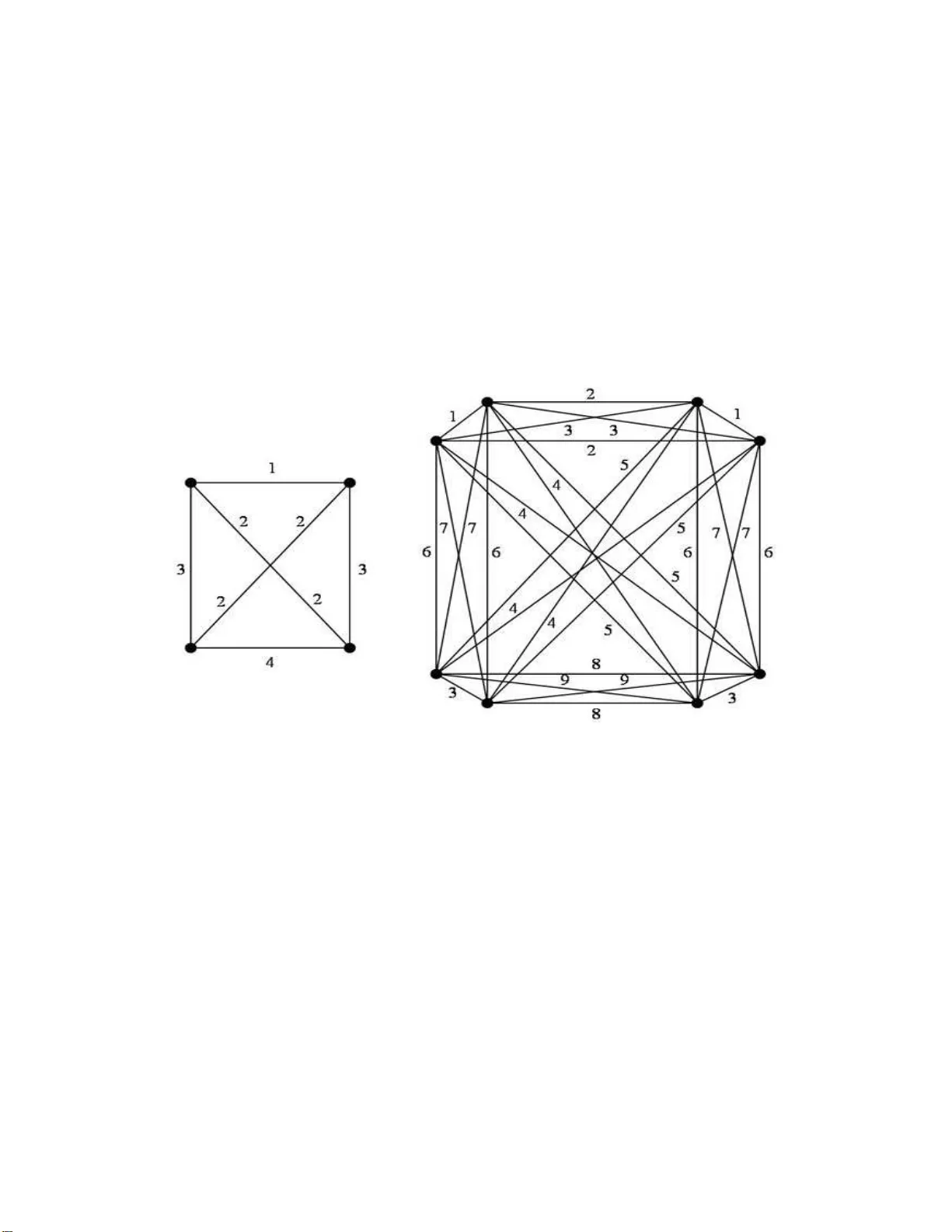
In terv al edge col oring s of some pro duct s o f graphs P etros A. P etrosy a n a b ∗ a Institute for Informatics and Automatio n Problems, National Academ y of Sciences, 0014, Armenia b Departmen t of Informatics a nd Applied Mathematics, Y erev a n State Univ ersit y , 00 25, Armenia An edge coloring of a g raph G with colors 1 , 2 , . . . , t is called an in terv al t -coloring if for eac h i ∈ { 1 , 2 , . . . , t } there is at least one edge of G colored by i , and the colors of edges inciden t to any verte x o f G a r e distinct and form an in terv al of inte gers. A graph G is in terv al colorable, if there is an integer t ≥ 1 for whic h G has an in terv a l t -coloring. Let N b e the set of all in terv al colorable gra phs. In 2004 Kubale and G iaro sho w ed that if G, H ∈ N , then the Cartesian pro duct of these graphs belongs to N . Also, they form u- lated a similar problem for the lexicographic pro duct as an op en problem. In this pap er w e first show that if G ∈ N , then G [ nK 1 ] ∈ N for an y n ∈ N . F urthermore, w e show that if G, H ∈ N and H is a regular graph, then strong and lexicographic pro ducts of graphs G, H b elong to N . W e also prov e that tensor and strong tensor pro ducts of graphs G, H b elong to N if G ∈ N and H is a regular gr a ph. Keyw ords: e dge colo ring, in terv a l coloring, pro ducts of gra phs AMS Sub j ect Classification: 0 5 C15 1. In tro duction An edge coloring of a g raph G with colors 1 , 2 , . . . , t is called an in terv al t -coloring if for eac h i ∈ { 1 , 2 , . . . , t } there is at least one edge of G colored by i , and the colors of edges inciden t t o any v ertex of G are distinct and form an in terv al of in tegers. Inte rv al edge colo r ings naturally arise in sc heduling problems and are related to the problem o f constructing timetables without “ g aps”for teac hers and classes. The no t ion of in terv al edge colorings w as in tro duced b y Asratian and Kamalian [ 1] in 1987. In [ 1] the y pro v ed that if a tria ng le- free graph G = ( V , E ) has an in terv a l t - coloring, then t ≤ | V | − 1. In [ 19] in t erv a l edge colorings of complete bipartite gra phs and t r ees w ere in v estigated. F urthermore, Kamalian [ 20] show ed that if G admits an in terv al t -coloring, then t ≤ 2 | V | − 3 . Giaro, Kubale and Malafiejski [ 12] prov ed that this upp er b o und can b e ∗ email: p et petros@ { ipia.sci.am, ysu.am, yahoo.c om } 1 2 P etros A. P etrosy a n impro v ed to 2 | V | − 4 if | V | ≥ 3. F or a planar gra ph G , Axeno vic h [ 5 ] sho w ed that if G has an in terv al t -coloring, then t ≤ 11 6 | V | . In general, it is an N P -complete problem to decide whether a giv en bipartite graph G admits an in terv al edge coloring [ 35]. In pap ers [ 2, 4, 5, 7, 8, 9 , 10, 11, 12, 13, 14, 15, 16, 19, 20, 21, 22, 23, 29, 30, 32, 34] the problem of existence and construction of interv al edge colorings w as considered and some b o unds for the n umber of colo r s in suc h colorings of some classes of gra phs we re giv en. Surv eys on this topic can b e fo und in some b o oks [ 3, 18, 25]. The differen t pro ducts of graphs we re in t ro duced by Berge [ 6 ], Sabidussi [ 33] and Vizing [ 3 6 ]. There are man y papers [ 17, 24, 26, 27, 28, 31, 38] dev oted to edge colorings of v arious pro ducts of graphs. In this pap er we inv estigate in terv al edge colorings of v arious pro ducts of graphs. 2. Definitions and preliminary results All gra phs conside red in this paper are finite, undirected and ha ve no loops or m ultiple edges. Let V ( G ) and E ( G ) denote the sets of v ertices and edges of G , resp ectiv ely . T he maxim um degree of a v ertex of G is denoted b y ∆( G ) and the c hromatic index of G by χ ′ ( G ). A partial edge coloring o f G is a colo ring of some of the edges of G suc h that no t w o adjacent edges receiv e the same color. If α is a partial edge coloring of G and v ∈ V ( G ) then S ( v , α ) denotes the set of colors of colored edges inciden t to v . A gra ph G is in terv al colorable, if there is an inte ger t ≥ 1, for whic h G has an interv al t -coloring. Let N b e the set of all interv al colorable graphs [ 1, 20]. F or a graph G ∈ N , the least and the greatest v alues of t fo r whic h G has an interv al t -coloring are denoted b y w ( G ) and W ( G ), respectiv ely . Let G = ( V ( G ) , E ( G )) and H = ( V ( H ) , E ( H )) b e tw o g raphs. The Cartesian pro duct G H is defined as follows: V ( G H ) = V ( G ) × V ( H ), E ( G H ) = { (( u 1 , v 1 ) , ( u 2 , v 2 )) | u 1 = u 2 and ( v 1 , v 2 ) ∈ E ( H ) or v 1 = v 2 and ( u 1 , u 2 ) ∈ E ( G ) } . The tensor (direct) pro duct G × H is defined as follows : V ( G × H ) = V ( G ) × V ( H ), E ( G × H ) = { (( u 1 , v 1 ) , ( u 2 , v 2 )) | ( u 1 , u 2 ) ∈ E ( G ) and ( v 1 , v 2 ) ∈ E ( H ) } . The strong tensor (semistrong) pro duct G ⊗ H is defined as follows : V ( G ⊗ H ) = V ( G ) × V ( H ), E ( G ⊗ H ) = { (( u 1 , v 1 ) , ( u 2 , v 2 )) | ( u 1 , u 2 ) ∈ E ( G ) and ( v 1 , v 2 ) ∈ E ( H ) or v 1 = v 2 and ( u 1 , u 2 ) ∈ E ( G ) } . The strong pro duct G ⊠ H is defined as follows: V ( G ⊠ H ) = V ( G ) × V ( H ), E ( G ⊠ H ) = { (( u 1 , v 1 ) , ( u 2 , v 2 )) | ( u 1 , u 2 ) ∈ E ( G ) and ( v 1 , v 2 ) ∈ E ( H ) or u 1 = u 2 and ( v 1 , v 2 ) ∈ E ( H ) or v 1 = v 2 and ( u 1 , u 2 ) ∈ E ( G ) } . The lexicographic pro duct (c omp osition) G [ H ] is defined as follo ws: In terv al edge colorings of some pro ducts of graphs 3 V ( G [ H ]) = V ( G ) × V ( H ), E ( G [ H ]) = { (( u 1 , v 1 ) , ( u 2 , v 2 )) | ( u 1 , u 2 ) ∈ E ( G ) or u 1 = u 2 and ( v 1 , v 2 ) ∈ E ( H ) } . The terms and concepts that w e do not define can be f ound in [ 37]. Asratian and Kamalian prov ed the f ollo wing: Theorem 1 [ 1]. L et G b e a r e gular gr aph. Then (1) G ∈ N if and only if χ ′ ( G ) = ∆( G ) . (2) I f G ∈ N a nd ∆( G ) ≤ t ≤ W ( G ) , then G has an interval t -c oloring. Corollary 2 I f G is an r -r e gular bip artite gr aph , then G ∈ N and w ( G ) = r . Kubale and Giaro prov ed the following: Theorem 3 [ 25]. If G, H ∈ N , then G H ∈ N . Mor e over, w ( G H ) ≤ w ( G ) + w ( H ) and W ( G H ) ≥ W ( G ) + W ( H ) . The k -dimensional grid G ( n 1 , n 2 , . . . , n k ), n i ∈ N is the Cartesian pro duct of paths P n 1 P n 2 · · · P n k . The cylinder C ( n 1 , n 2 ) is the Cartesian pro duct P n 1 C n 2 and the torus T ( n 1 , n 2 ) is t he Cartesian pro duct C n 1 C n 2 , where C n i is the cycle of length n i . F or these graphs Kubale and Giaro prov ed t he f ollo wing: Theorem 4 [ 10]. I f G = G ( n 1 , n 2 , . . . , n k ) or G = C ( m, 2 n ) , m ∈ N , n ≥ 2 , or G = T (2 m, 2 n ) , m, n ≥ 2 , then G ∈ N and w ( G ) = ∆( G ) . F or the greatest p ossible n um b er o f colors in interv al edge coloring s of g rid graphs P etrosy an and Karap ety an prov ed the follo wing theorems: Theorem 5 [ 29]. If G = C ( m, 2 n ) , m ∈ N , n ≥ 2 , then W ( G ) ≥ 3 m + n − 2 . Theorem 6 [ 29]. If G = T (2 m, 2 n ) , m, n ≥ 2 , then W ( G ) ≥ max { 3 m + n, 3 n + m } . In [ 30] P etrosyan inv estigated in terv al edge colorings of complete graphs and n -dimensional cub es Q n . In particular, he prov ed the f ollo wing theorems: Theorem 7 W ( Q n ) ≥ n ( n +1) 2 for any n ∈ N . Theorem 8 L e t n = p 2 q , wher e p is o dd and q is nonne gative. Then W ( K 2 n ) ≥ 4 n − 2 − p − q . The Hamming gr aph H ( n 1 , n 2 , . . . , n k ), n i ∈ N is the Cartesian pro duct o f complete graphs K n 1 K n 2 · · · K n k . The graph H k n is the Cartesian pro duct o f the complete graph K n b y itself k times. It is easy to see that from Theorems 1, 3 and 8, we ha v e the follo wing result: 4 P etros A. P etrosy a n Theorem 9 L et n = p 2 q , wher e p is o dd and q is nonne gative. The n (1) H k 2 n ∈ N , (2) w ( H k 2 n ) = (2 n − 1) k , (3) W ( H k 2 n ) ≥ (4 n − 2 − p − q ) k . It is kno wn that there ar e graphs G and H for whic h G H ∈ N ( G [ H ] ∈ N ), but G ∈ N , H / ∈ N o r G, H / ∈ N . F or example, K 2 C 3 ∈ N a nd K 1 , 1 , 3 C 3 ∈ N ( K 2 [ C 5 ] ∈ N and C 5 [ P ] ∈ N ), but K 1 , 1 , 3 , C 3 / ∈ N ( P , C 5 / ∈ N , where P is the P etersen gr a ph). Mor eov er, general results can b e obta ined f r om the follo wing theorems: Theorem 10 (Kotzig [ 24], Pisanski, S hawe-T aylor, Mohar [ 31]) I f G and H ar e two r e gular gr aphs for which at le ast one of the fol lowing c onditions holds: (1) G and H c ontain a p erfe ct m atching, (2) χ ′ ( G ) = ∆( G ) , (3) χ ′ ( H ) = ∆( H ) , then χ ′ ( G H ) = ∆( G H ) and χ ′ ( G [ H ]) = ∆( G [ H ]) . Theorem 11 (Kotzig [ 2 4], Pisa nski, Shawe-T aylor, Mohar [ 31]) L et G b e a cubic gr a ph. Then χ ′ ( G C n ) = ∆( G C n ) = 5 and χ ′ ( C n [ G ]) = ∆( C n [ G ]) for any n ≥ 4 . Corollary 12 If G and H ar e two r e gular gr ap hs for w hich at l e ast one of the fol lowing c onditions holds: (1) G and H c ontain a p erfe ct m atching, (2) G ∈ N , (3) H ∈ N , then G H, G [ H ] ∈ N and w ( G H ) = ∆( G H ) , w ( G [ H ]) = ∆( G [ H ]) . Corollary 13 L et G b e a cubic gr aph. Then G C n , C n [ G ] ∈ N and w ( G C n ) = ∆( G C n ) = 5 , w ( C n [ G ]) = ∆( C n [ G ]) for any n ≥ 4 . Theorem 14 The torus T ( n 1 , n 2 ) ∈ N if n 1 · n 2 is even, T ( n 1 , n 2 ) / ∈ N if n 1 · n 2 is o dd and the Hamming gr aph H ( n 1 , n 2 , . . . , n k ) ∈ N if n 1 · n 2 · · · n k is even, H ( n 1 , n 2 , . . . , n k ) / ∈ N if n 1 · n 2 · · · n k is o dd. Pro of. Since T ( n 1 , n 2 ) a nd H ( n 1 , n 2 , . . . , n k ) a re regular graphs, by Theorem 1 and Corol- lary 12, we ha v e T ( n 1 , n 2 ) ∈ N when n 1 · n 2 is ev en and H ( n 1 , n 2 , . . . , n k ) ∈ N when n 1 · n 2 · · · n k is ev en. Let us sho w that T ( n 1 , n 2 ) / ∈ N when n 1 · n 2 is o dd and H ( n 1 , n 2 , . . . , n k ) / ∈ N when n 1 · n 2 · · · n k is o dd. Since T ( n 1 , n 2 ) and H ( n 1 , n 2 , . . . , n k ) are regular graphs, we ha ve In terv al edge colorings of some pro ducts of graphs 5 | E ( T ( n 1 , n 2 )) | = 2 n 1 · n 2 and | E ( H ( n 1 , n 2 , . . . , n k )) | = n 1 · n 2 ··· n k · ∆( H ( n 1 ,n 2 ,...,n k )) 2 . If χ ′ ( T ( n 1 , n 2 )) = ∆( T ( n 1 , n 2 )) = 4, then | E ( T ( n 1 , n 2 )) | ≤ 2( n 1 · n 2 − 1), since n 1 · n 2 is o dd. This sho ws that χ ′ ( T ( n 1 , n 2 )) = ∆( T ( n 1 , n 2 ))+ 1 = 5 a nd, b y Theorem 1, T ( n 1 , n 2 ) / ∈ N . Similarly , if χ ′ ( H ( n 1 , n 2 , . . . , n k )) = ∆( H ( n 1 , n 2 , . . . , n k )), then | E ( H ( n 1 , n 2 , . . . , n k )) | ≤ ( n 1 · n 2 ··· n k − 1) · ∆( H ( n 1 ,n 2 ,...,n k )) 2 , since n 1 · n 2 · · · n k is o dd. This sho ws that χ ′ ( H ( n 1 , n 2 , . . . , n k )) = ∆( H ( n 1 , n 2 , . . . , n k )) + 1 and, b y Theorem 1, H ( n 1 , n 2 , . . . , n k ) / ∈ N . 3. Main results First, w e consider in terv al edge colorings of the tensor pro duct of gr aphs. In [ 25] Kubale and Giaro noted that there are graphs G, H ∈ N , suc h that G × H / ∈ N . Here, w e pro v e that if one of the graphs b elongs to N and the other is regular, then G × H ∈ N . Theorem 15 If G ∈ N and H is an r -r e gular gr aph, then G × H ∈ N . Mor e over, w ( G × H ) ≤ w ( G ) · r and W ( G × H ) ≥ W ( G ) · r . Pro of. Let V ( G ) = { u 1 , u 2 , . . . , u n } , V ( H ) = { v 1 , v 2 , . . . , v m } and V ( G × H ) = n w ( i ) j | 1 ≤ i ≤ n, 1 ≤ j ≤ m o , E ( G × H ) = n w ( i ) p , w ( j ) q | ( u i , u j ) ∈ E ( G ) and ( v p , v q ) ∈ E ( H ) o . Let us consider the graph K 2 × H . Clearly , K 2 × H is an r -regular bipartite graph, th us, by Corollary 2, K 2 × H ∈ N and w ( K 2 × H ) = r . Let α b e an inte rv al t - coloring of the graph G , β b e an in terv al r - coloring of the graph K 2 × H and V ( K 2 × H ) = { x 1 , x 2 , . . . , x m , y 1 , y 2 , . . . , y m } , E ( K 2 × H ) = { ( x i , y j ) | ( v i , v j ) ∈ E ( H ) , 1 ≤ i ≤ m, 1 ≤ j ≤ m } . Define an edge coloring γ of the graph G × H in the following w ay: for ev ery w ( i ) p , w ( j ) q ∈ E ( G × H ) γ w ( i ) p , w ( j ) q = ( α (( u i , u j )) − 1) · r + β (( x p , y q )), where 1 ≤ i ≤ n, 1 ≤ j ≤ n, 1 ≤ p ≤ m, 1 ≤ q ≤ m . It is not difficult to see that γ is an in t erv a l t · r -colo ring of the graph G × H . By the definition of γ , w e ha v e w ( G × H ) ≤ w ( G ) · r and W ( G × H ) ≥ W ( G ) · r . 6 P etros A. P etrosy a n Figure 1. The interv al 6 -coloring γ of the graph P 4 × C 5 . The Figure 1 sho ws the interv al 6 -coloring γ of the graph P 4 × C 5 described in the pro of of Theorem 15. Note that from Theorems 1 and 15, we ha ve the follo wing result: Corollary 16 (Pisanski, Shawe-T aylor, Mohar [ 31]) I f G is 1 -factor a ble and H is a r e gular gr aph, then G × H is also 1 -factor able . W e sho w ed that if G ∈ N and H is regular, then G × H ∈ N . No w we pro v e a similar result for the strong tensor pro duct of graphs. Theorem 17 If G ∈ N and H is an r -r e gular gr aph, then G ⊗ H ∈ N . Mor e ov er, w ( G ⊗ H ) ≤ w ( G ) · ( r + 1) and W ( G ⊗ H ) ≥ W ( G ) · ( r + 1) . Pro of. Let V ( G ) = { u 1 , u 2 , . . . , u n } , V ( H ) = { v 1 , v 2 , . . . , v m } and V ( G ⊗ H ) = n w ( i ) j | 1 ≤ i ≤ n, 1 ≤ j ≤ m o , E ( G ⊗ H ) = E ( G × H ) ∪ n w ( i ) p , w ( j ) p | 1 ≤ p ≤ m and ( u i , u j ) ∈ E ( G ) o . Let us consider the g r a ph K 2 ⊗ H . Clearly , K 2 ⊗ H is an ( r + 1)-regula r bipartite graph, th us, by Coro llary 2, K 2 ⊗ H ∈ N a nd w ( K 2 ⊗ H ) = r + 1. Let α b e an interv al t -colo ring of the graph G , β b e an interv al ( r + 1)- coloring of the graph K 2 ⊗ H and In terv al edge colorings of some pro ducts of graphs 7 V ( K 2 ⊗ H ) = { x 1 , x 2 , . . . , x m , y 1 , y 2 , . . . , y m } , E ( K 2 ⊗ H ) = { ( x i , y i ) | 1 ≤ i ≤ m } ∪ E ( K 2 × H ). Define an edge coloring γ of the graph G ⊗ H in the following w ay: for ev ery w ( i ) p , w ( j ) q ∈ E ( G ⊗ H ) γ w ( i ) p , w ( j ) q = ( α (( u i , u j )) − 1) · ( r + 1 ) + β (( x p , y q )), where 1 ≤ i ≤ n, 1 ≤ j ≤ n, 1 ≤ p ≤ m, 1 ≤ q ≤ m . It is not difficult to see that γ is a n in terv al t · ( r + 1)-coloring of the graph G ⊗ H . By the de finition of γ , we hav e w ( G ⊗ H ) ≤ w ( G ) · ( r + 1) and W ( G ⊗ H ) ≥ W ( G ) · ( r + 1) . The Figure 2 sho ws the interv al 9-coloring γ o f the graph P 4 ⊗ C 5 described in the pro of of Theorem 17. Figure 2. The in terv al 9- coloring γ o f the graph P 4 ⊗ C 5 . Note that from Theorems 1 and 17, we ha ve the follo wing result: Corollary 18 ( Pisanski, Sh awe-T aylor, Mohar [ 31]) If G is 1 -factor able and H is a r e gular gr aph, then G ⊗ H is also 1 -factor able. 8 P etros A. P etrosy a n Next, w e consider in terv al edge colo rings of the strong pro duct of graphs. In [ 25] Kubale and G iaro noted that t here are graphs G, H ∈ N , suc h that G ⊠ H / ∈ N . Here, w e prov e that if tw o g raphs b elong to N and one of them is regular, then G ⊠ H ∈ N . Theorem 19 If G, H ∈ N and H is an r - r e gular gr a ph, then G ⊠ H ∈ N . Mor e ove r, w ( G ⊠ H ) ≤ w ( G ) · ( r + 1) + r and W ( G ⊠ H ) ≥ W ( G ) · ( r + 1) + r . Pro of. Let V ( G ) = { u 1 , u 2 , . . . , u n } , V ( H ) = { v 1 , v 2 , . . . , v m } and V ( G ⊠ H ) = S n i =1 V i ( H ), whe re V i ( H ) = n w ( i ) j | 1 ≤ j ≤ m o , E ( G ⊠ H ) = E ( G ⊗ H ) ∪ S n i =1 E i ( H ), whe re E i ( H ) = n w ( i ) p , w ( i ) q | ( v p , v q ) ∈ E ( H ) o . F or i = 1 , 2 , . . . , n , define a graph H i as follow s: H i = ( V i ( H ) , E i ( H )). First of all note that χ ′ ( H ) = ∆( H ) = r since H ∈ N and H is a n r -regular gra ph. This implies tha t there exists an inte rv al r -colo r ing of the graph H . Let us consider the graph K 2 ⊗ H . Clearly , K 2 ⊗ H is an ( r + 1)-regular bipartit e graph, th us, b y Corollary 2, K 2 ⊗ H ∈ N and w ( K 2 ⊗ H ) = r + 1. Let α b e an in terv al t -coloring of the g raph G , β b e an in terv al ( r + 1) - coloring of the graph K 2 ⊗ H . Define an edge coloring γ of the graph G ⊠ H in the following w ay: (1) for ev ery w ( i ) p , w ( j ) q ∈ E ( G ⊗ H ) γ w ( i ) p , w ( j ) q = ( α (( u i , u j )) − 1) · ( r + 1 ) + β (( x p , y q )), where 1 ≤ i ≤ n, 1 ≤ j ≤ n, 1 ≤ p ≤ m, 1 ≤ q ≤ m . (2) for i = 1 , 2 , . . . , n , the edges of the subgraph H i w e color prop erly with colors max S ( u i , α ) · ( r + 1) + 1 , max S ( u i , α ) · ( r + 1) + 2 , . . . , max S ( u i , α ) · ( r + 1) + r It is easy to see that γ is an in terv al ( t · ( r + 1) + r )-coloring of the graph G ⊠ H . By t he definition of γ , w e hav e w ( G ⊠ H ) ≤ w ( G ) · ( r + 1) + r and W ( G ⊠ H ) ≥ W ( G ) · ( r + 1) + r . The Figure 3 shows the inte rv al 11-colo ring γ of the graph P 4 ⊠ C 4 described in the pro of of Theorem 19. Note that there are graphs G and H for whic h G ⊠ H ∈ N , but G ∈ N , H / ∈ N . F or example, K 2 ⊠ C 3 ∈ N , but C 3 / ∈ N . F or regular graphs the follo wing result w as obtained b y Zhou [ 38]. In terv al edge colorings of some pro ducts of graphs 9 Figure 3. The in terv al 11 -coloring γ of the graph P 4 ⊠ C 4 . Theorem 20 If G is 1 -factor able and H is a r e gular gr aph, then G ⊠ H is also 1 - factor able. Corollary 21 L et G an d H b e two r e gular gr aphs and G ∈ N . Then G ⊠ H ∈ N . Finally , w e turn our attention to in terv al edge colorings of the lexicographic pro duct of graphs. In [ 25] Kubale and G iaro po sed the follo wing question: Problem 1 D o es G [ H ] ∈ N if G, H ∈ N ? W e start b y fo cusing o n the sp ecial case of this problem, when G ∈ N and H = nK 1 for an y n ∈ N . Theorem 22 If G ∈ N , then G [ nK 1 ] ∈ N for any n ∈ N . Mor e over, w ( G [ nK 1 ]) ≤ w ( G ) · n a nd W ( G [ nK 1 ]) ≥ ( W ( G ) + 1) · n − 1 . Pro of. Let V ( G ) = { u 1 , u 2 , . . . , u m } and V ( G [ nK 1 ]) = n v ( i ) j | 1 ≤ i ≤ m, 1 ≤ j ≤ n o , E ( G [ nK 1 ]) = n v ( i ) p , v ( j ) q | ( u i , u j ) ∈ E ( G ) and p, q = 1 , 2 , . . . , n o . 10 P etros A. P etrosy a n Let α b e an in terv al t -coloring of the graph G . Define an edge coloring β of the gr a ph G [ nK 1 ] in the follo wing w ay : for ev ery v ( i ) p , v ( j ) q ∈ E ( G [ nK 1 ]) β v ( i ) p , v ( j ) q = ( α (( u i , u j )) − 1) · n + p + q − 1 (mo d n ), if p + q 6 = n + 1, α (( u i , u j )) · n , if p + q = n + 1. where 1 ≤ i ≤ m, 1 ≤ j ≤ m, 1 ≤ p ≤ n, 1 ≤ q ≤ n . It can b e v erified that β is an in terv al t · n -coloring of the graph G [ nK 1 ]. By the definition of β , w e hav e w ( G [ nK 1 ]) ≤ w ( G ) · n . No w w e sho w t ha t W ( G [ nK 1 ]) ≥ ( W ( G ) + 1) · n − 1. Let φ b e an in terv al W ( G )-coloring of the graph G . Define an edge coloring ψ o f the g r aph G [ nK 1 ] in the follo wing w ay : for ev ery v ( i ) p , v ( j ) q ∈ E ( G [ nK 1 ]) ψ v ( i ) p , v ( j ) q = ( φ (( u i , u j )) − 1) · n + p + q − 1, where 1 ≤ i ≤ m, 1 ≤ j ≤ m, 1 ≤ p ≤ n, 1 ≤ q ≤ n . It is easy to see that ψ is an in terv al ( W ( G ) · n + n − 1)-colo r ing of the graph G [ nK 1 ]. The Figure 4 sho ws the in terv al 6- coloring β o f the graph ( K 1 , 3 + e )[2 K 1 ] describ ed in the pro of of Theorem 22. Corollary 23 (Kamalian, Petr osyan [ 22]) If k is even, then C k [ nK 1 ] ∈ N and W ( C k [ nK 1 ]) ≥ 2 n + n · k 2 − 1 . Corollary 24 (Kamalian, Petr osyan [ 2 3]) L et k = p 2 q , wh er e p is o dd and q ∈ N . Then K k [ nK 1 ] ∈ N and W ( K k [ nK 1 ]) ≥ (2 k − p − q ) · n − 1 . No w w e sho w t ha t G [ H ] ∈ N if G, H ∈ N and H is regular. Theorem 25 If G, H ∈ N and H is an r -r e gular gr aph, then G [ H ] ∈ N . Mor e over, if | V ( H ) | = n , then w ( G [ H ]) ≤ w ( G ) · n + r and W ( G [ H ]) ≥ W ( G ) · n + r . Pro of. Let V ( G ) = { u 1 , u 2 , . . . , u m } , V ( H ) = { v 1 , v 2 , . . . , v n } and V ( G [ H ]) = S m i =1 V i ( H ), whe re V i ( H ) = { w ( i ) j | 1 ≤ j ≤ n } , In terv al edge colorings of some pro ducts of graphs 11 Figure 4. The in terv al 6- coloring β of the graph ( K 1 , 3 + e )[2 K 1 ]. E ( G [ H ]) = n w ( i ) p , w ( j ) q | ( u i , u j ) ∈ E ( G ) and p, q = 1 , 2 , . . . , n o ∪ S m i =1 E i ( H ), whe re E i ( H ) = n w ( i ) p , w ( i ) q | ( v p , v q ) ∈ E ( H ) o . Let α b e an in terv al t -coloring of the graph G and H i = ( V i ( H ) , E i ( H )) f or i = 1 , 2 , . . . , m . Note that χ ′ ( H ) = ∆( H ) = r since H ∈ N and H is an r - r egular graph. T his implies that there exists an in terv al r - coloring of the graph H . Define an edge coloring β of the gr a ph G [ H ] in the following w ay: (1) f or ev ery w ( i ) p , w ( j ) q ∈ E ( G [ H ]) β w ( i ) p , w ( j ) q = r + ( α (( u i , u j )) − 1) · n + p + q − 1 (mo d n ), if p + q 6 = n + 1, r + α (( u i , u j )) · n , if p + q = n + 1, where 1 ≤ i ≤ m, 1 ≤ j ≤ m, i 6 = j, 1 ≤ p ≤ n, 1 ≤ q ≤ n . (2) f or i = 1 , 2 , . . . , m , the edges of the subgraph H i w e color prop erly with colors (min S ( u i , α ) − 1) · n + 1 , (min S ( u i , α ) − 1) · n + 2 , . . . , (min S ( u i , α ) − 1) · n + r 12 P etros A. P etrosy a n It can b e v erified that β is an interv al ( t · n + r )-coloring of the graph G [ H ]. By the definition of β , w e hav e w ( G [ H ]) ≤ w ( G ) · n + r and W ( G [ H ]) ≥ W ( G ) · n + r . The F ig ure 5 sho ws the in terv al 9 -coloring β of the graph K 4 [ K 2 ] describ ed in the pro of of Theorem 25. Figure 5. The interv al 9 -coloring β of the graph K 4 [ K 2 ]. 4. Problems W e conclude with the follow ing problems on in terv al edge colorings of pro ducts of graphs. Problem 2 Ar e ther e gr aphs G, H / ∈ N , such that G × H ∈ N ? Problem 3 Ar e ther e gr aphs G, H / ∈ N , such that G ⊗ H ∈ N ? Problem 4 Ar e ther e gr aphs G, H / ∈ N , such that G ⊠ H ∈ N ? Ac kno wledgemen t W e would like to thank the a non ymous referees for useful sugges- tions. In terv al edge colorings of some pro ducts of graphs 13 REFEREN CES 1. A.S. Asratian, R.R. Kamalian, Interv al colorings of edges of a m ultigraph, Appl. Math. 5 (1987) 25-34 (in Russian). 2. A.S. Asratian, R.R. Kamalian, Inv estigation on in terv al edge- colo rings o f graphs, J. Com bin. Theory Ser. B 62 (1994) 34-43. 3. A.S. Asratian, T.M.J. Denley , R. Haggkvist, Bipartite Graphs and t heir Applications, Cam bridge Univ ersit y Press, Cam bridge, 199 8. 4. A.S. Asratian, C.J. Casselgren, J. V anden bussc he, D .B. W est, Prop er path-factors and in terv al edge-colo r ing of (3 , 4 )-biregular bigraphs, J. Graph Theory 61 (20 09) 88-97. 5. M.A. Axeno vic h, On interv al colorings of planar graphs, Congr . Numer. 159 (20 0 2) 77-94. 6. C. Berge, Theorie des Graphes et ses Applications, Duno d, P aris, 19 58 (in F renc h). 7. M. Bouc hard, A. Hertz, G. D esaulniers, Lo w er b ounds and a tabu searc h algo rithm for the minim um deficiency problem, J. Com b. Optim. 17 (20 09) 168-191. 8. Y. F eng, Q. Huang, Consecutiv e edge-coloring of the generalized θ -graph, Discrete Appl. Math. 15 5 (2007) 23 21-2327. 9. K. Giaro, The complexit y of consecutiv e ∆-coloring of bipartite graphs: 4 is easy , 5 is hard, Ars Com bin. 47 (1 997) 287-298 . 10. K . Gia ro, M. Kubale, Consecutiv e edge-colorings of complete and incomplete Carte- sian pro ducts of gra phs, Congr, Numer. 128 (1997) 143-149. 11. K . Gia ro, M. Kubale, M. Mala fiejski, On the deficiency of bipartite graphs, D iscrete Appl. Math. 94 (19 99) 193-203. 12. K . Giaro, M. K uba le, M. Mala fiejski, Consecutiv e colorings of the edges of general graphs, Discrete Math. 23 6 (2001) 131-143. 13. K . Giaro, M. Kubale, Compact sc heduling of zero-one time op erations in m ulti- stage systems , Discrete Appl. Math. 14 5 (2004) 95-103 . 14. H.M. Hansen, Schedu ling with minim um w aiting perio ds, Master’s Thesis, Odense Univ ersity , Odense, D enmark, 1992 (in Danish). 15. D . Hanson, C.O.M. Loten, A lo w er bo und for in terv al coloring of bi-regular bipartite graphs, Bull. ICA 18 (19 96) 69-74. 16. D . Hanson, C.O.M. Loten, B. T oft, On interv al colorings of bi-regular bipartite gra phs, Ars Com bin. 50 (1998 ) 23-32. 17. P .E. Himmelwrigh t, J.E. Williamson, On 1 - factorability and edge-colorability of car t e- sian pro ducts of gra phs, Elem. Der Math. 29 (1974) 66-67. 18. T.R. Jensen, B. T oft, Graph Coloring Problems , Wiley In terscience Series in Discre te Mathematics and Optimization, 1 9 95. 19. R .R. Kamalian, Inte rv al colo r ing s of complete bipartite graphs and trees, preprint, Comp. Cen. of Acad. Sci. of Armenian SSR, Erev an, 1 9 89 (in Russian). 20. R .R. Kamalian, Interv al edge colorings of graphs, Do ctoral Thesis, No v osibirsk, 1990. 21. R .R. Kamalian, A.N. Mirumian, In terv al edge colorings of bipartite graphs of some class, Dokl. NAN RA, 97 (199 7 ) 3-5 (in Russian). 22. R .R. K a malian, P .A . P etrosy an, Interv al colorings of some regular gra phs, Math. probl. of comp. sci. 25 (20 0 6) 53-56. 23. R .R. Ka malian, P .A. P etrosy an, On interv al colo rings of complete k -partit e graphs 14 P etros A. P etrosy a n K k n , Math. probl. of comp. sci. 26 (200 6) 28-32. 24. A. Kotzig, 1-F a cto r izat io ns of cartesian products of regular graphs, J. Graph Theory 3 (1979) 23-34 . 25. M. Kubale, Graph Colorings, American Mathematical So ciet y , 20 04. 26. E.S. Mahamoo dian, On edge-colorability of cartesian pro ducts of gr a phs, Canad. Math. Bull. 24 (1981) 10 7-108. 27. B. Mohar, T. Pisanski, Edge-coloring o f a family of regular graphs, Publ. Ins t. Math. (Beograd) 33 (47) (19 83) 157-162. 28. B. Mohar, On ed ge-colora bility of pro ducts of graphs, Pu bl. Inst. Math. ( Beograd) 3 6 (50) (1984) 13- 16. 29. P .A. Pe trosy an, G.H. K arap et y an, Low er b ounds for t he greatest p ossible num b er of colors in in terv al edge colorings o f bipartite cylinders and bipartite tori, Pro ceedings of the CSIT Conference (20 07) 86-88. 30. P .A. Pe trosy an, Inte rv al edge-colorings of complete graphs and n -dimensional cub es, Discrete Mathematics 310 (2 0 10) 1580-1587. 31. T. Pisanski, J. Shaw e-T a ylor, B. Mohar, 1-F actorization o f the c omp osition of regular graphs, Publ. Inst. Math. (Beogr ad) 33 (47) (1983) 193-1 96. 32. A.V. Py atkin, Inte rv al colo ring of (3 , 4)-biregular bipartite graphs hav ing larg e cubic subgraphs, J. Gra ph Theory 4 7 (2 004) 122-128. 33. G. Sabidussi, G raph m ultiplication, Math. Z. 72 (1960) 44 6 -457. 34. A. Sch w artz, The deficie ncy of a regular graph, Discrete Math. 306 (2006 ) 19 4 7-1954. 35. S.V. Sev ast’janov , In terv al c olorability of the edges of a bipartite graph, Meto dy Diskret. Analiza 50 (19 90) 61-72 (in Russian). 36. V.G. Vizing, The Cartesian pro duct of gr a phs, Vyc h. Sis. 9 (19 6 3) 30-43 (in Russian). 37. D.B. W est, In tro duction t o Graph Theory , Pren tice-Hall, New Jersey , 1996 . 38. M.K. Zhou, D ecomp osition of some pro duct g raphs in to 1-factors and Hamiltonian cycles, Ars Com bin. 28 (19 89) 258-268 .
Original Paper
Loading high-quality paper...
Comments & Academic Discussion
Loading comments...
Leave a Comment