On continuous functions on two-dimensional disk which are regular in its interior points
We introduce a class of regular continuous functions on the closed 2-disk and show that each function from this class is topologically conjugate to a linear function defined on a sqare, a closed half-disk or a closed disk.
Authors: Yevgen Polulyakh
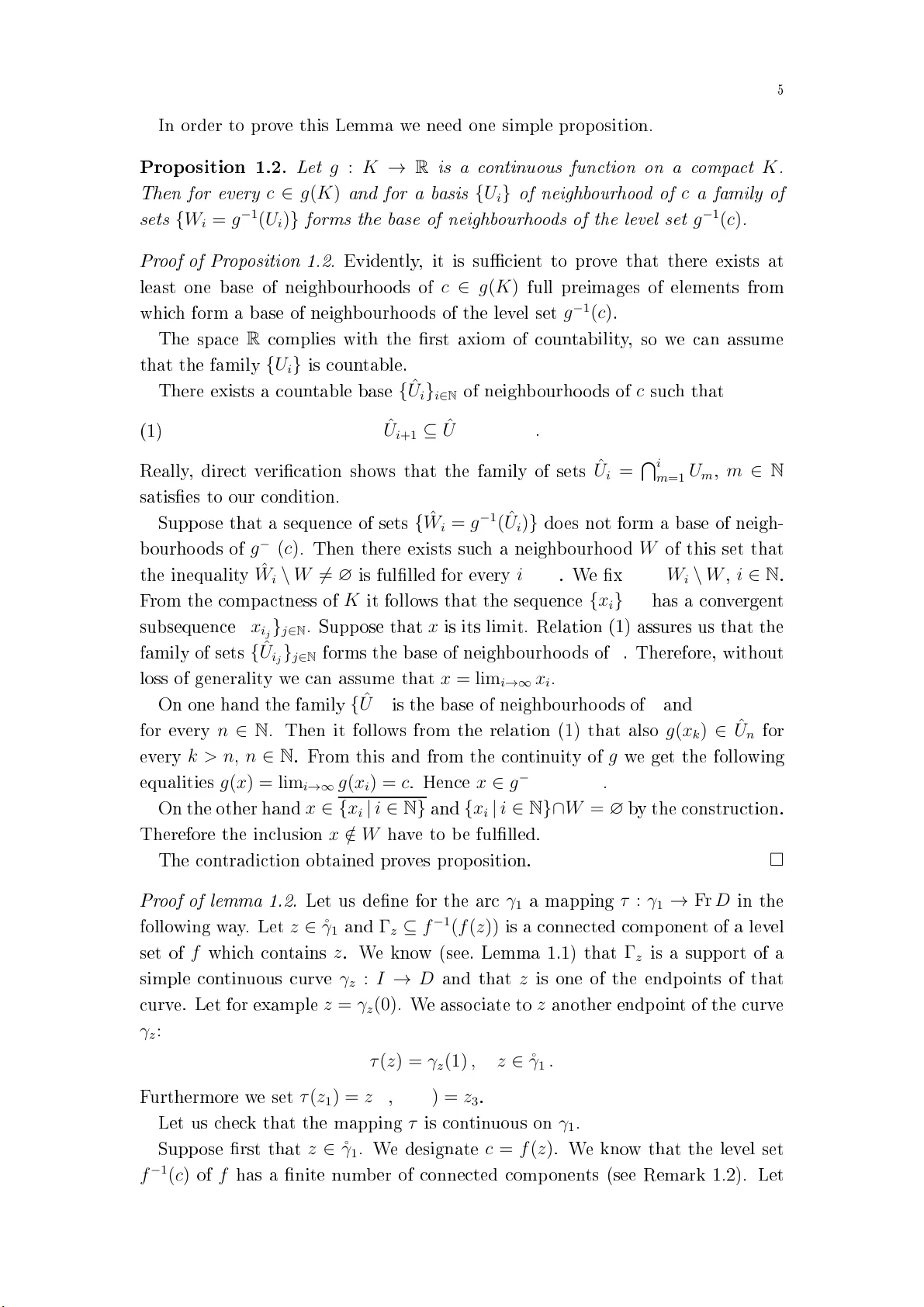
On on tin uous funtions on t w o-dimensional disk whi h are regular in its in terior p oin ts. Y evgen P oluly akh 1 Institute of mathematis of Natl. A ad. Si. of Ukraine, Kyiv Abstrat. W e in tro due a lass of regular on tin uous funtions on the losed 2-disk and sho w that ea h funtion from this lass is top ologially onjugate to a linear funtion dened on a sqare, a losed half-disk or a losed disk. Keyw ords . regular funtion, U -tra jetory , F re het distane b et w een urv es, µ -length of a urv e. Intr odution Let us remind that a pseudo-harmoni funtion (see [1℄) on a losed domain in the plain (see [2℄) is a on tin uous funtion su h that in a small op en neigh b ourho o d of ea h in terior p oin t of the domain it is top ologially onjugate to a funtion Re z n + const in a op en neigh b ourho o d of zero for a ertain n ∈ N . In the pro ess of in v estigation of pseudo-harmoni funtions the follo wing prob- lem arises. Supp ose w e ha v e t w o pseudo-harmoni funtions f and g on a same losed domain G and all singularities of f and g are on tained in some on v e- nien t subsets R ( f ) and R ( g ) of G whi h are unions of some families of onneted omp onen ts of lev el sets of f and g resp etiv ely with F r G . Supp ose that w e ha v e a homeomorphism Φ 0 : R ( f ) → R ( g ) whi h omplies with the relation g ◦ Φ 0 = f . The question is whether w e an extend Φ 0 to a homeomorphism Φ : G → G , su h that g ◦ Φ = f . In order to onstrut an extension w e ha v e to nd a homeomorphism Φ U : U → V su h that g ◦ Φ U = f and Φ U | R ( f ) = Φ 0 for ev ery onneted omp onen t U of the set G \ R ( f ) and a onneted omp onen t V of G \ R ( g ) whi h is b ounded b y the set F r V = Φ 0 (F r U ) = Φ 0 ( U ∩ R ( f )) . When a domain G is b ounded b y a nite n um b er of simple losed urv es and funtions f and g ha v e a nite n um b er of singular p oin ts b oth in G and on the fron tier F r G one ould v erify that for a on v enien t subset R ( f ) a losure U of ev ery omp onen t U of the set G \ R ( f ) is homeomorphi to a losed 2-disk (see [1, 3℄) and f is regular in a sense on U . In this artile w e will disuss the denition and dieren t prop erties of regular funtions on a losed 2-disk the most remark able of whi h is giv en b y the follo wing statemen t. Theorem. L et f and g ar e r e gular funtions on a lose d 2-disk D . 1 Institute of mathematis, T eres henkivsk a str. 3, 01601, Kyiv, Ukraine e-mail: polulyahimath. ki ev. ua 1 2 Every home omorphism ϕ 0 : ∂ D → ∂ D of the fr ontier ∂ D of D whih omplies with the e quality g ◦ ϕ 0 = f an b e extende d to a home omorphism ϕ : D → D whih satises the e quality g ◦ ϕ = f . 1. Weakl y regular funtions on disk and their pr oper ties. Let W b e a domain in the plane R 2 , f : W → R b e a on tin uous funtion. W e denote D 2 = { z | | z | ≤ 1 } , D 2 + = { z | | z | < 1 and I mz ≥ 0 } . Denition 1.1. W e al l z 0 ∈ W a regular p oin t of the funtion f if ther e exist an op en neighb ourho o d U ⊆ W of z 0 and a home omorphism ϕ : U → Int D 2 suh that ϕ ( z 0 ) = 0 and f ◦ ϕ − 1 ( z ) = R ez + f ( z 0 ) for al l z ∈ In t D 2 . U is al le d a anonial neigh b ourho o d of z 0 . Denition 1.2. Cal l z 0 ∈ F r W a regular b oundary p oin t of f if ther e exist an op en neighb ourho o d U in the sp a e W and a home omorphism ψ : U → D 2 + suh that ψ ( z 0 ) = 0 , ψ ( U ∩ f − 1 ( f ( z 0 ))) = { 0 } × [0 , 1) , ψ ( U ∩ F r W ) = ( − 1 , 1) × { 0 } and a funtion f ◦ ψ − 1 is stritly monotone on the interval ( − 1 , 1 ) × { 0 } . A neighb ourho o d U is al le d anonial . Remark 1.1. It is e asy to se e that anoni al neighb ourho o d in denitions 1.1 and 1.2 an b e hosen arbitr arily smal l. Let D is a losed subset of the plane whi h is homeomorphi to D 2 . Let us x a b ypass diretion of a b oundary irle F r D . Assume that when w e b ypass the irle F r D in the p ositiv e diretion w e on- seutiv ely pass through p oin ts z 1 , . . . , z 2 n − 1 , z 2 n for some n ≥ 2 , and also not neessarily z k 6 = z k +1 . F or ev ery k ∈ { 1 , . . . , 2 n } w e designate b y γ k an ar of the irle F r D whi h originates in z k and ends in either z k +1 when k < 2 n or z 1 if k = 2 n , so that the mo v emen t diretion along it oinsides with the b ypass diretion of F r D . W rite ˚ γ k = γ k \ { z k , z k +1 } when k ∈ { 1 , . . . , 2 n − 1 } , ˚ γ 2 n = γ 2 n \ { z 2 n , z 1 } . Denition 1.3. Assume that for a ontinuous funtion f : D → R ther e exist suh n = N ( f ) ≥ 2 and a se quen e of p oints z 1 , . . . , z 2 n − 1 , z 2 n ∈ F r D (whih ar e p asse d thr ough in this or der when the ir le F r D is byp asse d in the p ositive dir e tion) that fol lowing pr op erties ar e full le d: 1) every p oint of a domain In t D = D \ F r D is a r e gular p oint of f ; 2) ˚ γ 2 k − 1 6 = ∅ for k ∈ { 1 , . . . , n } and every p oint of an ar ˚ γ 2 k − 1 is a r e gular b oundary p oint of f (sp e i al ly, the r estrition of f onto γ 2 k − 1 is stritly monotone); 3) ar s γ 2 k , k ∈ { 1 , . . . , n } ar e onne te d omp onents of level urves of the funtion f . W e al l suh funtions w eakly regular on D . 3 Prop osition 1.1. L et f is a we akly r e gular funtion on D . A set S n k =1 γ 2 k do es not ontain r e gular b oundary p oints of f , ther efor e the num- b er N ( f ) is wel l dene d and oinides with the numb er of onne te d omp onents of the set of r e gular b oundary p oints of f . Pr o of. Let z ∈ F r D is a regular b oundary p oin t of f . Denote b y Γ z a onneted omp onen t of lev el urv e of f whi h on tains z . W e x a anonial neigh b ourho o d U of z and a homeomorphism ψ : U → D 2 + from denition 1.2 . Then, as it ould b e easily v eried, ψ − 1 ( { 0 } × [0 , 1)) ⊆ Γ z and ∅ 6 = ψ − 1 ( { 0 } × (0 , 1)) ⊆ Γ z ∩ Int D . Therefore it follo ws from the ondition 3 of denition 1.3 that z / ∈ S n k =1 γ 2 k . Hene, the n um b er of ars γ 2 k − 1 , k ∈ { 1 , . . . , n } oinides with the n um b er of onneted omp onen ts of the set of regular b oundary p oin ts of f . It dep ends only on f and the n um b er N ( f ) is w ell dened. Lemma 1.1. L et a funtion f is we akly r e gular on D . Every onne te d omp onent of nonempty level set of f is either a p oint z 2 k , k ∈ { 1 , . . . , n } if z 2 k = z 2 k + 1 , or a supp ort of a simple ontinuous urve γ : I → D whih satises to the fol lowing pr op erties: • endp oints γ (0) and γ (1) b elong to distint ar s γ 2 j − 1 and γ 2 k − 1 , j, k ∈ { 1 , . . . , n } , j 6 = k ; • either γ ( I ) \{ γ (0) , γ (1) } ⊂ In t D or γ ( I ) = γ 2 k for a ertain k ∈ { 1 , . . . , n } . Pr o of. Assume that c ∈ R omplies with the inequalit y f − 1 ( c ) 6 = ∅ . Let us on- sider a onneted omp onen t Γ c of the lev el set f − 1 ( c ) . There are t w o p ossibilities. 1) Let Γ c ∩ In t D = ∅ . Then Γ c = γ 2 k for a ertain k ∈ { 1 , . . . , n } . Really , if Γ c 6⊂ S n k =1 γ 2 k then there exists a regular b oundary p oin t w ∈ Γ c . It follo ws from denition 1.2 that a p ortion of the onneted omp onen t Γ c whi h is on tained in a anonial neigh b ourho o d of the p oin t w has a nonempt y in tersetion with In t D . But if Γ c ⊂ S n k =1 γ 2 k then the statemen t of lemma follo ws from prop ert y 3 of the denition of a w eakly regular funtion on D . In the ase under onsideration the set Γ c = γ 2 k is either a single-p oin t or a supp ort of a simple on tin uous urv e whi h endp oin ts are on tained in the sets γ 2 k − 1 and γ 2 k + 1 when k ∈ { 1 , . . . , n − 1 } or in γ 2 n − 1 and γ 1 if k = n . 2) Let Γ c ∩ Int D 6 = ∅ . Then the set Γ c is a supp ort of a simple on tin uous urv e γ : I → D , with Γ c ∩ F r D = { γ (0) , γ (1 ) } ⊂ S n k =1 ˚ γ 2 k − 1 . Let us v erify this. It follo ws from the ondition 3 of denition 1.3 that Γ c ∩ F r D ⊂ S n k =1 ˚ γ 2 k − 1 . Therefore b y denition all p oin ts of Γ c ∩ F r D are regular b oundary p oin ts of f . All remaining p oin ts of the set Γ c b elong to In t D and are regular p oin ts of f . Denote b y Θ : ( − 1 , 1) → Int D 2 a mapping Θ( s ) = (0 , s ) , s ∈ ( − 1 , 1) . 4 It is lear that Θ is the homeomorphism on to its image. Denote also ˆ Θ = Θ [0 , 1) : [0 , 1) → D 2 + . This mapping is ob viously also the em b edding. Let v ∈ In t D ∩ Γ c . By denition v is the regular p oin t of f . Let U v and ϕ v : U v → Int D 2 are a neigh b ourho o d and a homeomorphism from denition 1.1. Then ϕ v ( f − 1 ( f ( v ))) = { 0 } × ( − 1 , 1) , therefore ϕ v (Γ c ) = { 0 } × ( − 1 , 1) , a mapping Θ − 1 ◦ ϕ v = Φ v : Q v = Γ c ∩ U v → ( − 1 , 1) is w ell dened and it maps Q v homeomorphially on to ( − 1 , 1 ) . By onstrution the set Q v is an op en neigh b ourho o d of v in the spae Γ c . So, a map ( Q v , Φ v : Q v → ( − 1 , 1 )) is asso iated to ev ery p oin t v ∈ In t D ∩ Γ c . By analogy , if w ∈ Γ c ∩ F r D then for its neigh b ourho o d U w and a homeomor- phism ψ w : U w → D 2 + , whi h omply with denition 1.2 , a set ˆ Q w = U w ∩ Γ c and a mapping Ψ w = ˆ Θ − 1 ◦ ψ w : ˆ Q w → [0 , 1) dene a map of the spae Γ c in the p oin t w . Ob viously the set Γ c with the top ology indued from D is a Hausdor spae with a oun table base. Moreo v er, ev ery p oin t of this set has a neigh b ourho o d in Γ c whi h is homeomorphi to the in terv al (0 , 1) or to the haln terv al [0 , 1) . Hene Γ c is the ompat (it is the losed subset of ompat D ) onneted one-dimensional manifold with or without b oundary . Therefore the spae Γ c is homeomorphi either to the irle S 1 or to the segmen t I . Assume that Γ c ∼ = S 1 . Let R ⊂ D is a losed domain with the b oundary Γ c . All p oin ts of In t R are regular p oin ts of f . F rom denition 1.1 it follo ws that a regular p oin t annot b e a p oin t of lo al extrem um of f . Th us f 6≡ const on R , otherwise ev ery p oin t from In t R should b e a p oin t of lo al extrem um of f . R is the ompat set, so the on tin uous funtion f should ri h its maximal and minimal v alues on R . Let f ( v ′ ) = min z ∈ R f ( z ) , f ( v ′′ ) = max z ∈ R f ( z ) for ertain v ′ , v ′′ ∈ R . W e ha v e allready pro v ed that f ( v ′ ) 6 = f ( v ′′ ) , therefore one of these t w o n um b ers is distint from c = f (Γ c ) and one of the p oin ts v ′ , v ′′ is on tained in In t R , hene it is the p oin t of lo al extrem um of f . Then it annot b e a regular p oin t of f . F rom the reeiv ed on tradition w e onlude that Γ c ∼ = I , with a pair of p oin ts { z 0 ( c ) , z 1 ( c ) } ∈ S n k =1 ˚ γ 2 k − 1 orresp onding to the b oundary of the segmen t and the rest p oin ts of Γ c are on tained in In t D . By denition the funtion f is stritly monotone on ea h ar ˚ γ 2 k − 1 , k ∈ { 1 , . . . , n } , therefore z 0 ( c ) ∈ ˚ γ 2 i − 1 , z 1 ( c ) ∈ ˚ γ 2 j − 1 , i, j ∈ { 1 , . . . , n } and i 6 = j . Remark 1.2. F r om ondition 2 of Denition 1.3 and fr om L emma 1.1 it is se en that every level set of a we akly r e gular funtion f has a nite numb er of onne te d omp onents in D . Lemma 1.2. L et f is a we akly r e gular funtion on D . Then N ( f ) = 2 . 5 In order to pro v e this Lemma w e need one simple prop osition. Prop osition 1.2. L et g : K → R is a ontinuous funtion on a omp at K . Then for every c ∈ g ( K ) and for a b asis { U i } of neighb ourho o d of c a family of sets { W i = g − 1 ( U i ) } forms the b ase of neighb ourho o ds of the level set g − 1 ( c ) . Pr o of of Pr op osition 1.2 . Eviden tly , it is suien t to pro v e that there exists at least one base of neigh b ourho o ds of c ∈ g ( K ) full preimages of elemen ts from whi h form a base of neigh b ourho o ds of the lev el set g − 1 ( c ) . The spae R omplies with the rst axiom of oun tabilit y , so w e an assume that the family { U i } is oun table. There exists a oun table base { ˆ U i } i ∈ N of neigh b ourho o ds of c su h that (1) ˆ U i +1 ⊆ ˆ U i , i ∈ N . Really , diret v eriation sho ws that the family of sets ˆ U i = T i m =1 U m , m ∈ N satises to our ondition. Supp ose that a sequene of sets { ˆ W i = g − 1 ( ˆ U i ) } do es not form a base of neigh- b ourho o ds of g − 1 ( c ) . Then there exists su h a neigh b ourho o d W of this set that the inequalit y ˆ W i \ W 6 = ∅ is fullled for ev ery i ∈ N . W e x x i ∈ ˆ W i \ W , i ∈ N . F rom the ompatness of K it follo ws that the sequene { x i } i ∈ N has a on v ergen t subsequene { x i j } j ∈ N . Supp ose that x is its limit. Relation (1) assures us that the family of sets { ˆ U i j } j ∈ N forms the base of neigh b ourho o ds of c . Therefore, without loss of generalit y w e an assume that x = lim i →∞ x i . On one hand the family { ˆ U i } is the base of neigh b ourho o ds of c and g ( x n ) ∈ ˆ U n for ev ery n ∈ N . Then it follo ws from the relation (1) that also g ( x k ) ∈ ˆ U n for ev ery k > n , n ∈ N . F rom this and from the on tin uit y of g w e get the follo wing equalities g ( x ) = lim i →∞ g ( x i ) = c . Hene x ∈ g − 1 ( c ) ⊂ W . On the other hand x ∈ { x i | i ∈ N } and { x i | i ∈ N } ∩ W = ∅ b y the onstrution. Therefore the inlusion x / ∈ W ha v e to b e fullled. The on tradition obtained pro v es prop osition. Pr o of of lemma 1.2 . Let us dene for the ar γ 1 a mapping τ : γ 1 → F r D in the follo wing w a y . Let z ∈ ˚ γ 1 and Γ z ⊆ f − 1 ( f ( z )) is a onneted omp onen t of a lev el set of f whi h on tains z . W e kno w (see. Lemma 1.1) that Γ z is a supp ort of a simple on tin uous urv e γ z : I → D and that z is one of the endp oin ts of that urv e. Let for example z = γ z (0) . W e asso iate to z another endp oin t of the urv e γ z : τ ( z ) = γ z (1) , z ∈ ˚ γ 1 . F urthermore w e set τ ( z 1 ) = z 2 n , τ ( z 2 ) = z 3 . Let us he k that the mapping τ is on tin uous on γ 1 . Supp ose rst that z ∈ ˚ γ 1 . W e designate c = f ( z ) . W e kno w that the lev el set f − 1 ( c ) of f has a nite n um b er of onneted omp onen ts (see Remark 1.2 ). Let 6 this n um b er is equal to l ∈ N . W e x disjoin t op en neigh b ourho o ds W 1 , . . . , W l of these omp onen ts. Supp ose Γ z ⊂ W 1 . It follo ws from Lemma 1.1 and from the ondition 3 of Denition 1.3 that τ ( z ) ∈ ˚ γ 2 k − 1 for some k ∈ { 2 , . . . , n } . Let V ′ is an op en neigh b ourho o d of τ ( z ) in D . Without loss of generalit y w e an regard that V ′ ∩ F r D ⊆ γ 2 k − 1 ∪ γ 1 . Let us also tak e an op en neigh b ourho o d V of z in D su h that V ∩ F r D ⊆ γ 1 ∪ γ 2 k − 1 and V ∩ γ 2 k − 1 ⊂ V ′ . W e x an op en neigh b ourho o d ˆ W of the set Γ z su h that ˆ W ∩ F r D ⊆ V ∪ V ′ . F or example w e an tak e ˆ W = V ∪ V ′ ∪ In t D , where In t D = D \ F r D . Designate W = ˆ W ∩ W 1 . Eviden tly , inlusions W ∩ F r D ⊆ V ∪ V ′ are v alid, moreo v er W ∩ γ 2 k − 1 ⊂ V ′ b y the onstrution. It follo ws from Prop osition 1.2 that there exists su h δ > 0 for the op en neigh- b ourho o d O = W ∪ S l i =2 W i of the lev el set f − 1 ( c ) of f that Q = f − 1 ( B δ ( c )) ⊆ O . Here w e designate B δ ( c ) = { t ∈ R | | t − c | < δ } . Denote Q 0 = Q ∩ W , V 0 = V ∩ Q 0 . It is eviden t that z ∈ V 0 and Q 0 ∩ F r D ⊆ V 0 ∪ V ′ . Let z ′ ∈ γ 1 ∩ V 0 . Sign b y Γ z ′ a onneted omp onen t of a lev el set of f whi h on tains z ′ . Let γ z ′ : I → D is a simple on tin uous urv e with the supp ort Γ z ′ su h that γ z ′ (0) = z ′ and γ z ′ (1) = τ ( z ′ ) . Observ e that Γ z ′ ⊂ Q ⊆ O , moreo v er Γ z ′ ∩ Q 0 6 = ∅ and the set Γ z ′ is onneted. Op en sets Q 0 and Q ∩ S l i =2 W i are disjoin t b y the onstrution, so Γ z ′ ∩ S l i =2 W i = ∅ and Γ z ′ ⊂ Q 0 . It is easy to see that { γ z ′ (0) , γ z ′ (1) } ⊂ ( V 0 ∪ V ′ ) ∩ F r D ⊆ γ 1 ∪ γ 2 k − 1 , and also γ z ′ (0) ∈ γ 1 . It is eviden t that f ◦ γ z ′ (0) = f ◦ γ z ′ (1) = f ( z ′ ) , hene γ z ′ (1) ∈ γ 2 k − 1 (see. Lemma 1.1). But Q 0 ∩ γ 2 k − 1 ⊂ W ∩ γ 2 k − 1 ⊂ V ′ , therefore τ ( z ′ ) = γ z ′ (1) ∈ V ′ and V 0 ∩ γ 1 ⊆ τ − 1 ( V ′ ) . F rom arbitrariness in the hoie of z ∈ ˚ γ 1 and of its neigh b ourho o d V ′ it follo ws that the mapping τ is on tin uous on the set ˚ γ 1 . Supp ose no w that z = z 1 or z 2 . In the ase when z 1 = z 2 n (resp etiv ely z 2 = z 3 ) our previous argumen t remain true without an y hanges. If the ar γ 2 n (resp etiv ely γ 2 ) do es not redue to a single p oin t then the on ti- n uit y of τ in the p oin t z is he k ed with the help of argumen t that are analogous to what w as stated ab o v e. The only essen tial hange is that op en sets V ′ and V should b e seleted to satisfy orrelations ( V ′ ∪ V ) ∩ F r D ⊆ γ 1 ∪ γ 2 k − 1 ∪ γ 2 n and V ∩ γ 2 k − 1 ⊂ V ′ (resp etiv ely ( V ′ ∪ V ) ∩ F r D ⊆ γ 1 ∪ γ 2 k − 1 ∪ γ 2 and V ∩ γ 2 k − 1 ⊂ V ′ ). Also a neigh b ourho o d of the set Γ z = γ 2 n (resp etiv ely of Γ z = γ 2 ) should b e hosen to omply with the inlusion ˆ W ∩ F r D ⊆ V ∪ V ′ ∪ Γ z . F or example ˆ W = V ∪ V ′ ∪ Int D ∪ Γ z will t. So, the mapping τ : γ 1 → F r D is on tin uous. Let us explore some its prop erties. The set τ ( γ 1 ) is onneted (it is an image of the onneted set under on tin uous mapping) and on tains p oin ts z 2 n and z 3 . Therefore, it should on tain one of the ars of the irle F r D whi h onnet these p oin ts. 7 Ea h p oin t of the set τ ( γ 1 ) exept z 2 n and z 3 b elongs to S n k =2 ˚ γ 2 k − 1 . Really , as w e ha v e observ ed ab o v e if z ∈ ˚ γ 1 , then τ ( z ) ∈ ˚ γ 2 k − 1 for a ertain k 6 = 1 (see. Lemma 1.1 ). By denition ˚ γ i ∩ γ j = ∅ when i 6 = j , therefore (2) τ ( γ 1 ) ∩ ˚ γ 1 = ∅ . If n ≥ 3 , then (3) γ 4 ∩ τ ( γ 1 ) = ∅ . This is the onsequene of a simple observ ation that { z 3 , z 2 n } ∩ γ 4 = ∅ when n ≥ 3 (see. ondition 2 of Denition 1.3) together with the relation τ ( γ 1 ) ⊆ { z 3 , z 2 n } ∪ S n k =2 ˚ γ 2 k − 1 . T o omplete the pro of of lemma it remains to notie that if n ≥ 3 then the nonempt y sets ˚ γ 1 and γ 4 are on tained in dieren t onneted omp onen ts of F r D \ { z 3 , z 2 n } and relations (2 ) and (3) ould not hold at the same time, otherwise p oin ts z 3 and z 2 n w ould b elong to dieren t onneted omp onen ts of the set τ ( γ 1 ) . Th us, n = N ( f ) = 2 . Denition 1.4. L et for some n ≥ 2 and for a se quen e of p oints z 1 , . . . , z 2 n ∈ F r D a funtion f omplies with al l onditions of Denition 1.3 ex ept ondition 3, inste ad of whih the fol lowing ondition is valid 3 ′ ) for j = 2 k , k ∈ { 1 , . . . , n } the ar γ j b elongs to a level set of f . W e shal l al l suh a funtion almost w eakly regular on D . Let f is a w eakly regular funtion on D . W e denote b y 2 · N ( f ) the minimal n um b er of p oin ts and ars whi h satisfy to Denition 1.4 . Ob viously , this n um b er is w ell dened and dep ends only on f . Prop osition 1.3. Supp ose that for a ertain n ≥ 2 and a se quen e of p oints z 1 , . . . , z 2 n ∈ F r D funtion f omplies with onditions of Denition 1.4 . If n = N ( f ) , then a family of sets { ˚ γ 2 k − 1 } n k =1 oinides with the family of onne te d omp onents of the set of r e gular b oundary p oints of f . Pr o of. Let us designate a set of regular b oundary p oin ts of f b y R . The set R is op en in the spae F r D b y denition, therefore its onneted omp onen ts are op en ars of the irle F r D . Let us he k that R ∩ S n k =1 ˚ γ 2 k = ∅ . Really , for an arbitrary p oin t z ∈ ˚ γ 2 k there exists its op en neigh b ourho o d small enough to omply with the inequalit y U ( z ) ∩ F r D ⊆ ˚ γ 2 k , hene from the ondition 3 ′ of Denition 1.4 it follo ws that U ( z ) ∩ F r D ⊆ f − 1 ( z ) and a anonial neigh- b ourho o d V ( z ) ⊆ U ( z ) of z in the sense of Denition 1.2 an not exist (see also Remark 1.1 ). Let us v erify that if γ 2 k ∩ R 6 = ∅ for some k ∈ { 1 , . . . , n } then ˚ γ 2 k = ∅ and γ 2 k = { z 2 k } . 8 Let γ 2 k ∩ R 6 = ∅ . Then γ 2 k ∩ R ⊆ { z 2 k , z m } = γ 2 k \ ˚ γ 2 k , where m ≡ 2 k + 1 (mo d 2 n ) . But it is easy to see that if ˚ γ 2 k 6 = ∅ then for an arbitrary neigh b ourho o d U of z 2 k in the spae D an in tersetion U ∩ ˚ γ 2 k is not empt y and on tains some p oin t z ′ 6 = z 2 k . Therefore { z 2 k , z ′ } ⊂ f − 1 ( f ( z )) ∩ U ∩ F r D and U an not b e a anonial neigh b ourho o d of z 2 k in the sense of Denition 1.2. Similar is also true for z m . Consequen tly , if ˚ γ 2 k 6 = ∅ then { z 2 k , z m } ∩ R = ∅ and γ 2 k ∩ R = ∅ . Let n = N ( f ) . Let us he k that R ∩ S n k =1 γ 2 k = ∅ . Really , if γ 2 k ∩ R 6 = ∅ for some k ∈ { 1 , . . . , n } then z 2 k = z m , m ≡ 2 k + 1 (mo d 2 n ) and γ 2 k = { z 2 k } ⊂ R . Then the op en ar ˚ γ 2 k − 1 ∪ γ 2 k ∪ ˚ γ m is on tained in R so w e an thro w o the p oin ts z 2 k , z m and replae three onsequen t ars γ 2 k − 1 , γ 2 k , γ m , m ≡ 2 k + 1 (mo d 2 n ) b y the ar γ 2 k − 1 ∪ γ 2 k ∪ γ m in order to redue the quan tit y of p oin ts and orresp onding ars in the olletion { z 1 , . . . , z 2 n } . But it is imp ossible sine the quan tit y of p oin ts 2 n is already minimal. It is ob vious that F r D = S n k =1 γ 2 k ∪ S n k =1 ˚ γ 2 k + 1 and S n k =1 ˚ γ 2 k + 1 ⊆ R , therefore R = n [ k =1 ˚ γ 2 k + 1 and the family { ˚ γ 2 k − 1 } n k =1 of disjoin t nonempt y onneted sets whi h are op en in F r D oinides with the family of onneted omp onen ts of the set R of regular b oundary p oin ts of f . Lemma 1.3. If f : D → R is almost we akly r e gular on D and N ( f ) = 2 , then f is we akly r e gular on D . Pr o of. If N ( f ) = 2 , then the fron tier F r D of D onsists of four ars γ 1 , . . . , γ 4 , where ars γ 1 and γ 3 are nondegenerate and f is stritly monotone on them. On ea h of the ars γ 2 and γ 4 funtion f is onstan t and ea h of these ars an degenerate in to a p oin t. Let γ 2 ⊆ f − 1 ( c ′ ) , γ 4 ⊆ f − 1 ( c ′′ ) . F rom the strit monoton y of f on γ 1 w e onlude that c ′′ = f ( z 1 ) = f ( γ 4 ) 6 = f ( γ 2 ) = f ( z 2 ) = c ′ . Let c ′ < c ′′ for deniteness. Ev ery in terior p oin t of D is regular, hene lo al extrem um p oin ts of f an b e situated only on the fron tier F r D . F rom what w e said ab o v e it follo ws that f ( D ) = [ c ′ , c ′′ ] and ev ery p oin t of the set f − 1 ( c ′ ) ∪ f − 1 ( c ′′ ) is a lo al extrem um p oin t of f on D . Therefore f − 1 ( c ′ ) ∪ f − 1 ( c ′′ ) ⊂ F r D . But f − 1 ( c ′ ) ∩ F r D = γ 2 and f − 1 ( c ′′ ) ∩ F r D = γ 4 . Consequen tly f − 1 ( c ′ ) = γ 2 , f − 1 ( c ′′ ) = γ 4 and f is w eakly regular on D . Remark 1.3. Ther e exist almost we akly r e gular on D funtions with N ( f ) > 2 , se e Figur e 1. 2. On level sets of weakl y regular funtions on the square I 2 . Let W b e a domain in the plane R 2 , f : W → R b e a on tin uous funtion. 9 Figure 1. An almost w eakly regular on D funtion f with N ( f ) = 5 . w ∈ γ 9 is a regular b oundary p oin t of f . Denition 2.1. A simple ontinuous urve γ : [0 , 1] → W is al le d an U - tra jetory if f ◦ γ is str ongly monotone on the se gment [0 , 1] . W e designate I = [0 , 1] , I 2 = I × I ⊆ R 2 , ˚ I 2 = Int I 2 = (0 , 1) × (0 , 1) . Let us onsider a on tin uous funtion f : I 2 → R whi h omplies with the follo wing prop erties: • f ([0 , 1] × { 0 } ) = 0 , f ([0 , 1] × { 1 } ) = 1 ; • ea h p oin t of the set ˚ I 2 is a regular p oin t of f ; • ev ery p oin t of { 0 , 1 } × (0 , 1) is a regular b oundary p oin t of f ; • for an y p oin t of a dense subset Γ of (0 , 1) × { 0 , 1 } there exists an U - tra jetory whi h go es through this p oin t. Prop osition 2.1. F untion f is we akly r e gular on the squar e I 2 . Pr o of. W e tak e z 1 = (1 , 0) , z 2 = (1 , 1) , z 3 = (0 , 1) , z 4 = (0 , 0) . It is ob vious that f is almost w eakly regular on I 2 for this sequene of p oin ts and that N ( f ) = 2 . Then as a onsequene of Lemma 1.3 this funtion is w eakly regular on the square I 2 . Corollary 2.1. f ( z ) ∈ (0 , 1) for al l z ∈ I × (0 , 1) . Mor e over • for every c ∈ (0 , 1) level set f − 1 ( c ) is a supp ort of a simple ontinuous urve ζ c : I → I 2 suh that ζ c (0) ∈ { 0 } × (0 , 1) , ζ c (1) ∈ { 1 } × ( 0 , 1) , ζ c ( t ) ∈ ˚ I 2 ∀ t ∈ (0 , 1) ; • level sets f − 1 (0) = I × { 0 } and f − 1 (1) = I × { 1 } ar e supp orts of simple ontinuous urves. Pr o of. This statemen t follo ws from Lemma 1.1. 10 Lemma 2.1. L et v ∈ I 2 . F or every ε > 0 ther e exists δ > 0 to satisfy the fol lowing pr op erty: (ELC) if a set f − 1 ( c ) is supp ort of a simple ontinuous urve ζ c : I → I 2 for a ertain c ∈ (0 , 1) and ζ c ( s 1 ) , ζ c ( s 2 ) ∈ U δ ( v ) = { z | | z − v | < δ } for some s 1 , s 2 ∈ I , s 1 < s 2 , then ζ c ( t ) ∈ U ε ( v ) for al l t ∈ [ s 1 , s 2 ] . Remark 2.1. F ull lment of the (ELC) ondition is an analo g of so al le d equi- lo ally-onnetedness of a family of level sets of f in a p oint v ∈ I 2 (se e [4℄). Pr o of. Let on trary to Lemma statemen t there exist ε > 0 , a sequene { d j } of funtion f v alues, a family { ζ j } of simple Jordan urv es with supp orts { f − 1 ( d j ) } , and also sequenes { s ′ j } , { s ′′ j } and { τ j } of parameter v alues, su h that orrelations hold true s ′ j < τ j < s ′′ j ∀ j ∈ N , lim j →∞ ζ j ( s ′ j ) = lim j →∞ ζ j ( s ′′ j ) = v , dist ( ζ j ( τ j ) , v ) ≥ ε ∀ j ∈ N . W e shall denote v ′ j = ζ j ( s ′ j ) , v ′′ j = ζ j ( s ′′ j ) , w j = ζ j ( τ j ) , j ∈ N . F rom the ompatness of square it follo ws that the sequene { w j } has at least one limit p oin t. Going o v er to a subsequene w e an assume that this sequene is on v ergen t. Let its limit is w . The on tin uit y of f implies d = lim i →∞ d j = lim i →∞ f ( ζ j ( τ j )) = f ( w ) = f ( v ) . Let us x a simple on tin uous urv e ζ d : I → I 2 with the supp ort f − 1 ( d ) . Then v = ζ d ( s ) , w = ζ d ( τ ) for ertain v alues of parameter s , τ ∈ I , s 6 = τ . W e onsider the follo wing p ossibilities. Case 1. Let d / ∈ { 0 , 1 } . W e x t 0 ∈ I su h that one of pairs of inequalities s < t 0 < τ or τ < t 0 < s holds true. Designate z 0 = ζ d ( t 0 ) . W e note that it follo ws that t 0 / ∈ { 0 , 1 } from the hoie of t 0 , therefore Corollary 2.1 implies inequalit y z 0 / ∈ { 0 , 1 } × I , whi h in turn has as a onsequene inlusion z 0 ∈ ˚ I 2 = In t I 2 . Denition 1.1 implies that for a ertain α > 0 through z 0 passes an U -tra jetory γ 0 : I → I 2 su h that γ 0 (0) ∈ f − 1 ( d − α ) , γ 0 (1) ∈ f − 1 ( d + α ) , γ 0 (1 / 2) = z 0 . Moreo v er, if neessary w e an derease α as m u h that the urv e γ 0 will not in terset lateral sides of the square I 2 . Let us onsider a urvilinear quadrangle J b ounded b y Jordan urv es ζ d − α = f − 1 ( d − α ) , ζ d + α = f − 1 ( d + α ) , η 0 = f − 1 ([ d − α, d + α ]) ∩ ( { 0 } × I ) , η 1 = f − 1 ([ d − α , d + α ]) ∩ ( { 1 } × I ) . It is lear that this quadrangle is homeomorphi to losed disk. Ends ζ d (0) and ζ d (1) of the Jordan urv e ζ d are on tained in lateral sides of J , namely ζ d (0) ∈ η 0 , ζ d (1) ∈ η 1 (see Corollary 2.1). F rom the other side b y 11 onstrution the urv e γ 0 is a ut of the quadrangle J b et w een the p oin ts γ 0 (0) ∈ ζ d − α and γ 0 (1) ∈ ζ d + α whi h are on tained in its b ottom and top side resp etiv ely . F rom what w e said ab o v e it follo ws that the set J \ γ 0 ( I ) has t w o onneted omp onen ts J 0 and J 1 , moreo v er η 0 and η 1 are on tained in dieren t omp onen ts. Let η 0 ⊆ J 0 , η 1 ⊆ J 1 . It is ob vious that γ 0 ( I ) ∩ ζ d ( I ) = { z 0 } = { ζ d ( t 0 ) } . Hene p oin ts v and w b elong to dieren t omp onen ts of J \ γ 0 ( I ) . Really , if s < t 0 < τ then ζ d ([0 , s ]) ⊆ J 0 , ζ d ([ τ , 1]) ⊆ J 1 , b eause ζ d ([0 , s ]) , ζ d ([ τ , 1]) ⊆ J \ γ 0 ( I ) , these sets are onneted and inequalities are fullled ∅ 6 = ζ d ([0 , s ]) ∩ J 0 ∋ ζ d (0) , ∅ 6 = ζ d ([ τ , 1]) ∩ J 1 ∋ ζ d (1) . By analogy , if τ < t 0 < s then ζ d ([0 , τ ]) ⊆ J 0 and ζ d ([ s, 1]) ⊆ J 1 . Let V and W are op en neigh b ourho o ds of the p oin ts v and w resp etiv ely , and one of these sets do es not in terset J 0 , the other has an empt y in tersetion with J 1 . Existene of su h neigh b ourho o ds is a onsequene from the follo wing argumen t: if for a ertain m ∈ { 0 , 1 } the p oin t z do es not b elong neither to the set J m , nor to the urv e γ 0 , then z ∈ In t ( R 2 \ J m ) sine J m = J m ∪ γ 0 ( I ) . So, one of the sets V 0 = V ∩ J , W 0 = W ∩ J b elongs to J 0 , other is on tained in J 1 . Fix so big k ∈ N that v ′ k , v ′′ k ∈ V , w k ∈ W , d k ∈ ( d − α , d + α ) . Then v ′ k , v ′′ k , w k ∈ ζ k ( I ) = f − 1 ( d k ) ⊆ J and v ′ k , v ′′ k ∈ V 0 , w k ∈ W 0 . Th us the ends of b oth simple on tin uous urv es ζ k ([ s ′ k , τ k ]) and ζ k ([ τ k , s ′′ k ]) are on tained in dieren t onneted omp onen ts of J \ γ 0 . Therefore there exist t ′ ∈ ( s ′ k , τ k ) , t ′′ ∈ ( τ k , s ′′ k ) su h that ζ k ( t ′ ) , ζ k ( t ′′ ) ∈ γ 0 ( I ) . By onstrution w e ha v e ζ k ( t ′ ) 6 = ζ k ( t ′′ ) , but this is imp ossible sine the ar γ 0 is U -tra jetory and should in terset a lev el set f − 1 ( d k ) = ζ k ( I ) not more than in one p oin t. This brings us to the on tradition with our initial assumptions and pro v es Lemma in the ase 1. Case 2. Let d ∈ { 0 , 1 } . Ob viously , ζ d ( I ) is a onneted omp onen t of the set I × { 0 , 1 } . Therefore the set Γ ∩ ζ d ( I ) is dense in ζ d ( I ) . Mapping ζ d is homeomorphism on to its image, hene the set Γ ′ = ζ − 1 d (Γ ∩ ζ d ( I )) is dense in segmen t. W e x t 0 ∈ Γ ′ su h that one of the follo wing pairs of inequalities s < t 0 < τ or τ < t 0 < s is fullled. Denote z 0 = ζ d ( t 0 ) . By the hoie of t 0 there exists a U -tra jetory whi h passes through z 0 . F urther on this ase is onsidered b y analogy with ase 1 with eviden t hanges. Let us reall one imp ortan t denition (see [5, 6℄). Let α , β : I → R 2 b e on tin- uous urv es. W e designate b y Aut + ( I ) a set of all orien tation preserving home- omorphisms of the segmen t on to itself. F or ev ery H ∈ Aut + ( I ) ( H (0) = 0 ) w e 12 sign D ( H ) = max t ∈ I dist( α ( t ) , β ◦ H ( t )) . Denition 2.2. V alue dist F ( α, β ) = inf H ∈ A ut + ( I ) D ( H ) is al le d a F re het distane b etwe en urves α and β . F or ev ery v alue c ∈ I of a funtion f w e an x a parametrization ζ c : I → R 2 of the lev el set f − 1 ( c ) in su h w a y that an inlusion ζ c (0) ∈ { 0 } × I holds true (see Corollary 2.1). The follo wing statemen t is v alid. Lemma 2.2. L et c ∈ I . F or every ε > 0 ther e exists δ > 0 suh that dist F ( ζ c , ζ d ) < ε when | c − d | < δ . Pr o of. Let c ∈ I , ζ c : I → I 2 is a simple on tin uous urv e with a supp ort f − 1 ( c ) . Let ε > 0 is giv en. Let us nd for ev ery t ∈ I a n um b er δ ( t ) > 0 whi h satises Lemma 2.1 for a p oin t ζ c ( t ) and ˆ ε = ε/ 2 . W e onsider t w o p ossibilities. Case 1 . Let c ∈ (0 , 1) . It is lear that for ev ery t ∈ I there exists a neigh b our- ho o d U ( t ) of ζ c ( t ) whi h omplies with the follo wing onditions: • U ( t ) ⊆ U δ ( t ) ( ζ c ( t )) ; • U ( t ) is a anonial neigh b ourho o d from Denition 1.1 when t ∈ (0 , 1) or from Denition 1.2 for t ∈ { 0 , 1 } . Let a family of sets U 0 = U (0) , U 1 = U ( t 1 ) , . . . , U n − 1 = U ( t n − 1 ) , U n = U (1) , forms a nite sub o v ering of a o v ering { U ( t ) } t ∈ I of the ompat f − 1 ( c ) . W e denote z i = ζ c ( t i ) , J i = ζ − 1 c ( U i ∩ f − 1 ( c )) , i ∈ { 0 , . . . , n } . By onstrution a family of sets { J i } n i =0 is a o v ering of I . F rom Denitions 1.1 and 1.2 it follo ws that J 0 ∼ = [0 , 1) , J n ∼ = (0 , 1] ; J i ∼ = (0 , 1) , i ∈ { 1 , . . . , n − 1 } . If neessary w e derease neigh b ourho o ds U i as m u h that on one hand they remain anonial and form a o v ering of f − 1 ( c ) as b efore, on the other hand no t w o dieren t in terv als from the family { J i } n i =0 should ha v e a ommon endp oin t. It is straigh tforw ard that there exists a nite sequene of n um b ers 0 = τ 0 < τ 1 < . . . < τ m − 1 < τ m = 1 , whi h satises a ondition: • for ev ery k ∈ { 1 , . . . , m } there exists i ( k ) ∈ { 0 , . . . , n } su h that τ k − 1 , τ k ∈ J i ( k ) . 13 W e x su h a family { τ k } m k =0 and denote b y θ : { 1 , . . . , m } → { 0 , . . . , n } a mapping θ : k 7→ i ( k ) . W e also designate w k = ζ c ( τ k ) , k ∈ { 0 , . . . , m } . F rom Denitions 1.1 and 1.2 it follo ws that through ev ery p oin t w k , k ∈ { 0 , . . . , m } passes an U -tra jetory γ k : I → I 2 whi h omplies with inequali- ties f ◦ γ k (0) < c < f ◦ γ k (1) . W e an also assume that γ 0 ( I ) ⊂ { 0 } × I and γ m ( I ) ⊂ { 1 } × I (see Denition 1.2 ). If neessary w e derease these U -tra jetories as m u h that they should b e pairwise disjoin t and for ev ery k ∈ { 0 , . . . , m } rela- tions γ k − 1 ( I ) , γ k ( I ) ⊂ U θ ( k ) should hold true (that an b e done sine the urv es γ k are on tin uous and b y onstrution inlusions w k − 1 , w k ∈ U θ ( k ) are v alid). Let us designate δ = min k ∈{ 0 ,...,m } min( | f ◦ γ k (0) − c | , | f ◦ γ k (1) − c | ) . Supp ose that an inequalit y | c − d | < δ holds true. Then b y onstrution a simple on tin uous urv e ζ d : I → I 2 with the supp ort f − 1 ( d ) m ust in terset ev ery U -tra jetory γ k in a single p oin t w d k . Denote τ d k = ζ − 1 d ( w d k ) , k ∈ { 0 , . . . , m } . By hoie of parameterization of urv es ζ c and ζ d w e ha v e ζ c ( j ) , ζ d ( j ) ∈ { j } × I , j = 0 , 1 . Therefore w d k ∈ γ k ( I ) when k = 0 or m , and τ d 0 = 0 , τ d m = 1 . W e designate K = [min( c, d ) , max( c, d )] . Let us onsider a urvilinear quad- rangle R b ounded b y urv es ζ c , γ 0 ( I ) ∩ f − 1 ( K ) , ζ d , γ m ( I ) ∩ f − 1 ( K ) . Curv es γ k ( I ) ∩ f − 1 ( K ) , k ∈ { 1 , . . . , m − 1 } form uts of this quadrangle b et w een top and b ottom sides and are pairwise disjoin t. The straigh tforw ard onsequene of this fat is that orresp onding endp oin ts { w k } and { w d k } of these uts are similarly ordered on the urv es ζ c and ζ d . Therefore 0 = τ d 0 < τ d 1 < . . . < τ d m − 1 < τ d m = 1 . Let a mapping H : I → I translates τ k to τ d k for ev ery k and a segmen t [ τ k − 1 , τ k ] linearly maps on to [ τ d k − 1 , τ d k ] , k ∈ { 1 , . . . , m } . It is lear that H ∈ Aut + ( I ) . Let us estimate the v alue of D ( H ) . By onstrution for ev ery k ∈ { 1 , . . . , m } w e ha v e w k − 1 , w k , w d k − 1 , w d k ∈ U θ ( k ) , therefore, it follo ws from the hoie of neigh b ourho o d U θ ( k ) of the p oin t z θ ( k ) and from Lemma 2.1 that ζ c ([ τ k − 1 , τ k ]) , ζ d ([ τ d k − 1 , τ d k ]) ⊂ U ε/ 2 ( z θ ( k ) ) and for ev ery t ∈ [ τ k − 1 , τ k ] an inequalit y dist( ζ c ( t ) , ζ d ◦ H ( t )) < ε holds true. F rom what w as said ab o v e w e mak e a onsequene that dist F ( ζ c , ζ d ) ≤ D ( H ) = max k ∈{ 1 ,...,m } max t ∈ [ τ k − 1 ,τ k ] dist( ζ c ( t ) , ζ d ◦ H ( t )) < ε , if | c − d | < δ . Case 2 . Let c ∈ { 0 , 1 } . In this ase pro of mainly rep eats argumen t of the previous ase with the follo wing hanges. 14 W e kno w already that a set Γ ′ = ζ − 1 c (Γ ∩ ζ c ( I )) is dense in segmen t (see the pro of of Lemma 2.1). Moreo v er, ev ery p oin t of the set { 0 , 1 } × (0 , 1 ) is a regular b oundary p oin t of f . Therefore, on ea h of lateral sides of the square f is strongly monotone, hene b oth of lateral sides of the square are supp orts of U -tra jetories, and 0 , 1 ∈ Γ ′ . The set ζ c ( I ) in the ase under onsideration is the linear segmen t, so w e an selet a o v ering { U ( t ) } t ∈ I from the follo wing reason: • U ( t ) = U δ ( t ) ( ζ c ( t )) for t = 0 , 1 ; • U ( t ) = U δ ′ ( t ) ( ζ c ( t )) , where δ ′ ( t ) < min( δ, t, 1 − t ) when t ∈ (0 , 1) . After the hoie of n um b ers 0 = τ 0 < τ 1 < . . . < τ m = 1 is done, w e an with the help of small p erturbations of τ 1 , . . . , τ m − 1 a hiev e that { τ 0 , . . . , τ m } ⊂ Γ ′ and a family { τ k } k eeps its prop erties (see ase 1). Then for ev ery k ∈ { 0 , . . . , m } there exists an U -tra jetory whi h passes through ζ c ( τ k ) . Subsequen t pro of rep eats the argumen t of ase 1. Let us remind sev eral imp ortan t denitions. Let λ : I → R 2 is a on tin uous urv e. F or ev ery n ∈ N w e designate b y S n ( λ ) a set of all sequenes ( p i ∈ λ ( I )) n i =0 of the length n + 1 , su h that p i = λ ( t i ) , i = 0 , . . . , n , and inequalities t 0 ≤ t 1 ≤ . . . ≤ t n hold true. Denote d ( p 0 , . . . , p n ) = min i =1 ,...,n dist( p i − 1 , p i ) . Denition 2.3 (see [5, 6℄) . L et λ : I → R 2 b e a ontinuous urve, µ n ( λ ) = sup ( p 0 ,...,p n ) ∈ S n ( λ ) d ( p 0 , . . . , p n ) , n ∈ N . A value µ λ = X n ∈ N µ n ( λ ) 2 n is al le d µ -length of λ . Let again λ : I → R 2 is a on tin uous urv e. W e onsider a family of on tin uous urv es λ t : I → R 2 , λ t ( τ ) = λ ( tτ ) , t ∈ I . Let µ ( t ) = µ λ t , t ∈ I , is a µ -length of the urv e λ from 0 to t . It is kno wn that µ on tin uously and monotonially maps I on to [0 , µ λ ] . It is found that for an arbitrary on tin uous urv e λ and for ev ery c ∈ [0 , µ λ ] a set λ ( µ − 1 ( c )) is singleton. Hene a mapping r λ : [0 , µ λ ] → λ ( I ) ⊂ R 2 , r λ ( c ) = λ ( µ − 1 ( c )) , is w ell dened. It is kno wn also that this mapping is on tin uous. Denition 2.4 (see [6℄) . A urve r λ is al le d a µ -parameterization of λ . W e sa y that a on tin uous urv e η : I → R 2 is derive d from a on tin uous urv e λ : I → R 2 if there exists su h a on tin uous nondereasing surjetiv e mapping u : I → I that η ( t ) = λ ◦ u ( t ) , t ∈ I . It is kno wn that an arbitrary urv e λ is deriv ed from its µ -parameterization r λ (see [6℄). Therefore, if λ is a simple on tin uous urv e, then r λ is also a simple on tin uous urv e. 15 Denition 2.5 (see [6℄) . Class of urv es is a family of al l ontinuous urves with the same µ -p ar ameterization. It turns out (see [6℄) that the F re het distane b et w een urv es do es not hange when w e replae urv es to other represen tativ es of their lass of urv es. Conse- quen tly F re het distane is w ell dened on the set of all lasses of urv es. Moreo v er it is kno wn that F re het distane is the distane funtion on this set. W e shall denote metri spae of lasses of urv es with the F re het distane b y M ( R 2 ) . W e onsider a set R ⊆ M ( R 2 ) × R , R = [ λ ∈M ( R 2 ) { ( λ, τ ) | τ ∈ [0 , µ λ ] } , and a orresp ondene q : R → R 2 , q ( λ, τ ) = r λ ( τ ) , ( λ , τ ) ∈ R , whi h maps a pair ( λ, τ ) to a p oin t of the urv e λ su h that µ -length of λ from λ (0) to this p oin t equals τ . It is kno wn (see [6℄) that the mapping q is on tin uous. This allo ws us to pro v e follo wing. Lemma 2.3. L et ϕ : I → M ( R 2 ) b e a ontinuous mapping suh that µ ϕ ( t ) > 0 for every t ∈ I . Then a map Φ : I 2 → R 2 , Φ( τ , t ) = r ϕ ( t ) ( µ ϕ ( t ) · τ ) , ( τ , t ) ∈ I 2 , is ontinuous and for any t ∈ I orr elation Φ( I × { t } ) = ϕ ( t )( I ) holds true. Before w e b egin to pro v e Lemma w e will he k follo wing statemen t. Prop osition 2.2. L et [ a, b ] ⊆ R and α , β : [ a, b ] → R b e suh ontinuous funtions that α ( x ) < β ( x ) for every x ∈ [ a, b ] . L et K = { ( x, y ) ∈ R 2 | x ∈ [ a, b ] , y ∈ [ α ( x ) , β ( x )] } . Then a mapping G : [ a, b ] × I → K , G ( x, t ) = ( x, tβ ( x ) + (1 − t ) α ( x )) is home omorphism. Pr o of. W e shall onsider G as a mapping [ a, b ] × I → R 2 . It is kno wn (see [7℄) that a mapping Φ : X → Q α Y α is on tin uous i a o ordinate mapping pr α ◦ Φ : X → Y α is on tin uous for ev ery α . It is easy to see that o ordinate mappings pr 1 ◦ G : ( x, t ) 7→ x and pr 2 ◦ G ( x, t ) = tβ ( x ) + (1 − t ) α ( x ) , ( x, t ) ∈ [ a, b ] × I , are on tin uous sine they b oth an b e rep- resen ted as omp ositions of on tin uous mappings. Therefore G is also on tin uous. The mapping G is injetiv e. It transforms linearly ev ery segmen t { x } × I on to a segmen t { x } × [ α ( x ) , β ( x )] . It is lear that the subspae K of the plane R 2 is 16 Hausdor and G ([ a, b ] × I ) = K . The spae [ a, b ] × I is ompat, therefore G is homeomorphism on to its image K . Pr o of of lemma 2.3 . Let us onsider a set K = [ c ∈ I { ( c, τ ) | τ ∈ [0 , µ ϕ ( c ) ] } , and a mapping Ψ = ϕ × I d : K → R ⊂ M ( R 2 ) × R , Ψ( c, τ ) = ( ϕ ( c ) , τ ) , ( c, τ ) ∈ K . It is lear that this mapping is on tin uous sine b oth pro jetions pr 1 = ϕ and pr 2 = I d are on tin uous. W e onsider also a on tin uous mapping θ = q ◦ Ψ : K → R 2 , θ ( c, τ ) = r ϕ ( c ) ( τ ) , ( c, τ ) ∈ K . Ob viously , follo wing equalities hold true θ ( { c } × [0 , µ ϕ ( c ) ]) = r ϕ ( c ) ([0 , µ ϕ ( c ) ]) = ϕ ( c )( I ) . W e denote α ( t ) = 0 , β ( t ) = µ ϕ ( t ) , t ∈ I . It is kno wn (see [6℄) that a funtion whi h asso iates to a on tin uous urv e λ its µ -length µ λ is on tin uous on the spae M ( R 2 ) , therefore funtions α and β are on tin uous. Moreo v er, α ( t ) < β ( t ) for ev ery t ∈ I b y ondition of Lemma. W e apply Prop osition 2.2 to K and get a homeomorphism G : I 2 → K , G ( t, τ ) = ( t, µ ϕ ( t ) · τ ) , ( t, τ ) ∈ I 2 su h that G ( { t } × I ) = { t } × [0 , µ ϕ ( c ) ] for all t ∈ I . Let us onsider also a homeomorphism T : I 2 → I 2 , T ( x, y ) = ( y , x ) , ( x, y ) ∈ I 2 and a on tin uous mapping Φ = θ ◦ G ◦ T : I 2 → R 2 , Φ( τ , t ) = θ ◦ G ( t, τ ) = θ ( t, µ ϕ ( t ) · τ ) = r ϕ ( t ) ( µ ϕ ( t ) · τ ) , ( τ , t ) ∈ I 2 . This mapping omplies with the equalities Φ( I × { t } ) = θ ◦ G ( { t } × I ) = θ ( { t } × [0 , µ ϕ ( t ) ]) = ϕ ( t )( I ) . Lemma is pro v ed. 3. Retifia tion of f olia tions on disk whih are indued by regular funtions. What w e said ab o v e allo ws us to pro v e the follo wing theorem. Theorem 3.1. L et a ontinuous funtion f : I 2 → R omplies with the fol lowing onditions: • f ([0 , 1] × { 0 } ) = 0 , f ([0 , 1] × { 1 } ) = 1 ; • every p oint of the set ˚ I 2 is a r e gular p oint of f ; • al l p oints of a set { 0 , 1 } × (0 , 1) ar e r e gular b oundary p oints of f ; • thr ough any p oint of a subset Γ dense in (0 , 1) ×{ 0 , 1 } p asses a U -tr aje tory. Then ther e exists a home omorphism H f : I 2 → I 2 suh that H f ( z ) = z for al l z ∈ I × { 0 , 1 } and f ◦ H f ( x, y ) = y for every ( x, y ) ∈ I 2 . 17 Pr o of. F or ev ery v alue c ∈ I of the funtion f w e x a parameterization ζ c : I → R 2 of the lev el urv e f − 1 ( c ) to satisfy equalities ζ c (0) ∈ { 0 } × I (see Corollary 2.1). W e onsider a mapping ϕ : I → M ( R 2 ) , ϕ ( c ) = ζ c , c ∈ I . F rom Lemma 2.2 it follo ws that this map is on tin uous. Moreo v er, it is kno wn (see [6℄) that for ev ery on tin uous urv e λ an inequalit y µ λ ≥ (diam λ ( I )) / 2 holds true. Therefore µ ζ c > 0 for ev ery c ∈ I and ϕ omplies with the ondition of Lemma 2.3. Let Φ : I 2 → R 2 , Φ( τ , t ) = r ζ t ( µ ζ t · τ ) , ( τ , t ) ∈ I 2 is a on tin uous mapping from Lemma 2.3 . Then Φ( I 2 ) = [ c ∈ I Φ( I × { c } ) = [ c ∈ I ζ c ( I ) = [ c ∈ I f − 1 ( c ) = I 2 . F or ev ery simple on tin uous urv e ζ c , c ∈ I , its µ -parametrization r ζ c is a simple on tin uous urv e, so for ev ery c ∈ I a mapping Φ I ×{ c } : I × { c } → ζ c ( I ) is injetiv e. More than that, when c 6 = d w e ob viously ha v e Φ( I × { c } ) ∩ Φ( I × { d } ) = ζ c ( I ) ∩ ζ d ( I ) = f − 1 ( c ) ∩ f − 1 ( d ) = ∅ . Therefore Φ is injetiv e mapping. It is kno wn that a on tin uous injetiv e mapping of ompat in to a Hausdor spae is a homeomorphism on to its image, hene Φ : I 2 → I 2 is homeomorphism. Let us denote H f = Φ . It is ob vious that H f ( x, y ) ∈ ζ y ( I ) and ζ y ( I ) = f − 1 ( y ) , so f ◦ H f ( x, y ) = y for all ( x, y ) ∈ I 2 . It is straigh tforw ard that if a supp ort of a on tin uous urv e λ : I → R 2 is a linear segmen t of the length s , then µ n ( λ ) = s/n , n ∈ N , µ λ = X n ∈ N s n 2 n = s · S , S = X n ∈ N 1 n 2 n , and r λ : [0 , µ λ ] → λ ( I ) maps a segmen t [0 , µ λ ] = [0 , s · S ] linearly on to λ ( I ) . Consequen tly H f ( τ , 0) = Φ( τ , 0 ) = r ζ 0 ( µ ζ 0 · τ ) = ( τ , 0) , H f ( τ , 1) = Φ( τ , 1 ) = r ζ 1 ( µ ζ 1 · τ ) = ( τ , 1) , τ ∈ I . So, H f ( z ) = z for all z ∈ I × { 0 , 1 } . Corollary 3.1. L et a ontinuous funtion f : I 2 → R omplies with al l onditions of The or em 3.1 ex ept the rst one, inste ad of whih the fol lowing ondition is full le d: • f ([0 , 1] × { 0 } ) = f 0 , f ([0 , 1] × { 1 } ) = f 1 for ertain f 0 , f 1 ∈ R , f 0 6 = f 1 . Then ther e exists a home omorphism H f : I 2 → I 2 suh that H f ( z ) = z for al l z ∈ I × { 0 , 1 } and f ◦ H f ( x, y ) = (1 − y ) f 0 + y f 1 for every ( x, y ) ∈ I 2 . 18 Pr o of. Let us onsider a homeomorphism h : R → R , h ( t ) = t − f 0 f 1 − f 0 . An in v erse mapping h − 1 : R → R is giv en b y a relation h − 1 ( τ ) = ( f 1 − f 0 ) τ + f 0 = τ f 1 + (1 − τ ) f 0 . It is lear that a funtion ˜ f = h ◦ f satises ondition of Theorem 3.1 . Therefore there exists a homeomorphism H ˜ f : I 2 → I 2 whi h xes top and b ottom sides of the square and su h that ˜ f ◦ H ˜ f ( x, y ) = y , ( x, y ) ∈ I 2 . Then f ◦ H ˜ f ( x, y ) = h − 1 ◦ ˜ f ◦ H ˜ f ( x, y ) = h − 1 ( y ) = y f 1 + (1 − y ) f 0 , ( x, y ) ∈ I 2 and the mapping H f = H ˜ f omplies with the ondition of Corollary . W e shall need the follo wing lemma. Lemma 3.1. L et [ a, b ] ∈ R and α , β : [ a, b ] → R ar e suh ontinuous funtions that α ( t ) < β ( t ) for every t ∈ [ a, b ] . L et K = { ( x, y ) ∈ R 2 | y ∈ [ a, b ] , x ∈ [ α ( y ) , β ( y )] } , ˚ K = { ( x, y ) ∈ R 2 | y ∈ ( a, b ) , x ∈ ( α ( y ) , β ( y )) } . Supp ose that a ontinuous funtion f : K → R satises fol lowing onditions: • f ([ α ( a ) , β ( a )] × { a } ) = f 0 , f ([ α ( b ) , β ( b )] × { b } ) = f 1 for some f 0 6 = f 1 ; • every p oint of the set ˚ K is r e gular p oint of f ; • al l p oints of the set ( x, y ) | y ∈ ( a, b ) , x ∈ { α ( y ) , β ( y ) } ar e r e gular b ound- ary p oints of f ; • thr ough any p oint of a set Γ dense in ( α ( a ) , β ( a )) × { a } ∪ ( α ( b ) , β ( b )) × { b } p asses an U -tr aje tory. Then ther e exists a home omorphism H f : K → K suh that H f ( z ) = z for al l z ∈ [ α ( a ) , β ( a )] × { a } ∪ [ α ( b ) , β ( b )] × { b } and f ◦ H f ( x, y ) = ( b − y ) f 0 + ( y − a ) f 1 / ( b − a ) for every ( x, y ) ∈ K . Pr o of. Let T : I 2 → I 2 , T ( x, y ) = ( y , x ) , ( x, y ) ∈ R 2 . Let us designate b y pr 1 , pr 2 : R 2 → R pro jetions on orresp onding o ordinates. W e onsider a set K T = { ( x, y ) | T ( x, y ) ∈ K } and use Prop osition 2.2 to map it on to a retangle [ a, b ] × I with the help of a homeomorphism G . Note that on onstrution pr 1 ◦ G ( x, y ) = x , ( x, y ) ∈ K T . Let us examine a homeomorphism ˆ G = T ◦ G ◦ T : K → I × [ a, b ] and a linear homeomorphism L : I × [ a, b ] → I 2 , L ( x, y ) = ( x, ( y − a ) / ( b − a )) , ( x, y ) ∈ I × [ a, b ] . Denote F = L ◦ ˆ G : K → I 2 . Clearly F is homeomorphism. It is easy to see that pr 2 ◦ ˆ G ( x, y ) = y , ( x, y ) ∈ K , hene pr 2 ◦ F ( x, y ) = ( y − a ) / ( b − a ) for ev ery ( x, y ) ∈ K . Consider a on tin uous funtion ˆ f = f ◦ F − 1 : I 2 → R . A straigh tforw ard v eriation sho ws that ˆ f omplies with ondition of Corollary 3.1 , therefore there 19 exists a homeomorphism H ˆ f : I 2 → I 2 whi h is iden tit y on the set I × { 0 , 1 } and su h that ˆ f ◦ H ˆ f ( x, y ) = f 1 y + f 0 (1 − y ) for all ( x, y ) ∈ I 2 . Let us denote H f = F − 1 ◦ H ˆ f ◦ F : K → K . It is easy to see that F [ α ( a ) , β ( a )] × { a } ∪ [ α ( b ) , β ( b )] × { b } = I × { 0 , 1 } , therefore form Corollary 3.1 it follo ws that H f ( z ) = F − 1 ◦ H ˆ f ◦ F ( z ) = F − 1 ◦ F ( z ) = z for ev ery z ∈ [ α ( a ) , β ( a )] × { a } ∪ [ α ( b ) , β ( b )] × { b } . Moreo v er, for ev ery ( x, y ) ∈ K w e ha v e f ◦ H f ( x, y ) = f ◦ F − 1 ◦ H ˆ f ◦ F ( x, y ) = ˆ f ◦ H ˆ f ◦ F ( x, y ) = f 1 τ + f 0 (1 − τ ) , where τ = pr 2 ◦ F ( x, y ) = ( y − a ) / ( b − a ) . T aking in to aoun t an equalit y 1 − τ = ( b − y ) / ( b − a ) , nally w e obtain f ◦ H f ( x, y ) = ( y − a ) f 1 + ( b − y ) f 2 b − a , ( x, y ) ∈ K . Q. E. D. Let us in tro due follo wing notation: a − = ( − 1 , 0) , a + = (1 , 0) , D 2 + = { z | | z | ≤ 1 and I mz ≥ 0 } , ˚ D 2 + = { z | | z | < 1 and I mz > 0 } , S + = { z | | z | = 1 and I mz ≥ 0 } , ˚ S + = S + \ { a − , a + } . Theorem 3.2. L et a ontinuous funtion f : D 2 + → R omplies with onditions: • every p oint of the set ˚ D 2 + is a r e gular p oint of f ; • a ertain p oint v ∈ ˚ S + is lo al maximum of f , al l the r est p oints of ˚ S + ar e r e gular b oundary p oints of f ; • f ([ − 1 , 1] × { 0 } ) = 0 , f ( v ) = 1 ; • thr ough every p oint of a set Γ whih is dense in (0 , 1) × { 0 , 1 } p asses an U -tr aje tory. Then ther e exists a home omorphism H f : D 2 + → D 2 + suh that H f ( z ) = z for al l z ∈ [ − 1 , 1] × { 0 } and f ◦ H f ( x, y ) = y for every ( x, y ) ∈ D 2 + ⊂ R 2 . Pr o of. W e designate b y γ − and γ + lose ars whi h are on tained in S + and join with v p oin ts a − and a + resp etiv ely . Let ˚ γ − = γ − \ { a − , v } and ˚ γ + = γ + \ { a + , v } are orresp onding op en ars. It is lear that on ea h of the ars γ − and γ + funtion f hanges stritly monotonously from 0 to 1. Similarly to Prop osition 2.1 w e pro v e that f is w eakly regular on D 2 + . Lik e in Corollary 2.1 from this follo ws that f ( z ) ∈ (0 , 1) for all z ∈ D 2 + \ ([ − 1 , 1 ] × { 0 } ) ∪ { v } and for ev ery c ∈ (0 , 1) a lev el set f − 1 ( c ) is a supp ort of a simple on tin uous urv e ζ c : I → D 2 + , with ζ c (0) ∈ ˚ γ − , ζ c (1) ∈ ˚ γ + and ζ c ( t ) ∈ ˚ D 2 + when t ∈ (0 , 1) . W e apply Prop osition 1.2 to a lev el set f − 1 (1) = { v } and nd an inreasing sequene of n um b ers 0 = c 0 < c 1 < c 2 < . . . < 1 , lim k →∞ c k = 1 , whi h satises the follo wing requiremen t: f − 1 ( c ) ⊂ U 1 /k ( v ) for all c ≥ c k , k ∈ N . Here U ε ( v ) = { z ∈ D 2 + | dist( z , v ) < ε } is a ε -neigh b ourho o d of v . 20 Figure 2. A homeomorphism Φ k : J k → I k Let ˜ ζ k = ζ c k : I → D 2 + b e simple on tin uous urv es with supp orts f − 1 ( c k ) , k ∈ N . Let also ˜ ζ 0 : I → f − 1 (0) = [ − 1 , 1] × { 0 } ⊂ D 2 + , f ( t ) = (2 t − 1 , 0) . W e denote a k − = ˜ ζ k (0) ∈ ˚ γ − , a k + = ˜ ζ k (1) ∈ ˚ γ + (see ab o v e), a 0 − = a − , a 0 + = a + . Let γ k − : I → γ − , k ∈ N , b e simple on tin uous urv es su h that γ k − (0) = a k − , γ k − (1) = a k +1 − . By analogy w e x simple on tin uous urv es γ k + : I → γ + su h that γ k + (0) = a k + , γ k + (1) = a k +1 + . W e also designate b k − = ( − p 1 − c 2 k , c k ) , b k + = ( p 1 − c 2 k , c k ) ∈ S + , k ≥ 0 . F or ev ery k ≥ 0 w e x three on tin uous injetiv e mappings ϕ k : ˜ ζ k ( I ) → h − p 1 − c 2 k , p 1 − c 2 k i × { c k } , ψ k − : γ k − ( I ) → S + and ψ k + : γ k + ( I ) → S + , whi h satisfy requiremen ts: ϕ k (0) = ψ k − (0) = b k − , ϕ k (1) = ψ k + (0) = b k + , ψ k − (1) = b k +1 − , ψ k + (1) = b k +1 + . W e an regard that ϕ 0 = id : [ − 1 , 1 ] × { 0 } → [ − 1 , 1] × { 0 } is an iden tit y mapping. Let us onsider follo wing simple on tin uous urv es ξ k = ϕ k ◦ ˜ ζ k : I → − q 1 − c 2 k , q 1 − c 2 k × { c k } ⊂ D 2 + , η k − = ψ k − ◦ γ k − , η k + = ψ k + ◦ γ k + : I → S + , k ≥ 0 . Let J k b e a urvilinear retangle b ounded b y urv es γ k − , ˜ ζ k , γ k + and ˜ ζ k +1 , and I k = n ( x, y ) | y ∈ [ c k , c k +1 ] , x ∈ h − p 1 − y 2 , p 1 − y 2 io b e a urvilinear retangle b ounded b y urv es η k − , ξ k , η k + and ξ k +1 . It is straigh tforw ard that the mappings ψ k − , ϕ k , ψ k + and ϕ k +1 indue a homeomorphism Φ 0 k : ∂ J k → ∂ I k of a b oundary ∂ J k of the set J k on to a b oundary ∂ I k of I k , moreo v er on the set ˜ ζ k ( I ) = ∂ J k − 1 ∩ ∂ J k mappings Φ 0 k − 1 and Φ 0 k oinide for ev ery k ∈ N . W e use theorem of Sho enies (see [8, 9℄) and for ev ery k ≥ 0 on tin ue the mapping Φ 0 k to a homeomorphism Φ k : J k → I k (see Figure 2). Remark that b y onstrution homeomorphisms Φ k − 1 and Φ k oinide on a set ˜ ζ k ( I ) = J k − 1 ∩ J k for all k ∈ N . F or ev ery k ≥ 0 w e onsider a funtion f ◦ Φ − 1 k : I k → R . A straigh tforw ard v eriation sho ws that this funtions omplies with the ondition of Lemma 3.1 with f 0 = c k and f 1 = c k +1 . Therefore there exists a homeomorphism H k : I k → I k whi h is an iden tit y on a set ξ k ( I ) ∪ ξ k +1 ( I ) and su h that f ◦ Φ − 1 k ◦ H k ( x, y ) = ( c k +1 − y ) c k + ( y − c k ) c k +1 c k +1 − c k = y , y ∈ I k . 21 It is ob vious that b y onstrution homeomorphisms Φ − 1 k − 1 ◦ H k − 1 and Φ − 1 k ◦ H k oinside on the set ξ k ( I ) = I k − 1 ∩ I k for ev ery k ∈ N . Therefore w e an dene a mapping H f : D 2 + → D 2 + , H f ( x, y ) = Φ − 1 k ◦ H k ( x, y ) , if y ∈ [ c k , c k +1 ] ; v , if ( x, y ) = (0 , 1) , and b y onstrution it satises the relation f ◦ H f ( x, y ) = y , ( x, y ) ∈ D 2 + . It is easy to see that this mapping is bijetiv e. Moreo v er H f ( z ) = ϕ − 1 0 ( z ) = z when z ∈ [ − 1 , 1] × { 0 } . The set D 2 + is ompat, so for ompletion of the pro of it is suien t to v erify on tin uit y of H f . Let us onsider the set ˜ D + = D 2 + \ { (0 , 1) } and its o v ering { I k } k ≥ 0 . This o v ering is lo ally nite and lose, so it is fundamen tal (see [7℄). Moreo v er b y onstrution all mappings H f | I k = Φ − 1 k ◦ H k are on tin uous. Consequen tly , the mapping H f is also on tin uous on ˜ D + . In order to pro v e the on tin uit y of H f in the p oin t (0 , 1) w e observ e that a family of sets W k = { ( x, y ) ∈ D 2 + | y > c k } = { ( x, y ) ∈ D 2 + | f ◦ H f ( x, y ) > c k } , k ∈ N , forms the base of neigh b ourho o ds of (0 , 1) . W e sign V k = H f ( W k ) = { ( x, y ) ∈ D 2 + | f ( x, y ) > c k } , k ∈ N . A ording to the hoie of n um b ers { c k } k ≥ 0 for ev ery c ≥ c k the inequalit y f − 1 ( c ) ⊂ U 1 /k ( v ) holds true, k ∈ N . So V k ⊆ U 1 /k ( v ) , k ∈ N . A family of sets { U 1 /k ( v ) } k ∈ N forms the base of neigh b ourho o ds of v = H f (0 , 1) and for ev ery k ∈ N the inequalit y H − 1 f ( U 1 /k ( v )) ⊇ W k = H − 1 f ( V k ) is v alid. Consequen tly , the mapping H f is on tin uous in (0 , 1) , and hene it is on tin uous on D 2 + . Q. E. D. Similarly to 3.1 the follo wing statemen t is pro v ed. Corollary 3.2. Assume that a ontinuous funtion f : D 2 + → R omplies with the r e quir ements: • every p oint of the set ˚ D 2 + is a r e gular p oint of f ; • a ertain p oint v ∈ ˚ S + is a lo al extr emum of f , al l the r est p oints of ˚ S + ar e r e gular b oundary p oints of f ; • f ([ − 1 , 1] × { 0 } ) = f 0 , f ( v ) = f 1 for some f 0 , f 1 ∈ R , f 0 6 = f 1 ; • thr ough every p oint of a set Γ , whih is dense in (0 , 1) × { 0 , 1 } , p asses an U -tr aje tory. 22 Then ther e exists a home omorphism H f : D 2 + → D 2 + suh that H f ( z ) = z for al l z ∈ [ − 1 , 1] × { 0 } and f ◦ H f ( x, y ) = (1 − y ) f 0 + y f 1 for every ( x, y ) ∈ D 2 + . Corollary 3.3. L et a ontinuous funtion f : D 2 → R satises the onditions: • every p oint of the set In t D 2 is a r e gular p oint of f ; • ertain p oints v + , v − ∈ S = F r D 2 ar e lo al maximum and minimum of f r esp e tively; al l other p oints of S ar e r e gular b oundary p oints of f ; Then ther e exists a home omorphism H f : D 2 → D 2 suh that f ◦ H f ( x, y ) = (1 − y ) f ( v − ) + (1 + y ) f ( v + ) 2 , ( x , y ) ∈ D 2 . Pr o of. Similarly to Prop osition 2.1 it is pro v ed that the funtion f is w eakly regular on D 2 . Let γ 1 , γ 2 = { v − } , γ 3 and γ 4 = { v + } b e the ars from Denition 1.3. By analogy with Corollary 2.1 it is pro v ed that f ( z ) ∈ ( f ( v − ) , f ( v + )) for all z ∈ D 2 \ { v + , v − } , and also for ea h c ∈ ( f ( v − ) , f ( v + )) a lev el set f − 1 ( c ) is a supp ort of a simple on tin uous urv e ζ c : I → D 2 , moreo v er ζ c (0) ∈ ˚ γ 1 , ζ c (1) ∈ ˚ γ 3 and ζ c ( t ) ∈ In t D 2 for t ∈ (0 , 1) . Let c 0 = ( f ( v − ) + f ( v + )) / 2 . It is straigh tforw ard that a set f − 1 ( c 0 ) divides disk D 2 in to t w o parts, one of whi h on tains the p oin t v − , the other on tains v + . W e denote losures of onneted omp onen ts of D 2 \ f − 1 ( c 0 ) b y D − and D + resp etiv ely . Ea h of these sets is homeomorphi to losed disk and orrelations D − = { z ∈ D 2 | f ( z ) ≤ c 0 } , D + = { z ∈ D 2 | f ( z ) ≥ c 0 } , v − ∈ D − , v + ∈ D + , D − ∩ D + = f − 1 ( c 0 ) are fullled. The set f − 1 ( c 0 ) is the supp ort of a simple on tin uous urv e ζ : I → D 2 (see ab o v e). F or ev ery t ∈ ( 0 , 1) a p oin t ζ ( t ) is a regular p oin t of f , therefore through this p oin t passes a U -tra jetory and it is divided b y the p oin t ζ ( t ) in to t w o ars, one of whi h is on tained in D − , the other b elongs to D + . Consequen tly , in ea h of the sets D − and D + through the p oin t ζ ( t ) passes a U -tra jetory , so w e an tak e adv an tage of Corollary 3.2 and b y means of a straigh tforw ard v eriation w e establish v alidit y of the follo wing laims: • there exists su h a homeomorphism H − : D − → D 2 + that H − ◦ ζ ( t ) = (2 t − 1 , 0) , t ∈ I and f ◦ H − 1 − ( x, y ) = (1 − y ) c 0 + y f ( v − ) = = (1 − y )( f ( v − ) + f ( v + )) 2 + y f ( v − ) = (1 + y ) f ( v − ) 2 + (1 − y ) f ( v + ) 2 ; • there exists a homeomorphism H + : D + → D 2 + whi h omplies with the equalities H + ◦ ζ ( t ) = (2 t − 1 , 0) , t ∈ I and f ◦ H − 1 + ( x, y ) = (1 − y ) c 0 + y f ( v + ) = (1 − y ) f ( v − ) 2 + (1 + y ) f ( v + ) 2 . 23 Let us onsider a set D 2 − = { ( x, y ) ∈ D 2 | y ≤ 0 } and a homeomorphism I nv : D 2 + → D 2 − , I nv ( x, y ) = ( x, − y ) . A mapping ˆ H − = I nv ◦ H − : D − → D 2 − is ob viously a homeomorphism and is omplian t with the equalities ˆ H − ◦ ζ ( t ) = (2 t − 1 , 0) , t ∈ I and f ◦ ˆ H − 1 − ( x, y ) = (1 + ( − y )) f ( v − ) 2 + (1 − ( − y )) f ( v + ) 2 = (1 − y ) f ( v − ) 2 + (1 + y ) f ( v + ) 2 . F rom the ab o v e it easily follo ws that a mapping H f : D 2 → D 2 , H f ( x, y ) = ˆ H − ( x, y ) , if ( x, y ) ∈ D − , H + ( x, y ) , if ( x, y ) ∈ D + , is a homeomorphism and satises the h yp othesis of Corollary . Let us summarize laims pro v ed in this subsetion. T aking in to aoun t Lemma 1.2 w e an giv e the follo wing denition. Denition 3.1. L et f b e a we akly r e gular funtion on the disk D , let γ 1 , . . . , γ 4 b e ar s fr om Denition 1.3. If thr ough every p oint of a set Γ whih is dense in ˚ γ 2 ∪ ˚ γ 4 p asses a U -tr aje tory, then the funtion f is al le d regular on D . Theorem 3.3. L et f b e a r e gular funtion on the disk D , let γ 1 , . . . , γ 4 b e ar s fr om Denition 1.3 . L et D ′ = I 2 if ˚ γ 2 6 = ∅ and ˚ γ 4 6 = ∅ ; D ′ = D 2 if ˚ γ 2 ∪ ˚ γ 4 = ∅ ; D ′ = D 2 + if exatly one fr om the sets ˚ γ 2 or ˚ γ 4 is empty. L et φ : F r D → F r D ′ b e a home omorphism suh that φ ( K ) = K ′ , wher e K = f − 1 min z ∈ D ( f ( z )) ∪ max z ∈ D ( f ( z )) , K ′ = n ( x, y ) ∈ D ′ y ∈ min ( x,y ) ∈ D ′ ( y ) , max ( x,y ) ∈ D ′ ( y ) o . Then ther e exists a home omorphism H f of D onto D ′ suh that H f | K = φ and f ◦ H − 1 f ( x, y ) = ay + b , ( x, y ) ∈ D ′ for ertain a, b ∈ R , a 6 = 0 . Theorem 3.4. L et f and g b e r e gular funtions on a lose d 2-disk D . Every home omorphism ϕ 0 : ∂ D → ∂ D of the fr ontier ∂ D of D whih omplies with the e quality g ◦ ϕ 0 = f an b e extende d to a home omorphism ϕ : D → D whih satises the e quality g ◦ ϕ = f . Pr o of. This statemen t is a straigh tforw ard orollary from Theorem 3.3. Remark 3.1. Everything said her e ab out µ -length of a urve and ab out F r e het distan e b etwe en urves r emains true for ontinuous urves in every sep ar able metri sp a e (se e [6℄). In p artiular, pr o of of L emma 2.3 is liter al ly tr ansferr e d to that ase. Remark 3.2. In or der to pr ove The or em 3.1 we use d te hniques analo gous to the one of [4℄. 24 Referenes [1℄ Jenkins J. A, Morse.M. Contour e quivalent pseudoharmoni funtions and pseudo onjugates , Amer. J. Math., v ol. 74 (1952), P . 2351 [2℄ Y ur h uk I.A. T op olo gi al e quivalen e of funtions fr om F ( D 2 ) lass , Zbirn. nauk. pra Inst. math Ukr., v ol. 3 , N 3 (2006), P . 474486 (in Ukrainian) [3℄ Morse M. T op olo gi al metho ds in the the ory of funtions of a omplex variable , Prineton, 1947 [4℄ T oki Y. A top olo gi al har aterization of pseudo-harmoni funtions , Osak a Math. Journ., v ol. 3, N 1 (1951), P . 101122 [5℄ Whitney H. R e gular families of urves , Annals of Math., v ol. 34 (1933), P . 244270 [6℄ Morse M. A sp e ial p ar ameterization of urves , Bull. Amer. Math. So ., v ol. 42 (1936), P . 915922. [7℄ F uks D. B., Rokhlin V. A. Be ginner's ourse in top olo gy. Ge ometri hapters . T ranslated from the Russian b y A. Iaob. Univ ersitext. Springer Series in So viet Mathematis. Springer- V erlag, Berlin, 1984. xi+519 pp. [8℄ Zies hang H., Ý. V ogt E., Coldew ey H.-D. Surfa es and planar dis ontinuous gr oups . Springer-v erlag, 1981. [9℄ Newman M. H. A. Elements of the top olo gy of plane sets of p oints , Cam bridge: Cam bridge Univ. Press, 1964. 214 pp.
Original Paper
Loading high-quality paper...
Comments & Academic Discussion
Loading comments...
Leave a Comment