No-signaling, intractability and entanglement
We consider the problem of deriving the no-signaling condition from the assumption that, as seen from a complexity theoretic perspective, the universe is not an exponential place. A fact that disallows such a derivation is the existence of {\em polyn…
Authors: ** (논문에 명시된 저자 정보를 그대로 기재) - 이름1, 소속1 - 이름2, 소속2 - … **
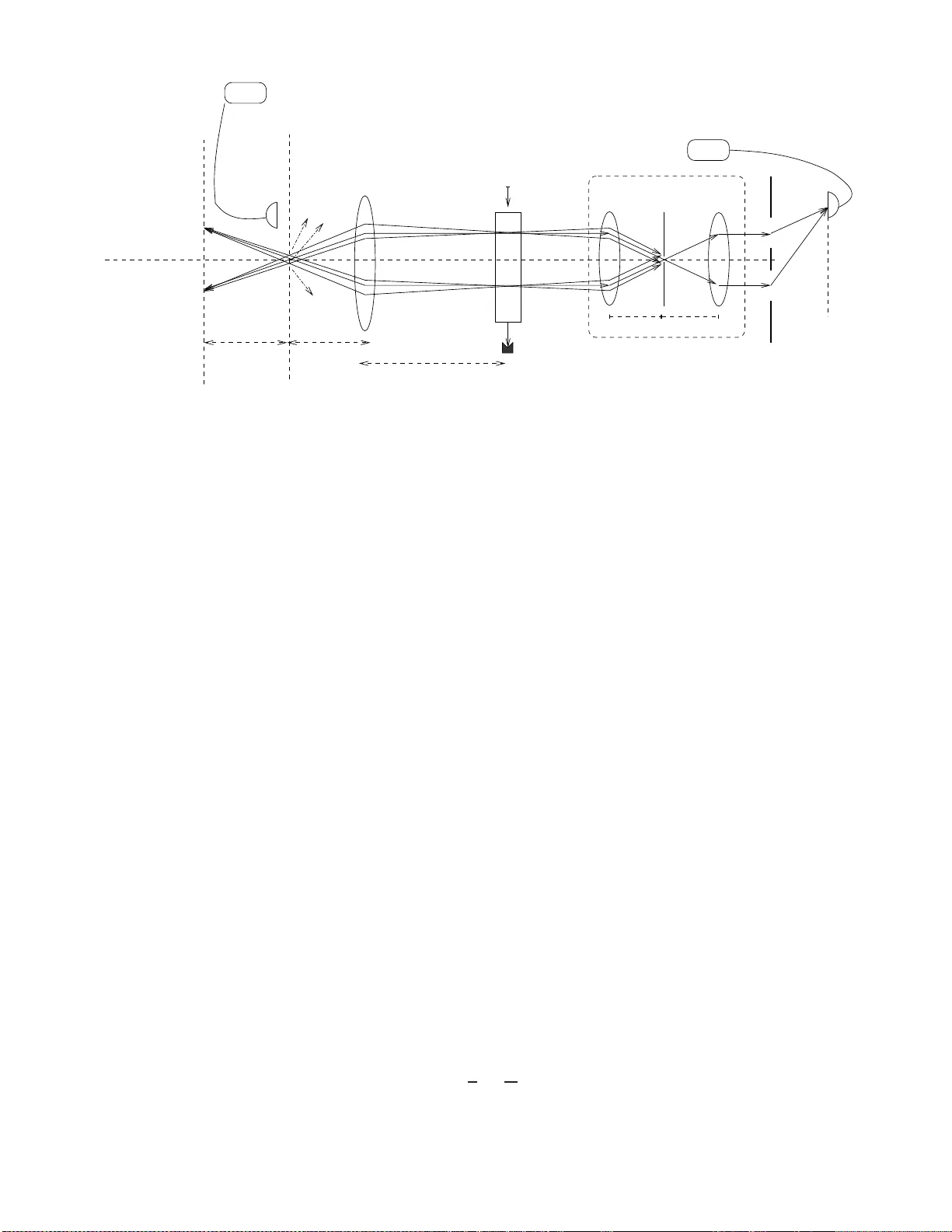
No-signaling, in tractabilit y and en tanglem en t R. Srik an th ∗ Po ornapr ajna Institute of Scientific R ese ar ch, Sadashivnagar, Bangalor e- 560080, India. and R am an R ese ar ch Institute, Sadashivnagar, Bangalor e- 560080, India. W e consider the problem of deriving t he no-signaling condition from th e assumption th at, as seen from a complexity theoretic p ersp ective, the un iverse is not an exp onential place. A fact that disallo ws suc h a deriv ation is the existence of p olynomial sup erluminal gates, h yp othetical p rimitive operations that enable sup erluminal signal ing but not the efficien t so lution of in tractable problems. It therefore follo ws, if t his assumption is a basic principle of physics, either that it must b e sup - plemented with additional assumptions to prohibit such gates, or, improbably , that no- signaling is not a universal condition. Y et, a gate of this kind is possibly implicit, though not recognized as such, i n a decade-old quantum o ptical exp eriment i nvo lving p osition-momentum en tangled photons. Here w e describ e a fea sible mo dified versi on exp eriment t hat appears to explicitly demonstrate the action of th is gate. Some ob vious counter-claims are shown to b e in v alid. W e b elieve that the un ex - p ected p ossibilit y of p olynomial sup erluminal op erations arises b ecause some practically measured quantum optical q uantities are not describable as standard quantum mec hanical observ ables. P ACS n umbers: 03.67 .- a, 03.65.Ud, 03.65.T a, 03.30.+p I. INTRO DUCT ION In a multipartite quantum system, a ny completely p ositive map applied lo ca lly to one part do e s not affect the reduced density op era tor of the remaining part. This fundamen tal no - go res ult, called the “no-signa lling theorem” implies that quantum ent ang le men t [1] do es no t ena ble nonlo ca l (“sup erluminal”) signaling [2] under sta ndard o p- erations, a nd is th us cons istent with r elativity , inspite of the counterint uitive, stronger -than-clas s ical correla tions [3] that ent angle ment ena bles. F or simple systems, no-signa ling follows from non-contextuality , the prop erty that the probability assigned to pro jector Π x , given by the Born rule, T r ( ρ Π x ), where ρ is the density op erato r, do es not depe nd o n how the orthono rmal basis set is c o mpleted [4, 5]. No- signaling ha s also b een treated as a basic p ostulate to derive qua nt um theory [6]. It is of in terest to consider the question of whether/how computation theory , in particular int ra ctability a nd uncomputability , matter to the foundations of (quantum) ph ysics. Such a study , if succes sful, could p otentially allow us to re duce the laws of physics to mathematica l theo rems ab out alg o rithms and th us s hed new light o n certain conceptual is sues. F or exa mple, it could explain wh y stronger-than- q uantum cor relations that are compatible with no-signaling [7] are disallowed in quantum mechanics. One strand of thought leading to the present w ork, ear lier considered b y us in Ref. [8], was the pro po sition that the mea surement pr oblem is a consequence o f basic algorithmic limitations impose d o n the computational power that ca n b e supp orted b y ph ysica l laws. In the present work, w e would lik e to see whether no -signaling can also be explained in a similar w ay , starting from computation theoretic assumptions. The T ur ing mac hine (TM) represe nts an abstr action o f the principles of mec hanical computation. The ma chine consists of a head a nd a tap e. The head is ca pable of b eing in o ne of a finite num b e r of “int erna l s tates” and can read a nd overwrite a symbol fro m a finite set, then s hifting one blo ck le ft or r ig ht a long the tap e. It contains a finite internal pro gram that directs its op e r ations. The cen tral problem in computer science is the conjecture that t wo computational complexity classes, P and NP , ar e distinct in the standar d T uring mo del o f c o mputation. P is the class of decision pro ble ms solv able in p oly nomial time by a (deterministic) TM. NP is the class of decision problems who se solution(s) can b e verified in polyno mial time by a deterministic TM. # P is the class of coun ting problems a sso ciated with the decision problems in NP . The word “ c omplete” following a class denotes a problem X within the cla ss, which is max ima lly hard in the sense tha t any o ther pro blem in the c lass can b e solved in p oly-time using an oracle giving the solutions of X in a sing le clo ck cycle. F o r example, determining whether a Bo olean forumla is satisfied is NP -complete, a nd counting the num b er of Bo olea n satisfactions is # P -complete. The word “hard” following a clas s denotes a pro blem not necess arily in the clas s, but to which all problems in the class r educe in p oly- time. P is often taken to b e the cla s s o f computational problems which are “efficiently solv able” (i.e., solv able in p olynomial ∗ Electronic address: srik@p oornapra jna.org 2 time) or “tracta ble ” , although there are p otentially larger classes that are consider ed tractable suc h as RP [9] and BQP , the latter being the cla ss of dec is ion problems efficiently solv able b y a quantum computer [9]. NP -complete and p otentially harder problems, which ar e not known to b e efficiently solv able, are co nsidered intractable in the T ur ing mo del. If P 6 = NP and the universe is a p olynomial– ra ther than an exp onential– place, physical laws cannot be harnessed to efficiently solve intractable pr oblems, and NP -co mplete problems will b e in tractable in the ph ysical world. That clas sical physics supp orts v ario us implementations of the T ur ing machine is well known. More genera lly , we exp ect that computational mo dels supp orted by a physical theory will be limited by that theory . Witten identified exp ectation v alues in a top olog ical q uantum field theor y with v alues of the Jones p olynomial that are # P -hard [11]. There is evidence tha t a ph ysical system with a non-Ab elian top olog ical ter m in its Lag rangian ma y ha ve obse r v able s that are NP -ha r d, or even # P -hard [12]. Other recent related works that have studied the computational p ow er of v ariants of s tandard physical theo ries from a complexity or computability p er sp ective are, resp ectively , Refs. [8, 13, 14, 1 5, 1 6] a nd Refs. [8, 1 3]. Ref. [15] noted that NP -complete problems do no t se em to be tractable using resources of the physical universe, and suggested that this mig h t embo dy a fundamen tal pr inciple, c hristened the NP -hardness assumption (also cf. [1 7]). Ref. [18] studies ho w insights from quantum infor mation theor y co uld b e used to constrain physical laws. W e will informally refer to the prop osition tha t the universe is a p oly nomial place in the co mputatio nal sense (to be strengthened below) as well as the commun icatio n s ense by the ex pr ession “the w or ld is not har d enough” (WNHE) [19]. In Ref. [8], w e po inted out that the as sumption of WNHE (and further that of P 6 = NP ) can po tentially give a unified expla nation of (a) the observed ‘insularity-in-theoryspace’ of quantum mechanics (QM), namely that QM is ex actly unitary , linear and requires mea surements to conform to the | ψ | 2 Born rule [1 4, 20]; (b) the cla s sicality of the macrosco pic world; (c) the la ck of quantum physical mechanisms for non-s ig naling sup erquantum cor relations [7]. In (a), the basic idea is tha t departure from one or mor e of these standard features of QM seems to inv est quant um computers with s uper -T uring p ow er to solve har d pr oblems efficien tly , th us ma king the universe a n e x po nential place, contrary to assumption. The p ossibility (b) a rises for the following reason. It is prop o sed that the WNHE ass umption holds not only in the sens e that hard pr oblems (in the standard T ur ing mo del) are not efficiently so lv able in the ph ysica l w orld, but in the str onger sense that any physical computation can b e simulated on a probabilistic TM with at most a polyno mia l slowdown in the num b er of steps (the Str ong Church-T uring thesis). Therefore, the evolution of any q uantum system co mputing a decision problem, could a symptotically b e sim ulated in po lynomial time in the size of the problem, a nd thus lie s in BPP , the class of pro blems that can b e e fficie ntly solved by a probabilistic TM [21]. Assuming BPP 6 = BQP , this sug gests that although at small scales, s tandard QM remains v a lid with characteristic BQP -like b ehavior, at sufficien tly lar ge sca les, classica l (‘ BPP -lik e’) b ehavior should emer ge, and that therefore there m ust b e a definite scale – so metimes called the Heisen b erg cut– where the sup er po sition principle breaks down [22], so that asymptotica lly , quantum states are not exp onentially long v ectors . In Ref. [8], we sp eculate that this sca le is related to a discretization o f Hilb er t space. This appr oach provides a p ossible computatio n theore tic r esolution to the quantum measurement pro blem. In (c), the idea is that in a po lynomial universe, we ex p ect that phenomena in which a p oly nomial a mount of physical bits can simulate exp onentially large (cla ssical) corre lations, thereby making communication complexity trivial, would be for bidden. In the pres ent work, we are interested in s tudying whether the no- signaling theorem follows fro m the WNHE assumption. The article is a rrang e d as follows. Some r e sults concerning non-standa rd oper ations that viola te no- signaling a nd help efficie ntly solve intractable pr o blems, ar e sur vey ed in Sections I I and I I I, resp ectively . In Sec tio n IV, w e in tro duce the co ncept o f a p olyno mial sup erlumina l ga te, a hypothetical primitiv e oper ation tha t is pro hibited by the assumption of no-sig naling, but allow ed if instead we o nly assume that in tracta ble pro blems should not b e efficiently solv able by ph ysical c o mputers. W e examine the r elation b etw een the ab ov e tw o classe s of non-standar d gates. W e also de s crib e an c onst ant ga te on a single qubit or qutrit, p ossibly the simplest instance of a poly nomial sup e rluminal op eratio n. A quantum optical realization of the constant ga te, a nd its application to an exp eriment inv olving entangled photons gener ated by par ametric downconv ersion in a nonlinea r crystal is presented in Section V. Physicists who could not care less ab out computational complexity a s pe cts could skip dir ectly to this Section. They ma y be warned that the in tervening sections will inv olve mangling QM in ways that may seem awkw ard, and whose consistency is, unfortunately , not ob vious! On the other ha nd, computer scie ntists unfamiliar with qua nt um optics ma y skip Sectio n V, which is essent ially cov ered in Section VI , which discusses quant itative and conceptual issues s urrounding the physical r ealization of the constant gate. Finally , we conclude with Sectio n VI I b y s urveying some implications of a possible po sitive o utcome of the propo s ed experiment, and discussing how suc h an unexpe c ted ph ysica l effect may fit in with the mathematical structure o f known physics. W e present a sligh tly abridged version of discussions in this work in Ref. [23]. 3 II. SUPERLUMINAL GA TES Even mino r v a riants o f QM are known to lead to sup erluminal signaling. An example is a v ariant incorp orating nonlinear observ ables [24], unles s the nonlinea rity is confined to sufficiently small scales [25 , 26]. In this Section, we will revie w the case of violatio n o f no-signling due to departure from standard QM via the int ro ductio n o f (a) non-complete Schr¨ odinger evolution o r measure ment, (b) nonlinear evolution, (c) departur e from the Born | ψ | 2 rule. In each case, w e will not attempt to develop a no n-standard QM in detail, but instead conten t ourselves with considering s imple representative e xamples. (a) Non-c omplete me asur ements or non-c omplete Schr¨ odinger evolution. Let us co nsider a QM v ar iant that a llows a non- tracepres e r ving (and hence no n-unitary) but invertible single-qubit o p e r ation of the form: G = 1 0 0 1 + ǫ , (1) where ǫ > 0 is a rea l num b er . The re sultant state P x α x | x i must b e normalized by dividing it b y the no rmalization factor p P x | α x | 2 immediately b efore a measurement, making measurements nonlinear. Given the entangled state (1 / √ 2)( | 01 i + | 10 i ) that Alice a nd B ob shar e, to tra nsmit a sup erluminal signal, Alice applies either G m (where m ≥ 1 is an integer) or the identit y op eration I to he r qubit. Bob’s particle is left, resp ectively , in the sta te ρ (1) B ∝ 1 2 ( | 0 ih 0 | + (1 + ǫ ) 2 m | 1 ih 1 | ) or ρ (0) B = 1 2 ( | 0 ih 0 | + | 1 ih 1 | ), which can in principle b e distinguished, the dista nce betw een the states b eing grea ter for larger m (cf. Section I I I), leading to a sup erluminal signal from Alice to Bob. More g enerally , we ma y a llow no n-unitary and irre versible evolution but still confor m to no-signaling , provided the corresp o nding set of op erato r (s) is c omplete , i.e., constitutes a partition of unity . Supp os e Alice and Bob share the s tate ρ AB , and Alice evolv es her part of ρ AB lo cally through the linear oper a tion given by the set P of (Kraus) op erator elements { E j ≡ e j ⊗ I B , j = 1 , 2 , 3 , · · · } [10], wher e I B is the identit y op erator in B o b’s subspace. B ob’s reduced dens ity op erator ρ ′ B conditioned on her p er forming the op eration and after no rmalization is : ρ ′ B = N − 1 T r A X j E j ρ AB E † j = N − 1 T r A X j E † j E j ρ AB , N = T r AB X j E † j E j ρ AB , (2) where N is the normaliza tion factor. W e s atisfy the no- signaling condition ρ ′ B = ρ B only if ρ AB is unentangled or P satisfies the completeness relation X j e † j e j = I A , (3) which gua r antees that the op eration preserves norm N . Here I A is the ident ity op erator in Alice’s subs pace. In the ab ov e, non-completeness suffices, and the nonlinearit y in tro duced b y renormalizing the wav efunction is not necessary , for the sup er luminality . If the system A is sub jected to unitary ev olution or non-unitary evolution due to noise, or to standard pro jective measurements or more general measuremen ts described by p ositive operato r v alued measures, the corresp onding map satisfies Eq. (3), and ρ ′ B = ρ B . F or ter mino logical brevity , we call a (non-standard) g ate lik e G , or a non-complete op eration P tha t enables sup erluminal signaling , as ‘sup e rluminal g ate’, and denote the set of all sup er luminal ga tes by ‘ C < ’. F or the purpo se of this work, C < is restricted to qubit or qutrit gates. Non- unitary sup e r-quantum cloning or deleting, intro duce d in Ref. [27], which lead to super luminal signaling, a re other examples of non-complete op erations. Even a t the sing le -particle level, if the mea surement is non-complete, there is a s up er luminal s ig naling due to breakdown in non-contextualit y co ming fro m the r enormaliza tio n. As a simple illustratio n, supp os e we a re g iven t wo obser vers Alice and Bob sharing a delo caliz e d qubit, cos( θ / 2) | 0 i + sin( θ/ 2 ) | 1 i , with eig enstate | 1 i loca lized near Alice and | 0 i nea r Bob. With an m -fold application of G (whic h can be thought of as an application of imaginary phase on Alice’s side, leading to selective a ug mentation of amplitude) on this sta te, Alice pro duce s the (unnormalized) state co s( θ / 2) | 0 i + (1 + ǫ ) m sin( θ/ 2) | 1 i , so that a fter renorma lization, B ob’s pr obability of obtaining | 0 i has changed in a context-dependent fas hion from cos 2 ( θ/ 2) to co s 2 ( θ/ 2)(cos 2 ( θ/ 2) + (1 + ǫ ) 2 m sin 2 ( θ/ 2)) − 1 . By thus nonlo cally co nt ro lling the pro bability with whic h Bob finds | 0 i , Alice ca n probabilistically signal 1 bit o f informa tio n sup e rluminally . (b) Nonline ar evo lution. As a simple illustr ation o f a superlumina l gate a rising from nonlinear ev olution, we consider the action of the nonlinea r tw o-qubit ‘OR’ ga te R , whose action in a preferr ed (say , computational) basis is given b y: | 00 i ± | 11 i | 01 i ± | 10 i | 01 i ± | 11 i R − → | 01 i ± | 11 i ; | 00 i ± | 10 i R − → | 0 0 i ± | 10 i ) , | αβ i R − → | αβ i . (4) 4 If the tw o qubits are entangled with o ther qubits, then the gate is assumed to act in each s ubspace lab elled by states o f the other qubits in the computationa l ba sis. Alice and Bob share the en tangled sta te | Ψ i = 2 − 1 / 2 ( | 00 i − | 11 i ). T o tra ns mit a bit super luminally Alice measures her qubit in the computational basis o r the diag onal ba sis {|±i ≡ 2 − 1 / 2 ( | 0 i ± | 1 i} , leaving Bob’s qubit’s density opera tor in a computational ba sis ensemble or a diagonal basis ensemble, whic h a re equiv alent in standard QM. How ever, with the nonlinea r op era tio n R , the tw o ensembles can b e distinguished. Bo b prepares an ancillary qubit in the state | 0 i , and applies a CNO T o n it, with his system qubit as the control. On the resulting state he perfo r ms the nonlinear gate R , a nd measur e s the a ncilla. The computational (resp., diagonal) basis ensem ble yields the v alue 1 with probability 1 2 (resp., 1). By a rep etition of the pro cedure a fixed nu mber m of times, a sup erluminal signal is transmitted from Alice to Bob with ex po nentially small uncerta int y in m . Analogous to Eq. (4), one can define a ‘nonlinear AND’, which, again, similarly leads to a no nlo cal s ignaling. Even at a single par ticle level, allowing for non-complete op e r ations, super lumina l effects can ar ise from the nonlinear it y due to re no rmalization [28]. (c) Dep artur e fr om the Born | ψ | 2 pr ob ability rule. Glea son’s theorem shows that the Bor n probability rule that ident ifies | ψ | 2 as a probability measure, and more generally , the trace rule, is the only probability prescription con- sistent in 3 or larg er dimensions with the requirement of non-contextualit y [4]. Supp ose we r etain unitar y evolution, which prese r ve the 2-norm, but assume that the pro bability of a measur ement o n the state P j α j | j i is o f the form | α j | p / P k | α k | p for outcome j , and p any non-ne g ative rea l num b e r. The renorma lization will mak e the measurement contextual, giving ris e to a sup erluminal signa l. O ne might consider more gener al evolution that preserves a p -norm, but ther e are no linear op erator s that do s o ex cept per mutation matrices [14]. F or example, let Alice and Bob share the tw o-qubit entangled state cos θ | 00 i + sin θ | 11 i (0 < θ < π / 2). The probability for Alice measuring her particle in the computational bas is and finding | 0 i (resp., | 1 i ) must b e the sa me as that for a jo int mea surement in this basis to yield | 00 i (resp., | 11 i ). Therefor e Bo b’s reduce d density op erator is given b y the state ρ (1) = (cos p θ | 0 ih 0 | + sin p θ | 1 ih 1 | ) / (cos p θ + sin p θ ). On the other hand, if Alice employs an ancillar y , third qubit prepar ed in the state | 0 i , and applies a Hadamard on it c onditioned o n her qubit b eing in the state | 0 i , she pro duces the state cos θ √ 2 | 000 i + cos θ √ 2 | 001 i + sin θ | 1 10 i . The proba bilit y that Alice obtains outcomes 00, 01 or 10 m ust be that for a joint measurement to y ie ld 000 , 00 1 or 110 . Along similar lines as in the ab ov e ca se we find that she leaves Bob’s qubit in the state ρ (2) ≡ 2 (1 − p/ 2) cos p θ | 0 ih 0 | + sin p θ | 1 ih 1 | ) 2 (1 − p/ 2) cos p θ + sin p θ . (5) Since ρ (1) and ρ (2) are probabilistica lly distinguishable, with sufficien tly man y shared copies Alice can signal Bob one bit s up er luminally , unless p = 2. II I. EXPONENTIAL GA TES As sup erluminal qua ntu m gates like G or R ar e in ternally co nsistent, one can co nsider why no such o p er ation o ccurs in Nature, whether a fundamental pr inciple preven ts their physical r e alization. One candidate principle is of course no- signaling itse lf. Alternatively , since we would like to der ive it, linear ity of Q M may b e taken as an ax iom. Since all the ab ov e non-s tandard op erations inv olve an ov erall nonlinear evolution, the assumption o f strict qua ntum mechanical line a rity ca n indeed rule out s uch no n-standard gates. Y et it m ust b e admitted that, from a purely physics viewp oint, assuming that QM is linear affords no gr e a ter ins ight than assuming it to be a non-signaling theor y . W e would lik e to sugges t that the the a bsence o f s uch oper ations may hav e a co mplexity theoretic bas is. Both sup erlumina l gates a s well as h yp othetical gates that allow efficien t solving of intractable pr oblems involv e some sort of co mmunication across supe rp osition branches. In pa r ticular, the sup erluminal ga tes of Section I I can b e turned into the la tter type of g ates, as discussed b elow. (a) Non-c omplete qu antum gates. It is easily seen that the gate G in Eq . (1) can be used to solve NP -complete problems efficiently . Consider solving b o olean satisfiability (SA T), which is NP -co mplete: giv en an efficien tly com- putable black box function f : { 0 , 1 } n 7→ { 0 , 1 } , to determine if there exists x such that f ( x ) = 1. With the use of an oracle tha t co mputes f ( x ), we prepare the ( n + 1)-qubit entangled state | Ψ nc i = 2 − n/ 2 X x ∈{ 0 , 1 } n | x i| f ( x ) i , (6) and then a pply G m to the second, 1-qubit register , where m is a sufficiently large integer, b efore measuring the register. In pa r ticular, suppose that at most one solution exists. The un-nor ma lized ‘pro bability mas s’ of obtaining outcome | 1 i b e comes 1 (and the nor malized pr obability ab out 1/2 ) when m = n/ (2 lo g(1 + ǫ )), if there is a solution, 5 or, if no solution exists, remains 0. Rep eating the exper iment a fixed n umber of times, and applying the Chernoff bo und, we find that to so lve SA T, we only requir e m ∈ O ( n ). F or terminologica l brevity , we will call as ‘ex po nential gate’ s uch a non-standard ga te that enables the efficient computation of NP -complete pr oblems, and denote by E the s et of all exp onential g ates, restr icted in the prese nt work to qubits and qutrit gates. (b) Nonline ar qu antum gates. The no nlinear op eration R in E q. (4) can b e used to efficiently simulate nonde- terminism. W e prepa re the state | ψ i in Eq. (6), where the first n qubits a re called the ‘index’ qubits and the last one the ‘flag ’ qubit. There are 2 n − 1 4-dim subspa ces, consisting of the first index qubit a nd the flag qubit, lab elled by the index qubits 2 , · · · , n . On each such s ubs pa ce, the first index qubit and flag qubit are in one of the states | 00 i + | 11 i , | 01 i + | 10 i , | 00 i + | 10 i . The oper ation Eq. (4) is a pplied n times, pairing each index qubit sequen tially with the flag. The num ber of terms with 1 o n the flag bit doubles with ea ch op er ation so that after the n op era tions, it beco mes disen tangled and can then be rea d off to obtain the answer [16]. A slight mo dification of this a lgorithm solves # P -complete problems efficiently , by replacing the flag qubit with log n qubits and the 1-bit no nlinear OR op eration with the corres po nding no nlinear counting. The final readout is then the num b er of so lutions to f ( x ) = 1 [16]. Applying the no nlinea r OR and AND alterna tively to the state | ψ i in E q. (6) allows one to efficiently solve the quantified Bo o lean for mula problem, which is PSP ACE -complete [29]. F urthermor e, it ca n be sho wn that a single particle quantum computer emplo ying the nonlinear (due to r enormaliza tion) q uantum mechanism mentioned above, enables e fficient solution o f NP -co mplete pr oblems [28]. (c) Non- Gle asonian gates. By employing p olynomially many a ncillas in the metho d of (c) in the previo us subsectio n, one can show that non-Glea sonian quantum computers (for which p 6 = 2) can s o lve PP -complete problems [30] efficiently . Defining BQP p as similar to BQP , except that the pr obability of mea suring a basis state | x i equals | α x | p / P y | α y | p (so that BQP 2 = BQP ), it can b e sho wn that PP ⊆ BQP p for all c onstants p 6 = 2, and that, in particular, PP exactly characterizes the p ow er o f a qua ntum computer with even-v alued p (except p = 2) [1 4]. In view of the connection b etw een the t wo clas ses of gates , we now prop ose, a s w e earlie r did in Ref. [8], that the reason for the absence in Nature o f the sup erluminal gates of Section I I is WNHE: in a universe that is a p olynomia l place, exp o nential gates lik e G and R are ruled o ut. In the next Sec tio n w e will consider in further de ta il the viabilit y of the WNHE a ssumption a s a n explana tion for no-s ignaling. IV. POL YNOMIAL SUPERLUMINAL GA T ES Even tho ugh WNHE excludes the t yp e of sup erluminal gates c onsidered ab ove, for the exclusion to b e general, it would have to b e shown that ev ery s upe r luminal g a te is exp o nent ial, i.e., C < ⊆ E . It turns out that this cannot b e done, b eca us e one c a n construct hypothetical p olynomial sup erluminal gates , which are sup erluminal op eratio ns that are not exp onential. In fact, it is probably true that E ⊂ C < . T o see this, let us consider solving the NP -complete problem asso ciated with Eq . (6) via Grover search [31], which is optimal for QM [32] but offers only a quadra tic sp eed-up, thus leaving the complexity of the problem exp onential in n , at leas t in the black b ox setting. The optimality pro of relies on showing that, given the pro blem of distinguishing an empty o racle ( ∀ x A ( x ) = 0) and a non-empty oracle containing a single rando m unknown string y of known length n (i.e. A ( y ) = 1, but ∀ x 6 = y A ( x ) = 0), sub ject to the c o nstraint that its ov erall evolution b e unitar y , and linear (so that in a computatio n w ith a nonempty o racle, all computation paths quer y ing empty lo cations evolve exactly a s they would for a n empt y or acle), the spee d-up ov er a classical s earch is a t b est quadr atic. An y degree of a mplitude amplification of the ma rked s tate ab ove the qua dratic level w ould then require empty sup e rp osition branches b eing ‘made aw are’ of the prese nce of a non-empty branch, i.e., a no nlinearity of some sort. Let us supp ose Bob can p er form a trace -preserv ing nonlinea r tra nsformation ρ j → ˜ ρ j of the ab ov e kind on an unknown ensemble of separ a ble states. F urther, let Alice and Bob sha r e a n e nt angle d state, by which Alice is able to prepa re, employing t wo differ e n t POVMs, t wo differe nt but equiv a lent ensembles of Bob. Then, dep ending on Alice’s choice, his reduced de ns it y matr ix ev olves as ρ B = P j p j ρ j → P p j ˜ ρ j ≡ ρ ′ or ρ B = P s p k ρ k → P p k ˜ ρ k ≡ ρ ′′ where ( ρ j , p j ) and ( ρ k , p k ) a re distinct, equiv alent ensembles [33 ]. The a ssumption o f linea rity is sufficient to ensure that ρ ′ = ρ ′′ . This is not guara nteed in the pr esence of nonlinearity , leading to a p otential super luminal signal. In a nonlinear ity o f the ab ov e kind, the result w ould dep end on whether the par ticular ensem ble remotely prepar ed b y Alice has states that inc lude | y i in the super po sition. This would lead to a scenario similar to that encountered with nonlinear gate R in Section I I. Possibly the s implest examples of p olynomial sup erluminal ga tes a r e the non- inv ertible c onst ant gates , whic h ma p any s ta te in a n input Hilb ert space to a fixed state in the output Hilb ert space , and hav e the form | ξ i ⊗ P j h j | , for 6 some fixe d ξ . Examples in ma trix no tation a r e: Q = 1 1 0 0 ; Q ′ = 1 1 1 0 0 0 0 0 0 , (7) acting in Hilber t space H 2 ≡ span {| 0 i , | 1 i} and H 3 ≡ spa n { | 0 i , | 1 i , | 2 i} , respectively . They ha ve the effect of mapping any input state in H 2 to a fixed (a part fr o m a normalization fac to r) state | ξ i , in this cas e | ξ i b eing | 0 i . In Eq. (7), we do not in gener al re q uire the input and output bases to b e the same, no r indeed tha t the input and output Hilb ert subspaces b e the same (for ex a mple, as with the distinct incoming a nd outgo ing mo des of a scattering problem.) Both Q and Q ′ are non-complete, inasm uch as Q † Q 6 = I a nd ( Q ′ ) † Q ′ 6 = I , and re present sup erluminal ga tes. F or example, by applying or not a pplying Q to her reg ister in the state (1 / √ 2)( | 01 i + | 10 i ) shared w ith Bo b, Alice can remotely pr e pare his state to b e the pure state (1 / √ 2)( | 0 i + | 1 i ) or leav e it as a maxima l mixture, respec tively . Similarly , by choos ing to a pply , or not, Q ′ on her half o f the state (1 / √ 2)( | 11 i + | 22 i ) sha red with Bob, Alice can sup e rluminally signal him 1 bit. The consta n t gate is linea r and presumes no re-normaliza tion following its non-complete ac tion. The probability of the o ccurance of a constant gate C when it is applied to a state | ψ i is simply given b y || C | ψ i|| 2 , per the usual prescription. One consequence is that it could not b e used to violate no- s ignaling without the use of entanglemen t. As an illustra tion: in H 3 , let the s tates | 0 i a nd | 1 i b e lo ca lized near Alice and | 2 i near Bo b. Applying Q ′ on the state | ψ i ≡ a | 0 i + b | 1 i + c | 2 i , Alice obtains the (unnormalized) state Q ′ | ψ i = ( a + b ) | 0 i + c | 2 i . If reno rmalization were allow ed, Alice co uld nonlo ca lly influence Bob’s pr obability to find | 2 i to b e | c | 2 / ( | a + b | 2 + | c | 2 ) or | c | 2 . How ever, the linearity of the cons tant gate requires the in terpre tation that following her action, Alice can detect the pa rticle with probability | a + b | 2 , while for B ob, the probability remains | c | 2 . As clar ified la ter, lack of probability cons e rv a tion can be in terpreted as coherent enhancement or s uppression o f emiss ion o f particles from a sour ce to a detector. On the o ther hand, neither Q nor Q ′ nor a g eneral consta nt gate is an exp onential gate: each of them simply transforms a ny v alid input into a fixed output. In tuitively , this lack of any dependence on the input clearly limits its c o mputational p ower. The family of constant gates like Q and Q ′ is simply e q uiv alent to a non-deterministic simulation of a constant function, and can b e simulated by the fo llowing classic al T ur ing machine pseudo co de in po lynomial time (in fa c t, O (1) time): “Read first bit o f x ; if x 6 = NULL, output 0; e ls e output NULL”. Op erations Q and Q ′ in E q. (7) can be extended to a more general cla s s of p olynomial super luminal qubit and qutrit gates Q 2 ( φ ) = 1 e iφ 0 0 , Q 3 ( φ 1 , φ 2 ) = 1 e iφ 1 e iφ 2 0 0 0 0 0 0 , etc . (8) By definition, Q = Q 2 (0) and Q ′ = Q 3 (0 , 0). T o see tha t Q 2 ( φ ) is a p o lynomial op era tion, it suffices to show that it ca n b e simulated using only polyno mial amount o f standard q ua ntu m mechanical resource s. Given an ar bitrary ( n + 1)-q ubit sta te | ψ i = | α i| 0 i + | β i| 1 i , where | α i and | β i are not necessa r ily mutually o rthogona l nor normalized, one first a pplies a pha se ga te 1 0 0 e iφ , followed b y a Hadamar d o n the n th qubit, follo wed by a measure ment conditioned on the outcome being | 0 i , which happ ens with proba bilit y ( ||| α i|| 2 + ||| β i|| 2 + ℜ [ e iφ h α | β i ]) / 2 , irresp ective of n . If | α i and | β i are orthogona l, the simulation succeeds with fixed probability 1 2 . Therefore , the clas s of pr oblems efficiently solv able using quantum computation equipp ed with the non- standard family o f consta nt gates is in BQP . In p oint of fac t, o ne could b e w ors e off applying a co nstant gate than not applying it. In Eq. (6), let | Ψ 1 nc i repres ent the state derived for the function f 1 ( · ), wher e f 1 ( j ) = 1 for precisely o ne j , and let | Ψ 0 nc i r epresent the state der ived for the function f 0 ( · ), wher e ∀ j f ( j ) = 0. In b oth cases , upo n applying I ⊗ Q , we obtain the sa me disentangled state, 2 − n/ 2 ( P j | j i ) | 0 i . The applica tion of Q causes the distance and hence distinguishability b etw e e n the tw o states to diminish, or equiv alently , the fidelity b etw een them to increa se: 1 = |h Ψ 1 nc ( I ⊗ Q † )( I ⊗ Q ) | Ψ 0 nc i| > |h Ψ 1 nc | Ψ 0 nc i| = 1 − O (2 − n ). It is worth noting that the co nstant gate is quite different fro m the following tw o op er ations that app ear to b e similar, but are in fact quite distinct. The first opera tion is a standard quan tum mec hanical completely p o s itive map, po lynomial and no t s uper luminal; the second is ex po nential and consequently super luminal. (a) T o b egin with, a constant gate is no t a quantum deleter [3 5], in which a qubit is s ub jected to a c omplete op eration, in sp ecific, a contractive completely p o sitive map that prepares it asymptotically in a fixed state | 0 i . The action of a quantum deleter is giv en by an amplitude da mping channel [10], whic h has an op erator sum r e presentation, resp ectively ρ 2 − → X j E j ρ 2 E † j ; ρ 3 − → X j E ′ j ρ 3 E ′† j , (9) 7 in the qubit cas e or when extended to the qutrit case, with the K raus op era tors given by Eq. (10a) o r (10b), resp ectively E 1 ≡ 1 0 0 0 , E 2 ≡ 0 1 0 0 , (10a) E ′ 1 ≡ 1 0 0 0 0 0 0 0 0 , E ′ 2 ≡ 0 1 0 0 0 0 0 0 0 , E ′ 3 ≡ 0 0 1 0 0 0 0 0 0 . (10b) Unlik e in the ca se o f Q , Q ′ or Q ′′ , there is no actual destruction of quant um infor mation, but its transfer through dissipative deco herence into cor r elations with a zero- temper ature environment. The reduced density op era tor of Bob’s entangled s ystem remains unaffected by Alice’s a pplication of this op eration on her system. The deleting action, tho ugh nonlinea r a t the s tate vector level, nevertheless acts linearly on the density op erator . (b) Next we note that the co ns tant gate is quite different from the ‘p ost-s election’ o per ation, which is a deterministic rank-1 pr o jection [14]. V erbally , if the cons ta nt g ate cor resp onds to the o p eration “for all input states | j i in the computational basis, set the output state to | ξ i , indep endently of j , except for a globa l phase” , where | ξ i is some fixed state, then pos t- selection corr esp onds to the action “for all input states | j i , if j 6 = ξ , then discard bra nch | j i ”. Post-selective equiv alents of Q a nd Q ′ are Q PS = 1 0 0 0 ; Q ′ PS = 1 0 0 0 0 0 0 0 0 , (11) follow ed by r enormalizatio n. In particular, whereas the action of Q on the first of tw o particles in the state (1 / √ 2)( | 00 i + | 11 i ) leaves the second par ticle in the state (1 / √ 2)( | 0 i + | 1 i ), that of Q PS leav es the seco nd parti- cle in the state | 0 i . It is stra ightforw ard to see that p ost-selectio n is an exp onential o pe r ation: acting it o n the second qubit o f | Ψ nc i in E q. (6), and p ost- selecting o n 1, we obtain the solution to SA T in o ne time-step. The seemingly immediate conclusion due to the fa c t C < 6⊆ E is that the WNHE ass umption is not str ong enough to derive no- signaling, and would hav e to b e supplemented with additional assumption(s), p ossibly purely physically motiv ated o nes, pro hibiting the physical re a lization of p olynomial sup erluminal g a tes. An alter native, hig hly unconv entional reading o f the situation is that WNHE is a fundamental principle of the ph ysica l world, while the no- signaling condition is in fact not universal, so that some p olyno mial sup erluminal ga tes may a c tually b e physically realiza ble . Quite surprisingly , we ma y b e able to o ffer some supp ort for this viewp oint. W e b elieve that constant gates of ab ove t ype can b e quantu m optically rea lized when a photon detection is made at a p ath singularity , defined as a point in space w he r e t wo or more incoming paths con verge and terminate. In gra ph theoretic parlance, a path sing ularity is a terminal no de in a directed gr aph, of degre e greater than 1. W e describ e in Section V an ex pe riment that poss ibly physically realizes Q . In pr inciple, a detecto r pla c ed at the fo cus of a conv ex lens realizes such a path sing ularity . This is b ecaus e the geo metry of the ray optics as s o ciated with the lens requires rays parallel to the lens axis to c o nv erge to the fo cus after refraction, while the destructive nature of photon detection implies the ter mination o f the path. As another exa mple, c o nsider a Mach-Zehnder interferometer where the second b ea m-splitter is repla ced b y a detecto r: the tw o con verging arms are then brought in to ov erlap and detected in the overlap region, without be ing sent throug h, as would be the case in a conv ent ional Mach-Zehnder set-up. W e find that altho ugh conceptually and exp er imentally simple, the high degree of mo de filtering or spatial resolution that these exp eriments require will be the main challenge in implemen ting them. Indeed, we believe this is the r eason that s uch ga tes have remained undiscov ered so far . Our argument here has implicitly ass umed tha t P 6 = NP . If it turns o ut that P = N P , then even the o bviously non-physical o pe r ations such as G o r R would be p o lynomial gates, a nd the WNHE assumption would not be able to exclude them. Nevertheless, the question of existence a nd testability of certain sup er lumina l gates, w hich is the main result o f this work, would still rema in v alid and of interest. If p olyno mial sup erluminal ga tes are indeed found to exist (and given tha t other sup e rluminal gates do not seem to exist a n yway), this would giv e us grea ter confidence that P 6 = NP (or, to be safe, that ev en Nature doe s not ‘know’ that P = NP !) a nd that the assumption of WNHE is indeed a v alid and fruitful one. V. AN EX PERIMENT WITH ENT ANGLED P AIRS OF PHOTONS Our pr op osed implemen tion of Q ′ , based on the use of entanglement, is broadly related to the t yp e of quan tum optical exp eriments encountered in Refs. [36], and c lo sely related to an exp eriment p er formed in Innbruc k that 8 imaging plane BOB ALICE Heisenberg lens z screen pump laser Heisenberg detector m l F F 2F p q x y 2 3 5 non−linear crystal f 6 1 4 f" coincidence detector circuit f’ plane focal double slit FIG. 1: An ‘un folded’ ve rsion of the Inn sbruck exp eriment (n ot to scale). A pair of momentum-enta ngled photons is created by type-I p arametric dow n con versi on of the p ump laser. Alice’s photon (th e signal photon) is reg istered b y a detector behind the Heisenberg lens. Bob’s photon (the idler) is detected b ehind a d ouble-slit assem bly . If the ‘Heisenberg detector’ is placed in th e focal plane of the lens (of fo cal length F ), it pro jects Bob’s state into a mixture of plane wa ves, which produce an in terference pattern on Bob’s screen in c oincidenc e with any fixed detection p oint on Alice’s focal plane. Bob’s pattern in his singles c ount , b eing the integration of suc h pattern s o ver all fo cal plane points, shows no in terference pattern. On the other hand , p ositioning the Heisenberg detector in the imaging plane can p otentially reveal the path the idler tak es th rough the slit assem b ly , an d thus does n ot lead to an in terference pattern on Bob’s screen even in the coincidence counts. elegantly illustrates wa ve-particle dua lit y by means of en tangled light [37, 38]. In the Innsbruck exper imen t, pairs of p o sition-momentum entangled photons a re pro duced by means o f type-I sp o n taneo us parametric down-con version (SPDC) at a nonlinear source, such as a BBO crystal. The tw o outgoing conical b ea ms from the nonlinear source are presented ‘unfolded’ in Figure 1. One of each pair , called the ‘sig nal photon’, is received b y Alice, while the other, called the ‘idler’, is received and analyzed by Bob. Alice’s photon is registered by a detector behind a ‘Heisenberg lens’. Bob’s photon is detected after it ent ers a double-slit a ssembly . If Alice’s detecto r, whic h is lo cated b ehind the lens, is p ositioned a t the fo ca l plane of the lens and detects a photon, it lo ca lizes Alice’s pho ton to a po int on the fo ca l plane. By virtue of entanglemen t, this pro jects the state of Bo b’s photon to a ‘mo ment um eigensta te’, a plane w av e propaga ting in a particular direction. F or e x ample, if Alice de tects her photon at f , f ′ or f ′′ , Bob’s pho to n is pro jected to a sup erp ositio n of the pa rallel modes 2 a nd 5 , modes 1 a nd 4, or mo des 3 a nd 6 . Since this cannot reveal p os itio nal information ab out whether the particle orig inated at p or q , a nd he nc e reveals no which-w ay info r mation ab out slit passage , therefore, in c oincidenc e with a registration of her photon at a fo cal plane point, the idler exhibits a Y oung’s double-slit interference pa ttern [37, 38]. The patterns co r resp onding to Alice’s re g istering her photon a t f , f ′ or f ′′ will b e mutually shifted. Bob’s observ ation in his single counts will therefore not show an y sign of int erfer ence, b eing the average of all p ossible suc h m utually shifted patterns . The in terference pattern is seen by B o b in coincidence with Alice’s detection, a nd cannot b e s e e n by him unilatera lly . This is of course exp ected on account of no -signaling . If the Heise nber g detector is placed at the imag ing plane (at distance 2 F fro m the plane o f the lens ), a click of the detector can re veal the path the idler takes from the crystal through the slit assembly which therefore cannot sho w the interference pa ttern even in the coincidence count s. F or example, if Alice detects her photon at l (res p., m ), Bob’s photon is pro jected to a s upe r p osition of the mutually non-par allel mo des 4, 5 and 6 (resp., 1, 2 and 3) and, b eca use the double-slit a ssembly is situated in the near field, can then ent er o nly slit y (r e sp., x ). Therefor e, Alice’s ima ging plane measurement gives path or pos itio n informatio n of the idler photon, so that no interference pattern e merges in Bob’s co incidence count s [37, 38], and consequently also in his singles coun ts. This qualitative descr iptio n of the Innsbruck exp eriment is made qua nt itative using a s imple six-mo de mo del in the next Subsection. 9 A. Quant um optical des cription of the Innsbruc k exp erim ent Here we give a simple, quan titative exp os ition of the exper iment. The state of the SPDC field of Figur e 2 is mo deled by a 6-mo de vector: | Ψ i = (1 + ǫ √ 6 6 X j =1 a † j b † j ) | v ac i (12) where | v ac i is the v acuum state, a † j (resp., b † j ) are the crea tion op erato rs for Alice’s (resp., Bob’s) lig ht field on mo de j , p er the mode num b ering scheme in Figure 2. The quantit y ǫ ( ≪ 1 ) depends o n the pump field stre ng th a nd the crystal nonlinearity . The coincidence counting r a te for cor resp onding measurement s b y Alice and Bob is prop or tional to the squa re o f the second- o rder corr elation function, and given by: R α ( z ) ∝ h Ψ | E ( − ) z E ( − ) α E (+) α E (+) z | Ψ i = || E (+) α E (+) z | Ψ i|| 2 , ( α = f , f ′′ , l , m, · · · ) . (13) where E (+) α represents the p ositive frequency part of the electr ic field a t a point on Alice’s fo ca l or imaging plane, and E (+) z that of the electric field at an arbitr ary p oint z o n Bob’s scr een. W e hav e: E (+) z = e ikr D e ikr 2 ˆ b 2 + e ikr 5 ˆ b 5 + e ikr D ′ e ikr 1 ˆ b 1 + e ikr 4 ˆ b 4 + e ikr D ′′ e ikr 3 ˆ b 3 + e ikr 6 ˆ b 6 , (14) where k is the w av enum b e r, r D the distance from the EPR so ur ce to the upper/ low er slit on Bob’s double slit diaphragm (the length of the segment q y or px ); r 2 (resp., r 5 ) is the dis tance from the lo wer (resp., upp er) slit to z . The other tw o ter ms in Eq . (1 4), p ertaining to the o ther tw o pair of mo des , ar e obtained analo gously . W e s tudy the t wo cases, corresp onding to Alice making a remote pos ition or remote momen tum measurement o n the idler photons. Case 1. Alic e r emotely me asur es p osition (p ath) of the id ler. Supp ose Alice p o sitions her dectecto r a t the imaging plane a nd detects a photon at l o r m . The co rresp onding field at her detector is E (+) m = e iks m (ˆ a 1 + ˆ a 2 + ˆ a 3 ); E (+) l = e iks l (ˆ a 4 + ˆ a 5 + ˆ a 6 ) , (15) where s m (resp., s l ) is the path length along any ray path from the so urce po int p (resp., q ) thro ugh the lens upto image p o int m (resp., l ). By F ermat’s principle, all paths connecting a given pair of sour ce and image p oint ar e equa l. Setting α = l, m in Eq. (13), and substituting Eq s. (12), (14 ) a nd (15) in Eq. (13), we find the co incidence co unt ing rate for detectio ns by Alice a nd Bob to b e R m ( z ) ∝ ǫ 2 | e ikr 1 + e ikr 2 + e ikr 3 | 2 ; R l ( z ) ∝ ǫ 2 | e ikr 4 + e ikr 5 + e ikr 6 | 2 , (16) which is essen tially a single slit diffraction pattern formed behind, resp ectively , the upper and low er slit. The in tensit y pattern Bob finds on his screen in the singles count, obtained b y averaging R α ( z ) over α = l , m , is th us not a double- slit interference patter n, but an incoherent mixture of the tw o single slit patterns. A similar lack of interference pattern is o btained by B ob if Alice makes no mea surement. Case 2. Alic e r emotely m e asure s moment um (dir e ct ion) of the id ler. Alice po sitions her dectector on the fo cal plane o f the Heisenber g lens . If she detects a photon at f , f ′ or f ′′ , the fie ld a t her detecto r is, resp ectively , E (+) f = e ikr 2 f ˆ a 2 + e ikr 5 f ˆ a 5 = e ikr f (ˆ a 2 + ˆ a 5 ) , (17a) E (+) f ′ = e ikr 1 f ′ ˆ a 1 + e ikr 4 f ′ ˆ a 4 = e ikr 1 f ′ (ˆ a 1 + e ik ( r 5 f ′ − r 1 f ′ ) ˆ a 4 ) , (17b) E (+) f ′′ = e ikr 3 f ′′ ˆ a 3 + e ikr 6 f ′′ ˆ a 6 = e ikr 3 f ′′ (ˆ a 3 + e ik ( r 6 f ′′ − r 3 f ′′ ) ˆ a 6 ) , (17c) where r 2 f (resp., r 5 f ) is the distance from p (resp., q ) along the pa th 2 (resp., 5) pa th throug h the lens upto p oint f . The distances alo ng the tw o paths b eing identical, r 2 f = r 5 f ≡ r f . The dis tances r 1 f ′ , r 4 f ′ , r 3 f ′′ and r 6 f ′′ are defined analogo usly . Substituting Eqs. (12), (14) and (17) in E q. (13), we find the c o incidence co unt ing rate is given b y R f ( z ) ∝ ǫ 2 [1 + cos( k · [ r 2 − r 5 ])] , (18a) R f ′ ( z ) ∝ ǫ 2 [1 + cos( k · [ r 1 − r 4 ] + ω 14 )] , (18b) R f ′′ ( z ) ∝ ǫ 2 [1 + cos( k · [ r 3 − r 6 ] + ω 36 )] , (18c) where ω 14 ≡ k ( r 4 f − r 1 f ) a nd ω 36 ≡ k ( r 6 f − r 3 f ) a re fixed for a given p oint on the fo cal pla ne. Each equation in Eq. (18) represents a conv en tional Y oung’s double slit pattern. Co nditioned on Alice detecting pho tons at f , Bo b finds 10 pump laser non−linear crystal plane focal slit double u v x y lens 2 lens 1 G G direction filter diaphragm o z BOB screen ALICE Heisenberg detector m l F F 2F 1 6 4 3 Heisenberg lens p q 2 5 f" f’ imaging plane f FIG. 2: The mo dified Inn sbruck ex p eriment (not to scale): Same configuration as in Figure 1, except that Bob’s p hoton (t h e idler), b efore entering t h e double-slit assem bly , trav erses a direction filter that p ermits only (nearly) horizontal modes to pass through, absorbing the other mod es at the filter wal ls. The d irection filter acts as a state filter that ensures that Bob receiv es only the pur e state consisting of th e horizontal mo des. Thus if Alice makes no measuement or makes a detection at f , Bob’s correspondin g photon bu ilds an interference pattern of the modes 2 and 5 in the singles counts. O n the other h and, if Alice p ositions the Heisen b erg detector in the imaging plane, she kno ws the path the idler tak es through the slit assem bly . Thus no interf erence pattern is found on Bob’s screen even in the coincidence counts. the pattern R f ( z ), and similarly for p oints f ′ and f ′′ . In his singles count, Bob p erceives no interference, b ecause he is left with a statistica l mixture of the patterns (18a), (18 b), (18c), etc., corresp onding to al l po ints on Alice’s fo cal plane illuminated b y the signal b eam. In summary , the se t-up of the Innsbr uck exp er iment entails that Bob do es not find a do uble-slit interference pattern in his singles count no matter what Alice do es. Howev er, in the coincidence counts he finds the in terfere nce pattern if Alice mea sures (momentum) in the fo ca l plane, and none if she measur es (p osition) in her imaging plane. B. The proposed exp erim ent The exp eriment pr op osed here, prese nted ear lie r by us in Ref. [39], is derived from the Innsbr uck exper iment, and therefore called ‘the Mo dified Innsbruck exp er iment’. It was claimed to manifest sup erluminal s ignaling, though it was no t clear what the exact orig in o f the sig naling was, and in particula r, which assumption that go e s to proving the no-sig naling theorem was being g iven up. The Mo dified Innsbruck exp eriment is revisited here in order to cla rify this issue in deta il in the light o f the discussions of the pr evious Sections. This will help crystalliz e what is, a nd what is not, resp onsible for the claimed signaling effect. In Ref. [4 0], we studied a version of no nlo cal communication inspired by the original Einstein-Po dolsky-Ro sen thought ex p er iment [1]. Recently , similar exper iments, also based on the Innsbr uck exp er iment , hav e b een indep endently pro po sed in Refs. [41, 42]. First w e prese nt a qualitativ e overview o f the mo dified Innsbruck expe riment. The only material difference betw een the orig inal Innsbruck exp er imen t a nd the mo dified version we prop ose here is that the latter con tains a ‘dir ection filter’, consisting o f t wo con vex lenses of the same fo cal length G , separa ted b y distance 2 G . Their shar ed foca l plane is co vered by an opaque screen, with a small ap ertur e o of diameter δ at their shared foc us . W e w ant δ to be small enough so that only almos t horizontal mo des are p ermitted b y the filter to fall on the double slit diaphra gm. The angular s pread (ab out the horiz o ntal) of the mo des that fall on the ap erture is given by ∆ θ = δ /G , we require tha t ( δ /G ) σ ≪ λ , where σ is the slit separation, to guarantee that only mo des that a re horizontal or almost horizontal are selected to pass thr ough the dir ection filter, to produce a Y oung’s double-s lit in terference pattern on his scre e n pla ne. On the other ha nd, we don’t wan t the ap erture to b e so s mall that it pro duces significa nt diffra ction, th us: δ ≫ λ . Putting these co nditions to g ether, we must have 1 ≪ δ λ ≪ G σ . (19) The ability to satisfy this condition, while pr eferable, is not cr ucial. If it is not sa tisfied stric tly , the predicted sig nal 11 is weaker but not entirely suppres sed. The p o int is clar ified further down. If Alice makes no measurement, the idler remains ent angle d w ith the sig nal photo n, which renders inco herent the bea ms coming through the upp er a nd lower slits on Bob’s side, so that he will find no in terference pattern on his screen. Similar ly , if she detects her photo n in the ima ging plane, she lo calizes Bob’s photon at his slit plane, a nd s o, again, no in terference pattern is seen. Th us far, the prop osed exp eriment the same effect a s the Innsbruck exper iment . On the other hand, if Alice s cans the fo ca l plane and mak es a detection, she remotely mea s ures Bob’s corr esp onding photon’s momentum and erases its path infor mation, thereby (non-selectively) leaving it as a mixture of plane wa ves incident on the dir ection filter. How ever only the fraction that makes up the pure state comprising the horizontal mo des pass es through the filter. Diffracting through the double-slit dia phragm, it pro duces a Y oung’s double s lit int erfer e nc e patter n o n B ob’s screen. Those plane wa ves coincident with Alice’s detecting her photon aw ay from fo cus f are filtere d o ut and do not reach Bo b’s double slit assembly . It follows that an interference pattern will emerge in Bo b’s singles c ounts , coinciding with Alice ’s detection a t f or c lose to f . Thu s Alice ca n remo tely prepa re inequiv alent ens embles of idlers, depending o n whether o r no t she measur es mo mentum on her photo n. In principle, this constitutes a sup erluminal signal. Quantitativ ely , the only difference b etw een the Innsbruck and the prop osed exper iment is that Eq. (14) is replaced by an expressio n con taining only horizontal mo des. As an idealization (to be relaxed b elow), assuming p erfect filter ing and low sprea ding o f the wa vepac ket at the a pe r ature, we hav e: E (+) z = e ikr D e ikr 2 ˆ b 2 + e ikr 5 ˆ b 5 , (20) where r D now repres e nts the distance from the EPR source to the upp er/lower slit on Bob’s double s lit dia phragm (the length of the segment q oux or pov y ); r 2 (resp., r 5 ) is the distance from the upp er (resp., lower) slit to z . The other tw o Dete ction of a signal photon at or ne ar f is the only p ossible event on the fo c al plane such that Bob dete cts the t win photon at al l . F o cal plane detectio ns sufficient ly distant from f will pro ject the idler into non-ho rizontal mo des that will b e filtered out befor e rea ching Bob’s double-s lit a ssembly . T her efore, the int erfer e nc e pattern Eq. (18a) is in fact the o nly one seen in Bob’s singles counts. W e denote by R F ( z ), this pattern, which Bob obtains conditioned on Alice measuring in the fo cal plane. By con trast, in the Innsbruck exp er iment Bob in his singles co unt s sees a statistical mixture o f the patterns (18a), (18b), (18c), etc., corresp onding to al l p oints on Alice’s fo ca l plane illuminated by the sig nal b eam. When Alice measures in the imaging plane, as in the Innsbruck exper iment Bob finds no interference patter n in his singles coun ts. Setting α = l , m in Eq. (13), and substituting Eqs. (12), (20) and (15) in Eq. (13), we find the coincidence counting rate fo r detections b y Alice a nd Bob to b e R α ( z ) ∝ ǫ 2 , ( α = l, m ) , (21) which is a uniform pa ttern (apar t from an env elop e due to s ingle slit diffraction, which w e igno re for the sa ke o f simplicity). It follows that Bob’s observed patter n in the singles co unts co nditioned on Alice measuring in the imaging plane, R I ( z ), is also the same, i.e., R I ( z ) ∝ ǫ 2 . Our ma in result is the difference betw een the patterns R I ( z ) and R F ( z ), whic h implies that Alice can signal Bob one bit of information a cross the spacelike in terv al connecting their measur ement even ts, by choosing to measure he r photon in the fo ca l plane or not to meas ure. In practice, Bob w ould need to include additiona l detectors to s ample or scan the z -plane fa st enough. T his pro ce dure ca n p o tentially form the basis for a s up er luminal quan tum telegraph, bringing into sharp fo c us the tension b etw een quantum nonlo cality and sp ecial relativity . Considering the far-r eaching implications of a p ositive result to the exp er iment, we may pause to consider whether our analysis of so far can be cor rect, and– in the chance (how ever limited) that it is– how such a signal may ever arise, in view of the no-signaling theorem. It may be ea sy to dismiss a proo f of putative superluminal communication as ‘not e ven wrong’, yet less e a sy to sp ot wher e the purp or ted pr o of fails and to provide a mechanism for th warting the signaling . F or one, the pr ediction of the nonlo cal sig naling is based on a mo del that depa rts only slightly fr o m our quantum optical mo del of Sectio n V A, which explains the or iginal I nns br uck exp e r iment quite well. There hav e bee n v arious attempts at proving that quantum nonlo cality s o mehow contrav enes sp ecia l relativity . The author has read some o f their acco un ts, and it was no t difficult to spo t a hidden erroneo us ass umption that led to the allege d conflict with relativity . Armed with this lesson, the present claim will b e different in the following three wa ys: • We individual ly discuss, in the fol lowing Se ction, various p ossible obje ctions t o our claim, and demonstr ate why e ach of them fails. By r uling out a ll the obvious mechanisms for th warting the signaling, we are led to b elieve either (a) that there are err o neous but less ob vious assumptions that have somehow gone in to arriv ing at the sup e rluminal signaling (more lik ely), or (b) that there is new physics, asso ciated with the signaling (less likely). Either way , it is in the spirit o f s cience that we must now rely on ex per iments to be the final arbiter o n the question. If item (a) turns out to b e the rig ht s cenario even tually , our present exercise could still b e instructive 12 in y ie lding new theoretical insights. F or example, a propo sal fo r sup erlumina l c o mmun icatio n based on light amplification was even tually understo o d to fail b e cause it v iolates the no-cloning theorem, a principle that had not b een discovered at the time of the prop osa l was made (cf. [44]). • We single out, in the fol lo wing S e ction, the key assumption r esp onsible for the sup erluminality. This is shown to be Alice’s momen tum mea surement, which implements a non-complete measuremen t o f the poly nomial superlu- minal t yp e. This makes clea r exactly what is the non-standard elemen t at stake, a nd further mak es it easier for the reader to judge whether the prop osal is wr ong, not even wrong, or– as we believe is the ca se– worth tes ting exp erimentally . • We ha ve furn ishe d c omputation- and information-the or etic gr ounds for why sup erlu m inal gates c ould b e p ossible. W e hav e s hown how no-signa ling could be a nearly- universal-but-not-quite side effect of the computatio n theo- retic prop erties of ph ysical reality; elsewhere [45], w e show how the relativity principle could b e a consequence of conserv a tion of information. These ideas sugges t that no-sig naling is not an exact or fundamen tal law, but an indicatio n of a deep er computational and informa tional lay er under lying physical r eality . It would no doubt be sur prising if such non-complete measurements, whic h hav e no place in standard quantum mechanics, turn out to exist. In the last Sectio n, we clarify how they co uld p o ssibly fit in with known ph ysics. There we will ar gue that they a r ise owing to the p otential fa ct that practically measura ble q uantities resulting fro m quantum field theory are not describe d by hermitian op era tors, at v aria nce with a key axiom of ortho dox quantum theo ry [43]. VI. THE QUEST ION OF EXISTENCE AND ORIGIN OF THE SIGNALING In the Section, we will consider a num b er o f p os sible ob jections to o ur main result. It might at first b e supp osed that as the only differe nce betw een our set-up in Figur e 2 and the Innsbruck exp eriment (Figure 1), the direction filter must b e resp onsible for the signaling , and that therefore, there m ust b e so me unph ysical assumption in the wa y the filter is descr ibe d to work. F or example, it might b e suppos ed that in a legitimate filter, the spreading caus ed by the a pe rture would w ash out any information ab o ut Alice’s choice. Y et, in the case o f each ob jection, we will quantitativ ely demonstr ate why there arises no physical mechanism to thw art the nonloc a l signaling, and th us the ob jection fails. F o r instance, contrary to the ab ov e example claim, we will find that the mo de-selectio n a t the filter can be describ ed as a lo c al linear unitary (and hence complete) op eration acting on the idler, and thus should no t lead to any vio lation of no-signa ling. The signaling ar ises from some action of Alice, which w e ident ify with her ‘mo men tum’ measurement, and whic h we s how to realize a noncomplete op e ration in the s ubspace o f interest. It turns o ut that the filter only ser ves the practical purp os e of exp osing the s ignaling that would otherwise remain hidden in the av erag e d pattern that Bo b rec e ives. These p o ints are disc us sed in the following Subsectio ns. A. Effect of s preading at the di rection fil ter In an actual ex pe r iment, the co nditions (19) may not hold str ictly , with narrow filtering leading to a diffractiv e spreading of Bob’s photon. It might app ear that b eca use the direction filter lo calizes the photon in momentum space, it would cause a complementary p ositiona l spread of the wa vefunction, as a result of which Bo b should observe a fixed interference pattern always, no matter what Alice do es (or do es not). How ever, a closer examina tion shows that s uch a spr eading only causes a r e duction in the visibility– a nd not a total w ashout– o f the pattern received by Bob in the case of Alice’s fo cal pla ne measurement. Th us, the spreading only low e rs– but do e s not eliminate– the distinguishability b etw een the tw o k inds o f patter n that Bob r e ceives. A simple, quantitativ e explanation of this situation is discussed in the remaining par t of this Subsection. F or illustration, supp ose w e ch o os e δ = 10 λ , and as a res ult, nearly only hor izontal mo des r 2 and r 5 are selected, but the diffra c tion is strong. W e mo del this diffra ction as a unitar y r otation cos θ sin θ − sin θ cos θ in the space a cted on by ˆ b 2 and ˆ b 5 , where θ is determined by the g eometry of the filter . In place of Eq. (14) we now ha ve: E ′ (+) z = e ikr D e ikr 2 (cos θ ˆ b 2 + s in θ ˆ b 5 ) + e ikr 5 (cos θ ˆ b 5 − s in θ ˆ b 2 ) . (22) In case of Alice’s p os ition meas urement, w e now hav e in pla ce of E q. (16) R ′ α ( z ) ∝ ǫ 2 [1 ± sin(2 θ ) co s( k · [ r 2 − r 5 ])] , (with ± according as α = l , m ) , (23) 13 where the interference ha s arisen be c a use the diffraction at o has given rise to an amplitude input to b oth slits. The pattern found by B ob in his singles counts is R ′ l ( z ) + R ′ m ( z ) ∝ ǫ 2 , (24) which is a constant pattern (ig no ring the finite width of the s lits), just as when the s pr eading had b een ignor ed (Eq. (21)). On the other hand, in place of Eq . (18), we no w obtain R ′ f ( z ) ∝ ǫ 2 [1 + cos(2 θ ) cos( k · [ r 2 − r 5 ])] , (25) W e recov er the cas e o f clear est distinction by setting θ = 0 (which corr e s po nds to the zer o diffraction limit), but even other wise, the tw o cases (24) and (25) a re in principle distinguishable in terms of visibility (except in the case θ = π / 4 , which is highly unlikely , and in a ny case, ca n b e precluded by altering δ or G ). B. Alice ’s fo cal plane me asurement imple ments a constant gate The state (1 2) is now repr esented in a simple wa y as the unnormalized state | Ψ (1) i = ǫ √ 6 6 X j =1 | j, j i , (26) where for s implicity the v acuum state, which does not contribute to the entanglemen t related effects, is omitted, and it is assumed that e ach mo de co ntains at most one pair of entangled photons (i.e., no higher excitations o f the light field). F ur ther b ecause of the direction filter, it s uffices to restric t our attention to the state | ψ (2) i ∝ 1 √ 2 ( | 2 , 2 i + | 5 , 5 i ) , (27) the pr o jection of | Ψ (1) i o nt o H 2 ⊗ H 2 , where H 2 is the subspace spanned b y {| 2 i , | 5 i} . Under these assumptions, Alice’s po sition mea s urement in this subspace, re pr esented by the op e rators ˆ a 2 and ˆ a 5 , can b e written as the Kraus op er a tors ˆ a 2 ≡ | 0 ih 2 | and ˆ a 5 ≡ | 0 ih 5 | . Within H 2 these op er ators for m a co mplete set since ˆ a † 2 ˆ a 2 + ˆ a † 5 ˆ a 5 = | 2 ih 2 | + | 5 ih 5 | = I 2 . Thu s, Alice’s mea surement o n | Ψ (2) i in the p os itio n basis do es not nonlo cally affect Bob’s reduced density op erator in this subspace, which is prop or tional to I 2 / 2. On the other hand, if Alice measures momentum, her measur men t is repres e nted b y the field op erato r E (+) f in E q. (17). W e have in the ab ov e nota tion E (+) f ∝ ˆ a 2 + ˆ a 5 ≡ | 0 i ( h 2 | + h 5 | ) . (28) This is just the p o lynomial superluminal gate Q in Eq. (1 0), with the output ba sis given by {| 0 i , | 0 ⊥ i} , where | 0 ⊥ i is any basis element or thogonal to the v acuum state. By contrast, Bob’s measurement, which in volv es no fo cussing, is complete (which rules out a Bob-to-Alice sup erlu- minal signa ling). E ach element of Bob’s screen z -basis is a po ssible outcome, des crib ed by the annihilation op erato r approximately o f the for m ˆ E ( − ) z ∝ ˆ a 2 + e iγ ˆ a 5 , wher e γ = γ ( k , z ) is the phase difference betw een the pa ths 2 and 5 from the s lits to a po int z on Bob’s scree n. This r epresents a P OVM of the fo r m ˆ E ( − ) z ˆ E (+) z = ( | 2 i + e − iγ | 5 i )( h 2 | + e iγ h 5 | ). Even though ˆ E (+) z has the s a me form as Alice ’s op er ator ˆ E (+) f – as a Kraus o p erator describing the absor ption of tw o int erfer ing modes a t a p oint z –, y et, when integrated over his whole ‘po sition bas is ’, Bob’s mea surement is s een to form a complete set, for , as it can b e shown, R + ∞ z = −∞ ˆ E ( − ) z ˆ E (+) z dz = | 2 ih 2 | + | 5 ih 5 | . In the case of Alice’s momentum measurement, b ecause the detection happens at a path singula r ity , a similar elimination of cross -terms via in tegration is not p oss ible , whence the non-co mpleteness. It is indeed so mewhat intriguing how geometry plays a fundamen tal role in determining the completeness status of a measure ment. This has to do with the fact that the direct detection of a photo n is practically a determination of p osition distribution. F or example, ev en in remo tely measuring the idler ’s momentum , Alice measures her pho ton’s p osition at the focal pla ne. W e will return again to this is sue in the final Section. 14 C. Role of the direction filter A s imple mo del of the a ction o f the p erfect dir ection filter is D ≡ X j =2 , 5 | j ih j | + X j 6 =2 , 5 |− j ih j | (29) acting lo cally on the s e cond register of the state of Eq. (26). Here |− j i can b e thought of as a state orthogo nal to a ll | j i ’s and other |− j i ’s, that r e mov es the photon fro m the ex p er iment, for example, b y r eflecting it out or by absorption at the filter. It s uffices for our pur p o se to note that D can be describ ed a s a lo cal, standard (linear , unitary a nd hence complete) op er ation. Since the structure o f QM guar a ntees that such an op era tio n cannot lead to nonlo cal signaling, the c o nclusion is that the sup erlumina l signal, if it exists, must remain even if t he the dir e ct ion filt er is absent . W e will employ the notation | j + k + m i ≡ (1 / √ 3)( | j i + | k i + | m i ). T o see that the nonlo cal signa ling is implicit in the state modified by Alice’s actions ev en without the a pplication of the filter, we note the following: if Alice meas ures ‘momentum ’ on the state | Ψ (1) i and detects a s ignal photon at f , she pro jects the co r resp onding idler in to the state | 2 + 5 i . Simila rly , her detection of a photon at f ′′ pro jects the idler in to the state | 3 + 6 i , and her detection at f ′ , pro jects the idler into the s tate | 1 + 4 i . Therefore, in the absence of the direction filter, Alice’s r emote mea surement of the idler’s momentum leav es the idler in a (a ssumed unifor m fo r simplicity) mixtur e given by ρ P ∝ | 2 + 5 ih 2 + 5 | + | 1 + 4 ih 1 + 4 | + | 3 + 6 ih 3 + 6 | . (30) Her momentum measurement is non-complete, since the summation ov er the co rresp onding pro jectors (r.h.s of Eq. (30)) is no t the identit y op eration I 6 per taining to the Hilber t space spanned by six mo de s | j i ( j = 1 , · · · , 6). On the other hand, if Alice re mo tely meas ures the idler’s p osition, she leaves the idler in the mixture ρ Q ∝ | 1 + 2 + 3 ih 1 + 2 + 3 | + | 4 + 5 + 6 ih 4 + 5 + 6 | . (31) Here ag ain, her positio n mea surement is non-co mplete, reflected in the fact that the summation ov er the c o rresp onding pro jectors (r.h.s of Eq. (31)) is not I 6 [46]. Since ρ P 6 = ρ Q , we a re led to conclude tha t the violation o f no-s ignaling is alr e ady implicit in the Inns bru ck exp eriment . Y et, since Bob measur es in the z -basis r a ther than the ‘mo de ’ basis, in the absence of a direction filter – as is the cas e in the Innsbruck exp eriment–, Bob’s scr een will not regis ter any signal, for the following reason. In case of Alice’s focal plane mea surement, the integrated diffraction-interference pattern co rresp onding to diff erent outcomes will wash out any observ able interference pattern. On the o ther hand, in case of Alice’s imaging pla ne meas urement, Bob’s each detection comes fro m the photo n’s incoher ent passa ge through one or the other s lit, and henc e – again– no interference pattern is pr o duced on his s creen. T hus, measurement at Bob’s screen plane z without a direction filter will r e nder ρ P effectively indistinguishable fro m ρ Q . The r ole play ed by the direction filter is to prev ent mo dal av eraging in case of Alice’s momentum meas ur ement, by selecting one s e t o f mo des . The filter do es not create, but only ex po ses, a sup er luminal effect that otherwise r e mains hidden. D. Complem entar ity of single- and t wo- particle correlations It is well known that path information (or particle nature ) a nd interference (or wa ve nature) are mutually exclusive or complementary . In the tw o-photo n case, this takes the form of m utual inco mpatibility of single- a nd tw o-particle int erfer e nc e [47, 48], b ecause entanglement can be use d to monitor path infor mation of the t win particle, and is thus equiv ale nt to ‘particle nature’. One may th us consider single- and t w o-pa rticle correlations as being related by a kind of complementarity relation that parallels wa ve- a nd particle - nature complementarity . A brief exp osition of this idea is given in the following par agra ph. F or a particle in a double-s lit exp eriment, w e restric t our attention to the Hilb ert space H , spanned b y the state | 0 i and | 1 i corre sp onding to the upper a nd low er slit of a double slit exp e riment. Given densit y op erator ρ , we define coherence C by C = 2 | ρ 01 | = 2 | ρ 10 | , a measure of cross- terms in the co mputational ba sis no t v anishing . The particle is initially assumed to b e in the s tate | ψ a i , a nd a “ monitor”, initially in the state | 0 i , interacting with e ach other by means of an interaction U , parametr iz e d b y v ariable θ that determines the entangling strength of U . It is co n venien t to choo se U = cos θ I ⊗ I + i sin θ CNOT, where CNOT is the o p eration I ⊗ | 0 ih 0 | + X ⊗ | 1 ih 1 | , where X is the Pauli X op erator . Under the action o f U , the system particle go es to the sta te ρ = T r m [ U ( | ψ a i| 0 ih ψ a |h 0 | ) U † ] = I 2 + 1 2 [(cos θ + i s in θ ) cos θ | 0 ih 1 | + c . c, wher e T r m [ · · · ] indica tes taking trac e o ver the monitor . Applying the a bove formula for co herence to ρ , w e calcula te that coherence C = cos θ . W e let λ ± denote the eigenv alues o f ρ . Quantifying the deg ree of en tanglement by co nc ur rence [55], we have E ≡ 2 p λ − λ + = sin θ . W e th us obtain a trade-off b etw een 15 coherence and en tanglement given by C 2 + E 2 = 1, a manifestation of the complementarity b etw e e n single-particle and tw o-par ticle interference. In the context o f the prop ose d exp eriment, this co uld ra ise the following purp or ted ob jection to our pro po sed signaling scheme: as the exp er iment ha ppens in the near -field regime, wher e tw o-pa r ticle correlatio ns are strong, one would exp ect that Bo b should not find an in terference pattern in his singles c o unts. Y et, contrary to this exp ectation, Eq. (18) implies that such a n interference patter n do es appea r. The reason is that in the fo ca l plane measure ment, Alice is able to erase her pa th information in the subspace H 2 , but, b y virtue of the asso c iated non-completeness, she do es so in only one wa y , viz. via the non-complete op eration E (+) f asso ciated with her mea surment. If her measurement were c omplete , s he would era se path information in more than one way , and the cor resp onding conditional single- particle int erfer e nce patterns would mutually cancel each other in the s ing les count. This is cla rified in the following Section. E. Non-completeness implies lack of complementary measureme nt Let us suppose Alice’s measur ement at f is replaced by a c omplete s cheme in which her measure men t is deferred to a p oint b ehind a bea m-splitter pla ced at f , whereby the path singular ity is remov ed. The a c tion of such a b e a m splitter is ˆ a 2 − → ˆ a 2 ′ ≡ cos β ˆ a 2 + i sin β ˆ a 5 , (32) ˆ a 5 − → ˆ a 5 ′ ≡ i s in β ˆ a 2 + c o s β ˆ a 5 . (33) Completeness nows ho lds since ˆ a † 2 ′ ˆ a 2 ′ + ˆ a † 5 ′ ˆ a 5 ′ = I 2 . F rom Eqs. (12), (13) a nd (14), with ˆ a ′ j replacing ˆ a j ( j = 2 , 5 ), we find that the joint pro bability for detection of a photon in mo de 2 ′ or 5 ′ by Alice and at z by Bob is g iven b y p 2 ′ ( z ) ∝ h E † z a † 2 ′ E z a 2 ′ i = 1 2 (1 + sin(2 β ) sin[ k ( r 5 − r 2 )]) (34a) p 5 ′ ( z ) ∝ h E † z a † 5 ′ E z a 2 ′ i = 1 2 (1 − sin(2 β ) sin[ k ( r 5 − r 2 )]) . (34b) T r acing over Alice’s outcomes , we find p 2 ′ ( z ) + p 5 ′ ( z ) ∝ 1, a nd so no sup er lumina l signa ling o c curs. In the lig ht of this, let us consider ho w Alice’s momentum measuremen t could seemingly b e co mpleted. W e restrict ourselves to the simplified first-quantization r epresentation o f the field s ta te vector Eq. (27). The measurement op erator corresp onding to her detection at f is P f ≡ E ( − ) f E (+) f ≡ 1 2 ( | 0 i + | 1 i )( h 0 | + h 1 | ) in view of Eq. (28). One might consider that to make her measurement complete, P f should b e complemented b y P f ≡ I 2 − P f = 1 2 ( | 0 i − | 1 i )( h 0 | − h 1 | ) , (35) which might b e in terpreted as the o pe r ator co rresp onding to Alice’s non-detection at f . If Alice’s mo ment um mea- surement w ere given by the pair { P f , P f } , clea rly no sup erluminal sig nal o ccurs for the r eason given above. Her e one might consider P f to the op erator corres p o nding to Alice’s non- detection at f . Unfortunately , the op era tor P f in necessarily non-physical, which can b e s een in several wa ys. Let us consider what P f represents from a quantum optics (second quantization) persp ective. Conv erting from first quantization langa uge, w e see that it represents ˆ a 2 − ˆ a 5 . B ut this do es not corre s po nd to the electric field op era to r a t any p oint o n Alice’s side, since these modes meet only a t f , and since p and q ar e equidistant fr o m f (along optical rays), the form o f the ele c tric field op er ator at f is ˆ a 2 + ˆ a 5 , which is of course P f in the fir st quantization la ng auge. Thu s P f is not a v alid measurement oper ator o f Alice in the cur rent set-up. In particula r, P f is not the measur ement op era tor that co rresp onds to her non-detection at f . If Alice do es no t detect her photon at the f , then she would in pr inciple detect them elsewher e on the focal plane (p oints f ′ and f ′′ in our present mo del of Figur e 2)). In o ur simplified 6 -mo de pictur e , they ar e given by the op erato rs P f ′ = 1 2 ( | 1 i + e ik ( r 4 f ′ − r 1 f ′ ) | 4 i )( h 1 | + e − ik ( r 4 f ′ − r 1 f ′ ) h 4 | ) P f ′′ = 1 2 ( | 3 i + e ik ( r 6 f ′′ − r 3 f ′′ ) | 6 i )( h 3 | + e − ik ( r 6 f ′′ − r 3 f ′′ ) h 6 | ) , (36) in v iew of E qs. (17b) a nd (1 7c). But cle a rly P f 6 = P f ′ + P f ′′ . In fact, the tw o o p er ators do n’t even have the same supp or t. Thus P f do es not corres p o nd to non-detection at f and could no t b e us ed to complete P f .This stra nge state o f affairs is a consequence of non-completeness as had b een cla rified in note-in-cita tio n [46]. I n other words, Alice’s non-detection at f do es not give rise to a complementary interference pattern, but to a non-detectio n at Bob’s side, to o. 16 F. Polarization and interference The physical rea lization of Q allows us to study the poly no miality of the family of Q -like g ates from a le s s abstract and more ph ysical per s pe c tive. The ga te Q 2 ( π ) acting on (1 / √ 2)( | 0 i + | 1 i ) annihilates it. Ph ysica lly this descr ibe s the s ituation wher e tw o conv erg ing modes at the path singularity , having the same polar ization, in terfere with each other destructively , resulting in no particles b eing observed. This is analog ous to the situatio n of dark fringes in a Y oung ’s double-slit exp eriment. The quantum o ptics formalism implies that if the p olar izations of the tw o incoming mo des are not parallel, then the p olar iz ations add v ector ially (whether in a complete or non-complete configuration), with the r esulting intensit y b eing the square d magnitude of the vector sum. This p oint is worth stressing, sinc e if it were not so, it could g ive rise to ‘int erfer o metric quantum computing’ that would allow for efficient solution of hard problems. F or ex ample, suppos e we hav e an N ≡ 2 n dimensional s ystem defined on n qubits, prepared initially in the state | a i ≡ (1 / √ N )( | 1 i + · · · + | N i ). The spatial part of the physical n -qubit system’s matter w av e is no w split in to t wo pa rtial w av es b y an appropriate beam-splitter, and then refo cused onto a path singular it y . On the second partial wav e, b efore the tw o pa rtial wa ves reach the region o f spatial ov erla p, an oracle o p eration is applied which in a single step inverts the sign of all the k ets, except the ‘marked’ state | N i , yielding | b i ≡ (1 / √ N )( −| 1 i − · · · + | N i ). Acco rding to the ab ov e prescriptio n for non-co mplete detection, the output at the path singularity should b e | a i + | b i ∼ 2 | N i / √ N , i.e., a n outcome | N i observed with the exp o ne ntially lo w (in ter ms of log ( N ), the n umber of qubits used to rea lize the state) probability of ||| a i + | b i|| 2 = 4 / N . The ph ysica l int erpr etation is tha t for the mos t part, with probabilit y ( N − 4) / N ≈ 1 for lar g e enough n , no atoms are observed at the path singularity , whereas the solution state | N i is observed with probability 4 / N . Her e non-detection of atoms should be interpreted as s uppr ession of spatia l transfer of atoms from their s o urce to the path s ingularity . This is reminiscent o f coherent p opulation trapping, where an atom in a ‘da rk state’ re ma ins unexcited b ecaus e tw o pathw ays to excita tion destructively interfere [49]. Therefore, if the ab ove or acle op er ation could be defined so that the marked state is a solution to SA T, the measurement would hav e to be repea ted exp onentially large num b er of times to detect a p ossible ‘yes’ outcome. Alternatively , exp onentially lar ge num ber o f atoms s hould b e used to build up an answer signal of strength O (1) in p olyno mial time. Either way , the physical situation is compatible with the WNHE a ssumption, but no t with no-signaling . The implementation of no n- complete measurement o f mo de s of ar bitrary p olar iz ation g ives us further insight int o the p o lynomiality of Nature . It is not difficult to imagine a more complicated rule tha n plain vector addition for the int erfer e nc e of qua nt um wa vefunctions (say a renormaliz a tion follo wing vector a dditio n), which co uld hav e been use d to b o ost the ab ov e signal, to solve SA T in p olyno mia l time. This would in fact implement the p os t-selection gate. How ever, it w ould hav e required ‘Nature to compute harder’ than b elieved to be p ossible with a T uring ma chine or equiv ale nt mo del of computatio n, in contradiction to the WNHE viewp oint that the universe is a p oly no mial pla c e. VII. DISCUSSIONS AND CONCLUSIONS Considering the far-r eaching implications of a po sitive result to our prop o sed exp er iment , we hav e to rema in op en to the p o ssibility that there is an err or somewhere in our ana lysis, p o ssibly a hidden unw arra nted a ssumption, the elimination of which would provide a mechanism to preven t the sup erluminal signaling . How ever, in supp ort of o ur claim, it may b e noted that our analysis of the Mo dified Innsbruck exper iment is ba s ed on a mo del that works quite well in explaining the res ults o f the orig inal Innsbr uck exp eriment. This suggests that it w ould b e difficult to prohibit the sup erluminal sig nal in the mo del of the Mo dified exp er iment without also ending up pr o scribing t wo-particle correla tions in the mo del fo r the Innsbr uck exp er iment . F urther more, we hav e ruled out in Sectio n VI a ll the (so far as known to us) o b vious ob jections. Hence w e a re led to believe that any erroneous as sumption or applicatio n o f ph ysica l principles, if it exists in our analysis, m ust b e sufficiently subtle. Therefor e, it would still b e instructive to per form our prop os ed experimental tests b ecause, even if the tests yield a negative r esult, provided the outco me is unam biguous, we co uld r e-examine our analysis confident of detecting an erro neous element that is o therwise no t obvious. As in the earlie r mentioned e x ample o f the no-cloning theorem, e ven this p otentially negative result could ca rry new theoretica l insights. On the other hand, in the sur pr ising even t the prop osed exp eriment yie lds a p os itive outcome, a num b er of issues would clea r ly be br ought up. F or emost among them: the appar ent violation of lo cality in standard, linear QM would now emerge as a real vio lation, and no-sig naling would no longer be a universal co nditio n. The iss ue o f ‘spe ed of quantum information’ [50] would assume pra c tical sig nificance. A putative p ositive outcome to either o f the propo sed exper iment would also b ols ter the case for believing that the WNHE a ssumption is a basic principle of quantum physics, while undermining the case for no-signaling in QM. It would then fo llow that intractability , and by extension uncomputability , matter to ph ysics in a fundamental wa y . This 17 would suggest that physical reality is fundamentally computational in natur e [8]. With this abs tr action, physical space would be r egarded a s a type of information, with physical separa tion no genuine obstacle to ra pid communication in the way it se e ms to b e when seen from the conv entional p ersp ective of causality in physics. On the o ther ha nd, the barrier betw een polyno mial-time and ha rd pro blems w ould b e r eal. The physical existence of s uper luminal signals would thus not b e a s surpris ing as that o f exp onential ga tes. Interestingly , p olyno mial sup erluminal op erations exist even in classical computation. The Random Access Ma chine (RAM ) mo del [51], a standard mo del in c omputer science wher ein memory acce s s takes exactly one time-s tep ir resp ective of the physical lo catio n of the memo r y element, illustrates this idea. RAMs ar e known to be p olynomia lly equiv a lent to T uring machines. At the lea st, WNHE could serve as an informal g uide to issues in the foundations of QM, and p erhaps even quantum gravit y . Even granting that the nonco mplete ga te Q ′ turns o ut to b e ph ysically v alid a nd re a lizable, this brings us to another imp orta nt issue: how w ould non- completeness fit in with the known mathematical structure o f the quantum prop erties of par ticles and fields, and wh y , if true, should it hav e remained theoretically unnoticed so far inspite of its far-rea ching co ns equences? W e ven ture that the ans wer ha s to do with the nature o f a nd relationship betw een observ ables in QM on the one hand, and thos e in quan tum o ptics , and more genera lly , in q uantum field theory (QFT), on the other hand. It is frequently claimed that QFT is just the sta ndard rules o f first quantization applied to c lassical fields, but this po sition can b e cr iticized [43, 52, 53]. F or example, the re la tivistic effects of the integer-spin QFT imply tha t the wa vefu nctions describing a fixed num b er of particles do not admit the usual probabilistic interpretation [53]. Aga in, fermionic fields do not really hav e a clas s ical counterpart and do not repre s ent q uantum observ ables [43]. In prac tice, measurable prop er ties resulting from a QFT are pr op erties of pa rticles– of photons in quantum optics. Particulate prop erties such as num ber , describ ed by the num b er o p erator constructed from fields, o r the mo ment um op erator , w hich allows the r epro duction of single-pa r ticle QM in momen tum space, do not present a pro blem. The problem is the p osition v ariable , which is considere d to b e a pa rameter, a nd no t a Hermitian op era tor, b oth in QFT and single-particle re la tivistic QM, and y et relev a n t e x pe r iments measure par ticle pos itio ns. The exper iment descr ibe d in this work inv olve mea surement o f the po s itions o f photons, as for example, Alice’s detection of photons at p oints on the imaging or fo cal plane, or Bob’s detection at p oints o n the z -plane, resp ectively . There seems to be no way to derive fro m QFT the exp erimentally confirmed Born r ule that the nonr elativistic wa vefunct ion ψ ( x , t ) deter mines quantum probabilities | ψ ( x , t ) | 2 of particle p ositions . In mo st prac tical situatio ns, this is really no t a problem. The probabilities in the above exp er iment were computed according to standard q ua ntu m optical r ules to determine the correla tion functions at v a rious orders [54], whic h ser ve as an effective wa vefunction of the photon, as seen for example from Eqs. (13). In QFT, par ticle physics phenomenolo gists hav e developed intuitiv e rules to pr edict distributions of particle po sitions from s c a ttering amplitudes in momentum spa ce. Nevertheless, there is a pr oblem in principle, a nd leads us to ask whether QFT is a genuine quantum theo ry [4 3]. If we a ccept that pr o p erties like position a re v alid obs erv a bles in QM, the answer seems to b e ‘no’. W e see this a gain in the fact that the effectiv e ’momen tum’ and ’pos ition’ obs e r v able s that arise in the ab ov e exp eriment are no t s een to b e Hermitian op era to rs of standard QM (cf. note [46]). F urther, non-complete o p er ations like ˆ E (+) f , disallow ed in QM, seem to app ear in QFT. This sugg ests that it is Q M, and not QFT, tha t is prov ed to be strictly non-signaling by the no-s ignaling theor em. Since nonrela tivistic QM and QFT a r e presumably not tw o indep endent theories describing entirely different o b jects, but do descr ibe the same par ticle s in many situations, the rela tionship betw een obse r v able s in the tw o theories needs to be b e tter understo o d. Perhaps some quantum mechanical obse rv a bles are a coa r se-gr aining of QFT ones, having wide but not universal v alidity . F or example, Alice’s detection o f a photon at a p oint in the fo cal plane was quan tum mechanically understo o d to pr o ject the state of Bob’s photon in to a one-dimensio nal subspace corresp onding to a momentum eigenstate. Q uantum optically , howev er, this ‘eig enstate’ is describ ed as a super p osition of a num b er of para llel, in-phase modes o riginating from differen t down-conv ersion events in the non-linear cr ystal, pro ducing a coherent plane wav e propag a ting in a par ticular dir ection. Ackno wledgments I thank the anonymous Referee, whose imp ortant co mment s have help ed improve the manuscript. I a m thankful to Prof. S. Rang wala and Mr. K . Ra vi for insigh tful elucidation of exper iment al issues, and to Prof. J . Sarfatti, Prof. 18 J. Cr a mer a nd Pr of. A. Shiekh for helpful discuss io ns. [1] A. Einstein, N. Rosen, and B. P o dolsky . Is the Quantum-Mec hanical Description of Ph ysical Reality Complete? Phys. Rev. Lett. 47 , 777 (1935). [2] P . H. Eb erhard, Nuovo Cimento 46B, 392 (1978); C. D. Cantrell and M. O . Scully , Phys. Rep. 43 , 499 (1978). G. C. Ghirardi, A. Rimini, and T. W eb er, Lett. Nuov o Cimen to 27 , 293 (1980). P . J. Bussey , Phys. Lett. A 90 , 9 (1982). T. F. Jordan, Phys. Lett. 94 A, 264 (1983). A. J. M. Garrett, F ound . Phys. 20 381 (1990); A. Shimony , in Pr o c. of the Int. Symp. on F oundations of Quantum Me ch. , ed s. S. Kamefuc hi et al. (Phys. S oc. Japan, T ok yo, 1993); R Srik an th, Phys Lett. A 292 , 161 (2002). [3] J. S. Bell, Physics 1 , 19 5 (1964); J. F. Clauser, M. A. Horne, A. S h imony , and R. A. H olt, Phys. Rev. Lett. 23 , 88 0 (1969); A. Asp ect, P . Grangier and G. Roger, Phys. R ev. Lett. 49 , 91 (1982); W. Tittel, J. Brendel, H. Zb inden and N. Gisin, Phys. Rev. Lett 81 3563 (1998); G. W eihs, T. Jennew ein, C. Simon, H. W einfurter and A. Zeili nger, Phys. Rev. Lett. 81 , 5039 (1998); P . W erb os, arXiv:0801.1234 . [4] A. M. Glea son. Measures on the closed subspaces of a Hilb ert space. J. Math. Mec h., 6 , 885 (1957). [5] A. P eres, Quantum Me chanics: Conc epts and M etho ds , (K luw er, Dordrech t, 1993). [6] C. Simon, V. Buˇ zek and N . Gisin, Phys. Rev. lett. 87 , 170405 (2001); ibi d. 90 , 208902 (2003). H. H alvo rson, Studies in History and Philosoph y of Mo dern Physics 35, 277 (2004); quant-ph/0310 101. [7] G. Bra ssard, H. Buhrman and N. Linden et al. A limit on n onlocality in any world in which comm unication complexit y is not trivial. Ph ys. Rev. Lett. 96 250401 (2006). [8] R. S rika nth. The q uantum measuremen t problem and p hysical reality: a computation th eoretic p ersp ective. AIP Conference Proceedings 864 , (Ed. D. Gosw ami) 178 (2006); quant-ph/0602114v2. [9] In complexit y th eory , RP is the class of decision prob lems for which there exists a probabilistic TM (a d eterministic TM with access to genuine randomness) suc h t h at: it runs in polyn omial time in the input size. If the answer is ‘no’, it returns ‘no’. If the answer is ‘ye s’, it return s ‘yes ’ with probability at least 0.5 (else it returns ‘no’). BQP is the class of decision problems solv able by a quantum TM [10] in p olynomial time, with error probability of at most 1/3 (or, equiv alently , any other fixed fraction smaller than 1/2) indep endently of input size. [10] M. A. Nielse n and I. Chuang, Quant um Computation and Quantum Information , (Cam bridge 2000). [11] E. Witten. Quantum field theory and the Jones p olynomial. Commun. Math. Ph ys. 121 , 351 (1989). [12] M. F reedman. P / PN and the quantum field computer. Proc. N atl. Acad. Sci. USA 95 , 98 (1998). [13] C. S. Calude, M. A. Sta y . F rom Heisen b erg to Goed el v ia Chaitin. Int. J. Th. Phys. 44 105 3 (2005); quant-ph/0402197. [14] S. Aaronson, quant-ph/040106 2; i bid. , quant-ph/041218 7. [15] S. Aaronson. NP-complete Problems and Ph ysical Reality . ACM SIGA CT News 36 30 (2005); quant-ph/0502072. [16] D. S Abrams and S. Lloyd. Nonlinear quantum mec hanics imp lies p olynomial-time solution for NP-complete and #P problems. Ph ys. Rev . Lett. 81 , 3992 (1998). [17] S. Aaronson. The limits of quantum computers. American Scientist 42 , Marc h 2008. [18] J. Grusk a. Quantum informatics paradigms and to ols for QIPC. Bac kAction Qu antum Computing: Bac k A ct ion 2006, I IT Kanpur, India, Marc h 2006, Ed. Dr. D. Gosw ami, A IP Conference Proceedings. 864, pp. 178193 (2006). [19] That is, ‘the universe is not hard enough to not b e simulable u sing polyn omial resources’. The expression is non-technicall y related to the statement “The w orld is not enough” (“ orbis non sufficit ”), the family motto of, as well as a motion picture featuring, a w ell known Anglo-Scottish secret agen t! [20] S. W einberg. Dr e ams of a Final The ory (Vintage 19 94). [21] More formally , BPP is th e class of decision problems solv able by a p robabilistic TM in p olynomial time, with error probabilit y of at most 1/3 (or, equiv alently , an y other fixed fraction smaller than 1/2) indep en dently of input size. [22] A. Bassi and G. Ghirardi. A General A rgument Against the U niversal V alidity of the S u p erp osition Principle. Phys. Lett . A 275 (2000); quant-ph/000902 0. [23] R. Srik anth. No-signaling, in tractability and en tanglement. Eprin t 0809.0 600v1. [24] N. Gisi n, Helv. Physica Acta 62 , 383 (1989); Phys. Lett. A 143, 1 (1990). J. Polc h inski. Phys. Rev. Lett . 66 , 397 (1991). [25] G. Svetl ichn y , Int. J. Theor. Phys. 44 , 2051 (2005): quant-ph/0410230. [26] G. Svetl ichn y . Informal Resource Letter – Nonlinear quantum mechanics. quant-ph/0410 036. [27] A. Sen-De and U. Sen. T esting quantum dynamics using signali ng. Phys. R ev. A 72 , 014304 (2005). [28] A. Shiekh. Quan tum Interference: an ex p erimental p rop osal, and p ossible Engineering app lications. arXiv:0901.1 475 . [29] PSP ACE is th e class of decision problems solv able by a T uring machine in p olynomial ( memory) space p ossibly takin g exp onential time. [30] In complexity th eory , PP is the class of decisi on problems for whic h t h ere ex ists a p olynomial time probabilis tic TM suc h that: if the answ er is ‘yes ’, it return s ‘yes’ with p robabilit y greater th an 1 / 2, and if the answer is ‘no’, it returns ‘yes’ with probabilit y at most 1 / 2. [31] Gro ver, L. K. Qu antum mec hanics helps in searc hing for a needle in a ha ystack. Ph ys. Rev. Lett. 79 , 325 (1997). [32] C. Bennett et al. Strengths and w eaknesses of quantum co mpu t ing. quant-ph/970100 1. [33] A. P eres. How t he no-cloning theorem got its name. quant-ph/0205076. [34] Op erations (7) are in fa ct a kind of sup erquantum deleter envisaged in Ref. [27]. 19 [35] R. Srika nth and S. Banerjee. An environmen t-mediated quantum deleter. Phys. Lett. A 367 , 295 (2007); q u ant-ph/06111 61. [36] R. Ghosh and L. Ma ndel, Phys. Rev. Lett. 59 , 1903 (1987); P . G. Kwiat, A. M. Stein b erg and R. Y. Chiao, Phys. R ev. A 47 , 2472 (1993); D. V. Streka lov, A. V. Sergienko, D. N. Klyshko, and Y . H. Shih, Phys. Rev. Lett. 74 , 3600 (1995); T. B. Pittman, Y. H. S hih, D. V. Streka lov, and A. V. Sergienko, Phys. Rev. A 52 , R3429 (1995); Y . -H. Kim, R. Y u, S. P . Kulik, and Y. Shih, M. O. Scully , Ph ys. Rev. Lett. 84 , 1 (2000). [37] A. Zeilinger . Exp eriment and foun d ations of quantum p hysics. Rev. Mod. Phys. 71 , S288 (1999). [38] B. Dopfer. Zw ei Exp erimente zur Interf erenz von Zw ei-Photonen Zust¨ anden: ein Heisen b ergmikroskop und P endell¨ osung. Ph.D. thesis (Universit y of Innsbruck, 1998). [39] R. Srik anth, Pramana 59 , 169 (2002); ibid. quant-ph/01010 23. [40] R. Srik anth. quant-ph/9904 075; ibid. quant-ph/0101022. [41] J. G. Cra mer, W. G. Nagourney and S. Mzali. A test of quantum nonlo cal communication. CENP A Ann ual Rep ort (2007); http://w ww.npl.w ashington.edu/npl/int rep/qm nl.html and http://facult y .w ashington.edu/jcramer/NLS/NL signal. htm. [42] R. Jensen, ST AIF- 2006 Pro c., M. El-Genk , ed. 1409 (AIP , 2006); h ttp://casimirinstitute.net/coherence/Jensen.pdf (2006). [43] H. Nikoli ˇ c. Is quantum field theory a genuine qu antum th eory? F oundational insigh ts on p articles and strings. arXiv:0705.35 42 . [44] A. P eres, FLASH (2003). [45] S. Banerje e, C. M. Chandrasekhar, R. Srik anth, in preparation. [46] W e can th en defin e Alice’s (remote) ‘momentum observ able’ as ˆ P ≡ f | 2 + 5 ih 2 + 5 | + f ′ | 1 + 4 ih 1 + 4 | + f ′′ | 3 + 6 ih 3 + 6 | . Interpreted as a q u antum field theoretic observ able, ˆ P is non-complete because the pro jectors to its eigenstates | 2 + 5 i , | 1 + 4 i and | 3 + 6 i do not sum to I 6 ≡ | 1 ih 1 | + | 2 ih 2 | + | 3 ih 3 | + | 4 ih 4 | + | 5 ih 5 | + | 6 i h 6 | . Similarly , Alice’s non-complete ‘p osition’ observ ab le is ˆ Q ≡ m | 1 + 2 + 3 ih 1 + 2 + 3 | + l | 4 + 5 + 6 ih 4 + 5 + 6 | . But note th at ˆ Q ’s p ro jection into t h e subspace H 2 , 5 is indeed a complete observa ble. ˆ P and ˆ Q are of rank 3 and 2, resp ectively , which is smaller than 6, the d imension of the relev ant Hilbert sub space. [47] A.F. Ab ouraddy , et al. Demonstration of the complementarit y of one- and t wo-photon in terference. Phys. R ev. A 63 , 063803 (2001). [48] S. Bose and D. Home. Generic En tanglemen t Generatio n, Quantum Statistics, and Co mplementarit y . Ph ys. Rev. Lett. 88 , 050401 (2002). [49] M. Scully and S. Zubairy . Quant um Optics ( Cam bridge Universit y Press, 1997). [50] D. Salart, A. Baas, C. Branciard, N . Gisin, and H. Zbind en. T esting the sp eed of ‘sp o oky action at a distance’. N ature 454, 861 (2008); arxiv:0808.33 1v1. [51] S. Skiena, The Algorithm Design Manuel , Springer (1998). [52] H. D. Zeh. T here is no ”first” quantization. Phys. Lett. A 309 , 329 (2003); quant-ph/021009 8. [53] H. Nik oliˇ c. There is no first quan tization - except in the de Brogl ie-Bohm interpretation. quan t-p h/0307179. [54] R. J. Glauber. The Quantum Theory of Optical Coherence. Ph ys. Rev. 130, 2529 (1963). [55] W. K. W o otters. Entanglemen t of F ormation and Concurrence. Quant. I n fo. and Comput. 1 , 27 (2001).
Original Paper
Loading high-quality paper...
Comments & Academic Discussion
Loading comments...
Leave a Comment