The example of a self-similar continuum which is not an attractor of any zipper
The article contains a construction of a self-similar dendryte which cannot be the attractor of any self-similar zipper.
Authors: O. Purevdorj (Hovd university, Mongolia), A. V. Tetenov (Gorno-Altaisk state university
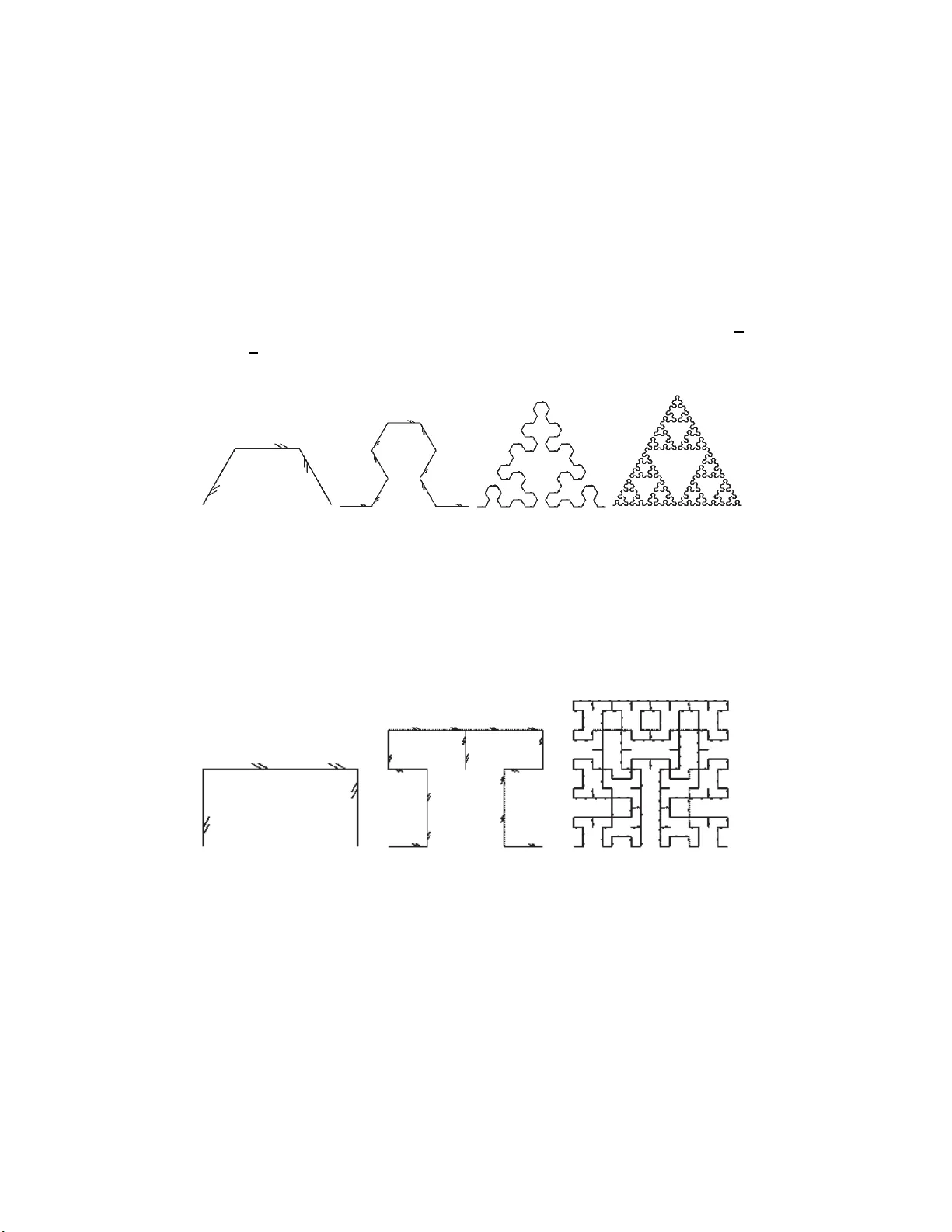
The example of a self-similar con tin uum whic h is not an attractor of an y zipp er. Purevdorj O., T eteno v A.V. Let S b e a system { S 1 , ..., S m } of injectiv e con tr ac tion map s of a com- plete metric space ( X , d ) to itself and let K b e it’s invariant set , i.e. suc h a nonempt y compact s et K t hat satisfies K = m S i =1 S i ( K ). The set K is also called the attr actor of the system S . A natural construction allo w- ing to obtai n the s ystems S with a connected (and therefore arcwise con- nected) in v arian t set is called a s elf-similar zipp er and it goes back to the w orks of Thurston [4] and Astala [2] and w as analyzed in detail by Aseev, Kra vtc henko and T etenov in [5]. Namely , Definition 0.1 A system S = { S 1 , ..., S m } of inje ctive c ontr action maps of c omplete metric sp ac e X to itself is c al le d a zipp er with vertic es ( z 0 , ..., z m ) and signatur e ~ ε = ( ε 1 , ..., ε m ) ∈ { 0 , 1 } m if for any j = 1 , ..., m the f ol lowing e qualities hold: 1. S j ( z 0 ) = z j − 1+ ε j ; 2. S j ( z m ) = z j − ε j . If the maps S i are s im ilarities (or affin e maps) th e zipp er is called self- similar (corresp ondingly self-affine). W e shall call the p oints z 0 and z m the i nitial and the final p oin t of the zipp er r espective ly . The simplest example of a s elf-similar zipp er ma y b e obtained if w e take a partition P , 0 = x 0 < x 1 < . . . < x m = 1 of the segment I = [0 , 1] into m pieces and pu t T i = x i − 1+ ε i (1 − t ) + x i − ε i t . This zipp er { T 1 , . . . , T m } w ill b e d en ot ed b y S P ,~ ε . Theorem 0.2 ( see [5]) . F o r any zipp er S = { S 1 , ..., S m } with vertic es { z 0 , . . . , z m } and signatur e ~ ε i n a c omplete metric sp ac e ( X , d ) and for any p artition 0 = x 0 < x 1 < . . . < x m = 1 of the se gment I = [0 , 1] into m pie c es ther e e xists unique map γ : I → K ( S ) su c h that for e ach i = 1 , ..., m , γ ( x i ) = z i and S i · γ = γ · T i (wher e T i ∈ S P ,~ ε ). Mor e over, the map γ is H¨ old er c ontinuous. 1 The mapping γ in the Theorem is called a line ar p ar a metrization of the zipp er S . Thus, the attractor K of an y zipp er S is an arcwise connected set, whereas the linear p aramet rization γ ma y b e view ed as a self-similar P eano curv e, filling the con tinuum K . Some P eano curv es. a) The attracto r K of a self-similar zipp er S with v ertices (0 , 0), (1 / 4 , √ 3 / 4), (3 / 4 , √ 3 / 4), (1 , 0) and signature (1 , 0 , 1) is the Sierpinsky gask et. Figure 1: 1,2,4,an d 8 iterati ons in the constru ction of the Peano curve for Sierpin sky gasket. b) A self-similar zipp er with vertic es (0 , 0), (0 , 1 / 2), (1 / 2 , 1 / 2), (1 , 1 / 2), (1 , 0) and signature (1,0,0 ,1) pro duces a self-similar P eano curve for the square [0 , 1] × [0 , 1] Figure 2: Iteratio ns for square-f illing Peano curve . c) A self-similar zipp er w ith vertic es (0 , 0) , (0 , 1 / 3), (1 / 3 , 1 / 3 ) , (1 / 3 , 2 / 3), (1 / 3 , 1 ) , (2 / 3 , 1), (2 / 3 , 2 / 3) , (2 / 3 , 1 / 3), (2 / 3 , 0 ) , (1 , 0) and signature (0,1,0, 0,1,0, 0,1,0) giv es a P eano curve for Sierp in sky carp et. d) T h e attractor of a zipp er w ith vertic es (0 , 0) , (1 , 0) , (1 , 1), (1 , 2), (2 , 2) , 2 (2 , 1) , (2 , 0) , (3 , 0) and signature (0,0,1,1, 1,0,0) is a dendrite. Figure 3: A zipper whose attracto r is a dendrit e. The main example. The follo w ing example sho ws that there do exist self-similar con tinua whic h cannot b e repr esen ted as an attractor of a self-similar zipp er. Let S b e a system of con traction similarities g k in R 2 where S 2 ( ~ x ) = ~ x/ 2 + (2 , 0), and S k ( ~ x ) = ~ x/ 4 + ~ a k where ~ a k run th rough the set { (0 , 0), (3 , 0), (1 , 2 h ), (3 / 2 , 3 h ) } , h = √ 3 / 2 for k = 1 , 3 , 4 , 5. L et K b e the attractor of the system S and T – the Hutc hin son op erator of the system S defined b y T ( A ) = 5 S j =1 S j ( A ). W e shall use the follo wing notation: By ∆ w e denote the triangle with v ertices A = (0 , 0), B = (2 , 2 √ 3) and C = (4 , 0). The p oin t (2 , 0) is d en ot ed b y D . F or a multiindex i = i 1 ...i k w e den ot e S i = S i 1 ...S i k , ∆ i = S i (∆), K i = S i ( K ), A i = S i ( A ), etc. 1. The set K is a dendrite. The w a y the system S is defined (see [3 , Thm.1.6.2]) guaran tees the arcwise connectedness of K . Sin ce for eac h n the set T n (∆) is simply-connecte d, the set K con tains no cycle s and therefore K is a den dryte. Eac h p oin t of K has the order 2 or 3. If a p oint x has the order 3, it is an image S i ( D ) of the p oin t D for some multiindex i . Any path in K connecting a p oin t ξ ∈ J with a p oin t η ∈ ∆ i , i = 4 , 5 , 24 , 25 , 224 , 225 , .. , 3 Figure 4: Iteratio ns for the example . passes through the p oin t D . 2. Each non-de g ener ate line se gment J c ontaine d in K , is p ar al lel to x axis and is c ontaine d in some maximal se g ment in K which has the length 4 1 − n . Consider a non-degenerate linear segmen t J ⊂ K . There is suc h m ultiin- dex i , that J meets the b oundary of S i (∆) in t wo differen t p oin ts which lie on different s id es of S i (∆) and do not lie in the same sub cop y of K i . Then J ′ = g − 1 i ( J ∩ K i ) is a segment in K with the endp oint s lyin g on different sides of D wh ic h is not con tained in neither of su bcopies K 1 , ..., K 5 of K . Then J ′ = [0 , 4]. Since a part of J is a base of some triangle S i (∆), the length of the maximal segmen t in K con taining J is 4 1 − n where n ≤ | i | . 3. Any inje ctive affine mapping f of K to itself is one of the similarities S i = S i 1 · ... · S i k . Since f maps [0 , 4] to s ome J ⊂ S i ([0 , 4]) for some i , it is of the form f ( x, y ) = ( ax + b 1 y + c 1 , b 2 y + c 2 ), w ith p ositive b 2 . Cho osing appropriate comp osition S − 1 i · f · S j ( K ) w e obtain a map of K to itself sending [0 , 4] to some s u bset of [0 . 4]. Therefore we ma y supp ose that f ( x, y ) = ( ax + b 1 y + c 1 , b 2 y ), and that 4 the image f (∆) is cont ained in ∆ and is not con tained in any ∆ i , i = 1 , ..., 5. If f ( B ) ∈ ∆ i , i = 4 , 5 , 24 , 25, then, since ev ery path from J to f ( B ) passes through D , f ( D ) = D and therefore c 1 = 2 − a . If f ( B ) ∈ ∆ i , i = 4 , 5, then 1 / 2 ≤ b 2 ≤ 1. In this case y − co ordinates of the p oin ts f ( B 1 ) , f ( B 3 ) are greater than √ 3 / 4, so they are conta ined in ∆ 1 and ∆ 3 , therefore the map f either ke eps the p oin ts D 1 , D 3 in v arian t, or transp oses them. In eac h case | a | = 1 and f ( { A, C } ) = { A, C } . If in this case f ( B ) 6 = B , th en f ( A 4 ) cannot b e con tained in T (∆). The same argumen t sho ws that if f ( B ) = B , then f ( A ) 6 = C . Therefore f = Id. Supp ose f ( B ) ∈ ∆ i , i = 24 , 25 and a > 1 / 2. Then the p oin ts f ( B 1 ) , f ( B 3 ) are con tained in ∆ 1 and ∆ 3 , therefore the m ap f either ke eps the p oin ts D 1 , D 3 in v arian t, or transp oses them, so | a | = 1 and f ( { A, C } ) = { A, C } . Considering th e intersect ions of the line segmen ts [ A, f ( B )] an d [ f ( B ) , C ] with the b oundary of T (∆) and T 2 (∆) we see that either f ( A 4 ) or f ( C 5 ) is not con tained in T 2 (∆), whic h is imp ossible. Therefore, either a ≤ 1 / 2 or f = Id . Th e first means that f (∆) ⊂ ∆ 2 , whic h con tradicts the original assumption, so f = Id. 4. The set K c annot b e an attr actor of a zipp er. Let Σ = { ϕ 1 , ..., ϕ m } b e a zipp er w hose inv ariant set is K . Let x 0 , x 1 b e the initial and fi n al p oint s of the zipp er Σ. Let γ b e a p ath in K conn ec ting x 0 and x 1 . Since for ev ery i = 1 , ..., m the m ap ϕ i is equal to some S j , the sets ϕ i ( K ) are the sub copies of K , therefore for eac h i at least one the images ϕ i ( x 0 ) , ϕ i ( x 1 ) is con tained in the intersect ion of ϕ i ( K ) with adjacen t copies of K . C onsider the p ath ˜ γ = T Σ ( γ ) = m S i =1 ϕ i ( γ ). It starts from the p oin t x 0 , ends at x 1 and passes through all copies K j of K . Eac h of the p oin ts C 1 = A 2 , C 2 = A 3 , B 2 = C 4 and B 4 = A 5 splits K to t wo comp onen ts, therefore is con tained in ˜ γ and is a common p oin t for the copies ϕ i ( γ ) , ϕ i +1 ( γ ) for some i . Therefore one of the p oin ts x 0 , x 1 m ust b e A , one of the p oin ts x 0 , x 1 m ust b e B , and one of the p oin ts x 0 , x 1 m ust b e C , which is imp ossible. References [1] Ase ev V.V. : On the regularit y of self-similar zipp er s -M aterials of the 6-th Russian-Korean In t. Symp . on S cie nce and T ec hnology , K OR US- 2002 (June 24-30, 2002. No vosibirsk State T ec hn. Univ., Russ ia”, P art 3, (Abs tr ac ts), p. 167. 5 [2] Astala K. : Self-similar zipp ers . – Holomorph.funct. and Mo duli: Pro c.W orkshop, Marc h 13-19,198 6, V ol.1— New Y ork, 1988, pp. 61- 73. [3] Kigami J. : Analysis on fractals, Cambridge Unive rsit y Press, 2001. [4] Thurston W.P. : Z ipp ers and univ alen t fun cti ons, in: Th e Bieb erbac h Conjecture, Math. S urv eys, No. 21, Am. Math. So c., Pr o vidence, R.I. (1986 ), pp. 18519 7. [5] Ase ev V.V., K r avtchenko A.S.,T etenov A.V. : On s elf-similar curv es in the plane// Sib erian math J., 2003, V.44, No3, pp.481-492 . [6] Hutchinson J. : F ractals and self-similarit y . – Indiana Univ. Math. J., 30, No 5, 1981 , p p .71 3-747. 6
Original Paper
Loading high-quality paper...
Comments & Academic Discussion
Loading comments...
Leave a Comment