The double of a Hopf monad
The center Z(C) of an autonomous category C is monadic over C (if certain coends exist in C). The notion of Hopf monad naturally arises if one tries to reconstruct the structure of Z(C) in terms of its monad Z: we show that Z is a quasitriangular Hop…
Authors: ** *논문에 명시된 저자 정보가 본문에 포함되어 있지 않으므로, 저자 이름을 확인할 수 없습니다.* **
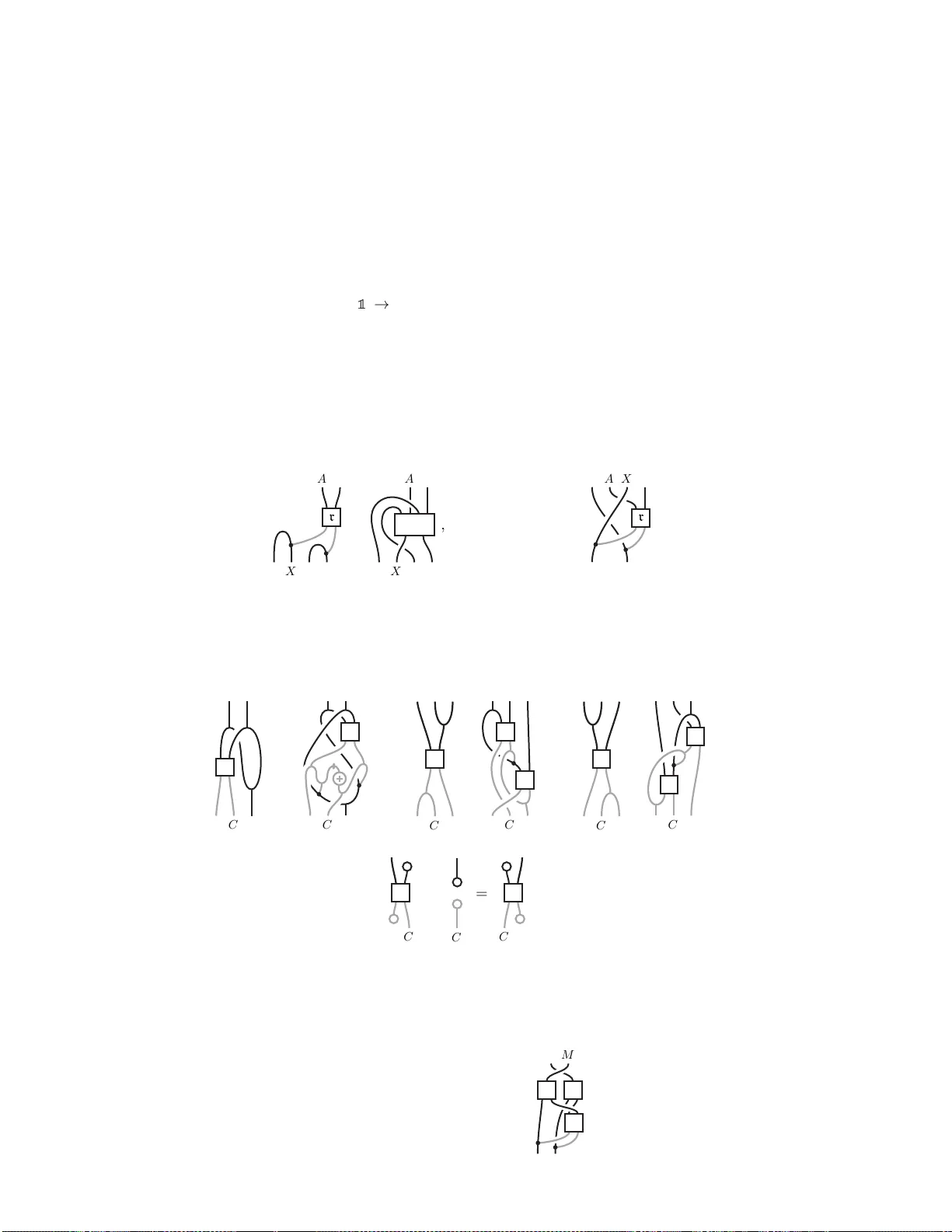
THE DOUBLE OF A HOPF MONAD ALAIN BRUGUI ` ERES AND ALEXIS VIRELIZIER Abstract. The cen ter Z ( C ) of an autonomous category C is monadic ov er C (if certain co ends exist in C ). The notion of Hopf monad naturally arises if one tries to reconstruct the structure of Z ( C ) in terms of its monad Z : w e sho w that Z is a quasitriangular Hopf monad on C and Z ( C ) is is omor phic to the braided category Z - C of Z - mo dules. More generally , let T be a Hopf monad on an autonomous category C . W e construct a Hopf monad Z T on C , the c e ntr alizer of T , and a canonical distributive la w Ω : T Z T → Z T T . By Bec k’s theory , this has t wo consequences. On one hand, D T = Z T ◦ Ω T is a quasitri angular Hopf monad on C , called the double of T , an d Z ( T - C ) ≃ D T - C as braided categories. As an il l ustration, we define the do uble D ( A ) of a Hopf algebra A in a braided autonomous category in such a wa y that the cente r of the category of A - mo dules is the br aided category of D ( A )- mo dules (generalizing the Drinfeld double). On the other hand, the canonical distributive la w Ω also lifts Z T to a Hopf monad ˜ Z Ω T on T - C , and ˜ Z Ω T ( 1 , T 0 ) is the co end of T - C . F or T = Z , this gives an explicit description of the Hopf algebra structure of the coend of Z ( C ) in terms of the structural morphis m s of C . Such a description i s useful in quantum topology , especially when C is a spherical fusion category , as Z ( C ) is then mo dular. Contents Int ro duction 1 1. Preliminarie s a nd no tations 3 2. Hopf mona ds a nd their mo dules 8 3. Hopf mona ds, mo noidal adjunctions, a nd co ends 13 4. Distributive laws a nd liftings 17 5. The ce ntralizer of a Hopf mo nad 21 6. The do uble o f a Hopf monad 29 7. The ce ntralizer of a Hopf mo nad on a category of mo dules 32 8. The do uble o f a Hopf algebra in a br aided categor y 38 9. Hopf mona ds a nd fusio n catego ries 45 References 48 Introduction The cen ter Z ( C ) of an autonomous category C , intro duced b y Drinfeld, is a braided autonomous category . This construction establishes a bridge be tw een the non-braided world and th e braided world. It is useful, in particula r, for co mparing quantum inv ariants o f 3 manifolds. Indeed, the cen ter Z ( C ) of spherical fusion category C is mo dular (see [M ¨ u03]) and it is conjectured that the T uraev-Viro inv ariant TV C (as revisited in [B W96]) is equal to the Reshetikhin-T uraev inv ariant R T Z ( C ) (see [T ur94]). Date : Octob er 27, 2018. 2000 Mathematics Subje ct Classific ation. 16W30,18C20,18D1 0. 1 2 A. BR UGUI ` ERES AND A. VIRELIZIER Let C b e a n a utonomous categor y . If the co end: Z ( X ) = Z Y ∈C ∨ Y ⊗ X ⊗ Y exists for all ob ject X o f C , then Day and Street [DS07] show ed tha t Z is a mona d on C and the center Z ( C ) is isomorphic to the categor y Z - C of Z - mo dules in C (also ca lled Z - algebras ). By T annak a reconstr uction, we endow the monad Z with a quasitriang ular Ho pf monad s tructure whic h reflects the braided autonomous structure o f Z ( C ) in the sense that Z ( C ) ≃ Z - C a s braided categories. The no tion of Hopf mo nad, which generalizes Hopf a lgebras to the non-bra ided (and non-linear) setting, w a s intro duce d in [BV07] fo r this very purp ose. The Res he tikhin- T u ra ev inv ariant can be expressed in terms of the s imple ob- jects of the categor y (as in Reshetikhin and T uraev’s orig inal construction) or in terms of the c o end o f the categ ory (following Lyuba s henk o, see [Lyu95, BV05]). In order to compute R T Z ( C ) , the first approach is not practicable for lac k of a w ork- able description of the simple ob jects o f the ce nter. And so we need to provide an explicit des cription of the co end o f Z ( C ) and its algebra ic structure . T o fulfill this ob jectiv e, we extend the previo us c onstruction of Z to a more g eneral situation. Let T b e a Hopf monad on an autonomous ca teg ory C . W e denote T - C the cat- egory of T - mo dules (also ca lled T - algebra s), which is auto nomous. Assume T is c ent r alizable , mea ning that the coe nd: Z T ( X ) = Z Y ∈C ∨ T ( Y ) ⊗ X ⊗ Y . exists for every o b ject X o f C . W e endow Z T with a str ucture of a Ho pf monad on C and call Z T the c entr alizer of T . In particular, Z 1 C = Z as Hopf mona ds. Note tha t the co end of C is Z ( 1 ) = Z 1 C ( 1 ), a nd so the co end of Z ( C ) is Z 1 Z ( C ) ( 1 ) = Z 1 Z - C ( 1 ). Using adjunction and exac tnes s prop erties of Hopf mona ds, we sho w that 1 T - C is centralizable and: U T Z 1 T - C = Z T U T . Note that this implies that, as an o b ject o f C , the co end of the category T - C is Z T ( 1 ) and, in par ticular, the c o end of Z ( C ) = Z - C is Z Z ( 1 ). Now U T Z 1 T - C = Z T U T means in fact that the Hopf mo nad Z 1 T - C is a lift to T - C o f the Hopf monad Z T . Extending Beck’s theo ry of distributive laws to Hopf mona ds, we show that such a lift is enco ded by an in vertible comonoida l distributive law Ω : T Z T → Z T T , called the c anonic al distributive law of T . The co end of T - C is therefore ( Z T ( 1 ) , Z T ( T 0 )Ω 1 ). When T is qua sitriangular, this co end has a structure of a Hopf alge br a in the braided autonomous ca tegory T - C , which we elucidate in terms of T . Hence, for T = Z , an explicit description of the co end o f Z ( C ). The case of fusion c a tegories is treated in detail. The canonica l distributive law Ω also endows the comp osition of Z T and T with a Hopf mona d structure, denoted D T = Z T ◦ Ω T a nd called the double of T . W e prov e that D T is q uasitriangular and giv e a br aided isomorphis m: D T - C ≃ Z ( T - C ) . This constructio n, which holds for any cen tra lizable Hopf monad on an au- tonomous category , genera lizes the Dr infeld double in an non-br aided setting. As an illustra tio n, we apply this to Hopf monads a sso ciated with Hopf algebra s. This leads to the double D ( A ) of a Hopf algebr a A in a braided autono mous c a tegory B . More pr ecisely , the endofunctor ? ⊗ A is a Hopf monad on B . Assuming B admits a co end C , the Hopf monad ? ⊗ A is centralizable, and its centralizer is o f the form ? ⊗ Z ( A ), wher e Z ( A ) = ∨ A ⊗ C is a Hopf alge bra in B . The canonica l distributive law of ? ⊗ A is of the form id 1 B ⊗ Ω, wher e Ω : Z ( A ) ⊗ A → A ⊗ Z ( A ) is a distributive THE DOUBLE OF A HOPF MONAD 3 law of Hopf algebras. Then D ( A ) = A ⊗ Ω Z ( A ) is a quasitria ngular Hopf a lgebra in B , suc h that: Z ( B A ) ≃ B D ( A ) ≃ D ( A ) B ≃ Z ( A B ) . as braided catego ries, wher e A B and B A denote the categ ories o f left and right mo dules over A . Note that a Hopf algebr a B in B is quasitria ngular when it is endow ed with a R-matr ix. In this con text, we define R-ma tr ices to b e morphisms r : C ⊗ C → B ⊗ B which enco de bra idings o n B B (or equiv alently B B ). When B is the ca tegory of finite-dimensio na l vector spaces ov er a field k , we re co ver the usua l definition of R-ma trices and the Drinfeld double of a Hopf alg ebra H . Indeed, in that ca se: C = k , Z ( H ) = H ∗ cop , and D ( H ) = H ⊗ Ω H ∗ cop . The canonica l distributive law o f a Hopf monad is in fact na turally de fined in a more genera l setting. Le t T b e a Hopf monad on a n autono mous ca tegory C and Q be a Hopf mona d on T - C . Their cross product Q ⋊ T = U T QF T is a Hopf monad on C . If Q ⋊ T is centralizable, then so is Q and the Ho pf monad Z Q is a lift to T - C of the Hopf monad Z Q ⋊ T : U T Z Q = Z Q ⋊ T U T . Hence a canonical dis tributiv e law Ω : T Z Q ⋊ T → Z Q ⋊ T T and a Hopf mona d D Q,T = Z Q ⋊ T ◦ Ω T on C . Moreov er, we show: D Q,T - C ≃ Z Q ( T - C ) , where Z Q ( T - C ) is the center of T - C relative to Q . When Q = id T - C , we obtain the previous res ults. This pap er is or ganized as follows. In Section 1 , w e review se veral facts ab out monoidal categories a nd Hopf algebras in braided categories . Section 2 r ecalls the definition and elementary prop erties of Hopf monads. Section 3 deals with monoidal adjunctions, exactness prop erties, and cross pr oducts of Hopf monads. In Section 4, we br iefly recall the basic results of Beck’s theory of distributive la ws and extend them to the Hopf mo na d s e tting. In Section 5 , we define the centralizer Z T of a Hopf monad T o n C and relate it to the center Z T ( C ) of C relative to T . In Section 6, we define the ca nonical distributive law Ω o f T over Z T and the double D T = Z T ◦ Ω T , and sta te their catego rical prop erties. In Section 7, we study the centralizer Z Q of a Hopf monad Q on T - C and construct the ca nonical distributive law of T ov er Z Q ⋊ T . Section 8 is devoted to Hopf monads o n a braided ca tegory B . In pa rticular, we define the double D ( A ) o f a Hopf algebra A in a braided autono mous categ ory . In Sectio n 9, we tr eat the ca se of the cen ter of a fusion category . 1. Preliminaries and not a tions 1.1. Categori es. Unless otherwise sp ecified, c a tegories ar e small, and mo noidal categorie s are s trict. If C is a categor y , we denote Ob( C ) the set of ob jects of C and Hom C ( X, Y ) the set o f mor phisms in C fro m an o b ject X to an ob ject Y . The identit y fun ctor of C will b e denoted by 1 C . W e denote C op the opp osite c ate gory (where a rrows ar e reversed). Let C , D b e tw o catego ries. F unctors from C to D are the ob jects of a c a te- gory Fun ( C , D ). Giv en tw o functors F , G : C → D , a morphism α : F → G is a family { α X : F ( X ) → G ( X ) } X ∈ Ob( C ) of morphisms in D satisfying the following functoriality condition: α Y F ( f ) = G ( f ) α X for every morphism f : X → Y in C . Such a morphism is called a natur al tr ansformation . W e denote Hom ( F, G ) the set Hom Fun ( C , D ) ( F, G ) of natural transfo r mations from F to G , and id F the identit y natural tr ansformation of a functor F . If C , C ′ are tw o categor ies, we denote σ C , C ′ the flip functor C × C ′ → C ′ × C defined by ( X , X ′ ) 7→ ( X ′ , X ). 4 A. BR UGUI ` ERES AND A. VIRELIZIER 1.2. Mo noidal categorie s. Let C be monoida l categor y with monoidal pr oduct ⊗ : C × C → C a nd unit ob ject 1 . F or n ≥ 0, we deno te ⊗ n the functor: ⊗ n : C n = C × · · · × C | {z } n times → C , ( X 1 , . . . , X n ) 7→ X 1 ⊗ · · · ⊗ X n . Note that ⊗ 0 is the constan t functor equal to 1 , ⊗ 1 = id 1 C , a nd ⊗ 2 = ⊗ . F o r a family of functors { F i : A i → C } 1 ≤ i ≤ n , se t: F 1 ⊗ · · · ⊗ F n = ⊗ n ◦ ( F 1 , · · · , F n ) : A 1 × · · · × A n → C . F o r a functor F : A → C , set: F ⊗ n = F ⊗ · · · ⊗ F | {z } n time s : A n → C . If C is a monoidal c a tegory , we deno te C ⊗ op the monoida l categor y with opp osite monoidal pr oduct ⊗ op defined by X ⊗ op Y = Y ⊗ X . 1.3. Mo noidal functors. Let ( C , ⊗ , 1 ) and ( D , ⊗ , 1 ) b e tw o monoidal categor ies. A monoidal functor from C to D is a triple ( F , F 2 , F 0 ), where F : C → D is a functor, F 2 : F ⊗ F → F ⊗ is a morphism o f functors, a nd F 0 : 1 → F ( 1 ) is a morphism in D , such that: F 2 ( X, Y ⊗ Z )(id F ( X ) ⊗ F 2 ( Y , Z )) = F 2 ( X ⊗ Y , Z )( F 2 ( X, Y ) ⊗ id F ( Z ) ); F 2 ( X, 1 )(id F ( X ) ⊗ F 0 ) = id F ( X ) = F 2 ( 1 , X )( F 0 ⊗ id F ( X ) ); for all ob jects X , Y , Z o f C . A mo noidal functor ( F, F 2 , F 0 ) is said to b e s t r ong (resp. strict ) if F 2 and F 0 are isomorphisms (re s p. identities). By a monoidal isomorphi sm , we mean a strong mono idal functor which is an isomorphism. 1.4. Mo noidal natural transformations . Let F : C → D and G : C → D be tw o monoidal functor s. A na tural transfor mation ϕ : F → G is monoidal if it satisfies: ϕ X ⊗ Y F 2 ( X, Y ) = G 2 ( X, Y )( ϕ X ⊗ ϕ Y ) and G 0 = ϕ 1 F 0 . 1.5. Com onoidal functors. Let ( C , ⊗ , 1 ) and ( D , ⊗ , 1 ) be tw o monoidal cate- gories. A c omonoidal functor 1 from C to D is a triple ( F, F 2 , F 0 ), where F : C → D is a functor, F 2 : F ⊗ → F ⊗ F is a natural tra nsformation, and F 0 : F ( 1 ) → 1 is a morphism in D , suc h that: id F ( X ) ⊗ F 2 ( Y , Z ) F 2 ( X, Y ⊗ Z ) = F 2 ( X, Y ) ⊗ id F ( Z ) F 2 ( X ⊗ Y , Z ); (id F ( X ) ⊗ F 0 ) F 2 ( X, 1 ) = id F ( X ) = ( F 0 ⊗ id F ( X ) ) F 2 ( 1 , X ); for all ob jects X , Y , Z o f C . It is conv enient to denote F 3 : F ⊗ 3 → F ⊗ 3 the natural tra nsformation defined by F 3 ( X, Y , Z ) = (id F ( X ) ⊗ F 2 ( Y , Z )) F 2 ( X, Y ⊗ Z ) = ( F 2 ( X, Y ) ⊗ id F ( Z ) ) F 2 ( X ⊗ Y , Z ). A como noidal functor ( F, F 2 , F 0 ) is said to b e str ong (res p. strict ) if F 2 and F 0 are is o morphisms (resp. ident ities). In that cas e, ( F , F − 1 2 , F − 1 0 ) is a strong (resp. strict) mo noidal functor . 1.6. Com onoidal natural transformations. Let F : C → D and G : C → D b e t wo comonoidal functor s. A natural transformation ϕ : F → G is c omonoidal if it satisfies: G 2 ( X, Y ) ϕ X ⊗ Y = ( ϕ X ⊗ ϕ Y ) F 2 ( X, Y ) a nd G 0 ϕ 1 = F 0 . 1 Comonoidal f unct ors are also called opmonoidal functors THE DOUBLE OF A HOPF MONAD 5 1.7. Autonom ous categorie s. Recall that a duality in a monoidal categor y C is a quadruple ( X , Y , e, d ), where X , Y a r e o b jects of C , e : X ⊗ Y → 1 (the evaluation ) and d : 1 → Y ⊗ X (the c o evaluation ) are morphisms in C , suc h tha t: ( e ⊗ id X )(id X ⊗ d ) = id X and (id Y ⊗ e )( d ⊗ id Y ) = id Y . Then ( X , e, d ) is a left dual of Y a nd ( Y , e, d ) is a right dual of X . If D = ( X , Y , e, d ) and D ′ = ( X ′ , Y ′ , e ′ , d ′ ) a re tw o dualities, tw o morphisms f : X → X ′ and g : Y ′ → Y a re in duality with r esp e ct to D and D ′ if e ′ ( f ⊗ id Y ′ ) = e (id X ⊗ g ) or, equiv alently , (id Y ′ ⊗ f ) d = ( g ⊗ id X ) d ′ . In that ca se we write f = ∨ g D,D ′ and g = f ∨ D,D ′ , or simply f = ∨ g and g = f ∨ . Note that this defines a bijection betw een Hom C ( X, X ′ ) and Hom C ( Y ′ , Y ). Left and right dua ls, if they exist, a r e essentially unique: if ( Y , e, d ) and ( Y ′ , e ′ , d ′ ) are right duals of some ob ject X , then there exists a unique iso morphism u : Y → Y ′ such that e ′ = e (id X ⊗ u − 1 ) and d ′ = ( u ⊗ id X ) d . A left autonomous (resp. right autonomous , resp. aut onomous ) categor y is a monoidal categ ory for which every o b ject admits a left dual (resp. a right dual, resp. b oth a left and a r igh t dual). Assume C is a left autonomous catego r y and, for each ob ject X , pick a left dual ( ∨ X , ev X , co ev X ). This data defines a s trong mo noidal functor ∨ ? : C op , ⊗ op → C . Likewise, if C is a rig ht auto no mous categor y , picking a right dual ( X ∨ , e ev X , g co ev X ) for each ob ject X defines a strong mono idal functor ? ∨ : C op , ⊗ op → C . Subsequently , when dea ling with left or r igh t autonomous catego ries, we shall alwa ys assume tac itly that left duals or rig ht duals have b een chosen. Moreover, in formulae, we abstain from wr iting down the follo wing canonical iso morphisms: ∨ ? 2 ( X, Y ) : ∨ Y ⊗ ∨ X → ∨ ( X ⊗ Y ) , ∨ ? 0 : 1 → ∨ 1 , ? ∨ 2 ( X, Y ) : Y ∨ ⊗ X ∨ → ( X ⊗ Y ) ∨ , ? ∨ 0 : 1 → 1 ∨ , and ( e ev X ⊗ id ∨ ( X ∨ ) )(id X ⊗ coev X ∨ ) : X → ∨ ( X ∨ ) , (id ( ∨ X ) ∨ ⊗ ev X )( g coev ∨ X ⊗ id X ) : X → ( ∨ X ) ∨ . 1.8. Braided categories. Recall that a br aiding on a monoidal categor y C is a natural is o morphism τ : ⊗ → ⊗ σ C , C such that: τ X,Y ⊗ Z = (id Y ⊗ τ X,Z )( τ X,Y ⊗ id Z ) and τ X ⊗ Y ,Z = ( τ X,Z ⊗ id Y )(id X ⊗ τ Y ,Z ) . A br aide d c ate gory is a mono idal categor y endow ed with a br aiding. The mirr or of a br aiding τ is the braiding τ defined by τ X,Y = τ − 1 Y ,X . The mirr or of a br aide d c ate gory B is the braided categor y B whic h co incides with B as a monoida l ca tegory but is endow ed with the mirro r bra iding. If C is braided with br aiding τ , then C ⊗ op is braide d with braiding τ o defined by τ o X,Y = τ Y ,X . Note that τ 7→ τ o is a bijection b et ween braidings on C and braidings on C ⊗ op . 1.9. Braided functors. A br aide d functor b etw een t wo braided categories B and B ′ is a strong monoidal f unctor F : B → B ′ such that: F ( τ X,Y ) F 2 ( X, Y ) = F 2 ( Y , X ) τ ′ F ( X ) ,F ( Y ) for all ob jects X , Y of B , wher e τ and τ ′ are the braidings of B and B ′ . Example 1. 1. If B is a br aided categ ory w ith br aiding τ , the monoida l functor (1 B , τ , id 1 ) : B ⊗ op → B is a braided isomorphism. 6 A. BR UGUI ` ERES AND A. VIRELIZIER 1.10. The center of a monoidal category. Let C be a mono idal c ategory . A left half br aiding o f C is a pair ( M , σ ), where M is an ob ject of C and σ : M ⊗ 1 C → 1 C ⊗ M is a natural transforma tio n such that: (i) σ Y ⊗ Z = (id Y ⊗ σ Z )( σ Y ⊗ id Z ) for all Y , Z ∈ Ob( C ); (ii) σ 1 = id M ; (iii) σ is an isomorphism. Note that if C is auto nomous, (iii) is a conse q uence of (i) and (ii) . The c enter of C is the br aided categ ory Z ( C ) defined as f ollows. Its o b jects are left ha lf braidings of C . A morphism in Z ( C ) fro m ( M , σ ) to ( M ′ , σ ′ ) is a morphism f : M → M ′ in C such that: (id 1 C ⊗ f ) σ = σ ′ ( f ⊗ id 1 C ). The mono idal pr oduct and braiding τ ar e: ( M , σ ) ⊗ ( N , γ ) = M ⊗ N , ( σ ⊗ id N )(id M ⊗ γ ) and τ ( M ,σ ) , ( N , γ ) = σ N . Note that if C is auto nomous, so is Z ( C ). Remark 1.2. Likewise, define a right half br aiding o f a monoida l categ ory C to b e a pair ( M , σ ), wher e M is an o b ject of C and σ : 1 C ⊗ M → M ⊗ 1 C is a na tural transformatio n satisfying analogo us axioms. Righ t ha lf br aidings form a braided category Z ′ ( C ), with braiding : τ ′ ( M ,σ ) , ( N , γ ) = γ M . W e have: Z ′ ( C ) = Z ( C ⊗ op ) ⊗ op . The braided categor y Z ′ ( C ) is is omorphic to the mirro r of Z ( C ) via the br aided isomorphism given by ( M , σ ) 7→ ( M , σ − 1 ). 1.11. Algebras, bi algebras, and H opf algebras in categories. Let C b e a monoidal category . An algebr a in C is an ob ject A of C endow ed with morphisms m : A ⊗ A → A (the pro duct) a nd u : 1 → A (the unit) such that: m ( m ⊗ id A ) = m (id A ⊗ m ) and m (id A ⊗ u ) = id A = m ( u ⊗ id A ) . A c o algebr a in C is a n ob ject C of C e ndo wed with morphisms ∆ : C → C ⊗ C (the copro duct) and ε : C → 1 (the counit) suc h that: (∆ ⊗ id C )∆ = (id C ⊗ ∆)∆ and (id C ⊗ ε )∆ = id C = ( ε ⊗ id C )∆ . Let B b e a braided categor y , with braiding τ . A bialgebr a in B is an ob ject A of B endow ed with a n a lg ebra structure ( m, u ) and a coa lgebra structur e (∆ , ε ) in B satisfying: ∆ m = ( m ⊗ m )(id A ⊗ τ A,A ⊗ id A )(∆ ⊗ ∆) , ∆ u = u ⊗ u, εm = ε ⊗ ε, εu = id 1 . Let A be a bialgebra in B . Set: m op = mτ − 1 A,A and ∆ cop = τ − 1 A,A ∆ . Then ( A, m op , u, ∆ , ε ) is a bialg ebra in the mirror B of B , called the opp osite of A , and denoted A op . Similarly ( A, m, u , ∆ cop , ε ) is a bialgebra in B , called the c o- opp osite of A , and deno ted A cop . Consequently A cop , op = ( A cop ) op is a bialgebra in B (with product mτ A,A and copr o duct τ − 1 A,A ∆). An antip o de for a bia lgebra A is a morphism S : A → A in B suc h tha t: m ( S ⊗ id A )∆ = uε = m (id A ⊗ S )∆ . If it ex ists, an antipo de is unique, and it is a mor phis m of bialg ebras A → A cop , op . A Hopf algebr a in B is a bia lgebra in B which admits an invertible antipo de. If A is a Hopf algebra in B , with antipo de S , then A op and A cop are Hopf a lgebras in the mirror B of B , with a ntipo de S − 1 . THE DOUBLE OF A HOPF MONAD 7 1.12. Mo dule s in categories. Let ( A, m, u ) b e an a lgebra in a monoidal cate- gory C . A left A - mo dule (in C ) is a pair ( M , r ), wher e M is an ob ject o f C and r : A ⊗ M → M is a morphism in C , such that: r ( m ⊗ id M ) = r (id A ⊗ r ) and r ( u ⊗ id M ) = id M . An A - line ar morphism b etw een t wo left A - mo dules ( M , r ) and ( N , s ) is a mor phism f : M → N such that f r = s (id A ⊗ f ). Hence the category A C o f left A - mo dules . Likewise, o ne defines the categor y C A of right A - mo dules. Let A be a bialgebr a in a bra ided catego ry B . Then the catego ry A B is monoidal, with unit ob ject ( 1 , ε ) a nd mono idal pro duct: ( M , r ) ⊗ ( N , s ) = ( r ⊗ s )(id A ⊗ τ A,M ⊗ id N )(∆ ⊗ id M ⊗ N ) , where ∆ and ǫ are the co pro duct and counit of A , and τ is the bra iding of B . Likewise the ca tegory C A is monoidal, with unit ob ject ( 1 , ε ) and monoidal pro duct: ( M , r ) ⊗ ( N , s ) = ( r ⊗ s )(id M ⊗ τ N ,A ⊗ id A )(∆ ⊗ id M ⊗ N ) . Assume B is autonomo us . Then A B is a utonomous if and only if B A is au- tonomous, if and only if A is a Hopf a lgebra. If A is a Hopf algebr a , with antipo de S , then the duals of a left A -module ( M , r ) are: ∨ ( M , r ) = ∨ M , (ev M ⊗ id ∨ M )(id ∨ M ⊗ r ( S ⊗ id M ) ⊗ id ∨ M )( τ A, ∨ M ⊗ coev M ) , ( M , r ) ∨ = M ∨ , (id M ∨ ⊗ e ev M )(id M ∨ ⊗ rτ − 1 A,M ⊗ id M ∨ )( g coev M ⊗ S − 1 ⊗ id M ∨ ) , and the duals of a righ t A -mo dule ( M , r ) are: ∨ ( M , r ) = ∨ M , (ev M ⊗ id ∨ M )(id ∨ M ⊗ rτ − 1 M ,A ⊗ id ∨ M )(id ∨ M ⊗ S − 1 ⊗ coev M ) , ( M , r ) ∨ = M ∨ , (id M ∨ ⊗ e ev M )(id M ∨ ⊗ r (id M ⊗ S ) ⊗ id M ∨ )( g co ev M ⊗ τ M ∨ ,A ) . Remark 1. 3. Let A b e a Hopf algebra in a braided category B , with bra iding τ . The functor F A : A B → B A , defined b y F A ( M , r ) = M , r τ M ,A (id M ⊗ S ) and F A ( f ) = f , g iv es rise to a monoidal isomo r phism of catego ries: F A = ( F A , τ , 1 ) : ( A B ) ⊗ op → B A . Therefore bra idings on A B are in bijection with braidings on B A . More precisely , if c is a bra iding on B A , then: c ′ ( M ,r ) , ( N ,s ) = τ M ,N c F A ( N ,s ) ,F A ( M ,r ) τ − 1 N ,M is a braiding on A B (making F A braided), and the corresp ondence c 7→ c ′ is bijective. 1.13. P enrose graphical calculus. W e represent mor phisms in a ca teg ory by diagrams to b e rea d from b ottom to top. Thus w e draw the identit y id X of an ob ject X , a mo rphism f : X → Y , and its comp osition with a mo rphism g : Y → Z as follows: id X = P S f r a g r e p la c e m e n t s X X Y f g Z , f = P S f r a g r e p la c e m e n t s X Y f g Z , and g f = P S f r a g r e p la c e m e n t s X Y f g Z . In a monoida l categor y , w e represent the monoidal pro duct of tw o mor phisms f : X → Y and g : U → V by juxtap osition: f ⊗ g = P S f r a g r e p la c e m e n t s X f Y P S f r a g r e p la c e m e n t s X f Y U g V . The dua lity morphisms of a n autonomous catego ry a re depicted as: ev X = P S f r a g r e p la c e m e n t s X ∨ X , co ev X = P S f r a g r e p la c e m e n t s X ∨ X X ∨ X , e ev X = P S f r a g r e p la c e m e n t s X ∨ X X ∨ X X X ∨ , and g co ev X = P S f r a g r e p la c e m e n t s X ∨ X X ∨ X X X ∨ X X ∨ . 8 A. BR UGUI ` ERES AND A. VIRELIZIER The br aiding τ o f a braided categor y , and its inv erse, ar e depicted as: τ X,Y = P S f r a g r e p la c e m e n t s X X Y Y and τ − 1 Y ,X = P S f r a g r e p la c e m e n t s X X Y Y . Given a Hopf a lgebra A in a braided category , we depict its pro duct m , unit u , copro duct ∆, counit ε , an tip o de S , a nd S − 1 as follows: m = P S f r a g r e p la c e m e n t s A A A , u = P S f r a g r e p la c e m e n t s A , ∆ = P S f r a g r e p la c e m e n t s A A A , ε = P S f r a g r e p la c e m e n t s A , S = P S f r a g r e p la c e m e n t s A A , S − 1 = P S f r a g r e p la c e m e n t s A A . 2. Hopf monads and their modul es In this section, we revie w the notion o f a Hopf monad. F o r a gene r al treatment, we refer to [BV0 7]. 2.1. Mo nads. Let C b e a categor y . Reca ll that the categ ory E nd( C ) of endofunc- tors of C is strict mono idal with comp osition for mo noidal pro duct and identit y functor 1 C for unit o b ject. A monad o n C is an alg ebra in End( C ), that is, a triple ( T , µ, η ), where T : C → C is a functor, µ : T 2 → T and η : 1 C → T are na tural transformatio ns, such that: µ X T ( µ X ) = µ X µ T ( X ) and µ X η T ( X ) = id T ( X ) = µ X T ( η X ) for any ob ject X of C . Example 2. 1. Let A b e an algebr a in a monoidal catego ry C , with pro duct m and unit u . Then the endo functor ? ⊗ A of C , defined by X 7→ X ⊗ A , has a structure of a monad on C , with pro duct µ = id 1 C ⊗ m and unit η = id 1 C ⊗ u . Similarly , the endofunctor A ⊗ ? is a mona d o n C with pr oduct m ⊗ id 1 C and unit u ⊗ id 1 C . 2.2. Bi monads. A bimonad 2 on a mo noidal category C is a monad ( T , µ, η ) o n C such that the functor T : C → C is comonoidal a nd the natural tr a nsformations µ : T 2 → T and η : 1 C → T are comonoida l. In o ther w ords, T is endow ed with a natural tr ansformation T 2 : T ⊗ → T ⊗ T and a morphis m T 0 : T ( 1 ) → 1 in C such that: id T ( X ) ⊗ T 2 ( Y , Z ) T 2 ( X, Y ⊗ Z ) = T 2 ( X, Y ) ⊗ id T ( Z ) T 2 ( X ⊗ Y , Z ) , (id T ( X ) ⊗ T 0 ) T 2 ( X, 1 ) = id T ( X ) = ( T 0 ⊗ id T ( X ) ) T 2 ( 1 , X ) , and T 2 ( X, Y ) µ X ⊗ Y = ( µ X ⊗ µ Y ) T 2 ( T ( X ) , T ( Y )) T ( T 2 ( X, Y )) , T 0 µ 1 = T 0 T ( T 0 ) , T 2 ( X, Y ) η X ⊗ Y = ( η X ⊗ η Y ) , T 0 η 1 = id 1 . Remark 2.2 . A bimo nad on a monoida l catego ry C is nothing but a n algebra in the str ict mono ida l ca teg ory o f comono idal endofunctors of C (with monoidal pro duct ◦ and unit ob ject 1 C ). Remark 2.3. A bimonad T on a monoidal categor y C = ( C , ⊗ , 1 ) may b e view ed as a bimona d T o on the mono idal catego ry C ⊗ op = ( C , ⊗ op , 1 ), with comonoida l structure T o 2 = T 2 σ C , C and T o 0 = T 0 . The bimonad T o is c a lled the opp osite of the bimonad T . W e have: T o - C ⊗ op = ( T - C ) ⊗ op . 2 Bimonads w ere i ntroduced in [Mo e02] under the name ‘Hopf monads’, which we prefer to reserve for bi monads wi th ant ip o des by analogy with H opf algebras. THE DOUBLE OF A HOPF MONAD 9 2.3. Antipo de s. Right and left a ntipo des o f a Hopf monad ge ne r alize the antipo de of a Hopf algebra and its inverse. Le t ( T , µ, η ) b e a bimonad on a monoidal c ate- gory C . Assume C is left auto nomous. A left antip o de for T is a natural transfor mation s l = { s l X : T ( ∨ T ( X )) → ∨ X } X ∈ Ob( C ) satisfying: T 0 T (ev X ) T ( ∨ η X ⊗ id X ) = ev T ( X ) ( s l T ( X ) T ( ∨ µ X ) ⊗ id T ( X ) ) T 2 ( ∨ T ( X ) , X ); ( η X ⊗ id ∨ X )co ev X T 0 = ( µ X ⊗ s l X ) T 2 ( T ( X ) , ∨ T ( X )) T (co ev T ( X ) ); for every ob ject X o f C . By [BV07, Theorem 3.7], a left antipo de s l is ‘anti- (co)mult iplicative’: fo r all ob jects X , Y of C , s l X µ ∨ T ( X ) = s l X T ( s l T ( X ) ) T 2 ( ∨ µ X ); s l X η ∨ T ( X ) = ∨ η X ; s l X ⊗ Y T ( ∨ T 2 ( X, Y )) = ( s l Y ⊗ s l X ) T 2 ( ∨ T ( Y ) , ∨ T ( X )); s l 1 T ( ∨ T 0 ) = T 0 . Assume C is right autonomous. A right ant ip o de for T is a natural transformation s r = { s r X : T ( T ( X ) ∨ ) → X ∨ } X ∈ Ob( C ) satisfying: T 0 T ( e ev X ) T (id X ⊗ η ∨ X ) = e ev T ( X ) (id T ( X ) ⊗ s r T ( X ) T ( µ ∨ X )) T 2 ( X, T ( X ) ∨ ); (id X ∨ ⊗ η X ) g coev X T 0 = ( s r X ⊗ µ X ) T 2 ( T ( X ) ∨ , T ( X )) T ( g co ev T ( X ) ); for ev ery ob ject X of C . By [BV07, Theo rem 3.7 ], a rig h t an tip ode s r is a lso ‘anti-(co)m ultiplicative’: for all ob jects X , Y of C , s r X µ T ( X ) ∨ = s r X T ( s r T ( X ) ) T 2 ( µ X ∨ ); s r X η T ( X ) ∨ = η X ∨ ; s r X ⊗ Y T ( T 2 ( X, Y ) ∨ ) = ( s r Y ⊗ s r X ) T 2 ( T ( Y ) ∨ , T ( X ) ∨ ); s r 1 T ( T 0 ∨ ) = T 0 . Note that if a left (resp. r igh t) an tip o de exists, then it is unique. F urthermore, when b oth exist, the left a n tip ode s l and the r igh t antipo de s r are ‘inv erse’ to each other in the se nse that id T ( X ) = s r ∨ T ( X ) T (( s l X ) ∨ ) = s l T ( X ) ∨ T ( ∨ ( s r X )) for a n y ob ject X of C . 2.4. Hopf m onads. A Hopf monad is a bimonad on an autonomo us catego ry which has a left a n tip ode and a rig h t antipo de. Hopf monads g eneralize Hopf alg ebras in a non-bra ided setting. In particu- lar, finite-dimensional Hopf algebra s and sev era l genera lizations (H opf alge br as in braided autonomous categorie s , bialgebr o ids, etc...) provide examples of Hopf mon- ads. If fact, an y mono ida l a djunction b etw een a utonomous catego ries g iv es rise to a Hopf monad (see Theor em 3.2). It turns out tha t m uch of the theory of finite- dimensional Hopf algebras (such as the deco mposition of Hopf mo dules, the exis- tence of integrals, Maschk e’s criter ium of semisimplicity , etc...) extends to Hopf monads, se e [BV07]. Example 2.4 (Hopf monads a sso ciated with Ho pf alg ebras) . Let A b e a Hopf algebra in a bra ided autonomous categor y B , with braiding τ . According to [BV0 7 ], the endofunctor ? ⊗ A o f B has a structure o f a Hopf monad on B , with pr oduct µ = id 1 B ⊗ m , unit η = id 1 B ⊗ u , como noidal str ucture given by: (? ⊗ A ) 2 ( X, Y ) = (id X ⊗ τ Y ,A ⊗ id A )(id X ⊗ Y ⊗ ∆) and (? ⊗ A ) 0 = ε, and left and right a n tip odes: s l X = (ev A ⊗ id ∨ X )(id ∨ A ⊗ τ ∨ X,A )(id ∨ A ⊗ ∨ X ⊗ S − 1 ) , s r X = ( e ev A ⊗ id X ∨ ) τ A ∨ ⊗ X ∨ ,A (id A ∨ ⊗ X ∨ ⊗ S ) . Pictorially , the structural morphisms of ? ⊗ A ar e : 10 A. BR UGUI ` ERES AND A. VIRELIZIER µ X = P S f r a g r e p la c e m e n t s A A A X X Y , η X = P S f r a g r e p la c e m e n t s A X Y , (? ⊗ A ) 2 ( X, Y ) = P S f r a g r e p la c e m e n t s A A A X X Y Y , (? ⊗ A ) 0 = P S f r a g r e p la c e m e n t s A X Y , s l X = P S f r a g r e p la c e m e n t s A X Y ∨ A ∨ X ∨ X , s r X = P S f r a g r e p la c e m e n t s A X Y ∨ A ∨ X A ∨ X ∨ X ∨ . Similarly , the endofunctor A ⊗ ? of B ha s a structure of a Hopf mona d o n B , with pro duct µ = m ⊗ id 1 B , unit η = u ⊗ id 1 B , co monoidal s tructure: ( A ⊗ ?) 2 ( X, Y ) = (id A ⊗ τ A,X ⊗ id Y )(∆ ⊗ id X ⊗ Y ) and ( A ⊗ ?) 0 = ε, and left and right a n tip odes: s l X = (id ∨ X ⊗ ev A ) τ A, ∨ X ⊗ ∨ A ( S ⊗ id ∨ X ⊗ ∨ A ) , s r X = (id X ∨ ⊗ e ev A )( τ A,X ∨ ⊗ id ∨ A )( S − 1 ⊗ id X ∨ ⊗ A ∨ ) . Pictorially , the structural morphisms of A ⊗ ? are: µ X = P S f r a g r e p la c e m e n t s A A A X X Y , η X = P S f r a g r e p la c e m e n t s A X Y , ( A ⊗ ?) 2 ( X, Y ) = P S f r a g r e p la c e m e n t s A A A X X Y Y , ( A ⊗ ?) 0 = P S f r a g r e p la c e m e n t s A X Y , s l X = P S f r a g r e p la c e m e n t s A X Y ∨ A ∨ X ∨ X , s r X = P S f r a g r e p la c e m e n t s A X Y ∨ A ∨ X A ∨ X ∨ X ∨ . Example 2.5. The prev io us example can b e extended to the non-braided setting as follows. Let C be a autonomo us categor y and ( A, σ ) b e a Hopf algebr a in the ce nter Z ( C ) of C (see Section 1.1 0). Denote m , u , ∆, ε , S the pr oduct, unit, copr oduct, counit, and antipo de of ( A, σ ). Obser v e that ( A, m, u ) is an algebr a in C . Then the endofunctor A ⊗ ? of C has a structure of a Hopf monad on C , deno ted A ⊗ σ ?, with pro duct µ = m ⊗ id 1 C , unit η = u ⊗ id 1 C , co monoidal s tructure: ( A ⊗ σ ?) 2 ( X, Y ) = (id A ⊗ σ X ⊗ id Y )(∆ ⊗ id X ⊗ Y ) and ( A ⊗ σ ?) 0 = ε, and left and right a n tip odes: s l X = (id ∨ X ⊗ ev A ) σ ∨ X ⊗ ∨ A ( S ⊗ id ∨ X ⊗ ∨ A ) , s r X = (id X ∨ ⊗ e ev A )( σ X ∨ ⊗ id ∨ A )( S − 1 ⊗ id X ∨ ⊗ A ∨ ) . Likewise, if ( A, σ ) is a Ho pf algebra in Z ′ ( C ) (see Remark 1 .2), then the endofunctor ? ⊗ A of C has a s tructure of a Hopf monad on C , denoted ? ⊗ σ A , with pro duct µ = id 1 C ⊗ m , unit η = id 1 C ⊗ u , comonoidal str ucture given by: (? ⊗ σ A ) 2 ( X, Y ) = (id X ⊗ σ Y ⊗ id A )(id X ⊗ Y ⊗ ∆) and (? ⊗ σ A ) 0 = ε, and left and right a n tip odes: s l X = (ev A ⊗ id ∨ X )(id ∨ A ⊗ σ ∨ X )(id ∨ A ⊗ ∨ X ⊗ S − 1 ) , s r X = ( e ev A ⊗ id X ∨ ) σ A ∨ ⊗ X ∨ (id A ∨ ⊗ X ∨ ⊗ S ) . Note that if A is a Hopf algebra in an a utonomous braided category B with braid- ing τ , then ( A, τ A, − ) is a Hopf a lgebra in Z ( B ), ( A, τ − ,A ) is a Hopf a lgebra in Z ′ ( B ), and we hav e A ⊗ ? = A ⊗ τ A, − ? and ? ⊗ A = ? ⊗ τ − ,A A as Hopf monads on B . THE DOUBLE OF A HOPF MONAD 11 2.5. Mo dul es o v er a monad. Let ( T , µ, η ) b e a monad on a ca tegory C . An action o f T on a n ob ject M o f C is a mor phism r : T ( M ) → M in C such that: rT ( r ) = r µ M and r η M = id M . The pa ir ( M , r ) is then ca lle d a T - mo dule in C , or just a T - mo dule 3 . Given tw o T -mo dules ( M , r ) and ( N , s ) in C , a morphism of T - mo dules fr o m ( M , r ) to ( N , r ) is a mo r phism f ∈ Hom C ( M , N ) which is T -line ar , that is , such that f r = sT ( f ). This gives rise to the c ate gory T - C of T -mo dules (in C ) , with comp osition inherited from C . W e denote by U T : T - C → C the for get fu l functor of T defined by U T ( M , r ) = M for any T - module ( M , r ) and U T ( f ) = f for any T -linear morphis m f . Example 2.6. Let A b e an a lg ebra in a monoidal ca tegory C and consider the monads ? ⊗ A a nd A ⊗ ? of Example 2 .1. Then the categ ory o f (? ⊗ A )- mo dules (resp. of ( A ⊗ ?)- mo dules) coincides with the ca tegory C A of right A -modules in C (resp. with the categor y A C o f left A -mo dules in C ): (? ⊗ A )- C = C A and ( A ⊗ ?)- C = A C . 2.6. T annak a dictionary. Structures o f bimonad a nd Hopf monad on a mona d T hav e natural interpretations in terms of t he category of T - mo dules: Theorem 2.7 ([BV07]) . L et T b e a monad on a monoidal c ate gory C and T - C b e the c ate gory of T -mo dules. (a) If T is a bimonad, then the c ate gory T - C is monoidal by setting: ( M , r ) ⊗ ( N , s ) = M ⊗ N , ( r ⊗ s ) T 2 ( M , N ) and 1 T - C = ( 1 , T 0 ) . Mor e over this gives a bije ctive c orr esp ondenc e b etwe en bimonad structu r es on t he monad T and monoidal structu r es on T - C su ch that the for getful functor U T : T - C → C is strict monoid al. (b) A ssume T is a bimonad and C is left autonomous (r esp. right) aut onomous. Then T has a left (r esp. right) ant ip o de if and only if T - C is left (r esp. right) autonomous. If s l is a lef t antip o de for T , left duals in T - C ar e given by: ∨ ( M , r ) = ( ∨ M , s l M T ( ∨ r )) , ev ( M ,r ) = ev M , coev ( M ,r ) = co ev M , and if s r is a righ t antip o de for T , righ t duals in T - C ar e given by: ( M , r ) ∨ = ( M ∨ , s r M T ( r ∨ )) , e ev ( M ,r ) = e ev M , g co ev ( M ,r ) = g co ev M . (c) Assu me T is a bimonad and C is autonomous. Then T is a Hopf monad i f and only if T - C is autonomous. Example 2.8. Let A be a Hopf algebra in a braided a utonomous categ ory B and consider the Hopf monads ? ⊗ A a nd A ⊗ ? of Exa mple 2.4. Then: (? ⊗ A )- B = B A and ( A ⊗ ?)- B = A B as mono idal categor ies. Example 2.9. More genera lly , let C b e a monoida l catego ry and ( A, σ ) b e a Hopf algebra in the braided c ategory Z ( C ). Then A C coincides with the catego ry o f mo dules ov er the Hopf mona d A ⊗ σ ? on C defined in E x ample 2.5. H ence A C is autonomous, with unit ob ject ( 1 , ε ) a nd mono idal pro duct: ( M , r ) ⊗ ( N , s ) = ( r ⊗ s )(id A ⊗ σ M ⊗ id N )(∆ ⊗ id M ⊗ N ) . 3 Pa ir s ( M , r ) are usually called T -algebras in the literature (see [Mac98]). Ho wev er, throughout this paper , pairs ( M, r ) are considered as the a nalogues of mo dules ov er an algebra, and so the term ‘algebra’ would b e awkw ard in this context . 12 A. BR UGUI ` ERES AND A. VIRELIZIER Likewise, if ( A, σ ) is a Hopf algebra in the bra ided catego r y Z ′ ( C ) (see Remark 1.2), then C A coincides with the ca tegory of modules ov er the Hopf monad ? ⊗ σ A , and so is autonomous, with unit o b ject ( 1 , ε ) a nd monoidal product: ( M , r ) ⊗ ( N , s ) = ( r ⊗ s )(id M ⊗ σ N ⊗ id A )(id M ⊗ N ⊗ ∆) . 2.7. Quasi triangular Ho pf monads. A R -matrix for a Hopf monad ( T , µ, η ) o n an autono mous categor y C is a natural transfor mation R = { R X,Y : X ⊗ Y → T ( Y ) ⊗ T ( X ) } X,Y ∈ Ob( C ) such that, for all ob jects X , Y , Z of C , ( µ Y ⊗ µ X ) R T ( X ) ,T ( Y ) T 2 ( X, Y ) = ( µ Y ⊗ µ X ) T 2 ( T ( Y ) , T ( X )) T ( R X,Y ); (id T ( Z ) ⊗ T 2 ( X, Y )) R X ⊗ Y ,Z = ( µ Z ⊗ id T ( X ) ⊗ T ( Y ) )( R X,T ( Z ) ⊗ id T ( Y ) )(id X ⊗ R Y ,Z ); ( T 2 ( Y , Z ) ⊗ id T ( X ) ) R X,Y ⊗ Z = (id T ( Y ) ⊗ T ( Z ) ⊗ µ X )(id T ( Y ) ⊗ R T ( X ) ,Z )( R X,Y ⊗ id Z ); (id T ( X ) ⊗ T 0 ) R 1 ,X = η X = ( T 0 ⊗ id T ( X ) ) R X, 1 . A quasitriangular Hopf monad is a Hopf mo nad equipp e d with an R-matrix. Remark 2.10. F o r a bimonad, an R-matr ix is also r e quired to b e ∗ -inv ertible (see [BV07, Section 8 .2 ]). F or a Hopf mona d T , this condition is automatic and we hav e: R ∗− 1 X,Y = id T ( X ) ⊗ T ( Y ) ⊗ ev X ( s l X ⊗ id X ) (id T ( X ) ⊗ R ∨ T ( X ) ,Y ⊗ id X )(co ev T ( X ) ⊗ id Y ⊗ X ); = e ev Y (id Y ⊗ s r Y ) ⊗ id T ( X ) ⊗ T ( Y ) (id Y ⊗ R X,T ( Y ) ∨ ⊗ id T ( Y ) )(id Y ⊗ X ⊗ g coev T ( Y ) ); where s l and s r are the left and r igh t antipo des o f T . There is a na tur al interpretation of R-matrices for a Hopf monad T in terms o f braidings on the catego ry of T - mo dules: Theorem 2.11 ([BV07 ]) . L et T b e a Hopf monad on an autonomous c ate gory C . Then any R -matrix R fo r T defines a br aiding τ on the c ate gory T - C as fol lows: τ ( M ,r ) , ( N ,s ) = ( s ⊗ t ) R M ,N : ( M , r ) ⊗ ( N , s ) → ( N , s ) ⊗ ( M , r ) . This assignment is a bi je ction b etwe en R -matric es for T and br aidings on T - C . Remark 2. 12. In Sec tio n 8.6, we define R-matrices for a Hopf alg e bra A in a braided autonomous c a tegory B admitting a co end C . These R-matrices ar e mor- phisms r : C ⊗ C → A ⊗ A , which enco de R-matrices for the Hopf monads ? ⊗ A and A ⊗ ?. They generalize usual R-ma trices for finit e-dimensio nal Hopf a lgebras. 2.8. Mo rphisms of Hopf m onads. A morphism of monads be tw een tw o mo na ds ( T , µ, η ) and ( T ′ , µ ′ , η ′ ) on a ca tegory C is a natura l tra nsformation f : T → T ′ such that, for ev ery o b ject X of C , f X µ X = µ ′ X f T ′ ( X ) T ( f X ) and f X η X = η ′ X . According to [BV07, Lemma 1.7], a morphism o f monads f : T → T ′ yields a functor f ∗ : T ′ - C → T - C defined b y f ∗ ( M , r ) = ( M , r f M ). Mo reov er, the mapping f 7→ f ∗ is a bijective cor respo ndence b etw een: (i) mor phisms of mona ds f : T → T ′ , and (ii) functors F : T ′ - C → T - C such that U T F = U T ′ . A morphism of bimonads b e tw een t wo bimonads T and T ′ on a monoidal cate- gory C is a morphism o f monads f : T → T ′ which is comonoidal, that is : T ′ 2 ( X, Y ) f X ⊗ Y = ( f X ⊗ f Y ) T 2 ( X, Y ) a nd T ′ 0 f 1 = T 0 . THE DOUBLE OF A HOPF MONAD 13 According to [BV07, Lemma 2.9], the asso ciated functor f ∗ : T ′ - C → C → T - C is then mo noidal str ict. Mor e o ver, the mapping f 7→ f ∗ is a bijective corres pon- dence betw een: (i) morphisms of bimonads f : T → T ′ , and (ii) monoidal functor s F : T ′ - C → T - C such that U T F = U T ′ as mono idal functors. A morphism o f Hopf monads is a morphism o f bimonads b et ween Ho pf mo na ds. Example 2.13. Let A b e a Hopf alg e bra in a braided auto nomous categ ory B , with braiding τ . Recall that A op is a Hopf a lgebra in the mirror B of B . The Ho pf monad ? ⊗ A op on B may b e seen as a Hopf monad o n B . The n τ A, ? : A ⊗ ? → ? ⊗ A op is an isomorphism of Hopf mo nads and ( τ A, ? ) ∗ : B A op = (? ⊗ A op )- B → ( A ⊗ ?)- B = A B is an isomor phism of mono idal ca tegories. Lik ewise, sinc e ( A op ) op = A as Ho pf algebras in B , τ ? ,A induces is omorphisms ? ⊗ A → A op ⊗ ? a nd A op B → B A . 3. Hopf monads, mono id al ad junctions, and coends Monads and a djunctions ar e clos ely related. This rela tionship extends na tur ally to Hopf monads a nd monoidal a djunctions b etw een autono mous ca tegories. W e show that the forgetful functor of a Hopf monad creates and prese rv es co ends. Lastly , we define the pushfor w ard of a Hopf monad under an a djunction and, as a sp ecial case, th e cross pro duct o f Hopf monads. 3.1. Adjunctions. L e t C and D be categ o ries. Reca ll that a n adjunction is a pair of functors ( F : C → D , U : D → C ) endowed with a bijection: Hom D F ( X ) , Y ≃ Hom C X , U ( Y ) which is na tural in both X ∈ O b( C ) and Y ∈ Ob( D ). The functor F is then ca lled left adjoint of U a nd the functor U right ad joint of F . Note that a left (resp. rig ht) adjoint of a given functor , if it exists, is unique up to unique na tur al iso mo rphism. An adjunction ( F, U ) is entirely determined by tw o natural transfo rmations η : 1 C → U F and ε : F U → 1 D satisfying: U ( ε ) η U = id U and ε F F ( η ) = id F . These transfor mations η and ε ar e res p ectively called the unit and c ounit of the adjunction, a nd co llectiv ely th e adjunction morp hisms . Adjunctions may be comp osed: giv en tw o adjunctions ( F : C → D , U : D → C ) and ( F ′ : D → E , U ′ : E → D ), the pa ir ( F ′ F : C → E , U U ′ : E → C ) is an adjunction called the c omp osite of ( F, U ) and ( F ′ , U ′ ). Adjunctions and mona ds a re clo sely rela ted. Indeed if T is a monad on a cate- gory C , then the forg etful functor U T : T - C → C has a left adjoint F T : C → T - C , de- fined by F T ( X ) = ( T ( X ) , µ X ) for any ob ject X of C a nd F T ( f ) = T ( f ) for any mor- phism f in C . The unit of the a djunction ( F T , U T ) is the unit η : 1 C → T = U T F T of the mona d T , and the counit ε : F T U T → 1 T - C of ( F T , U T ) is the T - ac tio n, that is, ε ( M ,r ) = r for an y T -mo dule ( M , r ). Moreov er if ( F : C → D , U : D → C ) is a pa ir of adjoint functors, with a djunction morphisms η : 1 C → U F and ε : F U → 1 D , then T = U F is a monad on C , with pro duct µ = U ( ε F ) : T 2 → T and unit η . The monad ( T , µ, η ) is the called the monad of the adjunction ( F, U ). In addition there exists a unique functor K : D → T - C such that U T K = U and K F = F T . The functor K is called the c omp arison functor and is given by K ( D ) = U ( D ) , U ( ε D ) for an y ob ject D of D . Note that if T is a monad on C , then T is the monad of the adjunction ( F T , U T ) and the comparison fun ctor is the identit y functor. In general, how ever, the com- parison functor of an adjunction need not b e a n eq uiv alence. 14 A. BR UGUI ` ERES AND A. VIRELIZIER 3.2. Mo nadic adjunctions. An adjunction is monadic if its comparis on functor (see Section 3.1) is an equiv alence. Remark that the compo site adjunction of t wo monadic adjunctions need not be monadic. A functor U : D → C is monadic if it admits a left adjoint F : C → D and the adjunction ( F, U ) is mo nadic. If such is the ca se, the monad T = U F of the adjunc- tion ( F, U ) is ca lled the monad of U . It is w ell-defined up to unique iso mo rphism of monads (as the left a djoin t F is unique up to unique natural isomo rphism). F o r example, if T is a monad on a categ ory C , the forgetful functor U T : T - C → C is monadic with monad T . Remark 3. 1. Let U : D → C b e a functor. If ther e e x ist a monad T on C and an iso - morphism of catego ries K : D → T - C such that U = U T K , then F = K − 1 F T is left adjoint to U a nd the adjunction ( F , U ) is monadic with monad T and comparison functor K . 3.3. Hopf monads and monoi dal adjunct io ns. Let C and D b e monoida l ca t- egories. An adjunction ( F : C → D , U : D → C ) is s aid t o b e monoidal if the right adjoint U : D → C is stro ng monoidal. F or e x ample, if T is a bimonad on a monoidal category C , then the adjunction ( F T , U T ) is monoidal. The monad of a monoidal adjunction b etw ee n mo noidal ca tegories (resp. au- tonomous ca tegories) is a bimonad (resp. a H opf monad). Mor e precis ely: Theorem 3.2 ([BV07]) . L et ( F : C → D , U : D → C ) b e a monoidal adjunction b etwe en monoidal c ate gories. Denote T = U F the monad of this adjunction. Then the functor F is c omonoidal and T is a bimonad on C . The c omp arison functor K : D → T - C is str ong monoidal, satisfies U T K = U as m onoidal functors, and K F = F T as c omonoidal functors. If the c ate gories C and D ar e furthermor e autonomous, then the bimonad T is a Hopf monad. Remark 3.3. Let ( F, U ) b e a monoidal adjunction b etw een autonomous cate- gories, with unit η and c o unit ε . Let T = U F b e t he Hopf mona d asso ciated with this mono idal adjunction (see Theo rem 3.2). Then the comonoidal structure a nd antipo des of T are: T 2 ( X, Y ) = U 2 ( F ( X ) , F ( Y )) − 1 U ( ε F ( X ) ⊗ F ( Y ) ) U F U 2 ( F ( X ) , F ( Y ))( η X ⊗ η Y ) , T 0 = U − 1 0 U ( ε 1 ) U F ( U 0 ) , s l X = ∨ η X U l 1 ( F ( X )) − 1 U ( ε ∨ F ( X ) ) U F U l 1 ( F ( X )) , s r X = η ∨ X U r 1 ( F ( X )) − 1 U ( ε F ( X ) ∨ ) U F U r 1 ( F ( X )) , where U l 1 ( Y ) : ∨ U ( Y ) → U ( ∨ Y ) and U r 1 ( Y ) : U ( Y ) ∨ → U ( Y ∨ ) a re the compatibility isomorphisms o f U with duals (see [BV07, Section 3.2]). 3.4. Hopf monads and righ t adjoint s. If F : C → D is a functor b et ween au- tonomous categories, denote F ! : C → D the functor defined b y: F ! ( X ) = F ( ∨ X ) ∨ and F ! ( f ) = F ( ∨ f ) ∨ for all ob ject X and morphism f in C . Lemma 3.4. L et U : D → C b e a str ong monoidal functor b etwe en autonomous c ate gories. If F : C → D is a lef t adjoint for U , then F ! is a righ t adjoint for U . Pr o of. Since U is strong mono idal, we hav e U ( ∨ X ) ≃ ∨ U ( X ) for an y ob jet X of C . Hence the following isomorphisms : Hom C U ( X ) , Y ≃ Hom C ∨ Y , ∨ U ( X ) ≃ Hom C ∨ Y , U ( ∨ X ) ≃ Hom D F ( ∨ Y ) , ∨ X ≃ Hom D X , F ( ∨ Y ) ∨ = Hom D X , F ! ( Y ) which are natural in both X ∈ Ob( C ) and Y ∈ Ob( D ). Prop osition 3.5 . Le t T b e a Hopf monad o n an autonomous c ate gory C . Then: THE DOUBLE OF A HOPF MONAD 15 (a) The endofunctor T ! of C is a right adjoint of T . (b) The functor F ! T : C → T - C is a right adjoint of the fo r getful functor U T . Pr o of. Part (a) is [BV07, Coro llary 3.12]. Part (b) is Lemma 3.4 applied to the monoidal a djunction ( F T , U T ). Remark 3.6 . If T is a Hopf mo nad on an autonomous category C , then the a d- junction morphis ms e : T T ! → 1 C and h : 1 C → T ! T are given by e X = s r ∨ X and h X = ( s l X ) ∨ , wher e s l and s r denote the left and r igh t a n tip odes of T . Recall that a functor G : D → C pr eserves c olimits if the image under G o f a colimit in D is a colimit in C . A functor G : D → C cr e ates c olimits if, fo r any functor F : I → D such that GF : I → C has a colimit, this colimit lifts uniquely to a colimit of F . Se e [Mac98] for more precise definit ions. Since the forgetful functor o f a monad which pr eserves colimits creates colimits (b y [Bor94, Prop osition 4.3.2 ]), P rop o sition 3 .5 admits the following co rollary: Corollary 3. 7. If T is a Hopf monad on an autonomous c ate gory C , then T pr e- serves c olimits and the for getful functor U T : T - C → C cr e ates and pr eserves c olim- its. 3.5. Co ends and Hopf m onads. Let C and D b e categor ie s and F : C op × C → D b e a functor. A dinatur al t r ansformation d : F → Z from F to an ob ject Z of D is family d = { d X : F ( X , X ) → Z } X ∈ Ob( C ) of morphisms in D satisfying the dinaturality co ndition: d Y F (id Y , f ) = F ( f , id X ) d X for ev ery morphism f : X → Y in C . W e denote Dina t ( F, Z ) the set of dinatural transformatio ns from F to Z . A c o end of a functor F : C op × C → D consists of an o b ject C of C and a dinatura l transformatio n i : F → C which is universal in the sense that, for ev ery dinatural transformatio n d : F → Z , there exists a unique morphism r : C → Z such that d X = r ◦ i X for all X ∈ Ob( C ). In other words, the map: Hom D ( C, Z ) → Dina t ( F , Z ) r 7→ r i is a bijection. The dinatural transformatio n i is then called a universal dinatura l tr ansformation for F . A co end o f F , if it exists, is unique up to unique isomo rphism. F o llo wing [Mac9 8], we denote it R X ∈C F ( X , X ). Co ends are well-behaved under adjunction: Lemma 3 .8. L et C , D , E b e c ate gories, ( F : C → D , U : D → C ) b e an adjunction, and G : D op × C → E b e a functor. We have: Z X ∈C G ( F ( X ) , X ) ≃ Z Y ∈D G ( Y , U ( Y )) , me aning that if either c o end exists, then b oth exist and they ar e natur al ly isomor- phic. Pr o of. Deno te η : 1 C → U F and ε : F U → 1 D the adjunction morphisms. The lemma results from the existence o f a bijection: ψ : Dina t G ( F × 1 C ) , E → Dina t G (1 D op × U ) , E which is natural in E ∈ Ob( E ). It is defined by ψ ( d ) = d U G ( ε, id U ), a nd its inv ers e by ψ − 1 ( t ) = t F G (id F , η ). Co ends ar e sp ecial cases of colimits (see [Mac98]), and particular, a functor which preserves (resp. creates) colimits preser ves (resp. crea tes) co ends. Hence, by Corollar y 3.7: 16 A. BR UGUI ` ERES AND A. VIRELIZIER Prop osition 3.9 . L et T b e a Hopf monad on an autonomous c ate gory C and F : D op × D → T - C b e a funct or. Then the c o end C = R Y ∈D U T F ( Y , Y ) ex- ists if and only if the c o end R Y ∈D F ( Y , Y ) exists. Mor e over, given a c o end C = R Y ∈D U T F ( Y , Y ) with universal dinatura l t r ansformation i Y : U T F ( Y , Y ) → C , ther e exists a unique action r : T ( C ) → C of T on C such t hat i Y : F ( Y , Y ) → ( C, r ) is T - line ar. We have then ( C, r ) = R Y ∈D F ( Y , Y ) , with universal dinatura l tr ans- formation i . The morphism r : T ( C ) → C is char acterize d by rT ( i Y ) = i Y α Y wher e F ( Y , Y ) = ( U T F ( Y , Y ) , α Y ) , as T ( i ) is a u niversal dina tu r al tr ansformation. 3.6. Pushforward of a monad under an adjunction. Let ( F : C → D , U : D → C ) b e a n adjunction a nd Q b e an endofunctor o f D . The endofunctor U Q F of C is called the pushforwar d of Q under the adjunction ( F, U ) and is de no ted by ( F, U ) ∗ Q . If Q is a mona d, then ( F , U ) ∗ Q is a mona d: it is the mo nad of the comp osite adjunction ( F Q F, U U Q ) of ( F, U ) and ( F Q , U Q ). If Q is comono ida l and ( F, U ) is mono ida l, then ( F, U ) ∗ Q is c o monoidal with comonoidal structure the comp osition of the comonoida l s tructures o f U T , Q , and F T . By Theorem 3.2, if the adjunction ( F , U ) is monoidal and Q is a bimonad, then ( F, U ) ∗ Q is a bimonad (since the comp osite of monoidal adjunctions is a monoida l adjunction). Finally , if C and D are autonomo us, ( F, U ) is monoida l, and Q is a Hopf monad, then ( F , U ) ∗ Q is a Hopf mo na d. Remark 3. 10. The s tructural morphisms of ( F , U ) ∗ Q can b e expressed using those of Q and the adjunction morphisms of ( F, U ) (b y applying Remar k 3.3 ). 3.7. Cross pro ducts. Let T b e a monad on a ca tegory C and Q b e an endofunctor of T - C . Denote η and ε the unit and counit of ( U T , F T ). The pushfor w ard of Q under the adjunction ( F T , U T ) is called the cr oss pr o duct of Q by T a nd denoted by Q ⋊ T . Recall: Q ⋊ T = U T QF T as an endofunctor of C . If ( Q, q , v ) is a monad on T - C , then Q ⋊ T is a monad o n C with pro duct p and unit e given by: p = q F T Q ( ε QF T ) and e = v F T η . If T is a bimonad and Q is comono idal, then Q ⋊ T is a como noidal with comonoidal str uc tur e g iv en by: ( Q ⋊ T ) 2 ( X, Y ) = Q 2 F T ( X ) , F T ( Y ) Q ε F T ( X ) ⊗ F T ( Y ) F T ( η X ⊗ η Y ) , ( Q ⋊ T ) 0 = Q 0 Q ( ε ( 1 ,T 0 ) ) . If T and Q a re bimonads , then Q ⋊ T is a bimonad. If T and Q ar e Hopf monads, then Q ⋊ T is a Hopf monad, with left and rig h t antipo des giv en by: a l X = ∨ η X S l ∨ F T ( X ) Q ( ε ∨ QF T ( X ) ) and a r X = η ∨ X S r F ∨ T ( X ) Q ( ε QF T ( X ) ∨ ) , where S l and S r are the an tip o des of Q . Example 3. 11. Let H b e a bialgebra ov er a field k and A b e a H -mo dule a lgebra, that is, an alg ebra in the monoidal catego ry H V ect k of left H - mo dules. In this situation, we may form the cr oss pr oduct A ⋊ H , which is a k -a lgebra (see [Ma j95]). Recall H ⊗ ? is a mona d o n V ect k and A ⊗ ? is a mo nad on H V ect k . The n: ( A ⊗ ?) ⋊ ( H ⊗ ?) = ( A ⋊ H ) ⊗ ? as monads. Moreover, if H is a quasitr iangular bialge bra and A is a H - mo dule bialgebra, that is, a bialgebra in the braided category H V ect k , then A ⋊ H is a k -bialgebra , and ( A ⊗ ?) ⋊ ( H ⊗ ?) = ( A ⋊ H ) ⊗ ? as bimo nads. THE DOUBLE OF A HOPF MONAD 17 4. Distributive la ws and liftings Given tw o monads P and T on a category C , when is the comp osition P T a monad? How can one lift P to a monad on the ca tegory T - C ? Beck’s theory of distributive law [Be c 6 9] provides a n a nsw er for these que s tions. In this s ection, we recall the basic results of this theory and extend them to Hopf monads. 4.1. Dis tributiv e la ws b etw een algebras. Let ( A, m, u ) a nd ( B , µ, η ) b e tw o algebras in a monoida l categ ory C . Given a morphism Ω : B ⊗ A → A ⊗ B in C , set: p = ( m ⊗ µ )(id A ⊗ Ω ⊗ id B ) : ( A ⊗ B ) ⊗ ( A ⊗ B ) → ( A ⊗ B ) . Then ( A ⊗ B , p, u ⊗ η ) is an alg ebra in C if and only if Ω satisfies: Ω(id B ⊗ m ) = ( m ⊗ id B )(id A ⊗ Ω)(Ω ⊗ id A ); Ω(id B ⊗ u ) = u ⊗ id B ; Ω( µ ⊗ id A ) = (id A ⊗ µ )(Ω ⊗ id B )(id B ⊗ Ω); Ω( η ⊗ id A ) = id A ⊗ η. If such is the case , we say that Ω is a distributive law of B over A . The algebr a ( A ⊗ B , p, u ⊗ η ) is then denoted A ⊗ Ω B . Note that i = (id A ⊗ η ) : A → A ⊗ Ω B and j = ( u ⊗ id B ) : B → A ⊗ Ω B ar e a lgebra morphisms, and the midd le u nitary law holds: p (id A ⊗ η ⊗ u ⊗ id A ) = id A ⊗ B . In o ther w ords, we hav e p ( i ⊗ j ) = id A ⊗ B . Remark 4.1. Let ( C , p, e ) be an a lgebra in C a nd i : A → C , j : B → C be tw o algebra morphisms such that Θ = p ( i ⊗ j ) : A ⊗ B → C is an iso morphism in C . Then there exis ts a unique distr ibutiv e law Ω of B o ver A such that Θ is an algebra isomorphism from A ⊗ Ω B to C . Moreover: Ω = Θ − 1 p ( j ⊗ i ) , i = Θ (id A ⊗ η ) and j = Θ( u ⊗ id B ) . Remark 4.2. If a distributiv e law Ω : B ⊗ A → A ⊗ B of B ov er A is a n is o morphism, then Ω − 1 is a distributive law o f A over B and Ω : B ⊗ Ω − 1 A → A ⊗ Ω B is a n isomorphism of algebras. Example 4.3. Let A and B b e bialgebra s in a bra ided catego ry B . A distributive law of B ov er A is c omultiplic ative if it satisfies: (id A ⊗ τ A,B ⊗ id B )(∆ A ⊗ ∆ B )Ω = (Ω ⊗ Ω)(id B ⊗ τ B ,A ⊗ id A )(∆ B ⊗ ∆ A ) , ( ε A ⊗ ε B )Ω = ε B ⊗ ε A , where τ is the braiding of B . A co m ultiplicative distr ibutiv e law is nothing but a distributive law b et ween algebr as in the monoida l category o f co algebras in B . Let Ω be a com ultiplicative distributive law of B over A . T he n A ⊗ Ω B is a bialg ebra in B . F ur thermore, if A and B are Hopf algebra s, t hen A ⊗ Ω B is a Hopf alge br a with str uctur al morphisms: m A ⊗ Ω B = ( m A ⊗ m B )(id A ⊗ Ω ⊗ id B ) , u A ⊗ Ω B = u A ⊗ u B , ∆ A ⊗ Ω B = (id A ⊗ τ A,B ⊗ id B )(∆ A ⊗ ∆ B ) , ε A ⊗ Ω B = ε A ⊗ ε B , S A ⊗ Ω B = S A ⊗ S B , where m C , u C , ∆ C , ε C , S C denote r espectively the pro duct, unit, copro duct, counit, a nd a n tip ode of a Hopf algebra C . 4.2. Lifting monads and bimo nads. Let ( P , m, u ) b e a monad o n a c a tegory C and U : D → C b e a functor. A lift o f the monad P to D is a monad ( ˜ P , ˜ m, ˜ u ) on D such that P U = U ˜ P , m U = U ( ˜ m ), and u U = U ( ˜ u ). Let P be a bimonad on a monoidal ca tegory C a nd U : D → C b e a stro ng monoidal functor . A li ft of the bimonad P to D is bimona d ˜ P on D which is a lift of the monad P to D such that U ˜ P = P U a s comonoidal functors . 18 A. BR UGUI ` ERES AND A. VIRELIZIER 4.3. Dis tributiv e l a ws b etw ee n monads. Let ( T , µ, η ) and ( P , m, u ) b e monads on a ca tegory C . F ollowing Beck [Bec6 9], a distributive law of T over P is a natural transformatio n Ω : T P → P T v erifying : Ω X T ( m X ) = m T ( X ) P (Ω X )Ω P ( X ) ; Ω X T ( u X ) = u T ( X ) ; Ω X µ P ( X ) = P ( µ X )Ω T ( X ) T (Ω X ); Ω X η P ( X ) = P ( η X ); for all ob ject X of C . Remark 4.4. Viewing the monads T and P a s algebra s in the monoida l c a tegory of endofunctors of C (with monoidal pro duct ◦ and unit ob ject 1 C ), the ab o ve definition o f a distributive law agree s w ith that given in Section 4.1. Let Ω b e a distributive law of T ov er P . Firstly , Ω defines a mo nad structure on the endofunctor P T of C , with pro duct p and unit e given by: p X = m T ( X ) P 2 ( µ X ) P (Ω T ( X ) ) and e X = u T ( X ) η X . The monad ( P T , p, e ) is denoted P ◦ Ω T . Secondly Ω defines a lift ( ˜ P Ω , ˜ m, ˜ u ) of the monad P to the category T - C as follows: ˜ P Ω ( M , r ) = P ( M ) , P ( r )Ω M , ˜ m ( M ,r ) = m M , and ˜ u ( M ,r ) = u M . F ur thermore, there is a canonical isomor phism of categories: K : ˜ P Ω - ( T - C ) − → ( P ◦ Ω T )- C ( M , r ) , s 7− → M , U T ( s ) P ( r ) with inv ers e : K − 1 : ( P ◦ Ω T )- C − → ˜ P Ω - ( T - C ) ( A, α ) 7− → ( A, α u T ( A ) ) , αP ( η A ) . In fact K is the comparison functor o f the c o mposite adjunction: ˜ P Ω - ( T - C ) U ˜ P Ω ' ' F ˜ P Ω g g T - C U T ' ' F T g g C Hence this compo site adjunction is monadic with mo nad P ◦ Ω T . The assignments Ω 7→ P ◦ Ω T and Ω 7→ ˜ P Ω are one-to-one in the following s ense: Theorem 4.5 ([Bec69]) . L et ( T , µ, η ) and ( P , m, u ) b e monads on a c ate gory C . We have bije ctive c orr esp ondenc es b etwe en: (i) Distributive laws Ω : T P → P T of T over P ; (ii) Pr o ducts p : P T P T → P T for which: (a) ( P T , p, u T η ) is a monad on C ; (b) u T : T → P T and P ( η ) : P → P T ar e morphisms of monads; (c) the midd le unitary law p X P ( η P T ( X ) u T ( X ) ) = id P T ( X ) holds; (iii) Lifts of t he mo nad P on C t o a monad ˜ P on T - C . 4.4. Dis tributiv e la ws b et w een bim onads. Let T and P b e bimonads o n a monoidal ca tegory C . Recall that T P and P T are comonoidal endofunctor s of C . A distr ibutive law Ω : T P → P T o f T ov er P is c omonoidal if it is comonoidal as a natural tr ansformation, that is, if it satisfies: ( P T ) 2 ( X, Y )Ω X ⊗ Y = (Ω X ⊗ Ω Y )( T P ) 2 ( X, Y ) a nd ( P T ) 0 Ω 1 = ( T P ) 0 . Remark 4.6. Viewing the bimonads T and P as algebr as in the monoidal catego ry of comono idal endofunctors of C (see Rema rk 2 .2), a comonoida l distributive law is a distributive law in the sense of Section 4.1. THE DOUBLE OF A HOPF MONAD 19 Beck’s Theo rem 4.5 was g eneralized by Street [Str72] to monads in a 2- categ ory . Applying this theo r em to the c ase of the 2-catego ry of monoida l categorie s and comonoidal functors , we o btain: Theorem 4.7. L et ( T , µ, η ) and ( P, m, u ) b e bimonads on a monoidal c ate gory C . We have bije ctive c orr esp ondenc es b etwe en: (i) Comonoidal distributive laws Ω : T P → P T of T over P ; (ii) Pr o ducts p : P T P T → P T for which: (a) ( P T , p, u T η ) is a bimonad on C ; (b) u T : T → P T and P ( η ) : P → P T ar e morphisms of bimonads; (c) the midd le unitary law p X P ( η P T ( X ) u T ( X ) ) = id P T ( X ) holds. (iii) Lifts of t he bi monad P on C to a bimonad ˜ P on T - C . Also , if Ω i s a c omonoidal di stributive law of T over P , the c anonic al isomo rphism of c ate gories ˜ P Ω - ( T - C ) ≃ ( P ◦ Ω T ) - C is strict monoidal. Example 4.8. Let B b e a braided categor y , A and B b e t wo bialg ebras in B , and Ω : B ⊗ A → A ⊗ B b e a morphism in B . Then the following conditions are equiv alent: (i) Ω ⊗ id 1 B is a comonoidal distributive law of B ⊗ ? over A ⊗ ?; (ii) id 1 B ⊗ Ω is a comono idal law of ? ⊗ A over ? ⊗ B ; (iii) Ω is a co m ultiplicative distr ibutiv e law of B ov er A (see Ex ample 4.3). If such is the c ase, we have the following equa lities of bimonads: ( A ⊗ ?) ◦ (Ω ⊗ id 1 B ) ( B ⊗ ?) = ( A ⊗ Ω B ) ⊗ ? (? ⊗ B ) ◦ (id 1 B ⊗ Ω) (? ⊗ A ) = ? ⊗ ( A ⊗ Ω B ) . Remark 4.9. Let Ω : T P → P T be a dis tr ibutiv e law b etw een monads on a cat- egory C . Then ˜ P Ω ⋊ T = P ◦ Ω T as mo nads, where ⋊ deno tes the cro ss pro duct (see Section 3 .7). Moreov er, if C is monoida l, T and P are bimonads, and Ω is comonoidal, then ˜ P Ω ⋊ T = P ◦ Ω T as bimonads. 4.5. Dis tributiv e laws and a ntipo des . W e show here that if Ω : T P → P T is a comonoidal distributive law b et ween Hopf monads, then th e composition P ◦ Ω T and the lift ˜ P Ω are Hopf monads: Prop osition 4.10 . L et T and P b e bimonads on a monoidal c ate gory C and let Ω : T P → P T b e a c omonoida l distributive law of T over P . Then: (a) If C is left autonomous, T has a left antip o de s l , and P has a left an- tip o de S l , t hen the bimonads P ◦ Ω T and ˜ P Ω have left antip o des, denote d a l and ˜ S l r esp e ctively, given by: a l X = S l X P ( s l P ( X ) ) P T ( ∨ Ω X ) : P T ∨ P T ( X ) → ∨ X , ˜ S l ( M ,r ) = S l M : ˜ P Ω ∨ ˜ P Ω ( M , r ) → ∨ ( M , r ) . (b) If C is right aut onomous, T has a right antip o de s r , and P has a right antip o de S r , t hen the bimonads P ◦ Ω T and ˜ P Ω have right antip o des, denote d a r and ˜ S r r esp e ctively, given by: a r X = S r X P ( s r P ( X ) ) P T (Ω ∨ X ) : P T P T ( X ) ∨ → X ∨ , ˜ S r ( M ,r ) = S r M : ˜ P Ω ˜ P Ω ( M , r ) ∨ → ( M , r ) ∨ . 20 A. BR UGUI ` ERES AND A. VIRELIZIER Pr o of. L e t us prove Part (a). One first checks that a l X satisfies the ax ioms o f a left antipo de, that is , ( P T ) 0 P T (ev X ) P T ( ∨ ( u T ( X ) η X ) ⊗ id X ) = ev P T ( X ) ( a l P T ( X ) P T ( ∨ p X ) ⊗ id P T ( X ) )( P T ) 2 ( ∨ P T ( X ) , X ); ( u T ( X ) η X ⊗ id ∨ X )co ev X ( P T ) 0 = ( p X ⊗ a l X )( P T ) 2 ( P T ( X ) , ∨ P T ( X )) P T (co ev P T ( X ) ) . This c a n b e done applying the axioms for the left an tipo des s l and S l of T a nd P and the axioms for the distributive law Ω. By Theorem 2.7 (b), this implies that ( P ◦ Ω T )- C is left autonomous. Now recall that: K : ˜ P Ω - ( T - C ) ∼ − → ( P ◦ Ω T )- C ( M , r ) , s 7− → M , sP ( r ) is a strict monoidal isomorphism of catego ries (see Section 4 .3). Therefor e ˜ P Ω - ( T - C ) is left autonomous and so, by Theorem 2.7(b), ˜ P Ω has a left antipo de ˜ S l . F urther- more, g iv en a ˜ P Ω - mo dule (( M , r ) , s ), w e hav e: K − 1 ∨ K (( M , r ) , s ) = ( ∨ M , s l M T ( r )) , ρ . where U T ( ρ ) = a l M P T ( ∨ P ( r ) ∨ s ) P ( η M ) = S l M P ( ∨ s ). Hence ˜ S l ( M ,r ) = S l M . Part (b) results from Part (a) applied to the opposite Hopf monads ( P ◦ Ω T ) o = P o ◦ Ω T o and ( ˜ P Ω ) o = ( f P o ) Ω , see Remar k 2 .3. F r om Prop osition 4.10 , Theor em 4 .7, and Remar k 4 .9, we deduce: Corollary 4. 11. If T and P ar e Hopf monads on an autonomous c ate gory C and Ω : T P → P T is a c omonoidal distributive law, then P ◦ Ω T is a H opf monad on C , ˜ P Ω is a Hopf monad o n T - C , and ˜ P Ω ⋊ T = P ◦ Ω T as Hopf monads. 4.6. Inv ertible distributi v e la ws. Let T , P b e t wo monads on a category C and Ω : T P → P T be a n inv ertible dis tr ibutiv e law of T ov er P . Then Ω − 1 : P T → T P is a distributive law of P ov er T , and Ω is a isomo r phism of monads from T ◦ Ω − 1 P to P ◦ Ω T . If C is mono idal, P , T are bimonads, a nd Ω : T P → P T is a comono idal dis- tributive law of T on P , then Ω − 1 : P T → T P is a co monoidal distr ibutiv e la w of P over T , and Ω is a isomorphism o f bimonads from T ◦ Ω − 1 P to P ◦ Ω T . Prop osition 4.12. L et P , T b e Hopf monads on an autonomous c ate gory C . Then any c omonoidal distributive law Ω : T P → P T of T over P is invertible. F urther- mor e, for any obje ct X of C , we have: Ω − 1 X = S r ∨ T P ( X ) P s r P ( ∨ T P ( X )) P T Ω ∨ ∨ T P ( X ) P T P ( s l P ( X ) ) ∨ P T S l ∨ X , wher e s l , s r , S l , S r denote left and righ t antip o des of T and P r esp e ctively. Pr o of. T he functors T , P and P T are Hopf monads by a ssumption and Corol- lary 4.1 1. Therefor e, by P rop osition 3.5 , the functor s T ! , P ! , and ( P T ) ! are right adjoints for T , P , and P T resp ectiv ely . On the o ther hand, b y compos i- tion of a djunctions, P ! ◦ T ! = ( P T ) ! is a right adjoint for T P . As a left adjoint is unique up to unique natura l is omorphism, we obtain a canonical isomorphism α : P T → T P . Deno ting e : T T ! → 1 C , h : 1 C → T ! T , e ′ : P P ! → 1 C , h ′ : 1 C → P ! P , E : P T ( P T ) ! → 1 C , and H : 1 C → ( P T ) ! P T the a djunction mo r phisms, we have α = E T P P T P ! ( h P ) P T ( h ′ ). Now the adjunction morphisms ca n b e expr essed in THE DOUBLE OF A HOPF MONAD 21 terms of the an tip odes, see Remark 3 .6. Therefore, using P ropo sition 4.10, w e g et that, for an y o b ject X of C , α X = S r ∨ T P ( X ) P ( s r P ( ∨ T P ( X )) ) P T (Ω ∨ ∨ T P ( X ) ) P T ( P ( s l P ( X ) ) ∨ ) P T ( S l ∨ X ) F ur thermore: E X = S r ∨ X P ( s r P ( ∨ X ) ) P T (Ω ∨ ∨ X ) and H X = ( P T ) ! (Ω X ) P ( s l P ( X ) ) ∨ S l ∨ X . Hence: id P T ( X ) = E P T ( X ) P T ( H X ) = E P T ( X ) P T ( P T ) ! (Ω X ) P T ( P ( s l P ( X ) ) ∨ ) P T ( S l ∨ X ) = Ω X E T P ( X ) P T ( P ( s l P ( X ) ) ∨ ) P T ( S l ∨ X ) by functoriality o f E = Ω X S r ∨ T P ( X ) P ( s r P ( ∨ T P ( X )) ) P T (Ω ∨ ∨ T P ( X ) ) P T ( P ( s l P ( X ) ) ∨ ) P T ( S l ∨ X ) = Ω X α X . This shows that Ω, as inv erse of the isomorphism α , is a n isomor phism. Remark 4.13. L e t Ω : B ⊗ A → A ⊗ B be a dis tributiv e law betw een tw o Hopf algebras A and B in a braide d autonomous category B with br aiding τ . Then, applying Pro position 4 .12 to the distributive law o f Exa mple 4 .8 , we find that Ω is inv e rtible, and its in verse is given by: Ω − 1 = ( S − 1 B ⊗ S − 1 A ) τ − 1 B ,A Ω τ A,B ( S A ⊗ S B ) , where S A and S B are the an tipo des of A a nd B . 5. The centralizer of a Hopf mon ad In this section, w e intro duce the notion o f cen tralize r of a Ho pf mona d, and int erpr et its categ ory of mo dules as the categor ical center re la tiv e to the Hopf monad. 5.1. Centralizers of endofunctors. Let C b e a monoidal category and T b e an endofunctor o f C . A c entr alizer of T at an obje ct X of C is a pair ( Z , δ ), where Z ∈ O b( C ) and δ = { δ Y : X ⊗ Y → T ( Y ) ⊗ Z } Y ∈ Ob( C ) : X ⊗ 1 C → T ⊗ Z is a natural transformatio n, verifying the following universal prop erty: for every ob ject W of C and every natural transfor mation ξ : X ⊗ 1 C → T ⊗ W , there exists a unique mo rphism r : Z → W in C such that ξ = (id T ⊗ r ) δ . Note that a centralizer of T at X , if it exists, is unique up to unique isomorphism. Remark 5.1. The no tion of centralizer is no t inv ariant under left/right symmetry . W e should prop erly call it ‘left-ha nded’ centralizer. W e can as well define a ‘r igh t- handed’ c en tralizer o f T at X to be a pa ir ( Z ′ , δ ′ ), with δ ′ = { δ ′ Y : Y ⊗ X → Z ′ ⊗ T ( Y ) } Y ∈ Ob( C ) : 1 C ⊗ X → Z ′ ⊗ T satisfying the relev ant universal prop erty . Note tha t this is equiv alent to saying that ( Z ′ , δ ′ ) is a ‘left-handed’ centralizer of T at X in the monoida l category C ⊗ op . By left/right s ymmetry , all notions and res ults co ncerning ‘left-handed’ centralizers can b e a dapted to the ‘r ig h t-handed’ version. The endofunctor T is said to be c entr alizable at an obje ct X of C if it admits a centralizer a t X . A c entr alizer o f T is a pair ( Z T , ∂ ), where Z T is an endofunctor of C and ∂ = { ∂ X,Y : X ⊗ Y → T ( Y ) ⊗ Z T ( X ) } X,Y ∈ Ob( C ) : ⊗ → ( T ⊗ Z T ) σ C , C is a natura l transforma tio n, such that ( Z T ( X ) , ∂ X, 1 C ) is a centralizer of T at X for every ob ject X of C . 22 A. BR UGUI ` ERES AND A. VIRELIZIER The endo functor T is sa id to b e c entr alizable if it admits a centralizer. An endofunctor of C is centralizable if and only if it is centralizable at every ob ject of C . In that case, its cen tralizer is essentially unique. More precisely: Lemma 5.2 . Le t T b e an endofunctor of a mo noidal c ate gory C . We have: (a) Given a c entr alizer ( Z T ( X ) , ∂ X ) of T at every obje ct X of C , the assignment Z T : X 7→ Z T ( X ) admits a unique stru ctur e of functor such that: ∂ = { ∂ X,Y = ( ∂ X ) Y : X ⊗ Y → T ( Y ) ⊗ Z T ( X ) } X,Y ∈ Ob( C ) is a natur al tr ansformation. The p air ( Z T , ∂ ) is then a c entra lizer of T . (b) If ( Z , ∂ ) and ( Z ′ , ∂ ′ ) ar e c entr alizers of T , then ther e exists a unique n atur al isomorphi sm α : Z → Z ′ such that ∂ ′ = (id T ⊗ α ) ∂ . Pr o of. F or ea ch mo rphism f : X → X ′ in C , by the univ ersal prop erty o f centraliz- ers, there exists a unique mor phism Z T ( f ) : Z T ( X ) → Z T ( X ′ ) such that: (id T ⊗ Z T ( f )) ∂ X, 1 C = ∂ X ′ , 1 C ( f ⊗ 1 C ) , and this assig nmen t defines the only str ucture of functor on Z T such that ∂ is a natural tr ansformation. 5.2. Centralizers and co ends. In this s ection, we g iv e a character iz ation of cen- tralizable endofunctors in a left autonomous ca tegory in terms of coends. Prop osition 5.3. L et C b e a left autonomous c ate gory, T b e an endo functor of C , and X b e an obj e ct of C . Then T is c entr alizable at X if and only if the c o end Z T ( X ) = Z Y ∈C ∨ T ( Y ) ⊗ X ⊗ Y exists. If such is the c ase, denoting i the universal dinatur al tr ansformation of the c o end and setting: ( ∂ X ) Y = id T ( Y ) ⊗ i Y (co ev T ( Y ) ⊗ id X ⊗ Y ) , the p air ( Z T ( X ) , ∂ X ) is a c entr alizer of T at X . Pr o of. L e t F : C op × C → C b e the functor defined by F ( Y , Z ) = ∨ T ( Y ) ⊗ X ⊗ Z and F ( f , g ) = ∨ T ( f ) ⊗ X ⊗ g . By duality , w e have a bijection: ψ : Dina t ( F , Z ) → Hom ( X ⊗ 1 C , T ⊗ Z ) which is natural in Z ∈ Ob( C ). It is defined by: ψ ( j ) Y = id T ( Y ) ⊗ j Y (co ev T ( Y ) ⊗ id X ⊗ Y ) : X ⊗ Y → T ( Y ) ⊗ Z and its in verse by: ψ − 1 ( δ ) = (ev T ( Y ) ⊗ id Z )(id ∨ T ( Y ) ⊗ δ Y ) : ∨ T ( Y ) ⊗ X ⊗ Y → Z. Therefore T is centralizable at X if a nd only if F admits a co end and, if s o , the centralizer o f T at X is cano nica lly iso mo rphic to the coend of F . 5.3. Extended fac torization prop ert y of the cen tralizer. Let T be a ce n tral- izable endofunctor o f a mo noidal ca tegory C and ( Z T , ∂ ) be a cen tralizer of T . F or any non- ne g ativ e integer n , let ∂ n : ⊗ n +1 → ( T ⊗ n ⊗ Z n T ) σ C , C n be the natura l tr ansformation defined b y the follo wing diagr am: ∂ n X,Y 1 ,...,Y n = P S f r a g r e p la c e m e n t s Y T ( Y 1 ) T ( Y 2 ) T ( Y n ) Y 1 Y 2 Y n X T ( Y ) Z T ( X ) Z n T ( X ) where ∂ X,Y = P S f r a g r e p la c e m e n t s Y T ( Y 1 ) T ( Y 2 ) T ( Y n ) Y 1 Y 2 Y n X T ( Y ) Z T ( X ) Z n T ( X ) . THE DOUBLE OF A HOPF MONAD 23 In o ther w ords, the morphisms: ∂ n X,Y 1 ,...,Y n : X ⊗ Y 1 ⊗ · · · ⊗ Y n → T ( Y 1 ) ⊗ · · · ⊗ T ( Y n ) ⊗ Z n T ( X ) are defined inductiv ely b y ∂ 0 X = id X and ∂ n +1 X,Y 1 ,...,Y n +1 = (id T ( Y 1 ) ⊗···⊗ T ( Y n ) ⊗ ∂ Z n T ( X ) ,Y n +1 )( ∂ n X,Y 1 ,...,Y n ⊗ id Y n +1 ) . Notice ∂ 1 = ∂ and ∂ p + q = (id T ⊗ p ⊗ ∂ q )( ∂ p ⊗ id ⊗ q ) fo r all no n- negative integers p, q . Lemma 5.4. Assu me C is left autonomous. L et D b e c ate gory and K , L : D → C b e two functors. F or every n on- ne gative inte ger n and every natur al tra nsforma- tion ξ : K ⊗ ⊗ n → ( T ⊗ n ⊗ L ) σ D , C n , ther e exists a unique natur al tr ansformation r : Z n T K → L such that: (id T ( Y 1 ) ⊗···⊗ T ( Y n ) ⊗ r X ) ∂ n X,Y 1 ,...,Y n = ξ X,Y 1 ,...,Y n , that is, P S f r a g r e p l a c e m e n t s T ( Y 1 ) T ( Y 2 ) T ( Y n ) Y 1 Y 2 Y n K ( X ) L ( X ) r X ξ X , Y 1 , . . . , Y n = P S f r a g r e p l a c e m e n t s T ( Y 1 ) T ( Y 2 ) T ( Y n ) Y 1 Y 2 Y n K ( X ) L ( X ) r X ξ X,Y 1 ,...,Y n , for al l X ∈ Ob( D ) and Y 1 , . . . , Y n ∈ Ob( C ) . Remark 5 .5. W e will o ften wr ite the equalit y defining r in Lemma 5.4 as: (id T ⊗ n ⊗ r ) ∂ n K, 1 C n = ξ . Strictly speaking, it sho uld b e: (id T ⊗ n ⊗ r ) σ D , C n ∂ n K, 1 C n = ξ . Ho wev er, in this kind of for m ulae, we will usually omit the p erm utation σ as it can easily b e recov ered from the con text. Pr o of of L emma 5.4. The lemma ca n b e verified b y induction o n n using the Pa- rameter Theorem and F ubini Theo rem for co ends (see [Mac98]) and the fact that, by Prop osition 5 .3, we hav e Z T K ( X ) = R Y ∈C ∨ T ( Y ) ⊗ K ( X ) ⊗ Y for all X ∈ Ob( C ). 5.4. Structure of centr alizers. In this section, we show that the centralizer Z T of a Ho pf monad T is a Hopf monad. The str uctural morphisms of Z T are defined as in Figure 1 using the extended factoriza tion prop erty of Z T given in Lemma 5 .4. More pr ecisely: Theorem 5. 6. L et T b e a c entr alizable endofunctor of a left autonomous c ate gory C and let ( Z T , ∂ ) b e its c entr alizer. We have: (a) If T is c omonoidal, then Z T is a monad on C , with pr o duct m : Z 2 T → Z T and unit u : 1 C → Z T define d by: (id T ⊗ 2 ⊗ m ) ∂ 2 = ( T 2 ⊗ id Z T ) ∂ 1 C , ⊗ and u = ( T 0 ⊗ id Z T ) ∂ 1 C , 1 . (b) If ( T , µ, η ) is a monad, then Z T is c omonoidal, with c omonoidal stru ctur e define d by: id T ⊗ ( Z T ) 2 ∂ ⊗ , 1 C = ( µ ⊗ id Z ⊗ 2 T )( ∂ 1 C ,T ⊗ id Z T )(id 1 C ⊗ ∂ ); id T ⊗ ( Z T ) 0 ∂ 1 , 1 C = η . (c) If T is a bimonad, then Z T is a bimonad on C , with the monad structure of Part (a) and t he c omonoidal stru ctur e of Part (b). (d) If C is aut onomous, T is a bimonad, and T has a right antip o de s r , t hen the bimonad Z T has a left antip o de S l define d by: (id T ⊗ S l ) ∂ ∨ Z T , 1 C = ∨ ( s r ⊗ id Z T ) ∂ 1 C ,T ∨ . 24 A. BR UGUI ` ERES AND A. VIRELIZIER P S f r a g r e p la c e m e n t s T ( Y 1 ) T ( Y 2 ) Y 1 Y 2 X Y 1 ⊗ Y 2 Z T ( X ) m X T 2 ( Y 1 , Y 2 ) = P S f r a g r e p la c e m e n t s T ( Y 1 ) T ( Y 2 ) Y 1 Y 2 X Y 1 ⊗ Y 2 Z T ( X ) m X T 2 ( Y 1 , Y 2 ) , u = P S f r a g r e p la c e m e n t s T ( Y 1 ) T ( Y 2 ) Y 1 Y 2 X Y 1 ⊗ Y 2 Z T ( X ) m X T 2 ( Y 1 , Y 2 ) X Z T ( X ) T 0 , P S f r a g r e p la c e m e n t s T ( Y 1 ) T ( Y 2 ) Y 1 Y 2 X Y 1 ⊗ Y 2 Z T ( X ) m X T 2 ( Y 1 , Y 2 ) X Z T ( X ) T 0 Z T ( X 1 ) Z T ( X 2 ) Y T ( Y ) X 1 ⊗ X 2 X 1 X 2 µ X ( Z T ) 2 ( X 1 , X 2 ) = P S f r a g r e p la c e m e n t s T ( Y 1 ) T ( Y 2 ) Y 1 Y 2 X Y 1 ⊗ Y 2 Z T ( X ) m X T 2 ( Y 1 , Y 2 ) X Z T ( X ) T 0 Z T ( X 1 ) Z T ( X 2 ) Y T ( Y ) X 1 ⊗ X 2 X 1 X 2 µ X ( Z T ) 2 ( X 1 , X 2 ) , P S f r a g r e p la c e m e n t s T ( Y 1 ) T ( Y 2 ) Y 1 Y 2 X Y 1 ⊗ Y 2 Z T ( X ) m X T 2 ( Y 1 , Y 2 ) X Z T ( X ) T 0 Z T ( X 1 ) Z T ( X 2 ) Y T ( Y ) X 1 ⊗ X 2 X 1 X 2 µ X ( Z T ) 2 ( X 1 , X 2 ) T ( Y ) Y Z T ( 1 ) ( Z T ) 0 η X = P S f r a g r e p la c e m e n t s T ( Y 1 ) T ( Y 2 ) Y 1 Y 2 X Y 1 ⊗ Y 2 Z T ( X ) m X T 2 ( Y 1 , Y 2 ) X Z T ( X ) T 0 Z T ( X 1 ) Z T ( X 2 ) Y T ( Y ) X 1 ⊗ X 2 X 1 X 2 µ X ( Z T ) 2 ( X 1 , X 2 ) T ( Y ) Y Z T ( 1 ) ( Z T ) 0 η X , P S f r a g r e p la c e m e n t s T ( Y 1 ) T ( Y 2 ) Y 1 Y 2 X Y 1 ⊗ Y 2 Z T ( X ) m X T 2 ( Y 1 , Y 2 ) X Z T ( X ) T 0 Z T ( X 1 ) Z T ( X 2 ) Y T ( Y ) X 1 ⊗ X 2 X 1 X 2 µ X ( Z T ) 2 ( X 1 , X 2 ) T ( Y ) Y Z T ( 1 ) ( Z T ) 0 η X T ( Y ) ∨ Z T ( X ) Y ∨ X S l X = P S f r a g r e p la c e m e n t s T ( Y 1 ) T ( Y 2 ) Y 1 Y 2 X Y 1 ⊗ Y 2 Z T ( X ) m X T 2 ( Y 1 , Y 2 ) X Z T ( X ) T 0 Z T ( X 1 ) Z T ( X 2 ) Y T ( Y ) X 1 ⊗ X 2 X 1 X 2 µ X ( Z T ) 2 ( X 1 , X 2 ) T ( Y ) Y Z T ( 1 ) ( Z T ) 0 η X T ( Y ) ∨ Z T ( X ) Y ∨ X S l X s r Y , P S f r a g r e p la c e m e n t s T ( Y 1 ) T ( Y 2 ) Y 1 Y 2 X Y 1 ⊗ Y 2 Z T ( X ) m X T 2 ( Y 1 , Y 2 ) X Z T ( X ) T 0 Z T ( X 1 ) Z T ( X 2 ) Y T ( Y ) X 1 ⊗ X 2 X 1 X 2 µ X ( Z T ) 2 ( X 1 , X 2 ) T ( Y ) Y Z T ( 1 ) ( Z T ) 0 η X T ( Y ) ∨ Z T ( X ) Y ∨ X S l X s r Y T ( Y ) Z T ( X ) ∨ Y X ∨ S r X = P S f r a g r e p la c e m e n t s T ( Y 1 ) T ( Y 2 ) Y 1 Y 2 X Y 1 ⊗ Y 2 Z T ( X ) m X T 2 ( Y 1 , Y 2 ) X Z T ( X ) T 0 Z T ( X 1 ) Z T ( X 2 ) Y T ( Y ) X 1 ⊗ X 2 X 1 X 2 µ X ( Z T ) 2 ( X 1 , X 2 ) T ( Y ) Y Z T ( 1 ) ( Z T ) 0 η X T ( Y ) ∨ Z T ( X ) Y ∨ X S l X s r Y T ( Y ) Z T ( X ) ∨ Y X ∨ S r X s l Y . Figure 1. Structura l mo rphisms of Z T (e) If C is autonomous, T is a bimonad, and T has a lef t antip o de s l , then the bimonad Z T has a ri ght ant ip o de S r define d by: (id T ⊗ S r ) ∂ Z ∨ T , 1 C = ( s l ⊗ id Z T ) ∂ 1 C , ∨ T ∨ . In p articular if C is autonomous and T is a Hopf monad, t hen Z T is a H opf monad. Remark 5.7. The cen tra lizer construction T 7→ Z T is functoria l, c o n trav aria n t in T . Mo re precisely , let C b e a left autonomous category and T , T ′ be tw o c e n- tralizable endofunctors of C , with c en tralizer s ( Z T , ∂ ) and ( Z T ′ , ∂ ′ ) resp ectively . Then, fo r each natural transfo rmation f : T → T ′ , ther e exis ts a unique natura l transformatio n Z f : Z T ′ → Z T such that: (id T ′ ⊗ Z f ) ∂ ′ = ( f ⊗ id Z T ) ∂ . W e hav e: Z f g = Z g Z f and Z id T = id Z T . More over, if f is co monoidal, then Z f is a morphism o f mona ds. If f if a mo rphism of monads, then Z f is comono idal. Thus, if f is a mor phism o f bimonads or Hopf monads, so is Z f . Remark 5 .8. Let T b e a centralizable Hopf mona d on an auto nomous categ ory C , with centralizer ( Z T , ∂ ). Set: ∂ ′ X,Y = P S f r a g r e p la c e m e n t s s r Y Y X T ( Y ) Z T ( X ) : Y ⊗ X → Z T ( X ) ⊗ T ( Y ) , and Z T o = ( Z T ) o . Then ( Z T o , ∂ ′ ) is a cen tralizer of T o in C ⊗ op . Moreov er, Z T o = ( Z T ) o as Hopf monads w he n Z T and Z T o are equipp ed with the Hopf monad structure o f The o rem 5 .6. In the langua ge of Remark 5 .1, ‘left centralizability’ and ‘right centralizability’ are equiv alent for a Hopf monad T , and a ‘left-handed’ cen- tralizer Z ′ T = ( Z T o ) o can b e identified with a ‘r igh t-handed’ centralizer Z T in a manner pre s erving the Hopf monad structures. THE DOUBLE OF A HOPF MONAD 25 Pr o of of The or em 5.6. T o simplify notations, set Z = Z T . Let us pr o ve P ar t (a). By definition of the product m and unit u of Z , w e hav e: id T ⊗ 3 ⊗ mZ ( m ) ∂ 3 = T 2 ⊗ id T ⊗ m ) ∂ 2 1 C , ⊗ , 1 C = ( T 2 ⊗ id T ) T 2 ⊗ id Z ) ∂ 1 C , ⊗ 2 = (id T ⊗ T 2 ) T 2 ⊗ id Z ) ∂ 1 C , ⊗ 2 = id T ⊗ T 2 ⊗ m ) ∂ 2 1 C , 1 C , ⊗ = id T ⊗ 3 ⊗ mm Z ∂ 3 . Therefore mZ ( m ) = mm Z by the uniqueness asser tion o f Lemma 5.4. Likewise, since: id T ⊗ mZ ( u ) ∂ = (id T ⊗ m ) ∂ Z, 1 C ( u ⊗ id 1 C ) = ( T 0 ⊗ id T ⊗ m ) ∂ 2 1 C , 1 , 1 C = ( T 0 ⊗ id T ) T 2 ( 1 , − ) ⊗ id Z ∂ = (id T ⊗ id Z ) ∂ and (id T ⊗ mu Z ) ∂ = (id T ⊗ T 0 ⊗ m ) ∂ 2 1 C , 1 C , 1 = (id T ⊗ T 0 ) T 2 ( − , 1 ) ⊗ id Z ∂ = (id T ⊗ id Z ) ∂ , we get mZ ( u ) = id Z = mu Z . Hence ( Z, m, u ) is a monad on C . Let us pro ve Part (b). By definition of the na tural transfor mation Z 2 , we hav e: id T ⊗ (id Z ⊗ Z 2 ) Z 2 ∂ ⊗ 3 , 1 C = ( µT ( µ ) ⊗ id Z ⊗ 3 )( ∂ T 2 , 1 C ⊗ id Z ⊗ 2 )(id 1 C ⊗ ∂ T , 1 C ⊗ id Z )(id ⊗ ⊗ ∂ ) = ( µµ T ⊗ id Z ⊗ 3 )( ∂ T 2 , 1 C ⊗ id Z ⊗ 2 )(id 1 C ⊗ ∂ T , 1 C ⊗ id Z )(id ⊗ ⊗ ∂ ) = id T ⊗ ( Z 2 ⊗ id Z ) Z 2 ∂ ⊗ 3 , 1 C , and so (id Z ⊗ Z 2 ) Z 2 = ( Z 2 ⊗ id Z ) Z 2 by Lemma 5.4. Likewise, s inc e : id T ⊗ (id Z ⊗ Z 0 ) Z 2 ( − , 1 ) ∂ = ( µ ⊗ id Z ⊗ Z 0 )( ∂ 1 C ,T ⊗ id Z ( 1 ) )(id 1 C ⊗ ∂ 1 , 1 C ) = ( µ ⊗ id Z ) ∂ 1 C ,T (id 1 C ⊗ η ) = ( µT ( η ) ⊗ id Z ) ∂ = ∂ and id T ⊗ ( Z 0 ⊗ id Z ) Z 2 ( 1 , − ) ∂ = ( µ ⊗ Z 0 ⊗ id Z )( ∂ 1 ,T ⊗ id Z ) ∂ = ( µη T ⊗ id Z ) ∂ = ∂ , we get: (id Z ⊗ Z 0 ) Z 2 (1 C , 1 ) = id Z = ( Z 0 ⊗ id Z ) Z 2 ( 1 , 1 C ). Hence Z is a co monoidal functor. Let us prove Part (c). W e have to s ho w that m and u a r e comono idal morphisms. Since µ and η ar e co monoidal, we hav e: (id T ⊗ 2 ⊗ Z 2 m ) ∂ 2 ⊗ , 1 C , 1 C = ( T 2 µ ⊗ id Z ⊗ 2 )( ∂ 1 C ,T ⊗ id Z )(id 1 C ⊗ ∂ ) = ( µ ⊗ µ ) T 2 T ( T 2 ) ⊗ id Z ⊗ 2 ( ∂ 1 C ,T ⊗ id Z )(id 1 C ⊗ ∂ ) = id T ⊗ 2 ⊗ ( m ⊗ m ) Z 2 Z ( Z 2 ) ∂ 2 ⊗ , 1 C , 1 C and (id T ⊗ 2 ⊗ Z 0 m 1 ) ∂ 2 1 , 1 C , 1 C = T 2 η = η ⊗ η = id T ⊗ 2 ⊗ Z 0 Z ( Z 0 ) ∂ 2 1 , 1 C , 1 C . Therefor e Z 2 m = ( m ⊗ m ) Z 2 Z ( Z 2 ) and Z 0 m 1 = Z 0 Z ( Z 0 ) by Lemma 5 .4, that is, m is 26 A. BR UGUI ` ERES AND A. VIRELIZIER comonoidal. Mo reov er, Z 2 u = ( T 0 ⊗ Z 2 ) ∂ ⊗ , 1 = ( T 0 µ 1 ⊗ id Z ⊗ 2 ) ∂ 2 1 C , 1 C , 1 = ( T 0 T ( T 0 ) ⊗ id Z ⊗ 2 ) ∂ 2 1 C , 1 C , 1 = u ⊗ u and Z 0 u 1 = ( T 0 ⊗ Z 0 ) ∂ 1 , 1 = T 0 η 1 = id 1 . Hence u is c o monoidal. Parts (d) and (e) can b e proved in a similar wa y , but we will ra ther deduce them in Sectio n 5.8 from the next Theore m 5 .1 2. 5.5. Categori cal cen ter relativ e to a Hopf monad. Let T b e a comono idal endofunctor o f a monoida l categ ory C . The c enter of C r elative to T , or shor tly the T -c enter of C , is the catego ry Z T ( C ) defined as follows: ob jects are pa irs ( M , σ ), where M is an ob ject of C and σ : M ⊗ 1 C → T ⊗ M is a natural transfor mation, such that: P S f r a g r e p la c e m e n t s T ( Y ) T ( Z ) M M Y ⊗ Z Y Z σ Y ⊗ Z σ Y σ Z σ 1 T 2 ( Y , Z ) T 0 = P S f r a g r e p la c e m e n t s T ( Y ) T ( Z ) M M Y ⊗ Z Y Z σ Y ⊗ Z σ Y σ Z σ 1 T 2 ( Y , Z ) T 0 and P S f r a g r e p la c e m e n t s T ( Y ) T ( Z ) M M Y ⊗ Z Y Z σ Y ⊗ Z σ Y σ Z σ 1 T 2 ( Y , Z ) T 0 = P S f r a g r e p la c e m e n t s T ( Y ) T ( Z ) M M Y ⊗ Z Y Z σ Y ⊗ Z σ Y σ Z σ 1 T 2 ( Y , Z ) T 0 , that is, ( T 2 ( Y , Z ) ⊗ id M ) σ Y ⊗ Z = (id T ( Y ) ⊗ σ Z )( σ Y ⊗ id Z ) for a ll Y , Z ∈ O b( C ); ( T 0 ⊗ id M ) σ 1 = id M . A mor phism f : ( M , σ ) → ( M ′ , σ ′ ) is a morphism f : M → M ′ in C such that: (id T ( Y ) ⊗ f ) σ Y = σ ′ Y ( f ⊗ id Y ) for every ob ject Y of C . The compo s ition a nd identities a r e inherited from C . Let U T : Z T ( C ) → C b e the forgetful functor defined by: U T ( M , σ ) = M and U T ( f ) = f . If C is autonomous and T is a Hopf mona d, then Z T ( C ) is a utonomous. More precisely: Prop osition 5. 9. L et ( T , µ, η ) b e a bimonad on a monoidal c ate gory C . Then Z T ( C ) is monoidal, with unit obje ct ( 1 , η ) and monoida l pr o duct: ( M , σ ) ⊗ ( N , γ ) = ( M ⊗ N , ρ ) wher e ρ = ( µ ⊗ id M ⊗ N )( σ T ⊗ id N )(id M ⊗ γ ) , and t he for getful functor U T : Z T ( C ) → C is strict monoidal. Now assume C is autonomous. If T has a right antip o de s r , then Z T ( C ) is left autonomous with left duals given by ∨ ( M , σ ) = ( ∨ M , σ l ) , wher e: σ l Y = ∨ ( s r Y ⊗ id M ) σ T ( Y ) ∨ . If T has a lef t antip o de s l , then the c ate gory Z T ( C ) is right autonomous with right duals given by ( M , σ ) ∨ = ( M ∨ , σ r ) , wher e: σ r Y = ( s l Y ⊗ id M ) σ ∨ T ( Y ) ∨ . In p articular, if T is a Hopf monad, then the c ate gory Z T ( C ) is autonomous. W e lea ve the pro of to the reader. Pictoria lly , the mor phisms ρ , σ l , σ r of Pro po- sition 5.9 are: THE DOUBLE OF A HOPF MONAD 27 ρ = P S f r a g r e p la c e m e n t s T ( Y ) N N M M M ∨ ∨ M Y σ T ( Y ) γ Y σ T ( Y ) ∨ σ ∨ T ( Y ) µ Y s r Y s l Y , σ l = P S f r a g r e p la c e m e n t s T ( Y ) N M M ∨ ∨ M ∨ M Y σ T ( Y ) γ Y σ T ( Y ) ∨ σ ∨ T ( Y ) µ Y s r Y s l Y , and σ r = P S f r a g r e p la c e m e n t s T ( Y ) N M M ∨ M ∨ ∨ M Y σ T ( Y ) γ Y σ T ( Y ) ∨ σ ∨ T ( Y ) µ Y s r Y s l Y . Remark 5.10. If C is an autonomous categ o ry , then Z 1 C ( C ) coincides with the usual center Z ( C ) of C (s e e Section 1.10 ). Remark 5.11. The definition o f the categor y Z T ( C ) is not left/right symmetric. One may a lso consider the categor y Z ′ T ( C ) = Z T o ( C ⊗ op ) ⊗ op , whose ob jects ar e pairs ( M , σ ), where M is an ob ject of C and σ : 1 C ⊗ M → M ⊗ T is a na tural transformatio n sa tisfying the obvious conditions. If C is autonomo us a nd T is a Hopf mona d, then the catego ry Z ′ T ( C ) is autono mous a nd isomorphic to Z T ( C ) via the str ict mono idal functor Z T ( C ) → Z ′ T ( C ) defined by ( M , σ ) 7→ ( M , σ ′ ), wher e : σ ′ Y = ( e ev Y (id Y ⊗ s r Y ) ⊗ id M ⊗ T ( Y ) )(id Y ⊗ σ T ( Y ) ∨ ⊗ id T ( Y ) )(id Y ⊗ M ⊗ g coev T ( Y ) ) . In par ticular Z ′ 1 C ( C ) = Z ′ ( C ), see Remark 1.2 . 5.6. Mo nadicit y o f centers. In this section, w e s ho w that the cent er relative to a centralizable Hopf monad is mono idally equiv alent to the ca tegory of modules o f a its cen tralizer . Theorem 5.12. L et T b e a c entr alizable c omonoidal endofunctor of a left au- tonomous c ate gory C , with c entr alizer ( Z T , ∂ ) . T he functor E : Z T - C → Z T ( C ) , define d by: E ( M , r ) = M , (id T ⊗ r ) ∂ M , 1 C and E ( f ) = f , is an isomorp hism of c ate gories such that the fo l lowing triangle c ommutes: Z T - C E / / U Z T " " D D D D D D Z T ( C ) U T | | z z z z z z C F urthermor e, if T is a bimonad, so that Z T is a bimonad and Z T ( C ) is monoidal, then E is strict monoidal (and so U T E = U Z T as monoida l fun ctors). W e prov e Theor em 5 .12 in Section 5 .7 . Remark 5.13. The functor F T = E F Z T : C → Z T ( C ) is left adjoint to U T and the adjunction ( F T , U T ) is monadic with monad Z T (see Remark 3 .1). If T is a bimonad, this a djunction is mono idal and Z T is its asso ciated bimonad (see Theorem 3.2). A monoidal categ ory C is said to b e c entra lizable if its identit y endofunctor 1 C is centralizable. In suc h case, the centralizer of 1 C is c a lled the c entr alizer of C . In view of Remark 5.10 , we have: Corollary 5. 14. L et C b e a c entra lizable autonomous c ate gory, with c entr alizer ( Z, ∂ ) . Then the for getful functor U : Z ( C ) → C is monadic with monad Z . In fact Z is a Hopf monad and t he f un ct or Z - C → Z ( C ) , defin e d by: ( M , r ) 7→ M , (id 1 C ⊗ r ) ∂ M , 1 C and f 7→ f , is a strict monoid al isomorphism of c ate gories. Remark 5. 15. The monadicity ass ertion of Corollary 5 .14 is a co nsequence o f [DS07, Theorem 4 .3]. 28 A. BR UGUI ` ERES AND A. VIRELIZIER Remark 5.16. W e will see in Section 6 .2 that R = u ⊗ id ∂ is an R-matrix for Z (where u denotes the unit of Z ), making the iso morphism of Corolla ry 5.14 an isomorphism of braided catego ries. 5.7. Pro of of Theorem 5.12. Throughout this sec tio n, let T b e a centralizable endofunctor o f a left autonomous ca teg ory C , with c e n tralizer ( Z T , ∂ ). Recall Z T is a monad by Theo r em 5.6(a). Deno te m and u its product a nd unit. Remark first that, by Lemma 5.4, for a n y o b ject M of C , we hav e a bijection: Hom C ( Z T ( M ) , M ) → Hom ( M ⊗ 1 C , T ⊗ M ) r 7→ σ ( M ,r ) = { (id T ( Y ) ⊗ r ) ∂ M ,Y } Y ∈ Ob( C ) . Lemma 5 .17. L et M b e an obje ct of C and r : Z T ( M ) → M b e a morphism in C . Then ( M , r ) is a Z T - mo dule if and only if ( M , σ ( M ,r ) ) is an ob je ct of Z T ( C ) . Pr o of. B y definition o f the multiplication m of Z T , we hav e: ( T 2 ⊗ id M )( σ ( M ,r ) ) ⊗ = ( T 2 ⊗ r ) ∂ M , ⊗ = (id T ⊗ 2 ⊗ rm M ) ∂ 2 M , 1 C , 1 C . Moreov er: (id T ⊗ σ ( M ,r ) )( σ ( M ,r ) ⊗ id 1 C ) = id T ⊗ 2 ⊗ rZ T ( r ) ∂ 2 M , 1 C , 1 C . Therefore, by Lemma 5 .4, ( T 2 ⊗ id M )( σ ( M ,r ) ) ⊗ = (id T ⊗ σ ( M ,r ) )( σ ( M ,r ) ⊗ id 1 C ) if and only if r m M = r Z T ( r ). Also, s ince ( T 0 ⊗ id M )( σ ( M ,r ) ) 1 = ( T 0 ⊗ r ) ∂ M , 1 = r u M , we hav e ( T 0 ⊗ id M )( σ ( M ,r ) ) 1 = id M if and only if ru M = id M . Lemma 5.18. L et ( M , r ) and ( N , s ) b e two Z T - mo dules. L et f : M → N b e a morphism in C . Then f is Z T - line ar if and only if it is a morphism fr om ( M , σ ( M ,r ) ) to ( N , σ ( N ,s ) ) in Z T ( C ) . Pr o of. W e ha ve: (id T ⊗ f ) σ ( M ,r ) = (id T ⊗ f r ) ∂ M , 1 C and σ ( N ,s ) ( f ⊗ id T ) = (id T ⊗ s ) ∂ N , 1 C ( f ⊗ id 1 C ) = (id T ⊗ sZ T ( f )) ∂ M , 1 C . Therefore, by Lemma 5.4 , we obtain: (id T ⊗ f ) σ ( M ,r ) = σ ( N ,s ) ( f ⊗ id T ) if a nd only if f r = sZ T ( f ). Using Lemmas 5.17 and 5.18, one sees that the functor E : Z T - C → Z T ( C ), given by E ( M , r ) = ( M , σ ( M ,r ) ) and E ( f ) = f , is a w ell-defined isomor phism o f categorie s. F urthermore it clearly sa tisfies U T E = U Z T . Assume now that ( T , µ, η ) is a bimonad. Then Z T is a bimonad by Theo- rem 5.6(c) and the ca teg ory Z T ( C ) is mo noidal by Prop osition 5 .9. Since, for all Z T - mo dules ( M , r ) and ( N , s ), w e hav e: E ( M , r ) ⊗ E ( N , s ) = ( M , σ ( M ,r ) ) ⊗ ( N , σ ( N ,s ) ) = M ⊗ N , ( µ ⊗ r ⊗ s )( ∂ M ,T ⊗ id Z T ( N ) )(id M ⊗ ∂ N , 1 C ) = M ⊗ N , (id T ⊗ ( r ⊗ s )( Z T ) 2 ( M , N )) ∂ M ⊗ N , 1 C = E ( M , r ) ⊗ ( N , s ) and E 1 , ( Z T ) 0 = 1 , (id T ⊗ ( Z T ) 0 ) ∂ 1 , 1 C = ( 1 , η ), the functor E is strict monoidal. Finally , w e hav e : U T E = U Z T as monoidal fu nctor s b ecause the forgetful functors U Z T : Z T - C → C and U T : Z T ( C ) → C are s tr ict mo no idal. 5.8. End of pro of o f Theorem 5. 6. Let us pro ve Part (d) of Theo r em 5.6. Let ( T , µ, η ) b e a centralizable bimonad on an autonomo us categ ory C , with centralizer ( Z T , ∂ ). By Theo rem 5.6(c), Z T is a bimonad. By Theorem 5.12 , the functor E : Z T - C → Z T ( C ), defined by: E ( M , r ) = M , (id T ⊗ r ) ∂ M , 1 C and E ( f ) = f , THE DOUBLE OF A HOPF MONAD 29 is a strict monoidal iso morphism. Assume T a dmits a righ t antipo de s r . Then the category Z T ( C ) is left autonomo us by Prop osition 5.9. Hence the ca tegory Z T - C is left autonomous, and so Z T admits a left antipo de b y Theorem 2.7(b). Denote m the product of Z T , u its unit, and S l its right antipo de. Let X be an ob ject of C . In the category Z T - C , we hav e a dualit y: ∨ ( Z T ( X ) , m X ) , ( Z T ( X ) , m X ) , ev Z T ( X ) , co ev Z T ( X ) , where ∨ ( Z T ( X ) , m X ) = ∨ Z T ( X ) , S l Z T ( X ) Z T ( ∨ m T ) . Hence, E b eing strict mono idal, a duality in the category Z T ( C ): E ∨ ( Z T ( X ) , m X ) , E ( Z T ( X ) , m X ) , ev Z T ( X ) , co ev Z T ( X ) , where E ∨ ( Z T ( X ) , m X ) = ∨ Z T ( X ) , (id T ⊗ S l Z T ( X ) Z T ( ∨ m T )) ∂ ∨ Z T ( X ) , 1 C . Now, by Prop osition 5.9, w e also have the follo wing duality in Z T ( C ): ∨ E ( Z T ( X ) , m X ) , E ( Z T ( X ) , m X ) , ev Z T ( X ) , co ev Z T ( X ) where ∨ E ( Z T ( X ) , m X ) = ∨ Z T ( X ) , ∨ (( s r ⊗ m X ) ∂ Z T ( X ) ,T ∨ ) . Hence, by uniquenes s of duals up to unique isomorphism: id T ⊗ S l Z T ( X ) Z T ( ∨ m T ) ∂ ∨ Z T ( X ) , 1 C = ∨ ( s r ⊗ m X ) ∂ Z T ( X ) ,T ∨ . Comp osing on t he left with (id T ⊗ ∨ u X ) = ∨ ( u X ⊗ id T ∨ ), we get: (id T ⊗ S l X ) ∂ ∨ Z T ( X ) , 1 C = ∨ ( s r ⊗ id Z T ( X ) ) ∂ X,T ∨ , which is the defining rela tion o f Theorem 5.6(d). Hence Part (d) o f Theorem 5.6. Part (e) can b e sho wn similar ly . 6. The double of a Hopf monad Given a centralizable Hopf monad T on a n autonomous catego ry C , we construct the cano nical distributive law Ω of T ov er its centralizer Z T , which ser ves tw o purp oses. Firstly Ω gives r ise to a new Hopf mo nad D T = Z T ◦ Ω T , c a lled the double of T . The double D T is actually quasitr iangular and Z ( T - C ) ≃ D T - C a s braided categ ories, s e e Sectio n 6.2. Secondly Ω defines a lift of the Hopf monad Z T to a Ho pf monad ˜ Z Ω T on T - C , whic h turns out to be the centralizer o f the category T - C , and so ˜ Z Ω T ( 1 , T 0 ) is the co end of T - C , see Section 6 .3. Most of the res ults of this section ar e spe cial cases of results of Section 7 . W e state them here for con venience. 6.1. The canonical distributive la w. Let T b e a cen traliza ble Hopf monad on an autono mous categor y C and ( Z T , ∂ ) be its ce ntralizer. Recall (see Pr opo sition 5 .3) that Z T ( X ) = R Y ∈C ∨ T ( Y ) ⊗ X ⊗ Y , with univ er s al dinatural tr a nsformation: i X,Y = (co ev T ( Y ) ⊗ id Z T ( X ) )(id ∨ T ( X ) ⊗ ∂ X,Y ) , which is natura l in X and dinatura l in Y . Since T ( i ) is a universal dinatur al tra ns- formation (see Section 3.5), we can define a natural transformatio n Ω : T Z T → Z T T by: Ω X T ( i X,Y ) = i T ( X ) ,T ( Y ) ∨ µ Y s l T ( Y ) T ( ∨ µ Y ) ⊗ id T ( X ) ⊗ T ( Y ) T 3 ∨ T ( Y ) , X , Y , where µ and s l are the pro duct a nd left antipo de o f T a nd T 3 : T ⊗ 3 → T ⊗ 3 is defined a s in Section 1 .5. Theorem 6.1. The natur al tra nsformation Ω : T Z T → Z T T is an invertible c o- monoidal distributive law. 30 A. BR UGUI ` ERES AND A. VIRELIZIER W e call Ω the c anonic al distributive law of T . W e prove Theor em 6 .1 in Sec- tion 7 .4. The inverse Ω − 1 : Z T T → T Z T of the distributive law Ω is the natural tra ns for- mation defined b y: Ω − 1 X i T ( X ) ,Y = ev T ( Y ) (id ∨ T ( Y ) ⊗ µ Y T ( µ Y )) ⊗ T ( i X,T ( Y ) ) ⊗ ev Y ( s l Y ⊗ id Y ) ◦ T 3 ( T 2 ( Y ) , ∨ T 2 ( Y ) ⊗ X ⊗ T ( Y ) , ∨ T ( Y )) T (co ev T 2 ( Y ) ⊗ id X ⊗ coev T ( Y ) ) . Remark 6 .2. The canonical distributiv e law o f T is the only natural transforma - tion Ω : T Z T → Z T T satisfying : ( µ ⊗ Ω) T 2 T ( ∂ ) = ( µ ⊗ id Z T T ) ∂ T ,T T 2 . Remark 6. 3. One can show that R-matrices for T cor resp ond bijectively with morphisms of Hopf monads f : Z T → T satisfying µT ( f ) = µf T Ω. The R-matrix asso ciated with s uc h a mor phism f is R = (id T ⊗ f ) ∂ . 6.2. The double of a Ho pf monad. Let T be a centralizable Hopf monad on an autonomous categ o ry C , with centralizer ( Z T , ∂ ). Let Ω : T Z T → Z T T b e the canonical distributive law of T . By Corollary 4.11 , D T = Z T ◦ Ω T , is a Hopf monad o n C . Denote η and u the units of T and Z T resp ectively . Theorem 6.4 . T he natu ra l tr ansformation R = { R X,Y } X,Y ∈ Ob( C ) , define d by: R X,Y = u T ( Y ) ⊗ Z T ( η X ) ∂ X,Y : X ⊗ Y → D T ( Y ) ⊗ D T ( X ) , is R -matrix fo r the Hopf monad D T . The quasitriang ula r Hopf mo nad D T is called the double o f T . This terminology is justified by the fact that the braided ca tegories Z ( T - C ) and D T - C co inc ide. Mo re precisely , let U : Z ( T - C ) → C be the strict monoidal forgetful functor defined by: U ( M , r ) , σ = M and U ( f ) = f . Let I : D T - C → Z ( T - C ) be the functor defined by I ( f ) = f and: I ( M , r ) = ( M , r u T ( M ) ) , σ with σ ( N ,s ) = ( s ⊗ rZ T ( η M )) ∂ M ,N . Theorem 6.5. The functor I is a strict monoidal isomorphism of br aide d c ate gories such that the fol lowing triangle of monoidal functors c ommutes: D T - C I / / U D T " " D D D D D D Z ( T - C ) U | | z z z z z z C W e prov e Theor ems 6.4 a nd 6 .5 in Section 7 .5. Remark 6.6. The functor F = I F D T : C → Z ( T - C ) is le ft adjoint to U a nd the adjunction ( F , U ) is monadic with mo nad D T (see Remark 3.1). Moreov er D T is the Hopf monad asso ciated with this monoidal a djunction (see Theo rem 3.2). Remark 6 .7. According to Remark 5.1 , the construction o f the double of a Hopf monad T admits a ‘r igh t-handed’ version: if Z ′ T is a ‘right-handed’ centralizer of T , there exists a ‘rig h t-handed’ ca nonical law Ω ′ of T ov er Z ′ T , and hence a Hopf monad D ′ T = Z ′ T ◦ Ω ′ T endow ed with an R-matr ix R ′ such that D ′ T - C ≃ Z ′ ( T - C ) as bra ided categ o ry . If we identify Z ′ T to Z T as in Rema rk 5.8, then Ω ′ = Ω, D ′ T = D T as Hopf monads, and R ′ = R ∗− 1 . THE DOUBLE OF A HOPF MONAD 31 Remark 6.8. Let T b e a centralizable Hopf mona d on an autonomous categor y C and ( Z T , ∂ ) be its centralizer. Denote η and u the unit s of T and Z T resp ectively . Assuming u T : T → Z T T is a monomo r phism, one can show that the cano nical distributive law of T is the only comonoida l distributive law Ω : T Z T → Z T T such that: R = u T ⊗ Z T ( η ) ∂ is a n R-matrix for the Hopf mona d Z T ◦ Ω T . This genera lizes Drinfeld’s original characterization o f the double of a finite-dimensional H opf algebra. 6.3. The centra li zer and the co end of a category o f mo dules . Let T b e a centralizable Hopf monad o n an a utonomous catego ry C . Let ( Z T , ∂ ) be the centralizer of T and Ω : T Z T → Z T T b e the ca nonical dis tr ibutiv e law of T . By Corollar y 4.11, ˜ Z Ω T is Ho pf monad which is a lift of the Hopf monad Z T to T - C . Recall: ˜ Z Ω T ( M , r ) = ( Z T ( M ) , Z T ( r )Ω M ) and ˜ Z Ω T ( f ) = Z T ( f ) . F o r any T -mo dules ( M , r ) and ( N , s ), set: ˜ ∂ ( M ,r ) , ( N ,s ) = ( s ⊗ id Z T ( M ) ) ∂ M ,N : ( M , r ) ⊗ ( N , s ) → ( N , s ) ⊗ ˜ Z Ω T ( M , r ) . Theorem 6.9 . T he p air ( ˜ Z Ω T , ˜ ∂ ) is a c ent ra lizer of the c ate gory T - C . W e prov e Theor em 6 .9 in Sec tio n 7 .6. Recall that: Z T ( 1 ) = Z Y ∈C ∨ T ( Y ) ⊗ Y , with univ ersa l dinatural transfor mation i Y = (ev T ( Y ) ⊗ id Z T ( 1 ) ) ∂ 1 ,Y . Denote α = Z T ( T 0 )Ω 1 the T - action of ˜ Z Ω T ( 1 , T 0 ). It is characterized by: αT ( i Y ) = i T ( Y ) ∨ µ Y s l T ( Y ) T ( ∨ µ Y ) ⊗ id T ( Y ) T 2 ∨ T ( Y ) , Y . By Theorem 6.9 and Prop o sition 5.3, ˜ Z Ω T ( 1 , T 0 ) = ( Z T ( 1 ) , α ) is th e co end of T - C , that is: ( Z T ( 1 ) , α ) = Z ( M ,r ) ∈ T - C ∨ ( M , r ) ⊗ ( M , r ) , with universal dinatural transformation ˜ ı ( M ,r ) = i M ( ∨ r ⊗ M ). The coend ( Z T ( 1 ) , α ) of T - C is a coalgebra in T - C , with copro duct and counit given by: ∆ = ( Z T ) 2 ( 1 , 1 ) : Z T ( 1 ) → Z T ( 1 ) ⊗ Z T ( 1 ) and ε = ( Z T ) 0 : Z T ( 1 ) → 1 . Assume now that T is furthermore quasitriang ular, with R-matrix R , so that the au- tonomous c ategory T - C is braided. Then the coalg ebra ( Z T ( 1 ) , α ) , ∆ , ε bec omes a Hopf a lgebra in T - C endow ed with a self-dual Ho pf pair ing (see Section 8.3 ). Its unit is: u = ( T 0 ⊗ id Z T ( 1 ) ) ∂ 1 , 1 : 1 → Z T ( 1 ) . Its pr oduct m , antipo de S , and Hopf pairing ω ar e given in Figure 2 . Remark 6.10. In Section 9.3, we treat the case of the centralizer o f a fusion category F (which is a quasitria ngular Hopf monad by Theo rem 6.5) to get a conv enient description o f the coend of Z ( F ). 32 A. BR UGUI ` ERES AND A. VIRELIZIER m ( i X ⊗ i Y ) = P S f r a g r e p la c e m e n t s X Y ∨ T ( X ) ∨ T ( Y ) T 2 ( T ( X ) , Y ) ∂ 1 ,T ( X ) ⊗ Y ∨ µ X s l T ( X ) T ( ∨ µ X ) T 2 ( ∨ T ( X ) , X ) Z T ( 1 ) R ∨ T ( X ) ⊗ X, ∨ T ( Y ) s l T ( Y ) T ( ∨ µ Y ) , S i Y = P S f r a g r e p la c e m e n t s X Y ∨ T ( X ) ∨ T ( Y ) T 2 ( T ( X ) , Y ) ∂ 1 , T ( X ) ⊗ Y ∨ µ X s l T ( X ) T ( ∨ µ X ) T 2 ( ∨ T ( X ) , X ) Z T ( 1 ) R ∨ T ( X ) ⊗ X , ∨ T ( Y ) s l T ( Y ) T ( ∨ µ Y ) Y ∨ T ( Y ) ∂ 1 , ∨ T ( Y ) µ Y α Z T ( 1 ) R Z T ( 1 ) ,T ( Y ) s l T ( Y ) T ( ∨ µ Y ) , ω ( i X ⊗ i Y ) = P S f r a g r e p la c e m e n t s X Y ∨ T ( X ) ∨ T ( Y ) T 2 ( T ( X ) , Y ) ∂ 1 , T ( X ) ⊗ Y ∨ µ X s l T ( X ) T ( ∨ µ X ) T 2 ( ∨ T ( X ) , X ) Z T ( 1 ) R ∨ T ( X ) ⊗ X , ∨ T ( Y ) s l T ( Y ) T ( ∨ µ Y ) Y ∨ T ( Y ) ∂ 1 , ∨ T ( Y ) µ Y α Z T ( 1 ) R Z T ( 1 ) , T ( Y ) s l T ( Y ) T ( ∨ µ Y ) X Y ∨ T ( X ) ∨ T ( Y ) R X, ∨ T ( Y ) R T ( ∨ T ( Y )) ,T ( X ) µ X s l Y µ ∨ T ( Y ) . Figure 2. Hopf a lgebra structure of the co end o f T - C 7. The centralizer of a Hopf mon ad on a ca tegor y of modules In this s ection, we study the centralizer of a Hopf monad Q on the categor y T - C of mo dules ov er a Hopf monad T on an autonomous catego r y C . W e show that it is centralizable whenever the cross pro duct Q ⋊ T is centralizable. In that case, the centralizer o f Q ⋊ T lifts naturally to a c e n tralizer of Q , which turns out to b e also a lift of Hopf monads. Hence a cano nical distributive law Ω o f T over Z Q ⋊ T and a Hopf mona d D Q,T = Z Q ⋊ T ◦ Ω T on C . W e interpret the ca tegory of D Q,T mo dules as the cen ter o f T - C r elativ e to Q . 7.1. Centralizabilit y on categorie s of mo dul es. In this section, given a Hopf monad T on an auto nomous ca tegory C , we giv e a criterion for an endofunctor Q of T - C to be centralizable in terms of the centralizability of the cr oss pr oduct Q ⋊ T on C (see Section 3.7 for the definition of cross- products). Prop osition 7.1 . L et T b e a Hop f monad on an aut onomous c ate gory C and let Q b e a endofunctor of T - C . L et ( M , r ) b e a T - mo dule. Then: (a) The endofunctor Q is c entr alizable at ( M , r ) if and only if Q ⋊ T is c en- tr alizable at U T ( M , r ) = M . (b) A ssume Q ⋊ T is c en tr alizable at M , with c entr alizer ( Z, δ ) . Then Q admits a unique c entr alizer ( ˜ Z , ˜ δ ) at ( M , r ) such that: U T ( ˜ Z ) = Z and ˜ δ ( N ,s ) = ( Q ( s ) ⊗ id Z ) δ N for any T - mo dule ( N , s ) . Remark 7.2. In the s econd form ula of Prop osition 7.1(b), Q ( s ) makes sense be- cause s : ( T ( N ) , µ N ) → ( N , s ) is a mor phism in T - C . This form ula can b e wr itten: ˜ δ = ( Q ( ε ) ⊗ id Z ) δ where ε denotes the counit of the adjunction ( U T , F T ). THE DOUBLE OF A HOPF MONAD 33 Pr o of of Pr op osition 7.1. Let us prove Part (a). Fix a T - mo dule ( M , r ). By Pro p o- sition 5.3 , Q is centralizable at ( M , r ) if a nd o nly if the coend: Z ( N ,s ) ∈ T - C ∨ Q ( N , s ) ⊗ ( M , r ) ⊗ ( N , s ) exists. Since the functor U T creates and preserves coends (see Section 3.5) and is strict monoida l, this is equiv alent to the existence of the coe nd: Z ( N ,s ) ∈ T - C U T ∨ Q ( N , s ) ⊗ ( M , r ) ⊗ ( N , s ) = Z ( N ,s ) ∈ T - C ∨ U T Q ( N , s ) ⊗ M ⊗ U T ( N , s ) . By Lemma 3.8, this is eq uiv alent to the exis tence of the coe nd: Z Y ∈C ∨ U T QF T ( Y ) ⊗ M ⊗ Y = Z Y ∈C ∨ Q ⋊ T ( Y ) ⊗ M ⊗ Y , and so, b y P rop osition 5 .3, to the fact that Q ⋊ T is cen traliz a ble at M . Let us pro ve Part (b). By P ropo sition 5.3 , we hav e: Z = Z Y ∈C ∨ Q ⋊ T ( Y ) ⊗ M ⊗ Y , with universal dinatural tr ansformation i Y = (ev Q ⋊ T ( Y ) ⊗ id Z )(id ∨ Q ⋊ T ( Y ) ⊗ δ Y ). By Lemma 3.8, we have also: Z = Z ( N ,s ) ∈ T - C ∨ U T Q ( N , s ) ⊗ M ⊗ U T ( N , s ) . with universal dinatural transformation j ( N ,s ) = i N ( ∨ U T Q ( s ) ⊗ id M ⊗ N ). Set: ˜ δ ( N ,s ) = (id Q ( N ,s ) ⊗ j ( N ,s ) )(co ev Q ( N ,s ) ⊗ id M ) . By Propo s ition 3.9, there ex ists a unique T - action α : T ( Z ) → Z such that j ( N ,s ) , or eq uiv alently ˜ δ ( N ,s ) , is T - linear for all T - mo dules ( N , s ). F urthermo re we have: ( Z, α ) = Z ( N ,s ) ∈ T - C ∨ Q ( N , s ) ⊗ ( M , r ) ⊗ ( N , s ) with universal dinatur al tr a nsformation j . Set ˜ Z = ( Z, α ). By Prop osition 5.3, ( ˜ Z , ˜ δ ) is a centralizer o f Q at ( M , r ). By construction, we hav e U T ( ˜ Z ) = Z and ˜ δ ( N ,s ) = ( U T Q ( s ) ⊗ id Z ) δ N for every T - mo dule ( N , s ). F urthermore, since α is the only action of T on Z = U T ( ˜ Z ) such that every ˜ δ ( N ,s ) is T - linear, ( ˜ Z , ˜ δ ) is the only centralizer o f Q at ( M , r ) satisfying the co nditions of Part (b). Applying Lemma 5.2 a nd Pro position 7.1 (a), we deduce immediately: Corollary 7.3. Le t T b e a Hopf monad on an autonomous c ate gory C and let Q b e a n endo functor of T - C . Then Q is c entr alizable if and only if, for any T -mo dule ( M , r ) , the endof un ctor Q ⋊ T of C is c entr alizable at M . 7.2. Lifting cen tralizers. In this section, given a centralizable Ho pf monad T o n an a utonomous ca tegory C and an endo functor Q of T - C , we show that a centralizer of Q ⋊ T lifts uniquely to a centralizer o f Q . F ur thermore, if Q is como noidal (resp. a bimonad), then it is als o a lift as a monad (resp. a bimonad). Theorem 7.4. L et T b e a Hopf monad on an autonomous c ate gory C and let Q b e an endofunctor of T - C . Assu me Q ⋊ T is c ent r alizable, with c entr alizer ( Z Q ⋊ T , ∂ ) . Then: 34 A. BR UGUI ` ERES AND A. VIRELIZIER (a) The c en t r alizer of Q ⋊ T lifts uniquely to a c entr alizer of Q . Mor e pr e cisely, Q admits a unique c entr alizer ( Z Q , ˜ ∂ ) such that U T Z Q = Z Q ⋊ T U T and: ˜ ∂ ( M ,r ) , ( N ,s ) = ( Q ( s ) ⊗ id Z Q ⋊ T ( M ) ) ∂ M ,N for al l T - mo dules ( M , r ) and ( N , s ) . (b) If Q is c omonoidal, the monad Z Q is a lif t of the monad Z Q ⋊ T to T - C . (c) If Q is a bi monad, t he bimonad Z Q is a lif t of the bimonad Z Q ⋊ T to T - C . Pr o of. Part (a) is a direct consequence of Lemma 5.2 a nd Pro positio n 7.1(b). Let ( Z Q , ˜ ∂ ) be the centralizer of Q giv en b y P art (a). Assume Q is comonoidal. Then Q ⋊ T is comono idal by Section 3.7. Therefor e bo th Z Q and Z Q ⋊ T are monads b y Theorem 5.6(a). Denote η and ε the unit a nd counit o f the adjunction ( U T , F T ). By P art (a), we have: U T ( ˜ ∂ ) = ( U T Q ( ε ) ⊗ id Z Q ⋊ T U T ) ∂ U T ,U T . By definition of the product ˜ m of Z Q , we have: (id QF T ⊗ QF T ⊗ ˜ m ) ˜ ∂ 2 1 T - C ,F T ,F T = Q 2 ( F T , F T ) ⊗ id Z Q ˜ ∂ 1 T - C ,F T ⊗ F T . Hence, we get: U T Q ( ε F T ) ⊗ U T Q ( ε F T ) ⊗ U T ( ˜ m ) ∂ 2 U T ,T , T = U T Q 2 ( F T , F T ) Q ( ε F T ⊗ F T ) ⊗ id U T Z Q ∂ U T ,T ⊗ T . Comp osing on the right with (id U T ⊗ η ⊗ η ) and then using the expres sion of the comonoidal str ucture of Q ⋊ T (see Section 3.7 ) and the identit y ε F T F T ( η ) = id F T , we obtain: id ( Q ⋊ T ) ⊗ 2 ⊗ U T ( ˜ m ) ∂ 2 U T , 1 C , 1 C = ( Q ⋊ T ) 2 ⊗ id Z Q ⋊ T U T ∂ U T , ⊗ and so, by definition of the pr oduct m of Z Q ⋊ T , we have: U T ( ˜ m ) = m U T . Mor eo ver, denoting ˜ u and u the units o f Z Q and Z Q ⋊ T resp ectively , we have: U T ( ˜ u ) = U T ( Q 0 ⊗ id Z Q ) ˜ ∂ 1 T - C , ( 1 ,T 0 ) = U T ( Q 0 ) U T Q ( T 0 ) ⊗ id U T Z Q ∂ U T , 1 = ( Q ⋊ T ) 0 ⊗ id Z Q ⋊ T U T ∂ U T , 1 = u U T . Hence Part (b). Suppo se now Q is a bimo na d. Then Q ⋊ T is a bimo nad (see Sec tio n 3.7). Therefore bo th Z Q and Z Q ⋊ T are bimo na ds by Theorem 5 .6(c). By definition o f the mor phism ( Z Q ) 2 , we hav e: id QF T ⊗ ( Z Q ) 2 ˜ ∂ ⊗ ,F T = ( q F T ⊗ id Z ⊗ 2 Q )( ˜ ∂ 1 T - C ,QF T ⊗ id Z Q )(id 1 T - C ⊗ ˜ ∂ 1 T - C ,F T ) , where q is the product of Q . Thus: U T Q ( ε F T ) ⊗ U T (( Z Q ) 2 ) ∂ U T ⊗ U T ,T = U T ( q F T Q ( ε QF T )) ⊗ id ( U T Z Q ) ⊗ 2 ◦ ∂ U T ,Q ⋊ T ⊗ id U T Z Q id U T ⊗ ( U T Q ( ε F T ) ⊗ id U T Z Q ) ∂ U T ,T . Comp osing on the r igh t with (id U T ⊗ id U T ⊗ η ), since the pro duct of Q ⋊ T is g iven by p = U T q F T Q ( ε QF T ) , we obtain: id Q ⋊ T ⊗ U T (( Z Q ) 2 ) ∂ U T ⊗ U T , 1 C = p ⊗ id ( Z Q ⋊ T U T ) ⊗ 2 ( ∂ U T ,Q ⋊ T ⊗ id Z Q ⋊ T U T )(id U T ⊗ ∂ U T , 1 C ) , and so, by definition of the morphism ( Z Q ⋊ T ) 2 , we obtain: ( U T Z Q ) 2 = ( Z Q ⋊ T U T ) 2 . Now, by de finitio n of the mo rphism ( Z Q ) 0 , we hav e: id QF T ⊗ ( Z Q ) 0 ˜ ∂ ( 1 ,T 0 ) ,F T = v F T . THE DOUBLE OF A HOPF MONAD 35 where v is the unit of Q . Applying U T and c omposing wit h η , w e get: id Q ⋊ T ⊗ U T (( Z Q ) 0 ) ∂ 1 , 1 C = U T ( v F T ) η . Since U T ( v F T ) η is the unit of Q ⋊ T a nd by definition o f the morphism ( Z Q ⋊ T ) 0 , w e hav e: ( U T Z Q ) 0 = ( Z Q ⋊ T U T ) 0 . Hence U T Z Q = Z Q ⋊ T U T as co mo noidal functors, and Part (c). 7.3. The canonical distri butiv e law and the doubl e. Throughout this section, let T be a Hopf mo nad on a n autonomous c ategory C and Q b e a comonoida l endofunctor o f T - C , such that Q ⋊ T is cen traliza ble with cen tralizer ( Z Q ⋊ T , ∂ ). By Theorem 7.4 , the centralizer ( Z Q ⋊ T , ∂ ) lifts to a centralizer ( Z Q , ˜ ∂ ) of Q and the mona d Z Q is a lif t of the monad Z Q ⋊ T to T - C . The monad: D Q,T = Z Q ⋊ T , is called the double of the p air ( Q , T ). Since lifts corresp ond bijectiv ely with dis- tributive laws (see Theor em 4.5 ), ther e exists a uniq ue distributive law Ω o f T over Z Q ⋊ T such that: Z Q = ˜ Z Ω Q ⋊ T . This distributive la w is called the c anonic al distributive law of the p air ( Q, T ). It provides a description of structure of the monad D Q,T : D Q,T = Z Q ⋊ T ◦ Ω T . Prop osition 7.5 . (a) If Q is a bimonad, then t he c anonic al distributive law Ω is c omonoidal, D Q,T is a bimo nad, and Z Q = ˜ Z Ω Q ⋊ T as bimonads. (b) If Q is a Hopf monad, then D Q,T is a Hopf monad. Pr o of. L e t us pro ve Part (a). By Theor em 7.4, Z Q is a lif t o f Z Q ⋊ T as a bimona d. Therefore, by Theor em 4.7, Ω is como noidal and D Q,T is a bimonad. Let us prove Part (b). Since Q ⋊ T is a Hopf monad (see Section 3 .7), so is Z Q ⋊ T (b y Theorem 5.6). Therefore D Q,T is a H opf monad (by Corolla ry 4.11 ). Let U : Z Q ( T - C ) → C b e the functor defined as the composition of the for getful functors U Q : Z Q ( T - C ) → T - C and U T : T - C → C , that is : U ( M , r ) , σ = M and U ( f ) = f . Denoting η and u the units o f T and Z Q ⋊ T , let I : D Q,T - C → Z Q ( T - C ) b e the functor defined b y: I ( M , r ) = ( M , r u T ( M ) ) , σ and I ( f ) = f , where σ ( N ,s ) = ( U T Q ( s ) ⊗ r Z Q ⋊ T ( η M )) ∂ M ,N . Theorem 7.6 . The fun ctor I is an isomorphism of c ate gories such that the fol- lowing triangle c ommutes: D Q,T - C I / / U D Q,T " " D D D D D D Z Q ( T - C ) U | | z z z z z z C F urthermor e, if Q is a bimonad (so that D Q,T is a bimonad and Z Q ( T - C ) is monoidal), then the functor I is strict monoidal (and so U I = U D Q,T as monoidal functors). Remark 7. 7. The functor F = I F D Q,T : C → Z Q ( T - C ) is left adjoint to U a nd the adjunction ( F , U ) is monadic with monad D Q,T (see Rema rk 3.1). If Q is a bimona d, this adjunction is monoidal and D Q,T is its asso ciated bimona d (see Theorem 3 .2). 36 A. BR UGUI ` ERES AND A. VIRELIZIER Pr o of. B y Section 4.3, s inc e D Q,T = Z Q ⋊ T ◦ Ω T and Z Q = ˜ Z Ω Q ⋊ T , the functor: L : D Q,T - C − → Z Q - ( T - C ) ( M , r ) 7− → ( M , r u T ( M ) ) , rZ Q ⋊ T ( η M ) is an isomorphism of categories. By Theo rem 5.12, the functor: E : Z Q - ( T - C ) − → Z Q ( T - C ) ( M , r ) , s 7− → ( M , r ) , (id Q ⊗ s ) ˜ ∂ ( M ,r ) , 1 T - C is an isomorphism of categories. Using Theorem 7.4(a), one verifies that I = E L . Thu s I is an isomorphism of categories, a nd it clearly sa tisfies U I = U D Q,T . Assume Q is a bimo nad. Then L is strict monoidal (by Theorem 4.7) and E is str ict monoidal (by T heo rem 5.1 2 ). Hence I = E L is strict monoidal, a nd so U I = U D Q,T as mono idal functors (since U and U D Q,T are s tr ict mo noidal). The canonical distributive law Ω can b e describ ed explicitly as follows. B y Prop osition 5.3, w e hav e: Z Q ⋊ T ( X ) = Z Y ∈C ∨ Q ⋊ T ( Y ) ⊗ X ⊗ Y , with universal dinatural transformation: i X,Y = (ev Q ⋊ T ( Y ) ⊗ id Z Q ⋊ T ( X ) )(id ∨ Q ⋊ T ( Y ) ⊗ ∂ X,Y ) . Recall that T ( i ) is a univ ersal dinatural transfor ma tion (see Propo s ition 3.9). De- note s l the left antipo de of T and ε the counit of the a djunction ( F T , U T ). Prop osition 7.8. The c anonic al d istributive law Ω of the p air ( Q, T ) is invertible, and Ω and Ω − 1 ar e char acterize d as natu ra l tr ansformations by: Ω X T ( i X,Y ) = i T ( X ) ,T ( Y ) ∨ b Y s l Y T ( ∨ a Y ) ⊗ id T ( X ) ⊗ T ( Y ) T 3 ( ∨ Q ⋊ T ( Y ) , X , Y ) , Ω − 1 X i T ( X ) ,Y = ev Q ⋊ T ( Y ) ⊗ T ( i X,T ( Y ) ) ⊗ ev Y (id ∨ Q ⋊ T ( Y ) ⊗ E X,Y ⊗ id Y ) , wher e a Y = U T ( ε QF T ( Y ) ) , b Y = U T Q ( ε F T ( Y ) ) , and: E X,Y =( a Y T ( b Y ) ⊗ id T ( ∨ Q ⋊ T T ( Y ) ⊗ X ⊗ T ( Y )) ⊗ s l Y ) ◦ T 3 ( Q ⋊ T T ( Y ) , ∨ Q ⋊ T T ( Y ) ⊗ X ⊗ T ( Y ) , ∨ T ( Y )) ◦ T (co ev Q ⋊ T T ( Y ) ⊗ id X ⊗ coev T ( Y ) ) . Remark 7.9. In the sp ecial case Q = 1 T - C , we hav e: 1 T - C ⋊ T = T and so, by Prop osition 7.8, the canonical distributiv e la w of the pair (1 T - C , T ) is nothing but the canonica l law of T defined in Section 6 .1, and the double D 1 T - C ,T of the pair (1 T - C , T ) co incide s with the do uble D T of T defined in Section 6.2 . Pr o of. No te that a Y and a ′ Y = s l Q ⋊ T ( Y ) T ( ∨ a Y ) are the T - actions of QF T ( Y ) and ∨ QF T ( Y ) resp ectively . B y adjunction we hav e: b Y Q ⋊ T ( η Y ) = id Q ⋊ T ( Y ) . Recall that ˜ Z Ω Q ⋊ T is the centralizer of Q , with universal dinatura l tr ansformation: j ( M ,r ) , ( N ,s ) = i M ,N ∨ U T Q ( ε ( N ,s ) ) ⊗ id M ⊗ id N . In par ticular, given tw o ob jects X , Y of C , the morphism j F T ( X ) ,F T ( Y ) is T - linear , that is, Z Q ⋊ T ( µ X )Ω T ( X ) T ( j F T ( X ) ,F T ( Y ) ) = j F T ( X ) ,F T ( Y ) γ X,Y , where: γ X,Y = a ′ Y ⊗ µ X ⊗ µ Y T 3 ( ∨ Q ⋊ T ( Y ) , T ( X ) , T ( Y )) THE DOUBLE OF A HOPF MONAD 37 is the T - ac tio n of ∨ QF T ( Y ) ⊗ F T ( X ) ⊗ F T ( Y ). Comp osing on the r igh t with T (id ∨ Q ⋊ T ( Y ) ⊗ η X ⊗ η Y ), the left-hand side b ecomes: Z Q ⋊ T ( µ X )Ω T ( X ) T i T ( X ) ,T ( Y ) ( ∨ b Y ⊗ η X ⊗ η Y ) = Z Q ⋊ T ( µ X )Ω T ( X ) T Z Q ⋊ T ( η X ) T ( i X,Y ) = Ω X T ( i X,Y ) , and the righ t-hand side b ecomes: i T ( X ) ,T ( Y ) ( ∨ b Y a ′ Y ⊗ µ X T ( η X ) ⊗ µ Y T ( η Y )) T 3 ( ∨ Q ⋊ T ( Y ) , X , Y ) . Hence the form ula for Ω. Let Ω ′ : Z Q ⋊ T T → T Z Q ⋊ T be the natura l tr ansformation defined b y: Ω ′ X i T ( X ) ,Y = ev Q ⋊ T ( Y ) ⊗ T ( i X,T ( Y ) ) ⊗ ev Y (id ∨ Q ⋊ T ( Y ) ⊗ E X,Y ⊗ id Y ) Using the axioms of a left a n tip ode, one shows that Ω ′ Ω = id T Z Q ⋊ T and Ω ′ Ω = id Z Q ⋊ T T by verifying that Ω ′ X Ω X T ( i X,Y ) = T ( i X,Y ) and Ω X Ω ′ X i T ( X ) ,Y = i T ( X ) ,Y . This is left to the reader. Note that when Q is a Hopf monad, the inv ertibility of Ω follows from Pr opo sition 4.12, since in this case b oth T and Z Q ⋊ T are Hopf monads. Remark 7.10. Let T b e a Hopf mona d on an autonomo us ca tegory C and Q b e a comonoidal endofunctor of T - C such that Q ⋊ T is centralizable. Co nsider the following diagr am: Z Q - ( T - C ) W { { x x x x x x x x x Z Q ⋊ T - C T - C ^ ^ w w C _ _ 8 8 where a double arr o w repres en ts the a djunction of the co rresp onding monad and the functor W is defined by W ( M , r ) , s = ( M , s ) and W ( f ) = f . This diagr a m is a distributive adjoint square in the sense of Beck [Be c69] who se distributive law is precisely the canonical dis tributiv e law Ω o f the pair ( Q, T ). F urthermore, since Ω is inv ertible by Prop osition 7.8, the mona d T lifts to a monad ˜ T Ω − 1 on Z Q ⋊ T - C . Therefore, since Z Q = ˜ Z Ω Q ⋊ T , we hav e an iso morphism of ca tegories: ˜ T Ω − 1 - ( Z Q ⋊ T - C ) ≃ ( T ◦ Ω − 1 Z Q ⋊ T )- C ≃ ( Z Q ⋊ T ◦ Ω T )- C ≃ Z Q - ( T - C ) . Via this is o morphism, W is the forg etful functor U ˜ T Ω − 1 . Hence W is mona dic. Note that when Q is a bimonad, the four mo nadic adjunctions ar e monoidal. 7.4. Pro of of Theorem 6.1. This is a direct consequence of Remark 7.9 and Prop ositions 7.5 a nd 7.8 applied to the Hopf monad Q = 1 T - C . 7.5. Pro of of Theorems 6. 4 and 6 .5. By Theo rem 7.6 a pplied to the Hopf monad Q = 1 T - C and Remark 7.9, the functor I : D T - C → Z ( T - C ) of Theorem 6.5 is a strict monoidal isomorphism o f monoidal categories such that U I = U D T . Now, by Remark 5 .10, the categor y Z ( T - C ) is a braided ca tegory with braiding: τ ( M ,r ) , γ , ( N ,s ) ,δ = γ ( N ,s ) . Therefore, s ince I is a str ict monoidal isomor phism, there exists a unique br aiding c on D T - C such that I is br aided. By Theore m 2.11 , c is enco ded by an R-matrix R 38 A. BR UGUI ` ERES AND A. VIRELIZIER for D T . L e t p and e = u T η b e the product a nd unit of D T . Then R is giv en by: R X,Y = c F D T ( X ) ,F D T ( Y ) ( e X ⊗ e Y ) = τ I F D T ( X ) ,I F D T ( Y ) ( e X ⊗ e Y ) = p Y u D T ( Y ) ⊗ p X Z T ( η D T ( X ) ) ∂ D T ( X ) ,D T ( Y ) ( e X ⊗ e Y ) = p Y u D T ( Y ) T ( e Y ) ⊗ p X Z T ( η D T ( X ) e X ) ∂ X,Y = p Y D T ( e Y ) u T ( Y ) ⊗ p X D T ( e X ) Z T ( η X ) ∂ X,Y = u T ( Y ) ⊗ Z T ( η X ) ∂ X,Y . This concludes the pro of o f Theo r ems 6.4 and 6.5. 7.6. Pro of of Theorem 6.9. This is a direct consequence of Remark 7.9 and Theorem 7 .4 applied to the Ho pf monad Q = 1 T - C . 8. The double of a Hopf a lgebra in a braided ca tegor y In this section, we extend several c la ssical no tions concerning a Hopf algebr a ov er a field to a Hopf algebra A in a braided autonomo us categ ory B , namely: quasitriang ularit y and R-matric e s a nd the double D ( A ) of A . O ur appro ac h consists in a pply ing the results of prev ious sections t o the Hopf mona d ? ⊗ A . W e need to as sume that B admits a co end C . Then the Ho pf monad ? ⊗ A is centralizable and its centralizer is o f the form ? ⊗ Z ( A ), where Z ( A ) is a certain Hopf alg ebra in B called the c e ntralizer of A . As an ob ject of B , Z ( A ) = ∨ A ⊗ C . W e then define the double of A as D ( A ) = A ⊗ Ω Z ( A ) = A ⊗ ∨ A ⊗ C , where Ω is a n ex plicit distr ibutive law. The double D ( A ) is a quas itriangular Hopf algebra in B such tha t D ? ⊗ A =? ⊗ D ( A ) (as q uasitriangular Hopf monads). It sa tisfies: Z ( B A ) ≃ B D ( A ) (as bra ided catego r ies). When B = vect k , we ha ve: C = k , A is a finite-dimensiona l Hopf alg ebra ov er k , Z ( A ) = ( A ∗ ) cop , and D ( A ) is the usual Drinfeld double of A . 8.1. Hopf monads repres en ted by Hopf algebras. Let B b e a braided au- tonomous category and le t A b e a Hopf alge bra in B . A Hopf monad T on a B is said to b e r epr esente d o n the left (r esp. on t he right ) by A if it is isomor phic to the Hopf mona d A ⊗ ? (resp. ? ⊗ A ) defined in E xample 2.4. More genera lly , let T b e a Hopf monad on a n autonomous c a tegory C . If ( A, σ ) is a Hopf algebra in the center Z ( C ) of C , then the Hopf monad T is said to b e r epr esente d on the left by ( A, σ ) if it is isomor phic to the Hopf monad A ⊗ σ ? on C defined in Exa mple 2.5. Likewise, if ( A, σ ) is a Ho pf algebr a in ¯ Z ( C ), then the Hopf monad T is said to b e r epr esente d on t he right by ( A, σ ) if it is isomo rphic to the Hopf mona d ? ⊗ σ A on C . Not a ll Hopf mo na ds can b e so represented by Hopf alg ebras (see Rema rk 8.5 for an example). 8.2. Co ends as Hopf algebras. Let T b e an endo functor of an autonomous ca t- egory C . If C admits a braiding τ , then, by P ropo sition 5.3 , T is centralizable if and only if the coend: C T = Z Y ∈B ∨ T ( Y ) ⊗ Y exists. Assume this is the ca se. By Lemma 3.8, if T is a monad, then C T coin- cides with the co end R ( M ,r ) ∈ T - C ∨ U T ( M , r ) ⊗ U T ( M , r ) of U T . According to Ma- jid [Ma j95], the (co)end of a s tr ong monoidal functor from an autonomo us ca tegory to a braided categ ory is a Hopf algebra . In par ticular, if T is a Hopf monad and τ a braiding on C , then C T is a Hopf algebra in C bra ided by τ . In this section THE DOUBLE OF A HOPF MONAD 39 we recov er this structure explicitly in terms of th e braiding τ and the Hopf monad structure o f T . Let T be a n endofunctor of an autonomous ca tegory C such that the coend C T = R Y ∈B ∨ T ( Y ) ⊗ Y exists. Denote i Y : ∨ T ( Y ) ⊗ Y → C T the universal dinatur al transformatio n of C T , a nd set: δ Y = P S f r a g r e p la c e m e n t s Y X T ( Y ) i Y C T = (id T ( Y ) ⊗ i Y )(co ev T ( Y ) ⊗ id Y ) : X → T ( Y ) ⊗ C T , depic ted P S f r a g r e p la c e m e n t s Y X T ( Y ) i Y C T . If T is a monad on C , then C T is a coa lgebra in C , with co product ∆ a nd counit ε defined by: P S f r a g r e p la c e m e n t s Y X T ( X ) T ( Y ) m C T C T T 2 ( X , Y ) X ⊗ Y ∆ = P S f r a g r e p la c e m e n t s Y X T ( X ) T ( Y ) m C T C T T 2 ( X , Y ) X ⊗ Y ∆ µ X and P S f r a g r e p la c e m e n t s Y X T ( X ) T ( Y ) m C T T 2 ( X , Y ) X ⊗ Y ∆ µ X X T ( X ) C T ε = P S f r a g r e p la c e m e n t s Y X T ( X ) T ( Y ) m C T T 2 ( X , Y ) X ⊗ Y ∆ µ X X T ( X ) C T ε η X , where µ and η are the pro duct and unit o f T . If T is comono idal and τ is a bra iding on C , then C T bec omes an algebra in C with pro duct m τ and unit u defined b y : P S f r a g r e p la c e m e n t s Y X T ( X ) T ( Y ) m τ C T = P S f r a g r e p la c e m e n t s Y X T ( X ) T ( Y ) m τ C T T 2 ( X, Y ) X ⊗ Y and u = P S f r a g r e p la c e m e n t s Y X T ( X ) T ( Y ) m τ C T T 2 ( X , Y ) X ⊗ Y T 0 , where τ X,Y = P S f r a g r e p la c e m e n t s Y X T ( X ) T ( Y ) m τ C T T 2 ( X , Y ) X ⊗ Y T 0 X X Y Y . If T is a bimona d a nd τ a braiding on C , then ( C T , m τ , u, ∆ , ε ) is a bialg ebra in C braided by τ . F urthermor e, if T is a Hopf mona d, then C T is a Hopf algebra , whose a ntipo de S τ and its in verse S − 1 τ are defined b y: P S f r a g r e p la c e m e n t s X T ( X ) C T S τ = P S f r a g r e p la c e m e n t s X T ( X ) C T S τ s l X and P S f r a g r e p la c e m e n t s X T ( X ) C T S τ s l X S − 1 τ = P S f r a g r e p la c e m e n t s X T ( X ) C T S τ s l X S − 1 τ s r X . W e denote this Hopf a lgebra by C τ T . 8.3. The co end of a braided autonom ous category. Le t B b e an autonomous category . The coend: C = Z Y ∈B ∨ Y ⊗ Y , if it exists, is called the c o end of B . Assume that B admits a co end C and denote by i Y : ∨ Y ⊗ Y → C its univ ers a l dinatural tra nsformation. The universal c o action o f C o n the o b jects of B is the natural tr ansformation δ defined b y : δ Y = (id Y ⊗ i Y )(co ev Y ⊗ id Y ) : Y → Y ⊗ C, depicted δ Y = P S f r a g r e p la c e m e n t s C Y Y . If B is braided, then C is a Hopf algebra in B . This well-kno wn fact may b e viewed as a special case of the constructio n of Section 8 .4 , a s 1 B is a H opf monad on B and C = C τ 1 B where τ is the braiding of B . F ur thermore, the morphism 40 A. BR UGUI ` ERES AND A. VIRELIZIER ω : C ⊗ C → 1 , defined b y: P S f r a g r e p la c e m e n t s Y Y X X ω = P S f r a g r e p la c e m e n t s Y Y X X ω , is a Hopf pairing for C , that is, it satisfies: ω ( m ⊗ id C ) = ω (id C ⊗ ω ⊗ id C )(id C ⊗ 2 ⊗ ∆) , ω ( u ⊗ id C ) = ε, ω (id C ⊗ m ) = ω (id C ⊗ ω ⊗ id C )(∆ ⊗ id C ⊗ 2 ) , ω (id C ⊗ u ) = ε. These axioms imply: ω ( S ⊗ id C ) = ω (id C ⊗ S ). Moreover the pair ing ω sa tisfies the self-dua lit y conditio n: ω τ C,C ( S ⊗ S ) = ω . In this section, the structur al morphisms of C are drawn in grey and the Hopf pairing w : C ⊗ C → 1 is depic ted as: ω = P S f r a g r e p la c e m e n t s C C . Remark 8.1. The catego ry B is s ymmetric if and only if ω = ǫ ⊗ ǫ . In par ticular, this is the case whe n C = 1 . Remark 8.2. The universal coa ction of the co end on itself can b e expresse d in terms of its Hopf alg ebra structure a s follows: δ C = P S f r a g r e p la c e m e n t s C C C = P S f r a g r e p la c e m e n t s C C C . Remark 8.3. The co end of the mirro r B of B is the Hopf algebra C op , with self- dual pairing ω ( S ⊗ id C ). 8.4. Centralizers in braided cat ego ries. Let T b e an endofunctor of a bra ide d autonomous categ ory B , with braiding τ . Assume that the coend: C T = Z Y ∈B ∨ T ( Y ) ⊗ Y exists. Set: ∂ X,Y = P S f r a g r e p la c e m e n t s Y X X T ( Y ) i Y C T = ( τ X,T ( Y ) ⊗ id C T )(id X ⊗ δ Y ) : X ⊗ Y → T ( Y ) ⊗ X ⊗ C T . Then (? ⊗ C T , ∂ ) is a cen tralizer of T . Likewise, s et: ∂ ′ X,Y = P S f r a g r e p la c e m e n t s Y X X T ( Y ) i Y C T = ( δ Y ⊗ id X ) τ − 1 Y ,X : X ⊗ Y → T ( Y ) ⊗ C T ⊗ X, Then ( C T ⊗ ? , ∂ ′ ) is also a centralizer of T . Assume furthermore t hat T is a Hopf monad. By Section 8.2, t he ob ject C T is endow ed with t wo Hopf algebra structur e s in B , namely: C τ T and ( C τ T ) op , wher e τ is the mir ror of τ . One verifies that the Hopf mo na d structure on ? ⊗ C T (resp. C T ⊗ ?) g iv en by Theorem 5.6 coincides with that induced by the Hopf alg ebra C τ T (resp. ( C τ T ) op ). Thus: Theorem 8.4. L et T b e a Hopf monad o n a br aide d autonomous c ate gory B , with br aiding τ . Then T is c entr alizable if and only if t he c o end: C T = Z Y ∈B ∨ T ( Y ) ⊗ Y THE DOUBLE OF A HOPF MONAD 41 exists. If such is t he c ase, the c entra lizer of T is r epr esente d on the right by the Hopf algebr a C τ T and on the le ft by the Hopf algebr a ( C τ T ) op . Remark 8.5. In genera l, the centralizer Z T of a Hopf monad T on a n autonomous category C is is omorphic neither to Z T ( 1 ) ⊗ ? no r to ? ⊗ Z T ( 1 ) as an endo functor of C , see Remar k 9 .2 for a counter-example. In particula r, it canno t b e r epresent ed on the left by a Hopf algebr a of Z ( C ), nor on the righ t by a Hopf algebr a of ¯ Z ( C ), in the sense of Section 8.1. 8.5. Centralizers of Hopf algebras. Let B b e a braided autono mous category , with braiding τ , admitting a co end C = R Y ∈B ∨ Y ⊗ Y . Reca ll tha t C is a Hopf algebra in B endow ed with a H opf pairing, and denote by δ the univ ersal c o action of C (se e Section 8 .3). Let A be a Hopf algebr a in B . Set Z ( A ) = ∨ A ⊗ C . Then: Z ( A ) = Z Y ∈B ∨ ( Y ⊗ A ) ⊗ Y , with universal dinatural transformation given by: i Y = P S f r a g r e p la c e m e n t s Y ∨ Y ∨ A ∨ A C : ∨ ( Y ⊗ A ) ⊗ Y = ∨ A ⊗ ∨ Y ⊗ Y → ∨ A ⊗ C . W e endow the ob ject Z ( A ) with the Hopf alge bra structure C τ ? ⊗ A defined in Sec- tion 8 .2. Explicitly , the structural morphisms of Z ( A ) are: m Z ( A ) = P S f r a g r e p la c e m e n t s ∨ A ∨ A ∨ A C C C , ∆ Z ( A ) = P S f r a g r e p la c e m e n t s ∨ A ∨ A ∨ A C C C , S Z ( A ) = P S f r a g r e p la c e m e n t s ∨ A ∨ A C C , u Z ( A ) = P S f r a g r e p la c e m e n t s ∨ A C , ε Z ( A ) = P S f r a g r e p la c e m e n t s ∨ A C . Example 8.6. Let H b e a finite-dimensional Hopf a lgebra over a field k . Note that k is the co end o f the category vect k of finite-dimens io nal vector spa ces. Then the centralizer of H is Z ( H ) = ( H ∗ ) cop . By Theor em 8 .4, (? ⊗ Z ( A ) , ∂ ) is a centralizer of ? ⊗ A , where: ∂ X,Y = P S f r a g r e p la c e m e n t s Y Y X X A ∨ A C , and the Hopf monad structure on ? ⊗ Z ( A ) giv en b y Theorem 5.6 is that induced by the Hopf algebra Z ( A ). Hence, by Theo rem 5 .1 2, we have: Z ? ⊗ A ( B ) ≃ (? ⊗ Z ( A ))- B = B Z ( A ) as mono idal categor ies. Remark 8 .7. One can show that the Hopf algebra Z ( A ) repres e n ts on the left the centralizer Z A ⊗ ? of A ⊗ ?, and so : Z A ⊗ ? ( B ) ≃ ( Z ( A ) ⊗ ?)- B = Z ( A ) B as mono idal categor ies. 42 A. BR UGUI ` ERES AND A. VIRELIZIER 8.6. R -matrices for Hopf algebras in braided categories. In [Dri90], Drinfeld int ro duced the notion o f R-matr ix for a Hopf alg ebra H ov er a field k . When H is finite-dimensional, R-matrice s for H are in bijection with braidings on the ca tegory of finite-dimens io nal H -mo dules. T he aim of this s ection is to extend the no tion of an R-ma trix to a Hopf algebra A in br aided autonomous categ ory s o as to preserve this bijectiv e co rresp ondence. No te that the definition of a n R- matrix for A as a mo rphism r : 1 → A ⊗ A by straightforw ar d extension of Drinfeld’s axioms (so metimes found in the literature) do es not fulfil this ob jectiv e. Recall that braidings on the a utonomous categ ory B A = (? ⊗ A )- B are enco ded by R-matr ic es for the Hopf mona d ? ⊗ A . When B admits a co end, we ca n enco de R-matr ic e s for ? ⊗ A in ter ms of A b y in tro ducing R- matrices for A . Let A b e a Hopf alg ebra in a br aided autono mous categ ory B , with braiding τ . Assume that B admits a co end C . Any R-ma trix R X,Y : X ⊗ Y → Y ⊗ A ⊗ X ⊗ A for the Hopf mona d ? ⊗ A g iv es rise to a unique mo rphism r : C ⊗ C → A ⊗ A in B , defined by: P S f r a g r e p la c e m e n t s X Y ∨ X ∨ Y C A A R X , Y r = P S f r a g r e p la c e m e n t s X Y ∨ X ∨ Y C A A R X,Y r , so that: R X,Y = P S f r a g r e p la c e m e n t s X X Y Y ∨ X ∨ Y C A A R X , Y r . Re-writing the axioms for R X,Y (see Section 2.7) in terms of r leads to the following definition: a R -matrix for A is a morphism r : C ⊗ C → A ⊗ A in B , whic h satisfies : P S f r a g r e p la c e m e n t s C C A A A r = P S f r a g r e p la c e m e n t s C C A A A r , P S f r a g r e p la c e m e n t s C C C A A A r = P S f r a g r e p la c e m e n t s C C C A A A r r , P S f r a g r e p la c e m e n t s C C C A A A r = P S f r a g r e p la c e m e n t s C C C A A A r r , P S f r a g r e p la c e m e n t s C A r = P S f r a g r e p la c e m e n t s C A r = P S f r a g r e p la c e m e n t s C A r . Remark 8.8. F or finite-dimensio na l Hopf algebr a s over a field k , our definition of an R-matrix coincides with D rinfeld’s definition (as the co end of v ect k is k ). An R-matrix r f or A defines an R-matr ix for ? ⊗ A (b y definition) and so a braiding c on B A = (? ⊗ A )- B (b y Theorem 2 .11) as: c ( M ,r ) , ( N ,s ) = ( s ⊗ r ) R M ,N = P S f r a g r e p la c e m e n t s M M N N r s r . THE DOUBLE OF A HOPF MONAD 43 As braidings on A B are in bijectiv e co rresp ondence with br aidings o n B A (see Remark 1 .3), an R-matr ix r for A defines also a bra iding c ′ on A B as: c ′ ( M ,r ) , ( N ,s ) = P S f r a g r e p la c e m e n t s M M N N r s r . F ur thermore, the map r 7→ c (resp. r 7→ c ′ ) is a bijection betw een R-matrices for A and braiding s on B A (resp. on A B ). A quasitriangular Hopf algebr a in B is a Hopf algebr a in B endow ed with an R-matrix. Remark 8.9. Let A be a quasitriang ular Ho pf alg ebra in B . B y constr uction, the monoidal is o morphism F A : ( A B ) ⊗ op → B A of Rema rk 1.3 is bra ided. Remark 8. 10. Let A b e a quasitriangula r Ho pf alg ebra in B . Combining Re- mark 8 .9 with Example 1.1, w e obtain that A B and B A are br aided isomorphic. 8.7. The canonical distributive la w of a Hopf algebra. Let A b e a Hopf alge- bra in a bra ided a utonomous categor y B which admits a co end C . By Section 8.5, the centralizer o f ? ⊗ A is Z ? ⊗ A =? ⊗ Z ( A ), where Z ( A ) = ∨ A ⊗ C is the centralizer of A . It turns out that the canonical distr ibutiv e la w of ? ⊗ A o ver Z ? ⊗ A is of the form id 1 B ⊗ Ω, wher e Ω : Z ( A ) ⊗ A → A ⊗ Z ( A ) is a com ultiplicative distributiv e law of Z ( A ) o ver A (see Example 4.3). W e hav e: Ω = P S f r a g r e p la c e m e n t s ∨ A ∨ A C C A A and Ω − 1 = P S f r a g r e p la c e m e n t s ∨ A ∨ A C C A A . W e call Ω the c anonic al distributive law of A . Remark 8.11. By Theo rem 6.9, Z B A ( M , r ) = M ⊗ Z ( A ) , ( r ⊗ id Z ( A ) )(id M ⊗ Ω) is the centralizer of the ca tegory B A . In particula r, the co end of B A is Z B A ( 1 , ε A ) = ( Z ( A ) , α ), where: α = ( ε A ⊗ id Z ( A ) )Ω = P S f r a g r e p la c e m e n t s ∨ A ∨ A C C A : Z ( A ) ⊗ A → Z ( A ) . If A is quasitriangula r, so that B A is braided, then ( Z ( A ) , α ) is a Hopf algebra in B A which represents Z B A on the right (see Theor em 8.4). Howev er, in t his case, this Hopf algebra ( Z ( A ) , α ) is not in gener al a lift to B A of the Hopf algebra Z ( A ). 8.8. The Double of a Hopf algebra in a braided category. Let A b e a Hopf algebra in a braided autonomous ca tegory B whic h admits a coend C . Let Z ( A ) b e the centralizer of A (see Section 8.5) and Ω b e the canonica l dis- tributive law of A (see Section 8.7). By Example 4.3 , D ( A ) = A ⊗ Ω Z ( A ) = A ⊗ ∨ A ⊗ C 44 A. BR UGUI ` ERES AND A. VIRELIZIER is a Hopf a lgebra in B . Since ? ⊗ Z ( A ) is the centralizer of ? ⊗ A (see Section 8.5), the Hopf mo nad ? ⊗ D ( A ) is the double of ? ⊗ A , and so admits a n R-matrix by Theorem 6 .5, which turns out to be enc o ded by the follo wing R-ma trix for D ( A ): r = P S f r a g r e p la c e m e n t s ∨ A ∨ A C C C C A A : C ⊗ C → D ( A ) ⊗ D ( A ) . The qua sitriangular Hopf a lgebra D ( A ) is called t he double of A . Remark 8 .12. The canonica l dis tr ibutiv e la w of A is the unique com ultiplicative distributive law Ω of Z ( A ) over A suc h tha t the morphism r ab o ve is an R-ma trix for A ⊗ Ω Z ( A ), see Remark 6 .8. Theorem 8.13. L et A b e a Hopf algebr a in a br aide d autonomous c ate gory B admit- ting a c o end C and D ( A ) = A ⊗ Ω Z ( A ) b e the double of A . We have isomorphisms of br aide d c ate gories: Z ( B A ) ≃ B D ( A ) ≃ D ( A ) B ≃ Z ′ ( A B ) ≃ Z ( A B ) . Pr o of. B y constructio n, the quasitria ng ular Hopf mona d ? ⊗ D ( A ) is the double of ? ⊗ A . Hence the first braided isomorphism by Theorem 6.5. By Remark 8.10, D ( A ) B ≃ B D ( A ) as braided ca tegories since D ( A ) is quasitr iangular. Finally , we hav e the following iso morphisms o f braided categories: Z ( B A ) ≃ Z ( B A ) ⊗ op by Remark 1.1 ≃ Z ( A B ) ⊗ op ⊗ op by Rema rk 8 .9 ≃ Z ′ ( A B ) ≃ Z ( A B ) b y Rema rk 1.2 . This completes the pro of of the theo rem. Remark 8 .14. When B = vect k is the catego ry of finite-dimensional vector spa c es ov er a field k , we recover the usua l Drinfeld double a nd the interpretation of its category of modules in terms of the center. More precisely , let H be a finite- dimensional Hopf alge br a ov er k and ( e i ) b e a basis of H with dual basis ( e i ). Then D ( H ) = H ⊗ ( H ∗ ) cop is a qua sitriangular Hopf alg ebra ov er k , with R- ma trix r = P i e i ⊗ ε ⊗ 1 H ⊗ e i , such that: Z (vect k ) H ≃ (vect k ) D ( H ) ≃ D ( H ) (vect k ) ≃ Z ′ H (vect k ) ≃ Z H (vect k ) as bra ided c a tegories. Remark 8.1 5. By Remar k 4.2 , Ω − 1 is a distributive law of Z ( A ) over A and induces a n is omorphism of Ho pf algebra s: D ( A ) = A ⊗ Ω Z ( A ) ∼ − → Z ( A ) ⊗ Ω − 1 A. Via this isomorphism, the R-matrix r o f D ( A ) is se nt to the R- matrix: r ′ = P S f r a g r e p la c e m e n t s ∨ A ∨ A C C C C A A : C ⊗ C → Z ( A ) ⊗ Ω − 1 A ⊗ Z ( A ) ⊗ Ω − 1 A of Z ( A ) ⊗ Ω − 1 A . Remark 8.16. Le t B a br aided autono mo us c ategory which admits a co end C . Then D ( 1 ) = C as a Ho pf a lgebra. Hence C is quasitria ng ular, with R-matr ix r = u C ε C ⊗ id C , and Z ( B ) ≃ B C ≃ C B ≃ Z ( B ) as bra ided ca tegories. In other words, the cen ter of B is self-mirro r a nd is the category of C - mo dules in B . THE DOUBLE OF A HOPF MONAD 45 9. Hopf monads an d fusion ca tegories In this s ection, given a k -linea r Hopf monad T of a fusion ca tegory F , we describ e explicitly the c e n tralizer of T and the canonic a l distributive law of T . Hence, in particular, a description of the co end of Z ( F ), which is used in [BV09] to show that the center of a spher ical fusion category is mo dular and in [BV08] to provide an alg orithm for co mputing the Reshetikhin-T uraev inv ariant R T Z ( F ) in terms of C itself. 9.1. F usion categories . A fusion c ate gory ov er a commutativ e r ing k is a k -linear autonomous catego r y F , whose monoidal pro duct ⊗ is k -linear in each v ar iable, endow ed with a finite family { V i } i ∈ I of ob jects of F satisfying : • Hom F ( V i , V j ) = δ i,j k for all i, j ∈ I ; • each ob ject of F is a finite direct s um of ob jects of { V i } i ∈ I ; • 1 is is omorphic to V 0 for so me 0 ∈ I . Let F be a fusion catego ry . The family { V i } i ∈ I is a r epresentativ e fa mily of scala r ob jects of F (an ob ject X of k - linear catego ry is sa id to b e sc alar if End( X ) = k ). The Hom spa ces in F are free k -mo dules of finite rank . T he multiplicity of i ∈ I in a n ob ject X of F is defined as: N i X = rank k Hom F ( V i , X ) = r ank k Hom F ( X, V i ) . F o r each ob ject X o f F , we c ho ose families o f morphisms ( p i,α X : X → V i ) 1 ≤ α ≤ N i X and ( q i,α X : V i → X ) 1 ≤ α ≤ N i X such that: id X = X i ∈ I 1 ≤ α ≤ N i X q i,α X p i,α X and p i,α X q j,β X = δ i,j δ α,β id V i . 9.2. Centralizers in fusion categories. Let F b e a fusion categor y ov er a com- m utative ring k and T b e a k -linear endofunctor T of F . Then T is cen tralizable, with centralizer ( Z T , ∂ ) given by: Z T ( X ) = M i ∈ I ∨ T ( V i ) ⊗ X ⊗ V i and ∂ X,Y = X i ∈ I 1 ≤ α ≤ N i Y T ( q i,α Y ) ⊗ id ∨ T ( V i ) ⊗ X ⊗ p i,α Y co ev T ( V i ) ⊗ id X ⊗ Y . In pa rticular, a fusion ca teg ory is centralizable, with centralizer Z = Z 1 F given by: Z ( X ) = M i ∈ I ∨ V i ⊗ X ⊗ V i . Remark 9.1. By Cor ollary 5.14, the centralizer Z of F provides in par ticular a left adjoin t F Z to the forgetful functor U : Z ( F ) ≃ Z - F → F , which is called the induction functor in [ENO05]. Remark 9.2. In genera l, the centralizer Z of F is not isomor phic (as an endofunc- tor of F ) to Z ( 1 ) ⊗ ? nor to ? ⊗ Z ( 1 ), as shown by the follo wing coun ter-ex ample. Let G b e a non-commutative finite group and let F be the fusion ca tegory of finite- dimensional G - graded vector spaces over a field k . The elements of G form a representative set of scalar ob jects of F . Then Z ( x ) = L g ∈ G g − 1 xg for x ∈ G . In particular Z ( 1 ) = 1 # G . Now, if x ∈ G is no t cent ra l, Z ( x ) is not iso morphic to Z ( 1 ) ⊗ x ≃ x # G ≃ x ⊗ Z ( 1 ). 46 A. BR UGUI ` ERES AND A. VIRELIZIER ( Z T ) 2 ( X, Y ) = X i,k ∈ I 1 ≤ α ≤ N k T ( V i ) P S f r a g r e p la c e m e n t s V i V i V k X X Y Y ∨ T ( V i ) ∨ T ( V i ) ∨ T ( V k ) ∨ T q k,α T ( V i ) p k,α T ( V i ) ∨ µ V i , ( Z T ) 0 = X i ∈ I P S f r a g r e p la c e m e n t s V i V k X Y ∨ T ( V i ) ∨ T ( V k ) ∨ T q k , α T ( V i ) p k , α T ( V i ) ∨ µ V i V i ∨ T ( V i ) η V i , m X = X i,j,k ∈ I 1 ≤ α ≤ N k V i ⊗ V j P S f r a g r e p la c e m e n t s V i V k X Y ∨ T ( V i ) ∨ T ( V k ) ∨ T q k , α T ( V i ) p k , α T ( V i ) ∨ µ V i V i ∨ T ( V i ) η V i V i V j V k ∨ T ( V k ) ∨ T ( V j ) ∨ T ( V i ) X X ∨ T q k,α V i ⊗ V j p k,α V i ⊗ V j ∨ T 2 ( V i , V j ) , u X = P S f r a g r e p la c e m e n t s V i V k X Y ∨ T ( V i ) ∨ T ( V k ) ∨ T q k , α T ( V i ) p k , α T ( V i ) ∨ µ V i V i ∨ T ( V i ) η V i V i V j V k ∨ T ( V k ) ∨ T ( V j ) ∨ T ( V i ) X ∨ T q k , α V i ⊗ V j p k , α V i ⊗ V j ∨ T 2 ( V i , V j ) V 0 X X ∨ T ( V 0 ) T 0 , S l X = X i,j ∈ I 1 ≤ α ≤ N i T ( V j ) ∨ P S f r a g r e p la c e m e n t s V i V k X Y ∨ T ( V i ) ∨ T ( V k ) ∨ T q k , α T ( V i ) p k , α T ( V i ) ∨ µ V i V i ∨ T ( V i ) η V i V i V j V k ∨ T ( V k ) ∨ T ( V j ) ∨ T ( V i ) X ∨ T q k , α V i ⊗ V j p k , α V i ⊗ V j ∨ T 2 ( V i , V j ) V 0 X ∨ T ( V 0 ) T 0 ∨∨ T ( V i ) V j ∨ T ( V j ) ∨ V i ∨ X ∨ X ∨∨ p i,α T ( V j ) ∨ ∨∨ T q i,α T ( V j ) ∨ ∨ ( s r V j ) , S r X = X i,j ∈ I 1 ≤ α ≤ N i ∨ T ( V j ) P S f r a g r e p la c e m e n t s V i V k X Y ∨ T ( V i ) ∨ T ( V k ) ∨ T q k , α T ( V i ) p k , α T ( V i ) ∨ µ V i V i ∨ T ( V i ) η V i V i V j V k ∨ T ( V k ) ∨ T ( V j ) ∨ T ( V i ) X ∨ T q k , α V i ⊗ V j p k , α V i ⊗ V j ∨ T 2 ( V i , V j ) V 0 X ∨ T ( V 0 ) T 0 ∨ ∨ T ( V i ) V j ∨ T ( V j ) ∨ V i ∨ X ∨ ∨ p i , α T ( V j ) ∨ ∨ ∨ T q i , α T ( V j ) ∨ ∨ ( s r V j ) T ( V i ) V j ∨ T ( V j ) V ∨ i X ∨ X ∨ p i,α ∨ T ( V j ) T q i,α ∨ T ( V j ) ( s l V j ) ∨ . Figure 3. Structura l mo rphisms of Z T Assume T is a cen traliza ble Hopf monad. By Theorem 5.6, its cen tra liz e r Z T is a Hopf mo nad on F and its structur a l mor phisms ca n b e desc r ibed purely in terms of those of T and of the c a tegory F (that is, the p, q ’s and the duality morphisms). They a re depicted in Figur e 3, where µ , η , s l , s r (resp. m , u , S l , S r ) denote the pro duct, unit, left antipo de, and right antipo de o f T (resp. Z T ). The canonical distributive law of T is: Ω X = X i,j ∈ I 1 ≤ α ≤ N j T ( V i ) ∨ T q j,α T ( V i ) ∨ µ V i s l T ( V i ) T ∨ µ V i ⊗ id T ( X ) ⊗ p j,α T ( V i ) T 3 ∨ T ( V i ) , X, V i . Hence an explicit description of the double D T = Z T ◦ Ω T of T a nd o f the lift ˜ Z Ω T of Z T to T - F . Note that the R-matrix o f D T is: R X,Y = X i ∈ I 1 ≤ α ≤ N i Y ∨ T 0 ⊗ T ( q i,α Y ) ⊗ id ∨ T ( V i ) ⊗ η X ⊗ p i,α Y co ev T ( V i ) ⊗ id X ⊗ Y . 9.3. The co end of the center of a fusion category. Let F b e a fusion catego ry ov er a comm utative r ing k , and denote Z the cent ra lizer of F . Recall that Z is a quasitriang ular Hopf monad on F such that Z ( F ) ≃ Z - F , se e Sectio n 9.2. Since Z is k -linear , it is centralizable. Denote Z Z its centralizer and Ω the cano nical distributive law of Z over Z Z . The n the co end of Z ( F ) is: C = ˜ Z Ω Z ( 1 , Z 0 ) = Z Z ( 1 ) , Z Z ( Z 0 )Ω 1 . THE DOUBLE OF A HOPF MONAD 47 ∆ C = X i,j,k,m,n ∈ I 1 ≤ α ≤ N k k,m 1 ≤ β ≤ N n ∨ k,j,k P S f r a g r e p la c e m e n t s ∨ V i ∨ V j ∨∨ V i V j V j ∨ V m ∨ V n ∨∨ V m V n ∨ V k ∨ V j ∨∨ V k ∨ p n,β ∨ k,j,k ∨ q n,β ∨ k,j,k ∨ p i,α k,m ∨∨ q i,α k,m , ε C = X j ∈ I P S f r a g r e p la c e m e n t s ∨ V i ∨ V j ∨ ∨ V i V j ∨ V m ∨ V n ∨ ∨ V m V n ∨ V k ∨ V j ∨ ∨ V k ∨ p n , β ∨ k , j , k ∨ q n , β ∨ k , j , k ∨ p i , α k , m ∨ ∨ q i , α k , m ∨ V 0 ∨ V j ∨∨ V 0 V j , m C = X i,j,k,l,m,n ∈ I 1 ≤ α ≤ N n ∨ k,l,k 1 ≤ β ≤ N i ∨ n,k,n 1 ≤ γ ≤ N m ∨∨ n,j, ∨ n,l P S f r a g r e p la c e m e n t s ∨ V i ∨ V j ∨ ∨ V i V j ∨ V m ∨ V n ∨ ∨ V m V n ∨ V k ∨ V j ∨ ∨ V k ∨ p n , β ∨ k , j , k ∨ q n , β ∨ k , j , k ∨ p i , α k , m ∨ ∨ q i , α k , m ∨ V 0 ∨ V j ∨ ∨ V 0 V j ∨ V k ∨ V l ∨∨ V k V l ∨ V i ∨ V j ∨∨ V i V j ∨ V k ∨ V m ∨ V m ∨∨ V k V m ∨ q m,γ ∨∨ n,j, ∨ n,l p m,γ ∨∨ n,j, ∨ n,l ∨ q n,α ∨ k,l,k ∨ p n,α ∨ k,l,k ∨ p i,β ∨ n,k,n ∨∨ q i,β ∨ n,k,n , u C = X i ∈ I P S f r a g r e p la c e m e n t s ∨ V i ∨ V j ∨ ∨ V i V j ∨ V m ∨ V n ∨ ∨ V m V n ∨ V k ∨ V j ∨ ∨ V k ∨ p n , β ∨ k , j , k ∨ q n , β ∨ k , j , k ∨ p i , α k , m ∨ ∨ q i , α k , m ∨ V 0 ∨ V j ∨ ∨ V 0 V j ∨ V k ∨ V l ∨ ∨ V k V l ∨ V i ∨ V j ∨ ∨ V i V j ∨ V k ∨ V m ∨ ∨ V k V m ∨ q m , γ ∨ ∨ n , j , ∨ n , l p m , γ ∨ ∨ n , j , ∨ n , l ∨ q n , α ∨ k , l , k ∨ p n , α ∨ k , l , k ∨ p i , β ∨ n , k , n ∨ ∨ q i , β ∨ n , k , n ∨ V i ∨ V 0 V 0 ∨∨ V i , S C = X i,j,k,l ∈ I 1 ≤ α ≤ N ∨ i j,k,j ∨ 1 ≤ β ≤ N l ∨ j, ∨ i, ∨ j, ∨∨ i,j P S f r a g r e p la c e m e n t s ∨ V i ∨ V j ∨ ∨ V i V j ∨ V m ∨ V n ∨ ∨ V m V n ∨ V k ∨ V j ∨ ∨ V k ∨ p n , β ∨ k , j , k ∨ q n , β ∨ k , j , k ∨ p i , α k , m ∨ ∨ q i , α k , m ∨ V 0 ∨ V j ∨ ∨ V 0 V j ∨ V k ∨ V l ∨∨ V k V l ∨ V i ∨ V j ∨ ∨ V i V j ∨ V k ∨ V m ∨ ∨ V k V m ∨ q m , γ ∨ ∨ n , j , ∨ n , l p m , γ ∨ ∨ n , j , ∨ n , l ∨ q n , α ∨ k , l , k ∨ p n , α ∨ k , l , k ∨ p i , β ∨ n , k , n ∨ ∨ q i , β ∨ n , k , n ∨ V i ∨ V 0 V 0 ∨ ∨ V i p l,β ∨ j, ∨ i, ∨ j, ∨∨ i,j ∨ q l,β ∨ j, ∨ i, ∨ j, ∨∨ i,j ∨ p ∨ i,α j,k,j ∨ ∨∨ q ∨ i,α j,k,j ∨ ∨ V k ∨ V l ∨∨ V k V l , ω C = X i,j,k,l ∈ I 1 ≤ α ≤ N ∨ k ∨ i,j,i 1 ≤ β ≤ N i ∨ k, ∨ l, ∨∨ k P S f r a g r e p la c e m e n t s ∨ V i ∨ V j ∨ ∨ V i V j ∨ V m ∨ V n ∨ ∨ V m V n ∨ V k ∨ V j ∨ ∨ V k ∨ p n , β ∨ k , j , k ∨ q n , β ∨ k , j , k ∨ p i , α k , m ∨ ∨ q i , α k , m ∨ V 0 ∨ V j ∨ ∨ V 0 V j ∨ V k ∨ V l ∨ ∨ V k V l ∨ V i ∨ V j ∨ ∨ V i V j ∨ V k ∨ V m ∨ ∨ V k V m ∨ q m , γ ∨ ∨ n , j , ∨ n , l p m , γ ∨ ∨ n , j , ∨ n , l ∨ q n , α ∨ k , l , k ∨ p n , α ∨ k , l , k ∨ p i , β ∨ n , k , n ∨ ∨ q i , β ∨ n , k , n ∨ V i ∨ V 0 V 0 ∨ ∨ V i p l , β ∨ j , ∨ i , ∨ j , ∨ ∨ i , j ∨ q l , β ∨ j , ∨ i , ∨ j , ∨ ∨ i , j ∨ p ∨ i , α j , k , j ∨ ∨ ∨ q ∨ i , α j , k , j ∨ ∨ V k ∨ V l ∨ ∨ V k V l p ∨ k,α ∨ i,j,i q i,β ∨ k, ∨ l, ∨∨ k ∨ q ∨ k,α ∨ i,j,i p i,β ∨ k, ∨ l, ∨∨ k ∨ V i ∨ V j ∨∨ V i V j ∨ V k ∨ V l ∨∨ V k V l . Figure 4. Structura l mo rphisms of the coend of Z ( C ) Note that: Z Z ( 1 ) = M j ∈ I ∨ Z ( V j ) ⊗ V j = M i,j ∈ I ∨ V i ⊗ ∨ V j ⊗ ∨∨ V i ⊗ V j . Using the results of Sectio n 6.3, one co mputes the Ho pf alg ebra struc tur e of C and its self-dual Hopf pairing. These a re depicted in Figur e 4, where we denote A V i 1 ⊗···⊗ V i n by A i 1 ,...,i n for A = p i,α , q i,α , or N i , and the do tted lines repres en t the r e le v ant isomo rphism b et ween 1 and V 0 or its duals. In [BV09], we use this explicit description of the co end of Z ( F ) to show that the center Z ( F ) o f a s pher ical fusion category F is mo dular. In particular , this implies that if F is a spherica l fusion category of inv er tible dimension over an algebr aic closed field k , then Z ( F ) is a modular ribb on fusion category ( this last result was first shown in [M¨ u03] using differen t methods). Also, this description of the co end of Z ( F ) leads to an explic it algorithm (in- volving Hopf diagra ms [B V05]) for computing the Reshetikhin-T uraev inv ariants defined with Z ( F ). Moreov er, this appro ac h allows o ne to define these inv ariants ov er an a rbitrary ba se ring, without as s umption o n the dimension of F (if the di- mension of F is not inv ertible, this yields ‘non-s emisimple’ inv ariants). See [BV0 8 ] for details. 48 A. BR UGUI ` ERES AND A. VIRELIZIER References [Bec69] J. Beck, Distributive laws , Sem. on T riples and Categorical Homology Theory (ETH, Z¨ urich, 1966/67), Springer, Berlin, 1969, pp. 119–140. [Bor94] F. Borceux, Handb o ok of c ate goric al algebr a. 2 , Encyclopedia of Mathematics and i ts Applications, v ol. 51, Cambridge Universit y Press, Cambridge, 1994. [BV05] A. Brugui` eres and A. Virelizier , Hopf diagr ams and quantum invariants , A l gebr. Geom. T opol. 5 (2005), 1677–1710 (electronic). [BV07] , Hopf monads , Adv ances i n Math. 215 (2007) , 679–733. [BV08] , Cate goric al c enters and Reshetik hin-Tur aev invariants , Acta Math. Viet. 33 (2008). [BV09] , On the c enter of fusion c ate gories , i n preparation. [BW96] J. Bar r ett and B. W estbury , Invariants of pie cew ise- line ar 3 -manifolds , T rans. Amer . Math. Soc. 348 (1996), no. 10, 3997–4022. [Dri90] V. Drinfeld, O n almost c o c ommutative Hopf algebr as , Leningrad Math. J. 1 (1990 ), no. 2, 321–342. [DS07] B. Da y and R. Street, Cent res of monoidal c ate gories of functors , Categories in A lgebra, Geometry and Mathematical Physics, Cont emp orary Mathematics, 2007. [ENO05] P . Etingof, D. Niksh ych, and V. Ostr i k, On fusion ca te gories , Ann. of M ath. 162 (2005), no. 2, 581–642. [Lyu95] V. Lyubashenk o, Invariants of 3 -manifolds and pr oje c tive r epr esentations of mapping class gr oups via quantum g ro ups at r o ots of unity , Comm. Math. Phys. 172 (1995), no. 3, 467–516. [M ¨ u03] M. M ¨ uger, F r om subfactors to c ate gories and top olo gy i i. The quantum double of tensor c ate g ories and subfactors. , J. Pur e Appl. Al g. 180 (2003), 159–219. [Mac98] S. Mac Lane, Cate gories f or t he working mathematician , second ed., Springer-V erlag, New Y ork, 1998. [Ma j95] S. Ma j id, F oundations of quantum gr oup the ory , Cam bridge: Cam bridge Univ. Press. xix, 607 p., 1995. [Mo e02] I. Moer dijk, Monads on tensor c ate gories , J. Pure Appl. Algebra 168 (2002 ), no. 2-3, 189–208. [Str72] R. Street, The formal t he ory o f monads , J. Pur e Appl. Algebra 348 (1972), no. 2, 149– 168. [T ur94] V. T uraev, Quantum invariants of knots and 3 -manifolds , W alter de Gruyter & Co., Berlin, 1994. E-mail addr e ss : bruguier@math .univ-montp2.fr and virelizi @math.univ-mo ntp2.fr
Original Paper
Loading high-quality paper...
Comments & Academic Discussion
Loading comments...
Leave a Comment