Computation of Grobner basis for systematic encoding of generalized quasi-cyclic codes
Generalized quasi-cyclic (GQC) codes form a wide and useful class of linear codes that includes thoroughly quasi-cyclic codes, finite geometry (FG) low density parity check (LDPC) codes, and Hermitian codes. Although it is known that the systematic e…
Authors: Vo Tam Van, Hajime Matsui, Seiichi Mita
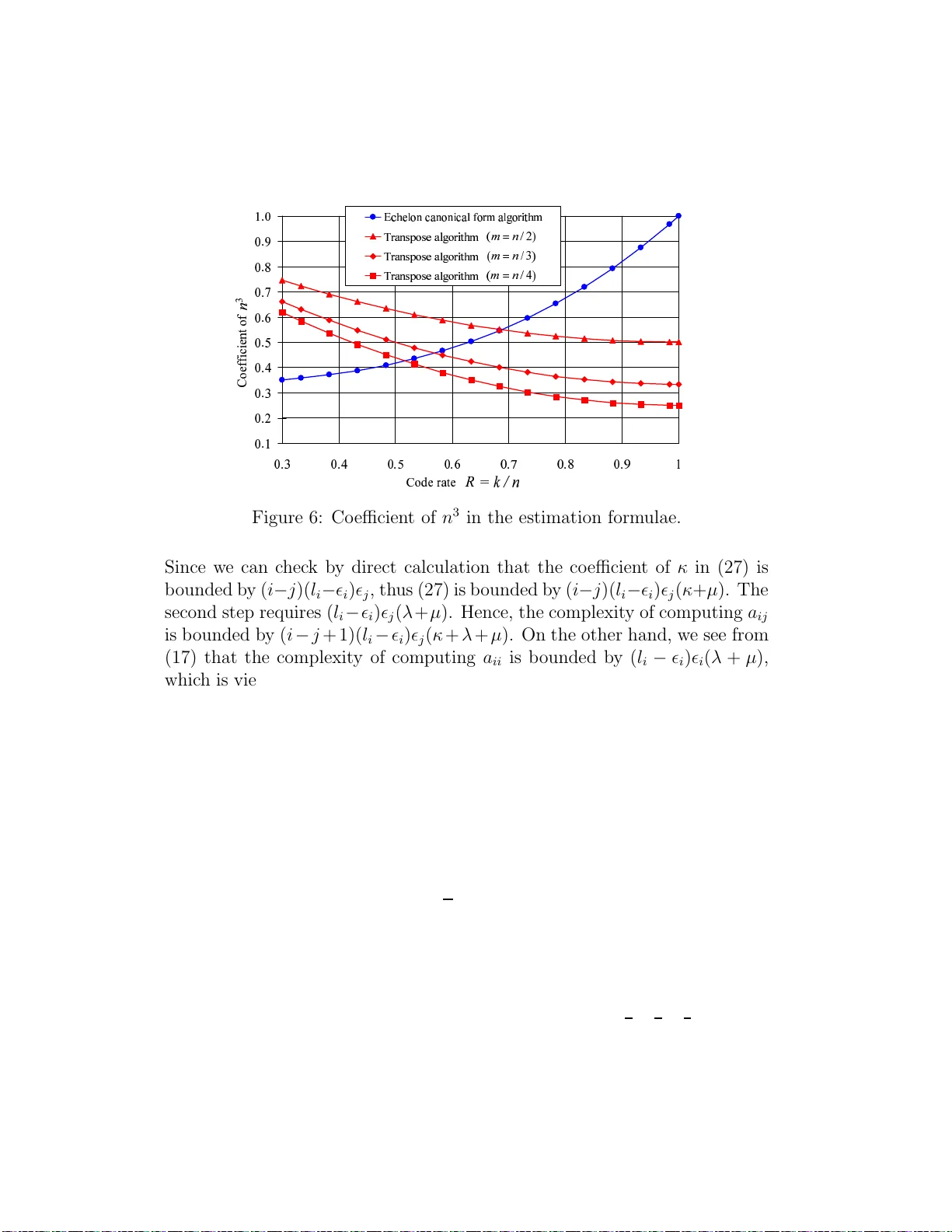
Computation of Gr¨ obner basis for systema tic enco ding of generalized quasi-cyclic co des V o T am V an Ha jime Matsui Seiic hi Mita Dept. Electronics and Information Science T oy ota T ec hnological Institute 2–12–1 Hisak ata, T enpaku, Nagoy a, 468– 8511, Japan Abstract Generalized quasi-cyclic (GQC) cod es form a wide and useful class of linear co d es that in cludes thoroughly quasi-cyclic co des, fi nite ge- ometry (F G) lo w densit y parity c hec k (LDPC) co des, and Hermitian co des. Although it is k n o wn that the systematic enco ding of GQC co des is equiv alen t to the division algorithm in the theory of Gr¨ obner basis of mo d ules, there has b een no algorithm that computes Gr¨ obner basis f or all types of GQC co des. In this pap er, w e prop ose t w o a l- gorithms to compute Gr¨ obner basis for GQC co des fr om their parit y c h ec k matrices: ec h elon canonical form algorithm and transp ose algo- rithm. Both algorithms require sufficien tly sm all num b er of finite-field op erations w ith the order of the thir d p o w er of co d e-length. E ach al- gorithm has its own c haracteristic; the fir s t algorithm is comp osed of elemen tary metho ds, and the second algorithm is based on a no vel form ula and is faster than the first one for high-rate co des. Moreo v er, w e sho w that a serial-i n serial-out enco der arc hitecture for F G LDPC co des is comp osed of linear feedbac k shift registers with the size of the linear order of code-length; to enco d e a binary co deword of length n , it tak es less than 2 n adder and 2 n memory elemen ts. Keyw ords: automorphism group, Buc h b erger’s algo rithm, division algorithm, circulant matrix, finite geometry lo w densit y parity c h ec k (LDPC) co des. 1 1 In tr o d u ction Lo w densit y parit y ch ec k ( LDPC) co des w ere first disco v ered by Gallager [9] in 1962 and hav e recen tly b een redisco v ered and generalized b y MacKay [18] in 1999. The metho ds of constructing LDPC co des can b e divided in to tw o classes: random construction a nd algebraic one. Random constructions of irregular LDPC co des [5][1 8 ][22] hav e s ho wn the p erformance near to the Shannon limit for long co de lengths of more than 10 7 bits. On the enco ding of rando m LDPC co des, Richardson et al. [23] prop osed a n efficien t enco ding metho d with the decompo sition of the generator ma t r ix in to low triang ular matrices, whic h was improv ed b y K a ji [11] and Maehata et al. [20] with another tria ngular (or LU-) factorization. Both metho ds o f enco ding a re based on the matrix multiplication. There are many algebraic constructions of LDPC co des [1][6][7][12][26], whic h b elong to a class of quasi-cyclic (Q C) c o des and pro vide efficien t de- co ding p erformance. Another remark able alg ebraic construction of LDPC co des is finite geometry (FG) co des [13][15]; These co des are divided in to Euclidean (or affine) geometry (EG) co des, whic h are included in Q C co des, and pro jectiv e g eometry (PG) co des, whic h ar e included not in QC co des but in broader gener alize d quasi-cyclic ( GQC ) c o des (cf. Figure 1). It can b e stated briefly that GQC co des increase the randomness f or QC co des and v ary eac h length of cyclic parts in Q C co des. F or sev eral classes of QC LDPC co des, F ujita et al. [8] prop osed efficien t enco ding with circulant matrices and division techniq ue. With regard to GQC co des, whic h includes the algebraic LDPC codes, Heegard et al. [10] sho wed tha t the systematic enco ding was equiv alent t o the division algorithm of Gr ¨ obner bases, which generalize the generator polynomials in cyclic co des. According to this w or k, Chen et al. [3] constructed an enco der archite cture. Th us, the enco ding pro blem for GQC co des w as c hanged into the computa- tion of Gr¨ obner basis. F or the computat io n of Gr¨ obner basis f o r enco ding GQC codes, Little [16] pro vided an algorithm for Hermitian co des, and Lally et al. [1 4] provide d an algorithm for QC co des. How ev er, there has b een no algorithm applicable to all GQC co des. In t his pap er, w e prop ose tw o algo r it hms for computing the G r¨ obner bases, which encode G QC co des, from their parit y c hec k matrices. The first algorithm is based on Gaussian elim ination, and the second a lgorithm is the generalization of Lally et al. ’s alg orithm. Both algorithms emplo y Buc hberger’s algorithm to create a Gr¨ obner basis from co dew ords. Moreov er, 2 ! " # $ % & ' ( ) * + , - . / 0 1 2 3 4 5 6 7 8 9 : ; < = > ? @ A B C D E FG H IJ K L M NO P Q R S T U V W X Y Z [ \ ] ^ _ ` a b cd e f g h i jk l m n o p qr s t u v w x y z { | } ~ ¡ ¢ £ ¤ ¥ ¦ § ¨ © ª « ¬ ® ¯ ° ± ² ³ ´ µ Figure 1: Inclusion-exclusion relation of v ario us linear co des. in order to sho w its efficiency , we pro v e that the n um b er of circuit elemen ts in the enco der arc hitecture is prop ortio nal to code-length for finite geometry co des. A part of the first prop osed algorithm to compute Gr¨ obner basis w as already kno wn to some sp ecialists in co ding theory . Kamiy a et al. [12] announced that an enco der w a s obtained with f undamen ta l row op eratio n fo r a QC LDPC co de fro m Euclidean geometry . Recen tly , Little [17] announced a similar result f or a Hermitian co de. Our ob ject is t o prov ide algorithms computing the G r ¨ obner bases for all GQC co des ev en in the case requiring column perm utation. On the other hand, the second proposed algorithm is based on a nov el formula that pro duces G r¨ obner basis from that of the dual co de. The sp ecial case of our formula w as found by L ally et al. [14] for QC c o des. In o rder to extend it to the case of GQC co des, w e pro vide o ur form ula with a completely different pro o f from that of Lally e t al. ’s f o rm ula. Both algorithms hav e O ( n 3 ) order of the computational complexit y , where n is the co de-length, and in fact for high- rate co des, w e can show that the second has less complexit y than the first. Although the size of the enco der archite cture fo r general GQC co des exceeds the linear or der of co de-length b ecause o f the num b er of orbits (cyclic parts), Chen et al. [3] prov ed that it had the linear order for Hermitian co des. W e newly pro v e that it also has the linear order for FG co des. While Ric hardson et al. ’s and Ka ji’s methods for g eneral LDPC co des run b y the linear order of finite-field op er ation s , our enco der arc hitecture for FG co des can ac hiev e not only the linear order of op erations but also the linear order of cir cuit ele m ents and no latency . In addition, our enco der arc hitecture for the binary F G LD PC co des requires only adder elemen ts without m ultiplicatio n 3 (i.e., no AND elemen t). This pap er deals with all GQC co des; Siap et al. [24] mainly fo cused on one-generator GQC co des. Anot her example of GQC co des is the class of algebraic geometry (A G) co des with automor phism g r o ups [10], including Hermitian co des [16]. It is worth y to notice that GQC co des include tw o remark able classes of Hermitian co des and some PG co des outside QC co des. Th us, G QC co des form the v astest alg ebraic class in linear co des that holds compact encoder arc hitecture. Therefore, we can choose more appropriate and high-p erformance co des f r o m GQC co des than those fro m QC co des. This pap er is organized as follows. Section 2 pro vides the definition of GQC co des and t he techniq ues o f Gr ¨ obner basis. Section 3 provide s the details of the first: ec helon canonical f orm algorithm. Section 4 pro vides the details of t he second: transp o se a lgorithm. In section 5 , w e estimate the computational comple xit y of prop osed tw o a lg orithms. In section 6 , w e pro v e the linearit y o f the circuit-scale o f the enco der a rc hitecture for F G LDPC co des. F inally , w e conclude this pap er in section 7. 2 Preliminaries Throughout the pap er, w e denote A := B if A is defined as B . First, w e de- scrib e the definition a nd mo dule structure of generalized quasi-cyclic co des. Then, w e rev iew Gr¨ obner basis of mo dules ov er polynomial rings; the com- plete theory of G r ¨ obner basis is referred to [2][4 ], and that of automorphism group and o rbit is referred to [19]. 2.1 Definitions Consider a linear co de C ⊂ F n q of length n , where q is a prime p o w er and F q is q - elemen t finite field. L et S b e the set of lo catio ns (that is, co ordina t e p ositions) of co dew or ds in C : C ∋ c = ( c s ) s ∈ S . Without loss of generality , w e set S = { 1 , 2 , · · · , n } . Now suppose that there is a decomp osition o f S , S = m [ i =1 O i , | S | = n = m X i =1 l i , l i := | O i | , (1) and accordingly , decomp o se any co dew ord c ∈ C in to m shortened co des: c = ( c 1 , c 2 , · · · , c m ) , (2) 4 where c i is a shortened co dew or d dro pping comp onents outside O i . Consider sim ultaneous lo cal cyclic shift σ of eac h c i satisfying σ ( c ) := ( σ ( c 1 ) , · · · , σ ( c m )) , σ ( c i ) := ( c i,l i − 1 , c i, 0 , · · · , c i,l i − 2 ) (3) for c i = ( c i, 0 , c i, 1 , · · · , c i,l i − 1 ) . Definition 1 If we have m < n and σ ( c ) ∈ C for al l c ∈ C , then we c al l a p air of C and σ a gener a lize d quasi- cyclic c o de (GQC c o de). ✷ If C is GQC, th us w e obtain a non trivial σ of the automorphism group Aut( C ) of C . Conv ersely , if Aut( C ) includes σ 6 = 1, then the cyclic group h σ i generated b y σ defines orbit O ( s ) := { σ l ( s ) | σ l ∈ h σ i } o f s ∈ S . Note that w e ha v e O ( s ) = O ( s ′ ) for s ′ ∈ O ( s ), a nd that we hav e O ( s ) = { s } if σ ( s ) = s . Then, S is equal to the disjoin t union of dis tinct orbits as des crib ed in (1), where O i := O ( s i ) for some s i ∈ S . W e can r ega rd σ a s the sim ulta neous shift (3) of { c i } . Th us, w e ha ve s ho wn that the class of GQC co des agrees with the class of linear co des with non trivial Aut( C ) ⊃ h σ i . Remark 1 Th us, we s ee that eac h C i := { c i } decides a cyclic co de. How - ev er, in general the whole C do es not agree with the com bined c o de Q C i ∋ [ c 1 · · · c m ], since the individual shift, for example ( σ ( c 1 ) , c 2 , · · · , c m ), does not generally b elong to C . W e will see the diffe rence b etw een C and Q C i at (7) in subsection 2 .3. Remark 2 Siap et al. [2 4] define GQC co des as F q [ t ]-submo dules of a certain mo dule M at (4) in the next subsection, where w e will see that their definition of GQC co des is equiv alent to our definition. Usually , the generator matrix of a linear co de indicates the matrix whose ro ws are linearly indep enden t and compose a bas is of the linear space. W e often relax this definition for conv enience; w e call a generator matrix o f a linear co de the matrix whose rows are not to o man y a nd con tain the basis. Example 1 Consider the linear code C 1 ⊂ F 7 2 defined b y a generator matrix as b elow . G 1 = 1 1 1 0 0 0 1 1 1 0 1 0 1 0 0 1 1 1 1 0 0 1 0 1 0 1 1 0 5 Since the second ro w plus the third row equals the fourth ro w, w e see that the dimension of C 1 is three. If w e apply the p erm utation σ g iv en by (3), then a co dew ord in C 1 is transferred into another co dew ord in C 1 . Th us, C 1 is made from 4 cyclic co des defined b y (1), (1 1 1) , 1 1 0 0 1 1 1 0 1 , and 1 0 1 1 1 0 0 1 1 (and tw o all-zero co des), and C 1 is a GQC co de with 3 orbits. ✷ Note that, if l 1 = l 2 = · · · = l m , then C is a quasi-cyclic co de [14][15][21]. Moreo v er, if m = 1 , then we come bac k to cyclic co de. In order to increase the r andomness of t he co des, it is desirable that we can combine v arious circulan t matrices (cf. Section 4 ) to g enerate new G QC co des. The co de in Figure 2, a) show s us a 2-o rbit GQC co de constructed from four matrices. On the o t her hand, Figure 2, b) sho ws that the co de is also obta ined from four matrices but is not a GQC co de. ¶ · ¸ ¹ º » ¼ ½ Figure 2: In tuitive mo dels of generator matrices made from four ma t r ices. Mo del a ) defines a 2-o rbit GQC co de, but Mo del b) do es not define a G QC co de. 2.2 Mo dule structure of generali zed quasi-cyclic co des Let C b e a G QC co de with a p erm utation σ . Under the action of h σ i , w e can decompose c ∈ C in to m shortened co des as describ ed in (2) . Pic k c i and lab el it as c i = ( c i,j ) where j = 0 , · · · , l i − 1 with l i := | O i | . F o r con v enience, w e decide that the second index is an integer mo dulo l i , a nd the p erm utation σ of (3) means σ ( c i,j ) = c i, ( j − 1 mod l i ) for all i = 1 , · · · , m and j = 0 , · · · , l i − 1. Then, a co dew ord in C can b e represen ted as an m -tuple of p olynomials in F q [ t ]: c = ( c 1 ( t ) , c 2 ( t ) , · · · , c m ( t )) , 6 where c i ( t ) = l i − 1 P j =0 c i,j t j . Th us, C is regarded as a linear subspace of M , where M := m M i =1 F q [ t ] / t l i − 1 (4) and F q [ t ] / t l i − 1 is the quotien t ring by a n ideal t l i − 1 := t l i − 1 F q [ t ]. Moreo v er, w e can regard the action of σ as the m ultiplication of t a s follow s: tc i ( t ) = l i − 1 X j =0 c i,j t j +1 ≡ l i − 1 X j =0 c i,j − 1 t j = l i − 1 X j =0 σ ( c i,j ) t j , (5) where “ ≡ ” means the equalit y mo dulo t l i − 1 . W e can see that m ultiplying c b y t is equiv alent to p erm uting the co dew or d lo cally cyclically b y σ . Thus , C is closed under the m ultiplication by t and C is considered as an F q [ t ]- submo dule of M . F or con v enience to compute Gr¨ obner basis, w e consider the fo llo wing na t ur a l map: π : F q [ t ] m → M . Let e i b e the i -th standard basis v ector in F q [ t ]-mo dule F q [ t ] m , that is, e 1 := (1 , 0 , 0 , · · · , 0) , e 2 := (0 , 1 , 0 , · · · , 0) , · · · , e m := (0 , 0 , 0 , · · · , 1) , and X i := t l i − 1 e i for i = 1 , · · · , m . Define C := π − 1 ( C ), which is a submo dule of F q [ t ] m and is generated b y a ll co dew ords in C (regarded as v ectors in F q [ t ] m ) and all X i ’s, that is, C = C + h X i | i = 1 , · · · , m i , (6) where h X i | i = 1 , · · · , m i indicates the submo dule generated by all X i . 2.3 Gr¨ obner basis of F q [ t ] -mo dule W e call an elemen t of the form t j e i a monomial in F q [ t ] m . Then, any p olyno- mial v ector in F q [ t ] m can b e represen ted as a linear combination of monomials. Although Gr¨ obner b asis of a submo dule in F q [ t ] m is determined fo r eac h monomial or dering , only t he f ollo wing t w o orderings are required in this pap er. The p osition over term (POT) ordering [10] on F q [ t ] m is d efined b y t l e i > POT t k e j if i < j , or i = j a nd l > k . Then, we hav e e 1 > POT e 2 > POT · · · > POT e m . 7 Similarly , the r everse POT (rPOT ) ordering is defined b y t l e i > rPOT t k e j if i > j , or i = j and l > k . Then, w e hav e e 1 < rPOT e 2 < rPOT · · · < rPOT e m . F or a p olynomial f ( t ) := P d i =0 f i t i ∈ F q [ t ] with f d 6 = 0, we define de gr e e of f ( t ) by deg( f ) := d , and we say that f is monic if f d = 1. Thus , w e can define tw o t yp es of Gr¨ obner bases for the submo dule C o f F q [ t ] m asso ciated with an m -orbit G Q C co de C . Definition 2 We define POT Gr¨ obner b asis of C as the fol lowing set G = { g 1 , g 2 , · · · , g m } of p o lynomial ve ctors g 1 = ( g 11 ( t ) , g 12 ( t ) , · · · , g 1 m ( t )) , g 2 = (0 , g 22 ( t ) , · · · , g 2 m ( t )) , . . . . . . . . . . . . . . . g m = (0 , · · · , 0 , g mm ( t )) (7) such that g 1 , · · · , g m ∈ C and g ii ( t ) ha s the minim um de gr e e am ong the ve c tors of the form (0 , · · · , 0 , c i ( t ) , · · · , c m ( t )) ∈ C with c i ( t ) 6 = 0 . If g ii ’s ar e monic and G satisfies deg g ij < deg g j j for al l 1 ≤ i < j ≤ m , then we c al l it r e duc e d POT Gr¨ obner b asis. Mor e over, we define rPOT Gr¨ obner b as i s of C a s the fol lowing set H = { h 1 , h 2 , · · · , h m } of p o lynomial ve ctors h 1 = ( h 11 ( t ) , 0 , · · · , 0) , . . . . . . . . . . . . . . . h m − 1 = ( h m − 1 , 1 ( t ) , · · · , h m − 1 ,m − 1 ( t ) , 0) , h m = ( h m 1 ( t ) , · · · , h m,m − 1 ( t ) , h mm ( t )) (8) such that h 1 , · · · , h m ∈ C and h ii ( t ) has the m i n imum de gr e e among the ve ctors of the form ( c 1 ( t ) , · · · , c i ( t ) , 0 , · · · , 0) ∈ C with c i ( t ) 6 = 0 . If h ii ’s ar e monic and H satisfies deg h ij < deg h j j for al l 1 ≤ j < i ≤ m , then we c al l it r e d uc e d rPOT Gr¨ obner b asis. ✷ Since t l i − 1 e i ’s are included in C , the diagonal p olynomials g ii and h ii divide t l i − 1, and bo t h G r¨ obner bases of C exist. If g ij = 0 for all i 6 = j , then C agrees with the com bined co de Q C i as noticed at Remark 1. F rom any Gr¨ obner basis, w e can easily obtain the reduced Gr¨ obner ba sis b y fundamen tal ro w op era t io ns of p o lynomial matrix. Each GQC c o de has its unique r educed Gr¨ obner basis. 8 The Gr¨ obner basis of C has tw o imp ortant roles; one is that it generates C , and the other is division a lgorithm (whic h is stated in t he next subsection). An y elemen t c ∈ C has the following expression c = P 1 ( t ) g 1 + · · · + P m ( t ) g m , (9) where P i ( t ) ∈ F q [ t ]. If deg( P i g ii ) < l i for all i , then w e ha ve c ∈ C strictly . F or the use of enco ding, we define r e dundant m onomial as t j e i with 0 ≤ j < deg g ii ( t ) (standard mo no mial in [10]). The other types o f monomial t j e i with deg g ii ( t ) ≤ j < l i are called no n-r e dundant (or informa tion ) monomial. It follows fr o m (9) that the num b er of information monomials equals the dimension of C . By minimizing deg g ii , w e can obtain G from the generator matr ix. This pro cedure is called Buchb er ger’s al g o rithm , whic h is no w describ ed f o r our situation. Buc h b erger’s algorithm Input: A k × n g enerato r matrix G of a GQC co de C Output: A POT Gr¨ obner basis G = { g 1 , · · · , g m } . Step 1. Regard the ro w G i of G as p olynomial v ector G i = ( G i 1 , · · · , G im ) ∈ F q [ t ] m . Step 2. F o r j = 1 to m ; g j := P k i = j Q ij G i with { Q j j , · · · , Q k j } suc h that g j j := gcd { G j j , · · · , G k j } = P k i = j Q ij G ij . F or l = j + 1 to k ; h G l := G l − R l ( t ) g j with R l := G lj /g j j . Step 3. If g j is z ero v ector, then put g j := X j . Reduce G b y fundamen ta l ro w op eratio ns. ✷ Example 2 Consider a gain Exampl e 1. Buc h b erger’s algorithm is applied to G 1 . W e o btain g 1 = (1 , 1 + t, 1) by adding the third row to the first r ow. Since the o ther p olynomial v ectors ar e the m ultiple of g 1 , w e obtain g 2 = X 2 and g 3 = X 3 as show n in Figure 3. Then, the information monomials are t 2 e 1 , te 1 , e 1 and the redundan t monomials are t 2 e 2 , te 2 , e 2 , e 3 . ✷ 9 Figure 3: The reduced POT Gr¨ obner basis of C 1 and monomials. 2.4 Systematic enco ding algorithm Once a Gr¨ obner basis G = { g 1 , · · · , g m } of C is obtained, then division algo- rithm with resp ect to G can b e a pplied to u ∈ F q [ t ] m to o btain the follo wing represen tation u = Q 1 ( t ) g 1 + · · · + Q m ( t ) g m + u, (10) where Q i ( t ) ∈ F q [ t ], and u = ( u 1 ( t ) , · · · , u m ( t )) with deg u i < deg g ii . In other words, u is a unique linear com bination of redundan t monomials. It follo ws from (9) and (10) that u ∈ C ⇔ u = (0 , · · · , 0), which generalizes the condition of co dew or ds in cyclic co des. Then, the enco ding of C is describ ed as follow s. Systematic enco ding algorithm Input: Information sym b ols u ∈ F k q and Gr¨ obner basis G = { g 1 , · · · , g m } . Output: Enco ded co dew or d c ∈ C . Step 1. Calculate u ∈ F q [ t ] m as a linear com binatio n of information sym b ols and information monomials. Step 2. Put u 1 = ( u 11 ( t ) , · · · , u 1 m ( t )) := u ; F or i = 1 to m ; Find Q i ( t ) and u i ( t ) suc h that u ii ( t ) = Q i ( t ) g ii ( t ) + u i ( t ) , deg u i < deg g ii . Calculate u i +1 := u i − Q i ( t ) g i ( ∈ M ) = ( u 1 ( t ) , · · · , u i ( t ) , u i +1 ,i +1 ( t ) , · · · , u i +1 ,m ( t )) . Put u := ( u 1 ( t ) , · · · , u m ( t )) = u − P m i =1 Q i ( t ) g i in M . Step 3. By subtraction c := u − u , we o bt a in the enco ded co dew ord c ∈ C . ✷ 10 Step 2 itself is called divisio n al g orithm , whic h generalizes the classical p olynomial div ision in the enco ding of cyclic co des. Thus , another merit of considering the reduced Gr¨ obner basis is that it reduces the computational complexit y of the division algorithm. Example 3 W e reuse the GQC code C 1 with the reduced Gr¨ obner bas is G 1 . The information sym b ols fo r C 1 can b e tak en as the co efficien ts of information monomials { e 1 , te 1 , t 2 e 1 } . W e apply the systematic enco ding algo r ithm to enco de message ( 1 , 0 , 1). First, w e put u := e 1 + 0 · te 1 + t 2 e 1 = (1 + t 2 , 0 , 0 ). Then, w e divide u b y G 1 to obtain the remainder ( o r parit y sym b ols) u : u = u − (1 + t 2 ) g 1 = (0 , t + t 2 , 0) , where the last equalit y follows from ( 0 , 1 + t 3 , 0) = (0 , 0 , 0) in M . Since u con- tains only redundant monomials, we finish the division alg o rithm. Thus , the enco ded p olynomial v ector is u − u = (1 + t 2 , t + t 2 , 0) and the corresp onding enco ded co dew ord c is equal to (101011 0). Since w e hav e 1 0 1 0 1 1 0 = 0 1 1 0 1 1 1 0 0 0 1 1 1 0 1 0 1 0 0 1 1 1 1 0 0 1 0 1 0 1 1 0 , w e can che c k that c ∈ C 1 , whic h is required. ✷ 3 Computing Gr¨ obner basis fro m parit y c he c k matrix with ec helon canonical form In this section, we consider the pro blem ab out computing Gr ¨ obner basis, whic h generates a GQC co de, from a giv en parit y c hec k matrix. In man y situations, eac h GQC co de C is sp ecified by a parity chec k matrix, that is, the generator matrix of its dual co de C ⊥ . Since w e hav e Aut ( C ) = Aut( C ⊥ ), b oth co des are view ed as the submo dules of the same M at (4). Before describing the prop osed algorithm, w e remind tha t elemen tary row op erations can b e used to simplify a matrix a nd w e obtain e chelon c anonic al form [2 1], whic h is defined a s follow s: • Ev ery leftmost non- zero v alue is 1. 11 ¾ ¿ À Á Â Ã Ä Å Æ Ç È É Ê Ë Ì Í Î Ï Ð Ñ Ò Ó Ô Õ Ö × Ø Ù Ú Û Ü Ý Þ ß à á â ã ä å æ ç è é ê ë ìí î ï ð ñ ò ó ô õ ö ÷ ø ù ú û ü ý þ ÿ ! " #$ % & ' ( ) * + , - . / 0 1 2 3 4 5 6 7 8 9 :; < = > ? @A B CD E F G H I J K L M N O P Figure 4 : Outline of computing Gr¨ obner basis for enco ding b y ec helon canon- ical form a lg orithm from parit y chec k matrix. • Ev ery column con taining the leftmost non-zero v alue has all zero o t her en tr ies. • The leftmost non- zero v alue in an y ro w is on the right of that in ev ery preceding row . F or example, w e consider the followin g tw o matr ices: 1 0 1 0 0 0 0 1 0 1 1 0 0 1 0 0 0 0 0 1 0 0 0 1 0 0 0 0 1 1 0 0 0 0 0 0 0 0 1 1 , 1 0 1 1 1 1 0 0 0 1 1 0 0 1 0 0 1 0 1 0 1 1 1 0 1 1 0 1 0 1 0 0 0 1 1 0 0 1 1 1 . The left matrix is the ec helon canonical form of the rig ht matrix. By using the ec helon canonical form, w e can compute the Gr¨ obner basis of C from parit y c hec k ma t r ix. The flo w of our first algorithm is presen ted in Figure 4 and describ ed as fo llows: Ec helon canonical form algorit hm Input: P arit y che c k matrix H of a GQC co de C . Output: POT Gr¨ obner basis G of C . Step 1. T ransform H to ec helon canonical form H ′ b y Gaussian elimination. Step 2. Select p erm utation τ satisfying H 1 := τ ( H ′ ) = [ I | A ], and then G 1 := [ − A T | I ]. Step 3. Compute generato r matrix G = τ − 1 ( G 1 ). Step 4. Obta in G b y Buc hberger’s alg orithm from G . ✷ 12 In the step 2 of the ab o v e algorithm, G 1 satisfies the equation G 1 × H T 1 = 0 and τ − 1 ( G 1 ) × { τ − 1 ( H 1 ) } T = τ − 1 ( G 1 ) × H ′ T = 0. Therefore, w e p ermute the column ve ctors o f G 1 b y τ − 1 to obtain a generator matrix G of the GQC co de C . Example 4 Let C 2 b e a G QC co de defined by the follow ing parity c hec k ma- trix H 2 : H 2 := 1 1 0 1 1 0 1 0 1 1 0 0 1 1 0 0 1 1 0 1 1 0 1 0 1 1 0 0 1 1 1 0 1 1 0 1 0 0 1 0 1 1 1 0 1 1 1 0 1 1 0 1 0 0 1 0 1 1 1 0 0 1 1 0 1 1 1 1 0 0 1 0 0 1 1 1 0 1 1 0 1 0 1 1 0 0 1 1 0 1 . W e can see that C 2 has lo cally cyclic prop erty with the column p erm utation σ = (1 · · · 6)(7 · · · 12)(13 · · · 15), where, e.g., ( 1 · · · 6) indicates p erm utat io n 1 → 2 → · · · → 6 → 1, and C 2 has 3 orbits: l 1 = l 2 = 6 and l 3 = 3. Firstly , we use Gaussian elimination to transform H 2 to the equiv alen t eche lon canonical form 1 0 1 1 0 1 0 0 0 0 1 0 1 0 1 0 1 1 0 1 1 0 0 0 0 1 1 0 1 1 0 0 0 0 0 0 1 0 0 0 1 1 0 0 0 0 0 0 0 0 0 0 1 0 0 1 0 0 0 0 0 0 0 0 0 0 0 0 1 0 0 1 0 0 0 0 0 0 0 0 0 0 0 0 1 1 1 0 0 0 . (11) If w e choo se the column p erm uta tion τ suc h that the set of column lo cation (1 , 2 , · · · , 14 , 1 5) is mapp ed b y τ to (1 , 2 , 7 , 8 , 9 , 10 , 3 , 4 , 5 , 6 , 11 , 12 , 1 3 , 14 , 15) , then matrix ( 1 1) is transformed to the standard form matrix [ I | A ]: 1 0 0 0 0 0 1 1 0 1 1 0 1 0 1 0 1 0 0 0 0 1 0 1 1 1 1 0 1 1 0 0 1 0 0 0 0 0 0 0 1 1 0 0 0 0 0 0 1 0 0 0 0 0 0 1 0 0 0 0 0 0 0 0 1 0 0 0 0 0 0 1 0 0 0 0 0 0 0 0 1 0 0 0 0 1 1 0 0 0 . 13 (Note that, in this case, τ has no relation to the o rbit decomp osition.) Then, w e permute the corresp onding matrix [ − A T | I ] by τ − 1 to obtain the generator matrix G 2 of C 2 . G 2 = 1 1 1 0 0 0 0 0 0 0 0 0 0 0 0 1 0 0 1 0 0 0 0 0 0 0 0 0 0 0 0 1 0 0 1 0 0 0 0 0 0 0 0 0 0 1 1 0 0 0 1 0 0 0 0 0 0 0 0 0 1 1 0 0 0 0 1 1 0 1 1 0 0 0 0 0 1 0 0 0 0 1 0 1 1 0 1 0 0 0 1 0 0 0 0 0 0 0 0 0 0 0 1 0 0 0 1 0 0 0 0 0 0 0 0 0 0 0 1 0 1 1 0 0 0 0 0 0 0 0 0 0 0 0 1 By using Buch b erger’s algorithm, w e can compute the reduced POT Gr¨ obner basis { g 1 , g 2 , g 3 } of generator matrix G 2 : g 1 g 2 g 3 = 1 , 0 , 1 0 , 1 + t + t 3 + t 4 , 1 + t 0 , 0 , 1 + t + t 2 . ✷ Although this example is bina r y , our algorithm can b e applied to all parit y c heck matrix H of F q -en tries. W e consider in section 5 the computational complexit y of our algorithm to obtain G from H . 4 T ransp ose form ula for POT Gr¨ obne r basis In this section, w e pro p ose another algorithm to compute the Gr¨ obner basis from parity c heck matrix. This no v el a lgorithm uses transp ose form ula (20) that is giv en a t Theorem 2. Although Theorem 1 is not necessary for our computation except a scalar pro duct (13) and Corollary 1, w e describ e it for completeness ; Theorem 1 pro vides t he orthog o nal property w ith resp ect to the scalar pro duct for arbitrary G r¨ obner bases of GQC co des. Firstly , w e define a circu lan t l × l matrix as a square l × l matrix suc h that eac h row is constructed from the prev ious ro w b y a single righ t cyclic 14 shift. Then, w e can represen t the circulan t l × l matrix A = a 0 a 1 · · · a l − 1 a l − 1 a 0 · · · a l − 2 . . . . . . . . . . . . a 1 · · · a l − 1 a 0 as a p olynomial a ( t ) = a 0 + a 1 t + · · · + a l − 1 t l − 1 in mo dule F q [ t ] / t l − 1 . Prop osition 1 L et a ( t ) and b ( t ) r epr esent the c orr esp onding p olynomials of cir culant matric es A a n d B of size l × l , r esp e ctively. (i) T r ansp ose of A is a cir culant matrix c orr esp onding to p olynomial b a ( t ) := a 0 + a l − 1 t + · · · + a 1 t l − 1 in mo dule F q [ t ] / t l − 1 . (ii) Matrix pr o duct AB e quals B A and c o rr esp onds to p olynomial a ( t ) b ( t ) . In p articular, we have AB = 0 i f and only if a ( t ) b ( t ) ≡ 0 m o d t l − 1 . (iii) If [ A 1 · · · A m ] ∗ B T 1 . . . B T m = 0 holds, wher e A i and B i ar e cir c ulan t l × l matric es, then we have the c orr esp onding p olynomial m P i =1 a i ( t ) b b i ( t ) ≡ 0 mo d t l − 1 . (iv) The pr o duct A . . . A ∗ B T · · · B T e quals a cir culant matrix o f size ml × ml and c orr e s p onds to p olynomial a ( t ) b b ( t ) m − 1 P i =0 t il mo d t ml − 1 . Pr o of: Prop osition 1 .( i)–(iii) are easy to prov e and we refer to [14]. Prop o- sition 1.(iv) can b e prov ed by executing matrix m ultiplication A . . . A B T · · · B T = AB T · · · AB T . . . · · · . . . AB T · · · AB T . (12) F rom (i) a nd (ii), w e see that the matrix (12) is a circulant matrix of size ml × ml , and moreov er, the circulan t matrix AB T can corresp ond to p olynomial 15 a ( t ) b b ( t ) in mo dule F q [ t ] / t l − 1 . Therefore, matrix (12) can b e represen ted b y the following p olynomial a ( t ) b b ( t ) 1 + t l + · · · + t l ( m − 1) = a ( t ) b b ( t ) m − 1 X i =0 t il in mo dule F q [ t ] / t ml − 1 . ✷ Next, w e define a scalar pro duct of p o lynomial ve ctors u = ( u 1 , · · · , u m ) , v = ( v 1 , · · · , v m ) ∈ M as h u, v i := m X i =1 u i ( t ) b v i ( t ) l/l i − 1 X k =0 t k l i mo d t l − 1 , (13) where l is the least common multiple (lcm) of l i ’s that corresp ond to non-zero u i and v i . W e denote [ u ] as the matrix represen tation of p olynomial ve ctor u = ( u 1 , · · · , u m ) ∈ M by shifting lo cally cyclically l times. Since l i divides l and t l i is regarded as 1 , w e can repres en t matrix [ u ] by non- zero c irculan t matrices [ u i ] and zero mat r ices. F or example, assume u = (1 + t, 0 , 1 + t 2 ) , v = (1 + t + t 3 , 1 + t, 1 + t ) ∈ M , where l 1 = 5 , l 2 = 4 , l 3 = 3 , q = 2. Since l = lcm( l 1 , l 3 ) = 15, the matrix represen tation of p olynomial v ector u agrees with 1 1 0 0 0 0 1 1 0 0 0 0 1 1 0 0 0 0 1 1 1 0 0 0 1 1 1 0 0 0 0 1 1 0 0 0 0 1 1 0 0 0 0 1 1 1 0 0 0 1 1 1 0 0 0 0 1 1 0 0 0 0 1 1 0 0 0 0 1 1 1 0 0 0 1 0 0 0 0 0 0 0 0 0 0 0 0 0 0 0 0 0 0 0 0 0 0 0 0 0 0 0 0 0 0 0 0 0 0 0 0 0 0 0 0 0 0 0 0 0 0 0 0 0 0 0 0 0 0 0 0 0 0 0 0 1 0 1 1 1 0 0 1 1 1 0 1 1 1 0 0 1 1 1 0 1 1 1 0 0 1 1 1 0 1 1 1 0 0 1 1 1 0 1 1 1 0 0 1 1 . 16 W e see that matrix [ u ] can b e decomp osed in to t w o non-zero circulan t ma- trices 1 1 0 0 0 0 1 1 0 0 0 0 1 1 0 0 0 0 1 1 1 0 0 0 1 and 1 0 1 1 1 0 0 1 1 , whic h corresp ond to p olynomials (1 + t ) mo d ( t 5 − 1), and (1 + t 2 ) mo d ( t 3 − 1), respectiv ely . The scalar pro duct h u, v i agrees with (1 + t )(1 + t 2 + t 4 ) 2 X k =0 t 5 k + (1 + t 2 )(1 + t 2 ) 4 X k =0 t 3 k ≡ (1 + t 2 + t 8 + t 10 + t 11 + t 14 ) mo d t 15 − 1 . With these preparations, w e can obtain the follo wing orthogonality b et w een a Gr¨ obner basis of a G QC co de and that of its dual. Theorem 1 L e t G = { g 1 , · · · , g m } and H = { h 1 , · · · , h m } b e a Gr¨ obner b as is of a GQC c o de C and that of C ⊥ with r esp e ct to any or dering, r esp e ctively. Then, we have h g i , h j i ≡ h h j , g i i ≡ 0 mo d t l − 1 for al l 1 ≤ i, j ≤ m . Pr o of: h h j , g i i ≡ 0 follo ws f rom h g i , h j i ≡ 0 easily . Shifting the comp onent g i = ( g i 1 , · · · , g im ) lo cally cyclically l times, w e obtain g i , tg i , · · · , t l − 1 g i that corresp ond to l p olynomial v ectors as follows: g i 1 g i 2 · · · g im tg i 1 tg i 2 · · · tg im . . . . . . · · · . . . t l − 1 g i 1 t l − 1 g i 2 · · · t l − 1 g im . (14) Let [ g i ] denote the matrix corr esp o nding to l v ectors (1 4). W e can represen t [ g i ] b y circulant ma t rices [ g ij ] as follows: [ g i ] = [ g i 1 ] . . . [ g i 1 ] [ g i 2 ] . . . [ g i 2 ] · · · [ g im ] . . . [ g im ] , (15) 17 where [ g ik ] . . . [ g ik ] is the l × l k matrix made fr o m non-zero matrix [ g ik ] or only from zeros. Since t δ g i ∈ C for a ll δ , ev ery ro ws of [ g i ] are co dewords in C . Similarly , the corresp onding matrix represen tation of h j agrees with [ h j ] = [ h j 1 ] . . . [ h j 1 ] [ h j 2 ] . . . [ h j 2 ] · · · [ h j m ] . . . [ h j m ] and ev ery rows of [ h j ] are co dewords in C ⊥ . The relation c ∗ c ⊥ T = 0, where c ∈ C and c ⊥ ∈ C ⊥ , correspo nds to [ g i ] [ h j ] T = 0 for all i, j . Therefore, w e ha v e the following equiv alent equation [ g i 1 ] . . . [ g i 1 ] [ h j 1 ] . . . [ h j 1 ] T + [ g i 2 ] . . . [ g i 2 ] [ h j 2 ] . . . [ h j 2 ] T + · · · + [ g im ] . . . [ g im ] [ h j m ] . . . [ h j m ] T = 0 . (16) If g ik = 0 or h ik = 0, then the k -th term of (16) is zero matrix of s ize l × l . Otherwise, b y Prop osition 1.(iv), the k -th term of (16) is a circulant l × l matrix and the corr esp o nding p olynomial agrees with g ik ( t ) b h j k ( t ) t l − 1 / t l k − 1 mo d t l − 1 . Therefore, the corresp onding p olynomial of (16) is obtained as follows: g i 1 ( t ) b h j 1 ( t ) l/l 1 − 1 X δ =0 t δl 1 + g i 2 ( t ) b h j 2 ( t ) l/l 2 − 1 X δ =0 t δl 2 + · · · + g im ( t ) b h j m ( t ) l/l m − 1 X δ =0 t δl m = h g i , h j i ≡ 0 mo dulo t l − 1 , whic h leads the theorem. ✷ 18 By using Theorem 1 , w e can compute the Gr¨ obner basis G f rom H . Ho w eve r, the computation is no t straigh tforw ard b ecause of the am bigu- it y “mo d t l − 1 .” Little et al. [16] obtained strict equalities for POT and rPOT diagonal comp onen t s h g i , h i i , which w e applied to finite geometry co des in [27]. Now, w e remov e a ll mo dulo conditions. F or later use, w e deriv e a corollary from the argumen t at (16). Corollary 1 L et H = { h 1 , h 2 , · · · , h m } b e a Gr¨ obner b asis of C ⊥ , and u ∈ M a p olynomial ve ctor. Then , it h olds that h h i , u i ≡ 0 for al l 1 ≤ i ≤ m if and only if u c o rr esp onds to a c o dewor d in C . ✷ In the case of cyclic co des, if w e kno w the generator p olynomial h ( t ) of the dual co de C ⊥ and a ( t ) h ( t ) = t n − 1, then that of C is the recipro cal p olynomial t deg a a ( t − 1 ) of a ( t ), whic h agrees with t deg a b a ( t ) mo d ( t n − 1). W e generalize this r elat io n to G Q C co des. Assume that H is rPOT Gr¨ obner basis of an m -orbit GQC co de C ⊥ . Since H is a ba sis of C ⊥ (as described at (9)), there exists m × m p olynomial matrix A = ( a ij ) satisfying A h 1 h 2 . . . h m = t l 1 − 1 0 · · · 0 0 t l 2 − 1 . . . . . . . . . . . . . . . 0 0 · · · 0 t l m − 1 . It is easy t o observ e that A = ( a ij ) is a low er tria ngular matrix similar to ( h ij ), namely , a ij = 0 if i < j . If C ⊥ (or C ) is a QC co de, then we ha v e A ( h ij ) = ( h ij ) A as noticed in [1 4 ], but in general not comm uta tiv e. W e can calculate a ij recursiv ely as follo ws: a ij := 0 if j > i, t l i − 1 h ii if j = i, − 1 h j j i X δ = j +1 a iδ h δj if j < i. (17) It is imp ortan t fact t ha t, if H is the reduced rPOT G r¨ obner basis, the n A = ( a ij ) has the similar prop ert y , that is, deg a ij < deg a ii for all i > j . Now w e prov e this b y induction on j . The first step deg a i,i − 1 < deg a ii follo ws 19 from a i,i − 1 h i − 1 ,i − 1 + a ii h i,i − 1 = 0 from (17). Supp ose induction hypothesis deg a iδ < deg a ii for j + 1 ≤ δ < i . F rom (17), we obtain deg a ij = deg i X δ = j +1 a iδ h δj ! − deg h j j ≤ m ax j <δ ≤ i { deg a iδ + deg h δj − deg h j j } < deg a ii , whic h prov es t he fact. F rom no w on, w e assume that H is the reduced rPOT G r¨ obner basis. W e define transp ose p olynomial matrix of A b y b a 11 b a 21 · · · b a m 1 0 b a 22 · · · b a m 2 . . . . . . . . . . . . 0 · · · 0 b a mm =: b 1 b 2 . . . b m , (18) where b a ij is calculated in F q [ t ] / t l i − 1 , and not in F q [ t ] / t l j − 1 . Since a ij is the j -t h comp o nen t of a p olynomial r ow ve ctor, it migh t seem natural to calculate b a ij in F q [ t ] / t l j − 1 . Nev ertheless, w e consider b a ij mo dulo t l i − 1 , whic h is justified by deg a ij < deg a ii ≤ l i and is a characteristic o f GQC co des that is disapp eared in the case o f QC co des. The latter half of the following t heorem provide s the ob jectiv e f orm ula of POT Gr¨ obner basis fo r GQC co des. Theorem 2 Polynomial ve ctors (18) satisfy h h i , b j i = t l i − 1 1 ≤ i = j ≤ m, 0 1 ≤ i 6 = j ≤ m. (19) Mor e over, G = { g 1 , · · · , g m } , wher e g ij := t deg a ii b ij mo d t l i − 1 , (20) determines a POT Gr¨ obner b asis of GQC c o d e C (usual ly n o t r e duc e d) . This for m ula (20 ) generalize s that of cyc lic co des and tha t of QC co des b y Lally–Fitzpatrick [14] to the case of G QC co des. In [14], their form ula is 20 pro v ed by the fundamental ro w o p eration of a p olynomial matrix; this pro of cannot b e applied to our case b ecause of the complication t o different orbit lengths. W e first show (19) directly from (17), then we conclude b y degree argumen t. Pr o of of The or e m 2: F rom the definition (13), it obviously holds that h h i , b j i = 0 for i < j , and then w e concen trate on the case of j ≤ i . Con- sider tw o p olynomial ve ctors h i = ( h i 1 , · · · , h ii , 0 , · · · , 0) ∈ H and b j = (0 , · · · , 0 , b a j j , · · · , b a mj ), where 1 ≤ j ≤ i ≤ m . F rom (17) and b b a = a , it is trivial that h h k , b k i = t l k − 1 for all 1 ≤ k ≤ m . Thus , w e may pro v e o nly h h i , b j i = 0 for all j < i by induction on i − j . W e denote β ij := lcm( l j , · · · , l i ), then h h i , b j i is computed as follo ws: h h i , b j i = t β ij − 1 X j ≤ k ≤ i h ik a k j t l k − 1 . (21) If i − j = 1, w e ha v e h h i , b j i = t β ij − 1 h ij a j j t l j − 1 + h ii a ij t l i − 1 = t β ij − 1 h j j a ii ( h ij a ii + h j j a ij ) = 0 . If i − j = 2, w e ha v e h h i , b j i = t β ij − 1 h ij a j j t l j − 1 + h i,j +1 a j +1 ,j t l j +1 − 1 + h ii a ij t l i − 1 = t β ij − 1 h ij h j j + h i,j +1 a j +1 ,j h j +1 ,j +1 a j +1 ,j +1 + a ij a ii . F rom (17), we obtain h i,j +1 = − a i,j +1 h j +1 ,j +1 a ii , a j +1 ,j = − a j +1 ,j +1 h j +1 ,j h j j . Therefore, h h i , b j i corresp onds to t β ij − 1 h j j a ii ( a ij h j j + a i,j +1 h j +1 ,j + a ii h ij ) = 0 . 21 Supp ose induction h yp othesis h h θ , b δ i = 0 for all θ < δ with δ − θ < i − j . F rom (17), we receiv e, for all j + 1 ≤ k ≤ i − 1, the following equations h ik = − 1 a ii i − 1 X δ = k a iδ h δk , a k j = − 1 h j j k X θ = j +1 a k θ h θ j . Consider the following partial summation of (21): a ii h j j i − 1 X k = j +1 h ik a k j t l k − 1 = i − 1 X k = j +1 1 t l k − 1 i − 1 X δ = k a iδ h δk ! k X θ = j +1 a k θ h θ j ! = X j +1 ≤ k ≤ i − 1 X k ≤ δ ≤ i − 1 j +1 ≤ θ ≤ k 1 t l k − 1 a iδ h δk a k θ h θ j = X j +1 ≤ θ ≤ δ ≤ i − 1 a iδ h θ j X θ ≤ k ≤ δ 1 t l k − 1 h δk a k θ . (22) F or all j + 1 ≤ θ < δ ≤ i − 1, we ha v e h h θ , b δ i = 0 by induction hy p othesis. Therefore, from (17), the double summation (2 2 ) is equal to i − 1 X θ = j +1 a iθ h θ j h θ θ a θ θ t l θ − 1 = i − 1 X θ = j +1 a iθ h θ j = − a ij h j j − a ii h ij . F rom this result, h h i , b j i is equal to t β ij − 1 h ij a j j t l j − 1 − a ij a ii − h ij h j j + h ii a ij t l i − 1 = 0 Therefore, w e hav e h h i , b j i = 0 for all 1 ≤ i 6 = j ≤ m . The rest of the pro of is to sho w that (20) determines a POT Gr¨ obner basis in the meaning of Definition 2. F rom Corollary 1, w e hav e b i ∈ C , t hen g i ∈ C . Th us, w e ma y prov e only that g ii has the minim um degree among the v ectors of the form (0 , · · · , 0 , c i ( t ) , · · · , c m ( t )) ∈ C with c i ( t ) 6 = 0. W e notice that C i := { c i | (0 , · · · , 0 , c i , · · · , c m ) ∈ C } de fines a cyclic co de. Since the generator p olynomial of the dual co de C ⊥ i is h ii , that of C i is g ii , then g ii has the minim um degree. ✷ By Theorem 2, w e obtain the second algo rithm for computing Gr¨ obner basis G of m -orbit GQC co de C fr o m the parit y chec k matrix as follow s. The flo w of this a lg orithm is presen ted in Figure 5. 22 Q R S T U V W X Y Z [ \ ] ^ _ ` a b c d e f g h i j k l m n o p q r s t u v w x y z { | } ~ ¡ ¢ £ ¤ ¥ ¦ § ¨ © ª « ¬ ® ¯ ° ± ² ³ ´ µ ¶ · ¸ ¹ º » ¼ ½ ¾ ¿ À Á Â Ã Ä Å Æ Ç È É Ê Ë Ì Í Î Ï Ð Ñ Ò Ó Ô Õ Ö × Ø Ù Ú Figure 5: Outline o f computing Gr¨ obner ba sis by t ransp ose alg orithm from parit y che c k matrix. T ransp ose algorithm Input: P arit y che c k matrix H of a GQC co de C . Output: POT Gr¨ obner basis G of C . Step 1. Compute the reduced rPOT G r¨ obner basis H b y Buc h b erger’s algorithm fro m matrix H . Step 2. Calculate A = ( a ij ) b y (1 7). Step 3. Obta in G = { g 1 , · · · , g m } , where g i = ( g ij ) 1 ≤ j ≤ m , g ij := 0 if i > j, t deg a ii b a j i if i ≤ j. ✷ Remark 3 W e can construct the g enerator matrix G of GQC co de C from its reduced POT G r¨ obner basis { g 1 , · · · , g m } as follow s: G = g 11 g 12 · · · g 1 m tg 11 tg 12 · · · tg 1 m . . . . . . . . . . . . t x 1 g 11 t x 1 g 12 · · · t x 1 g 1 m 0 g 22 · · · g 2 m 0 tg 22 · · · tg 2 m . . . . . . . . . . . . 0 t x 2 g 22 · · · t x 2 g 2 m . . . . . . . . . . . . 0 0 · · · g mm 0 0 · · · tg mm . . . . . . . . . . . . 0 0 · · · t x m g mm , (23) where g i = (0 , · · · , 0 , g ii , · · · , g im ) and x i := l i − deg g ii − 1 for all 1 ≤ i ≤ m . Since the diagonal comp onen ts g ii all lie in differen t p o sition, the ro ws of 23 this matrix ar e linearly indep enden t. Moreo v er, the total n um b er of ro ws equals m P i =1 ( l i − deg g ii ) = k . Therefore, the mat rix (23 ) pro vides the generator matrix of G QC co de C , whic h g eneralizes the represen ta t io n for quasi-cyclic co des in [14]. ✷ Example 5 W e demonstrate the transp o se alg o rithm. Let C 3 b e a binary GQC co de with l 1 = 6 , l 2 = 6 , l 3 = 4 defined b y H 3 := 0 1 1 0 1 1 1 0 1 0 0 0 0 0 0 0 1 0 1 1 0 1 0 1 0 1 0 0 0 0 0 0 1 1 0 1 1 0 0 0 1 0 1 0 0 0 0 0 0 1 1 0 1 1 0 0 0 1 0 1 0 0 0 0 1 1 0 1 1 0 1 0 0 0 0 0 1 0 0 0 0 1 1 0 1 1 0 1 0 0 0 0 0 1 0 0 1 0 1 1 0 1 0 0 1 0 0 0 0 0 1 0 1 1 0 1 1 0 0 0 0 1 0 0 0 0 0 1 . W e calculate the reduce d rPOT Gr¨ obner basis H 3 = { h 1 , h 2 , h 3 } of dual co de C ⊥ 3 b y Buc h b erger’s algorithm: h 1 h 2 h 3 = 1 + t 6 , 0 , 0 t + t 2 + t 4 + t 5 , 1 + t 2 , 0 1 + t + t 3 + t 4 , 1 , 1 . There exists a p olynomial matrix A = ( a ij ) satisfying A [ h i ] = 0. F rom (17), w e can calculate A inductiv ely: A = 1 , 0 , 0 t + t 2 + t 3 , 1 + t 2 + t 4 , 0 1 + t 2 , 1 + t 2 , 1 + t 4 . The transp ose p olynomial matrix of A turns in to b a 11 , b a 21 , b a 31 0 , b a 22 , b a 32 0 , 0 , b a 33 = 1 , t 3 + t 4 + t 5 , 1 + t 2 0 , 1 + t 2 + t 4 , 1 + t 2 0 , 0 , 1 + t 4 . According to Theorem 2, a POT Gr¨ obner basis of GQC co de C 3 can b e computed b y g ij := t deg a ii b a j i mo d t l i − 1 . After reduction, we obtain the 24 reduced POT G r ¨ obner ba sis G 3 = { g 1 , g 2 , g 3 } : g 1 g 2 g 3 = 1 , 1 + t + t 2 , t + t 3 0 , 1 + t 2 + t 4 , 1 + t 2 0 , 0 , 1 + t 4 . (24) T o ch ec k the correctness of (24), w e calculate the generator matrix G 3 of C 3 b y ( 23): G 3 = 1 0 0 0 0 0 1 1 1 0 0 0 0 1 0 1 0 1 0 0 0 0 0 1 1 1 0 0 1 0 1 0 0 0 1 0 0 0 0 0 1 1 1 0 0 1 0 1 0 0 0 1 0 0 0 0 0 1 1 1 1 0 1 0 0 0 0 0 1 0 1 0 0 0 1 1 0 1 0 1 0 0 0 0 0 1 1 1 0 0 0 1 1 0 1 0 0 0 0 0 0 0 1 0 1 0 1 0 1 0 1 0 0 0 0 0 0 0 0 1 0 1 0 1 0 1 0 1 . W e o bserve that G 3 × H T 3 = 0, as required. ✷ Remark 4 It should b e noted that Theorem 1 is v alid not only for POT and rPOT ordering but also for any ordering. W e demonstrate Theorem 1 to the term o v er p osition (TOP) ordering [10] o n F q [ t ] m defined b y t l e i > TOP t k e j if l > k , or l = k and i < j . The reduced TOP G r¨ obner basis { g ′ 1 , g ′ 2 , g ′ 3 } of C 3 turns into g ′ 1 g ′ 2 g ′ 3 = 1 + t, t + t 2 + t 3 , 1 + t 2 1 , 1 + t + t 2 , t + t 3 1 + t + t 2 , 0 , 0 . It is easy to chec k that h g ′ i , h j i = 0 for all i, j . ✷ 5 Estimation of algorit hms In this section, w e estimate the computational complexit y of t w o alg orithms and compare the one with the other. W e represen t the n um b ers of a dditions, subtractions, m ultiplications, and divisions in F q as the co efficien ts of κ , λ , µ , and ν , resp ectiv ely . W e aim for an a symptotic estimation; w e denote f ∼ g if f /g tends to 1 as the v aria ble tends to ∞ . Once w e obtain f ∼ g , then it follo ws tha t the usual notation f = O ( g ), whic h means f ≤ cg f or s ome constan t c > 0. 25 First, w e describ e it with resp ect t o t he Gaussian elimination. Although it is well-kno wn that the complexit y is O ( n 3 ), w e calculate the order up to constan t factor. W e can assume that a given ( n − k ) × n parity c hec k matrix H is transformed in to [ I | A ] with p ermutation τ = 1 since the p erm ut a tion costs no finite-field op era t io n. Without loss of generalit y , w e can assume that the (1 , 1) comp onen t of H is non- zero. Then, dividing the other comp onent of the first row by t his v alue ta k es ( n − 1) ν . Moreo v er, subtracting the m ultiple of the ( i, 1) comp onen t a nd the first row for 2 ≤ i ≤ n − k tak es ( n − k − 1)( n − 1)( λ + µ ). Summing up these manipulatio ns for n − k columns, w e obtain k +1 X i = n − 1 { iν + ( i − k ) i ( λ + µ ) + ( n − i ) k ( λ + µ ) } where the la st term ( n − i ) k ( λ + µ ) come s from the bac k substitution. W e ignore the first term iν since it contributes square order 1 2 ( n + k )( n − k − 1) of n . Then, w e o btain ( ν + λ + µ ) times 1 3 ( n − k − 1)( n − k − 1 2 )( n − k ) + k ( n − k ) 2 , whic h is asymptotically 1 3 ( n − k ) 3 + k ( n − k ) 2 . Next, w e describ e the computational complexit y with respect t o the Buc h- b erger’s algorithm for a giv en k × n generator matrix G to obtain a POT Gr¨ obner basis. The estimation is similar to the ab ov e; now the alg orithm is based on p olynomial gcd computation. Without loss of generalit y , we can assume that the (1 , l 1 ) comp onen t of G is not z ero. Then, dividing the other comp onen t of the first row b y this v alue, and moreov er, subtracting the m ultiple of the ( i, l 1 ) comp onen t and the first row for 2 ≤ i ≤ k tak es ( n − 1) ν + ( k − 1)( n − 1)( λ + µ ). The second stage of these manipulations tak es ( n − 2) ν + k ( n − 2)( λ + µ ) since the first ro w has a p olynomial whose degree is greater than that of the o ther ro ws. Summing up these manipulations for the first o r bit, w e obtain l 1 − 1 X j = d 1 " j + m X i =2 l i ! { ν + k ( λ + µ ) } # − ( n − 1)( λ + µ ) , where w e denote d i := deg g ii and the last term, whic h is ignored b ecause of less c ontribution, comes from the special situation stated ab ov e at the first 26 ro w. F urthermore, simplifying this and summing up for all orbits, w e obtain ( ν + λ + µ ) times m X j =1 ( l j − d j ) l j − 1 + d j 2 + m X i = j +1 l i ! ( k − j + 1) , (25) whic h is b ounded b y nk 2 , since the second brac k et ≤ n . It is necessary that w e estimate the reducing computat ion of Gr¨ obner basis, whic h cor r esp o nds to the bac k substitution of p olynomial matrix. F or POT Gr¨ obner basis, we m ust start from reducing g 12 and not g im . The length of g 12 is l 2 in the worst case, and w e hav e to eliminate l 2 − d 2 v alues. Th us, the reduction of g 12 tak es ( l 2 − d 2 ) ( d 2 + P m i =3 l i ) ( λ + µ ). Summing up for all g ij ( i < j ), we obtain ( λ + µ ) times m X j =2 ( l j − d j ) d j + m X i = j +1 l i ! ( j − 1) , (26) whic h is b ounded b y mnk . F or the to t al complex it y o f Buc h b erger’s a lg orithm to obtain the reduced Gr¨ obner basis, w e m ust add (26) to (25). Since w e can b ound (26) b y the summation of j from 1, the last brac k et of ( 2 5) is c hanged in to k . Then, w e observ e that the total complexit y is still nk 2 . The final stage o f estimation is to calculate the n um b er of o p erations required f or computing the p olynomial matrix A from the p olynomial matrix ( h ij ) b y (17). It should b e noted that the multiplic ation of t w o p olynomial a ( t ) and b ( t ) requires (deg a deg b ) κ + (1 + deg a )(1 + deg b ) µ op erations, and that the division of a ( t ) by b ( t ) requires deg b (deg a − deg b )( λ + µ ) op erations. W e denote ǫ i := deg h ii ; then w e hav e deg a ii = l i − ǫ i , m X i =1 ǫ i = k , m X i =1 ( l i − ǫ i ) = n − k . F rom (17), w e see that the computation of a ij ( j < i ) is separated in to t w o steps: i P δ = j +1 a iδ h δj and its division b y h j j . Since deg a iδ < l i − ǫ i and deg h δj < ǫ j , the complexit y of the first step is b ounded by i X δ = j +1 h ( l i − ǫ i − 1)( ǫ j − 1) κ + ( l i − ǫ i ) ǫ j µ i + ( i − j − 1)( l i − ǫ i + ǫ j ) κ. (27) 27 Û Ü Ý Þ ß à á â ã ä å æ ç è é ê ë ì í î ï ð ñ ò ó ô õ ö ÷ ø ù ú û ü ý þ ÿ ! " # $ % & ' ( ) * + , - . / 0 1 2 3 4 5 6 7 8 9 : ; < = > ? @ A B C D E F G H I J K L M N O P Q R S T U V W X Y Z [ \ ] ^ _ ` a b c d e f g h i j k l m n o p q r s t u v w x y z { | } ~ ¡ ¢ £ ¤ ¥ ¦ § ¨ © ª « ¬ ® ¯ ° ± ² ³ ´ µ ¶ · ¸ ¹ º » ¼ ½ ¾ ¿ À Á Â Ã Ä Å Æ Ç È É Ê Ë Ì Í Î Ï Ð Ñ Ò Ó Ô Õ Ö × Ø Ù Ú Û Ü Ý Þ ß à á â ã ä å æ ç è é ê ë ì í î ï ð ñ ò ó ô õ ö ÷ ø ù ú û ü ý þ ÿ ! " # $ % & ' ( ) * + , - . / 0 1 2 3 4 5 6 7 8 9 : ; < = > ? @ A B C D E F G H I J Figure 6: Co efficien t of n 3 in the estimation for mulae. Since w e can c hec k b y direct calculation that the coefficien t of κ in (27) is b ounded b y ( i − j )( l i − ǫ i ) ǫ j , th us (27) is b ounded b y ( i − j )( l i − ǫ i ) ǫ j ( κ + µ ). The second step requires ( l i − ǫ i ) ǫ j ( λ + µ ). Hence, the complexit y of computing a ij is b ounded b y ( i − j + 1)( l i − ǫ i ) ǫ j ( κ + λ + µ ). On the other hand, w e see from (17) that the comple xit y of compu ting a ii is bo unded b y ( l i − ǫ i ) ǫ i ( λ + µ ), whic h is view ed as the case of i = j for ( i − j + 1)( l i − ǫ i ) ǫ j ( λ + µ ). Summing up these results, we obtain ( κ + λ + µ ) times m X i =1 i X j =1 ( i − j + 1)( l i − ǫ i ) ǫ j ≤ mk ( n − k ) . Therefore, the complexit y of computing p olynomial matrix A is estimated as mk ( n − k ). Th us, w e obta in estimation formulae. Ec helon canonical form algorithm : 1 3 ( n − k ) 3 + k ( n − k ) 2 + nk 2 T ransp o se algorit hm : n ( n − k ) 2 + mnk + mk ( n − k ) W e can observ e that b o th algorithms ha v e the same rough o rder O ( n 3 ) of computational complexit y . F or the comparison o f t w o algorit hms, w e assume m = 1 2 n, 1 3 n, 1 4 n to elim- inate m in the estimation formu la for t r a nsp ose algorithm. Since there exist 28 sp ecial GQC co des tha t satisfy m = n − 1, these assumptions are no t v alid for general GQC co des. How ev er, for effectiv e GQC co des, these assumptions are reasonable; actually , F G LDPC co des hav e further less n um b er o f orbits than these assumptions (cf. T able 1 in the next section). F ig ure 6 is the comparison b etw een the co efficien ts of n 3 in the ab ov e estimation formulae under the assumptions, where t he curv es near 1 represen t limits. Th us, we can conclude that, for the effectiv e high- r a te GQC co des, t he computational complexit y of the transp ose a lgorithm is far less than t ha t o f the ec helon canonical fo rm algorithm. 6 Estimation of the ci r c uit In the prev ious sections, we ha v e prop osed t w o algorithms to calculate the reduced Gr¨ obner basis of the form (7) that generates m -orbit GQC co de C . In [3], Chen et al. hav e dev elop ed a serial-in serial-out hardw are arc hit ecture to enco de infor ma t io n sym b ols systematically with POT Gr¨ obner basis as an application o f results in Heegard et a l. [1 0 ]. The architec ture generalizes classical enco der of cyclic co des and consists of division circuits b y g ii ( t ) and m ultiplication circuits with g ij ( t ) ( i < j ). W e quote the estimation of their hardware complexit y f r om [3]. The total num b ers of finite-field adder elemen ts A m and memory elemen ts (shift registers) D m are giv en a s follows: A m ≤ m X i =1 deg g ii + m − 1 X i =1 m X j = i +1 (deg g ij + 1 ) ≤ ( n − k ) + m − 1 X i =1 ( m − i ) deg g ii ≤ m ( n − k ) , D m ≤ m X i =1 deg g ii + m − 1 X i =1 m X j = i +1 deg g ij + m − 1 X i =1 ( δ i + 1 ) ≤ m ( n − k ) + k , where δ i := max ( k 1 − 2 , k 2 − 2 , · · · , k i − 1 − 2 , k i − 1), and k i := l i − deg g ii . W e can conclude that the har dw a r e complexit y for G QC co des is nearly prop ortiona l to the co de length since m is small compared to n . F or more practical estimation, w e f o cus on the finite geometry (FG) LDPC co des [13][1 5][21] as an imp orta n t class of GQ C co des. There are 29 t w o types of FG LDPC co des: type-I and t yp e-I I. T yp e-I F G LDPC co des are defined b y the parit y che c k matrix comp osed of incidence vec tors (as ro ws) of lines and p oints in finite geometries (Euclidean geometry (EG) and pro jectiv e geometry (PG)) and a re cyclic co des. T yp e-I I F G L DPC co des are defined by the tr ansp osed parity che c k matrix of t yp e-I and are not cyclic but GQC co des. Therefore, w e concen t r a te on t yp e-I I F G LDPC co des. W e quote the required prop erties of this ty p e of co des from [25 ]. W e denote n ′ and k ′ as the corresp onding v alues of ty p e-I co des. 1. l 1 ≤ l 2 = · · · = l m (Actually , it b ecomes the equalit y for EG co des.) 2. g 11 = · · · = g m − 1 ,m − 1 = 1 and deg g mm = n − k 3. ( n − k ) = ( n ′ − k ′ ) < n ′ = l m The last tw o pro p erties follow easily from the fa ct that the dual co des of F G LD PC co des are the one-generator GQC codes, whic h corresponds to the case of l = 1 in [25, eq.(23)]. Therefore, the reduced POT Gr¨ obner basis G = { g 1 , · · · , g m } of t yp e-I I FG LDPC co des mus t b e in the following form: g 1 g 2 . . . g m − 1 g m = 1 0 · · · 0 g 1 m ( t ) 0 1 . . . . . . g 2 m ( t ) . . . . . . . . . 0 . . . . . . . . . 1 g m − 1 ,m ( t ) 0 · · · · · · 0 g mm ( t ) , where deg g im < deg g mm = n − k . The information blo ck u is represen ted a s the v ector u = ( u 1 ( t ) , · · · , u m ( t )), where u i ( t ) = l i − 1 P j =0 u i,j t j i = 1 , · · · , m − 1 , l m − 1 P j = n − k u m,j t j i = m. The parity blo ck u = (0 , 0 , · · · , 0 , u m ( t )), where u m ( t ) = n − k − 1 P j =0 u m,j t j , is the remainder of u with respect to the reduced Gr¨ obner basis G . The corresp ond- ing co dew ord is the result of subtracted ve ctor u − u . This is receiv ed at the 30 K L M N O P QR S T U V W X Y Z [ \ ] ^ _ ` a b c de f ghi j k l m n o p q r s t u v w x y z { | } ~ Figure 7: Serial- in serial- out arc hitecture for t yp e-I I FG (EG and PG) L D PC co des. Input is information { u i,j } , and output is redundan t parity bits { u m,j } . The con trol signal is used to switc h for feedbac k shift registers after en tering u 1 , 0 , · · · , u 1 ,l 1 − 1 . output of architec ture in Figure 7, serial-in serial-o ut arc hitecture fo r FG LDPC co des. The elemen t L represen ts an adder (exclusiv e-OR elemen t) and the rectangle represen ts a memory elemen t (a shift register). The t wo remaining building elemen ts corresp ond to multiplexe r a nd ga te elemen ts. The gate elemen t is a switc h control with tw o stat us—o p en and close. The m ultiplexer elemen t is signal choice con trol that selects signal either from input or fro m the feedbac k of shift registers. Then, the total num b er A m of adder elemen ts for FG co des satisfies the follo wing inequalit y: A m ≤ m ( n − k ) ≤ ml m ≤ 2 n. Moreo v er, the tota l num b er D m of required memory elemen ts satisfies D m ≤ ml m + m − 1 X i =1 l i = ( m − 1) l m + m X i =1 l i ≤ 2 n. Th us, w e ha v e pro v ed t hat the hardw are complexit y of F G LDPC co des is O ( n ) order. 31 T able 1 : Hardw are complexit y for sev eral 3-dimensional type-I I EG and PG LDPC co des. The first three rows ev aluate type-I I EG LD PC co des. The others ev aluate type-I I PG LDPC co des. s n k n − k m adder memory 1 21 1 5 6 3 12 26 2 315 265 50 5 76 328 3 4599 4227 372 9 168 1 5769 1 35 2 4 11 3 16 36 2 357 296 61 5 1 38 438 3 4745 4344 401 9 184 6 6396 F or F G LDPC co des made from 3-dimensional EG and PG ov er the finite field F 2 s , where s = 1 , 2 , 3, w e summarize computational results in T able 1. The last tw o columns of T able 1 are the n um b ers of adder and memory elemen ts, resp ectiv ely . W e see that the actual n um b ers of elemen ts are less than the ab o v e estimation. 7 Conclus ions One contribution of this pap er is to provide algorithms of computing Gr¨ obner basis f o r efficien t systematic enco der of GQC co des. Our algorithms are appli- cable to not only binary GQC LD PC codes but also non-binary GQC LDPC co des and linear co des with no n trivial automorphism groups. Although the computation of Gr¨ obner basis is required only once at the construction of en- co der differen tly fro m deco ding algorithm, our algor it hms are still useful; for example, b ot h alg o rithms can searc h effectiv e co des rapidly in the p o lynomial (third p o w er) order of co de-length. F or high-rate co des, we ha v e sho wn that the algorithm applying transp ose formula is faster than the ec helon canonical form algorithm. It is expected that G QC LDPC codes improv e t he decoding p erformance of QC LDPC co des and make it close to that of the random LDPC co des. Another contribution of this pap er is to demonstrate that the hardw are complexit y of the serial-in serial-out systematic enco der is the lin- ear order of co de-length for F G codes and F G LDPC codes. By exploiting the structure of GQC co des, we b eliev e that many new and o ptim um co des are constructed, and our results in system atic enco ding migh t b ecome a k ey 32 step to practical implemen tation. Ac knowledgmen t This w ork was partly supp orted b y the Gran t - in-Aid for Y oung Scien tists (B, researc h pro ject 19760 2 69) b y the Ministry o f Education, Culture, Sp orts, Science and T ec hnology (MEXT), the Academic F ron tier Cen ter by MEXT for “F uture D ata Storage Materials Researc h Pro ject,” and a researc h grant from SRC (Stor a ge Researc h Consortium). References [1] K. Andrews, S. D olinar, J. Thorp e, “Enco ders for blo c k-circulan t LD PC co des,” Pro c. International Symp osium o n Informatio n Theory and Its applications, Adelaide, Australia, pp.2300-23 04, Sep. 2005. [2] T. Bec k er, V. W eispfenning, “Gr¨ obner bases,” New Y ork: Springer Pub- lishers, 1992. [3] J.-P . Chen, C.-C. Lu, “A serial-in serial-out hardw are arc hitecture for systematic enco ding of Hermitian co des via Gr¨ obner bases,” IEEE T rans. Comm., v ol.52, no .8 , pp.1322-133 1 , Aug. 2004. [4] D. Co x, J. Little, D. O’Shea, “ Ideals, V arieties, and Algorithms: An in tro duction to computatio nal algebraic geometry and comm utativ e al- gebra,” 2nd ed. New Y ork: Springer Publishers, 199 7. [5] S.Y. Ch ung, G.D. F orney , T.J. Rich ardson, R.L. Urbank e, “On the de- sign of lo w densit y parit y c hec k codes w ithin 0.004 5dB o f t he Sh annon limit,” IEEE Comm. Lett. , v ol.5, no.2 , pp.58 - 60, F eb. 2001. [6] J.L. F an, “Array co des as lo w density parit y chec k co des,” Pro c. 2nd In t ernat ional Symp osium on T urb o Co des and Related T opics, Brest, F rance, pp.543-54 6 , Sep. 2 000. [7] M.P .C. F ossorier, “Quasi-cyclic lo w densit y parit y c hec k co des from cir- culan t p erm utat ion matrices,” IEEE T rans. Inf. Theory , v ol.50, no.8, pp.1788-179 3, Aug . 2004. 33 [8] H. F ujita and K. Sak aniw a, “Some classes of quasi-cyclic LD PC co des: Prop erties and efficien t enco ding metho d,” IEICE T rans. F undamen tals, v o l.E88 -A, no.12, pp.362 7-3635 , Dec. 200 5 [9] R. G. Gallag er, “Lo w densit y parity c hec k co des,” IRE T rans. Inf. The- ory , v ol.IT-8, pp.21-2 8 , Jan. 1962. [10] C. Heegard, J. Little, K. Sain ts, “Systematic encoding via Gr¨ obner bases for a class o f algebraic geometric Goppa co des,” IEEE T rans. Inf. Theory , v o l.4 1, no.6, pp.1752 -1761, No v. 1995. [11] Y. K a ji, “Enco ding LDPC co des using the triangular factorization,” IEICE T rans. F undamen tals, vol.E89-A, no.10, pp.2510-25 1 8, Oct. 2006 [12] N. Kamiy a, E. Sasaki, “Design and implemen tation of high-rate QC- LDPC co des,” (in Japanese) Pro c. 2 0 06 SIT A, Hak o date, Hokk aido, Japan, pp.545- 5 48, No v. 2006. [13] Y. Kou, S. Lin, M.P .C. F ossorier, “Lo w density parity che c k co des based on finite g eometries: A redisco v ery and new results,” IEE E T rans. Inf. Theory , v ol.47, no.7, pp.271 1-2761, Nov . 2001 . [14] K. Lally , P . Fitzpatrick , “Algebraic structure of quasi-cyclic codes,” Dis- crete Applied Mathematics, 11 1, pp.157-175 , Jul. 2001. [15] S. Lin, D.J. Costello, “Error Control Co ding: F undamentals and Appli- cations,” 2nd ed. Englewoo d Cliffs, NJ: Prentice -Hall, 2004. [16] J. Little, K. Saints , C. Heegard, “On the structure of Hermitian co des,” Journal of Pure and Applied Algebra 121, pp.293- 314, Oct. 1997. [17] J. L it t le, “Automorphisms and enco ding of AG and order domain co des,” to app ear in v olume from D1 W orkshop on applications of Gr¨ obner bases in co ding theory and cryptography , RISC-Linz, 2007. [18] D.J.C. MacKay , “G o o d erro r-correcting co des based on ve ry sparse ma- trices,” IEEE T rans. Inf. Theory , vol.IT -45, no.2, pp.399 - 431, Mar. 1999 . [19] F.J. MacWilliams, N.J.A. Sloane, “ The theory o f error correcting co des,” 9th ed. North Holland, 1988 . 34 [20] T. Maehata, M. Onishi, “A reduced complexit y , high thro ughput LDPC enco der using LU facto r izat io n,” ( in Japanese) Pro c. the 2008 IEICE general conference, B-5- 157, p.543, Mar. 2008 . [21] W.W. P eterson, E.J. W eldon, “Error correcting co des,” 2nd ed. Cam- bridge, MA: MIT Press, 1 9 72. [22] T.J. Ric hardson, M.A. Shokrollahi, R.L. Urbank e, “Design of capacity approac hing irregular lo w density parit y c hec k co des,” IEEE T rans. Inf. Theory , v ol.IT-47, no.2, pp.619 -637, F eb. 2001. [23] T.J. Ric hardson, R.L. Urbank e, “Efficien t enco ding of low densit y parit y c heck co des,” IEEE T ra ns. Inf. Theory , v ol.47, no.2, pp.638-656 , F eb. 2001. [24] I. Siap, N. Kulhan, “The structure of generalized quasi-cyclic co des,” Applied Mathematics E-Not es, v o l.5 , pp.24-30 , Mar. 2005. [25] H. T ang , J. Xu, S. Lin, K.A.S. Ab del- G haffar, “Co des on finite geome- tries,” IEEE T rans Inf. Theory , vol.51, no.2, pp.572-596 , F eb. 2 005. [26] R.M. T anner, D. Sridhara , T. F uja “A class of gro up- structured LDPC co des,” Pro c. In ternational Symp osium on Comm unication Theory a nd Applications, Am bleside, U.K, pp.365-3 70, Jul. 2001. [27] V.T. V an, H. Matsui, S. Mita “Systematic enco ding for finite geometry lo w density parit y c hec k co des based on Gr¨ obner bases,” Pro c. 2007 SIT A, Ka shiko jima, Mie, Ja pan, pp.424-429, Nov. 2 007. V o T am V an receiv ed the B.S. and M.S. degrees from the D epartmen t of Info rmation T ec hnology , HCM Univ ersit y of Sciences , Vietnam in 2001, 2005, resp ectiv ely . F rom 200 2 to 2007, he was a lecturer in the Departmen t of Information T ec hnology , HCM Univ ersit y o f Sciences , Vietnam. No w, he is a second-y ear Ph.D. studen t in the Depart men t of Electronics and Information Science, T oy ota T ec hnological Institute, Japan. His research in terests include co ding theory , alg ebraic co des, and LDPC co des. Ha jime Matsui receiv ed t he B.S. degree in 1994 from t he Departmen t of Mathematics, Shizuok a Unive rsit y , Japan, and the M.S. degree in 1996 fr o m the Graduate School of Science and T ec hnolog y , Niiga t a Univers it y , Japan, 35 and the Ph.D. degree in 1 9 99 from the Graduate Sc ho ol of Mathematics, Nago y a Univ ersit y , Japan. F rom 1999 to 2002, he was a P ost-Do ctorate F ello w in the D epartmen t of Electronics a nd Information Science, T oy ota T ec hnological Institute, Japan. F ro m 2002 to 2006, he w as a Researc h Asso- ciate there. Since 2006, he has b een working as an Associat e Professor there. His r esearch in terests include num b er theory , co ding theory , error-correcting co des, and encoding/ deco ding alg orithms. He is a mem b er of SIT A and IEEE. Seiic hi Mita receiv ed the B.S. degree, the M.S. degree and the Ph.D. degree in electrical engineering from Ky oto Univ ersity in 1 9 69, 197 1, 1989 resp ectiv ely . He studied at Hitac hi Central Researc h Lab orator y , Kokubunji, Japan from 1971 to 1991 on signal pro cessing and co ding metho ds for digita l video recording equipmen t fo r broadcast use and home use. He mov ed t o Data Storage & Retriev al Systems Division, Hitac hi, Ltd. in 1991. He dev el- op ed c hannel co ding methods and these LSI chips fo r magnetic disk drives . No w, he is a professor of T o y ota T ec hnological Institute in Nago y a . He is a member of the Institute of Electronics, Information a nd Comm unication Engineers and the Institute of Image Information and T elevision Engineers in Japan. He is also a me m b er of IEEE, Magnetic Society . He receiv ed the b est pap er a w a rds of IEEE Consumer Electronics So ciet y in 1986 a nd the b est pap er a w a rds of the Institute of T elevision Engineers in Japan in 1987 . 36
Original Paper
Loading high-quality paper...
Comments & Academic Discussion
Loading comments...
Leave a Comment