Online Ad Slotting With Cancellations
Many advertisers buy advertisements (ads) on the Internet or on traditional media and seek simple, online mechanisms to reserve ad slots in advance. Media publishers represent a vast and varying inventory, and they too seek automatic, online mechanis…
Authors: Florin Constantin, Jon Feldman, S. Muthukrishnan
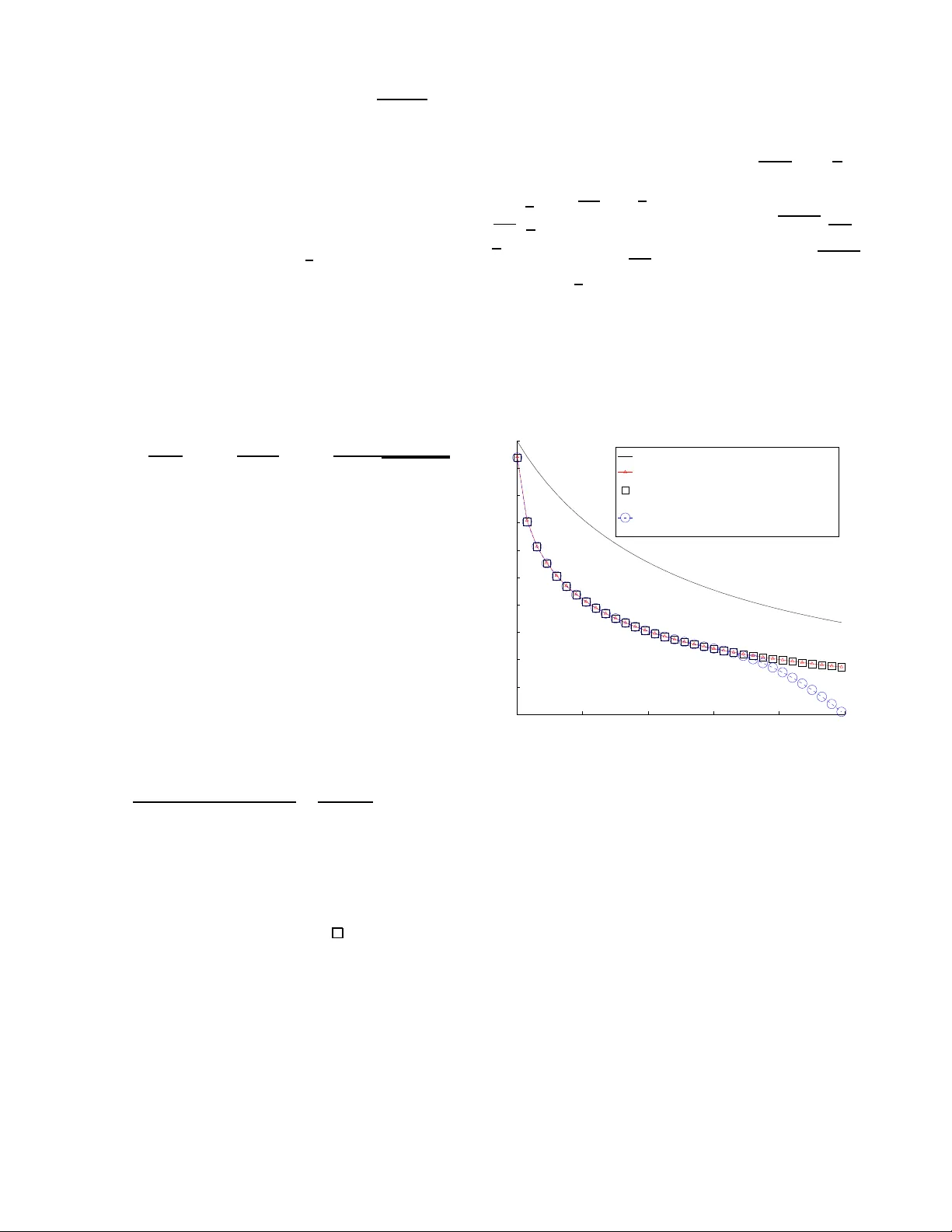
Online Ad Slotting With Cancellations Florin Constantin ∗ Jon F eldman † S . Muthukrishnan † Mar tin Pál † ABSTRA CT Man y advertise rs use Internet systems to buy advertise - ments on publishers’ w ebpages or on traditional media suc h as radio, TV and newsprin t. They seek a simple, online mec hanism to r eserve ad slots in adv ance. On the other hand, media p ublishers represent a vas t and v ary in g in ven- tory , and they to o seek a utomatic, online mechanisms for pricing and allo cating such reserv ations. In this pap er, we present a nd stud y a simple mod el for auctioning such ad slots in adv ance. B idders arriv e sequen - tially and report which sl ots they are in terested in. The seller must d ecide immediately wheth er or n ot to g rant a reserv ation. Our model allows a sell er to accept reserv a- tions, b ut p oss ibly c anc el the allocations later and pay the bidder a cancellation compen satio n ( bump p ayment ). Our m ain result is an online mec hanism to derive prices and bump paymen ts that is efficient to implemen t. This mec hanism has many desirable prop erties. It is individually rational; winners ha ve an incentive to be honest and bidding one’s true v alue d ominates any lo w er bid. O ur mec hanism’s efficiency is within a constan t fraction of th e a p osteriori optimally efficien t solution. Its reven ue is within a constan t fraction of the a p osteriori VCG reven ue. Our results make no assumptions about th e order of arri v al of bids or the v alue distribution of bidders. All our results still hold if the items for sale are elements of a matroid, a more general setting than slot allocation. 1. INTR ODUCTION Man y advertise rs no w use In ternet adv ertising systems. These take the form of adve rtisement ( ad , hen cefo rth) place- ments either in response to users’ web search queries, or ∗ SEAS, Harv ard Universit y , 33 Oxford St., Cam bridge, MA 02138. Email: florin@eec s.harvard.edu . Most of this w ork was done while the auth or wa s visiting Go ogle Re- searc h, New Y ork. † Google Research, 76 Ninth Ave., 4th Floor, New Y ork, NY, 10011. Email: {jonfeld,m uthu,mpal}@goo gle.com . Permission to m ak e digital or hard copies of all or part of this work for personal or classroom use is gra nted withou t fee provided that copies are not made or distrib uted for profit or commercial advanta ge and that copies bear this notice and the full cita tion on the first page. T o cop y otherwise, to republi sh, to post on serv ers or to redistri bute to li sts, requires prior spe cific permission and/or a fee. Copyri ght 200X AC M X-XXXXX-XX-X/XX/XX ... $5.00. at predetermined slots on publishers’ web pages. In ad- dition, increasingly , adv ertisers use Internet systems th at sell ad slots on b ehalf of offline pu blishers on T V, ra dio or newsprint. In sponsored search, and in some other cases, ad slots are t ypically sold via r e al time auctions, i.e., when a user p oses a query or visits a w eb page, an auction is used to det ermine which ads will show and where they will b e placed. On th e other hand, traditional ly , advertisers seek ad slots in advanc e , i.e. t o reserve their slots. Prod uct releases (such as movies, electronic gadgets, etc) and ad campaigns (e.g., creating and testing ads, b udgets) are planned ahead of time and need to co ordinate with future ev ents that target suitable demographics. The ad vertisers then do not wan t to risk th e v agrancies of real-time auctions and lose ad slots at critical even ts; they typical ly like a reasonable guarantee of ad slots at a sp ecific time in th e future within their b udget constrain ts to day . Our motiv ation arises from systems that enable such ad- v anced ad slotting. In p articular, our focus is on automatic systems that have to manage ad slots in man y differen t p u b- lishers’ prop erties. These prop erties differ wildly in their traffic, targeting, p rice an d effectiv eness; consider p lacemen t in th e fron t page of nytimes.com vers us p lace ment in an in- dividual’s blog versus a radio slot in a lo cal country music radio station. A lso, the inv entory levels are massiv e. Slots and impressions in w eb publishers’ prop erties as w ell ad slots in TV, radio, newsprint an d other traditional media are in 100’s of millions and more. Not all p ublishers can estimate their inven tory accurately: traffic to w ebsites resp onds to time-dep endent even ts, and sometimes we bpages are gener- ated dy namically so t h at even t h e av ailability of a slot in the future is not known a priori . Most web publishers are not able to estimate accurately a price for an ad slot, or pro vide sales agen ts to negotiate terms and w ould like automatic metho d s to price ad slots. Thus, what is d esirable is a sim- ple, automatic, online 1 market-based mechanis m to enab le adv anced ad slotting ov er such v aried, massive in ven tory . Inspired by these considerations, we study the p roblem of mec hanism d esig n for adv anced ad slotting. T he p roblem is qu ite general with many facets. Our contribution is to prop ose a simple model, to design a suitable mec hanism and to analyze its prop erties. In more detail, our con tributions are as follo ws. (i) W e prop ose the follo wing simple h igh-lev el mo del for adv anced ad slotting auctions. A n auction starts at time 0; 1 W e u se the wo rd onli ne as in onli ne algorithm —i.e., th e input arrives ov er time, and th e algorithm makes sequential decisions —we d o not mean “on the Internet.” the seller has a set of slots for sale that will b e published at time T . Bidder i arrives at some time a i < T , reports which slots he is interested in, places a bid w ( i ) and requ ests an immediate response. Bidder i is either accepted or rejected; if accepted, he m ay b e remo ved ( bump e d ) later, but in t h at case, he is aw arded a bump p ayment . W e assume that if bump ed, a bidder incurs a loss of an α fraction of its v alue. At time T , each accepted bidder th at has not b een bump ed is p ublished in one of the sl ots he w as in terested in , and pays a price th at is at most his bid. This mod el lets the publisher accept a reserv ation at time t for a slot a v ailable at a later time T , and lets the advertiser get a reasonable guarantee. Ho wev er, crucially , it lets the publisher c anc el the reserv ation at a later time. Cancellatio n is n ecessa ry for publishers to tak e adv antage of a spike in d e- mand and rising prices for an item and not b e forced to sell the slot b elo w the market b ecause of an a priori contract. In addition, in a pragmatic sense, cancellation is crucial: for example, a website might ov erestimate its inv entory for a later date and accept ads, but as time progresses, its esti- mates may b ecome smaller, and the publisher will not b e able to honor all the accepted ads from the past. Finally , cancellations are very muc h part of t h e b usiness with ad- v ance b ookin gs, b oth within advertising and b eyond. A t the same time, it comes at a cost, whic h is the b u mp pa y- ment. This is reas onable since it compensates the advertise r for t h e uncertaint y , and lets advertis ers recoup part of their costs inv olve d in preparing a campaign for time T based on their reserv ation at time t . W e presen t our mo del formally in Section 3. (ii) W e p resen t an efficiently implemen table mechanism M α ( γ ) for d etermining who is accepted, who is bump ed and also the prices and bu mp paymen ts. The parameter γ represents how muc h h igher a new bid h as to b e in order t o b ump an older bid. A b umped b idder will b e paid an α fraction of th eir bid, making up for their utility loss due to b eing bump ed. (iii) W e show a num b er of imp ortant strategic as w ell as efficiency- and revenue-rela ted prop erties of M α ( γ ): • M α ( γ ) is individ u ally rational and winners hav e an in- centiv e to b id tru thfully while losers should b id at least their true va lue. • With resp ect to the bids received, the efficiency (v alue of assignment) of M α ( γ ) is at least a constant factor (dep ending on γ and α ) of th e offline optimum. U nder mild playe r rationalit y assumptions, w e show that our mec hanism is competitive with resp ect t o the optimum offline efficiency on bidders’ true values . • W e also consider t he notion of effe ctive efficiency which interprets social w elfare as the sum of th e winners’ bids minus bump ed (if any) bidd ers’ losses. W e sho w that for suitable γ ( α ), our mechanism’ s effective efficiency matc hes a numerically obtained upp er b ound on the effective efficiency of any deterministic algorithm. T o our knowl edge, costly cancellations hav e not been p re- viously studied in online bipartite matching problems. • The reven ue of M α ( γ ) is at least a constant factor ( de- p enden t on γ and α ) of that of the Vickrey-Clark e- Gro ves (VCG ) mechanism on all received bids. • W e also study sp e culators , that is, ones who hav e no interes t in th e items for sale but who participate in order to earn th e bu mp payment. W e show severa l game theoretic prop erties ab out the b eha vior of th e sp ecu lators , including b ounding th eir o verall profi t . T o the b est of our k no wledge our results are t he first ab out mec hanisms with strong game-theoretic prop erties for ad- v anced placemen t of ads (more generally , ind ivisible go ods) with a cancellation fe ature. W e mak e no assumptions on the arriv al order of the bidders or on their v alues. Prior w ork has studied adv anced sale of go ods without cancellations, but only under a probabilistic distribu t ion of bidders’ v al- ues [6 , 8]. Under a worst case mo del like ours, no nontrivial results are p ossible without making additional assumptions; in our case, we ov ercome these imp ossibilities by allo wing cancellations. In secretary problems [1], bids may b e arbi- trary but th eir order is assumed to b e un ifo rmly rand om (cannot b e sp ecified b y an adversary). There are sp ecific examples of systems t hat implement adv anced b ooking with cancellations. F or ex ample, this is common in the airline ind ustry , where tick ets may b e b o ok ed ahead of time, and customers may b e bump ed later for a paymen t. In the airline case, th e inve ntory is mostly fi xed, sophisticated mo dels are used to calculate prices ov er time, and often negotiations are inv olved in establishing the pay- ment for bump in g, just prior to time T . In some cases, the bump p a yments may even b e larger than th e original bid (price) of the customer. Lik ewise, in offline media such as TV or Radio, humans are inv olved are in n egotia ting ad- v anced prices, and often if the pu blisher do es not resp ect the reserv ation due to in ven tory crunc h, a paymen t is a p os- teriori arranged includ ing p ossibly a b etter ad slot in the future. These metho ds are not immediately applicable to the auction-driven automatic settings like ours. F rom a technical p oint of view, one can v iew our mod el as an online w eighted bipartite matching prob lem (or more gen- erally , an online maximum wei ghted indep endent set prob- lem in a matroid). On one side we hav e slots known ahead of t ime. The other side comprises advertisers whose b id s (w eighted n odes) arrive online. Our goal is to fi nd a “go od” w eighted matching in the even tual graph. Each time an ad- vertise r app ears w e need to decide if w e should retain it or discard it; retaining it may lead to discarding a p reviously retained b idder. Our mec hanism builds on such an online matc hing algorithm [9] t o determine a suitable bump pay- ment and prices. It is, curiously , able to make use of such an online algorithm p reviously p roposed in the semi-str e aming mod el in the th eoretica l compu ter science literature. All our results extend to a setting where the items for sale are elements of a m atroid, a more general setting than slot allocation. A bidder bids on ex actly one element of the matroid, which is known ahead of t ime and may v ary across b idders. A set S of bidders is then feasible if the set conta ining each bidder’s element forms an indep endent set of the matroid. In the bipartite matching setting, t h e seller’s matroid contains one element for eac h su b set of slots and a set of bidders (elements) is indep endent if the bidders can b e matched to slots such that each on e receives an element from its subset. W e prefer the matc hing language for clarit y of exp osition. W e hav e initiated the study of mechanisms for adv anced reserv ations with cancellations. A n umber of tec hnical prob- lems remain op en, b oth within our mo del, as we ll as in its extensions, which w e describ e later for futu re stud y . 2. RELA TED WORK There is considerable w ork on auctions when b idders are present th roughout a p eriod of time. Of more direct rele- v ance are the follo wing classes of p rob lems. Babaioff et al. [1] address the matr oid se cr etary pr oblem : finding a comp etitiv e assignmen t when wei ghted elements of a m atroid arrive online and no cancellations are allow ed. As is common in secretary p roblems, while not makin g any assumption on b idder v aluations, they assume that all or- ders of arriv als are equally likely . They present a log r - compet itive algorithm for general matroids where r is the rank of the matroid (the size of the large st indep enden t sets) and a 4 d -comp etitive algori thm for our setting without can- cellations (transversal matroids) b u t where each bidder can only be in terested in at most d items. Both these algorithms observe half of the input and then set a threshold price: p er item in the transvers al case and uniform in the general case . The 4 d -comp etitiv e algorithm ensures t ruthful bidding eve n when the items desired by an agen t are priv ate information. Dimitro v and Plaxton [4] exten d t he 4 d - algorithm and pro- vide an algorithm with a constant comp etitiv e ratio for any transversa l matroid. Bikhchandani et al. [2] present an ascending auction for selling elements of a matroid that ends with an optimal al- location (i.e. the auction is efficient). T ruthful b idding is an eq uilibrium of the auction. They assume how eve r t h at bidders are present throughout the auction. Cary et al. [3] show th at a random sampling profit extrac- tion mec hanism approximates a VCG-based target profit in a pro curemen t setting on a matroid. Gallien and Gupta [6] analyze play ers’ strategies regard- ing buyout prices in online auct ions. In t h eir mo del, bid- ders’ v aluations are drawn from a k no wn distribution and their utilities are time-discounted; furthermore there are no cancellations and arriv als are assumed to follo w a Poisso n process. They exh ib it sy mmetric Bay es-Nash equilibria in whic h bu y ers follo w certain threshold strategies. Assuming that buyers foll ow t he corresp onding equilibrium strategies, the seller can then optimize revenue by tuning the price function. La vi and Nisan [8] consider online auctions for identical goo ds. In their mo d el, b idders’ v alues are arbitrary from the interv al [ ρ , ρ ] and n o cancellations are p ossi ble. They present a simple online p osted-price auction based on exp onentia l scaling. This auction is optimal among online auctions and ac hieves a Θ(log ( ρ/ρ )) approximation with respect t o b oth efficiency and t h e VCG rev enue. Indep endently form us, F eige et al. [5] stud y an offline w eighted bipartite matching problem where the seller can partially satisfy a bidder’s request at th e cost of paying a prop ortional p enalt y . Accepting a bid but not providing any items results in a utilit y loss p roportional to the bid, similar to our definition of effe ctive efficiency in Section 5.1. They sho w that it is NP- hard to app ro ximate th e optimal solu- tion within an y constant factor. They prop ose an adaptive greedy algorithm assigning one bidder at a time (bu t that insp ects all unassigned bidders in deciding whic h bidd er to allocate) and that may reassign b idders. They provide a lo wer b ound on this algorithm’s efficiency with resp ect to the optimal assignment. 3. MODEL AND MECHANISM W e first define our mo del and present our mechanism whic h w e will study in later sections. 3.1 Model Basics There is a seller who has a finite set of slots (items), an d starts sale at time 0 and ends sale at time T . Eac h bid der i is interested in exactly one slot out of a set N ( i ) called i ’s choic e set . W e den ote by v ( i ) bidder i ’s v alue for an y slot in N ( i ) and we ass ume t hat v ( i ) is priva te information to i . Each b idder i p laces a bid w ( i ) (that m ay b e d ifferen t than v ( i )) as soon as it arrives, at time a i . As a consequence of i bidd ing, i ’s choice set b ecomes kn o wn to the seller. When i b ids, he ma y b e ac c epte d (i.e. promised an item from N ( i )), else rejected. If promised an allocation, h e ma y get bump e d later, losing th e reserv ation. A n y accepted bidder who is not bump ed b efo re time T is allo cated. W e mod el bidder i ’s utili ty as λ · v ( i ) − x ( i ) , where (1) • λ equals 0 if i is rejected, 1 if i is accepted and granted from N ( i ) and − α if i is accepted bu t b umped. • x ( i ) is i ’s tr ansfer to th e seller (price). I t is 0 if i is rejected, and some non-negative amount if i is accepted and allocated. x ( i ) may b e negative (e.g. the bump p ayment the seller makes in M α ( γ )). That is, a b idder is unaffected if rejected right a wa y , has a v alue of v ( i ) fo r b eing allocated, and incurs a loss amo unt- ing to an α fraction of its va lue if b umped. The utility is quasilinear in money . Note that from an algorithmic p ersp ectiv e, our problem is online m ax im um weigh ted bipartite matc hing with costly cancellations. There is a bipartite graph with items (re- sp ectively bidders) as “right” -(respectively “left” -)hand side vertices . Left-h and side vertices are fixed. One by one, a righ t-hand side vertex i is revealed together with its w eigh t w ( i ) and its ed ges (i.e. th e set N ( i )). A decision whether to accept i or not must b e taken immediately . The goal is to find a matching of w eight as high as possible, where can- cellations are allo w ed, but canceling bidder i of weigh t w ( i ) results in a p enalty of αw ( i ). How ever, in our settin g bidd ers are self-interested and ma y alter the input to the algorithm (their bids) if it is in their interes t t o d o so. Therefore we aim for a mec hanism th at is comp etitive while b ounding the bidders’ manipu latio ns. Note t hat if α = 0, th en we can t en tatively accept any bidder and only decide at time T which bidders are truly accepted while rejecting the remainder, thus reducing the p roblem to finding a bipartite matching of maxim um weigh t, a standard offline optimization. By c harging each bidder its VC G (see Section 6) price, it b ecomes a dominant strategy for each bidder to b e truthful (i.e. bid its true v alue). 3.2 Our M α ( γ ) Mechanism W e p resen t our adv ance-b ooking online mechanis m M α ( γ ) (allocation algorithm and paymen ts). The allo cation algo- rithm follow s the Find-Weighte d-Matching algori thm in [9 ] 2 . 2 Unlike [9], a b id d er i ’s v alue is th e same for any slot (ver- tices as opp osed to edges are wei ghted). Our mechanism ma y then change the slot i is currently assigned to at v ari- ous stages in the algorithm. Apart from α , which is sp ecified by t he mo del, the algorithm uses an i mpr ovement factor γ > 0 such that 0 < α < γ 1+ γ . Denote t he num b er of bidders by n ; our mechanism is indep endent of n . By relab eling bidders, assume that they bid in order 1 , 2 , . . . , n ; time is indexed likewi se. Definition 1. We say that a set of bidders B can b e matc hed if for e ach b ∈ B ther e exists an i tem i b ∈ N ( b ) such that i b 6 = i b ′ , ∀ b 6 = b ′ . We say that B is a p erfect matc hing if it c an b e matche d and no item is left unmatche d ( B ’s c ar dinali ty must e qual the numb er of items). M α ( γ )’s pseudo code is listed in Algorithm 1. At a high leve l, M α ( γ ) mainta ins a set of accepted b idders that form a p erfect matching. F or any new arriving bidder i bidd in g w ( i ), the al gorithm lo oks if there ex ists some bidd er j in the accepted set with w ( j ) < w ( i ) 1+ γ such that i can b e swapped in th e matching if j is swa pp ed out. If so, accept i and cancel the reserv ation of ( bump ) j ∗ , the lo we st w eight such j . Bidder j ∗ is paid the b ump payment αw ( j ∗ ). (N ote that j ∗ makes no payment at all and in fact gets money for fr e e from the seller if bu m p ed.) An accepted b idder who is not bump ed by time T is necessarily allocated a slot from his choi ce set and pays t he seller an amount w e define later (Eq.(2)). At time 0, A 0 is an arbitrary matching; we introd uce r dummy bidders ( eac h bidd ing 0) whose choice set is the whole set of items, arriving b efore all actual bidders. This will not affect our arguments below. 3 At time t , we call cur- rently accepted bidders ali ve , and denote th e set of alive bidders as A t . Let X t = { b ∈ A t − 1 : A t − 1 ∪ { t } \ { b } can b e matc hed } ; X t is the set of alive b idders at t − 1 th at can b e exchanged for t . Bidders still aliv e at the end (time T ) are called survivors and S = S ( w ) denotes this set. W e denote the set of bump ed b idders by R = R ( w ). Algorithm 1 M α ( γ ). Fix A 0 , an arbitrary perfect matching on dummy bidders. for each i ≥ 1 bid d ing w ( i ) (with choice set N ( i )) do Let X i = { j < i : A i − 1 ∪ { i } \ { j } can b e matched } . Let j ∗ = argmin j ∈ X i w ( j ) if (1 + γ ) w ( j ∗ ) < w ( i ) then A i = A i − 1 ∪ { i } \ { j ∗ } : i is accepted, j ∗ is bump ed j ∗ is paid αw ( j ∗ ), i.e. an α fraction of its bid end if end for Charge any bidder i in S , A n (i.e. survivor) as in Eq. (2). Definition 2. L et i b e a bidder and fix the bids of al l other bidders. L et w ac ( i ) ( i ’s acceptance weigh t ) b e the infi- mum of al l bids that i c an m ake such that i is ac c epte d when he bids. Similarly, let w sv ( i ) ( i ’s surviva l w eight ) b e the in- fimum of al l bids that i c an make such that i is ac c epte d when he bids and survives u n til time T (the en d) . Cl e arly, w ac ( i ) ≤ w sv ( i ) . L et W sv = P i ∈ S w sv ( i ) . 3 When bidder t arrives, assume A t − 1 = A ∪ D where D only contai ns d umm y bidders and th ere ex ists a matching I t of A ∪ { t } which matches t to some item i t . By reassign- ing d umm y bidders, we can assume that actual bidders are matc hed according to I t . Then bidder t can bump at least the dummy b id der d ∈ D that is matched to i t in A t − 1 . Note t h at w sv ( i ) alwa ys exists since it suffices to b id (1 + γ ) max j 6 = i w ( j ). Also, w ac ( i ) and w sv ( i ) are indep enden t of i ’s actual bid, but ma y dep end on the time i bids and on the other b idders’ bids or arriv als (times of bidding). Note that w ac ( i ) can b e computed by the seller as so on as a bidd er arriv es whereas w sv ( i ) may dep end on future bid ders and thus can only b e compu ted at time T . In summary , i is 8 > < > : rejected , if w ( i ) < w ac ( i ) bump ed , if w ac ( i ) ≤ w ( i ) < w sv ( i ) a survivor , if w sv ( i ) ≤ w ( i ) If i is a survivor, i ’s p rice p i is as follow s: p i = ( w sv ( i )(1 − α ) if w ac ( i ) < w sv ( i ). w sv ( i ) if w ac ( i ) = w sv ( i ) . (2) The common case is when w ac ( i ) < w sv ( i ): i gets a dis- count amoun ting to the highest refund it could hav e other- wise obtained: αw sv ( i ). The sp ecial case of w ac ( i ) = w sv ( i ) occurs when i ’s acceptance is enough for its surviva l (in par- ticular if i is th e last bidder). When w ac ( i ) = w sv ( i ), from the bidder p oint’s of v iew, M α ( γ ) p osts a price of w ac ( i ). This concludes the definition of M α ( γ ). W e will now study its prop erties. 4. INCENTIVE PR OPER TIES The follow ing theorem summarizes our mechanism’s fa- vora ble in centive prop erties. Theorem 1. The M α ( γ ) me chanism is individual ly r atio- nal. Bidding one’s true value (we akly) dominates any lower bid. If honest, any survivor is (we akly) b est-r esp onding. The pro of follo ws from t he tw o lemmas b elo w. Note that with bump paymen ts ( “money for nothing” ) w e cannot hop e to hav e a tru thful mechanism since any- one with no interest in any allo cation can bid hoping to get a bump p a yment. I t is nev ertheless p ossible that other typ es of truthful comp etitive allo cation mechanisms ex ist. Lemma 1. Bidding less than one’s true value is domi - nate d by bi dding one’s true value. A bump e d bidder’s b est r esp onse m ay however b e to bid mor e than i ts true value. Pr oof. I f w ac ( i ) < w sv ( i ), bidder i ’s highest p oss ible bump payment is αw sv ( i ). The price of (1 − α ) w sv ( i ) has b een c hosen su ch that i prefers winning to b eing p aid αw sv ( i ) if and only if v ( i ) ≥ w sv ( i ). That is, the b est bid i can mak e ( i ’s b est-r esp onse ) is to bid just b elo w w sv ( i ) if v ( i ) < w sv ( i ) and to bid its true v alue otherwise. If w ac ( i ) = w sv ( i ), t h en i can n ever get a bump paymen t and i simply faces a take-it-or-lea ve-it offer of w sv ( i ). Can a bidder ever incu r a loss by participating? The fol- lo wing result shows that if truthful, n o bidder will hav e a negative ut ili ty , i.e. the mechanism is individually rational. Lemma 2. If bidder i bids its true value v ( i ) , then i ’s utility after p articip ating in the me chanism i s non-ne gative. Pr oof. Wh en surviving, i pays at most w sv ( i ) ≤ v ( i ). If i is not accepted then i ’s u tilit y is 0. If i is accepted and then bump ed, i ’s utility is − αv ( i ) + αv ( i ) = 0. In the follo wing tw o sections we sho w that apart from fa vorable incentiv e prop erties, M α ( γ ) is also comp etitive with respect to reven ue and efficiency . 5. EFFICIENCY OF M α ( γ ) Definition 3. F or any ve ctor w ′ = ( w ′ (1) , . . . , w ′ ( n )) of weights, we let OPT[ w ′ ] b e the weight of the optimal match- ing (r e c al l that the sel ler knows any bidder’s choic e set). We wil l overlo ad the expr ession and let OPT[ w ′ ] also de- note the optimal matching (as opp ose d to its wei ght ), when ther e is no c onfusion. If B is a set of bidders, we wil l denote w ′ ( B ) = P b ∈ B w ′ ( b ) . Unless sp e cifie d otherwise, w = ( w (1) , . . . , w ( n )) denotes the input bids and v denotes the true values. We wil l denote by OPT = OPT[ w ] . F rom an algorithmic p ersp ective, our mec hanism is a 1 + γ approximation to the optimum assignment ( Lemma 4). How ever, if in centives are not aligned then bidders may wan t to significantly alter th e input to th e algorithm (their bids). The allocation may then b e a p o or choice considering bid- ders’ true v alues. W e sho w t hat th is is not the case, in Theorem 2, our main result regarding M α ( γ )’s efficiency: the assignmen t output by our mechanism is a constant factor (dep ending on α and γ ) ap p ro ximation t o th e offline opti- mum on bidders’ true values if bids are ” reasonable” . Theorem 2. L et w b e a set of bids such that e ach bidder bids at l e ast its true value, that is w ( i ) ≥ v ( i ) ∀ i , and the sum of al l bi dders ’ utilities is non-ne gative. When run on w , M α ( γ ) ’s efficiency with r esp e ct to the true v alues v is: X i ∈ S ( w ) v ( i ) ≥ 1 − α − α γ (2 − α − α γ )(1 + γ ) · OPT[ v ] . Note that if all bidders are truthful then the right-hand side constant can b e in creased to 1 1+ γ (see Lemma 4 below). Recall the imp ossibilit y of making truthfulness a d omi- nant strategy due to the use of b ump p a yments. Theorem 2’s assumption allo ws for some bidders to hav e negative utilit y and t herefore fail to b est-resp ond (Lemma 2 sho ws th at sim- ply by b eing trut hful, a bidder’s utilit y is at least 0) as long as o verall, gains outw eigh losses in utility . The assumption fails when, for examp le, b id ders with v alue 0 for an alloca- tion (the “sp eculators” of Section 7 ) grossly overe stimate the actual bids and end up b eing allocated and h aving to p ay due to bidding too high. In such a scenario , the true v alue of the allo cation ma y b e very small, p ossibly 0. W e refer the reader to Section 7 for a more detailed d iscussio n on how sp ecu lators affect incentiv es. W e no w pro ceed to proving Theorem 2, establi shing a few other imp ortant results along the wa y . The follo wing bid vector will prov e useful: ˜ w S ( i ) = ( w sv ( i ) , if i ∈ S w ( i ) / (1 + γ ) , if i / ∈ S . Note that if i / ∈ S then w sv ( i ) > w ( i ) > w ( i ) / (1 + γ ). Lemma 3 is used for b oth efficiency and reven ue claims. Its pro of is more inv olved and we defer it to the App endix. Lemma 3. Any survivor s ∈ S ( w ) is also in OPT[ ˜ w S ] . The follo wing result pro vides an upp er b ound on th e sum of bump ed bidders’ bid s and shows that S is a 1 + γ approx- imation to t he optimal offline matching giv en the same set of bids. Recall that R is the set of bump ed bidders. Lemma 4. We have w ( R ) ≤ W sv /γ ≤ w ( S ) /γ . Also, OPT ≤ (1 + γ ) w ( S ) . Pr oof. F or eac h s ∈ S , let d 1 , . . . , d J = s b e a c hain such that: d j +1 bumps d j , ∀ 1 ≤ j ≤ J − 1. T o simplify notation, assume d 1 = 1 , . . . , d J − 1 = J − 1. W e will show t h at J − 1 X j =1 w ( j ) ≤ w sv ( s ) /γ The claim will follo w since t he set of bidders is the disjoin t union of survivors’ chai ns. Since s b umped J − 1, we h a ve w J − 1 ≤ w sv ( s ) 1+ γ . Since j + 1 bumps j , ∀ 1 ≤ j ≤ J − 2, w j ≤ w j +1 1+ γ . Thus by ind uction, w j ≤ w sv ( s )(1 + γ ) j − J , ∀ 1 ≤ j ≤ J − 1. W e get J − 1 X j =1 w j ≤ w sv ( s ) J − 1 X j =1 (1 + γ ) j − J ≤ w sv ( s ) /γ W e h ave w ( S ) ≥ ˜ w S ( S ) = OPT[ ˜ w S ] ≥ OPT[ w ] / (1 + γ ). Eac h inequality is implied by t he fact that n o bidder’s contri bution decreases when going from th e left h and side to the righ t hand side. The equalit y follo ws from Lemma 3: S is an optimal basis for ˜ w S , i.e. ˜ w S ( S ) = OPT[ ˜ w S ]. An analogous lemma can b e found in [9 ]. Ou r constants are tighter b ecause in our mod el, a bidder’s v alue for any slot is the same, and all edges incident to a bidd er arrive sim ultaneously . These b ounds are almost tigh t: Example 1. Consider k + 2 truthful bidders c omp eting on one item; bidder i is the i -th to arrive and has value (1 + γ ) i − 1 unless i = k + 2 , whose value is ( 1 + γ ) k +1 − ε . Bidder i + 1 bumps i , ∀ 1 ≤ i ≤ k . Only the k + 1 -st bidder survives. The bump e d bidders have total weight P k − 1 i =0 (1 + γ ) i = ((1 + γ ) k − 1) /γ . OPT is (1 + γ ) k +1 − ε . Pr oof of Theorem 2. By assumption, bidders’ total u til- it y is non-negative: X s ∈ S ( v ( s ) − (1 − α ) w sv ( s )) + X r ∈ R αw ( r ) ≥ 0 W e hav e from Lemma 4 th at P r ∈ R w ( r ) ≤ P s ∈ S w sv ( s ) /γ . W e prov e that X s ∈ S ( v ( s ) + w sv ( s )) ≥ OPT[ v ] / (1 + γ ) . The theorem then follow s by algebraic manipulation. Let w ′ ( s ) := max( v ( s ) , w sv ( s )) ∀ s ∈ S . Cle arly , w ( s ) ≥ w ′ ( s ) ∀ s ∈ S , otherwise th ey w ould not hav e survived. Also, v ( s ) + w sv ( s ) ≥ w ′ ( s ) ∀ s ∈ S by d efi nition. If every one in S bids w ′ instead of w , the outcome do es n ot change (they still bid ab o ve their surviv al th resholds). By Lemma 4, P s ∈ S w ′ ( s ) ≥ OPT[ w ′ ] / (1 + γ ) and OPT[ w ′ ] ≥ OPT[ v ] by definition, giving the claim. 5.1 Effec tive Efficiency Efficiency is usually measured as the sum of winn in g bid- ders’ v alues. An alternativ e defi nition which also takes in to account the losses of bu mped bidders and may b e more ap- propriate when cancellations are allo w ed is the follo wing: Definition 4. L et w b e a se quenc e of bids and A an on- line al lo c ation algorithm, p ossibly with c anc el lations. L et S ( A ) (r esp. R ( A ) ) b e the set of winners (r esp. bump e d bid- ders) when A is run on w . We define the effective efficiency of A on w as u ( w ) = P s ∈ S ( A ) w ( s ) − α P r ∈ R ( A ) w ( r ) A ’s effe ctive efficiency competitive ratio is inf w u ( w ) OPT[ w ] W e present an upp er b ound (obtained numerically) on the comp etitiv e ratio of any deterministic algorithm. F or α < 0 . 618 and a certain γ α , M α ( γ α ) matches this upp er b ound. F or a fixed α , let n ≥ 2 a p ositiv e integ er and c ∈ (0 , 1): w e aim for n bidders and a comp etitive ratio of c . Consider one item and a sequence of bids { a k ( c ) } 1 ≤ k ≤ n on it (bidder k bids a k ) such th at a 1 = 1 , a 2 = 1 c > 1 and ca k +1 ( c ) = a k ( c ) − α k − 1 X j =1 a j ( c ) ∀ k ≥ 2 implying ca k +1 = (1 + c ) a k − (1 + α ) a k − 1 ∀ k ≥ 2 (3) W e will lo ok for a c = c n such that a n ( c ) − α n − 1 X j =1 a j ( c ) = ca n ( c ) ⇐ ⇒ a n = (1 + α ) a n − 1 (4) E.g. c 2 = 1 1 + α > c 3 = 1 1 + 2 α > c 4 = 2 1+3 α + √ (1+5 α )(1+ α ) . Unfortunately , c n does not hav e a nice closed form for n ≥ 4 (in addition, c n ma y b e not b e un ique - the smallest c n ∈ [0 , 1] is then of interest). Theorem 3. Fix n and α . L et c n b e the lowest numb er (if any) i n [0 , 1] f or which Eqs. (3) and (4) simultane ously hold. Then no deterministic algorithm c an have an effe ctive efficiency c omp etitive r atio higher than c n . Pr oof. On any input , the offline optimum with resp ect to effective efficiency is simply t he highest w eight assign- ment, and it results in b umping no bidders. Assume that the bids that arrive are a 1 , . . . , a k 0 for some 1 ≤ k 0 ≤ n . Then at eac h k , t h e algorithm A must accept a k , or its comp etitiv e ratio will b e smaller than c n when k = k 0 . This is clear for k = 1. Fix k ∈ [2 , n − 1]. Let M k b e the highest ( i.e. the offline optimum) of a 1 , . . . , a k . If A do es not accept k then the comp etitiv e ratio on in put a 1 , . . . , a k will b e at most a k − 1 ( c n ) − α P k − 2 j =1 a j ( c n ) M k ( c n ) = c n a k ( c n ) M k ( c n ) ≤ c n where the eq ualit y follo ws from Eq. (3). N o w we claim that whether or not A accepts a n , its comp etitive ratio will b e at most c n . If a n is accepted, α P n − 1 j =1 a j has b een lost due to bumping bidders 1 , . . . , n − 1; if a n is rejected the effective efficiency is a n − 1 − α P n − 2 j =1 a j . By Eqs. (3) and (4), b oth quantities are a c n fraction of a n , which in turn is at most M n , the optimal (eff ective) efficiency . Figure 1 strongly suggests that the comp etitiv e ratio of any algorithm cannot b e higher t h an 2 α + 1 − 2 α 0 . 5 ( α + 1) 0 . 5 , sho wn as squares in the figu re. N ote that for t h is c the chara cteristic equation of Eq. (3) has a double ro ot. The triangles plot the minimum c found for th e corre- sp on d ing α for d ifferen t val ues of n (we used Fibonacci v al- ues up to rank 12, i.e. largest n w as 144). The c v alues w ere found v ia binary sea rch. I t w as tru e in general, although n ot alw a ys, th at the higher n , the lo w er c n . W e suspect that one can alw ays fi nd an in creasing sequ ence of integers { n i } i ≥ 1 such that a solution c n i to Eq s. (3) and (4) conv erges from above to 2 α + 1 − 2 α 0 . 5 ( α + 1) 0 . 5 as i → ∞ . Lemma 4 implies th at for our algorithm u = w ( S ) − αw ( R ) ≥ w ( S ) − αw ( S ) /γ ≥ OPT 1 + γ „ 1 − α γ « . Let u ( γ ) = 1 1+ γ “ 1 − α γ ” . S ub ject to the constraint α ≤ γ γ +1 , u ( γ ) is maximized for γ 0 = max { α + √ α 2 + α, α 1 − α } . u ( γ 0 ) is displa yed in Fig. 1 by circles. The v alue 0.618 (the golden ratio) is where α 1 − α b ecomes higher than α + √ α 2 + α . If α < 0 . 618, u ( γ 0 ) = 2 α + 1 − 2 α 0 . 5 ( α + 1) 0 . 5 , whic h matc hes the numerical upp er bound . Recall th at this is just a worst- case low er b ound on the effective efficiency , but likewise, so are the upp er b ounds. The top curve plots c 3 = 1 / (1 + 2 α ). Recall t hat when α = 0 all bidders can b e tentativ ely accepted (by letting γ = 0) since they incur no loss and do not hav e to b e refunded. Then, the optimal matc hing can b e found via a one-shot (offline) algorithm at time T . 0 0.2 0.4 0.6 0.8 1 0 0.1 0.2 0.3 0.4 0.5 0.6 0.7 0.8 0.9 1 Refund fraction α Competitive ratio Effective efficiency: Competitive ratio Analytical upper bound (3 bidders) Numerical upper bound (n bidders) 2 α +1 − 2 α 0.5 ( α + 1) 0.5 M α ( γ ) for best γ = max( α + ( α 2 + α ) 0.5 , α /(1− α )) Figure 1: Effective efficiency (EE) b ounds as a func- tion of α . The top curve is c 3 = 1 / (1+2 α ) . The middl e curv e i s a numerical upp er b ound on any determin- istic algorithm’s EE: it shows c n computed numeri- cally from its recursion relations. The b ottom curv e shows (a lower b ound on) our algorithm’s EE for the be st γ α : it matches the upp er b ound for α < 0 . 618 . Our choice of γ is constrained by α < γ / ( γ + 1) ; if it were not, the b ounds w ould match for all α . 6. REVENUE OF M α ( γ ) W e show that apart from fav orable incentiv e and efficiency prop erties, M α ( γ ) is also comp etitive with respect to reven ue. As a reven ue b enchmark, w e consider t he offline VCG mec hanism b ecause it generates the h ighest reven ue among truthful efficient allocation mechanisms [7]. W e show th at our mec hanism is comp etitive with resp ect to reven ue with VCG on b idders’ true values . Let w ′ b e a sequence of bid s - when defining VCG on w ′ w e will assume t h at all bids are receive d at once by VCG. Let w ′ − i denote th e set of all bids in w ′ except bidder i ’s. The VC G mec hanism implements an efficient allocation and thus the matching it output s is optimal. If i ∈ OPT[ w ′ ] then VCG charges bidder i its externalit y on th e other bidders: X k ∈ OP T[ w ′ − i ] w ′ ( k ) − X j 6 = i,j ∈ OPT[ w ′ ] w ′ ( j ) (5) W e will use the follo wing k n o wn (see e.g. [3], F act 3.2) com binatorial prop ert y of our setting: ∀ i 6 = x , if x ∈ OPT[ w ′ ] then x ∈ OPT[ w ′ − i ]. Lemma 5. A winning bidder’s VCG p ayment i s a losing bid. Also, the V CG r evenue c an only incr e ase i f some bids in w ′ ar e i ncr e ase d. On bids w ′ w e denote the V CG reven ue by REV vcg [ w ′ ] and the net reven ue of M α ( γ ) (payments from su rv iv ors minus bump payments) by REV γ ,α [ w ′ ]. Theorem 4. Assume w ( i ) ≥ v ( i ) ∀ i , i.e. no one bids b elow their true value, sinc e that would b e dominate d. Then REV γ ,α [ w ] ≥ 1 − α − α/γ 1 + γ REV vcg [ w ] This theorem shows the tradeoff betw een γ , th e improv e- ment factor required for b umping an accepted bidder and α , the fraction returned as the bump payment. F or instance, for α = 0 . 25 (refund of 1/4th t h e bid), if w e choose γ = 1 then the constan t in Theorem 4 becomes 0 . 2 5, i.e. ou r mec h- anism obtains at least a quarter of th e VCG reven ue. W e will now pro ve Theorem 4. Lemma 4 implies th at payments received by M α ( γ ) are at least W sv (1 − α ) (since only survivors pay) and t hat bump paymen ts sum to at most W sv α γ . It will suffice to show that W sv ≥ REV vcg [ w ] / (1 + γ ). Let u ( i ) = ( max( w sv ( i ) , w ( i ) / (1 + γ )) , if i ∈ S w ( i ) 1+ γ , if i / ∈ S . Lemma 3 states t hat ∀ s ∈ S , s ∈ OPT[ ˜ w S ]. Since on ˜ w S VCG paymen ts cannot b e higher than its efficiency , W sv ≥ REV vcg [ ˜ w S ]. Also, Lemma 5 imp lies REV vcg [ ˜ w S ] = REV vcg [ u ] ≥ REV vcg [ w ] / (1 + γ ) , since when going from ˜ w S to u only VCG winners ma y in- crease their bid, and for all i , u ( i ) ≥ w ( i ) / (1 + γ ). Note that unlike the analogous efficiency result (Theo- rem 2), this result mak es no assumpt ion on bidders’ utilities. 7. SPECULA TORS Since money is given aw ay , sp eculators, that is, bidders without interest in any item are likel y to enter the mec ha- nism lo oking for bump payments. F or a sp eculator i , utilit y is also give n b y Eq. (1), b ut with v ( i ) = 0. Sp eculators ma y bid (under false iden tities) more th an once or collude. Their bids can effectivel y indu ce reserve prices, since actual bid- ders will hav e to bid a 1 + γ factor higher than a comp eting sp ecu lator. I f sp eculators bid judiciously on high- demand items, t hey can garner payment from the auctioneer, who gets even more reven ue via larger prices for h igh-v alue bid- ders. So, it is clear that sp eculators are impactful. In this section we address the question of ho w sp eculators affect t he mechanism. In S ection 7.1, w e sho w tw o p ositive results • W e show that the M α ( γ ) algorithm has goo d ov erall ef- ficiency , as long as the sp eculators h a ve p ositiv e ov erall surplus and the surv iv ors are b est-resp onding. • W e p rove a b ou n d on t he o verall revenue that sp ecu- lators can obtain. In Section 7.2 we giv e a more detailed discussion of sp ecu- lator strategy . Along the wa y , we show that man y natural simplifying assumpt ions regarding sp eculators’ or bidders’ strategies are unfortunately false. Sp ecifically , we show that: • the profits av ailable for specu lators may dep end on t he arriv al order of actual bid d ers (Example 2); • there ma y b e no pure N ash equilibrium for actual bid- ders or sp eculators (Example 2); • sp eculators may p refer to induce a sub optimal p erfect matc hing of actual bidders (Example 3); • a coll uding set of speculators ma y b e able to get higher bump paymen ts if some of th em survive (Example 4). 7.1 Impact on Efficiency and Rev enue The follo wing result gives a comp etitiv e ratio of our al- gorithm’s efficiency with resp ect to the opt im um efficiency giv en b idders’ true v alues. It only requires that total specu - lator utilit y is non-negative: this is particularly applicable if sp ecu lators are co ordinated and can make mon et ary trans- fers b etw een t hem. Pr oposition 1. L et w b e a set of bi ds such that actual survivors ar e b est-r esp onding and total sp e culator surplus, i.e. the sum of sp e culators’ p ayments minus the sum of sp e c- ulators’ pric es, i s non-ne gative. Then the M α ( γ ) algorithm with true v alues v has efficiency X i actual ,i ∈ S v ( i ) ≥ 1 − α − α γ (1 − α )(1 + γ ) · OPT[ v ] The proof is mostly algebraic and deferred to the App endix. This result is a strengthening of Theorem 2: Prop. 1’s con- stant is larger and its preconditions are less general. Note that Prop. 1 requires th at actual surv iv ors are b est-resp onding; a sp eculator’s b est resp onse cannot ind u ce it to survive. Next w e p ro ve an u pper b ound on sp eculators’ profit: Pr oposition 2. Sp e culators’ total pr ofit is at most α OPT /γ . Pr oof. Let Σ b e th e sum of surviv al weigh ts for sp ec- ulators that hav e survived. Denote sp eculators’ p rofit by Π ≤ − (1 − α )Σ + αw ( R ), where R are the participants who obtain bump payments (some may b e tru e b idders). By Lemma 4, w ( R ) ≤ (Σ + A ) /γ , where A is the total w eight of survivors t h at are actual bidders. W e get Π ≤ − (1 − α − α γ )Σ + α γ A The claim fo llo ws since (1 − α − α γ )Σ ≥ 0 and A ≤ OPT. 7.2 Specu lator Strategies At first gl ance, it wo uld seem that it is in the sp eculators’ b est interest to induce an assignmen t of actual bidders of w eight as high as p ossible in the survivor set, since then o verall bump paymen ts w ould b e maximized. This is true in some cases but not alw a ys (Example 3). The reason for such a distinction is that the or der of b id ders arriving also influences the max imum refunds attainable by sp eculators as show n b elo w. Example 2. Consider two bidders, one bidding 1 , the other C > 1 , on two items and assume that sp e culators c an- not c ol lude. If C arrives first, no sp e culator c an have higher r evenue if bump e d than when bidding 1 / (1 + γ ) on b oth items: this is actual ly a Nash e quilibrium (NE) for them. If 1 how- ever arrives first, then sp e culators c ould p articip ate with two identities bidding 1 / (1 + γ ) and C / (1 + γ ) on b oth items, b oth b eing bump e d. One c an show via a c ase analysis that ther e i s no pur e str ate gy NE for sp e culators. This example also show s that there ma y not b e a pu re strat- egy NE when only actual bidders participate: if tw o bidders with low v alues arrive, follow ed by the 1 bidder and after that the C bidder, then t h e t w o low v alue bidders are essen- tially sp eculators and the argumen t in the ex ample applies. Observe t hat a sp eculator who is bump ed with a bid of x could hav e obtained more bump paymen t by entering an earlier bid of at most x/ (1 + γ ); likewise, he could ha ve obtained yet more by b idding earlier x / (1 + γ ) 2 ; and so on. This is formalized as follo ws. Definition 5. L et x > 0 . We say that the sp e culator σ is an x -geometric sp eculator wi th choic e set N ( i ) i f σ plac es bids as f ol lows on choic e set N ( i ) . L et ε b e the m inimum strictly p ositive bi d that c an b e m ade and l = 1+ — log( x/ε ) log(1 + γ ) i.e. l ∈ Z & x (1 + γ ) l ≥ ε > x (1 + γ ) l +1 Then σ p articip ates with l + 1 differ ent identities, placing c onse cutive bids of x (1+ γ ) l , x (1+ γ ) l − 1 , . . . , x (1+ γ ) , x on N ( i ) . If speculators hav e full information on bidders’ v alues and bidders in OPT arr ive in increas ing order of their va lues, the outcome has many desirable prop erties: Lemma 6. Fix a set of actual bids such that OPT[ v ] bids arrive i n i ncr e asing or der. Supp ose that sp e culators c ol lude and want to maximize their joint r evenue. Then optim al sp e culator bi dding has the fol lowi ng c onse quenc es: • no sp e culator survives, no actual bidder i s bump e d; al l OPT bidders and only them ar e ac c epte d. • sp e culators c an achieve the highest p ayoff p ossible as given by L emm a 2. • truthful bidding is a NE for al l actual bidders. This is a further strengthen in g of Theorem 2. Optimal spec- ulator bidd ing in this case is as follo ws. F or each bidder i ∈ O PT with choice set N ( i ) there will b e one w ( i ) / (1 + γ )- geometric speculator σ i with the same choice set. The proof is deferred to the full version. This result has an app eali ng interpretation. If very w ell informed, sp ecu lators can ov ercome the efficiency loss due to late bidders not being ab le t o improv e by a 1 + γ factor o ver their earlier comp etitors. In general how ever, sp eculators may p refer to indu ce a sub optimal perfect matc hing: Example 3. Consider two items { i 1 , i 2 } and thr e e bid- ders b 1 , b 2 , b 3 arriving in this or der; bidder k is i nter este d in item i k , k = 1 , 2 , whil e bidder 3 i s i nter este d in any of i 1 or i 2 . Note that any matching that do es not match al l thr e e bidders is vali d. Assume that w ( b 1 ) < w ( b 3 ) < (1 + γ ) w ( b 1 ) and w ( b 2 ) > 2 w ( b 3 ) . The fol lowing analysis shows th at sp e c- ulators pr efer the sub optimal set of actual bidders b 1 and b 2 to the optimal one with b 2 and b 3 . • If b oth b 2 and b 3 survive, then sp e culators’ pr ofit is at most 2 w ( b 3 ) /γ : the sp e culator bump e d by b 2 must have a l ower weight than the one bump e d by b 3 , which i s at most w ( b 3 ) / (1 + γ ) . Even if sp e culators ar e ge ometric, sp e culator pr ofit c an onl y go as high as 2 w ( b 3 ) /γ . • If however b 1 and b 2 ar e alive when b 3 arrives, b 3 c an- not bump b 1 . By sim ply having one ge ometric w ( b 2 ) / (1+ γ ) -sp e culator which i s bump e d by b 2 , sp e culator pr ofit is w ( b 2 ) /γ > 2 w ( b 3 ) /γ . The follow ing example shows t hat sp eculators may b e able to make more money if they “sacrifice” , i.e. some of them inten tionally su rviv e so that others obtain high refunds: Example 4. L et ther e b e k items, k − 1 actual bidders bidding C > 1 al l arriving b efor e an actual bidder bidding 1 ; al l k bidders bid on al l the items. I f sp e culators c o or di- nate and p articip ate with k i dentities as C / (1 + γ ) -ge ometric sp e culators on al l the items then total sp e culator p ayoff is ( k − 1) αC /γ − (1 − α ) C /γ = ( k α − 1) C /γ sinc e k − 1 wil l b e bump e d, but one wil l survive. If no sp e cu- lator survives, the most money sp e culators c an m ake is k /γ , by p articip ating as k 1 / (1 + γ ) -ge ometric sp e culators. F or any α > 1 /k , f or a lar ge enough C , sp e culators’ pr ofit is higher when one of them i s sacrific e d. 8. O THER GAME-THEORETIC CLAIMS W e will now sho w that several app eali ng statements re- garding incentiv es in our algorithm are false. The algorithm may b e more ap p ealing for incentiv e pur- p oses if w e paid a b umped bidder αw sv ( i ) instead of αw ( i ) as bump paymen t. The follo wing example shows wh y this ma y result in a deficit: Example 5. Fix α and c onsider an e arly bidder e bidding 1 and a late bidder ℓ bidding L on one item wher e L > (1 + γ ) 2 /α . Bi dder ℓ survives and p ays (1 + γ ) . If we wer e to r efund e an α fr action of w sv ( e ) , e would get αL/ (1 + γ ) . The choic e of L ensur es that e is p aid mor e than ℓ p ays, i.e. the me chanism runs a deficit. W e assumed throughout that as soon as a bidder arrives, its choice set is known. If how ever that is priv ate informa- tion as well, incentiv es b ecome weak er: in Example 6, no bid by B ∗ on its true item i 2 is a b est-response if bidd ing on different item(s) instead is allo w ed. This ex ample also suggests why a naive generalization of M α ( γ ) to the setting where bidders hav e a different v alue for eac h of several items w ould n ot b e able to incentivize bidders to bid at least t h eir true v alue for each item. Example 6. Consider two items i 1 , i 2 and the f ol lowing set of thr e e bidders (arriving i n this or der): B − 3 / 2 with value (1 + γ ) − 3 / 2 for any of i 1 , i 2 (only demanding one of them), B ∗ who has value x < α (1 + γ ) − 3 / 2 for item i 2 and B 1 bidding 1 on item i 1 . Assume B − 3 / 2 and B 1 bid truthful ly. We wil l show that, whenever B ∗ bids on { i 1 , i 2 } , it c an do strictly b ette r by bi dding on i 1 only. We claim that if B ∗ bids on { i 1 , i 2 } then its utility is at most α (1 + γ ) − 3 / 2 . This is cle ar if it survives. If it is bump e d by B 1 , then its bid c annot b e hi gher than (1+ γ ) − 3 / 2 ( B − 3 / 2 ’s bid), sinc e B 1 c an r eplac e any of B − 3 / 2 and B ∗ . But then B ∗ ’s c omp ensation is at most α (1 + γ ) − 3 / 2 . L et 0 < ε < 1 / 2 . By bi dding (1 + γ ) − 1 − ε on i 1 only and b ei ng bump e d by B 1 , B ∗ c an get utili ty α (1 + γ ) − 1 − ε > α (1 + γ ) − 3 / 2 . W e have how eve r the follow ing conjecture: if a bidder prefers surviv ing to b eing refunded, th ey are b etter off bid- ding on their true choice set. If bidders myopical ly and sim ultaneously b est-resp ond then these d ynamics may lead to bid vectors where th e sum of their utilities is n egativ e: Example 7. L et ther e b e n items and 2 n bidders (i n- ter este d i n any i tem) arriving in incr e asing or der of their values: bidders B 1 , . . . , B n have value x < m in { 1 , 5(1 − α ) } / (1 + γ ) , bi dder s B n +1 , . . . , B 2 n − 1 have value 1 and bid- der B 2 n has value 5 . Assume they al l bi d truthful ly initial ly. Bidders n + 1 , . . . , 2 n ar e b est-r esp onding by L emma 1 and they wil l not change their bids. Each bidder B i ’s, i ∈ [1 , n ] , myopic b est-r esp onse i s to bid 5 / (1 + γ ) . O nl y one of them wil l b e bump e d by B 2 n and the others wil l survive: the sum of their utilities is at most x − ( n − 1) · 5(1 − α ) / (1 + γ ) < − ( n − 2) · 5(1 − α ) / (1 + γ ) . No bidder b etwe en n + 1 and 2 n − 1 wil l b e ac c epte d. Sinc e B 2 n ’s utili ty is at most 5 , for lar ge n the sum of al l 2 n bidders’ utilities wil l b e ne gative. This example d oes n ot preclude go od p erfor mance for other dynamics. 9. CONCLUDING REMARKS Advertisers seek a mechanism to reserve ad slots in ad- v ance, while th e pub lishers presen t a large inven tory of ad slots with v arying c haracteristics and seek automatic, online metho d s for pricing and allo cation of reserv ations. In th is pap er, w e present a simple model fo r auctioning such ad slots in advance, whic h allows canceling allocations at th e cost of a bump paymen t. W e present an efficiently implementable online mechanism to d erive p rices and bu mp pa yments that has many desirable prop erties of incentiv es, reven ue and ef- ficiency . These p roperties hold even though we may hav e sp ecu lators who are in the game for earning bump pa yments only . Our results make no assumptions ab out order of ar- riv al of bids or the v alue distribution of bidders. Our work lea ves op en severa l t ec hnical and mo deling di- rections to study in the future. F rom a technical p oin t of view, the main questions are ab out designing mechanisms with impro ved revenue and efficiency , p erhaps under ad- ditional assumptions ab out v alue distributions and bid ar- riv als. Also, mechanisms th at limit further the role of sp ec- ulators will b e of in terest. I n addition, there are oth er mod- els that ma y b e applicable as well. I n teresting d irections for future researc h include allo wing bidders to p a y more for higher γ (making it harder for future bidders to d isplac e this bidder) or higher α ( being refund ed more in case of b eing bump ed). Other mec hanisms ma y allo w α to b e a function of time b et ween t h e acceptance and bum p ing. Accepted ad- vertise rs may b e allow ed to withd ra w t h eir bid at any time. There may b e a secondary market where bidders may b uy in- surance against cancell ations. Finally , advertisers may w an t a bundle of slots, say man y impressions at multiple websites sim ultaneously , which will result in combinatorial extension of the auctions we study here. W e b eliev e th at there is a ric h collection of such mec hanism design and analysis issues of interest whic h will need t o inform any online system for adv anced ad slotting with cancellations. Ackno wledgments. W e w ould like to th ank Stanislav Angelo v for p oin ting u s to [9] and t he EconCS researc h group at Harv ard for helpful discussions. 10. REFERENCE S [1] M. Babaioff, N. Immorlica, and R . Kleinberg. Matroids, secretary problems and online algorithms. In Pr o c e e dings of SODA , 2007. [2] S. Bikh c handani, J. Sch ummer, S. de V ries, and R. V ohra. An ascending Vic krey auction for selling bases of a matroid. Nov ember 2006. [3] M. C. Cary , A. D. Flaxman, J. D. Hartline, and A . R. Karlin. Auctions for structured procu remen t. In Pr o c e e dings of SODA , 2008. [4] N. B. Dimitro v and C. G. Plaxton. Comp etitive w eighted matc hing in transvers al matroids. UT Austin, T ec hnical Rep ort T-08-03, January 2008. [5] U. F eige, N . Immorlica, V. Mirrokni, and H. Nazerzadeh. A com binatorial allocation mechanism for bann er advertisemen t with p enalties. In World Wide Web Confer enc e (WWW) , 2008. [6] J. Gallien and S. Gupta. T emp orary and p ermanent buyout prices in online auctions. M anage ment Scienc e , 53(5):814– 833, May 2007. [7] V. K rishna. Auction The ory . A cademic Press, 2002. [8] R. Lavi and N. N isan. Comp etitive analysis of incentiv e compatible on-line auct ions. In ACM Confer enc e on Ele ctr onic Com m er c e , pages 233–241, 2000. [9] A. McGregor. Finding graph matchings in data streams. In Pr o c e e dings of APPRO X-RANDOM , pages 170–181 , 2005. APPENDIX A.1 Pr oof of Prop. 1 Assume that actual surv ivors bid h onestly: w ( i ) = v ( i ) ∀ i ; at the end of the pro of w e will eliminate this assumption. Let w ′ ( i ) = ( w sv ( i ) , if i ∈ S and i is a sp eculator w ( i ) , otherwise . As w sv ( i ) can only b e (1 + γ ) w ( k ) if i bum p s k or w ( i ′ ) if i ′ is bump ed instead of i , the set of survivors will still b e S if the mechanism is run on w ′ instead of w . W e h a ve w ′ ( S ) = P i ∈ S w ′ ( i ) ≥ OPT[ w ′ ] 1 + γ ≥ OPT[ v ] 1 + γ (6) The first inequality follow s from Lemma 4. Eac h actual bidder i bids at least its true v alue: w ′ ( i ) ≥ v ( i ) and t here is the additional comp etition of sp eculators; this fact y ields the second ineq u alit y . Also, γ w ( R ) ≤ W sv ≤ X i actual i ∈ S w ( i ) + X i sp eculator i ∈ S w sv ( i ) = w ′ ( S ) Again, the first inequality follo ws from Lemma 4. By as- sumption, sp eculator paymen ts (a (1 − α ) fraction of their surviv al w eigh ts) cannot b e higher th an sp eculator refunds: (1 − α ) X i sp ec . i ∈ S w sv ( i ) ≤ X i sp ec . i ∈ R αw ( i ) ≤ X i ∈ R αw ( i ) = αw ( R ) By combining t he last tw o relationships, w e get (1 − α ) X i sp ec .,i ∈ S w sv ( i ) ≤ α γ w ′ ( S ) Adding (1 − α ) P i actual ,i ∈ S w ( i ) to b oth sides w e get (1 − α ) w ′ ( S ) ≤ α γ w ′ ( S ) + (1 − α ) X i actual ,i ∈ S w ( i ) i.e. 1 − α − α γ 1 − α w ′ ( S ) ≤ X i actual ,i ∈ S w ( i ) = X i actual ,i ∈ S v ( i ) The last eq ualit y follo ws since actual survivors are bidding truthfully . This last inequality , together with Eq . (6) imp ly the prop osition’s claim. Lemma 1 shows that bidding tru thfully is a (weak) b est- response for survivors. Let i b e an actual survivor. Any bid ab ov e its true val ue is also a b est-response for i . In th e claim, as we in crease i ’s bid, the right-hand side quantit y increases (if at all) at a constant rate which is less than 1, the left-hand side quantit y’s increase rate. A.2 Proof of L emma 3 W e will denote by w sv ≤ t ( b ) the minimum bid bidder b must make in order to survive u p to and includ in g time t . Then w ac ( b ) = w sv ≤ b ( b ) and w sv ( b ) = w sv ≤ T ( b ). It is clear that w sv ≤ t ( b ) ≤ w sv ≤ t +1 ( b ). Definition 6. L et B b e a set of bidders. W e say that B is tight for a bidder i at time t if al l bi dders in B ar e alive at t , B c an b e matche d but B ∪ { i } c annot b e matche d. W e say that B ˜ w S -dominates a bid d er i at time t in the algorithm if B is tight for i at t and ∀ b ∈ B , w sv ≤ t ( b ) ≥ w ( i ) / (1 + γ ) . Lemma 7. X t is tight f or t at t . Pr oof. X t can b e matc hed since X t ⊆ A t − 1 . Supp ose for a con tradiction that X t ∪ { t } can b e matched. Then X t 6 = A t − 1 since A t − 1 is a p erfect matching by as- sumption. Therefore th ere exists X ⊂ A t − 1 \ X t , | X | = | A t − 1 | − | X t | − 1 such that X t ∪ { t } ∪ X can b e matched. There ex ists exactly one bidd er { y } = A t − 1 \ ( X t ∪ X ) and w e hav e th at X t ∪ { t } ∪ X = A t − 1 ∪ { t } \ { y } is a p erfect matc hing, imp ly ing y ∈ X t , contradiction. Let i ∗ b e the time step when i ceases t o be aliv e ( i.e. i if i is not accepted or th e time i is bump ed if i was accepted) . W e inductively construct a sequence { B t } i ∗ ≤ t ≤ n as follo ws: if i is not accepted, B i = X i ; if i is bump ed by i ∗ then B i ∗ = X i ∗ ∪ { i ∗ } \ { i } . At time t ≥ i ∗ + 1, • if no bidder in B t − 1 is bump ed, then w e let B t = B t − 1 . • if t bumps some b ∈ B t − 1 then we let B t = ( B t − 1 ∪ X t ∪ { t } ) \ { b } W e will prov e inductively on t that Lemma 8. B t ˜ w S -dominates i at tim e t . Pr oof of Lemma 8. Note that by defi n ition, all bidders in B t are alive at t . Base case t = i ∗ : If i is not accepted ( i ∗ = i ), i cannot bump any bidder in X i : therefore ∀ b ∈ X i , w sv ≤ i ( b ) ≥ w ( i ) / (1 + γ ). X i is tight for i at i by Lemma 7 . If i is bump ed, then w ( i ) ≤ w sv ≤ i ∗ ( r ) , ∀ r ∈ X i ∗ . B i ∗ = X i ∗ ∪ { i ∗ } \ { i } can b e matched since they are all alive at i ∗ . X i ∗ ∪ { i ∗ } cannot b e matched since otherwise i ∗ w ould not need to b ump i ∈ X i ∗ . Inductiv e step: Assume th at B t − 1 ˜ w S -dominates i at t − 1. If at time t , no b idder in B t − 1 is bu mped, t hen th e claim obviousl y holds by the ind uction hyp othesis. O t herwise , let b ∈ B t − 1 b e th e bidd er that is bump ed by t . Clearly , ( B t − 1 ∪ X t ∪ { t } ) \ { b } can b e matc hed since th ey are alive at t . Supp ose for a contradiction that B t ∪ { i } = ( B t − 1 ∪ X t ∪ { t } ) ∪ { i } \ { b } could be matc hed. i / ∈ B t since i is no longer alive. B t − 1 ∪ X t can b e matched since they are all aliv e at t − 1. As | B t − 1 ∪ X t | = | B t ∪ { i }| − 1, either B t − 1 ∪ X t ∪ { i } or B t − 1 ∪ X t ∪ { t } can b e matched. The first case is not p ossible since a subset, B t − 1 ∪ { i } , cannot b e matched (by t he induction hypoth esis ); the second case is n ot p ossible since X t ∪ { t } cannot b e matc hed (Lemma 7) . W e hav e reac hed a contradictio n, so B t must b e tight for i . By the indu ction hyp othesis, ∀ b ′ ∈ B t − 1 , w sv ( b ′ ) ≤ t − 1 ≥ w ( i ) / (1 + γ ). As noted b efore, surviv al thresholds can only increase from t − 1 to t and w ( t ) ≥ (1 + γ ) w ( b ). W e are ready for Pr oof of Lemma 3. Let V b e t h e OPT[ ˜ w S ] as signment (where ties are brok en in fav or of bidders in S ). S u ppose for a contradiction that there exists a non-su rv iv or i ∈ V . By Lemma 8 for time n , i is dominated b y a set B n ⊆ S at time n . S ince i / ∈ S , but B n ⊆ S , in ˜ w S any bidder in B n has a higher weig ht than i . Since V is a p erfect matc hing and B n can b e matched there must exist V ′ ⊂ V \ B n , | V ′ | = | V | − | B n | ( V ′ = ∅ if B n is a p erfect matching) such that B n ∪ V ′ is a (p er- fect) matching. W e k no w that B n ∪ { i } cannot be matc hed, therefore i / ∈ V ′ . Ho wev er, i ∈ V therefore i ∈ V \ V ′ . V \ { i } can b e matc hed and h as size | V | − 1. Therefore there ∃ b ∈ B n ∪ V ′ , b / ∈ V \ { i } such that V ∪ { b } \ { i } can b e matc hed. That implies b ∈ B n ⊆ S , i.e. ˜ w S ( b ) ≥ ˜ w S ( i ). But then V ∪ { b } \ { i } is a p erfect matching of higher w eight than V , contra diction. That is, V \ S = ∅ , i.e. V = S since b oth are p erfect matc hings.
Original Paper
Loading high-quality paper...
Comments & Academic Discussion
Loading comments...
Leave a Comment